Vi använder cookies för att ge dig bästa möjliga upplevelse. Välj vilka cookies du tillåter.
Läs mer i vår integritetspolicy
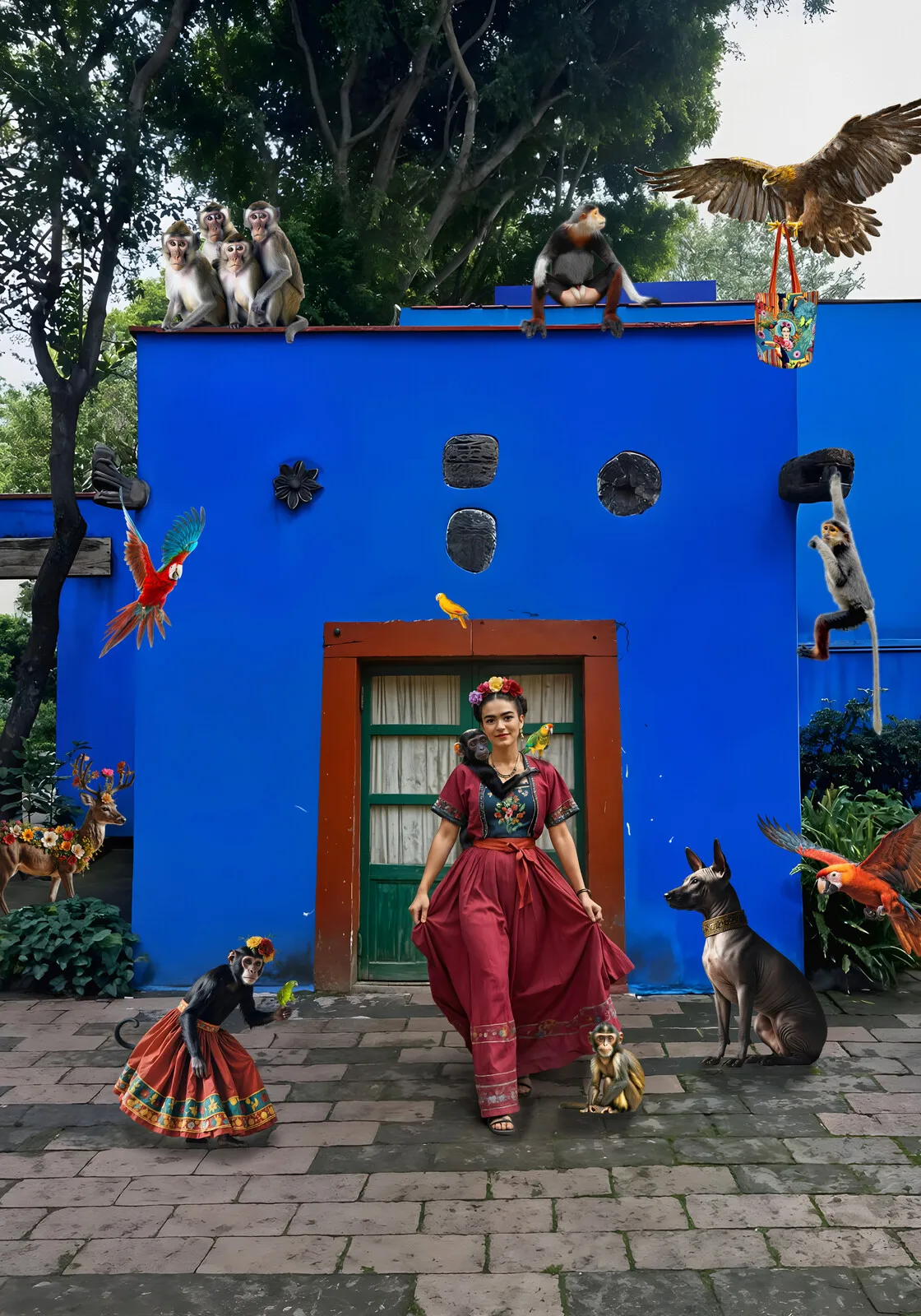
Jörgen Thornberg
Zoo Azul, 2025
Digital
50 x 70 cm
3 200 kr
Zoo Azul
A Mischievous Legacy and a Decisive Stroll
In her dazzling Mexican-inspired attire, Frida Kahlo sat across from me at Konditori Hollandia in Malmö, sipping her coffee latte and recounting tales as vibrant as the flowers in her hair. On her day off from playing Hamlet at Nöjesteatern, she had dressed with a flair that made the café glow with her signature presence.
As our conversation unfolded, Frida told stories of her beloved animals, from the spirited Bonito and Perico to the audacious Fulang Chang. Her laughter echoed in the café as she painted vivid pictures of her spider monkey’s antics—stealing sips of Frida Colada, climbing trees, and even attempting Pollock-inspired art.
"Fulang Chang truly was a rascal," she said, her smile tinged with affection. "But it’s hard to stay mad at someone who could turn chaos into art."
The stories shifted from playful to reflective as Frida mused her connection to her home, Casa Azul, and the animals that filled it with life. She shared memories of Calavera, the Día de los Muertos-inspired dog, and Granizo, the elegant deer who inspired her poignant painting The Wounded Deer.
Her humour never wavered, even as she recounted how Pollock’s critiques had backfired spectacularly once he learned of Fulang Chang’s unintentional forgeries. "A monkey didn’t replicate at least my work," she quipped, leaving the abstract expressionist artist stunned.
Read on to explore Frida's and her pets’ adventures.
‘‘Monkey Drip
Fulang Chang, with mischievous glee,
Eyed Pollock's works in a magazine spree.
"Splashes and drips, a genius, they say,
But I’m a monkey—I'll show them today!"
He grabbed some paints, red, green and blue,
And household buckets with a vibrant hue.
On a canvas flat, he made his stand,
Ready to craft with his eager hand.
He splashed and dripped; he poured and sprayed,
Colours collided, and a dance they played.
With paws and tail, he joined the spree,
Scrubbing and smearing with simian esprit.
A stomp of a foot, a flick of a brush,
Each motion brought chaos, a vibrant rush.
He gnashed his teeth, he let out a cry,
And Pollock’s spirit seemed to sigh.
For patterns emerged, both wild and bright,
A jungle of art, a primal delight.
Circles, lines and swirls, a dripping cascade,
A masterpiece only a monkey could’ve made.
Critics now marvel, and collectors do seek,
The "Monkey Drip Technique" in galleries each week.
With pouring and splashing, experts declared,
That genius is boundless, no matter who dared.
So raise a glass to the simian spark,
A monkey’s joy in creating art.
For Fulang Chang, with a cheeky grin,
Proved greatness lies not in the species but within.
Malmö, January 2025
A Coffee Break with Frida Kahlo
Me: “You didn’t like being alone, did you?” I asked Frida as we sipped our coffee lattes at Konditori Hollandia in central Malmö. She had taken the day off from her performance as Hamlet at Nöjesteatern and had dressed for the occasion in a Mexican-inspired outfit with a beautifully embroidered short jacket.
Frida's warm and inviting smile lit up her face, her vibrant floral crown catching the late morning light. “No, I truly disliked being alone. I always sought human connection and companionship. Though I used my art to process my pain and thoughts, I depended on the company of people, animals, and my surroundings to feel whole.”
Me: “Your relationship with Diego must have been a big part of that.”
Frida: She nodded, a soft chuckle escaping her lips. “Diego was everything—husband, artistic partner, a constant presence in my life. Our relationship was passionate and turbulent, full of love and betrayal. And when that wasn’t enough, I sought comfort in other relationships, both romantic and platonic. Anything to keep the loneliness at bay.”
Me: “That loneliness seems to seep into your art. In so many of your self-portraits, you depict yourself as isolated and vulnerable, surrounded by symbols of your pain and struggles.”
Frida: She leaned back, her fingers tracing the rim of her coffee cup. “That’s true. Those self-portraits were my way of confronting the loneliness I couldn’t always escape. But I also surrounded myself with friends, artists, and intellectuals. Casa Azul was a gathering place for lively debates, parties, and shared creativity. Those moments kept me grounded and less alone.”
Me: “Your family was a constant presence, too, wasn’t it?”
Frida: “Yes, especially my father. He encouraged my artistic ambitions. My relationship with my mother was more complex, but family always provided security and connection.”
Me: “And then there were your animals. They seem to have been your companions when you were bedridden.”
Frida: Her face lit up. “Absolutely! My animals were more than just pets—they were family. I had monkeys, dogs, birds, and even a fawn. Each one had a name and a personality that reflected my values and beliefs.”
Me: “Your collection sounds like a zoo.”
Frida: She laughed heartily. “Diego used to call Casa Azul ‘Zoo Azul.’ I had several spider monkeys, including Fulang Chang, who was a gift from Diego. Another, Caimito de Guayabal, joined later. Guests visiting Casa Azul would be entertained by Fulang Chang or Bonito, my Amazon parrot, performing tricks at the table.”
Me: “And the dogs?”
Frida: “I had a pack of Mexican Xoloitzcuintlis, hairless dogs with Aztec heritage. They were deeply connected to my cultural roots. Señor Xolotl, named after the Aztec god of death and the underworld, was the leader of the pack. Señora, a true diva, appeared in many of my paintings. Then there was Guera Chabela—her name, meaning ‘blonde,’ was an ironic nod to her dark skin. Calavera, another favourite, was named for the sugar skulls of Día de los Muertos, symbolising joy and remembrance.”
Me: “And then there was Granizo, the deer. Was he the inspiration for The Wounded Deer?”
Frida: “Indeed. Granizo, with his gentle nature, became my muse for that painting. Though slightly exaggerated in size, he symbolised my physical and emotional pain. The arrows piercing the deer’s body, the barren forest—they reflected my struggles after a failed spinal surgery. That painting was my way of channelling the agony into something tangible.”
Me: “Despite your pain, you found a way to create such a powerful masterpiece.”
Frida: She smiled wistfully. “Pain is like a brushstroke—unavoidable, but you decide where it lands on the canvas.”
Me: “Your parrots must have been a cheerful counterpoint to the more serious moments in your life.”
Frida's eyes sparkled with amusement as she recounted her parrots' antics. 'Oh, absolutely. Bonito and Perico were my little comedians. Bonito loved fruit, especially mangoes and papayas, and he’d get so excited when I peeled an orange—he couldn’t resist the scent. On the other hand, Perico was all about vegetables, with a special fondness for corn. He’d climb up my arm just to nibble on a cob.'
Me: “They sound like they brought much joy into your life.”
Frida: “They did. They were part of the vibrant tapestry of Casa Azul. Their antics, colours, and personalities kept me smiling, even on the hardest days.”
As our conversation wound down, Frida glanced out the window at the bustling streets of Malmö. The rich aroma of coffee lingered in the air, blending with the warmth of her laughter.
Me: “Thank you for sharing all of this, Frida. It’s incredible to hear these stories from you.”
Frida reached across the table, her hand resting lightly on mine. “Thank you for listening, mi amiga. Stories like these keep my world alive, even far from Casa Azul.”
We raised our coffee cups in a toast, and for a moment, the lively streets outside faded away, leaving only the shared warmth of our connection.
Me: “You and your parrots shared a love for nuts and seeds, didn’t you?”
Frida smiled warmly, stirring the foam on her latte with a delicate spoon. “Oh, yes, they adored almonds and sunflower seeds. Bonito was always so elegant and methodical when eating his nuts, while Perico…” She chuckled, shaking her head. “Perico was the glutton. He’d try to eat everything at once, stuffing his little beak as if there were no tomorrow. I often had to limit him to keep him from getting too plump.”
Me: “Did you ever share your meals with them?”
Frida: “Sometimes,” she admitted, leaning back in her chair. “Small pieces of tortilla, rice, or boiled beans—they loved it. Watching them figure out how to hold and eat treats was like seeing children with toys. But I was careful to give them small portions—they were parrots, not people, after all.”
She paused, a soft laugh escaping her lips. “And water! They always had fresh water, but they preferred fruit juice. Bonito would take delicate little sips, while Perico, the rascal, always had juice dripping from his beak. He never could keep himself clean!”
Me: “They must have brought so much joy to your life.”
Frida: Her eyes softened, and she nodded. “They filled my home with life. Bonito often perched on my finger while I painted, and Perico would squawk and try to mimic my voice from his cage. They reminded me that nature was always close, even when I was confined to my bed. Parrots are extraordinary creatures—intelligent, affectionate, and full of personality. I miss them sometimes.”
Me: “Did any of your parrots ever try your Frida Colada?”
Frida: She laughed heartily, her shoulders shaking with amusement. “Ah, Perico tried! He was always curious about whatever I had in my glass, especially if it looked colourful or smelled intriguing. Once, he managed to dip his beak into my Frida Colada when I wasn’t looking. But the poor thing immediately sneezed and shook his head, clearly regretting it. Perhaps the coconut milk or the rum didn’t sit well with him.”
She took a sip of her latte, her eyes sparkling with mischief. “Bonito, on the other hand, was much more disciplined. He never cared for human drinks. But if I placed a slice of mango or pineapple beside me while enjoying my Frida Colada, he’d swoop down to taste it. I used to joke that he wanted his own version—a Bonito Colada, perhaps?”
She leaned forward with a playful grin. “But no, I never let my beloved parrots taste anything bad for them. They had tropical fruits and nuts, making them as happy as I was with my drink.” She raised her cup in a symbolic toast. “So, no rum for the parrots—but we always shared the moment's joy.”
Me: “Which of your animals would have been most likely to sneak a sip of your drink? What about your dogs, monkeys, or deer—were they all teetotalers?”
Frida: She laughed, her vibrant floral crown bobbing slightly. “Oh, if any of them had tried, it would’ve been one of my monkeys. Fulang Chang, my mischievous spider monkey, was always up to something. I remember turning my back for a moment to fetch a brush, only to find him dipping his fingers into my glass when I turned around! He had such a cheeky look on his face, and I know he loved the scent of pineapple and coconut.”
Leaning back, she continued, “My dogs, though, were too dignified for such antics. Xoloitzcuintlis are not like other dogs—they’re calm, almost philosophical. They wouldn’t bother with a drink unless it smelled like something edible. But they were always there, faithfully by my side, whether I was painting or relaxing in the garden.”
Me: “And Granizo, your deer? Here in Sweden, there was a story about a drunken herd of elk that surrounded an old people’s home after gorging on fermented apples. Armed police had to shoo them away! Do you think Granizo might have been tempted by something like that?”
Frida: She laughed, waving her hand in mock dismissal. “No, Granizo was far too delicate and graceful for such escapades. He stuck to his favourite vegetables and flowers in the garden. He wouldn't have cared if I’d offered him a piece of pineapple. He was like a poet, moving through nature with elegance and peace.”
Me: “But your parrots—I wouldn’t be so sure about their sobriety. Here in Skåne, we have sayings like ‘full som en alika’ (drunk as a jackdaw) and ‘fyllekaja’ (drunken magpie), based on stories of birds getting intoxicated on brewery byproducts. Some say they’d gorge themselves on mash and stagger like proper drunks.”
Frida: She burst into laughter, nearly spilling her coffee. “Ah, my parrots were mischievous, but I don’t think they ever got truly drunk! Though Perico had the spirit of a little troublemaker, he always poked his beak where it didn’t belong. Perhaps in another life, he might’ve been a fyllekaja!”
She raised her cup in mock solemnity, her eyes glinting with humour. “To Perico and Bonito—partners in crime and bringers of endless joy. Salud!”
Me: “Frida, you hinted earlier that Fulang Chang might have been the one most likely to sneak a sip of your Frida Colada. I can't stop thinking about how mischievous he must have been.”
Frida: She leaned forward, her eyes glinting with humour. “Oh, he was incorrigible! Fulang Chang had the perfect mix of charm and mischief—always curious, always finding ways to push boundaries. Diego used to joke that we were two peas in a pod, endlessly drawn to adventure.”
Me: “Did he ever manage to cause real trouble?”
Frida: She released a theatrical sigh, covering her face with her hands as if reliving a moment of exasperation. “Oh, let me tell you. Once, during a garden party at Casa Azul, I set my Frida Colada on the table for a moment. Before I could blink, Fulang Chang had snatched the glass with his long, nimble fingers. And not just to inspect it—no, he drank it! His eyes sparkled as if he’d discovered heaven in liquid form.”
Me: “What happened next? Did he get tipsy?”
Frida: She laughed, the sound rich and infectious. “Oh, he didn’t just get tipsy; he became the life of the party. He climbed into the trees, swinging around and screeching like performing for an audience. My guests were in tears laughing, but I was terrified he might fall. Thankfully, he tired himself out and fell asleep in the branches before anything could happen.”
Me: “So he didn’t exactly paint himself as a responsible drinker.”
Frida: “Not at all,” she said, shaking her head. “And that wasn’t even the end of it. Another time, in a drunken haze, he got hold of my brushes and started splattering paint on a blank canvas I’d left out. It was chaos—splashes of colour everywhere. But you know, in its wild way, it was almost beautiful. I spent hours cleaning up, though.”
Me: “A true Boozy monkey,” I said, laughing.
Frida: “Exactly! Maybe even a ‘Sot monkey’, a real plastered primate,” she exclaimed, clinking her coffee cup against mine. “From that day on, I learned to keep my drinks far out of his reach. But oh, the charm he had! It’s hard to stay mad at someone who could turn every day into an adventure.”
Me: “Did Fulang Chang express his artistic side again, or was that a one-time experiment?”
Frida: She tilted her head with a playful smirk. “Oh, he expressed it, all right. But it wasn’t entirely innocent. After flipping through some art magazines I’d left in the studio, he started mimicking the' drip technique'. I didn’t pay much attention—I was too focused on my work—but images of Jackson Pollock’s paintings indeed inspired him.”
Me: “Wait—you’re telling me your monkey replicated Pollock?”
Frida: “He did,” she said, laughing at the absurdity of it all. “And not just replicated—sometimes he surpassed him. Fulang Chang’s pieces were wild, vibrant, and full of energy. But of course, I didn’t appreciate them at the time. I couldn’t stand Pollock’s work, so I threw the monkey’s paintings into the trash.”
Me: “You’re joking.”
Frida: “I wish I were,” she said, her voice tinged with mock regret. “Some garbage collector must have seen them and thought they were experimental Frida Kahlos. They ended up in a shady gallery in downtown Mexico City, where a clever dealer forged Pollock’s signature on them. Can you imagine? Fulang Chang’s work is now hanging in museums and private collections as authentic Pollocks.”
Me: “That’s outrageous! Pollock was one of the most forged artists of all time.”
Frida: “Oh, I know. Diego once told me about the controversy, laughing at the idea that someone might have forged Pollock’s work. He didn’t like Pollock either. But when he described the paintings, I immediately knew they were Fulang Chang’s. From that day forward, the little rascal was banned from my studio—and we kept a close eye on our drinks.”
Me: “And yet Pollock is revered today. Have you ever crossed paths with him up there?”
Frida: “Oh, yes,” she said, her voice dropping to a conspiratorial tone. “We met at a universal art biennial near the North Star. Pollock dared to comment on my work, calling it an ‘unending lament.’ He even joked that viewing my paintings was like enduring a trinity of misery—waiting for oil paint to dry, staring at one of my pieces, and listening to Leonard Cohen.”
Me: “That’s awful!”
Frida: “It was,” she said, her lips curling into a sly smile. “But I had my revenge. I told him my paintings, at least, couldn’t be replicated by monkeys. He turned red as a chili pepper when I explained the Fulang Chang story. Since then, he’s kept his opinions to himself.”
As Frida finished her coffee, she glanced at the time and adjusted the embroidered shawl draped over her shoulders. “I think it’s time for me to head to Hansakompagniet,” she said. “I’m not much of a shopaholic, but you never know. If I see something that catches my eye, I don’t waste time deciding.”
I smiled, picturing her walking through the bustling mall, her vibrant, Mexican-inspired outfit standing out among the crowd. “I can’t imagine anyone more decisive, Frida.”
She stood, her earrings glinting in the café’s warm light, and extended a hand to me. “Thank you for the company—and the conversation. It’s always good to reminisce, especially when the stories are as colourful as Fulang Chang’s escapades.”
With a final wave, she disappeared into the Malmö streets, her presence lingering like a vivid brushstroke on a canvas.
Zoo Azul, also known as the Blue House (La Casa Azul), is now an art museum dedicated to the life and work of Frida Kahlo. It is located in the Colonia del Carmen neighbourhood of Coyoacán in Mexico City. This building was not only Kahlo’s birthplace but also the home where she grew up and lived with her husband, Diego Rivera, for several years. Frida ultimately passed away in an upstairs room. In 1957, Rivera donated the house and its contents to transform it into a museum in her honour.
All the animals are gone now, except in the remaining paintings and photographs. The once-lively house, filled with fluttering wings, snuffling, rooting, barking dogs, and chattering monkeys—a cacophony of life—has fallen silent and empty. That is, until it opens daily to hordes of tourists, bringing a different soundtrack: shuffling feet, murmurs, and aimless chatter.
The museum features artwork by Frida, her husband, Diego Rivera, and other artists, as well as Mexican folk art, pre-Hispanic artefacts, photographs, memorabilia, and personal items from their lives. The collection is exhibited in the house’s rooms, which remain essentially unchanged from the 1950s when Frida departed for her star. Initially, the house served as Frida Kahlo’s family home.
Casa Azul is located in the Colonia del Carmen area of the Coyoacán borough in Mexico City. Since the 1920s, this area has been known for its intellectual and avant-garde reputation. The house is distinguished by its cobalt-blue walls, which give it its name: La Casa Azul (The Blue House).
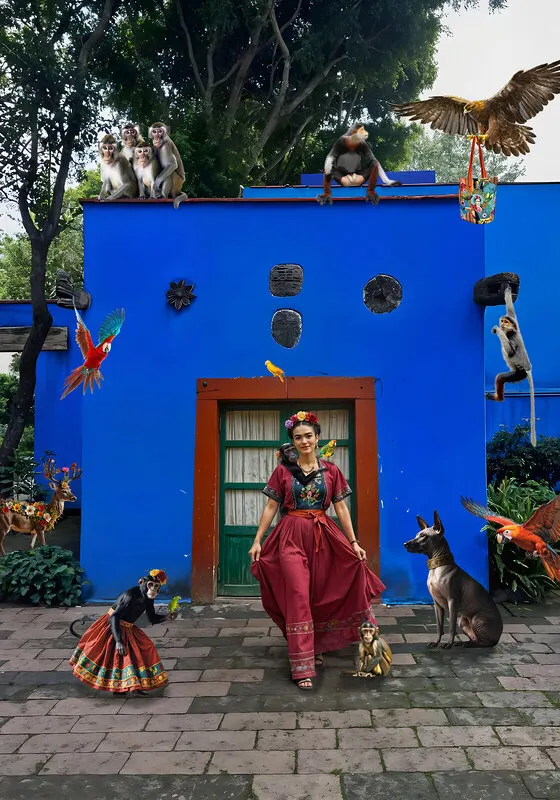
Jörgen Thornberg
Zoo Azul, 2025
Digital
50 x 70 cm
3 200 kr
Zoo Azul
A Mischievous Legacy and a Decisive Stroll
In her dazzling Mexican-inspired attire, Frida Kahlo sat across from me at Konditori Hollandia in Malmö, sipping her coffee latte and recounting tales as vibrant as the flowers in her hair. On her day off from playing Hamlet at Nöjesteatern, she had dressed with a flair that made the café glow with her signature presence.
As our conversation unfolded, Frida told stories of her beloved animals, from the spirited Bonito and Perico to the audacious Fulang Chang. Her laughter echoed in the café as she painted vivid pictures of her spider monkey’s antics—stealing sips of Frida Colada, climbing trees, and even attempting Pollock-inspired art.
"Fulang Chang truly was a rascal," she said, her smile tinged with affection. "But it’s hard to stay mad at someone who could turn chaos into art."
The stories shifted from playful to reflective as Frida mused her connection to her home, Casa Azul, and the animals that filled it with life. She shared memories of Calavera, the Día de los Muertos-inspired dog, and Granizo, the elegant deer who inspired her poignant painting The Wounded Deer.
Her humour never wavered, even as she recounted how Pollock’s critiques had backfired spectacularly once he learned of Fulang Chang’s unintentional forgeries. "A monkey didn’t replicate at least my work," she quipped, leaving the abstract expressionist artist stunned.
Read on to explore Frida's and her pets’ adventures.
‘‘Monkey Drip
Fulang Chang, with mischievous glee,
Eyed Pollock's works in a magazine spree.
"Splashes and drips, a genius, they say,
But I’m a monkey—I'll show them today!"
He grabbed some paints, red, green and blue,
And household buckets with a vibrant hue.
On a canvas flat, he made his stand,
Ready to craft with his eager hand.
He splashed and dripped; he poured and sprayed,
Colours collided, and a dance they played.
With paws and tail, he joined the spree,
Scrubbing and smearing with simian esprit.
A stomp of a foot, a flick of a brush,
Each motion brought chaos, a vibrant rush.
He gnashed his teeth, he let out a cry,
And Pollock’s spirit seemed to sigh.
For patterns emerged, both wild and bright,
A jungle of art, a primal delight.
Circles, lines and swirls, a dripping cascade,
A masterpiece only a monkey could’ve made.
Critics now marvel, and collectors do seek,
The "Monkey Drip Technique" in galleries each week.
With pouring and splashing, experts declared,
That genius is boundless, no matter who dared.
So raise a glass to the simian spark,
A monkey’s joy in creating art.
For Fulang Chang, with a cheeky grin,
Proved greatness lies not in the species but within.
Malmö, January 2025
A Coffee Break with Frida Kahlo
Me: “You didn’t like being alone, did you?” I asked Frida as we sipped our coffee lattes at Konditori Hollandia in central Malmö. She had taken the day off from her performance as Hamlet at Nöjesteatern and had dressed for the occasion in a Mexican-inspired outfit with a beautifully embroidered short jacket.
Frida's warm and inviting smile lit up her face, her vibrant floral crown catching the late morning light. “No, I truly disliked being alone. I always sought human connection and companionship. Though I used my art to process my pain and thoughts, I depended on the company of people, animals, and my surroundings to feel whole.”
Me: “Your relationship with Diego must have been a big part of that.”
Frida: She nodded, a soft chuckle escaping her lips. “Diego was everything—husband, artistic partner, a constant presence in my life. Our relationship was passionate and turbulent, full of love and betrayal. And when that wasn’t enough, I sought comfort in other relationships, both romantic and platonic. Anything to keep the loneliness at bay.”
Me: “That loneliness seems to seep into your art. In so many of your self-portraits, you depict yourself as isolated and vulnerable, surrounded by symbols of your pain and struggles.”
Frida: She leaned back, her fingers tracing the rim of her coffee cup. “That’s true. Those self-portraits were my way of confronting the loneliness I couldn’t always escape. But I also surrounded myself with friends, artists, and intellectuals. Casa Azul was a gathering place for lively debates, parties, and shared creativity. Those moments kept me grounded and less alone.”
Me: “Your family was a constant presence, too, wasn’t it?”
Frida: “Yes, especially my father. He encouraged my artistic ambitions. My relationship with my mother was more complex, but family always provided security and connection.”
Me: “And then there were your animals. They seem to have been your companions when you were bedridden.”
Frida: Her face lit up. “Absolutely! My animals were more than just pets—they were family. I had monkeys, dogs, birds, and even a fawn. Each one had a name and a personality that reflected my values and beliefs.”
Me: “Your collection sounds like a zoo.”
Frida: She laughed heartily. “Diego used to call Casa Azul ‘Zoo Azul.’ I had several spider monkeys, including Fulang Chang, who was a gift from Diego. Another, Caimito de Guayabal, joined later. Guests visiting Casa Azul would be entertained by Fulang Chang or Bonito, my Amazon parrot, performing tricks at the table.”
Me: “And the dogs?”
Frida: “I had a pack of Mexican Xoloitzcuintlis, hairless dogs with Aztec heritage. They were deeply connected to my cultural roots. Señor Xolotl, named after the Aztec god of death and the underworld, was the leader of the pack. Señora, a true diva, appeared in many of my paintings. Then there was Guera Chabela—her name, meaning ‘blonde,’ was an ironic nod to her dark skin. Calavera, another favourite, was named for the sugar skulls of Día de los Muertos, symbolising joy and remembrance.”
Me: “And then there was Granizo, the deer. Was he the inspiration for The Wounded Deer?”
Frida: “Indeed. Granizo, with his gentle nature, became my muse for that painting. Though slightly exaggerated in size, he symbolised my physical and emotional pain. The arrows piercing the deer’s body, the barren forest—they reflected my struggles after a failed spinal surgery. That painting was my way of channelling the agony into something tangible.”
Me: “Despite your pain, you found a way to create such a powerful masterpiece.”
Frida: She smiled wistfully. “Pain is like a brushstroke—unavoidable, but you decide where it lands on the canvas.”
Me: “Your parrots must have been a cheerful counterpoint to the more serious moments in your life.”
Frida's eyes sparkled with amusement as she recounted her parrots' antics. 'Oh, absolutely. Bonito and Perico were my little comedians. Bonito loved fruit, especially mangoes and papayas, and he’d get so excited when I peeled an orange—he couldn’t resist the scent. On the other hand, Perico was all about vegetables, with a special fondness for corn. He’d climb up my arm just to nibble on a cob.'
Me: “They sound like they brought much joy into your life.”
Frida: “They did. They were part of the vibrant tapestry of Casa Azul. Their antics, colours, and personalities kept me smiling, even on the hardest days.”
As our conversation wound down, Frida glanced out the window at the bustling streets of Malmö. The rich aroma of coffee lingered in the air, blending with the warmth of her laughter.
Me: “Thank you for sharing all of this, Frida. It’s incredible to hear these stories from you.”
Frida reached across the table, her hand resting lightly on mine. “Thank you for listening, mi amiga. Stories like these keep my world alive, even far from Casa Azul.”
We raised our coffee cups in a toast, and for a moment, the lively streets outside faded away, leaving only the shared warmth of our connection.
Me: “You and your parrots shared a love for nuts and seeds, didn’t you?”
Frida smiled warmly, stirring the foam on her latte with a delicate spoon. “Oh, yes, they adored almonds and sunflower seeds. Bonito was always so elegant and methodical when eating his nuts, while Perico…” She chuckled, shaking her head. “Perico was the glutton. He’d try to eat everything at once, stuffing his little beak as if there were no tomorrow. I often had to limit him to keep him from getting too plump.”
Me: “Did you ever share your meals with them?”
Frida: “Sometimes,” she admitted, leaning back in her chair. “Small pieces of tortilla, rice, or boiled beans—they loved it. Watching them figure out how to hold and eat treats was like seeing children with toys. But I was careful to give them small portions—they were parrots, not people, after all.”
She paused, a soft laugh escaping her lips. “And water! They always had fresh water, but they preferred fruit juice. Bonito would take delicate little sips, while Perico, the rascal, always had juice dripping from his beak. He never could keep himself clean!”
Me: “They must have brought so much joy to your life.”
Frida: Her eyes softened, and she nodded. “They filled my home with life. Bonito often perched on my finger while I painted, and Perico would squawk and try to mimic my voice from his cage. They reminded me that nature was always close, even when I was confined to my bed. Parrots are extraordinary creatures—intelligent, affectionate, and full of personality. I miss them sometimes.”
Me: “Did any of your parrots ever try your Frida Colada?”
Frida: She laughed heartily, her shoulders shaking with amusement. “Ah, Perico tried! He was always curious about whatever I had in my glass, especially if it looked colourful or smelled intriguing. Once, he managed to dip his beak into my Frida Colada when I wasn’t looking. But the poor thing immediately sneezed and shook his head, clearly regretting it. Perhaps the coconut milk or the rum didn’t sit well with him.”
She took a sip of her latte, her eyes sparkling with mischief. “Bonito, on the other hand, was much more disciplined. He never cared for human drinks. But if I placed a slice of mango or pineapple beside me while enjoying my Frida Colada, he’d swoop down to taste it. I used to joke that he wanted his own version—a Bonito Colada, perhaps?”
She leaned forward with a playful grin. “But no, I never let my beloved parrots taste anything bad for them. They had tropical fruits and nuts, making them as happy as I was with my drink.” She raised her cup in a symbolic toast. “So, no rum for the parrots—but we always shared the moment's joy.”
Me: “Which of your animals would have been most likely to sneak a sip of your drink? What about your dogs, monkeys, or deer—were they all teetotalers?”
Frida: She laughed, her vibrant floral crown bobbing slightly. “Oh, if any of them had tried, it would’ve been one of my monkeys. Fulang Chang, my mischievous spider monkey, was always up to something. I remember turning my back for a moment to fetch a brush, only to find him dipping his fingers into my glass when I turned around! He had such a cheeky look on his face, and I know he loved the scent of pineapple and coconut.”
Leaning back, she continued, “My dogs, though, were too dignified for such antics. Xoloitzcuintlis are not like other dogs—they’re calm, almost philosophical. They wouldn’t bother with a drink unless it smelled like something edible. But they were always there, faithfully by my side, whether I was painting or relaxing in the garden.”
Me: “And Granizo, your deer? Here in Sweden, there was a story about a drunken herd of elk that surrounded an old people’s home after gorging on fermented apples. Armed police had to shoo them away! Do you think Granizo might have been tempted by something like that?”
Frida: She laughed, waving her hand in mock dismissal. “No, Granizo was far too delicate and graceful for such escapades. He stuck to his favourite vegetables and flowers in the garden. He wouldn't have cared if I’d offered him a piece of pineapple. He was like a poet, moving through nature with elegance and peace.”
Me: “But your parrots—I wouldn’t be so sure about their sobriety. Here in Skåne, we have sayings like ‘full som en alika’ (drunk as a jackdaw) and ‘fyllekaja’ (drunken magpie), based on stories of birds getting intoxicated on brewery byproducts. Some say they’d gorge themselves on mash and stagger like proper drunks.”
Frida: She burst into laughter, nearly spilling her coffee. “Ah, my parrots were mischievous, but I don’t think they ever got truly drunk! Though Perico had the spirit of a little troublemaker, he always poked his beak where it didn’t belong. Perhaps in another life, he might’ve been a fyllekaja!”
She raised her cup in mock solemnity, her eyes glinting with humour. “To Perico and Bonito—partners in crime and bringers of endless joy. Salud!”
Me: “Frida, you hinted earlier that Fulang Chang might have been the one most likely to sneak a sip of your Frida Colada. I can't stop thinking about how mischievous he must have been.”
Frida: She leaned forward, her eyes glinting with humour. “Oh, he was incorrigible! Fulang Chang had the perfect mix of charm and mischief—always curious, always finding ways to push boundaries. Diego used to joke that we were two peas in a pod, endlessly drawn to adventure.”
Me: “Did he ever manage to cause real trouble?”
Frida: She released a theatrical sigh, covering her face with her hands as if reliving a moment of exasperation. “Oh, let me tell you. Once, during a garden party at Casa Azul, I set my Frida Colada on the table for a moment. Before I could blink, Fulang Chang had snatched the glass with his long, nimble fingers. And not just to inspect it—no, he drank it! His eyes sparkled as if he’d discovered heaven in liquid form.”
Me: “What happened next? Did he get tipsy?”
Frida: She laughed, the sound rich and infectious. “Oh, he didn’t just get tipsy; he became the life of the party. He climbed into the trees, swinging around and screeching like performing for an audience. My guests were in tears laughing, but I was terrified he might fall. Thankfully, he tired himself out and fell asleep in the branches before anything could happen.”
Me: “So he didn’t exactly paint himself as a responsible drinker.”
Frida: “Not at all,” she said, shaking her head. “And that wasn’t even the end of it. Another time, in a drunken haze, he got hold of my brushes and started splattering paint on a blank canvas I’d left out. It was chaos—splashes of colour everywhere. But you know, in its wild way, it was almost beautiful. I spent hours cleaning up, though.”
Me: “A true Boozy monkey,” I said, laughing.
Frida: “Exactly! Maybe even a ‘Sot monkey’, a real plastered primate,” she exclaimed, clinking her coffee cup against mine. “From that day on, I learned to keep my drinks far out of his reach. But oh, the charm he had! It’s hard to stay mad at someone who could turn every day into an adventure.”
Me: “Did Fulang Chang express his artistic side again, or was that a one-time experiment?”
Frida: She tilted her head with a playful smirk. “Oh, he expressed it, all right. But it wasn’t entirely innocent. After flipping through some art magazines I’d left in the studio, he started mimicking the' drip technique'. I didn’t pay much attention—I was too focused on my work—but images of Jackson Pollock’s paintings indeed inspired him.”
Me: “Wait—you’re telling me your monkey replicated Pollock?”
Frida: “He did,” she said, laughing at the absurdity of it all. “And not just replicated—sometimes he surpassed him. Fulang Chang’s pieces were wild, vibrant, and full of energy. But of course, I didn’t appreciate them at the time. I couldn’t stand Pollock’s work, so I threw the monkey’s paintings into the trash.”
Me: “You’re joking.”
Frida: “I wish I were,” she said, her voice tinged with mock regret. “Some garbage collector must have seen them and thought they were experimental Frida Kahlos. They ended up in a shady gallery in downtown Mexico City, where a clever dealer forged Pollock’s signature on them. Can you imagine? Fulang Chang’s work is now hanging in museums and private collections as authentic Pollocks.”
Me: “That’s outrageous! Pollock was one of the most forged artists of all time.”
Frida: “Oh, I know. Diego once told me about the controversy, laughing at the idea that someone might have forged Pollock’s work. He didn’t like Pollock either. But when he described the paintings, I immediately knew they were Fulang Chang’s. From that day forward, the little rascal was banned from my studio—and we kept a close eye on our drinks.”
Me: “And yet Pollock is revered today. Have you ever crossed paths with him up there?”
Frida: “Oh, yes,” she said, her voice dropping to a conspiratorial tone. “We met at a universal art biennial near the North Star. Pollock dared to comment on my work, calling it an ‘unending lament.’ He even joked that viewing my paintings was like enduring a trinity of misery—waiting for oil paint to dry, staring at one of my pieces, and listening to Leonard Cohen.”
Me: “That’s awful!”
Frida: “It was,” she said, her lips curling into a sly smile. “But I had my revenge. I told him my paintings, at least, couldn’t be replicated by monkeys. He turned red as a chili pepper when I explained the Fulang Chang story. Since then, he’s kept his opinions to himself.”
As Frida finished her coffee, she glanced at the time and adjusted the embroidered shawl draped over her shoulders. “I think it’s time for me to head to Hansakompagniet,” she said. “I’m not much of a shopaholic, but you never know. If I see something that catches my eye, I don’t waste time deciding.”
I smiled, picturing her walking through the bustling mall, her vibrant, Mexican-inspired outfit standing out among the crowd. “I can’t imagine anyone more decisive, Frida.”
She stood, her earrings glinting in the café’s warm light, and extended a hand to me. “Thank you for the company—and the conversation. It’s always good to reminisce, especially when the stories are as colourful as Fulang Chang’s escapades.”
With a final wave, she disappeared into the Malmö streets, her presence lingering like a vivid brushstroke on a canvas.
Zoo Azul, also known as the Blue House (La Casa Azul), is now an art museum dedicated to the life and work of Frida Kahlo. It is located in the Colonia del Carmen neighbourhood of Coyoacán in Mexico City. This building was not only Kahlo’s birthplace but also the home where she grew up and lived with her husband, Diego Rivera, for several years. Frida ultimately passed away in an upstairs room. In 1957, Rivera donated the house and its contents to transform it into a museum in her honour.
All the animals are gone now, except in the remaining paintings and photographs. The once-lively house, filled with fluttering wings, snuffling, rooting, barking dogs, and chattering monkeys—a cacophony of life—has fallen silent and empty. That is, until it opens daily to hordes of tourists, bringing a different soundtrack: shuffling feet, murmurs, and aimless chatter.
The museum features artwork by Frida, her husband, Diego Rivera, and other artists, as well as Mexican folk art, pre-Hispanic artefacts, photographs, memorabilia, and personal items from their lives. The collection is exhibited in the house’s rooms, which remain essentially unchanged from the 1950s when Frida departed for her star. Initially, the house served as Frida Kahlo’s family home.
Casa Azul is located in the Colonia del Carmen area of the Coyoacán borough in Mexico City. Since the 1920s, this area has been known for its intellectual and avant-garde reputation. The house is distinguished by its cobalt-blue walls, which give it its name: La Casa Azul (The Blue House).
3 200 kr

Jörgen Thornberg
Malmö
Lite om bilder och mig. Translation in English at the end.
Jag är en nyfiken person som ser allt i bilder, även det jag fäster i ord, gärna tillsammans för bakom alla mina bilder finns en berättelse. Till vissa bilder hör en kortare eller längre novell som följer med bilden.
Bilder berättar historier. Jag omges av naturlig skönhet, intressanta människor och historia var jag än går. Jag använder min kamera för att dokumentera världen och blanda det jag ser med vad jag känner för att fånga den dolda magin.
Mina bilder berättar mina historier. Genom mina bilder, tryck och berättelser. Jag bjuder in dig att ta del av dessa berättelser, in i ditt liv och hem och dela min mycket personliga syn på vår värld. Mer än vad ögat ser. Jag tänker i bilder, drömmer och skriver och pratar om dem; följaktligen måste jag också skapa bilder. De blir vad jag ser, inte nödvändigtvis begränsade till verkligheten. Det finns en bild runt varje hörn. Jag hoppas att du kommer att se vad jag såg och gilla det.
Jag är också en skrivande person och till många bilder hör en kortare eller längre essay. Den följer med tavlan, tryckt på fint papper och med en personlig hälsning från mig.
Flertalet bilder startar sin resa i min kamera. Enkelt förklarat beskriver jag bilden jag ser i mitt inre, upplevd eller fantiserad. Bilden uppstår inom mig redan innan jag fått okularet till ögat. På bråkdelen av ett ögonblick ser jag vad jag vill ha och vad som kan göras med bilden. Här skall jag stoppa in en giraff, stålmannen, Titanic eller vad det är min fantasi finner ut. Ännu märkligare är att jag kommer ihåg minnesbilden långt efteråt när det blir tid att skapa verket. Om jag lyckas eller inte, är upp till betraktaren, oftast präglat av en stråk av svart humor – meningen är att man skall bli underhållen. Mina bilder blir ofta en snackis där de hänger.
Jag föredrar bilder som förmedlar ett budskap i flera lager. Vid första anblicken fylld av feel-good, en vacker utsikt, fint väder, solen skiner, blommor på ängen eller vattnet som ligger förrädiskt spegelblankt. I en sådan bild kan jag gömma min egentliga berättelse, mitt förakt för förtryckare och våldsverkare, rasister och fördomsfulla människor - ett gärna återkommande motiv mer eller mindre dolt i det vackra motivet. Jag försöker förena dem i ett gemensamt narrativ.
Bild och formgivning har löpt som en röd tråd genom livet. Fotokonst känns som en värdig final som jag gärna delar med mig.
Min genre är vid som framgår av mina bilder, temat en blandning av pop- och gatukonst i kollage som kan bestå av hundratals lager. Vissa bilder kan ta veckor, andra någon dag innan det är dags att överlämna resultatet till printverkstaden. Fine Art Prints är digitala fotocollage. I dessa kollage sker rivandet, klippandet, pusslandet, målandet, ritandet och sprayningen digitalt. Det jag monterar in kan vara hundratals år gamla bilder som jag omsorgsfullt frilägger så att de ser ut att vara en del av tavlan men också bilder skapade av mig själv efter min egen fantasi. Därefter besöks printstudion och för vissa bilder numrera en limiterad upplaga (oftast 7 exemplar) och signera för hand. Vissa bilder kan köpas i olika format. Det är bara att fråga efter vilka. Gillar man en bild som är 70x100 men inte har plats på väggen, går den kanske att få i 50x70 cm istället. Frågan är fri.
Metoden Giclée eller Fine Art Print som det också kallas är det moderna sättet för framställning av grafisk konst. Villkoret för denna typ av utskrifter är att en högkvalitativ storformatskrivare används med åldersbeständigt färgpigment och konstnärspapper eller i förekommande fall på duk. Pappret som används möter de krav på livslängd som ställs av museer och gallerier. Normalt säljer jag mina bilder oinramade så att den nya ägaren själv kan bestämma hur de skall se ut, med eller utan passepartout färg på ram, med eller utan glas etc..
Under många år ställde jag bara ut på nätet, i valda grupper och på min egen Facebooksida - https://www.facebook.com/jorgen.thornberg.9
Jag finns också på en egen hemsida som tyvärr inte alltid är uppdaterad – https://www.jth.life/ Där kan du också läsa en del av de berättelser som följer med bilden.
UTSTÄLLNINGAR
Luftkastellet, oktober 2022
Konst i Lund, november 2022
Luftkastellet, mars 2023
Engleson Galleri Caroli, april 2023
Hydra, Greece June 2023
Engleson Galleri Caroli, oktober 2023
Toppen, Höllviken december 2023
Luftkastellet, mars 2024
Torups Galleri, mars 2024
Venice, May 2024
Luftkastellet, oktober 2024
Konst i Advent, December 2024
Galleri Engleson, Caroli December 2024
Jäger & Jansson Galleri, april 2025
A bit about pictures and me.
I'm a curious person who sees everything in pictures, even what I express in words, often combining them, for behind all my pictures lies a story. These narratives, some as short as a single image and others as long as a novel, are the heart and soul of my work.
Pictures tell stories. Wherever I go, I'm surrounded by natural beauty, exciting people, and history. I use my camera to document the world and blend what I see with what I feel to capture the hidden magic.
My images tell my stories. Through my pictures, prints, and narratives, I invite you to partake in these stories in your life and home and share my deeply personal perspective of our world. More than meets the eye. I think in pictures, dream, write, and talk about them; consequently, I must create images too. They become what I see, not necessarily confined to reality. There's a picture around every corner. I hope you'll see what I saw and enjoy it.
I'm also a writer, and many images come with a shorter or longer essay. It accompanies the painting, printed on fine paper with my personal greeting.
Many pictures start their journey on my camera. Simply put, I describe the image I see in my mind, experienced or imagined. The image arises within me even before I bring the eyepiece to my eye. In a fraction of a moment, I see what I want and what can be done with the picture. Here, I'll insert a giraffe, Superman, the Titanic, or whatever my imagination conjures up. Even stranger is that I remember the mental image long after it's time to create the work. Whether I succeed is up to the observer, often imbued with a streak of black humour – the aim is to entertain. My pictures usually become a talking point wherever they hang.
I prefer pictures that convey a message in multiple layers. At first glance, they're filled with feel-good vibes, a beautiful view, lovely weather, the sun shining, flowers in the meadow, or the water lying deceptively calm. But beneath this surface beauty, I often conceal a deeper story, a narrative that challenges societal norms or explores the human condition. I invite you to delve into these hidden narratives and discover the layers of meaning within my work.
Picture and design have been a thread running through my life. Photographic art feels like a fitting finale, and I'm happy to share it.
My genre is varied, as seen in my pictures; the theme is a blend of pop and street art in collages that can consist of hundreds of layers. Some images can take weeks, others just a day before it's time to hand over the result to the print workshop. Fine Art Prints are digital photo collages. In these collages, tearing, cutting, puzzling, painting, drawing, and spraying happen digitally. What I insert can be images hundreds of years old that I carefully extract so they appear to be part of the painting, but also images created by myself, now also generated from my imagination. Next, visit the print studio and, for certain images, number a limited edition (usually 7 copies) and sign them by hand. Some images may be available in other formats. Just ask which ones. If you like an image that's 70x100 but doesn't have space on the wall, you might be able to get it in 50x70 cm instead. The question is open.
The Giclée method, or Fine Art Print as it's also called, is the modern way of producing graphic art. This method ensures the highest quality and longevity of the artwork, using a high-quality large-format printer with archival pigment inks and artist paper or, in some cases, canvas. The paper used meets the longevity requirements set by museums and galleries. I sell my pictures unframed, allowing the new owner to personalise their artwork, confident in the lasting value and quality of the piece.
For many years, I only exhibited online, in selected groups, and on my Facebook page - https://www.facebook.com/jorgen.thornberg.9. I also have my website, which unfortunately is not constantly updated - https://www.jth.life/. You can also read some of the stories accompanying the pictures there.
EXHIBITIONS
Luftkastellet, October 2022
Art in Lund, November 2022
Luftkastellet, March 2023
Engleson Gallery Caroli, April 2023
Hydra, Greece June 2023
Engleson Gallery Caroli, October 2023
Toppen, Höllviken December 2023
Luftkastellet, March 2024
Torup Gallery, March 2024
Venice, May 2024
UTSTÄLLNINGAR
Luftkastellet, oktober 2022
Konst i Lund, november 2022
Luftkastellet, mars 2023
Engleson Galleri Caroli, april 2023
Hydra, Greece June 2023
Engleson Galleri Caroli, oktober 2023
Toppen, Höllviken december 2023
Luftkastellet, mars 2024
Torups Galleri, mars 2024
Venice, May 2024
Luftkastellet, October 2024
Konst i Advent, December 2024
Galleri Engleson, Caroli December 2024
Jäger & Jansson Galleri, April 2025
Utbildning
Autodidakt
Medlem i konstnärsförening
Öppna Sinnen
Med i konstrunda
Konstrundan i Skåne
Utställningar
Luftkastellet, October 2022
Art in Lund, November 2022
Luftkastellet, March 2023
Engleson Gallery Caroli, April 2023
Hydra, Greece June 2023
Engleson Gallery Caroli, October 2023
Toppen, Höllviken December 2023
Luftkastellet, March 2024
Torup Gallery, March 2024
Venice, May 2024