Vi använder cookies för att ge dig bästa möjliga upplevelse. Välj vilka cookies du tillåter.
Läs mer i vår integritetspolicy
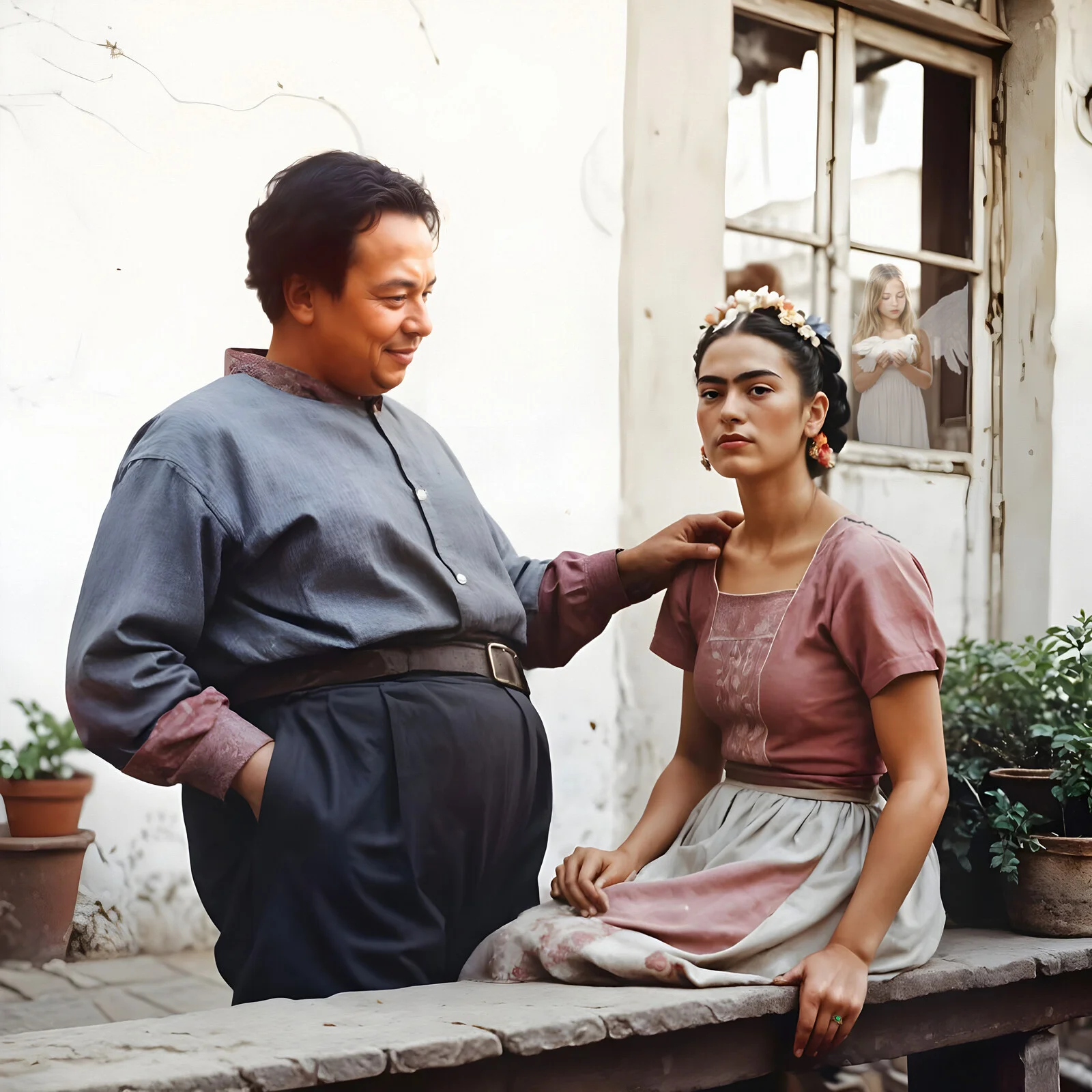
Jörgen Thornberg
Wishful thinking, 2025
Digital
80 x 80 cm
3 200 kr
Wishful thinking
Wishful Thinking
Over a Paloma and a local beer, our conversation wandered from weather and world affairs to the profoundly personal. Intrigued by her painting Wishful Thinking—a seemingly idyllic portrait of her and Diego—I asked about the title. Her response, layered with symbolism and humour, unfolded into a story of love, loss, and Frida's remarkable resilience above all. It was a witness to the vibrant masks we wear to face life’s challenges.
Diego’s literal and figurative size mirrored his immense ambitions and influence. He was a giant in the art world and a central figure in Frida’s life. Rivera sometimes referred to himself as “an elephant” next to Frida, whom he described as “a little dove.” Their physical contrast was striking, which also heightened the dynamic of their relationship. Despite his size and dominance, he was known to admire Frida and occasionally yield to her will and intelligence.
Read on to explore Frida's and Diego’s life together….
‘‘Wishful Thinking
A deceitful photo turned to art.
Its hidden truth refused to part.
For Frida sought no beauty's guise
But glimpses of the veiled and unwise
Beneath the varnish, layers blend,
A harmony we wish would never end.
Yet life, like art, holds truths unseen,
In Sfumato’s haze, lies intervene.
Edges softened, colours fade,
Dreams of balance deftly made.
A tranquil scene, a peaceful guise,
But shadows linger, veiled in lies.
The elephant rests beside the dove,
A paradox of pain and love.
Diego’s mass, Frida’s grace, a fractured whole,
Two bodies bound, yet distant souls.
Through the brush, a fragile truce,
The weight of grief, the threads come loose.
An angel peers through glassy panes,
A childless hope that still remains.
Wishful thinking paints the day,
A fleeting calm, a gentle sway.
But truth, like layers, intertwines,
A dance of sorrow, love, and lines.
So look beyond, not just the hue,
For hidden depths, invite the view.
In varnish, life’s soft edges gleam,
A portrait built on hope and dream.
Malmö, January 2025
Wishful Thinking
The scene was set at Ciao, a cosy restaurant on Friisgatan in Malmö, where Frida Kahlo and I had decided to grab a drink before her evening performance. Frida had a couple of hours to spare and had chosen a Paloma—a classic Mexican cocktail with tequila, grapefruit soda, lime, and a touch of salt. True to my usual preferences, I ordered a glass of fresh local beer.
Our conversation meandered through the predictable topics: the ever-windy weather in Skåne, praise for what deserved recognition, and shared indignation over the day’s unpleasant events. We voiced our support for Ukraine and disdain for Putin and Trump, likening the latter to a cancer on democracy. Though our comments wouldn’t reach the Kremlin or Trump Tower, it felt good to commiserate.
Eventually, I decided to ask Frida about a painting from her retrospective exhibition. The title, Wishful Thinking, intrigued me and contrasted sharply with the painting’s seemingly idyllic subject matter.
Me: “Your painting of you and Diego at the exhibition—you titled it Wishful Thinking. Why that name?” I wiped a bit of foam from my upper lip.
Frida: She leaned back, swirling the salt rim of her glass with a finger before taking a sip. “It has many layers—like the classic works of art where beneath the varnish are strata of transparent colours blending to create depth. Life is like that, a kind of sfumato—a Renaissance technique where everything merges softly, creating a hazy effect. Just as in art, in life, nothing exists in isolation. Everything is interconnected, influenced by layers beneath the surface.”
Me: I nodded, though still slightly mystified. “I see… though I’m not sure I fully grasp it yet. But perhaps more questions will help. Without knowing Diego personally, I’d have felt small in his presence based on your depiction. Did you feel that way?”
Frida: She smiled thoughtfully, tapping her glass with her fingernails. “Yes and no. Physically, we were very different, but I felt like his equal in most other ways. Diego would sometimes call himself ‘the elephant in the room’ and me his ‘little dove.’ Our physical contrast was undeniable, but it also heightened our dynamic. Despite his size and dominant personality, Diego admired me—and at times, he even yielded to my will and sharpness.”
Me: “He was undeniably large… in many ways.”
Frida cut me off with a playful laugh. “Physically, yes—and in his artistic presence, too. Diego was a man of immense charisma, matching his artistic ambition. At 188 cm, he towered over most men of his time. His weight often fluctuated, but he was around 136–140 kilos at his heaviest. And I loved every kilo.”
Me: “Had he been Japanese, he could’ve been a sumo wrestler.”
Frida: She chuckled, her eyes twinkling. “Diego would have loved that! I’ll ask him about it when I’m back on the star. Up there, weight doesn’t matter—there’s no gravity. On Earth, he could’ve crushed me in bed, so more often than not, I’d ride him like an elephant.” She grinned mischievously. “His invitation was always, ‘Would the dove-like to ride the elephant tonight?’ And most often, I did.”
I blushed slightly, focusing on my beer. “I… see.”
Frida: She smirked knowingly. “No, you don’t. But that’s okay. Diego’s physical size increased his commanding presence in social and artistic settings. He occupied space in every sense. But he had a sense of humour about it, which was part of what made me fall for him.”
Me: “Diego was certainly a giant in his artistic expression. His murals are monumental in scale and significance. I’ve seen a few—his works at the Palacio Nacional in Mexico City and the Detroit Institute of Arts are breathtaking.”
Frida: She nodded, her tone softening with pride. “His ambitions were never small, politically or artistically. Diego wanted to change the world. He saw himself as an artist for the people, using his murals to communicate social and political messages—about Mexico’s history and the struggles of the working class. That, too, I loved about him.”
Me: “May I ask about your height? Your age is public knowledge, after all,” I teased, fully aware of how such questions were once considered impolite.
Frida: “I don’t mind. You could probably find that out yourself. I’m 161 cm tall—not shrinking anytime soon.” She paused, a playful glint in her eye. “Unless you count the effects of polio, which I had as a child. It stunted my growth and left my right leg thinner than the left. That’s also the leg they amputated the year before I left Earth for my star.”
She took a deep breath and continued, her voice steady. “When I arrived in eternity, I got the leg back—it’s optional, but who wants to hop around on one leg? Not me. Oh, and in case you’re curious, I weigh 45 kilos—exactly. Want to know my shoe size, too?”
Me: I waved my hand, laughing nervously. “I’ll pass on that one. But losing your leg must’ve been devastating, physically and emotionally.”
Frida: Her back straightened, pride shining in her expression. “It was, undoubtedly. It further limited my already impaired mobility. But I refused to let it defeat me. ‘Pies, para qué los quiero si tengo alas para volar?’—‘Feet, why do I need them when I have wings to fly?’ That’s what I wrote in my diary.”
Me: “You’ve always been resourceful and resilient.”
Frida leaned forward, her intense gaze meeting mine. “I had to be. Life gave me challenges and wings to paint, love, and live.”
Me: “Your strength is remarkable. You may be small, but your presence is larger than life.”
Frida: She smiled modestly. “Thank you. My size may be small, but I’ve always believed that greatness comes from within.”
Me: “Like all your paintings, Wishful Thinking is rich with symbolism. The title, seemingly idyllic subject matter, and the layers you mentioned all hint at something deeper. Could you share more about the symbolism in this painting?”
Frida: “It is,” she agreed. “The painting is based on my father Guillermo's photograph of Diego and me in 1932. I had just suffered my first miscarriage, and Diego was comforting me. The angel with the dove inside the terrace door represents the child I never saw grow up.”
She sipped her Paloma, the bittersweet taste matching her reflective tone. “That loss deeply affected me, both physically and emotionally. It inspired works like Henry Ford Hospital (The Flying Bed), where I depicted the pain and existential questions that followed. I explored the theme further in My Birth and Tree of Hope—the sorrow, the loss, and the complex relationship with my body and femininity.”
Me: “But surely you don’t believe a woman’s worth is tied to her ability to have children?”
Frida: “Not now,” she said firmly. “But there were moments when I felt that way. It took time to heal.”
Me: “Perhaps your self-reflection has helped others.”
Frida: “I know it has. My paintings have helped many women understand and relate to the emotions tied to motherhood and loss.”
Me: “And the dove? Does it symbolise motherhood?”
Frida: She smiled softly. “Only indirectly. The dove represents my hope for peace in the world so children can be born into a future worth living in—a world rebuilt from the ashes of what previous generations have destroyed.”
Frida and I continued our conversation, the restaurant's warm ambience blending seamlessly with the vibrant hues of her Mexican-inspired outfit. Her Paloma, with its fizzy grapefruit aroma, sat glistening in the soft lighting while my local beer retained its frothy head.
Me: “And the ring on your finger—does it have anything to do with the child you lost?”
Frida: She raised her hand slowly, turning it so the jade and gold ring caught the light. “This ring is Yin and Yang. The cool green jade represents grounded energy, while the warm, glowing gold signifies the sun’s energy. Together, they symbolise balance—between good and bad, the spiritual and the material. Jade is the spiritual, earthy connection, while gold represents the material, the celestial. The ring is a bridge between these worlds.”
She paused, her expression softening. “Diego gave it to me as comfort and a reminder that we could have another try—a wish for eternal harmony and love. Gold stood for passion, jade for serenity. But in our life together, gold won. Serenity was in short supply.”
Me: “Yet you didn’t idealise Diego’s appearance despite his weight. The portrait in your museum shows him just as he was—neither more nor less.”
Frida: She smiled warmly, fingers lightly grazing the ring. “Indeed, I idealised him. I loved him as he was. It wasn’t about ‘less is beautiful.’ For Diego, more was more—at least, not less.”
Me: “The childish ribbon in your hair in the museum painting—it obviously wasn’t worth repeating in your later works.”
Frida: She chuckled softly, her eyes glinting with amusement. “The ribbon? No, that was an experiment, perhaps a youthful impulse. But the flowers in my hair—ah, they were something else entirely. They were far more than decoration; they carried deep symbolism and played a vital role in my identity. They reflected how I felt, my love for Mexico, and my pride in being a woman. They celebrated life—even when death whispered in the background.”
Me: “Why flowers, though? You could have chosen jewellery or other symbols to express yourself.”
Frida: She leaned forward, her hands cradling her glass. “Flowers are life. They’re fleeting yet so full of colour and beauty. I grew up surrounded by the garden at Casa Azul, and every time I wore flowers in my hair, I felt like I was bringing a piece of that nature into my world—even when confined to a hospital bed. They’re also part of our cultural heritage. The women of Tehuantepec, with their intricate floral hairstyles, inspired me. I wanted to carry their strength and pride forward.”
Me: “So you see them as more than just decoration? Something imbued with meaning?”
Frida: “Absolutely. Flowers can speak without words. Red roses in my hair could say, ‘I love you,’ even when my lips couldn’t. Marigolds, cempasúchil, are my tribute to death and those who came before me. And hibiscus—oh, they’re pure sensuality, like Mexico itself, hot and passionate.”
Me: “You also wore white flowers sometimes, like jasmine. What do they say?”
Frida: Her expression softened, her fingers tracing the rim of her glass. “They’re purity, yes, but also a kind of sorrow. I wore them often when I tried to hide my pain as if to say, ‘Look, I am innocent and strong, even though I’m breaking inside.’ They were my way of balancing what I showed the world and what I kept for myself.”
Me: “So the flowers became part of your mask, like your colourful clothes?”
Frida: She nodded, her voice steady. “Exactly. The mask gave me control. When people saw me, they thought I was vibrant and larger than life. But behind the flowers and clothes was a woman who often felt broken and alone. The flowers gave me a crown to hold onto when everything else felt uncertain.”
Me: “And what do you think your crown of flowers meant to others?”
Frida: She tilted her head thoughtfully. “To others? Perhaps they saw beauty first, but I hope they also saw courage. The flowers were a reminder that life, no matter how painful, could still be full of colour, passion, and strength.”
Me: “Is there any flower you’d never wear in your hair?”
Frida: She shook her head slowly, a wistful smile playing on her lips. “Never? No, I don’t think so. Every flower has its own story and beauty. But some feel too heavy, like lilies. They’re beautiful, but they remind me too much of death. My flowers were always filled with life, even when wilting.”
Me: “That’s a beautiful thought, Frida—life in all its colours and forms. It’s what you’ve always stood for.”
Frida: She raised her glass in a small toast, her eyes shining. “Exactly. And let’s not forget—flowers also have a practical purpose. They hide bad hair days,” she added with a laugh. “But that’s our little secret.”
We both laughed, clinking our glasses lightly. Frida’s Paloma was nearly finished, the salt rim leaving faint traces on her fingers. Her vibrant spirit and unfiltered honesty had turned a simple conversation into a vivid journey through art, identity, and resilience.
As the minutes ticked away, Frida glanced at her watch. “I should head back to the theatre soon. But I think I’ll take a little detour to Hansakompagniet first—window shopping—or maybe more. You never know with me,” she said with a playful wink.
I watched her rise gracefully, her jade and gold ring glinting under the restaurant’s lights. “You’re full of surprises, Frida,” I said with a smile.
She adjusted her shawl, the floral embroidery catching the evening light. “Life is better that way, don’t you think?”
With a final wave and a burst of laughter, she stepped out into the Malmö streets, her presence as unforgettable as the stories she shared.
She raised her empty glass in a toast. “To hope and to the wings that carry us through life.”
Me: I clinked my beer glass against her Paloma. “To hope—and to the stories that keep it alive.”
Frida: “I think I’ll head on,” she said and left.
I watched her leave, a figure of strength and vibrancy whose presence lingers long after disappearing into the Malmö streets. Her vibrant outfit caught the early evening light.
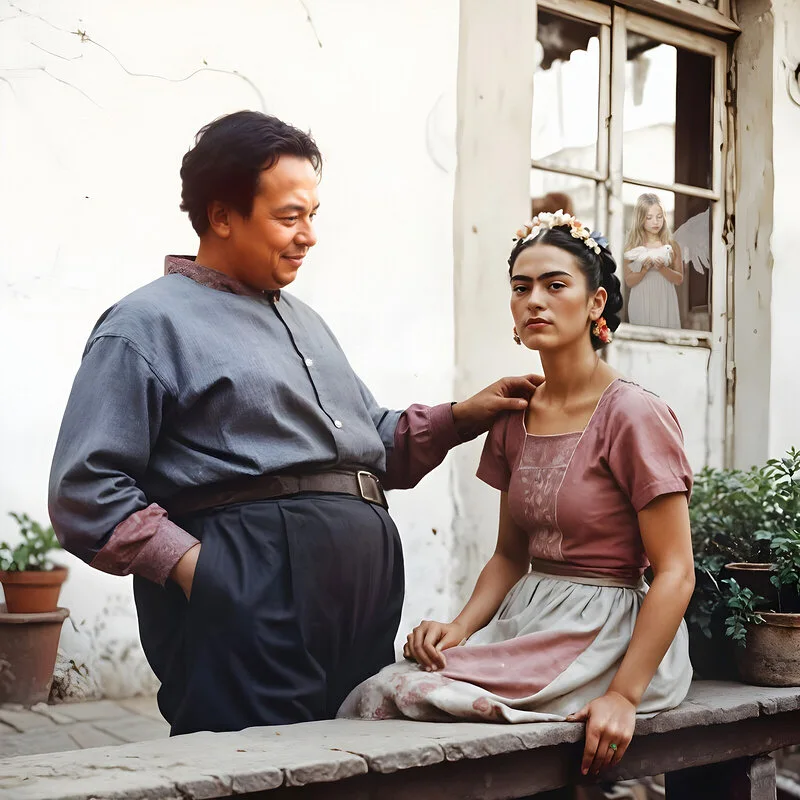
Jörgen Thornberg
Wishful thinking, 2025
Digital
80 x 80 cm
3 200 kr
Wishful thinking
Wishful Thinking
Over a Paloma and a local beer, our conversation wandered from weather and world affairs to the profoundly personal. Intrigued by her painting Wishful Thinking—a seemingly idyllic portrait of her and Diego—I asked about the title. Her response, layered with symbolism and humour, unfolded into a story of love, loss, and Frida's remarkable resilience above all. It was a witness to the vibrant masks we wear to face life’s challenges.
Diego’s literal and figurative size mirrored his immense ambitions and influence. He was a giant in the art world and a central figure in Frida’s life. Rivera sometimes referred to himself as “an elephant” next to Frida, whom he described as “a little dove.” Their physical contrast was striking, which also heightened the dynamic of their relationship. Despite his size and dominance, he was known to admire Frida and occasionally yield to her will and intelligence.
Read on to explore Frida's and Diego’s life together….
‘‘Wishful Thinking
A deceitful photo turned to art.
Its hidden truth refused to part.
For Frida sought no beauty's guise
But glimpses of the veiled and unwise
Beneath the varnish, layers blend,
A harmony we wish would never end.
Yet life, like art, holds truths unseen,
In Sfumato’s haze, lies intervene.
Edges softened, colours fade,
Dreams of balance deftly made.
A tranquil scene, a peaceful guise,
But shadows linger, veiled in lies.
The elephant rests beside the dove,
A paradox of pain and love.
Diego’s mass, Frida’s grace, a fractured whole,
Two bodies bound, yet distant souls.
Through the brush, a fragile truce,
The weight of grief, the threads come loose.
An angel peers through glassy panes,
A childless hope that still remains.
Wishful thinking paints the day,
A fleeting calm, a gentle sway.
But truth, like layers, intertwines,
A dance of sorrow, love, and lines.
So look beyond, not just the hue,
For hidden depths, invite the view.
In varnish, life’s soft edges gleam,
A portrait built on hope and dream.
Malmö, January 2025
Wishful Thinking
The scene was set at Ciao, a cosy restaurant on Friisgatan in Malmö, where Frida Kahlo and I had decided to grab a drink before her evening performance. Frida had a couple of hours to spare and had chosen a Paloma—a classic Mexican cocktail with tequila, grapefruit soda, lime, and a touch of salt. True to my usual preferences, I ordered a glass of fresh local beer.
Our conversation meandered through the predictable topics: the ever-windy weather in Skåne, praise for what deserved recognition, and shared indignation over the day’s unpleasant events. We voiced our support for Ukraine and disdain for Putin and Trump, likening the latter to a cancer on democracy. Though our comments wouldn’t reach the Kremlin or Trump Tower, it felt good to commiserate.
Eventually, I decided to ask Frida about a painting from her retrospective exhibition. The title, Wishful Thinking, intrigued me and contrasted sharply with the painting’s seemingly idyllic subject matter.
Me: “Your painting of you and Diego at the exhibition—you titled it Wishful Thinking. Why that name?” I wiped a bit of foam from my upper lip.
Frida: She leaned back, swirling the salt rim of her glass with a finger before taking a sip. “It has many layers—like the classic works of art where beneath the varnish are strata of transparent colours blending to create depth. Life is like that, a kind of sfumato—a Renaissance technique where everything merges softly, creating a hazy effect. Just as in art, in life, nothing exists in isolation. Everything is interconnected, influenced by layers beneath the surface.”
Me: I nodded, though still slightly mystified. “I see… though I’m not sure I fully grasp it yet. But perhaps more questions will help. Without knowing Diego personally, I’d have felt small in his presence based on your depiction. Did you feel that way?”
Frida: She smiled thoughtfully, tapping her glass with her fingernails. “Yes and no. Physically, we were very different, but I felt like his equal in most other ways. Diego would sometimes call himself ‘the elephant in the room’ and me his ‘little dove.’ Our physical contrast was undeniable, but it also heightened our dynamic. Despite his size and dominant personality, Diego admired me—and at times, he even yielded to my will and sharpness.”
Me: “He was undeniably large… in many ways.”
Frida cut me off with a playful laugh. “Physically, yes—and in his artistic presence, too. Diego was a man of immense charisma, matching his artistic ambition. At 188 cm, he towered over most men of his time. His weight often fluctuated, but he was around 136–140 kilos at his heaviest. And I loved every kilo.”
Me: “Had he been Japanese, he could’ve been a sumo wrestler.”
Frida: She chuckled, her eyes twinkling. “Diego would have loved that! I’ll ask him about it when I’m back on the star. Up there, weight doesn’t matter—there’s no gravity. On Earth, he could’ve crushed me in bed, so more often than not, I’d ride him like an elephant.” She grinned mischievously. “His invitation was always, ‘Would the dove-like to ride the elephant tonight?’ And most often, I did.”
I blushed slightly, focusing on my beer. “I… see.”
Frida: She smirked knowingly. “No, you don’t. But that’s okay. Diego’s physical size increased his commanding presence in social and artistic settings. He occupied space in every sense. But he had a sense of humour about it, which was part of what made me fall for him.”
Me: “Diego was certainly a giant in his artistic expression. His murals are monumental in scale and significance. I’ve seen a few—his works at the Palacio Nacional in Mexico City and the Detroit Institute of Arts are breathtaking.”
Frida: She nodded, her tone softening with pride. “His ambitions were never small, politically or artistically. Diego wanted to change the world. He saw himself as an artist for the people, using his murals to communicate social and political messages—about Mexico’s history and the struggles of the working class. That, too, I loved about him.”
Me: “May I ask about your height? Your age is public knowledge, after all,” I teased, fully aware of how such questions were once considered impolite.
Frida: “I don’t mind. You could probably find that out yourself. I’m 161 cm tall—not shrinking anytime soon.” She paused, a playful glint in her eye. “Unless you count the effects of polio, which I had as a child. It stunted my growth and left my right leg thinner than the left. That’s also the leg they amputated the year before I left Earth for my star.”
She took a deep breath and continued, her voice steady. “When I arrived in eternity, I got the leg back—it’s optional, but who wants to hop around on one leg? Not me. Oh, and in case you’re curious, I weigh 45 kilos—exactly. Want to know my shoe size, too?”
Me: I waved my hand, laughing nervously. “I’ll pass on that one. But losing your leg must’ve been devastating, physically and emotionally.”
Frida: Her back straightened, pride shining in her expression. “It was, undoubtedly. It further limited my already impaired mobility. But I refused to let it defeat me. ‘Pies, para qué los quiero si tengo alas para volar?’—‘Feet, why do I need them when I have wings to fly?’ That’s what I wrote in my diary.”
Me: “You’ve always been resourceful and resilient.”
Frida leaned forward, her intense gaze meeting mine. “I had to be. Life gave me challenges and wings to paint, love, and live.”
Me: “Your strength is remarkable. You may be small, but your presence is larger than life.”
Frida: She smiled modestly. “Thank you. My size may be small, but I’ve always believed that greatness comes from within.”
Me: “Like all your paintings, Wishful Thinking is rich with symbolism. The title, seemingly idyllic subject matter, and the layers you mentioned all hint at something deeper. Could you share more about the symbolism in this painting?”
Frida: “It is,” she agreed. “The painting is based on my father Guillermo's photograph of Diego and me in 1932. I had just suffered my first miscarriage, and Diego was comforting me. The angel with the dove inside the terrace door represents the child I never saw grow up.”
She sipped her Paloma, the bittersweet taste matching her reflective tone. “That loss deeply affected me, both physically and emotionally. It inspired works like Henry Ford Hospital (The Flying Bed), where I depicted the pain and existential questions that followed. I explored the theme further in My Birth and Tree of Hope—the sorrow, the loss, and the complex relationship with my body and femininity.”
Me: “But surely you don’t believe a woman’s worth is tied to her ability to have children?”
Frida: “Not now,” she said firmly. “But there were moments when I felt that way. It took time to heal.”
Me: “Perhaps your self-reflection has helped others.”
Frida: “I know it has. My paintings have helped many women understand and relate to the emotions tied to motherhood and loss.”
Me: “And the dove? Does it symbolise motherhood?”
Frida: She smiled softly. “Only indirectly. The dove represents my hope for peace in the world so children can be born into a future worth living in—a world rebuilt from the ashes of what previous generations have destroyed.”
Frida and I continued our conversation, the restaurant's warm ambience blending seamlessly with the vibrant hues of her Mexican-inspired outfit. Her Paloma, with its fizzy grapefruit aroma, sat glistening in the soft lighting while my local beer retained its frothy head.
Me: “And the ring on your finger—does it have anything to do with the child you lost?”
Frida: She raised her hand slowly, turning it so the jade and gold ring caught the light. “This ring is Yin and Yang. The cool green jade represents grounded energy, while the warm, glowing gold signifies the sun’s energy. Together, they symbolise balance—between good and bad, the spiritual and the material. Jade is the spiritual, earthy connection, while gold represents the material, the celestial. The ring is a bridge between these worlds.”
She paused, her expression softening. “Diego gave it to me as comfort and a reminder that we could have another try—a wish for eternal harmony and love. Gold stood for passion, jade for serenity. But in our life together, gold won. Serenity was in short supply.”
Me: “Yet you didn’t idealise Diego’s appearance despite his weight. The portrait in your museum shows him just as he was—neither more nor less.”
Frida: She smiled warmly, fingers lightly grazing the ring. “Indeed, I idealised him. I loved him as he was. It wasn’t about ‘less is beautiful.’ For Diego, more was more—at least, not less.”
Me: “The childish ribbon in your hair in the museum painting—it obviously wasn’t worth repeating in your later works.”
Frida: She chuckled softly, her eyes glinting with amusement. “The ribbon? No, that was an experiment, perhaps a youthful impulse. But the flowers in my hair—ah, they were something else entirely. They were far more than decoration; they carried deep symbolism and played a vital role in my identity. They reflected how I felt, my love for Mexico, and my pride in being a woman. They celebrated life—even when death whispered in the background.”
Me: “Why flowers, though? You could have chosen jewellery or other symbols to express yourself.”
Frida: She leaned forward, her hands cradling her glass. “Flowers are life. They’re fleeting yet so full of colour and beauty. I grew up surrounded by the garden at Casa Azul, and every time I wore flowers in my hair, I felt like I was bringing a piece of that nature into my world—even when confined to a hospital bed. They’re also part of our cultural heritage. The women of Tehuantepec, with their intricate floral hairstyles, inspired me. I wanted to carry their strength and pride forward.”
Me: “So you see them as more than just decoration? Something imbued with meaning?”
Frida: “Absolutely. Flowers can speak without words. Red roses in my hair could say, ‘I love you,’ even when my lips couldn’t. Marigolds, cempasúchil, are my tribute to death and those who came before me. And hibiscus—oh, they’re pure sensuality, like Mexico itself, hot and passionate.”
Me: “You also wore white flowers sometimes, like jasmine. What do they say?”
Frida: Her expression softened, her fingers tracing the rim of her glass. “They’re purity, yes, but also a kind of sorrow. I wore them often when I tried to hide my pain as if to say, ‘Look, I am innocent and strong, even though I’m breaking inside.’ They were my way of balancing what I showed the world and what I kept for myself.”
Me: “So the flowers became part of your mask, like your colourful clothes?”
Frida: She nodded, her voice steady. “Exactly. The mask gave me control. When people saw me, they thought I was vibrant and larger than life. But behind the flowers and clothes was a woman who often felt broken and alone. The flowers gave me a crown to hold onto when everything else felt uncertain.”
Me: “And what do you think your crown of flowers meant to others?”
Frida: She tilted her head thoughtfully. “To others? Perhaps they saw beauty first, but I hope they also saw courage. The flowers were a reminder that life, no matter how painful, could still be full of colour, passion, and strength.”
Me: “Is there any flower you’d never wear in your hair?”
Frida: She shook her head slowly, a wistful smile playing on her lips. “Never? No, I don’t think so. Every flower has its own story and beauty. But some feel too heavy, like lilies. They’re beautiful, but they remind me too much of death. My flowers were always filled with life, even when wilting.”
Me: “That’s a beautiful thought, Frida—life in all its colours and forms. It’s what you’ve always stood for.”
Frida: She raised her glass in a small toast, her eyes shining. “Exactly. And let’s not forget—flowers also have a practical purpose. They hide bad hair days,” she added with a laugh. “But that’s our little secret.”
We both laughed, clinking our glasses lightly. Frida’s Paloma was nearly finished, the salt rim leaving faint traces on her fingers. Her vibrant spirit and unfiltered honesty had turned a simple conversation into a vivid journey through art, identity, and resilience.
As the minutes ticked away, Frida glanced at her watch. “I should head back to the theatre soon. But I think I’ll take a little detour to Hansakompagniet first—window shopping—or maybe more. You never know with me,” she said with a playful wink.
I watched her rise gracefully, her jade and gold ring glinting under the restaurant’s lights. “You’re full of surprises, Frida,” I said with a smile.
She adjusted her shawl, the floral embroidery catching the evening light. “Life is better that way, don’t you think?”
With a final wave and a burst of laughter, she stepped out into the Malmö streets, her presence as unforgettable as the stories she shared.
She raised her empty glass in a toast. “To hope and to the wings that carry us through life.”
Me: I clinked my beer glass against her Paloma. “To hope—and to the stories that keep it alive.”
Frida: “I think I’ll head on,” she said and left.
I watched her leave, a figure of strength and vibrancy whose presence lingers long after disappearing into the Malmö streets. Her vibrant outfit caught the early evening light.
3 200 kr

Jörgen Thornberg
Malmö
Lite om bilder och mig. Translation in English at the end.
Jag är en nyfiken person som ser allt i bilder, även det jag fäster i ord, gärna tillsammans för bakom alla mina bilder finns en berättelse. Till vissa bilder hör en kortare eller längre novell som följer med bilden.
Bilder berättar historier. Jag omges av naturlig skönhet, intressanta människor och historia var jag än går. Jag använder min kamera för att dokumentera världen och blanda det jag ser med vad jag känner för att fånga den dolda magin.
Mina bilder berättar mina historier. Genom mina bilder, tryck och berättelser. Jag bjuder in dig att ta del av dessa berättelser, in i ditt liv och hem och dela min mycket personliga syn på vår värld. Mer än vad ögat ser. Jag tänker i bilder, drömmer och skriver och pratar om dem; följaktligen måste jag också skapa bilder. De blir vad jag ser, inte nödvändigtvis begränsade till verkligheten. Det finns en bild runt varje hörn. Jag hoppas att du kommer att se vad jag såg och gilla det.
Jag är också en skrivande person och till många bilder hör en kortare eller längre essay. Den följer med tavlan, tryckt på fint papper och med en personlig hälsning från mig.
Flertalet bilder startar sin resa i min kamera. Enkelt förklarat beskriver jag bilden jag ser i mitt inre, upplevd eller fantiserad. Bilden uppstår inom mig redan innan jag fått okularet till ögat. På bråkdelen av ett ögonblick ser jag vad jag vill ha och vad som kan göras med bilden. Här skall jag stoppa in en giraff, stålmannen, Titanic eller vad det är min fantasi finner ut. Ännu märkligare är att jag kommer ihåg minnesbilden långt efteråt när det blir tid att skapa verket. Om jag lyckas eller inte, är upp till betraktaren, oftast präglat av en stråk av svart humor – meningen är att man skall bli underhållen. Mina bilder blir ofta en snackis där de hänger.
Jag föredrar bilder som förmedlar ett budskap i flera lager. Vid första anblicken fylld av feel-good, en vacker utsikt, fint väder, solen skiner, blommor på ängen eller vattnet som ligger förrädiskt spegelblankt. I en sådan bild kan jag gömma min egentliga berättelse, mitt förakt för förtryckare och våldsverkare, rasister och fördomsfulla människor - ett gärna återkommande motiv mer eller mindre dolt i det vackra motivet. Jag försöker förena dem i ett gemensamt narrativ.
Bild och formgivning har löpt som en röd tråd genom livet. Fotokonst känns som en värdig final som jag gärna delar med mig.
Min genre är vid som framgår av mina bilder, temat en blandning av pop- och gatukonst i kollage som kan bestå av hundratals lager. Vissa bilder kan ta veckor, andra någon dag innan det är dags att överlämna resultatet till printverkstaden. Fine Art Prints är digitala fotocollage. I dessa kollage sker rivandet, klippandet, pusslandet, målandet, ritandet och sprayningen digitalt. Det jag monterar in kan vara hundratals år gamla bilder som jag omsorgsfullt frilägger så att de ser ut att vara en del av tavlan men också bilder skapade av mig själv efter min egen fantasi. Därefter besöks printstudion och för vissa bilder numrera en limiterad upplaga (oftast 7 exemplar) och signera för hand. Vissa bilder kan köpas i olika format. Det är bara att fråga efter vilka. Gillar man en bild som är 70x100 men inte har plats på väggen, går den kanske att få i 50x70 cm istället. Frågan är fri.
Metoden Giclée eller Fine Art Print som det också kallas är det moderna sättet för framställning av grafisk konst. Villkoret för denna typ av utskrifter är att en högkvalitativ storformatskrivare används med åldersbeständigt färgpigment och konstnärspapper eller i förekommande fall på duk. Pappret som används möter de krav på livslängd som ställs av museer och gallerier. Normalt säljer jag mina bilder oinramade så att den nya ägaren själv kan bestämma hur de skall se ut, med eller utan passepartout färg på ram, med eller utan glas etc..
Under många år ställde jag bara ut på nätet, i valda grupper och på min egen Facebooksida - https://www.facebook.com/jorgen.thornberg.9
Jag finns också på en egen hemsida som tyvärr inte alltid är uppdaterad – https://www.jth.life/ Där kan du också läsa en del av de berättelser som följer med bilden.
UTSTÄLLNINGAR
Luftkastellet, oktober 2022
Konst i Lund, november 2022
Luftkastellet, mars 2023
Engleson Galleri Caroli, april 2023
Hydra, Greece June 2023
Engleson Galleri Caroli, oktober 2023
Toppen, Höllviken december 2023
Luftkastellet, mars 2024
Torups Galleri, mars 2024
Venice, May 2024
Luftkastellet, oktober 2024
Konst i Advent, December 2024
Galleri Engleson, Caroli December 2024
Jäger & Jansson Galleri, april 2025
A bit about pictures and me.
I'm a curious person who sees everything in pictures, even what I express in words, often combining them, for behind all my pictures lies a story. These narratives, some as short as a single image and others as long as a novel, are the heart and soul of my work.
Pictures tell stories. Wherever I go, I'm surrounded by natural beauty, exciting people, and history. I use my camera to document the world and blend what I see with what I feel to capture the hidden magic.
My images tell my stories. Through my pictures, prints, and narratives, I invite you to partake in these stories in your life and home and share my deeply personal perspective of our world. More than meets the eye. I think in pictures, dream, write, and talk about them; consequently, I must create images too. They become what I see, not necessarily confined to reality. There's a picture around every corner. I hope you'll see what I saw and enjoy it.
I'm also a writer, and many images come with a shorter or longer essay. It accompanies the painting, printed on fine paper with my personal greeting.
Many pictures start their journey on my camera. Simply put, I describe the image I see in my mind, experienced or imagined. The image arises within me even before I bring the eyepiece to my eye. In a fraction of a moment, I see what I want and what can be done with the picture. Here, I'll insert a giraffe, Superman, the Titanic, or whatever my imagination conjures up. Even stranger is that I remember the mental image long after it's time to create the work. Whether I succeed is up to the observer, often imbued with a streak of black humour – the aim is to entertain. My pictures usually become a talking point wherever they hang.
I prefer pictures that convey a message in multiple layers. At first glance, they're filled with feel-good vibes, a beautiful view, lovely weather, the sun shining, flowers in the meadow, or the water lying deceptively calm. But beneath this surface beauty, I often conceal a deeper story, a narrative that challenges societal norms or explores the human condition. I invite you to delve into these hidden narratives and discover the layers of meaning within my work.
Picture and design have been a thread running through my life. Photographic art feels like a fitting finale, and I'm happy to share it.
My genre is varied, as seen in my pictures; the theme is a blend of pop and street art in collages that can consist of hundreds of layers. Some images can take weeks, others just a day before it's time to hand over the result to the print workshop. Fine Art Prints are digital photo collages. In these collages, tearing, cutting, puzzling, painting, drawing, and spraying happen digitally. What I insert can be images hundreds of years old that I carefully extract so they appear to be part of the painting, but also images created by myself, now also generated from my imagination. Next, visit the print studio and, for certain images, number a limited edition (usually 7 copies) and sign them by hand. Some images may be available in other formats. Just ask which ones. If you like an image that's 70x100 but doesn't have space on the wall, you might be able to get it in 50x70 cm instead. The question is open.
The Giclée method, or Fine Art Print as it's also called, is the modern way of producing graphic art. This method ensures the highest quality and longevity of the artwork, using a high-quality large-format printer with archival pigment inks and artist paper or, in some cases, canvas. The paper used meets the longevity requirements set by museums and galleries. I sell my pictures unframed, allowing the new owner to personalise their artwork, confident in the lasting value and quality of the piece.
For many years, I only exhibited online, in selected groups, and on my Facebook page - https://www.facebook.com/jorgen.thornberg.9. I also have my website, which unfortunately is not constantly updated - https://www.jth.life/. You can also read some of the stories accompanying the pictures there.
EXHIBITIONS
Luftkastellet, October 2022
Art in Lund, November 2022
Luftkastellet, March 2023
Engleson Gallery Caroli, April 2023
Hydra, Greece June 2023
Engleson Gallery Caroli, October 2023
Toppen, Höllviken December 2023
Luftkastellet, March 2024
Torup Gallery, March 2024
Venice, May 2024
UTSTÄLLNINGAR
Luftkastellet, oktober 2022
Konst i Lund, november 2022
Luftkastellet, mars 2023
Engleson Galleri Caroli, april 2023
Hydra, Greece June 2023
Engleson Galleri Caroli, oktober 2023
Toppen, Höllviken december 2023
Luftkastellet, mars 2024
Torups Galleri, mars 2024
Venice, May 2024
Luftkastellet, October 2024
Konst i Advent, December 2024
Galleri Engleson, Caroli December 2024
Jäger & Jansson Galleri, April 2025
Utbildning
Autodidakt
Medlem i konstnärsförening
Öppna Sinnen
Med i konstrunda
Konstrundan i Skåne
Utställningar
Luftkastellet, October 2022
Art in Lund, November 2022
Luftkastellet, March 2023
Engleson Gallery Caroli, April 2023
Hydra, Greece June 2023
Engleson Gallery Caroli, October 2023
Toppen, Höllviken December 2023
Luftkastellet, March 2024
Torup Gallery, March 2024
Venice, May 2024