Vi använder cookies för att ge dig bästa möjliga upplevelse. Välj vilka cookies du tillåter.
Läs mer i vår integritetspolicy
Jörgen Thornberg
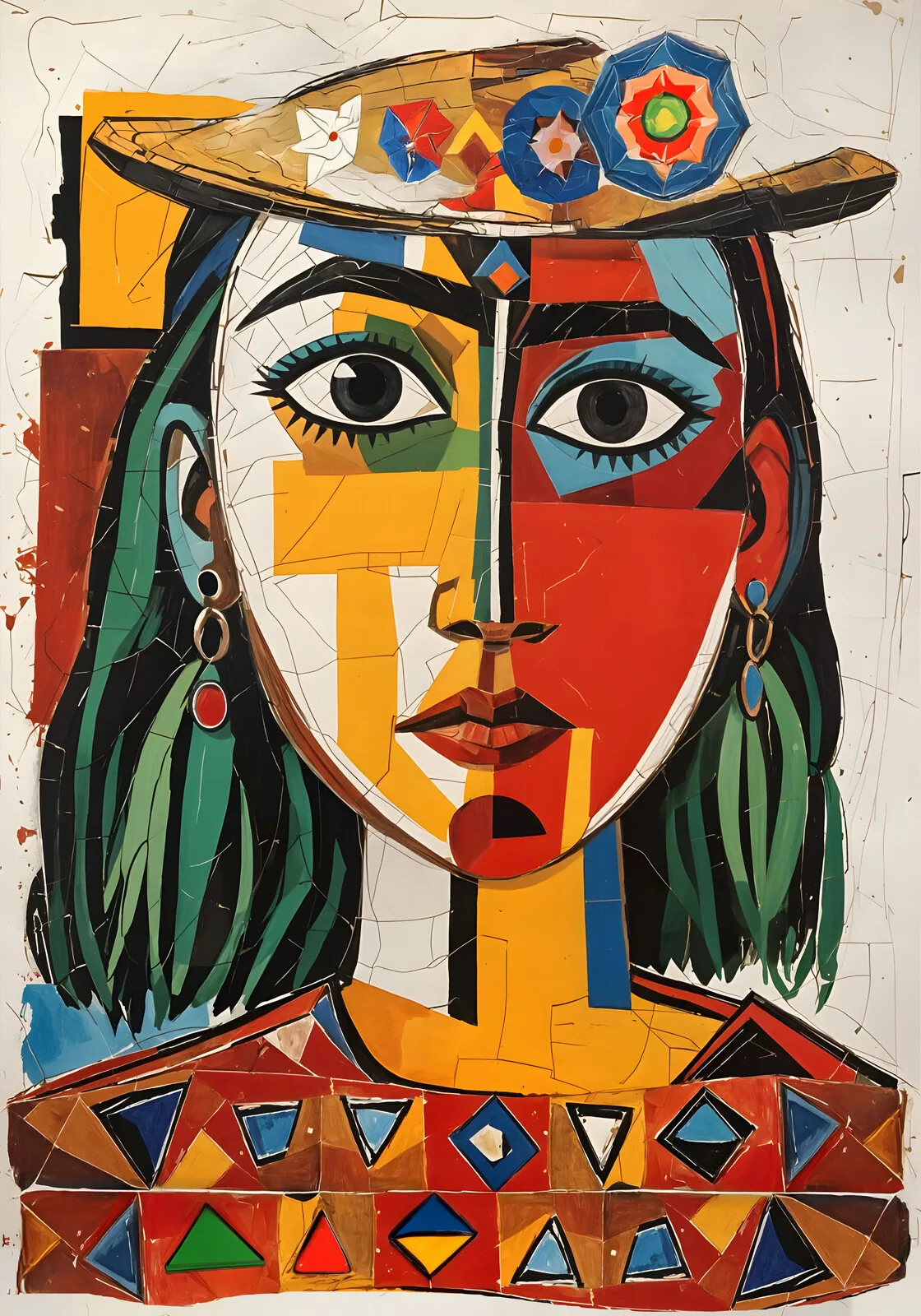
Frida Kahlo, Femme au chapeau - Picasso - Frida Kahlo in Hat, 2025
Digital
70 x 100 cm
5 200 kr
Frida Kahlo, Femme au chapeau - Picasso - Frida Kahlo in Hat
Frida and Pablo: The Eternal Dance of Artist and Muse
In the celestial expanse where artistry meets eternity, Frida Kahlo and Pablo Picasso, two of the greatest minds in art, find themselves at a crossroads of creation, love, and identity. Their conversations—intense, reflective, and often laced with wit—explore the unique and complex aspects of the artist's and muse's relationship, a relationship that transcends time and space.
As Frida reimagines Picasso's ‘Girl with a Hat’ in her style, their dialogue traverses centuries of artistic legacy, weaving through the stories of muses and creators from Vermeer and Da Vinci to the mythical Pygmalion. Through their shared experiences, triumphs, and struggles, they probe deeply into the role of inspiration, power dynamics, and art's transformative nature. This shared journey leaves us in awe of the power of art to transcend time and influence, fostering a sense of unity with these great artists.
In this timeless exchange, Frida and Pablo unmask their vulnerabilities, challenge each other’s philosophies, and reflect on the ever-elusive balance between love, possession, and creative expression. Their conversation reveals a poignant truth: the artist’s journey is as much about breaking and reshaping their subjects as it is about understanding themselves. This insight invites us to reflect on our own relationships and the transformative power of art.
Their laughter, debates, and fleeting moments of tenderness remind us that while their muses shaped their art, their fractured yet whole humanity leaves an indelible mark on history.
Will you join their thoughts? Please read on and delve deeper into the artistic dialogue between Frida Kahlo and Pablo Picasso.
“When the Brushes Rest
When the brushes rest and the stars hang low,
The artist and muses let their passions flow.
No canvas demands, no pigment persists,
It’s life they now paint through embraces and trysts.
A goblet of wine in a circle they pass,
Discussing Plato, the soul, and the glass.
“Are we shadows?” they ask, “Or the light that remains?”
Between sips and laughter, they unravel their chains.
Fernande laughs loud, her voice a refrain,
As Marie-Thérèse dreams of the ocean's domain.
Dora debates with a fire in her tone,
While Frida observes, carving truths of her own.
They talk of their children, both real and portrayed,
Of how innocence dances and ideals might fade.
The artist listens, his gaze shifting soft,
For even the boldest has moments aloft.
“Tell me,” says Fernande, “Is this what it means—
To be immortal yet caught in your schemes?
We live in your fragments, your cubes and your lines,
But are we the muses or prisoners confined?”
Marie-Thérèse smiles, her cheek on her hand,
“The truth’s in the wine, not the brush in his hand.
We are lovers and muses but captains as well,
For every portrait of us, there’s a story to tell.”
In corners of shadow, passions ignite,
Whispered confessions slip into the night.
The artist’s hands, once steady with skill,
Now tremble with longing, both eager and still.
In tangled sheets, where the night grows deep,
They dream of each other in restless sleep.
For art’s not enough to bind hearts in one,
And even in starlight, desires outrun.
At dawn, they rise, their bodies aglow,
Refreshed by the chaos that only they know.
Back to their easels, their sculptures, their clay,
Transforming the night into truths for the day.
The muses and artists, a circle so wide,
Bound by creation and love as their guide.
For in every great work, a secret does dwell:
Not just what is seen but what’s hidden as well.
Malmö January 2025
Frida and Pablo: The Artist and the Model
Frida decided to reimagine Picasso's ‘Girl with a Hat’ (Femme au chapeau) in her own way as part of her continued experiments with Cubism. Picasso's original is a vibrant and intriguing portrait that exemplifies his evolution as an artist and his ability to capture the essence of his muses through innovative styles. Often associated with his early forays into Fauvism and Cubism, the painting carries layers of artistic experimentation and reflections on personal relationships.
Frida hoped to contribute more than just her facial features to her interpretation. She aimed to infuse the piece with her identity, emotions, and symbolic imagery, creating not merely a replica but a dialogue—a conversation between their artistic worlds. By merging her struggles, cultural heritage, and revolutionary spirit with Picasso’s bold techniques, she intended to craft something entirely her own. This piece would speak not only of innovation but also of resilience and transformation.
‘Girl with a Hat’ was created during Picasso’s transition from his Blue and Rose periods into a more experimental phase, during which he began to incorporate brighter colours and fragmented forms. ‘Girl with a Hat’, completed in 1905-1906, reflects his growing fascination with the work of artists like Henri Matisse, whose Fauvist influence can be seen in the vibrant palette and expressive brushstrokes.
The model's identity in ‘Girl with a Hat’ remains a captivating mystery, a puzzle that invites exploration—at least on Earth. Some art historians speculate it might have been Fernande Olivier, Picasso’s lover and muse at the time. Fernande was a significant figure in Picasso’s personal and artistic development during these years, providing emotional support and inspiring many of his works. They are correct.
Frida knew that Fernande had posed for the painting, and in fact, Frida was fascinated by the woman behind the cubist face. She was not the most beautiful of Picasso’s models, but nonetheless someone who intrigued her. Fernande had grand plans for herself and Picasso to build a family together. To that end, Fernande adopted Raymonde, a thirteen-year-old girl, from a local orphanage.
The little family, however, was short-lived when Olivier discovered daring, not to say inappropriate, drawings of Raymonde that Picasso had made. She returned the girl to the orphanage despite Picasso denying that anything had happened between them. The incident was long forgotten, and Fernande now lived among the other muses on the star. Being his first muse gave her a certain aura of prestige within their celestial circle.
"Girl with a Hat" is notable for its departure from realism, a bold step into the world of abstraction. The exaggerated features, bold use of colour, and simplified forms suggest Picasso was moving toward the style that would culminate in Cubism. At this stage, he was experimenting with the deconstruction of form, reducing the human figure to its essential elements while retaining a sense of personality and emotion.
The hat, a striking feature of the painting, is more than a mere accessory. It adds to the playful and almost theatrical nature of the piece, suggesting that Picasso was as interested in capturing mood and character as he was in representing physical likeness. Of course, Frida would add some flowers to the straw hat.
The painting also vibrantly reflects the cultural dynamism of Paris at the time, particularly in Montmartre, where Picasso was living. The bohemian lifestyle of artists, writers, and performers infused his work, as did his exposure to African art and masks, which shaped his approach to depicting faces and figures.
According to Fernande, the painting also hints at their dynamic relationship. She described her years with Picasso as both passionate and tumultuous, and his portraits of her often oscillate between admiration and a sense of control or possession.
"Femme au chapeau" is a pivotal work in Picasso's career. It is a significant departure from traditional representation and a bold step into modernism. The painting is celebrated for its energy and role in bridging the gap between Picasso's early figurative work and, later, more abstract explorations.
For viewers, 'Girl with a Hat' is a canvas that invites many interpretations. Is it a playful tribute to the model's uniqueness? A critique of the artificiality of societal roles and appearances? Or is it simply an experiment in form and colour? Like much of Picasso’s work, its meaning is a puzzle that shifts depending on the viewer's perspective, inviting them to participate in its interpretation.
The picture offers, however, a broader narrative. Whether a deliberate muse or a fleeting figure, the subject of "Girl with a Hat" represents the intersections of personal relationships, artistic innovation, and cultural shifts in early 20th-century Paris. It’s a painting that doesn’t just depict a woman in a hat—it tells a story of personal and artistic transformation in the life of one of the greatest artists of all time. That feeling, albeit on a different level, was something Frida intended to weave into her version. Her life and Picasso’s had, in many ways, mirrored each other—minus, of course, her suffering, a burden Picasso had been spared. Yet Frida had indulged in her share of wild escapades, though she had deliberately chosen not to paint that part of her story.
Frida and Pablo: The Artist and the Model
How many times Frida had been here, she’d lost count when Picasso strolled casually into the guest studio where she sat at a massive easel—the easel Picasso borrowed slyly from the Atélier Musée Picasso in Mougins years ago. To avoid raising suspicion, he’d left behind a near-identical one, though one he’d never personally used. Frida was working on yet another self-portrait, ablaze with longing, framed by the twin red suns of Picasso’s star as her backdrop. It wasn’t precisely planned, but she had been here several times recently. Her host could easily misinterpret it, but truthfully, it wasn’t Picasso himself who drew her back—it was a few of his muses. Two of them had become her lovers, and, as a matter of courtesy, Picasso had obliged with a private supper and dessert.
The studio was filled with fragments of his works—sculptures and paintings scattered like constellations across the horizon. Picasso, in his prime forty-something form, stood at the centre, arms wide open, radiating charm like a seasoned matador greeting a rival.“Frida,” he said with a grin, striding toward her, “you bring colour to even my corner of eternity.”
Frida smirked, brushing past his outstretched arms but allowing him a kiss on the cheek. “Don’t think I’ve come here to add to your harem, Pablo. I’m here to talk about art, not your... extracurricular activities.”
Picasso chuckled, his dark eyes sparkling. “Art is life, Frida. And life is always a little more interesting when it’s personal. Surely, you understand that better than anyone.”
Frida raised an eyebrow. “Perhaps. But tell me, Pablo, how do you keep your muses under one roof without them tearing each other apart?”
He leaned closer, his voice dropping to a conspiratorial whisper. “I flatter them equally, of course. And occasionally, I let them paint me.” He gestured to a nearby painting where Dora Maar had captured him in surrealistic agony. “Even my flaws look magnificent through their eyes.”
Frida rolled her eyes. “You’re insufferable, you know that? But let’s talk about the real reason I’m here: the model and the artist. Can you truly separate the two?”
Picasso’s demeanour shifted, becoming more reflective. “It’s difficult. A model is not just a body or a face—they’re a story and presence. When you paint someone, you see them in ways no one else can. You capture their light, shadows, even the things they try to hide.”
Frida nodded. “And yet, you have to break them apart, piece by piece, especially in your cubist works. Did any of your muses resent you for it?”
“Resent me?” Picasso laughed, though it was tinged with an edge. “Fernande Olivier, my first great muse, hated my cubist portraits of her. She preferred the works from my Blue Period, where she thought I captured her soul. The cubist pieces? She called them cruel. And maybe she was right.”
“Fernande?” Frida asked, her curiosity piqued. “What was she like?”
“She was fiery, passionate, and often angry,” Picasso admitted. “But she taught me to see the world differently. Without her, I might not have found my way to cubism. Of course, I was no angel. Our relationship was... complicated.”
Frida smirked. “Complicated seems to be your speciality.”
Picasso ignored the jab. “What about you? Did Diego’s presence help or hinder your art?”
Frida sighed, glancing at one of Picasso’s sculptures as if searching for answers. “Diego was everything and nothing to me. He inspired me, supported me, betrayed me, broke me. But through all of it, he made me feel alive. My paintings wouldn’t exist without the pain he caused, but I wouldn’t wish that pain on anyone.”
Picasso nodded, his expression softening. “That’s the price. The people we love most are both our muses and our tormentors.”
Frida turned the conversation back to the broader question. “What about other artists? Do you think Vermeer loved the women he painted, or were they just props for his light and shadow games?”
Picasso tilted his head, considering. “Vermeer’s women... they’re quiet, introspective. I want to think he admired them, but love? Who knows? Love complicates everything.”
“As far as I’ve heard, there was a fling between him and the girl with the pearl earring. I have no details, but indeed, she was beautiful. But young. Leonardo da Vinci,” Frida added. “Do you think he loved his Mona Lisa? Or was she just an enigma he couldn’t resist solving?”
Picasso chuckled. “Leonardo loved ideas more than people, I think. The *Mona Lisa*? She was a puzzle, a challenge he set for himself. Capturing that enigmatic smile wasn’t just about her; it was about proving to himself that he could do the impossible. But,” he added with a sly grin, “they live together now on his star. Three of them, actually, because Leonardo’s apprentice and lover Gian Caprotti is there too. Da Vinci knew Gian as Salaí, aka 'Little Devil'. So, there were always bonds between Leonardo and his model, without a doubt.” Picasso leaned closer to Frida, his voice dropping to a teasing tone. “Though I suspect, if it had been you sitting for him, ‘mi querida Frida,’ he might never have painted anyone else again.”
Frida rolled her eyes but couldn’t suppress a smile. “I doubt it. But I’d have given him something to think about.”
Picasso laughed, his hand brushing hers briefly as if testing the waters of her tolerance. “You always do, Frida. You always do.”
Frida leaned forward, her eyes narrowing playfully. “And what about you, Pablo? Did you love your muses, or did you use them?”
He placed a hand over his heart theatrically. “I loved them all, Frida. Each in their way. Fernande, Eva, Dora, and Marie-Thérèse were all pieces of me. Without them, there would be no Picasso.”
Frida snorted. “Convenient answer. But tell me, did loving them make it easier to paint them? Or did it just make things messier?”
Picasso’s gaze turned serious. “It made it... intense. When you love someone, you see everything—their beauty, flaws, and fears. That intensity translates to the canvas. But it also consumes you. For example, Dora Maar was brilliant, but our love was destructive. She gave me some of my best work, but at what cost to her?”
“And Eva?” Frida asked. “Ma Jolie?”
“She was light,” Picasso said softly. “She brought joy to my life, but she left too soon. Tuberculosis took her. Sometimes, I think the brevity of our time together made her all the more radiant in my memory.”
Frida considered this. “So, a model isn’t just a subject. They’re a mirror, a partner, maybe even a rival.”
Picasso smiled. “Exactly. And sometimes, they surpass us. Look at Dora. In many ways, her photography captured truths I could only hint at.”
Frida’s thoughts drifted to her own experiences. “I’ve often wondered how it feels for the model,” she said. “To see themselves distorted, fragmented. I once asked one of Diego’s models how she felt. She said she didn’t recognise herself but saw something deeper—something she didn’t know was there.”
Picasso nodded. “It’s a strange intimacy. They give us their image, and we give them a new one. Sometimes, they love it; sometimes, they hate it. But it’s always a part of them.”
“And what about hatred?” Frida asked. “Have you ever painted someone you hated?”
Picasso hesitated, then laughed. “No, but I’ve painted people I was angry with. The anger... it fuels the brush. But hate? That would destroy the art.”
Frida leaned back, a small smile playing on her lips. “Maybe you’re not as insufferable as I thought, Pablo.”
Picasso took her hand, his touch lingering. “And maybe, Frida, you’re the only one who truly understands me.”
She pulled her hand away, laughing. “Nice try, Pablo. But I’m still not joining your harem.”
Picasso leaned closer to Frida, a playful glint in his eyes. "Ah, Frida, you are both muse and creator, the alpha and omega of your art. But tell me, does that not become... tiresome? Always painting your face, your own body?"
Frida smirked, her dark eyes narrowing slightly. "Not at all, Pablo. I contain multitudes, as your American poet Whitman said. My face, my body—they are landscapes, stages upon which my life unfolds. Why search for models when I carry my entire world within me?"
Picasso tilted his head, intrigued. "And yet, the relationships you've woven into your life—they spill onto the canvas too, do they not? Diego, your lovers, your pain, your joy. They are all there, even if you paint only yourself."
"Precisely," Frida replied, her tone sharpening. "Every stroke, every colour, carries the weight of my experiences. When I paint myself, I paint them too. Diego is there in my brow, my lovers in the curve of my lips, my pain in the shadows beneath my eyes."
He chuckled, leaning back into his chair with a grin. "You make it sound like you need no one, yet your canvases speak otherwise. Every artist, Frida, needs someone to draw out their fire."
Frida arched an eyebrow. "And you, Pablo? How many fires have you ignited—and extinguished—among your muses? How many have loved you, only to see themselves fractured into your cubes and angles?"
Picasso laughed, raising his hands as though in surrender. "Touché! But those fractures, querida, they are not wounds. They are revelations. My muses are my co-conspirators. Together, we break apart reality to see it anew."
Frida leaned forward, her expression serious now. "And when they see themselves on your canvas? When their bodies and faces are no longer whole but shattered, reshaped—do they thank you for it or curse you?"
"Both," Picasso admitted, his voice softer. "Some understand it; others never forgive me. But art is not about pleasing others. It’s about truth."
Frida nodded slowly, her fingers absently tracing the edge of her paintbrush. "Truth, yes. But also empathy. I paint myself because I know my pain best. I have not hidden mine if others see their suffering in my work."
Picasso studied her momentarily, his usual bravado giving way to a rare moment of vulnerability. "Perhaps that’s where we differ, Frida. You reveal; I conceal. You lay yourself bare while I hide behind my geometry."
"Perhaps," Frida said softly. "But both paths lead to the same place—connection. Whether through your fractured muses or my raw self-portraits, we remind people that they are not alone in their pain, joy, and humanity."
Picasso reached for her hand, his charm returning. "Frida, you are more than an artist. You are a mirror, a truth-teller. And perhaps... a muse yourself?"
Frida withdrew her hand with a smile that was both knowing and dismissive. "Nice try, Pablo. But this muse is no one’s to keep."
As they walked through his celestial gallery, the conversation turned to history. They spoke of artists who came before them, muses who shaped the course of art, and complicated, messy relationships that fuel creativity. And as they parted ways, Frida couldn’t help but feel a newfound appreciation for the strange, beautiful dance between artist and model—two souls intertwined, creating something neither could achieve alone.
Picasso stopped for a while with a satisfied smile and a glint in his eye as if he had just won a friendly duel.
"Frida, you see," he began, "Ovid knew something about the power of passion in creation. Pygmalion—that’s all of us, in a way. We don’t just shape the world around us; we shape our desires and dreams. And sometimes… we become prisoners of them."
Frida raised an eyebrow, though a smile played at the corner of her lips. "So says the man who turned his models into cubist puzzles. But tell me, Pablo—was it passion, love, or something else that drove you to break them down into their smallest geometric pieces?"
He chuckled softly, letting his fingers dance in the air as if drawing invisible lines and angles. "Perhaps all of that and more. When I painted them—Fernande, Dora, Marie-Thérèse—it was as if they became a part of me. Their forms, their faces, their souls… I wanted to understand them in a way that goes beyond the surface. Perhaps, if I’m honest, it was also a way to own them. For if they exist on my canvas, in my lines, they can never leave me."
Frida shook her head, her smile now fully visible. "You’re a true manipulator, Picasso. But let me ask you: do you think Pygmalion truly loved his statue or was he just in love with himself?"
Picasso met her gaze, silent momentarily, an unusual stillness in his usually lively demeanour. Then he shrugged and gave his signature, carefree grin. "That’s a question for eternity, mi querida. And now, with Ovid and Pygmalion as my defence counsel, I think I’ll leave it at that."
With that, he took one last imaginary puff of his cigarette and left the room, his echoing laughter a reminder of his eternal charm and complexity. Back at her easel, Frida pondered Pygmalion and the artist’s eternal dance between love, creation, and possession.
Jörgen Thornberg
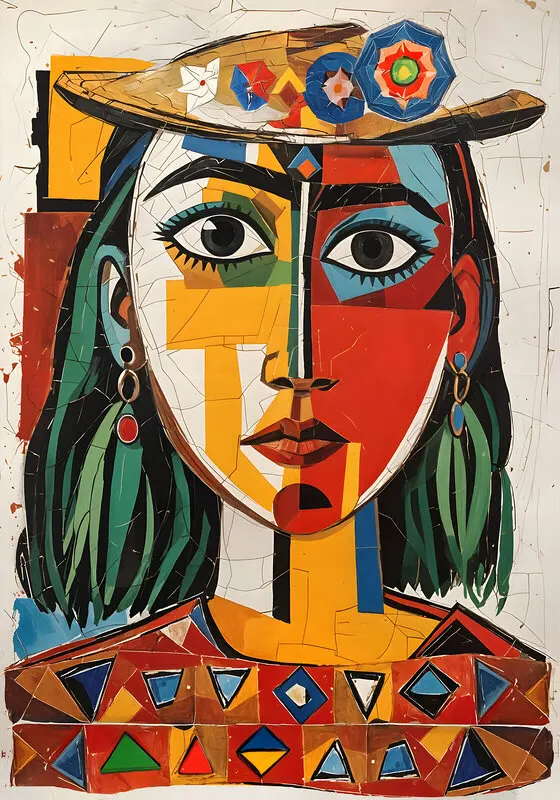
Frida Kahlo, Femme au chapeau - Picasso - Frida Kahlo in Hat, 2025
Digital
70 x 100 cm
5 200 kr
Frida Kahlo, Femme au chapeau - Picasso - Frida Kahlo in Hat
Frida and Pablo: The Eternal Dance of Artist and Muse
In the celestial expanse where artistry meets eternity, Frida Kahlo and Pablo Picasso, two of the greatest minds in art, find themselves at a crossroads of creation, love, and identity. Their conversations—intense, reflective, and often laced with wit—explore the unique and complex aspects of the artist's and muse's relationship, a relationship that transcends time and space.
As Frida reimagines Picasso's ‘Girl with a Hat’ in her style, their dialogue traverses centuries of artistic legacy, weaving through the stories of muses and creators from Vermeer and Da Vinci to the mythical Pygmalion. Through their shared experiences, triumphs, and struggles, they probe deeply into the role of inspiration, power dynamics, and art's transformative nature. This shared journey leaves us in awe of the power of art to transcend time and influence, fostering a sense of unity with these great artists.
In this timeless exchange, Frida and Pablo unmask their vulnerabilities, challenge each other’s philosophies, and reflect on the ever-elusive balance between love, possession, and creative expression. Their conversation reveals a poignant truth: the artist’s journey is as much about breaking and reshaping their subjects as it is about understanding themselves. This insight invites us to reflect on our own relationships and the transformative power of art.
Their laughter, debates, and fleeting moments of tenderness remind us that while their muses shaped their art, their fractured yet whole humanity leaves an indelible mark on history.
Will you join their thoughts? Please read on and delve deeper into the artistic dialogue between Frida Kahlo and Pablo Picasso.
“When the Brushes Rest
When the brushes rest and the stars hang low,
The artist and muses let their passions flow.
No canvas demands, no pigment persists,
It’s life they now paint through embraces and trysts.
A goblet of wine in a circle they pass,
Discussing Plato, the soul, and the glass.
“Are we shadows?” they ask, “Or the light that remains?”
Between sips and laughter, they unravel their chains.
Fernande laughs loud, her voice a refrain,
As Marie-Thérèse dreams of the ocean's domain.
Dora debates with a fire in her tone,
While Frida observes, carving truths of her own.
They talk of their children, both real and portrayed,
Of how innocence dances and ideals might fade.
The artist listens, his gaze shifting soft,
For even the boldest has moments aloft.
“Tell me,” says Fernande, “Is this what it means—
To be immortal yet caught in your schemes?
We live in your fragments, your cubes and your lines,
But are we the muses or prisoners confined?”
Marie-Thérèse smiles, her cheek on her hand,
“The truth’s in the wine, not the brush in his hand.
We are lovers and muses but captains as well,
For every portrait of us, there’s a story to tell.”
In corners of shadow, passions ignite,
Whispered confessions slip into the night.
The artist’s hands, once steady with skill,
Now tremble with longing, both eager and still.
In tangled sheets, where the night grows deep,
They dream of each other in restless sleep.
For art’s not enough to bind hearts in one,
And even in starlight, desires outrun.
At dawn, they rise, their bodies aglow,
Refreshed by the chaos that only they know.
Back to their easels, their sculptures, their clay,
Transforming the night into truths for the day.
The muses and artists, a circle so wide,
Bound by creation and love as their guide.
For in every great work, a secret does dwell:
Not just what is seen but what’s hidden as well.
Malmö January 2025
Frida and Pablo: The Artist and the Model
Frida decided to reimagine Picasso's ‘Girl with a Hat’ (Femme au chapeau) in her own way as part of her continued experiments with Cubism. Picasso's original is a vibrant and intriguing portrait that exemplifies his evolution as an artist and his ability to capture the essence of his muses through innovative styles. Often associated with his early forays into Fauvism and Cubism, the painting carries layers of artistic experimentation and reflections on personal relationships.
Frida hoped to contribute more than just her facial features to her interpretation. She aimed to infuse the piece with her identity, emotions, and symbolic imagery, creating not merely a replica but a dialogue—a conversation between their artistic worlds. By merging her struggles, cultural heritage, and revolutionary spirit with Picasso’s bold techniques, she intended to craft something entirely her own. This piece would speak not only of innovation but also of resilience and transformation.
‘Girl with a Hat’ was created during Picasso’s transition from his Blue and Rose periods into a more experimental phase, during which he began to incorporate brighter colours and fragmented forms. ‘Girl with a Hat’, completed in 1905-1906, reflects his growing fascination with the work of artists like Henri Matisse, whose Fauvist influence can be seen in the vibrant palette and expressive brushstrokes.
The model's identity in ‘Girl with a Hat’ remains a captivating mystery, a puzzle that invites exploration—at least on Earth. Some art historians speculate it might have been Fernande Olivier, Picasso’s lover and muse at the time. Fernande was a significant figure in Picasso’s personal and artistic development during these years, providing emotional support and inspiring many of his works. They are correct.
Frida knew that Fernande had posed for the painting, and in fact, Frida was fascinated by the woman behind the cubist face. She was not the most beautiful of Picasso’s models, but nonetheless someone who intrigued her. Fernande had grand plans for herself and Picasso to build a family together. To that end, Fernande adopted Raymonde, a thirteen-year-old girl, from a local orphanage.
The little family, however, was short-lived when Olivier discovered daring, not to say inappropriate, drawings of Raymonde that Picasso had made. She returned the girl to the orphanage despite Picasso denying that anything had happened between them. The incident was long forgotten, and Fernande now lived among the other muses on the star. Being his first muse gave her a certain aura of prestige within their celestial circle.
"Girl with a Hat" is notable for its departure from realism, a bold step into the world of abstraction. The exaggerated features, bold use of colour, and simplified forms suggest Picasso was moving toward the style that would culminate in Cubism. At this stage, he was experimenting with the deconstruction of form, reducing the human figure to its essential elements while retaining a sense of personality and emotion.
The hat, a striking feature of the painting, is more than a mere accessory. It adds to the playful and almost theatrical nature of the piece, suggesting that Picasso was as interested in capturing mood and character as he was in representing physical likeness. Of course, Frida would add some flowers to the straw hat.
The painting also vibrantly reflects the cultural dynamism of Paris at the time, particularly in Montmartre, where Picasso was living. The bohemian lifestyle of artists, writers, and performers infused his work, as did his exposure to African art and masks, which shaped his approach to depicting faces and figures.
According to Fernande, the painting also hints at their dynamic relationship. She described her years with Picasso as both passionate and tumultuous, and his portraits of her often oscillate between admiration and a sense of control or possession.
"Femme au chapeau" is a pivotal work in Picasso's career. It is a significant departure from traditional representation and a bold step into modernism. The painting is celebrated for its energy and role in bridging the gap between Picasso's early figurative work and, later, more abstract explorations.
For viewers, 'Girl with a Hat' is a canvas that invites many interpretations. Is it a playful tribute to the model's uniqueness? A critique of the artificiality of societal roles and appearances? Or is it simply an experiment in form and colour? Like much of Picasso’s work, its meaning is a puzzle that shifts depending on the viewer's perspective, inviting them to participate in its interpretation.
The picture offers, however, a broader narrative. Whether a deliberate muse or a fleeting figure, the subject of "Girl with a Hat" represents the intersections of personal relationships, artistic innovation, and cultural shifts in early 20th-century Paris. It’s a painting that doesn’t just depict a woman in a hat—it tells a story of personal and artistic transformation in the life of one of the greatest artists of all time. That feeling, albeit on a different level, was something Frida intended to weave into her version. Her life and Picasso’s had, in many ways, mirrored each other—minus, of course, her suffering, a burden Picasso had been spared. Yet Frida had indulged in her share of wild escapades, though she had deliberately chosen not to paint that part of her story.
Frida and Pablo: The Artist and the Model
How many times Frida had been here, she’d lost count when Picasso strolled casually into the guest studio where she sat at a massive easel—the easel Picasso borrowed slyly from the Atélier Musée Picasso in Mougins years ago. To avoid raising suspicion, he’d left behind a near-identical one, though one he’d never personally used. Frida was working on yet another self-portrait, ablaze with longing, framed by the twin red suns of Picasso’s star as her backdrop. It wasn’t precisely planned, but she had been here several times recently. Her host could easily misinterpret it, but truthfully, it wasn’t Picasso himself who drew her back—it was a few of his muses. Two of them had become her lovers, and, as a matter of courtesy, Picasso had obliged with a private supper and dessert.
The studio was filled with fragments of his works—sculptures and paintings scattered like constellations across the horizon. Picasso, in his prime forty-something form, stood at the centre, arms wide open, radiating charm like a seasoned matador greeting a rival.“Frida,” he said with a grin, striding toward her, “you bring colour to even my corner of eternity.”
Frida smirked, brushing past his outstretched arms but allowing him a kiss on the cheek. “Don’t think I’ve come here to add to your harem, Pablo. I’m here to talk about art, not your... extracurricular activities.”
Picasso chuckled, his dark eyes sparkling. “Art is life, Frida. And life is always a little more interesting when it’s personal. Surely, you understand that better than anyone.”
Frida raised an eyebrow. “Perhaps. But tell me, Pablo, how do you keep your muses under one roof without them tearing each other apart?”
He leaned closer, his voice dropping to a conspiratorial whisper. “I flatter them equally, of course. And occasionally, I let them paint me.” He gestured to a nearby painting where Dora Maar had captured him in surrealistic agony. “Even my flaws look magnificent through their eyes.”
Frida rolled her eyes. “You’re insufferable, you know that? But let’s talk about the real reason I’m here: the model and the artist. Can you truly separate the two?”
Picasso’s demeanour shifted, becoming more reflective. “It’s difficult. A model is not just a body or a face—they’re a story and presence. When you paint someone, you see them in ways no one else can. You capture their light, shadows, even the things they try to hide.”
Frida nodded. “And yet, you have to break them apart, piece by piece, especially in your cubist works. Did any of your muses resent you for it?”
“Resent me?” Picasso laughed, though it was tinged with an edge. “Fernande Olivier, my first great muse, hated my cubist portraits of her. She preferred the works from my Blue Period, where she thought I captured her soul. The cubist pieces? She called them cruel. And maybe she was right.”
“Fernande?” Frida asked, her curiosity piqued. “What was she like?”
“She was fiery, passionate, and often angry,” Picasso admitted. “But she taught me to see the world differently. Without her, I might not have found my way to cubism. Of course, I was no angel. Our relationship was... complicated.”
Frida smirked. “Complicated seems to be your speciality.”
Picasso ignored the jab. “What about you? Did Diego’s presence help or hinder your art?”
Frida sighed, glancing at one of Picasso’s sculptures as if searching for answers. “Diego was everything and nothing to me. He inspired me, supported me, betrayed me, broke me. But through all of it, he made me feel alive. My paintings wouldn’t exist without the pain he caused, but I wouldn’t wish that pain on anyone.”
Picasso nodded, his expression softening. “That’s the price. The people we love most are both our muses and our tormentors.”
Frida turned the conversation back to the broader question. “What about other artists? Do you think Vermeer loved the women he painted, or were they just props for his light and shadow games?”
Picasso tilted his head, considering. “Vermeer’s women... they’re quiet, introspective. I want to think he admired them, but love? Who knows? Love complicates everything.”
“As far as I’ve heard, there was a fling between him and the girl with the pearl earring. I have no details, but indeed, she was beautiful. But young. Leonardo da Vinci,” Frida added. “Do you think he loved his Mona Lisa? Or was she just an enigma he couldn’t resist solving?”
Picasso chuckled. “Leonardo loved ideas more than people, I think. The *Mona Lisa*? She was a puzzle, a challenge he set for himself. Capturing that enigmatic smile wasn’t just about her; it was about proving to himself that he could do the impossible. But,” he added with a sly grin, “they live together now on his star. Three of them, actually, because Leonardo’s apprentice and lover Gian Caprotti is there too. Da Vinci knew Gian as Salaí, aka 'Little Devil'. So, there were always bonds between Leonardo and his model, without a doubt.” Picasso leaned closer to Frida, his voice dropping to a teasing tone. “Though I suspect, if it had been you sitting for him, ‘mi querida Frida,’ he might never have painted anyone else again.”
Frida rolled her eyes but couldn’t suppress a smile. “I doubt it. But I’d have given him something to think about.”
Picasso laughed, his hand brushing hers briefly as if testing the waters of her tolerance. “You always do, Frida. You always do.”
Frida leaned forward, her eyes narrowing playfully. “And what about you, Pablo? Did you love your muses, or did you use them?”
He placed a hand over his heart theatrically. “I loved them all, Frida. Each in their way. Fernande, Eva, Dora, and Marie-Thérèse were all pieces of me. Without them, there would be no Picasso.”
Frida snorted. “Convenient answer. But tell me, did loving them make it easier to paint them? Or did it just make things messier?”
Picasso’s gaze turned serious. “It made it... intense. When you love someone, you see everything—their beauty, flaws, and fears. That intensity translates to the canvas. But it also consumes you. For example, Dora Maar was brilliant, but our love was destructive. She gave me some of my best work, but at what cost to her?”
“And Eva?” Frida asked. “Ma Jolie?”
“She was light,” Picasso said softly. “She brought joy to my life, but she left too soon. Tuberculosis took her. Sometimes, I think the brevity of our time together made her all the more radiant in my memory.”
Frida considered this. “So, a model isn’t just a subject. They’re a mirror, a partner, maybe even a rival.”
Picasso smiled. “Exactly. And sometimes, they surpass us. Look at Dora. In many ways, her photography captured truths I could only hint at.”
Frida’s thoughts drifted to her own experiences. “I’ve often wondered how it feels for the model,” she said. “To see themselves distorted, fragmented. I once asked one of Diego’s models how she felt. She said she didn’t recognise herself but saw something deeper—something she didn’t know was there.”
Picasso nodded. “It’s a strange intimacy. They give us their image, and we give them a new one. Sometimes, they love it; sometimes, they hate it. But it’s always a part of them.”
“And what about hatred?” Frida asked. “Have you ever painted someone you hated?”
Picasso hesitated, then laughed. “No, but I’ve painted people I was angry with. The anger... it fuels the brush. But hate? That would destroy the art.”
Frida leaned back, a small smile playing on her lips. “Maybe you’re not as insufferable as I thought, Pablo.”
Picasso took her hand, his touch lingering. “And maybe, Frida, you’re the only one who truly understands me.”
She pulled her hand away, laughing. “Nice try, Pablo. But I’m still not joining your harem.”
Picasso leaned closer to Frida, a playful glint in his eyes. "Ah, Frida, you are both muse and creator, the alpha and omega of your art. But tell me, does that not become... tiresome? Always painting your face, your own body?"
Frida smirked, her dark eyes narrowing slightly. "Not at all, Pablo. I contain multitudes, as your American poet Whitman said. My face, my body—they are landscapes, stages upon which my life unfolds. Why search for models when I carry my entire world within me?"
Picasso tilted his head, intrigued. "And yet, the relationships you've woven into your life—they spill onto the canvas too, do they not? Diego, your lovers, your pain, your joy. They are all there, even if you paint only yourself."
"Precisely," Frida replied, her tone sharpening. "Every stroke, every colour, carries the weight of my experiences. When I paint myself, I paint them too. Diego is there in my brow, my lovers in the curve of my lips, my pain in the shadows beneath my eyes."
He chuckled, leaning back into his chair with a grin. "You make it sound like you need no one, yet your canvases speak otherwise. Every artist, Frida, needs someone to draw out their fire."
Frida arched an eyebrow. "And you, Pablo? How many fires have you ignited—and extinguished—among your muses? How many have loved you, only to see themselves fractured into your cubes and angles?"
Picasso laughed, raising his hands as though in surrender. "Touché! But those fractures, querida, they are not wounds. They are revelations. My muses are my co-conspirators. Together, we break apart reality to see it anew."
Frida leaned forward, her expression serious now. "And when they see themselves on your canvas? When their bodies and faces are no longer whole but shattered, reshaped—do they thank you for it or curse you?"
"Both," Picasso admitted, his voice softer. "Some understand it; others never forgive me. But art is not about pleasing others. It’s about truth."
Frida nodded slowly, her fingers absently tracing the edge of her paintbrush. "Truth, yes. But also empathy. I paint myself because I know my pain best. I have not hidden mine if others see their suffering in my work."
Picasso studied her momentarily, his usual bravado giving way to a rare moment of vulnerability. "Perhaps that’s where we differ, Frida. You reveal; I conceal. You lay yourself bare while I hide behind my geometry."
"Perhaps," Frida said softly. "But both paths lead to the same place—connection. Whether through your fractured muses or my raw self-portraits, we remind people that they are not alone in their pain, joy, and humanity."
Picasso reached for her hand, his charm returning. "Frida, you are more than an artist. You are a mirror, a truth-teller. And perhaps... a muse yourself?"
Frida withdrew her hand with a smile that was both knowing and dismissive. "Nice try, Pablo. But this muse is no one’s to keep."
As they walked through his celestial gallery, the conversation turned to history. They spoke of artists who came before them, muses who shaped the course of art, and complicated, messy relationships that fuel creativity. And as they parted ways, Frida couldn’t help but feel a newfound appreciation for the strange, beautiful dance between artist and model—two souls intertwined, creating something neither could achieve alone.
Picasso stopped for a while with a satisfied smile and a glint in his eye as if he had just won a friendly duel.
"Frida, you see," he began, "Ovid knew something about the power of passion in creation. Pygmalion—that’s all of us, in a way. We don’t just shape the world around us; we shape our desires and dreams. And sometimes… we become prisoners of them."
Frida raised an eyebrow, though a smile played at the corner of her lips. "So says the man who turned his models into cubist puzzles. But tell me, Pablo—was it passion, love, or something else that drove you to break them down into their smallest geometric pieces?"
He chuckled softly, letting his fingers dance in the air as if drawing invisible lines and angles. "Perhaps all of that and more. When I painted them—Fernande, Dora, Marie-Thérèse—it was as if they became a part of me. Their forms, their faces, their souls… I wanted to understand them in a way that goes beyond the surface. Perhaps, if I’m honest, it was also a way to own them. For if they exist on my canvas, in my lines, they can never leave me."
Frida shook her head, her smile now fully visible. "You’re a true manipulator, Picasso. But let me ask you: do you think Pygmalion truly loved his statue or was he just in love with himself?"
Picasso met her gaze, silent momentarily, an unusual stillness in his usually lively demeanour. Then he shrugged and gave his signature, carefree grin. "That’s a question for eternity, mi querida. And now, with Ovid and Pygmalion as my defence counsel, I think I’ll leave it at that."
With that, he took one last imaginary puff of his cigarette and left the room, his echoing laughter a reminder of his eternal charm and complexity. Back at her easel, Frida pondered Pygmalion and the artist’s eternal dance between love, creation, and possession.
5 200 kr

Jörgen Thornberg
Malmö
Lite om bilder och mig. Translation in English at the end.
Jag är en nyfiken person som ser allt i bilder, även det jag fäster i ord, gärna tillsammans för bakom alla mina bilder finns en berättelse. Till vissa bilder hör en kortare eller längre novell som följer med bilden.
Bilder berättar historier. Jag omges av naturlig skönhet, intressanta människor och historia var jag än går. Jag använder min kamera för att dokumentera världen och blanda det jag ser med vad jag känner för att fånga den dolda magin.
Mina bilder berättar mina historier. Genom mina bilder, tryck och berättelser. Jag bjuder in dig att ta del av dessa berättelser, in i ditt liv och hem och dela min mycket personliga syn på vår värld. Mer än vad ögat ser. Jag tänker i bilder, drömmer och skriver och pratar om dem; följaktligen måste jag också skapa bilder. De blir vad jag ser, inte nödvändigtvis begränsade till verkligheten. Det finns en bild runt varje hörn. Jag hoppas att du kommer att se vad jag såg och gilla det.
Jag är också en skrivande person och till många bilder hör en kortare eller längre essay. Den följer med tavlan, tryckt på fint papper och med en personlig hälsning från mig.
Flertalet bilder startar sin resa i min kamera. Enkelt förklarat beskriver jag bilden jag ser i mitt inre, upplevd eller fantiserad. Bilden uppstår inom mig redan innan jag fått okularet till ögat. På bråkdelen av ett ögonblick ser jag vad jag vill ha och vad som kan göras med bilden. Här skall jag stoppa in en giraff, stålmannen, Titanic eller vad det är min fantasi finner ut. Ännu märkligare är att jag kommer ihåg minnesbilden långt efteråt när det blir tid att skapa verket. Om jag lyckas eller inte, är upp till betraktaren, oftast präglat av en stråk av svart humor – meningen är att man skall bli underhållen. Mina bilder blir ofta en snackis där de hänger.
Jag föredrar bilder som förmedlar ett budskap i flera lager. Vid första anblicken fylld av feel-good, en vacker utsikt, fint väder, solen skiner, blommor på ängen eller vattnet som ligger förrädiskt spegelblankt. I en sådan bild kan jag gömma min egentliga berättelse, mitt förakt för förtryckare och våldsverkare, rasister och fördomsfulla människor - ett gärna återkommande motiv mer eller mindre dolt i det vackra motivet. Jag försöker förena dem i ett gemensamt narrativ.
Bild och formgivning har löpt som en röd tråd genom livet. Fotokonst känns som en värdig final som jag gärna delar med mig.
Min genre är vid som framgår av mina bilder, temat en blandning av pop- och gatukonst i kollage som kan bestå av hundratals lager. Vissa bilder kan ta veckor, andra någon dag innan det är dags att överlämna resultatet till printverkstaden. Fine Art Prints är digitala fotocollage. I dessa kollage sker rivandet, klippandet, pusslandet, målandet, ritandet och sprayningen digitalt. Det jag monterar in kan vara hundratals år gamla bilder som jag omsorgsfullt frilägger så att de ser ut att vara en del av tavlan men också bilder skapade av mig själv efter min egen fantasi. Därefter besöks printstudion och för vissa bilder numrera en limiterad upplaga (oftast 7 exemplar) och signera för hand. Vissa bilder kan köpas i olika format. Det är bara att fråga efter vilka. Gillar man en bild som är 70x100 men inte har plats på väggen, går den kanske att få i 50x70 cm istället. Frågan är fri.
Metoden Giclée eller Fine Art Print som det också kallas är det moderna sättet för framställning av grafisk konst. Villkoret för denna typ av utskrifter är att en högkvalitativ storformatskrivare används med åldersbeständigt färgpigment och konstnärspapper eller i förekommande fall på duk. Pappret som används möter de krav på livslängd som ställs av museer och gallerier. Normalt säljer jag mina bilder oinramade så att den nya ägaren själv kan bestämma hur de skall se ut, med eller utan passepartout färg på ram, med eller utan glas etc..
Under många år ställde jag bara ut på nätet, i valda grupper och på min egen Facebooksida - https://www.facebook.com/jorgen.thornberg.9
Jag finns också på en egen hemsida som tyvärr inte alltid är uppdaterad – https://www.jth.life/ Där kan du också läsa en del av de berättelser som följer med bilden.
UTSTÄLLNINGAR
Luftkastellet, oktober 2022
Konst i Lund, november 2022
Luftkastellet, mars 2023
Engleson Galleri Caroli, april 2023
Hydra, Greece June 2023
Engleson Galleri Caroli, oktober 2023
Toppen, Höllviken december 2023
Luftkastellet, mars 2024
Torups Galleri, mars 2024
Venice, May 2024
Luftkastellet, oktober 2024
Konst i Advent, December 2024
Galleri Engleson, Caroli December 2024
Jäger & Jansson Galleri, april 2025
A bit about pictures and me.
I'm a curious person who sees everything in pictures, even what I express in words, often combining them, for behind all my pictures lies a story. These narratives, some as short as a single image and others as long as a novel, are the heart and soul of my work.
Pictures tell stories. Wherever I go, I'm surrounded by natural beauty, exciting people, and history. I use my camera to document the world and blend what I see with what I feel to capture the hidden magic.
My images tell my stories. Through my pictures, prints, and narratives, I invite you to partake in these stories in your life and home and share my deeply personal perspective of our world. More than meets the eye. I think in pictures, dream, write, and talk about them; consequently, I must create images too. They become what I see, not necessarily confined to reality. There's a picture around every corner. I hope you'll see what I saw and enjoy it.
I'm also a writer, and many images come with a shorter or longer essay. It accompanies the painting, printed on fine paper with my personal greeting.
Many pictures start their journey on my camera. Simply put, I describe the image I see in my mind, experienced or imagined. The image arises within me even before I bring the eyepiece to my eye. In a fraction of a moment, I see what I want and what can be done with the picture. Here, I'll insert a giraffe, Superman, the Titanic, or whatever my imagination conjures up. Even stranger is that I remember the mental image long after it's time to create the work. Whether I succeed is up to the observer, often imbued with a streak of black humour – the aim is to entertain. My pictures usually become a talking point wherever they hang.
I prefer pictures that convey a message in multiple layers. At first glance, they're filled with feel-good vibes, a beautiful view, lovely weather, the sun shining, flowers in the meadow, or the water lying deceptively calm. But beneath this surface beauty, I often conceal a deeper story, a narrative that challenges societal norms or explores the human condition. I invite you to delve into these hidden narratives and discover the layers of meaning within my work.
Picture and design have been a thread running through my life. Photographic art feels like a fitting finale, and I'm happy to share it.
My genre is varied, as seen in my pictures; the theme is a blend of pop and street art in collages that can consist of hundreds of layers. Some images can take weeks, others just a day before it's time to hand over the result to the print workshop. Fine Art Prints are digital photo collages. In these collages, tearing, cutting, puzzling, painting, drawing, and spraying happen digitally. What I insert can be images hundreds of years old that I carefully extract so they appear to be part of the painting, but also images created by myself, now also generated from my imagination. Next, visit the print studio and, for certain images, number a limited edition (usually 7 copies) and sign them by hand. Some images may be available in other formats. Just ask which ones. If you like an image that's 70x100 but doesn't have space on the wall, you might be able to get it in 50x70 cm instead. The question is open.
The Giclée method, or Fine Art Print as it's also called, is the modern way of producing graphic art. This method ensures the highest quality and longevity of the artwork, using a high-quality large-format printer with archival pigment inks and artist paper or, in some cases, canvas. The paper used meets the longevity requirements set by museums and galleries. I sell my pictures unframed, allowing the new owner to personalise their artwork, confident in the lasting value and quality of the piece.
For many years, I only exhibited online, in selected groups, and on my Facebook page - https://www.facebook.com/jorgen.thornberg.9. I also have my website, which unfortunately is not constantly updated - https://www.jth.life/. You can also read some of the stories accompanying the pictures there.
EXHIBITIONS
Luftkastellet, October 2022
Art in Lund, November 2022
Luftkastellet, March 2023
Engleson Gallery Caroli, April 2023
Hydra, Greece June 2023
Engleson Gallery Caroli, October 2023
Toppen, Höllviken December 2023
Luftkastellet, March 2024
Torup Gallery, March 2024
Venice, May 2024
UTSTÄLLNINGAR
Luftkastellet, oktober 2022
Konst i Lund, november 2022
Luftkastellet, mars 2023
Engleson Galleri Caroli, april 2023
Hydra, Greece June 2023
Engleson Galleri Caroli, oktober 2023
Toppen, Höllviken december 2023
Luftkastellet, mars 2024
Torups Galleri, mars 2024
Venice, May 2024
Luftkastellet, October 2024
Konst i Advent, December 2024
Galleri Engleson, Caroli December 2024
Jäger & Jansson Galleri, April 2025
Utbildning
Autodidakt
Medlem i konstnärsförening
Öppna Sinnen
Med i konstrunda
Konstrundan i Skåne
Utställningar
Luftkastellet, October 2022
Art in Lund, November 2022
Luftkastellet, March 2023
Engleson Gallery Caroli, April 2023
Hydra, Greece June 2023
Engleson Gallery Caroli, October 2023
Toppen, Höllviken December 2023
Luftkastellet, March 2024
Torup Gallery, March 2024
Venice, May 2024