Vi använder cookies för att ge dig bästa möjliga upplevelse. Välj vilka cookies du tillåter.
Läs mer i vår integritetspolicy
Jörgen Thornberg
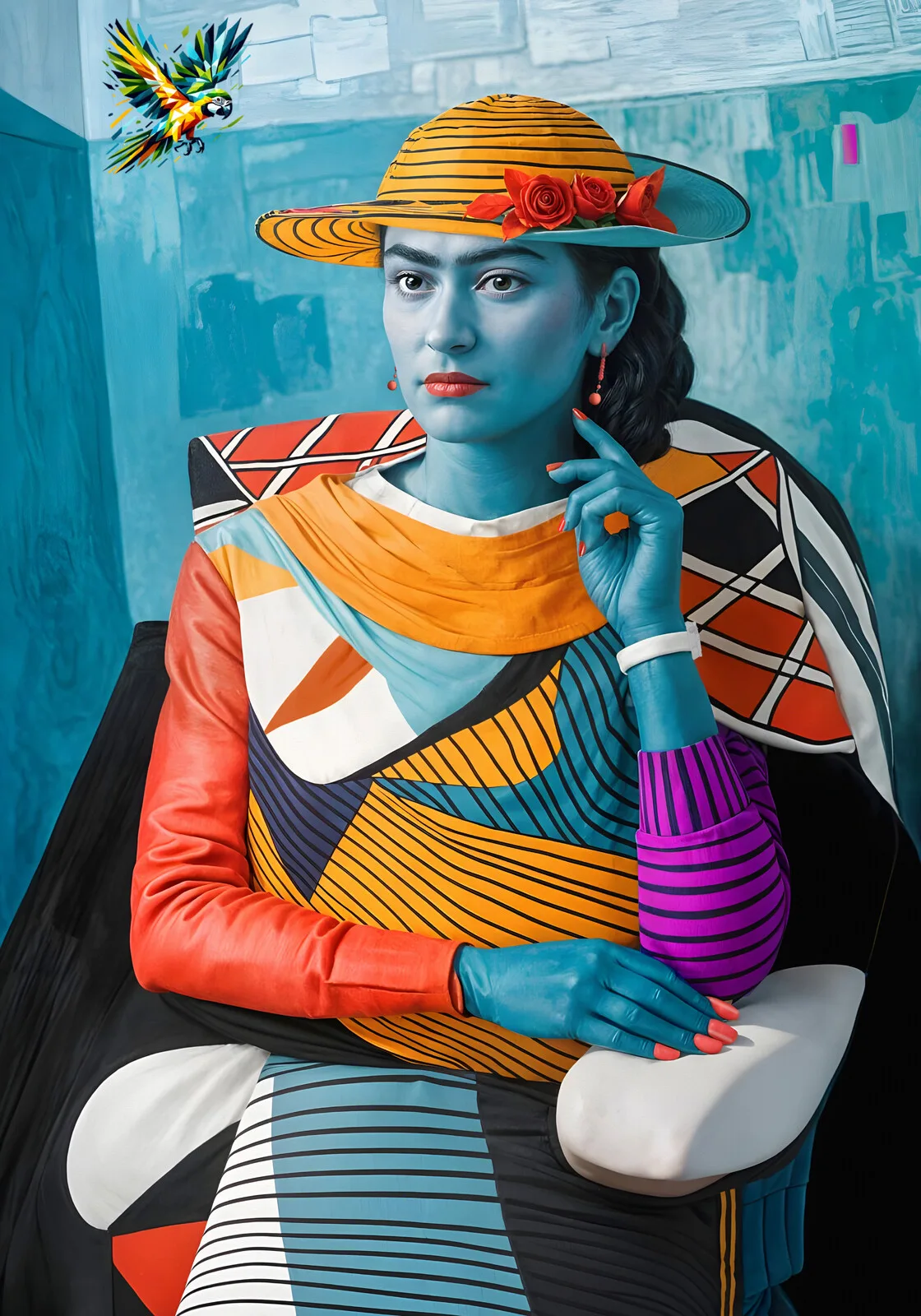
Frida Kahlo, Portrait of Frida Kahlo, 2025
Digital
70 x 100 cm
5 200 kr
Frida Kahlo, Portrait of Frida Kahlo
Frida and Picasso: A Meeting of Sparks and Shapes
When the unique artistic voices of Frida Kahlo and Pablo Picasso collided, a vibrant dialogue was born. In the prime of his imagined youth, Picasso's charm was calculated yet irresistible. Frida, vibrant and unyielding, matched his wit with sharp candour and an artist’s unwavering curiosity. Their conversation danced between flirtation and philosophy, from the fractured beauty of Cubism to the muses who had inspired his fragmented masterpieces. With every word, Picasso sought to draw her closer, to persuade her to see the world through his kaleidoscopic lens, but Frida, ever her own master, was not so easily swayed.
Their dialogue was a mix of sharp banter, shared insight, and a spark that bridged the gap between the abstract and the profoundly personal. Could Picasso's Cubism, a revolutionary art movement that depicted objects from multiple viewpoints, resonate with Frida’s deeply symbolic, emotional art? Their exchange promised to reveal the genesis of a revolutionary movement and how two great artists could inspire and challenge each other across eternity, through their deeply personal narratives in artistic expression.
Will you join their dreams? Please read on and delve deeper into the artistic dialogue between Frida Kahlo and Pablo Picasso.
“A face of Cubism
A cute face whispers, "Break me apart,
Shatter the rules, rewire the heart."
Geometry bends where the eye cannot see,
A prism of truths in fractured debris.
“Be gentle,” the face softly pleads,
“For beauty’s a gift every soul needs.”
Arms and legs echo, “Do us no harm,
Though twisted, we stand, still keep our charm.”
Shapes collide, a chaotic embrace,
Circles and angles distort the face.
Eyes unmoored, a nose astray,
A mouth in shadow, yearning to stay.
Why hold to lines that bind the soul?
Why cling to mirrors that make us whole?
For in the breaking, a vision is born,
A dream remade, not merely torn.
The world is not flat; it twists and turns,
Each angle is a story, and each fragment burns.
Cubism whispers, "See what is true,
Not what you’re shown, but all points of view."
In bending time, it captures space,
A single moment, every place.
Through shards of colour and splintered form,
It tells of chaos yet keeps us warm.
For life itself is a fractured thing,
A broken tune the heartstrings sing.
And Cubism dares, with its fractured art,
To hold the pieces and call it a heart.
And as the face meets the broken lines,
It sees the beauty within the designs.
“I am not lost,” it softly cries,
“In this fractured art, my soul still lies.”
Malmö January 2025
Frida and Pablo: A Meeting Between Masters
To have her facial features—eyes, nose, mouth—shifted and overlapping, her once-beautiful face fragmented and rearranged. The rouge on her cheeks, the red lips, and the carefully painted lashes were rendered in muted earthy tones or vibrant contrasts, emphasising form over realism. The light and shadows, stylised and fragmented, contributed to an abstract, dynamic essence in the work, a quality that Picasso often sought to capture in his art. It wasn’t exactly what the woman had seen in the mirror before sitting down after carefully applying her makeup.
Frida had interviewed several of Picasso’s muses. They all resided on his star and were still his muses. Just as Hugh Hefner had maintained a shared home for his women in eternity, Picasso had done the same.
The first Frida met was Fernande Olivier, Picasso’s partner during his early Cubist period. Their relationship had been stormy, and Fernande’s feelings toward him varied depending on her mood. They reconciled on Picasso’s star; she had forgiven him for distorting her face. Fernande much preferred the portrait from his Blue Period, "Young Woman in a White Blouse" (1905), when his work was imbued with melancholy and introspection.
“That suited my temperament and reflection far better,” Fernande laughed.
“I understand you perfectly,” Frida replied with a knowing smile.
The next muse, whom the women on the star affectionately called "the girls," was Eva Gouel, whom Picasso had nicknamed "Ma Jolie." Tragically, Eva died young from tuberculosis over a century ago. She was a significant inspiration during Picasso’s Synthetic Cubist phase and was another striking beauty. Picasso often painted her with long hair, though she usually wore short, dark locks in a sleek bob.
“He must’ve needed glasses,” Eva quipped dryly.
Frida felt a particular kinship with Dora Maar. Both were fierce, independent women and artists in their own right. A painter and photographer, Dora had been Picasso’s muse during his Surrealist and later Cubist periods. Unlike some muses, she had led a long, productive life and, in eternity, was far more prolific than her lover. Dora was a captivating muse and a vital creative force, bringing freshness to both Picasso’s life and work. Even she admitted that she looked better in life than in his Cubist renderings.
Frida was also drawn to Marie-Thérèse Walter, a woman with an emotional volatility that mirrored Frida’s own. Marie-Thérèse, with her short blonde hair and lithe frame, had been one of Picasso’s most famous muses, immortalised in many of his sensuous portraits. She had taken her life years after Picasso’s death. Picasso’s "Portrait of Marie-Thérèse Walter" (1937) inspired Frida to paint herself in the same pose, in the same room, seated in the same slightly absurd straw hat. However, Frida replaced the ribbon on the hat with her signature flowers and felt she had given her face a more authentic representation. Her beloved parrot even made a guest appearance in the painting.
Despite not being widely known for working in a purely Cubist style, Frida's early works hint at its influence. Her experimentation with various styles and techniques during her recovery from her accident, her exposure to avant-garde movements in Mexico and Europe, and her familiarity with Cubism through artists like Diego Rivera, who had studied in Paris, all demonstrate her courage to challenge artistic norms.
One example of Cubist influence in Frida's work is her painting 'Still Life (Pitahayas)' (1938). While not pure Cubism, it employs geometric forms and fragmented perspectives reminiscent of Cubist techniques. However, Frida’s art was deeply rooted in Mexican tradition, Surrealism, and a profoundly personal, symbolic style that reflected her emotions and experiences. Her art's individual and metaphorical nature connects the audience to her emotional journey.
Frida's art defied categorisation by any specific artistic movement. Her paintings, deeply entwined with her story and identity, represented a unique hybrid style rather than adherence to any particular 'ism '. This uniqueness of her art will intrigue art enthusiasts, students, and scholars alike.
When planning a major retrospective, Frida decided to give the Cubist genre another chance. She knew precisely which artwork to tackle first: Picasso’s 'Portrait of Marie-Thérèse Walter' from 1937. This deeply iconic work is rooted in Picasso's complex, turbulent relationship with Marie-Thérèse, his mistress, muse, and one of the most important women in his life during the 1920s and 1930s. By revisiting this work in a Cubist context, Frida aimed to explore the artistic dialogue between her deeply personal, symbolic style and the more abstract, multi-perspective approach to Cubism.
Frida and Pablo: A Meeting Between Masters
Frida sat at her easel in the combined guestroom and studio at Picasso’s mansion, her fingers playfully smudged with paint. She studied her host before her, blending curiosity and scepticism in her gaze. Pablo Picasso had arrived with the charisma and charm that only a man of his stature could command. He had assumed his most flattering form—a forty-something Picasso, vital, magnetic, and smiling in a way that could melt even the iciest of hearts.
"Frida," Pablo said in a low, seductive tone as he took her hand. "It’s an honour to meet a woman whose art is as wild and free as my soul."
Frida pulled her hand away, though a slight smile betrayed her amusement. "Flattery, Pablo? I thought Cubists dealt in straight lines, not curvy compliments."
Pablo laughed and leaned closer as if accidentally brushing her cheek. "Ah, but even the most geometric shapes need some warmth to come alive, don’t they? That’s why I’m here. I hear you’re considering exploring Cubism. What can I say to inspire you?"
Frida leaned back, sceptical yet intrigued. "Tell me why you started it. What made you want to break reality apart and piece it together like a puzzle?"
Pablo placed a hand on her easel, his fingers just millimetres from hers. "Frida, reality is never as simple as it seems. The central perspective we’ve used for centuries—it’s a lie. Cézanne, my master, taught me to see the world as it truly is—cylinders, spheres, and cones. I wanted to show everything at once—all angles, all secrets, all truths." Frida listened intently, her eyes reflecting a mix of understanding and challenge. She was not one to accept a new perspective without questioning it.
His gaze lingered on Frida’s face, and he couldn’t resist reaching forward to adjust a strand of hair that had fallen across her forehead. "You see, it’s not just a technique. It’s a way of thinking, a way of feeling."
Frida pulled away, but not without a faint blush. "And African masks? I’ve heard they inspired you. You took other cultures and made them your own."
Pablo grinned, undeterred. "Yes, African masks, primitive forms—they showed me the strength in simplicity. It’s not about stealing, Frida; it’s about learning. Their art was free from Western ideals of beauty and proportion. I wanted to do the same. Create something new. Something no one had ever seen before."
Frida leaned forward, her interest piqued despite herself. "And science? Einstein? Was that truly an inspiration?"
Pablo nodded, letting his hand rest on her shoulder for a moment longer than necessary. "Absolutely. Relativity. The idea is that time and space are flexible. Cubism is our version of that. An attempt to capture everything at once, to show reality as a mosaic rather than a linear story."
Frida laughed, a warm, melodic sound that made Pablo smile triumphantly. "And all this to justify painting a woman with two faces, right?"
"Frida," Pablo said with theatrical resignation, "a woman always has at least two faces. I show it to the world."
She stood, and for a moment, they were eye to eye. "Thank you for the lesson, Pablo. Maybe I should try it. Break apart my world and reassemble it in my way."
Pablo leaned in and kissed her hand lightly. "If anyone can make it more beautiful than I did, Frida, it’s you. And if you need a model for your experiments, you know where to find me."
Frida laughed and withdrew her hand. "I think I’ll manage without you, Pablo. But thank you anyway."
As he left, exuding his characteristic self-assurance, Frida couldn’t help but smile. Picasso had tried to charm himself into her bed, but in the end, he had given her something far more valuable: a spark—a new way of seeing.
It was time for her cubist self-portrait, ‘Portrait of Frida Kahlo.’
Jörgen Thornberg
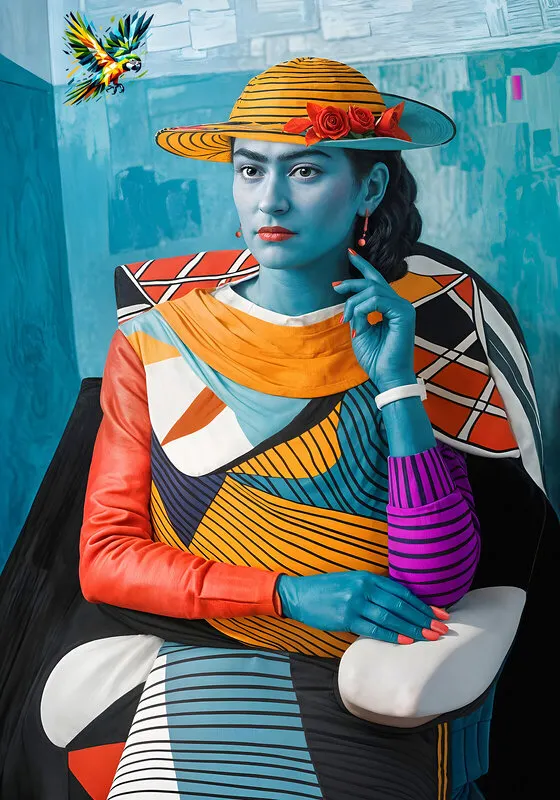
Frida Kahlo, Portrait of Frida Kahlo, 2025
Digital
70 x 100 cm
5 200 kr
Frida Kahlo, Portrait of Frida Kahlo
Frida and Picasso: A Meeting of Sparks and Shapes
When the unique artistic voices of Frida Kahlo and Pablo Picasso collided, a vibrant dialogue was born. In the prime of his imagined youth, Picasso's charm was calculated yet irresistible. Frida, vibrant and unyielding, matched his wit with sharp candour and an artist’s unwavering curiosity. Their conversation danced between flirtation and philosophy, from the fractured beauty of Cubism to the muses who had inspired his fragmented masterpieces. With every word, Picasso sought to draw her closer, to persuade her to see the world through his kaleidoscopic lens, but Frida, ever her own master, was not so easily swayed.
Their dialogue was a mix of sharp banter, shared insight, and a spark that bridged the gap between the abstract and the profoundly personal. Could Picasso's Cubism, a revolutionary art movement that depicted objects from multiple viewpoints, resonate with Frida’s deeply symbolic, emotional art? Their exchange promised to reveal the genesis of a revolutionary movement and how two great artists could inspire and challenge each other across eternity, through their deeply personal narratives in artistic expression.
Will you join their dreams? Please read on and delve deeper into the artistic dialogue between Frida Kahlo and Pablo Picasso.
“A face of Cubism
A cute face whispers, "Break me apart,
Shatter the rules, rewire the heart."
Geometry bends where the eye cannot see,
A prism of truths in fractured debris.
“Be gentle,” the face softly pleads,
“For beauty’s a gift every soul needs.”
Arms and legs echo, “Do us no harm,
Though twisted, we stand, still keep our charm.”
Shapes collide, a chaotic embrace,
Circles and angles distort the face.
Eyes unmoored, a nose astray,
A mouth in shadow, yearning to stay.
Why hold to lines that bind the soul?
Why cling to mirrors that make us whole?
For in the breaking, a vision is born,
A dream remade, not merely torn.
The world is not flat; it twists and turns,
Each angle is a story, and each fragment burns.
Cubism whispers, "See what is true,
Not what you’re shown, but all points of view."
In bending time, it captures space,
A single moment, every place.
Through shards of colour and splintered form,
It tells of chaos yet keeps us warm.
For life itself is a fractured thing,
A broken tune the heartstrings sing.
And Cubism dares, with its fractured art,
To hold the pieces and call it a heart.
And as the face meets the broken lines,
It sees the beauty within the designs.
“I am not lost,” it softly cries,
“In this fractured art, my soul still lies.”
Malmö January 2025
Frida and Pablo: A Meeting Between Masters
To have her facial features—eyes, nose, mouth—shifted and overlapping, her once-beautiful face fragmented and rearranged. The rouge on her cheeks, the red lips, and the carefully painted lashes were rendered in muted earthy tones or vibrant contrasts, emphasising form over realism. The light and shadows, stylised and fragmented, contributed to an abstract, dynamic essence in the work, a quality that Picasso often sought to capture in his art. It wasn’t exactly what the woman had seen in the mirror before sitting down after carefully applying her makeup.
Frida had interviewed several of Picasso’s muses. They all resided on his star and were still his muses. Just as Hugh Hefner had maintained a shared home for his women in eternity, Picasso had done the same.
The first Frida met was Fernande Olivier, Picasso’s partner during his early Cubist period. Their relationship had been stormy, and Fernande’s feelings toward him varied depending on her mood. They reconciled on Picasso’s star; she had forgiven him for distorting her face. Fernande much preferred the portrait from his Blue Period, "Young Woman in a White Blouse" (1905), when his work was imbued with melancholy and introspection.
“That suited my temperament and reflection far better,” Fernande laughed.
“I understand you perfectly,” Frida replied with a knowing smile.
The next muse, whom the women on the star affectionately called "the girls," was Eva Gouel, whom Picasso had nicknamed "Ma Jolie." Tragically, Eva died young from tuberculosis over a century ago. She was a significant inspiration during Picasso’s Synthetic Cubist phase and was another striking beauty. Picasso often painted her with long hair, though she usually wore short, dark locks in a sleek bob.
“He must’ve needed glasses,” Eva quipped dryly.
Frida felt a particular kinship with Dora Maar. Both were fierce, independent women and artists in their own right. A painter and photographer, Dora had been Picasso’s muse during his Surrealist and later Cubist periods. Unlike some muses, she had led a long, productive life and, in eternity, was far more prolific than her lover. Dora was a captivating muse and a vital creative force, bringing freshness to both Picasso’s life and work. Even she admitted that she looked better in life than in his Cubist renderings.
Frida was also drawn to Marie-Thérèse Walter, a woman with an emotional volatility that mirrored Frida’s own. Marie-Thérèse, with her short blonde hair and lithe frame, had been one of Picasso’s most famous muses, immortalised in many of his sensuous portraits. She had taken her life years after Picasso’s death. Picasso’s "Portrait of Marie-Thérèse Walter" (1937) inspired Frida to paint herself in the same pose, in the same room, seated in the same slightly absurd straw hat. However, Frida replaced the ribbon on the hat with her signature flowers and felt she had given her face a more authentic representation. Her beloved parrot even made a guest appearance in the painting.
Despite not being widely known for working in a purely Cubist style, Frida's early works hint at its influence. Her experimentation with various styles and techniques during her recovery from her accident, her exposure to avant-garde movements in Mexico and Europe, and her familiarity with Cubism through artists like Diego Rivera, who had studied in Paris, all demonstrate her courage to challenge artistic norms.
One example of Cubist influence in Frida's work is her painting 'Still Life (Pitahayas)' (1938). While not pure Cubism, it employs geometric forms and fragmented perspectives reminiscent of Cubist techniques. However, Frida’s art was deeply rooted in Mexican tradition, Surrealism, and a profoundly personal, symbolic style that reflected her emotions and experiences. Her art's individual and metaphorical nature connects the audience to her emotional journey.
Frida's art defied categorisation by any specific artistic movement. Her paintings, deeply entwined with her story and identity, represented a unique hybrid style rather than adherence to any particular 'ism '. This uniqueness of her art will intrigue art enthusiasts, students, and scholars alike.
When planning a major retrospective, Frida decided to give the Cubist genre another chance. She knew precisely which artwork to tackle first: Picasso’s 'Portrait of Marie-Thérèse Walter' from 1937. This deeply iconic work is rooted in Picasso's complex, turbulent relationship with Marie-Thérèse, his mistress, muse, and one of the most important women in his life during the 1920s and 1930s. By revisiting this work in a Cubist context, Frida aimed to explore the artistic dialogue between her deeply personal, symbolic style and the more abstract, multi-perspective approach to Cubism.
Frida and Pablo: A Meeting Between Masters
Frida sat at her easel in the combined guestroom and studio at Picasso’s mansion, her fingers playfully smudged with paint. She studied her host before her, blending curiosity and scepticism in her gaze. Pablo Picasso had arrived with the charisma and charm that only a man of his stature could command. He had assumed his most flattering form—a forty-something Picasso, vital, magnetic, and smiling in a way that could melt even the iciest of hearts.
"Frida," Pablo said in a low, seductive tone as he took her hand. "It’s an honour to meet a woman whose art is as wild and free as my soul."
Frida pulled her hand away, though a slight smile betrayed her amusement. "Flattery, Pablo? I thought Cubists dealt in straight lines, not curvy compliments."
Pablo laughed and leaned closer as if accidentally brushing her cheek. "Ah, but even the most geometric shapes need some warmth to come alive, don’t they? That’s why I’m here. I hear you’re considering exploring Cubism. What can I say to inspire you?"
Frida leaned back, sceptical yet intrigued. "Tell me why you started it. What made you want to break reality apart and piece it together like a puzzle?"
Pablo placed a hand on her easel, his fingers just millimetres from hers. "Frida, reality is never as simple as it seems. The central perspective we’ve used for centuries—it’s a lie. Cézanne, my master, taught me to see the world as it truly is—cylinders, spheres, and cones. I wanted to show everything at once—all angles, all secrets, all truths." Frida listened intently, her eyes reflecting a mix of understanding and challenge. She was not one to accept a new perspective without questioning it.
His gaze lingered on Frida’s face, and he couldn’t resist reaching forward to adjust a strand of hair that had fallen across her forehead. "You see, it’s not just a technique. It’s a way of thinking, a way of feeling."
Frida pulled away, but not without a faint blush. "And African masks? I’ve heard they inspired you. You took other cultures and made them your own."
Pablo grinned, undeterred. "Yes, African masks, primitive forms—they showed me the strength in simplicity. It’s not about stealing, Frida; it’s about learning. Their art was free from Western ideals of beauty and proportion. I wanted to do the same. Create something new. Something no one had ever seen before."
Frida leaned forward, her interest piqued despite herself. "And science? Einstein? Was that truly an inspiration?"
Pablo nodded, letting his hand rest on her shoulder for a moment longer than necessary. "Absolutely. Relativity. The idea is that time and space are flexible. Cubism is our version of that. An attempt to capture everything at once, to show reality as a mosaic rather than a linear story."
Frida laughed, a warm, melodic sound that made Pablo smile triumphantly. "And all this to justify painting a woman with two faces, right?"
"Frida," Pablo said with theatrical resignation, "a woman always has at least two faces. I show it to the world."
She stood, and for a moment, they were eye to eye. "Thank you for the lesson, Pablo. Maybe I should try it. Break apart my world and reassemble it in my way."
Pablo leaned in and kissed her hand lightly. "If anyone can make it more beautiful than I did, Frida, it’s you. And if you need a model for your experiments, you know where to find me."
Frida laughed and withdrew her hand. "I think I’ll manage without you, Pablo. But thank you anyway."
As he left, exuding his characteristic self-assurance, Frida couldn’t help but smile. Picasso had tried to charm himself into her bed, but in the end, he had given her something far more valuable: a spark—a new way of seeing.
It was time for her cubist self-portrait, ‘Portrait of Frida Kahlo.’
5 200 kr

Jörgen Thornberg
Malmö
Lite om bilder och mig. Translation in English at the end.
Jag är en nyfiken person som ser allt i bilder, även det jag fäster i ord, gärna tillsammans för bakom alla mina bilder finns en berättelse. Till vissa bilder hör en kortare eller längre novell som följer med bilden.
Bilder berättar historier. Jag omges av naturlig skönhet, intressanta människor och historia var jag än går. Jag använder min kamera för att dokumentera världen och blanda det jag ser med vad jag känner för att fånga den dolda magin.
Mina bilder berättar mina historier. Genom mina bilder, tryck och berättelser. Jag bjuder in dig att ta del av dessa berättelser, in i ditt liv och hem och dela min mycket personliga syn på vår värld. Mer än vad ögat ser. Jag tänker i bilder, drömmer och skriver och pratar om dem; följaktligen måste jag också skapa bilder. De blir vad jag ser, inte nödvändigtvis begränsade till verkligheten. Det finns en bild runt varje hörn. Jag hoppas att du kommer att se vad jag såg och gilla det.
Jag är också en skrivande person och till många bilder hör en kortare eller längre essay. Den följer med tavlan, tryckt på fint papper och med en personlig hälsning från mig.
Flertalet bilder startar sin resa i min kamera. Enkelt förklarat beskriver jag bilden jag ser i mitt inre, upplevd eller fantiserad. Bilden uppstår inom mig redan innan jag fått okularet till ögat. På bråkdelen av ett ögonblick ser jag vad jag vill ha och vad som kan göras med bilden. Här skall jag stoppa in en giraff, stålmannen, Titanic eller vad det är min fantasi finner ut. Ännu märkligare är att jag kommer ihåg minnesbilden långt efteråt när det blir tid att skapa verket. Om jag lyckas eller inte, är upp till betraktaren, oftast präglat av en stråk av svart humor – meningen är att man skall bli underhållen. Mina bilder blir ofta en snackis där de hänger.
Jag föredrar bilder som förmedlar ett budskap i flera lager. Vid första anblicken fylld av feel-good, en vacker utsikt, fint väder, solen skiner, blommor på ängen eller vattnet som ligger förrädiskt spegelblankt. I en sådan bild kan jag gömma min egentliga berättelse, mitt förakt för förtryckare och våldsverkare, rasister och fördomsfulla människor - ett gärna återkommande motiv mer eller mindre dolt i det vackra motivet. Jag försöker förena dem i ett gemensamt narrativ.
Bild och formgivning har löpt som en röd tråd genom livet. Fotokonst känns som en värdig final som jag gärna delar med mig.
Min genre är vid som framgår av mina bilder, temat en blandning av pop- och gatukonst i kollage som kan bestå av hundratals lager. Vissa bilder kan ta veckor, andra någon dag innan det är dags att överlämna resultatet till printverkstaden. Fine Art Prints är digitala fotocollage. I dessa kollage sker rivandet, klippandet, pusslandet, målandet, ritandet och sprayningen digitalt. Det jag monterar in kan vara hundratals år gamla bilder som jag omsorgsfullt frilägger så att de ser ut att vara en del av tavlan men också bilder skapade av mig själv efter min egen fantasi. Därefter besöks printstudion och för vissa bilder numrera en limiterad upplaga (oftast 7 exemplar) och signera för hand. Vissa bilder kan köpas i olika format. Det är bara att fråga efter vilka. Gillar man en bild som är 70x100 men inte har plats på väggen, går den kanske att få i 50x70 cm istället. Frågan är fri.
Metoden Giclée eller Fine Art Print som det också kallas är det moderna sättet för framställning av grafisk konst. Villkoret för denna typ av utskrifter är att en högkvalitativ storformatskrivare används med åldersbeständigt färgpigment och konstnärspapper eller i förekommande fall på duk. Pappret som används möter de krav på livslängd som ställs av museer och gallerier. Normalt säljer jag mina bilder oinramade så att den nya ägaren själv kan bestämma hur de skall se ut, med eller utan passepartout färg på ram, med eller utan glas etc..
Under många år ställde jag bara ut på nätet, i valda grupper och på min egen Facebooksida - https://www.facebook.com/jorgen.thornberg.9
Jag finns också på en egen hemsida som tyvärr inte alltid är uppdaterad – https://www.jth.life/ Där kan du också läsa en del av de berättelser som följer med bilden.
UTSTÄLLNINGAR
Luftkastellet, oktober 2022
Konst i Lund, november 2022
Luftkastellet, mars 2023
Engleson Galleri Caroli, april 2023
Hydra, Greece June 2023
Engleson Galleri Caroli, oktober 2023
Toppen, Höllviken december 2023
Luftkastellet, mars 2024
Torups Galleri, mars 2024
Venice, May 2024
Luftkastellet, oktober 2024
Konst i Advent, December 2024
Galleri Engleson, Caroli December 2024
Jäger & Jansson Galleri, april 2025
A bit about pictures and me.
I'm a curious person who sees everything in pictures, even what I express in words, often combining them, for behind all my pictures lies a story. These narratives, some as short as a single image and others as long as a novel, are the heart and soul of my work.
Pictures tell stories. Wherever I go, I'm surrounded by natural beauty, exciting people, and history. I use my camera to document the world and blend what I see with what I feel to capture the hidden magic.
My images tell my stories. Through my pictures, prints, and narratives, I invite you to partake in these stories in your life and home and share my deeply personal perspective of our world. More than meets the eye. I think in pictures, dream, write, and talk about them; consequently, I must create images too. They become what I see, not necessarily confined to reality. There's a picture around every corner. I hope you'll see what I saw and enjoy it.
I'm also a writer, and many images come with a shorter or longer essay. It accompanies the painting, printed on fine paper with my personal greeting.
Many pictures start their journey on my camera. Simply put, I describe the image I see in my mind, experienced or imagined. The image arises within me even before I bring the eyepiece to my eye. In a fraction of a moment, I see what I want and what can be done with the picture. Here, I'll insert a giraffe, Superman, the Titanic, or whatever my imagination conjures up. Even stranger is that I remember the mental image long after it's time to create the work. Whether I succeed is up to the observer, often imbued with a streak of black humour – the aim is to entertain. My pictures usually become a talking point wherever they hang.
I prefer pictures that convey a message in multiple layers. At first glance, they're filled with feel-good vibes, a beautiful view, lovely weather, the sun shining, flowers in the meadow, or the water lying deceptively calm. But beneath this surface beauty, I often conceal a deeper story, a narrative that challenges societal norms or explores the human condition. I invite you to delve into these hidden narratives and discover the layers of meaning within my work.
Picture and design have been a thread running through my life. Photographic art feels like a fitting finale, and I'm happy to share it.
My genre is varied, as seen in my pictures; the theme is a blend of pop and street art in collages that can consist of hundreds of layers. Some images can take weeks, others just a day before it's time to hand over the result to the print workshop. Fine Art Prints are digital photo collages. In these collages, tearing, cutting, puzzling, painting, drawing, and spraying happen digitally. What I insert can be images hundreds of years old that I carefully extract so they appear to be part of the painting, but also images created by myself, now also generated from my imagination. Next, visit the print studio and, for certain images, number a limited edition (usually 7 copies) and sign them by hand. Some images may be available in other formats. Just ask which ones. If you like an image that's 70x100 but doesn't have space on the wall, you might be able to get it in 50x70 cm instead. The question is open.
The Giclée method, or Fine Art Print as it's also called, is the modern way of producing graphic art. This method ensures the highest quality and longevity of the artwork, using a high-quality large-format printer with archival pigment inks and artist paper or, in some cases, canvas. The paper used meets the longevity requirements set by museums and galleries. I sell my pictures unframed, allowing the new owner to personalise their artwork, confident in the lasting value and quality of the piece.
For many years, I only exhibited online, in selected groups, and on my Facebook page - https://www.facebook.com/jorgen.thornberg.9. I also have my website, which unfortunately is not constantly updated - https://www.jth.life/. You can also read some of the stories accompanying the pictures there.
EXHIBITIONS
Luftkastellet, October 2022
Art in Lund, November 2022
Luftkastellet, March 2023
Engleson Gallery Caroli, April 2023
Hydra, Greece June 2023
Engleson Gallery Caroli, October 2023
Toppen, Höllviken December 2023
Luftkastellet, March 2024
Torup Gallery, March 2024
Venice, May 2024
UTSTÄLLNINGAR
Luftkastellet, oktober 2022
Konst i Lund, november 2022
Luftkastellet, mars 2023
Engleson Galleri Caroli, april 2023
Hydra, Greece June 2023
Engleson Galleri Caroli, oktober 2023
Toppen, Höllviken december 2023
Luftkastellet, mars 2024
Torups Galleri, mars 2024
Venice, May 2024
Luftkastellet, October 2024
Konst i Advent, December 2024
Galleri Engleson, Caroli December 2024
Jäger & Jansson Galleri, April 2025
Utbildning
Autodidakt
Medlem i konstnärsförening
Öppna Sinnen
Med i konstrunda
Konstrundan i Skåne
Utställningar
Luftkastellet, October 2022
Art in Lund, November 2022
Luftkastellet, March 2023
Engleson Gallery Caroli, April 2023
Hydra, Greece June 2023
Engleson Gallery Caroli, October 2023
Toppen, Höllviken December 2023
Luftkastellet, March 2024
Torup Gallery, March 2024
Venice, May 2024