Vi använder cookies för att ge dig bästa möjliga upplevelse. Välj vilka cookies du tillåter.
Läs mer i vår integritetspolicy
Jörgen Thornberg
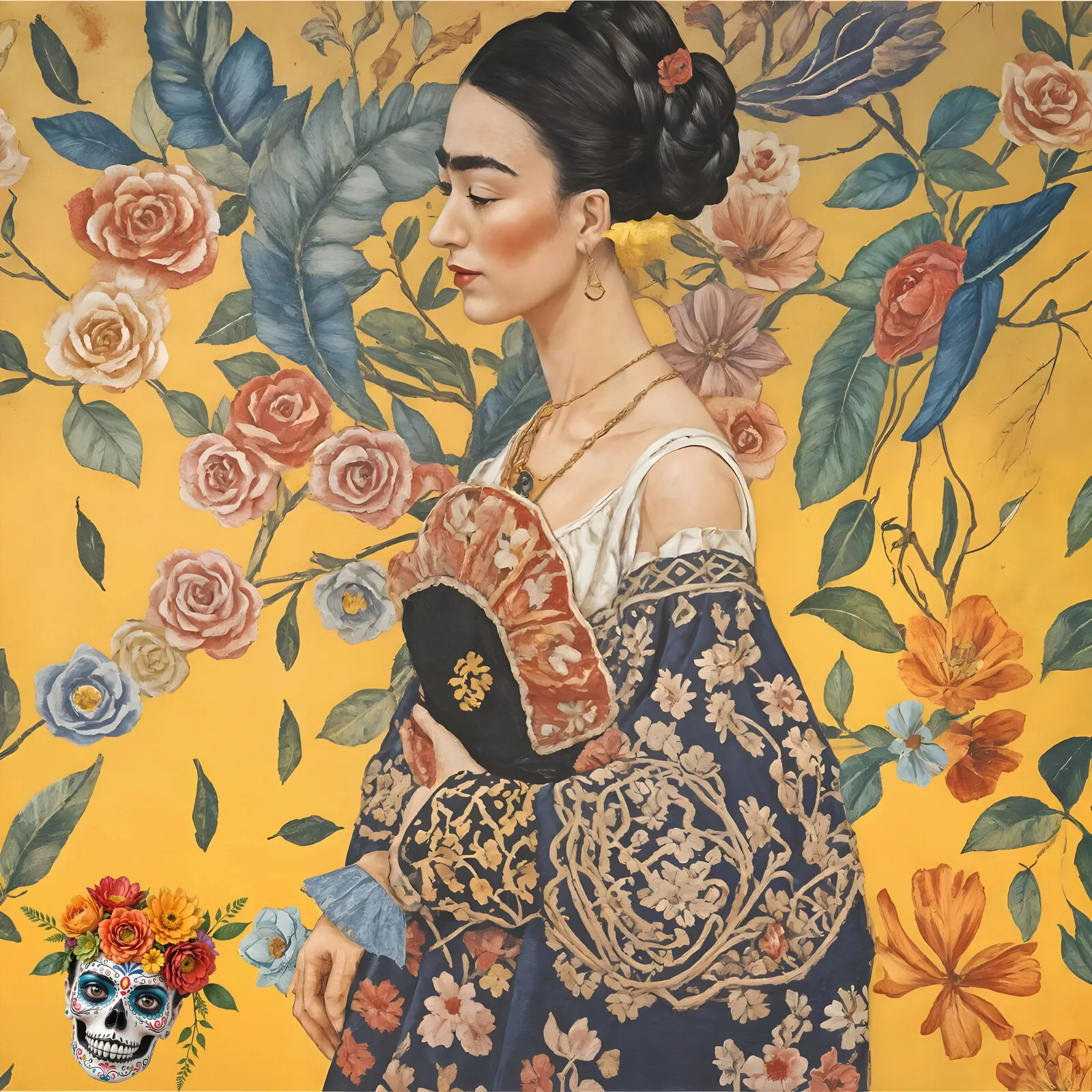
Frida Kahlo with a Fan, 2024
Digital
80 x 80 cm
4 500 kr
Frida Kahlo with a Fan
“Behind the Fan
Behind the fan, a mystery lies,
A woman's world beneath disguise.
A fluttered breeze, a painted screen,
Hides truths unseen; what could it mean?
Her eyes peek out, a fleeting glance,
A silent question, a daring dance.
Is it charm, or is it fear,
What stories whisper, drawing near?
The fan conceals, yet it reveals,
The hidden truths a glance unseals.
The secrets of her heart are confined,
Yet hinted through the veiled design.
Behind the fan, her soul takes flight,
A storm of shadows, beams of light.
A thousand thoughts, a silent song,
Of battles fought and where she belongs.
Her truest face, a fleeting spark,
Soft as dawn or sharp as dark.
The fan, a shield, a delicate art,
Protecting dreams, her fragile heart.
For what she hides, the world may crave,
But what she shows is just as brave.
Behind the fan, her story dwells,
A quiet tale no tongue can tell.
So let her hold it, let it stay,
Her guard, her grace, her chosen way.
Behind the fan, she reigns supreme,
A living poem, a waking dream.
Malmö, December 2024
In July, Frida had been in Malmö for almost a year and had already performed in three plays at the Nöjesteatern. By autumn, she was scheduled for a fourth. It was also seventy years since she had left Earth to journey to her star. The thirteenth of July held no special reason for her to celebrate. Time-travelers rarely have cause to commemorate their death dates, as they dislike speaking about death. Moreover, most perceive eternity as infinitely preferable to their time on Earth. Behind them, they leave pain and illness, and in eternity, they can live at any age of their choosing, free from the fear of death or other anxieties.
However, Frida chose to honour her short life on Earth—only forty-seven years—because of a celebrated event in the art world: the Frida Kahlo Retrospective. This retrospective, celebrating women's strength and resilience, uplifted and empowered all who experienced it. Frida's version of Klimt's ‘Woman with Fan’ was one of many important paintings.
It brought together all the paintings Frida had created after she had laid down her brush for the last time. Her life had been marked by severe health issues, and from 1953, she was bedridden following an amputation. However, this did not deter her from her passion for painting or even participating in political events; her bed was carried wherever she wished to go, a testament to her unwavering determination and courage. Her resilience in the face of adversity is a source of inspiration for all.
Frida embarked on an ambitious project that set her apart from other artists in eternity. She encountered creators from all eras and decided to paint extraordinary women from history with whom she identified. This unique project, with its fresh and innovative interpretations of historical art, was a testament to her creativity and the power of art to transcend time and space, sparking intrigue and appreciation among audiences. It remained unknown until the paintings were discovered recently—not by chance, but carefully orchestrated by Frida herself.
Thus, the paintings at Malmö’s Moderna Museet, including canvases and statues featuring Frida, reimagine well-known motifs but now incorporate her face and body. The entire collection was discovered in a hidden room behind a wall at Casa Azul, her home in the Coyoacán neighbourhood of Mexico City. Three dozen previously unknown paintings caused a global sensation and sparked intense debate, as their style did not match her known works. The international attention these paintings received underscored the exhibition's significance, making it a cultural event of global importance. The world was particularly captivated by Frida’s interpretation of Gustav Klimt’s Woman with a Fan.
Frida Kahlo shared with me her personal and spiritual reflection on this piece. I cannot recount the entire story except as part of a whimsical exhibition presentation. However, art experts summoned to study the collection were supported by notes Frida had left alongside the paintings. The handwriting was unmistakably hers, and the commentary was essential for understanding the purpose of the works and why she had hidden them. Simply put, the world of the 1950s was not ready for such messages—they had to wait for their time, and that time is now. I quote Frida’s own words:
“When I first saw Klimt’s ‘Woman with a Fan’, I immediately felt she was speaking to me, as though her gaze sought something I had long been searching for. It wasn’t just a painting—it was a mirror—a mirror of the beauty, mystery, and pain that we as women carry within us. I imagined myself in her place, a different kind of woman, yet the same.
I absorbed the decorative, nonfigurative background winding around her and realised it wasn’t merely a backdrop—it was her world. It was chaotic and rich, and I wanted to fill it with my favourite flowers, as though she bore all of nature’s beauty and burden in her gaze. I thought: ‘That could be me. Or you. We are all part of this web of life and colour.’”
And the fan—it was no mere ornament. It was a tool, shield, or symbol of her control over her life. She held it with such natural grace, and I saw how she balanced between a symbol and a real woman. It was as if she were saying, “I’m not just here to be seen—I am looking back at you.”
When I painted my version, I realised something important. The nameless woman wasn’t just a woman. She was every woman who has ever stood between the chaos of the world and her own heart. Klimt, I believe, understood this. He concealed her identity not to anonymise but to allow us to fill her with ourselves. Of course, he had a model, someone he knew well. I won’t reveal her name because it doesn’t matter.
I painted my face in her place because it was impossible for me not to see myself there. I painted the background with colours representing my world: roses and flowers from Mexico, blossoms and leaves from my dreams. I thought, “If the world sees me now, let them see everything I carry, everything I am.”
But there was more than just beauty in her—there was impermanence. I saw the flowers wilting behind her, and the peacock, so proud and beautiful, was also a symbol of how we are created and lost to time. Just like myself—my body, which bore pain and transformation but still created, painted, and loved. I wonder if Klimt saw in her what I saw in myself: the strength in our fragility. Yet my flowers were in full bloom, and impermanence was relegated to a corner where I tucked in my favourite skull.
And what was Klimt trying to say? He wanted us to stop and see—not just to look at her but to truly see her as a part of the world and a part of us. He wanted us to understand that beauty doesn’t exist in isolation—it reflects life, with all its complexity and transience.
So, yes, I copied his motif but did not imitate it. I placed myself there to say, “Here I am. And here you are. We are the same, yet different. We all carry a fan and vanish with time, but we leave behind something greater than ourselves.”
I hung my version alongside my other works and smiled when I finished the painting. Klimt created a woman with a fan; I made a woman who sees the world and holds onto her heart. At that moment, he and I were equals. Two artists are trying to understand life, one brushstroke at a time. Now, in eternity, without answers to the original questions. Because in the timeless space where we meet people from all eras and cultures, we realise that the eternal questions have no definitive answers. The mystery of life is as infinite as the questions themselves. And the painting belongs to Klimt’s more modestly clothed works, which suits me just fine. Frida laughed shyly.
A prudish society harshly criticised Klimt for his naked women. A hallmark of his style at the end of the 19th century was the inclusion of ‘Nuda Veritas’ (naked truth) as a symbolic figure in some of his works, such as ‘Ancient Greece and Egypt’ (1891), ‘Pallas Athene’ (1898), and ‘Nuda Veritas’ (1899). Frida recounted that Klimt revealed his ‘Nuda Veritas’ paintings as his way of denouncing both the policies of the Habsburgs and Austrian society, which ignored the political and social problems of the time. ‘Veritas’ refers to the Roman virtue of truthfulness, considered one of the main virtues of a good Roman citizen. The ‘Nuda Veritas’ is the naked truth, far from being pornographic. Klimt didn’t need pornography; his life was filled with women. His unique muse, Austrian fashion designer Emilie Louise Flöge, was his companion until the end of his life. Their relationship seems platonic, but Klimt fathered fourteen children in total with others. Klimt had many lovers among the women who posed for him, and his intimate relationships with his models are reflected in the sensual portraits he created, particularly in works like ‘The Kiss’ and ‘Danaë’. His studio was famous for being where he both worked and conducted romantic encounters.
His ‘Nuda Veritas’ further defined his mission to challenge the establishment. The starkly naked red-headed woman holds the mirror of truth, with a quote by Friedrich Schiller above her in stylised lettering: “If you cannot please everyone with your deeds and your art, please only a few. To please many is bad.” In 1902, fueled by resentment, Klimt considered titling the painting ‘Gold Fish’, featuring a naked woman ostentatiously showing her buttocks, ‘To My Critics’. Friends dissuaded him. Frida adored the painting and confessed that had she not thought her buttocks too flat, she might have created her version. A raised middle finger sufficed.
As artists, Frida and Klimt differed in how they used the female body to convey their messages. Frida’s art focused more on symbolism, emotion, and experience than depicting the body in a traditionally nude form. She used her body to tell stories of pain, identity, love, and struggle rather than to express herself through pure physical nudity.
In many of her self-portraits, Frida depicted parts of her body, often wounded or fragmented, as metaphors for the physical and emotional pain she endured. An example is ‘Self-Portrait with Thorn Necklace and Hummingbird’ (1940), where she is not naked at all. Yet, her vulnerability and symbolism suggest an emotional nakedness that moral guardians found unproblematic.
In works like ‘Henry Ford Hospital’ (1932) and ‘The Broken Column’ (1944), Frida portrayed her body during difficult moments, such as a miscarriage and surgical interventions. The body is unclothed or partially nude, but not in an idealised way and far from Klimt’s uninhibited and provocative exposures.
In paintings like ‘Roots’ (1943) and ‘Two Nudes in a Forest’ (1939), nudity appears but not as self-portraits. In the latter, she depicts two female bodies in a lesbian relationship, one of whom has features suggesting it could be Frida herself. The other woman was Frida’s friend and lover, Dolores del Rio, a woman she shared with her husband, Diego. He once said of Dolores: “We were totally in love with her, just like forty million Mexicans and one hundred and twenty million Americans who couldn’t be wrong.”
Frida had several colourful affairs with women, including movie stars Dolores del Rio, Paulette Goddard, and Maria Felix. Other lovers included Italian-American photographer Tina Modotti, legendary Mexican singer Chavela Vargas, Jacqueline Lamba, and American painter Georgia O’Keeffe. The details of Frida’s relationship with Parisian nightclub sensation Josephine Baker remain mysterious. However, Frida revealed one detail: she had “eaten” Josephine’s clothes. Knowing that Miss Baker performed wearing nothing but a skirt made of ripe bananas explains it. Unsurprisingly, both today’s feminists and the LGBTQ+ community celebrate Frida. She was undeniably ahead of her time.
The list could go on and be complemented by an equally extensive list of men, including the revolutionary Leon Trotsky. She and Klimt shared a passion for eroticism, which, as Frida claimed, had led to a few nights together on their respective stars. Those who think sexual desire vanishes after earthly life may need to revise their understanding. Since pregnancy and sexually transmitted diseases are no longer concerns, only personal morals serve as limits. According to Frida, her and Klimt’s love life among the stars made the wild rabbits of Gotland seem like monks and nuns.
Frida laughed when I looked slightly puzzled, “Personality comes with you, so you’ll find all kinds of people up here. That’s enough about rabbits.”
Jörgen Thornberg
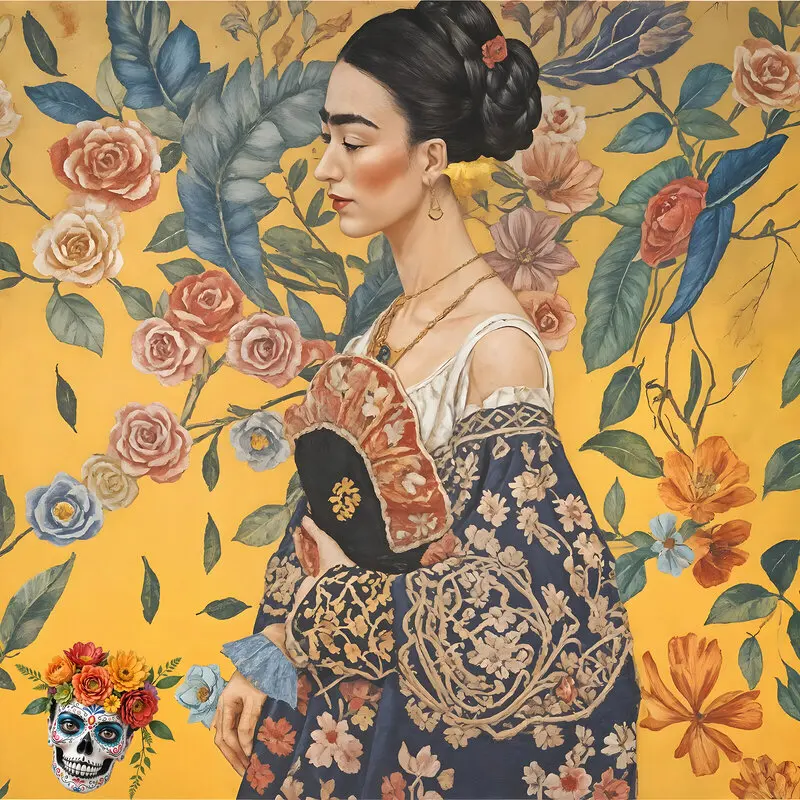
Frida Kahlo with a Fan, 2024
Digital
80 x 80 cm
4 500 kr
Frida Kahlo with a Fan
“Behind the Fan
Behind the fan, a mystery lies,
A woman's world beneath disguise.
A fluttered breeze, a painted screen,
Hides truths unseen; what could it mean?
Her eyes peek out, a fleeting glance,
A silent question, a daring dance.
Is it charm, or is it fear,
What stories whisper, drawing near?
The fan conceals, yet it reveals,
The hidden truths a glance unseals.
The secrets of her heart are confined,
Yet hinted through the veiled design.
Behind the fan, her soul takes flight,
A storm of shadows, beams of light.
A thousand thoughts, a silent song,
Of battles fought and where she belongs.
Her truest face, a fleeting spark,
Soft as dawn or sharp as dark.
The fan, a shield, a delicate art,
Protecting dreams, her fragile heart.
For what she hides, the world may crave,
But what she shows is just as brave.
Behind the fan, her story dwells,
A quiet tale no tongue can tell.
So let her hold it, let it stay,
Her guard, her grace, her chosen way.
Behind the fan, she reigns supreme,
A living poem, a waking dream.
Malmö, December 2024
In July, Frida had been in Malmö for almost a year and had already performed in three plays at the Nöjesteatern. By autumn, she was scheduled for a fourth. It was also seventy years since she had left Earth to journey to her star. The thirteenth of July held no special reason for her to celebrate. Time-travelers rarely have cause to commemorate their death dates, as they dislike speaking about death. Moreover, most perceive eternity as infinitely preferable to their time on Earth. Behind them, they leave pain and illness, and in eternity, they can live at any age of their choosing, free from the fear of death or other anxieties.
However, Frida chose to honour her short life on Earth—only forty-seven years—because of a celebrated event in the art world: the Frida Kahlo Retrospective. This retrospective, celebrating women's strength and resilience, uplifted and empowered all who experienced it. Frida's version of Klimt's ‘Woman with Fan’ was one of many important paintings.
It brought together all the paintings Frida had created after she had laid down her brush for the last time. Her life had been marked by severe health issues, and from 1953, she was bedridden following an amputation. However, this did not deter her from her passion for painting or even participating in political events; her bed was carried wherever she wished to go, a testament to her unwavering determination and courage. Her resilience in the face of adversity is a source of inspiration for all.
Frida embarked on an ambitious project that set her apart from other artists in eternity. She encountered creators from all eras and decided to paint extraordinary women from history with whom she identified. This unique project, with its fresh and innovative interpretations of historical art, was a testament to her creativity and the power of art to transcend time and space, sparking intrigue and appreciation among audiences. It remained unknown until the paintings were discovered recently—not by chance, but carefully orchestrated by Frida herself.
Thus, the paintings at Malmö’s Moderna Museet, including canvases and statues featuring Frida, reimagine well-known motifs but now incorporate her face and body. The entire collection was discovered in a hidden room behind a wall at Casa Azul, her home in the Coyoacán neighbourhood of Mexico City. Three dozen previously unknown paintings caused a global sensation and sparked intense debate, as their style did not match her known works. The international attention these paintings received underscored the exhibition's significance, making it a cultural event of global importance. The world was particularly captivated by Frida’s interpretation of Gustav Klimt’s Woman with a Fan.
Frida Kahlo shared with me her personal and spiritual reflection on this piece. I cannot recount the entire story except as part of a whimsical exhibition presentation. However, art experts summoned to study the collection were supported by notes Frida had left alongside the paintings. The handwriting was unmistakably hers, and the commentary was essential for understanding the purpose of the works and why she had hidden them. Simply put, the world of the 1950s was not ready for such messages—they had to wait for their time, and that time is now. I quote Frida’s own words:
“When I first saw Klimt’s ‘Woman with a Fan’, I immediately felt she was speaking to me, as though her gaze sought something I had long been searching for. It wasn’t just a painting—it was a mirror—a mirror of the beauty, mystery, and pain that we as women carry within us. I imagined myself in her place, a different kind of woman, yet the same.
I absorbed the decorative, nonfigurative background winding around her and realised it wasn’t merely a backdrop—it was her world. It was chaotic and rich, and I wanted to fill it with my favourite flowers, as though she bore all of nature’s beauty and burden in her gaze. I thought: ‘That could be me. Or you. We are all part of this web of life and colour.’”
And the fan—it was no mere ornament. It was a tool, shield, or symbol of her control over her life. She held it with such natural grace, and I saw how she balanced between a symbol and a real woman. It was as if she were saying, “I’m not just here to be seen—I am looking back at you.”
When I painted my version, I realised something important. The nameless woman wasn’t just a woman. She was every woman who has ever stood between the chaos of the world and her own heart. Klimt, I believe, understood this. He concealed her identity not to anonymise but to allow us to fill her with ourselves. Of course, he had a model, someone he knew well. I won’t reveal her name because it doesn’t matter.
I painted my face in her place because it was impossible for me not to see myself there. I painted the background with colours representing my world: roses and flowers from Mexico, blossoms and leaves from my dreams. I thought, “If the world sees me now, let them see everything I carry, everything I am.”
But there was more than just beauty in her—there was impermanence. I saw the flowers wilting behind her, and the peacock, so proud and beautiful, was also a symbol of how we are created and lost to time. Just like myself—my body, which bore pain and transformation but still created, painted, and loved. I wonder if Klimt saw in her what I saw in myself: the strength in our fragility. Yet my flowers were in full bloom, and impermanence was relegated to a corner where I tucked in my favourite skull.
And what was Klimt trying to say? He wanted us to stop and see—not just to look at her but to truly see her as a part of the world and a part of us. He wanted us to understand that beauty doesn’t exist in isolation—it reflects life, with all its complexity and transience.
So, yes, I copied his motif but did not imitate it. I placed myself there to say, “Here I am. And here you are. We are the same, yet different. We all carry a fan and vanish with time, but we leave behind something greater than ourselves.”
I hung my version alongside my other works and smiled when I finished the painting. Klimt created a woman with a fan; I made a woman who sees the world and holds onto her heart. At that moment, he and I were equals. Two artists are trying to understand life, one brushstroke at a time. Now, in eternity, without answers to the original questions. Because in the timeless space where we meet people from all eras and cultures, we realise that the eternal questions have no definitive answers. The mystery of life is as infinite as the questions themselves. And the painting belongs to Klimt’s more modestly clothed works, which suits me just fine. Frida laughed shyly.
A prudish society harshly criticised Klimt for his naked women. A hallmark of his style at the end of the 19th century was the inclusion of ‘Nuda Veritas’ (naked truth) as a symbolic figure in some of his works, such as ‘Ancient Greece and Egypt’ (1891), ‘Pallas Athene’ (1898), and ‘Nuda Veritas’ (1899). Frida recounted that Klimt revealed his ‘Nuda Veritas’ paintings as his way of denouncing both the policies of the Habsburgs and Austrian society, which ignored the political and social problems of the time. ‘Veritas’ refers to the Roman virtue of truthfulness, considered one of the main virtues of a good Roman citizen. The ‘Nuda Veritas’ is the naked truth, far from being pornographic. Klimt didn’t need pornography; his life was filled with women. His unique muse, Austrian fashion designer Emilie Louise Flöge, was his companion until the end of his life. Their relationship seems platonic, but Klimt fathered fourteen children in total with others. Klimt had many lovers among the women who posed for him, and his intimate relationships with his models are reflected in the sensual portraits he created, particularly in works like ‘The Kiss’ and ‘Danaë’. His studio was famous for being where he both worked and conducted romantic encounters.
His ‘Nuda Veritas’ further defined his mission to challenge the establishment. The starkly naked red-headed woman holds the mirror of truth, with a quote by Friedrich Schiller above her in stylised lettering: “If you cannot please everyone with your deeds and your art, please only a few. To please many is bad.” In 1902, fueled by resentment, Klimt considered titling the painting ‘Gold Fish’, featuring a naked woman ostentatiously showing her buttocks, ‘To My Critics’. Friends dissuaded him. Frida adored the painting and confessed that had she not thought her buttocks too flat, she might have created her version. A raised middle finger sufficed.
As artists, Frida and Klimt differed in how they used the female body to convey their messages. Frida’s art focused more on symbolism, emotion, and experience than depicting the body in a traditionally nude form. She used her body to tell stories of pain, identity, love, and struggle rather than to express herself through pure physical nudity.
In many of her self-portraits, Frida depicted parts of her body, often wounded or fragmented, as metaphors for the physical and emotional pain she endured. An example is ‘Self-Portrait with Thorn Necklace and Hummingbird’ (1940), where she is not naked at all. Yet, her vulnerability and symbolism suggest an emotional nakedness that moral guardians found unproblematic.
In works like ‘Henry Ford Hospital’ (1932) and ‘The Broken Column’ (1944), Frida portrayed her body during difficult moments, such as a miscarriage and surgical interventions. The body is unclothed or partially nude, but not in an idealised way and far from Klimt’s uninhibited and provocative exposures.
In paintings like ‘Roots’ (1943) and ‘Two Nudes in a Forest’ (1939), nudity appears but not as self-portraits. In the latter, she depicts two female bodies in a lesbian relationship, one of whom has features suggesting it could be Frida herself. The other woman was Frida’s friend and lover, Dolores del Rio, a woman she shared with her husband, Diego. He once said of Dolores: “We were totally in love with her, just like forty million Mexicans and one hundred and twenty million Americans who couldn’t be wrong.”
Frida had several colourful affairs with women, including movie stars Dolores del Rio, Paulette Goddard, and Maria Felix. Other lovers included Italian-American photographer Tina Modotti, legendary Mexican singer Chavela Vargas, Jacqueline Lamba, and American painter Georgia O’Keeffe. The details of Frida’s relationship with Parisian nightclub sensation Josephine Baker remain mysterious. However, Frida revealed one detail: she had “eaten” Josephine’s clothes. Knowing that Miss Baker performed wearing nothing but a skirt made of ripe bananas explains it. Unsurprisingly, both today’s feminists and the LGBTQ+ community celebrate Frida. She was undeniably ahead of her time.
The list could go on and be complemented by an equally extensive list of men, including the revolutionary Leon Trotsky. She and Klimt shared a passion for eroticism, which, as Frida claimed, had led to a few nights together on their respective stars. Those who think sexual desire vanishes after earthly life may need to revise their understanding. Since pregnancy and sexually transmitted diseases are no longer concerns, only personal morals serve as limits. According to Frida, her and Klimt’s love life among the stars made the wild rabbits of Gotland seem like monks and nuns.
Frida laughed when I looked slightly puzzled, “Personality comes with you, so you’ll find all kinds of people up here. That’s enough about rabbits.”
4 500 kr

Jörgen Thornberg
Malmö
Lite om bilder och mig. Translation in English at the end.
Jag är en nyfiken person som ser allt i bilder, även det jag fäster i ord, gärna tillsammans för bakom alla mina bilder finns en berättelse. Till vissa bilder hör en kortare eller längre novell som följer med bilden.
Bilder berättar historier. Jag omges av naturlig skönhet, intressanta människor och historia var jag än går. Jag använder min kamera för att dokumentera världen och blanda det jag ser med vad jag känner för att fånga den dolda magin.
Mina bilder berättar mina historier. Genom mina bilder, tryck och berättelser. Jag bjuder in dig att ta del av dessa berättelser, in i ditt liv och hem och dela min mycket personliga syn på vår värld. Mer än vad ögat ser. Jag tänker i bilder, drömmer och skriver och pratar om dem; följaktligen måste jag också skapa bilder. De blir vad jag ser, inte nödvändigtvis begränsade till verkligheten. Det finns en bild runt varje hörn. Jag hoppas att du kommer att se vad jag såg och gilla det.
Jag är också en skrivande person och till många bilder hör en kortare eller längre essay. Den följer med tavlan, tryckt på fint papper och med en personlig hälsning från mig.
Flertalet bilder startar sin resa i min kamera. Enkelt förklarat beskriver jag bilden jag ser i mitt inre, upplevd eller fantiserad. Bilden uppstår inom mig redan innan jag fått okularet till ögat. På bråkdelen av ett ögonblick ser jag vad jag vill ha och vad som kan göras med bilden. Här skall jag stoppa in en giraff, stålmannen, Titanic eller vad det är min fantasi finner ut. Ännu märkligare är att jag kommer ihåg minnesbilden långt efteråt när det blir tid att skapa verket. Om jag lyckas eller inte, är upp till betraktaren, oftast präglat av en stråk av svart humor – meningen är att man skall bli underhållen. Mina bilder blir ofta en snackis där de hänger.
Jag föredrar bilder som förmedlar ett budskap i flera lager. Vid första anblicken fylld av feel-good, en vacker utsikt, fint väder, solen skiner, blommor på ängen eller vattnet som ligger förrädiskt spegelblankt. I en sådan bild kan jag gömma min egentliga berättelse, mitt förakt för förtryckare och våldsverkare, rasister och fördomsfulla människor - ett gärna återkommande motiv mer eller mindre dolt i det vackra motivet. Jag försöker förena dem i ett gemensamt narrativ.
Bild och formgivning har löpt som en röd tråd genom livet. Fotokonst känns som en värdig final som jag gärna delar med mig.
Min genre är vid som framgår av mina bilder, temat en blandning av pop- och gatukonst i kollage som kan bestå av hundratals lager. Vissa bilder kan ta veckor, andra någon dag innan det är dags att överlämna resultatet till printverkstaden. Fine Art Prints är digitala fotocollage. I dessa kollage sker rivandet, klippandet, pusslandet, målandet, ritandet och sprayningen digitalt. Det jag monterar in kan vara hundratals år gamla bilder som jag omsorgsfullt frilägger så att de ser ut att vara en del av tavlan men också bilder skapade av mig själv efter min egen fantasi. Därefter besöks printstudion och för vissa bilder numrera en limiterad upplaga (oftast 7 exemplar) och signera för hand. Vissa bilder kan köpas i olika format. Det är bara att fråga efter vilka. Gillar man en bild som är 70x100 men inte har plats på väggen, går den kanske att få i 50x70 cm istället. Frågan är fri.
Metoden Giclée eller Fine Art Print som det också kallas är det moderna sättet för framställning av grafisk konst. Villkoret för denna typ av utskrifter är att en högkvalitativ storformatskrivare används med åldersbeständigt färgpigment och konstnärspapper eller i förekommande fall på duk. Pappret som används möter de krav på livslängd som ställs av museer och gallerier. Normalt säljer jag mina bilder oinramade så att den nya ägaren själv kan bestämma hur de skall se ut, med eller utan passepartout färg på ram, med eller utan glas etc..
Under många år ställde jag bara ut på nätet, i valda grupper och på min egen Facebooksida - https://www.facebook.com/jorgen.thornberg.9
Jag finns också på en egen hemsida som tyvärr inte alltid är uppdaterad – https://www.jth.life/ Där kan du också läsa en del av de berättelser som följer med bilden.
UTSTÄLLNINGAR
Luftkastellet, oktober 2022
Konst i Lund, november 2022
Luftkastellet, mars 2023
Engleson Galleri Caroli, april 2023
Hydra, Greece June 2023
Engleson Galleri Caroli, oktober 2023
Toppen, Höllviken december 2023
Luftkastellet, mars 2024
Torups Galleri, mars 2024
Venice, May 2024
Luftkastellet, oktober 2024
Konst i Advent, December 2024
Galleri Engleson, Caroli December 2024
Jäger & Jansson Galleri, april 2025
A bit about pictures and me.
I'm a curious person who sees everything in pictures, even what I express in words, often combining them, for behind all my pictures lies a story. These narratives, some as short as a single image and others as long as a novel, are the heart and soul of my work.
Pictures tell stories. Wherever I go, I'm surrounded by natural beauty, exciting people, and history. I use my camera to document the world and blend what I see with what I feel to capture the hidden magic.
My images tell my stories. Through my pictures, prints, and narratives, I invite you to partake in these stories in your life and home and share my deeply personal perspective of our world. More than meets the eye. I think in pictures, dream, write, and talk about them; consequently, I must create images too. They become what I see, not necessarily confined to reality. There's a picture around every corner. I hope you'll see what I saw and enjoy it.
I'm also a writer, and many images come with a shorter or longer essay. It accompanies the painting, printed on fine paper with my personal greeting.
Many pictures start their journey on my camera. Simply put, I describe the image I see in my mind, experienced or imagined. The image arises within me even before I bring the eyepiece to my eye. In a fraction of a moment, I see what I want and what can be done with the picture. Here, I'll insert a giraffe, Superman, the Titanic, or whatever my imagination conjures up. Even stranger is that I remember the mental image long after it's time to create the work. Whether I succeed is up to the observer, often imbued with a streak of black humour – the aim is to entertain. My pictures usually become a talking point wherever they hang.
I prefer pictures that convey a message in multiple layers. At first glance, they're filled with feel-good vibes, a beautiful view, lovely weather, the sun shining, flowers in the meadow, or the water lying deceptively calm. But beneath this surface beauty, I often conceal a deeper story, a narrative that challenges societal norms or explores the human condition. I invite you to delve into these hidden narratives and discover the layers of meaning within my work.
Picture and design have been a thread running through my life. Photographic art feels like a fitting finale, and I'm happy to share it.
My genre is varied, as seen in my pictures; the theme is a blend of pop and street art in collages that can consist of hundreds of layers. Some images can take weeks, others just a day before it's time to hand over the result to the print workshop. Fine Art Prints are digital photo collages. In these collages, tearing, cutting, puzzling, painting, drawing, and spraying happen digitally. What I insert can be images hundreds of years old that I carefully extract so they appear to be part of the painting, but also images created by myself, now also generated from my imagination. Next, visit the print studio and, for certain images, number a limited edition (usually 7 copies) and sign them by hand. Some images may be available in other formats. Just ask which ones. If you like an image that's 70x100 but doesn't have space on the wall, you might be able to get it in 50x70 cm instead. The question is open.
The Giclée method, or Fine Art Print as it's also called, is the modern way of producing graphic art. This method ensures the highest quality and longevity of the artwork, using a high-quality large-format printer with archival pigment inks and artist paper or, in some cases, canvas. The paper used meets the longevity requirements set by museums and galleries. I sell my pictures unframed, allowing the new owner to personalise their artwork, confident in the lasting value and quality of the piece.
For many years, I only exhibited online, in selected groups, and on my Facebook page - https://www.facebook.com/jorgen.thornberg.9. I also have my website, which unfortunately is not constantly updated - https://www.jth.life/. You can also read some of the stories accompanying the pictures there.
EXHIBITIONS
Luftkastellet, October 2022
Art in Lund, November 2022
Luftkastellet, March 2023
Engleson Gallery Caroli, April 2023
Hydra, Greece June 2023
Engleson Gallery Caroli, October 2023
Toppen, Höllviken December 2023
Luftkastellet, March 2024
Torup Gallery, March 2024
Venice, May 2024
UTSTÄLLNINGAR
Luftkastellet, oktober 2022
Konst i Lund, november 2022
Luftkastellet, mars 2023
Engleson Galleri Caroli, april 2023
Hydra, Greece June 2023
Engleson Galleri Caroli, oktober 2023
Toppen, Höllviken december 2023
Luftkastellet, mars 2024
Torups Galleri, mars 2024
Venice, May 2024
Luftkastellet, October 2024
Konst i Advent, December 2024
Galleri Engleson, Caroli December 2024
Jäger & Jansson Galleri, April 2025
Utbildning
Autodidakt
Medlem i konstnärsförening
Öppna Sinnen
Med i konstrunda
Konstrundan i Skåne
Utställningar
Luftkastellet, October 2022
Art in Lund, November 2022
Luftkastellet, March 2023
Engleson Gallery Caroli, April 2023
Hydra, Greece June 2023
Engleson Gallery Caroli, October 2023
Toppen, Höllviken December 2023
Luftkastellet, March 2024
Torup Gallery, March 2024
Venice, May 2024