Vi använder cookies för att ge dig bästa möjliga upplevelse. Välj vilka cookies du tillåter.
Läs mer i vår integritetspolicy
Jörgen Thornberg
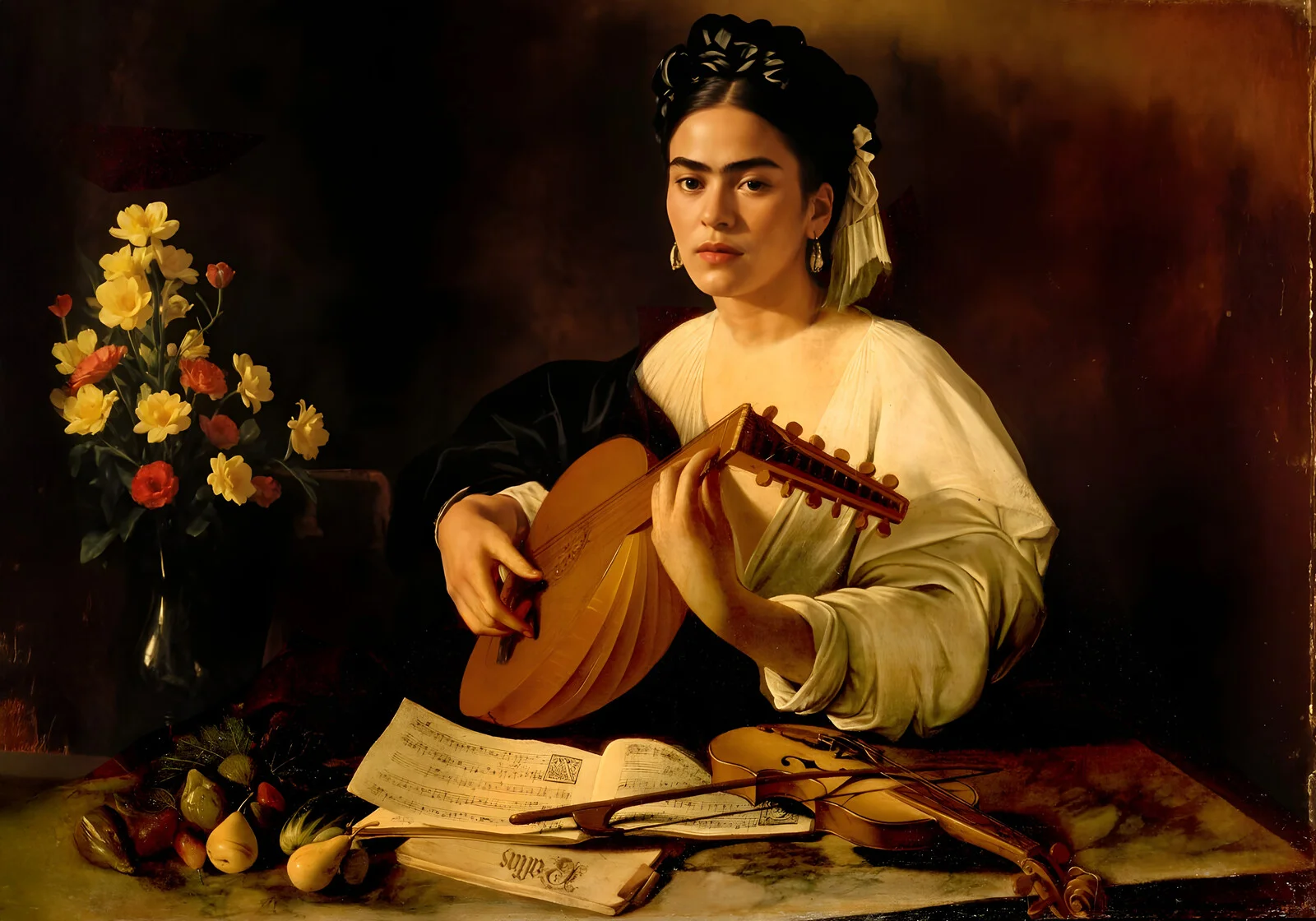
Frida playing the Lute, 2024
Digital
100 x 70 cm
5 200 kr
Frida playing the Lute
“Love, Folie à deux
Alas, Michelino, my love, you do me wrong,
To cast me off discourteously.
I’ve loved you and your art well and long,
Delighting in your mastery.
Chorus:
Michelangelo was all my joy,
Michelangelo was my delight,
Michelangelo was my heart of gold,
And who but my dear Michelino.
Alas, my love, that you should choose
A life of fire and vanity,
And leave me here to muse alone,
Upon your fleeting artistry.
Your vows you’ve shattered, like my heart,
Oh, why did you so abandon me?
Now, I must dwell where shadows start,
Yet bound to you eternally.
I have been faithful at your hand,
To honour every bold decree,
I gave my soul to understand
Your restless, haunted legacy.
If you must spurn me, even so,
My passion burns unyieldingly,
For love like this can only grow—
Though pain becomes an eternity.
My heart was clothed in colours bright,
And sought to mirror all you gave;
Yet, in your chiaroscuro light,
I was a flame you could not save.
You sought no comfort of the earth,
Your solace lay in destiny;
Through paint and strife, you proved your worth,
But never turned your heart to me.
Yet I will pray to red stars blush,
That you may see the truth I hold—
A love that echoes through my brush,
In every hue, both bright and bold.
Ah, Michelino, now farewell, adieu,
To heaven’s grace, I give your name;
For I am still your lover, Folie à deux,
Though you may never feel the same.
Michelangelo was all my joy,
Michelangelo was my delight,
Michelangelo was my heart of gold,
And who but my dear Michelino.
Malmö, December 2024
In July, Frida had been in Malmö for almost a year and had already performed in three plays at the Nöjesteatern. By autumn, she was scheduled for a fourth. It was also seventy years since she had left Earth to journey to her star. The thirteenth of July held no special reason for her to celebrate. Time-travelers rarely have cause to commemorate their death dates, as they dislike speaking about death. Moreover, most perceive eternity as infinitely preferable to their time on Earth. Behind them, they leave pain and illness, and in eternity, they can live at any age of their choosing, free from the fear of death or other anxieties.
However, Frida chose to honour her short life on Earth—only forty-seven years—because of a celebrated event in the art world: the Frida Kahlo Retrospective. This retrospective, celebrating women's strength and resilience, uplifted and empowered all who experienced it. Frida's version of Caravaggio's ‘The Lute Player’ was one of the more important paintings.
It brought together all the paintings Frida had created after she had laid down her brush for the last time. Her life had been marked by severe health issues, and from 1953, she was bedridden following an amputation. However, this did not deter her from her passion for painting or even participating in political events; her bed was carried wherever she wished to go, a testament to her unwavering determination and courage. Her resilience in the face of adversity is a source of inspiration for all.
Frida embarked on an ambitious project that set her apart from other artists in eternity. She encountered artists from all eras and decided to paint extraordinary women from history with whom she identified. This unique project, with its fresh and innovative interpretations of historical art, was a testament to her creativity and the power of art to transcend time and space, sparking intrigue and appreciation in the audience.
Thus, Malmö’s Moderna Museum paintings, including canvases and statues with Frida, embody well-known motifs but now feature her face and body. The entire collection had been discovered in a hidden room behind a wall at Casa Azul, The Blue House, her home in the Coyoacán neighbourhood of Mexico City. Three dozen previously unknown paintings caused a global sensation and debate, as their style did not match her known works. The international attention these previously unknown paintings received underscored the exhibition's significance in the art world, making it a cultural event of global importance.
For the vernissage at Moderna Museet, a staged interview with Frida Kahlo had been arranged to discuss her works and, notably, her interpretation of Caravaggio’s The Lute Player from the late 1500s. The painting, which has sparked centuries of debate regarding the gender of its subject, drew a packed hall as the moment for Caravaggio’s feature arrived. The museum had hired an actress to portray Frida Kahlo at the Nöjesteatern, and neither the curator nor the audience knew that Frida herself—visiting from the beyond—was playing the role. Alexander Olsson, a young, ambitious journalist known for his provocative questioning, had been engaged to lead the discussion. His direct and often tactless manner promised a lively exchange, especially when paired with Frida’s fiery wit and sensitivity.
Alex: (leaning forward, intrigued) Frida, let’s start with something provocative. Is your admiration for The Lute Player more about the painting itself or the stories surrounding it? The rumours, the sexuality, the mystery?
Frida: (smirking) Alex, how do you want to begin? Straight into the gossip? Fine. The painting captivates me for many reasons, not least because it embodies so much of what art should be—complex, layered, and scandalous. Yes, Caravaggio’s models, like the lute player, stir curiosity, but for me, it’s about the vulnerability they radiate. Look at the figure—soft, androgynous, unguarded. That’s what drew me in.
Alex: (pressing) But you can’t deny the sensual undertones. Caravaggio often painted young men, and people speculate endlessly about his relationships with them. Don’t you find that fascinating?
Frida: (tilting her head) Fascinating? Perhaps. Necessary? Not always. Artists pour themselves into their work—desires, fears, passions—but does it matter who they loved or didn’t love? The lute player could be a boy, a girl, or neither. Caravaggio captured a human essence, and that’s what endures. Let’s not reduce his genius to bedroom stories.
Alex: (grinning) Fair enough, but you’ve described Caravaggio himself as “attractive, not unlike Diego.” Was that just an offhand comment, or do you see a more profound parallel?
Frida: (pausing thoughtfully) Diego was a storm—a force of nature, infuriating and magnetic. I sense some of that in Caravaggio. He painted with passion, unapologetically, just as Diego lived. And perhaps I’m drawn to that same energy in his work. It’s less about appearance and more about the fire within.
Alex: (leaning in) And the lute player? What do you see in them? The painting suggests they’re singing a madrigal about love. Does that speak to you personally?
Frida: (nodding) Absolutely. Love—especially unrequited love—has a way of lodging itself deep in our souls. The lute player sings of it, mourns it, and perhaps even celebrates it in their own way. I’ve felt that longing, too. Haven’t we all?
Alex: (smiling) You have a way of romanticising sorrow. Speaking of music, I hear you sang Greensleeves while working on your self-portrait inspired by this painting. Why that song?
Frida: (grinning) Because it’s timeless, like the madrigal the lute player seems to sing. Greensleeves is full of heartbreak and longing, yet it’s beautiful in its sadness. It was a perfect companion as I painted. Of course, I’d never sing it for Henry VIII—an executioner of wives and mistresses! But the song transcends its dubious associations.
Alex: (laughing) So, no love for Henry VIII. What about Anne Boleyn? She rejected his advances, and the song reflects that rejection. Do you relate to her defiance?
Frida: (eyes sparkling) Oh. Anne’s story is one of resilience and tragedy, much like the songs and stories that inspire me. Greensleeves isn’t just about sorrow but strength in the face of loss. That’s why it endures.
Alex: (leaning back) Let’s return to The Lute Player. Caravaggio often depicted young men with soft, almost feminine features. Why do you think that was?
Frida: (thoughtfully) Perhaps it was his way of challenging boundaries, blurring lines between the spiritual and the sensual, the masculine and the feminine. It’s a duality I admire. The lute player’s ambiguity invites us to look beyond the surface and see the universality of love, music, and longing.
Alex: (pressing further) Do you think Caravaggio’s choice of models says something about his desires?
Frida: (shrugging) Perhaps. But art isn’t a confession; it’s a mirror. Caravaggio’s models reflect not just him but us, our questions and curiosities. What did they do before and after their sittings? We can only imagine. That’s part of the allure.
Alex: (smirking) And you? When you painted your version of The Lute Player, were you imagining yourself as the model or the artist?
Frida: (grinning) Both. That’s the beauty of reinterpretation. I became the lute player, singing my song, but I was also Caravaggio, wrestling with my passions and fears. Painting is an act of creation and self-reflection. It’s both intensely personal and universal.
Alex: (nodding) Finally, Frida, you’ve mentioned the parties at Casa Azul. Did Renaissance madrigals ever make their way into those gatherings?
Frida: (laughing) Oh, Alex, everything made its way to Casa Azul! We had musicians from all over—traditional Mexican folk songs, jazz, even the occasional madrigal. Music was our bridge between worlds, just as it was for Caravaggio. The lute player would have felt right at home. Maybe they’d have sung Greensleeves with me.
Alex: (leaning forward) Frida, it’s fascinating that Greensleeves is often misattributed to Henry VIII, but history tells us it’s Elizabethan, based on an Italian style. Does that shift its significance for you?
Frida: (firmly) Entirely. Had it indeed been Henry VIII’s creation, I wouldn’t have touched it—not a single note. How could I? A man who executed wives and mistresses doesn’t deserve to linger in melody. But its actual origin, Elizabethan and Italian-inspired, gives it a purity I respect and embrace.
Alex: (thoughtfully) Italian music seems to resonate with your artistic influences. Do you think Caravaggio, with his Italian roots, would have connected to something like Greensleeves?
Frida: (nodding) Without a doubt. He would have known its predecessors, those early compositions that inspired such melodies. Caravaggio’s art is filled with music—The Lute Player, The Musicians—portraying young men with instruments, creating moments where music and life blend seamlessly.
Alex: (gesturing) So, in a way, Caravaggio painted the spirit of Greensleeves, even if he never heard it?
Frida: (smiling) Exactly. His works capture that same wistfulness, that same bittersweet ache. The lute and violin in his paintings aren’t just props; they sing the silence between the notes. That’s where art and music meet.
Frida sings a capella with a strong and beautiful voice:
“Greensleeves was all my joy
Greensleeves was my delight
Greensleeves, my heart of gold
And who but my Lady Greensleeves
Greensleeves, now farewell, adieu
To God, I pray to prosper thee
For I am still thy lover true
Come once again and love me.”
Alex: (leaning back, visibly impressed) That was beautifully sung, Frida. Thank you for sharing that.
Frida: No reason.
Alex: (with a slightly sensational tone) I've heard that ‘Greensleeves’ carries a hidden sexual message.
Frida: (irritated) You seem to have sex on the brain. But you might be right. One interpretation of the lyrics suggests that Lady Green Sleeves was a promiscuous young woman, perhaps even a prostitute. At the time, the word "green" had sexual connotations, particularly in the phrase "a green gown," which referred to the grass stains that might appear on a woman’s dress after making love outdoors.
Another explanation is that Lady Green Sleeves, due to her attire, was wrongly assumed to be immoral. Her "discourteous" rejection of the singer’s advances could indicate that she was not. As Nevill Coghill notes in his translation of ‘The Canterbury Tales’, “Green, in Chaucer’s age, was the colour of lightness in love.” This idea echoes through lines like "Greensleeves is my delight" and elsewhere in the song.
Alex: (Embarrassed) Now, let’s pivot back to Caravaggio and The Lute Player. The model, as many believe, was likely his friend Mario Minniti. What do you think about their relationship?
Frida: (smiling thoughtfully) Mario Minniti… yes, he appears in many of Caravaggio’s early works. Like most artistic collaborations, their bond must have been profound, creative, and perhaps layered with complexities. I’ve worked with muses, too, Alex. Sometimes, they inspire beyond the canvas; sometimes, they only inhabit the work. Who can say where Mario and Caravaggio drew their lines?
Alex: (leaning forward) And those soft, androgynous features—the hallmark of many of Caravaggio’s models. Do you see that as a deliberate choice?
Frida: (nodding) Absolutely. Androgyny offers a universality that transcends gender. In The Lute Player, the figure becomes male and female, a vessel for beauty, longing, and sensuality. Caravaggio painted a timeless muse that resonates beyond the constraints of identity. For me, it’s freeing. It’s a reminder that art doesn’t need boundaries.
Alex: (gesturing to the painting’s details) Discuss the symbolism. You’ve mentioned the violin beneath the lute—disrupted harmony, a pause from life’s rhythm. Why do you think Caravaggio included that?
Frida: (tilting her head) Perhaps to ground us. The lute’s joyous association with love and celebration contrasts with the violin's melancholy. It’s a dance between harmony and disharmony, joy and sorrow. That tension—between what we have and what we’ve lost—is the heartbeat of the painting.
Alex: (thoughtfully) And the sheet music? It feels so purposeful.
Frida: (grinning) Oh, of course. Music was a language for Caravaggio, just as it is for many of us. The open sheet suggests an unfinished story—a love song, a madrigal left hanging. Just like love itself, it’s never truly complete. That’s why it draws us in.
Alex: (pointing to the table) Then there are the flowers and the fruits—symbols of impermanence and decay. They’re beautiful, but there’s always that hint of loss, isn’t there?
Frida: (leaning forward) Exactly. The flowers, wilting as they bloom, remind us of life’s fragility. The overripe fruits, some bruised—reflect the abundance and the fleeting nature of beauty and pleasure. Caravaggio understood that tension so well. He captured the transient moments that make life poignant.
Alex: (smiling) And the model—the gaze directed gently at us. What do you think they’re inviting the viewer to feel?
Frida: (pausing) An invitation to love and to listen, perhaps. The lute player looks at us as if to share their music and story. But it’s also an invitation to question, to wonder—about the person behind the gaze, the artist who painted them, and the truths they both sought.
Alex: (leaning back) And yet, as with many of Caravaggio’s works, the rumours about his life tend to overshadow the art. Speculations about his relationships with young male models like Minniti. What’s your take on that?
Frida: (firmly) People love a scandal, Alex. It’s easier to dissect someone’s personal life than to understand their art. Caravaggio’s paintings—The Lute Player, Amor Vincit Omnia, John the Baptist—are sensual but reflect human emotion's complexity. Whether he loved his models or not, what matters is that he immortalised them with tenderness and truth.
Alex: (pressing) But indeed, the sensuality in his work hints at something more profound.
Frida: (smiling slyly) Of course it does. Art without sensuality is lifeless. But that doesn’t mean we should reduce the artist to their desires. Caravaggio painted life—its beauty, its chaos, its fleeting passions. That’s the real story.
Alex: (leaning in) So you see Caravaggio as both a seeker and a creator?
Frida: (nodding) Precisely. He sought truth, beauty, and meaning in a world often denied them. His models, like Minniti, were part of that journey. But the art—its light, its shadow, its soul—that’s what endures, inspiring us with its timeless power.
Alex: (leaning back in his chair) Frida, let’s delve into a topic that resonates throughout Caravaggio’s works—eroticism. It’s undeniably present in The Lute Player, wouldn’t you say?
Frida: (smirking slightly) Of course, Alex. But let’s not reduce it to mere titillation. The sensuality in Caravaggio’s art is layered, almost like a mirror reflecting his complex relationship with beauty and desire. It’s not unusual for the time, though, especially in religious or mythological themes. Eroticism was often the language artists used to explore more profound truths, stimulating our intellect and understanding.
Alex: (raising an eyebrow) And yet, it’s often interpreted as a window into his personal life. Do you think the fascination with youthful beauty, as seen in The Lute Player, tells us more about Caravaggio himself?
Frida: (pausing) Perhaps, but we shouldn’t be so quick to impose our assumptions. What’s clear is that Caravaggio was captivated by the fleeting nature of youth and beauty. It’s not just adoration—it’s also an acknowledgement of its impermanence. That duality is what gives his work its power.
Alex: (leaning in) Speaking of fleeting moments, music plays a pivotal symbolic role in The Lute Player. Could it be more than just an aesthetic choice?
Frida: (nodding) Music, particularly in the Renaissance and Baroque periods, was seen as a bridge between the earthly and the divine. In The Lute Player, it becomes a metaphor for transcendence. The act of playing music is ephemeral, existing only in the moment. It’s like life itself—beautiful but fleeting.
Alex: (gesturing toward the reproduction) And the broader themes of transience? How do you see those at play here?
Frida: (thoughtfully) Caravaggio was a master of vanitas, wasn’t he? In The Lute Player, the music, the model's youth—it all speaks to the fragility of life. It’s not just about celebrating beauty but reminding us that it doesn’t last. It’s a bittersweet message, one that resonates deeply with me.
Alex: (smiling) His realism is another striking element. The model feels raw, almost vulnerable. Do you think that was intentional?
Frida: (firmly) Absolutely. Caravaggio didn’t paint fantasies—he painted life. In The Lute Player, the young man isn’t idealised. He’s honest and human, perhaps even grappling with his questions about beauty and mortality. That honesty makes the work compelling, connecting us to the human experience.
Alex: (leaning back, folding his hands) Do you see the lute player as a homoerotic message? A kind of hidden message, perhaps?
Frida: (smiling slyly) It’s possible. Caravaggio seems to have anticipated centuries of interpretive promiscuity in his work. By this, I mean the diverse and often contradictory interpretations that his work has inspired. He began by seductively inviting the spectator to read him.
Caravaggio was always caught between chaos and beauty, much like the lute player caught in a fleeting music moment. If anything, his work reflects his struggles—his attempt to capture the ephemeral while living with the turbulence of his existence.
Alex: (leaning forward, his tone slightly provocative) What if the lute player isn't just a boy, but Caravaggio himself?
Frida: (her voice carrying a hint of mystery) That's an intriguing thought. Caravaggio, a man of turbulent life, might have used this piece to mirror his own experiences. The young lute player could reflect the artist and, as I said, always caught between life's chaos and moments of beauty.
Alex: Frida, Caravaggio’s life was anything but ordinary—filled with violence and passion. Do you think The Lute Player is his way of reflecting on his own chaos?
Frida: (nodding thoughtfully) Absolutely. The young lute player could very well be a reflection of Caravaggio himself. He lived in extremes—moments of beauty intertwined with chaos. I lived such a life, too, Alex, so I understand him well. The art becomes a mirror, showing the world and the artist’s soul.
Alex: (leaning forward) And love and desire are constant themes within that mirror. Do you see The Lute Player as a depiction of love—earthly or spiritual?
Frida: (pausing) Both, Alex. That’s the brilliance of it. The soft, androgynous features of the lute player embody the tension between physical love and spiritual longing. Baroque art, a period of artistic style that used exaggerated motion and clear, easily interpreted detail to produce drama, tension, exuberance, and grandeur in sculpture, painting, literature, dance, and music, thrived on this duality, and Caravaggio captured it with unparalleled brilliance. In his work, love isn’t just passion—it’s transcendence.
Alex: (raising an eyebrow) Music plays a central role here, particularly the lute. Why do you think it was such a powerful symbol during this period?
Frida: (smiling) Music was the language of love. The lute symbolised romance and passion—feelings that transcend the physical and touch the divine. For Caravaggio, it wasn’t just a prop. It was a bridge between the earthly and the metaphysical. Through the lute, he asked how love—so fleeting, so tangible—could connect to something eternal.
Alex: (gesturing to the painting) he blurs the lines between reality and art. What do you make of that?
Frida: (leaning in) That’s Caravaggio’s genius. He didn’t just paint what he saw; he painted questions. What is real? What is illusion? The lifelike figure of the lute player isn’t just a subject—it’s a profound challenge. He dares the viewer to question the boundaries between art and life, stimulating our intellect and perception.
Alex: (curious) Do you think The Lute Player reflects Caravaggio’s struggles with meaning and faith?
Frida: (nodding) Without a doubt. Caravaggio was a seeker and a doubter. He lived in a time of religious reform and conflict, wrestling with the expectations of a society that demanded strict morality. This painting feels like his way of asking where humanity fits in the divine cosmos. The music, youth, and fleeting beauty are all part of that question.
Alex: (smiling) You’ve met him, haven’t you? In the beyond, I mean. What do you think he would say about his role as an artist?
Frida: (laughing softly) Oh, Alex, Caravaggio would have much to say! Through The Lute Player, he asks if an artist is merely a recreator of reality or a Pygmalion—a creator, breathing life into the lifeless. I had to decide that for myself when I painted my version. Inspiration may come from above, but the choice and creation belong to the artist alone.
Alex: (leaning back) So, for Caravaggio, this work wasn’t just about beauty—it was about the more significant questions?
Frida: (smiling) Exactly. He combined sensuality, realism, and symbolism to explore the essence of life. The Lute Player invites us to reflect on beauty's impermanence, love's nature, and humanity’s place in the universe. I did the same before I picked up my brush to reinterpret his work.
Alex: (with a sly tone) Are you in love with Caravaggio or the boy? I sense an interest that goes beyond oil and canvas.
Frida: (forcedly polite) You're crossing a line there, but let me conclude our time together with this: one does not exclude the other, and platonic love is far more refined than lustful dreams. In any case, my deeper feelings belong to a higher sphere, but that’s not something I intend to elaborate on.
We leave the interview here, but it seems fitting to offer a summary.
Love and desire—earthly and spiritual questions, Eros and transcendence, were themes that preoccupied both Frida and Caravaggio, not only during their time on Earth but also, in Frida’s case, in eternity. Both lived short but intense lives, leaving much unfinished when they departed.
Caravaggio was sentenced to death ‘in absentia’ for murder. In 1606, he became involved in a violent duel or brawl in Rome that resulted in the death of a man named Ranuccio Tomassoni. The reasons for the conflict remain unclear; some sources suggest it was a matter of honour, possibly tied to gambling or a romantic dispute.
After the killing, Caravaggio fled Rome to escape justice. Because of the death sentence, he became a "bando capitale", meaning anyone could legally kill him without facing punishment. He led a nomadic life, moving between Naples, Malta, and Sicily.
Caravaggio’s life after the sentence was marked by constant flight and unrest. His art, which often depicted human pain and sin, may have grown even more intense during this period, reflecting his desperate circumstances and the dramatic tension that permeated his work.
During his time in Malta, Caravaggio sought entry into the Order of the Knights of Malta, hoping for protection and perhaps a royal pardon. He was admitted but soon found himself in trouble again after a violent altercation. He was imprisoned but managed to escape.
Despite his efforts to secure a papal pardon, it arrived too late. Caravaggio died under mysterious circumstances in 1610 at the age of only 39. According to Frida, who had first-hand information from her place in eternity, Caravaggio was murdered and hastily buried in an unmarked grave in Porto Ercole, Tuscany, adding a layer of intrigue to his already fascinating life story.
The sensual depiction of the lute player, with soft, androgynous features, may explore the tension between earthly love and spiritual longing. The duality of love—physical and divine—was a recurring theme in Baroque art.
Music was also strongly associated with expressions of love during this time. Instruments like the lute often symbolised romance and passion. The question may have been how these feelings could be balanced between the physical and the metaphysical. Music was the language of love, and Caravaggio portrayed this vividly, infusing his art with a sense of passion and romance.
Through representation and illusion, Caravaggio questioned his role and that of art. He was a master at blurring the lines between reality and art. The Lute Player can be interpreted as an exploration of the very nature of art: What is real, and what is a construction? Caravaggio challenges the viewer to reflect on the relationship between art and life by creating a lifelike figure like the lute player.
Having reached eternity, Frida appreciated Caravaggio’s search for humanity’s place in the universe. Like the music in the painting, art can be seen as an attempt to grasp the ineffable. Perhaps the work reflects the artist’s struggle to find meaning in his creativity and the world around him. Caravaggio was both a seeker and a doubter, living with lifelong conflicts about religion and morality. The late Renaissance and early Baroque periods were times of religious reform and conflict, which often coloured his works. Caravaggio wrestled with his place in a society that imposed strict moral and spiritual expectations. The Lute Player may reflect his questions about spirituality and humanity’s role in the divine cosmos.
Frida had met Caravaggio in the beyond and said that through The Lute Player, he posed questions about the artist’s role as a creator: Is he a recreator of reality or a Pygmalion figure attempting to create life from dead materials? It’s a matter of interpretation and something Frida herself had to decide. She had done so in her version of the painting. She was the creator; neither God nor Caravaggio held the brush—only she did. The inspiration came from above, but that is entirely different, for the choice was hers.
According to Frida, the work reflected more profound questions about the transience of life, the nature of love, and the role of art in understanding the world. Caravaggio’s way of combining sensuality, realism, and symbolism makes it likely that he used the painting to explore earthly and metaphysical questions. What is clear is that the work invites the viewer to reflect on questions of beauty, time, and humanity’s place in the universe. Frida carefully did so before painting his lute player.
Caravaggio's mysteries are not meant to be fully deciphered. In Western civilisation, at least since Oedipus, mysteries have served as intellectual challenges. Rather than hindering understanding, their elusiveness invites curiosity—offering a chance for new insights and expanding knowledge. And, of course, we love to speculate and gossip.
Jörgen Thornberg
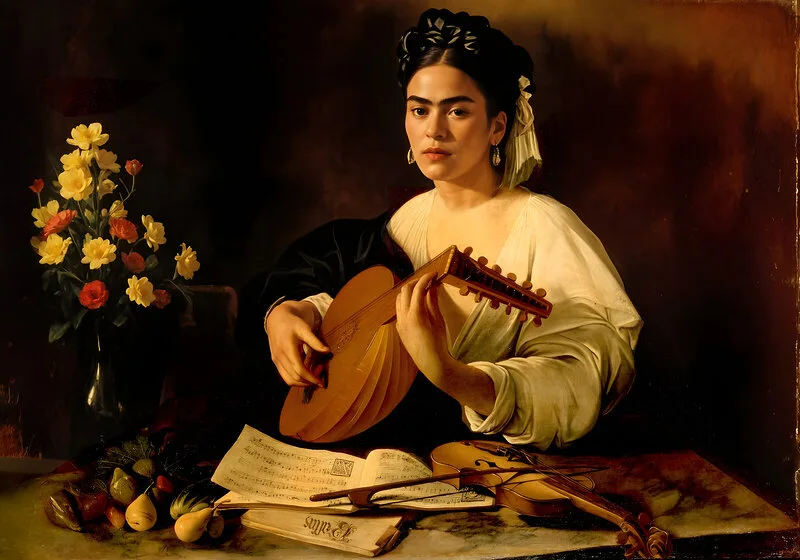
Frida playing the Lute, 2024
Digital
100 x 70 cm
5 200 kr
Frida playing the Lute
“Love, Folie à deux
Alas, Michelino, my love, you do me wrong,
To cast me off discourteously.
I’ve loved you and your art well and long,
Delighting in your mastery.
Chorus:
Michelangelo was all my joy,
Michelangelo was my delight,
Michelangelo was my heart of gold,
And who but my dear Michelino.
Alas, my love, that you should choose
A life of fire and vanity,
And leave me here to muse alone,
Upon your fleeting artistry.
Your vows you’ve shattered, like my heart,
Oh, why did you so abandon me?
Now, I must dwell where shadows start,
Yet bound to you eternally.
I have been faithful at your hand,
To honour every bold decree,
I gave my soul to understand
Your restless, haunted legacy.
If you must spurn me, even so,
My passion burns unyieldingly,
For love like this can only grow—
Though pain becomes an eternity.
My heart was clothed in colours bright,
And sought to mirror all you gave;
Yet, in your chiaroscuro light,
I was a flame you could not save.
You sought no comfort of the earth,
Your solace lay in destiny;
Through paint and strife, you proved your worth,
But never turned your heart to me.
Yet I will pray to red stars blush,
That you may see the truth I hold—
A love that echoes through my brush,
In every hue, both bright and bold.
Ah, Michelino, now farewell, adieu,
To heaven’s grace, I give your name;
For I am still your lover, Folie à deux,
Though you may never feel the same.
Michelangelo was all my joy,
Michelangelo was my delight,
Michelangelo was my heart of gold,
And who but my dear Michelino.
Malmö, December 2024
In July, Frida had been in Malmö for almost a year and had already performed in three plays at the Nöjesteatern. By autumn, she was scheduled for a fourth. It was also seventy years since she had left Earth to journey to her star. The thirteenth of July held no special reason for her to celebrate. Time-travelers rarely have cause to commemorate their death dates, as they dislike speaking about death. Moreover, most perceive eternity as infinitely preferable to their time on Earth. Behind them, they leave pain and illness, and in eternity, they can live at any age of their choosing, free from the fear of death or other anxieties.
However, Frida chose to honour her short life on Earth—only forty-seven years—because of a celebrated event in the art world: the Frida Kahlo Retrospective. This retrospective, celebrating women's strength and resilience, uplifted and empowered all who experienced it. Frida's version of Caravaggio's ‘The Lute Player’ was one of the more important paintings.
It brought together all the paintings Frida had created after she had laid down her brush for the last time. Her life had been marked by severe health issues, and from 1953, she was bedridden following an amputation. However, this did not deter her from her passion for painting or even participating in political events; her bed was carried wherever she wished to go, a testament to her unwavering determination and courage. Her resilience in the face of adversity is a source of inspiration for all.
Frida embarked on an ambitious project that set her apart from other artists in eternity. She encountered artists from all eras and decided to paint extraordinary women from history with whom she identified. This unique project, with its fresh and innovative interpretations of historical art, was a testament to her creativity and the power of art to transcend time and space, sparking intrigue and appreciation in the audience.
Thus, Malmö’s Moderna Museum paintings, including canvases and statues with Frida, embody well-known motifs but now feature her face and body. The entire collection had been discovered in a hidden room behind a wall at Casa Azul, The Blue House, her home in the Coyoacán neighbourhood of Mexico City. Three dozen previously unknown paintings caused a global sensation and debate, as their style did not match her known works. The international attention these previously unknown paintings received underscored the exhibition's significance in the art world, making it a cultural event of global importance.
For the vernissage at Moderna Museet, a staged interview with Frida Kahlo had been arranged to discuss her works and, notably, her interpretation of Caravaggio’s The Lute Player from the late 1500s. The painting, which has sparked centuries of debate regarding the gender of its subject, drew a packed hall as the moment for Caravaggio’s feature arrived. The museum had hired an actress to portray Frida Kahlo at the Nöjesteatern, and neither the curator nor the audience knew that Frida herself—visiting from the beyond—was playing the role. Alexander Olsson, a young, ambitious journalist known for his provocative questioning, had been engaged to lead the discussion. His direct and often tactless manner promised a lively exchange, especially when paired with Frida’s fiery wit and sensitivity.
Alex: (leaning forward, intrigued) Frida, let’s start with something provocative. Is your admiration for The Lute Player more about the painting itself or the stories surrounding it? The rumours, the sexuality, the mystery?
Frida: (smirking) Alex, how do you want to begin? Straight into the gossip? Fine. The painting captivates me for many reasons, not least because it embodies so much of what art should be—complex, layered, and scandalous. Yes, Caravaggio’s models, like the lute player, stir curiosity, but for me, it’s about the vulnerability they radiate. Look at the figure—soft, androgynous, unguarded. That’s what drew me in.
Alex: (pressing) But you can’t deny the sensual undertones. Caravaggio often painted young men, and people speculate endlessly about his relationships with them. Don’t you find that fascinating?
Frida: (tilting her head) Fascinating? Perhaps. Necessary? Not always. Artists pour themselves into their work—desires, fears, passions—but does it matter who they loved or didn’t love? The lute player could be a boy, a girl, or neither. Caravaggio captured a human essence, and that’s what endures. Let’s not reduce his genius to bedroom stories.
Alex: (grinning) Fair enough, but you’ve described Caravaggio himself as “attractive, not unlike Diego.” Was that just an offhand comment, or do you see a more profound parallel?
Frida: (pausing thoughtfully) Diego was a storm—a force of nature, infuriating and magnetic. I sense some of that in Caravaggio. He painted with passion, unapologetically, just as Diego lived. And perhaps I’m drawn to that same energy in his work. It’s less about appearance and more about the fire within.
Alex: (leaning in) And the lute player? What do you see in them? The painting suggests they’re singing a madrigal about love. Does that speak to you personally?
Frida: (nodding) Absolutely. Love—especially unrequited love—has a way of lodging itself deep in our souls. The lute player sings of it, mourns it, and perhaps even celebrates it in their own way. I’ve felt that longing, too. Haven’t we all?
Alex: (smiling) You have a way of romanticising sorrow. Speaking of music, I hear you sang Greensleeves while working on your self-portrait inspired by this painting. Why that song?
Frida: (grinning) Because it’s timeless, like the madrigal the lute player seems to sing. Greensleeves is full of heartbreak and longing, yet it’s beautiful in its sadness. It was a perfect companion as I painted. Of course, I’d never sing it for Henry VIII—an executioner of wives and mistresses! But the song transcends its dubious associations.
Alex: (laughing) So, no love for Henry VIII. What about Anne Boleyn? She rejected his advances, and the song reflects that rejection. Do you relate to her defiance?
Frida: (eyes sparkling) Oh. Anne’s story is one of resilience and tragedy, much like the songs and stories that inspire me. Greensleeves isn’t just about sorrow but strength in the face of loss. That’s why it endures.
Alex: (leaning back) Let’s return to The Lute Player. Caravaggio often depicted young men with soft, almost feminine features. Why do you think that was?
Frida: (thoughtfully) Perhaps it was his way of challenging boundaries, blurring lines between the spiritual and the sensual, the masculine and the feminine. It’s a duality I admire. The lute player’s ambiguity invites us to look beyond the surface and see the universality of love, music, and longing.
Alex: (pressing further) Do you think Caravaggio’s choice of models says something about his desires?
Frida: (shrugging) Perhaps. But art isn’t a confession; it’s a mirror. Caravaggio’s models reflect not just him but us, our questions and curiosities. What did they do before and after their sittings? We can only imagine. That’s part of the allure.
Alex: (smirking) And you? When you painted your version of The Lute Player, were you imagining yourself as the model or the artist?
Frida: (grinning) Both. That’s the beauty of reinterpretation. I became the lute player, singing my song, but I was also Caravaggio, wrestling with my passions and fears. Painting is an act of creation and self-reflection. It’s both intensely personal and universal.
Alex: (nodding) Finally, Frida, you’ve mentioned the parties at Casa Azul. Did Renaissance madrigals ever make their way into those gatherings?
Frida: (laughing) Oh, Alex, everything made its way to Casa Azul! We had musicians from all over—traditional Mexican folk songs, jazz, even the occasional madrigal. Music was our bridge between worlds, just as it was for Caravaggio. The lute player would have felt right at home. Maybe they’d have sung Greensleeves with me.
Alex: (leaning forward) Frida, it’s fascinating that Greensleeves is often misattributed to Henry VIII, but history tells us it’s Elizabethan, based on an Italian style. Does that shift its significance for you?
Frida: (firmly) Entirely. Had it indeed been Henry VIII’s creation, I wouldn’t have touched it—not a single note. How could I? A man who executed wives and mistresses doesn’t deserve to linger in melody. But its actual origin, Elizabethan and Italian-inspired, gives it a purity I respect and embrace.
Alex: (thoughtfully) Italian music seems to resonate with your artistic influences. Do you think Caravaggio, with his Italian roots, would have connected to something like Greensleeves?
Frida: (nodding) Without a doubt. He would have known its predecessors, those early compositions that inspired such melodies. Caravaggio’s art is filled with music—The Lute Player, The Musicians—portraying young men with instruments, creating moments where music and life blend seamlessly.
Alex: (gesturing) So, in a way, Caravaggio painted the spirit of Greensleeves, even if he never heard it?
Frida: (smiling) Exactly. His works capture that same wistfulness, that same bittersweet ache. The lute and violin in his paintings aren’t just props; they sing the silence between the notes. That’s where art and music meet.
Frida sings a capella with a strong and beautiful voice:
“Greensleeves was all my joy
Greensleeves was my delight
Greensleeves, my heart of gold
And who but my Lady Greensleeves
Greensleeves, now farewell, adieu
To God, I pray to prosper thee
For I am still thy lover true
Come once again and love me.”
Alex: (leaning back, visibly impressed) That was beautifully sung, Frida. Thank you for sharing that.
Frida: No reason.
Alex: (with a slightly sensational tone) I've heard that ‘Greensleeves’ carries a hidden sexual message.
Frida: (irritated) You seem to have sex on the brain. But you might be right. One interpretation of the lyrics suggests that Lady Green Sleeves was a promiscuous young woman, perhaps even a prostitute. At the time, the word "green" had sexual connotations, particularly in the phrase "a green gown," which referred to the grass stains that might appear on a woman’s dress after making love outdoors.
Another explanation is that Lady Green Sleeves, due to her attire, was wrongly assumed to be immoral. Her "discourteous" rejection of the singer’s advances could indicate that she was not. As Nevill Coghill notes in his translation of ‘The Canterbury Tales’, “Green, in Chaucer’s age, was the colour of lightness in love.” This idea echoes through lines like "Greensleeves is my delight" and elsewhere in the song.
Alex: (Embarrassed) Now, let’s pivot back to Caravaggio and The Lute Player. The model, as many believe, was likely his friend Mario Minniti. What do you think about their relationship?
Frida: (smiling thoughtfully) Mario Minniti… yes, he appears in many of Caravaggio’s early works. Like most artistic collaborations, their bond must have been profound, creative, and perhaps layered with complexities. I’ve worked with muses, too, Alex. Sometimes, they inspire beyond the canvas; sometimes, they only inhabit the work. Who can say where Mario and Caravaggio drew their lines?
Alex: (leaning forward) And those soft, androgynous features—the hallmark of many of Caravaggio’s models. Do you see that as a deliberate choice?
Frida: (nodding) Absolutely. Androgyny offers a universality that transcends gender. In The Lute Player, the figure becomes male and female, a vessel for beauty, longing, and sensuality. Caravaggio painted a timeless muse that resonates beyond the constraints of identity. For me, it’s freeing. It’s a reminder that art doesn’t need boundaries.
Alex: (gesturing to the painting’s details) Discuss the symbolism. You’ve mentioned the violin beneath the lute—disrupted harmony, a pause from life’s rhythm. Why do you think Caravaggio included that?
Frida: (tilting her head) Perhaps to ground us. The lute’s joyous association with love and celebration contrasts with the violin's melancholy. It’s a dance between harmony and disharmony, joy and sorrow. That tension—between what we have and what we’ve lost—is the heartbeat of the painting.
Alex: (thoughtfully) And the sheet music? It feels so purposeful.
Frida: (grinning) Oh, of course. Music was a language for Caravaggio, just as it is for many of us. The open sheet suggests an unfinished story—a love song, a madrigal left hanging. Just like love itself, it’s never truly complete. That’s why it draws us in.
Alex: (pointing to the table) Then there are the flowers and the fruits—symbols of impermanence and decay. They’re beautiful, but there’s always that hint of loss, isn’t there?
Frida: (leaning forward) Exactly. The flowers, wilting as they bloom, remind us of life’s fragility. The overripe fruits, some bruised—reflect the abundance and the fleeting nature of beauty and pleasure. Caravaggio understood that tension so well. He captured the transient moments that make life poignant.
Alex: (smiling) And the model—the gaze directed gently at us. What do you think they’re inviting the viewer to feel?
Frida: (pausing) An invitation to love and to listen, perhaps. The lute player looks at us as if to share their music and story. But it’s also an invitation to question, to wonder—about the person behind the gaze, the artist who painted them, and the truths they both sought.
Alex: (leaning back) And yet, as with many of Caravaggio’s works, the rumours about his life tend to overshadow the art. Speculations about his relationships with young male models like Minniti. What’s your take on that?
Frida: (firmly) People love a scandal, Alex. It’s easier to dissect someone’s personal life than to understand their art. Caravaggio’s paintings—The Lute Player, Amor Vincit Omnia, John the Baptist—are sensual but reflect human emotion's complexity. Whether he loved his models or not, what matters is that he immortalised them with tenderness and truth.
Alex: (pressing) But indeed, the sensuality in his work hints at something more profound.
Frida: (smiling slyly) Of course it does. Art without sensuality is lifeless. But that doesn’t mean we should reduce the artist to their desires. Caravaggio painted life—its beauty, its chaos, its fleeting passions. That’s the real story.
Alex: (leaning in) So you see Caravaggio as both a seeker and a creator?
Frida: (nodding) Precisely. He sought truth, beauty, and meaning in a world often denied them. His models, like Minniti, were part of that journey. But the art—its light, its shadow, its soul—that’s what endures, inspiring us with its timeless power.
Alex: (leaning back in his chair) Frida, let’s delve into a topic that resonates throughout Caravaggio’s works—eroticism. It’s undeniably present in The Lute Player, wouldn’t you say?
Frida: (smirking slightly) Of course, Alex. But let’s not reduce it to mere titillation. The sensuality in Caravaggio’s art is layered, almost like a mirror reflecting his complex relationship with beauty and desire. It’s not unusual for the time, though, especially in religious or mythological themes. Eroticism was often the language artists used to explore more profound truths, stimulating our intellect and understanding.
Alex: (raising an eyebrow) And yet, it’s often interpreted as a window into his personal life. Do you think the fascination with youthful beauty, as seen in The Lute Player, tells us more about Caravaggio himself?
Frida: (pausing) Perhaps, but we shouldn’t be so quick to impose our assumptions. What’s clear is that Caravaggio was captivated by the fleeting nature of youth and beauty. It’s not just adoration—it’s also an acknowledgement of its impermanence. That duality is what gives his work its power.
Alex: (leaning in) Speaking of fleeting moments, music plays a pivotal symbolic role in The Lute Player. Could it be more than just an aesthetic choice?
Frida: (nodding) Music, particularly in the Renaissance and Baroque periods, was seen as a bridge between the earthly and the divine. In The Lute Player, it becomes a metaphor for transcendence. The act of playing music is ephemeral, existing only in the moment. It’s like life itself—beautiful but fleeting.
Alex: (gesturing toward the reproduction) And the broader themes of transience? How do you see those at play here?
Frida: (thoughtfully) Caravaggio was a master of vanitas, wasn’t he? In The Lute Player, the music, the model's youth—it all speaks to the fragility of life. It’s not just about celebrating beauty but reminding us that it doesn’t last. It’s a bittersweet message, one that resonates deeply with me.
Alex: (smiling) His realism is another striking element. The model feels raw, almost vulnerable. Do you think that was intentional?
Frida: (firmly) Absolutely. Caravaggio didn’t paint fantasies—he painted life. In The Lute Player, the young man isn’t idealised. He’s honest and human, perhaps even grappling with his questions about beauty and mortality. That honesty makes the work compelling, connecting us to the human experience.
Alex: (leaning back, folding his hands) Do you see the lute player as a homoerotic message? A kind of hidden message, perhaps?
Frida: (smiling slyly) It’s possible. Caravaggio seems to have anticipated centuries of interpretive promiscuity in his work. By this, I mean the diverse and often contradictory interpretations that his work has inspired. He began by seductively inviting the spectator to read him.
Caravaggio was always caught between chaos and beauty, much like the lute player caught in a fleeting music moment. If anything, his work reflects his struggles—his attempt to capture the ephemeral while living with the turbulence of his existence.
Alex: (leaning forward, his tone slightly provocative) What if the lute player isn't just a boy, but Caravaggio himself?
Frida: (her voice carrying a hint of mystery) That's an intriguing thought. Caravaggio, a man of turbulent life, might have used this piece to mirror his own experiences. The young lute player could reflect the artist and, as I said, always caught between life's chaos and moments of beauty.
Alex: Frida, Caravaggio’s life was anything but ordinary—filled with violence and passion. Do you think The Lute Player is his way of reflecting on his own chaos?
Frida: (nodding thoughtfully) Absolutely. The young lute player could very well be a reflection of Caravaggio himself. He lived in extremes—moments of beauty intertwined with chaos. I lived such a life, too, Alex, so I understand him well. The art becomes a mirror, showing the world and the artist’s soul.
Alex: (leaning forward) And love and desire are constant themes within that mirror. Do you see The Lute Player as a depiction of love—earthly or spiritual?
Frida: (pausing) Both, Alex. That’s the brilliance of it. The soft, androgynous features of the lute player embody the tension between physical love and spiritual longing. Baroque art, a period of artistic style that used exaggerated motion and clear, easily interpreted detail to produce drama, tension, exuberance, and grandeur in sculpture, painting, literature, dance, and music, thrived on this duality, and Caravaggio captured it with unparalleled brilliance. In his work, love isn’t just passion—it’s transcendence.
Alex: (raising an eyebrow) Music plays a central role here, particularly the lute. Why do you think it was such a powerful symbol during this period?
Frida: (smiling) Music was the language of love. The lute symbolised romance and passion—feelings that transcend the physical and touch the divine. For Caravaggio, it wasn’t just a prop. It was a bridge between the earthly and the metaphysical. Through the lute, he asked how love—so fleeting, so tangible—could connect to something eternal.
Alex: (gesturing to the painting) he blurs the lines between reality and art. What do you make of that?
Frida: (leaning in) That’s Caravaggio’s genius. He didn’t just paint what he saw; he painted questions. What is real? What is illusion? The lifelike figure of the lute player isn’t just a subject—it’s a profound challenge. He dares the viewer to question the boundaries between art and life, stimulating our intellect and perception.
Alex: (curious) Do you think The Lute Player reflects Caravaggio’s struggles with meaning and faith?
Frida: (nodding) Without a doubt. Caravaggio was a seeker and a doubter. He lived in a time of religious reform and conflict, wrestling with the expectations of a society that demanded strict morality. This painting feels like his way of asking where humanity fits in the divine cosmos. The music, youth, and fleeting beauty are all part of that question.
Alex: (smiling) You’ve met him, haven’t you? In the beyond, I mean. What do you think he would say about his role as an artist?
Frida: (laughing softly) Oh, Alex, Caravaggio would have much to say! Through The Lute Player, he asks if an artist is merely a recreator of reality or a Pygmalion—a creator, breathing life into the lifeless. I had to decide that for myself when I painted my version. Inspiration may come from above, but the choice and creation belong to the artist alone.
Alex: (leaning back) So, for Caravaggio, this work wasn’t just about beauty—it was about the more significant questions?
Frida: (smiling) Exactly. He combined sensuality, realism, and symbolism to explore the essence of life. The Lute Player invites us to reflect on beauty's impermanence, love's nature, and humanity’s place in the universe. I did the same before I picked up my brush to reinterpret his work.
Alex: (with a sly tone) Are you in love with Caravaggio or the boy? I sense an interest that goes beyond oil and canvas.
Frida: (forcedly polite) You're crossing a line there, but let me conclude our time together with this: one does not exclude the other, and platonic love is far more refined than lustful dreams. In any case, my deeper feelings belong to a higher sphere, but that’s not something I intend to elaborate on.
We leave the interview here, but it seems fitting to offer a summary.
Love and desire—earthly and spiritual questions, Eros and transcendence, were themes that preoccupied both Frida and Caravaggio, not only during their time on Earth but also, in Frida’s case, in eternity. Both lived short but intense lives, leaving much unfinished when they departed.
Caravaggio was sentenced to death ‘in absentia’ for murder. In 1606, he became involved in a violent duel or brawl in Rome that resulted in the death of a man named Ranuccio Tomassoni. The reasons for the conflict remain unclear; some sources suggest it was a matter of honour, possibly tied to gambling or a romantic dispute.
After the killing, Caravaggio fled Rome to escape justice. Because of the death sentence, he became a "bando capitale", meaning anyone could legally kill him without facing punishment. He led a nomadic life, moving between Naples, Malta, and Sicily.
Caravaggio’s life after the sentence was marked by constant flight and unrest. His art, which often depicted human pain and sin, may have grown even more intense during this period, reflecting his desperate circumstances and the dramatic tension that permeated his work.
During his time in Malta, Caravaggio sought entry into the Order of the Knights of Malta, hoping for protection and perhaps a royal pardon. He was admitted but soon found himself in trouble again after a violent altercation. He was imprisoned but managed to escape.
Despite his efforts to secure a papal pardon, it arrived too late. Caravaggio died under mysterious circumstances in 1610 at the age of only 39. According to Frida, who had first-hand information from her place in eternity, Caravaggio was murdered and hastily buried in an unmarked grave in Porto Ercole, Tuscany, adding a layer of intrigue to his already fascinating life story.
The sensual depiction of the lute player, with soft, androgynous features, may explore the tension between earthly love and spiritual longing. The duality of love—physical and divine—was a recurring theme in Baroque art.
Music was also strongly associated with expressions of love during this time. Instruments like the lute often symbolised romance and passion. The question may have been how these feelings could be balanced between the physical and the metaphysical. Music was the language of love, and Caravaggio portrayed this vividly, infusing his art with a sense of passion and romance.
Through representation and illusion, Caravaggio questioned his role and that of art. He was a master at blurring the lines between reality and art. The Lute Player can be interpreted as an exploration of the very nature of art: What is real, and what is a construction? Caravaggio challenges the viewer to reflect on the relationship between art and life by creating a lifelike figure like the lute player.
Having reached eternity, Frida appreciated Caravaggio’s search for humanity’s place in the universe. Like the music in the painting, art can be seen as an attempt to grasp the ineffable. Perhaps the work reflects the artist’s struggle to find meaning in his creativity and the world around him. Caravaggio was both a seeker and a doubter, living with lifelong conflicts about religion and morality. The late Renaissance and early Baroque periods were times of religious reform and conflict, which often coloured his works. Caravaggio wrestled with his place in a society that imposed strict moral and spiritual expectations. The Lute Player may reflect his questions about spirituality and humanity’s role in the divine cosmos.
Frida had met Caravaggio in the beyond and said that through The Lute Player, he posed questions about the artist’s role as a creator: Is he a recreator of reality or a Pygmalion figure attempting to create life from dead materials? It’s a matter of interpretation and something Frida herself had to decide. She had done so in her version of the painting. She was the creator; neither God nor Caravaggio held the brush—only she did. The inspiration came from above, but that is entirely different, for the choice was hers.
According to Frida, the work reflected more profound questions about the transience of life, the nature of love, and the role of art in understanding the world. Caravaggio’s way of combining sensuality, realism, and symbolism makes it likely that he used the painting to explore earthly and metaphysical questions. What is clear is that the work invites the viewer to reflect on questions of beauty, time, and humanity’s place in the universe. Frida carefully did so before painting his lute player.
Caravaggio's mysteries are not meant to be fully deciphered. In Western civilisation, at least since Oedipus, mysteries have served as intellectual challenges. Rather than hindering understanding, their elusiveness invites curiosity—offering a chance for new insights and expanding knowledge. And, of course, we love to speculate and gossip.
5 200 kr

Jörgen Thornberg
Malmö
Lite om bilder och mig. Translation in English at the end.
Jag är en nyfiken person som ser allt i bilder, även det jag fäster i ord, gärna tillsammans för bakom alla mina bilder finns en berättelse. Till vissa bilder hör en kortare eller längre novell som följer med bilden.
Bilder berättar historier. Jag omges av naturlig skönhet, intressanta människor och historia var jag än går. Jag använder min kamera för att dokumentera världen och blanda det jag ser med vad jag känner för att fånga den dolda magin.
Mina bilder berättar mina historier. Genom mina bilder, tryck och berättelser. Jag bjuder in dig att ta del av dessa berättelser, in i ditt liv och hem och dela min mycket personliga syn på vår värld. Mer än vad ögat ser. Jag tänker i bilder, drömmer och skriver och pratar om dem; följaktligen måste jag också skapa bilder. De blir vad jag ser, inte nödvändigtvis begränsade till verkligheten. Det finns en bild runt varje hörn. Jag hoppas att du kommer att se vad jag såg och gilla det.
Jag är också en skrivande person och till många bilder hör en kortare eller längre essay. Den följer med tavlan, tryckt på fint papper och med en personlig hälsning från mig.
Flertalet bilder startar sin resa i min kamera. Enkelt förklarat beskriver jag bilden jag ser i mitt inre, upplevd eller fantiserad. Bilden uppstår inom mig redan innan jag fått okularet till ögat. På bråkdelen av ett ögonblick ser jag vad jag vill ha och vad som kan göras med bilden. Här skall jag stoppa in en giraff, stålmannen, Titanic eller vad det är min fantasi finner ut. Ännu märkligare är att jag kommer ihåg minnesbilden långt efteråt när det blir tid att skapa verket. Om jag lyckas eller inte, är upp till betraktaren, oftast präglat av en stråk av svart humor – meningen är att man skall bli underhållen. Mina bilder blir ofta en snackis där de hänger.
Jag föredrar bilder som förmedlar ett budskap i flera lager. Vid första anblicken fylld av feel-good, en vacker utsikt, fint väder, solen skiner, blommor på ängen eller vattnet som ligger förrädiskt spegelblankt. I en sådan bild kan jag gömma min egentliga berättelse, mitt förakt för förtryckare och våldsverkare, rasister och fördomsfulla människor - ett gärna återkommande motiv mer eller mindre dolt i det vackra motivet. Jag försöker förena dem i ett gemensamt narrativ.
Bild och formgivning har löpt som en röd tråd genom livet. Fotokonst känns som en värdig final som jag gärna delar med mig.
Min genre är vid som framgår av mina bilder, temat en blandning av pop- och gatukonst i kollage som kan bestå av hundratals lager. Vissa bilder kan ta veckor, andra någon dag innan det är dags att överlämna resultatet till printverkstaden. Fine Art Prints är digitala fotocollage. I dessa kollage sker rivandet, klippandet, pusslandet, målandet, ritandet och sprayningen digitalt. Det jag monterar in kan vara hundratals år gamla bilder som jag omsorgsfullt frilägger så att de ser ut att vara en del av tavlan men också bilder skapade av mig själv efter min egen fantasi. Därefter besöks printstudion och för vissa bilder numrera en limiterad upplaga (oftast 7 exemplar) och signera för hand. Vissa bilder kan köpas i olika format. Det är bara att fråga efter vilka. Gillar man en bild som är 70x100 men inte har plats på väggen, går den kanske att få i 50x70 cm istället. Frågan är fri.
Metoden Giclée eller Fine Art Print som det också kallas är det moderna sättet för framställning av grafisk konst. Villkoret för denna typ av utskrifter är att en högkvalitativ storformatskrivare används med åldersbeständigt färgpigment och konstnärspapper eller i förekommande fall på duk. Pappret som används möter de krav på livslängd som ställs av museer och gallerier. Normalt säljer jag mina bilder oinramade så att den nya ägaren själv kan bestämma hur de skall se ut, med eller utan passepartout färg på ram, med eller utan glas etc..
Under många år ställde jag bara ut på nätet, i valda grupper och på min egen Facebooksida - https://www.facebook.com/jorgen.thornberg.9
Jag finns också på en egen hemsida som tyvärr inte alltid är uppdaterad – https://www.jth.life/ Där kan du också läsa en del av de berättelser som följer med bilden.
UTSTÄLLNINGAR
Luftkastellet, oktober 2022
Konst i Lund, november 2022
Luftkastellet, mars 2023
Engleson Galleri Caroli, april 2023
Hydra, Greece June 2023
Engleson Galleri Caroli, oktober 2023
Toppen, Höllviken december 2023
Luftkastellet, mars 2024
Torups Galleri, mars 2024
Venice, May 2024
Luftkastellet, oktober 2024
Konst i Advent, December 2024
Galleri Engleson, Caroli December 2024
Jäger & Jansson Galleri, april 2025
A bit about pictures and me.
I'm a curious person who sees everything in pictures, even what I express in words, often combining them, for behind all my pictures lies a story. These narratives, some as short as a single image and others as long as a novel, are the heart and soul of my work.
Pictures tell stories. Wherever I go, I'm surrounded by natural beauty, exciting people, and history. I use my camera to document the world and blend what I see with what I feel to capture the hidden magic.
My images tell my stories. Through my pictures, prints, and narratives, I invite you to partake in these stories in your life and home and share my deeply personal perspective of our world. More than meets the eye. I think in pictures, dream, write, and talk about them; consequently, I must create images too. They become what I see, not necessarily confined to reality. There's a picture around every corner. I hope you'll see what I saw and enjoy it.
I'm also a writer, and many images come with a shorter or longer essay. It accompanies the painting, printed on fine paper with my personal greeting.
Many pictures start their journey on my camera. Simply put, I describe the image I see in my mind, experienced or imagined. The image arises within me even before I bring the eyepiece to my eye. In a fraction of a moment, I see what I want and what can be done with the picture. Here, I'll insert a giraffe, Superman, the Titanic, or whatever my imagination conjures up. Even stranger is that I remember the mental image long after it's time to create the work. Whether I succeed is up to the observer, often imbued with a streak of black humour – the aim is to entertain. My pictures usually become a talking point wherever they hang.
I prefer pictures that convey a message in multiple layers. At first glance, they're filled with feel-good vibes, a beautiful view, lovely weather, the sun shining, flowers in the meadow, or the water lying deceptively calm. But beneath this surface beauty, I often conceal a deeper story, a narrative that challenges societal norms or explores the human condition. I invite you to delve into these hidden narratives and discover the layers of meaning within my work.
Picture and design have been a thread running through my life. Photographic art feels like a fitting finale, and I'm happy to share it.
My genre is varied, as seen in my pictures; the theme is a blend of pop and street art in collages that can consist of hundreds of layers. Some images can take weeks, others just a day before it's time to hand over the result to the print workshop. Fine Art Prints are digital photo collages. In these collages, tearing, cutting, puzzling, painting, drawing, and spraying happen digitally. What I insert can be images hundreds of years old that I carefully extract so they appear to be part of the painting, but also images created by myself, now also generated from my imagination. Next, visit the print studio and, for certain images, number a limited edition (usually 7 copies) and sign them by hand. Some images may be available in other formats. Just ask which ones. If you like an image that's 70x100 but doesn't have space on the wall, you might be able to get it in 50x70 cm instead. The question is open.
The Giclée method, or Fine Art Print as it's also called, is the modern way of producing graphic art. This method ensures the highest quality and longevity of the artwork, using a high-quality large-format printer with archival pigment inks and artist paper or, in some cases, canvas. The paper used meets the longevity requirements set by museums and galleries. I sell my pictures unframed, allowing the new owner to personalise their artwork, confident in the lasting value and quality of the piece.
For many years, I only exhibited online, in selected groups, and on my Facebook page - https://www.facebook.com/jorgen.thornberg.9. I also have my website, which unfortunately is not constantly updated - https://www.jth.life/. You can also read some of the stories accompanying the pictures there.
EXHIBITIONS
Luftkastellet, October 2022
Art in Lund, November 2022
Luftkastellet, March 2023
Engleson Gallery Caroli, April 2023
Hydra, Greece June 2023
Engleson Gallery Caroli, October 2023
Toppen, Höllviken December 2023
Luftkastellet, March 2024
Torup Gallery, March 2024
Venice, May 2024
UTSTÄLLNINGAR
Luftkastellet, oktober 2022
Konst i Lund, november 2022
Luftkastellet, mars 2023
Engleson Galleri Caroli, april 2023
Hydra, Greece June 2023
Engleson Galleri Caroli, oktober 2023
Toppen, Höllviken december 2023
Luftkastellet, mars 2024
Torups Galleri, mars 2024
Venice, May 2024
Luftkastellet, October 2024
Konst i Advent, December 2024
Galleri Engleson, Caroli December 2024
Jäger & Jansson Galleri, April 2025
Utbildning
Autodidakt
Medlem i konstnärsförening
Öppna Sinnen
Med i konstrunda
Konstrundan i Skåne
Utställningar
Luftkastellet, October 2022
Art in Lund, November 2022
Luftkastellet, March 2023
Engleson Gallery Caroli, April 2023
Hydra, Greece June 2023
Engleson Gallery Caroli, October 2023
Toppen, Höllviken December 2023
Luftkastellet, March 2024
Torup Gallery, March 2024
Venice, May 2024