Vi använder cookies för att ge dig bästa möjliga upplevelse. Välj vilka cookies du tillåter.
Läs mer i vår integritetspolicy
Jörgen Thornberg
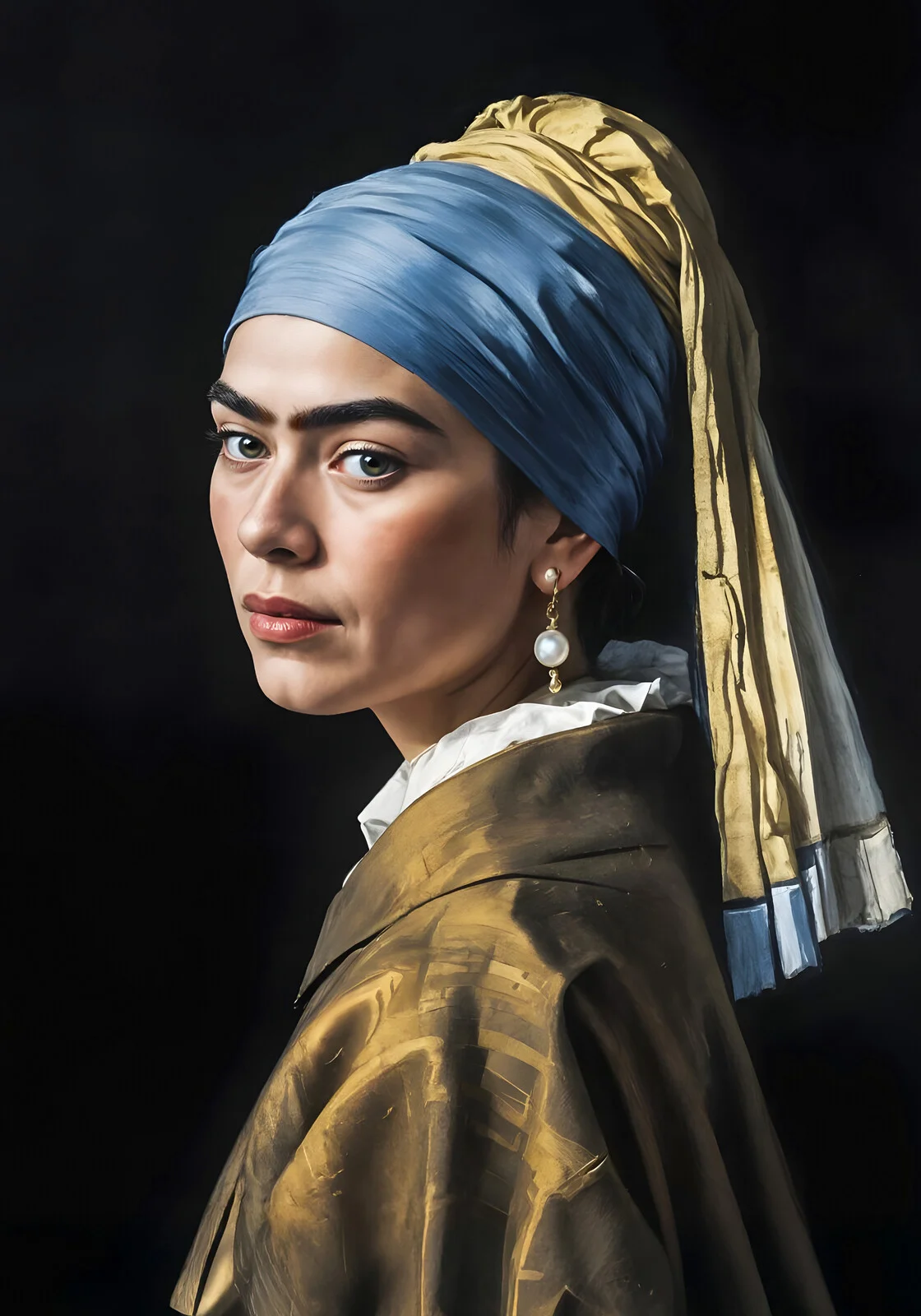
Frida Kahlo With a Pearl Earring, 2024
Digital
70 x 100 cm
5 200 kr
Frida Kahlo With a Pearl Earring
“Lysbeth’s Whisper
In Delft’s quiet, cobblestone glow,
a servant girl, her face aglow,
mixed pigments bright, with hands so still,
her touch as soft as winter's chill.
Her eyes caught his, a fleeting stare,
a dance of light, a question there.
Not love, nor fear, nor servile grace,
but strength reflected in her face.
“Three pinches lapis, a touch of red,
enough for dreams,” was all she said.
Yet, in her words, a world did speak
of those unheard, unseen, unique.
Her pearl, too large for her small ear,
a drop of moonlight, sharp and clear,
became her mark, her silent shout,
her story whispered roundabout.
Vermeer, the master, held her gaze,
his brush caressed her fleeting phase.
Yet was it his, this magic spun,
or hers—the girl who faced the sun?
Behind her shadow, history wept,
her name erased, her secret kept.
In galleries vast, her face now gleams,
but under his name, she lives in dreams.
And yet Lysbeth still softly speaks,
in every gaze, the world she seeks:
“Do you see me? Am I here?
A girl, a whisper, held so near.
For though his hand the canvas traced,
it’s my soul and pencil that light embraced.
I’m more than a pearl, a painted hue—
I’m the silent voice that outshines you.”
Lysbeth’s fame is a paradox of art,
both gift and theft and a fractured heart.
But still, she smiles; her truth remains,
a legacy through beauty’s chains.
Malmö, December 2024
In July, Frida had been in Malmö for almost a year and had already performed in three plays at the Nöjesteatern. By autumn, she was scheduled for a fourth. It was also seventy years since she had left Earth to journey to her star. The thirteenth of July held no special reason for her to celebrate. Time-travelers rarely have cause to commemorate their death dates, as they dislike speaking about death. Moreover, most perceive eternity as infinitely preferable to their time on Earth. Behind them, they leave pain and illness, and in eternity, they can live at any age of their choosing, free from the fear of death or other anxieties.
However, Frida chose to honour her short life on Earth—only forty-seven years—because of a celebrated event in the art world: the Frida Kahlo Retrospective. This retrospective, celebrating women's strength and resilience, uplifted and empowered all who experienced it. Frida's version of Klimt's ‘Woman with Fan’ was one of many important paintings.
It brought together all the paintings Frida had created after she had laid down her brush for the last time. Her life had been marked by severe health issues, and from 1953, she was bedridden following an amputation. However, this did not deter her from her passion for painting or even participating in political events; her bed was carried wherever she wished to go, a testament to her unwavering determination and courage. Her resilience in the face of adversity is a source of inspiration for all.
Frida embarked on an ambitious project that set her apart from other artists in eternity. She encountered creators from all eras and decided to paint extraordinary women from history with whom she identified. This unique project, with its fresh and innovative interpretations of historical art, was a testament to her creativity and the power of art to transcend time and space, sparking intrigue and appreciation among audiences. It remained unknown until the paintings were discovered recently—not by chance, but carefully orchestrated by Frida herself.
Thus, the paintings at Malmö’s Moderna Museet, including canvases and statues featuring Frida, reimagine well-known motifs but now incorporate her face and body. The entire collection was discovered in a hidden room behind a wall at Casa Azul, her home in the Coyoacán neighbourhood of Mexico City. Three dozen previously unknown paintings caused a global sensation and sparked intense debate, as their style did not match her known works. The international attention these paintings received underscored the exhibition's significance, making it a cultural event of global importance. The world was particularly captivated by Frida’s interpretation of Gustav Klimt’s Woman with a Fan.
Frida Kahlo shared with me her personal and spiritual reflection on this piece. I cannot recount the entire story except as part of a whimsical exhibition presentation. However, art experts summoned to study the collection were supported by notes Frida had left alongside the paintings. The handwriting was unmistakably hers, and the commentary was essential for understanding the purpose of the works and why she had hidden them. Simply put, the world of the 1950s was not ready for such messages—they had to wait for their time, and that time is now. I quote Frida’s own words:
This brings us to the next painting, where Frida shares her interpretation of Vermeer’s Girl with a Pearl Earring.
Frida: “Of course, I was familiar with the painting. Portraiture was my speciality, although, with few exceptions, my focus was self-portraits. A little over 140 of my paintings are preserved, of which 55 are self-portraits, but only about 20 are portraits of others in the true sense. Compared to greats like Rembrandt and Élisabeth Louise Vigée-Le Brun, I pale—both lived far longer than I did and retained their health. However, when it comes to depicting one’s own suffering in a portrait, I dare say I stand in a class of my own. My art is distinguished by its intensity and its deep personal connection to my pain.”
Me: “I tend to agree. Vincent van Gogh and Edvard Munch also depicted suffering, but your unique combination of surrealism, symbolism, and cultural identity makes your works unforgettable. Your boldness in bearing yourself, both physically and emotionally, is even more intense than theirs. But we’ve veered off topic—Vermeer’s girl, who has stirred more debate than most. The question is whether this was intentional.”
Frida: (interested) “Is there something specific you have in mind?”
Me: “The girl's expression, to me, is a mass of contradictions—innocent yet experienced, joyous yet sad, full of longing and yet filled with a loss of innocence. It’s a portrait of a relationship rather than a portrait of a girl, said Frida. I perceive her gaze and slightly open mouth as indicating she is sexually available. This must also have been the artist’s intention. A photograph might instantly capture such an expression, but not a portrait. Either Vermeer expressed a pious hope or wanted to boast about his conquest for posterity. A mystery, many would say.”
Frida: “You’re close to solving the mystery. To truly understand the girl, you have to think as she did. And Vermeer—because, as they say, ‘It takes two to tango.’ Vermeer is present in the portrait in a palpable way, even if he isn’t visible.”
Me: “I’ve reached the same conclusion.”
Frida: “I didn’t grasp it initially, perhaps because I repressed part of what I saw and didn’t open my eyes or mind enough. I was lost in philosophical tangents and big questions. For a while, her gaze contained the entirety of metaphysics, obscuring your point.”
Me: “But eventually, your perspectives aligned on the same wavelength.”
Frida: “You could put it that way, though it took time. It wasn’t during my time on Earth but a study trip a few years ago. I visited all the major Dutch museums of significance and eventually ended up at Mauritshuis, a museum in The Hague. I sought to understand Vermeer and his worldview. And I looked for her and found her face in two other paintings.”
Me: “Naturally, you’ve met Vermeer among the stars.”
Frida: “Of course. We belong to the same Guild. But, like me, Vermeer embellishes the truth when it suits him. Our legacy lives with us for eternity, and we do our best to polish it.” Frida laughed sheepishly.
Me: “So, you sought the truth.”
Frida: “Yes! Standing before Vermeer’s painting, I felt something I hadn’t felt in an eternity. It was as if she had turned around, just for me, to whisper something I could never hear but somehow understand. Her face was so simple, so still—and yet she carried the mysteries of the entire world in her gaze. I thought: ‘How can someone so silent speak so loudly?’ ‘I can’t find the word,’ Frida said after a moment of thought.
Me: “Ambiguous.”
Frida: “Exactly! Ambiguous, but even that word feels too weak. Multifaceted is better. Perhaps even dubious.”
Me: “And a dozen other synonyms with subtle distinctions.”
Frida: (nodding) “When I looked at her, at first, I didn’t see her gaze as a gaze. I saw a question. I saw someone wondering about her life, place in the world, and worth. And the pearl—it wasn’t just a piece of jewellery. It symbolised her fragility, her strength—a drop of light in the darkness. She had already gained a name and identity: Lysbeth, a sixteen-year-old housemaid. I thought: ‘She and I, we’re not so different. We carry the same questions and the same burdens. I must paint her—but I must also paint myself in her place.’”
Me: “It seems you idealised the image and made it unnecessarily complicated.”
Frida: “Absolutely. Back in my hotel room, I set up my easel and began reshaping Lysbeth’s face into my own. Her smooth, almost innocent complexion gave way to my face—a face that had borne pain, love, and an entire world of struggles. Her quiet elegance met my eyebrows, gaze, story, and questions. I kept her turban, for it was like a crown—pale azure with a veil tinged by the sun’s reddish-yellow heat—but I altered the details to make it my own.”
Me: “And the pearl? You changed its size.”
Thank you for sharing this beautifully intricate dialogue! It weaves together a rich tapestry of art, history, feminism, and the nuances of interpretation. Here's the English version of the added portion:
________________________________________
Frida: “I let it remain, but in my painting, it became smaller, with a touch of gold in its setting. It was no longer just a symbol of beauty but of my weight: my dreams, pain, and Mexico. It was like a tear, a pearl born of hardship—just like me.
When I finished painting Lysbeth’s gaze, it was no longer just mine or hers. Every woman’s question was directed at the world: ‘Do you see me? Do you hear me?’
Vermeer knew how to create magic from the ordinary. He could capture light as if it were born from the skin itself. I didn’t try to imitate his technique—it’s impossible—but I borrowed his light. I made it my own, letting it reflect my colours, shadows, and inner life. I gave her the same quiet strength, but now it was a strength that spoke louder, that screamed: ‘I am here! I exist!’
Frida continued dreamily as if shielding herself from her thoughts. “When I looked at her once I was done, I thought: ‘She’s no longer just Vermeer’s girl. Lysbeth had become my sister, my friend, but perhaps most of all, a second me—an older sister reproaching her.’ Perhaps that’s the nature of art—that we all wear a pearl in our ear, a symbol of what we’ve endured and still hope for. Vermeer gave us beauty, but we give it meaning through observation and thought.”
Me: “We’re circling the topic, aren’t we? Surely, while painting, you must have noticed what I and so many others have seen? I’ve thought a lot about that portrait because I perceive it as such and not as a tronie—a painting depicting a type rather than a specific person. This, I believe, was a flesh-and-blood person, someone who knew Vermeer well. Not his daughter, who was only in her early teens. Besides, a daughter doesn’t look at her father that way. I estimate the young woman to be around sixteen years old.”
Frida: (Interested, tilting her head slightly) “I’m listening.”
Me: “What struck me the first time I saw the painting was the intimacy of the portrait—something forbidden. The girl you call Lysbeth is captured in an intimate moment, glancing back over her shoulder. Her ambiguous expression adds to the painting's sense of mystery and allure. The simplicity of the composition and Vermeer’s focus entirely on the girl, with no background detail, create an air of effortlessness. This lack of distraction emphasises her gaze, expression, and the elaborate pearl accessory. The pearl, of course, isn’t hers—far too large and prohibitively expensive. Lysbeth isn’t made up the way a noblewoman would be, which is why I believe she’s more likely a servant girl than a model.”
Frida: “You’re on the right track. Contemporaries saw the intimate gaze and angle of the girl's face as sexually suggestive. Having a young woman make direct eye contact with the viewer was considered provocative and improper. The pearl earring itself had erotic overtones, as pearls were sometimes symbolic of sexuality and fertility. The relationship was criticised early on, and the painting was hidden away.”
Me: “So, according to you, the painting has to do with sex?”
Frida: “In part, at least. She was responding to a poorly disguised proposition.”
Me: “I can imagine.”
Frida: “Vermeer has told me about their conversation. ‘Plenty of ultramarine and a quarter pinch of ruby red madder, if you please. A shy artist never gets to kiss the pretty girls,’ said Vermeer with a cheeky tone.”
Me: “Hard to misunderstand—and explains her gaze.”
Frida: “Lysbeth looked up from mixing colours. Her gaze held his for a moment too long, filled with something that could have been mockery—or a test. Her lips parted just enough to hint at a smile but insufficient to confirm it.
‘Three pinches of lapis and a touch of madder, Meester Vermeer,’ she said, pausing to let the silence speak first. Then, almost as an afterthought, she added softly but firmly:
‘Cheeky artists only get to kiss... if the girl allows it.’
Me: “And that’s the moment Vermeer captured on the canvas.”
Frida: “Exactly. The double layer in the remark and how it’s delivered lets the viewer interpret it as if Lysbeth is the one driving the game, playing with him—or as if she carries a kind of resignation or awareness of her role in his gaze and art. Because it’s through his portrait that we know her.”
Me: “Have you met Lysbeth as well in eternity?”
Frida: “Of course! She lives with Vermeer, his wife Catharina Bolnes, and her mother Maria Thins on the same star, just as they did on Earth.”
Me: “Did her gaze lead to anything?” I asked curiously.
Frida: “Yes, to a deep friendship. Vermeer respected Lysbeth’s response, even if it was layered with ambiguity. Lysbeth married art and remained her master’s apprentice. She became so skilled that several of her works have been attributed to him. The theory that Vermeer didn’t paint the masterful Girl with the Red Hat has long been speculated, and since the model in Girl with the Flute appears to be the same, it falls into the same category. Even The Lacemaker (1669) and one of Vermeer’s last works, The Guitar Player, are fruits of Lysbeth’s hand—or painted by them together.”
Me: “A fantastic story. That a young servant girl had a relationship with her employer, the house's master, was nothing unique in those days—quite the opposite, it was common. Men took what they wanted, and rarely was the alliance on equal terms.”
Frida: “In this case, Vermeer wasn’t a typical chauvinist. He had a close relationship with his wife and fifteen children, so the girl with the pearl earring was an exception because Vermeer provided the world with visual evidence of what could have been a misstep.”
Me: “Your expression on your version of the girl doesn’t seem to invite intimacy.”
Frida: “Correct. As a woman and a feminist, I can’t validate a man exploiting a young woman’s vulnerability, no matter how complicit she seems. Her choices were limited. That nothing happened was mostly thanks to Lysbeth, who could have taken advantage to secure privileges. She did gain some due to her skill with colours and brushes.”
Me: “If she became so skilled, what happened to Lysbeth after Vermeer’s untimely death?”
Frida: “Lysbeth didn’t outlive her master. Both died of tuberculosis in 1675, leaving the widow destitute. After Vermeer’s death, Catharina Bolnes filed for bankruptcy. Several paintings that cannot be identified with any known works today were mentioned in the bankruptcy proceedings. Some have disappeared and been attributed to other artists, now hanging in collections under the wrong name. The 1670s were difficult years for artists, and Vermeer and his apprentice were no exceptions.
The Guitar Player represents a new direction in Vermeer’s art, resulting from Lysbeth and his collaboration. It saved the widow, who managed to sell the painting and repay much of the debt. Lysbeth also painted a now-lost portrait of Vermeer, previously assumed to be painted by him.”
Me: “And now she hangs in Malmö.”
Frida: “So it is, in my version, with my face but still with the pearl. And Lysbeth still whispers, but now I decide what she says. And perhaps this is what she says: ‘We women carry the world—sometimes in a simple earring, sometimes in our gaze. See us. Understand us. And carry us forward.’”
Jörgen Thornberg
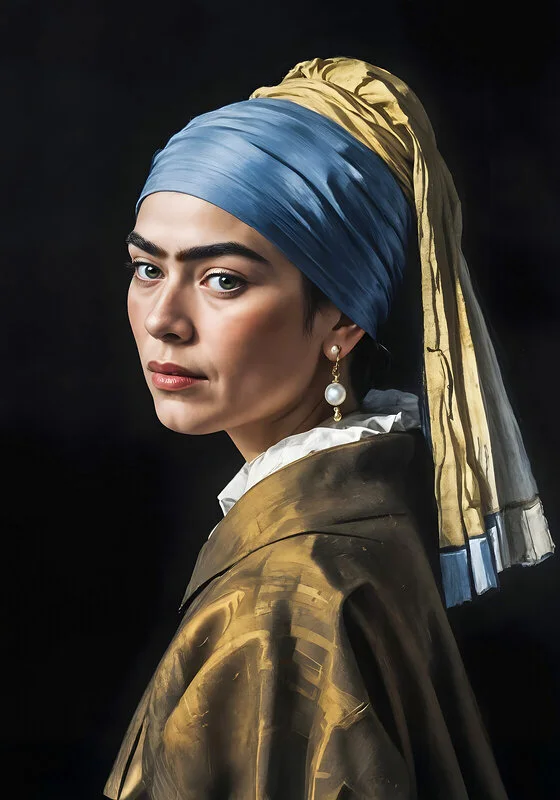
Frida Kahlo With a Pearl Earring, 2024
Digital
70 x 100 cm
5 200 kr
Frida Kahlo With a Pearl Earring
“Lysbeth’s Whisper
In Delft’s quiet, cobblestone glow,
a servant girl, her face aglow,
mixed pigments bright, with hands so still,
her touch as soft as winter's chill.
Her eyes caught his, a fleeting stare,
a dance of light, a question there.
Not love, nor fear, nor servile grace,
but strength reflected in her face.
“Three pinches lapis, a touch of red,
enough for dreams,” was all she said.
Yet, in her words, a world did speak
of those unheard, unseen, unique.
Her pearl, too large for her small ear,
a drop of moonlight, sharp and clear,
became her mark, her silent shout,
her story whispered roundabout.
Vermeer, the master, held her gaze,
his brush caressed her fleeting phase.
Yet was it his, this magic spun,
or hers—the girl who faced the sun?
Behind her shadow, history wept,
her name erased, her secret kept.
In galleries vast, her face now gleams,
but under his name, she lives in dreams.
And yet Lysbeth still softly speaks,
in every gaze, the world she seeks:
“Do you see me? Am I here?
A girl, a whisper, held so near.
For though his hand the canvas traced,
it’s my soul and pencil that light embraced.
I’m more than a pearl, a painted hue—
I’m the silent voice that outshines you.”
Lysbeth’s fame is a paradox of art,
both gift and theft and a fractured heart.
But still, she smiles; her truth remains,
a legacy through beauty’s chains.
Malmö, December 2024
In July, Frida had been in Malmö for almost a year and had already performed in three plays at the Nöjesteatern. By autumn, she was scheduled for a fourth. It was also seventy years since she had left Earth to journey to her star. The thirteenth of July held no special reason for her to celebrate. Time-travelers rarely have cause to commemorate their death dates, as they dislike speaking about death. Moreover, most perceive eternity as infinitely preferable to their time on Earth. Behind them, they leave pain and illness, and in eternity, they can live at any age of their choosing, free from the fear of death or other anxieties.
However, Frida chose to honour her short life on Earth—only forty-seven years—because of a celebrated event in the art world: the Frida Kahlo Retrospective. This retrospective, celebrating women's strength and resilience, uplifted and empowered all who experienced it. Frida's version of Klimt's ‘Woman with Fan’ was one of many important paintings.
It brought together all the paintings Frida had created after she had laid down her brush for the last time. Her life had been marked by severe health issues, and from 1953, she was bedridden following an amputation. However, this did not deter her from her passion for painting or even participating in political events; her bed was carried wherever she wished to go, a testament to her unwavering determination and courage. Her resilience in the face of adversity is a source of inspiration for all.
Frida embarked on an ambitious project that set her apart from other artists in eternity. She encountered creators from all eras and decided to paint extraordinary women from history with whom she identified. This unique project, with its fresh and innovative interpretations of historical art, was a testament to her creativity and the power of art to transcend time and space, sparking intrigue and appreciation among audiences. It remained unknown until the paintings were discovered recently—not by chance, but carefully orchestrated by Frida herself.
Thus, the paintings at Malmö’s Moderna Museet, including canvases and statues featuring Frida, reimagine well-known motifs but now incorporate her face and body. The entire collection was discovered in a hidden room behind a wall at Casa Azul, her home in the Coyoacán neighbourhood of Mexico City. Three dozen previously unknown paintings caused a global sensation and sparked intense debate, as their style did not match her known works. The international attention these paintings received underscored the exhibition's significance, making it a cultural event of global importance. The world was particularly captivated by Frida’s interpretation of Gustav Klimt’s Woman with a Fan.
Frida Kahlo shared with me her personal and spiritual reflection on this piece. I cannot recount the entire story except as part of a whimsical exhibition presentation. However, art experts summoned to study the collection were supported by notes Frida had left alongside the paintings. The handwriting was unmistakably hers, and the commentary was essential for understanding the purpose of the works and why she had hidden them. Simply put, the world of the 1950s was not ready for such messages—they had to wait for their time, and that time is now. I quote Frida’s own words:
This brings us to the next painting, where Frida shares her interpretation of Vermeer’s Girl with a Pearl Earring.
Frida: “Of course, I was familiar with the painting. Portraiture was my speciality, although, with few exceptions, my focus was self-portraits. A little over 140 of my paintings are preserved, of which 55 are self-portraits, but only about 20 are portraits of others in the true sense. Compared to greats like Rembrandt and Élisabeth Louise Vigée-Le Brun, I pale—both lived far longer than I did and retained their health. However, when it comes to depicting one’s own suffering in a portrait, I dare say I stand in a class of my own. My art is distinguished by its intensity and its deep personal connection to my pain.”
Me: “I tend to agree. Vincent van Gogh and Edvard Munch also depicted suffering, but your unique combination of surrealism, symbolism, and cultural identity makes your works unforgettable. Your boldness in bearing yourself, both physically and emotionally, is even more intense than theirs. But we’ve veered off topic—Vermeer’s girl, who has stirred more debate than most. The question is whether this was intentional.”
Frida: (interested) “Is there something specific you have in mind?”
Me: “The girl's expression, to me, is a mass of contradictions—innocent yet experienced, joyous yet sad, full of longing and yet filled with a loss of innocence. It’s a portrait of a relationship rather than a portrait of a girl, said Frida. I perceive her gaze and slightly open mouth as indicating she is sexually available. This must also have been the artist’s intention. A photograph might instantly capture such an expression, but not a portrait. Either Vermeer expressed a pious hope or wanted to boast about his conquest for posterity. A mystery, many would say.”
Frida: “You’re close to solving the mystery. To truly understand the girl, you have to think as she did. And Vermeer—because, as they say, ‘It takes two to tango.’ Vermeer is present in the portrait in a palpable way, even if he isn’t visible.”
Me: “I’ve reached the same conclusion.”
Frida: “I didn’t grasp it initially, perhaps because I repressed part of what I saw and didn’t open my eyes or mind enough. I was lost in philosophical tangents and big questions. For a while, her gaze contained the entirety of metaphysics, obscuring your point.”
Me: “But eventually, your perspectives aligned on the same wavelength.”
Frida: “You could put it that way, though it took time. It wasn’t during my time on Earth but a study trip a few years ago. I visited all the major Dutch museums of significance and eventually ended up at Mauritshuis, a museum in The Hague. I sought to understand Vermeer and his worldview. And I looked for her and found her face in two other paintings.”
Me: “Naturally, you’ve met Vermeer among the stars.”
Frida: “Of course. We belong to the same Guild. But, like me, Vermeer embellishes the truth when it suits him. Our legacy lives with us for eternity, and we do our best to polish it.” Frida laughed sheepishly.
Me: “So, you sought the truth.”
Frida: “Yes! Standing before Vermeer’s painting, I felt something I hadn’t felt in an eternity. It was as if she had turned around, just for me, to whisper something I could never hear but somehow understand. Her face was so simple, so still—and yet she carried the mysteries of the entire world in her gaze. I thought: ‘How can someone so silent speak so loudly?’ ‘I can’t find the word,’ Frida said after a moment of thought.
Me: “Ambiguous.”
Frida: “Exactly! Ambiguous, but even that word feels too weak. Multifaceted is better. Perhaps even dubious.”
Me: “And a dozen other synonyms with subtle distinctions.”
Frida: (nodding) “When I looked at her, at first, I didn’t see her gaze as a gaze. I saw a question. I saw someone wondering about her life, place in the world, and worth. And the pearl—it wasn’t just a piece of jewellery. It symbolised her fragility, her strength—a drop of light in the darkness. She had already gained a name and identity: Lysbeth, a sixteen-year-old housemaid. I thought: ‘She and I, we’re not so different. We carry the same questions and the same burdens. I must paint her—but I must also paint myself in her place.’”
Me: “It seems you idealised the image and made it unnecessarily complicated.”
Frida: “Absolutely. Back in my hotel room, I set up my easel and began reshaping Lysbeth’s face into my own. Her smooth, almost innocent complexion gave way to my face—a face that had borne pain, love, and an entire world of struggles. Her quiet elegance met my eyebrows, gaze, story, and questions. I kept her turban, for it was like a crown—pale azure with a veil tinged by the sun’s reddish-yellow heat—but I altered the details to make it my own.”
Me: “And the pearl? You changed its size.”
Thank you for sharing this beautifully intricate dialogue! It weaves together a rich tapestry of art, history, feminism, and the nuances of interpretation. Here's the English version of the added portion:
________________________________________
Frida: “I let it remain, but in my painting, it became smaller, with a touch of gold in its setting. It was no longer just a symbol of beauty but of my weight: my dreams, pain, and Mexico. It was like a tear, a pearl born of hardship—just like me.
When I finished painting Lysbeth’s gaze, it was no longer just mine or hers. Every woman’s question was directed at the world: ‘Do you see me? Do you hear me?’
Vermeer knew how to create magic from the ordinary. He could capture light as if it were born from the skin itself. I didn’t try to imitate his technique—it’s impossible—but I borrowed his light. I made it my own, letting it reflect my colours, shadows, and inner life. I gave her the same quiet strength, but now it was a strength that spoke louder, that screamed: ‘I am here! I exist!’
Frida continued dreamily as if shielding herself from her thoughts. “When I looked at her once I was done, I thought: ‘She’s no longer just Vermeer’s girl. Lysbeth had become my sister, my friend, but perhaps most of all, a second me—an older sister reproaching her.’ Perhaps that’s the nature of art—that we all wear a pearl in our ear, a symbol of what we’ve endured and still hope for. Vermeer gave us beauty, but we give it meaning through observation and thought.”
Me: “We’re circling the topic, aren’t we? Surely, while painting, you must have noticed what I and so many others have seen? I’ve thought a lot about that portrait because I perceive it as such and not as a tronie—a painting depicting a type rather than a specific person. This, I believe, was a flesh-and-blood person, someone who knew Vermeer well. Not his daughter, who was only in her early teens. Besides, a daughter doesn’t look at her father that way. I estimate the young woman to be around sixteen years old.”
Frida: (Interested, tilting her head slightly) “I’m listening.”
Me: “What struck me the first time I saw the painting was the intimacy of the portrait—something forbidden. The girl you call Lysbeth is captured in an intimate moment, glancing back over her shoulder. Her ambiguous expression adds to the painting's sense of mystery and allure. The simplicity of the composition and Vermeer’s focus entirely on the girl, with no background detail, create an air of effortlessness. This lack of distraction emphasises her gaze, expression, and the elaborate pearl accessory. The pearl, of course, isn’t hers—far too large and prohibitively expensive. Lysbeth isn’t made up the way a noblewoman would be, which is why I believe she’s more likely a servant girl than a model.”
Frida: “You’re on the right track. Contemporaries saw the intimate gaze and angle of the girl's face as sexually suggestive. Having a young woman make direct eye contact with the viewer was considered provocative and improper. The pearl earring itself had erotic overtones, as pearls were sometimes symbolic of sexuality and fertility. The relationship was criticised early on, and the painting was hidden away.”
Me: “So, according to you, the painting has to do with sex?”
Frida: “In part, at least. She was responding to a poorly disguised proposition.”
Me: “I can imagine.”
Frida: “Vermeer has told me about their conversation. ‘Plenty of ultramarine and a quarter pinch of ruby red madder, if you please. A shy artist never gets to kiss the pretty girls,’ said Vermeer with a cheeky tone.”
Me: “Hard to misunderstand—and explains her gaze.”
Frida: “Lysbeth looked up from mixing colours. Her gaze held his for a moment too long, filled with something that could have been mockery—or a test. Her lips parted just enough to hint at a smile but insufficient to confirm it.
‘Three pinches of lapis and a touch of madder, Meester Vermeer,’ she said, pausing to let the silence speak first. Then, almost as an afterthought, she added softly but firmly:
‘Cheeky artists only get to kiss... if the girl allows it.’
Me: “And that’s the moment Vermeer captured on the canvas.”
Frida: “Exactly. The double layer in the remark and how it’s delivered lets the viewer interpret it as if Lysbeth is the one driving the game, playing with him—or as if she carries a kind of resignation or awareness of her role in his gaze and art. Because it’s through his portrait that we know her.”
Me: “Have you met Lysbeth as well in eternity?”
Frida: “Of course! She lives with Vermeer, his wife Catharina Bolnes, and her mother Maria Thins on the same star, just as they did on Earth.”
Me: “Did her gaze lead to anything?” I asked curiously.
Frida: “Yes, to a deep friendship. Vermeer respected Lysbeth’s response, even if it was layered with ambiguity. Lysbeth married art and remained her master’s apprentice. She became so skilled that several of her works have been attributed to him. The theory that Vermeer didn’t paint the masterful Girl with the Red Hat has long been speculated, and since the model in Girl with the Flute appears to be the same, it falls into the same category. Even The Lacemaker (1669) and one of Vermeer’s last works, The Guitar Player, are fruits of Lysbeth’s hand—or painted by them together.”
Me: “A fantastic story. That a young servant girl had a relationship with her employer, the house's master, was nothing unique in those days—quite the opposite, it was common. Men took what they wanted, and rarely was the alliance on equal terms.”
Frida: “In this case, Vermeer wasn’t a typical chauvinist. He had a close relationship with his wife and fifteen children, so the girl with the pearl earring was an exception because Vermeer provided the world with visual evidence of what could have been a misstep.”
Me: “Your expression on your version of the girl doesn’t seem to invite intimacy.”
Frida: “Correct. As a woman and a feminist, I can’t validate a man exploiting a young woman’s vulnerability, no matter how complicit she seems. Her choices were limited. That nothing happened was mostly thanks to Lysbeth, who could have taken advantage to secure privileges. She did gain some due to her skill with colours and brushes.”
Me: “If she became so skilled, what happened to Lysbeth after Vermeer’s untimely death?”
Frida: “Lysbeth didn’t outlive her master. Both died of tuberculosis in 1675, leaving the widow destitute. After Vermeer’s death, Catharina Bolnes filed for bankruptcy. Several paintings that cannot be identified with any known works today were mentioned in the bankruptcy proceedings. Some have disappeared and been attributed to other artists, now hanging in collections under the wrong name. The 1670s were difficult years for artists, and Vermeer and his apprentice were no exceptions.
The Guitar Player represents a new direction in Vermeer’s art, resulting from Lysbeth and his collaboration. It saved the widow, who managed to sell the painting and repay much of the debt. Lysbeth also painted a now-lost portrait of Vermeer, previously assumed to be painted by him.”
Me: “And now she hangs in Malmö.”
Frida: “So it is, in my version, with my face but still with the pearl. And Lysbeth still whispers, but now I decide what she says. And perhaps this is what she says: ‘We women carry the world—sometimes in a simple earring, sometimes in our gaze. See us. Understand us. And carry us forward.’”
5 200 kr

Jörgen Thornberg
Malmö
Lite om bilder och mig. Translation in English at the end.
Jag är en nyfiken person som ser allt i bilder, även det jag fäster i ord, gärna tillsammans för bakom alla mina bilder finns en berättelse. Till vissa bilder hör en kortare eller längre novell som följer med bilden.
Bilder berättar historier. Jag omges av naturlig skönhet, intressanta människor och historia var jag än går. Jag använder min kamera för att dokumentera världen och blanda det jag ser med vad jag känner för att fånga den dolda magin.
Mina bilder berättar mina historier. Genom mina bilder, tryck och berättelser. Jag bjuder in dig att ta del av dessa berättelser, in i ditt liv och hem och dela min mycket personliga syn på vår värld. Mer än vad ögat ser. Jag tänker i bilder, drömmer och skriver och pratar om dem; följaktligen måste jag också skapa bilder. De blir vad jag ser, inte nödvändigtvis begränsade till verkligheten. Det finns en bild runt varje hörn. Jag hoppas att du kommer att se vad jag såg och gilla det.
Jag är också en skrivande person och till många bilder hör en kortare eller längre essay. Den följer med tavlan, tryckt på fint papper och med en personlig hälsning från mig.
Flertalet bilder startar sin resa i min kamera. Enkelt förklarat beskriver jag bilden jag ser i mitt inre, upplevd eller fantiserad. Bilden uppstår inom mig redan innan jag fått okularet till ögat. På bråkdelen av ett ögonblick ser jag vad jag vill ha och vad som kan göras med bilden. Här skall jag stoppa in en giraff, stålmannen, Titanic eller vad det är min fantasi finner ut. Ännu märkligare är att jag kommer ihåg minnesbilden långt efteråt när det blir tid att skapa verket. Om jag lyckas eller inte, är upp till betraktaren, oftast präglat av en stråk av svart humor – meningen är att man skall bli underhållen. Mina bilder blir ofta en snackis där de hänger.
Jag föredrar bilder som förmedlar ett budskap i flera lager. Vid första anblicken fylld av feel-good, en vacker utsikt, fint väder, solen skiner, blommor på ängen eller vattnet som ligger förrädiskt spegelblankt. I en sådan bild kan jag gömma min egentliga berättelse, mitt förakt för förtryckare och våldsverkare, rasister och fördomsfulla människor - ett gärna återkommande motiv mer eller mindre dolt i det vackra motivet. Jag försöker förena dem i ett gemensamt narrativ.
Bild och formgivning har löpt som en röd tråd genom livet. Fotokonst känns som en värdig final som jag gärna delar med mig.
Min genre är vid som framgår av mina bilder, temat en blandning av pop- och gatukonst i kollage som kan bestå av hundratals lager. Vissa bilder kan ta veckor, andra någon dag innan det är dags att överlämna resultatet till printverkstaden. Fine Art Prints är digitala fotocollage. I dessa kollage sker rivandet, klippandet, pusslandet, målandet, ritandet och sprayningen digitalt. Det jag monterar in kan vara hundratals år gamla bilder som jag omsorgsfullt frilägger så att de ser ut att vara en del av tavlan men också bilder skapade av mig själv efter min egen fantasi. Därefter besöks printstudion och för vissa bilder numrera en limiterad upplaga (oftast 7 exemplar) och signera för hand. Vissa bilder kan köpas i olika format. Det är bara att fråga efter vilka. Gillar man en bild som är 70x100 men inte har plats på väggen, går den kanske att få i 50x70 cm istället. Frågan är fri.
Metoden Giclée eller Fine Art Print som det också kallas är det moderna sättet för framställning av grafisk konst. Villkoret för denna typ av utskrifter är att en högkvalitativ storformatskrivare används med åldersbeständigt färgpigment och konstnärspapper eller i förekommande fall på duk. Pappret som används möter de krav på livslängd som ställs av museer och gallerier. Normalt säljer jag mina bilder oinramade så att den nya ägaren själv kan bestämma hur de skall se ut, med eller utan passepartout färg på ram, med eller utan glas etc..
Under många år ställde jag bara ut på nätet, i valda grupper och på min egen Facebooksida - https://www.facebook.com/jorgen.thornberg.9
Jag finns också på en egen hemsida som tyvärr inte alltid är uppdaterad – https://www.jth.life/ Där kan du också läsa en del av de berättelser som följer med bilden.
UTSTÄLLNINGAR
Luftkastellet, oktober 2022
Konst i Lund, november 2022
Luftkastellet, mars 2023
Engleson Galleri Caroli, april 2023
Hydra, Greece June 2023
Engleson Galleri Caroli, oktober 2023
Toppen, Höllviken december 2023
Luftkastellet, mars 2024
Torups Galleri, mars 2024
Venice, May 2024
Luftkastellet, oktober 2024
Konst i Advent, December 2024
Galleri Engleson, Caroli December 2024
Jäger & Jansson Galleri, april 2025
A bit about pictures and me.
I'm a curious person who sees everything in pictures, even what I express in words, often combining them, for behind all my pictures lies a story. These narratives, some as short as a single image and others as long as a novel, are the heart and soul of my work.
Pictures tell stories. Wherever I go, I'm surrounded by natural beauty, exciting people, and history. I use my camera to document the world and blend what I see with what I feel to capture the hidden magic.
My images tell my stories. Through my pictures, prints, and narratives, I invite you to partake in these stories in your life and home and share my deeply personal perspective of our world. More than meets the eye. I think in pictures, dream, write, and talk about them; consequently, I must create images too. They become what I see, not necessarily confined to reality. There's a picture around every corner. I hope you'll see what I saw and enjoy it.
I'm also a writer, and many images come with a shorter or longer essay. It accompanies the painting, printed on fine paper with my personal greeting.
Many pictures start their journey on my camera. Simply put, I describe the image I see in my mind, experienced or imagined. The image arises within me even before I bring the eyepiece to my eye. In a fraction of a moment, I see what I want and what can be done with the picture. Here, I'll insert a giraffe, Superman, the Titanic, or whatever my imagination conjures up. Even stranger is that I remember the mental image long after it's time to create the work. Whether I succeed is up to the observer, often imbued with a streak of black humour – the aim is to entertain. My pictures usually become a talking point wherever they hang.
I prefer pictures that convey a message in multiple layers. At first glance, they're filled with feel-good vibes, a beautiful view, lovely weather, the sun shining, flowers in the meadow, or the water lying deceptively calm. But beneath this surface beauty, I often conceal a deeper story, a narrative that challenges societal norms or explores the human condition. I invite you to delve into these hidden narratives and discover the layers of meaning within my work.
Picture and design have been a thread running through my life. Photographic art feels like a fitting finale, and I'm happy to share it.
My genre is varied, as seen in my pictures; the theme is a blend of pop and street art in collages that can consist of hundreds of layers. Some images can take weeks, others just a day before it's time to hand over the result to the print workshop. Fine Art Prints are digital photo collages. In these collages, tearing, cutting, puzzling, painting, drawing, and spraying happen digitally. What I insert can be images hundreds of years old that I carefully extract so they appear to be part of the painting, but also images created by myself, now also generated from my imagination. Next, visit the print studio and, for certain images, number a limited edition (usually 7 copies) and sign them by hand. Some images may be available in other formats. Just ask which ones. If you like an image that's 70x100 but doesn't have space on the wall, you might be able to get it in 50x70 cm instead. The question is open.
The Giclée method, or Fine Art Print as it's also called, is the modern way of producing graphic art. This method ensures the highest quality and longevity of the artwork, using a high-quality large-format printer with archival pigment inks and artist paper or, in some cases, canvas. The paper used meets the longevity requirements set by museums and galleries. I sell my pictures unframed, allowing the new owner to personalise their artwork, confident in the lasting value and quality of the piece.
For many years, I only exhibited online, in selected groups, and on my Facebook page - https://www.facebook.com/jorgen.thornberg.9. I also have my website, which unfortunately is not constantly updated - https://www.jth.life/. You can also read some of the stories accompanying the pictures there.
EXHIBITIONS
Luftkastellet, October 2022
Art in Lund, November 2022
Luftkastellet, March 2023
Engleson Gallery Caroli, April 2023
Hydra, Greece June 2023
Engleson Gallery Caroli, October 2023
Toppen, Höllviken December 2023
Luftkastellet, March 2024
Torup Gallery, March 2024
Venice, May 2024
UTSTÄLLNINGAR
Luftkastellet, oktober 2022
Konst i Lund, november 2022
Luftkastellet, mars 2023
Engleson Galleri Caroli, april 2023
Hydra, Greece June 2023
Engleson Galleri Caroli, oktober 2023
Toppen, Höllviken december 2023
Luftkastellet, mars 2024
Torups Galleri, mars 2024
Venice, May 2024
Luftkastellet, October 2024
Konst i Advent, December 2024
Galleri Engleson, Caroli December 2024
Jäger & Jansson Galleri, April 2025
Utbildning
Autodidakt
Medlem i konstnärsförening
Öppna Sinnen
Med i konstrunda
Konstrundan i Skåne
Utställningar
Luftkastellet, October 2022
Art in Lund, November 2022
Luftkastellet, March 2023
Engleson Gallery Caroli, April 2023
Hydra, Greece June 2023
Engleson Gallery Caroli, October 2023
Toppen, Höllviken December 2023
Luftkastellet, March 2024
Torup Gallery, March 2024
Venice, May 2024