Vi använder cookies för att ge dig bästa möjliga upplevelse. Välj vilka cookies du tillåter.
Läs mer i vår integritetspolicy
Jörgen Thornberg
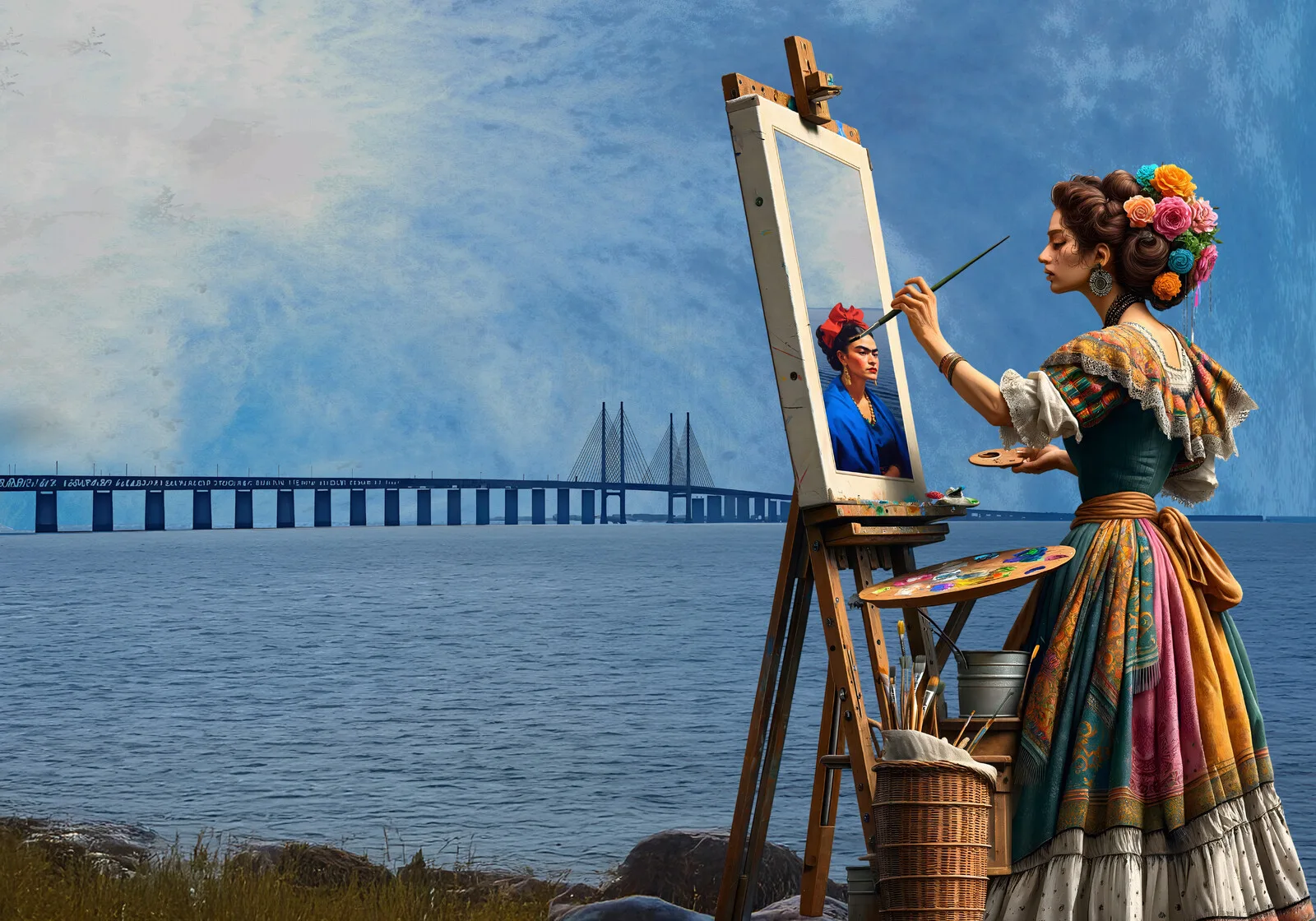
Frida and the Bridge to Freedom, 2024
Digital
100 x 70 cm
5 200 kr
A Brush of Pain and Power
In a blue place with whispered pain,
Frida stands, a figure never quite tame.
With flowers woven in braids of night,
She paints her soul in shades of light.
A woman who bore the weight of scars,
Carved with a needle, stitched in stars.
She painted her pain, her body laid bare,
Each stroke was a testament to all she'd bear.
With eyes that held both grief and fire,
She faced her truths and climbed ever higher.
Her world was filled with reds and blues,
A vibrant tapestry of all she knew.
In a skirt of ruffles embroidered bright,
She stood defiant, a warrior in the fight.
Her gaze intense, her jaw set strong,
She gave her pain a voice, a song.
Her canvas was life, raw and real,
With every brushstroke, she dared to feel.
Picture a wounded deer, a broken spine,
Her art is a testament to the feminine divine.
Years have passed, yet she remains,
A spirit who embraced both joy and pains.
In Mexico's warmth or cold northern mist,
Her presence lingers, impossible to resist.
By the bridge where the waters sway,
Under Malmö's hazy sky, at the end of the day.
I saw her there, impossible yet true,
In the golden light of a sky-tinged blue.
Her easel stood against the breeze,
A figure of strength, at once at ease.
The flowers in her hair were just the same,
The spirit of a legend, untamed flame.
Her eyes met mine, a fleeting glance,
As if we shared a secret dance.
Her brush moved with a timeless grace,
Painting the echoes of a distant place.
She stood by the bridge, a ghost of light,
Casting colour in the fading night.
In that moment, time ceased to be,
And Frida’s spirit was wild and free.
A silhouette against the sundown’s glow,
In Malmö's air, her spirit did flow.
With a stroke of crimson, a touch of blue,
She painted herself anew, and I knew—
That legends live where colours remain,
In the strokes of art and the heart’s true pain.
At the water’s edge, she still creates,
A testament to fate and the soul she paints.
In Malmö’s stillness, she stood so near,
A brush in hand, her gaze sincere.
And when I blinked, she was gone from sight,
Yet her presence lingered in the fading light.
Malmö, October 2024
Frida and the Bridge to Freedom, a metaphor for her journey towards self-expression and liberation.
I had made my way to the bridgehead, right where Luftkastellet is located, where I exhibit my paintings a couple of times a year. With its historical significance and connection to Frida's life, this spot was now deserted. It was vacation time, and people were surely lounging at the Ribersborg or Sibbarp beaches rather than swimming from this rocky shore. This July day was approaching late afternoon, but the sun blazed its strongest through a haze that had settled over the Öresund Bridge in the light breeze. I would describe the sky as dramatic and beautiful and the view as enchanting.
That was when I spotted her. There was no mistaking who stood there, even though it shouldn't have been possible, as the woman had left this earth seventy years earlier. From my previous encounters with Time-travellers, I knew it still happened quite often—they returned to earth. And now it was happening again. What had drawn Frida to choose Malmö and this very spot was a mystery, though. The place is, after all, beautiful, if not overwhelming. She indeed had her reasons. Frida is one of my favourites, and I was relatively well-read on her art. My thoughts raced like an internal documentary. I had caught a fleeting glance, but she seemed uninterested in my gaze. If it was Frida, a Time-traveller, she knew that earthlings didn’t recognise them; the closer they had been to each other in life, the less they recognised them. Only those with personal experience, like me, understood whom they were meeting.
Frida Kahlo was indeed standing by her easel, slightly turned to the side, so I saw her face and body in profile. Her posture was proud and determined, and it was clear that each brushstroke she placed on the canvas was charged with seriousness and passion. The air vibrated with her intensity and focused presence as if every movement she made was carefully considered.
Her hair, a dark cascade of braids, was adorned with a traditional Mexican knot, and the black and red ribbons woven between the braids were a testament to her heritage. A vibrant crown of roses and what appeared to be petrol-blue carnations perched atop her head, a striking contrast to her dark locks. The flowers, a reflection of her pride in her Mexican roots, caught my eye and held my gaze.
She glanced in my direction, revealing her expressive face with those famously joined eyebrows that framed her intense, deep gaze. It was a face marked by the pain and struggle of life but also by strength and beauty. Her red-painted lips were slightly pressed together in concentration as she focused on her work, her gaze piercing through the canvas and into my soul.
Frida wore a traditional Tehuana dress, a masterpiece of Mexican craftsmanship and colour that captured my attention. The fabric was richly embroidered in shades of burnt orange, turquoise, and green, and I noticed how golden threads shimmered as the light hit the dress. Ruffles and frills along the sleeves and hem created a playful movement as she stood painting. The skirt was wide and swirled around her legs, and I could make out the traditional, patterned leather sandals adorning her feet, each element a vibrant celebration of her Mexican heritage.
Around Frida’s neck hung a heavy necklace of Mexican silver, with large medallions and matching earrings with intricate details, giving her a queenly aura. She had draped a pale pink shawl around her waist, gathered in a knot over her hips as if it were part of her creative uniform. It was as if every detail about her reflected Frida’s intense and passionate life. This was not the worn forty-seven-year-old woman who left the earth in 1954. In the way of Time-travellers, she had left her body behind on earth and assumed the person who suited the moment. I would estimate the woman's age to be no more than thirty-five when she reached her artistic breakthrough, perhaps forty at most when she painted the controversial self-portrait ‘The Broken Column’. In it, with her breasts exposed, she showed a body pierced with nails and spikes, bearing witness to her physical pain after an accident at eighteen. That painting was not one of my favourites, and it made me uncomfortable.
In front of Frida stood the easel, and she was creating yet another of her self-portraits on the canvas. I watched how she portrayed herself in a raw, honest light—a face that bore equal parts beauty, sorrow, and uncompromising truth. The background was the muted blue shades of the sound that reflected her mood, and the red ribbon she had in her hair in the portrait symbolised her creative fire. The brush, which Frida held with a steady but gentle hand, seemed almost to dance over the canvas as she captured herself in colour in one of her ever-recurring encounters with her soul.
There was an aura around her, a mixture of pain and strength that I could feel clearly. Despite everything, she was a woman who had chosen to confront the world—and herself—through her paintings. Every detail of her appearance, from the colourful floral crown to the sharp brushstrokes on the canvas, reflected her intense and uncompromising view of life and art. Even as I saw her then, it was as if she was painting herself directly into history as an artist and an icon.
There wasn’t much to be seen of the view—not even the bridge, just the water and the dark outline of Denmark on the other side of the sound. The portrait was only about her, another confrontation with the pains she had left behind on earth. For so it was; it was only about Frida and not the world beyond her inner self.
Was Frida Kahlo a narcissist? The question might seem justified. Kahlo was not necessarily a narcissist in the clinical sense of the word, which would imply that she suffered from a narcissistic personality disorder. However, she has sometimes been accused of being self-centred or narcissistic because of her extensive self-portraits and focus on her own life and suffering in her art.
Why is Kahlo seen as self-centred? I have often asked myself this question, but the answer has always been the same. Frida painted over fifty self-portraits during her lifetime, usually placing herself at the centre to express her pain, sorrow, and health struggles. To some, this may seem self-absorbed, but it is essential to remember that her artworks were a way to cope with her chronic pain, physical injuries, and emotional trauma.
I understood that Kahlo used her self-portraits to explore her identity, Mexican culture, gender, and political beliefs. Her works reflect her experiences and broader issues of women’s rights, colonialism, and social justice. In this way, her art was much more than a self-glorifying expression.
Frida is often seen as a feminist icon, even though she never explicitly identified herself as a feminist in the modern sense. Her life and works, however, expressed many ideas and themes that resonate with the feminist movement, especially concerning female identity, sexuality, and the struggle for social justice.
In both her life and work, Frida Kahlo defied many of the traditional gender norms of her time. She painted her body and face with candour and honesty, challenging the era's notions of femininity and beauty. Instead of trying to idealise herself, she depicted her face and body with their flaws, pain, and vulnerabilities. This was a radical move, especially at a time when women's bodies were often objectified or expected to fit into narrow ideals.
Frida also explored women’s experiences through her paintings, particularly issues such as motherhood, abortion, infertility, and physical suffering. Many of her works are deeply personal and depict her own experiences of pain, both physical and emotional, making her an early pioneer in highlighting women's bodily experiences. In works like ‘Henry Ford Hospital’ from, I believe, 1932, she portrayed her miscarriage, an experience that was both taboo and painful for women to speak about publicly.
Frida often experimented with gender and identity. She sometimes dressed in traditionally male clothing and painted self-portraits that included historically masculine traits, like her famous moustache and joined eyebrows. These artistic choices challenged the norm of what was considered "feminine" and showed that gender can be fluid and multifaceted.
Frida was a strong and independent woman who defied many of the limitations of her time. She lived on her own terms, had relationships with both men and women and refused to be confined by her marriage to Diego Rivera, even though their relationship was tumultuous. Her independence and way of living have made her a role model for women fighting to define their identity and live outside traditional expectations.
Frida Kahlo was also politically engaged and supported feminist and socialist movements. She was a member of the Mexican Communist Party and fought for the rights of the working class and equality, especially for Indigenous peoples and women. Many of her works reflect a deep love for Mexico’s culture and a solid commitment to social justice, making her a symbol of the struggle against oppression and for justice.
Even though Frida did not define herself as a feminist by today’s standards, she has become a feminist icon because her life and works reflect the struggle many women still face. Her willingness to present herself as a complex, vulnerable, yet powerful woman—while challenging patriarchal norms and gender roles—has made her an essential symbol of feminist strength and resistance. Without a doubt, Frida must be regarded as a feminist icon.
In many ways, Frida was a forerunner of the feminist movement. By using her own life to explore themes of gender, sexuality, identity, and social justice, she became a symbol of female strength and rebellion. Her art and life inspire women worldwide to break conventions, embrace their complexity, and fight for a world where women's voices and experiences are valued equally to men's.
Kahlo suffered from severe pain and illness.
For most of her life, including the consequences of a serious bus accident and chronic health issues. She used painting as a means of self-care, a way to express her pain and emotions, which gave her control over her narrative. By painting herself, she could symbolically reclaim her body and self, making her art a form of therapy rather than a sign of narcissism.
To call Frida narcissistic diminishes the complexity and challenges that marked her life and artistic work. Her self-portraits were not necessarily expressions of self-glorification but a deeply personal, cultural, and political statement that made her one of the most influential artists of the 20th century. I am a great admirer of hers.
Frida painted more than just self-portraits, although self-portraits make up a significant part of her work. Her art encompassed a range of other themes that often reflected her life, political beliefs, and culture.
Kahlo painted several still-life paintings, often featuring Mexican fruits, flowers, and objects representing Mexican culture. These works often contain symbolism and allegories that reflect her emotions, anxiety, or hope. For example, her Still Life with Parrot and Fruit from the final period of her life is a painting I like.
Kahlo often included animals such as monkeys, birds, and dogs in her paintings. These animals can be interpreted as symbols of companionship and protection or sometimes as representatives of specific aspects of her personality and experiences. Animals like monkeys and hummingbirds frequently appear in her works, for example, in ‘Self-Portrait with Thorn Necklace and Hummingbird’.
Kahlo's exploration of mythological and symbolic themes in her works is a testament to her artistic depth. Her symbolism from Mexican folk art, traditions, and iconography reflects her cultural identity and her profound views on femininity, pain, and death. The painting 'The Love Embrace of the Universe, the Earth (Mexico), Me, Diego, and Mr. Xolotl' from the final period of her life is a striking example of how Kahlo delves into Mexican cosmology and love.
Several of Kahlo’s paintings are inspired by her political beliefs, especially her support for communism and the fight for social justice. ‘Marxism Will Give Health to the Sick’ from the year she died, 1954, expresses her political stance—a powerful painting.
Kahlo also painted scenes that included family and relationships, often with Diego Rivera, her husband, as a central figure. She explored themes of motherhood, love, and loss and also painted some family portraits. One of my favourites is ‘My Grandparents, My Parents, and I (Family Tree)’ from the mid-1930s.
"1936!" I heard an inner voice specify. I had experienced this before: a Time-traveller speaking to me telepathically. I took a glance from Frida as confirmation that she read my thoughts and followed the internal dialogue.
While Frida Kahlo is best known for her self-portraits, her artistic repertoire extends to other motifs that reflect Mexican culture, nature, political beliefs, and symbolic themes. Her diverse works, filled with hidden meanings, are complex explorations of her personal experiences and profound reflections of her view of the world.
I knew that Frida Kahlo's art rarely featured pure landscapes or architectural motifs. Her focus was primarily on the personal and symbolic, and landscapes and architecture often served as background elements rather than primary themes. This unique approach to art kept me engaged and intrigued.
Frida suddenly began to speak to me as if we were old acquaintances. I understood that she had read my thoughts and recognised that I had met Time-travellers.
"I don't paint landscapes and architecture in the traditional sense but occasionally use these elements as symbolic or narrative backdrops to enhance my works' emotional and cultural messages. For example, a barren landscape can symbolise loneliness or pain, while a lush, blooming landscape can symbolise life and fertility. In ‘The Two Fridas’ I painted in 1939, there is no traditional architecture or landscape, but the open and desolate sky creates a sense of isolation and introspection. So, no bridge is needed," Frida said in response to my unspoken question. Not a comment on everything I had thought but simply pushing her way into my world of thoughts.
"I understand," I said, even though I didn't follow.
"My interest lies more in exploring the inner landscape of emotions, identity, and culture rather than documenting external worlds," she said, ignoring my thoughts.
"But isn't the bridge that connects two countries and cultures beautiful, even inspiring," I said, for that’s how I felt about the Öresund Bridge.
"Architecture is rarely the primary focus in my paintings. When buildings or structures are visible, they are usually simplified and stylised, often representing something larger than just buildings—like a symbol for Mexico's culture or my life. In the painting ‘My Dress Hangs There’ from the early thirties, I used New York's cityscape, for example, to criticise capitalist culture, but the buildings are more of a symbolic background than a detailed representation." Frida dabbed a dark curl in her hair.
"That your dress hangs under the Parthenon is popular in Greece," I said, envisioning the painting.
"From your mental detour, I gather that you have a connection to the island of Hydra," said Frida appreciatively. A good friend from above, Ghikas, comes from there. In the rare cases where landscapes appear in my art, they are often filled with symbolism and are strongly tied to emotions or cultural heritage. As an artist, I let the waters of the sound accentuate just that, intentionally darker on the canvas than in reality. If you don’t mind," she said, offended by my thoughts.
"No problem. The portrait is brilliant," I said, ashamed.
"My images are often surreal and have a dreamlike quality rather than being realistic depictions of nature. One example is the painting ‘The Dream’ or ‘The Bed’ from the second year of the war in 1940, where a stylised landscape in the background enhances the sense of fate and death. Even in self-portraits, landscapes can be part of the psychological and emotional context," Frida said, returning to her portrait. Nothing more was said, and when I looked away momentarily, she was suddenly gone, easel and all. Despite several years of recurring encounters with Time-travellers like Leonard Cohen, I do not understand how that happens. "Teleportation," Leonard had said without going into how it worked. But the view had taken on a different, less banal appearance. After pondering the phenomenon, I continued my walk.
Jörgen Thornberg
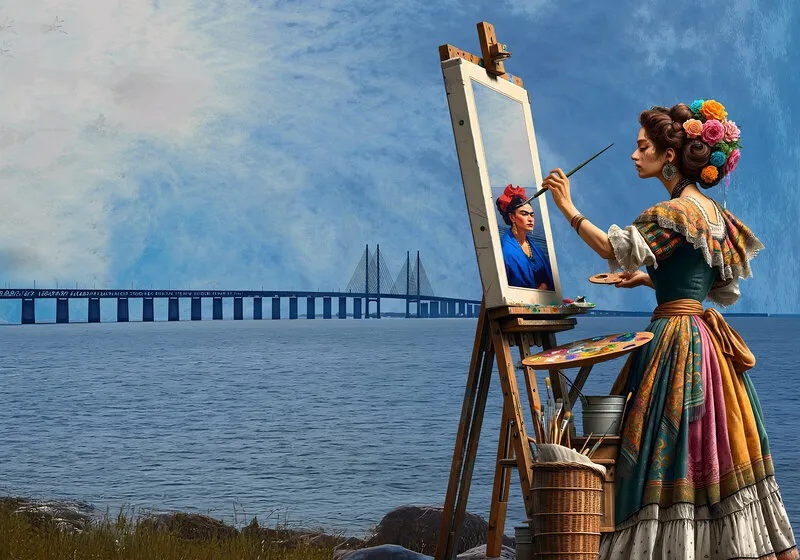
Frida and the Bridge to Freedom, 2024
Digital
100 x 70 cm
5 200 kr
A Brush of Pain and Power
In a blue place with whispered pain,
Frida stands, a figure never quite tame.
With flowers woven in braids of night,
She paints her soul in shades of light.
A woman who bore the weight of scars,
Carved with a needle, stitched in stars.
She painted her pain, her body laid bare,
Each stroke was a testament to all she'd bear.
With eyes that held both grief and fire,
She faced her truths and climbed ever higher.
Her world was filled with reds and blues,
A vibrant tapestry of all she knew.
In a skirt of ruffles embroidered bright,
She stood defiant, a warrior in the fight.
Her gaze intense, her jaw set strong,
She gave her pain a voice, a song.
Her canvas was life, raw and real,
With every brushstroke, she dared to feel.
Picture a wounded deer, a broken spine,
Her art is a testament to the feminine divine.
Years have passed, yet she remains,
A spirit who embraced both joy and pains.
In Mexico's warmth or cold northern mist,
Her presence lingers, impossible to resist.
By the bridge where the waters sway,
Under Malmö's hazy sky, at the end of the day.
I saw her there, impossible yet true,
In the golden light of a sky-tinged blue.
Her easel stood against the breeze,
A figure of strength, at once at ease.
The flowers in her hair were just the same,
The spirit of a legend, untamed flame.
Her eyes met mine, a fleeting glance,
As if we shared a secret dance.
Her brush moved with a timeless grace,
Painting the echoes of a distant place.
She stood by the bridge, a ghost of light,
Casting colour in the fading night.
In that moment, time ceased to be,
And Frida’s spirit was wild and free.
A silhouette against the sundown’s glow,
In Malmö's air, her spirit did flow.
With a stroke of crimson, a touch of blue,
She painted herself anew, and I knew—
That legends live where colours remain,
In the strokes of art and the heart’s true pain.
At the water’s edge, she still creates,
A testament to fate and the soul she paints.
In Malmö’s stillness, she stood so near,
A brush in hand, her gaze sincere.
And when I blinked, she was gone from sight,
Yet her presence lingered in the fading light.
Malmö, October 2024
Frida and the Bridge to Freedom, a metaphor for her journey towards self-expression and liberation.
I had made my way to the bridgehead, right where Luftkastellet is located, where I exhibit my paintings a couple of times a year. With its historical significance and connection to Frida's life, this spot was now deserted. It was vacation time, and people were surely lounging at the Ribersborg or Sibbarp beaches rather than swimming from this rocky shore. This July day was approaching late afternoon, but the sun blazed its strongest through a haze that had settled over the Öresund Bridge in the light breeze. I would describe the sky as dramatic and beautiful and the view as enchanting.
That was when I spotted her. There was no mistaking who stood there, even though it shouldn't have been possible, as the woman had left this earth seventy years earlier. From my previous encounters with Time-travellers, I knew it still happened quite often—they returned to earth. And now it was happening again. What had drawn Frida to choose Malmö and this very spot was a mystery, though. The place is, after all, beautiful, if not overwhelming. She indeed had her reasons. Frida is one of my favourites, and I was relatively well-read on her art. My thoughts raced like an internal documentary. I had caught a fleeting glance, but she seemed uninterested in my gaze. If it was Frida, a Time-traveller, she knew that earthlings didn’t recognise them; the closer they had been to each other in life, the less they recognised them. Only those with personal experience, like me, understood whom they were meeting.
Frida Kahlo was indeed standing by her easel, slightly turned to the side, so I saw her face and body in profile. Her posture was proud and determined, and it was clear that each brushstroke she placed on the canvas was charged with seriousness and passion. The air vibrated with her intensity and focused presence as if every movement she made was carefully considered.
Her hair, a dark cascade of braids, was adorned with a traditional Mexican knot, and the black and red ribbons woven between the braids were a testament to her heritage. A vibrant crown of roses and what appeared to be petrol-blue carnations perched atop her head, a striking contrast to her dark locks. The flowers, a reflection of her pride in her Mexican roots, caught my eye and held my gaze.
She glanced in my direction, revealing her expressive face with those famously joined eyebrows that framed her intense, deep gaze. It was a face marked by the pain and struggle of life but also by strength and beauty. Her red-painted lips were slightly pressed together in concentration as she focused on her work, her gaze piercing through the canvas and into my soul.
Frida wore a traditional Tehuana dress, a masterpiece of Mexican craftsmanship and colour that captured my attention. The fabric was richly embroidered in shades of burnt orange, turquoise, and green, and I noticed how golden threads shimmered as the light hit the dress. Ruffles and frills along the sleeves and hem created a playful movement as she stood painting. The skirt was wide and swirled around her legs, and I could make out the traditional, patterned leather sandals adorning her feet, each element a vibrant celebration of her Mexican heritage.
Around Frida’s neck hung a heavy necklace of Mexican silver, with large medallions and matching earrings with intricate details, giving her a queenly aura. She had draped a pale pink shawl around her waist, gathered in a knot over her hips as if it were part of her creative uniform. It was as if every detail about her reflected Frida’s intense and passionate life. This was not the worn forty-seven-year-old woman who left the earth in 1954. In the way of Time-travellers, she had left her body behind on earth and assumed the person who suited the moment. I would estimate the woman's age to be no more than thirty-five when she reached her artistic breakthrough, perhaps forty at most when she painted the controversial self-portrait ‘The Broken Column’. In it, with her breasts exposed, she showed a body pierced with nails and spikes, bearing witness to her physical pain after an accident at eighteen. That painting was not one of my favourites, and it made me uncomfortable.
In front of Frida stood the easel, and she was creating yet another of her self-portraits on the canvas. I watched how she portrayed herself in a raw, honest light—a face that bore equal parts beauty, sorrow, and uncompromising truth. The background was the muted blue shades of the sound that reflected her mood, and the red ribbon she had in her hair in the portrait symbolised her creative fire. The brush, which Frida held with a steady but gentle hand, seemed almost to dance over the canvas as she captured herself in colour in one of her ever-recurring encounters with her soul.
There was an aura around her, a mixture of pain and strength that I could feel clearly. Despite everything, she was a woman who had chosen to confront the world—and herself—through her paintings. Every detail of her appearance, from the colourful floral crown to the sharp brushstrokes on the canvas, reflected her intense and uncompromising view of life and art. Even as I saw her then, it was as if she was painting herself directly into history as an artist and an icon.
There wasn’t much to be seen of the view—not even the bridge, just the water and the dark outline of Denmark on the other side of the sound. The portrait was only about her, another confrontation with the pains she had left behind on earth. For so it was; it was only about Frida and not the world beyond her inner self.
Was Frida Kahlo a narcissist? The question might seem justified. Kahlo was not necessarily a narcissist in the clinical sense of the word, which would imply that she suffered from a narcissistic personality disorder. However, she has sometimes been accused of being self-centred or narcissistic because of her extensive self-portraits and focus on her own life and suffering in her art.
Why is Kahlo seen as self-centred? I have often asked myself this question, but the answer has always been the same. Frida painted over fifty self-portraits during her lifetime, usually placing herself at the centre to express her pain, sorrow, and health struggles. To some, this may seem self-absorbed, but it is essential to remember that her artworks were a way to cope with her chronic pain, physical injuries, and emotional trauma.
I understood that Kahlo used her self-portraits to explore her identity, Mexican culture, gender, and political beliefs. Her works reflect her experiences and broader issues of women’s rights, colonialism, and social justice. In this way, her art was much more than a self-glorifying expression.
Frida is often seen as a feminist icon, even though she never explicitly identified herself as a feminist in the modern sense. Her life and works, however, expressed many ideas and themes that resonate with the feminist movement, especially concerning female identity, sexuality, and the struggle for social justice.
In both her life and work, Frida Kahlo defied many of the traditional gender norms of her time. She painted her body and face with candour and honesty, challenging the era's notions of femininity and beauty. Instead of trying to idealise herself, she depicted her face and body with their flaws, pain, and vulnerabilities. This was a radical move, especially at a time when women's bodies were often objectified or expected to fit into narrow ideals.
Frida also explored women’s experiences through her paintings, particularly issues such as motherhood, abortion, infertility, and physical suffering. Many of her works are deeply personal and depict her own experiences of pain, both physical and emotional, making her an early pioneer in highlighting women's bodily experiences. In works like ‘Henry Ford Hospital’ from, I believe, 1932, she portrayed her miscarriage, an experience that was both taboo and painful for women to speak about publicly.
Frida often experimented with gender and identity. She sometimes dressed in traditionally male clothing and painted self-portraits that included historically masculine traits, like her famous moustache and joined eyebrows. These artistic choices challenged the norm of what was considered "feminine" and showed that gender can be fluid and multifaceted.
Frida was a strong and independent woman who defied many of the limitations of her time. She lived on her own terms, had relationships with both men and women and refused to be confined by her marriage to Diego Rivera, even though their relationship was tumultuous. Her independence and way of living have made her a role model for women fighting to define their identity and live outside traditional expectations.
Frida Kahlo was also politically engaged and supported feminist and socialist movements. She was a member of the Mexican Communist Party and fought for the rights of the working class and equality, especially for Indigenous peoples and women. Many of her works reflect a deep love for Mexico’s culture and a solid commitment to social justice, making her a symbol of the struggle against oppression and for justice.
Even though Frida did not define herself as a feminist by today’s standards, she has become a feminist icon because her life and works reflect the struggle many women still face. Her willingness to present herself as a complex, vulnerable, yet powerful woman—while challenging patriarchal norms and gender roles—has made her an essential symbol of feminist strength and resistance. Without a doubt, Frida must be regarded as a feminist icon.
In many ways, Frida was a forerunner of the feminist movement. By using her own life to explore themes of gender, sexuality, identity, and social justice, she became a symbol of female strength and rebellion. Her art and life inspire women worldwide to break conventions, embrace their complexity, and fight for a world where women's voices and experiences are valued equally to men's.
Kahlo suffered from severe pain and illness.
For most of her life, including the consequences of a serious bus accident and chronic health issues. She used painting as a means of self-care, a way to express her pain and emotions, which gave her control over her narrative. By painting herself, she could symbolically reclaim her body and self, making her art a form of therapy rather than a sign of narcissism.
To call Frida narcissistic diminishes the complexity and challenges that marked her life and artistic work. Her self-portraits were not necessarily expressions of self-glorification but a deeply personal, cultural, and political statement that made her one of the most influential artists of the 20th century. I am a great admirer of hers.
Frida painted more than just self-portraits, although self-portraits make up a significant part of her work. Her art encompassed a range of other themes that often reflected her life, political beliefs, and culture.
Kahlo painted several still-life paintings, often featuring Mexican fruits, flowers, and objects representing Mexican culture. These works often contain symbolism and allegories that reflect her emotions, anxiety, or hope. For example, her Still Life with Parrot and Fruit from the final period of her life is a painting I like.
Kahlo often included animals such as monkeys, birds, and dogs in her paintings. These animals can be interpreted as symbols of companionship and protection or sometimes as representatives of specific aspects of her personality and experiences. Animals like monkeys and hummingbirds frequently appear in her works, for example, in ‘Self-Portrait with Thorn Necklace and Hummingbird’.
Kahlo's exploration of mythological and symbolic themes in her works is a testament to her artistic depth. Her symbolism from Mexican folk art, traditions, and iconography reflects her cultural identity and her profound views on femininity, pain, and death. The painting 'The Love Embrace of the Universe, the Earth (Mexico), Me, Diego, and Mr. Xolotl' from the final period of her life is a striking example of how Kahlo delves into Mexican cosmology and love.
Several of Kahlo’s paintings are inspired by her political beliefs, especially her support for communism and the fight for social justice. ‘Marxism Will Give Health to the Sick’ from the year she died, 1954, expresses her political stance—a powerful painting.
Kahlo also painted scenes that included family and relationships, often with Diego Rivera, her husband, as a central figure. She explored themes of motherhood, love, and loss and also painted some family portraits. One of my favourites is ‘My Grandparents, My Parents, and I (Family Tree)’ from the mid-1930s.
"1936!" I heard an inner voice specify. I had experienced this before: a Time-traveller speaking to me telepathically. I took a glance from Frida as confirmation that she read my thoughts and followed the internal dialogue.
While Frida Kahlo is best known for her self-portraits, her artistic repertoire extends to other motifs that reflect Mexican culture, nature, political beliefs, and symbolic themes. Her diverse works, filled with hidden meanings, are complex explorations of her personal experiences and profound reflections of her view of the world.
I knew that Frida Kahlo's art rarely featured pure landscapes or architectural motifs. Her focus was primarily on the personal and symbolic, and landscapes and architecture often served as background elements rather than primary themes. This unique approach to art kept me engaged and intrigued.
Frida suddenly began to speak to me as if we were old acquaintances. I understood that she had read my thoughts and recognised that I had met Time-travellers.
"I don't paint landscapes and architecture in the traditional sense but occasionally use these elements as symbolic or narrative backdrops to enhance my works' emotional and cultural messages. For example, a barren landscape can symbolise loneliness or pain, while a lush, blooming landscape can symbolise life and fertility. In ‘The Two Fridas’ I painted in 1939, there is no traditional architecture or landscape, but the open and desolate sky creates a sense of isolation and introspection. So, no bridge is needed," Frida said in response to my unspoken question. Not a comment on everything I had thought but simply pushing her way into my world of thoughts.
"I understand," I said, even though I didn't follow.
"My interest lies more in exploring the inner landscape of emotions, identity, and culture rather than documenting external worlds," she said, ignoring my thoughts.
"But isn't the bridge that connects two countries and cultures beautiful, even inspiring," I said, for that’s how I felt about the Öresund Bridge.
"Architecture is rarely the primary focus in my paintings. When buildings or structures are visible, they are usually simplified and stylised, often representing something larger than just buildings—like a symbol for Mexico's culture or my life. In the painting ‘My Dress Hangs There’ from the early thirties, I used New York's cityscape, for example, to criticise capitalist culture, but the buildings are more of a symbolic background than a detailed representation." Frida dabbed a dark curl in her hair.
"That your dress hangs under the Parthenon is popular in Greece," I said, envisioning the painting.
"From your mental detour, I gather that you have a connection to the island of Hydra," said Frida appreciatively. A good friend from above, Ghikas, comes from there. In the rare cases where landscapes appear in my art, they are often filled with symbolism and are strongly tied to emotions or cultural heritage. As an artist, I let the waters of the sound accentuate just that, intentionally darker on the canvas than in reality. If you don’t mind," she said, offended by my thoughts.
"No problem. The portrait is brilliant," I said, ashamed.
"My images are often surreal and have a dreamlike quality rather than being realistic depictions of nature. One example is the painting ‘The Dream’ or ‘The Bed’ from the second year of the war in 1940, where a stylised landscape in the background enhances the sense of fate and death. Even in self-portraits, landscapes can be part of the psychological and emotional context," Frida said, returning to her portrait. Nothing more was said, and when I looked away momentarily, she was suddenly gone, easel and all. Despite several years of recurring encounters with Time-travellers like Leonard Cohen, I do not understand how that happens. "Teleportation," Leonard had said without going into how it worked. But the view had taken on a different, less banal appearance. After pondering the phenomenon, I continued my walk.
5 200 kr

Jörgen Thornberg
Malmö
Lite om bilder och mig. Translation in English at the end.
Jag är en nyfiken person som ser allt i bilder, även det jag fäster i ord, gärna tillsammans för bakom alla mina bilder finns en berättelse. Till vissa bilder hör en kortare eller längre novell som följer med bilden.
Bilder berättar historier. Jag omges av naturlig skönhet, intressanta människor och historia var jag än går. Jag använder min kamera för att dokumentera världen och blanda det jag ser med vad jag känner för att fånga den dolda magin.
Mina bilder berättar mina historier. Genom mina bilder, tryck och berättelser. Jag bjuder in dig att ta del av dessa berättelser, in i ditt liv och hem och dela min mycket personliga syn på vår värld. Mer än vad ögat ser. Jag tänker i bilder, drömmer och skriver och pratar om dem; följaktligen måste jag också skapa bilder. De blir vad jag ser, inte nödvändigtvis begränsade till verkligheten. Det finns en bild runt varje hörn. Jag hoppas att du kommer att se vad jag såg och gilla det.
Jag är också en skrivande person och till många bilder hör en kortare eller längre essay. Den följer med tavlan, tryckt på fint papper och med en personlig hälsning från mig.
Flertalet bilder startar sin resa i min kamera. Enkelt förklarat beskriver jag bilden jag ser i mitt inre, upplevd eller fantiserad. Bilden uppstår inom mig redan innan jag fått okularet till ögat. På bråkdelen av ett ögonblick ser jag vad jag vill ha och vad som kan göras med bilden. Här skall jag stoppa in en giraff, stålmannen, Titanic eller vad det är min fantasi finner ut. Ännu märkligare är att jag kommer ihåg minnesbilden långt efteråt när det blir tid att skapa verket. Om jag lyckas eller inte, är upp till betraktaren, oftast präglat av en stråk av svart humor – meningen är att man skall bli underhållen. Mina bilder blir ofta en snackis där de hänger.
Jag föredrar bilder som förmedlar ett budskap i flera lager. Vid första anblicken fylld av feel-good, en vacker utsikt, fint väder, solen skiner, blommor på ängen eller vattnet som ligger förrädiskt spegelblankt. I en sådan bild kan jag gömma min egentliga berättelse, mitt förakt för förtryckare och våldsverkare, rasister och fördomsfulla människor - ett gärna återkommande motiv mer eller mindre dolt i det vackra motivet. Jag försöker förena dem i ett gemensamt narrativ.
Bild och formgivning har löpt som en röd tråd genom livet. Fotokonst känns som en värdig final som jag gärna delar med mig.
Min genre är vid som framgår av mina bilder, temat en blandning av pop- och gatukonst i kollage som kan bestå av hundratals lager. Vissa bilder kan ta veckor, andra någon dag innan det är dags att överlämna resultatet till printverkstaden. Fine Art Prints är digitala fotocollage. I dessa kollage sker rivandet, klippandet, pusslandet, målandet, ritandet och sprayningen digitalt. Det jag monterar in kan vara hundratals år gamla bilder som jag omsorgsfullt frilägger så att de ser ut att vara en del av tavlan men också bilder skapade av mig själv efter min egen fantasi. Därefter besöks printstudion och för vissa bilder numrera en limiterad upplaga (oftast 7 exemplar) och signera för hand. Vissa bilder kan köpas i olika format. Det är bara att fråga efter vilka. Gillar man en bild som är 70x100 men inte har plats på väggen, går den kanske att få i 50x70 cm istället. Frågan är fri.
Metoden Giclée eller Fine Art Print som det också kallas är det moderna sättet för framställning av grafisk konst. Villkoret för denna typ av utskrifter är att en högkvalitativ storformatskrivare används med åldersbeständigt färgpigment och konstnärspapper eller i förekommande fall på duk. Pappret som används möter de krav på livslängd som ställs av museer och gallerier. Normalt säljer jag mina bilder oinramade så att den nya ägaren själv kan bestämma hur de skall se ut, med eller utan passepartout färg på ram, med eller utan glas etc..
Under många år ställde jag bara ut på nätet, i valda grupper och på min egen Facebooksida - https://www.facebook.com/jorgen.thornberg.9
Jag finns också på en egen hemsida som tyvärr inte alltid är uppdaterad – https://www.jth.life/ Där kan du också läsa en del av de berättelser som följer med bilden.
UTSTÄLLNINGAR
Luftkastellet, oktober 2022
Konst i Lund, november 2022
Luftkastellet, mars 2023
Engleson Galleri Caroli, april 2023
Hydra, Greece June 2023
Engleson Galleri Caroli, oktober 2023
Toppen, Höllviken december 2023
Luftkastellet, mars 2024
Torups Galleri, mars 2024
Venice, May 2024
Luftkastellet, oktober 2024
Konst i Advent, December 2024
Galleri Engleson, Caroli December 2024
Jäger & Jansson Galleri, april 2025
A bit about pictures and me.
I'm a curious person who sees everything in pictures, even what I express in words, often combining them, for behind all my pictures lies a story. These narratives, some as short as a single image and others as long as a novel, are the heart and soul of my work.
Pictures tell stories. Wherever I go, I'm surrounded by natural beauty, exciting people, and history. I use my camera to document the world and blend what I see with what I feel to capture the hidden magic.
My images tell my stories. Through my pictures, prints, and narratives, I invite you to partake in these stories in your life and home and share my deeply personal perspective of our world. More than meets the eye. I think in pictures, dream, write, and talk about them; consequently, I must create images too. They become what I see, not necessarily confined to reality. There's a picture around every corner. I hope you'll see what I saw and enjoy it.
I'm also a writer, and many images come with a shorter or longer essay. It accompanies the painting, printed on fine paper with my personal greeting.
Many pictures start their journey on my camera. Simply put, I describe the image I see in my mind, experienced or imagined. The image arises within me even before I bring the eyepiece to my eye. In a fraction of a moment, I see what I want and what can be done with the picture. Here, I'll insert a giraffe, Superman, the Titanic, or whatever my imagination conjures up. Even stranger is that I remember the mental image long after it's time to create the work. Whether I succeed is up to the observer, often imbued with a streak of black humour – the aim is to entertain. My pictures usually become a talking point wherever they hang.
I prefer pictures that convey a message in multiple layers. At first glance, they're filled with feel-good vibes, a beautiful view, lovely weather, the sun shining, flowers in the meadow, or the water lying deceptively calm. But beneath this surface beauty, I often conceal a deeper story, a narrative that challenges societal norms or explores the human condition. I invite you to delve into these hidden narratives and discover the layers of meaning within my work.
Picture and design have been a thread running through my life. Photographic art feels like a fitting finale, and I'm happy to share it.
My genre is varied, as seen in my pictures; the theme is a blend of pop and street art in collages that can consist of hundreds of layers. Some images can take weeks, others just a day before it's time to hand over the result to the print workshop. Fine Art Prints are digital photo collages. In these collages, tearing, cutting, puzzling, painting, drawing, and spraying happen digitally. What I insert can be images hundreds of years old that I carefully extract so they appear to be part of the painting, but also images created by myself, now also generated from my imagination. Next, visit the print studio and, for certain images, number a limited edition (usually 7 copies) and sign them by hand. Some images may be available in other formats. Just ask which ones. If you like an image that's 70x100 but doesn't have space on the wall, you might be able to get it in 50x70 cm instead. The question is open.
The Giclée method, or Fine Art Print as it's also called, is the modern way of producing graphic art. This method ensures the highest quality and longevity of the artwork, using a high-quality large-format printer with archival pigment inks and artist paper or, in some cases, canvas. The paper used meets the longevity requirements set by museums and galleries. I sell my pictures unframed, allowing the new owner to personalise their artwork, confident in the lasting value and quality of the piece.
For many years, I only exhibited online, in selected groups, and on my Facebook page - https://www.facebook.com/jorgen.thornberg.9. I also have my website, which unfortunately is not constantly updated - https://www.jth.life/. You can also read some of the stories accompanying the pictures there.
EXHIBITIONS
Luftkastellet, October 2022
Art in Lund, November 2022
Luftkastellet, March 2023
Engleson Gallery Caroli, April 2023
Hydra, Greece June 2023
Engleson Gallery Caroli, October 2023
Toppen, Höllviken December 2023
Luftkastellet, March 2024
Torup Gallery, March 2024
Venice, May 2024
UTSTÄLLNINGAR
Luftkastellet, oktober 2022
Konst i Lund, november 2022
Luftkastellet, mars 2023
Engleson Galleri Caroli, april 2023
Hydra, Greece June 2023
Engleson Galleri Caroli, oktober 2023
Toppen, Höllviken december 2023
Luftkastellet, mars 2024
Torups Galleri, mars 2024
Venice, May 2024
Luftkastellet, October 2024
Konst i Advent, December 2024
Galleri Engleson, Caroli December 2024
Jäger & Jansson Galleri, April 2025
Utbildning
Autodidakt
Medlem i konstnärsförening
Öppna Sinnen
Med i konstrunda
Konstrundan i Skåne
Utställningar
Luftkastellet, October 2022
Art in Lund, November 2022
Luftkastellet, March 2023
Engleson Gallery Caroli, April 2023
Hydra, Greece June 2023
Engleson Gallery Caroli, October 2023
Toppen, Höllviken December 2023
Luftkastellet, March 2024
Torup Gallery, March 2024
Venice, May 2024