Vi använder cookies för att ge dig bästa möjliga upplevelse. Välj vilka cookies du tillåter.
Läs mer i vår integritetspolicy
Jörgen Thornberg
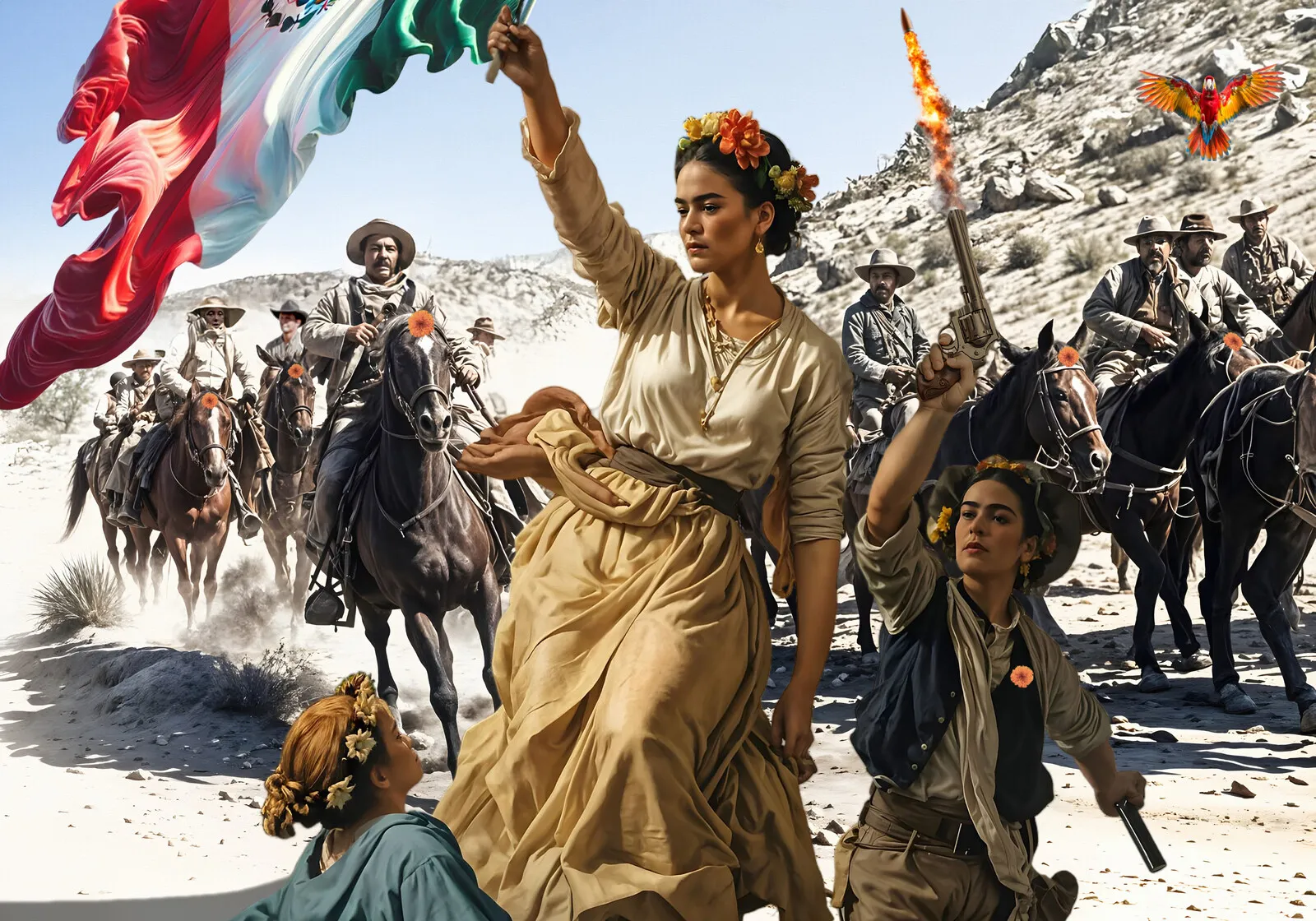
Long Live the Revolution, Long Live Frida!, 2025
Digital
70 x 50 cm
3 200 kr
Long Live Frida!
Frida Kahlo was an artist and a passionate admirer of Mexico’s revolutionary history. Through her paintings, she paid tribute to figures like Pancho Villa and Emiliano Zapata, capturing their legacy and the spirit of the struggle for justice. One of her notable works, ‘La Adelita, Pancho Villa, and Frida’ (1927), places her at the heart of the revolution, visually aligning herself with its leaders and ideals. This painting is a testament to her deep connection with the revolutionary movement and its enduring symbols.
Continue reading to learn more about Frida's lifelong fight for justice.
"The Ballad of Robin’s Shadow
Through time’s long road, they ride and run,
Cloaked in dusk, kissed by the sun.
Some in rags, some draped in gold,
Their tales of justice fierce and bold.
From Sherwood’s depths, where arrows flew,
To desert sands and mountains blue.
A whispered name, a rebel’s cheer,
A legend spun year after year.
Some stole for love, some fought for pride,
Some sought revenge; some stood aside.
Heroes, bandits—who can tell?
A saviour’s hand, a thief’s farewell.
Jesse rode through prairie dust,
Villa’s gun spoke through the rust.
Outlaws marked by freedom’s brand,
With justice trembling in their hand.
They kissed the poor with silver bright,
Took from towers bathed in light.
But were they good? Or were they sin?
A shadow’s truth lies deep within.
Still, the echoes stir the night,
In whispered song and torches’ light.
Robin’s kin, both lost and free,
Even haunt the world—eternally.”
Malmö, February 2025
Frida Kahlo – The Revolutionary Who Never Gave Up
Frida Kahlo is often remembered for her striking self-portraits, her tumultuous love affair with Diego Rivera, and the immense suffering caused by the physical pain that haunted her throughout her life. However, her role as a committed revolutionary is equally significant. Frida was not merely an artist; she was a woman of conviction, deeply engaged in the political struggles of her time, remaining active in the movement until her last breath. Her final act—a symbolic and defiant appearance at a demonstration against U.S. intervention in Latin America—encapsulated her unyielding spirit.
A Turbulent Mexico: The World That Shaped Frida
To fully understand Frida’s revolutionary stance, one must consider the political climate in which she was raised. Mexico, in the early 20th century, was a country in upheaval. The long and brutal dictatorship of Porfirio Díaz had enriched the elite while leaving the working class and indigenous communities in poverty. The Mexican Revolution (1910-1920) erupted in response to this inequality, bringing figures like Pancho Villa in the north and Emiliano Zapata in the south to the forefront. The war transformed Mexico, dismantling the old aristocracy and reshaping the nation into a battleground of ideologies.
Frida was born in 1907, though she later claimed 1910 as her birth year to align herself symbolically with the revolution. Her father, Guillermo Kahlo, was a German immigrant and photographer, while her mother, Matilde Calderón, was of mixed Spanish and indigenous descent. The Kahlo household was not particularly political—indeed, not revolutionary—but Frida gravitated towards leftist ideologies from a young age, aided by her sharp intellect and independent spirit. She was one of the first women to attend the prestigious National Preparatory School in Mexico City, where she mingled with students who would later become leaders in the political and artistic movements of the country.
The Accident That Changed Everything
In 1925, at the age of eighteen, Frida was involved in a near-fatal bus accident that shattered her spine and pelvis, leaving her with lifelong pain and requiring multiple surgeries. It was during her lengthy periods of convalescence that she began to paint seriously. Despite her immense physical suffering, Frida's spirit remained unbroken. Her experience deepened her commitment to radical politics, as she recognised the inequalities around her and developed a profound disdain for capitalism and imperialism. Her resilience in the face of such adversity is truly inspiring.
Diego, Communism, and Trotsky
Her relationship with the renowned muralist Diego Rivera was as passionate as tempestuous. Diego, already a devoted communist, introduced Frida more deeply to Marxist philosophy, although she was never one to be a mere disciple. She became a member of the Mexican Communist Party (PCM) in 1927 and actively supported leftist causes throughout her life. Her unwavering dedication to these causes, even in the face of personal and physical challenges, is a testament to her revolutionary spirit.
One of their most notable guests was Leon Trotsky, the exiled Russian revolutionary leader who had fled Stalin's purges. He and his wife, Natalia Sedova, were granted asylum in Mexico in 1937, primarily due to Rivera’s influence. Frida and Trotsky engaged in an intense, albeit brief, love affair driven as much by ideology as by attraction. Their romance was fueled by a shared revolutionary zeal and a deep respect for one another's intellect. Frida even gifted Trotsky a self-portrait inscribed with a playful yet pointed dedication. However, as tensions escalated between Trotsky and Rivera, Frida’s allegiance shifted towards Stalinism, leading her to distance herself from the Trotskyist faction.
Political Commitment Beyond Art
Frida’s art itself was revolutionary. While many male artists, including Rivera, painted grand murals depicting Mexico’s history and struggles, Frida’s paintings were deeply personal yet profoundly political. She utilised her body—broken, bleeding, yet unbowed—as a symbol of Mexico itself, reflecting themes of pain, oppression, and resilience. Her works often included indigenous symbolism, paying tribute to Mexico’s pre-colonial heritage and resisting the Eurocentric influences that had long dominated the country’s elite culture. Her art also significantly impacted the feminist movement, as she portrayed the female experience in a raw and empowering manner.
She supported workers’ rights, indigenous autonomy, and anti-fascist movements. During the Spanish Civil War, she and Rivera actively championed the Republicans while opposing Franco’s fascist regime. She also condemned U.S. interventionism in Latin America, viewing it as another form of colonial exploitation.
A Body Failing, A Spirit Unyielding
By the early 1950s, Frida’s health had deteriorated significantly. She had undergone numerous operations, and her right leg was ultimately amputated due to gangrene. Frequently confined to a wheelchair or bedridden, she continued to paint, write, and engage in political activism. Aware that her time was limited, she was determined to remain involved in the struggle.
Her final act of defiance came on 2 July 1954. A demonstration was organised in Mexico City to protest the CIA-backed coup in Guatemala, which had overthrown the democratically elected president, Jacobo Árbenz. Frida, against her doctors' advice and despite excruciating pain, insisted on attending. Unable to walk, she was rolled into the protest in her bed, draped in a shawl, and holding a red Communist flag. Surrounded by comrades and supporters, she sang revolutionary songs and chanted slogans, her voice filled with the same fiery conviction that had driven her throughout her life. Her defiance in the face of her own physical limitations is a powerful testament to her revolutionary spirit.
This was to be her last public appearance. Eleven days later, on 13 July 1954, Frida Kahlo passed away in her home, La Casa Azul. Her death was officially attributed to a pulmonary embolism, though some speculate that it may have been an intentional overdose. This controversy surrounding her death adds another layer to the complex narrative of her life. She was only 47 years old, yet her legacy was already immortal.
A Revolutionary Forever
Frida Kahlo was more than an artist, more than Diego Rivera’s wife, more than a woman who suffered. She was a revolutionary in every sense—politically, artistically, and personally. She defied societal norms, challenged the boundaries of art, and never ceased to fight for what she believed in, even when her own body waged war against her. Her legacy inspires and resonates with people worldwide, both in her art and political activism.
Her funeral was attended by political leaders, artists, and activists. Flowers and the red flag of the hammer and sickle were draped over her casket, the ultimate symbol of her lifelong commitment to the struggle. As Mexico and the world mourned her passing, Frida’s last words in her diary stood as her final, enigmatic declaration:
“I hope the exit is joyful and never to return.”
Yet she never truly left. Frida Kahlo remains a beacon of resistance, creativity, and unyielding defiance. Her spirit marches on, just as it did that final day when she allowed herself to be carried to the streets, refusing to be silenced.
Through her art, Frida Kahlo expressed her admiration for Mexican revolutionaries Pancho Villa and Emiliano Zapata. In 1927, she painted ‘La Adelita, Pancho Villa, and Frida’, placing herself at the centre, with a portrait of Pancho Villa above her. To her right, she included an image of Zapatista revolutionaries and their female supporters, referencing *Adelita*, a symbol of female soldiers during the revolution. This painting reflects Frida's identification with the ideals and leaders of the revolution.
The less told truth of Pancho Villa.
The legend of Robin Hood, a bandit who steals from the rich to give to the poor, has echoed throughout history. Though no historical figure perfectly embodies the mythical outlaw, many have been labelled modern-day Robin Hoods. Jesse James, Butch Cassidy, and even the gangsters of the 1930s have had this romanticised reputation thrust upon them, often undeservedly. Among them stands Doroteo Arango, later known as Francisco "Pancho" Villa. Unlike many others, Villa genuinely emerged from poverty and demonstrated a sincere commitment to the well-being of Mexico’s disenfranchised population.
Like any historical figure of significant impact, Villa is remembered in dual extremes—either as a champion of justice and economic reform for the poor or as a ruthless, bloodthirsty outlaw. The reality, of course, is far more complex. Villa was sometimes heroic and violent, generous and self-serving, and a man of the people driven by his legend.
From Poverty to Rebellion
Born into extreme poverty in 1878, Villa was the son of poor farmers. His early life was filled with hardship, and at just 15 years old, he lost his father, forcing him to take on the role of head of the family. It was an act of vengeance that led him onto the path of banditry—when a powerful man harassed his sister, Villa responded by killing him. He fled into the mountains to escape retribution, adopting a new name and joining bands of outlaws who roamed the countryside.
His transition from outlaw to revolutionary occurred amid the winds of change sweeping through Mexico. The dictatorship of Porfirio Díaz had exacerbated the divide between the affluent elite and the impoverished majority. Villa was drawn into the revolutionary cause led by Francisco Madero, whose movement aimed to depose Díaz and implement democratic reforms. Villa played a crucial role in Madero’s successful uprising, establishing himself as a formidable military leader. However, the victory was short-lived. When Madero was betrayed and assassinated by General Victoriano Huerta, Villa, demonstrating unwavering resilience, refused to accept the new dictatorship and took up arms once more.
The Revolutionary General
Villa rapidly became one of Mexico's most powerful military leaders, forming his army, the División del Norte. He allied with other revolutionary leaders, such as Emiliano Zapata and Venustiano Carranza, to reshape Mexico’s political landscape. Their combined forces succeeded in controlling vast portions of northern Mexico, but internal conflicts arose, as is often the case in revolutions. Eventually, the revolution devolved into a power struggle between Villa, Carranza, and remnants of the old regime.
For a time, the U.S. government supported Villa, regarding him as a valuable ally in the fight against Huerta. However, Villa perceived it as a betrayal once Carranza gained the upper hand and secured U.S. recognition. In retaliation, he led an attack on Columbus, New Mexico, in 1916, resulting in the deaths of American citizens and prompting the U.S. government to initiate a military campaign to hunt him down; among the officers sent after Villa was a young George S. Patton, who experienced his first combat engagement during the pursuit.
A Revolutionary on Film
Villa was not only a military leader but also a master of propaganda. Recognising the growing influence of film, he struck a deal with Mutual Film Company, allowing them to document his battles. The arrangement was unprecedented—his forces were filmed in actual combat, though myths suggest he would sometimes reenact scenes for better cinematic effect. Historian Friedrich Katz notes that Villa received some of the film’s profits, though the project ultimately failed at the American box office. Audiences found the depiction of the revolution unrealistic despite its real-life footage.
Villa’s Vision for a New Mexico
Villa’s revolutionary vision extended beyond the battlefield. He envisioned a Mexico where workers and peasants could live in self-sustaining communes independent of a ruling elite. Unlike communism, his idea was rooted in agrarian reform and self-governance rather than state control. He sought to abolish the traditional military in favour of an armed citizenry, where workers could defend themselves while cultivating discipline. Although radical, his dream reflected the deep inequalities he had witnessed.
As the revolution dragged on, Villa’s fortunes declined. His forces suffered significant defeats, and his once-mighty army crumbled. He retreated to the mountains, where he had once sought refuge as a young outlaw, living in a secluded collective with few loyal followers. His past exploits, however, continued to fuel speculation about hidden caches of gold, though no such treasure has ever been found.
The Assassination of Pancho Villa
His death marked the closing chapter of one of Mexico’s most legendary figures. However, his legacy continued to be debated, inviting us all to participate in the ongoing discussion regarding Pancho Villa's true nature.
Hero, Villain, or Something More?
Was Pancho Villa a hero or a villain? A revolutionary liberator or a self-serving bandit? Arizona’s official historian, Marshall Trimble, once remarked, "Pancho Villa was the 'Good, the Bad, and the Ugly,' all rolled into one."
Villa was a product of his time, shaped by injustice and conflict and driven by ideology and personal ambition. He remains one of Mexico’s most enigmatic figures, whose legacy continues to inspire and divide. The truth of Pancho Villa is neither simple nor absolute—just like the man himself, a complex and multifaceted character who continues to intrigue and engage us.
Jörgen Thornberg
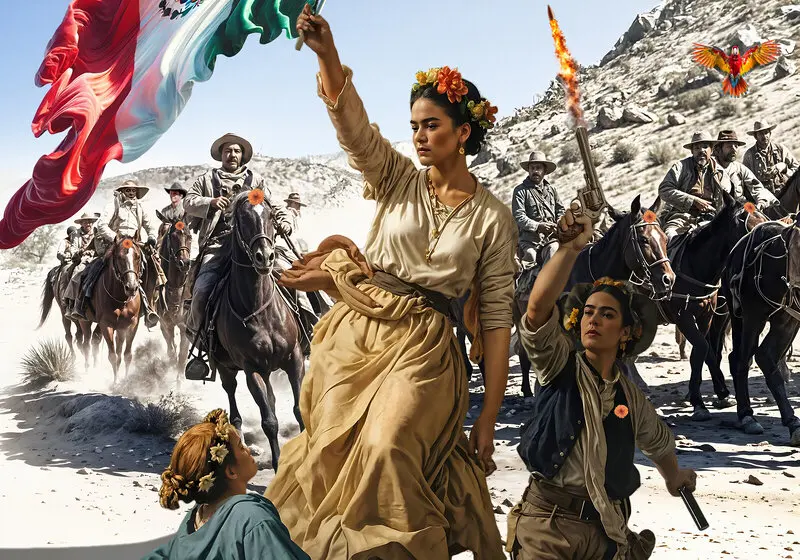
Long Live the Revolution, Long Live Frida!, 2025
Digital
70 x 50 cm
3 200 kr
Long Live Frida!
Frida Kahlo was an artist and a passionate admirer of Mexico’s revolutionary history. Through her paintings, she paid tribute to figures like Pancho Villa and Emiliano Zapata, capturing their legacy and the spirit of the struggle for justice. One of her notable works, ‘La Adelita, Pancho Villa, and Frida’ (1927), places her at the heart of the revolution, visually aligning herself with its leaders and ideals. This painting is a testament to her deep connection with the revolutionary movement and its enduring symbols.
Continue reading to learn more about Frida's lifelong fight for justice.
"The Ballad of Robin’s Shadow
Through time’s long road, they ride and run,
Cloaked in dusk, kissed by the sun.
Some in rags, some draped in gold,
Their tales of justice fierce and bold.
From Sherwood’s depths, where arrows flew,
To desert sands and mountains blue.
A whispered name, a rebel’s cheer,
A legend spun year after year.
Some stole for love, some fought for pride,
Some sought revenge; some stood aside.
Heroes, bandits—who can tell?
A saviour’s hand, a thief’s farewell.
Jesse rode through prairie dust,
Villa’s gun spoke through the rust.
Outlaws marked by freedom’s brand,
With justice trembling in their hand.
They kissed the poor with silver bright,
Took from towers bathed in light.
But were they good? Or were they sin?
A shadow’s truth lies deep within.
Still, the echoes stir the night,
In whispered song and torches’ light.
Robin’s kin, both lost and free,
Even haunt the world—eternally.”
Malmö, February 2025
Frida Kahlo – The Revolutionary Who Never Gave Up
Frida Kahlo is often remembered for her striking self-portraits, her tumultuous love affair with Diego Rivera, and the immense suffering caused by the physical pain that haunted her throughout her life. However, her role as a committed revolutionary is equally significant. Frida was not merely an artist; she was a woman of conviction, deeply engaged in the political struggles of her time, remaining active in the movement until her last breath. Her final act—a symbolic and defiant appearance at a demonstration against U.S. intervention in Latin America—encapsulated her unyielding spirit.
A Turbulent Mexico: The World That Shaped Frida
To fully understand Frida’s revolutionary stance, one must consider the political climate in which she was raised. Mexico, in the early 20th century, was a country in upheaval. The long and brutal dictatorship of Porfirio Díaz had enriched the elite while leaving the working class and indigenous communities in poverty. The Mexican Revolution (1910-1920) erupted in response to this inequality, bringing figures like Pancho Villa in the north and Emiliano Zapata in the south to the forefront. The war transformed Mexico, dismantling the old aristocracy and reshaping the nation into a battleground of ideologies.
Frida was born in 1907, though she later claimed 1910 as her birth year to align herself symbolically with the revolution. Her father, Guillermo Kahlo, was a German immigrant and photographer, while her mother, Matilde Calderón, was of mixed Spanish and indigenous descent. The Kahlo household was not particularly political—indeed, not revolutionary—but Frida gravitated towards leftist ideologies from a young age, aided by her sharp intellect and independent spirit. She was one of the first women to attend the prestigious National Preparatory School in Mexico City, where she mingled with students who would later become leaders in the political and artistic movements of the country.
The Accident That Changed Everything
In 1925, at the age of eighteen, Frida was involved in a near-fatal bus accident that shattered her spine and pelvis, leaving her with lifelong pain and requiring multiple surgeries. It was during her lengthy periods of convalescence that she began to paint seriously. Despite her immense physical suffering, Frida's spirit remained unbroken. Her experience deepened her commitment to radical politics, as she recognised the inequalities around her and developed a profound disdain for capitalism and imperialism. Her resilience in the face of such adversity is truly inspiring.
Diego, Communism, and Trotsky
Her relationship with the renowned muralist Diego Rivera was as passionate as tempestuous. Diego, already a devoted communist, introduced Frida more deeply to Marxist philosophy, although she was never one to be a mere disciple. She became a member of the Mexican Communist Party (PCM) in 1927 and actively supported leftist causes throughout her life. Her unwavering dedication to these causes, even in the face of personal and physical challenges, is a testament to her revolutionary spirit.
One of their most notable guests was Leon Trotsky, the exiled Russian revolutionary leader who had fled Stalin's purges. He and his wife, Natalia Sedova, were granted asylum in Mexico in 1937, primarily due to Rivera’s influence. Frida and Trotsky engaged in an intense, albeit brief, love affair driven as much by ideology as by attraction. Their romance was fueled by a shared revolutionary zeal and a deep respect for one another's intellect. Frida even gifted Trotsky a self-portrait inscribed with a playful yet pointed dedication. However, as tensions escalated between Trotsky and Rivera, Frida’s allegiance shifted towards Stalinism, leading her to distance herself from the Trotskyist faction.
Political Commitment Beyond Art
Frida’s art itself was revolutionary. While many male artists, including Rivera, painted grand murals depicting Mexico’s history and struggles, Frida’s paintings were deeply personal yet profoundly political. She utilised her body—broken, bleeding, yet unbowed—as a symbol of Mexico itself, reflecting themes of pain, oppression, and resilience. Her works often included indigenous symbolism, paying tribute to Mexico’s pre-colonial heritage and resisting the Eurocentric influences that had long dominated the country’s elite culture. Her art also significantly impacted the feminist movement, as she portrayed the female experience in a raw and empowering manner.
She supported workers’ rights, indigenous autonomy, and anti-fascist movements. During the Spanish Civil War, she and Rivera actively championed the Republicans while opposing Franco’s fascist regime. She also condemned U.S. interventionism in Latin America, viewing it as another form of colonial exploitation.
A Body Failing, A Spirit Unyielding
By the early 1950s, Frida’s health had deteriorated significantly. She had undergone numerous operations, and her right leg was ultimately amputated due to gangrene. Frequently confined to a wheelchair or bedridden, she continued to paint, write, and engage in political activism. Aware that her time was limited, she was determined to remain involved in the struggle.
Her final act of defiance came on 2 July 1954. A demonstration was organised in Mexico City to protest the CIA-backed coup in Guatemala, which had overthrown the democratically elected president, Jacobo Árbenz. Frida, against her doctors' advice and despite excruciating pain, insisted on attending. Unable to walk, she was rolled into the protest in her bed, draped in a shawl, and holding a red Communist flag. Surrounded by comrades and supporters, she sang revolutionary songs and chanted slogans, her voice filled with the same fiery conviction that had driven her throughout her life. Her defiance in the face of her own physical limitations is a powerful testament to her revolutionary spirit.
This was to be her last public appearance. Eleven days later, on 13 July 1954, Frida Kahlo passed away in her home, La Casa Azul. Her death was officially attributed to a pulmonary embolism, though some speculate that it may have been an intentional overdose. This controversy surrounding her death adds another layer to the complex narrative of her life. She was only 47 years old, yet her legacy was already immortal.
A Revolutionary Forever
Frida Kahlo was more than an artist, more than Diego Rivera’s wife, more than a woman who suffered. She was a revolutionary in every sense—politically, artistically, and personally. She defied societal norms, challenged the boundaries of art, and never ceased to fight for what she believed in, even when her own body waged war against her. Her legacy inspires and resonates with people worldwide, both in her art and political activism.
Her funeral was attended by political leaders, artists, and activists. Flowers and the red flag of the hammer and sickle were draped over her casket, the ultimate symbol of her lifelong commitment to the struggle. As Mexico and the world mourned her passing, Frida’s last words in her diary stood as her final, enigmatic declaration:
“I hope the exit is joyful and never to return.”
Yet she never truly left. Frida Kahlo remains a beacon of resistance, creativity, and unyielding defiance. Her spirit marches on, just as it did that final day when she allowed herself to be carried to the streets, refusing to be silenced.
Through her art, Frida Kahlo expressed her admiration for Mexican revolutionaries Pancho Villa and Emiliano Zapata. In 1927, she painted ‘La Adelita, Pancho Villa, and Frida’, placing herself at the centre, with a portrait of Pancho Villa above her. To her right, she included an image of Zapatista revolutionaries and their female supporters, referencing *Adelita*, a symbol of female soldiers during the revolution. This painting reflects Frida's identification with the ideals and leaders of the revolution.
The less told truth of Pancho Villa.
The legend of Robin Hood, a bandit who steals from the rich to give to the poor, has echoed throughout history. Though no historical figure perfectly embodies the mythical outlaw, many have been labelled modern-day Robin Hoods. Jesse James, Butch Cassidy, and even the gangsters of the 1930s have had this romanticised reputation thrust upon them, often undeservedly. Among them stands Doroteo Arango, later known as Francisco "Pancho" Villa. Unlike many others, Villa genuinely emerged from poverty and demonstrated a sincere commitment to the well-being of Mexico’s disenfranchised population.
Like any historical figure of significant impact, Villa is remembered in dual extremes—either as a champion of justice and economic reform for the poor or as a ruthless, bloodthirsty outlaw. The reality, of course, is far more complex. Villa was sometimes heroic and violent, generous and self-serving, and a man of the people driven by his legend.
From Poverty to Rebellion
Born into extreme poverty in 1878, Villa was the son of poor farmers. His early life was filled with hardship, and at just 15 years old, he lost his father, forcing him to take on the role of head of the family. It was an act of vengeance that led him onto the path of banditry—when a powerful man harassed his sister, Villa responded by killing him. He fled into the mountains to escape retribution, adopting a new name and joining bands of outlaws who roamed the countryside.
His transition from outlaw to revolutionary occurred amid the winds of change sweeping through Mexico. The dictatorship of Porfirio Díaz had exacerbated the divide between the affluent elite and the impoverished majority. Villa was drawn into the revolutionary cause led by Francisco Madero, whose movement aimed to depose Díaz and implement democratic reforms. Villa played a crucial role in Madero’s successful uprising, establishing himself as a formidable military leader. However, the victory was short-lived. When Madero was betrayed and assassinated by General Victoriano Huerta, Villa, demonstrating unwavering resilience, refused to accept the new dictatorship and took up arms once more.
The Revolutionary General
Villa rapidly became one of Mexico's most powerful military leaders, forming his army, the División del Norte. He allied with other revolutionary leaders, such as Emiliano Zapata and Venustiano Carranza, to reshape Mexico’s political landscape. Their combined forces succeeded in controlling vast portions of northern Mexico, but internal conflicts arose, as is often the case in revolutions. Eventually, the revolution devolved into a power struggle between Villa, Carranza, and remnants of the old regime.
For a time, the U.S. government supported Villa, regarding him as a valuable ally in the fight against Huerta. However, Villa perceived it as a betrayal once Carranza gained the upper hand and secured U.S. recognition. In retaliation, he led an attack on Columbus, New Mexico, in 1916, resulting in the deaths of American citizens and prompting the U.S. government to initiate a military campaign to hunt him down; among the officers sent after Villa was a young George S. Patton, who experienced his first combat engagement during the pursuit.
A Revolutionary on Film
Villa was not only a military leader but also a master of propaganda. Recognising the growing influence of film, he struck a deal with Mutual Film Company, allowing them to document his battles. The arrangement was unprecedented—his forces were filmed in actual combat, though myths suggest he would sometimes reenact scenes for better cinematic effect. Historian Friedrich Katz notes that Villa received some of the film’s profits, though the project ultimately failed at the American box office. Audiences found the depiction of the revolution unrealistic despite its real-life footage.
Villa’s Vision for a New Mexico
Villa’s revolutionary vision extended beyond the battlefield. He envisioned a Mexico where workers and peasants could live in self-sustaining communes independent of a ruling elite. Unlike communism, his idea was rooted in agrarian reform and self-governance rather than state control. He sought to abolish the traditional military in favour of an armed citizenry, where workers could defend themselves while cultivating discipline. Although radical, his dream reflected the deep inequalities he had witnessed.
As the revolution dragged on, Villa’s fortunes declined. His forces suffered significant defeats, and his once-mighty army crumbled. He retreated to the mountains, where he had once sought refuge as a young outlaw, living in a secluded collective with few loyal followers. His past exploits, however, continued to fuel speculation about hidden caches of gold, though no such treasure has ever been found.
The Assassination of Pancho Villa
His death marked the closing chapter of one of Mexico’s most legendary figures. However, his legacy continued to be debated, inviting us all to participate in the ongoing discussion regarding Pancho Villa's true nature.
Hero, Villain, or Something More?
Was Pancho Villa a hero or a villain? A revolutionary liberator or a self-serving bandit? Arizona’s official historian, Marshall Trimble, once remarked, "Pancho Villa was the 'Good, the Bad, and the Ugly,' all rolled into one."
Villa was a product of his time, shaped by injustice and conflict and driven by ideology and personal ambition. He remains one of Mexico’s most enigmatic figures, whose legacy continues to inspire and divide. The truth of Pancho Villa is neither simple nor absolute—just like the man himself, a complex and multifaceted character who continues to intrigue and engage us.
3 200 kr

Jörgen Thornberg
Malmö
Lite om bilder och mig. Translation in English at the end.
Jag är en nyfiken person som ser allt i bilder, även det jag fäster i ord, gärna tillsammans för bakom alla mina bilder finns en berättelse. Till vissa bilder hör en kortare eller längre novell som följer med bilden.
Bilder berättar historier. Jag omges av naturlig skönhet, intressanta människor och historia var jag än går. Jag använder min kamera för att dokumentera världen och blanda det jag ser med vad jag känner för att fånga den dolda magin.
Mina bilder berättar mina historier. Genom mina bilder, tryck och berättelser. Jag bjuder in dig att ta del av dessa berättelser, in i ditt liv och hem och dela min mycket personliga syn på vår värld. Mer än vad ögat ser. Jag tänker i bilder, drömmer och skriver och pratar om dem; följaktligen måste jag också skapa bilder. De blir vad jag ser, inte nödvändigtvis begränsade till verkligheten. Det finns en bild runt varje hörn. Jag hoppas att du kommer att se vad jag såg och gilla det.
Jag är också en skrivande person och till många bilder hör en kortare eller längre essay. Den följer med tavlan, tryckt på fint papper och med en personlig hälsning från mig.
Flertalet bilder startar sin resa i min kamera. Enkelt förklarat beskriver jag bilden jag ser i mitt inre, upplevd eller fantiserad. Bilden uppstår inom mig redan innan jag fått okularet till ögat. På bråkdelen av ett ögonblick ser jag vad jag vill ha och vad som kan göras med bilden. Här skall jag stoppa in en giraff, stålmannen, Titanic eller vad det är min fantasi finner ut. Ännu märkligare är att jag kommer ihåg minnesbilden långt efteråt när det blir tid att skapa verket. Om jag lyckas eller inte, är upp till betraktaren, oftast präglat av en stråk av svart humor – meningen är att man skall bli underhållen. Mina bilder blir ofta en snackis där de hänger.
Jag föredrar bilder som förmedlar ett budskap i flera lager. Vid första anblicken fylld av feel-good, en vacker utsikt, fint väder, solen skiner, blommor på ängen eller vattnet som ligger förrädiskt spegelblankt. I en sådan bild kan jag gömma min egentliga berättelse, mitt förakt för förtryckare och våldsverkare, rasister och fördomsfulla människor - ett gärna återkommande motiv mer eller mindre dolt i det vackra motivet. Jag försöker förena dem i ett gemensamt narrativ.
Bild och formgivning har löpt som en röd tråd genom livet. Fotokonst känns som en värdig final som jag gärna delar med mig.
Min genre är vid som framgår av mina bilder, temat en blandning av pop- och gatukonst i kollage som kan bestå av hundratals lager. Vissa bilder kan ta veckor, andra någon dag innan det är dags att överlämna resultatet till printverkstaden. Fine Art Prints är digitala fotocollage. I dessa kollage sker rivandet, klippandet, pusslandet, målandet, ritandet och sprayningen digitalt. Det jag monterar in kan vara hundratals år gamla bilder som jag omsorgsfullt frilägger så att de ser ut att vara en del av tavlan men också bilder skapade av mig själv efter min egen fantasi. Därefter besöks printstudion och för vissa bilder numrera en limiterad upplaga (oftast 7 exemplar) och signera för hand. Vissa bilder kan köpas i olika format. Det är bara att fråga efter vilka. Gillar man en bild som är 70x100 men inte har plats på väggen, går den kanske att få i 50x70 cm istället. Frågan är fri.
Metoden Giclée eller Fine Art Print som det också kallas är det moderna sättet för framställning av grafisk konst. Villkoret för denna typ av utskrifter är att en högkvalitativ storformatskrivare används med åldersbeständigt färgpigment och konstnärspapper eller i förekommande fall på duk. Pappret som används möter de krav på livslängd som ställs av museer och gallerier. Normalt säljer jag mina bilder oinramade så att den nya ägaren själv kan bestämma hur de skall se ut, med eller utan passepartout färg på ram, med eller utan glas etc..
Under många år ställde jag bara ut på nätet, i valda grupper och på min egen Facebooksida - https://www.facebook.com/jorgen.thornberg.9
Jag finns också på en egen hemsida som tyvärr inte alltid är uppdaterad – https://www.jth.life/ Där kan du också läsa en del av de berättelser som följer med bilden.
UTSTÄLLNINGAR
Luftkastellet, oktober 2022
Konst i Lund, november 2022
Luftkastellet, mars 2023
Engleson Galleri Caroli, april 2023
Hydra, Greece June 2023
Engleson Galleri Caroli, oktober 2023
Toppen, Höllviken december 2023
Luftkastellet, mars 2024
Torups Galleri, mars 2024
Venice, May 2024
Luftkastellet, oktober 2024
Konst i Advent, December 2024
Galleri Engleson, Caroli December 2024
Jäger & Jansson Galleri, april 2025
A bit about pictures and me.
I'm a curious person who sees everything in pictures, even what I express in words, often combining them, for behind all my pictures lies a story. These narratives, some as short as a single image and others as long as a novel, are the heart and soul of my work.
Pictures tell stories. Wherever I go, I'm surrounded by natural beauty, exciting people, and history. I use my camera to document the world and blend what I see with what I feel to capture the hidden magic.
My images tell my stories. Through my pictures, prints, and narratives, I invite you to partake in these stories in your life and home and share my deeply personal perspective of our world. More than meets the eye. I think in pictures, dream, write, and talk about them; consequently, I must create images too. They become what I see, not necessarily confined to reality. There's a picture around every corner. I hope you'll see what I saw and enjoy it.
I'm also a writer, and many images come with a shorter or longer essay. It accompanies the painting, printed on fine paper with my personal greeting.
Many pictures start their journey on my camera. Simply put, I describe the image I see in my mind, experienced or imagined. The image arises within me even before I bring the eyepiece to my eye. In a fraction of a moment, I see what I want and what can be done with the picture. Here, I'll insert a giraffe, Superman, the Titanic, or whatever my imagination conjures up. Even stranger is that I remember the mental image long after it's time to create the work. Whether I succeed is up to the observer, often imbued with a streak of black humour – the aim is to entertain. My pictures usually become a talking point wherever they hang.
I prefer pictures that convey a message in multiple layers. At first glance, they're filled with feel-good vibes, a beautiful view, lovely weather, the sun shining, flowers in the meadow, or the water lying deceptively calm. But beneath this surface beauty, I often conceal a deeper story, a narrative that challenges societal norms or explores the human condition. I invite you to delve into these hidden narratives and discover the layers of meaning within my work.
Picture and design have been a thread running through my life. Photographic art feels like a fitting finale, and I'm happy to share it.
My genre is varied, as seen in my pictures; the theme is a blend of pop and street art in collages that can consist of hundreds of layers. Some images can take weeks, others just a day before it's time to hand over the result to the print workshop. Fine Art Prints are digital photo collages. In these collages, tearing, cutting, puzzling, painting, drawing, and spraying happen digitally. What I insert can be images hundreds of years old that I carefully extract so they appear to be part of the painting, but also images created by myself, now also generated from my imagination. Next, visit the print studio and, for certain images, number a limited edition (usually 7 copies) and sign them by hand. Some images may be available in other formats. Just ask which ones. If you like an image that's 70x100 but doesn't have space on the wall, you might be able to get it in 50x70 cm instead. The question is open.
The Giclée method, or Fine Art Print as it's also called, is the modern way of producing graphic art. This method ensures the highest quality and longevity of the artwork, using a high-quality large-format printer with archival pigment inks and artist paper or, in some cases, canvas. The paper used meets the longevity requirements set by museums and galleries. I sell my pictures unframed, allowing the new owner to personalise their artwork, confident in the lasting value and quality of the piece.
For many years, I only exhibited online, in selected groups, and on my Facebook page - https://www.facebook.com/jorgen.thornberg.9. I also have my website, which unfortunately is not constantly updated - https://www.jth.life/. You can also read some of the stories accompanying the pictures there.
EXHIBITIONS
Luftkastellet, October 2022
Art in Lund, November 2022
Luftkastellet, March 2023
Engleson Gallery Caroli, April 2023
Hydra, Greece June 2023
Engleson Gallery Caroli, October 2023
Toppen, Höllviken December 2023
Luftkastellet, March 2024
Torup Gallery, March 2024
Venice, May 2024
UTSTÄLLNINGAR
Luftkastellet, oktober 2022
Konst i Lund, november 2022
Luftkastellet, mars 2023
Engleson Galleri Caroli, april 2023
Hydra, Greece June 2023
Engleson Galleri Caroli, oktober 2023
Toppen, Höllviken december 2023
Luftkastellet, mars 2024
Torups Galleri, mars 2024
Venice, May 2024
Luftkastellet, October 2024
Konst i Advent, December 2024
Galleri Engleson, Caroli December 2024
Jäger & Jansson Galleri, April 2025
Utbildning
Autodidakt
Medlem i konstnärsförening
Öppna Sinnen
Med i konstrunda
Konstrundan i Skåne
Utställningar
Luftkastellet, October 2022
Art in Lund, November 2022
Luftkastellet, March 2023
Engleson Gallery Caroli, April 2023
Hydra, Greece June 2023
Engleson Gallery Caroli, October 2023
Toppen, Höllviken December 2023
Luftkastellet, March 2024
Torup Gallery, March 2024
Venice, May 2024