Vi använder cookies för att ge dig bästa möjliga upplevelse. Välj vilka cookies du tillåter.
Läs mer i vår integritetspolicy
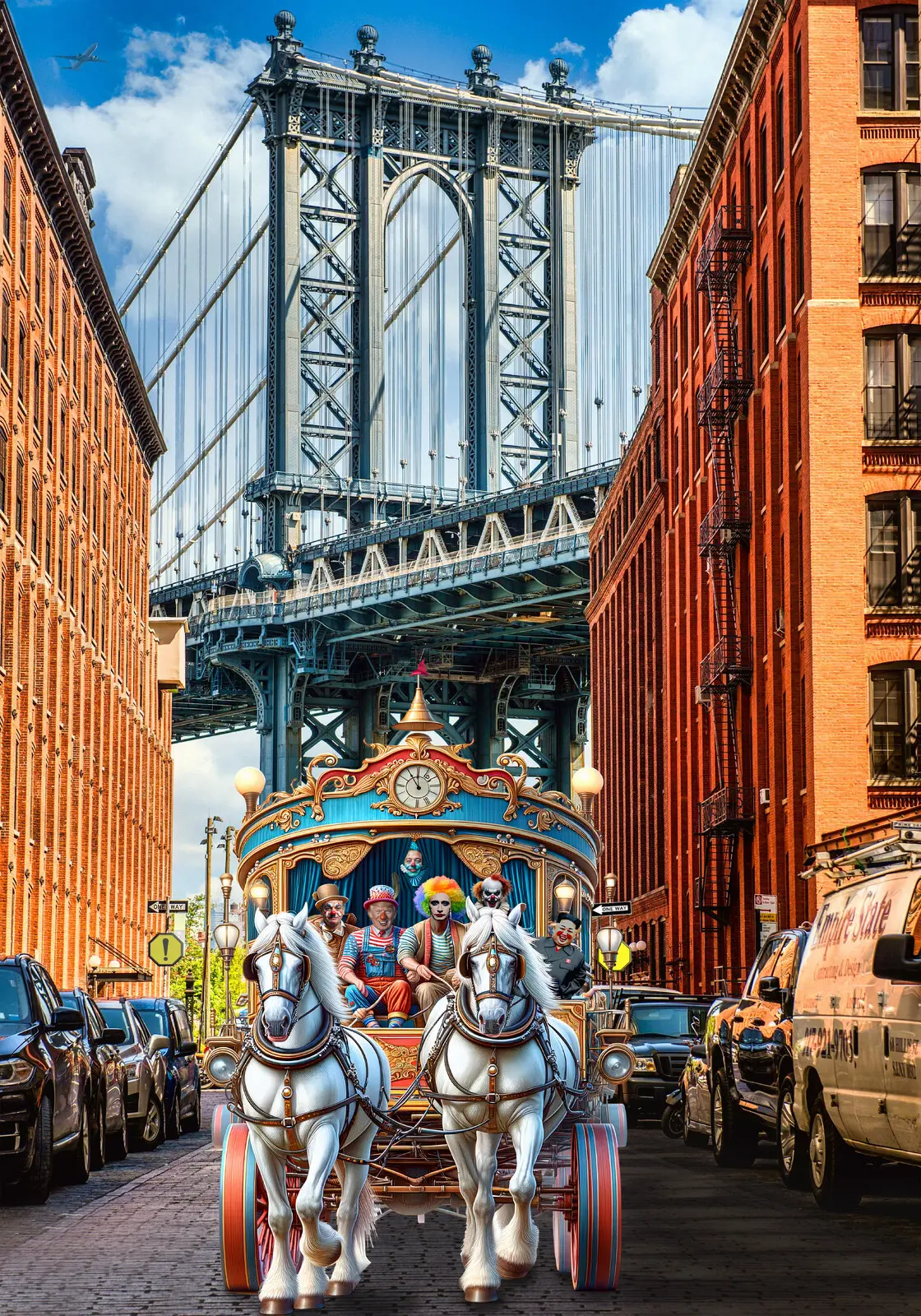
Jörgen Thornberg
The Clowns are on the loose!, 2024
Digital
70 x 100 cm
3 200 kr
Clowns of Power, Jest and Dread
“The circus rolls on, a grand parade,
With clowns in masks that never fade.
There’s Trump in his suit, red tie askew,
Laughing loudly, but his words cut through.
He dances and juggles on democracy’s stage,
A grin so wide it hides his rage.
Orban twirls with a sly, crooked smile,
Bending laws and truth, mile by mile.
A trickster’s act, where justice bows,
As he tightens the ropes, no one knows how.
Behind him echoes the jester’s rhyme,
Mocking freedom, one step at a time.
Putin stalks with a shadowed gaze,
Dressed in red, wrapped in fear's cold haze.
His laughter’s chill turns smiles to stone,
For behind the mask lies the tyrant's throne.
He spins tales of might, of blood and pride,
While innocents fall and truths collide.
Jong Un rides in a wagon of fire,
Feeding the flames of a dictator's desire.
He struts like a king in his gilded cage,
But his laughter cracks with unspoken rage.
A painted face that hides his plight,
In a land where day is always night.
Musk, the joker with a tech-born crown,
The maverick smirks as he flips the truth upside down.
He plays with rockets, with stars in his eyes,
Yet his jokes pierce like satellites in the skies.
With power to sway and the crowd in his palm,
He teeters the line between chaos and calm.
Behind them all stands the final clown,
Death, in a cloak with a weary frown.
His smile is fixed, his eyes are deep,
For he knows the promises these jesters keep.
Like Hades himself, he waits, and he waits,
For the harvest of ruin, these clowns create.
In the Halls of Kings, the Jesters Played,
Where shadows danced, and swords decayed.
Triboulet, sharp-tongued and wild,
He whispered truths with a devilish smile.
He jested, he mocked and brought men to heel,
His laughter was sharp as a dagger, his folly real.
Sommers, the gentle fool in Henry’s court,
With words that charmed but cut men short.
He knew when to jest when to keep still,
How to twist the truth to bend a king’s will.
With honeyed wit and a careful hand,
He survived the tides of a ruthless land.
In Poland’s court, Stańczyk stood tall,
His jokes were bitter; his truths did gall.
A sad-faced jester who wore wisdom’s mask,
Turning laughter to sorrow, a heavy task.
His wit cut deep, like a blade in the dark,
Leaving echoes of truth long after the spark.
Now, these jesters of old are buried in lore,
Yet their spirits dance in the clowns we abhor.
For power and laughter are threads of the same,
And history’s fools still play their game.
In circles, they dance, from court to street,
In painted masks with hollowed feet.
The stage is set, the world’s in thrall,
As the circus winds through cities and halls.
These clowns of power, with lies and might,
Perform their acts under shadowed light.
Yet Death waits patient, with a knowing grin,
For the curtain falls, his truth will begin.
So laugh if you must while the jesters play,
For, in the end, they, too, will pay.
The mask will slip, the paint will run,
When Death collects what’s been undone.
And the echoes of their laughter—so cruel, so vain—
Will fade like whispers in a cold autumn rain.”
Malmö, October 2024
The Clowns are on the loose!
Who would have thought, after the fall of the Berlin Wall in 1989, that fascism would make a comeback? Nor did we expect the return of racism and other outdated values. After decades of progress toward a better world, this unexpected turn of events, with greater equality and reduced poverty, is now threatened. That the threat would come from a bunch of clowns is even more surprising. The strongmen of the past – for they were almost always men – were not jokers but stern figures. Political evolution has instead bred a generation of clowns. The goal remains the same: power in the hands of a few, but the result is the same – oppression.
The Clowns are on the loose! This phrase implies a playful sense of mayhem, with the potential for unexpected or humorous antics. It suggests that things might get a little wild! On the surface, the slogan sounds harmless, but hold on! That's precisely what the clowns want. The clown concept is contradictory and requires a thorough analysis because clowns can certainly amuse, but they can also be infernally dangerous with the clown's mask. The 'clown concept' refers to the idea that clowns, with their ability to win over the crowd's laughter, can be exploited by forces that make thoughtful people choke on their laughter—he who laughs last laughs best. This potential for exploitation is a serious concern and should be a wake-up call for all of us, instilling a sense of concern and alertness in the audience.
Clowns, often dressed in distinctive makeup or costumes that invert societal norms, entertain with physical comedy and open-ended acts. This performance art, known as clowning or buffoonery, has a rich tradition with significant variation in both costume and style. The most iconic clowns are known for their circus performances, featuring vibrant wigs, red noses, and oversized shoes. However, clowns have a long history in theatre and folklore, such as the court jesters of the Middle Ages and the ritual clowns found in various Indigenous cultures. Their performances provoke a wide range of emotions—from laughter and joy to fear and discomfort—highlighting their profound societal and psychological impact. Over the centuries, clowns have played essential roles, evolving in response to shifting cultural standards and artistic practices. Understanding the historical significance of clowns can enlighten us about their profound societal and psychological impact, leaving us feeling more knowledgeable and engaged.
The earliest known clowns date back to Egypt's Fifth Dynasty, around 2400 BC. Unlike court jesters, clowns traditionally fulfilled a socio-religious and psychological purpose, with the roles of priest and clown often overlapping. Sociologist Peter Berger notes that "folly and fools, like religion and magic, meet some deeply rooted needs in human society." As a result, clowning is often considered a foundational aspect of training in physical performance disciplines because it addresses challenging themes and demands a high degree of risk-taking and playful energy from the performer.
Joseph Grimaldi, who developed the iconic whiteface clown makeup, is credited with creating the first popular clown character in the early 1800s. He significantly expanded the role of the clown, becoming a kind of evolutionary bridge to the modern version—a "Homo erectus" of clowning, so to speak. Before Grimaldi, clowns might use only a touch of rouge to exaggerate the appearance of being jovial drunkards or rustic bumpkins. Grimaldi, however, took it further, donning eccentric, colourful outfits and painting his face stark white with bright red patches on his cheeks, topped off with a blue mohawk. He was a master of physical comedy, performing acrobatic leaps, standing on his head, and staging mock fights with himself that left audiences in stitches. Beyond physical antics, he satirised the absurd fashions of his time, made comic impressions, and performed bawdy songs, making him a pioneer of slapstick and satirical humour.
Grimaldi’s innovations laid the foundation for modern clowning, yet clowns have always been more than mere comic relief. They have historically served as a reflection of society, addressing its humorous, absurd, and often uncomfortable dimensions. This role of clowns as a mirror to society can help us connect and engage with the societal issues they bring to light, fostering a sense of connection and engagement with the world around us.
The English word “clown” was first recorded around 1560 (as ‘Clowne’ or ‘Cloyne’), originally meaning a rustic, boor, or peasant. Its precise origins remain uncertain, though it might derive from a Scandinavian word related to "clumsy." In this sense, the word ‘Clown’ appeared in Shakespeare’s plays, such as in ‘Othello’ and ‘The Winter’s Tale’, referring to fool-like characters of a rural background. By the early 17th century, the term evolved to denote a professional or habitual fool or jester inspired by the rustic characters in Elizabethan theatre, particularly in Shakespeare’s works. Understanding the evolution of the term 'clown' can make us more knowledgeable and interested in the history of clowning.
In Italy, “Pagliaccio” refers to a stock character from the ‘Commedia dell'arte’ tradition, specifically one of the ‘Zanni’, or comic servants. The pairing of the classical White Clown with Auguste, which became a staple of modern clowning, finds its roots in the relationship between Pierrot and Harlequin in ‘Commedia dell'arte’. Harlequin, initially a nimble, clever, and light-hearted servant, was contrasted with Pierrot, who played the sterner, melancholic role.
The relationship between these figures shifted in the English Harlequinade of the 18th century. The Harlequin, who had developed into a romantic and more sophisticated character, was paired with the Clown, who took on a more mischievous and brutish persona. Joseph Grimaldi significantly shaped this dynamic around 1800, transforming the Clown into a foil for the refined Harlequin. Grimaldi’s Clown was a character full of mischief and physical comedy, contrasting sharply with the romantic and agile Harlequin, marking a significant evolution in the clown's role from a mere rustic buffoon to a central figure in comedic performance.
Being mischievous and brutal makes the audience laugh and relax. The clown's message and intentions—if the clown even had any other than to entertain—could easily reach an unsuspecting audience. One must not forget the political role that clowns, like the court jester, have played when whispering in the ruler's ear. The clown was often the only one who dared to be candid with the ruler without risking his life. However, being candid does not necessarily mean speaking the truth or having honest intentions; the clown could have his agenda and ambitions for power—disguised behind a wolfish grin, a wolf in sheep’s clothing.
The court jester was a singular presence in the medieval and Renaissance courts, distinct from the rigid hierarchies that defined the era. Typically adorned in bright, flamboyant costumes, holding a mock sceptre, and wearing a playful hat, the jester’s primary role was to entertain royalty with wit, storytelling, songs, and biting satire. Unlike other courtiers, who were bound by strict rules of conduct, the jester enjoyed a rare privilege: the freedom to mock, jest, and criticise—often in ways no one else could without facing severe consequences. These jesters were far more than mere comedians; they were trusted confidants, keen observers, and sometimes even the moral voice of the court.
One of the most legendary jesters was Triboulet, who served at the French court in the early 16th century. Triboulet was the favoured entertainer of both King Louis XII and King Francis I, known for his sharp wit and willingness to challenge even the highest authorities. His boldness became famous, especially when he managed to provoke King Francis I to the point of ordering his execution. Yet Triboulet’s cleverness matched his daring, and he negotiated to be hanged with a silk rope—an unusual request that the amused king granted.
Often referred to as the "fool of fools," Triboulet's reputation rested on his fearless, sharp-tongued humour. One memorable incident demonstrated his daring: he once complained to the king, saying, “An aristocrat has threatened to hang me!” In an unexpected show of solidarity, the king replied, “Don’t worry! If he hangs you, I’ll have him beheaded fifteen minutes later.” Never missing a beat, Triboulet quickly quipped, “Ah, in that case, could you behead him fifteen minutes earlier?”
Triboulet’s boldness was not just verbal; his actions became legend. On one occasion, he impulsively slapped King Francis I on the rear, delighting the surrounding courtiers. The king, however, was not amused and, in a rage, threatened to execute him. Later, as the king’s anger cooled, he offered Triboulet a chance to save himself: if he could devise an apology even more offensive than his original act, he would be forgiven. Triboulet responded without hesitation, saying, “I am so sorry, Your Majesty, that I didn’t recognise you! I thought you were the queen!”
Such episodes highlighted Triboulet’s precarious balancing act, skirting what was permissible. Inevitably, his audacity crossed the limit. Ignoring a direct command from King Francis I, Triboulet dared to make another joke about the queen, leading the king to issue a final order for his execution. However, in recognition of his many years of service, Triboulet was given the rare opportunity to choose the manner of his death. Ever the humorist, he is said to have requested, “Good sir, by Saint Nitouche and Saint Pansard, protectors of madness, I ask to die of old age.”
King Francis I, with no choice but to laugh, commuted the sentence. Instead of execution, Triboulet was banished from the kingdom, allowing him to survive and continue his jesting ways. His quick wit had once again saved him from the ultimate punishment, highlighting the jester’s unique blend of audacity and intelligence.
Across the English Channel, another well-known jester, Will Sommers, served under the formidable King Henry VIII of England. Unlike the daring Triboulet, Sommers was celebrated for his gentle and light-hearted humour, which earned him a secure position in Henry's court. He was one of the rare individuals who could bring a smile to the notoriously stern and temperamental king, making him a favourite in the Tudor court. After Henry’s death, Sommers remained a beloved figure, serving the king's children and maintaining his presence at court. His long career, navigating periods of significant political upheaval, showcased his exceptional ability to combine loyalty with humour.
In the early 17th century, Archibald Armstrong emerged as a favoured jester in the courts of King James VI of Scotland—later James I of England—and his son, King Charles I. Armstrong's wit was edgier than Sommers', marked by a sharper and more sarcastic tone that often mirrored the political tensions of the era. His audacity eventually led to his downfall when he overstepped the bounds of his freedom with an incredibly offensive remark. Despite his dismissal, Armstrong’s legacy as a clever, if occasionally dangerous, court jester endured, and his name remained synonymous with the risky humour of the time.
In 16th-century Poland, Stańczyk rose to prominence as a jester serving three Polish kings: Alexander, Sigismund I, and Sigismund II Augustus. Stańczyk was more than a mere fool; he was a man of profound intelligence, famous for delivering sharp political insights through humour. Often portrayed as a sombre figure in Polish art, Stańczyk is a reminder that jesters were sometimes the bearers of the harshest truths, veiled in comedy. His lasting reputation as an entertainer and critic underscores jesters’ nuanced and complex role in the royal courts.
Denmark's renowned jester, Narren Claus, served King Christian IV during the 16th century. Known for his bawdy humour and playful nature, Claus had the rare distinction of being able to tease the king himself—a testament to the unique bond that could develop between jesters and their royal patrons. Though often outrageous, his jokes were tolerated and enjoyed, revealing how the jester's humour could ease the weight of courtly life while still keeping the favour of those in power.
One of the few documented female jesters, Jane, the Fool, carved out a role in the English courts of Queen Mary I and, possibly, earlier in the court of Queen Catherine Parr. Though the records of her life are limited, Jane was noted for her close and trusted relationships with her royal patrons. Even during the volatile political climate of Tudor England, Jane's status remained secure, suggesting that her humour and companionship were deeply valued, providing comfort in an era fraught with uncertainty and danger.
Each of these jesters—whether gentle, daring, or satirical—demonstrates the critical role that jesters played in history. They used wit to navigate court life's complex dynamics while offering entertainment and a mirror to society’s most profound truths.
These court jesters were not just entertainers but often held a unique position of influence. They could speak truths disguised in wit that others dared not say, steering and manipulating their ruler to the best of their ability. Many did so with great success.
But not everyone is laughing. "Elect clowns, expect a circus!" is a warning frequently appearing during protests against Mr. Trump’s ambitions for another four years in the White House. Regardless of political affiliation, a majority should be concerned when the jester takes the ruler's place. This is not the kind of clown the world needs.
Let’s not forget the synonym for "clown"—‘joker,’ which carries a similar meaning but also hints at other roles clowns play: to be a wildcard or, like Batman’s arch-nemesis the super-villain Joker, to take over the world on his terms. The jokers of politics, the clowns, should be taken seriously, for they are no more someone to laugh at than Batman's nemesis.
The ‘Joker’ who most closely resembles Batman’s foe, The Joker, is Putin, whose bloodlust knows no bounds and whose methods are diabolical. Mr Trump and Orbán cannot develop similarly because they operate within democracies, even though the latter has eroded Hungary's legal system over his fourteen years in power. The former President, Trump, has never hidden his admiration for dictators and fascism. If he could alter the American system into a dictatorship, he wouldn’t hesitate. Trump embodies the culture of the strongman. Many perceive him as a clown challenging the establishment.
A famous historical figure began as a court entertainer and later seized significant power, though not precisely a ‘court jester’ in the traditional sense. The most notable example is Baibars, a Mamluk sultan who began his rise as a slave and eventually became a ruler, but he wasn't strictly a court fool.
However, in the classic sense of a court jester rising to political power, the closest example is from Russia: Ivan the Terrible’s "Jester" - Maliuta Skuratov, who, while not strictly a jester, acted as a kind of court clown or fool while also holding significant influence. Skuratov was a member of the Oprichnina, Ivan’s private army, known for his vicious sense of humour and brutality. He used his "jester-like" role to hide his actual influence, ultimately serving as one of Ivan’s trusted enforcers.
In these historical accounts, jesters themselves rarely seized power outright. However, their positions as jesters often allowed them to wield influence, whispering counsel to monarchs or swaying the court under the guise of comedy. Thus, while true stories of jesters becoming kings are rare, jesters often profoundly impacted decision-making, enjoying unique proximity to power and freedom to critique those in authority.
The Swedish expression ‘gossen Ruda’ (the lad Ruda) carries a connotation beyond a simple label. It describes a young male troublemaker—a disruptive, disrespectful figure who consistently finds himself at the centre of the conflict. Often refusing to abide by social rules, ‘gossen Ruda’ isn't just a mischievous lad; he's a symbol of rebellion and unpredictability, someone who refuses to conform and frequently challenges the established order.
Finding a precise equivalent in English can be challenging. Initially, terms like "black sheep" capture the sense of being an outsider or different, but they lack the active, rebellious energy that defines ‘Gossen Ruda.’
A more fitting English equivalent could be "maverick." This term describes an unconventional, independent, and often disruptive person who refuses to play by the rules. A maverick challenges norms and stirs the pot, much like ‘Gossen Ruda’ does in the Swedish context. The term also implies a certain independence of spirit, capturing both the positive and negative sides of rebellion. Similarly, a maverick might not always intend to cause trouble. Still, his very nature leads him to defy expectations and create disturbances, a quality that ‘Gossen Ruda’ embodies in Swedish culture.
Thus, while ‘Gossen Ruda’ carries a uniquely Swedish flavour, steeped in cultural nuance, the English "maverick" offers a strong, if not perfect, parallel. Both terms suggest a figure who stands apart, refusing to be hemmed in by societal expectations, causing trouble not just for its own sake but as an expression of individuality. Whether in Sweden or the English-speaking world, every society seems to have its version of the young troublemaker, the figure who won’t play by the rules—disruptive, rebellious, and often unforgettable.
One such maverick playing a political game is Elon Musk, a controversial figure who follows his path. In doing so, according to Forbes, he has become the wealthiest person in the world, with a net worth of over $200 billion. He now clearly desires political influence and is backing Mr. Trump in his ambitions. Musk, a tech tycoon and CEO of Tesla and SpaceX, has also maintained regular contact with Vladimir Putin and other Kremlin officials since 2022. Which of the jesters from history he might take as a model remains to be seen. If Mr. Trump wins, the gang on the circus wagon will dominate the next four years, with the death clown grinning in the background. What a circus!
Clown Fear: A Strange and Colorful Panic
There is good reason to be wary of the kind of clowns I’ve described—the ones who whisper in the ears of rulers, who manipulate and deceive with a mischievous grin. But traditional circus clowns, with their goofy antics and oversized shoes, shouldn’t inspire the same fear. Yet, some dread even the most innocent of clowns. This fear, called coulrophobia, is a genuine phenomenon, and it’s not limited to children—many adults are affected too. The term "coulrophobia" originated in English and likely dates back to the 1980s.
In October 2016, fear of clowns reached fever pitch as reports of sinister sightings spread across the United States, eventually reaching Europe, including Sweden. It all began in August when people started dressing up as terrifying clowns, lurking in dark corners and public spaces, scaring unsuspecting passersby. That year, the phenomenon spread like wildfire, forcing McDonald’s to bench its mascot, Ronald McDonald temporarily. The panic was not just an American phenomenon—countries across Europe reported similar incidents, with clowns appearing in streets, forests, and even schools, creating a wave of unease that transcended borders.
The Rise of the Clown Plague
By Halloween 2016, the so-called "clown plague" seemed to have taken over Sweden. Clowns were reported everywhere, lurking ominously in the shadows, causing a flood of police reports and stirring panic nationwide. Hundreds of incidents were documented—“90 reports of clowns in southern Sweden in one day alone,” read one headline. Some reports were absurd and disturbing: four ten-year-old boys surrounded by clowns wielding fake chainsaws or a hip-hop duo blamed for sparking the epidemic with an elaborate internet prank.
There were stranger stories, too—one eight-year-old boy, thinking his mother had returned home, opened the door only to find himself face-to-face with a grown man in full clown makeup. The terrified boy had to flee via the balcony. These tales multiplied rapidly in October 2016, creating a true hysteria that intensified as Halloween approached. Reports of clowns chasing people with knives, threatening women, and even breaking into homes filled the news. Even the iconic golden arches of McDonald’s had to dim Ronald’s red smile to avoid sparking more panic.
From the Ridiculous to the Truly Terrifying
While the hysteria began to subside after Halloween, that strange October left an indelible mark on public memory. Swedish media had a field day covering stories of clowns lurking at the edge of forests, trying to lure children into the dark. Police were inundated with 112 emergency calls from terrified citizens. The psychological impact of this fear was significant, with many people feeling unsafe in their own communities. One dog owner, startled by a clown, watched as his faithful dog charged and attacked the creepy intruder—proof, if ever needed, that not even dogs are immune to clown fear!
Not surprisingly, some people responded aggressively. As the fear escalated, social media became a battleground. Numerous online groups popped up, encouraging members to go out and hunt clowns. One group even amassed 3,000 members, sharing pictures of recommended weapons for catching a clown. This bizarre phenomenon is equal parts horror and humour, culminating in numerous clashes, with both clowns and vigilantes suffering injuries. The role of social media in amplifying and spreading this fear cannot be understated. “Stop it! There's no humour in this,” the police pleaded in one frustrated press release.
Europe’s Clown Craze
Sweden was far from the only country affected. The clown panic of 2016 spread across Europe, hitting the UK, Germany, and France particularly hard. Reports of sinister clowns lurking near schools or brandishing weapons appeared in newspapers across the continent. In some cases, authorities warned parents to keep their children indoors during the Halloween season, fearing that the clown craze might escalate into serious violence. In Germany, there were reports of masked clowns assaulting pedestrians. In the UK, schools sent out warnings to parents after several children were terrified by clowns appearing at the edge of schoolyards. It was a European epidemic, with each country reacting to the shared fear but united in a sense of unease.
Why Are We Afraid of Clowns?
But what is it about clowns that makes them so unsettling? According to psychologist Fredrik Sandin, the answer lies in their appearance. “The clown is a fabricated character with a very distinct look, someone who deviates from the norm of what a person should look like,” he explains. Clowns often have fixed facial expressions, making it hard to read their genuine emotions, particularly for children. The stark, exaggerated makeup—a bright red smile, stark white face, exaggerated eyebrows—creates an unnerving dissonance. You can never be sure if the clown is truly happy or if there’s something more sinister hidden beneath the mask.
Sandin compares clown fear to riding a roller coaster: some people are thrilled by the rush, while others are terrified. It’s a question of perspective, an individual’s response to the unexpected and unknown. A clown’s painted face can evoke curiosity—who is hiding behind the makeup? Are they angry, sad, or joyful? The mystery is unsettling for some and intriguing for others.
Clowns in Culture: A Love-Hate Relationship
The clown concept has deep roots in European culture, from the medieval court jesters who could speak uncomfortable truths to kings to the sinister figure of Pennywise in Stephen King’s It or the twisted villain The Joker from the Batman franchise. Clowns occupy a curious space in the human psyche: they are symbols of chaos, capable of causing laughter and terror. Their unpredictability, the sense that they might be hiding something sinister behind the smile, has made them both beloved and feared throughout history. Understanding this historical and cultural significance can provide a broader context for the fear of clowns.
In 2016, these cultural associations collided with a modern urban legend, causing widespread panic and leaving a lingering fear of the painted face. In a peculiar twist, a hip-hop duo was even accused of sparking the craze as a prank to promote a Hollywood film, showing how easily old fears can be revived and amplified in the digital age.
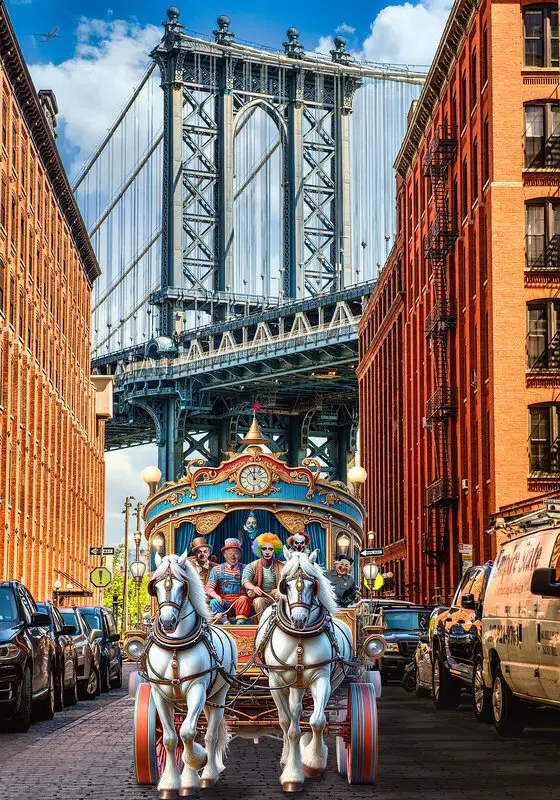
Jörgen Thornberg
The Clowns are on the loose!, 2024
Digital
70 x 100 cm
3 200 kr
Clowns of Power, Jest and Dread
“The circus rolls on, a grand parade,
With clowns in masks that never fade.
There’s Trump in his suit, red tie askew,
Laughing loudly, but his words cut through.
He dances and juggles on democracy’s stage,
A grin so wide it hides his rage.
Orban twirls with a sly, crooked smile,
Bending laws and truth, mile by mile.
A trickster’s act, where justice bows,
As he tightens the ropes, no one knows how.
Behind him echoes the jester’s rhyme,
Mocking freedom, one step at a time.
Putin stalks with a shadowed gaze,
Dressed in red, wrapped in fear's cold haze.
His laughter’s chill turns smiles to stone,
For behind the mask lies the tyrant's throne.
He spins tales of might, of blood and pride,
While innocents fall and truths collide.
Jong Un rides in a wagon of fire,
Feeding the flames of a dictator's desire.
He struts like a king in his gilded cage,
But his laughter cracks with unspoken rage.
A painted face that hides his plight,
In a land where day is always night.
Musk, the joker with a tech-born crown,
The maverick smirks as he flips the truth upside down.
He plays with rockets, with stars in his eyes,
Yet his jokes pierce like satellites in the skies.
With power to sway and the crowd in his palm,
He teeters the line between chaos and calm.
Behind them all stands the final clown,
Death, in a cloak with a weary frown.
His smile is fixed, his eyes are deep,
For he knows the promises these jesters keep.
Like Hades himself, he waits, and he waits,
For the harvest of ruin, these clowns create.
In the Halls of Kings, the Jesters Played,
Where shadows danced, and swords decayed.
Triboulet, sharp-tongued and wild,
He whispered truths with a devilish smile.
He jested, he mocked and brought men to heel,
His laughter was sharp as a dagger, his folly real.
Sommers, the gentle fool in Henry’s court,
With words that charmed but cut men short.
He knew when to jest when to keep still,
How to twist the truth to bend a king’s will.
With honeyed wit and a careful hand,
He survived the tides of a ruthless land.
In Poland’s court, Stańczyk stood tall,
His jokes were bitter; his truths did gall.
A sad-faced jester who wore wisdom’s mask,
Turning laughter to sorrow, a heavy task.
His wit cut deep, like a blade in the dark,
Leaving echoes of truth long after the spark.
Now, these jesters of old are buried in lore,
Yet their spirits dance in the clowns we abhor.
For power and laughter are threads of the same,
And history’s fools still play their game.
In circles, they dance, from court to street,
In painted masks with hollowed feet.
The stage is set, the world’s in thrall,
As the circus winds through cities and halls.
These clowns of power, with lies and might,
Perform their acts under shadowed light.
Yet Death waits patient, with a knowing grin,
For the curtain falls, his truth will begin.
So laugh if you must while the jesters play,
For, in the end, they, too, will pay.
The mask will slip, the paint will run,
When Death collects what’s been undone.
And the echoes of their laughter—so cruel, so vain—
Will fade like whispers in a cold autumn rain.”
Malmö, October 2024
The Clowns are on the loose!
Who would have thought, after the fall of the Berlin Wall in 1989, that fascism would make a comeback? Nor did we expect the return of racism and other outdated values. After decades of progress toward a better world, this unexpected turn of events, with greater equality and reduced poverty, is now threatened. That the threat would come from a bunch of clowns is even more surprising. The strongmen of the past – for they were almost always men – were not jokers but stern figures. Political evolution has instead bred a generation of clowns. The goal remains the same: power in the hands of a few, but the result is the same – oppression.
The Clowns are on the loose! This phrase implies a playful sense of mayhem, with the potential for unexpected or humorous antics. It suggests that things might get a little wild! On the surface, the slogan sounds harmless, but hold on! That's precisely what the clowns want. The clown concept is contradictory and requires a thorough analysis because clowns can certainly amuse, but they can also be infernally dangerous with the clown's mask. The 'clown concept' refers to the idea that clowns, with their ability to win over the crowd's laughter, can be exploited by forces that make thoughtful people choke on their laughter—he who laughs last laughs best. This potential for exploitation is a serious concern and should be a wake-up call for all of us, instilling a sense of concern and alertness in the audience.
Clowns, often dressed in distinctive makeup or costumes that invert societal norms, entertain with physical comedy and open-ended acts. This performance art, known as clowning or buffoonery, has a rich tradition with significant variation in both costume and style. The most iconic clowns are known for their circus performances, featuring vibrant wigs, red noses, and oversized shoes. However, clowns have a long history in theatre and folklore, such as the court jesters of the Middle Ages and the ritual clowns found in various Indigenous cultures. Their performances provoke a wide range of emotions—from laughter and joy to fear and discomfort—highlighting their profound societal and psychological impact. Over the centuries, clowns have played essential roles, evolving in response to shifting cultural standards and artistic practices. Understanding the historical significance of clowns can enlighten us about their profound societal and psychological impact, leaving us feeling more knowledgeable and engaged.
The earliest known clowns date back to Egypt's Fifth Dynasty, around 2400 BC. Unlike court jesters, clowns traditionally fulfilled a socio-religious and psychological purpose, with the roles of priest and clown often overlapping. Sociologist Peter Berger notes that "folly and fools, like religion and magic, meet some deeply rooted needs in human society." As a result, clowning is often considered a foundational aspect of training in physical performance disciplines because it addresses challenging themes and demands a high degree of risk-taking and playful energy from the performer.
Joseph Grimaldi, who developed the iconic whiteface clown makeup, is credited with creating the first popular clown character in the early 1800s. He significantly expanded the role of the clown, becoming a kind of evolutionary bridge to the modern version—a "Homo erectus" of clowning, so to speak. Before Grimaldi, clowns might use only a touch of rouge to exaggerate the appearance of being jovial drunkards or rustic bumpkins. Grimaldi, however, took it further, donning eccentric, colourful outfits and painting his face stark white with bright red patches on his cheeks, topped off with a blue mohawk. He was a master of physical comedy, performing acrobatic leaps, standing on his head, and staging mock fights with himself that left audiences in stitches. Beyond physical antics, he satirised the absurd fashions of his time, made comic impressions, and performed bawdy songs, making him a pioneer of slapstick and satirical humour.
Grimaldi’s innovations laid the foundation for modern clowning, yet clowns have always been more than mere comic relief. They have historically served as a reflection of society, addressing its humorous, absurd, and often uncomfortable dimensions. This role of clowns as a mirror to society can help us connect and engage with the societal issues they bring to light, fostering a sense of connection and engagement with the world around us.
The English word “clown” was first recorded around 1560 (as ‘Clowne’ or ‘Cloyne’), originally meaning a rustic, boor, or peasant. Its precise origins remain uncertain, though it might derive from a Scandinavian word related to "clumsy." In this sense, the word ‘Clown’ appeared in Shakespeare’s plays, such as in ‘Othello’ and ‘The Winter’s Tale’, referring to fool-like characters of a rural background. By the early 17th century, the term evolved to denote a professional or habitual fool or jester inspired by the rustic characters in Elizabethan theatre, particularly in Shakespeare’s works. Understanding the evolution of the term 'clown' can make us more knowledgeable and interested in the history of clowning.
In Italy, “Pagliaccio” refers to a stock character from the ‘Commedia dell'arte’ tradition, specifically one of the ‘Zanni’, or comic servants. The pairing of the classical White Clown with Auguste, which became a staple of modern clowning, finds its roots in the relationship between Pierrot and Harlequin in ‘Commedia dell'arte’. Harlequin, initially a nimble, clever, and light-hearted servant, was contrasted with Pierrot, who played the sterner, melancholic role.
The relationship between these figures shifted in the English Harlequinade of the 18th century. The Harlequin, who had developed into a romantic and more sophisticated character, was paired with the Clown, who took on a more mischievous and brutish persona. Joseph Grimaldi significantly shaped this dynamic around 1800, transforming the Clown into a foil for the refined Harlequin. Grimaldi’s Clown was a character full of mischief and physical comedy, contrasting sharply with the romantic and agile Harlequin, marking a significant evolution in the clown's role from a mere rustic buffoon to a central figure in comedic performance.
Being mischievous and brutal makes the audience laugh and relax. The clown's message and intentions—if the clown even had any other than to entertain—could easily reach an unsuspecting audience. One must not forget the political role that clowns, like the court jester, have played when whispering in the ruler's ear. The clown was often the only one who dared to be candid with the ruler without risking his life. However, being candid does not necessarily mean speaking the truth or having honest intentions; the clown could have his agenda and ambitions for power—disguised behind a wolfish grin, a wolf in sheep’s clothing.
The court jester was a singular presence in the medieval and Renaissance courts, distinct from the rigid hierarchies that defined the era. Typically adorned in bright, flamboyant costumes, holding a mock sceptre, and wearing a playful hat, the jester’s primary role was to entertain royalty with wit, storytelling, songs, and biting satire. Unlike other courtiers, who were bound by strict rules of conduct, the jester enjoyed a rare privilege: the freedom to mock, jest, and criticise—often in ways no one else could without facing severe consequences. These jesters were far more than mere comedians; they were trusted confidants, keen observers, and sometimes even the moral voice of the court.
One of the most legendary jesters was Triboulet, who served at the French court in the early 16th century. Triboulet was the favoured entertainer of both King Louis XII and King Francis I, known for his sharp wit and willingness to challenge even the highest authorities. His boldness became famous, especially when he managed to provoke King Francis I to the point of ordering his execution. Yet Triboulet’s cleverness matched his daring, and he negotiated to be hanged with a silk rope—an unusual request that the amused king granted.
Often referred to as the "fool of fools," Triboulet's reputation rested on his fearless, sharp-tongued humour. One memorable incident demonstrated his daring: he once complained to the king, saying, “An aristocrat has threatened to hang me!” In an unexpected show of solidarity, the king replied, “Don’t worry! If he hangs you, I’ll have him beheaded fifteen minutes later.” Never missing a beat, Triboulet quickly quipped, “Ah, in that case, could you behead him fifteen minutes earlier?”
Triboulet’s boldness was not just verbal; his actions became legend. On one occasion, he impulsively slapped King Francis I on the rear, delighting the surrounding courtiers. The king, however, was not amused and, in a rage, threatened to execute him. Later, as the king’s anger cooled, he offered Triboulet a chance to save himself: if he could devise an apology even more offensive than his original act, he would be forgiven. Triboulet responded without hesitation, saying, “I am so sorry, Your Majesty, that I didn’t recognise you! I thought you were the queen!”
Such episodes highlighted Triboulet’s precarious balancing act, skirting what was permissible. Inevitably, his audacity crossed the limit. Ignoring a direct command from King Francis I, Triboulet dared to make another joke about the queen, leading the king to issue a final order for his execution. However, in recognition of his many years of service, Triboulet was given the rare opportunity to choose the manner of his death. Ever the humorist, he is said to have requested, “Good sir, by Saint Nitouche and Saint Pansard, protectors of madness, I ask to die of old age.”
King Francis I, with no choice but to laugh, commuted the sentence. Instead of execution, Triboulet was banished from the kingdom, allowing him to survive and continue his jesting ways. His quick wit had once again saved him from the ultimate punishment, highlighting the jester’s unique blend of audacity and intelligence.
Across the English Channel, another well-known jester, Will Sommers, served under the formidable King Henry VIII of England. Unlike the daring Triboulet, Sommers was celebrated for his gentle and light-hearted humour, which earned him a secure position in Henry's court. He was one of the rare individuals who could bring a smile to the notoriously stern and temperamental king, making him a favourite in the Tudor court. After Henry’s death, Sommers remained a beloved figure, serving the king's children and maintaining his presence at court. His long career, navigating periods of significant political upheaval, showcased his exceptional ability to combine loyalty with humour.
In the early 17th century, Archibald Armstrong emerged as a favoured jester in the courts of King James VI of Scotland—later James I of England—and his son, King Charles I. Armstrong's wit was edgier than Sommers', marked by a sharper and more sarcastic tone that often mirrored the political tensions of the era. His audacity eventually led to his downfall when he overstepped the bounds of his freedom with an incredibly offensive remark. Despite his dismissal, Armstrong’s legacy as a clever, if occasionally dangerous, court jester endured, and his name remained synonymous with the risky humour of the time.
In 16th-century Poland, Stańczyk rose to prominence as a jester serving three Polish kings: Alexander, Sigismund I, and Sigismund II Augustus. Stańczyk was more than a mere fool; he was a man of profound intelligence, famous for delivering sharp political insights through humour. Often portrayed as a sombre figure in Polish art, Stańczyk is a reminder that jesters were sometimes the bearers of the harshest truths, veiled in comedy. His lasting reputation as an entertainer and critic underscores jesters’ nuanced and complex role in the royal courts.
Denmark's renowned jester, Narren Claus, served King Christian IV during the 16th century. Known for his bawdy humour and playful nature, Claus had the rare distinction of being able to tease the king himself—a testament to the unique bond that could develop between jesters and their royal patrons. Though often outrageous, his jokes were tolerated and enjoyed, revealing how the jester's humour could ease the weight of courtly life while still keeping the favour of those in power.
One of the few documented female jesters, Jane, the Fool, carved out a role in the English courts of Queen Mary I and, possibly, earlier in the court of Queen Catherine Parr. Though the records of her life are limited, Jane was noted for her close and trusted relationships with her royal patrons. Even during the volatile political climate of Tudor England, Jane's status remained secure, suggesting that her humour and companionship were deeply valued, providing comfort in an era fraught with uncertainty and danger.
Each of these jesters—whether gentle, daring, or satirical—demonstrates the critical role that jesters played in history. They used wit to navigate court life's complex dynamics while offering entertainment and a mirror to society’s most profound truths.
These court jesters were not just entertainers but often held a unique position of influence. They could speak truths disguised in wit that others dared not say, steering and manipulating their ruler to the best of their ability. Many did so with great success.
But not everyone is laughing. "Elect clowns, expect a circus!" is a warning frequently appearing during protests against Mr. Trump’s ambitions for another four years in the White House. Regardless of political affiliation, a majority should be concerned when the jester takes the ruler's place. This is not the kind of clown the world needs.
Let’s not forget the synonym for "clown"—‘joker,’ which carries a similar meaning but also hints at other roles clowns play: to be a wildcard or, like Batman’s arch-nemesis the super-villain Joker, to take over the world on his terms. The jokers of politics, the clowns, should be taken seriously, for they are no more someone to laugh at than Batman's nemesis.
The ‘Joker’ who most closely resembles Batman’s foe, The Joker, is Putin, whose bloodlust knows no bounds and whose methods are diabolical. Mr Trump and Orbán cannot develop similarly because they operate within democracies, even though the latter has eroded Hungary's legal system over his fourteen years in power. The former President, Trump, has never hidden his admiration for dictators and fascism. If he could alter the American system into a dictatorship, he wouldn’t hesitate. Trump embodies the culture of the strongman. Many perceive him as a clown challenging the establishment.
A famous historical figure began as a court entertainer and later seized significant power, though not precisely a ‘court jester’ in the traditional sense. The most notable example is Baibars, a Mamluk sultan who began his rise as a slave and eventually became a ruler, but he wasn't strictly a court fool.
However, in the classic sense of a court jester rising to political power, the closest example is from Russia: Ivan the Terrible’s "Jester" - Maliuta Skuratov, who, while not strictly a jester, acted as a kind of court clown or fool while also holding significant influence. Skuratov was a member of the Oprichnina, Ivan’s private army, known for his vicious sense of humour and brutality. He used his "jester-like" role to hide his actual influence, ultimately serving as one of Ivan’s trusted enforcers.
In these historical accounts, jesters themselves rarely seized power outright. However, their positions as jesters often allowed them to wield influence, whispering counsel to monarchs or swaying the court under the guise of comedy. Thus, while true stories of jesters becoming kings are rare, jesters often profoundly impacted decision-making, enjoying unique proximity to power and freedom to critique those in authority.
The Swedish expression ‘gossen Ruda’ (the lad Ruda) carries a connotation beyond a simple label. It describes a young male troublemaker—a disruptive, disrespectful figure who consistently finds himself at the centre of the conflict. Often refusing to abide by social rules, ‘gossen Ruda’ isn't just a mischievous lad; he's a symbol of rebellion and unpredictability, someone who refuses to conform and frequently challenges the established order.
Finding a precise equivalent in English can be challenging. Initially, terms like "black sheep" capture the sense of being an outsider or different, but they lack the active, rebellious energy that defines ‘Gossen Ruda.’
A more fitting English equivalent could be "maverick." This term describes an unconventional, independent, and often disruptive person who refuses to play by the rules. A maverick challenges norms and stirs the pot, much like ‘Gossen Ruda’ does in the Swedish context. The term also implies a certain independence of spirit, capturing both the positive and negative sides of rebellion. Similarly, a maverick might not always intend to cause trouble. Still, his very nature leads him to defy expectations and create disturbances, a quality that ‘Gossen Ruda’ embodies in Swedish culture.
Thus, while ‘Gossen Ruda’ carries a uniquely Swedish flavour, steeped in cultural nuance, the English "maverick" offers a strong, if not perfect, parallel. Both terms suggest a figure who stands apart, refusing to be hemmed in by societal expectations, causing trouble not just for its own sake but as an expression of individuality. Whether in Sweden or the English-speaking world, every society seems to have its version of the young troublemaker, the figure who won’t play by the rules—disruptive, rebellious, and often unforgettable.
One such maverick playing a political game is Elon Musk, a controversial figure who follows his path. In doing so, according to Forbes, he has become the wealthiest person in the world, with a net worth of over $200 billion. He now clearly desires political influence and is backing Mr. Trump in his ambitions. Musk, a tech tycoon and CEO of Tesla and SpaceX, has also maintained regular contact with Vladimir Putin and other Kremlin officials since 2022. Which of the jesters from history he might take as a model remains to be seen. If Mr. Trump wins, the gang on the circus wagon will dominate the next four years, with the death clown grinning in the background. What a circus!
Clown Fear: A Strange and Colorful Panic
There is good reason to be wary of the kind of clowns I’ve described—the ones who whisper in the ears of rulers, who manipulate and deceive with a mischievous grin. But traditional circus clowns, with their goofy antics and oversized shoes, shouldn’t inspire the same fear. Yet, some dread even the most innocent of clowns. This fear, called coulrophobia, is a genuine phenomenon, and it’s not limited to children—many adults are affected too. The term "coulrophobia" originated in English and likely dates back to the 1980s.
In October 2016, fear of clowns reached fever pitch as reports of sinister sightings spread across the United States, eventually reaching Europe, including Sweden. It all began in August when people started dressing up as terrifying clowns, lurking in dark corners and public spaces, scaring unsuspecting passersby. That year, the phenomenon spread like wildfire, forcing McDonald’s to bench its mascot, Ronald McDonald temporarily. The panic was not just an American phenomenon—countries across Europe reported similar incidents, with clowns appearing in streets, forests, and even schools, creating a wave of unease that transcended borders.
The Rise of the Clown Plague
By Halloween 2016, the so-called "clown plague" seemed to have taken over Sweden. Clowns were reported everywhere, lurking ominously in the shadows, causing a flood of police reports and stirring panic nationwide. Hundreds of incidents were documented—“90 reports of clowns in southern Sweden in one day alone,” read one headline. Some reports were absurd and disturbing: four ten-year-old boys surrounded by clowns wielding fake chainsaws or a hip-hop duo blamed for sparking the epidemic with an elaborate internet prank.
There were stranger stories, too—one eight-year-old boy, thinking his mother had returned home, opened the door only to find himself face-to-face with a grown man in full clown makeup. The terrified boy had to flee via the balcony. These tales multiplied rapidly in October 2016, creating a true hysteria that intensified as Halloween approached. Reports of clowns chasing people with knives, threatening women, and even breaking into homes filled the news. Even the iconic golden arches of McDonald’s had to dim Ronald’s red smile to avoid sparking more panic.
From the Ridiculous to the Truly Terrifying
While the hysteria began to subside after Halloween, that strange October left an indelible mark on public memory. Swedish media had a field day covering stories of clowns lurking at the edge of forests, trying to lure children into the dark. Police were inundated with 112 emergency calls from terrified citizens. The psychological impact of this fear was significant, with many people feeling unsafe in their own communities. One dog owner, startled by a clown, watched as his faithful dog charged and attacked the creepy intruder—proof, if ever needed, that not even dogs are immune to clown fear!
Not surprisingly, some people responded aggressively. As the fear escalated, social media became a battleground. Numerous online groups popped up, encouraging members to go out and hunt clowns. One group even amassed 3,000 members, sharing pictures of recommended weapons for catching a clown. This bizarre phenomenon is equal parts horror and humour, culminating in numerous clashes, with both clowns and vigilantes suffering injuries. The role of social media in amplifying and spreading this fear cannot be understated. “Stop it! There's no humour in this,” the police pleaded in one frustrated press release.
Europe’s Clown Craze
Sweden was far from the only country affected. The clown panic of 2016 spread across Europe, hitting the UK, Germany, and France particularly hard. Reports of sinister clowns lurking near schools or brandishing weapons appeared in newspapers across the continent. In some cases, authorities warned parents to keep their children indoors during the Halloween season, fearing that the clown craze might escalate into serious violence. In Germany, there were reports of masked clowns assaulting pedestrians. In the UK, schools sent out warnings to parents after several children were terrified by clowns appearing at the edge of schoolyards. It was a European epidemic, with each country reacting to the shared fear but united in a sense of unease.
Why Are We Afraid of Clowns?
But what is it about clowns that makes them so unsettling? According to psychologist Fredrik Sandin, the answer lies in their appearance. “The clown is a fabricated character with a very distinct look, someone who deviates from the norm of what a person should look like,” he explains. Clowns often have fixed facial expressions, making it hard to read their genuine emotions, particularly for children. The stark, exaggerated makeup—a bright red smile, stark white face, exaggerated eyebrows—creates an unnerving dissonance. You can never be sure if the clown is truly happy or if there’s something more sinister hidden beneath the mask.
Sandin compares clown fear to riding a roller coaster: some people are thrilled by the rush, while others are terrified. It’s a question of perspective, an individual’s response to the unexpected and unknown. A clown’s painted face can evoke curiosity—who is hiding behind the makeup? Are they angry, sad, or joyful? The mystery is unsettling for some and intriguing for others.
Clowns in Culture: A Love-Hate Relationship
The clown concept has deep roots in European culture, from the medieval court jesters who could speak uncomfortable truths to kings to the sinister figure of Pennywise in Stephen King’s It or the twisted villain The Joker from the Batman franchise. Clowns occupy a curious space in the human psyche: they are symbols of chaos, capable of causing laughter and terror. Their unpredictability, the sense that they might be hiding something sinister behind the smile, has made them both beloved and feared throughout history. Understanding this historical and cultural significance can provide a broader context for the fear of clowns.
In 2016, these cultural associations collided with a modern urban legend, causing widespread panic and leaving a lingering fear of the painted face. In a peculiar twist, a hip-hop duo was even accused of sparking the craze as a prank to promote a Hollywood film, showing how easily old fears can be revived and amplified in the digital age.
3 200 kr

Jörgen Thornberg
Malmö
Lite om bilder och mig. Translation in English at the end.
Jag är en nyfiken person som ser allt i bilder, även det jag fäster i ord, gärna tillsammans för bakom alla mina bilder finns en berättelse. Till vissa bilder hör en kortare eller längre novell som följer med bilden.
Bilder berättar historier. Jag omges av naturlig skönhet, intressanta människor och historia var jag än går. Jag använder min kamera för att dokumentera världen och blanda det jag ser med vad jag känner för att fånga den dolda magin.
Mina bilder berättar mina historier. Genom mina bilder, tryck och berättelser. Jag bjuder in dig att ta del av dessa berättelser, in i ditt liv och hem och dela min mycket personliga syn på vår värld. Mer än vad ögat ser. Jag tänker i bilder, drömmer och skriver och pratar om dem; följaktligen måste jag också skapa bilder. De blir vad jag ser, inte nödvändigtvis begränsade till verkligheten. Det finns en bild runt varje hörn. Jag hoppas att du kommer att se vad jag såg och gilla det.
Jag är också en skrivande person och till många bilder hör en kortare eller längre essay. Den följer med tavlan, tryckt på fint papper och med en personlig hälsning från mig.
Flertalet bilder startar sin resa i min kamera. Enkelt förklarat beskriver jag bilden jag ser i mitt inre, upplevd eller fantiserad. Bilden uppstår inom mig redan innan jag fått okularet till ögat. På bråkdelen av ett ögonblick ser jag vad jag vill ha och vad som kan göras med bilden. Här skall jag stoppa in en giraff, stålmannen, Titanic eller vad det är min fantasi finner ut. Ännu märkligare är att jag kommer ihåg minnesbilden långt efteråt när det blir tid att skapa verket. Om jag lyckas eller inte, är upp till betraktaren, oftast präglat av en stråk av svart humor – meningen är att man skall bli underhållen. Mina bilder blir ofta en snackis där de hänger.
Jag föredrar bilder som förmedlar ett budskap i flera lager. Vid första anblicken fylld av feel-good, en vacker utsikt, fint väder, solen skiner, blommor på ängen eller vattnet som ligger förrädiskt spegelblankt. I en sådan bild kan jag gömma min egentliga berättelse, mitt förakt för förtryckare och våldsverkare, rasister och fördomsfulla människor - ett gärna återkommande motiv mer eller mindre dolt i det vackra motivet. Jag försöker förena dem i ett gemensamt narrativ.
Bild och formgivning har löpt som en röd tråd genom livet. Fotokonst känns som en värdig final som jag gärna delar med mig.
Min genre är vid som framgår av mina bilder, temat en blandning av pop- och gatukonst i kollage som kan bestå av hundratals lager. Vissa bilder kan ta veckor, andra någon dag innan det är dags att överlämna resultatet till printverkstaden. Fine Art Prints är digitala fotocollage. I dessa kollage sker rivandet, klippandet, pusslandet, målandet, ritandet och sprayningen digitalt. Det jag monterar in kan vara hundratals år gamla bilder som jag omsorgsfullt frilägger så att de ser ut att vara en del av tavlan men också bilder skapade av mig själv efter min egen fantasi. Därefter besöks printstudion och för vissa bilder numrera en limiterad upplaga (oftast 7 exemplar) och signera för hand. Vissa bilder kan köpas i olika format. Det är bara att fråga efter vilka. Gillar man en bild som är 70x100 men inte har plats på väggen, går den kanske att få i 50x70 cm istället. Frågan är fri.
Metoden Giclée eller Fine Art Print som det också kallas är det moderna sättet för framställning av grafisk konst. Villkoret för denna typ av utskrifter är att en högkvalitativ storformatskrivare används med åldersbeständigt färgpigment och konstnärspapper eller i förekommande fall på duk. Pappret som används möter de krav på livslängd som ställs av museer och gallerier. Normalt säljer jag mina bilder oinramade så att den nya ägaren själv kan bestämma hur de skall se ut, med eller utan passepartout färg på ram, med eller utan glas etc..
Under många år ställde jag bara ut på nätet, i valda grupper och på min egen Facebooksida - https://www.facebook.com/jorgen.thornberg.9
Jag finns också på en egen hemsida som tyvärr inte alltid är uppdaterad – https://www.jth.life/ Där kan du också läsa en del av de berättelser som följer med bilden.
UTSTÄLLNINGAR
Luftkastellet, oktober 2022
Konst i Lund, november 2022
Luftkastellet, mars 2023
Engleson Galleri Caroli, april 2023
Hydra, Greece June 2023
Engleson Galleri Caroli, oktober 2023
Toppen, Höllviken december 2023
Luftkastellet, mars 2024
Torups Galleri, mars 2024
Venice, May 2024
Luftkastellet, oktober 2024
Konst i Advent, December 2024
Galleri Engleson, Caroli December 2024
Jäger & Jansson Galleri, april 2025
A bit about pictures and me.
I'm a curious person who sees everything in pictures, even what I express in words, often combining them, for behind all my pictures lies a story. These narratives, some as short as a single image and others as long as a novel, are the heart and soul of my work.
Pictures tell stories. Wherever I go, I'm surrounded by natural beauty, exciting people, and history. I use my camera to document the world and blend what I see with what I feel to capture the hidden magic.
My images tell my stories. Through my pictures, prints, and narratives, I invite you to partake in these stories in your life and home and share my deeply personal perspective of our world. More than meets the eye. I think in pictures, dream, write, and talk about them; consequently, I must create images too. They become what I see, not necessarily confined to reality. There's a picture around every corner. I hope you'll see what I saw and enjoy it.
I'm also a writer, and many images come with a shorter or longer essay. It accompanies the painting, printed on fine paper with my personal greeting.
Many pictures start their journey on my camera. Simply put, I describe the image I see in my mind, experienced or imagined. The image arises within me even before I bring the eyepiece to my eye. In a fraction of a moment, I see what I want and what can be done with the picture. Here, I'll insert a giraffe, Superman, the Titanic, or whatever my imagination conjures up. Even stranger is that I remember the mental image long after it's time to create the work. Whether I succeed is up to the observer, often imbued with a streak of black humour – the aim is to entertain. My pictures usually become a talking point wherever they hang.
I prefer pictures that convey a message in multiple layers. At first glance, they're filled with feel-good vibes, a beautiful view, lovely weather, the sun shining, flowers in the meadow, or the water lying deceptively calm. But beneath this surface beauty, I often conceal a deeper story, a narrative that challenges societal norms or explores the human condition. I invite you to delve into these hidden narratives and discover the layers of meaning within my work.
Picture and design have been a thread running through my life. Photographic art feels like a fitting finale, and I'm happy to share it.
My genre is varied, as seen in my pictures; the theme is a blend of pop and street art in collages that can consist of hundreds of layers. Some images can take weeks, others just a day before it's time to hand over the result to the print workshop. Fine Art Prints are digital photo collages. In these collages, tearing, cutting, puzzling, painting, drawing, and spraying happen digitally. What I insert can be images hundreds of years old that I carefully extract so they appear to be part of the painting, but also images created by myself, now also generated from my imagination. Next, visit the print studio and, for certain images, number a limited edition (usually 7 copies) and sign them by hand. Some images may be available in other formats. Just ask which ones. If you like an image that's 70x100 but doesn't have space on the wall, you might be able to get it in 50x70 cm instead. The question is open.
The Giclée method, or Fine Art Print as it's also called, is the modern way of producing graphic art. This method ensures the highest quality and longevity of the artwork, using a high-quality large-format printer with archival pigment inks and artist paper or, in some cases, canvas. The paper used meets the longevity requirements set by museums and galleries. I sell my pictures unframed, allowing the new owner to personalise their artwork, confident in the lasting value and quality of the piece.
For many years, I only exhibited online, in selected groups, and on my Facebook page - https://www.facebook.com/jorgen.thornberg.9. I also have my website, which unfortunately is not constantly updated - https://www.jth.life/. You can also read some of the stories accompanying the pictures there.
EXHIBITIONS
Luftkastellet, October 2022
Art in Lund, November 2022
Luftkastellet, March 2023
Engleson Gallery Caroli, April 2023
Hydra, Greece June 2023
Engleson Gallery Caroli, October 2023
Toppen, Höllviken December 2023
Luftkastellet, March 2024
Torup Gallery, March 2024
Venice, May 2024
UTSTÄLLNINGAR
Luftkastellet, oktober 2022
Konst i Lund, november 2022
Luftkastellet, mars 2023
Engleson Galleri Caroli, april 2023
Hydra, Greece June 2023
Engleson Galleri Caroli, oktober 2023
Toppen, Höllviken december 2023
Luftkastellet, mars 2024
Torups Galleri, mars 2024
Venice, May 2024
Luftkastellet, October 2024
Konst i Advent, December 2024
Galleri Engleson, Caroli December 2024
Jäger & Jansson Galleri, April 2025
Utbildning
Autodidakt
Medlem i konstnärsförening
Öppna Sinnen
Med i konstrunda
Konstrundan i Skåne
Utställningar
Luftkastellet, October 2022
Art in Lund, November 2022
Luftkastellet, March 2023
Engleson Gallery Caroli, April 2023
Hydra, Greece June 2023
Engleson Gallery Caroli, October 2023
Toppen, Höllviken December 2023
Luftkastellet, March 2024
Torup Gallery, March 2024
Venice, May 2024