Vi använder cookies för att ge dig bästa möjliga upplevelse. Välj vilka cookies du tillåter.
Läs mer i vår integritetspolicy
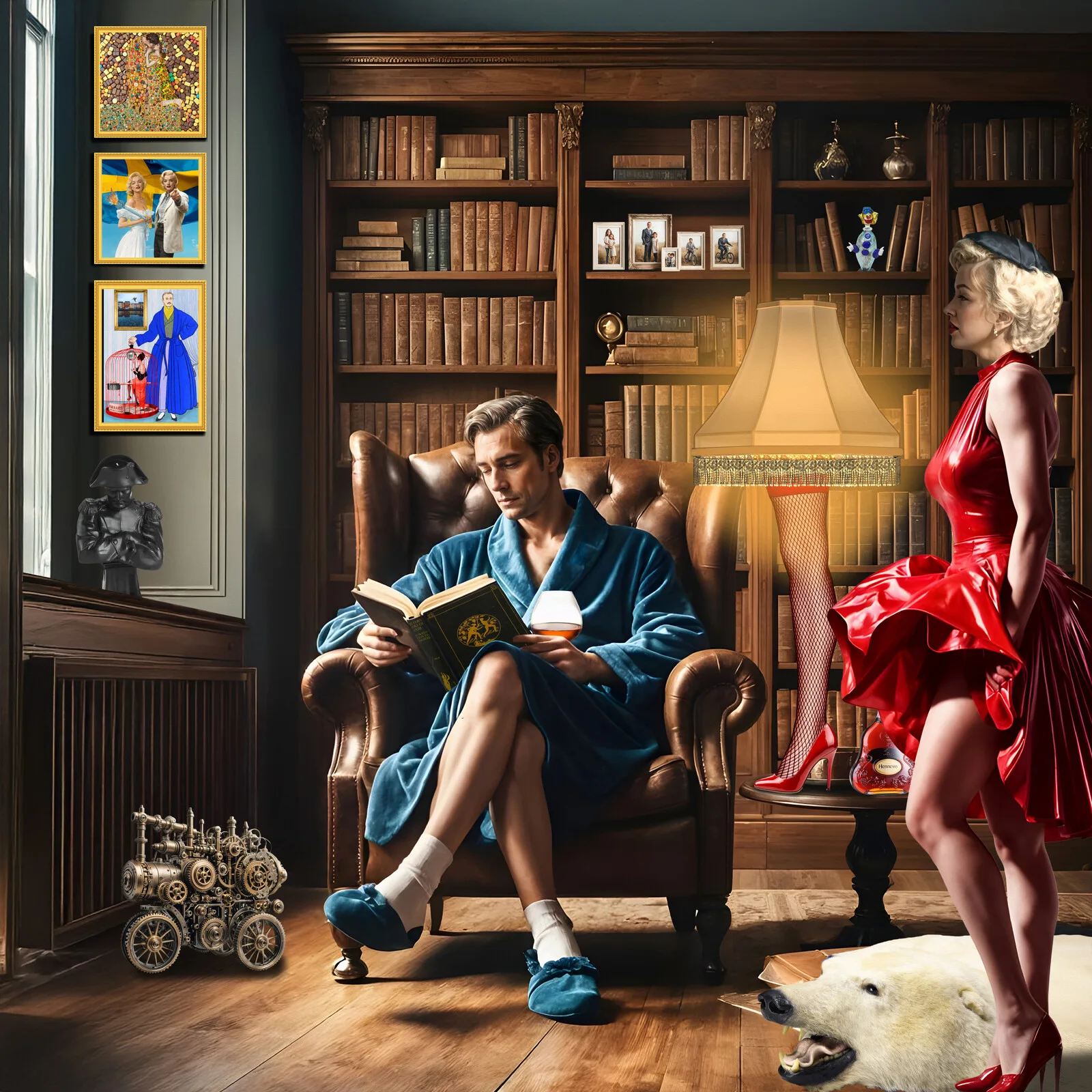
Jörgen Thornberg
Our home, Our castle, 2024
Digital
70 x 70 cm
3 500 kr
A Home Through Time
”A man’s home is his cave,”
Rough stone walls, a fortress brave.
Within his hands, the firelight glows,
A place for peace where wild winds blow.
Then to the castle, a gleaming tower,
Built with stone, it’s a seat of power.
He guards his keep, his kingdom claimed,
A man at home, his fortress famed.
”But what of her?”—the voice rang clear,
”Her castle, too, stands strong and near.”
A girl’s home blooms in colours bright,
A space for dreams and fearless light.
With doors flung wide to let life in,
Her castle, too, is where she begins.
And now we see, as walls dissolve,
A home that grows, a life evolved.
No longer "his" nor "hers" alone,
Together, shared—a mutual throne.
Our home, our castle, side by side,
Filled with laughter, joy, and pride.
With equal hands, the bricks are laid,
In light and love, our dreams displayed.
For caves are past, and towers tall,
In homes of heart, we find it all.
Where we belong, where we create,
Our home, our castle, strong and great.
Together built, together stay,
Our shared domain in every way.
Malmö, September 2024
United we stand; divided, the fortress walls swiftly crumble.
"My home is my castle" – an expression so rooted in autonomy and self-governance that you can almost hear the creak of ancient castle gates as you say it. But when we talk about the home as a castle today, we do it with a certain irony. Has it really become a secure, independent realm for each of us, or has modern life forced us to re-evaluate what happens within these walls?
Historically, the phrase stems from English legal philosophy, enshrining one’s right to govern and protect one’s home. "A man’s home is his castle," they said in 17th-century England. The idea is noble, no doubt: I make the rules and guard the peace in my home, and no one – not even the king – can enter without my permission. But now, centuries later, we might wonder: who truly commands today’s home?
The Fortress of Equality
After all, we live in an era where gender roles are no longer as strictly defined as they were in the 17th century (or even the 1950s). The phrase' My home is my castle' may carry a different meaning today, where we embrace ideals of shared responsibilities and equality. In the past, the home represented physical security, with the man as the guardian of the gate and the woman as the keeper of inner peace. But what happens to the castle’s hierarchy when responsibilities are shared? This shift in roles is a fascinating aspect of modern home dynamics.
Imagine a modern 'castle' where the washing machine hums, the lawnmower tackles weeds, and the vacuum reigns over the kitchen floor like a roaring dragon. Who should take charge of these 'fortress duties'? One of my friends, Johan, quips that 'the modern way to share a castle is to share household chores.' And yes, he does his part, though he keeps a reminder on the fridge: 'This week, it’s Sir Johan’s turn to empty the dishwasher.' This emphasis on shared responsibilities not only underscores the importance of everyone's contribution to a household but also empowers each member to take charge of their 'castle '.
Lord or Lady of the Manor?
How does this expression fare in the context of feminism and the notion of equal responsibility? On the one hand, the phrase can be appreciated for lifting the idea that one’s home is an autonomous sanctuary, perhaps especially relevant for women in past generations who lacked such autonomy. Feminists today might value the concept that a home should be a place of equality, where no one is the absolute ruler and the workload is shared.
On the other hand, the saying may also feel outdated, particularly since the English version still includes the word' man.' In a world striving for equality, it's important to consider a more modern expression that reflects how we see the home today – as a shared responsibility where we are all 'guardians of the realm.' This inclusivity is crucial in our understanding of the modern home dynamics.
A feminist interpretation might suggest that 'our castle' rather than 'my castle' would be the ideal. It could reflect a vision of balance, where everyone in the home—regardless of gender—shares the control and responsibility. This balance and shared responsibility not only reassures us of a harmonious home but also gives us hope for a more equitable future.
Anecdotes from the Fortress
We only need a few typical scenarios to see how the expression might play out in real life.
The Lawn as Stronghold: A colleague shared a story about the ongoing battle over gardening with her partner. He had always taken on the role of “protector of the green domain.” But when she took over the trimmer and suggested new flower beds, the battle lines blurred. His “stronghold” was no longer his own, and their shared garden became a team project – though he admits he misses “his lawn.”
Knight of the Vacuum Order: Another friend, Anna, shared how she and her husband hold a “formal” ceremony weekly for vacuuming. They declare loudly and formally that “the Knight of the Vacuum Order is ready to combat dust.” They swing the vacuum as if wielding a sword, humorously illustrating how they take on “castle cleanliness” with a playful twist.
The Kitchen Fortress and the "Queen of Cooking”: I also have a friend who affectionately calls herself the “Queen of the Castle’s Cuisine.” She loves cooking and sees the kitchen as her realm. She puts her foot down when her partner tries to “invade” with his quick pasta and ketchup ideas. In this case, it’s “her castle,” and she has the final say.
Castles for a New Era
Reflecting on what the phrase means today, it’s clear that "my home is my castle" no longer implies sole control. Instead, it’s about finding common ground where everyone in the household feels safe and responsible. And maybe we do need an update to the phrase—one that feminists and like-minded individuals can support. Perhaps something like "Our home, our castle," where everyone has a role and a voice.
In the end, the saying reminds us of the importance of the home as a place for freedom, security, and self-governance—values that are as relevant today as they were in the 17th century, even as roles within the home continue to evolve.
Adding cultural references to "My Home is My Castle" opens up fascinating perspectives on how homes and personal spaces are depicted as bastions of identity, self-expression, and independence. This idea has resonated widely across various forms of storytelling, from literature to film and documentaries, each medium highlighting unique aspects of our relationship with the home.
Cinematic and Literary Portrayals of the “Castle”
Films:
"Parasite" (2019) – This Oscar-winning film by Bong Joon-ho delves into the contrast between spaces of power and vulnerability. The wealthy Park family’s luxurious home becomes a fortress of privilege and control, while the impoverished Kim family inhabits a basement. The film offers a commentary on social status and how a house can provide security or expose one to hardship, depending on one’s resources.
"The Money Pit" (1986) – This comedy, starring Tom Hanks and Shelley Long, humorously explores the idea of a dream home as a nightmare. The characters buy what they believe is a “castle” only to discover that it’s a crumbling mess, symbolising the pitfalls of idealising home ownership without fully realising its challenges. Their relationship is tested as they struggle to restore the house, reflecting the emotional toll that our homes can sometimes exert on us.
"Revolutionary Road" (2008) – Based on the novel by Richard Yates, this film focuses on the disillusionment of suburban life in 1950s America. The protagonists, Frank and April Wheeler, find their home more a prison than a castle, as societal expectations and personal discontent transform their once-hopeful space into a source of stifling routine and unfulfilled dreams. The film critiques how cultural pressures to conform can erode the joy of one’s personal haven.
Books:
"Wuthering Heights" by Emily Brontë – The iconic English moors and Wuthering Heights estate play a central role in Brontë’s exploration of power, passion, and confinement. The house itself becomes a character, embodying the turbulence of its residents’ relationships and showing how a home can reflect the emotional landscape within it.
"A Room of One’s Own" by Virginia Woolf – This classic feminist essay argues that women need physical space and economic independence to write and achieve intellectual freedom. Woolf’s concept of “a room of one’s own” underlines the importance of personal space and autonomy within the home and suggests that this room is as essential as a castle, providing literal and figurative freedom.
"The Great Gatsby" by F. Scott Fitzgerald – Gatsby’s lavish mansion fortifies his carefully curated identity and longing for Daisy. But his castle, rather than providing true fulfilment, represents the emptiness of wealth and unattainable dreams. Fitzgerald’s depiction of the mansion as both glamorous and hollow reflects the precarious nature of building one’s life and happiness around a physical space.
Documentaries Examining Home and Identity
"Minimalism: A Documentary About the Important Things" (2015) explores how decluttering one’s home can lead to a decluttered life, focusing on the minimalist movement’s advocacy for simplified, intentional living. It emphasises that home should be a place of tranquillity, not burdened by excess belongings. The documentary questions whether our “castles” can bring us joy or if they sometimes trap us within consumer-driven values.
"Won’t You Be My Neighbor?" (2018)—This heartwarming documentary on Mr. Rogers shows his home as a place of warmth, safety, and emotional nourishment. Fred Rogers’ home and studio represent his core values of kindness and understanding, embodying his belief that personal space is a haven for growth and compassion.
"Tiny: A Story About Living Small" (2013) – This documentary chronicles individuals building and living in tiny homes. The subjects redefine “my home is my castle,” as their homes are no larger than a single room. Through minimalist spaces, they find freedom, creativity, and self-sufficiency. It challenges the idea that a castle must be vast and luxurious, emphasising that meaningful space is defined by personal significance rather than size.
Relevance to Modern Gender Roles and Equality
As these works reveal, “Home as a Castle” intersects with themes of identity, security, and societal expectations. In a modern context, as gender roles evolve, the home often becomes a microcosm of these shifting dynamics. Whether the home serves as a space for equality or one that reflects traditional roles, each “castle” speaks to the aspirations and challenges of its inhabitants.
For example:
"A Room of One’s Own" resonates with discussions on women’s right to personal space and time in their homes—a foundation of equality in modern partnerships.
- In "The Money Pit", the endless repair scenes can humorously relate to the shared (or contested) responsibilities in maintaining a home, with gender roles often influencing who takes on which tasks.
These stories illuminate the diverse ways homes are shaped by their inhabitants. They remind us that a proper “castle” is not merely defined by grandeur but by its ability to nurture, reflect, and empower those who dwell within it.
Whether the home is one partner's castle, the other’s, or a shared domain in mutual understanding, the walls have crumbled. Divorce statistics reveal that, in many castles, battles rage within the walls while the outer world can only observe.
Books and films frequently depict this situation. The renowned zoologist and behavioural scientist Desmond Morris covered it in his documentary ‘The Human Sexes - The Gender Wars.’ Morris presents a credible perspective as the author of ‘The Naked Ape,’ which once shook the world to its core. Women are challenging men, and once firmly held bastions crumble to dust.
A saying from the feminist movements of the '70s boldly stated, “If the home is a man’s castle, he should clean it.” This powerful statement underscores the importance of equality in our evolving society. Increasingly, men resemble the Knight of the Sorrowful Countenance, Cervantes’ Don Quixote, endlessly trying to patch the shot-up fortress walls, metaphorically fighting the mill wings. Of course, it's not about one gender being better than the other—both are essential, and equality is not just a goal but a necessity to set this world on the right course.
Jörgen Thornberg
Our home, Our castle, 2024
Digital
70 x 70 cm
3 500 kr
A Home Through Time
”A man’s home is his cave,”
Rough stone walls, a fortress brave.
Within his hands, the firelight glows,
A place for peace where wild winds blow.
Then to the castle, a gleaming tower,
Built with stone, it’s a seat of power.
He guards his keep, his kingdom claimed,
A man at home, his fortress famed.
”But what of her?”—the voice rang clear,
”Her castle, too, stands strong and near.”
A girl’s home blooms in colours bright,
A space for dreams and fearless light.
With doors flung wide to let life in,
Her castle, too, is where she begins.
And now we see, as walls dissolve,
A home that grows, a life evolved.
No longer "his" nor "hers" alone,
Together, shared—a mutual throne.
Our home, our castle, side by side,
Filled with laughter, joy, and pride.
With equal hands, the bricks are laid,
In light and love, our dreams displayed.
For caves are past, and towers tall,
In homes of heart, we find it all.
Where we belong, where we create,
Our home, our castle, strong and great.
Together built, together stay,
Our shared domain in every way.
Malmö, September 2024
United we stand; divided, the fortress walls swiftly crumble.
"My home is my castle" – an expression so rooted in autonomy and self-governance that you can almost hear the creak of ancient castle gates as you say it. But when we talk about the home as a castle today, we do it with a certain irony. Has it really become a secure, independent realm for each of us, or has modern life forced us to re-evaluate what happens within these walls?
Historically, the phrase stems from English legal philosophy, enshrining one’s right to govern and protect one’s home. "A man’s home is his castle," they said in 17th-century England. The idea is noble, no doubt: I make the rules and guard the peace in my home, and no one – not even the king – can enter without my permission. But now, centuries later, we might wonder: who truly commands today’s home?
The Fortress of Equality
After all, we live in an era where gender roles are no longer as strictly defined as they were in the 17th century (or even the 1950s). The phrase' My home is my castle' may carry a different meaning today, where we embrace ideals of shared responsibilities and equality. In the past, the home represented physical security, with the man as the guardian of the gate and the woman as the keeper of inner peace. But what happens to the castle’s hierarchy when responsibilities are shared? This shift in roles is a fascinating aspect of modern home dynamics.
Imagine a modern 'castle' where the washing machine hums, the lawnmower tackles weeds, and the vacuum reigns over the kitchen floor like a roaring dragon. Who should take charge of these 'fortress duties'? One of my friends, Johan, quips that 'the modern way to share a castle is to share household chores.' And yes, he does his part, though he keeps a reminder on the fridge: 'This week, it’s Sir Johan’s turn to empty the dishwasher.' This emphasis on shared responsibilities not only underscores the importance of everyone's contribution to a household but also empowers each member to take charge of their 'castle '.
Lord or Lady of the Manor?
How does this expression fare in the context of feminism and the notion of equal responsibility? On the one hand, the phrase can be appreciated for lifting the idea that one’s home is an autonomous sanctuary, perhaps especially relevant for women in past generations who lacked such autonomy. Feminists today might value the concept that a home should be a place of equality, where no one is the absolute ruler and the workload is shared.
On the other hand, the saying may also feel outdated, particularly since the English version still includes the word' man.' In a world striving for equality, it's important to consider a more modern expression that reflects how we see the home today – as a shared responsibility where we are all 'guardians of the realm.' This inclusivity is crucial in our understanding of the modern home dynamics.
A feminist interpretation might suggest that 'our castle' rather than 'my castle' would be the ideal. It could reflect a vision of balance, where everyone in the home—regardless of gender—shares the control and responsibility. This balance and shared responsibility not only reassures us of a harmonious home but also gives us hope for a more equitable future.
Anecdotes from the Fortress
We only need a few typical scenarios to see how the expression might play out in real life.
The Lawn as Stronghold: A colleague shared a story about the ongoing battle over gardening with her partner. He had always taken on the role of “protector of the green domain.” But when she took over the trimmer and suggested new flower beds, the battle lines blurred. His “stronghold” was no longer his own, and their shared garden became a team project – though he admits he misses “his lawn.”
Knight of the Vacuum Order: Another friend, Anna, shared how she and her husband hold a “formal” ceremony weekly for vacuuming. They declare loudly and formally that “the Knight of the Vacuum Order is ready to combat dust.” They swing the vacuum as if wielding a sword, humorously illustrating how they take on “castle cleanliness” with a playful twist.
The Kitchen Fortress and the "Queen of Cooking”: I also have a friend who affectionately calls herself the “Queen of the Castle’s Cuisine.” She loves cooking and sees the kitchen as her realm. She puts her foot down when her partner tries to “invade” with his quick pasta and ketchup ideas. In this case, it’s “her castle,” and she has the final say.
Castles for a New Era
Reflecting on what the phrase means today, it’s clear that "my home is my castle" no longer implies sole control. Instead, it’s about finding common ground where everyone in the household feels safe and responsible. And maybe we do need an update to the phrase—one that feminists and like-minded individuals can support. Perhaps something like "Our home, our castle," where everyone has a role and a voice.
In the end, the saying reminds us of the importance of the home as a place for freedom, security, and self-governance—values that are as relevant today as they were in the 17th century, even as roles within the home continue to evolve.
Adding cultural references to "My Home is My Castle" opens up fascinating perspectives on how homes and personal spaces are depicted as bastions of identity, self-expression, and independence. This idea has resonated widely across various forms of storytelling, from literature to film and documentaries, each medium highlighting unique aspects of our relationship with the home.
Cinematic and Literary Portrayals of the “Castle”
Films:
"Parasite" (2019) – This Oscar-winning film by Bong Joon-ho delves into the contrast between spaces of power and vulnerability. The wealthy Park family’s luxurious home becomes a fortress of privilege and control, while the impoverished Kim family inhabits a basement. The film offers a commentary on social status and how a house can provide security or expose one to hardship, depending on one’s resources.
"The Money Pit" (1986) – This comedy, starring Tom Hanks and Shelley Long, humorously explores the idea of a dream home as a nightmare. The characters buy what they believe is a “castle” only to discover that it’s a crumbling mess, symbolising the pitfalls of idealising home ownership without fully realising its challenges. Their relationship is tested as they struggle to restore the house, reflecting the emotional toll that our homes can sometimes exert on us.
"Revolutionary Road" (2008) – Based on the novel by Richard Yates, this film focuses on the disillusionment of suburban life in 1950s America. The protagonists, Frank and April Wheeler, find their home more a prison than a castle, as societal expectations and personal discontent transform their once-hopeful space into a source of stifling routine and unfulfilled dreams. The film critiques how cultural pressures to conform can erode the joy of one’s personal haven.
Books:
"Wuthering Heights" by Emily Brontë – The iconic English moors and Wuthering Heights estate play a central role in Brontë’s exploration of power, passion, and confinement. The house itself becomes a character, embodying the turbulence of its residents’ relationships and showing how a home can reflect the emotional landscape within it.
"A Room of One’s Own" by Virginia Woolf – This classic feminist essay argues that women need physical space and economic independence to write and achieve intellectual freedom. Woolf’s concept of “a room of one’s own” underlines the importance of personal space and autonomy within the home and suggests that this room is as essential as a castle, providing literal and figurative freedom.
"The Great Gatsby" by F. Scott Fitzgerald – Gatsby’s lavish mansion fortifies his carefully curated identity and longing for Daisy. But his castle, rather than providing true fulfilment, represents the emptiness of wealth and unattainable dreams. Fitzgerald’s depiction of the mansion as both glamorous and hollow reflects the precarious nature of building one’s life and happiness around a physical space.
Documentaries Examining Home and Identity
"Minimalism: A Documentary About the Important Things" (2015) explores how decluttering one’s home can lead to a decluttered life, focusing on the minimalist movement’s advocacy for simplified, intentional living. It emphasises that home should be a place of tranquillity, not burdened by excess belongings. The documentary questions whether our “castles” can bring us joy or if they sometimes trap us within consumer-driven values.
"Won’t You Be My Neighbor?" (2018)—This heartwarming documentary on Mr. Rogers shows his home as a place of warmth, safety, and emotional nourishment. Fred Rogers’ home and studio represent his core values of kindness and understanding, embodying his belief that personal space is a haven for growth and compassion.
"Tiny: A Story About Living Small" (2013) – This documentary chronicles individuals building and living in tiny homes. The subjects redefine “my home is my castle,” as their homes are no larger than a single room. Through minimalist spaces, they find freedom, creativity, and self-sufficiency. It challenges the idea that a castle must be vast and luxurious, emphasising that meaningful space is defined by personal significance rather than size.
Relevance to Modern Gender Roles and Equality
As these works reveal, “Home as a Castle” intersects with themes of identity, security, and societal expectations. In a modern context, as gender roles evolve, the home often becomes a microcosm of these shifting dynamics. Whether the home serves as a space for equality or one that reflects traditional roles, each “castle” speaks to the aspirations and challenges of its inhabitants.
For example:
"A Room of One’s Own" resonates with discussions on women’s right to personal space and time in their homes—a foundation of equality in modern partnerships.
- In "The Money Pit", the endless repair scenes can humorously relate to the shared (or contested) responsibilities in maintaining a home, with gender roles often influencing who takes on which tasks.
These stories illuminate the diverse ways homes are shaped by their inhabitants. They remind us that a proper “castle” is not merely defined by grandeur but by its ability to nurture, reflect, and empower those who dwell within it.
Whether the home is one partner's castle, the other’s, or a shared domain in mutual understanding, the walls have crumbled. Divorce statistics reveal that, in many castles, battles rage within the walls while the outer world can only observe.
Books and films frequently depict this situation. The renowned zoologist and behavioural scientist Desmond Morris covered it in his documentary ‘The Human Sexes - The Gender Wars.’ Morris presents a credible perspective as the author of ‘The Naked Ape,’ which once shook the world to its core. Women are challenging men, and once firmly held bastions crumble to dust.
A saying from the feminist movements of the '70s boldly stated, “If the home is a man’s castle, he should clean it.” This powerful statement underscores the importance of equality in our evolving society. Increasingly, men resemble the Knight of the Sorrowful Countenance, Cervantes’ Don Quixote, endlessly trying to patch the shot-up fortress walls, metaphorically fighting the mill wings. Of course, it's not about one gender being better than the other—both are essential, and equality is not just a goal but a necessity to set this world on the right course.
3 500 kr

Jörgen Thornberg
Malmö
Lite om bilder och mig. Translation in English at the end.
Jag är en nyfiken person som ser allt i bilder, även det jag fäster i ord, gärna tillsammans för bakom alla mina bilder finns en berättelse. Till vissa bilder hör en kortare eller längre novell som följer med bilden.
Bilder berättar historier. Jag omges av naturlig skönhet, intressanta människor och historia var jag än går. Jag använder min kamera för att dokumentera världen och blanda det jag ser med vad jag känner för att fånga den dolda magin.
Mina bilder berättar mina historier. Genom mina bilder, tryck och berättelser. Jag bjuder in dig att ta del av dessa berättelser, in i ditt liv och hem och dela min mycket personliga syn på vår värld. Mer än vad ögat ser. Jag tänker i bilder, drömmer och skriver och pratar om dem; följaktligen måste jag också skapa bilder. De blir vad jag ser, inte nödvändigtvis begränsade till verkligheten. Det finns en bild runt varje hörn. Jag hoppas att du kommer att se vad jag såg och gilla det.
Jag är också en skrivande person och till många bilder hör en kortare eller längre essay. Den följer med tavlan, tryckt på fint papper och med en personlig hälsning från mig.
Flertalet bilder startar sin resa i min kamera. Enkelt förklarat beskriver jag bilden jag ser i mitt inre, upplevd eller fantiserad. Bilden uppstår inom mig redan innan jag fått okularet till ögat. På bråkdelen av ett ögonblick ser jag vad jag vill ha och vad som kan göras med bilden. Här skall jag stoppa in en giraff, stålmannen, Titanic eller vad det är min fantasi finner ut. Ännu märkligare är att jag kommer ihåg minnesbilden långt efteråt när det blir tid att skapa verket. Om jag lyckas eller inte, är upp till betraktaren, oftast präglat av en stråk av svart humor – meningen är att man skall bli underhållen. Mina bilder blir ofta en snackis där de hänger.
Jag föredrar bilder som förmedlar ett budskap i flera lager. Vid första anblicken fylld av feel-good, en vacker utsikt, fint väder, solen skiner, blommor på ängen eller vattnet som ligger förrädiskt spegelblankt. I en sådan bild kan jag gömma min egentliga berättelse, mitt förakt för förtryckare och våldsverkare, rasister och fördomsfulla människor - ett gärna återkommande motiv mer eller mindre dolt i det vackra motivet. Jag försöker förena dem i ett gemensamt narrativ.
Bild och formgivning har löpt som en röd tråd genom livet. Fotokonst känns som en värdig final som jag gärna delar med mig.
Min genre är vid som framgår av mina bilder, temat en blandning av pop- och gatukonst i kollage som kan bestå av hundratals lager. Vissa bilder kan ta veckor, andra någon dag innan det är dags att överlämna resultatet till printverkstaden. Fine Art Prints är digitala fotocollage. I dessa kollage sker rivandet, klippandet, pusslandet, målandet, ritandet och sprayningen digitalt. Det jag monterar in kan vara hundratals år gamla bilder som jag omsorgsfullt frilägger så att de ser ut att vara en del av tavlan men också bilder skapade av mig själv efter min egen fantasi. Därefter besöks printstudion och för vissa bilder numrera en limiterad upplaga (oftast 7 exemplar) och signera för hand. Vissa bilder kan köpas i olika format. Det är bara att fråga efter vilka. Gillar man en bild som är 70x100 men inte har plats på väggen, går den kanske att få i 50x70 cm istället. Frågan är fri.
Metoden Giclée eller Fine Art Print som det också kallas är det moderna sättet för framställning av grafisk konst. Villkoret för denna typ av utskrifter är att en högkvalitativ storformatskrivare används med åldersbeständigt färgpigment och konstnärspapper eller i förekommande fall på duk. Pappret som används möter de krav på livslängd som ställs av museer och gallerier. Normalt säljer jag mina bilder oinramade så att den nya ägaren själv kan bestämma hur de skall se ut, med eller utan passepartout färg på ram, med eller utan glas etc..
Under många år ställde jag bara ut på nätet, i valda grupper och på min egen Facebooksida - https://www.facebook.com/jorgen.thornberg.9
Jag finns också på en egen hemsida som tyvärr inte alltid är uppdaterad – https://www.jth.life/ Där kan du också läsa en del av de berättelser som följer med bilden.
UTSTÄLLNINGAR
Luftkastellet, oktober 2022
Konst i Lund, november 2022
Luftkastellet, mars 2023
Engleson Galleri Caroli, april 2023
Hydra, Greece June 2023
Engleson Galleri Caroli, oktober 2023
Toppen, Höllviken december 2023
Luftkastellet, mars 2024
Torups Galleri, mars 2024
Venice, May 2024
Luftkastellet, oktober 2024
Konst i Advent, December 2024
Galleri Engleson, Caroli December 2024
Jäger & Jansson Galleri, april 2025
A bit about pictures and me.
I'm a curious person who sees everything in pictures, even what I express in words, often combining them, for behind all my pictures lies a story. These narratives, some as short as a single image and others as long as a novel, are the heart and soul of my work.
Pictures tell stories. Wherever I go, I'm surrounded by natural beauty, exciting people, and history. I use my camera to document the world and blend what I see with what I feel to capture the hidden magic.
My images tell my stories. Through my pictures, prints, and narratives, I invite you to partake in these stories in your life and home and share my deeply personal perspective of our world. More than meets the eye. I think in pictures, dream, write, and talk about them; consequently, I must create images too. They become what I see, not necessarily confined to reality. There's a picture around every corner. I hope you'll see what I saw and enjoy it.
I'm also a writer, and many images come with a shorter or longer essay. It accompanies the painting, printed on fine paper with my personal greeting.
Many pictures start their journey on my camera. Simply put, I describe the image I see in my mind, experienced or imagined. The image arises within me even before I bring the eyepiece to my eye. In a fraction of a moment, I see what I want and what can be done with the picture. Here, I'll insert a giraffe, Superman, the Titanic, or whatever my imagination conjures up. Even stranger is that I remember the mental image long after it's time to create the work. Whether I succeed is up to the observer, often imbued with a streak of black humour – the aim is to entertain. My pictures usually become a talking point wherever they hang.
I prefer pictures that convey a message in multiple layers. At first glance, they're filled with feel-good vibes, a beautiful view, lovely weather, the sun shining, flowers in the meadow, or the water lying deceptively calm. But beneath this surface beauty, I often conceal a deeper story, a narrative that challenges societal norms or explores the human condition. I invite you to delve into these hidden narratives and discover the layers of meaning within my work.
Picture and design have been a thread running through my life. Photographic art feels like a fitting finale, and I'm happy to share it.
My genre is varied, as seen in my pictures; the theme is a blend of pop and street art in collages that can consist of hundreds of layers. Some images can take weeks, others just a day before it's time to hand over the result to the print workshop. Fine Art Prints are digital photo collages. In these collages, tearing, cutting, puzzling, painting, drawing, and spraying happen digitally. What I insert can be images hundreds of years old that I carefully extract so they appear to be part of the painting, but also images created by myself, now also generated from my imagination. Next, visit the print studio and, for certain images, number a limited edition (usually 7 copies) and sign them by hand. Some images may be available in other formats. Just ask which ones. If you like an image that's 70x100 but doesn't have space on the wall, you might be able to get it in 50x70 cm instead. The question is open.
The Giclée method, or Fine Art Print as it's also called, is the modern way of producing graphic art. This method ensures the highest quality and longevity of the artwork, using a high-quality large-format printer with archival pigment inks and artist paper or, in some cases, canvas. The paper used meets the longevity requirements set by museums and galleries. I sell my pictures unframed, allowing the new owner to personalise their artwork, confident in the lasting value and quality of the piece.
For many years, I only exhibited online, in selected groups, and on my Facebook page - https://www.facebook.com/jorgen.thornberg.9. I also have my website, which unfortunately is not constantly updated - https://www.jth.life/. You can also read some of the stories accompanying the pictures there.
EXHIBITIONS
Luftkastellet, October 2022
Art in Lund, November 2022
Luftkastellet, March 2023
Engleson Gallery Caroli, April 2023
Hydra, Greece June 2023
Engleson Gallery Caroli, October 2023
Toppen, Höllviken December 2023
Luftkastellet, March 2024
Torup Gallery, March 2024
Venice, May 2024
UTSTÄLLNINGAR
Luftkastellet, oktober 2022
Konst i Lund, november 2022
Luftkastellet, mars 2023
Engleson Galleri Caroli, april 2023
Hydra, Greece June 2023
Engleson Galleri Caroli, oktober 2023
Toppen, Höllviken december 2023
Luftkastellet, mars 2024
Torups Galleri, mars 2024
Venice, May 2024
Luftkastellet, October 2024
Konst i Advent, December 2024
Galleri Engleson, Caroli December 2024
Jäger & Jansson Galleri, April 2025
Utbildning
Autodidakt
Medlem i konstnärsförening
Öppna Sinnen
Med i konstrunda
Konstrundan i Skåne
Utställningar
Luftkastellet, October 2022
Art in Lund, November 2022
Luftkastellet, March 2023
Engleson Gallery Caroli, April 2023
Hydra, Greece June 2023
Engleson Gallery Caroli, October 2023
Toppen, Höllviken December 2023
Luftkastellet, March 2024
Torup Gallery, March 2024
Venice, May 2024