Vi använder cookies för att ge dig bästa möjliga upplevelse. Välj vilka cookies du tillåter.
Läs mer i vår integritetspolicy
Jörgen Thornberg
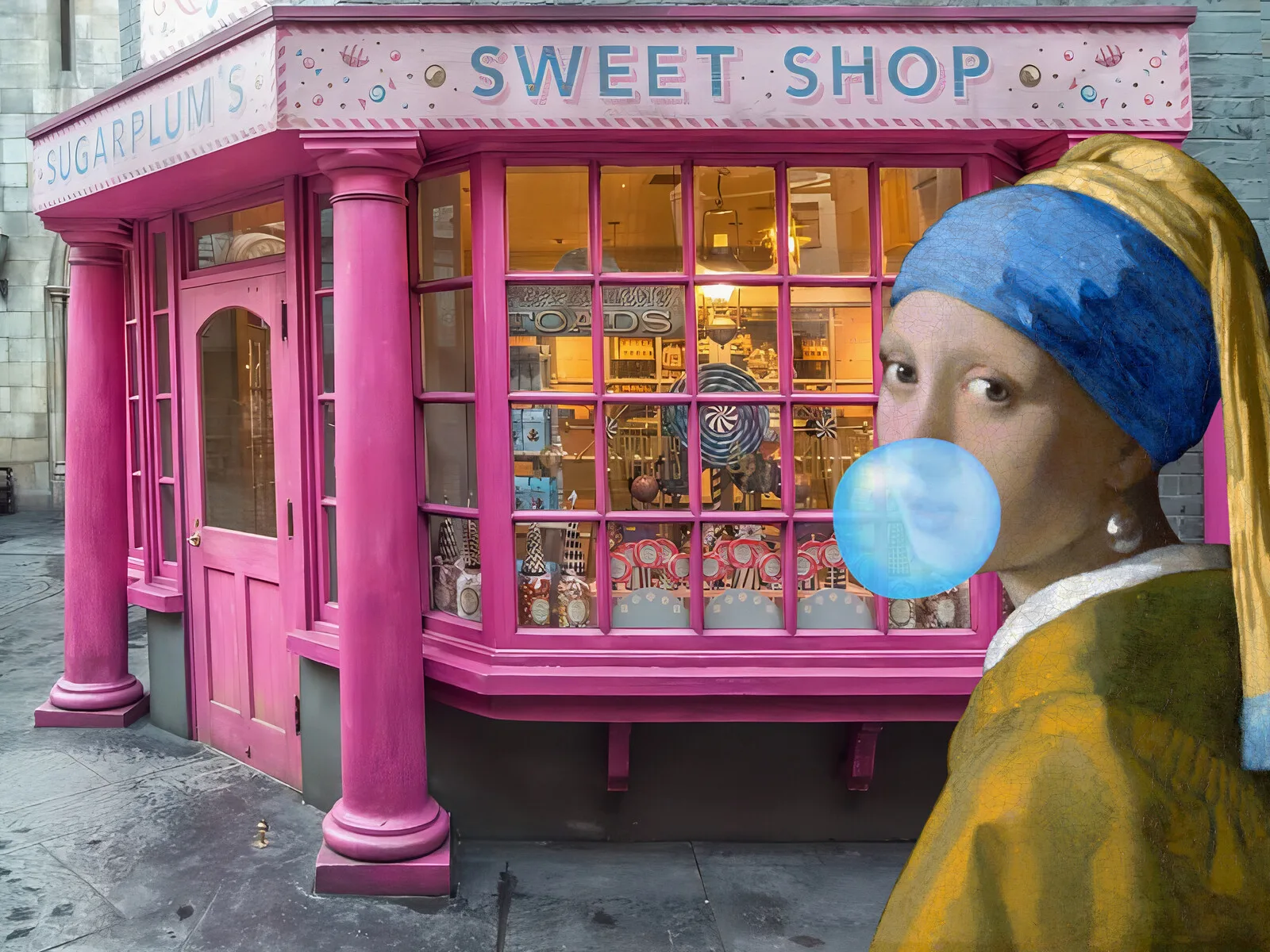
Girl with Blue Chewing Gum, 2024
Digital
70 x 50 cm
3 200 kr
I was on a nostalgic trip in Holland. With my wife and our closest friends, we had been in Delft in 1972, with our first child still four years away, allowing us to manage our time. Now, I was wandering aimlessly in the older part of the city, around the Nieuwe Kerk, the New Church, a Protestant church. I visited a few art exhibitions, each one a treasure trove of stories and emotions, as art always has something to tell, regardless of the era it originates from. Naturally, I visited the Vermeer Centre, an information hub that seemed to breathe life into the city's great man, the painter Johannes Vermeer, and the work of his contemporaries. My mind was filled with all of Vermeer's images, not in original form but as reproductions, each a window into a different time and place.
Many think visual art is dry, boring, lifeless, or functions as a decorative element in home styling. But the stories behind those paintings, sculptures, drawings, and photographs are often weirder, more outrageous, or more fun than you can imagine. In these thoughts, I wandered when, a bit further away, I saw a candy store I recognised. Being a sweet tooth, I never miss such a sight. The craving for sweets had gripped my stomach. The exterior seemed the same as fifty years earlier. But the woman outside was new, yet old and familiar. I secretly took a picture as I got closer. It's the one I'm sharing with you.
If told in full, my image of the young woman chewing gum and blowing a blue bubble outside a candy store could become an entire novel. I'll settle for a shorter version. The Girl in the picture, I now know, is named Anna-Maria van Scheveningen. She is much older than she looks, three hundred and seventy-six years old, to be exact, as she was born in 1648. It was a surreal moment, to say the least, to come face to face with a figure from history, a living embodiment of a Vermeer painting.
I almost thought I had gone mad because of the woman outside the candy store. I had left her just under an hour ago. Then, she was hanging as a reproduction on one of the Vermeer Centre's walls, in a central place because this picture is Vermeer's most famous. The original hangs in the Mauritshuis, in the centre of The Hague. Original and original, I felt the original was here for my entire being. My previous encounters with Time-Travellers make me feel when I come close to someone. Most of them look entirely normal, have adapted their clothing to the present, and have no desire to stand out. This woman was the opposite, looking like she had just stepped out of Vermeer's painting.
Her look was universal rather than specific. Vermeer's painting is not a portrait of a particular person but what the Dutch called a 'Tronie' – the head of an 'ideal type', be it a soldier or a musician – or, in this case, a young beauty. I would soon learn more.
As I gazed at the young woman's arrestingly beautiful and enigmatic face, I couldn't help but be captivated by her timeless charm. Her youthful, oval face was softly illuminated by a sky covered with thin grey clouds, casting delicate shadows that accentuated her smooth, fair complexion. She had large, almond-shaped eyes that were wide and expressive, conveying a sense of curiosity and innocence. Her gaze, directed slightly over her shoulder, seemed to beckon me into her world, creating a feeling of intimate engagement with the viewer. It wasn't me her eyes were searching for, but no one else was to be seen on the street.
Her finely arched eyebrows framed her eyes with a lifelike sparkle, adding a serenity to her gaze. The Girl's straight and delicately shaped nose was a testament to the harmony of her features. Her lips, slightly parted lips revealed a hint of a smile, inviting me to wonder about the thoughts and emotions behind that enigmatic expression.
The most captivating aspect of her appearance was her pearl earrings, which seemed to hold a secret within their shimmer. They drew attention to her elegant neck and the graceful contour of her jawline. Her hair was mostly concealed under a turban-like headscarf, a combination of yellow fabric wrapped around blue fabric, which added an exotic and timeless quality to her look. That was when I recognised her. She was the Girl from the Dutch seventeenth-century painter Johannes Vermeer. Having learned to recognise and occasionally encounter Time-Travellers, I was not particularly surprised. She fit in. This was where she had lived, and naturally, it was here she wanted to return.
The overall effect of her face's serene beauty and quiet allure captured a moment of the brief and intimate connection between her and someone who wasn't present at that moment but couldn't be far away. I saw it in her gaze. At that moment, she became aware that she wasn't alone, that I was familiarly looking at her even though we had never met. I recognised her image; it was as if I had known her all my life, yet I knew nothing about the woman behind Vermeer's Girl.
Our encounter was a unique and intimate moment, a meeting of souls transcending time and space. The scene seemed to shift, and the enchantment was broken as she became aware of my gaze. She looked at me with an inscrutable expression for what felt like an eternity. She looked at me inscrutably for nearly half a minute before a smile spread across her face.
"You are not one of us," she said kindly when she realised I understood, referring to our different periods and the fact that she was a visitor from the past.
"No, but I know Leonard Cohen and his eternal companion, Marianne Ihlen," I said, disregarding that she probably had no idea who a singer-songwriter from my time was. Her music, I speculated, must be from the Baroque period; perhaps she loved Monteverdi and his operas. The thought of such a different world, with its unique history and culture, filled me with an insatiable curiosity and a profound sense of wonder as I tried to imagine the stark contrast between her time and mine.
"What a funny coincidence. I met them on Sirius during a happening with the theme 'Music of All Ages.' My name is Anna-Maria, by the way," she said, extending a graceful hand that took mine gently.
"George. That's what Leonard calls me," I said, bringing her hand to my lips and giving it a fleeting kiss, a gesture reminiscent of a bygone era. In that moment, I felt a profound connection, a thread of shared experiences that seemed to transcend time and space, uniting us in a comforting and exhilarating way. It was like we were old friends, separated by time but brought together by a shared understanding.
"Pleasant." She withdrew her hand just as gracefully.
"You mentioned 'happening.' That sounds intriguing, if I may say so." I probably looked a bit surprised. Leonard's stories about the uninhibited parties in the artist circles of the 1960s might have spread to the universe. A 'happening' is a unique cultural event, often associated with the 1960s counterculture, characterised by its spontaneity, participation, and immersive nature. It isn't easy to describe, partly because each is unique. I had never been to anything defined as such. But my general impression from what I had read and heard about them when I was young was that they were pretty eventful gatherings, to put it mildly.
"Not in that way, I assure you," she said, laughing and showing that she had read my thoughts in the unique manner of Time-travellers. This method of communication allows them to talk regardless of language and era. There is no oxygen up there, so vocal cords are useless. It's all telepathy; with that, there are neither languages nor dialects, just thoughts and feelings. "The happening was very serious and a kind of competition. I played the Virginal, a common instrument during the Baroque period."
"You mean harpsichord?" I was a bit unsure what the instrument was called.
"It's the same thing. I call it Virginal; in English, it's called Harpsichord, and in German, Cembalo. A beloved child has many names; there was no standard but many preconceived notions in our time. Each instrument maker did as he thought best, for it was always a man. The virginal, or Harpsichord, is a keyboard instrument popular during the Baroque period. It's similar to a piano, but the strings are plucked rather than struck, producing a unique sound.
"So, you've had the privilege of meeting Leonard?" The thought was staggering. Consider the vast number of people who have inhabited Earth throughout history. I've heard about 108 billion, each finding their star, sometimes in pairs like Leonard and Marianne, but still. The Milky Way, our galaxy, is home to an estimated 400 billion stars, so there is still abundant space. When it reaches its end, the next galaxy is not too distant by astronomical standards.
The distances are enormous even if they travel through so-called wormholes, short-time shortcuts that allow faster-than-light travel. These wormholes shrink the universe to perhaps the size of London communication-wise. Londoners are ten million and do not just run into each other randomly. Here, we talked about billions, and she met Leonard. It's a once-in-a-lifetime encounter, given that he's a newcomer, having only been in eternity since 2016. The probability is a fraction of winning the jackpot in Powerball.
"Our meeting was a stroke of luck on Sirius, where we were randomly paired for a 'Say it with Tones competition.' The challenge was interpreting a given theme in the most captivating musical way. Our theme was 'The Bird on Its Branch.' Can you fathom the exhilaration?" she said, her eyes sparkling with the memory.
"Yes, I suppose it is. Who were the competitors?"
"Five amateurs in this context. Leonard, Monteverdi, Paganini, and then Lucy and I," she said as if I knew them.
"Some of those names sound quite professional."
"In the realm of music creation, yes, they are professionals. But in the competition, we were all amateurs. None of us had the experience of participating in grand events like the European Song Contest or Britain's Got Talent, which I've seen on our Universe Network." Anna-Maria's voice was brimming with a sense of unity. "Our collaboration was based on improvisation, a method that thrives when people from different eras come together. It's not as challenging as it seems. Birdsong has echoed through the ages; a sunset is a timeless beauty. Regardless of our era, we can all revel in these shared experiences in eternity."
"So, you created music together?"
"Yes, that's what we did, even if we didn't win. I think we placed a thousandth out of twenty thousand. Something that disturbed the gentlemen. Leonard laughed, but both Monteverdi and Paganini felt misunderstood."
"How do you manage to listen to so many entries?" I asked sceptically.
"In eternity, time is a fluid concept. Everything happens simultaneously, and what would have taken seventy Earth days of continuous playing took the equivalent of a few days down here. It's a mind-boggling concept, isn't it?" Anna-Maria's voice was filled with a sense of wonder.
"I find it incomprehensible."
"Everyone does for a while after they arrive, but you get used to it.
"So you played and sang, like?"
"Yes, we formed an exciting quintet. I play many instruments, including guitar, but I am not much of a composer or songwriter worth mentioning. First, we had to create music, then perform it, and when we felt ready, the audience and jury would hear the finished result. It was nerve-wracking—many wills, preferences, styles, and eras. The most modern was the oldest of us, and the most conservative was the youngest, Leonard, who had experimented with a lot but still excluded most influences from his music. Excluding me, I didn't have much to contribute."
"What instruments did you play?" The question was justified since they mastered many skills, such as Leonard's handling of the guitar and keyboard.
"Leonard played the guitar; I played my Virginal, which I had brought from Johannes and my star. It barely fit in the fast-track wormhole. Niccolò Paganini played the violin; what else? The versatile Monteverdi handled a cello from his own time, a Rugeri, and then the fascinating Lucy, the early Australopithecine girl who played the flute. And how she played. You surely know that there are no forward or backwards times in eternity. Everyone can talk to everyone, and we learn each other's epochs. Lucy, for example, has gone from playing simple tunes on a flute carved from bone to playing Mozart's Concerto for Flute and Harp for an audience across the universe. Her flute is now made of platinum.
"Leonard has told me about her. She was invited as a guest of honour to a party on Hydra, the local nightclub king Babis Mores' memorial bash, an event he called 'The Last Dance,' an event I understand has made quite an impression even in the cosmos."
"He has mentioned that bash. Then I understand which Jorgos or George you are. He talked about an Earthling who ensured that seven hundred revellers from eternity got food and drink in a villa on a Greek island they occupied for a day." Anna-Maria shook her head.
"Lucy couldn't attend, but we got to listen to a live recording from Sirius." I didn't comment further on the big bash since I didn't know what Leonard had said.
"Only good things," Anna-Maria commented, reading my doubt. "As for Lucy, as you might know, she died in her post, so to speak. She fell from a tree while sitting on a branch playing the flute. That's how she ended up in eternity."
"You play guitar too," I said, thinking of another of Vermeer's paintings.
"You've understood, I see. Yes, it's the same person, the young, inexperienced Girl at the virginal and the confident young woman with her guitar on her lap. Johannes used me as a model several times."
"I suspected as much. In the painting with the pearl earring, you might be around fourteen or fifteen years old, still shy, unsure, and inexperienced. Your face is youthful, almost childlike, filled with a subtle innocence. Your attire is simple and traditional for its time, with a dark dress and a prominent yellow and blue turban that almost completely covers your hair. I see it as Vermeer reflecting your status and modesty, then. But your expression is thoughtful and somewhat mysterious, suggesting a budding relationship filled with curiosity and respect with Vermeer."
"Almost correct. In 1665, I was thirteen. Fast forward seven years to the painting with the guitar, one of his last, unfortunately. The Girl is now a young woman, twenty-one years old, with a more mature face, exuding the confidence and joy that comes with age and experience. My attire is more colourful and elegant, and my hair is no longer completely hidden. The yellow dress had fine lace details, exposing my hair with loose curls. Yes, I was happy then, even though we had to sneak around with our relationship."
"I've always thought the painting with the guitar suggests a closer and more lasting relationship with Vermeer, one where the woman feels comfortable enough to show her hair, something that historically was only done in front of family and close friends. I had thought the model might be his daughter, for the young woman's smile and expression while playing the guitar indicate a deeper level of intimacy and trust in their relationship. Now I know better."
"It wasn't fair to his wife, Catharina Bolnes, who was related to me on her maternal line. At that time, it was somewhat acceptable for men to have a side relationship. Women, of course, were expected to be faithful so that the children's paternity was clear, especially the boys who inherited the father's status. Johannes was quite active in the bedroom, fathering eleven children with Catharina. Our relationship was platonic for a long time and only consummated towards the end. Our artistic minds connected us, he with his brushes and I with music. In his later years, Johannes had a difficult time. During our country's ruinous war with France, the collapse of the art market damaged his business as both a painter and an art dealer. He sought more physical comfort in my arms. He lapsed into such decay and decadence, and the poor thing went from being healthy to being dead in less than one day."
"Yes, he died far too young. Just over 40, right?"
"43. Johannes had a few pupils, one of whom was me, and another was his daughter Maria. We became friends, and thanks to her, Johannes and I could be close without attracting too much attention. Maria became very skilled, almost on par with her father. I became, at best, half-good but developed much more musically. I dare say that no one in Holland could match me on the virginal and guitar, and I still hold that distinction. That's why I was invited to the happening on Sirius."
"Maria Vermeer isn't often mentioned, but I've heard rumours that she painted several of her father's works."
"Entirely correct. During the Baroque period, female artists were not recognised, even though there were many talented, more or less self-taught women. Maria's painting 'Girl With a Red Hat,' one of the most popular, is attributed to Johannes but is her self-portrait. Seven of the thirty-five paintings conventionally ascribed to Vermeer are hers. The collapse of the art market and Johannes' death ended her artistic career—a sad chapter. We lost contact, partly because Maria caught me and Johannes red-handed and partly because I was forced to marry. Without the facade of Johannes' informal little art school, my family pushed me into the marriage market. But that's another chapter."
"You've continued to make music, I assume."
"Oh, yes, indeed. Throughout my time on Earth, with short breaks for childbirth and the period when I was ill before leaving for my star. The time in eternity before Johannes found me and we rekindled our relationship, I didn't play because my instruments were left on Earth. Johannes helped me get them back. As is often the case among us, we replace what was once our property with a copy. That was also the case for me. Johannes fixed transporting up my Virginal in a jiffy, together with my old viola and my beloved guitar."
"As an expert, can you tell me about your old instruments and how they differ from their modern counterparts?"
"Of course. The virginal or Harpsichord was a common instrument during the Baroque period. It resembles a modern piano but has a different mechanism for producing sound. Instead of striking the strings with hammers like in a piano, the Harpsichord's keys pluck the strings with small plectra, which gives it a brighter and more distinctive sound. Much like a guitar, actually."
"I love these old instruments and always seize the opportunity when they hold concerts with instruments from the sixteenth and seventeenth centuries."
"I agree. My viola da gamba is the predecessor of the modern cello. I play it between my knees, just like a cello. It has a richer, deeper tone that is well-suited for solo and ensemble playing. It is a lovely instrument that reminds me of a baritone or a deep alto. When I want to soothe my soul and feel nostalgic among all my memories, it's the viola I bring out." Anna-Maria took a deep sip of her second cappuccino that had just been served.
"In Vermeer's painting 'The Guitar Player,' the young woman is depicted holding and playing a Baroque guitar, an instrument distinct from modern guitars in several ways, as I understand."
"That's correct. The Baroque guitar typically features a slightly smaller and more delicate body compared to contemporary guitars, with a rounded, curvy shape. Its body is made of finely crafted wood, often with ornate decorations and intricate inlays, highlighting the artistry of the instrument itself. The guitar's sound hole is usually surrounded by a decorative rosette, adding to its aesthetic appeal.
The neck of the Baroque guitar is relatively shorter, with a set of tied-on gut frets rather than the fixed metal frets seen on modern guitars. The headstock usually has open peg tuners, similar to those found on early string instruments, giving it a classic and elegant appearance." Anna-Maria took a careful sip of her coffee before continuing:
"The guitar strings in Johannes's painting were, like on my real guitar, made of gut, which was standard for the period. The gut produces a softer, resonant sound than modern nylon or steel strings. The guitar typically has five courses of strings, meaning it has ten strings in pairs, except the highest course, which may be a single string.
"I can see the painting in my mind, how Vermeer captured you in mid-performance, your fingers delicately positioned on the fretboard, suggesting you skillfully played a piece of lovely music. Your elegant posture and focused expression conveyed a sense of grace and concentration, reflecting a musical moment's intimate and personal nature. I can feel inside me the warm tones of the guitar's wood contrast beautifully with your flowing garments, adding to the overall harmony and balance of the composition."
"You got it," she said softly.
"Where did Vermeer and his family live, the place where you, so to speak, went to school for him?"
"Johannes lived in the Catholic quarters in a house called Trapmolen, on Oude Langendijk, next to a hidden Jesuit church, with Maria Thins, Johannes' mother-in-law, my aunt, who owned the house. Protestants disdainfully referred to the area as the Papist Corner, but it was not a ghetto because many families chose to live there of their own free will, and they were prosperous. In Delft, about a quarter of the population was Catholic. Just over there by the church, right across the narrow canal." Anna-Maria pointed with a finger capable of strumming guitar strings and caressing the ivory keys of a harpsichord.
"It must have been crowded with such a large family and an artist's studio and everything?"
"I don't think they experienced it that way. The children didn't have single rooms then, and eleven rooms were spread out. So they had enough space. But everything is relative, of course, and my aunt had two rooms for herself. After all, it was her house."
"You're probably right. There's something else I've been wondering about. Something isn't right about the Girl With a Pearl Earring."
"What do you mean?" Anna-Maria asked with a suspicious tone. Since I hadn't thought of it beforehand, she was unprepared.
"I'm referring to the earring, the same one you're wearing today. It looks real but, in my opinion, shouldn't be able to be."
"It hasn't been misattributed, and no, it's not a fake. But the earring was a glass bauble rather than a real pearl. A pearl of this size would have been astronomically expensive, far beyond the financial reach of any Dutch painter. In the painting, you are looking at imitation glass pearls, which were exclusive and made by the best Venetian glass blowers. Johannes bought them in Amsterdam."
"Now I understand. The glassmakers from Murano were the only ones at that time who could make such exquisite glass, and those kinds of art pieces are still costly in the twenty-first century. Some experts claim that the earrings were neither pearl nor glass but painted." How wrong they were, which they would have realised if they had met Anna-Maria outside the candy shop. The truth was even more complicated, as it would turn out.
"There's more to tell, but I'll wait until you've finished your thoughts," she said cryptically. "Genuine pearl earrings and necklaces were all the rage among the wealthy, but they were decidedly luxurious items. Pearls like mine would have had to be shipped all the way from South Asia," Anna-Maria said, fingering the right earring that wasn't visible in the painting. "At this size, it would have been precious."
"I understand," I said, nodding. "Maybe we can go to that little café over there. It feels strange to stand outside the candy shop without going in." My inner craving for sweets and the bag Anna-Maria was holding, with the candy shop's emblem on it, was starting to get too much. I understood she was stocking up on real Dutch candy for the journey back to her star.
"Correct. It's for the trip," she said, laughing. "Sure, we can have a cup of coffee. There were coffee houses during my time here. Coffee first came to Europe through the port of Venice. Because of their vibrant trade with North Africa, it was through these Venetian merchants that coffee was introduced to the rest of Europe. 1600 Pope Clement VIII baptised the drink, making it more acceptable to European markets. As a Catholic, that was important. Coffee came to Holland the same way as the earrings."
"You might need to change clothes before we sit at the café," I said, thinking her attire might attract attention.
"You don't need to worry. No sensible person would think I jumped out of the painting in The Hague and travelled up to Delft to have coffee." Anna-Maria laughed delightedly at my thoughts. "They'll just think it's a Vermeer fan dressed up or someone on their way to a costume party. I don't mind. So come now," she said, taking my arm. Indeed, she didn't cause much of a sensation, only friendly smiles when we sat at the outdoor café. It was clear that this wasn't Anna-Maria's first return visit to Earth when she effortlessly ordered a double cappuccino and didn't try to order it in a sixteenth-century manner, similar to that still used in parts of the Middle East, pungent and bitter, flavoured with cinnamon and cardamom and sweetened with honey to ease the bitter taste. I asked for a large cafe latte.
"The painting wasn't always called Girl With a Pearl Earring," Anna-Maria said after sipping some of her cappuccino and getting a sweet white moustache from the cream. "From the beginning, it was often called Girl With the Turban. Now that you've finished your thoughts and gotten the coffee your inner craving was calling for, I'll tell you more about the earrings."
"I'm all ears," I said, taking a cautious sip of the hot latte.
"As you thought earlier, the painting is a 'tronie,' a work that isn't a portrait of a specific person; rather, it's focused on depicting facial expressions – but not quite. To quote another art expert, 'A young woman might have sat for Vermeer, but the painting is not meant to portray her or any specific individual.' This is yet another of those know-it-alls who missed the mark because, superficially, the painting works that way, but on a deeper level, it reveals a deep attraction between the artist and his model. Johannes had fallen in love with me and wanted to express it correctly. Not so openly as to offend. My sensually half-open mouth and eyes seeking Vermeer's seem to ask, 'What do you want with me?' And that's exactly how it was."
"Did he show it in any other way?" I asked cautiously, not wanting to be as indiscreet as my thoughts, which were racing ahead.
"Of course he did, gently touching my arm, stroking my cheek, sometimes putting his arm around my shoulders. I believe he kissed me once, maybe twice in five years. Johannes was very well-mannered and restrained himself. Probably no one but me sensed the smouldering fire behind. I enjoyed being the centre of attention, feeling desired, and developing my artistic soul above all. I wouldn't have become such a skilled musician if I hadn't played for him. He bought, or rather my aunt bought, the instruments. She and Catharina often came down to listen, and occasionally, I played at some event they had." Anna-Maria had read me like an open book but elegantly dismissed my lewd imagination.
"I'm impressed," I said, and my thoughts drifted to the aftermath of #MeToo, about men who hadn't been as considerate. But in my thoughts, I sensed that the situation couldn't last.
"It didn't last," Anna-Maria said, answering my internal questions. "I became his in the summer of 1672 after seven years of hidden desire. He was about to turn forty in the fall and one day told me he didn't want to end his days without having all of me. We were cautious, and he was disciplined enough to use coitus interruptus, one of the oldest and most known methods from antiquity and most effective. At any rate, I didn't get pregnant, and our bond grew stronger. As a responsible family man and a Catholic, there was never any talk of us getting married. I was content with the situation, the best of both worlds. I could develop as an artist and a musician without being torn between maternal duties and what I loved. Johannes suffered more than I realised at the time."
"That's entirely understandable," I said, trying to imagine his situation.
"In the summer of 1675, Johannes borrowed a thousand guilders in Amsterdam from a silk trader, using my aunt's property as security. It wasn't something I knew about until much later. In fact, I knew nothing about it until our first joint visit back to Earth in the early 1700s. Johannes insisted on visiting the Oude Kerk, the Old Church, nicknamed Scheve Jan, Skewed John, the Protestant church in the old city centre. He hadn't been there since his funeral."
"A Protestant church! Didn't he convert when he got married? Catharina was Catholic, wasn't she?"
"Yes, technically, but when he died, his Protestant relatives insisted on it being that way. Once you reach the stars and eternity, all the humbug around religions is revealed, so the question of which faith one belonged to on Earth becomes obsolete. Still, I asked him what he had to do there. 'Just fetching something that belongs to you,' he said."
"Sounds like he had a plan."
"You can bet on it."
"You'll tell me, of course, because I can't read thoughts."
After ensuring the church was empty—"You know Protestants don't have masses all the time and no monks praying to God every hour, so the church was deserted"—he went straight to the large monument of the naval hero Piet Hein.
"I suppose he was the admiral who seized the Spanish treasure fleet, which carried vast quantities of gold and silver from Spanish America to Spain. The volume of silver captured was so immense that it led to a global increase in the price of silver and nearly bankrupted Spain."
"Exactly, and the monument reflects that it's huge. Anyway, Johannes climbed up behind the reclining marble hero and, with a knife, scratched out the plaster from an ear he had made a hole in back in 1675, where he had hidden a small package. Then he crawled back down, and we sneaked out of the church."
"What was in the package?" I asked eagerly.
"Patience! I had to show it, for he revealed the secret not until we were back on our star. A pair of earrings like those I wore when he painted my portrait was in the leather pouch. The difference was that the pair he gave me then were real, two huge pearls set in gold. For this reason, he took the loan back then to give me the earrings on the anniversary of our first union. A hundred thousand euros is an incredible declaration of love in today's money. But then he suddenly fell ill that same autumn and left this world without having the chance to tell me. And widow Catharina was left destitute with debts up to her ears. All she had was his studio, filled mostly with junk, and twelve paintings she gradually had to sell for far too little money."
"But the earrings were safe, for who would ever think to look for something in the ear of a fallen hero's marble statue? Are they the ones you're wearing now?"
"Of course!"
"Didn't he feel guilty about the way he left Earth?"
"Sure, but Johannes had a huge commission lined up that would have solved all his problems. The war with France ended, and his customers' desire to buy art had returned. But the Grim Reaper came in between. No one can overrule him," Anna-Maria concluded, wiping away some cream from her upper lip with a napkin, a small detail that added to the realism of the scene.
"Why were you hiding your hair, Anna-Maria?" I asked, even though I already suspected the answer.
Anna-Maria's voice carried a hint of nostalgia as she spoke. "Hiding my hair is a habit I've clung to for centuries, a symbol that holds deep meaning for me and my generation."
"I noticed you kept it hidden so meticulously. It seemed more than just a style choice," I remarked.
"Yes, it's a symbol of my reserved, cautious nature. Showing my bare head to a man was a significant moment of intimacy. Even now, visiting Earth, I wear my headscarf for nostalgia, recalling when our relationship was still a secret. My reserved nature has always been a barrier in my relationships, but it has kept me safe and preserved my sense of self."
"It must have been a major upheaval for you to reveal your hair to Vermeer," I said, understanding the emotional weight of that moment.
"It was. Women generally kept their hair covered during our time, especially in public or around people outside their immediate family. Unmarried women might show their hair privately, but covering it was the norm. Even though Johannes and I have been together for three hundred and fifty years, I like to pretend it's still the time when we were just a secret pair. My habits, like hiding my hair, have always been a part of our relationship, a symbol of our secret love."
"You've always seemed different from other girls your age," I observed.
Anna-Maria nodded. "I am different. Instead of styling my hair, I kept it hidden, tucking it into a covering that pointed downward on either side of my face. This way, I could keep my expressions hidden, staying private and cautious," she revealed, hinting at a more profound, unspoken complexity.
"It sounds like you are a deeply private person," I commented.
"I was and still am to some degree. I was very reluctant to connect with people outside my small family. Showing my hair was a serious display of intimacy. And then, there's my obsession with cleanliness," she continued. "Even the smallest displays of blood under the butcher's fingernails or dust around objects in a painting bothered me immensely."
I chuckled. "You must have been an ideal maid, but it sounds like it made you critical of others."
"It did," she admitted. "My cleanliness contrasted sharply with other women like Catharina, who often had a sloppy collar or messy hair. The fact that my ears were unpierced for most of the story also shows my tendency to keep myself pure and clean. Piercing them for Johannes was a significant step for me, symbolising a departure from my previous purity."
"And what about gossip?" I asked. "You claimed to stay away from it, but were you really different from other girls in that respect?"
Anna-Maria smiled knowingly. "I tried to avoid 'market talk,' but when the gossip was about something or someone I was interested in, I couldn't resist. I even fed information into the gossip mill about the subjects of a painting to serve my purposes," she confessed, her eyes gleaming with a mischievous twinkle.
"That doesn't sound too different from your peers," I said, laughing.
"No, it doesn't," she agreed, her eyes twinkling. "But it was all part of navigating the complexities of life back then, just as it is now."
"So, here you are, centuries later, still holding onto those same symbols and habits," I said, respecting her enduring connection to her past.
"Yes," she said softly. "Some things are worth preserving, even into eternity," she said, fingering her earring pearl, a symbol of her departure from her previous purity.
"Will I meet your Johannes Vermeer before we part ways?" It would be exciting to meet him, as I have some questions regarding his son, who is rumoured to have secretly followed in his footsteps and moved to Ghent in present-day Belgium.
"I find that hard to believe. Johannes takes his tours, and I never know when he will show up. He's called 'The Sphinx of Delft' because so little was known about Johannes, barely even his paintings. The art critic Thoré-Bürger, who rediscovered Johannes, named him in the 19th century. Quite fitting, actually." Anna-Maria looked up at the clock tower on the Nieuwe Kerk. Not that time mattered to someone living in eternity, but because she felt it was about time now.
"You probably have more important things to do than sit and gossip with a three hundred seventy-six-year-old lady," she said, standing up. Though it had been subtle, I understood the hint and gave her a quick hug. She felt like hugging a cloud of the finest eiderdown.
Jörgen Thornberg
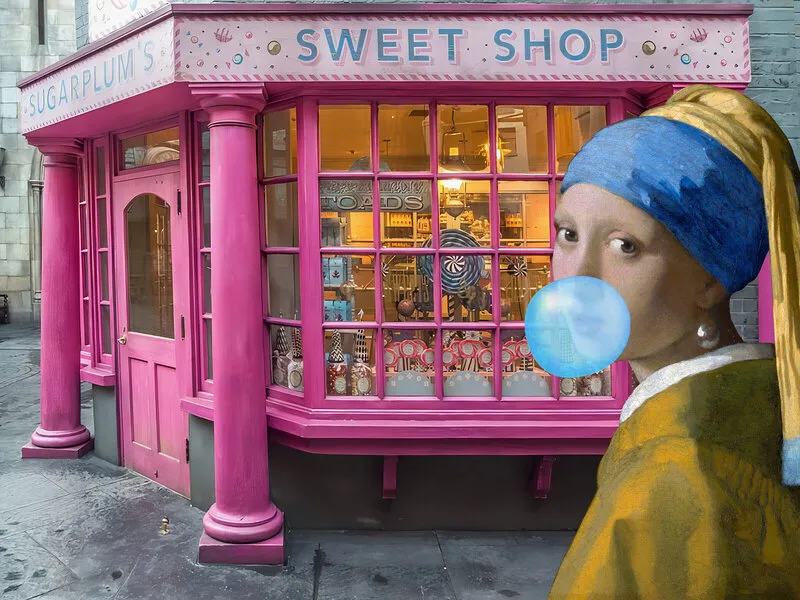
Girl with Blue Chewing Gum, 2024
Digital
70 x 50 cm
3 200 kr
I was on a nostalgic trip in Holland. With my wife and our closest friends, we had been in Delft in 1972, with our first child still four years away, allowing us to manage our time. Now, I was wandering aimlessly in the older part of the city, around the Nieuwe Kerk, the New Church, a Protestant church. I visited a few art exhibitions, each one a treasure trove of stories and emotions, as art always has something to tell, regardless of the era it originates from. Naturally, I visited the Vermeer Centre, an information hub that seemed to breathe life into the city's great man, the painter Johannes Vermeer, and the work of his contemporaries. My mind was filled with all of Vermeer's images, not in original form but as reproductions, each a window into a different time and place.
Many think visual art is dry, boring, lifeless, or functions as a decorative element in home styling. But the stories behind those paintings, sculptures, drawings, and photographs are often weirder, more outrageous, or more fun than you can imagine. In these thoughts, I wandered when, a bit further away, I saw a candy store I recognised. Being a sweet tooth, I never miss such a sight. The craving for sweets had gripped my stomach. The exterior seemed the same as fifty years earlier. But the woman outside was new, yet old and familiar. I secretly took a picture as I got closer. It's the one I'm sharing with you.
If told in full, my image of the young woman chewing gum and blowing a blue bubble outside a candy store could become an entire novel. I'll settle for a shorter version. The Girl in the picture, I now know, is named Anna-Maria van Scheveningen. She is much older than she looks, three hundred and seventy-six years old, to be exact, as she was born in 1648. It was a surreal moment, to say the least, to come face to face with a figure from history, a living embodiment of a Vermeer painting.
I almost thought I had gone mad because of the woman outside the candy store. I had left her just under an hour ago. Then, she was hanging as a reproduction on one of the Vermeer Centre's walls, in a central place because this picture is Vermeer's most famous. The original hangs in the Mauritshuis, in the centre of The Hague. Original and original, I felt the original was here for my entire being. My previous encounters with Time-Travellers make me feel when I come close to someone. Most of them look entirely normal, have adapted their clothing to the present, and have no desire to stand out. This woman was the opposite, looking like she had just stepped out of Vermeer's painting.
Her look was universal rather than specific. Vermeer's painting is not a portrait of a particular person but what the Dutch called a 'Tronie' – the head of an 'ideal type', be it a soldier or a musician – or, in this case, a young beauty. I would soon learn more.
As I gazed at the young woman's arrestingly beautiful and enigmatic face, I couldn't help but be captivated by her timeless charm. Her youthful, oval face was softly illuminated by a sky covered with thin grey clouds, casting delicate shadows that accentuated her smooth, fair complexion. She had large, almond-shaped eyes that were wide and expressive, conveying a sense of curiosity and innocence. Her gaze, directed slightly over her shoulder, seemed to beckon me into her world, creating a feeling of intimate engagement with the viewer. It wasn't me her eyes were searching for, but no one else was to be seen on the street.
Her finely arched eyebrows framed her eyes with a lifelike sparkle, adding a serenity to her gaze. The Girl's straight and delicately shaped nose was a testament to the harmony of her features. Her lips, slightly parted lips revealed a hint of a smile, inviting me to wonder about the thoughts and emotions behind that enigmatic expression.
The most captivating aspect of her appearance was her pearl earrings, which seemed to hold a secret within their shimmer. They drew attention to her elegant neck and the graceful contour of her jawline. Her hair was mostly concealed under a turban-like headscarf, a combination of yellow fabric wrapped around blue fabric, which added an exotic and timeless quality to her look. That was when I recognised her. She was the Girl from the Dutch seventeenth-century painter Johannes Vermeer. Having learned to recognise and occasionally encounter Time-Travellers, I was not particularly surprised. She fit in. This was where she had lived, and naturally, it was here she wanted to return.
The overall effect of her face's serene beauty and quiet allure captured a moment of the brief and intimate connection between her and someone who wasn't present at that moment but couldn't be far away. I saw it in her gaze. At that moment, she became aware that she wasn't alone, that I was familiarly looking at her even though we had never met. I recognised her image; it was as if I had known her all my life, yet I knew nothing about the woman behind Vermeer's Girl.
Our encounter was a unique and intimate moment, a meeting of souls transcending time and space. The scene seemed to shift, and the enchantment was broken as she became aware of my gaze. She looked at me with an inscrutable expression for what felt like an eternity. She looked at me inscrutably for nearly half a minute before a smile spread across her face.
"You are not one of us," she said kindly when she realised I understood, referring to our different periods and the fact that she was a visitor from the past.
"No, but I know Leonard Cohen and his eternal companion, Marianne Ihlen," I said, disregarding that she probably had no idea who a singer-songwriter from my time was. Her music, I speculated, must be from the Baroque period; perhaps she loved Monteverdi and his operas. The thought of such a different world, with its unique history and culture, filled me with an insatiable curiosity and a profound sense of wonder as I tried to imagine the stark contrast between her time and mine.
"What a funny coincidence. I met them on Sirius during a happening with the theme 'Music of All Ages.' My name is Anna-Maria, by the way," she said, extending a graceful hand that took mine gently.
"George. That's what Leonard calls me," I said, bringing her hand to my lips and giving it a fleeting kiss, a gesture reminiscent of a bygone era. In that moment, I felt a profound connection, a thread of shared experiences that seemed to transcend time and space, uniting us in a comforting and exhilarating way. It was like we were old friends, separated by time but brought together by a shared understanding.
"Pleasant." She withdrew her hand just as gracefully.
"You mentioned 'happening.' That sounds intriguing, if I may say so." I probably looked a bit surprised. Leonard's stories about the uninhibited parties in the artist circles of the 1960s might have spread to the universe. A 'happening' is a unique cultural event, often associated with the 1960s counterculture, characterised by its spontaneity, participation, and immersive nature. It isn't easy to describe, partly because each is unique. I had never been to anything defined as such. But my general impression from what I had read and heard about them when I was young was that they were pretty eventful gatherings, to put it mildly.
"Not in that way, I assure you," she said, laughing and showing that she had read my thoughts in the unique manner of Time-travellers. This method of communication allows them to talk regardless of language and era. There is no oxygen up there, so vocal cords are useless. It's all telepathy; with that, there are neither languages nor dialects, just thoughts and feelings. "The happening was very serious and a kind of competition. I played the Virginal, a common instrument during the Baroque period."
"You mean harpsichord?" I was a bit unsure what the instrument was called.
"It's the same thing. I call it Virginal; in English, it's called Harpsichord, and in German, Cembalo. A beloved child has many names; there was no standard but many preconceived notions in our time. Each instrument maker did as he thought best, for it was always a man. The virginal, or Harpsichord, is a keyboard instrument popular during the Baroque period. It's similar to a piano, but the strings are plucked rather than struck, producing a unique sound.
"So, you've had the privilege of meeting Leonard?" The thought was staggering. Consider the vast number of people who have inhabited Earth throughout history. I've heard about 108 billion, each finding their star, sometimes in pairs like Leonard and Marianne, but still. The Milky Way, our galaxy, is home to an estimated 400 billion stars, so there is still abundant space. When it reaches its end, the next galaxy is not too distant by astronomical standards.
The distances are enormous even if they travel through so-called wormholes, short-time shortcuts that allow faster-than-light travel. These wormholes shrink the universe to perhaps the size of London communication-wise. Londoners are ten million and do not just run into each other randomly. Here, we talked about billions, and she met Leonard. It's a once-in-a-lifetime encounter, given that he's a newcomer, having only been in eternity since 2016. The probability is a fraction of winning the jackpot in Powerball.
"Our meeting was a stroke of luck on Sirius, where we were randomly paired for a 'Say it with Tones competition.' The challenge was interpreting a given theme in the most captivating musical way. Our theme was 'The Bird on Its Branch.' Can you fathom the exhilaration?" she said, her eyes sparkling with the memory.
"Yes, I suppose it is. Who were the competitors?"
"Five amateurs in this context. Leonard, Monteverdi, Paganini, and then Lucy and I," she said as if I knew them.
"Some of those names sound quite professional."
"In the realm of music creation, yes, they are professionals. But in the competition, we were all amateurs. None of us had the experience of participating in grand events like the European Song Contest or Britain's Got Talent, which I've seen on our Universe Network." Anna-Maria's voice was brimming with a sense of unity. "Our collaboration was based on improvisation, a method that thrives when people from different eras come together. It's not as challenging as it seems. Birdsong has echoed through the ages; a sunset is a timeless beauty. Regardless of our era, we can all revel in these shared experiences in eternity."
"So, you created music together?"
"Yes, that's what we did, even if we didn't win. I think we placed a thousandth out of twenty thousand. Something that disturbed the gentlemen. Leonard laughed, but both Monteverdi and Paganini felt misunderstood."
"How do you manage to listen to so many entries?" I asked sceptically.
"In eternity, time is a fluid concept. Everything happens simultaneously, and what would have taken seventy Earth days of continuous playing took the equivalent of a few days down here. It's a mind-boggling concept, isn't it?" Anna-Maria's voice was filled with a sense of wonder.
"I find it incomprehensible."
"Everyone does for a while after they arrive, but you get used to it.
"So you played and sang, like?"
"Yes, we formed an exciting quintet. I play many instruments, including guitar, but I am not much of a composer or songwriter worth mentioning. First, we had to create music, then perform it, and when we felt ready, the audience and jury would hear the finished result. It was nerve-wracking—many wills, preferences, styles, and eras. The most modern was the oldest of us, and the most conservative was the youngest, Leonard, who had experimented with a lot but still excluded most influences from his music. Excluding me, I didn't have much to contribute."
"What instruments did you play?" The question was justified since they mastered many skills, such as Leonard's handling of the guitar and keyboard.
"Leonard played the guitar; I played my Virginal, which I had brought from Johannes and my star. It barely fit in the fast-track wormhole. Niccolò Paganini played the violin; what else? The versatile Monteverdi handled a cello from his own time, a Rugeri, and then the fascinating Lucy, the early Australopithecine girl who played the flute. And how she played. You surely know that there are no forward or backwards times in eternity. Everyone can talk to everyone, and we learn each other's epochs. Lucy, for example, has gone from playing simple tunes on a flute carved from bone to playing Mozart's Concerto for Flute and Harp for an audience across the universe. Her flute is now made of platinum.
"Leonard has told me about her. She was invited as a guest of honour to a party on Hydra, the local nightclub king Babis Mores' memorial bash, an event he called 'The Last Dance,' an event I understand has made quite an impression even in the cosmos."
"He has mentioned that bash. Then I understand which Jorgos or George you are. He talked about an Earthling who ensured that seven hundred revellers from eternity got food and drink in a villa on a Greek island they occupied for a day." Anna-Maria shook her head.
"Lucy couldn't attend, but we got to listen to a live recording from Sirius." I didn't comment further on the big bash since I didn't know what Leonard had said.
"Only good things," Anna-Maria commented, reading my doubt. "As for Lucy, as you might know, she died in her post, so to speak. She fell from a tree while sitting on a branch playing the flute. That's how she ended up in eternity."
"You play guitar too," I said, thinking of another of Vermeer's paintings.
"You've understood, I see. Yes, it's the same person, the young, inexperienced Girl at the virginal and the confident young woman with her guitar on her lap. Johannes used me as a model several times."
"I suspected as much. In the painting with the pearl earring, you might be around fourteen or fifteen years old, still shy, unsure, and inexperienced. Your face is youthful, almost childlike, filled with a subtle innocence. Your attire is simple and traditional for its time, with a dark dress and a prominent yellow and blue turban that almost completely covers your hair. I see it as Vermeer reflecting your status and modesty, then. But your expression is thoughtful and somewhat mysterious, suggesting a budding relationship filled with curiosity and respect with Vermeer."
"Almost correct. In 1665, I was thirteen. Fast forward seven years to the painting with the guitar, one of his last, unfortunately. The Girl is now a young woman, twenty-one years old, with a more mature face, exuding the confidence and joy that comes with age and experience. My attire is more colourful and elegant, and my hair is no longer completely hidden. The yellow dress had fine lace details, exposing my hair with loose curls. Yes, I was happy then, even though we had to sneak around with our relationship."
"I've always thought the painting with the guitar suggests a closer and more lasting relationship with Vermeer, one where the woman feels comfortable enough to show her hair, something that historically was only done in front of family and close friends. I had thought the model might be his daughter, for the young woman's smile and expression while playing the guitar indicate a deeper level of intimacy and trust in their relationship. Now I know better."
"It wasn't fair to his wife, Catharina Bolnes, who was related to me on her maternal line. At that time, it was somewhat acceptable for men to have a side relationship. Women, of course, were expected to be faithful so that the children's paternity was clear, especially the boys who inherited the father's status. Johannes was quite active in the bedroom, fathering eleven children with Catharina. Our relationship was platonic for a long time and only consummated towards the end. Our artistic minds connected us, he with his brushes and I with music. In his later years, Johannes had a difficult time. During our country's ruinous war with France, the collapse of the art market damaged his business as both a painter and an art dealer. He sought more physical comfort in my arms. He lapsed into such decay and decadence, and the poor thing went from being healthy to being dead in less than one day."
"Yes, he died far too young. Just over 40, right?"
"43. Johannes had a few pupils, one of whom was me, and another was his daughter Maria. We became friends, and thanks to her, Johannes and I could be close without attracting too much attention. Maria became very skilled, almost on par with her father. I became, at best, half-good but developed much more musically. I dare say that no one in Holland could match me on the virginal and guitar, and I still hold that distinction. That's why I was invited to the happening on Sirius."
"Maria Vermeer isn't often mentioned, but I've heard rumours that she painted several of her father's works."
"Entirely correct. During the Baroque period, female artists were not recognised, even though there were many talented, more or less self-taught women. Maria's painting 'Girl With a Red Hat,' one of the most popular, is attributed to Johannes but is her self-portrait. Seven of the thirty-five paintings conventionally ascribed to Vermeer are hers. The collapse of the art market and Johannes' death ended her artistic career—a sad chapter. We lost contact, partly because Maria caught me and Johannes red-handed and partly because I was forced to marry. Without the facade of Johannes' informal little art school, my family pushed me into the marriage market. But that's another chapter."
"You've continued to make music, I assume."
"Oh, yes, indeed. Throughout my time on Earth, with short breaks for childbirth and the period when I was ill before leaving for my star. The time in eternity before Johannes found me and we rekindled our relationship, I didn't play because my instruments were left on Earth. Johannes helped me get them back. As is often the case among us, we replace what was once our property with a copy. That was also the case for me. Johannes fixed transporting up my Virginal in a jiffy, together with my old viola and my beloved guitar."
"As an expert, can you tell me about your old instruments and how they differ from their modern counterparts?"
"Of course. The virginal or Harpsichord was a common instrument during the Baroque period. It resembles a modern piano but has a different mechanism for producing sound. Instead of striking the strings with hammers like in a piano, the Harpsichord's keys pluck the strings with small plectra, which gives it a brighter and more distinctive sound. Much like a guitar, actually."
"I love these old instruments and always seize the opportunity when they hold concerts with instruments from the sixteenth and seventeenth centuries."
"I agree. My viola da gamba is the predecessor of the modern cello. I play it between my knees, just like a cello. It has a richer, deeper tone that is well-suited for solo and ensemble playing. It is a lovely instrument that reminds me of a baritone or a deep alto. When I want to soothe my soul and feel nostalgic among all my memories, it's the viola I bring out." Anna-Maria took a deep sip of her second cappuccino that had just been served.
"In Vermeer's painting 'The Guitar Player,' the young woman is depicted holding and playing a Baroque guitar, an instrument distinct from modern guitars in several ways, as I understand."
"That's correct. The Baroque guitar typically features a slightly smaller and more delicate body compared to contemporary guitars, with a rounded, curvy shape. Its body is made of finely crafted wood, often with ornate decorations and intricate inlays, highlighting the artistry of the instrument itself. The guitar's sound hole is usually surrounded by a decorative rosette, adding to its aesthetic appeal.
The neck of the Baroque guitar is relatively shorter, with a set of tied-on gut frets rather than the fixed metal frets seen on modern guitars. The headstock usually has open peg tuners, similar to those found on early string instruments, giving it a classic and elegant appearance." Anna-Maria took a careful sip of her coffee before continuing:
"The guitar strings in Johannes's painting were, like on my real guitar, made of gut, which was standard for the period. The gut produces a softer, resonant sound than modern nylon or steel strings. The guitar typically has five courses of strings, meaning it has ten strings in pairs, except the highest course, which may be a single string.
"I can see the painting in my mind, how Vermeer captured you in mid-performance, your fingers delicately positioned on the fretboard, suggesting you skillfully played a piece of lovely music. Your elegant posture and focused expression conveyed a sense of grace and concentration, reflecting a musical moment's intimate and personal nature. I can feel inside me the warm tones of the guitar's wood contrast beautifully with your flowing garments, adding to the overall harmony and balance of the composition."
"You got it," she said softly.
"Where did Vermeer and his family live, the place where you, so to speak, went to school for him?"
"Johannes lived in the Catholic quarters in a house called Trapmolen, on Oude Langendijk, next to a hidden Jesuit church, with Maria Thins, Johannes' mother-in-law, my aunt, who owned the house. Protestants disdainfully referred to the area as the Papist Corner, but it was not a ghetto because many families chose to live there of their own free will, and they were prosperous. In Delft, about a quarter of the population was Catholic. Just over there by the church, right across the narrow canal." Anna-Maria pointed with a finger capable of strumming guitar strings and caressing the ivory keys of a harpsichord.
"It must have been crowded with such a large family and an artist's studio and everything?"
"I don't think they experienced it that way. The children didn't have single rooms then, and eleven rooms were spread out. So they had enough space. But everything is relative, of course, and my aunt had two rooms for herself. After all, it was her house."
"You're probably right. There's something else I've been wondering about. Something isn't right about the Girl With a Pearl Earring."
"What do you mean?" Anna-Maria asked with a suspicious tone. Since I hadn't thought of it beforehand, she was unprepared.
"I'm referring to the earring, the same one you're wearing today. It looks real but, in my opinion, shouldn't be able to be."
"It hasn't been misattributed, and no, it's not a fake. But the earring was a glass bauble rather than a real pearl. A pearl of this size would have been astronomically expensive, far beyond the financial reach of any Dutch painter. In the painting, you are looking at imitation glass pearls, which were exclusive and made by the best Venetian glass blowers. Johannes bought them in Amsterdam."
"Now I understand. The glassmakers from Murano were the only ones at that time who could make such exquisite glass, and those kinds of art pieces are still costly in the twenty-first century. Some experts claim that the earrings were neither pearl nor glass but painted." How wrong they were, which they would have realised if they had met Anna-Maria outside the candy shop. The truth was even more complicated, as it would turn out.
"There's more to tell, but I'll wait until you've finished your thoughts," she said cryptically. "Genuine pearl earrings and necklaces were all the rage among the wealthy, but they were decidedly luxurious items. Pearls like mine would have had to be shipped all the way from South Asia," Anna-Maria said, fingering the right earring that wasn't visible in the painting. "At this size, it would have been precious."
"I understand," I said, nodding. "Maybe we can go to that little café over there. It feels strange to stand outside the candy shop without going in." My inner craving for sweets and the bag Anna-Maria was holding, with the candy shop's emblem on it, was starting to get too much. I understood she was stocking up on real Dutch candy for the journey back to her star.
"Correct. It's for the trip," she said, laughing. "Sure, we can have a cup of coffee. There were coffee houses during my time here. Coffee first came to Europe through the port of Venice. Because of their vibrant trade with North Africa, it was through these Venetian merchants that coffee was introduced to the rest of Europe. 1600 Pope Clement VIII baptised the drink, making it more acceptable to European markets. As a Catholic, that was important. Coffee came to Holland the same way as the earrings."
"You might need to change clothes before we sit at the café," I said, thinking her attire might attract attention.
"You don't need to worry. No sensible person would think I jumped out of the painting in The Hague and travelled up to Delft to have coffee." Anna-Maria laughed delightedly at my thoughts. "They'll just think it's a Vermeer fan dressed up or someone on their way to a costume party. I don't mind. So come now," she said, taking my arm. Indeed, she didn't cause much of a sensation, only friendly smiles when we sat at the outdoor café. It was clear that this wasn't Anna-Maria's first return visit to Earth when she effortlessly ordered a double cappuccino and didn't try to order it in a sixteenth-century manner, similar to that still used in parts of the Middle East, pungent and bitter, flavoured with cinnamon and cardamom and sweetened with honey to ease the bitter taste. I asked for a large cafe latte.
"The painting wasn't always called Girl With a Pearl Earring," Anna-Maria said after sipping some of her cappuccino and getting a sweet white moustache from the cream. "From the beginning, it was often called Girl With the Turban. Now that you've finished your thoughts and gotten the coffee your inner craving was calling for, I'll tell you more about the earrings."
"I'm all ears," I said, taking a cautious sip of the hot latte.
"As you thought earlier, the painting is a 'tronie,' a work that isn't a portrait of a specific person; rather, it's focused on depicting facial expressions – but not quite. To quote another art expert, 'A young woman might have sat for Vermeer, but the painting is not meant to portray her or any specific individual.' This is yet another of those know-it-alls who missed the mark because, superficially, the painting works that way, but on a deeper level, it reveals a deep attraction between the artist and his model. Johannes had fallen in love with me and wanted to express it correctly. Not so openly as to offend. My sensually half-open mouth and eyes seeking Vermeer's seem to ask, 'What do you want with me?' And that's exactly how it was."
"Did he show it in any other way?" I asked cautiously, not wanting to be as indiscreet as my thoughts, which were racing ahead.
"Of course he did, gently touching my arm, stroking my cheek, sometimes putting his arm around my shoulders. I believe he kissed me once, maybe twice in five years. Johannes was very well-mannered and restrained himself. Probably no one but me sensed the smouldering fire behind. I enjoyed being the centre of attention, feeling desired, and developing my artistic soul above all. I wouldn't have become such a skilled musician if I hadn't played for him. He bought, or rather my aunt bought, the instruments. She and Catharina often came down to listen, and occasionally, I played at some event they had." Anna-Maria had read me like an open book but elegantly dismissed my lewd imagination.
"I'm impressed," I said, and my thoughts drifted to the aftermath of #MeToo, about men who hadn't been as considerate. But in my thoughts, I sensed that the situation couldn't last.
"It didn't last," Anna-Maria said, answering my internal questions. "I became his in the summer of 1672 after seven years of hidden desire. He was about to turn forty in the fall and one day told me he didn't want to end his days without having all of me. We were cautious, and he was disciplined enough to use coitus interruptus, one of the oldest and most known methods from antiquity and most effective. At any rate, I didn't get pregnant, and our bond grew stronger. As a responsible family man and a Catholic, there was never any talk of us getting married. I was content with the situation, the best of both worlds. I could develop as an artist and a musician without being torn between maternal duties and what I loved. Johannes suffered more than I realised at the time."
"That's entirely understandable," I said, trying to imagine his situation.
"In the summer of 1675, Johannes borrowed a thousand guilders in Amsterdam from a silk trader, using my aunt's property as security. It wasn't something I knew about until much later. In fact, I knew nothing about it until our first joint visit back to Earth in the early 1700s. Johannes insisted on visiting the Oude Kerk, the Old Church, nicknamed Scheve Jan, Skewed John, the Protestant church in the old city centre. He hadn't been there since his funeral."
"A Protestant church! Didn't he convert when he got married? Catharina was Catholic, wasn't she?"
"Yes, technically, but when he died, his Protestant relatives insisted on it being that way. Once you reach the stars and eternity, all the humbug around religions is revealed, so the question of which faith one belonged to on Earth becomes obsolete. Still, I asked him what he had to do there. 'Just fetching something that belongs to you,' he said."
"Sounds like he had a plan."
"You can bet on it."
"You'll tell me, of course, because I can't read thoughts."
After ensuring the church was empty—"You know Protestants don't have masses all the time and no monks praying to God every hour, so the church was deserted"—he went straight to the large monument of the naval hero Piet Hein.
"I suppose he was the admiral who seized the Spanish treasure fleet, which carried vast quantities of gold and silver from Spanish America to Spain. The volume of silver captured was so immense that it led to a global increase in the price of silver and nearly bankrupted Spain."
"Exactly, and the monument reflects that it's huge. Anyway, Johannes climbed up behind the reclining marble hero and, with a knife, scratched out the plaster from an ear he had made a hole in back in 1675, where he had hidden a small package. Then he crawled back down, and we sneaked out of the church."
"What was in the package?" I asked eagerly.
"Patience! I had to show it, for he revealed the secret not until we were back on our star. A pair of earrings like those I wore when he painted my portrait was in the leather pouch. The difference was that the pair he gave me then were real, two huge pearls set in gold. For this reason, he took the loan back then to give me the earrings on the anniversary of our first union. A hundred thousand euros is an incredible declaration of love in today's money. But then he suddenly fell ill that same autumn and left this world without having the chance to tell me. And widow Catharina was left destitute with debts up to her ears. All she had was his studio, filled mostly with junk, and twelve paintings she gradually had to sell for far too little money."
"But the earrings were safe, for who would ever think to look for something in the ear of a fallen hero's marble statue? Are they the ones you're wearing now?"
"Of course!"
"Didn't he feel guilty about the way he left Earth?"
"Sure, but Johannes had a huge commission lined up that would have solved all his problems. The war with France ended, and his customers' desire to buy art had returned. But the Grim Reaper came in between. No one can overrule him," Anna-Maria concluded, wiping away some cream from her upper lip with a napkin, a small detail that added to the realism of the scene.
"Why were you hiding your hair, Anna-Maria?" I asked, even though I already suspected the answer.
Anna-Maria's voice carried a hint of nostalgia as she spoke. "Hiding my hair is a habit I've clung to for centuries, a symbol that holds deep meaning for me and my generation."
"I noticed you kept it hidden so meticulously. It seemed more than just a style choice," I remarked.
"Yes, it's a symbol of my reserved, cautious nature. Showing my bare head to a man was a significant moment of intimacy. Even now, visiting Earth, I wear my headscarf for nostalgia, recalling when our relationship was still a secret. My reserved nature has always been a barrier in my relationships, but it has kept me safe and preserved my sense of self."
"It must have been a major upheaval for you to reveal your hair to Vermeer," I said, understanding the emotional weight of that moment.
"It was. Women generally kept their hair covered during our time, especially in public or around people outside their immediate family. Unmarried women might show their hair privately, but covering it was the norm. Even though Johannes and I have been together for three hundred and fifty years, I like to pretend it's still the time when we were just a secret pair. My habits, like hiding my hair, have always been a part of our relationship, a symbol of our secret love."
"You've always seemed different from other girls your age," I observed.
Anna-Maria nodded. "I am different. Instead of styling my hair, I kept it hidden, tucking it into a covering that pointed downward on either side of my face. This way, I could keep my expressions hidden, staying private and cautious," she revealed, hinting at a more profound, unspoken complexity.
"It sounds like you are a deeply private person," I commented.
"I was and still am to some degree. I was very reluctant to connect with people outside my small family. Showing my hair was a serious display of intimacy. And then, there's my obsession with cleanliness," she continued. "Even the smallest displays of blood under the butcher's fingernails or dust around objects in a painting bothered me immensely."
I chuckled. "You must have been an ideal maid, but it sounds like it made you critical of others."
"It did," she admitted. "My cleanliness contrasted sharply with other women like Catharina, who often had a sloppy collar or messy hair. The fact that my ears were unpierced for most of the story also shows my tendency to keep myself pure and clean. Piercing them for Johannes was a significant step for me, symbolising a departure from my previous purity."
"And what about gossip?" I asked. "You claimed to stay away from it, but were you really different from other girls in that respect?"
Anna-Maria smiled knowingly. "I tried to avoid 'market talk,' but when the gossip was about something or someone I was interested in, I couldn't resist. I even fed information into the gossip mill about the subjects of a painting to serve my purposes," she confessed, her eyes gleaming with a mischievous twinkle.
"That doesn't sound too different from your peers," I said, laughing.
"No, it doesn't," she agreed, her eyes twinkling. "But it was all part of navigating the complexities of life back then, just as it is now."
"So, here you are, centuries later, still holding onto those same symbols and habits," I said, respecting her enduring connection to her past.
"Yes," she said softly. "Some things are worth preserving, even into eternity," she said, fingering her earring pearl, a symbol of her departure from her previous purity.
"Will I meet your Johannes Vermeer before we part ways?" It would be exciting to meet him, as I have some questions regarding his son, who is rumoured to have secretly followed in his footsteps and moved to Ghent in present-day Belgium.
"I find that hard to believe. Johannes takes his tours, and I never know when he will show up. He's called 'The Sphinx of Delft' because so little was known about Johannes, barely even his paintings. The art critic Thoré-Bürger, who rediscovered Johannes, named him in the 19th century. Quite fitting, actually." Anna-Maria looked up at the clock tower on the Nieuwe Kerk. Not that time mattered to someone living in eternity, but because she felt it was about time now.
"You probably have more important things to do than sit and gossip with a three hundred seventy-six-year-old lady," she said, standing up. Though it had been subtle, I understood the hint and gave her a quick hug. She felt like hugging a cloud of the finest eiderdown.
3 200 kr

Jörgen Thornberg
Malmö
Lite om bilder och mig. Translation in English at the end.
Jag är en nyfiken person som ser allt i bilder, även det jag fäster i ord, gärna tillsammans för bakom alla mina bilder finns en berättelse. Till vissa bilder hör en kortare eller längre novell som följer med bilden.
Bilder berättar historier. Jag omges av naturlig skönhet, intressanta människor och historia var jag än går. Jag använder min kamera för att dokumentera världen och blanda det jag ser med vad jag känner för att fånga den dolda magin.
Mina bilder berättar mina historier. Genom mina bilder, tryck och berättelser. Jag bjuder in dig att ta del av dessa berättelser, in i ditt liv och hem och dela min mycket personliga syn på vår värld. Mer än vad ögat ser. Jag tänker i bilder, drömmer och skriver och pratar om dem; följaktligen måste jag också skapa bilder. De blir vad jag ser, inte nödvändigtvis begränsade till verkligheten. Det finns en bild runt varje hörn. Jag hoppas att du kommer att se vad jag såg och gilla det.
Jag är också en skrivande person och till många bilder hör en kortare eller längre essay. Den följer med tavlan, tryckt på fint papper och med en personlig hälsning från mig.
Flertalet bilder startar sin resa i min kamera. Enkelt förklarat beskriver jag bilden jag ser i mitt inre, upplevd eller fantiserad. Bilden uppstår inom mig redan innan jag fått okularet till ögat. På bråkdelen av ett ögonblick ser jag vad jag vill ha och vad som kan göras med bilden. Här skall jag stoppa in en giraff, stålmannen, Titanic eller vad det är min fantasi finner ut. Ännu märkligare är att jag kommer ihåg minnesbilden långt efteråt när det blir tid att skapa verket. Om jag lyckas eller inte, är upp till betraktaren, oftast präglat av en stråk av svart humor – meningen är att man skall bli underhållen. Mina bilder blir ofta en snackis där de hänger.
Jag föredrar bilder som förmedlar ett budskap i flera lager. Vid första anblicken fylld av feel-good, en vacker utsikt, fint väder, solen skiner, blommor på ängen eller vattnet som ligger förrädiskt spegelblankt. I en sådan bild kan jag gömma min egentliga berättelse, mitt förakt för förtryckare och våldsverkare, rasister och fördomsfulla människor - ett gärna återkommande motiv mer eller mindre dolt i det vackra motivet. Jag försöker förena dem i ett gemensamt narrativ.
Bild och formgivning har löpt som en röd tråd genom livet. Fotokonst känns som en värdig final som jag gärna delar med mig.
Min genre är vid som framgår av mina bilder, temat en blandning av pop- och gatukonst i kollage som kan bestå av hundratals lager. Vissa bilder kan ta veckor, andra någon dag innan det är dags att överlämna resultatet till printverkstaden. Fine Art Prints är digitala fotocollage. I dessa kollage sker rivandet, klippandet, pusslandet, målandet, ritandet och sprayningen digitalt. Det jag monterar in kan vara hundratals år gamla bilder som jag omsorgsfullt frilägger så att de ser ut att vara en del av tavlan men också bilder skapade av mig själv efter min egen fantasi. Därefter besöks printstudion och för vissa bilder numrera en limiterad upplaga (oftast 7 exemplar) och signera för hand. Vissa bilder kan köpas i olika format. Det är bara att fråga efter vilka. Gillar man en bild som är 70x100 men inte har plats på väggen, går den kanske att få i 50x70 cm istället. Frågan är fri.
Metoden Giclée eller Fine Art Print som det också kallas är det moderna sättet för framställning av grafisk konst. Villkoret för denna typ av utskrifter är att en högkvalitativ storformatskrivare används med åldersbeständigt färgpigment och konstnärspapper eller i förekommande fall på duk. Pappret som används möter de krav på livslängd som ställs av museer och gallerier. Normalt säljer jag mina bilder oinramade så att den nya ägaren själv kan bestämma hur de skall se ut, med eller utan passepartout färg på ram, med eller utan glas etc..
Under många år ställde jag bara ut på nätet, i valda grupper och på min egen Facebooksida - https://www.facebook.com/jorgen.thornberg.9
Jag finns också på en egen hemsida som tyvärr inte alltid är uppdaterad – https://www.jth.life/ Där kan du också läsa en del av de berättelser som följer med bilden.
UTSTÄLLNINGAR
Luftkastellet, oktober 2022
Konst i Lund, november 2022
Luftkastellet, mars 2023
Engleson Galleri Caroli, april 2023
Hydra, Greece June 2023
Engleson Galleri Caroli, oktober 2023
Toppen, Höllviken december 2023
Luftkastellet, mars 2024
Torups Galleri, mars 2024
Venice, May 2024
Luftkastellet, oktober 2024
Konst i Advent, December 2024
Galleri Engleson, Caroli December 2024
Jäger & Jansson Galleri, april 2025
A bit about pictures and me.
I'm a curious person who sees everything in pictures, even what I express in words, often combining them, for behind all my pictures lies a story. These narratives, some as short as a single image and others as long as a novel, are the heart and soul of my work.
Pictures tell stories. Wherever I go, I'm surrounded by natural beauty, exciting people, and history. I use my camera to document the world and blend what I see with what I feel to capture the hidden magic.
My images tell my stories. Through my pictures, prints, and narratives, I invite you to partake in these stories in your life and home and share my deeply personal perspective of our world. More than meets the eye. I think in pictures, dream, write, and talk about them; consequently, I must create images too. They become what I see, not necessarily confined to reality. There's a picture around every corner. I hope you'll see what I saw and enjoy it.
I'm also a writer, and many images come with a shorter or longer essay. It accompanies the painting, printed on fine paper with my personal greeting.
Many pictures start their journey on my camera. Simply put, I describe the image I see in my mind, experienced or imagined. The image arises within me even before I bring the eyepiece to my eye. In a fraction of a moment, I see what I want and what can be done with the picture. Here, I'll insert a giraffe, Superman, the Titanic, or whatever my imagination conjures up. Even stranger is that I remember the mental image long after it's time to create the work. Whether I succeed is up to the observer, often imbued with a streak of black humour – the aim is to entertain. My pictures usually become a talking point wherever they hang.
I prefer pictures that convey a message in multiple layers. At first glance, they're filled with feel-good vibes, a beautiful view, lovely weather, the sun shining, flowers in the meadow, or the water lying deceptively calm. But beneath this surface beauty, I often conceal a deeper story, a narrative that challenges societal norms or explores the human condition. I invite you to delve into these hidden narratives and discover the layers of meaning within my work.
Picture and design have been a thread running through my life. Photographic art feels like a fitting finale, and I'm happy to share it.
My genre is varied, as seen in my pictures; the theme is a blend of pop and street art in collages that can consist of hundreds of layers. Some images can take weeks, others just a day before it's time to hand over the result to the print workshop. Fine Art Prints are digital photo collages. In these collages, tearing, cutting, puzzling, painting, drawing, and spraying happen digitally. What I insert can be images hundreds of years old that I carefully extract so they appear to be part of the painting, but also images created by myself, now also generated from my imagination. Next, visit the print studio and, for certain images, number a limited edition (usually 7 copies) and sign them by hand. Some images may be available in other formats. Just ask which ones. If you like an image that's 70x100 but doesn't have space on the wall, you might be able to get it in 50x70 cm instead. The question is open.
The Giclée method, or Fine Art Print as it's also called, is the modern way of producing graphic art. This method ensures the highest quality and longevity of the artwork, using a high-quality large-format printer with archival pigment inks and artist paper or, in some cases, canvas. The paper used meets the longevity requirements set by museums and galleries. I sell my pictures unframed, allowing the new owner to personalise their artwork, confident in the lasting value and quality of the piece.
For many years, I only exhibited online, in selected groups, and on my Facebook page - https://www.facebook.com/jorgen.thornberg.9. I also have my website, which unfortunately is not constantly updated - https://www.jth.life/. You can also read some of the stories accompanying the pictures there.
EXHIBITIONS
Luftkastellet, October 2022
Art in Lund, November 2022
Luftkastellet, March 2023
Engleson Gallery Caroli, April 2023
Hydra, Greece June 2023
Engleson Gallery Caroli, October 2023
Toppen, Höllviken December 2023
Luftkastellet, March 2024
Torup Gallery, March 2024
Venice, May 2024
UTSTÄLLNINGAR
Luftkastellet, oktober 2022
Konst i Lund, november 2022
Luftkastellet, mars 2023
Engleson Galleri Caroli, april 2023
Hydra, Greece June 2023
Engleson Galleri Caroli, oktober 2023
Toppen, Höllviken december 2023
Luftkastellet, mars 2024
Torups Galleri, mars 2024
Venice, May 2024
Luftkastellet, October 2024
Konst i Advent, December 2024
Galleri Engleson, Caroli December 2024
Jäger & Jansson Galleri, April 2025
Utbildning
Autodidakt
Medlem i konstnärsförening
Öppna Sinnen
Med i konstrunda
Konstrundan i Skåne
Utställningar
Luftkastellet, October 2022
Art in Lund, November 2022
Luftkastellet, March 2023
Engleson Gallery Caroli, April 2023
Hydra, Greece June 2023
Engleson Gallery Caroli, October 2023
Toppen, Höllviken December 2023
Luftkastellet, March 2024
Torup Gallery, March 2024
Venice, May 2024