Vi använder cookies för att ge dig bästa möjliga upplevelse. Välj vilka cookies du tillåter.
Läs mer i vår integritetspolicy
Jörgen Thornberg
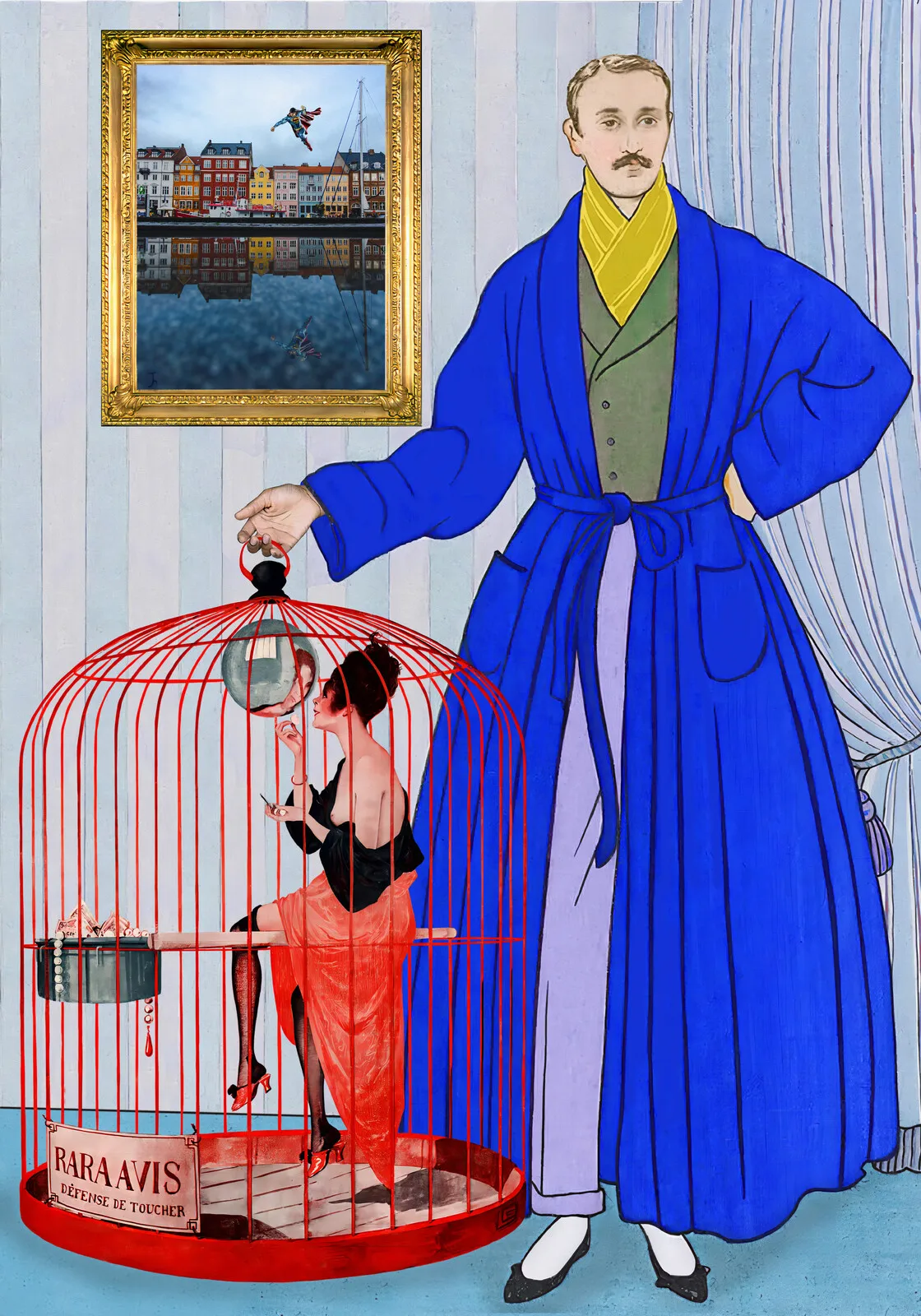
A girl in the cage - a man's wet dream, 2023
Digital
50 x 70 cm
3 200 kr
The image superficially deals with a male dream: to have a woman on hand without needing any particular responsibility. A harem does not fit the budget of ordinary men, but a woman in a figurative cage might be an idea. At least, that was the thesis when the home still was the man's castle. He ruled and arranged, and she was available, perhaps not literally locked in a cage but at least utterly dependent on men for her survival.
There is another aspect as well, that of women wanting to lock themselves in a cage. Not to be on hand but to shut out, especially men. The Muslim veil is a cage made of fabric. But it's imposed, although many women find it comfortable to avoid men's gazes. So they say. What they mean is hard to determine since their religion ultimately governs them. Since men know themselves, they do not allow other men to see what they consider theirs, their wives and daughters. Muslim men's homes are their castles, but it is Allah who decides. Since both he and his prophet were men, the men were well catered for. As martyrs, forty virgins await them in heaven. All in cages. It was not long ago that it was the same here, though our religion never offered free sex in the afterlife. Women have fought long for their freedom, and the struggle continues.
Parts of the image, albeit heavily altered by me, are attributed to George Barbier (1882–1932), who became one of the most renowned French Art Deco illustrators after his exhibition of ninety costume drawings at the Galerie Boutet de Monval in Paris. A distinguished artist of the Art Deco movement, Barbier created fashion designs for several leading couturiers and fashion houses during his time. He was widely acclaimed for designing costumes, jewellery, wallpaper, and glasswork. His creations were published in famous magazines, including Gazette du Bon Ton, La Vie Parisienne, and Vogue, the latter the only one still alive. If he is such, the gentleman is from his hand, though he was dressed in red.
The image of the woman in the cage was made by a colleague, Georges Leonnec (1881-1940), and is titled 'L'Amour' without further explanation. The sign's text 'Rara avis' is a Latin phrase meaning 'Rare bird'. 'Rara avis' may also refer to an American ghost town in Mississippi. The words "very scanty" are used most advisedly, for in truth, a woman in a bird's cage is a rara avis.
‘DÉFENCE DE TOUCHER’, or Do not touch! It is more easily understood as the man in the robe wants his woman to be left alone with other men. Look but do not touch.
A hundred years later, it is striking how much has changed. Today, it is remarkable that the illustration of a woman in a cage was published on the front page of La Vie Parisienne (1917), a leading fashion magazine for women.
In the shimmering shadows of wartime Paris, amidst the echoes of explosions and the sombre march of soldiers, a magazine fluttered its pages defiantly. "La Vie Parisienne," not just a periodical but a cultural phenomenon, whisked its readers away from the grim realities of World War I, bathing them in a seductive blend of romance, fashion, and distinctly French frivolities. Its pages, splashed with the art of Chéri Hérouard, Georges Leonnec and my favourite George Barbier and others, presented an escape, a portal to a less grim world and more glam. La Vie Parisienne (the Parisian Life) was a French weekly magazine founded in Paris in 1863 and was published without interruption until 1970.
It's the mid-1910s; Paris is a city under the strain of war, yet within the pages of "La Vie Parisienne," life whirls on in a dazzling spectacle of elegance and eroticism. The magazine, with its 'scantily clad girls,' didn't just serve to titillate but acted as a cultural salve, helping a beleaguered populace cope with the war's emotional toll. These illustrations, far from mere eye candy, were loaded with the weight of national identity and cultural superiority. The depiction of French sexual mores and allure wasn't just about showing off haute couture or the latest risqué party; it was a statement of civilisation itself—a thumbing of the nose at the barbarity at the gates, quite literally so.
And yet, beneath the surface glamour, there was a complex interplay of seduction and aggression. The magazine's portrayal of romance and sexuality during these years was a double-edged sword. On one hand, it celebrated French sexual liberalism as a hallmark of cultural superiority. On the other, it perpetuated troubling norms where the notions of consent were, to put it mildly, murky. Women were both holy and objectified in breaths as quick as the flip of a magazine page. Their consent, wrapped in layers of nationalistic pride and wartime propaganda, became a token exchanged in French valour and virility narratives. Some have changed, but some persist even if the magazine was discontinued in 1970.
Imagine a world where sexual politics were as much a battlefield as the muddy, blood-soaked trenches. "La Vie Parisienne" crafted a vision of France where love and lust were weapons against the encroaching despair of war. Through its vivid depictions of fleeting romances and stylish soirées, the magazine suggested that to be French was to be at the pinnacle of cultural sophistication—effortlessly superior to the 'barbaric' enemy.
Yet, this portrayal was not without its critics and complications. The very act of framing French sexual norms as a beacon of civilisation implicitly suggested that anything outside these norms was uncivilised, other, barbaric. It was a seductive narrative but also a dangerous one, simplifying complex human behaviours into a binary of us versus them, civilised versus barbaric.
Fast forward to today, and the lens of modernity offers a more critical view. The sexual politics of early 20th-century France, as depicted in "La Vie Parisienne," are ripe for reevaluation. What was once seen as playful and liberating might now be critiqued for its implicit sexism and idealisation of non-consensual dynamics. The magazine's legacy, a mosaic of artistry, nationalism, and eroticism, invites us to ponder the price of cultural pride and the shadows it can cast over issues of consent and equality.
Thus, "La Vie Parisienne" serves as a historical mirror, reflecting the complexities of its time—a blend of light and shadow, seduction and power, liberation and constraint. It reminds us that history often rhymes, and the themes of yesterday's pages can inform the narratives of today, urging us to look deeper into the stories we tell about who we are and who we aspire to be. Ultimately, the magazine is not just a relic of print but a dialogue between past and present, asking us to consider the cost of beauty and the battles fought in the name of love and war.
The illustrations were steeped in desire and sex, with women exposing much of themselves, including garter belts, skirts lifted by the wind, plunging necklines, and invitingly seductive smiles and gestures. They were unmistakable, which was, of course, the intention. During the 1920s, the young women who embraced the new, more accessible lifestyle and fashion were called "flappers." Flappers were known for their short dresses, short hair, and willingness to challenge social norms concerning female behaviour. They danced to jazz music, smoked cigarettes, drove cars, and were generally bold in their demeanour, which was radical compared to previous generations' more conservative views of womanhood. Flappers represented a new type of freedom for women, both socially and culturally, during an era of significant changes.
'An Englishman's home is his castle,' a sentiment that originated in 17th-century legislation, doesn't quite sound up-to-date by today's standards. Nevertheless, the expression is still frequently used, often with a hint of irony nowadays. Once, it was said to mean that people have the right to do what they want in their homes and that neither others nor the state have any right to interfere in people's private lives. An Englishman's home is his castle. Everyone has a right to defend their home. In theory, that is. Nowadays, that freedom is significantly restricted. A man cannot beat his wife or children, which was once a legally sanctioned right. In reality, you cannot do anything within the walls of your home that is prohibited by law.
The idea that a man's home was once his castle is a sentiment dating back to Roman times:
“Quid enim sanctius, quid omni religione munitius, quam domus unusquisque civium? - What more sacred, strongly guarded by every holy feeling, than a man's own home?"
—Cicero 53 BC
The law of 1700s England was so particular and tender regarding the immunity of a man's house that it styled it his castle and would never allow it to be violated with impunity, aligning with the sentiments of ancient Rome.
From a more contemporary perspective, one could argue that a man's home is his castle until his queen arrives. In reality, many men feel she takes charge once they start living together. This shift in dynamics has been the subject of many theories, but as a cliché, it holds some truth. In many cases, this arrangement works well for both parties. However, in a more feminist interpretation, the phrase takes on a different meaning: 'If it's a man's castle, let him clean it.' This witty remark underscores the imbalance in household responsibilities, particularly in tasks such as cleaning and childcare.
The Shakespearean phrase 'eaten me out of house and home' refers to another aspect. Who contributes more to the home? In money or labour? In fairness, one's labour and income should be equally valued. This concept, often called 'The Woman Trap,' suggests that women's contributions to the household, particularly in unpaid domestic work, are undervalued and usually go unnoticed. More on this later under the concept of 'The Woman Trap.'
A female Swedish actress researched the subject in a somewhat different way. Elin Skarin sat naked in a cage for three days in the performance' Actress in a Cage,' which, among other things, involved a desexualisation of the female body.
Naked, alone, and locked in a cage for three days. That was the essence of Elin Skarin's performance, 'Actress in a Cage.' She found it particularly interesting that nudity stirred so many emotions in people. However, according to her, it was more about desexualising the female body.
The Actress Elin Skarin sat naked in a cage at the Artist's Stage in Stockholm as part of the performance' Actress in a Cage.' She didn't bring clothes or food into the cage. What was available was a camping toilet, a shower curtain, toilet paper, and a microphone. Like in my image, the visibility was 360 degrees, but the purpose was entirely different.
"It's interesting that this nudity brings up so much. That it stirs so many emotions in people. But in reality, it has been more about desexualising the female body, portraying her as an animal, an actress, and a human being."
The Actress found it a very tumultuous and fun experience in many ways. It was much more collective than it might sound. The audience was present and provided suggestions.
The performance was open between 9 AM and 10 PM and live-streamed on a TV facing the street at night so one could follow Elin around the clock. Those who visited the performance could pass in items like food or clothes.
According to Elin, the play was very well received. Some people were not regular theatregoers who just walked by, came in for a while, and returned several times. It felt like it became an artistic communal meditation on our time.
People wrote and shared their thoughts, but many sent items and necessities they thought Elin needed. A lot of things came in that she then used in the performance. It was all sorts of things, like texts the audience had written. Someone had sent in receipts, and someone sent a bathrobe. Elin got the hint, even though it was a nice one. The garment was stolen from the Hilton Park Lane in London.
The term' women's trap' is a concept that holds significant relevance in the Swedish context. It refers to something that (unintentionally) has severe consequences for women, threatening their freedom or other life conditions. This concept is often used in connection with regulations or proposals that, despite gender-neutral wording, are considered in practice to cement gender roles and societal structures to women's disadvantage. The word was first used in printed Swedish in 1988, marking its deep-rooted presence in our society.
Many critics describe the childcare allowance as a way to encourage the homemaker role economically, steering women away from careers and professional life since the overwhelming majority of the beneficiaries are women who stay at home with children, not men. Defenders of the allowance argue that there is nothing that prevents men from equally taking advantage of it, against which opponents contend that it is precisely a classic women's trap: the already prevailing unequal family tradition in society means that more women will use the allowance, which in turn reinforces inequality, leading into a vicious circle through which women are alienated from the labour market.
The concept has also been used in less political contexts; among other things, the Swedish politician Gudrun Schyman has criticised the availability of box wine as a 'women's trap' in connection with a discussion about her alcohol problem."
Let's journey through the 'Five Women's Traps and How to Avoid Them.' These traps, including the Part-Time Peril, Pension Puzzles, the Equitable vs. Equal Expenditure Enigma, Consumption Over Capital, and the Divorce Downturn, are not just abstract concepts. They have the potential to impact our lives significantly. By learning to sidestep these pitfalls, we can empower ourselves to navigate societal and economic challenges with grace and grit!
Trap One: The Part-Time Peril
Ah, Sweden! A land of fika, a Swedish cultural tradition of taking a break, often with coffee and a sweet treat, to socialise. It's also a land of forests and fantastic gender equality—well, sort of. Despite leading the charts in inequality, Swedish women are still champions of unpaid home labour and often find themselves in the part-time job jungle. This not only trims the paycheck but can thin out long-term earning potential. Strategy for Escape: Go halfsies! Equal sharing of parental leave, sick days, and domestic doings might be the ticket to keeping your career and cash flow robust.
Trap Two: Pension Puzzles
Peek into the pension pot, and you'll see it's not split evenly. Women typically pocket only 69% of what men do, thanks mainly to a resume filled with part-time gigs and career breaks for child-rearing. Pension Protection Plan: Stay vigilant in your childbearing years. Ensure you're accruing pension points even while on leave, and don't hesitate to negotiate with your employer about keeping those retirement contributions coming.
Trap Three: The Equitable vs. Equal Expenditure Enigma
Here's a head-scratcher: women earn about 9% less than men, but when expenses are split equally, it's not equitable. Savvy Solution: Consider a proportional split. Tailor your shared expenses based on income, ensuring each partner's wallet wears equally.
Trap Four: Consumption Over Capital
Regarding household economics, women often find their funds fizzling out on family necessities, while men might merrily invest in assets they appreciate. Financial Fair Play: Join forces on financial fronts. Ensure both names are on the big-ticket items and blend your budgeting skills to cover costs collectively.
Trap Five: Divorce Downturn
Are you navigating a divorce? Emotionally, women demonstrate their strength and adaptability, weathering the storm more resiliently. Financially, it's often a different tale, with men ending up on the sunnier side of the settlement. Divorce Defense: Understand your entitlements. Ensure property and pensions are divided reasonably, and consider a cohabitation agreement to safeguard interests before wedding bells even ring.
Meanwhile, Sweden's broader society is seeing a shrinking populace, with births hitting a low and immigration policies tightening. This paints a sad picture of a future where fewer workers support an ageing crowd. Oddly enough, the responsibility to repopulate increasingly rests on women despite societal shifts.
Surveys show that 'childfree cohabiting Swedes,' a term used to describe Swedes who are in a committed relationship but have chosen not to have children, score high on the happiness index, enjoying ample leisure and financial freedom—contrasting starkly with those navigating the nursery route.
So, here's the million-dollar question: Why should young women choose motherhood with all its economic encumbrances? Perhaps it's time for society and politicians to step up and craft policies that genuinely support those choosing to chart the challenging terrain of parenthood, offering a glimmer of hope for a more equitable future.
In the background, a painting depicts Superman flying over one of Copenhagen's canals. This superhero can hardly be called a feminist, even though he specialised in catching women free-falling from skyscrapers. He would be needed today to save the lives of young women thrown from balconies in honour-related murders or to address modern gang crime. A Lex Luthor lurks in nearly every district today, with shootings and explosions occurring frequently. Just like in Metropolis, ordinary police work does not suffice, and people are desperately looking for help, not least women.
Are you a bird owner with a feathered friend living in a cage at home? Since September 2007, regulations regarding minimum cage sizes for caged birds have also been applied to private animal owners.
At the heart of animal welfare laws is the well-being of the animals. They must be kept and cared for in an environment that promotes their health and allows for their natural behaviours and needs. This provision is a testament to our shared responsibility to ensure the best for our feathered friends.
The size of the cage is based on the bird's length, measured from the tip of the beak to the tip of the tail. If the tail feather is missing, the measurement is estimated as if the feather were present. For birds like whydahs and long-tailed finches in breeding plumage, the extended tail feathers are disregarded, but the space should be large enough that the birds can move without their tail feathers continuously touching the cage's floor or walls.
When choosing the size of a bird cage, the rule of thumb is to buy a cage that is four times as high as the bird and four times as wide.
It would be best to consider that most birds are social animals. The main rule is that they should be kept in pairs or groups. If you do keep a bird alone, it must have close social contact with a human.
In a metaphorical sense, the cage in the picture is far too small. For comparison, a prison cell in civilised countries is at least 6 square meters (USA), 7 (England), and 10 square meters (Sweden). Thus, it can be concluded that even the roughest prisoners have it better than the girl in the picture.
I hope the irony comes across. Otherwise, it's not me who has the problem. LOL.
Jörgen Thornberg
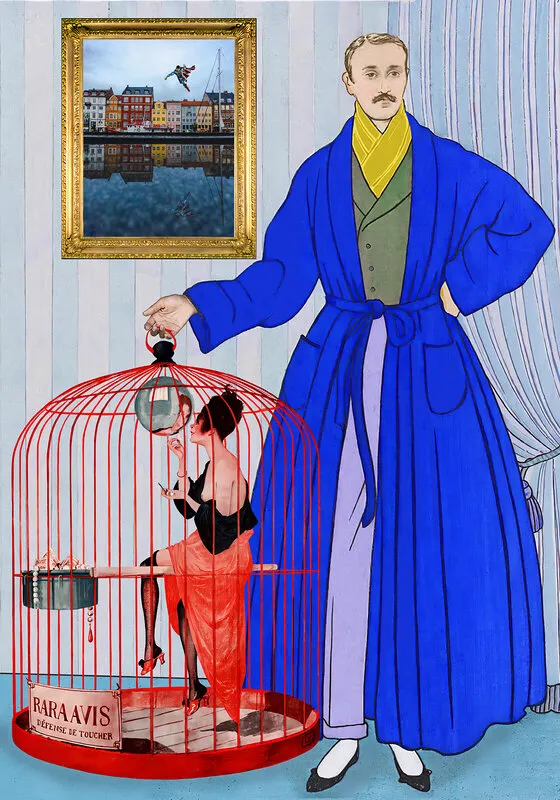
A girl in the cage - a man's wet dream, 2023
Digital
50 x 70 cm
3 200 kr
The image superficially deals with a male dream: to have a woman on hand without needing any particular responsibility. A harem does not fit the budget of ordinary men, but a woman in a figurative cage might be an idea. At least, that was the thesis when the home still was the man's castle. He ruled and arranged, and she was available, perhaps not literally locked in a cage but at least utterly dependent on men for her survival.
There is another aspect as well, that of women wanting to lock themselves in a cage. Not to be on hand but to shut out, especially men. The Muslim veil is a cage made of fabric. But it's imposed, although many women find it comfortable to avoid men's gazes. So they say. What they mean is hard to determine since their religion ultimately governs them. Since men know themselves, they do not allow other men to see what they consider theirs, their wives and daughters. Muslim men's homes are their castles, but it is Allah who decides. Since both he and his prophet were men, the men were well catered for. As martyrs, forty virgins await them in heaven. All in cages. It was not long ago that it was the same here, though our religion never offered free sex in the afterlife. Women have fought long for their freedom, and the struggle continues.
Parts of the image, albeit heavily altered by me, are attributed to George Barbier (1882–1932), who became one of the most renowned French Art Deco illustrators after his exhibition of ninety costume drawings at the Galerie Boutet de Monval in Paris. A distinguished artist of the Art Deco movement, Barbier created fashion designs for several leading couturiers and fashion houses during his time. He was widely acclaimed for designing costumes, jewellery, wallpaper, and glasswork. His creations were published in famous magazines, including Gazette du Bon Ton, La Vie Parisienne, and Vogue, the latter the only one still alive. If he is such, the gentleman is from his hand, though he was dressed in red.
The image of the woman in the cage was made by a colleague, Georges Leonnec (1881-1940), and is titled 'L'Amour' without further explanation. The sign's text 'Rara avis' is a Latin phrase meaning 'Rare bird'. 'Rara avis' may also refer to an American ghost town in Mississippi. The words "very scanty" are used most advisedly, for in truth, a woman in a bird's cage is a rara avis.
‘DÉFENCE DE TOUCHER’, or Do not touch! It is more easily understood as the man in the robe wants his woman to be left alone with other men. Look but do not touch.
A hundred years later, it is striking how much has changed. Today, it is remarkable that the illustration of a woman in a cage was published on the front page of La Vie Parisienne (1917), a leading fashion magazine for women.
In the shimmering shadows of wartime Paris, amidst the echoes of explosions and the sombre march of soldiers, a magazine fluttered its pages defiantly. "La Vie Parisienne," not just a periodical but a cultural phenomenon, whisked its readers away from the grim realities of World War I, bathing them in a seductive blend of romance, fashion, and distinctly French frivolities. Its pages, splashed with the art of Chéri Hérouard, Georges Leonnec and my favourite George Barbier and others, presented an escape, a portal to a less grim world and more glam. La Vie Parisienne (the Parisian Life) was a French weekly magazine founded in Paris in 1863 and was published without interruption until 1970.
It's the mid-1910s; Paris is a city under the strain of war, yet within the pages of "La Vie Parisienne," life whirls on in a dazzling spectacle of elegance and eroticism. The magazine, with its 'scantily clad girls,' didn't just serve to titillate but acted as a cultural salve, helping a beleaguered populace cope with the war's emotional toll. These illustrations, far from mere eye candy, were loaded with the weight of national identity and cultural superiority. The depiction of French sexual mores and allure wasn't just about showing off haute couture or the latest risqué party; it was a statement of civilisation itself—a thumbing of the nose at the barbarity at the gates, quite literally so.
And yet, beneath the surface glamour, there was a complex interplay of seduction and aggression. The magazine's portrayal of romance and sexuality during these years was a double-edged sword. On one hand, it celebrated French sexual liberalism as a hallmark of cultural superiority. On the other, it perpetuated troubling norms where the notions of consent were, to put it mildly, murky. Women were both holy and objectified in breaths as quick as the flip of a magazine page. Their consent, wrapped in layers of nationalistic pride and wartime propaganda, became a token exchanged in French valour and virility narratives. Some have changed, but some persist even if the magazine was discontinued in 1970.
Imagine a world where sexual politics were as much a battlefield as the muddy, blood-soaked trenches. "La Vie Parisienne" crafted a vision of France where love and lust were weapons against the encroaching despair of war. Through its vivid depictions of fleeting romances and stylish soirées, the magazine suggested that to be French was to be at the pinnacle of cultural sophistication—effortlessly superior to the 'barbaric' enemy.
Yet, this portrayal was not without its critics and complications. The very act of framing French sexual norms as a beacon of civilisation implicitly suggested that anything outside these norms was uncivilised, other, barbaric. It was a seductive narrative but also a dangerous one, simplifying complex human behaviours into a binary of us versus them, civilised versus barbaric.
Fast forward to today, and the lens of modernity offers a more critical view. The sexual politics of early 20th-century France, as depicted in "La Vie Parisienne," are ripe for reevaluation. What was once seen as playful and liberating might now be critiqued for its implicit sexism and idealisation of non-consensual dynamics. The magazine's legacy, a mosaic of artistry, nationalism, and eroticism, invites us to ponder the price of cultural pride and the shadows it can cast over issues of consent and equality.
Thus, "La Vie Parisienne" serves as a historical mirror, reflecting the complexities of its time—a blend of light and shadow, seduction and power, liberation and constraint. It reminds us that history often rhymes, and the themes of yesterday's pages can inform the narratives of today, urging us to look deeper into the stories we tell about who we are and who we aspire to be. Ultimately, the magazine is not just a relic of print but a dialogue between past and present, asking us to consider the cost of beauty and the battles fought in the name of love and war.
The illustrations were steeped in desire and sex, with women exposing much of themselves, including garter belts, skirts lifted by the wind, plunging necklines, and invitingly seductive smiles and gestures. They were unmistakable, which was, of course, the intention. During the 1920s, the young women who embraced the new, more accessible lifestyle and fashion were called "flappers." Flappers were known for their short dresses, short hair, and willingness to challenge social norms concerning female behaviour. They danced to jazz music, smoked cigarettes, drove cars, and were generally bold in their demeanour, which was radical compared to previous generations' more conservative views of womanhood. Flappers represented a new type of freedom for women, both socially and culturally, during an era of significant changes.
'An Englishman's home is his castle,' a sentiment that originated in 17th-century legislation, doesn't quite sound up-to-date by today's standards. Nevertheless, the expression is still frequently used, often with a hint of irony nowadays. Once, it was said to mean that people have the right to do what they want in their homes and that neither others nor the state have any right to interfere in people's private lives. An Englishman's home is his castle. Everyone has a right to defend their home. In theory, that is. Nowadays, that freedom is significantly restricted. A man cannot beat his wife or children, which was once a legally sanctioned right. In reality, you cannot do anything within the walls of your home that is prohibited by law.
The idea that a man's home was once his castle is a sentiment dating back to Roman times:
“Quid enim sanctius, quid omni religione munitius, quam domus unusquisque civium? - What more sacred, strongly guarded by every holy feeling, than a man's own home?"
—Cicero 53 BC
The law of 1700s England was so particular and tender regarding the immunity of a man's house that it styled it his castle and would never allow it to be violated with impunity, aligning with the sentiments of ancient Rome.
From a more contemporary perspective, one could argue that a man's home is his castle until his queen arrives. In reality, many men feel she takes charge once they start living together. This shift in dynamics has been the subject of many theories, but as a cliché, it holds some truth. In many cases, this arrangement works well for both parties. However, in a more feminist interpretation, the phrase takes on a different meaning: 'If it's a man's castle, let him clean it.' This witty remark underscores the imbalance in household responsibilities, particularly in tasks such as cleaning and childcare.
The Shakespearean phrase 'eaten me out of house and home' refers to another aspect. Who contributes more to the home? In money or labour? In fairness, one's labour and income should be equally valued. This concept, often called 'The Woman Trap,' suggests that women's contributions to the household, particularly in unpaid domestic work, are undervalued and usually go unnoticed. More on this later under the concept of 'The Woman Trap.'
A female Swedish actress researched the subject in a somewhat different way. Elin Skarin sat naked in a cage for three days in the performance' Actress in a Cage,' which, among other things, involved a desexualisation of the female body.
Naked, alone, and locked in a cage for three days. That was the essence of Elin Skarin's performance, 'Actress in a Cage.' She found it particularly interesting that nudity stirred so many emotions in people. However, according to her, it was more about desexualising the female body.
The Actress Elin Skarin sat naked in a cage at the Artist's Stage in Stockholm as part of the performance' Actress in a Cage.' She didn't bring clothes or food into the cage. What was available was a camping toilet, a shower curtain, toilet paper, and a microphone. Like in my image, the visibility was 360 degrees, but the purpose was entirely different.
"It's interesting that this nudity brings up so much. That it stirs so many emotions in people. But in reality, it has been more about desexualising the female body, portraying her as an animal, an actress, and a human being."
The Actress found it a very tumultuous and fun experience in many ways. It was much more collective than it might sound. The audience was present and provided suggestions.
The performance was open between 9 AM and 10 PM and live-streamed on a TV facing the street at night so one could follow Elin around the clock. Those who visited the performance could pass in items like food or clothes.
According to Elin, the play was very well received. Some people were not regular theatregoers who just walked by, came in for a while, and returned several times. It felt like it became an artistic communal meditation on our time.
People wrote and shared their thoughts, but many sent items and necessities they thought Elin needed. A lot of things came in that she then used in the performance. It was all sorts of things, like texts the audience had written. Someone had sent in receipts, and someone sent a bathrobe. Elin got the hint, even though it was a nice one. The garment was stolen from the Hilton Park Lane in London.
The term' women's trap' is a concept that holds significant relevance in the Swedish context. It refers to something that (unintentionally) has severe consequences for women, threatening their freedom or other life conditions. This concept is often used in connection with regulations or proposals that, despite gender-neutral wording, are considered in practice to cement gender roles and societal structures to women's disadvantage. The word was first used in printed Swedish in 1988, marking its deep-rooted presence in our society.
Many critics describe the childcare allowance as a way to encourage the homemaker role economically, steering women away from careers and professional life since the overwhelming majority of the beneficiaries are women who stay at home with children, not men. Defenders of the allowance argue that there is nothing that prevents men from equally taking advantage of it, against which opponents contend that it is precisely a classic women's trap: the already prevailing unequal family tradition in society means that more women will use the allowance, which in turn reinforces inequality, leading into a vicious circle through which women are alienated from the labour market.
The concept has also been used in less political contexts; among other things, the Swedish politician Gudrun Schyman has criticised the availability of box wine as a 'women's trap' in connection with a discussion about her alcohol problem."
Let's journey through the 'Five Women's Traps and How to Avoid Them.' These traps, including the Part-Time Peril, Pension Puzzles, the Equitable vs. Equal Expenditure Enigma, Consumption Over Capital, and the Divorce Downturn, are not just abstract concepts. They have the potential to impact our lives significantly. By learning to sidestep these pitfalls, we can empower ourselves to navigate societal and economic challenges with grace and grit!
Trap One: The Part-Time Peril
Ah, Sweden! A land of fika, a Swedish cultural tradition of taking a break, often with coffee and a sweet treat, to socialise. It's also a land of forests and fantastic gender equality—well, sort of. Despite leading the charts in inequality, Swedish women are still champions of unpaid home labour and often find themselves in the part-time job jungle. This not only trims the paycheck but can thin out long-term earning potential. Strategy for Escape: Go halfsies! Equal sharing of parental leave, sick days, and domestic doings might be the ticket to keeping your career and cash flow robust.
Trap Two: Pension Puzzles
Peek into the pension pot, and you'll see it's not split evenly. Women typically pocket only 69% of what men do, thanks mainly to a resume filled with part-time gigs and career breaks for child-rearing. Pension Protection Plan: Stay vigilant in your childbearing years. Ensure you're accruing pension points even while on leave, and don't hesitate to negotiate with your employer about keeping those retirement contributions coming.
Trap Three: The Equitable vs. Equal Expenditure Enigma
Here's a head-scratcher: women earn about 9% less than men, but when expenses are split equally, it's not equitable. Savvy Solution: Consider a proportional split. Tailor your shared expenses based on income, ensuring each partner's wallet wears equally.
Trap Four: Consumption Over Capital
Regarding household economics, women often find their funds fizzling out on family necessities, while men might merrily invest in assets they appreciate. Financial Fair Play: Join forces on financial fronts. Ensure both names are on the big-ticket items and blend your budgeting skills to cover costs collectively.
Trap Five: Divorce Downturn
Are you navigating a divorce? Emotionally, women demonstrate their strength and adaptability, weathering the storm more resiliently. Financially, it's often a different tale, with men ending up on the sunnier side of the settlement. Divorce Defense: Understand your entitlements. Ensure property and pensions are divided reasonably, and consider a cohabitation agreement to safeguard interests before wedding bells even ring.
Meanwhile, Sweden's broader society is seeing a shrinking populace, with births hitting a low and immigration policies tightening. This paints a sad picture of a future where fewer workers support an ageing crowd. Oddly enough, the responsibility to repopulate increasingly rests on women despite societal shifts.
Surveys show that 'childfree cohabiting Swedes,' a term used to describe Swedes who are in a committed relationship but have chosen not to have children, score high on the happiness index, enjoying ample leisure and financial freedom—contrasting starkly with those navigating the nursery route.
So, here's the million-dollar question: Why should young women choose motherhood with all its economic encumbrances? Perhaps it's time for society and politicians to step up and craft policies that genuinely support those choosing to chart the challenging terrain of parenthood, offering a glimmer of hope for a more equitable future.
In the background, a painting depicts Superman flying over one of Copenhagen's canals. This superhero can hardly be called a feminist, even though he specialised in catching women free-falling from skyscrapers. He would be needed today to save the lives of young women thrown from balconies in honour-related murders or to address modern gang crime. A Lex Luthor lurks in nearly every district today, with shootings and explosions occurring frequently. Just like in Metropolis, ordinary police work does not suffice, and people are desperately looking for help, not least women.
Are you a bird owner with a feathered friend living in a cage at home? Since September 2007, regulations regarding minimum cage sizes for caged birds have also been applied to private animal owners.
At the heart of animal welfare laws is the well-being of the animals. They must be kept and cared for in an environment that promotes their health and allows for their natural behaviours and needs. This provision is a testament to our shared responsibility to ensure the best for our feathered friends.
The size of the cage is based on the bird's length, measured from the tip of the beak to the tip of the tail. If the tail feather is missing, the measurement is estimated as if the feather were present. For birds like whydahs and long-tailed finches in breeding plumage, the extended tail feathers are disregarded, but the space should be large enough that the birds can move without their tail feathers continuously touching the cage's floor or walls.
When choosing the size of a bird cage, the rule of thumb is to buy a cage that is four times as high as the bird and four times as wide.
It would be best to consider that most birds are social animals. The main rule is that they should be kept in pairs or groups. If you do keep a bird alone, it must have close social contact with a human.
In a metaphorical sense, the cage in the picture is far too small. For comparison, a prison cell in civilised countries is at least 6 square meters (USA), 7 (England), and 10 square meters (Sweden). Thus, it can be concluded that even the roughest prisoners have it better than the girl in the picture.
I hope the irony comes across. Otherwise, it's not me who has the problem. LOL.
3 200 kr

Jörgen Thornberg
Malmö
Lite om bilder och mig. Translation in English at the end.
Jag är en nyfiken person som ser allt i bilder, även det jag fäster i ord, gärna tillsammans för bakom alla mina bilder finns en berättelse. Till vissa bilder hör en kortare eller längre novell som följer med bilden.
Bilder berättar historier. Jag omges av naturlig skönhet, intressanta människor och historia var jag än går. Jag använder min kamera för att dokumentera världen och blanda det jag ser med vad jag känner för att fånga den dolda magin.
Mina bilder berättar mina historier. Genom mina bilder, tryck och berättelser. Jag bjuder in dig att ta del av dessa berättelser, in i ditt liv och hem och dela min mycket personliga syn på vår värld. Mer än vad ögat ser. Jag tänker i bilder, drömmer och skriver och pratar om dem; följaktligen måste jag också skapa bilder. De blir vad jag ser, inte nödvändigtvis begränsade till verkligheten. Det finns en bild runt varje hörn. Jag hoppas att du kommer att se vad jag såg och gilla det.
Jag är också en skrivande person och till många bilder hör en kortare eller längre essay. Den följer med tavlan, tryckt på fint papper och med en personlig hälsning från mig.
Flertalet bilder startar sin resa i min kamera. Enkelt förklarat beskriver jag bilden jag ser i mitt inre, upplevd eller fantiserad. Bilden uppstår inom mig redan innan jag fått okularet till ögat. På bråkdelen av ett ögonblick ser jag vad jag vill ha och vad som kan göras med bilden. Här skall jag stoppa in en giraff, stålmannen, Titanic eller vad det är min fantasi finner ut. Ännu märkligare är att jag kommer ihåg minnesbilden långt efteråt när det blir tid att skapa verket. Om jag lyckas eller inte, är upp till betraktaren, oftast präglat av en stråk av svart humor – meningen är att man skall bli underhållen. Mina bilder blir ofta en snackis där de hänger.
Jag föredrar bilder som förmedlar ett budskap i flera lager. Vid första anblicken fylld av feel-good, en vacker utsikt, fint väder, solen skiner, blommor på ängen eller vattnet som ligger förrädiskt spegelblankt. I en sådan bild kan jag gömma min egentliga berättelse, mitt förakt för förtryckare och våldsverkare, rasister och fördomsfulla människor - ett gärna återkommande motiv mer eller mindre dolt i det vackra motivet. Jag försöker förena dem i ett gemensamt narrativ.
Bild och formgivning har löpt som en röd tråd genom livet. Fotokonst känns som en värdig final som jag gärna delar med mig.
Min genre är vid som framgår av mina bilder, temat en blandning av pop- och gatukonst i kollage som kan bestå av hundratals lager. Vissa bilder kan ta veckor, andra någon dag innan det är dags att överlämna resultatet till printverkstaden. Fine Art Prints är digitala fotocollage. I dessa kollage sker rivandet, klippandet, pusslandet, målandet, ritandet och sprayningen digitalt. Det jag monterar in kan vara hundratals år gamla bilder som jag omsorgsfullt frilägger så att de ser ut att vara en del av tavlan men också bilder skapade av mig själv efter min egen fantasi. Därefter besöks printstudion och för vissa bilder numrera en limiterad upplaga (oftast 7 exemplar) och signera för hand. Vissa bilder kan köpas i olika format. Det är bara att fråga efter vilka. Gillar man en bild som är 70x100 men inte har plats på väggen, går den kanske att få i 50x70 cm istället. Frågan är fri.
Metoden Giclée eller Fine Art Print som det också kallas är det moderna sättet för framställning av grafisk konst. Villkoret för denna typ av utskrifter är att en högkvalitativ storformatskrivare används med åldersbeständigt färgpigment och konstnärspapper eller i förekommande fall på duk. Pappret som används möter de krav på livslängd som ställs av museer och gallerier. Normalt säljer jag mina bilder oinramade så att den nya ägaren själv kan bestämma hur de skall se ut, med eller utan passepartout färg på ram, med eller utan glas etc..
Under många år ställde jag bara ut på nätet, i valda grupper och på min egen Facebooksida - https://www.facebook.com/jorgen.thornberg.9
Jag finns också på en egen hemsida som tyvärr inte alltid är uppdaterad – https://www.jth.life/ Där kan du också läsa en del av de berättelser som följer med bilden.
UTSTÄLLNINGAR
Luftkastellet, oktober 2022
Konst i Lund, november 2022
Luftkastellet, mars 2023
Engleson Galleri Caroli, april 2023
Hydra, Greece June 2023
Engleson Galleri Caroli, oktober 2023
Toppen, Höllviken december 2023
Luftkastellet, mars 2024
Torups Galleri, mars 2024
Venice, May 2024
Luftkastellet, oktober 2024
Konst i Advent, December 2024
Galleri Engleson, Caroli December 2024
Jäger & Jansson Galleri, april 2025
A bit about pictures and me.
I'm a curious person who sees everything in pictures, even what I express in words, often combining them, for behind all my pictures lies a story. These narratives, some as short as a single image and others as long as a novel, are the heart and soul of my work.
Pictures tell stories. Wherever I go, I'm surrounded by natural beauty, exciting people, and history. I use my camera to document the world and blend what I see with what I feel to capture the hidden magic.
My images tell my stories. Through my pictures, prints, and narratives, I invite you to partake in these stories in your life and home and share my deeply personal perspective of our world. More than meets the eye. I think in pictures, dream, write, and talk about them; consequently, I must create images too. They become what I see, not necessarily confined to reality. There's a picture around every corner. I hope you'll see what I saw and enjoy it.
I'm also a writer, and many images come with a shorter or longer essay. It accompanies the painting, printed on fine paper with my personal greeting.
Many pictures start their journey on my camera. Simply put, I describe the image I see in my mind, experienced or imagined. The image arises within me even before I bring the eyepiece to my eye. In a fraction of a moment, I see what I want and what can be done with the picture. Here, I'll insert a giraffe, Superman, the Titanic, or whatever my imagination conjures up. Even stranger is that I remember the mental image long after it's time to create the work. Whether I succeed is up to the observer, often imbued with a streak of black humour – the aim is to entertain. My pictures usually become a talking point wherever they hang.
I prefer pictures that convey a message in multiple layers. At first glance, they're filled with feel-good vibes, a beautiful view, lovely weather, the sun shining, flowers in the meadow, or the water lying deceptively calm. But beneath this surface beauty, I often conceal a deeper story, a narrative that challenges societal norms or explores the human condition. I invite you to delve into these hidden narratives and discover the layers of meaning within my work.
Picture and design have been a thread running through my life. Photographic art feels like a fitting finale, and I'm happy to share it.
My genre is varied, as seen in my pictures; the theme is a blend of pop and street art in collages that can consist of hundreds of layers. Some images can take weeks, others just a day before it's time to hand over the result to the print workshop. Fine Art Prints are digital photo collages. In these collages, tearing, cutting, puzzling, painting, drawing, and spraying happen digitally. What I insert can be images hundreds of years old that I carefully extract so they appear to be part of the painting, but also images created by myself, now also generated from my imagination. Next, visit the print studio and, for certain images, number a limited edition (usually 7 copies) and sign them by hand. Some images may be available in other formats. Just ask which ones. If you like an image that's 70x100 but doesn't have space on the wall, you might be able to get it in 50x70 cm instead. The question is open.
The Giclée method, or Fine Art Print as it's also called, is the modern way of producing graphic art. This method ensures the highest quality and longevity of the artwork, using a high-quality large-format printer with archival pigment inks and artist paper or, in some cases, canvas. The paper used meets the longevity requirements set by museums and galleries. I sell my pictures unframed, allowing the new owner to personalise their artwork, confident in the lasting value and quality of the piece.
For many years, I only exhibited online, in selected groups, and on my Facebook page - https://www.facebook.com/jorgen.thornberg.9. I also have my website, which unfortunately is not constantly updated - https://www.jth.life/. You can also read some of the stories accompanying the pictures there.
EXHIBITIONS
Luftkastellet, October 2022
Art in Lund, November 2022
Luftkastellet, March 2023
Engleson Gallery Caroli, April 2023
Hydra, Greece June 2023
Engleson Gallery Caroli, October 2023
Toppen, Höllviken December 2023
Luftkastellet, March 2024
Torup Gallery, March 2024
Venice, May 2024
UTSTÄLLNINGAR
Luftkastellet, oktober 2022
Konst i Lund, november 2022
Luftkastellet, mars 2023
Engleson Galleri Caroli, april 2023
Hydra, Greece June 2023
Engleson Galleri Caroli, oktober 2023
Toppen, Höllviken december 2023
Luftkastellet, mars 2024
Torups Galleri, mars 2024
Venice, May 2024
Luftkastellet, October 2024
Konst i Advent, December 2024
Galleri Engleson, Caroli December 2024
Jäger & Jansson Galleri, April 2025
Utbildning
Autodidakt
Medlem i konstnärsförening
Öppna Sinnen
Med i konstrunda
Konstrundan i Skåne
Utställningar
Luftkastellet, October 2022
Art in Lund, November 2022
Luftkastellet, March 2023
Engleson Gallery Caroli, April 2023
Hydra, Greece June 2023
Engleson Gallery Caroli, October 2023
Toppen, Höllviken December 2023
Luftkastellet, March 2024
Torup Gallery, March 2024
Venice, May 2024