Vi använder cookies för att ge dig bästa möjliga upplevelse. Välj vilka cookies du tillåter.
Läs mer i vår integritetspolicy
Jörgen Thornberg
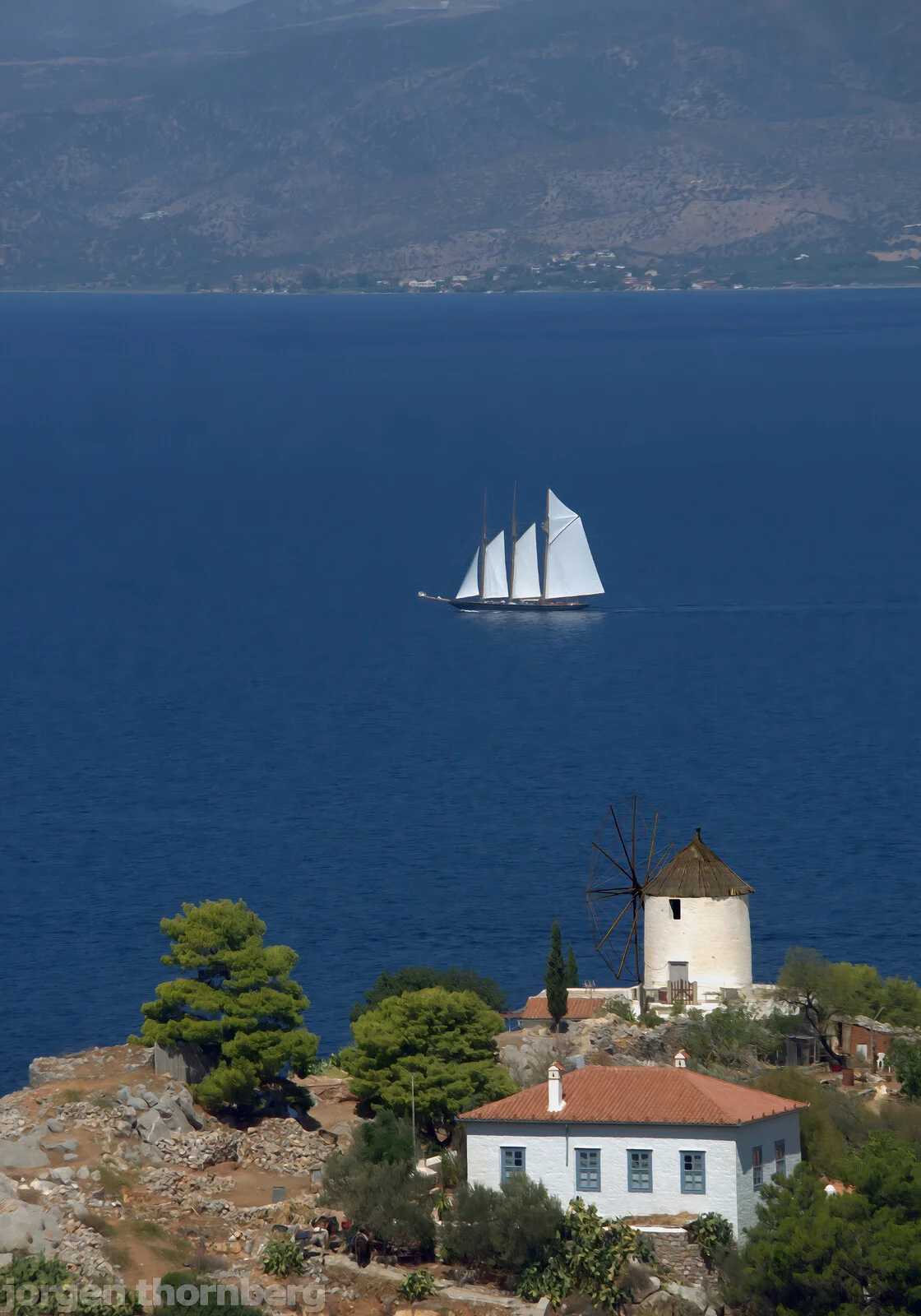
The Scooner Saving Greece, 2020
Digital
50 x 70 cm
The Flying Dutchman
In the shadowed seas where legends dwell,
Sails the Flying Dutchman, bound by a spell,
With Captain Van der Decken at the wheel,
On endless quests, through storms of steel.
Through tempests wild and storms so fierce,
He steers his course with naught to pierce,
The wind’s defiance, the ocean’s rage,
Locked in time forever, he turns no page.
He once commanded a Fluyt, so old,
With timber worn and stories told,
But tired of creaks and splintered beams,
He traded up to a schooner of dreams.
No haven calls, no port’s embrace,
Only mist and waves to trace,
For a vow he made with an iron will,
It keeps him bound, forever still.
He bought a sleek three-masted ship so fast,
To outrun storms and winds that blast,
He left the Fluyt to flames and strife,
To burn the Turks and claim their life.
The Turkish admiral, with pride and might,
Met his destiny in a fiery light,
As the old Fluyt roared and flared,
The seas engulfed the foe, unspared.
Now, with a modern schooner’s grace,
Van der Decken sets his pace,
The Flying Dutchman, swift and keen,
Haunts the seas, forever unseen.
The new ship now bears the name,
Swift and silent, without shame,
Yet in the mist, his fate remains,
Chasing winds with ghostly chains.
But though his ship has changed its form,
His fate remains through every storm,
Chasing winds, defying death,
Till the end of time steals his final breath.
Through Hydra’s strait, by moonlight’s gleam,
He slipped unseen, like a fading dream,
An endless voyage, night and day,
The Flying Dutchman finds no bay.
And as the years, like waves, roll on,
His legend grows, though he's long gone,
For Van der Decken’s tale won’t cease,
Until his soul finds final peace.
Hydra, August 2024
The three-masted schooner depicted in the image is a fascinating vessel, living up to its name with three masts, all rigged with sails set lengthwise along the ship. This unique 'fore-and-aft' rigging allows the schooner to sail closer to the wind, showcasing its versatility. These schooners, often called 'Tern schooners,' were highly esteemed in the late 19th and early 20th centuries for their speed, agility, and ability to sail well, even when the wind came from the front. They were used for many purposes, including fishing, transporting goods, and leisure sailing. Notably, ships with two masts were more prevalent around Greece’s fight for independence in 1821. The three-masted schooner was a marvel of maritime engineering, with each mast supporting a different set of sails, allowing for more speed and manoeuvrability.
Less known is that Van der Decken, the legendary captain of the infamous ghost ship, the Flying Dutchman, upgraded his vessel to a three-masted schooner during the Greek War of Independence. This change had fatal consequences for the Turks and their admiral, Nasuhzade Ali Pasha. Read on to learn how the ghostly captain ended up near Hydra—it’s a truly spooky story.
In their quest to rid themselves of the Turks, some Greeks were willing to make deals with the devil himself if necessary. This wasn’t far from striking a bargain with a ghostly captain. Before the naval battle off Chios in 1822 and the burning of the Ottoman flagship, Andreas Pipinos, a native of Hydra and a respected naval captain, and Van der Decken met at a harbour tavern in Piraeus. It's a common misconception that the ghost captain was always at sea. Anyone could figure out that sailors need to come ashore from time to time. Even a ghostly crew requires supplies and a few pints of beer. In any case, Van der Decken found himself in the company of Captain Pipinos, and they discovered they had similar feelings about the Turks—very negative ones. The same went for the Spaniards, who had also humiliated the Flying Dutchman and its crew by firing upon them unprovoked, as Van der Decken merely tried to navigate Table Bay, not attack ships. While the old ghost ship was unsinkable, cannon holes didn’t mend themselves, and the vessel became increasingly drafty. After a few beers, the ghostly captain lamented how tired he was of his old ship, a 17th-century cargo vessel known as a 'Fluyt.' Pipinos was astonished at how one could still sail such an ancient tub.
"It's a long story," sighed Van der Decken.
"I'm in no rush, and the beer is good," Pipinos replied.
"Okay, but let this stay between us." The ghostly captain recounted that he was a staunch seaman who would have his way despite any force, including the devil. Even so, none of his sailors ever had reason to complain. Once, while rounding the Cape, he and his ship spent a long day trying to weather Table Bay. However, the wind grew stronger against them, making passing impossible. Van der Decken walked the deck, swearing at the wind. Just after sunset, the captain of a passing vessel called out to him, asking if he didn’t intend to anchor in the bay that night. Van der Decken replied: "May I be eternally damned if I do, though I should beat about here till the day of judgment." And so it was.
"And you can be certain I would never yield to a wind. I never did go into that bay that night, nor any other night, and I decided to challenge all winds, which I still do. But I need a new and faster ship because I swear that's where the problem lies. A boat like yours would do nicely," said Van der Decken.
Pipinos had boasted about his three-masted schooner, how fast and manoeuvrable it was, with an easy-to-manage rig that didn’t require a large crew. It wasn’t for sale, but why not if he got a reasonable offer? The war chest needed replenishing, and Pipinos had other boats. When asked how much a three-masted schooner would cost, he had said between 23 and 40 kilograms of gold, exaggerating to the point of embarrassment. He didn’t think the question was serious; after all, why would a notorious ghost captain change his ship’s silhouette after a few hundred years? The spooky 17th-century Fluyt was an established brand, so to speak.
"You'll get eighty kilograms for the whole lot," said Van der Decken, who had far more of the precious metal aboard his ship. There weren't many buried pirate treasures around the world that he hadn't already dug up. The best proof is that no one has found anything despite maps with Xs indicating where the treasure is buried. The offer was a considerable sum, representing a significant investment, even for governments. Pipinos could buy four similar ships or a much larger warship with plenty of cannons with the money.
The offer was for everything—lock, stock, and barrel—and the next day, Pipinos delivered the ship with rigging, sails, basic outfitting, and supplies necessary for the crew. The only thing not included was the ship's cannons, better needed in the war for independence. Besides, cannons were unnecessary on a peaceful ghost ship, which was now so fast that Van der Decken could easily outrun aggressive Turks and Spaniards in his eternal chase of defiant winds.
As a bonus, Pipinos received the ghost captain’s old, extremely worn Flying Dutchman. While the Fluyt wasn’t of much use as a warship by discerning standards, it was perfect as a fireship. With so much old, dry, tar-impregnated wood and rigging, it promised to be a spectacular blaze. And so it was—two thousand Turkish sailors were killed or drowned on the spot, including the admiral of the Ottoman navy, Ali Pasha, when the 84-gun ship exploded. Van der Decken missed the Turkish bonfire because he was already halfway to Cape Town for another attempt to sail directly into the wind.
Since the ship swap, confirmed sightings of the Flying Dutchman have significantly decreased. The ship passing outside Hydra this morning looked far too modern and wasn’t flying the old Dutch naval flag that the ghost captain was always careful to keep hoisted on the aft mast.
Perhaps the sightings were reduced because the new, modern ship's silhouette didn’t attract as much attention as a seventeenth-century vessel appearing out of the mist. After all, that was Captain Van der Decken’s signature move—only showing up in foul weather with poor visibility. Moreover, modern technology like radar likely filters out questionable sightings. Still, from time to time, mysterious radar echoes appear with no other explanation than that it was Van der Decken and his Flying Dutchman passing by in the fog.
The full-rigged ship, a vessel with three or more masts carrying square sails on all of them, is a marvel of maritime history. The German ship Preussen, a shining example of a full-rigged ship with five masts, was built in the early 20th century. Some full-rigged ships even boasted four masts. Other renowned full-rigged ships include the Cutty Sark, the Flying Cloud, and the Great Republic, each contributing to the rich tapestry of naval history.
Another intriguing type of ship is the 'Barque,' which has at least three masts. However, it stands out with its unique feature of having only fore-and-aft sails on its rearmost mast, while the other masts are adorned with square sails. This distinctive design sets the barque apart in the world of sailing ships.
Schooners usually have at least two masts, both rigged with fore-and-aft sails. But even if they have some square sails, they can still be classified as schooners. To be a schooner, the tallest mast on a two-masted ship must be in the back. The boat is considered a ketch if it has a shorter mast in the front and a yawl if it has a shorter mast in the back. Some schooners were built with as many as seven masts.
A "brig" is always a two-masted sailing vessel that carries square sails on both masts. It started as a type of "brigantine" but evolved into its style by the late 18th century. The key difference is that a brig has a square mainsail, while a brigantine has a fore-and-aft mainsail.
As a ship grows, its masts must be taller to hold more sails and capture more wind power to move the boat. However, taller masts also make the vessels lean more to the side when the wind blows, which can be a problem unless the ship’s keel (the bottom part of the boat) is made heavier or deeper to balance it. But a heavier, deeper keel can make the ship more expensive and slow it down by increasing drag in the water.
Shipbuilders often add more masts instead of making them taller to increase the sail area without making the ship more prone to tipping. Adding more masts allows the crew to adjust the sails to keep the boat steady and make it more manageable to steer.
In summary, designing and building a sailing ship involves many trade-offs, but adding more masts is one way to make a ship faster and more stable without making it harder to control. As is evident, being a shipbuilder is not easy.
If the centre of force is too far forward on the vessel, pointing into the wind becomes more challenging. Conversely, pointing away from the wind becomes trickier if it is too far aft. Therefore, moving the centre of force further aft makes it easier to point into the wind, and moving the centre of force farther forward makes it easier to point away from the wind.
How fast can these types of ships sail? The answer is simple and has been known for millennia: All sailboats have displacement-type hulls, and as such, their maximum speed is 1.34 times the square root of their length on the waterline in feet, which gives you the maximum speed in knots.
This is because, at that speed, the hull sits between the bow and the stern wave. To exceed that speed, the vessel must start climbing the bow wave, which requires flat buttock lines aft of midship. This speed, known as the 'displacement speed ', is a vessel's maximum speed without climbing the bow wave.
This is why, incidentally, modern racing yachts have wide and relatively flat sterns. When sailing downwind with a spinnaker or gennaker, they exceed the displacement speed a bit.
Hence, the longer the hull, the faster it can sail. Also, remember that a hull is twice as long as four times its wet surface and drag because of the square and eight times its displacement because of the cubic. This is why bigger boats can withstand stronger winds and need to reef later.
How many crew members would be required to sail a 2-masted, 52-foot-long Greek schooner in 1827 with two cannons? That depends on whether it’s wartime or not. In regular commercial traffic, the crew size was reduced to a minimum to increase profits. Sometimes, this led to disaster when the crew wasn’t sufficient during rough weather, causing the boat to capsize.
There was a rule of thumb: the Captain, 1st Lieutenant, master, gunner, carpenter, plus two mates each for the master, gunner, boatswain, carpenter, and purser—the number multiplied by the size of the boat, especially with the number of cannons. In the early 19th century, during the liberation war, it took up to twelve men to operate a muzzle-loading cannon; the number varied depending on the size of the cannon. This included two gunners, rammers (who pushed the black powder charges and cannonballs into the barrel), swabbers (who washed out the burning embers with wet sponges), trainers (who pulled the ropes to aim the gun), and, of course, powder monkeys (children who carried the black powder from the ship’s magazine) and then bigger monkeys to carry the heavy cannonballs.
Gun crews on a smaller Hydra ship with two guns could be fewer—about 8 per gun whether carronades or long guns were employed—so 16 for that, plus an additional ten or so other “waisters". A "waister" onboard a ship was a term historically used to describe an unskilled or less experienced crew member assigned to work in the waist of the ship. The waist is the centre of the ship's deck, between the forecastle in the front and the quarterdeck in the rear.
Waisters were typically less skilled than more experienced sailors and were often given menial or less demanding tasks. They might have been older seamen past their prime, young and inexperienced sailors, or less physically capable individuals. The term is outdated and was more commonly used during the Age of Sail.
A smaller Hydra schooner typically had two main fore-and-aft rigged masts and a flush upper deck. The guns would all be housed on the upper deck, so they were lighter, perhaps 6 or 8-pounders, and could be manned by a team of 4–5 men.
The ship would require a complement large enough to handle at least one broadside and have enough left over to sail the ship in the case of an attack. You’re looking at a range of around 20 to 70 seamen. A captain and a few petty officers would bring the complement up another five men.
Terpsichore was an armed 2-masted schooner laid down in 1816 on the island of Hydra and launched in 1818, three years before the independence war started. She was 27.45 meters long and had a burden of 256 tons, not particularly large but not small either, and as it would turn out, capable of inflicting significant damage on the Turkish enemy. The Turks allowed the Greeks to build and sail smaller merchant vessels, but none larger than brigs.
Terpsichore’s owners were the brothers Emmanuel and Jacob Tombazis from Hydra. Besides being a successful merchant, Jacob Tombazis studied naval engineering and design in Portsmouth until 1816. He secretly copied the lines of a captured American schooner, Lynx, which was then a modern design.
When England, France, and Russia joined forces with the Greeks in 1820 to help free the country, one of the main concerns was building a fleet capable of countering the mighty Turkish one. Most Greek shipowners joined forces and armed their vessels. The Tombazis brothers sailed Terpsichore to France to buy guns; they purchased six 12-pounder guns and one huge 48-pounder from 1680.
This was not cheap; the shipowners had to cover these investments themselves before the war. Once the war began in earnest, the central provisional government bore a significant portion of the costs. However, just keeping a ship operational was incredibly expensive. For example, the supply of Terpsichore with necessities such as gunpowder, lead, iron for the cannons, peas, tar, wood, nails, cannonballs, cork for the parapet, needles to sew the sails and sailcloth, and, in addition to keeping the crew in good spirits, plenty of wine, meat, bread, rusk, barley, wheat, cheese, rice, coffee, and sugar, and last but not least, money for the sailors’ salaries, was essential. The crew consisted of regular seamen who worked for their livelihood, not dedicated revolutionaries working for free. They risked their lives without any extra compensation. Such were the times.
But income could be supplemented. During long patrols around the Aegean, it became clear that these patrol duties included acts of piracy as an easy and efficient way of finding supplies and boosting salaries. This was nothing new for the Hydriots, who had mastered that trade for decades.
Such raids produced spoils and, therefore, wealth, which was divided into three shares: One share went to the central provisional government for the needs of the war, another part was given to the Church, which always ensured it had a stake, and the third was divided proportionally between the commander of the ship, usually the shipowner, the sailors, and the fighting men.
Additionally, you might have a captain's steward and a coxswain. They may be the same person. There would be a dedicated cook, a glorified water boiler, “assisted” by the mess cooks, who were members of each mess, both officers and enlisted men. As a rule, there would be four hands for each mast. There might also be a couple of ship boys who took on the job of running powder to the guns from the magazine when in action, applying nips to the messenger line of the captain when it was employed, hoisting yards, weighing anchors, and other such tasks. There might be as many as four. This assumes a naval vessel. A merchant vessel would have far fewer hands, depending on her role. For a merchant, a crew of fifteen would be considered “possible and economical.” And economical was something the Hydriot shipowners were known for. Just look at the grand houses and mansions they’ve left behind for the tourists' delight.
Jörgen Thornberg
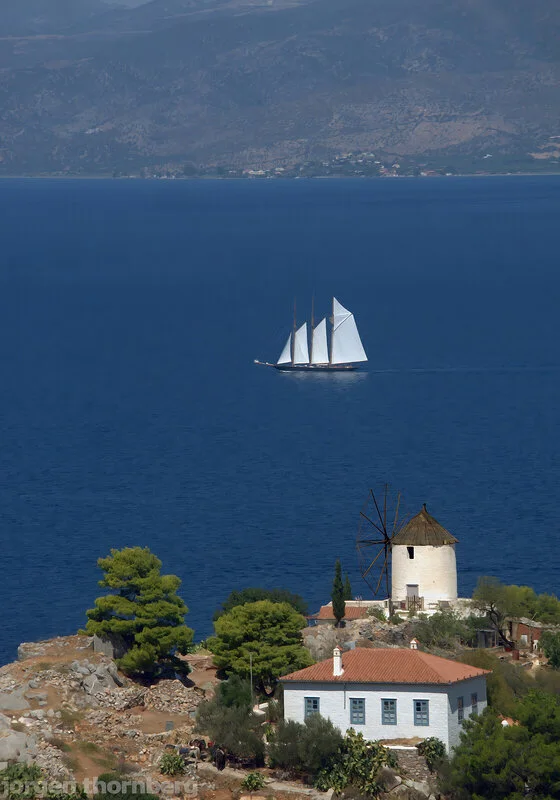
The Scooner Saving Greece, 2020
Digital
50 x 70 cm
The Flying Dutchman
In the shadowed seas where legends dwell,
Sails the Flying Dutchman, bound by a spell,
With Captain Van der Decken at the wheel,
On endless quests, through storms of steel.
Through tempests wild and storms so fierce,
He steers his course with naught to pierce,
The wind’s defiance, the ocean’s rage,
Locked in time forever, he turns no page.
He once commanded a Fluyt, so old,
With timber worn and stories told,
But tired of creaks and splintered beams,
He traded up to a schooner of dreams.
No haven calls, no port’s embrace,
Only mist and waves to trace,
For a vow he made with an iron will,
It keeps him bound, forever still.
He bought a sleek three-masted ship so fast,
To outrun storms and winds that blast,
He left the Fluyt to flames and strife,
To burn the Turks and claim their life.
The Turkish admiral, with pride and might,
Met his destiny in a fiery light,
As the old Fluyt roared and flared,
The seas engulfed the foe, unspared.
Now, with a modern schooner’s grace,
Van der Decken sets his pace,
The Flying Dutchman, swift and keen,
Haunts the seas, forever unseen.
The new ship now bears the name,
Swift and silent, without shame,
Yet in the mist, his fate remains,
Chasing winds with ghostly chains.
But though his ship has changed its form,
His fate remains through every storm,
Chasing winds, defying death,
Till the end of time steals his final breath.
Through Hydra’s strait, by moonlight’s gleam,
He slipped unseen, like a fading dream,
An endless voyage, night and day,
The Flying Dutchman finds no bay.
And as the years, like waves, roll on,
His legend grows, though he's long gone,
For Van der Decken’s tale won’t cease,
Until his soul finds final peace.
Hydra, August 2024
The three-masted schooner depicted in the image is a fascinating vessel, living up to its name with three masts, all rigged with sails set lengthwise along the ship. This unique 'fore-and-aft' rigging allows the schooner to sail closer to the wind, showcasing its versatility. These schooners, often called 'Tern schooners,' were highly esteemed in the late 19th and early 20th centuries for their speed, agility, and ability to sail well, even when the wind came from the front. They were used for many purposes, including fishing, transporting goods, and leisure sailing. Notably, ships with two masts were more prevalent around Greece’s fight for independence in 1821. The three-masted schooner was a marvel of maritime engineering, with each mast supporting a different set of sails, allowing for more speed and manoeuvrability.
Less known is that Van der Decken, the legendary captain of the infamous ghost ship, the Flying Dutchman, upgraded his vessel to a three-masted schooner during the Greek War of Independence. This change had fatal consequences for the Turks and their admiral, Nasuhzade Ali Pasha. Read on to learn how the ghostly captain ended up near Hydra—it’s a truly spooky story.
In their quest to rid themselves of the Turks, some Greeks were willing to make deals with the devil himself if necessary. This wasn’t far from striking a bargain with a ghostly captain. Before the naval battle off Chios in 1822 and the burning of the Ottoman flagship, Andreas Pipinos, a native of Hydra and a respected naval captain, and Van der Decken met at a harbour tavern in Piraeus. It's a common misconception that the ghost captain was always at sea. Anyone could figure out that sailors need to come ashore from time to time. Even a ghostly crew requires supplies and a few pints of beer. In any case, Van der Decken found himself in the company of Captain Pipinos, and they discovered they had similar feelings about the Turks—very negative ones. The same went for the Spaniards, who had also humiliated the Flying Dutchman and its crew by firing upon them unprovoked, as Van der Decken merely tried to navigate Table Bay, not attack ships. While the old ghost ship was unsinkable, cannon holes didn’t mend themselves, and the vessel became increasingly drafty. After a few beers, the ghostly captain lamented how tired he was of his old ship, a 17th-century cargo vessel known as a 'Fluyt.' Pipinos was astonished at how one could still sail such an ancient tub.
"It's a long story," sighed Van der Decken.
"I'm in no rush, and the beer is good," Pipinos replied.
"Okay, but let this stay between us." The ghostly captain recounted that he was a staunch seaman who would have his way despite any force, including the devil. Even so, none of his sailors ever had reason to complain. Once, while rounding the Cape, he and his ship spent a long day trying to weather Table Bay. However, the wind grew stronger against them, making passing impossible. Van der Decken walked the deck, swearing at the wind. Just after sunset, the captain of a passing vessel called out to him, asking if he didn’t intend to anchor in the bay that night. Van der Decken replied: "May I be eternally damned if I do, though I should beat about here till the day of judgment." And so it was.
"And you can be certain I would never yield to a wind. I never did go into that bay that night, nor any other night, and I decided to challenge all winds, which I still do. But I need a new and faster ship because I swear that's where the problem lies. A boat like yours would do nicely," said Van der Decken.
Pipinos had boasted about his three-masted schooner, how fast and manoeuvrable it was, with an easy-to-manage rig that didn’t require a large crew. It wasn’t for sale, but why not if he got a reasonable offer? The war chest needed replenishing, and Pipinos had other boats. When asked how much a three-masted schooner would cost, he had said between 23 and 40 kilograms of gold, exaggerating to the point of embarrassment. He didn’t think the question was serious; after all, why would a notorious ghost captain change his ship’s silhouette after a few hundred years? The spooky 17th-century Fluyt was an established brand, so to speak.
"You'll get eighty kilograms for the whole lot," said Van der Decken, who had far more of the precious metal aboard his ship. There weren't many buried pirate treasures around the world that he hadn't already dug up. The best proof is that no one has found anything despite maps with Xs indicating where the treasure is buried. The offer was a considerable sum, representing a significant investment, even for governments. Pipinos could buy four similar ships or a much larger warship with plenty of cannons with the money.
The offer was for everything—lock, stock, and barrel—and the next day, Pipinos delivered the ship with rigging, sails, basic outfitting, and supplies necessary for the crew. The only thing not included was the ship's cannons, better needed in the war for independence. Besides, cannons were unnecessary on a peaceful ghost ship, which was now so fast that Van der Decken could easily outrun aggressive Turks and Spaniards in his eternal chase of defiant winds.
As a bonus, Pipinos received the ghost captain’s old, extremely worn Flying Dutchman. While the Fluyt wasn’t of much use as a warship by discerning standards, it was perfect as a fireship. With so much old, dry, tar-impregnated wood and rigging, it promised to be a spectacular blaze. And so it was—two thousand Turkish sailors were killed or drowned on the spot, including the admiral of the Ottoman navy, Ali Pasha, when the 84-gun ship exploded. Van der Decken missed the Turkish bonfire because he was already halfway to Cape Town for another attempt to sail directly into the wind.
Since the ship swap, confirmed sightings of the Flying Dutchman have significantly decreased. The ship passing outside Hydra this morning looked far too modern and wasn’t flying the old Dutch naval flag that the ghost captain was always careful to keep hoisted on the aft mast.
Perhaps the sightings were reduced because the new, modern ship's silhouette didn’t attract as much attention as a seventeenth-century vessel appearing out of the mist. After all, that was Captain Van der Decken’s signature move—only showing up in foul weather with poor visibility. Moreover, modern technology like radar likely filters out questionable sightings. Still, from time to time, mysterious radar echoes appear with no other explanation than that it was Van der Decken and his Flying Dutchman passing by in the fog.
The full-rigged ship, a vessel with three or more masts carrying square sails on all of them, is a marvel of maritime history. The German ship Preussen, a shining example of a full-rigged ship with five masts, was built in the early 20th century. Some full-rigged ships even boasted four masts. Other renowned full-rigged ships include the Cutty Sark, the Flying Cloud, and the Great Republic, each contributing to the rich tapestry of naval history.
Another intriguing type of ship is the 'Barque,' which has at least three masts. However, it stands out with its unique feature of having only fore-and-aft sails on its rearmost mast, while the other masts are adorned with square sails. This distinctive design sets the barque apart in the world of sailing ships.
Schooners usually have at least two masts, both rigged with fore-and-aft sails. But even if they have some square sails, they can still be classified as schooners. To be a schooner, the tallest mast on a two-masted ship must be in the back. The boat is considered a ketch if it has a shorter mast in the front and a yawl if it has a shorter mast in the back. Some schooners were built with as many as seven masts.
A "brig" is always a two-masted sailing vessel that carries square sails on both masts. It started as a type of "brigantine" but evolved into its style by the late 18th century. The key difference is that a brig has a square mainsail, while a brigantine has a fore-and-aft mainsail.
As a ship grows, its masts must be taller to hold more sails and capture more wind power to move the boat. However, taller masts also make the vessels lean more to the side when the wind blows, which can be a problem unless the ship’s keel (the bottom part of the boat) is made heavier or deeper to balance it. But a heavier, deeper keel can make the ship more expensive and slow it down by increasing drag in the water.
Shipbuilders often add more masts instead of making them taller to increase the sail area without making the ship more prone to tipping. Adding more masts allows the crew to adjust the sails to keep the boat steady and make it more manageable to steer.
In summary, designing and building a sailing ship involves many trade-offs, but adding more masts is one way to make a ship faster and more stable without making it harder to control. As is evident, being a shipbuilder is not easy.
If the centre of force is too far forward on the vessel, pointing into the wind becomes more challenging. Conversely, pointing away from the wind becomes trickier if it is too far aft. Therefore, moving the centre of force further aft makes it easier to point into the wind, and moving the centre of force farther forward makes it easier to point away from the wind.
How fast can these types of ships sail? The answer is simple and has been known for millennia: All sailboats have displacement-type hulls, and as such, their maximum speed is 1.34 times the square root of their length on the waterline in feet, which gives you the maximum speed in knots.
This is because, at that speed, the hull sits between the bow and the stern wave. To exceed that speed, the vessel must start climbing the bow wave, which requires flat buttock lines aft of midship. This speed, known as the 'displacement speed ', is a vessel's maximum speed without climbing the bow wave.
This is why, incidentally, modern racing yachts have wide and relatively flat sterns. When sailing downwind with a spinnaker or gennaker, they exceed the displacement speed a bit.
Hence, the longer the hull, the faster it can sail. Also, remember that a hull is twice as long as four times its wet surface and drag because of the square and eight times its displacement because of the cubic. This is why bigger boats can withstand stronger winds and need to reef later.
How many crew members would be required to sail a 2-masted, 52-foot-long Greek schooner in 1827 with two cannons? That depends on whether it’s wartime or not. In regular commercial traffic, the crew size was reduced to a minimum to increase profits. Sometimes, this led to disaster when the crew wasn’t sufficient during rough weather, causing the boat to capsize.
There was a rule of thumb: the Captain, 1st Lieutenant, master, gunner, carpenter, plus two mates each for the master, gunner, boatswain, carpenter, and purser—the number multiplied by the size of the boat, especially with the number of cannons. In the early 19th century, during the liberation war, it took up to twelve men to operate a muzzle-loading cannon; the number varied depending on the size of the cannon. This included two gunners, rammers (who pushed the black powder charges and cannonballs into the barrel), swabbers (who washed out the burning embers with wet sponges), trainers (who pulled the ropes to aim the gun), and, of course, powder monkeys (children who carried the black powder from the ship’s magazine) and then bigger monkeys to carry the heavy cannonballs.
Gun crews on a smaller Hydra ship with two guns could be fewer—about 8 per gun whether carronades or long guns were employed—so 16 for that, plus an additional ten or so other “waisters". A "waister" onboard a ship was a term historically used to describe an unskilled or less experienced crew member assigned to work in the waist of the ship. The waist is the centre of the ship's deck, between the forecastle in the front and the quarterdeck in the rear.
Waisters were typically less skilled than more experienced sailors and were often given menial or less demanding tasks. They might have been older seamen past their prime, young and inexperienced sailors, or less physically capable individuals. The term is outdated and was more commonly used during the Age of Sail.
A smaller Hydra schooner typically had two main fore-and-aft rigged masts and a flush upper deck. The guns would all be housed on the upper deck, so they were lighter, perhaps 6 or 8-pounders, and could be manned by a team of 4–5 men.
The ship would require a complement large enough to handle at least one broadside and have enough left over to sail the ship in the case of an attack. You’re looking at a range of around 20 to 70 seamen. A captain and a few petty officers would bring the complement up another five men.
Terpsichore was an armed 2-masted schooner laid down in 1816 on the island of Hydra and launched in 1818, three years before the independence war started. She was 27.45 meters long and had a burden of 256 tons, not particularly large but not small either, and as it would turn out, capable of inflicting significant damage on the Turkish enemy. The Turks allowed the Greeks to build and sail smaller merchant vessels, but none larger than brigs.
Terpsichore’s owners were the brothers Emmanuel and Jacob Tombazis from Hydra. Besides being a successful merchant, Jacob Tombazis studied naval engineering and design in Portsmouth until 1816. He secretly copied the lines of a captured American schooner, Lynx, which was then a modern design.
When England, France, and Russia joined forces with the Greeks in 1820 to help free the country, one of the main concerns was building a fleet capable of countering the mighty Turkish one. Most Greek shipowners joined forces and armed their vessels. The Tombazis brothers sailed Terpsichore to France to buy guns; they purchased six 12-pounder guns and one huge 48-pounder from 1680.
This was not cheap; the shipowners had to cover these investments themselves before the war. Once the war began in earnest, the central provisional government bore a significant portion of the costs. However, just keeping a ship operational was incredibly expensive. For example, the supply of Terpsichore with necessities such as gunpowder, lead, iron for the cannons, peas, tar, wood, nails, cannonballs, cork for the parapet, needles to sew the sails and sailcloth, and, in addition to keeping the crew in good spirits, plenty of wine, meat, bread, rusk, barley, wheat, cheese, rice, coffee, and sugar, and last but not least, money for the sailors’ salaries, was essential. The crew consisted of regular seamen who worked for their livelihood, not dedicated revolutionaries working for free. They risked their lives without any extra compensation. Such were the times.
But income could be supplemented. During long patrols around the Aegean, it became clear that these patrol duties included acts of piracy as an easy and efficient way of finding supplies and boosting salaries. This was nothing new for the Hydriots, who had mastered that trade for decades.
Such raids produced spoils and, therefore, wealth, which was divided into three shares: One share went to the central provisional government for the needs of the war, another part was given to the Church, which always ensured it had a stake, and the third was divided proportionally between the commander of the ship, usually the shipowner, the sailors, and the fighting men.
Additionally, you might have a captain's steward and a coxswain. They may be the same person. There would be a dedicated cook, a glorified water boiler, “assisted” by the mess cooks, who were members of each mess, both officers and enlisted men. As a rule, there would be four hands for each mast. There might also be a couple of ship boys who took on the job of running powder to the guns from the magazine when in action, applying nips to the messenger line of the captain when it was employed, hoisting yards, weighing anchors, and other such tasks. There might be as many as four. This assumes a naval vessel. A merchant vessel would have far fewer hands, depending on her role. For a merchant, a crew of fifteen would be considered “possible and economical.” And economical was something the Hydriot shipowners were known for. Just look at the grand houses and mansions they’ve left behind for the tourists' delight.

Jörgen Thornberg
Malmö
Lite om bilder och mig. Translation in English at the end.
Jag är en nyfiken person som ser allt i bilder, även det jag fäster i ord, gärna tillsammans för bakom alla mina bilder finns en berättelse. Till vissa bilder hör en kortare eller längre novell som följer med bilden.
Bilder berättar historier. Jag omges av naturlig skönhet, intressanta människor och historia var jag än går. Jag använder min kamera för att dokumentera världen och blanda det jag ser med vad jag känner för att fånga den dolda magin.
Mina bilder berättar mina historier. Genom mina bilder, tryck och berättelser. Jag bjuder in dig att ta del av dessa berättelser, in i ditt liv och hem och dela min mycket personliga syn på vår värld. Mer än vad ögat ser. Jag tänker i bilder, drömmer och skriver och pratar om dem; följaktligen måste jag också skapa bilder. De blir vad jag ser, inte nödvändigtvis begränsade till verkligheten. Det finns en bild runt varje hörn. Jag hoppas att du kommer att se vad jag såg och gilla det.
Jag är också en skrivande person och till många bilder hör en kortare eller längre essay. Den följer med tavlan, tryckt på fint papper och med en personlig hälsning från mig.
Flertalet bilder startar sin resa i min kamera. Enkelt förklarat beskriver jag bilden jag ser i mitt inre, upplevd eller fantiserad. Bilden uppstår inom mig redan innan jag fått okularet till ögat. På bråkdelen av ett ögonblick ser jag vad jag vill ha och vad som kan göras med bilden. Här skall jag stoppa in en giraff, stålmannen, Titanic eller vad det är min fantasi finner ut. Ännu märkligare är att jag kommer ihåg minnesbilden långt efteråt när det blir tid att skapa verket. Om jag lyckas eller inte, är upp till betraktaren, oftast präglat av en stråk av svart humor – meningen är att man skall bli underhållen. Mina bilder blir ofta en snackis där de hänger.
Jag föredrar bilder som förmedlar ett budskap i flera lager. Vid första anblicken fylld av feel-good, en vacker utsikt, fint väder, solen skiner, blommor på ängen eller vattnet som ligger förrädiskt spegelblankt. I en sådan bild kan jag gömma min egentliga berättelse, mitt förakt för förtryckare och våldsverkare, rasister och fördomsfulla människor - ett gärna återkommande motiv mer eller mindre dolt i det vackra motivet. Jag försöker förena dem i ett gemensamt narrativ.
Bild och formgivning har löpt som en röd tråd genom livet. Fotokonst känns som en värdig final som jag gärna delar med mig.
Min genre är vid som framgår av mina bilder, temat en blandning av pop- och gatukonst i kollage som kan bestå av hundratals lager. Vissa bilder kan ta veckor, andra någon dag innan det är dags att överlämna resultatet till printverkstaden. Fine Art Prints är digitala fotocollage. I dessa kollage sker rivandet, klippandet, pusslandet, målandet, ritandet och sprayningen digitalt. Det jag monterar in kan vara hundratals år gamla bilder som jag omsorgsfullt frilägger så att de ser ut att vara en del av tavlan men också bilder skapade av mig själv efter min egen fantasi. Därefter besöks printstudion och för vissa bilder numrera en limiterad upplaga (oftast 7 exemplar) och signera för hand. Vissa bilder kan köpas i olika format. Det är bara att fråga efter vilka. Gillar man en bild som är 70x100 men inte har plats på väggen, går den kanske att få i 50x70 cm istället. Frågan är fri.
Metoden Giclée eller Fine Art Print som det också kallas är det moderna sättet för framställning av grafisk konst. Villkoret för denna typ av utskrifter är att en högkvalitativ storformatskrivare används med åldersbeständigt färgpigment och konstnärspapper eller i förekommande fall på duk. Pappret som används möter de krav på livslängd som ställs av museer och gallerier. Normalt säljer jag mina bilder oinramade så att den nya ägaren själv kan bestämma hur de skall se ut, med eller utan passepartout färg på ram, med eller utan glas etc..
Under många år ställde jag bara ut på nätet, i valda grupper och på min egen Facebooksida - https://www.facebook.com/jorgen.thornberg.9
Jag finns också på en egen hemsida som tyvärr inte alltid är uppdaterad – https://www.jth.life/ Där kan du också läsa en del av de berättelser som följer med bilden.
UTSTÄLLNINGAR
Luftkastellet, oktober 2022
Konst i Lund, november 2022
Luftkastellet, mars 2023
Engleson Galleri Caroli, april 2023
Hydra, Greece June 2023
Engleson Galleri Caroli, oktober 2023
Toppen, Höllviken december 2023
Luftkastellet, mars 2024
Torups Galleri, mars 2024
Venice, May 2024
Luftkastellet, oktober 2024
Konst i Advent, December 2024
Galleri Engleson, Caroli December 2024
Jäger & Jansson Galleri, april 2025
A bit about pictures and me.
I'm a curious person who sees everything in pictures, even what I express in words, often combining them, for behind all my pictures lies a story. These narratives, some as short as a single image and others as long as a novel, are the heart and soul of my work.
Pictures tell stories. Wherever I go, I'm surrounded by natural beauty, exciting people, and history. I use my camera to document the world and blend what I see with what I feel to capture the hidden magic.
My images tell my stories. Through my pictures, prints, and narratives, I invite you to partake in these stories in your life and home and share my deeply personal perspective of our world. More than meets the eye. I think in pictures, dream, write, and talk about them; consequently, I must create images too. They become what I see, not necessarily confined to reality. There's a picture around every corner. I hope you'll see what I saw and enjoy it.
I'm also a writer, and many images come with a shorter or longer essay. It accompanies the painting, printed on fine paper with my personal greeting.
Many pictures start their journey on my camera. Simply put, I describe the image I see in my mind, experienced or imagined. The image arises within me even before I bring the eyepiece to my eye. In a fraction of a moment, I see what I want and what can be done with the picture. Here, I'll insert a giraffe, Superman, the Titanic, or whatever my imagination conjures up. Even stranger is that I remember the mental image long after it's time to create the work. Whether I succeed is up to the observer, often imbued with a streak of black humour – the aim is to entertain. My pictures usually become a talking point wherever they hang.
I prefer pictures that convey a message in multiple layers. At first glance, they're filled with feel-good vibes, a beautiful view, lovely weather, the sun shining, flowers in the meadow, or the water lying deceptively calm. But beneath this surface beauty, I often conceal a deeper story, a narrative that challenges societal norms or explores the human condition. I invite you to delve into these hidden narratives and discover the layers of meaning within my work.
Picture and design have been a thread running through my life. Photographic art feels like a fitting finale, and I'm happy to share it.
My genre is varied, as seen in my pictures; the theme is a blend of pop and street art in collages that can consist of hundreds of layers. Some images can take weeks, others just a day before it's time to hand over the result to the print workshop. Fine Art Prints are digital photo collages. In these collages, tearing, cutting, puzzling, painting, drawing, and spraying happen digitally. What I insert can be images hundreds of years old that I carefully extract so they appear to be part of the painting, but also images created by myself, now also generated from my imagination. Next, visit the print studio and, for certain images, number a limited edition (usually 7 copies) and sign them by hand. Some images may be available in other formats. Just ask which ones. If you like an image that's 70x100 but doesn't have space on the wall, you might be able to get it in 50x70 cm instead. The question is open.
The Giclée method, or Fine Art Print as it's also called, is the modern way of producing graphic art. This method ensures the highest quality and longevity of the artwork, using a high-quality large-format printer with archival pigment inks and artist paper or, in some cases, canvas. The paper used meets the longevity requirements set by museums and galleries. I sell my pictures unframed, allowing the new owner to personalise their artwork, confident in the lasting value and quality of the piece.
For many years, I only exhibited online, in selected groups, and on my Facebook page - https://www.facebook.com/jorgen.thornberg.9. I also have my website, which unfortunately is not constantly updated - https://www.jth.life/. You can also read some of the stories accompanying the pictures there.
EXHIBITIONS
Luftkastellet, October 2022
Art in Lund, November 2022
Luftkastellet, March 2023
Engleson Gallery Caroli, April 2023
Hydra, Greece June 2023
Engleson Gallery Caroli, October 2023
Toppen, Höllviken December 2023
Luftkastellet, March 2024
Torup Gallery, March 2024
Venice, May 2024
UTSTÄLLNINGAR
Luftkastellet, oktober 2022
Konst i Lund, november 2022
Luftkastellet, mars 2023
Engleson Galleri Caroli, april 2023
Hydra, Greece June 2023
Engleson Galleri Caroli, oktober 2023
Toppen, Höllviken december 2023
Luftkastellet, mars 2024
Torups Galleri, mars 2024
Venice, May 2024
Luftkastellet, October 2024
Konst i Advent, December 2024
Galleri Engleson, Caroli December 2024
Jäger & Jansson Galleri, April 2025
Utbildning
Autodidakt
Medlem i konstnärsförening
Öppna Sinnen
Med i konstrunda
Konstrundan i Skåne
Utställningar
Luftkastellet, October 2022
Art in Lund, November 2022
Luftkastellet, March 2023
Engleson Gallery Caroli, April 2023
Hydra, Greece June 2023
Engleson Gallery Caroli, October 2023
Toppen, Höllviken December 2023
Luftkastellet, March 2024
Torup Gallery, March 2024
Venice, May 2024