Vi använder cookies för att ge dig bästa möjliga upplevelse. Välj vilka cookies du tillåter.
Läs mer i vår integritetspolicy
Jörgen Thornberg
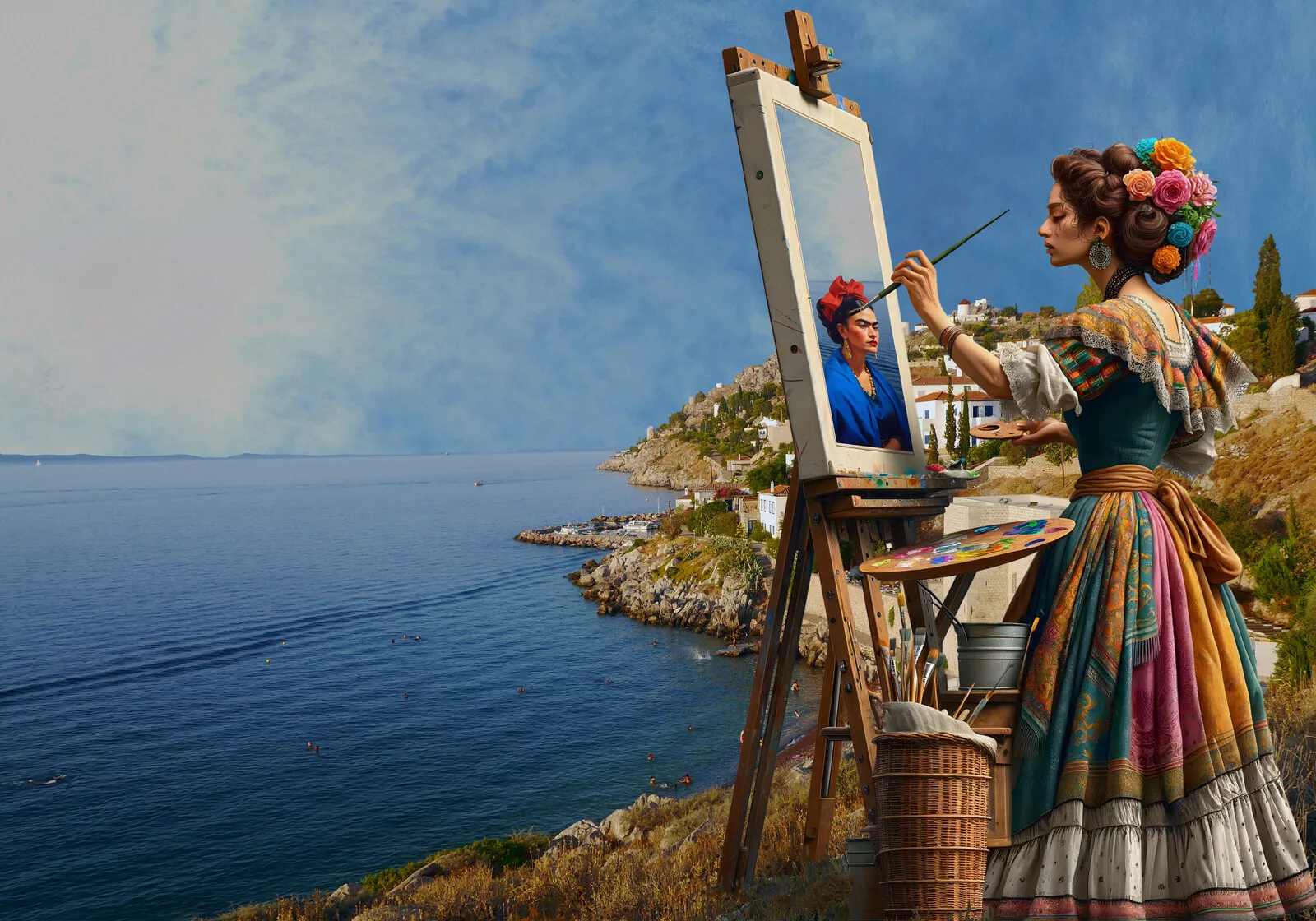
Frida, Blue on Blue, 2024
Digital
70 x 50 cm
A Tale of Lefties and Righties
In a world of left and right,
Where hands determine might,
The righties claim they’re in the lead,
But lefties chuckle at their creed.
Righties say, “We’ve got it best,
Our tools are made to pass the test,
Scissors, desks, and pens galore,
Are built for us; we don’t need more.”
But lefties grin, "Oh, don't you see?
Your world’s not quite for you or me!
We flip the script, we tilt the page,
In a right-hand world, we’re all the rage!"
When a righty grabs a fork to dine,
No problems and all fall in line,
But give a lefty that same tool,
Watch them break the dining rule!
A Righty opens up a door,
Easy peasy, nothing more,
But lefty tries, and—oh, dear me!
They pull, they push—what can it be?
Writing words from left to right,
Righties sail with pure delight,
But lefties leave an inky streak,
On every page—unique technique!
Some say that lefties think so bright,
Their brains a spark of genius light,
While righties claim, “We’re just as keen,
In fact, our minds are more serene!”
And what about the years we live?
Righties boast, “We’ve more to give!”
But lefties smile, “We’ve got our charm,
Our shorter lives still hold no harm!”
In sports, it’s quite a sight to see,
A lefty throws unpredictably,
Righties sweat, they’re caught off guard,
“Lefty’s pitch! This game is hard!”
Righty says, “Our world’s designed,
To suit us all, it’s well-aligned,”
But lefties wink, “We’ve got a flair,
For making do, we’ll get in there!”
In the end, what have we learned?
Lefties twist while righties turn,
Both have perks, both have flaws,
But life’s more fun with both because—
Whether left or right, you lean,
The world’s a place of in-between,
And when we mix, it’s clear to see,
That hands together make harmony!
Hydra, August 2024
When left is right
August 13th is International Left-Handers Day. If you didn’t celebrate it, then you can celebrate it today. As a left-hander, you can celebrate it every day of the year because it’s worth celebrating. Forget everything you thought you knew about left-handers, that it should be a handicap that must be trained away when everyone should be left-handed, like Frida Kahlo, the iconic Mexican painter. Like many other great artists throughout history, Frida was left-handed. Her paintings, which often explore identity, pain, and femininity, have left a significant mark on the art world.
Frida was the Queen of the self-portrait, a goddess or empress, the greatest of all. Her self-portraits were not just a significant part of her work but essential. At least a third of her total 150 paintings depicted herself. This was not without reason. Frida could express her suffering through her self-portraits, showing it to the world and allowing others to identify with it. Her paintings became a powerful medium for her pain, a way for her to refuse to hide her anxieties, which were integral to her life. Other artists, such as Rembrandt and Van Gogh, also depicted themselves in extreme conditions, leaving no doubt about their fragile mental health. But Frida's self-portraits were unique in their power to connect with others through art. Her art style, often characterised by vibrant colours, symbolic imagery, and a raw emotional intensity, left a significant mark on the art world. The title' Frida, Blue on Blue' refers to the emotional depth and complexity of her life and art, often delving into pain, identity, and femininity themes.
Frida’s life was, from the start, like a Greek drama. When she was 18, everything changed. The young medical student was out in the city with her boyfriend when they were involved in a terrible accident. The bus they were travelling in collided with a tram, and many people were injured, including Frida. The drama could have ended there, and the world would have lost a genius. But fate had other plans. Frida's abdomen was pierced by an iron bar in the accident. Seriously injured, she remained in the hospital for months and underwent thirty operations. She, who had set out to become a doctor and help others, had to live as a patient for the rest of her life. Yet, she rose above her circumstances and found a new way to heal and inspire through her art.
Frida Kahlo was born Magdalena Frida Carmen Kahlo y Calderón in Coyoacán, Mexico. But she dropped all names except Frida and Kahlo when she decided to become an artist after she no longer could become a doctor.
Even her birth was a dramatic event—Frida always manages to surprise us! Her birth certificate states that she was born on July 6, 1907, but she insisted that she was born on July 7th, three years later, in 1910. This date was not chosen randomly, nor was it a youthful whim, as many women might do. Frida's choice of birthdate was deeply political. It coincided with the start of the Mexican Revolution, a decade-long struggle for social and political change. This choice reflects Frida's deep connection to her country and strong patriotism. She saw herself as the voice of the oppressed, a role she would later embody in her art.
Before taking up painting, Frida had dreamed of becoming a doctor and being able to help her fellow human beings. Her father, an established photographer, had already given her an interest in the arts, although this remained secondary. An excellent student, her life was turned upside down by illness—the drama began early. At the age of six, Frida was diagnosed with polio and partially lost the use of her right leg, and her foot stopped growing. Her classmates nicknamed her ‘Frida la coja,’ Frida the lame. But nothing could stop her. At sixteen, she entered a prestigious Mexican school. She was a talented girl, one of thirty-five accepted out of two thousand applicants, and naturally, almost the only woman.
In 1928, as her health gradually improved, Frida Kahlo fearlessly joined the Mexican Communist Party, a bold move amid the country's unstable politics. Her decision to offer political asylum to the communist revolutionary Leon Trotsky and his wife in 1937 further exemplified her courage.
Her primary interest was feminism; she wanted to defend the status and emancipation of Mexican women. In this macho society, she wanted to be the voice of all silent, oppressed, and submissive women. Privately, Frida was far from an object and did not hesitate to flaunt her bisexuality publicly.
Frida's love life was a testament to her resilience. Despite the challenges she faced, including her husband's infidelity, she remained strong and committed to her art and her beliefs. Her unwavering commitment to her principles, her refusal to compromise her values for anyone or anything, is a source of inspiration for many, a reminder that staying true to oneself is the ultimate victory.
If Frida had many names, they were nothing compared to Diego. Her husband, Diego Rivera, filled out half a passport: Diego María de la Concepción Juan Nepomuceno Estanislao de la Rivera y Barrientos Acosta y Rodríguez.
But Frida was no less daring and had numerous affairs. She is said to have had an affair with Leon Trotsky before Stalin's henchmen murdered him with an ice axe. But that wasn't all. Frida is also said to have dated Josephine Baker, the one with bananas as a skirt.
Frida was already a pioneer in many ways in the mid-twentieth-century cultural world, promiscuous and free of all complexes.
By definition, Frida Kahlo was a unique and beautiful woman. Those who see her as a ragged woman with little elegance should reconsider, for she is a true beauty icon in Mexico. Her individuality and strength shine through, making her a true icon of individuality and beauty. Her features, from her unibrow to her vibrant style, make her a true beauty icon in Mexico, a woman to be appreciated and respected for her unique gorgeousness.
Her beauty was not just on the surface but radiated from within. She was a strong and avant-garde woman, a muse for her husband, and a model of commitment for many women. It's no coincidence that she has become a source of inspiration for many artists, designers, and feminists.
Frida's face is a work of art in itself, and she designed her own hairstyles, which she adorned with strands of wool, colourful ribbons, and flowers. With her red lips and unibrow accentuated on canvas, no one could remain indifferent to this elaborate allure. Her artistic expression, even in her personal appearance, proved her creativity and unique vision.
Frida Kahlo also questioned women and their relationship with the body. First and foremost, her own, the one that had been mutilated forever, preventing her from ever having children.
Frida Kahlo generally displays the same emotion in her self-portraits—a strong presence but serious. Quite distant and direct, she doesn't let any curves show in her features. This was no coincidence: she hated her smile and her teeth. For this reason, she never depicts herself with even the slightest hint of a smile at the corners of her mouth.
Casa Azul, the Blue House, has become a must-see in Mexico. Today, it is the Frida Kahlo Museum located in the centre of Coyoacán. Frida was born in the bluepainted house and died there in 1954. Her ashes rest on her bed, collected in an urn in the shape of her face.
Choosing a favourite painting from her work is difficult, for there are so many. Her ‘Self-Portrait with Thorn Necklace and Hummingbird’ from 1940 left a deep impression on me.
Frida did not hide her political thoughts but used her painting to convey messages and even asserted her anti-Americanism in her ‘Self Portrait on the Border between Mexico and the United States’ from 1932, a strange painting and not one of my favourites, but clear in its intent.
But what was Frida doing on Hydra? Like many Time-travelers who moved in intellectual and artistic circles, it was hard to avoid the island. Naturally, she met Ghikas and Tetzis, two of the island’s foremost artists, who encouraged her to visit. Every island has its unique light, and Hydra is no exception. The self-portrait with Castello and the fluorescent afternoon sky in the background is something we won’t see on Earth again, except in my picture. But I assure you, the image is one of her very best. Leonard Cohen persuaded her to descend from her star, Huitzilopochtli—meaning ‘Left-handed Hummingbird’—a neighbouring star to the bright Sirius. Frida had never experienced his music on Earth, but the cosmos was full of it. A man who could write such music must have found inspiration somewhere. "On Hydra," said Leonard. "Where else?" So she had to visit and see if the same magic applied to her.
Leonard had urged Frida to contact me as a local guide, so on this hot August afternoon, I found myself above Castello.
"I don’t know if my paintings are surreal, but I do know that they represent the frankest expression of myself," Frida replied to my question.
“Is painting your life?” A question that sounded more like a statement.
"Painting made my life full on Earth and still does in eternity. Painting has replaced everything, or at least complemented it. I don’t think there’s anything better than work."
“You were very ill during your time on Earth. How did you manage?”
"I was not sick. I was broken. But, happy to be alive as long as I could paint," Frida's words resonated with a truly inspiring resilience.
“That was strong.”
"I used to think I was the strangest person in the world, but then I realised that there must be someone just like me who feels bizarre and flawed in the same ways I did. I would imagine her and imagine that she must be out there thinking of me, too." Frida's laughter showed the acceptance of her uniqueness, empowering those who feel different.
“Have you met her? Your emotional twin?”
"Of course, you do in eternity. You’re not as unique as you think. Nothing is absolute. Not even in eternity. Everything changes, moves, revolves, flies, and goes away but always comes back as something else because energy is indestructible. Eternity is a cycle."
“What is your favourite subject to paint?” Another dumb question with an obvious answer.
"Myself!" she said frankly. "Everything can have beauty, even the worst pain. Though I left my physical suffering on Earth, I relive the pain so that the portraits are genuine. Only those who have truly experienced it can capture moments of suffering."
“You liked flowers.”
"Like! On Earth, I painted flowers so they would not die, on our star so I wouldn’t forget them."
“Do you live with Diego in eternity?” I asked.
"There is no one else today, and our star is big enough for two such bright personalities. Nothing compares to his hands—nothing like the dark gold of his eyes. My body is filled with him for eternity; Diego is the mirror of the night, the violent flash of lightning from the Milky Way. He is the dampness of our sun, and the hollow of his armpits is my shelter. Diego’s fingertips touch my blood." The depth of Frida's love for Diego was palpable in her words.
“You said you were crazy. Do you still think that?”
"I wished I could do whatever I liked behind the curtain of ‘madness.’ Today, in eternity, I can. I arrange flowers all day, paint, make love, and feel tender. I laugh as much as I feel at the stupidity of others, and they laugh back. Telepathy travels far in space, and I can hear their words inside me like distant prominences. ‘Poor thing, she’s crazy!’ What do I care? Above all, I laugh at my own stupidity. I have built my world, which, while I lived on Earth, was in agreement with all the worlds. My thoughts are mine in eternity, and through my art, everyone else’s—my madness is not an escape from reality but my contribution to it."
"I’ve read or heard that you were known for your raucous dinner parties in Mexico City. Is that true?"
"It could get wild sometimes, a habit Diego and I have continued on our star."
“You like Tequila.”
"My life elixir, my tears of joy, pain, and sorrow on Earth. I tried to drown my sorrows, but the bastards learned how to swim, but now, in eternity, I am overwhelmed by this decent and good feeling and no more hangovers."
“Have you ever considered your legacy as an artist and a person?”
"I don't give a shit what the world thinks. What applied on Earth applies forever; nothing can change that. I was born a bitch, I was born a painter, I was born fucked. But I was happy in my way. People still don’t understand what I am. I am love. I am pleasure, I am essence, I am an idiot, at least I was an alcoholic, I am tenacious. I am what I am, and all the other ones are shit."
I left Frida with her almost finished painting. We agreed to meet at the harbour for dinner when the worst heat had subsided. She had borrowed Leonard and Marianne's house since neither the son nor the daughter was there. As I walked back towards Kiafa, I thought about all the talented left-handers.
I reflected on left-handed people in my internal dialogue, separating fact from fiction.
Frida Kahlo had asked me, “Are you a left-handed artist?” She laughed and added, “Then raise your hand! Your left hand, that is.”
“I’m not left-handed, but I manage as best I can,” I answered. I mentioned to her that International Left-Handers Day had just passed. This day was created to raise awareness about the challenges left-handers face in a world designed for right-handers, who make up the majority. Today, however, it’s more about celebrating the uniqueness and differences left-handers bring. It serves as a platform to educate people about the history, challenges, and advantages of being left-handed and dispel the myths and misconceptions surrounding left-handedness for centuries.
Left-handed artists have certainly made their mark on the world’s leading museums. Just think of these famous lefties: Leonardo da Vinci (who was reportedly ambidextrous), Paul Klee, Michelangelo Buonarroti, Henri de Toulouse-Lautrec, Peter Paul Rubens, Hans Holbein the Younger, and Vincent van Gogh.
Many left-handers have shown remarkable resilience throughout history, adapting to right-handed tools and objects. If you’re curious, choose an object to draw, set a timer for two minutes, and sketch it with your dominant hand. Then, do the same with your other hand. Are the results similar? Did your concentration or focus change when you switched hands? How did it feel to draw with your non-dominant hand?
In today’s politically divided world, it's crucial to remember that our differences are what make us unique and collectively strong. We each bring unique perspectives and abilities that help create a more balanced—and maybe even more interesting—society. Left-Handers Day is a wonderful reminder of this celebration of uniqueness.
Left-handed people are often seen as more creative and sometimes even smarter than their right-handed peers, but it wasn’t always this way.
For thousands of years, left-handers were unfairly labelled as “unholy,” and their left-handedness was linked to learning disabilities and even mental health issues. The term “sinistral” is still used in science to describe left-handed people, deriving from the Latin word “sinister,” which means “left” or “evil.” This negative perception of left-handedness has deep roots in history and has influenced societal attitudes towards left-handed individuals.
As recently as the 1960s, left-handed children in American schools were often forced to use their right hand for writing and other tasks.
That may be a thing of the past, but myths about left-handers persist. There was a time when being left-handed was even associated with witchcraft, and we know how badly that ended!
Nowadays, discrimination based on hand preference is rare, except in some sports, where being left-handed can give an athlete an advantage because their movements are less predictable.
Researchers and the general public are still fascinated by what makes someone left-handed and how it might affect their personality, cognitive abilities, and health. The ongoing research in this field keeps us informed and curious about the complexities of left-handedness.
Why have only about 10 per cent of people been left-handed for the last 5,000 years? Some experts believe that in a society that relies heavily on cooperation, it’s beneficial for most people to be right-handed.
There are also questions about whether left-handers live shorter lives or if they tend to earn more money. International Left-Handers Day is a perfect opportunity to look into these claims, dispel myths, and explore the latest research on left-handers.
One of the most talked-about statistics is that left-handers supposedly die, on average, nine years earlier than right-handers. This idea came from studies in the late 1980s and early 1990s that reviewed about 1,000 deaths in Southern California. Family members were asked whether the deceased was right- or left-handed, and the researchers found that left-handers died at an average age of 66, while right-handers lived to about 75.
The study also suggested that left-handers were more likely to die in industrial or car accidents, possibly because the world is designed for right-handers.
However, psychologist Marian Annett debunked these findings in 1993, pointing out that older people were more likely to have been forced to use their right hand as children. Therefore, the sample of left-handers might have been younger, skewing the results.
Regarding intelligence, the jury is still out on whether left-handers are more intelligent. Medical research shows that the brains of left- and right-handers are wired differently, but that doesn’t necessarily mean one is brighter than the other.
Some studies suggest a higher percentage of left-handers among people with high IQs. You might hear that 20 per cent of members in high-IQ societies are left-handed, but there’s no hard data to support this. However, famous left-handed geniuses include Albert Einstein, Aristotle, Charles Darwin, Friedrich Nietzsche, Benjamin Franklin, and Sir Isaac Newton.
Some think left-handed people might be more creative because they’re forced to use both sides of their brain more often. But the evidence for this is mixed.
A recent Harvard Joshua Goodman study found that left-handers scored about 10 to 12 per cent lower than right-handers on cognitive skills tests. This study also found that left-handers were more likely to have behavioural and speech problems, as well as learning disabilities.
Interestingly, five of the last eight U.S. presidents were left-handed: Gerald Ford, Ronald Reagan, George H.W. Bush, Bill Clinton, and Barack Obama. The evidence on whether left-handers are better leaders is inconclusive.
In sports, left-handers seem to have an advantage in activities requiring hand-eye coordination, such as baseball, boxing, swimming, tennis, fencing, and table tennis. Some say that lefties’ right-brain dominance gives them better spatial awareness and their unique body movements make them more unpredictable and successful in sports.
For example, famous left-handed athletes include Babe Ruth, John McEnroe, Pele (also famously left-footed), Lionel Messi, and Martina Navratilova.
Are lefties more creative? There’s growing evidence that left-handers are more innovative and better at thinking outside the box. Neuroscientists have found that left-handers use the right hemisphere of their brain—the part often associated with creativity—more than right-handers do.
If you look at pop culture, you’ll find plenty of creative lefties, like Lady Gaga, Tina Fey, Will Ferrell, Eminem, and Paul McCartney. And when you add artists like Leonardo da Vinci, Michelangelo, Vincent van Gogh, Peter Paul Rubens, Henri de Toulouse-Lautrec, and Frida Kahlo to the list, it’s hard to ignore the trend.
However, measuring creativity is tough, and it’s often a topic more popular with the general public than with scientists.
What about mental illness? Some studies suggest that left-handed people might be more prone to specific mental health issues, like schizophrenia. A study by Yale University and the University of Texas found that about 40 per cent of people with severe psychosis, such as schizophrenia, were left-handed—much higher than the general population.
This finding supports earlier studies that suggested left-handedness might be linked to mental health conditions, possibly due to how the brain develops differently in left-handers.
Finally, there’s the question of whether left-handers earn more money. Some research suggests that left-handed men might earn more because they can process information quickly. One study found that highly educated left-handed men earned 15 per cent more than their right-handed peers, though left-handed women didn’t show the same increase in earnings.
Regardless of whether these findings hold up across the board, it’s clear that lefties share the stage with some of history’s most successful business leaders, like Henry Ford, Bill Gates, John D. Rockefeller, Mark Zuckerberg, Alan Turing, and Lou Gerstner, former CEO of IBM.
So, if you’re left-handed, raise that ink-smudged hand with pride. Pat yourself on the back (using your left hand) for being unique. And remember to take all the myths, speculation, and research you hear with a big grain of salt.
Jörgen Thornberg
Frida, Blue on Blue, 2024
Digital
70 x 50 cm
A Tale of Lefties and Righties
In a world of left and right,
Where hands determine might,
The righties claim they’re in the lead,
But lefties chuckle at their creed.
Righties say, “We’ve got it best,
Our tools are made to pass the test,
Scissors, desks, and pens galore,
Are built for us; we don’t need more.”
But lefties grin, "Oh, don't you see?
Your world’s not quite for you or me!
We flip the script, we tilt the page,
In a right-hand world, we’re all the rage!"
When a righty grabs a fork to dine,
No problems and all fall in line,
But give a lefty that same tool,
Watch them break the dining rule!
A Righty opens up a door,
Easy peasy, nothing more,
But lefty tries, and—oh, dear me!
They pull, they push—what can it be?
Writing words from left to right,
Righties sail with pure delight,
But lefties leave an inky streak,
On every page—unique technique!
Some say that lefties think so bright,
Their brains a spark of genius light,
While righties claim, “We’re just as keen,
In fact, our minds are more serene!”
And what about the years we live?
Righties boast, “We’ve more to give!”
But lefties smile, “We’ve got our charm,
Our shorter lives still hold no harm!”
In sports, it’s quite a sight to see,
A lefty throws unpredictably,
Righties sweat, they’re caught off guard,
“Lefty’s pitch! This game is hard!”
Righty says, “Our world’s designed,
To suit us all, it’s well-aligned,”
But lefties wink, “We’ve got a flair,
For making do, we’ll get in there!”
In the end, what have we learned?
Lefties twist while righties turn,
Both have perks, both have flaws,
But life’s more fun with both because—
Whether left or right, you lean,
The world’s a place of in-between,
And when we mix, it’s clear to see,
That hands together make harmony!
Hydra, August 2024
When left is right
August 13th is International Left-Handers Day. If you didn’t celebrate it, then you can celebrate it today. As a left-hander, you can celebrate it every day of the year because it’s worth celebrating. Forget everything you thought you knew about left-handers, that it should be a handicap that must be trained away when everyone should be left-handed, like Frida Kahlo, the iconic Mexican painter. Like many other great artists throughout history, Frida was left-handed. Her paintings, which often explore identity, pain, and femininity, have left a significant mark on the art world.
Frida was the Queen of the self-portrait, a goddess or empress, the greatest of all. Her self-portraits were not just a significant part of her work but essential. At least a third of her total 150 paintings depicted herself. This was not without reason. Frida could express her suffering through her self-portraits, showing it to the world and allowing others to identify with it. Her paintings became a powerful medium for her pain, a way for her to refuse to hide her anxieties, which were integral to her life. Other artists, such as Rembrandt and Van Gogh, also depicted themselves in extreme conditions, leaving no doubt about their fragile mental health. But Frida's self-portraits were unique in their power to connect with others through art. Her art style, often characterised by vibrant colours, symbolic imagery, and a raw emotional intensity, left a significant mark on the art world. The title' Frida, Blue on Blue' refers to the emotional depth and complexity of her life and art, often delving into pain, identity, and femininity themes.
Frida’s life was, from the start, like a Greek drama. When she was 18, everything changed. The young medical student was out in the city with her boyfriend when they were involved in a terrible accident. The bus they were travelling in collided with a tram, and many people were injured, including Frida. The drama could have ended there, and the world would have lost a genius. But fate had other plans. Frida's abdomen was pierced by an iron bar in the accident. Seriously injured, she remained in the hospital for months and underwent thirty operations. She, who had set out to become a doctor and help others, had to live as a patient for the rest of her life. Yet, she rose above her circumstances and found a new way to heal and inspire through her art.
Frida Kahlo was born Magdalena Frida Carmen Kahlo y Calderón in Coyoacán, Mexico. But she dropped all names except Frida and Kahlo when she decided to become an artist after she no longer could become a doctor.
Even her birth was a dramatic event—Frida always manages to surprise us! Her birth certificate states that she was born on July 6, 1907, but she insisted that she was born on July 7th, three years later, in 1910. This date was not chosen randomly, nor was it a youthful whim, as many women might do. Frida's choice of birthdate was deeply political. It coincided with the start of the Mexican Revolution, a decade-long struggle for social and political change. This choice reflects Frida's deep connection to her country and strong patriotism. She saw herself as the voice of the oppressed, a role she would later embody in her art.
Before taking up painting, Frida had dreamed of becoming a doctor and being able to help her fellow human beings. Her father, an established photographer, had already given her an interest in the arts, although this remained secondary. An excellent student, her life was turned upside down by illness—the drama began early. At the age of six, Frida was diagnosed with polio and partially lost the use of her right leg, and her foot stopped growing. Her classmates nicknamed her ‘Frida la coja,’ Frida the lame. But nothing could stop her. At sixteen, she entered a prestigious Mexican school. She was a talented girl, one of thirty-five accepted out of two thousand applicants, and naturally, almost the only woman.
In 1928, as her health gradually improved, Frida Kahlo fearlessly joined the Mexican Communist Party, a bold move amid the country's unstable politics. Her decision to offer political asylum to the communist revolutionary Leon Trotsky and his wife in 1937 further exemplified her courage.
Her primary interest was feminism; she wanted to defend the status and emancipation of Mexican women. In this macho society, she wanted to be the voice of all silent, oppressed, and submissive women. Privately, Frida was far from an object and did not hesitate to flaunt her bisexuality publicly.
Frida's love life was a testament to her resilience. Despite the challenges she faced, including her husband's infidelity, she remained strong and committed to her art and her beliefs. Her unwavering commitment to her principles, her refusal to compromise her values for anyone or anything, is a source of inspiration for many, a reminder that staying true to oneself is the ultimate victory.
If Frida had many names, they were nothing compared to Diego. Her husband, Diego Rivera, filled out half a passport: Diego María de la Concepción Juan Nepomuceno Estanislao de la Rivera y Barrientos Acosta y Rodríguez.
But Frida was no less daring and had numerous affairs. She is said to have had an affair with Leon Trotsky before Stalin's henchmen murdered him with an ice axe. But that wasn't all. Frida is also said to have dated Josephine Baker, the one with bananas as a skirt.
Frida was already a pioneer in many ways in the mid-twentieth-century cultural world, promiscuous and free of all complexes.
By definition, Frida Kahlo was a unique and beautiful woman. Those who see her as a ragged woman with little elegance should reconsider, for she is a true beauty icon in Mexico. Her individuality and strength shine through, making her a true icon of individuality and beauty. Her features, from her unibrow to her vibrant style, make her a true beauty icon in Mexico, a woman to be appreciated and respected for her unique gorgeousness.
Her beauty was not just on the surface but radiated from within. She was a strong and avant-garde woman, a muse for her husband, and a model of commitment for many women. It's no coincidence that she has become a source of inspiration for many artists, designers, and feminists.
Frida's face is a work of art in itself, and she designed her own hairstyles, which she adorned with strands of wool, colourful ribbons, and flowers. With her red lips and unibrow accentuated on canvas, no one could remain indifferent to this elaborate allure. Her artistic expression, even in her personal appearance, proved her creativity and unique vision.
Frida Kahlo also questioned women and their relationship with the body. First and foremost, her own, the one that had been mutilated forever, preventing her from ever having children.
Frida Kahlo generally displays the same emotion in her self-portraits—a strong presence but serious. Quite distant and direct, she doesn't let any curves show in her features. This was no coincidence: she hated her smile and her teeth. For this reason, she never depicts herself with even the slightest hint of a smile at the corners of her mouth.
Casa Azul, the Blue House, has become a must-see in Mexico. Today, it is the Frida Kahlo Museum located in the centre of Coyoacán. Frida was born in the bluepainted house and died there in 1954. Her ashes rest on her bed, collected in an urn in the shape of her face.
Choosing a favourite painting from her work is difficult, for there are so many. Her ‘Self-Portrait with Thorn Necklace and Hummingbird’ from 1940 left a deep impression on me.
Frida did not hide her political thoughts but used her painting to convey messages and even asserted her anti-Americanism in her ‘Self Portrait on the Border between Mexico and the United States’ from 1932, a strange painting and not one of my favourites, but clear in its intent.
But what was Frida doing on Hydra? Like many Time-travelers who moved in intellectual and artistic circles, it was hard to avoid the island. Naturally, she met Ghikas and Tetzis, two of the island’s foremost artists, who encouraged her to visit. Every island has its unique light, and Hydra is no exception. The self-portrait with Castello and the fluorescent afternoon sky in the background is something we won’t see on Earth again, except in my picture. But I assure you, the image is one of her very best. Leonard Cohen persuaded her to descend from her star, Huitzilopochtli—meaning ‘Left-handed Hummingbird’—a neighbouring star to the bright Sirius. Frida had never experienced his music on Earth, but the cosmos was full of it. A man who could write such music must have found inspiration somewhere. "On Hydra," said Leonard. "Where else?" So she had to visit and see if the same magic applied to her.
Leonard had urged Frida to contact me as a local guide, so on this hot August afternoon, I found myself above Castello.
"I don’t know if my paintings are surreal, but I do know that they represent the frankest expression of myself," Frida replied to my question.
“Is painting your life?” A question that sounded more like a statement.
"Painting made my life full on Earth and still does in eternity. Painting has replaced everything, or at least complemented it. I don’t think there’s anything better than work."
“You were very ill during your time on Earth. How did you manage?”
"I was not sick. I was broken. But, happy to be alive as long as I could paint," Frida's words resonated with a truly inspiring resilience.
“That was strong.”
"I used to think I was the strangest person in the world, but then I realised that there must be someone just like me who feels bizarre and flawed in the same ways I did. I would imagine her and imagine that she must be out there thinking of me, too." Frida's laughter showed the acceptance of her uniqueness, empowering those who feel different.
“Have you met her? Your emotional twin?”
"Of course, you do in eternity. You’re not as unique as you think. Nothing is absolute. Not even in eternity. Everything changes, moves, revolves, flies, and goes away but always comes back as something else because energy is indestructible. Eternity is a cycle."
“What is your favourite subject to paint?” Another dumb question with an obvious answer.
"Myself!" she said frankly. "Everything can have beauty, even the worst pain. Though I left my physical suffering on Earth, I relive the pain so that the portraits are genuine. Only those who have truly experienced it can capture moments of suffering."
“You liked flowers.”
"Like! On Earth, I painted flowers so they would not die, on our star so I wouldn’t forget them."
“Do you live with Diego in eternity?” I asked.
"There is no one else today, and our star is big enough for two such bright personalities. Nothing compares to his hands—nothing like the dark gold of his eyes. My body is filled with him for eternity; Diego is the mirror of the night, the violent flash of lightning from the Milky Way. He is the dampness of our sun, and the hollow of his armpits is my shelter. Diego’s fingertips touch my blood." The depth of Frida's love for Diego was palpable in her words.
“You said you were crazy. Do you still think that?”
"I wished I could do whatever I liked behind the curtain of ‘madness.’ Today, in eternity, I can. I arrange flowers all day, paint, make love, and feel tender. I laugh as much as I feel at the stupidity of others, and they laugh back. Telepathy travels far in space, and I can hear their words inside me like distant prominences. ‘Poor thing, she’s crazy!’ What do I care? Above all, I laugh at my own stupidity. I have built my world, which, while I lived on Earth, was in agreement with all the worlds. My thoughts are mine in eternity, and through my art, everyone else’s—my madness is not an escape from reality but my contribution to it."
"I’ve read or heard that you were known for your raucous dinner parties in Mexico City. Is that true?"
"It could get wild sometimes, a habit Diego and I have continued on our star."
“You like Tequila.”
"My life elixir, my tears of joy, pain, and sorrow on Earth. I tried to drown my sorrows, but the bastards learned how to swim, but now, in eternity, I am overwhelmed by this decent and good feeling and no more hangovers."
“Have you ever considered your legacy as an artist and a person?”
"I don't give a shit what the world thinks. What applied on Earth applies forever; nothing can change that. I was born a bitch, I was born a painter, I was born fucked. But I was happy in my way. People still don’t understand what I am. I am love. I am pleasure, I am essence, I am an idiot, at least I was an alcoholic, I am tenacious. I am what I am, and all the other ones are shit."
I left Frida with her almost finished painting. We agreed to meet at the harbour for dinner when the worst heat had subsided. She had borrowed Leonard and Marianne's house since neither the son nor the daughter was there. As I walked back towards Kiafa, I thought about all the talented left-handers.
I reflected on left-handed people in my internal dialogue, separating fact from fiction.
Frida Kahlo had asked me, “Are you a left-handed artist?” She laughed and added, “Then raise your hand! Your left hand, that is.”
“I’m not left-handed, but I manage as best I can,” I answered. I mentioned to her that International Left-Handers Day had just passed. This day was created to raise awareness about the challenges left-handers face in a world designed for right-handers, who make up the majority. Today, however, it’s more about celebrating the uniqueness and differences left-handers bring. It serves as a platform to educate people about the history, challenges, and advantages of being left-handed and dispel the myths and misconceptions surrounding left-handedness for centuries.
Left-handed artists have certainly made their mark on the world’s leading museums. Just think of these famous lefties: Leonardo da Vinci (who was reportedly ambidextrous), Paul Klee, Michelangelo Buonarroti, Henri de Toulouse-Lautrec, Peter Paul Rubens, Hans Holbein the Younger, and Vincent van Gogh.
Many left-handers have shown remarkable resilience throughout history, adapting to right-handed tools and objects. If you’re curious, choose an object to draw, set a timer for two minutes, and sketch it with your dominant hand. Then, do the same with your other hand. Are the results similar? Did your concentration or focus change when you switched hands? How did it feel to draw with your non-dominant hand?
In today’s politically divided world, it's crucial to remember that our differences are what make us unique and collectively strong. We each bring unique perspectives and abilities that help create a more balanced—and maybe even more interesting—society. Left-Handers Day is a wonderful reminder of this celebration of uniqueness.
Left-handed people are often seen as more creative and sometimes even smarter than their right-handed peers, but it wasn’t always this way.
For thousands of years, left-handers were unfairly labelled as “unholy,” and their left-handedness was linked to learning disabilities and even mental health issues. The term “sinistral” is still used in science to describe left-handed people, deriving from the Latin word “sinister,” which means “left” or “evil.” This negative perception of left-handedness has deep roots in history and has influenced societal attitudes towards left-handed individuals.
As recently as the 1960s, left-handed children in American schools were often forced to use their right hand for writing and other tasks.
That may be a thing of the past, but myths about left-handers persist. There was a time when being left-handed was even associated with witchcraft, and we know how badly that ended!
Nowadays, discrimination based on hand preference is rare, except in some sports, where being left-handed can give an athlete an advantage because their movements are less predictable.
Researchers and the general public are still fascinated by what makes someone left-handed and how it might affect their personality, cognitive abilities, and health. The ongoing research in this field keeps us informed and curious about the complexities of left-handedness.
Why have only about 10 per cent of people been left-handed for the last 5,000 years? Some experts believe that in a society that relies heavily on cooperation, it’s beneficial for most people to be right-handed.
There are also questions about whether left-handers live shorter lives or if they tend to earn more money. International Left-Handers Day is a perfect opportunity to look into these claims, dispel myths, and explore the latest research on left-handers.
One of the most talked-about statistics is that left-handers supposedly die, on average, nine years earlier than right-handers. This idea came from studies in the late 1980s and early 1990s that reviewed about 1,000 deaths in Southern California. Family members were asked whether the deceased was right- or left-handed, and the researchers found that left-handers died at an average age of 66, while right-handers lived to about 75.
The study also suggested that left-handers were more likely to die in industrial or car accidents, possibly because the world is designed for right-handers.
However, psychologist Marian Annett debunked these findings in 1993, pointing out that older people were more likely to have been forced to use their right hand as children. Therefore, the sample of left-handers might have been younger, skewing the results.
Regarding intelligence, the jury is still out on whether left-handers are more intelligent. Medical research shows that the brains of left- and right-handers are wired differently, but that doesn’t necessarily mean one is brighter than the other.
Some studies suggest a higher percentage of left-handers among people with high IQs. You might hear that 20 per cent of members in high-IQ societies are left-handed, but there’s no hard data to support this. However, famous left-handed geniuses include Albert Einstein, Aristotle, Charles Darwin, Friedrich Nietzsche, Benjamin Franklin, and Sir Isaac Newton.
Some think left-handed people might be more creative because they’re forced to use both sides of their brain more often. But the evidence for this is mixed.
A recent Harvard Joshua Goodman study found that left-handers scored about 10 to 12 per cent lower than right-handers on cognitive skills tests. This study also found that left-handers were more likely to have behavioural and speech problems, as well as learning disabilities.
Interestingly, five of the last eight U.S. presidents were left-handed: Gerald Ford, Ronald Reagan, George H.W. Bush, Bill Clinton, and Barack Obama. The evidence on whether left-handers are better leaders is inconclusive.
In sports, left-handers seem to have an advantage in activities requiring hand-eye coordination, such as baseball, boxing, swimming, tennis, fencing, and table tennis. Some say that lefties’ right-brain dominance gives them better spatial awareness and their unique body movements make them more unpredictable and successful in sports.
For example, famous left-handed athletes include Babe Ruth, John McEnroe, Pele (also famously left-footed), Lionel Messi, and Martina Navratilova.
Are lefties more creative? There’s growing evidence that left-handers are more innovative and better at thinking outside the box. Neuroscientists have found that left-handers use the right hemisphere of their brain—the part often associated with creativity—more than right-handers do.
If you look at pop culture, you’ll find plenty of creative lefties, like Lady Gaga, Tina Fey, Will Ferrell, Eminem, and Paul McCartney. And when you add artists like Leonardo da Vinci, Michelangelo, Vincent van Gogh, Peter Paul Rubens, Henri de Toulouse-Lautrec, and Frida Kahlo to the list, it’s hard to ignore the trend.
However, measuring creativity is tough, and it’s often a topic more popular with the general public than with scientists.
What about mental illness? Some studies suggest that left-handed people might be more prone to specific mental health issues, like schizophrenia. A study by Yale University and the University of Texas found that about 40 per cent of people with severe psychosis, such as schizophrenia, were left-handed—much higher than the general population.
This finding supports earlier studies that suggested left-handedness might be linked to mental health conditions, possibly due to how the brain develops differently in left-handers.
Finally, there’s the question of whether left-handers earn more money. Some research suggests that left-handed men might earn more because they can process information quickly. One study found that highly educated left-handed men earned 15 per cent more than their right-handed peers, though left-handed women didn’t show the same increase in earnings.
Regardless of whether these findings hold up across the board, it’s clear that lefties share the stage with some of history’s most successful business leaders, like Henry Ford, Bill Gates, John D. Rockefeller, Mark Zuckerberg, Alan Turing, and Lou Gerstner, former CEO of IBM.
So, if you’re left-handed, raise that ink-smudged hand with pride. Pat yourself on the back (using your left hand) for being unique. And remember to take all the myths, speculation, and research you hear with a big grain of salt.

Jörgen Thornberg
Malmö
Lite om bilder och mig. Translation in English at the end.
Jag är en nyfiken person som ser allt i bilder, även det jag fäster i ord, gärna tillsammans för bakom alla mina bilder finns en berättelse. Till vissa bilder hör en kortare eller längre novell som följer med bilden.
Bilder berättar historier. Jag omges av naturlig skönhet, intressanta människor och historia var jag än går. Jag använder min kamera för att dokumentera världen och blanda det jag ser med vad jag känner för att fånga den dolda magin.
Mina bilder berättar mina historier. Genom mina bilder, tryck och berättelser. Jag bjuder in dig att ta del av dessa berättelser, in i ditt liv och hem och dela min mycket personliga syn på vår värld. Mer än vad ögat ser. Jag tänker i bilder, drömmer och skriver och pratar om dem; följaktligen måste jag också skapa bilder. De blir vad jag ser, inte nödvändigtvis begränsade till verkligheten. Det finns en bild runt varje hörn. Jag hoppas att du kommer att se vad jag såg och gilla det.
Jag är också en skrivande person och till många bilder hör en kortare eller längre essay. Den följer med tavlan, tryckt på fint papper och med en personlig hälsning från mig.
Flertalet bilder startar sin resa i min kamera. Enkelt förklarat beskriver jag bilden jag ser i mitt inre, upplevd eller fantiserad. Bilden uppstår inom mig redan innan jag fått okularet till ögat. På bråkdelen av ett ögonblick ser jag vad jag vill ha och vad som kan göras med bilden. Här skall jag stoppa in en giraff, stålmannen, Titanic eller vad det är min fantasi finner ut. Ännu märkligare är att jag kommer ihåg minnesbilden långt efteråt när det blir tid att skapa verket. Om jag lyckas eller inte, är upp till betraktaren, oftast präglat av en stråk av svart humor – meningen är att man skall bli underhållen. Mina bilder blir ofta en snackis där de hänger.
Jag föredrar bilder som förmedlar ett budskap i flera lager. Vid första anblicken fylld av feel-good, en vacker utsikt, fint väder, solen skiner, blommor på ängen eller vattnet som ligger förrädiskt spegelblankt. I en sådan bild kan jag gömma min egentliga berättelse, mitt förakt för förtryckare och våldsverkare, rasister och fördomsfulla människor - ett gärna återkommande motiv mer eller mindre dolt i det vackra motivet. Jag försöker förena dem i ett gemensamt narrativ.
Bild och formgivning har löpt som en röd tråd genom livet. Fotokonst känns som en värdig final som jag gärna delar med mig.
Min genre är vid som framgår av mina bilder, temat en blandning av pop- och gatukonst i kollage som kan bestå av hundratals lager. Vissa bilder kan ta veckor, andra någon dag innan det är dags att överlämna resultatet till printverkstaden. Fine Art Prints är digitala fotocollage. I dessa kollage sker rivandet, klippandet, pusslandet, målandet, ritandet och sprayningen digitalt. Det jag monterar in kan vara hundratals år gamla bilder som jag omsorgsfullt frilägger så att de ser ut att vara en del av tavlan men också bilder skapade av mig själv efter min egen fantasi. Därefter besöks printstudion och för vissa bilder numrera en limiterad upplaga (oftast 7 exemplar) och signera för hand. Vissa bilder kan köpas i olika format. Det är bara att fråga efter vilka. Gillar man en bild som är 70x100 men inte har plats på väggen, går den kanske att få i 50x70 cm istället. Frågan är fri.
Metoden Giclée eller Fine Art Print som det också kallas är det moderna sättet för framställning av grafisk konst. Villkoret för denna typ av utskrifter är att en högkvalitativ storformatskrivare används med åldersbeständigt färgpigment och konstnärspapper eller i förekommande fall på duk. Pappret som används möter de krav på livslängd som ställs av museer och gallerier. Normalt säljer jag mina bilder oinramade så att den nya ägaren själv kan bestämma hur de skall se ut, med eller utan passepartout färg på ram, med eller utan glas etc..
Under många år ställde jag bara ut på nätet, i valda grupper och på min egen Facebooksida - https://www.facebook.com/jorgen.thornberg.9
Jag finns också på en egen hemsida som tyvärr inte alltid är uppdaterad – https://www.jth.life/ Där kan du också läsa en del av de berättelser som följer med bilden.
UTSTÄLLNINGAR
Luftkastellet, oktober 2022
Konst i Lund, november 2022
Luftkastellet, mars 2023
Engleson Galleri Caroli, april 2023
Hydra, Greece June 2023
Engleson Galleri Caroli, oktober 2023
Toppen, Höllviken december 2023
Luftkastellet, mars 2024
Torups Galleri, mars 2024
Venice, May 2024
Luftkastellet, oktober 2024
Konst i Advent, December 2024
Galleri Engleson, Caroli December 2024
Jäger & Jansson Galleri, april 2025
A bit about pictures and me.
I'm a curious person who sees everything in pictures, even what I express in words, often combining them, for behind all my pictures lies a story. These narratives, some as short as a single image and others as long as a novel, are the heart and soul of my work.
Pictures tell stories. Wherever I go, I'm surrounded by natural beauty, exciting people, and history. I use my camera to document the world and blend what I see with what I feel to capture the hidden magic.
My images tell my stories. Through my pictures, prints, and narratives, I invite you to partake in these stories in your life and home and share my deeply personal perspective of our world. More than meets the eye. I think in pictures, dream, write, and talk about them; consequently, I must create images too. They become what I see, not necessarily confined to reality. There's a picture around every corner. I hope you'll see what I saw and enjoy it.
I'm also a writer, and many images come with a shorter or longer essay. It accompanies the painting, printed on fine paper with my personal greeting.
Many pictures start their journey on my camera. Simply put, I describe the image I see in my mind, experienced or imagined. The image arises within me even before I bring the eyepiece to my eye. In a fraction of a moment, I see what I want and what can be done with the picture. Here, I'll insert a giraffe, Superman, the Titanic, or whatever my imagination conjures up. Even stranger is that I remember the mental image long after it's time to create the work. Whether I succeed is up to the observer, often imbued with a streak of black humour – the aim is to entertain. My pictures usually become a talking point wherever they hang.
I prefer pictures that convey a message in multiple layers. At first glance, they're filled with feel-good vibes, a beautiful view, lovely weather, the sun shining, flowers in the meadow, or the water lying deceptively calm. But beneath this surface beauty, I often conceal a deeper story, a narrative that challenges societal norms or explores the human condition. I invite you to delve into these hidden narratives and discover the layers of meaning within my work.
Picture and design have been a thread running through my life. Photographic art feels like a fitting finale, and I'm happy to share it.
My genre is varied, as seen in my pictures; the theme is a blend of pop and street art in collages that can consist of hundreds of layers. Some images can take weeks, others just a day before it's time to hand over the result to the print workshop. Fine Art Prints are digital photo collages. In these collages, tearing, cutting, puzzling, painting, drawing, and spraying happen digitally. What I insert can be images hundreds of years old that I carefully extract so they appear to be part of the painting, but also images created by myself, now also generated from my imagination. Next, visit the print studio and, for certain images, number a limited edition (usually 7 copies) and sign them by hand. Some images may be available in other formats. Just ask which ones. If you like an image that's 70x100 but doesn't have space on the wall, you might be able to get it in 50x70 cm instead. The question is open.
The Giclée method, or Fine Art Print as it's also called, is the modern way of producing graphic art. This method ensures the highest quality and longevity of the artwork, using a high-quality large-format printer with archival pigment inks and artist paper or, in some cases, canvas. The paper used meets the longevity requirements set by museums and galleries. I sell my pictures unframed, allowing the new owner to personalise their artwork, confident in the lasting value and quality of the piece.
For many years, I only exhibited online, in selected groups, and on my Facebook page - https://www.facebook.com/jorgen.thornberg.9. I also have my website, which unfortunately is not constantly updated - https://www.jth.life/. You can also read some of the stories accompanying the pictures there.
EXHIBITIONS
Luftkastellet, October 2022
Art in Lund, November 2022
Luftkastellet, March 2023
Engleson Gallery Caroli, April 2023
Hydra, Greece June 2023
Engleson Gallery Caroli, October 2023
Toppen, Höllviken December 2023
Luftkastellet, March 2024
Torup Gallery, March 2024
Venice, May 2024
UTSTÄLLNINGAR
Luftkastellet, oktober 2022
Konst i Lund, november 2022
Luftkastellet, mars 2023
Engleson Galleri Caroli, april 2023
Hydra, Greece June 2023
Engleson Galleri Caroli, oktober 2023
Toppen, Höllviken december 2023
Luftkastellet, mars 2024
Torups Galleri, mars 2024
Venice, May 2024
Luftkastellet, October 2024
Konst i Advent, December 2024
Galleri Engleson, Caroli December 2024
Jäger & Jansson Galleri, April 2025
Utbildning
Autodidakt
Medlem i konstnärsförening
Öppna Sinnen
Med i konstrunda
Konstrundan i Skåne
Utställningar
Luftkastellet, October 2022
Art in Lund, November 2022
Luftkastellet, March 2023
Engleson Gallery Caroli, April 2023
Hydra, Greece June 2023
Engleson Gallery Caroli, October 2023
Toppen, Höllviken December 2023
Luftkastellet, March 2024
Torup Gallery, March 2024
Venice, May 2024