Vi använder cookies för att ge dig bästa möjliga upplevelse. Välj vilka cookies du tillåter.
Läs mer i vår integritetspolicy
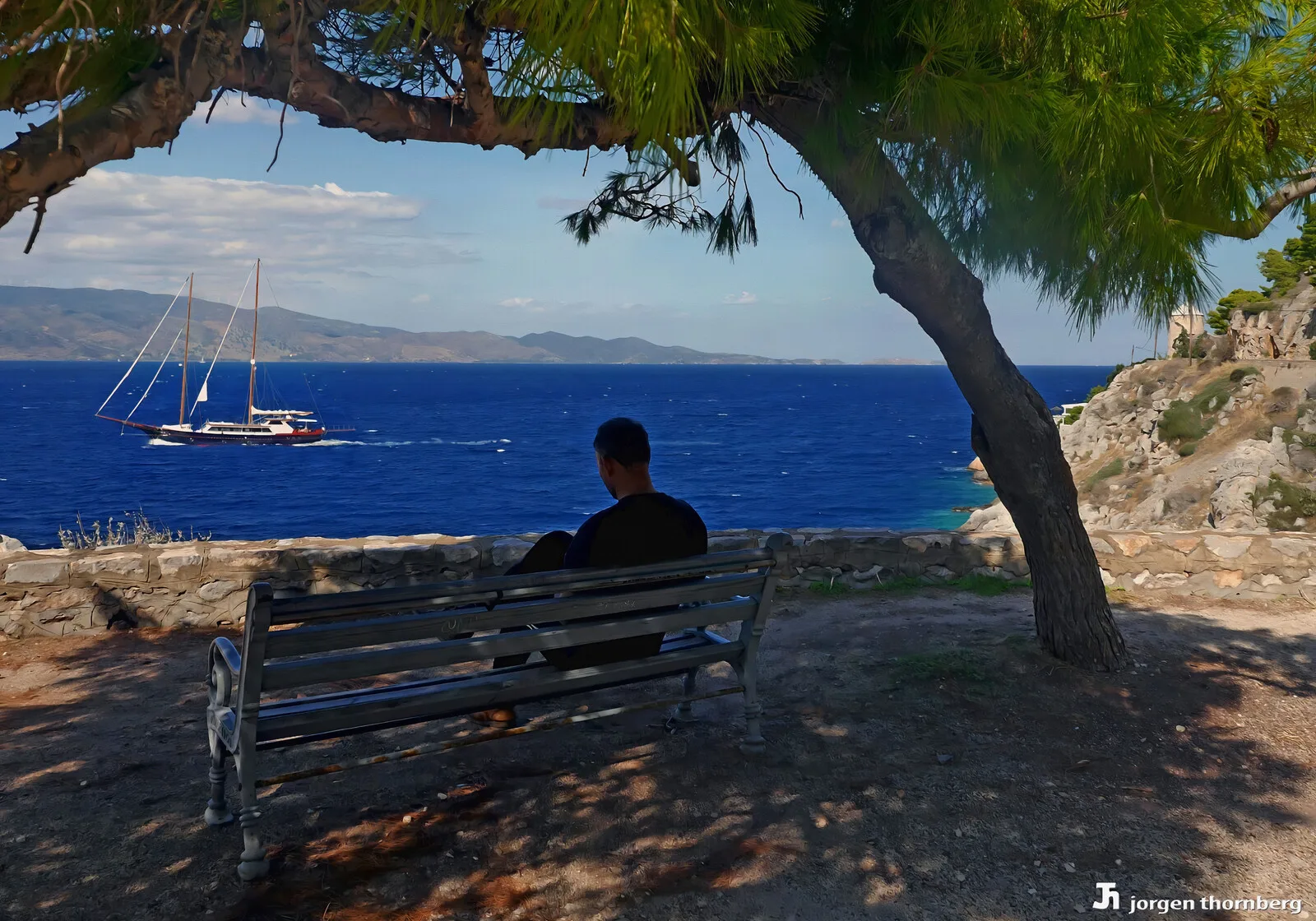
Jörgen Thornberg
Blue Remembrance, 2020
Digital
70 x 50 cm
Shades of Blue
He sits alone, with thoughts so deep,
In memories where shadows creep,
Blue as the sea that gently weeps,
For all the love he couldn’t keep.
Pebbles whispers from the past,
A voice so sweet, forever cast,
In echoes where the moments last,
But our time flies so far, so fast.
His mind clings tight to days of old,
To warmth and joy that once were gold,
Yet, in this grasp, he’s growing cold,
For nostalgia’s chains are firm and bold.
The pain of loss is tucked away,
Beneath the light of yesterday,
Yet, every blue and clouded day,
He feels the weight he cannot sway.
To live in joy, yet not succumb,
To memories that make him numb,
He must let go, though it feels dumb,
And find the peace he’s running from.
For in the blue, there’s room for light,
Beyond the past, beyond the night,
Pebbles’ smile, a guiding sight,
To live anew, to set things right.
Hydra, August 2024
Good memories could hurt so much. He still had the memories, but she was gone. Yet, Pebbles, his passed wife, was sitting beside him on the bench—not physically, for she had passed away many years ago. Time flies but does not heal all wounds. The notion that it does is a myth. At least, that was how it was for him. The memories were as blue as the sea beyond, as vivid but tinged with melancholy. The sense of loss was palpable, a constant companion in his daily life.
He tried to comfort himself with the thought that the memories were good, but he was caught in a wave of sadness because what happened would never be repeated. The beautiful images inside his mind were so many and so delightful, while the ugly ones had long since faded away. Pictures of happy moments that made him feel like he was floating, only to brutally crash back onto the bench when the harsh reality caught up with him. Her voice caressed his ears from within, nibbling at his earlobes, whispering words of love, though it was just the gentle wind playing tricks on him. This was how it was every day. And knowing himself, it would likely remain this way for as long as he lived. The strange thing was that the bad memories were like erased marks, insignificant in his inner odyssey.
"You need to move on," his friends would say, well-meaning. Yes, he had moved on, but his soul was lonely. Abandoned. For that’s the nature of first love—it’s carved into the granite of the soul, never to erode within a single human lifetime. Every day, Pebbles returned, emerging from a word or a thought, always smiling as she did the first time he saw her, forever young, a testament to the enduring nature of his first love. The struggle to move on was not for lack of trying, but the depth of his love made it an ongoing battle.
The Peloponnesian mountains in the distance seemed like a distant hum in his transcendent state. The sailboat passing outside, heading somewhere, awakened memories of voyages in the Greek archipelago, a place of unparalleled beauty. He had sold their boat when the ship’s figurehead was no longer there. But the ship’s logbook remained. The sailboat was the hub of the family’s life, where they spent most of their free time together, creating cherished memories. The Greek archipelago is vast, always offering a new cove to discover, a favourite to return to, and fascinating people to meet. Boaters are rarely dull. And the dinners, the barbecues on some cliff with the waves lapping below. The memories choked him, often involving a celebration, for in Pebbles’ eyes, every day was one.
The logbook stood on the shelf at home, filled with all of Pebbles’ notes, illustrated with little funny drawings, fragments of a happy time at sea, dinners with candles under a starry sky, notes about the weather that always seemed to have been beautiful, even though he knew it could sometimes be quite rough. Like the time they rounded Mani’s peninsula in stormy weather. They had spent the night in a sheltered cove at Siderianika and sailed in the lee of Laconia’s mountain range, heading south to round Cape Tainaron Lighthouse, the southernmost point of mainland Greece. A deceptively uneventful sail. It wasn’t until they had the lighthouse in sight that the change came, which was brutal. From a calm sea with a gentle swell, the waves suddenly towered. A gale blew in from the west, and there was no land protection until Tunisia, a thousand kilometres away, just open sea with tiny Malta as a dot in the Mediterranean along the way.
It was no surprise; they had sailed here before, and the weather service had clarified that it would be Beaufort from six to seven that day. No problem. They had set the sails accordingly, and with a sailboat tacking against the wind, the boat leaned steadily toward land and was gently lifted up and down by the long swells. It was worse for a larger luxury yacht they encountered, which, despite its size, bobbed like a rudderless cork in the violent sea. Sometimes, size doesn’t matter that much.
The wise Pebbles and the children retreated to the cabin below to escape seasickness. She never had sea legs but loved the sea nonetheless, which mostly showed its friendlier side. Still, she was born in Mani, surrounded by the sea. In all other respects, Pebbles was a true Maniot, with blonde hair and green eyes, tall and slender, the most beautiful woman he had ever known.
Seven nautical miles northwest, less than an hour’s sail, lay the picturesque harbour of Gerolimenas. Harbor might be too grand a word, but at least it was sheltered from the west by a hundred-meter mountain, where they could anchor or moor in a tiny cove. Once there, Pebbles perked up and prepared one of her usual delicious dinners.
In the logbook, Pebbles had filled an entire page with drawings and a story about Cape Tainaron, which in ancient times was mainly known for something different, something far more mysterious, which Pebbles had dramatised with her illustrations and text. He knew every line by heart, and the images were etched into his memory. The Greeks believed this was the entrance to the Underworld. Inside a temple, a couple of kilometres north of where the lighthouse now stands, deep in a cave, were the Gates of Hades. Outside, the fearsome Cerberus, a multi-headed hound, guarded the entrance, keeping the living away from the river Styx and the dead within. Some versions of the myth say that Cerberus had just a couple of heads; others claim he had fifty. Pebbles settled on seven because it rhymed with ‘heaven,’ which was Hades’ antipode in her little poem. According to the myth, they were on opposite sides of an enigmatic street.
In Hades, Cerberus lets in a dead felon
Nodding his head, the number seven.
Opposite Heaven's golden light,
He prowls the dark eternal night.
No angel’s song, no holy leaven,
Just echoes deep, far from Heaven,
Where souls do wander, lost, unled,
Under Cerberus, with eyes blood-red.
In Hades, the food is bitter and rotten,
A taste so vile, it's best forgotten.
But across the street, in Heaven's gleam,
Pebbles from Mani serves a feast supreme.
Pebbles told brief tales of brave souls and heroes who had tried to pass the Gates; some managed to enter Hades’ kingdom, but not many returned. One successful hero was Hercules. He had to capture Cerberus and bring him to King Eurystheus for his twelfth labour. Hades agreed to let him try, but only if Hercules managed to capture the beast without using any weapons, which he did because he was incredibly strong. Ultimately, King Eurystheus wasn’t pleased with his new pet—above all, it became a problem when no one died anymore, Greece became overcrowded—and Cerberus was returned to the Underworld safe and sound. Alongside his dry notes on courses, destinations, speed, and wind, the logbook was like a comic book, and the children loved flipping through the pages of their adventures.
He remembered long winter days at the shipyard because a boat must be maintained. Every year, twenty in total, the sixty-eight-foot yacht had to be taken out of the water, the hull scraped and varnished, and the mahogany superstructures sanded and polished. Pebbles was brave, always there, never complaining even though it was physically demanding for a woman, with sharp odours from paint and solvents and a dirty bilge. She never wrote about that, only about lunches outside the shed in the pale winter sun, which she described as a feast in paradise. The emotional toll of guilt, unspoken but deeply felt, weighed heavily on his shoulders.
Had it not been for her Alzheimer's, the idyll would likely have lasted to this day. The first signs were vague, followed by lies, and even more, lies, until their entire existence was threatened. The insidious disease took everything except the memories of the happy days, for those they could share until the last day she lived. In hindsight, his subconscious grief had polished away all the rough edges, leaving only his youthful love. He found solace in focusing on the positive memories, the moments of joy and love, and letting the pain and frustration fade into the background. The memory session ended, as all previous ones had, in blue. His eyes became as wet as the sea, for his memories were like blue embraces of the past.
Nostalgia, a universally relatable term that evokes a certain warmth and wistfulness, is a concept that has woven itself into the very fabric of human emotion. It is the subtle ache we feel when we remember the "good old days" or the longing that arises when we think of a childhood bathed in the golden light of memory. But nostalgia is more than just a fleeting emotion; it is a complex, multi-faceted phenomenon that transcends time and culture, allowing us to connect with our past in a deeply personal and, often, profoundly moving way.
The word "nostalgia" itself has a fascinating origin. It was first coined in 1688 by Johannes Hofer, a Swiss medical student, in his dissertation in Basel. Hofer combined two ancient Greek words: "nostos," meaning "return home," and "algia," meaning "longing" or "pain." Initially, the term was used to describe the homesickness felt by Swiss mercenaries fighting far from their native land. These soldiers were afflicted with what was seen as a medical condition, a deep yearning to return to the familiar sights, sounds, and smells of their homeland.
Over time, nostalgia evolved from being a clinical diagnosis to something much broader. Today, it is no longer limited to homesickness but encompasses a wide range of emotions tied to the past. Whether longing for the simplicity of childhood, a desire to relive a particular era or even a melancholy remembrance of a lost love, nostalgia touches upon the essence of being human.
Nostalgia has a unique power to transport us back in time, often triggered by unexpected stimuli. A particular scent, a familiar song, or even a taste can suddenly open a floodgate of memories, bringing the past rushing back with startling clarity. These memories are often idealised, polished to a shine by the passage of time, making the past seem more perfect than it perhaps ever was.
This idealisation is one of the reasons why nostalgia is so comforting. In a constantly changing world where the future can seem uncertain or daunting, nostalgia offers a refuge, a haven where everything is just as we remember it—or at least as we want to remember it. The "good old days" are often seen through rose-coloured glasses, free from the flaws and challenges we might have faced.
But nostalgia is not just about escaping the present; it also serves a deeper psychological function. Studies have shown that nostalgia can improve our mood and increase social connectedness. By recalling positive memories, we are reminded of the continuity of our lives, the relationships we've formed, and the experiences that have shaped us. This, in turn, can provide a sense of stability and identity, grounding us in the present even as we look back to the past. Nostalgia plays a significant role in shaping our identity, as it reminds us of the experiences and relationships that have influenced us and helps us understand who we are in relation to our past.
Nostalgia is a powerful force in shaping popular culture, influencing everything from fashion and music to film and television. The cyclical nature of trends means that what was once old often becomes new again, as each generation looks back to the past for inspiration. We see this in the resurgence of vintage fashion, the revival of classic television shows, and the popularity of retro-inspired music. These cultural artefacts serve as a bridge between generations, allowing us to connect with the past while reinterpreting it for the present.
The entertainment industry has long understood the appeal of nostalgia. Reboots, remakes, and sequels are often driven by a desire to recapture the magic of a beloved original. These projects tap into the audience's emotional connection to the past, offering a chance to revisit familiar characters, settings, and stories. Whether it's the revival of a 1980s sitcom or the return of a classic movie franchise, nostalgia sells—and it sells well.
However, nostalgia in popular culture is not just about commercialism. It also reflects a more profound cultural yearning for when life seemed more straightforward, the world was less complicated, and the future appeared brighter. In an era of rapid technological change, political instability, and environmental challenges, it's no wonder people seek solace in the past. Nostalgia offers a comforting reminder of who we are and where we come from, even as we navigate an uncertain present.
Despite its many benefits, nostalgia can also be a double-edged sword. While it can provide comfort and connection, it can also lead to melancholy or regret. When we idealise the past, we may become dissatisfied with the present, feeling that nothing can ever measure up to how things used to be. This can lead to paralysis, where we are so caught up in longing for what was that we fail to appreciate what is.
Moreover, an excessive focus on the past can prevent us from moving forward. If we are constantly looking back, we may miss out on the opportunities and experiences that the present has to offer. Nostalgia, when taken to extremes, can become a form of escapism, a way of avoiding the challenges and responsibilities of the here and now. It can lead to dissatisfaction with the present as we compare it unfavourably to our idealised memories. This can be a barrier to personal growth and even lead to loss or regret for what we perceive as a better time.
Yet, it is precisely this tension between the past and present that makes nostalgia so compelling. It reminds us that time is both fleeting and cyclical, that the moments we cherish are gone but not forgotten. Nostalgia allows us to hold on to those moments, to keep them alive in our hearts and minds, even as we move forward into the future.
In the end, nostalgia is a profoundly human experience that speaks to our desire for continuity, connection, and meaning. It is a way of honouring the past, remembering where we came from, and finding comfort in the familiar. But it is also a reminder that life is a journey that is always moving forward, even as we carry the memories of the past with us.
As we reflect on our own experiences of nostalgia, we can see it not just as a longing for what was but as a celebration of what is. The past may be gone, but its echoes remain, shaping who we are and guiding us toward who we will become. In that sense, nostalgia is not just about looking back but also about looking forward with hope, gratitude, and a deep appreciation for the moments that make life worth living.
That brings us to the man’s memories. In Greek mythology's vast and intricate tapestry, Mnemosyne, the Goddess of Memory, holds a unique and revered place. Her name, derived from the Greek word "mneme," meaning "memory" or "remembrance," speaks to her profound influence over the minds and souls of gods and mortals alike. Mnemosyne is not just a figure of myth but a personification of one of the most essential aspects of human consciousness: the ability to remember, recall the past, and carry life experiences through the corridors of time.
The Origins and Role of Mnemosyne
Mnemosyne, a Titan and the daughter of Uranus and Gaia, was pivotal in shaping the universe. Her role was unique and crucial—she was the keeper of memory, a responsibility that ensured the preservation of the world's deeds, stories, and knowledge, never to be forgotten.
As the Goddess of Memory, Mnemosyne's domain extended far beyond the mere recollection of facts. In ancient Greek culture, memory was seen as a vital force that connected the present to the past, allowing individuals and societies to learn, grow, and maintain their identities. Without memory, there would be no history, continuity, or understanding of the world. Mnemosyne embodied this power, serving as a bridge between the ephemeral nature of human life and the eternal truths of the universe.
Mnemosyne and the Muses
Mnemosyne's significance is further underscored by her role as the mother of the Muses, the nine goddesses who inspired art, literature, music, and all forms of creative expression. According to myth, Mnemosyne lay with Zeus for nine consecutive nights, and the Muses were born from this union. Each Muse presided over a different domain of the arts and sciences, from epic poetry and history to dance and astronomy, inspiring and guiding mortals in their creative and intellectual pursuits.
The Muses, revered as the patrons of intellectual and artistic endeavours, were born from Mnemosyne's union with Zeus. This connection underscores the profound relationship between memory and creativity. Creation was about inventing something new for the Greeks and drawing upon the vast reservoir of memory, tradition, and knowledge that Mnemosyne guarded. To create was to remember, and to remember was to honour the legacy of the past.
The River of Forgetfulness
In Greek mythology, memory and forgetfulness were two sides of the same coin. Just as Mnemosyne personified memory, her opposite was Lethe, the river of forgetfulness. According to myth, the souls of the dead would drink from the waters of Lethe to forget their earthly lives before reincarnation. This act of forgetting was seen as a necessary step in the cycle of life and death, allowing souls to start anew without the burdens of their past.
However, there was another path for those who sought wisdom and enlightenment. The Orphic Mysteries, an ancient religious tradition, taught that the souls of the initiated could choose to drink from the waters of Mnemosyne instead of Lethe. By doing so, they would retain their memories and gain knowledge of the divine, allowing them to escape the cycle of rebirth and achieve eternal peace.
This duality between memory and forgetfulness underscores the importance of Mnemosyne's role. While forgetting was necessary for some, the power of memory was seen as a gateway to higher understanding and spiritual transcendence. As the guardian of memory, Mnemosyne held the key to this wisdom, offering those who revered her the chance to connect with the deeper truths of existence.
Mnemosyne in Literature and Philosophy
Mnemosyne's influence extended beyond mythology and into literature and philosophy. The ancient Greeks understood that memory was a passive process of recalling information and an active force that shaped their perception of the world. In their view, memory was closely tied to the concept of aletheia, or 'truth,' which literally means 'unforgetting.' To remember was not just to recall but to uncover the truth and see things as they were, a concept deeply ingrained in Greek philosophy and literature.
This connection between memory and truth is reflected in the works of many Greek philosophers and poets. Plato, for instance, believed that learning was essentially an act of remembering. In his theory of anamnesis, he argued that the immortal soul possesses all knowledge from its previous incarnations. Therefore, learning was not about acquiring new information but recalling what the soul already knew—a process guided by memory.
In literature, Mnemosyne was often invoked as a source of inspiration. Poets and artists would call upon her and the Muses to help them remember the stories, myths, and traditions they sought to preserve and share with the world. In this sense, memory was seen as a divine gift, a link between the human and the holy, the past and the present.
Mnemosyne in the Modern World
Though the ancient gods have largely faded from the collective consciousness, Mnemosyne's legacy lives on in the modern world. Memory remains a central aspect of our identity and experience, shaping how we understand ourselves, our relationships, and our place in the world.
In contemporary culture, the concept of memory has taken on new dimensions, influenced by advancements in technology, psychology, and neuroscience. The study of memory has become a field of scientific inquiry, exploring how the brain stores, retrieves, and sometimes distorts our recollections. Yet, even as we learn more about the mechanisms of memory, the mystery and power of Mnemosyne's gift remain.
Memory continues to be a rich source of inspiration in literature, art, and philosophy. Writers and artists grapple with the themes of memory and forgetfulness, exploring how the past influences the present and how remembering can be both a blessing and a curse. From Marcel Proust's exploration of involuntary memory in "In Search of Lost Time" to the fragmented recollections in the works of modernist authors like Virginia Woolf and James Joyce, memory remains a central theme in exploring human consciousness.
Mnemosyne's influence can also be seen in the rise of nostalgia as a cultural phenomenon. People often turn to the past for comfort and reassurance in a constantly changing world where the future seems uncertain. This longing for a simpler, more familiar time reflects Mnemosyne's enduring power to connect us with the experiences, people, and places that have shaped us.
Mnemosyne, the Goddess of Memory, is more than just a figure from ancient myth; she symbolises the profound connection between memory, identity, and creativity. Her legacy reminds us that memory is not just a repository of the past but a living, dynamic force that shapes our present and future.
As we navigate the complexities of modern life, Mnemosyne's gift offers us a way to stay grounded, remember who we are and where we come from, and draw upon the wisdom of the past as we forge our path forward. In a world where forgetting can be all too easy, Mnemosyne is a guardian of our collective memory, ensuring that the stories, knowledge, and experiences of those who came before us are never lost.
Through her, we are reminded that memory is a treasure, a source of strength, and a guide on our journey through life. And in this way, Mnemosyne continues to hold a place of honour in the hearts and minds of those who seek to understand the deeper truths of existence.
Preserving the joyful part of one’s blue memories is one thing, but it's essential to keep nostalgia at bay so that it doesn't take over one’s life. This is something for the man on the bench to consider.
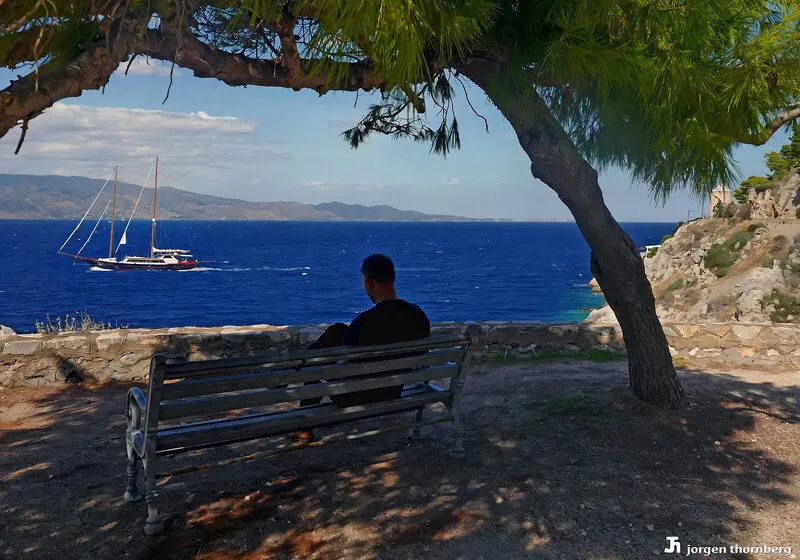
Jörgen Thornberg
Blue Remembrance, 2020
Digital
70 x 50 cm
Shades of Blue
He sits alone, with thoughts so deep,
In memories where shadows creep,
Blue as the sea that gently weeps,
For all the love he couldn’t keep.
Pebbles whispers from the past,
A voice so sweet, forever cast,
In echoes where the moments last,
But our time flies so far, so fast.
His mind clings tight to days of old,
To warmth and joy that once were gold,
Yet, in this grasp, he’s growing cold,
For nostalgia’s chains are firm and bold.
The pain of loss is tucked away,
Beneath the light of yesterday,
Yet, every blue and clouded day,
He feels the weight he cannot sway.
To live in joy, yet not succumb,
To memories that make him numb,
He must let go, though it feels dumb,
And find the peace he’s running from.
For in the blue, there’s room for light,
Beyond the past, beyond the night,
Pebbles’ smile, a guiding sight,
To live anew, to set things right.
Hydra, August 2024
Good memories could hurt so much. He still had the memories, but she was gone. Yet, Pebbles, his passed wife, was sitting beside him on the bench—not physically, for she had passed away many years ago. Time flies but does not heal all wounds. The notion that it does is a myth. At least, that was how it was for him. The memories were as blue as the sea beyond, as vivid but tinged with melancholy. The sense of loss was palpable, a constant companion in his daily life.
He tried to comfort himself with the thought that the memories were good, but he was caught in a wave of sadness because what happened would never be repeated. The beautiful images inside his mind were so many and so delightful, while the ugly ones had long since faded away. Pictures of happy moments that made him feel like he was floating, only to brutally crash back onto the bench when the harsh reality caught up with him. Her voice caressed his ears from within, nibbling at his earlobes, whispering words of love, though it was just the gentle wind playing tricks on him. This was how it was every day. And knowing himself, it would likely remain this way for as long as he lived. The strange thing was that the bad memories were like erased marks, insignificant in his inner odyssey.
"You need to move on," his friends would say, well-meaning. Yes, he had moved on, but his soul was lonely. Abandoned. For that’s the nature of first love—it’s carved into the granite of the soul, never to erode within a single human lifetime. Every day, Pebbles returned, emerging from a word or a thought, always smiling as she did the first time he saw her, forever young, a testament to the enduring nature of his first love. The struggle to move on was not for lack of trying, but the depth of his love made it an ongoing battle.
The Peloponnesian mountains in the distance seemed like a distant hum in his transcendent state. The sailboat passing outside, heading somewhere, awakened memories of voyages in the Greek archipelago, a place of unparalleled beauty. He had sold their boat when the ship’s figurehead was no longer there. But the ship’s logbook remained. The sailboat was the hub of the family’s life, where they spent most of their free time together, creating cherished memories. The Greek archipelago is vast, always offering a new cove to discover, a favourite to return to, and fascinating people to meet. Boaters are rarely dull. And the dinners, the barbecues on some cliff with the waves lapping below. The memories choked him, often involving a celebration, for in Pebbles’ eyes, every day was one.
The logbook stood on the shelf at home, filled with all of Pebbles’ notes, illustrated with little funny drawings, fragments of a happy time at sea, dinners with candles under a starry sky, notes about the weather that always seemed to have been beautiful, even though he knew it could sometimes be quite rough. Like the time they rounded Mani’s peninsula in stormy weather. They had spent the night in a sheltered cove at Siderianika and sailed in the lee of Laconia’s mountain range, heading south to round Cape Tainaron Lighthouse, the southernmost point of mainland Greece. A deceptively uneventful sail. It wasn’t until they had the lighthouse in sight that the change came, which was brutal. From a calm sea with a gentle swell, the waves suddenly towered. A gale blew in from the west, and there was no land protection until Tunisia, a thousand kilometres away, just open sea with tiny Malta as a dot in the Mediterranean along the way.
It was no surprise; they had sailed here before, and the weather service had clarified that it would be Beaufort from six to seven that day. No problem. They had set the sails accordingly, and with a sailboat tacking against the wind, the boat leaned steadily toward land and was gently lifted up and down by the long swells. It was worse for a larger luxury yacht they encountered, which, despite its size, bobbed like a rudderless cork in the violent sea. Sometimes, size doesn’t matter that much.
The wise Pebbles and the children retreated to the cabin below to escape seasickness. She never had sea legs but loved the sea nonetheless, which mostly showed its friendlier side. Still, she was born in Mani, surrounded by the sea. In all other respects, Pebbles was a true Maniot, with blonde hair and green eyes, tall and slender, the most beautiful woman he had ever known.
Seven nautical miles northwest, less than an hour’s sail, lay the picturesque harbour of Gerolimenas. Harbor might be too grand a word, but at least it was sheltered from the west by a hundred-meter mountain, where they could anchor or moor in a tiny cove. Once there, Pebbles perked up and prepared one of her usual delicious dinners.
In the logbook, Pebbles had filled an entire page with drawings and a story about Cape Tainaron, which in ancient times was mainly known for something different, something far more mysterious, which Pebbles had dramatised with her illustrations and text. He knew every line by heart, and the images were etched into his memory. The Greeks believed this was the entrance to the Underworld. Inside a temple, a couple of kilometres north of where the lighthouse now stands, deep in a cave, were the Gates of Hades. Outside, the fearsome Cerberus, a multi-headed hound, guarded the entrance, keeping the living away from the river Styx and the dead within. Some versions of the myth say that Cerberus had just a couple of heads; others claim he had fifty. Pebbles settled on seven because it rhymed with ‘heaven,’ which was Hades’ antipode in her little poem. According to the myth, they were on opposite sides of an enigmatic street.
In Hades, Cerberus lets in a dead felon
Nodding his head, the number seven.
Opposite Heaven's golden light,
He prowls the dark eternal night.
No angel’s song, no holy leaven,
Just echoes deep, far from Heaven,
Where souls do wander, lost, unled,
Under Cerberus, with eyes blood-red.
In Hades, the food is bitter and rotten,
A taste so vile, it's best forgotten.
But across the street, in Heaven's gleam,
Pebbles from Mani serves a feast supreme.
Pebbles told brief tales of brave souls and heroes who had tried to pass the Gates; some managed to enter Hades’ kingdom, but not many returned. One successful hero was Hercules. He had to capture Cerberus and bring him to King Eurystheus for his twelfth labour. Hades agreed to let him try, but only if Hercules managed to capture the beast without using any weapons, which he did because he was incredibly strong. Ultimately, King Eurystheus wasn’t pleased with his new pet—above all, it became a problem when no one died anymore, Greece became overcrowded—and Cerberus was returned to the Underworld safe and sound. Alongside his dry notes on courses, destinations, speed, and wind, the logbook was like a comic book, and the children loved flipping through the pages of their adventures.
He remembered long winter days at the shipyard because a boat must be maintained. Every year, twenty in total, the sixty-eight-foot yacht had to be taken out of the water, the hull scraped and varnished, and the mahogany superstructures sanded and polished. Pebbles was brave, always there, never complaining even though it was physically demanding for a woman, with sharp odours from paint and solvents and a dirty bilge. She never wrote about that, only about lunches outside the shed in the pale winter sun, which she described as a feast in paradise. The emotional toll of guilt, unspoken but deeply felt, weighed heavily on his shoulders.
Had it not been for her Alzheimer's, the idyll would likely have lasted to this day. The first signs were vague, followed by lies, and even more, lies, until their entire existence was threatened. The insidious disease took everything except the memories of the happy days, for those they could share until the last day she lived. In hindsight, his subconscious grief had polished away all the rough edges, leaving only his youthful love. He found solace in focusing on the positive memories, the moments of joy and love, and letting the pain and frustration fade into the background. The memory session ended, as all previous ones had, in blue. His eyes became as wet as the sea, for his memories were like blue embraces of the past.
Nostalgia, a universally relatable term that evokes a certain warmth and wistfulness, is a concept that has woven itself into the very fabric of human emotion. It is the subtle ache we feel when we remember the "good old days" or the longing that arises when we think of a childhood bathed in the golden light of memory. But nostalgia is more than just a fleeting emotion; it is a complex, multi-faceted phenomenon that transcends time and culture, allowing us to connect with our past in a deeply personal and, often, profoundly moving way.
The word "nostalgia" itself has a fascinating origin. It was first coined in 1688 by Johannes Hofer, a Swiss medical student, in his dissertation in Basel. Hofer combined two ancient Greek words: "nostos," meaning "return home," and "algia," meaning "longing" or "pain." Initially, the term was used to describe the homesickness felt by Swiss mercenaries fighting far from their native land. These soldiers were afflicted with what was seen as a medical condition, a deep yearning to return to the familiar sights, sounds, and smells of their homeland.
Over time, nostalgia evolved from being a clinical diagnosis to something much broader. Today, it is no longer limited to homesickness but encompasses a wide range of emotions tied to the past. Whether longing for the simplicity of childhood, a desire to relive a particular era or even a melancholy remembrance of a lost love, nostalgia touches upon the essence of being human.
Nostalgia has a unique power to transport us back in time, often triggered by unexpected stimuli. A particular scent, a familiar song, or even a taste can suddenly open a floodgate of memories, bringing the past rushing back with startling clarity. These memories are often idealised, polished to a shine by the passage of time, making the past seem more perfect than it perhaps ever was.
This idealisation is one of the reasons why nostalgia is so comforting. In a constantly changing world where the future can seem uncertain or daunting, nostalgia offers a refuge, a haven where everything is just as we remember it—or at least as we want to remember it. The "good old days" are often seen through rose-coloured glasses, free from the flaws and challenges we might have faced.
But nostalgia is not just about escaping the present; it also serves a deeper psychological function. Studies have shown that nostalgia can improve our mood and increase social connectedness. By recalling positive memories, we are reminded of the continuity of our lives, the relationships we've formed, and the experiences that have shaped us. This, in turn, can provide a sense of stability and identity, grounding us in the present even as we look back to the past. Nostalgia plays a significant role in shaping our identity, as it reminds us of the experiences and relationships that have influenced us and helps us understand who we are in relation to our past.
Nostalgia is a powerful force in shaping popular culture, influencing everything from fashion and music to film and television. The cyclical nature of trends means that what was once old often becomes new again, as each generation looks back to the past for inspiration. We see this in the resurgence of vintage fashion, the revival of classic television shows, and the popularity of retro-inspired music. These cultural artefacts serve as a bridge between generations, allowing us to connect with the past while reinterpreting it for the present.
The entertainment industry has long understood the appeal of nostalgia. Reboots, remakes, and sequels are often driven by a desire to recapture the magic of a beloved original. These projects tap into the audience's emotional connection to the past, offering a chance to revisit familiar characters, settings, and stories. Whether it's the revival of a 1980s sitcom or the return of a classic movie franchise, nostalgia sells—and it sells well.
However, nostalgia in popular culture is not just about commercialism. It also reflects a more profound cultural yearning for when life seemed more straightforward, the world was less complicated, and the future appeared brighter. In an era of rapid technological change, political instability, and environmental challenges, it's no wonder people seek solace in the past. Nostalgia offers a comforting reminder of who we are and where we come from, even as we navigate an uncertain present.
Despite its many benefits, nostalgia can also be a double-edged sword. While it can provide comfort and connection, it can also lead to melancholy or regret. When we idealise the past, we may become dissatisfied with the present, feeling that nothing can ever measure up to how things used to be. This can lead to paralysis, where we are so caught up in longing for what was that we fail to appreciate what is.
Moreover, an excessive focus on the past can prevent us from moving forward. If we are constantly looking back, we may miss out on the opportunities and experiences that the present has to offer. Nostalgia, when taken to extremes, can become a form of escapism, a way of avoiding the challenges and responsibilities of the here and now. It can lead to dissatisfaction with the present as we compare it unfavourably to our idealised memories. This can be a barrier to personal growth and even lead to loss or regret for what we perceive as a better time.
Yet, it is precisely this tension between the past and present that makes nostalgia so compelling. It reminds us that time is both fleeting and cyclical, that the moments we cherish are gone but not forgotten. Nostalgia allows us to hold on to those moments, to keep them alive in our hearts and minds, even as we move forward into the future.
In the end, nostalgia is a profoundly human experience that speaks to our desire for continuity, connection, and meaning. It is a way of honouring the past, remembering where we came from, and finding comfort in the familiar. But it is also a reminder that life is a journey that is always moving forward, even as we carry the memories of the past with us.
As we reflect on our own experiences of nostalgia, we can see it not just as a longing for what was but as a celebration of what is. The past may be gone, but its echoes remain, shaping who we are and guiding us toward who we will become. In that sense, nostalgia is not just about looking back but also about looking forward with hope, gratitude, and a deep appreciation for the moments that make life worth living.
That brings us to the man’s memories. In Greek mythology's vast and intricate tapestry, Mnemosyne, the Goddess of Memory, holds a unique and revered place. Her name, derived from the Greek word "mneme," meaning "memory" or "remembrance," speaks to her profound influence over the minds and souls of gods and mortals alike. Mnemosyne is not just a figure of myth but a personification of one of the most essential aspects of human consciousness: the ability to remember, recall the past, and carry life experiences through the corridors of time.
The Origins and Role of Mnemosyne
Mnemosyne, a Titan and the daughter of Uranus and Gaia, was pivotal in shaping the universe. Her role was unique and crucial—she was the keeper of memory, a responsibility that ensured the preservation of the world's deeds, stories, and knowledge, never to be forgotten.
As the Goddess of Memory, Mnemosyne's domain extended far beyond the mere recollection of facts. In ancient Greek culture, memory was seen as a vital force that connected the present to the past, allowing individuals and societies to learn, grow, and maintain their identities. Without memory, there would be no history, continuity, or understanding of the world. Mnemosyne embodied this power, serving as a bridge between the ephemeral nature of human life and the eternal truths of the universe.
Mnemosyne and the Muses
Mnemosyne's significance is further underscored by her role as the mother of the Muses, the nine goddesses who inspired art, literature, music, and all forms of creative expression. According to myth, Mnemosyne lay with Zeus for nine consecutive nights, and the Muses were born from this union. Each Muse presided over a different domain of the arts and sciences, from epic poetry and history to dance and astronomy, inspiring and guiding mortals in their creative and intellectual pursuits.
The Muses, revered as the patrons of intellectual and artistic endeavours, were born from Mnemosyne's union with Zeus. This connection underscores the profound relationship between memory and creativity. Creation was about inventing something new for the Greeks and drawing upon the vast reservoir of memory, tradition, and knowledge that Mnemosyne guarded. To create was to remember, and to remember was to honour the legacy of the past.
The River of Forgetfulness
In Greek mythology, memory and forgetfulness were two sides of the same coin. Just as Mnemosyne personified memory, her opposite was Lethe, the river of forgetfulness. According to myth, the souls of the dead would drink from the waters of Lethe to forget their earthly lives before reincarnation. This act of forgetting was seen as a necessary step in the cycle of life and death, allowing souls to start anew without the burdens of their past.
However, there was another path for those who sought wisdom and enlightenment. The Orphic Mysteries, an ancient religious tradition, taught that the souls of the initiated could choose to drink from the waters of Mnemosyne instead of Lethe. By doing so, they would retain their memories and gain knowledge of the divine, allowing them to escape the cycle of rebirth and achieve eternal peace.
This duality between memory and forgetfulness underscores the importance of Mnemosyne's role. While forgetting was necessary for some, the power of memory was seen as a gateway to higher understanding and spiritual transcendence. As the guardian of memory, Mnemosyne held the key to this wisdom, offering those who revered her the chance to connect with the deeper truths of existence.
Mnemosyne in Literature and Philosophy
Mnemosyne's influence extended beyond mythology and into literature and philosophy. The ancient Greeks understood that memory was a passive process of recalling information and an active force that shaped their perception of the world. In their view, memory was closely tied to the concept of aletheia, or 'truth,' which literally means 'unforgetting.' To remember was not just to recall but to uncover the truth and see things as they were, a concept deeply ingrained in Greek philosophy and literature.
This connection between memory and truth is reflected in the works of many Greek philosophers and poets. Plato, for instance, believed that learning was essentially an act of remembering. In his theory of anamnesis, he argued that the immortal soul possesses all knowledge from its previous incarnations. Therefore, learning was not about acquiring new information but recalling what the soul already knew—a process guided by memory.
In literature, Mnemosyne was often invoked as a source of inspiration. Poets and artists would call upon her and the Muses to help them remember the stories, myths, and traditions they sought to preserve and share with the world. In this sense, memory was seen as a divine gift, a link between the human and the holy, the past and the present.
Mnemosyne in the Modern World
Though the ancient gods have largely faded from the collective consciousness, Mnemosyne's legacy lives on in the modern world. Memory remains a central aspect of our identity and experience, shaping how we understand ourselves, our relationships, and our place in the world.
In contemporary culture, the concept of memory has taken on new dimensions, influenced by advancements in technology, psychology, and neuroscience. The study of memory has become a field of scientific inquiry, exploring how the brain stores, retrieves, and sometimes distorts our recollections. Yet, even as we learn more about the mechanisms of memory, the mystery and power of Mnemosyne's gift remain.
Memory continues to be a rich source of inspiration in literature, art, and philosophy. Writers and artists grapple with the themes of memory and forgetfulness, exploring how the past influences the present and how remembering can be both a blessing and a curse. From Marcel Proust's exploration of involuntary memory in "In Search of Lost Time" to the fragmented recollections in the works of modernist authors like Virginia Woolf and James Joyce, memory remains a central theme in exploring human consciousness.
Mnemosyne's influence can also be seen in the rise of nostalgia as a cultural phenomenon. People often turn to the past for comfort and reassurance in a constantly changing world where the future seems uncertain. This longing for a simpler, more familiar time reflects Mnemosyne's enduring power to connect us with the experiences, people, and places that have shaped us.
Mnemosyne, the Goddess of Memory, is more than just a figure from ancient myth; she symbolises the profound connection between memory, identity, and creativity. Her legacy reminds us that memory is not just a repository of the past but a living, dynamic force that shapes our present and future.
As we navigate the complexities of modern life, Mnemosyne's gift offers us a way to stay grounded, remember who we are and where we come from, and draw upon the wisdom of the past as we forge our path forward. In a world where forgetting can be all too easy, Mnemosyne is a guardian of our collective memory, ensuring that the stories, knowledge, and experiences of those who came before us are never lost.
Through her, we are reminded that memory is a treasure, a source of strength, and a guide on our journey through life. And in this way, Mnemosyne continues to hold a place of honour in the hearts and minds of those who seek to understand the deeper truths of existence.
Preserving the joyful part of one’s blue memories is one thing, but it's essential to keep nostalgia at bay so that it doesn't take over one’s life. This is something for the man on the bench to consider.

Jörgen Thornberg
Malmö
Lite om bilder och mig. Translation in English at the end.
Jag är en nyfiken person som ser allt i bilder, även det jag fäster i ord, gärna tillsammans för bakom alla mina bilder finns en berättelse. Till vissa bilder hör en kortare eller längre novell som följer med bilden.
Bilder berättar historier. Jag omges av naturlig skönhet, intressanta människor och historia var jag än går. Jag använder min kamera för att dokumentera världen och blanda det jag ser med vad jag känner för att fånga den dolda magin.
Mina bilder berättar mina historier. Genom mina bilder, tryck och berättelser. Jag bjuder in dig att ta del av dessa berättelser, in i ditt liv och hem och dela min mycket personliga syn på vår värld. Mer än vad ögat ser. Jag tänker i bilder, drömmer och skriver och pratar om dem; följaktligen måste jag också skapa bilder. De blir vad jag ser, inte nödvändigtvis begränsade till verkligheten. Det finns en bild runt varje hörn. Jag hoppas att du kommer att se vad jag såg och gilla det.
Jag är också en skrivande person och till många bilder hör en kortare eller längre essay. Den följer med tavlan, tryckt på fint papper och med en personlig hälsning från mig.
Flertalet bilder startar sin resa i min kamera. Enkelt förklarat beskriver jag bilden jag ser i mitt inre, upplevd eller fantiserad. Bilden uppstår inom mig redan innan jag fått okularet till ögat. På bråkdelen av ett ögonblick ser jag vad jag vill ha och vad som kan göras med bilden. Här skall jag stoppa in en giraff, stålmannen, Titanic eller vad det är min fantasi finner ut. Ännu märkligare är att jag kommer ihåg minnesbilden långt efteråt när det blir tid att skapa verket. Om jag lyckas eller inte, är upp till betraktaren, oftast präglat av en stråk av svart humor – meningen är att man skall bli underhållen. Mina bilder blir ofta en snackis där de hänger.
Jag föredrar bilder som förmedlar ett budskap i flera lager. Vid första anblicken fylld av feel-good, en vacker utsikt, fint väder, solen skiner, blommor på ängen eller vattnet som ligger förrädiskt spegelblankt. I en sådan bild kan jag gömma min egentliga berättelse, mitt förakt för förtryckare och våldsverkare, rasister och fördomsfulla människor - ett gärna återkommande motiv mer eller mindre dolt i det vackra motivet. Jag försöker förena dem i ett gemensamt narrativ.
Bild och formgivning har löpt som en röd tråd genom livet. Fotokonst känns som en värdig final som jag gärna delar med mig.
Min genre är vid som framgår av mina bilder, temat en blandning av pop- och gatukonst i kollage som kan bestå av hundratals lager. Vissa bilder kan ta veckor, andra någon dag innan det är dags att överlämna resultatet till printverkstaden. Fine Art Prints är digitala fotocollage. I dessa kollage sker rivandet, klippandet, pusslandet, målandet, ritandet och sprayningen digitalt. Det jag monterar in kan vara hundratals år gamla bilder som jag omsorgsfullt frilägger så att de ser ut att vara en del av tavlan men också bilder skapade av mig själv efter min egen fantasi. Därefter besöks printstudion och för vissa bilder numrera en limiterad upplaga (oftast 7 exemplar) och signera för hand. Vissa bilder kan köpas i olika format. Det är bara att fråga efter vilka. Gillar man en bild som är 70x100 men inte har plats på väggen, går den kanske att få i 50x70 cm istället. Frågan är fri.
Metoden Giclée eller Fine Art Print som det också kallas är det moderna sättet för framställning av grafisk konst. Villkoret för denna typ av utskrifter är att en högkvalitativ storformatskrivare används med åldersbeständigt färgpigment och konstnärspapper eller i förekommande fall på duk. Pappret som används möter de krav på livslängd som ställs av museer och gallerier. Normalt säljer jag mina bilder oinramade så att den nya ägaren själv kan bestämma hur de skall se ut, med eller utan passepartout färg på ram, med eller utan glas etc..
Under många år ställde jag bara ut på nätet, i valda grupper och på min egen Facebooksida - https://www.facebook.com/jorgen.thornberg.9
Jag finns också på en egen hemsida som tyvärr inte alltid är uppdaterad – https://www.jth.life/ Där kan du också läsa en del av de berättelser som följer med bilden.
UTSTÄLLNINGAR
Luftkastellet, oktober 2022
Konst i Lund, november 2022
Luftkastellet, mars 2023
Engleson Galleri Caroli, april 2023
Hydra, Greece June 2023
Engleson Galleri Caroli, oktober 2023
Toppen, Höllviken december 2023
Luftkastellet, mars 2024
Torups Galleri, mars 2024
Venice, May 2024
Luftkastellet, oktober 2024
Konst i Advent, December 2024
Galleri Engleson, Caroli December 2024
Jäger & Jansson Galleri, april 2025
A bit about pictures and me.
I'm a curious person who sees everything in pictures, even what I express in words, often combining them, for behind all my pictures lies a story. These narratives, some as short as a single image and others as long as a novel, are the heart and soul of my work.
Pictures tell stories. Wherever I go, I'm surrounded by natural beauty, exciting people, and history. I use my camera to document the world and blend what I see with what I feel to capture the hidden magic.
My images tell my stories. Through my pictures, prints, and narratives, I invite you to partake in these stories in your life and home and share my deeply personal perspective of our world. More than meets the eye. I think in pictures, dream, write, and talk about them; consequently, I must create images too. They become what I see, not necessarily confined to reality. There's a picture around every corner. I hope you'll see what I saw and enjoy it.
I'm also a writer, and many images come with a shorter or longer essay. It accompanies the painting, printed on fine paper with my personal greeting.
Many pictures start their journey on my camera. Simply put, I describe the image I see in my mind, experienced or imagined. The image arises within me even before I bring the eyepiece to my eye. In a fraction of a moment, I see what I want and what can be done with the picture. Here, I'll insert a giraffe, Superman, the Titanic, or whatever my imagination conjures up. Even stranger is that I remember the mental image long after it's time to create the work. Whether I succeed is up to the observer, often imbued with a streak of black humour – the aim is to entertain. My pictures usually become a talking point wherever they hang.
I prefer pictures that convey a message in multiple layers. At first glance, they're filled with feel-good vibes, a beautiful view, lovely weather, the sun shining, flowers in the meadow, or the water lying deceptively calm. But beneath this surface beauty, I often conceal a deeper story, a narrative that challenges societal norms or explores the human condition. I invite you to delve into these hidden narratives and discover the layers of meaning within my work.
Picture and design have been a thread running through my life. Photographic art feels like a fitting finale, and I'm happy to share it.
My genre is varied, as seen in my pictures; the theme is a blend of pop and street art in collages that can consist of hundreds of layers. Some images can take weeks, others just a day before it's time to hand over the result to the print workshop. Fine Art Prints are digital photo collages. In these collages, tearing, cutting, puzzling, painting, drawing, and spraying happen digitally. What I insert can be images hundreds of years old that I carefully extract so they appear to be part of the painting, but also images created by myself, now also generated from my imagination. Next, visit the print studio and, for certain images, number a limited edition (usually 7 copies) and sign them by hand. Some images may be available in other formats. Just ask which ones. If you like an image that's 70x100 but doesn't have space on the wall, you might be able to get it in 50x70 cm instead. The question is open.
The Giclée method, or Fine Art Print as it's also called, is the modern way of producing graphic art. This method ensures the highest quality and longevity of the artwork, using a high-quality large-format printer with archival pigment inks and artist paper or, in some cases, canvas. The paper used meets the longevity requirements set by museums and galleries. I sell my pictures unframed, allowing the new owner to personalise their artwork, confident in the lasting value and quality of the piece.
For many years, I only exhibited online, in selected groups, and on my Facebook page - https://www.facebook.com/jorgen.thornberg.9. I also have my website, which unfortunately is not constantly updated - https://www.jth.life/. You can also read some of the stories accompanying the pictures there.
EXHIBITIONS
Luftkastellet, October 2022
Art in Lund, November 2022
Luftkastellet, March 2023
Engleson Gallery Caroli, April 2023
Hydra, Greece June 2023
Engleson Gallery Caroli, October 2023
Toppen, Höllviken December 2023
Luftkastellet, March 2024
Torup Gallery, March 2024
Venice, May 2024
UTSTÄLLNINGAR
Luftkastellet, oktober 2022
Konst i Lund, november 2022
Luftkastellet, mars 2023
Engleson Galleri Caroli, april 2023
Hydra, Greece June 2023
Engleson Galleri Caroli, oktober 2023
Toppen, Höllviken december 2023
Luftkastellet, mars 2024
Torups Galleri, mars 2024
Venice, May 2024
Luftkastellet, October 2024
Konst i Advent, December 2024
Galleri Engleson, Caroli December 2024
Jäger & Jansson Galleri, April 2025
Utbildning
Autodidakt
Medlem i konstnärsförening
Öppna Sinnen
Med i konstrunda
Konstrundan i Skåne
Utställningar
Luftkastellet, October 2022
Art in Lund, November 2022
Luftkastellet, March 2023
Engleson Gallery Caroli, April 2023
Hydra, Greece June 2023
Engleson Gallery Caroli, October 2023
Toppen, Höllviken December 2023
Luftkastellet, March 2024
Torup Gallery, March 2024
Venice, May 2024