Vi använder cookies för att ge dig bästa möjliga upplevelse. Välj vilka cookies du tillåter.
Läs mer i vår integritetspolicy
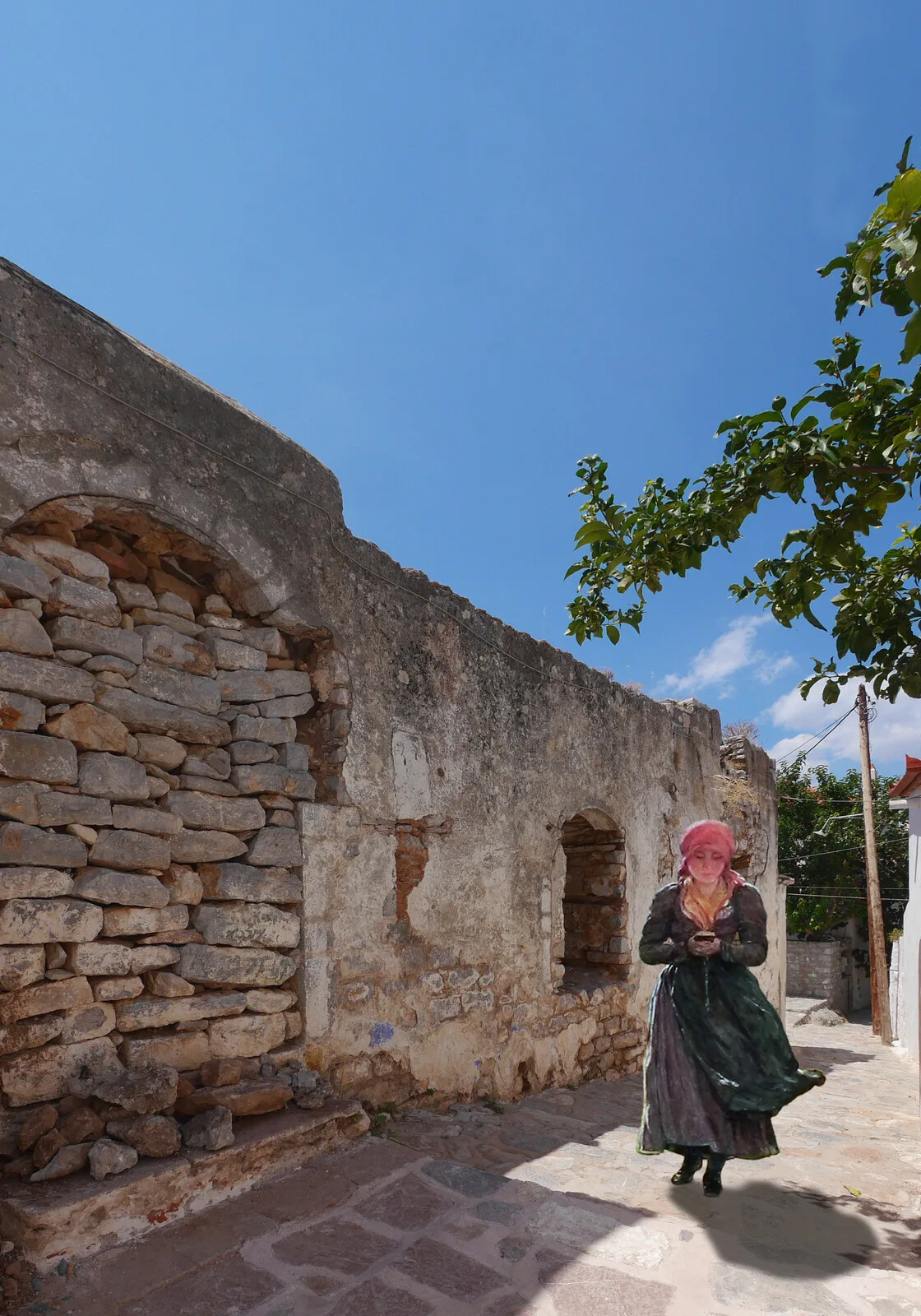
Jörgen Thornberg
Destiny Lane, 2021
Digital
50 x 70 cm
Kiafa, Hydra's oldest district, has its interesting parts. The long downhill slope of truly walkable steps between a small church and the corner that once was Nefeli, the blue hotel. I was on my way down, and she was on her way up. We met outside what I believe was once a butcher shop; at least, the hooks in the vaulted ceiling suggest it. It's been so long that no one remembers anymore. The woman smiled shyly and hurried on upwards. When I turned around, the beautiful woman had disappeared. Then, it struck me that she wasn't from my own time but one of those Time-travellers on a return visit. Her attire, with many layers of skirts, an apron, and a headscarf covering her hair, the embroidered vest, and the blouse underneath with Hydra lace, placed her more in the 19th century than later.
That she vanished precisely where the old entrance to the butcher shop, now covered by stacked stones, once stood was probably no coincidence. It must have been the butcher's maid I encountered, the one he fathered a child with—a scandal hushed up at the time. The maid was allowed to stay under the same roof as the butcher and his wife, and the result of their affair, a son, grew up together with their daughters. He was the son the butcher never had, and as an adult, he took over the butcher shop after his father. Such is how things are when the latch isn't on, as they say.
There are, in any case, many stories about that butcher, Giorgios, who was said to be a large and boisterous man who wasn’t always entirely sober when he wielded his butcher’s axe. One time, he slipped and cut off half of his little finger. Giorgios was clear-headed enough to pick up the stump and take it to his friend, the island’s only surgeon, Dimitris, who lived a few houses away. Dimitris and Giorgios had been friends since childhood, their bond strengthened by their shared love for Tsipouro, a now-trendy Greek spirit of the stronger kind. Tsipouro is made from grapes and wine byproducts, usually consumed neat or, as Giorgios preferred, with an anise flavour. Just like its cousin Ouzo, it was often enjoyed with small dishes. Olives, charcuterie, and spicy sausages paired with a glass of Tsipouro are a beloved combination. The reason for Giorgios' large girth, with a belly like a wine barrel, could be found here.
In any case, Dimitris praised his friend for coming so quickly with the finger stump; for now, he could probably fix the injury so that it would barely be noticeable after a while. The surgeon reattached the half with only a minor loss and bandaged the little finger, telling Giorgios to be extra careful with the axe for a while, as reattaching the finger a second time would be impossible.
Giorgios was overwhelmed with gratitude and asked what he owed.
'Not a thing. What wouldn’t one do for friends,' said Dimitris with his most courteous smile.
'Dear Dimitris, don't be shy about coming over to the shop and ordering whatever you want from my selection for free,' said the jovial and trusting Giorgios.
By the same weekend, Dimitris came over and took a couple of kilos of the best filet mignon. It should be noted that oxen were rare on Hydra; the pasture was insufficient for the gluttonous animals, so much meat had to be acquired at great expense from the mainland.
And so it continued, with a surgeon who had developed a taste for the delicacies from the animal kingdom and the butcher’s wife, Aikaterini, complaining that the finances didn’t add up. Eventually, Giorgios grew tired of his wife’s constant complaints and placed his little finger on the butcher's table, chopping off the piece that had so beautifully healed with his hand. Then he went over to Dimitris and slammed the finger on his desk.
'Here’s the finger, Dimitris, and now we’re even,' said the butcher, feeling he had settled his debt of honour to the surgeon. My plumber told me the story, so it’s undoubtedly true or at least plausible.
It wasn’t Giorgios’ drinking habits I was going to talk about—this story just slipped in—but rather about the butcher’s old house. The house, a significant part of Hydra's historical and cultural heritage, is in severe disrepair, with few walls still standing, and the upper floor and roof have long since disappeared. The fact that the vaulted ceilings with hooks remain intact is due to the ingenious construction. As long as the outer walls stand, the roof cannot collapse. That doesn’t stop me from wondering for nearly twenty-five years how such a beautiful old house with the best location in Kiafa could be allowed to fall into ruin. Its decay is a poignant reminder of the rich history and cultural legacy of this place.
Have you also wondered why so many buildings in Greece are ruined or unfinished? It's a mystery that has intrigued me for years, sparking my curiosity about the stories these abandoned structures hold.
"One might be surprised by the many empty or half-finished buildings, ruins, or vacant plots you come across in Greece," I remarked, observing the deteriorating structure before us walking down Donkey Shit Lane together. "It's not just a problem on Hydra; you see it everywhere—in cities, towns, villages, and even remote areas. For many visitors, it's an eyesore, detracting from the otherwise beautiful impression of Greece."
Aleksander, my plumber, nodded thoughtfully. "According to many Greeks, what you see is part of the problem of modern Greece. 'We are all the time like that. We are half Europeans and half Romans,' some of my Greek friends say, shrugging their shoulders." He sighed, gesturing toward the ruined building. "The problem, in the Greek way of thinking, isn’t our’s—it's someone else's, practically no one's, since the state neither has the interest nor the means to deal with it. If it's even a problem, except for aesthetic tourists." Aleksander looked stint at me.
"It's hard to understand the reason behind all these ruins," I said, glancing back at the crumbling walls. "After skimming through the internet, talking with friends, politicians, and experts, I've gotten an idea of the most common reasons for abandoned and unfinished buildings in Greece."
Aleksander’s expression grew serious. "The war and the German occupation left behind a ruined country where more than ten per cent of the population died due to starvation, even here on Hydra. People on the island even sold the roof tiles off their houses to buy food for their children. Piece by piece, buildings were dismantled and sold to buyers from the mainland. A house without a roof deteriorates quickly, and when the owners emigrated after the war to make a living, the decay accelerated."
"Many buildings were left unfinished because they ran out of funding," I continued, picking up his train of thought.
"But during the 1970s, 1980s, and 1990s boom, houses were often erected without permits. These arbitrary buildings in Greece were common practice for decades. The most common cause for a construction halt was a complaint from a neighbour to the local building office about an unpermitted project."
Aleksander smiled wryly. "And then there was the 2008 economic crisis," he added. "It hit Greece hard after an economic boom following the 2004 Olympic Games. Optimism exploded, and Greeks speculated wildly. Here on Hydra, some Athenians bought multiple plots and built houses, hoping prices would rise. One of your neighbouring houses was such a case. An Athenian built three houses at once—one for himself and two for his children when they grew up. A few years later, the Athenians had no houses left."
"Building is a life-long project, Giorgios," Aleksander explained, his voice carrying a tone of humour and resignation. "Property ownership is critical in Greek culture. It’s a symbol of wealth for a family. But where people from other countries precisely plan and budget their future house before building it, the Greeks take a slightly different approach."
He paused, then continued with a touch of pride. "Greeks will start building their houses even if they know they do not have enough funds to complete them. They are, by nature, super optimistic—or naive, maybe—hoping that money will show up at one point. But it can take up to a whole generation before completing the first floor. They start building when they have their land and must stop when the money runs out. It can be ten years between building the walls and putting in the windows. Of course, the economic crisis only made this worse. 'Siga, Siga,' 'Take it easy! Better times will come.'"
"I’ve heard that claiming the land as yours is another reason," I interjected.
Aleksander nodded. "That's true. In Greece, land ownership is not well registered. In fact, you are only obliged to register your property or plot with the National Cadastre of Greece since 2019, and even today, this system is not fully functioning. Records about ownership get lost; therefore, you have to claim your land as yours physically."
"When a Greek finds a plot perfect for his or her future house," he continued, "buying it and then leaving it empty for years could result in losing the land and the money it cost to buy. To avoid this, the Greeks build frames for future houses. This structure can be owned while you barely have to pay taxes."
"Building rules change continuously, I’ve understood," I said, speaking from my experience.
"Of course," Aleksander grinned. "Another benefit of putting up the house's structure before actually building it is that you’ll later be able to build the size of the house you wanted in the first place."
"Building regulations change quickly in Greece as a counteraction to all these practices. When you buy land in Greece today and want to build a mansion in thirty years, there’s a chance you might not be able to build more than a shed. However, if the structure already exists and is the size of a mansion, your volume is safe. No matter what rules come in the future, they won’t be able to decrease the size of your property."
"You do everything to cheat the system," I remarked.
"Naturally! Making the illegal, legal," Aleksander laughed. "But the structure is not only put up to avoid future rules. The Greeks even try to avoid the rules that exist today. Only in Greece is it possible to buy land on which you can’t legally build a house and then go ahead and build one anyway."
He paused to let that sink in, then continued, "In these cases, the house's structure is built first. Then, the Greeks went to the municipality, saying that since they already built the structure, it should become legal. Often, the municipality decides to make it legal and hands out a building permit. But you’re left with another abandoned, unfinished structure when they don't. The problem is that no one takes responsibility for these structures. Neither the government nor the owner invests money to remove the illegal structure; it just remains."
Aleksander leaned in slightly, his voice lowering as he shared an insider's knowledge. "According to experts, practically all buildings built in previous years have some type of arbitrary building. The Greek government has taken steps to resolve the issue of unpermitted buildings."
"As you mentioned, building permits have been required since 1955, but enforcement has been lax, resulting in numerous unpermitted structures. In 2011, legislation changed, making selling properties without proper permits illegal. This was part of a broader effort to regulate the real estate market and ensure compliance with building regulations."
"A practical system," Aleksander agreed. "Moreover, owners can declare excess construction, pay fines, and avoid demolition. This law aims to bring buildings into compliance and streamline the real estate market. Legalising unpermitted buildings is crucial for property owners. Present Greek law prohibits the sale, rental, or mortgaging of illegal structures. Owners must submit a 'Declaration of Legal Property Status,' verified by a certified architect or engineer, to confirm compliance with building codes. This declaration is necessary for all legal transactions involving the property. To legalise an unpermitted building, owners must first find a capable Engineer."
"The Engineer will conduct an on-site inspection and gather all relevant documents, such as building permits and ownership titles. They can declare the property and begin legalisation through the Technical Chamber of Greece if discrepancies are found. The Engineer will then measure which part is without a permit and calculate a fine to be paid. Fines are calculated based on various factors, including the structure's size and use, the construction timeframe, and the area’s tax value. Property owners must proactively legalise their structures to avoid penalties and facilitate future transactions. The Greek government continues to refine its approach to address this longstanding issue."
"Inheritance complicates things quite a bit, doesn’t it?" I asked.
"Unfortunately, yes," Aleksander said, his tone now sombre. "The final reason for the number of abandoned buildings in Greece is inheritance. As mentioned before, homeownership is important in Greek culture. Because of this, a house isn’t a tradable thing for the Greeks. It’s a family legacy."
Aleksander leaned back, a thoughtful expression crossing his face as he continued, "This made sense until the Second World War when most Greeks still lived in the villages, in their family legacies. But things started changing after the ’50s. When the economy began to grow, Greeks started moving towards the cities, driven by work and the promise of money. The next generation moved even further away, spreading out across Europe, Australia, and the US in search of a better life. Yet, despite all this, they still own their family houses in the villages—or at least a part of them."
He paused, his eyes reflecting a mixture of pride and frustration. "Today, Greeks no longer use the family house, but they still recognise its value to the family. They don’t want to sell; they want to own. And to make things more complicated, many of these houses aren’t owned by just one person but by the entire family. If just one member doesn’t want to sell, problems arise. Selling the family house means getting the whole Greek family to agree. And trust me, there’s always someone who won’t agree. Even if everyone knows they won’t live in the house, they won’t agree to sell it. Maybe they’ll use it to celebrate Easter together once a year, to have a reason to keep it. The result? The house falls into disrepair."
He then leaned forward, his voice dropping slightly. "And then there’s the matter Greeks despise more than anything: taxes."
I couldn’t help but chuckle at his tone. "Worse than kissing your sister," I teased, recalling a popular Greek saying. "There are many stories about how Greeks leave their houses unfinished to avoid taxes. However, nowadays, this is more of a myth than reality. Years ago, there was a rule in Greece that if you didn’t finish your house, you would pay fewer taxes. As a result, many Greeks just left a small part of their house unfinished to avoid the normal tax rate. But that rule doesn’t exist anymore, and it hasn’t for a long time. The only way to avoid higher taxes now is for unfinished, uninhabited buildings that have never been lived in and aren’t connected to electricity. That’s not an issue on Hydra."
Aleksander nodded in agreement, then smiled, "We should probably talk a little about perception and culture."
"Aside from Hydra, where we fiercely guard against any attempts at change, Greece doesn’t have a municipal beauty committee, nor do Greeks strictly follow building rules. This can make cities look a bit messy. Besides, my people are very practical. They want to easily add an extension or extra floor to their house or leave the ground floor completely open so they can park cars between the concrete columns. The function takes precedence over design, which can cause some confusion."
"And what about the future? Will it continue like this?" I asked, curious.
"Walking through Athens today, you can see that we’ve started doing something about the many abandoned buildings," Aleksander explained, cautiously optimistic. "Renovation is becoming popular, especially in the big cities, but also here on Hydra. Most of the time, people from outside buy and renovate these houses. One by one, old ruins disappear, but many remain. Hopefully, the number of abandoned and unfinished buildings in Greece will soon become a thing of the past. But it will take decades, maybe generations, because somewhere in the world, there’s a Greek in the diaspora dreaming of returning. That person’s small house share becomes the foundation of their dream. There are plenty of those kinds of Shangri-Las."
"Why are there so many derelict buildings?" I pressed.
"It would be easy to say: 'It’s because of the crisis,'" Aleksander replied, his voice tinged with complexity. "But the thing is, it’s more complicated than that because derelict buildings existed even before the crisis. However, the crisis definitely helped increase the number of these buildings, and of course, now everybody notices them."
He sighed, shaking his head. "The short answer is that it’s a matter of supply and demand. Someone decides to put their house up for sale, asking for a high amount of Euros. No one is willing to pay that much. Instead of lowering the price, the owner decides to 'sit on' the building until someone finally meets their demand. They can’t afford or don’t want to renovate the house, so the building remains abandoned, and its condition starts deteriorating. The crisis exacerbated this situation. People expected owners to lower the prices, but that didn’t happen—or didn’t happen to the extent expected."
He gestured towards one of the crumbling houses nearby. "There are several such cases on Hydra, some now supported by the municipality to prevent them from collapsing into the street. For years, part of lower Donkey Shit Lane was closed off, and all traffic had to take a detour via a steep side staircase."
"Money, money, and more money—it’s always what dictates everything," I remarked, echoing his earlier sentiment.
Aleksander nodded. "Prices tend to be very high in many places, not just on Hydra, and ownership can be complicated. A family patriarch will pass ownership to all his children. So if many family members own a house—say two or three siblings—some might wish to sell, others not. Infighting in Greek families is very common."
He leaned in closer, his voice taking on a conspiratorial tone. "In Athens, some areas are devalued for various reasons, so nobody will ever think of buying even one square meter in a place like that. Before the crisis, speculation was that this was being done on purpose. Whole districts were left to rot, becoming 'no man’s lands.' Prices were lowered to ridiculous sums, and developers swooped in, bought everything, and transformed the place. The Gazi district is a good example of that."
Aleksander sighed deeply, the weight of history and circumstance evident in his expression. "Finally, there isn’t—and never was—a state plan to save and restore historic buildings anywhere in Greece for that reason. Most derelict houses are really old and have more or less some historical importance. Despite that, the state will never do anything to save them unless private funds are involved."
"Now, let’s forget about old, crumbling houses and grab a beer at Roloi."
"Excellent suggestion. You can sit safely there without worrying about a roof tile falling on your head. The houses are well-maintained and have been for as long as I can remember," Aleksander grinned.
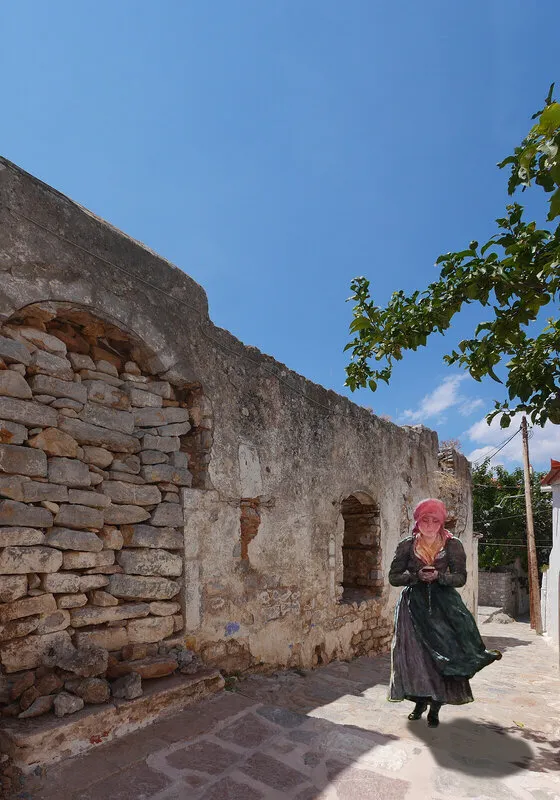
Jörgen Thornberg
Destiny Lane, 2021
Digital
50 x 70 cm
Kiafa, Hydra's oldest district, has its interesting parts. The long downhill slope of truly walkable steps between a small church and the corner that once was Nefeli, the blue hotel. I was on my way down, and she was on her way up. We met outside what I believe was once a butcher shop; at least, the hooks in the vaulted ceiling suggest it. It's been so long that no one remembers anymore. The woman smiled shyly and hurried on upwards. When I turned around, the beautiful woman had disappeared. Then, it struck me that she wasn't from my own time but one of those Time-travellers on a return visit. Her attire, with many layers of skirts, an apron, and a headscarf covering her hair, the embroidered vest, and the blouse underneath with Hydra lace, placed her more in the 19th century than later.
That she vanished precisely where the old entrance to the butcher shop, now covered by stacked stones, once stood was probably no coincidence. It must have been the butcher's maid I encountered, the one he fathered a child with—a scandal hushed up at the time. The maid was allowed to stay under the same roof as the butcher and his wife, and the result of their affair, a son, grew up together with their daughters. He was the son the butcher never had, and as an adult, he took over the butcher shop after his father. Such is how things are when the latch isn't on, as they say.
There are, in any case, many stories about that butcher, Giorgios, who was said to be a large and boisterous man who wasn’t always entirely sober when he wielded his butcher’s axe. One time, he slipped and cut off half of his little finger. Giorgios was clear-headed enough to pick up the stump and take it to his friend, the island’s only surgeon, Dimitris, who lived a few houses away. Dimitris and Giorgios had been friends since childhood, their bond strengthened by their shared love for Tsipouro, a now-trendy Greek spirit of the stronger kind. Tsipouro is made from grapes and wine byproducts, usually consumed neat or, as Giorgios preferred, with an anise flavour. Just like its cousin Ouzo, it was often enjoyed with small dishes. Olives, charcuterie, and spicy sausages paired with a glass of Tsipouro are a beloved combination. The reason for Giorgios' large girth, with a belly like a wine barrel, could be found here.
In any case, Dimitris praised his friend for coming so quickly with the finger stump; for now, he could probably fix the injury so that it would barely be noticeable after a while. The surgeon reattached the half with only a minor loss and bandaged the little finger, telling Giorgios to be extra careful with the axe for a while, as reattaching the finger a second time would be impossible.
Giorgios was overwhelmed with gratitude and asked what he owed.
'Not a thing. What wouldn’t one do for friends,' said Dimitris with his most courteous smile.
'Dear Dimitris, don't be shy about coming over to the shop and ordering whatever you want from my selection for free,' said the jovial and trusting Giorgios.
By the same weekend, Dimitris came over and took a couple of kilos of the best filet mignon. It should be noted that oxen were rare on Hydra; the pasture was insufficient for the gluttonous animals, so much meat had to be acquired at great expense from the mainland.
And so it continued, with a surgeon who had developed a taste for the delicacies from the animal kingdom and the butcher’s wife, Aikaterini, complaining that the finances didn’t add up. Eventually, Giorgios grew tired of his wife’s constant complaints and placed his little finger on the butcher's table, chopping off the piece that had so beautifully healed with his hand. Then he went over to Dimitris and slammed the finger on his desk.
'Here’s the finger, Dimitris, and now we’re even,' said the butcher, feeling he had settled his debt of honour to the surgeon. My plumber told me the story, so it’s undoubtedly true or at least plausible.
It wasn’t Giorgios’ drinking habits I was going to talk about—this story just slipped in—but rather about the butcher’s old house. The house, a significant part of Hydra's historical and cultural heritage, is in severe disrepair, with few walls still standing, and the upper floor and roof have long since disappeared. The fact that the vaulted ceilings with hooks remain intact is due to the ingenious construction. As long as the outer walls stand, the roof cannot collapse. That doesn’t stop me from wondering for nearly twenty-five years how such a beautiful old house with the best location in Kiafa could be allowed to fall into ruin. Its decay is a poignant reminder of the rich history and cultural legacy of this place.
Have you also wondered why so many buildings in Greece are ruined or unfinished? It's a mystery that has intrigued me for years, sparking my curiosity about the stories these abandoned structures hold.
"One might be surprised by the many empty or half-finished buildings, ruins, or vacant plots you come across in Greece," I remarked, observing the deteriorating structure before us walking down Donkey Shit Lane together. "It's not just a problem on Hydra; you see it everywhere—in cities, towns, villages, and even remote areas. For many visitors, it's an eyesore, detracting from the otherwise beautiful impression of Greece."
Aleksander, my plumber, nodded thoughtfully. "According to many Greeks, what you see is part of the problem of modern Greece. 'We are all the time like that. We are half Europeans and half Romans,' some of my Greek friends say, shrugging their shoulders." He sighed, gesturing toward the ruined building. "The problem, in the Greek way of thinking, isn’t our’s—it's someone else's, practically no one's, since the state neither has the interest nor the means to deal with it. If it's even a problem, except for aesthetic tourists." Aleksander looked stint at me.
"It's hard to understand the reason behind all these ruins," I said, glancing back at the crumbling walls. "After skimming through the internet, talking with friends, politicians, and experts, I've gotten an idea of the most common reasons for abandoned and unfinished buildings in Greece."
Aleksander’s expression grew serious. "The war and the German occupation left behind a ruined country where more than ten per cent of the population died due to starvation, even here on Hydra. People on the island even sold the roof tiles off their houses to buy food for their children. Piece by piece, buildings were dismantled and sold to buyers from the mainland. A house without a roof deteriorates quickly, and when the owners emigrated after the war to make a living, the decay accelerated."
"Many buildings were left unfinished because they ran out of funding," I continued, picking up his train of thought.
"But during the 1970s, 1980s, and 1990s boom, houses were often erected without permits. These arbitrary buildings in Greece were common practice for decades. The most common cause for a construction halt was a complaint from a neighbour to the local building office about an unpermitted project."
Aleksander smiled wryly. "And then there was the 2008 economic crisis," he added. "It hit Greece hard after an economic boom following the 2004 Olympic Games. Optimism exploded, and Greeks speculated wildly. Here on Hydra, some Athenians bought multiple plots and built houses, hoping prices would rise. One of your neighbouring houses was such a case. An Athenian built three houses at once—one for himself and two for his children when they grew up. A few years later, the Athenians had no houses left."
"Building is a life-long project, Giorgios," Aleksander explained, his voice carrying a tone of humour and resignation. "Property ownership is critical in Greek culture. It’s a symbol of wealth for a family. But where people from other countries precisely plan and budget their future house before building it, the Greeks take a slightly different approach."
He paused, then continued with a touch of pride. "Greeks will start building their houses even if they know they do not have enough funds to complete them. They are, by nature, super optimistic—or naive, maybe—hoping that money will show up at one point. But it can take up to a whole generation before completing the first floor. They start building when they have their land and must stop when the money runs out. It can be ten years between building the walls and putting in the windows. Of course, the economic crisis only made this worse. 'Siga, Siga,' 'Take it easy! Better times will come.'"
"I’ve heard that claiming the land as yours is another reason," I interjected.
Aleksander nodded. "That's true. In Greece, land ownership is not well registered. In fact, you are only obliged to register your property or plot with the National Cadastre of Greece since 2019, and even today, this system is not fully functioning. Records about ownership get lost; therefore, you have to claim your land as yours physically."
"When a Greek finds a plot perfect for his or her future house," he continued, "buying it and then leaving it empty for years could result in losing the land and the money it cost to buy. To avoid this, the Greeks build frames for future houses. This structure can be owned while you barely have to pay taxes."
"Building rules change continuously, I’ve understood," I said, speaking from my experience.
"Of course," Aleksander grinned. "Another benefit of putting up the house's structure before actually building it is that you’ll later be able to build the size of the house you wanted in the first place."
"Building regulations change quickly in Greece as a counteraction to all these practices. When you buy land in Greece today and want to build a mansion in thirty years, there’s a chance you might not be able to build more than a shed. However, if the structure already exists and is the size of a mansion, your volume is safe. No matter what rules come in the future, they won’t be able to decrease the size of your property."
"You do everything to cheat the system," I remarked.
"Naturally! Making the illegal, legal," Aleksander laughed. "But the structure is not only put up to avoid future rules. The Greeks even try to avoid the rules that exist today. Only in Greece is it possible to buy land on which you can’t legally build a house and then go ahead and build one anyway."
He paused to let that sink in, then continued, "In these cases, the house's structure is built first. Then, the Greeks went to the municipality, saying that since they already built the structure, it should become legal. Often, the municipality decides to make it legal and hands out a building permit. But you’re left with another abandoned, unfinished structure when they don't. The problem is that no one takes responsibility for these structures. Neither the government nor the owner invests money to remove the illegal structure; it just remains."
Aleksander leaned in slightly, his voice lowering as he shared an insider's knowledge. "According to experts, practically all buildings built in previous years have some type of arbitrary building. The Greek government has taken steps to resolve the issue of unpermitted buildings."
"As you mentioned, building permits have been required since 1955, but enforcement has been lax, resulting in numerous unpermitted structures. In 2011, legislation changed, making selling properties without proper permits illegal. This was part of a broader effort to regulate the real estate market and ensure compliance with building regulations."
"A practical system," Aleksander agreed. "Moreover, owners can declare excess construction, pay fines, and avoid demolition. This law aims to bring buildings into compliance and streamline the real estate market. Legalising unpermitted buildings is crucial for property owners. Present Greek law prohibits the sale, rental, or mortgaging of illegal structures. Owners must submit a 'Declaration of Legal Property Status,' verified by a certified architect or engineer, to confirm compliance with building codes. This declaration is necessary for all legal transactions involving the property. To legalise an unpermitted building, owners must first find a capable Engineer."
"The Engineer will conduct an on-site inspection and gather all relevant documents, such as building permits and ownership titles. They can declare the property and begin legalisation through the Technical Chamber of Greece if discrepancies are found. The Engineer will then measure which part is without a permit and calculate a fine to be paid. Fines are calculated based on various factors, including the structure's size and use, the construction timeframe, and the area’s tax value. Property owners must proactively legalise their structures to avoid penalties and facilitate future transactions. The Greek government continues to refine its approach to address this longstanding issue."
"Inheritance complicates things quite a bit, doesn’t it?" I asked.
"Unfortunately, yes," Aleksander said, his tone now sombre. "The final reason for the number of abandoned buildings in Greece is inheritance. As mentioned before, homeownership is important in Greek culture. Because of this, a house isn’t a tradable thing for the Greeks. It’s a family legacy."
Aleksander leaned back, a thoughtful expression crossing his face as he continued, "This made sense until the Second World War when most Greeks still lived in the villages, in their family legacies. But things started changing after the ’50s. When the economy began to grow, Greeks started moving towards the cities, driven by work and the promise of money. The next generation moved even further away, spreading out across Europe, Australia, and the US in search of a better life. Yet, despite all this, they still own their family houses in the villages—or at least a part of them."
He paused, his eyes reflecting a mixture of pride and frustration. "Today, Greeks no longer use the family house, but they still recognise its value to the family. They don’t want to sell; they want to own. And to make things more complicated, many of these houses aren’t owned by just one person but by the entire family. If just one member doesn’t want to sell, problems arise. Selling the family house means getting the whole Greek family to agree. And trust me, there’s always someone who won’t agree. Even if everyone knows they won’t live in the house, they won’t agree to sell it. Maybe they’ll use it to celebrate Easter together once a year, to have a reason to keep it. The result? The house falls into disrepair."
He then leaned forward, his voice dropping slightly. "And then there’s the matter Greeks despise more than anything: taxes."
I couldn’t help but chuckle at his tone. "Worse than kissing your sister," I teased, recalling a popular Greek saying. "There are many stories about how Greeks leave their houses unfinished to avoid taxes. However, nowadays, this is more of a myth than reality. Years ago, there was a rule in Greece that if you didn’t finish your house, you would pay fewer taxes. As a result, many Greeks just left a small part of their house unfinished to avoid the normal tax rate. But that rule doesn’t exist anymore, and it hasn’t for a long time. The only way to avoid higher taxes now is for unfinished, uninhabited buildings that have never been lived in and aren’t connected to electricity. That’s not an issue on Hydra."
Aleksander nodded in agreement, then smiled, "We should probably talk a little about perception and culture."
"Aside from Hydra, where we fiercely guard against any attempts at change, Greece doesn’t have a municipal beauty committee, nor do Greeks strictly follow building rules. This can make cities look a bit messy. Besides, my people are very practical. They want to easily add an extension or extra floor to their house or leave the ground floor completely open so they can park cars between the concrete columns. The function takes precedence over design, which can cause some confusion."
"And what about the future? Will it continue like this?" I asked, curious.
"Walking through Athens today, you can see that we’ve started doing something about the many abandoned buildings," Aleksander explained, cautiously optimistic. "Renovation is becoming popular, especially in the big cities, but also here on Hydra. Most of the time, people from outside buy and renovate these houses. One by one, old ruins disappear, but many remain. Hopefully, the number of abandoned and unfinished buildings in Greece will soon become a thing of the past. But it will take decades, maybe generations, because somewhere in the world, there’s a Greek in the diaspora dreaming of returning. That person’s small house share becomes the foundation of their dream. There are plenty of those kinds of Shangri-Las."
"Why are there so many derelict buildings?" I pressed.
"It would be easy to say: 'It’s because of the crisis,'" Aleksander replied, his voice tinged with complexity. "But the thing is, it’s more complicated than that because derelict buildings existed even before the crisis. However, the crisis definitely helped increase the number of these buildings, and of course, now everybody notices them."
He sighed, shaking his head. "The short answer is that it’s a matter of supply and demand. Someone decides to put their house up for sale, asking for a high amount of Euros. No one is willing to pay that much. Instead of lowering the price, the owner decides to 'sit on' the building until someone finally meets their demand. They can’t afford or don’t want to renovate the house, so the building remains abandoned, and its condition starts deteriorating. The crisis exacerbated this situation. People expected owners to lower the prices, but that didn’t happen—or didn’t happen to the extent expected."
He gestured towards one of the crumbling houses nearby. "There are several such cases on Hydra, some now supported by the municipality to prevent them from collapsing into the street. For years, part of lower Donkey Shit Lane was closed off, and all traffic had to take a detour via a steep side staircase."
"Money, money, and more money—it’s always what dictates everything," I remarked, echoing his earlier sentiment.
Aleksander nodded. "Prices tend to be very high in many places, not just on Hydra, and ownership can be complicated. A family patriarch will pass ownership to all his children. So if many family members own a house—say two or three siblings—some might wish to sell, others not. Infighting in Greek families is very common."
He leaned in closer, his voice taking on a conspiratorial tone. "In Athens, some areas are devalued for various reasons, so nobody will ever think of buying even one square meter in a place like that. Before the crisis, speculation was that this was being done on purpose. Whole districts were left to rot, becoming 'no man’s lands.' Prices were lowered to ridiculous sums, and developers swooped in, bought everything, and transformed the place. The Gazi district is a good example of that."
Aleksander sighed deeply, the weight of history and circumstance evident in his expression. "Finally, there isn’t—and never was—a state plan to save and restore historic buildings anywhere in Greece for that reason. Most derelict houses are really old and have more or less some historical importance. Despite that, the state will never do anything to save them unless private funds are involved."
"Now, let’s forget about old, crumbling houses and grab a beer at Roloi."
"Excellent suggestion. You can sit safely there without worrying about a roof tile falling on your head. The houses are well-maintained and have been for as long as I can remember," Aleksander grinned.

Jörgen Thornberg
Malmö
Lite om bilder och mig. Translation in English at the end.
Jag är en nyfiken person som ser allt i bilder, även det jag fäster i ord, gärna tillsammans för bakom alla mina bilder finns en berättelse. Till vissa bilder hör en kortare eller längre novell som följer med bilden.
Bilder berättar historier. Jag omges av naturlig skönhet, intressanta människor och historia var jag än går. Jag använder min kamera för att dokumentera världen och blanda det jag ser med vad jag känner för att fånga den dolda magin.
Mina bilder berättar mina historier. Genom mina bilder, tryck och berättelser. Jag bjuder in dig att ta del av dessa berättelser, in i ditt liv och hem och dela min mycket personliga syn på vår värld. Mer än vad ögat ser. Jag tänker i bilder, drömmer och skriver och pratar om dem; följaktligen måste jag också skapa bilder. De blir vad jag ser, inte nödvändigtvis begränsade till verkligheten. Det finns en bild runt varje hörn. Jag hoppas att du kommer att se vad jag såg och gilla det.
Jag är också en skrivande person och till många bilder hör en kortare eller längre essay. Den följer med tavlan, tryckt på fint papper och med en personlig hälsning från mig.
Flertalet bilder startar sin resa i min kamera. Enkelt förklarat beskriver jag bilden jag ser i mitt inre, upplevd eller fantiserad. Bilden uppstår inom mig redan innan jag fått okularet till ögat. På bråkdelen av ett ögonblick ser jag vad jag vill ha och vad som kan göras med bilden. Här skall jag stoppa in en giraff, stålmannen, Titanic eller vad det är min fantasi finner ut. Ännu märkligare är att jag kommer ihåg minnesbilden långt efteråt när det blir tid att skapa verket. Om jag lyckas eller inte, är upp till betraktaren, oftast präglat av en stråk av svart humor – meningen är att man skall bli underhållen. Mina bilder blir ofta en snackis där de hänger.
Jag föredrar bilder som förmedlar ett budskap i flera lager. Vid första anblicken fylld av feel-good, en vacker utsikt, fint väder, solen skiner, blommor på ängen eller vattnet som ligger förrädiskt spegelblankt. I en sådan bild kan jag gömma min egentliga berättelse, mitt förakt för förtryckare och våldsverkare, rasister och fördomsfulla människor - ett gärna återkommande motiv mer eller mindre dolt i det vackra motivet. Jag försöker förena dem i ett gemensamt narrativ.
Bild och formgivning har löpt som en röd tråd genom livet. Fotokonst känns som en värdig final som jag gärna delar med mig.
Min genre är vid som framgår av mina bilder, temat en blandning av pop- och gatukonst i kollage som kan bestå av hundratals lager. Vissa bilder kan ta veckor, andra någon dag innan det är dags att överlämna resultatet till printverkstaden. Fine Art Prints är digitala fotocollage. I dessa kollage sker rivandet, klippandet, pusslandet, målandet, ritandet och sprayningen digitalt. Det jag monterar in kan vara hundratals år gamla bilder som jag omsorgsfullt frilägger så att de ser ut att vara en del av tavlan men också bilder skapade av mig själv efter min egen fantasi. Därefter besöks printstudion och för vissa bilder numrera en limiterad upplaga (oftast 7 exemplar) och signera för hand. Vissa bilder kan köpas i olika format. Det är bara att fråga efter vilka. Gillar man en bild som är 70x100 men inte har plats på väggen, går den kanske att få i 50x70 cm istället. Frågan är fri.
Metoden Giclée eller Fine Art Print som det också kallas är det moderna sättet för framställning av grafisk konst. Villkoret för denna typ av utskrifter är att en högkvalitativ storformatskrivare används med åldersbeständigt färgpigment och konstnärspapper eller i förekommande fall på duk. Pappret som används möter de krav på livslängd som ställs av museer och gallerier. Normalt säljer jag mina bilder oinramade så att den nya ägaren själv kan bestämma hur de skall se ut, med eller utan passepartout färg på ram, med eller utan glas etc..
Under många år ställde jag bara ut på nätet, i valda grupper och på min egen Facebooksida - https://www.facebook.com/jorgen.thornberg.9
Jag finns också på en egen hemsida som tyvärr inte alltid är uppdaterad – https://www.jth.life/ Där kan du också läsa en del av de berättelser som följer med bilden.
UTSTÄLLNINGAR
Luftkastellet, oktober 2022
Konst i Lund, november 2022
Luftkastellet, mars 2023
Engleson Galleri Caroli, april 2023
Hydra, Greece June 2023
Engleson Galleri Caroli, oktober 2023
Toppen, Höllviken december 2023
Luftkastellet, mars 2024
Torups Galleri, mars 2024
Venice, May 2024
Luftkastellet, oktober 2024
Konst i Advent, December 2024
Galleri Engleson, Caroli December 2024
Jäger & Jansson Galleri, april 2025
A bit about pictures and me.
I'm a curious person who sees everything in pictures, even what I express in words, often combining them, for behind all my pictures lies a story. These narratives, some as short as a single image and others as long as a novel, are the heart and soul of my work.
Pictures tell stories. Wherever I go, I'm surrounded by natural beauty, exciting people, and history. I use my camera to document the world and blend what I see with what I feel to capture the hidden magic.
My images tell my stories. Through my pictures, prints, and narratives, I invite you to partake in these stories in your life and home and share my deeply personal perspective of our world. More than meets the eye. I think in pictures, dream, write, and talk about them; consequently, I must create images too. They become what I see, not necessarily confined to reality. There's a picture around every corner. I hope you'll see what I saw and enjoy it.
I'm also a writer, and many images come with a shorter or longer essay. It accompanies the painting, printed on fine paper with my personal greeting.
Many pictures start their journey on my camera. Simply put, I describe the image I see in my mind, experienced or imagined. The image arises within me even before I bring the eyepiece to my eye. In a fraction of a moment, I see what I want and what can be done with the picture. Here, I'll insert a giraffe, Superman, the Titanic, or whatever my imagination conjures up. Even stranger is that I remember the mental image long after it's time to create the work. Whether I succeed is up to the observer, often imbued with a streak of black humour – the aim is to entertain. My pictures usually become a talking point wherever they hang.
I prefer pictures that convey a message in multiple layers. At first glance, they're filled with feel-good vibes, a beautiful view, lovely weather, the sun shining, flowers in the meadow, or the water lying deceptively calm. But beneath this surface beauty, I often conceal a deeper story, a narrative that challenges societal norms or explores the human condition. I invite you to delve into these hidden narratives and discover the layers of meaning within my work.
Picture and design have been a thread running through my life. Photographic art feels like a fitting finale, and I'm happy to share it.
My genre is varied, as seen in my pictures; the theme is a blend of pop and street art in collages that can consist of hundreds of layers. Some images can take weeks, others just a day before it's time to hand over the result to the print workshop. Fine Art Prints are digital photo collages. In these collages, tearing, cutting, puzzling, painting, drawing, and spraying happen digitally. What I insert can be images hundreds of years old that I carefully extract so they appear to be part of the painting, but also images created by myself, now also generated from my imagination. Next, visit the print studio and, for certain images, number a limited edition (usually 7 copies) and sign them by hand. Some images may be available in other formats. Just ask which ones. If you like an image that's 70x100 but doesn't have space on the wall, you might be able to get it in 50x70 cm instead. The question is open.
The Giclée method, or Fine Art Print as it's also called, is the modern way of producing graphic art. This method ensures the highest quality and longevity of the artwork, using a high-quality large-format printer with archival pigment inks and artist paper or, in some cases, canvas. The paper used meets the longevity requirements set by museums and galleries. I sell my pictures unframed, allowing the new owner to personalise their artwork, confident in the lasting value and quality of the piece.
For many years, I only exhibited online, in selected groups, and on my Facebook page - https://www.facebook.com/jorgen.thornberg.9. I also have my website, which unfortunately is not constantly updated - https://www.jth.life/. You can also read some of the stories accompanying the pictures there.
EXHIBITIONS
Luftkastellet, October 2022
Art in Lund, November 2022
Luftkastellet, March 2023
Engleson Gallery Caroli, April 2023
Hydra, Greece June 2023
Engleson Gallery Caroli, October 2023
Toppen, Höllviken December 2023
Luftkastellet, March 2024
Torup Gallery, March 2024
Venice, May 2024
UTSTÄLLNINGAR
Luftkastellet, oktober 2022
Konst i Lund, november 2022
Luftkastellet, mars 2023
Engleson Galleri Caroli, april 2023
Hydra, Greece June 2023
Engleson Galleri Caroli, oktober 2023
Toppen, Höllviken december 2023
Luftkastellet, mars 2024
Torups Galleri, mars 2024
Venice, May 2024
Luftkastellet, October 2024
Konst i Advent, December 2024
Galleri Engleson, Caroli December 2024
Jäger & Jansson Galleri, April 2025
Utbildning
Autodidakt
Medlem i konstnärsförening
Öppna Sinnen
Med i konstrunda
Konstrundan i Skåne
Utställningar
Luftkastellet, October 2022
Art in Lund, November 2022
Luftkastellet, March 2023
Engleson Gallery Caroli, April 2023
Hydra, Greece June 2023
Engleson Gallery Caroli, October 2023
Toppen, Höllviken December 2023
Luftkastellet, March 2024
Torup Gallery, March 2024
Venice, May 2024