Vi använder cookies för att ge dig bästa möjliga upplevelse. Välj vilka cookies du tillåter.
Läs mer i vår integritetspolicy
Jörgen Thornberg
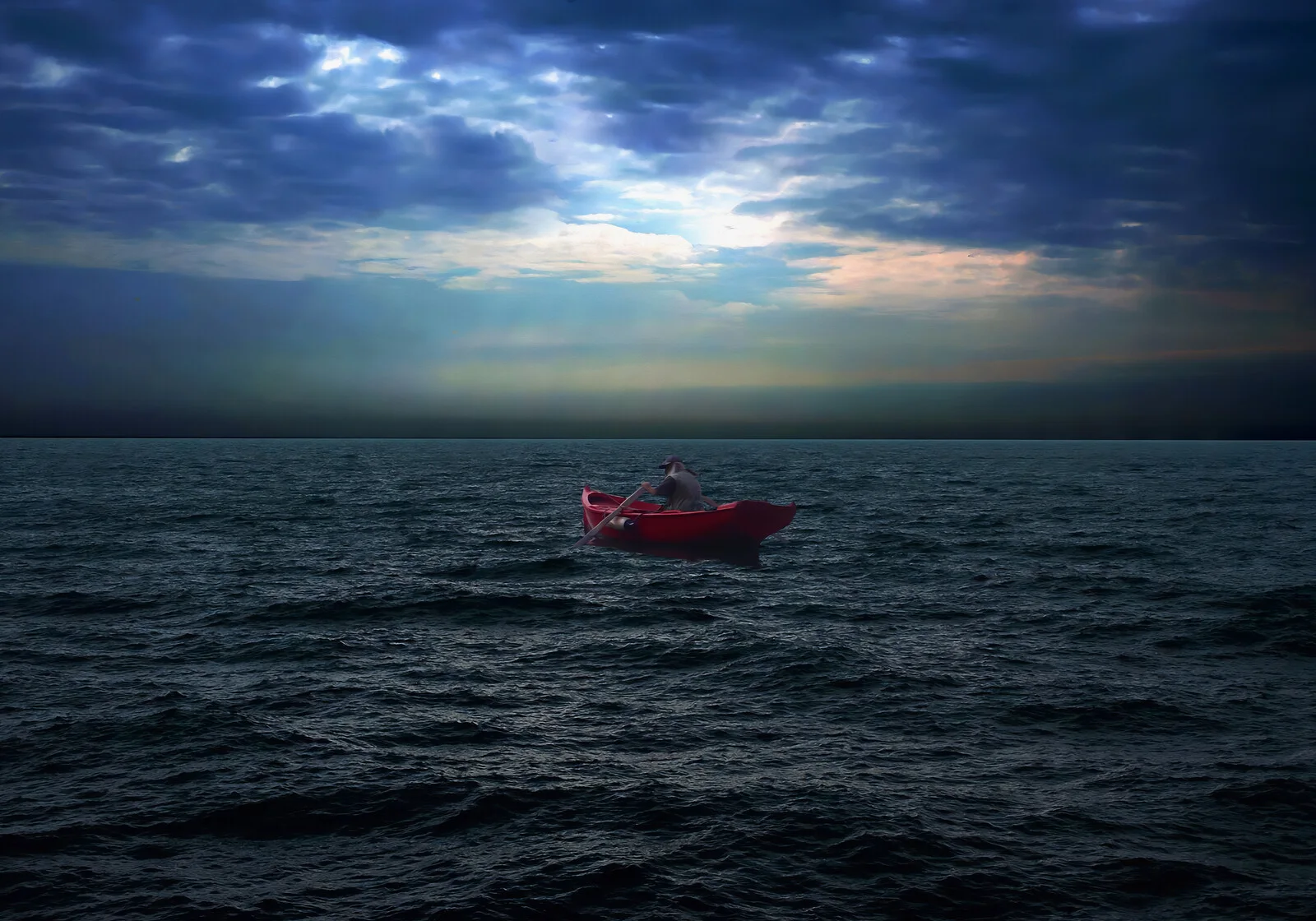
The Old Man and the Sea of Memories, 2024
Digital
70 x 50 cm
The Old Man and the Sea of Memories
In a boat bleeding red, adrift on the waves,
The old man rowed through the years and the days.
The Sea of Memories, dark and deep,
Held stories and secrets he could not keep.
Waves of thought crashed against his mind,
Reflections of wars, of battles unkind.
His heart was heavy with questions that roared,
What did they fight for? What was the reward?
Through the mist of the past, he battled with oars,
Fighting to stay afloat, far from the shores.
The ghosts of his comrades whispered and cried,
Asking why they had fallen and why they had died.
The waters swirled with Alpha and Kappa’s strife,
Debating the purpose, the value of life.
But Omega, the end, the wise, the calm,
Brought peace to his soul, a soothing balm.
As the storm of thoughts began to subside,
The sea grew still, no longer a tide.
The old man turned the boat toward the light,
Feeling the peace of the coming night.
He knew in his heart, through all he had seen,
That he owed Pan a drink for what might have been.
For the sea had calmed, the memories stilled,
And the old man rowed, his heart refilled.
To the harbour, he steered, with a quieted mind,
Leaving the questions and doubts behind.
In the Sea of Memories, he found his way,
To the shores of tomorrow and the peace of today.
Hydra, August 2024
This is the story of an old Hydriot, a Vietnam veteran, who found himself in a bright red little boat on a stormy dark sea off Hydra—a tale of the battle between memories, conscience against conviction, and facts pitted against illusions. The old man, haunted by his memories and thoughts about war, was engaged in an internal reckoning that had transcended his personal experience to become universally significant. The questions were so numerous that they echoed within him in a cacophony, and the old man rowed faster and faster to escape the noise. His struggle was palpable, and his journey was one of profound introspection.
The old man was engaged in an inner dialogue where two of his sides, Alpha and Kappa, fought an internal battle over the necessity of war, hurling arguments at each other. Alpha, his better side, had become pacifistic due to his war experiences, while Kappa, the darker side, defended the strong's right to maintain world order. The sea around him surged as a witch's cauldron, and the boat found itself in a whirlpool that took him thousands of years back to the time of the Peloponnesian War. From that perspective, the internal discussion grew even more intense, for what happened in Vietnam also occurred in Greece four centuries before our era. That parallel loomed behind the parties' arguments. The dialogue had developed into a violent internal confrontation, with arguments sharper than the sharpest axe, more pointed than Damocles' sword. The historical parallels were not just intriguing, but they also added a layer of intellectual stimulation to the narrative.
The sea around the old man was not just a physical entity but a metaphor for the turmoil within him. It was a furious, churning mass, and the boat was caught in a vortex that could only have been caused by Charybdis. The water was so dark that black had consumed the blue, and even the whirlpool's foam caps had turned into bottomless darkness. The sea mirrored the old man's inner turmoil and the overwhelming nature of his internal conflict. With its unpredictable and uncontrollable nature, the sea symbolised the chaos and confusion in the old man's mind, while the boat represented his attempt to navigate this turmoil.
According to Alpha, in modern times, the Vietnam War was a war that wasn't their own, not America's concern. The Americans had inherited colonial France's legacy, which ended in a French defeat at Điện Biên Phủ. This defeat marked the beginning of American involvement in Vietnam. The war was a manifestation of the global struggle between the ideologies of democracy and communism, with the Americans representing the former and the Vietnamese communists the latter. The war was also part of the more significant Cold War conflict between the United States and the Soviet Union. Once again, the Whites stood against the Reds, democracy against communism, rifle muzzle against rifle muzzle in a faraway land. Many innocent people would die; that wasn't in dispute because it was what happened. So far, Alpha and Kappa agreed, but then the gap between their positions widened, highlighting the futility of the war. This sense of disillusionment was a prevailing theme in their discourse.
“What were we doing there?” Alpha screamed.
“Domino theory, if one falls, they all fall, the first tile knocks over another, and so on until all the world's states have fallen victim to the red aggression. Even a blockhead like you should get that!” Kappa shouted back, equally agitated. “You were there when the old man was younger and played dominoes, so you understand how the domino effect works.”
“I know,” Alpha said. “How it was supposed to work in theory. The domino theory was a Cold War policy that suggested a communist government in one nation would quickly lead to communist takeovers in neighbouring states, each falling like a row of dominos. But despite the Americans losing in Vietnam, none of this happened. The Domino Theory proved to be wrong because South Vietnam did fall in 1975, but communism didn’t spread to every other country in the region. The real point being, of course, that Western countries like the US and Australia went to war on a flimsy pretext.”
“Advanced bullshit. That’s just bad history. No one knows what would have happened if there’d been no Western involvement in Vietnam. We do know that communism is a missionary cause – it’s inherently expansionistic, and it wants to grow and spread. It’s written in its slogan, Workers of the World Unite – of course, with the help of repressive regimes like the Soviet Union and China.”
“Loose theories,” Alpha said contemptuously.
“Not at all. I’m convinced that the lengthy involvement of the US, Australia, and other countries prevented the domino effect, even if they didn’t stop the North Vietnamese. Historians have argued that Western intervention gave time for other Southeast Asian countries to consolidate and engage in economic growth. Such growth was inhospitable to communism. The Domino Theory may have been at least partly a valid reason for war after all,” Kappa said diplomatically.
“Counterfactual, since no one can ever prove something that didn’t happen by claiming that what didn’t happen actually could have happened even if it didn’t,” Alpha said, unimpressed.
Alpha’s voice was tinged with frustration as he continued, “Indeed, the war was marred by a fundamental misunderstanding of Vietnamese culture and nationalism. Many historians argue that the U.S. severely underestimated the strength of Vietnamese nationalism and the resistance to foreign domination, whether it came from the West or the East. U.S. leaders failed to grasp the depth of Ho Chi Minh’s popularity and the legitimacy of the Viet Minh movement.”
Kappa scoffed, “You’re talking as if understanding culture would’ve stopped the spread of communism. They were fighting for their freedom, sure, but also for a communist regime that would have turned all of Southeast Asia red if left unchecked.”
Alpha shook his head. “You’re ignoring the strategic blunders made by the U.S. military. The Vietnam War is often cited as a classic example of asymmetric warfare, where a technologically superior military power faced a smaller but highly motivated and resourceful enemy. The U.S. strategy relied heavily on technological superiority and overwhelming firepower, but it proved ineffective against the guerrilla tactics employed by North Vietnam and the Viet Cong.”
Kappa leaned forward, his tone biting. “And yet, the Tet Offensive of 1968, which you historians love to call a turning point, was a military victory for the U.S. But you conveniently ignore that it was also a psychological victory for North Vietnam. It eroded American public support for the war and shattered the illusion that victory was near, as their leaders had falsely assured them.”
Alpha’s irritation grew. “Yes, and that psychological impact led to a massive anti-war movement within the U.S., especially after Tet. The war didn’t just split the American population; it ignited a huge anti-war movement that influenced political decisions and led to profound social consequences.”
Kappa sneered, “You’re going to bring up the effects on soldiers and civilians next, aren’t you?”
“Of course,” Alpha snapped. “The long-lasting effects on American veterans, including PTSD and the controversies surrounding chemical weapons like Agent Orange, are still felt today. On the Vietnamese side, millions of civilians and soldiers suffered during and after the war due to the massive bombings and long-term damage from chemical warfare.”
“And don’t forget the moral and ethical quagmires,” Alpha continued. “Events like the My Lai Massacre are stark examples of the war crimes and moral decay that the war brought about. The use of napalm and other inhumane weapons further highlights the moral compromises made.”
Kappa cut in sharply, “War is hell, Alpha. There’s no denying that. But was it all pointless? Many historians see Vietnam as a war fought without a clear or achievable strategy. It resulted in losses on all sides, and more importantly, the U.S. didn’t achieve its goals. Yet, was it entirely without purpose?”
“Look at the aftermath,” Alpha argued. “The Vietnam War was a significant blow to the U.S.'s international reputation and credibility. It marked the end of the unchallenged belief in American military superiority and began a period of deep introspection and scepticism towards military interventions abroad.”
Kappa sighed as if conceding a minor point. “Yes, but what about Southeast Asia? Vietnam became a unified communist state, and the war had significant repercussions for neighbouring countries like Laos and Cambodia, where instability and conflict continued for years.”
“In conclusion,” Alpha said, his voice firm, “Historians largely view the Vietnam War as a cautionary tale—a symbol of what can go wrong when nations go to war without clear objectives or a true understanding of the local context. It’s a lesson in the dangers of faulty assumptions, poor strategy, and cultural ignorance leading to disastrous consequences.”
Kappa leaned back, his expression unreadable. “You make it sound so clear-cut, Alpha. But history isn’t black and white. There are always shades of grey, and we can’t dismiss the possibility that intervention, despite all its flaws, might have prevented something far worse.”
Alpha’s tone softened slightly. “Perhaps, but the cost was too high. Too many lives were lost, too much suffering endured. And for what? A war that, in the end, achieved nothing of lasting value.”
The argument continued, the storm around them mirroring the storm within as the boat drifted through the endless sea of history with no clear resolution in sight.
As the storm within the old man, a symbol of the collective wisdom of the ancient world raged, Omega, representing his female side and ultimate balance and wisdom, intervened in the heated debate between Alpha and Kappa. Omega's calm voice echoed in the tumultuous sea, trying to mediate and save the old man from being swallowed by the jaws of Charybdis.
"If Alpha stands for strength, power, and positive energy—the best or the wisest—and Kappa represents the mysterious or the unknown, often associated with danger or evil, then Omega, the last letter of the Greek alphabet, symbolises the end, perfection, or the ultimate. If anyone could save the old man and his warring sides, it was Omega, the female side of the old man."
In the old man's troubled soul, a three-way discussion ensued, filled with questions, answers, insults, arguments, and counterarguments. Omega stood for what could be proven, what history agreed upon, what likely happened, and what seemed reasonable behind the fog of war and the heated debate. The discussion reflected the ongoing debate in the historical community about the nature and causes of these wars.
"History repeats itself because people like you don’t listen to each other. Instead of absorbing each other's arguments and coming to some common understanding, you continue this endless cycle of repetition," Omega said calmly, emphasising the importance of learning from history to inspire the audience.
"So you’re saying there was an equivalent to the political situation with the so-called domino theory guiding events in the background?" Kappa asked sceptically, referring to the Cold War-era belief that if one country in a region came under the influence of communism, then the surrounding countries would follow in a domino effect.
Sensing the potential to cool down the heated discussion, Omega highlighted the historical parallels. "One of the most striking parallels to the Vietnam War in ancient Greece is the Peloponnesian War (431–404 BC). Although the context and specific details differ significantly, there are similarities, particularly in how the conflicts involved multiple states and how larger powers supported their allies to advance their own interests, often with long-lasting and devastating consequences," he said.
"There were indeed many similarities with the Vietnam War," said Alpha, recalling what the old man had learned in school.
Omega continued, "The Peloponnesian War, like the Vietnam War, was fundamentally a conflict between alliances. In ancient Greece, it was the Delian League, led by Athens, against the Peloponnesian League, led by Sparta. Similarly, the United States supported South Vietnam to stop the spread of communism according to the domino theory. Various Greek city-states supported their respective allies to ensure their influence in Greece, much like how superpowers backed their proxies in Vietnam."
Alpha nodded, "It was also an ideological conflict, just as Vietnam was. The Peloponnesian War was a struggle between two different political and social systems: Athenian democracy versus Spartan oligarchy. In the same way, the Vietnam War was seen as a battle between democracy (the U.S.) and communism (the Soviet Union and China)."
Kappa, not one to be outdone, added, "Don’t forget the interventions and proxy battles. Just as in Vietnam, where the U.S., the Soviet Union, and China were involved without directly having interests in Vietnam, the Peloponnesian War was filled with interventions from various Greek city-states and empires. These powers didn’t necessarily have direct stakes in the main conflict but supported their allies to protect their political and military interests."
"The devastating consequences for the entire region were also eerily similar," Alpha pointed out. "The Peloponnesian War, like the Vietnam War, had catastrophic consequences for all of Greece. The conflict was prolonged, and even when it ended, Greece was severely weakened—just as Vietnam and the U.S. were deeply divided and scarred after the Vietnam War."
Still holding onto his stance, Kappa said, "The domino theory may specifically refer to the spread of communism in the post-war world, but a certain parallel can be drawn to Athens and Sparta’s attempts to prevent their ideological enemies from gaining too much power in the Greek world. Athens and Sparta feared that a victory for the other would lead to dominance over all of Greece and that their political systems and ways of life would be threatened."
Sensing the need to provide a broader perspective, Omega added, "In both cases, the conflicts were driven by the fear of losing influence and the belief that their ideology was under threat, leading to long, destructive wars involving multiple parties and affecting entire regions."
Kappa, unwilling to concede, challenged, "But was there internal resistance and protests during the Peloponnesian War, as there were during Vietnam?"
Omega responded, "Yes, there were indeed protests and internal resistance during the Peloponnesian War, especially in the city-states involved. This internal resistance often reflected fatigue with the prolonged war, social tensions, and political disagreements that arose from the extended conflict."
Alpha chimed in, "For instance, there were revolts among Athens' allies in the Delian League. Many of these city-states were tired of Athenian dominance and the war effort. The island of Lesbos revolted against Athens in 428 BC, leading to a brutal repression by Athens."
"And let’s not forget the oligarchic coup in Athens in 411 BC," Kappa added. "This was during the war, and it was a result of dissatisfaction with the democratic leadership’s handling of the war. Although democracy was restored relatively quickly, the coup showed how deep the internal division was in Athens."
Omega continued, "The war also led to significant social unrest, particularly in Athens. The prolonged conflict caused economic exhaustion, and Athens' reliance on taxes from its allies created tensions. Poverty and social divisions increased, worsening domestic discontent."
"And there was opposition to specific military decisions," Alpha interjected. "Like the disastrous Sicilian Expedition from 415–413 BC. This expedition led to a devastating Athenian defeat, which prompted further criticism of the political leadership and the continuation of the war."
Seeing an opportunity, Kappa added, "And just like in modern times, there were pacifist movements and critics of the war. One of the most famous critics was the playwright Aristophanes, who mocked the senselessness of the war and advocated for peace in his plays like 'Lysistrata' and 'Peace."
Omega concluded, "Indeed, the internal opposition during the Peloponnesian War mirrors the protests and internal resistance to the Vietnam War in the U.S. and other parts of the world. This internal dissent was often a reaction to the devastating effects of a prolonged war that drained resources and caused immense human suffering, as well as a growing sense that the war was no longer worth the cost."
As the storm subsided slightly, the three sides of the old man’s consciousness—Alpha, Kappa, and Omega—found a rare moment of reflection, each recognising that history's lessons were as complex and multifaceted as the conflicts themselves.
After a moment of reflection, Kappa thought of something. "Did religion play any role in the Vietnam War?" he asked. "Nowadays, the dividing lines are clearer—it's the Islamic factions, Sunnis versus Shiites, and together they stand against the broader Christian world, to the extent that the more secularised, developed world even cares."
Omega, always the voice of reason and balance, stepped in. "Religion indeed played a complex and multifaceted role during the Vietnam War, though it wasn't the primary driver of the conflict. Let me explain," Omega began.
"Buddhism, the dominant religion in Vietnam, especially in the South, was significant in protesting the South Vietnamese government, particularly under President Ngo Dinh Diem. Diem was a Catholic, and he was perceived as favouring Catholics over the Buddhist majority. This led to Buddhist protests, the most famous being the self-immolation of Thich Quang Duc in 1963. That act became a powerful symbol of resistance against Diem’s regime and brought international attention to the religious tensions in South Vietnam.
"Diem's government, with its preferential treatment of Catholics, exacerbated tensions between Buddhists and Catholics, further destabilising the region. Many Catholics from North Vietnam, fearing persecution under the communist regime, fled to the South after the partition of Vietnam in 1954. These refugees often became staunch supporters of Diem, seeing him as a protector of their faith.
"In the United States, some viewed the Vietnam War through a religious or moral lens, considering it a battle against godless communism. This perspective was used to rally public support, framing the war as a defence of freedom and religious values against the atheistic communism of the North.
"Religion also played a role in the personal lives of soldiers on both sides. Many American soldiers, particularly those from religious backgrounds, drew on their faith to cope with the horrors of war. Military chaplains and religious services provided spiritual support to the troops. On the other side, while the North Vietnamese government was officially atheistic, many Viet Cong and North Vietnamese soldiers came from traditional Buddhist or folk religious backgrounds. However, these beliefs were often overshadowed by communist ideology.
"And after the war," Omega continued, "the communist government of Vietnam maintained strict control over religious practices, particularly targeting religions seen as potential sources of opposition. This included Buddhist and Catholic communities, as the government sought to suppress any challenges to its authority."
Omega paused, letting the weight of history settle over the conversation. "So, while religion wasn't the cause of the war, it certainly shaped the social and political dynamics, influencing both the domestic opposition to the Diem regime and the personal experiences of those involved in the conflict."
"Which gods were involved, so to speak, in the Peloponnesian War, used in the propaganda, and supported or opposed it?" Alpha asked with interest.
Omega, ever the peacemaker and source of reason, took a moment to gather his thoughts before responding to Alpha's question. "You ask about the gods' involvement in the Peloponnesian War, and rightly so. They played a significant role, woven deeply into the propaganda and political manoeuvres on both sides," he began.
Kappa, still irritated, couldn't help but interject. "And what does that have to do with Vietnam? We're discussing communism and the Cold War, not ancient Greek mythology."
Curious and slightly defensive, Alpha replied, "Perhaps nothing directly, but it's fascinating to see how people across different eras use similar methods to rally their cause. Besides, understanding history helps us grasp the present."
Omega, nodding in agreement with Alpha, continued, "In ancient Greece, religion was an integral part of life, and every city-state believed their successes and failures were directly linked to the will and support of the gods."
Alpha, always eager for more knowledge, leaned in. "So, who were the gods that were involved? How were they used in the propaganda?"
Omega smiled slightly at Alpha's enthusiasm. "Let me explain," she said. "During the Peloponnesian War, several gods were invoked by Athens and Sparta to justify their actions and rally support."
"Like who?" asked Alpha.
"Athena, for one," Omega began. "Athens, named after the goddess Athena, considered her their protector. She was the goddess of wisdom, war, and craft, and Athenian leaders often attributed their military successes to her support. The Parthenon, built on the Acropolis, was more than just a temple—it symbolised Athena's protection over the city. Athenian propaganda used her image extensively to inspire their citizens and soldiers."
Kappa, still sceptical, muttered, "And Zeus? He’s supposed to be the king of the gods. Did he pick a side?"
Omega said Zeus was more neutral, though central in Greek religion. Sparta, Athens, and other Greek city-states prayed to Zeus for victory and support. He was seen as the god who maintained balance and justice, and his will was often interpreted through oracles and signs. However, both sides claimed they had Zeus' blessing for their actions.
"Sounds like a way to cover all bases," Kappa commented dryly.
"Indeed," Omega agreed. "But Apollo was more closely aligned with Sparta. Apollo held particular significance for the Spartans as the god of light, music, and prophecy. The Oracle at Delphi, dedicated to Apollo, played a significant role in Spartan decisions regarding war and peace. The Spartans believed that Apollo was on their side, especially after receiving favourable oracles from Delphi."
Alpha chimed in, "What about Poseidon? Athens had a strong navy; surely they invoked him."
"Poseidon," Omega explained, "had an ambivalent role. While he was traditionally important to maritime cities like Athens, which relied on a strong navy, Sparta also invoked him because many of their allies were coastal cities and islands. Both sides attributed their naval successes to Poseidon’s favour."
"And what about diplomacy? Was there a god for that?" Alpha asked, genuinely curious.
"Hermes," Omega said with a nod. "He was the god of trade, communication, and diplomacy, often symbolising negotiation and peaceful resolutions. In a war filled with diplomatic efforts and negotiations, Hermes was frequently invoked to bless diplomatic missions or ensure successful negotiations."
Kappa, still doubtful, asked, "So the gods were just pawns in their propaganda games?"
Omega considered this for a moment. "In a way, yes. The gods were deeply embedded in Greek culture, and their favour—or disfavour—was used to legitimise decisions, inspire warriors, and maintain morale. Oracles and prophecies were sought before major battles, and sacrifices were made to appease the gods. Victories were often attributed to the gods' satisfaction with these offerings."
Alpha then asked, "And what happened when things went wrong? When they lost battles or faced disasters?"
Omega replied, "These events were often seen as signs of the gods' displeasure. Natural phenomena like earthquakes, solar eclipses, and plagues were considered omens. These omens were used to warn against continuing the war or to push for peace. In Athens, for example, religious interpretations sometimes led to political strife. The case of Alcibiades is notable—his loyalty was questioned after he was accused of desecrating religious symbols, leading to his exile and eventual defection to Sparta."
"So, the gods were like a double-edged sword," Alpha mused. "They could bring victory but also cause division and disaster."
"Precisely," Omega agreed. "The gods were central to war propaganda in the Peloponnesian War. Both sides used religion to justify their actions and strengthen morale. The gods were invoked to inspire and intimidate, and their supposed favour or displeasure could significantly affect how the war was fought and perceived."
Still sceptical but intrigued, Kappa concluded, "Sounds like not much has changed. Whether it's gods or ideology, people will use whatever they can to justify war."
Omega nodded, "Indeed, and perhaps that's one of the most enduring lessons of history."
“Could Pan, the god of the wild, be against war?” Kappa asked with a hint of personal interest. The old man had always felt a deep connection to Pan, a connection Alpha often questioned.
Omega, the voice of reason, took the lead. “Pan, known for his love of nature, herds, and the simple life, wasn’t directly involved in wars like Ares or Athena. But if you think about what he stands for—nature, fertility, peace, and pleasure—it’s easy to imagine him opposing the chaos and destruction that war brings.”
Alpha nodded, intrigued. “Pan did value the tranquillity of the wilderness. War would certainly disrupt that.”
“Exactly,” Omega continued. “Pan was the protector of the natural world and the god of fertility. War devastates the environment and the cycles of life and growth, something Pan would likely be against. Imagine the fields and forests torn apart by battles; that’s not something Pan would support.”
Kappa chimed in, “And Pan loved a good party, right? Music, dancing, revelry would all disappear in the face of war.”
“Precisely,” Omega agreed. “War silences the music, stops the dancing, and replaces joy with sorrow. Pan’s world would be turned upside down. His pleasures—festivities, eroticism, fertility, and the peaceful life of the countryside—would be crushed under the weight of conflict.”
Reflecting on this, Alpha added, “It’s almost as if Pan, in his love for life’s simple joys and the continuation of life through fertility, would stand in direct opposition to the harsh realities of war.”
With a smirk, Kappa remarked, “Pan might be the god of revelry, but even he wouldn’t want his parties ruined by the sounds of battle.”
Omega concluded, “Exactly. Pan, with his deep connection to nature, fertility, erotics and pleasure, would likely hate the destruction and suffering that comes with war. In that sense, he could be seen as a symbol of resistance to conflict, a guardian of the peace and joy that war threatens to destroy.”
”I couldn’t agree more”, said Alpha, who wasn’t Pan's best friend.
"We seem to be agreeing more and more, so perhaps the sea will soon calm down," Omega continued.
With a hint of scepticism, Kappa asked, "Has anything actually improved because of the war? From a neutral perspective?"
Omega, always the voice of reason, paused before responding. “Finding positive aspects of the Vietnam War from a neutral standpoint is challenging, especially considering the immense human suffering and material costs. However, historians and analysts have identified a few long-term effects that could be seen as improvements, though these are often debated and depend on perspective.”
Alpha interjected, “Such as?”
Omega continued, “For one, Vietnam’s Unification and Self-Determination.”
“What do you mean?” Kappa asked, somewhat puzzled.
“After the war, Vietnam became a unified nation under a communist government. Although part of the population suffered under this regime, and many fled the country, Vietnam has since experienced a period of stability and self-determination that it didn’t have under colonial rule or when it was divided between North and South. The country has also been able to follow its development path without foreign interference.”
Alpha nodded thoughtfully, “And economically?”
“Vietnam has seen impressive economic growth since the 1980s,” Omega explained. “Especially after the implementation of reforms under the ‘Đổi Mới’ policy, which led to market-oriented economic changes and an opening up to international trade.”
Not entirely convinced, Kappa pressed on, “But what about international relations? Did the war change anything there?”
“Absolutely,” Omega replied. “The war forced the United States to reevaluate its foreign policy, particularly its use of military power. This led to greater scepticism about engaging in foreign conflicts without a clear and achievable strategy. It has influenced how the U.S. and other Western nations approach international crises and military interventions.”
“And diplomacy?” Alpha asked.
“The failures of Vietnam led to improved diplomatic relations between former enemies, especially between the U.S. and Vietnam, which now have a functioning relationship. It’s an example of how nations can overcome past conflicts through diplomacy and cooperation,” Omega added.
Kappa raised an eyebrow, “What about military and strategic lessons? Surely something was learned there?”
“Indeed,” Omega agreed. “The war taught valuable lessons about asymmetric warfare, guerrilla tactics, and the need to understand cultural and political contexts in war zones. These lessons have influenced how modern military forces are trained and deployed today.”
Alpha chimed in, “And let’s not forget the impact on veteran care.”
Omega nodded, “Yes, the psychological and physical injuries suffered by many veterans during the Vietnam War led to greater awareness and improved systems for veteran care, not just in the U.S. but in other countries as well.”
Kappa, still probing, asked, “What about the anti-war movement? Did that have any lasting effects?”
“Definitely,” Omega responded. “The Vietnam War contributed to a strong anti-war movement and increased civic engagement in political issues. It also highlighted the importance of freedom of speech, the press’s role in scrutinising the government, and the right to protest—all of which have had lasting effects on democracies worldwide.”
Alpha added, “Let’s not overlook the emerging environmental awareness.”
Omega agreed, “The use of chemical weapons like Agent Orange and its long-term consequences for the environment and public health in Vietnam led to greater global awareness of the environmental impact of military actions and the necessity of considering environmental concerns in war planning and post-war recovery efforts.”
Finally relenting, Kappa concluded, “So, despite the devastation, there were some areas where the war’s effects, seen from a longer perspective, led to improvements or lessons that had a positive impact.”
Omega nodded, “Yes, but it’s important to remember that these improvements often came from overcoming the war’s negative effects rather than being direct positive outcomes of the conflict itself.”
Alpha pondered the question for a moment before asking, “Can we apply the same reasoning to the Peloponnesian War as we did with Vietnam? What were the lasting political changes and positive and negative consequences, and how did it impact people in the long run?”
Omega, ever the historian, nodded thoughtfully. “The Peloponnesian War (431–404 B.C.) was a long and devastating conflict between Athens and Sparta and their respective allies. Like Vietnam, it led to significant changes in the Greek world, and we can certainly analyse its consequences from various angles.”
“Let’s hear it then,” Kappa said, leaning forward, his tone a mix of curiosity and challenge.
Omega began, “First, there was the Political and Military Instability.”
“How so?” Alpha asked, intrigued.
“The war led to a general weakening of the Greek city-states, which eventually opened the door for external threats, particularly from Macedonia under Philip II and later Alexander the Great,” Omega explained. “The conflict marked the end of the classical Greek democracy that had flourished in Athens and resulted in a period of despotism and fragmented power struggles.”
Kappa interjected, “But Sparta came out on top, right? What about their dominance?”
“True,” Omega agreed. “Sparta emerged as the victor and established a brief hegemonic power over Greece. But this dominance was short-lived, as Sparta quickly weakened, partly due to the war's enormous human and material costs.”
Alpha, always interested in democratic principles, asked, “And what about democracy? How did it fare?”
Omega continued, “The war led to significant changes in democratic thought. Athenian democracy, which was once a model of direct democracy, was questioned after the war. The outcome led to reevaluating democracy as a system, especially after the democratic structures in Athens proved vulnerable to demagoguery and internal strife.”
Kappa added with a hint of satisfaction, “And then there was the rule of the Thirty Tyrants, right? A clear example of how fragile democracy can be.”
“Exactly,” Omega confirmed. “After Athens’ defeat, an oligarchic government known as the Thirty Tyrants was established. This highlighted the instability that came with power shifts and revealed the dangers of extremism and concentrated power. It became a crucial example of the fragility of democracy in Greece.”
Alpha, shifting gears, asked, “But what about the cultural and philosophical impact?”
“Good point,” Omega replied. “The war sparked a period of intense philosophical reflection on war, politics, and morality. Philosophers like Socrates, Plato, and later Aristotle were profoundly influenced by the war and its consequences, shaping their thoughts on ethics, politics, and human nature.”
Kappa, now more engaged, commented, “And Thucydides, right? He gave us much insight into power dynamics and human ambition.”
“Indeed,” Omega agreed. “Thucydides’ work on the Peloponnesian War provided a deeper understanding of the war’s dynamics, including power politics, human ambition, and the role of morality in political decisions. His writings remain central to the study of history and international relations.”
“But what about the social consequences?” Alpha asked, concerned about the impact on ordinary people.
Omega sighed, “The war caused massive economic destruction, with ruined fields, famine, and a general decline in trade and industry. The economic recovery was slow, and many Greek city-states never fully recovered.”
Kappa added, “And let’s not forget the demographic decline. War, disease—like the plague in Athens—and migration heavily affected the population. It affected the long-term development of Greek civilisation and its ability to recover and expand.”
Omega nodded, “Exactly. The population decline had lasting effects on Greece’s social and economic fabric.”
Alpha, always looking for lessons, asked, “Were there any lessons learned for future conflicts?”
“Absolutely,” Omega replied. “The war taught the Greeks, and later generations, about the importance of realpolitik and balance of power. Lessons from the Peloponnesian War helped shape future diplomatic and military strategies in the ancient world.”
With a rare moment of agreement, Kappa added, “And it highlighted the dangers of internal power struggles. The conflicts within Athens and Sparta emphasised the importance of unified leadership, a central idea in later political theories.”
Omega concluded, “The Peloponnesian War had profound and long-lasting effects on the Greek world. It led to political and social instability and prompted philosophical reflection and cultural development. While the negative consequences were significant, the lessons learned, and the introspection it prompted have influenced historical thinking and political theory for centuries.”
Alpha nodded, seeing the parallels, “Just like Vietnam—a tragic conflict with hard-earned lessons that shaped the future.”
“Yes,” Omega agreed, “and it shows that even in the darkest times, there are lessons to be learned and insights to be gained that can guide future generations.”
Kappa leaned in, his curiosity piqued, “So, did the Peloponnesian War pave the way for Alexander the Great and his father, Philip, to conquer all of Greece? Did it change the course of history?”
Omega nodded, taking a moment to gather her thoughts before responding. “Yes, the Peloponnesian War and its aftermath can be seen as a significant gateway for Philip II of Macedon, and later his son, Alexander the Great, to conquer and dominate Greece.”
Alpha, ever the scholar, urged Omega to elaborate. “How exactly did that happen?”
Omega began, “The Peloponnesian War created a period of deep weakness among the Greek city-states. After the war, these city-states were severely weakened both economically and militarily. The previous balance of power between Athens and Sparta had collapsed. Despite emerging victorious, Sparta quickly proved incapable of maintaining its newfound dominance over Greece and soon weakened. Athens, on the other hand, was broken and politically unstable. This general weakening made it difficult for the Greek city-states to resist an external threat.”
Kappa interjected, “And that’s when Philip II saw his opportunity, right?”
“Exactly,” Omega continued. “Philip II of Macedon seized this power vacuum. He reformed the Macedonian army, introduced the Macedonian phalanx, and developed a highly effective military force. With Greece weakened and divided, Philip was able to gradually conquer and control large parts of the Greek world through a combination of military superiority, diplomacy, and strategic marriages.”
Alpha, always drawn to decisive moments in history, asked, “What about the Battle of Chaeronea? Was that the turning point?”
Omega nodded, “The Battle of Chaeronea in 338 B.C. was indeed the climax of Philip’s rise to power. He defeated an alliance of Greek city-states led by Athens and Thebes. This battle marked the end of the independence of the Greek city-states and the establishment of the Corinthian League, a federation of Greek city-states under Macedonian control. Philip became the de facto leader of Greece, setting the stage for his son Alexander to use Greece as a base for his conquests of Persia and beyond.”
Now fully engaged, Kappa added, “So, when Philip died, Alexander inherited a unified Macedonian army and a Greece that was politically fragmented but militarily dominated?”
“Exactly! Lock, stock and barrel”, Omega confirmed. “Philip’s sudden death left Alexander with a powerful military and a politically divided Greece, which he could harness for his grand conquests. This allowed Alexander to create one of the largest empires in the ancient world.”
Alpha asked, reflecting on the broader implications, “So, can we say that the Peloponnesian War was a catalyst that reshaped the Greek world and set the stage for Macedonian dominance?”
Omega agreed, “Yes, the Peloponnesian War weakened the Greek city-states to such an extent that they became vulnerable to an external power like Macedon. Philip II’s military and political genius capitalised on this, leading to Macedonian dominance over Greece and paving the way for Alexander the Great’s conquests. The war can indeed be seen as a catalyst that transformed the Greek world and prepared the stage for a new era under Macedonian control.”
Still processing the information, Kappa muttered, “It’s incredible how one conflict can change the entire course of history.”
Alpha nodded, “Indeed. It’s a stark reminder of how fragile power can be and how quickly the balance can shift.”
Omega smiled slightly, sensing a moment of unity among the three sides of the old man’s soul. “History often hinges on such moments. The Peloponnesian War, like Vietnam, is a powerful example of how conflict can reshape the world in both predictable and unforeseen ways.”
Alpha, ever the seeker of broader understanding, leaned forward, asking, “Given this historical reflection, can we speculate on what the Vietnam War, the failed Iraq War, and similar conflicts might have for consequences for the present day? Hypothetically, of course.”
Omega took a deep breath, knowing the complexity of the question. “Speculating on the consequences of wars like Vietnam and Iraq from a historical perspective can offer insights into possible future developments. History shows us that failed or controversial wars often lead to long-lasting and unexpected consequences for the nations directly involved and the global order.”
Kappa, who was always keen on finding the practical takeaways, cut in, “Alright, let’s hear it. What kind of consequences are we talking about?”
Omega began, “First, there’s the weakening of superpowers and the creation of power vacuums. The Vietnam War significantly weakened the global influence of the United States and led to a period of questioning American foreign policy. Much like how the Peloponnesian War weakened the Greek city-states, the Vietnam War led to internal U.S. polarisation and a loss of international confidence.”
Alpha nodded thoughtfully, “And Iraq?”
Omega continued, “The Iraq War, especially the prolonged occupation and chaotic aftermath, contributed to weakening the U.S. position in the Middle East, creating a power vacuum that allowed the rise of groups like ISIS. This has destabilised the region and contributed to ongoing conflicts.”
Kappa frowned, “So, we’re talking about long-term destabilisation. But what about changed alliances and geopolitical shifts?”
Omega agreed, “Yes, much like the Peloponnesian War reshaped power structures in Greece, failed wars can lead to changes in international alliances and power balances. For instance, after the Vietnam and Iraq wars, China and Russia have been able to expand their influence, capitalising on the weakened U.S. stance.”
Considering the broader picture, Alpha added, “And in the Middle East, Iran’s influence grew stronger after the war weakened Iraq. Meanwhile, U.S. allies began questioning its reliability and seeking alternative alliances, potentially reshaping global power balances.”
Kappa jumped in again, “What about internal divisions and polarization? We’ve seen that in the U.S., right?”
Omega nodded, “Exactly. Just as the Greek city-states were internally divided after the Peloponnesian War, the Vietnam and Iraq wars have contributed to deep political polarisation in the U.S. and other Western countries. This mistrust in government, rising nationalism, and populism can be seen as aftershocks of these conflicts.”
Alpha sighed, “And these divisions weaken democracies, creating space for authoritarian forces to gain ground nationally and internationally.”
Still pressing for concrete outcomes, Kappa asked, “What about the rise of non-state actors and asymmetric warfare?”
Omega replied, “That’s another consequence. Modern conflicts have seen the rise of non-state actors like terrorist groups and militias, similar to how fragmentation in Greece led to various factions and small states trying to fill the power vacuum. Asymmetric warfare, where smaller, irregular forces take on larger national armies, has become more common. Future conflicts will likely be marked by this type of warfare rather than conventional state-on-state wars.”
Reflecting on the long-term, Alpha inquired, “And the economic and social aftermath?”
Omega answered, “The economic costs of the Vietnam and Iraq wars have had long-lasting effects on the economies of the involved countries. Like in Greece, where wars led to economic decline and social unrest, these conflicts can increase inequality, unemployment, and social instability.”
Kappa added, “And the trauma of war, the situation of veterans, and general war fatigue can influence how future generations view military intervention and national security policies.”
Alpha, always hopeful for a positive turn, asked, “But are there any opportunities for reform and lessons learned?”
Omega smiled slightly, “History also shows us that failed wars can lead to self-reflection and reform. Just as Greece eventually rethought its political structures after the Peloponnesian Wars, the U.S. and other nations may be forced to rethink their foreign policy, military strategies, and global roles due to the Vietnam and Iraq wars.”
Kappa, somewhat sceptical, said, “So, we might see a more cautious and diplomatically oriented foreign policy emerge as a lesson from these failed wars?”
Omega nodded, “That’s a possibility. These wars, like the Peloponnesian War, could lead to long-term changes on global and national levels, creating power vacuums, shifting alliances, weakening superpowers, and leading to internal divisions. But they might also give rise to opportunities for reform and rethinking global power structures and strategies.”
Alpha, looking for a final reflection, asked, “What about Putin, North Vietnam, China, and Mr. Trump? How do they compare to these historical examples?”
Omega, ready to conclude, responded, “Putin, North Vietnam, China, and Mr. Trump represent different but significant players on the global stage, each interacting with Europe and the world in ways that echo historical dynamics. Putin has challenged European security through aggressive policies and hybrid warfare, much like how shifting powers challenged Greece after the Peloponnesian War. North Vietnam’s struggle against the U.S. resonates with how smaller states can resist larger powers, influencing how Europe views modern interventions.”
Kappa, always the realist, added, “China’s economic expansion and strategic ambitions remind us of how new powers can rise when old powers falter. And Mr. Trump’s nationalist policies and strained relations with Europe show how alliances can be tested and reshaped, much like how Greek alliances shifted after their war.”
Alpha, nodding in agreement, concluded, “These relationships and their impacts on Europe and the world continue to shape our present and future, much like the wars and power shifts of ancient times.”
After a long time rowing to prevent the boat from capsizing, the old man suddenly found himself back in the present, in the strait off Hydra, where the sea had calmed. He turned the bow towards the harbour, feeling that he owed the god Pan a beer or three.
Jörgen Thornberg
The Old Man and the Sea of Memories, 2024
Digital
70 x 50 cm
The Old Man and the Sea of Memories
In a boat bleeding red, adrift on the waves,
The old man rowed through the years and the days.
The Sea of Memories, dark and deep,
Held stories and secrets he could not keep.
Waves of thought crashed against his mind,
Reflections of wars, of battles unkind.
His heart was heavy with questions that roared,
What did they fight for? What was the reward?
Through the mist of the past, he battled with oars,
Fighting to stay afloat, far from the shores.
The ghosts of his comrades whispered and cried,
Asking why they had fallen and why they had died.
The waters swirled with Alpha and Kappa’s strife,
Debating the purpose, the value of life.
But Omega, the end, the wise, the calm,
Brought peace to his soul, a soothing balm.
As the storm of thoughts began to subside,
The sea grew still, no longer a tide.
The old man turned the boat toward the light,
Feeling the peace of the coming night.
He knew in his heart, through all he had seen,
That he owed Pan a drink for what might have been.
For the sea had calmed, the memories stilled,
And the old man rowed, his heart refilled.
To the harbour, he steered, with a quieted mind,
Leaving the questions and doubts behind.
In the Sea of Memories, he found his way,
To the shores of tomorrow and the peace of today.
Hydra, August 2024
This is the story of an old Hydriot, a Vietnam veteran, who found himself in a bright red little boat on a stormy dark sea off Hydra—a tale of the battle between memories, conscience against conviction, and facts pitted against illusions. The old man, haunted by his memories and thoughts about war, was engaged in an internal reckoning that had transcended his personal experience to become universally significant. The questions were so numerous that they echoed within him in a cacophony, and the old man rowed faster and faster to escape the noise. His struggle was palpable, and his journey was one of profound introspection.
The old man was engaged in an inner dialogue where two of his sides, Alpha and Kappa, fought an internal battle over the necessity of war, hurling arguments at each other. Alpha, his better side, had become pacifistic due to his war experiences, while Kappa, the darker side, defended the strong's right to maintain world order. The sea around him surged as a witch's cauldron, and the boat found itself in a whirlpool that took him thousands of years back to the time of the Peloponnesian War. From that perspective, the internal discussion grew even more intense, for what happened in Vietnam also occurred in Greece four centuries before our era. That parallel loomed behind the parties' arguments. The dialogue had developed into a violent internal confrontation, with arguments sharper than the sharpest axe, more pointed than Damocles' sword. The historical parallels were not just intriguing, but they also added a layer of intellectual stimulation to the narrative.
The sea around the old man was not just a physical entity but a metaphor for the turmoil within him. It was a furious, churning mass, and the boat was caught in a vortex that could only have been caused by Charybdis. The water was so dark that black had consumed the blue, and even the whirlpool's foam caps had turned into bottomless darkness. The sea mirrored the old man's inner turmoil and the overwhelming nature of his internal conflict. With its unpredictable and uncontrollable nature, the sea symbolised the chaos and confusion in the old man's mind, while the boat represented his attempt to navigate this turmoil.
According to Alpha, in modern times, the Vietnam War was a war that wasn't their own, not America's concern. The Americans had inherited colonial France's legacy, which ended in a French defeat at Điện Biên Phủ. This defeat marked the beginning of American involvement in Vietnam. The war was a manifestation of the global struggle between the ideologies of democracy and communism, with the Americans representing the former and the Vietnamese communists the latter. The war was also part of the more significant Cold War conflict between the United States and the Soviet Union. Once again, the Whites stood against the Reds, democracy against communism, rifle muzzle against rifle muzzle in a faraway land. Many innocent people would die; that wasn't in dispute because it was what happened. So far, Alpha and Kappa agreed, but then the gap between their positions widened, highlighting the futility of the war. This sense of disillusionment was a prevailing theme in their discourse.
“What were we doing there?” Alpha screamed.
“Domino theory, if one falls, they all fall, the first tile knocks over another, and so on until all the world's states have fallen victim to the red aggression. Even a blockhead like you should get that!” Kappa shouted back, equally agitated. “You were there when the old man was younger and played dominoes, so you understand how the domino effect works.”
“I know,” Alpha said. “How it was supposed to work in theory. The domino theory was a Cold War policy that suggested a communist government in one nation would quickly lead to communist takeovers in neighbouring states, each falling like a row of dominos. But despite the Americans losing in Vietnam, none of this happened. The Domino Theory proved to be wrong because South Vietnam did fall in 1975, but communism didn’t spread to every other country in the region. The real point being, of course, that Western countries like the US and Australia went to war on a flimsy pretext.”
“Advanced bullshit. That’s just bad history. No one knows what would have happened if there’d been no Western involvement in Vietnam. We do know that communism is a missionary cause – it’s inherently expansionistic, and it wants to grow and spread. It’s written in its slogan, Workers of the World Unite – of course, with the help of repressive regimes like the Soviet Union and China.”
“Loose theories,” Alpha said contemptuously.
“Not at all. I’m convinced that the lengthy involvement of the US, Australia, and other countries prevented the domino effect, even if they didn’t stop the North Vietnamese. Historians have argued that Western intervention gave time for other Southeast Asian countries to consolidate and engage in economic growth. Such growth was inhospitable to communism. The Domino Theory may have been at least partly a valid reason for war after all,” Kappa said diplomatically.
“Counterfactual, since no one can ever prove something that didn’t happen by claiming that what didn’t happen actually could have happened even if it didn’t,” Alpha said, unimpressed.
Alpha’s voice was tinged with frustration as he continued, “Indeed, the war was marred by a fundamental misunderstanding of Vietnamese culture and nationalism. Many historians argue that the U.S. severely underestimated the strength of Vietnamese nationalism and the resistance to foreign domination, whether it came from the West or the East. U.S. leaders failed to grasp the depth of Ho Chi Minh’s popularity and the legitimacy of the Viet Minh movement.”
Kappa scoffed, “You’re talking as if understanding culture would’ve stopped the spread of communism. They were fighting for their freedom, sure, but also for a communist regime that would have turned all of Southeast Asia red if left unchecked.”
Alpha shook his head. “You’re ignoring the strategic blunders made by the U.S. military. The Vietnam War is often cited as a classic example of asymmetric warfare, where a technologically superior military power faced a smaller but highly motivated and resourceful enemy. The U.S. strategy relied heavily on technological superiority and overwhelming firepower, but it proved ineffective against the guerrilla tactics employed by North Vietnam and the Viet Cong.”
Kappa leaned forward, his tone biting. “And yet, the Tet Offensive of 1968, which you historians love to call a turning point, was a military victory for the U.S. But you conveniently ignore that it was also a psychological victory for North Vietnam. It eroded American public support for the war and shattered the illusion that victory was near, as their leaders had falsely assured them.”
Alpha’s irritation grew. “Yes, and that psychological impact led to a massive anti-war movement within the U.S., especially after Tet. The war didn’t just split the American population; it ignited a huge anti-war movement that influenced political decisions and led to profound social consequences.”
Kappa sneered, “You’re going to bring up the effects on soldiers and civilians next, aren’t you?”
“Of course,” Alpha snapped. “The long-lasting effects on American veterans, including PTSD and the controversies surrounding chemical weapons like Agent Orange, are still felt today. On the Vietnamese side, millions of civilians and soldiers suffered during and after the war due to the massive bombings and long-term damage from chemical warfare.”
“And don’t forget the moral and ethical quagmires,” Alpha continued. “Events like the My Lai Massacre are stark examples of the war crimes and moral decay that the war brought about. The use of napalm and other inhumane weapons further highlights the moral compromises made.”
Kappa cut in sharply, “War is hell, Alpha. There’s no denying that. But was it all pointless? Many historians see Vietnam as a war fought without a clear or achievable strategy. It resulted in losses on all sides, and more importantly, the U.S. didn’t achieve its goals. Yet, was it entirely without purpose?”
“Look at the aftermath,” Alpha argued. “The Vietnam War was a significant blow to the U.S.'s international reputation and credibility. It marked the end of the unchallenged belief in American military superiority and began a period of deep introspection and scepticism towards military interventions abroad.”
Kappa sighed as if conceding a minor point. “Yes, but what about Southeast Asia? Vietnam became a unified communist state, and the war had significant repercussions for neighbouring countries like Laos and Cambodia, where instability and conflict continued for years.”
“In conclusion,” Alpha said, his voice firm, “Historians largely view the Vietnam War as a cautionary tale—a symbol of what can go wrong when nations go to war without clear objectives or a true understanding of the local context. It’s a lesson in the dangers of faulty assumptions, poor strategy, and cultural ignorance leading to disastrous consequences.”
Kappa leaned back, his expression unreadable. “You make it sound so clear-cut, Alpha. But history isn’t black and white. There are always shades of grey, and we can’t dismiss the possibility that intervention, despite all its flaws, might have prevented something far worse.”
Alpha’s tone softened slightly. “Perhaps, but the cost was too high. Too many lives were lost, too much suffering endured. And for what? A war that, in the end, achieved nothing of lasting value.”
The argument continued, the storm around them mirroring the storm within as the boat drifted through the endless sea of history with no clear resolution in sight.
As the storm within the old man, a symbol of the collective wisdom of the ancient world raged, Omega, representing his female side and ultimate balance and wisdom, intervened in the heated debate between Alpha and Kappa. Omega's calm voice echoed in the tumultuous sea, trying to mediate and save the old man from being swallowed by the jaws of Charybdis.
"If Alpha stands for strength, power, and positive energy—the best or the wisest—and Kappa represents the mysterious or the unknown, often associated with danger or evil, then Omega, the last letter of the Greek alphabet, symbolises the end, perfection, or the ultimate. If anyone could save the old man and his warring sides, it was Omega, the female side of the old man."
In the old man's troubled soul, a three-way discussion ensued, filled with questions, answers, insults, arguments, and counterarguments. Omega stood for what could be proven, what history agreed upon, what likely happened, and what seemed reasonable behind the fog of war and the heated debate. The discussion reflected the ongoing debate in the historical community about the nature and causes of these wars.
"History repeats itself because people like you don’t listen to each other. Instead of absorbing each other's arguments and coming to some common understanding, you continue this endless cycle of repetition," Omega said calmly, emphasising the importance of learning from history to inspire the audience.
"So you’re saying there was an equivalent to the political situation with the so-called domino theory guiding events in the background?" Kappa asked sceptically, referring to the Cold War-era belief that if one country in a region came under the influence of communism, then the surrounding countries would follow in a domino effect.
Sensing the potential to cool down the heated discussion, Omega highlighted the historical parallels. "One of the most striking parallels to the Vietnam War in ancient Greece is the Peloponnesian War (431–404 BC). Although the context and specific details differ significantly, there are similarities, particularly in how the conflicts involved multiple states and how larger powers supported their allies to advance their own interests, often with long-lasting and devastating consequences," he said.
"There were indeed many similarities with the Vietnam War," said Alpha, recalling what the old man had learned in school.
Omega continued, "The Peloponnesian War, like the Vietnam War, was fundamentally a conflict between alliances. In ancient Greece, it was the Delian League, led by Athens, against the Peloponnesian League, led by Sparta. Similarly, the United States supported South Vietnam to stop the spread of communism according to the domino theory. Various Greek city-states supported their respective allies to ensure their influence in Greece, much like how superpowers backed their proxies in Vietnam."
Alpha nodded, "It was also an ideological conflict, just as Vietnam was. The Peloponnesian War was a struggle between two different political and social systems: Athenian democracy versus Spartan oligarchy. In the same way, the Vietnam War was seen as a battle between democracy (the U.S.) and communism (the Soviet Union and China)."
Kappa, not one to be outdone, added, "Don’t forget the interventions and proxy battles. Just as in Vietnam, where the U.S., the Soviet Union, and China were involved without directly having interests in Vietnam, the Peloponnesian War was filled with interventions from various Greek city-states and empires. These powers didn’t necessarily have direct stakes in the main conflict but supported their allies to protect their political and military interests."
"The devastating consequences for the entire region were also eerily similar," Alpha pointed out. "The Peloponnesian War, like the Vietnam War, had catastrophic consequences for all of Greece. The conflict was prolonged, and even when it ended, Greece was severely weakened—just as Vietnam and the U.S. were deeply divided and scarred after the Vietnam War."
Still holding onto his stance, Kappa said, "The domino theory may specifically refer to the spread of communism in the post-war world, but a certain parallel can be drawn to Athens and Sparta’s attempts to prevent their ideological enemies from gaining too much power in the Greek world. Athens and Sparta feared that a victory for the other would lead to dominance over all of Greece and that their political systems and ways of life would be threatened."
Sensing the need to provide a broader perspective, Omega added, "In both cases, the conflicts were driven by the fear of losing influence and the belief that their ideology was under threat, leading to long, destructive wars involving multiple parties and affecting entire regions."
Kappa, unwilling to concede, challenged, "But was there internal resistance and protests during the Peloponnesian War, as there were during Vietnam?"
Omega responded, "Yes, there were indeed protests and internal resistance during the Peloponnesian War, especially in the city-states involved. This internal resistance often reflected fatigue with the prolonged war, social tensions, and political disagreements that arose from the extended conflict."
Alpha chimed in, "For instance, there were revolts among Athens' allies in the Delian League. Many of these city-states were tired of Athenian dominance and the war effort. The island of Lesbos revolted against Athens in 428 BC, leading to a brutal repression by Athens."
"And let’s not forget the oligarchic coup in Athens in 411 BC," Kappa added. "This was during the war, and it was a result of dissatisfaction with the democratic leadership’s handling of the war. Although democracy was restored relatively quickly, the coup showed how deep the internal division was in Athens."
Omega continued, "The war also led to significant social unrest, particularly in Athens. The prolonged conflict caused economic exhaustion, and Athens' reliance on taxes from its allies created tensions. Poverty and social divisions increased, worsening domestic discontent."
"And there was opposition to specific military decisions," Alpha interjected. "Like the disastrous Sicilian Expedition from 415–413 BC. This expedition led to a devastating Athenian defeat, which prompted further criticism of the political leadership and the continuation of the war."
Seeing an opportunity, Kappa added, "And just like in modern times, there were pacifist movements and critics of the war. One of the most famous critics was the playwright Aristophanes, who mocked the senselessness of the war and advocated for peace in his plays like 'Lysistrata' and 'Peace."
Omega concluded, "Indeed, the internal opposition during the Peloponnesian War mirrors the protests and internal resistance to the Vietnam War in the U.S. and other parts of the world. This internal dissent was often a reaction to the devastating effects of a prolonged war that drained resources and caused immense human suffering, as well as a growing sense that the war was no longer worth the cost."
As the storm subsided slightly, the three sides of the old man’s consciousness—Alpha, Kappa, and Omega—found a rare moment of reflection, each recognising that history's lessons were as complex and multifaceted as the conflicts themselves.
After a moment of reflection, Kappa thought of something. "Did religion play any role in the Vietnam War?" he asked. "Nowadays, the dividing lines are clearer—it's the Islamic factions, Sunnis versus Shiites, and together they stand against the broader Christian world, to the extent that the more secularised, developed world even cares."
Omega, always the voice of reason and balance, stepped in. "Religion indeed played a complex and multifaceted role during the Vietnam War, though it wasn't the primary driver of the conflict. Let me explain," Omega began.
"Buddhism, the dominant religion in Vietnam, especially in the South, was significant in protesting the South Vietnamese government, particularly under President Ngo Dinh Diem. Diem was a Catholic, and he was perceived as favouring Catholics over the Buddhist majority. This led to Buddhist protests, the most famous being the self-immolation of Thich Quang Duc in 1963. That act became a powerful symbol of resistance against Diem’s regime and brought international attention to the religious tensions in South Vietnam.
"Diem's government, with its preferential treatment of Catholics, exacerbated tensions between Buddhists and Catholics, further destabilising the region. Many Catholics from North Vietnam, fearing persecution under the communist regime, fled to the South after the partition of Vietnam in 1954. These refugees often became staunch supporters of Diem, seeing him as a protector of their faith.
"In the United States, some viewed the Vietnam War through a religious or moral lens, considering it a battle against godless communism. This perspective was used to rally public support, framing the war as a defence of freedom and religious values against the atheistic communism of the North.
"Religion also played a role in the personal lives of soldiers on both sides. Many American soldiers, particularly those from religious backgrounds, drew on their faith to cope with the horrors of war. Military chaplains and religious services provided spiritual support to the troops. On the other side, while the North Vietnamese government was officially atheistic, many Viet Cong and North Vietnamese soldiers came from traditional Buddhist or folk religious backgrounds. However, these beliefs were often overshadowed by communist ideology.
"And after the war," Omega continued, "the communist government of Vietnam maintained strict control over religious practices, particularly targeting religions seen as potential sources of opposition. This included Buddhist and Catholic communities, as the government sought to suppress any challenges to its authority."
Omega paused, letting the weight of history settle over the conversation. "So, while religion wasn't the cause of the war, it certainly shaped the social and political dynamics, influencing both the domestic opposition to the Diem regime and the personal experiences of those involved in the conflict."
"Which gods were involved, so to speak, in the Peloponnesian War, used in the propaganda, and supported or opposed it?" Alpha asked with interest.
Omega, ever the peacemaker and source of reason, took a moment to gather his thoughts before responding to Alpha's question. "You ask about the gods' involvement in the Peloponnesian War, and rightly so. They played a significant role, woven deeply into the propaganda and political manoeuvres on both sides," he began.
Kappa, still irritated, couldn't help but interject. "And what does that have to do with Vietnam? We're discussing communism and the Cold War, not ancient Greek mythology."
Curious and slightly defensive, Alpha replied, "Perhaps nothing directly, but it's fascinating to see how people across different eras use similar methods to rally their cause. Besides, understanding history helps us grasp the present."
Omega, nodding in agreement with Alpha, continued, "In ancient Greece, religion was an integral part of life, and every city-state believed their successes and failures were directly linked to the will and support of the gods."
Alpha, always eager for more knowledge, leaned in. "So, who were the gods that were involved? How were they used in the propaganda?"
Omega smiled slightly at Alpha's enthusiasm. "Let me explain," she said. "During the Peloponnesian War, several gods were invoked by Athens and Sparta to justify their actions and rally support."
"Like who?" asked Alpha.
"Athena, for one," Omega began. "Athens, named after the goddess Athena, considered her their protector. She was the goddess of wisdom, war, and craft, and Athenian leaders often attributed their military successes to her support. The Parthenon, built on the Acropolis, was more than just a temple—it symbolised Athena's protection over the city. Athenian propaganda used her image extensively to inspire their citizens and soldiers."
Kappa, still sceptical, muttered, "And Zeus? He’s supposed to be the king of the gods. Did he pick a side?"
Omega said Zeus was more neutral, though central in Greek religion. Sparta, Athens, and other Greek city-states prayed to Zeus for victory and support. He was seen as the god who maintained balance and justice, and his will was often interpreted through oracles and signs. However, both sides claimed they had Zeus' blessing for their actions.
"Sounds like a way to cover all bases," Kappa commented dryly.
"Indeed," Omega agreed. "But Apollo was more closely aligned with Sparta. Apollo held particular significance for the Spartans as the god of light, music, and prophecy. The Oracle at Delphi, dedicated to Apollo, played a significant role in Spartan decisions regarding war and peace. The Spartans believed that Apollo was on their side, especially after receiving favourable oracles from Delphi."
Alpha chimed in, "What about Poseidon? Athens had a strong navy; surely they invoked him."
"Poseidon," Omega explained, "had an ambivalent role. While he was traditionally important to maritime cities like Athens, which relied on a strong navy, Sparta also invoked him because many of their allies were coastal cities and islands. Both sides attributed their naval successes to Poseidon’s favour."
"And what about diplomacy? Was there a god for that?" Alpha asked, genuinely curious.
"Hermes," Omega said with a nod. "He was the god of trade, communication, and diplomacy, often symbolising negotiation and peaceful resolutions. In a war filled with diplomatic efforts and negotiations, Hermes was frequently invoked to bless diplomatic missions or ensure successful negotiations."
Kappa, still doubtful, asked, "So the gods were just pawns in their propaganda games?"
Omega considered this for a moment. "In a way, yes. The gods were deeply embedded in Greek culture, and their favour—or disfavour—was used to legitimise decisions, inspire warriors, and maintain morale. Oracles and prophecies were sought before major battles, and sacrifices were made to appease the gods. Victories were often attributed to the gods' satisfaction with these offerings."
Alpha then asked, "And what happened when things went wrong? When they lost battles or faced disasters?"
Omega replied, "These events were often seen as signs of the gods' displeasure. Natural phenomena like earthquakes, solar eclipses, and plagues were considered omens. These omens were used to warn against continuing the war or to push for peace. In Athens, for example, religious interpretations sometimes led to political strife. The case of Alcibiades is notable—his loyalty was questioned after he was accused of desecrating religious symbols, leading to his exile and eventual defection to Sparta."
"So, the gods were like a double-edged sword," Alpha mused. "They could bring victory but also cause division and disaster."
"Precisely," Omega agreed. "The gods were central to war propaganda in the Peloponnesian War. Both sides used religion to justify their actions and strengthen morale. The gods were invoked to inspire and intimidate, and their supposed favour or displeasure could significantly affect how the war was fought and perceived."
Still sceptical but intrigued, Kappa concluded, "Sounds like not much has changed. Whether it's gods or ideology, people will use whatever they can to justify war."
Omega nodded, "Indeed, and perhaps that's one of the most enduring lessons of history."
“Could Pan, the god of the wild, be against war?” Kappa asked with a hint of personal interest. The old man had always felt a deep connection to Pan, a connection Alpha often questioned.
Omega, the voice of reason, took the lead. “Pan, known for his love of nature, herds, and the simple life, wasn’t directly involved in wars like Ares or Athena. But if you think about what he stands for—nature, fertility, peace, and pleasure—it’s easy to imagine him opposing the chaos and destruction that war brings.”
Alpha nodded, intrigued. “Pan did value the tranquillity of the wilderness. War would certainly disrupt that.”
“Exactly,” Omega continued. “Pan was the protector of the natural world and the god of fertility. War devastates the environment and the cycles of life and growth, something Pan would likely be against. Imagine the fields and forests torn apart by battles; that’s not something Pan would support.”
Kappa chimed in, “And Pan loved a good party, right? Music, dancing, revelry would all disappear in the face of war.”
“Precisely,” Omega agreed. “War silences the music, stops the dancing, and replaces joy with sorrow. Pan’s world would be turned upside down. His pleasures—festivities, eroticism, fertility, and the peaceful life of the countryside—would be crushed under the weight of conflict.”
Reflecting on this, Alpha added, “It’s almost as if Pan, in his love for life’s simple joys and the continuation of life through fertility, would stand in direct opposition to the harsh realities of war.”
With a smirk, Kappa remarked, “Pan might be the god of revelry, but even he wouldn’t want his parties ruined by the sounds of battle.”
Omega concluded, “Exactly. Pan, with his deep connection to nature, fertility, erotics and pleasure, would likely hate the destruction and suffering that comes with war. In that sense, he could be seen as a symbol of resistance to conflict, a guardian of the peace and joy that war threatens to destroy.”
”I couldn’t agree more”, said Alpha, who wasn’t Pan's best friend.
"We seem to be agreeing more and more, so perhaps the sea will soon calm down," Omega continued.
With a hint of scepticism, Kappa asked, "Has anything actually improved because of the war? From a neutral perspective?"
Omega, always the voice of reason, paused before responding. “Finding positive aspects of the Vietnam War from a neutral standpoint is challenging, especially considering the immense human suffering and material costs. However, historians and analysts have identified a few long-term effects that could be seen as improvements, though these are often debated and depend on perspective.”
Alpha interjected, “Such as?”
Omega continued, “For one, Vietnam’s Unification and Self-Determination.”
“What do you mean?” Kappa asked, somewhat puzzled.
“After the war, Vietnam became a unified nation under a communist government. Although part of the population suffered under this regime, and many fled the country, Vietnam has since experienced a period of stability and self-determination that it didn’t have under colonial rule or when it was divided between North and South. The country has also been able to follow its development path without foreign interference.”
Alpha nodded thoughtfully, “And economically?”
“Vietnam has seen impressive economic growth since the 1980s,” Omega explained. “Especially after the implementation of reforms under the ‘Đổi Mới’ policy, which led to market-oriented economic changes and an opening up to international trade.”
Not entirely convinced, Kappa pressed on, “But what about international relations? Did the war change anything there?”
“Absolutely,” Omega replied. “The war forced the United States to reevaluate its foreign policy, particularly its use of military power. This led to greater scepticism about engaging in foreign conflicts without a clear and achievable strategy. It has influenced how the U.S. and other Western nations approach international crises and military interventions.”
“And diplomacy?” Alpha asked.
“The failures of Vietnam led to improved diplomatic relations between former enemies, especially between the U.S. and Vietnam, which now have a functioning relationship. It’s an example of how nations can overcome past conflicts through diplomacy and cooperation,” Omega added.
Kappa raised an eyebrow, “What about military and strategic lessons? Surely something was learned there?”
“Indeed,” Omega agreed. “The war taught valuable lessons about asymmetric warfare, guerrilla tactics, and the need to understand cultural and political contexts in war zones. These lessons have influenced how modern military forces are trained and deployed today.”
Alpha chimed in, “And let’s not forget the impact on veteran care.”
Omega nodded, “Yes, the psychological and physical injuries suffered by many veterans during the Vietnam War led to greater awareness and improved systems for veteran care, not just in the U.S. but in other countries as well.”
Kappa, still probing, asked, “What about the anti-war movement? Did that have any lasting effects?”
“Definitely,” Omega responded. “The Vietnam War contributed to a strong anti-war movement and increased civic engagement in political issues. It also highlighted the importance of freedom of speech, the press’s role in scrutinising the government, and the right to protest—all of which have had lasting effects on democracies worldwide.”
Alpha added, “Let’s not overlook the emerging environmental awareness.”
Omega agreed, “The use of chemical weapons like Agent Orange and its long-term consequences for the environment and public health in Vietnam led to greater global awareness of the environmental impact of military actions and the necessity of considering environmental concerns in war planning and post-war recovery efforts.”
Finally relenting, Kappa concluded, “So, despite the devastation, there were some areas where the war’s effects, seen from a longer perspective, led to improvements or lessons that had a positive impact.”
Omega nodded, “Yes, but it’s important to remember that these improvements often came from overcoming the war’s negative effects rather than being direct positive outcomes of the conflict itself.”
Alpha pondered the question for a moment before asking, “Can we apply the same reasoning to the Peloponnesian War as we did with Vietnam? What were the lasting political changes and positive and negative consequences, and how did it impact people in the long run?”
Omega, ever the historian, nodded thoughtfully. “The Peloponnesian War (431–404 B.C.) was a long and devastating conflict between Athens and Sparta and their respective allies. Like Vietnam, it led to significant changes in the Greek world, and we can certainly analyse its consequences from various angles.”
“Let’s hear it then,” Kappa said, leaning forward, his tone a mix of curiosity and challenge.
Omega began, “First, there was the Political and Military Instability.”
“How so?” Alpha asked, intrigued.
“The war led to a general weakening of the Greek city-states, which eventually opened the door for external threats, particularly from Macedonia under Philip II and later Alexander the Great,” Omega explained. “The conflict marked the end of the classical Greek democracy that had flourished in Athens and resulted in a period of despotism and fragmented power struggles.”
Kappa interjected, “But Sparta came out on top, right? What about their dominance?”
“True,” Omega agreed. “Sparta emerged as the victor and established a brief hegemonic power over Greece. But this dominance was short-lived, as Sparta quickly weakened, partly due to the war's enormous human and material costs.”
Alpha, always interested in democratic principles, asked, “And what about democracy? How did it fare?”
Omega continued, “The war led to significant changes in democratic thought. Athenian democracy, which was once a model of direct democracy, was questioned after the war. The outcome led to reevaluating democracy as a system, especially after the democratic structures in Athens proved vulnerable to demagoguery and internal strife.”
Kappa added with a hint of satisfaction, “And then there was the rule of the Thirty Tyrants, right? A clear example of how fragile democracy can be.”
“Exactly,” Omega confirmed. “After Athens’ defeat, an oligarchic government known as the Thirty Tyrants was established. This highlighted the instability that came with power shifts and revealed the dangers of extremism and concentrated power. It became a crucial example of the fragility of democracy in Greece.”
Alpha, shifting gears, asked, “But what about the cultural and philosophical impact?”
“Good point,” Omega replied. “The war sparked a period of intense philosophical reflection on war, politics, and morality. Philosophers like Socrates, Plato, and later Aristotle were profoundly influenced by the war and its consequences, shaping their thoughts on ethics, politics, and human nature.”
Kappa, now more engaged, commented, “And Thucydides, right? He gave us much insight into power dynamics and human ambition.”
“Indeed,” Omega agreed. “Thucydides’ work on the Peloponnesian War provided a deeper understanding of the war’s dynamics, including power politics, human ambition, and the role of morality in political decisions. His writings remain central to the study of history and international relations.”
“But what about the social consequences?” Alpha asked, concerned about the impact on ordinary people.
Omega sighed, “The war caused massive economic destruction, with ruined fields, famine, and a general decline in trade and industry. The economic recovery was slow, and many Greek city-states never fully recovered.”
Kappa added, “And let’s not forget the demographic decline. War, disease—like the plague in Athens—and migration heavily affected the population. It affected the long-term development of Greek civilisation and its ability to recover and expand.”
Omega nodded, “Exactly. The population decline had lasting effects on Greece’s social and economic fabric.”
Alpha, always looking for lessons, asked, “Were there any lessons learned for future conflicts?”
“Absolutely,” Omega replied. “The war taught the Greeks, and later generations, about the importance of realpolitik and balance of power. Lessons from the Peloponnesian War helped shape future diplomatic and military strategies in the ancient world.”
With a rare moment of agreement, Kappa added, “And it highlighted the dangers of internal power struggles. The conflicts within Athens and Sparta emphasised the importance of unified leadership, a central idea in later political theories.”
Omega concluded, “The Peloponnesian War had profound and long-lasting effects on the Greek world. It led to political and social instability and prompted philosophical reflection and cultural development. While the negative consequences were significant, the lessons learned, and the introspection it prompted have influenced historical thinking and political theory for centuries.”
Alpha nodded, seeing the parallels, “Just like Vietnam—a tragic conflict with hard-earned lessons that shaped the future.”
“Yes,” Omega agreed, “and it shows that even in the darkest times, there are lessons to be learned and insights to be gained that can guide future generations.”
Kappa leaned in, his curiosity piqued, “So, did the Peloponnesian War pave the way for Alexander the Great and his father, Philip, to conquer all of Greece? Did it change the course of history?”
Omega nodded, taking a moment to gather her thoughts before responding. “Yes, the Peloponnesian War and its aftermath can be seen as a significant gateway for Philip II of Macedon, and later his son, Alexander the Great, to conquer and dominate Greece.”
Alpha, ever the scholar, urged Omega to elaborate. “How exactly did that happen?”
Omega began, “The Peloponnesian War created a period of deep weakness among the Greek city-states. After the war, these city-states were severely weakened both economically and militarily. The previous balance of power between Athens and Sparta had collapsed. Despite emerging victorious, Sparta quickly proved incapable of maintaining its newfound dominance over Greece and soon weakened. Athens, on the other hand, was broken and politically unstable. This general weakening made it difficult for the Greek city-states to resist an external threat.”
Kappa interjected, “And that’s when Philip II saw his opportunity, right?”
“Exactly,” Omega continued. “Philip II of Macedon seized this power vacuum. He reformed the Macedonian army, introduced the Macedonian phalanx, and developed a highly effective military force. With Greece weakened and divided, Philip was able to gradually conquer and control large parts of the Greek world through a combination of military superiority, diplomacy, and strategic marriages.”
Alpha, always drawn to decisive moments in history, asked, “What about the Battle of Chaeronea? Was that the turning point?”
Omega nodded, “The Battle of Chaeronea in 338 B.C. was indeed the climax of Philip’s rise to power. He defeated an alliance of Greek city-states led by Athens and Thebes. This battle marked the end of the independence of the Greek city-states and the establishment of the Corinthian League, a federation of Greek city-states under Macedonian control. Philip became the de facto leader of Greece, setting the stage for his son Alexander to use Greece as a base for his conquests of Persia and beyond.”
Now fully engaged, Kappa added, “So, when Philip died, Alexander inherited a unified Macedonian army and a Greece that was politically fragmented but militarily dominated?”
“Exactly! Lock, stock and barrel”, Omega confirmed. “Philip’s sudden death left Alexander with a powerful military and a politically divided Greece, which he could harness for his grand conquests. This allowed Alexander to create one of the largest empires in the ancient world.”
Alpha asked, reflecting on the broader implications, “So, can we say that the Peloponnesian War was a catalyst that reshaped the Greek world and set the stage for Macedonian dominance?”
Omega agreed, “Yes, the Peloponnesian War weakened the Greek city-states to such an extent that they became vulnerable to an external power like Macedon. Philip II’s military and political genius capitalised on this, leading to Macedonian dominance over Greece and paving the way for Alexander the Great’s conquests. The war can indeed be seen as a catalyst that transformed the Greek world and prepared the stage for a new era under Macedonian control.”
Still processing the information, Kappa muttered, “It’s incredible how one conflict can change the entire course of history.”
Alpha nodded, “Indeed. It’s a stark reminder of how fragile power can be and how quickly the balance can shift.”
Omega smiled slightly, sensing a moment of unity among the three sides of the old man’s soul. “History often hinges on such moments. The Peloponnesian War, like Vietnam, is a powerful example of how conflict can reshape the world in both predictable and unforeseen ways.”
Alpha, ever the seeker of broader understanding, leaned forward, asking, “Given this historical reflection, can we speculate on what the Vietnam War, the failed Iraq War, and similar conflicts might have for consequences for the present day? Hypothetically, of course.”
Omega took a deep breath, knowing the complexity of the question. “Speculating on the consequences of wars like Vietnam and Iraq from a historical perspective can offer insights into possible future developments. History shows us that failed or controversial wars often lead to long-lasting and unexpected consequences for the nations directly involved and the global order.”
Kappa, who was always keen on finding the practical takeaways, cut in, “Alright, let’s hear it. What kind of consequences are we talking about?”
Omega began, “First, there’s the weakening of superpowers and the creation of power vacuums. The Vietnam War significantly weakened the global influence of the United States and led to a period of questioning American foreign policy. Much like how the Peloponnesian War weakened the Greek city-states, the Vietnam War led to internal U.S. polarisation and a loss of international confidence.”
Alpha nodded thoughtfully, “And Iraq?”
Omega continued, “The Iraq War, especially the prolonged occupation and chaotic aftermath, contributed to weakening the U.S. position in the Middle East, creating a power vacuum that allowed the rise of groups like ISIS. This has destabilised the region and contributed to ongoing conflicts.”
Kappa frowned, “So, we’re talking about long-term destabilisation. But what about changed alliances and geopolitical shifts?”
Omega agreed, “Yes, much like the Peloponnesian War reshaped power structures in Greece, failed wars can lead to changes in international alliances and power balances. For instance, after the Vietnam and Iraq wars, China and Russia have been able to expand their influence, capitalising on the weakened U.S. stance.”
Considering the broader picture, Alpha added, “And in the Middle East, Iran’s influence grew stronger after the war weakened Iraq. Meanwhile, U.S. allies began questioning its reliability and seeking alternative alliances, potentially reshaping global power balances.”
Kappa jumped in again, “What about internal divisions and polarization? We’ve seen that in the U.S., right?”
Omega nodded, “Exactly. Just as the Greek city-states were internally divided after the Peloponnesian War, the Vietnam and Iraq wars have contributed to deep political polarisation in the U.S. and other Western countries. This mistrust in government, rising nationalism, and populism can be seen as aftershocks of these conflicts.”
Alpha sighed, “And these divisions weaken democracies, creating space for authoritarian forces to gain ground nationally and internationally.”
Still pressing for concrete outcomes, Kappa asked, “What about the rise of non-state actors and asymmetric warfare?”
Omega replied, “That’s another consequence. Modern conflicts have seen the rise of non-state actors like terrorist groups and militias, similar to how fragmentation in Greece led to various factions and small states trying to fill the power vacuum. Asymmetric warfare, where smaller, irregular forces take on larger national armies, has become more common. Future conflicts will likely be marked by this type of warfare rather than conventional state-on-state wars.”
Reflecting on the long-term, Alpha inquired, “And the economic and social aftermath?”
Omega answered, “The economic costs of the Vietnam and Iraq wars have had long-lasting effects on the economies of the involved countries. Like in Greece, where wars led to economic decline and social unrest, these conflicts can increase inequality, unemployment, and social instability.”
Kappa added, “And the trauma of war, the situation of veterans, and general war fatigue can influence how future generations view military intervention and national security policies.”
Alpha, always hopeful for a positive turn, asked, “But are there any opportunities for reform and lessons learned?”
Omega smiled slightly, “History also shows us that failed wars can lead to self-reflection and reform. Just as Greece eventually rethought its political structures after the Peloponnesian Wars, the U.S. and other nations may be forced to rethink their foreign policy, military strategies, and global roles due to the Vietnam and Iraq wars.”
Kappa, somewhat sceptical, said, “So, we might see a more cautious and diplomatically oriented foreign policy emerge as a lesson from these failed wars?”
Omega nodded, “That’s a possibility. These wars, like the Peloponnesian War, could lead to long-term changes on global and national levels, creating power vacuums, shifting alliances, weakening superpowers, and leading to internal divisions. But they might also give rise to opportunities for reform and rethinking global power structures and strategies.”
Alpha, looking for a final reflection, asked, “What about Putin, North Vietnam, China, and Mr. Trump? How do they compare to these historical examples?”
Omega, ready to conclude, responded, “Putin, North Vietnam, China, and Mr. Trump represent different but significant players on the global stage, each interacting with Europe and the world in ways that echo historical dynamics. Putin has challenged European security through aggressive policies and hybrid warfare, much like how shifting powers challenged Greece after the Peloponnesian War. North Vietnam’s struggle against the U.S. resonates with how smaller states can resist larger powers, influencing how Europe views modern interventions.”
Kappa, always the realist, added, “China’s economic expansion and strategic ambitions remind us of how new powers can rise when old powers falter. And Mr. Trump’s nationalist policies and strained relations with Europe show how alliances can be tested and reshaped, much like how Greek alliances shifted after their war.”
Alpha, nodding in agreement, concluded, “These relationships and their impacts on Europe and the world continue to shape our present and future, much like the wars and power shifts of ancient times.”
After a long time rowing to prevent the boat from capsizing, the old man suddenly found himself back in the present, in the strait off Hydra, where the sea had calmed. He turned the bow towards the harbour, feeling that he owed the god Pan a beer or three.

Jörgen Thornberg
Malmö
Lite om bilder och mig. Translation in English at the end.
Jag är en nyfiken person som ser allt i bilder, även det jag fäster i ord, gärna tillsammans för bakom alla mina bilder finns en berättelse. Till vissa bilder hör en kortare eller längre novell som följer med bilden.
Bilder berättar historier. Jag omges av naturlig skönhet, intressanta människor och historia var jag än går. Jag använder min kamera för att dokumentera världen och blanda det jag ser med vad jag känner för att fånga den dolda magin.
Mina bilder berättar mina historier. Genom mina bilder, tryck och berättelser. Jag bjuder in dig att ta del av dessa berättelser, in i ditt liv och hem och dela min mycket personliga syn på vår värld. Mer än vad ögat ser. Jag tänker i bilder, drömmer och skriver och pratar om dem; följaktligen måste jag också skapa bilder. De blir vad jag ser, inte nödvändigtvis begränsade till verkligheten. Det finns en bild runt varje hörn. Jag hoppas att du kommer att se vad jag såg och gilla det.
Jag är också en skrivande person och till många bilder hör en kortare eller längre essay. Den följer med tavlan, tryckt på fint papper och med en personlig hälsning från mig.
Flertalet bilder startar sin resa i min kamera. Enkelt förklarat beskriver jag bilden jag ser i mitt inre, upplevd eller fantiserad. Bilden uppstår inom mig redan innan jag fått okularet till ögat. På bråkdelen av ett ögonblick ser jag vad jag vill ha och vad som kan göras med bilden. Här skall jag stoppa in en giraff, stålmannen, Titanic eller vad det är min fantasi finner ut. Ännu märkligare är att jag kommer ihåg minnesbilden långt efteråt när det blir tid att skapa verket. Om jag lyckas eller inte, är upp till betraktaren, oftast präglat av en stråk av svart humor – meningen är att man skall bli underhållen. Mina bilder blir ofta en snackis där de hänger.
Jag föredrar bilder som förmedlar ett budskap i flera lager. Vid första anblicken fylld av feel-good, en vacker utsikt, fint väder, solen skiner, blommor på ängen eller vattnet som ligger förrädiskt spegelblankt. I en sådan bild kan jag gömma min egentliga berättelse, mitt förakt för förtryckare och våldsverkare, rasister och fördomsfulla människor - ett gärna återkommande motiv mer eller mindre dolt i det vackra motivet. Jag försöker förena dem i ett gemensamt narrativ.
Bild och formgivning har löpt som en röd tråd genom livet. Fotokonst känns som en värdig final som jag gärna delar med mig.
Min genre är vid som framgår av mina bilder, temat en blandning av pop- och gatukonst i kollage som kan bestå av hundratals lager. Vissa bilder kan ta veckor, andra någon dag innan det är dags att överlämna resultatet till printverkstaden. Fine Art Prints är digitala fotocollage. I dessa kollage sker rivandet, klippandet, pusslandet, målandet, ritandet och sprayningen digitalt. Det jag monterar in kan vara hundratals år gamla bilder som jag omsorgsfullt frilägger så att de ser ut att vara en del av tavlan men också bilder skapade av mig själv efter min egen fantasi. Därefter besöks printstudion och för vissa bilder numrera en limiterad upplaga (oftast 7 exemplar) och signera för hand. Vissa bilder kan köpas i olika format. Det är bara att fråga efter vilka. Gillar man en bild som är 70x100 men inte har plats på väggen, går den kanske att få i 50x70 cm istället. Frågan är fri.
Metoden Giclée eller Fine Art Print som det också kallas är det moderna sättet för framställning av grafisk konst. Villkoret för denna typ av utskrifter är att en högkvalitativ storformatskrivare används med åldersbeständigt färgpigment och konstnärspapper eller i förekommande fall på duk. Pappret som används möter de krav på livslängd som ställs av museer och gallerier. Normalt säljer jag mina bilder oinramade så att den nya ägaren själv kan bestämma hur de skall se ut, med eller utan passepartout färg på ram, med eller utan glas etc..
Under många år ställde jag bara ut på nätet, i valda grupper och på min egen Facebooksida - https://www.facebook.com/jorgen.thornberg.9
Jag finns också på en egen hemsida som tyvärr inte alltid är uppdaterad – https://www.jth.life/ Där kan du också läsa en del av de berättelser som följer med bilden.
UTSTÄLLNINGAR
Luftkastellet, oktober 2022
Konst i Lund, november 2022
Luftkastellet, mars 2023
Engleson Galleri Caroli, april 2023
Hydra, Greece June 2023
Engleson Galleri Caroli, oktober 2023
Toppen, Höllviken december 2023
Luftkastellet, mars 2024
Torups Galleri, mars 2024
Venice, May 2024
Luftkastellet, oktober 2024
Konst i Advent, December 2024
Galleri Engleson, Caroli December 2024
Jäger & Jansson Galleri, april 2025
A bit about pictures and me.
I'm a curious person who sees everything in pictures, even what I express in words, often combining them, for behind all my pictures lies a story. These narratives, some as short as a single image and others as long as a novel, are the heart and soul of my work.
Pictures tell stories. Wherever I go, I'm surrounded by natural beauty, exciting people, and history. I use my camera to document the world and blend what I see with what I feel to capture the hidden magic.
My images tell my stories. Through my pictures, prints, and narratives, I invite you to partake in these stories in your life and home and share my deeply personal perspective of our world. More than meets the eye. I think in pictures, dream, write, and talk about them; consequently, I must create images too. They become what I see, not necessarily confined to reality. There's a picture around every corner. I hope you'll see what I saw and enjoy it.
I'm also a writer, and many images come with a shorter or longer essay. It accompanies the painting, printed on fine paper with my personal greeting.
Many pictures start their journey on my camera. Simply put, I describe the image I see in my mind, experienced or imagined. The image arises within me even before I bring the eyepiece to my eye. In a fraction of a moment, I see what I want and what can be done with the picture. Here, I'll insert a giraffe, Superman, the Titanic, or whatever my imagination conjures up. Even stranger is that I remember the mental image long after it's time to create the work. Whether I succeed is up to the observer, often imbued with a streak of black humour – the aim is to entertain. My pictures usually become a talking point wherever they hang.
I prefer pictures that convey a message in multiple layers. At first glance, they're filled with feel-good vibes, a beautiful view, lovely weather, the sun shining, flowers in the meadow, or the water lying deceptively calm. But beneath this surface beauty, I often conceal a deeper story, a narrative that challenges societal norms or explores the human condition. I invite you to delve into these hidden narratives and discover the layers of meaning within my work.
Picture and design have been a thread running through my life. Photographic art feels like a fitting finale, and I'm happy to share it.
My genre is varied, as seen in my pictures; the theme is a blend of pop and street art in collages that can consist of hundreds of layers. Some images can take weeks, others just a day before it's time to hand over the result to the print workshop. Fine Art Prints are digital photo collages. In these collages, tearing, cutting, puzzling, painting, drawing, and spraying happen digitally. What I insert can be images hundreds of years old that I carefully extract so they appear to be part of the painting, but also images created by myself, now also generated from my imagination. Next, visit the print studio and, for certain images, number a limited edition (usually 7 copies) and sign them by hand. Some images may be available in other formats. Just ask which ones. If you like an image that's 70x100 but doesn't have space on the wall, you might be able to get it in 50x70 cm instead. The question is open.
The Giclée method, or Fine Art Print as it's also called, is the modern way of producing graphic art. This method ensures the highest quality and longevity of the artwork, using a high-quality large-format printer with archival pigment inks and artist paper or, in some cases, canvas. The paper used meets the longevity requirements set by museums and galleries. I sell my pictures unframed, allowing the new owner to personalise their artwork, confident in the lasting value and quality of the piece.
For many years, I only exhibited online, in selected groups, and on my Facebook page - https://www.facebook.com/jorgen.thornberg.9. I also have my website, which unfortunately is not constantly updated - https://www.jth.life/. You can also read some of the stories accompanying the pictures there.
EXHIBITIONS
Luftkastellet, October 2022
Art in Lund, November 2022
Luftkastellet, March 2023
Engleson Gallery Caroli, April 2023
Hydra, Greece June 2023
Engleson Gallery Caroli, October 2023
Toppen, Höllviken December 2023
Luftkastellet, March 2024
Torup Gallery, March 2024
Venice, May 2024
UTSTÄLLNINGAR
Luftkastellet, oktober 2022
Konst i Lund, november 2022
Luftkastellet, mars 2023
Engleson Galleri Caroli, april 2023
Hydra, Greece June 2023
Engleson Galleri Caroli, oktober 2023
Toppen, Höllviken december 2023
Luftkastellet, mars 2024
Torups Galleri, mars 2024
Venice, May 2024
Luftkastellet, October 2024
Konst i Advent, December 2024
Galleri Engleson, Caroli December 2024
Jäger & Jansson Galleri, April 2025
Utbildning
Autodidakt
Medlem i konstnärsförening
Öppna Sinnen
Med i konstrunda
Konstrundan i Skåne
Utställningar
Luftkastellet, October 2022
Art in Lund, November 2022
Luftkastellet, March 2023
Engleson Gallery Caroli, April 2023
Hydra, Greece June 2023
Engleson Gallery Caroli, October 2023
Toppen, Höllviken December 2023
Luftkastellet, March 2024
Torup Gallery, March 2024
Venice, May 2024