Vi använder cookies för att ge dig bästa möjliga upplevelse. Välj vilka cookies du tillåter.
Läs mer i vår integritetspolicy
Jörgen Thornberg
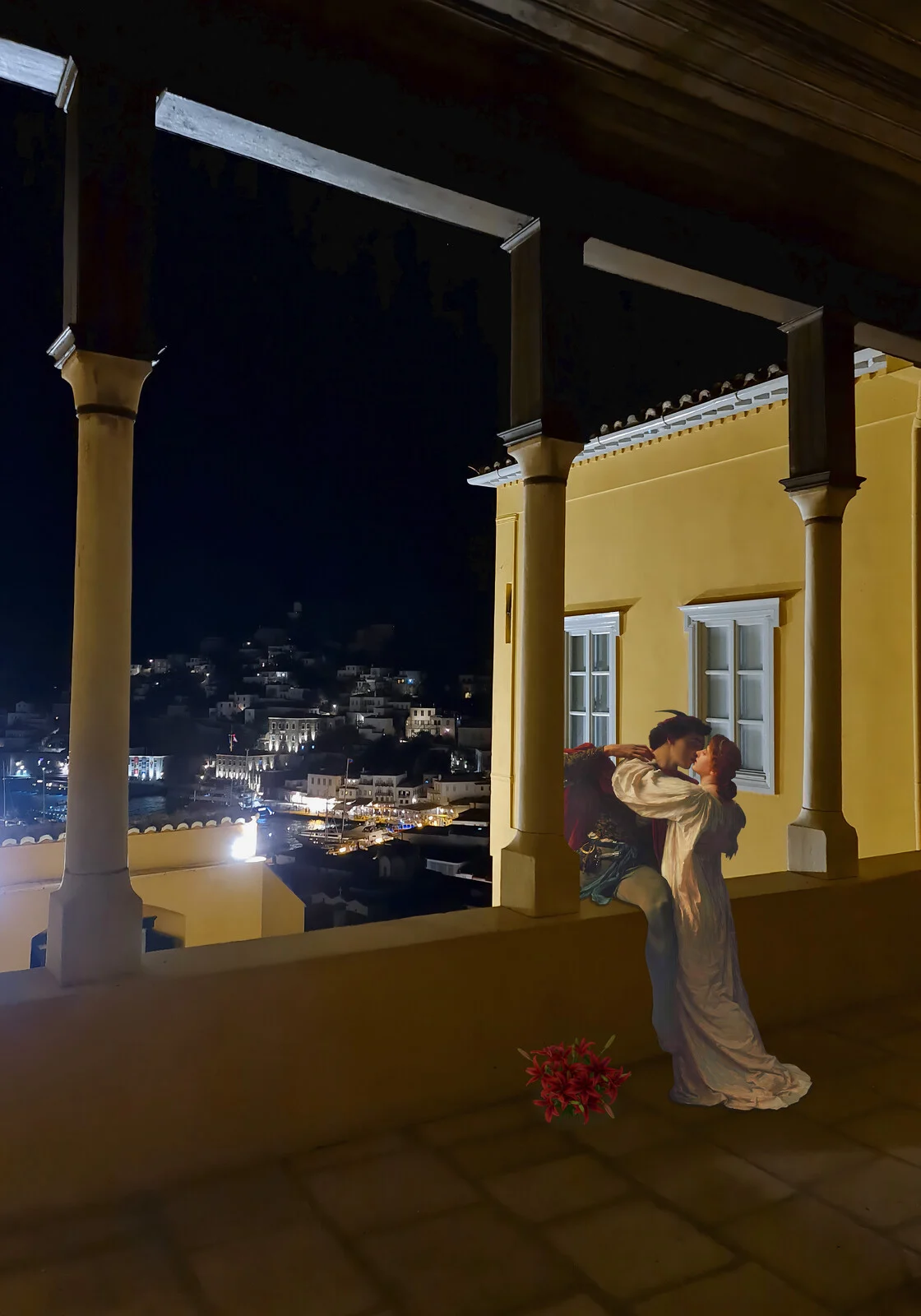
Romeus and Juliet on Hydra, 2024
Digital
50 x 70 cm
The Argument
Love hath inflaméd twain by sudden sight,
And both do grant the thing that both desire
They wed in shrift by counsel of a friar.
Young Romeus climbs fair Juliet's bower by night.
Three months he doth enjoy his chief delight.
By Tybalt's rage provokéd unto ire,
He payeth death to Tybalt for his hire.
A banished man he 'scapes by secret flight.
New marriage is offered to his wife.
She drinks a drink that seems to reave her breath:
They bury her that sleeping yet hath life.
Her husband hears the tidings of her death.
He drinks his bane. And she with Romeus' knife,
When she awakes, herself, alas! she slay'th.
Arthur Brooke, 1562
The opening lines come from ‘The Argument’, an irregular sonnet by Arthur Brooke in his ‘Romeus and Juliet’. It was first published in 1562, two years before Shakespeare's birth, and reprinted in 1587, about eight years before the first performance of Romeo and Juliet. Brooke was Shakespeare's primary source for Romeo and Juliet, and in these initial lines, Brooke sums up the whole story in one verse.
Prosaic? Maybe so if the drama had ended there. It doesn't, and various storytellers have honed and developed the verse into an epic drama that has hung around for a few thousand years. Shakespeare is the one who gave the loving couple its eternal status, but what do we know about the future? What once happened inspiring poetry and prose will appear again, and some other poet, filmmaker or writer may succeed better in describing the drama, formulating a tragedy so that it fits their own time best. Even though the same story reappears and is told repeatedly, it constantly touches people in a new interpretation. When the 'Time-travellers Romeo and Juliet ', or Pyramus and Thisbe as their real names were, arrived on Hydra last year, they looked for a proper balcony or terrace. This reference to 'Time-travellers Romeo and Juliet' is a metaphor for the timeless nature of the story, suggesting that the themes of love and tragedy are universal and can be reinterpreted in any era. The choice was relatively easy. At Lazaros Kountouriotis’ Mansion, a similar love story as they happened at the beginning of the 19th century. Maria, a girl in his household, fell in love with one of the early revolutionaries, Antonis Oikonomou. At the time, the idea of throwing out the Turks was not well established on the island. Money talked, you could call it, and Hydra had not suffered as many other places during the Ottomans. The leaders of Hydra did not want to lose the privileges given to them by the Turks, so initially, they didn't join the revolution. Antonis was brutally assassinated by the mercenaries of the Hydra elite near Argos on December 16, 1821. Receiving the message of her beloved’s death, poor Maria threw herself off a cliff.
They live together on a star but have sworn never to return to Hydra, so their friends Pyramus and Thisbe go there each year instead. It is a simple ceremony commemorating their love story. Pyramus climbs a ladder to Thisbe, waiting on the upper terrace of the mansion. It happens every 35 days after Easter Sunday, one day for every day their life lasted. Over the years, there has been speculation about the bouquet of red lilies left on the terrace floor. The red lilies symbolise their passionate love and the revolutionary spirit that led to their tragic end. Red for love and revolution.
Read the full story, and you will comprehend the tragic power of love, a force that can elevate and destroy.
Occasionally, love wins and overcomes power, hostility, stupidity, and greed; those in love get each other and live happily ever after - not so often in reality but in cheaper romance novels and soap operas. Most of us want it to happen but know it will not be likely. Read the tragedy instead, weep, and then continue with life. Or watch a soap.
The story of Romeo and Juliet belongs to a tradition of tragic romances stretching back to antiquity and even earlier. This tradition includes classic works such as Pyramus and Thisbe and Tristan and Isolde, featuring themes of forbidden love and tragic endings. In his turn, Brooke based his poem on a French tale translation by the Italian writer Matteo Bandello. Artists and writers are all thieves because we copy each other.
Shakespeare’s Romeo Montague and Juliet Capulet hailed from affluent families in the kingdom of Verona, modern-day Italy. However, their families had been embroiled in a bitter feud for years. The play commences with members of the two families engaging in a street brawl, setting the stage for the tragic events that follow.
As reality was not enough, Shakespeare used a poetic, dramatic structure. He created effects such as switching between comedy and tragedy to heighten tension, let minor characters take more space, and wrote numerous sub-plots to embellish the story—a masterpiece in its art.
A global couple
However, the young couple’s story is known worldwide; the foundation lies in antiquity, and Ovid forwarded the tale of Pyramus and Thisbe in his Metamorphosis. Like Romeo and Juliet, they were young lovers forbidden to wed because of a long-standing rivalry between their families.
Similar fates are told. In India, for example, their names were Heer and Ranjha. Heer was an upper-class girl, whereas Ranjha belonged to a lower tribe. Their love story was opposed due to differences in their class. It has been filmed several times in Bollywood, a perfect place for tragicomic.
From the Persian tale of ‘Layla and Majnun’ to the Chinese legend of ‘The Butterfly Lovers’ to Aztec mythology’s ‘Popocatépetl and Iztaccíhuatl’ – tragic stories of undying love can be found throughout human history. In modern times, don’t forget Jack and Rose in the film Titanic, who were separated by fate and a sad ending.
As usual, Greeks behind
Whatever you call these unfortunate young ones, they derive from Greek Mythology, and their destiny has spread across borders and centuries. The first pair was Pyramus and Thisbe, who were said to have lived in Babylonia or Thebes in Central Greece some three millennia ago.
It is interesting to compare the two stories, separated by more than two thousand years. In Romeo and Juliet, Juliet can't be together with Romeo because she has been engaged to another man by her parents. Their parents have been in a long feud and forbid them from meeting.
Pyramus and Thisbe are lovers from different houses, with parents forbidding them to wed because of a long-standing rivalry between their families. Their love grew through a crack in a wall which the families’ homes shared. Through the wall, the young couple exchanged hushed vows of devotion and plotted their elopement. On the night that they hoped to run away together, their story met a tragic end. The couple planned to meet under a mulberry tree. Upon arriving at the meeting, Thisbe encountered a lion with a bloodied mouth, fresh from a recent prey kill. Thisbe ran away in fear, losing her veil in the process. Pyramus arrived shortly after this exchange and was overcome by what he saw: the lion and Thisbe’s veil. Assuming Thisbe was the lion’s victim, Pyramus took his own life with his sword. Thisbe returned to the secret meeting place to find Pyramus dead. She stabbed herself with the very same sword which took her true love.
Some joy amid all solemnity
But before that, there was much love in all these plays and sometimes unexpected fun. One amusing anecdote about the film adaptation of "Romeo and Juliet" (1968), directed by Franco Zeffirelli, involves casting the title characters. Zeffirelli wanted to ensure that the actors playing Romeo and Juliet had genuine chemistry and youthful energy, so he cast young, relatively unknown actors.
Leonard Whiting, who was only 17 years old at the time, caught the director's attention when auditioning for the role of Romeo. However, Zeffirelli wanted to test the chemistry between Whiting and his potential Juliet. He invited a group of young actresses, including Olivia Hussey, who was just 15, to audition with Whiting.
Whiting and Hussey were asked to perform the iconic balcony scene during one audition. A bit nervous, Whiting forgot his lines and improvised, saying, "But soft, what light through yonder window breaks? It is the east, and Juliet is the sun... or rather, Olivia is the sun!"
This unexpected mix-up caused Olivia Hussey to burst into laughter, and the entire room was filled with amusement. Zeffirelli saw their natural chemistry and thought their spontaneous reactions were perfect for the film. Consequently, Leonard Whiting was cast as Romeo, and Olivia Hussey secured the role of Juliet, leading to their iconic and memorable performances in the movie. It won 2 Oscars, and the audience still gives it 7,6 out of 10 on IMDB, which is suitable for an old film. DiCaprio made it worse in the 1996 adaption. Many have tried, most have failed, and some are natural turkeys. The ballet adaption by Sergei Prokofiev from 1966 with Margot Fonteyn and Rudolf Nureyev was a lovely experience.
These words, appropriately performed, beautifully capture Romeo's adoration for Juliet, comparing her radiant presence to the rising sun. It symbolises his profound love and infatuation, suggesting she brings light and warmth into his life. The line encapsulates the intensity of their love and the romanticism that permeates the play. But reality talks in another language. Circumstances, together with hostility, killed the lovers.
Sens morale, skip hatred and let love free. It’s too late to make friends at the funeral of your children. Why not go to Hydra and find love?
I will finish quoting my favourite among Leonard Cohen’s most important love songs. Juliet and Thisbe must have felt that way. Life did not make sense because they didn’t get the desired love.
If the sun would lose its light
And we lived in an endless night
And there was nothing left that you could feel
If the sea were sand alone
And the flowers made of stone
And no one that you hurt could ever heal
Well that's how broken I would be
What my life would seem to me
If I didn't have your love to make it real.
PS. A little about a great building.
The Lazaros Kountouriotis Mansion stands proudly in Hydra town, showcasing a rich history and architectural beauty. As one of the most distinguished mansions on the island, it is a testament to the legacy of Hydra's golden days.
The Kountouriotis family was a prominent Arvanite family. Their original family name was Zervas, but it was allegedly changed after one of their ancestors lived in the village of Kountoura, in the ancient Megaris, close to Corinth.
The Mansion holds great historical importance as the former residence of Lazaros Kountouriotis, a prominent figure in Greek history. Lazaros, a statesman and naval hero, played a crucial role in the Greek War of Independence and later became Greece's first president. The mansion, built in the late 18th century, symbolised the family's influence, wealth, and contribution to the nation's struggle for independence.
The mansion's architectural style combines elements of traditional Greek and neoclassical design. Its imposing façade features intricate stonework, arched windows, and ornate balconies adorned with wrought iron railings, like the one used by Hydra’s Romeo. The interior boasts spacious rooms, high ceilings, and elegant furnishings, capturing the grandeur of a bygone era. Each room showcases exquisite craftsmanship, from hand-carved wooden details to beautifully painted ceilings, reflecting the opulence and sophistication of the family.
Beyond its historical significance, the Mansion has made notable cultural contributions to Hydra. Today, it serves as a museum and art exhibition, giving visitors a glimpse into the island's past and the Kountouriotis family's legacy. The museum showcases artefacts, memorabilia, and artworks that depict the family's involvement in Greek history and their contributions to the arts and culture. It is a cultural hub, fostering a deeper understanding and appreciation of Hydra's heritage.
The Lazaros Kountouriotis Mansion plays a vital role in promoting tourism on Hydra. Visitors are drawn to the island to explore its rich history and architectural treasures, with the mansion as a must-visit attraction. The mansion's preservation and conversion into a museum help sustain the island's cultural heritage, ensuring its preservation for future generations.
Preserving the Lazaros Kountouriotis Mansion requires ongoing efforts to maintain its structural integrity and historical significance. The Greek government and the municipality have taken measures to ensure its restoration and conservation. Such endeavours reflect a commitment to preserving Hydra's cultural heritage and allowing visitors to appreciate the mansion's splendour for years to come.
The Mansion stands as a captivating symbol of history, artistry, and cultural significance on the island of Hydra. It is a cultural beacon, inviting visitors to immerse themselves in the island's rich heritage. As a beautifully preserved architectural gem, the mansion reminds us of the importance of preserving our past and honouring the legacies that have shaped our present. Time-travellers, including Romeo, alias Antonis, and his local Juliet, Maria, go there. Now and then, the family Kountouriotis come down from their stars and gather for a big family celebration. Imagine how it sounds with all people. The high ceilings could have been even higher up.
.
Jörgen Thornberg
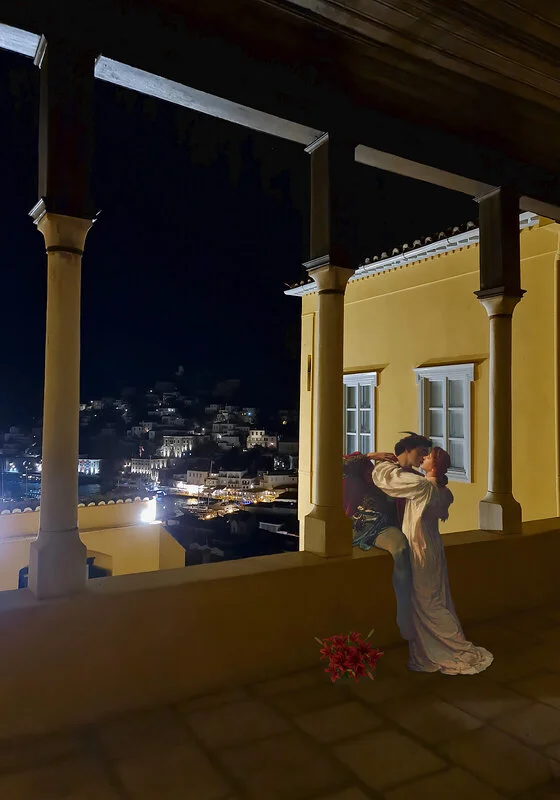
Romeus and Juliet on Hydra, 2024
Digital
50 x 70 cm
The Argument
Love hath inflaméd twain by sudden sight,
And both do grant the thing that both desire
They wed in shrift by counsel of a friar.
Young Romeus climbs fair Juliet's bower by night.
Three months he doth enjoy his chief delight.
By Tybalt's rage provokéd unto ire,
He payeth death to Tybalt for his hire.
A banished man he 'scapes by secret flight.
New marriage is offered to his wife.
She drinks a drink that seems to reave her breath:
They bury her that sleeping yet hath life.
Her husband hears the tidings of her death.
He drinks his bane. And she with Romeus' knife,
When she awakes, herself, alas! she slay'th.
Arthur Brooke, 1562
The opening lines come from ‘The Argument’, an irregular sonnet by Arthur Brooke in his ‘Romeus and Juliet’. It was first published in 1562, two years before Shakespeare's birth, and reprinted in 1587, about eight years before the first performance of Romeo and Juliet. Brooke was Shakespeare's primary source for Romeo and Juliet, and in these initial lines, Brooke sums up the whole story in one verse.
Prosaic? Maybe so if the drama had ended there. It doesn't, and various storytellers have honed and developed the verse into an epic drama that has hung around for a few thousand years. Shakespeare is the one who gave the loving couple its eternal status, but what do we know about the future? What once happened inspiring poetry and prose will appear again, and some other poet, filmmaker or writer may succeed better in describing the drama, formulating a tragedy so that it fits their own time best. Even though the same story reappears and is told repeatedly, it constantly touches people in a new interpretation. When the 'Time-travellers Romeo and Juliet ', or Pyramus and Thisbe as their real names were, arrived on Hydra last year, they looked for a proper balcony or terrace. This reference to 'Time-travellers Romeo and Juliet' is a metaphor for the timeless nature of the story, suggesting that the themes of love and tragedy are universal and can be reinterpreted in any era. The choice was relatively easy. At Lazaros Kountouriotis’ Mansion, a similar love story as they happened at the beginning of the 19th century. Maria, a girl in his household, fell in love with one of the early revolutionaries, Antonis Oikonomou. At the time, the idea of throwing out the Turks was not well established on the island. Money talked, you could call it, and Hydra had not suffered as many other places during the Ottomans. The leaders of Hydra did not want to lose the privileges given to them by the Turks, so initially, they didn't join the revolution. Antonis was brutally assassinated by the mercenaries of the Hydra elite near Argos on December 16, 1821. Receiving the message of her beloved’s death, poor Maria threw herself off a cliff.
They live together on a star but have sworn never to return to Hydra, so their friends Pyramus and Thisbe go there each year instead. It is a simple ceremony commemorating their love story. Pyramus climbs a ladder to Thisbe, waiting on the upper terrace of the mansion. It happens every 35 days after Easter Sunday, one day for every day their life lasted. Over the years, there has been speculation about the bouquet of red lilies left on the terrace floor. The red lilies symbolise their passionate love and the revolutionary spirit that led to their tragic end. Red for love and revolution.
Read the full story, and you will comprehend the tragic power of love, a force that can elevate and destroy.
Occasionally, love wins and overcomes power, hostility, stupidity, and greed; those in love get each other and live happily ever after - not so often in reality but in cheaper romance novels and soap operas. Most of us want it to happen but know it will not be likely. Read the tragedy instead, weep, and then continue with life. Or watch a soap.
The story of Romeo and Juliet belongs to a tradition of tragic romances stretching back to antiquity and even earlier. This tradition includes classic works such as Pyramus and Thisbe and Tristan and Isolde, featuring themes of forbidden love and tragic endings. In his turn, Brooke based his poem on a French tale translation by the Italian writer Matteo Bandello. Artists and writers are all thieves because we copy each other.
Shakespeare’s Romeo Montague and Juliet Capulet hailed from affluent families in the kingdom of Verona, modern-day Italy. However, their families had been embroiled in a bitter feud for years. The play commences with members of the two families engaging in a street brawl, setting the stage for the tragic events that follow.
As reality was not enough, Shakespeare used a poetic, dramatic structure. He created effects such as switching between comedy and tragedy to heighten tension, let minor characters take more space, and wrote numerous sub-plots to embellish the story—a masterpiece in its art.
A global couple
However, the young couple’s story is known worldwide; the foundation lies in antiquity, and Ovid forwarded the tale of Pyramus and Thisbe in his Metamorphosis. Like Romeo and Juliet, they were young lovers forbidden to wed because of a long-standing rivalry between their families.
Similar fates are told. In India, for example, their names were Heer and Ranjha. Heer was an upper-class girl, whereas Ranjha belonged to a lower tribe. Their love story was opposed due to differences in their class. It has been filmed several times in Bollywood, a perfect place for tragicomic.
From the Persian tale of ‘Layla and Majnun’ to the Chinese legend of ‘The Butterfly Lovers’ to Aztec mythology’s ‘Popocatépetl and Iztaccíhuatl’ – tragic stories of undying love can be found throughout human history. In modern times, don’t forget Jack and Rose in the film Titanic, who were separated by fate and a sad ending.
As usual, Greeks behind
Whatever you call these unfortunate young ones, they derive from Greek Mythology, and their destiny has spread across borders and centuries. The first pair was Pyramus and Thisbe, who were said to have lived in Babylonia or Thebes in Central Greece some three millennia ago.
It is interesting to compare the two stories, separated by more than two thousand years. In Romeo and Juliet, Juliet can't be together with Romeo because she has been engaged to another man by her parents. Their parents have been in a long feud and forbid them from meeting.
Pyramus and Thisbe are lovers from different houses, with parents forbidding them to wed because of a long-standing rivalry between their families. Their love grew through a crack in a wall which the families’ homes shared. Through the wall, the young couple exchanged hushed vows of devotion and plotted their elopement. On the night that they hoped to run away together, their story met a tragic end. The couple planned to meet under a mulberry tree. Upon arriving at the meeting, Thisbe encountered a lion with a bloodied mouth, fresh from a recent prey kill. Thisbe ran away in fear, losing her veil in the process. Pyramus arrived shortly after this exchange and was overcome by what he saw: the lion and Thisbe’s veil. Assuming Thisbe was the lion’s victim, Pyramus took his own life with his sword. Thisbe returned to the secret meeting place to find Pyramus dead. She stabbed herself with the very same sword which took her true love.
Some joy amid all solemnity
But before that, there was much love in all these plays and sometimes unexpected fun. One amusing anecdote about the film adaptation of "Romeo and Juliet" (1968), directed by Franco Zeffirelli, involves casting the title characters. Zeffirelli wanted to ensure that the actors playing Romeo and Juliet had genuine chemistry and youthful energy, so he cast young, relatively unknown actors.
Leonard Whiting, who was only 17 years old at the time, caught the director's attention when auditioning for the role of Romeo. However, Zeffirelli wanted to test the chemistry between Whiting and his potential Juliet. He invited a group of young actresses, including Olivia Hussey, who was just 15, to audition with Whiting.
Whiting and Hussey were asked to perform the iconic balcony scene during one audition. A bit nervous, Whiting forgot his lines and improvised, saying, "But soft, what light through yonder window breaks? It is the east, and Juliet is the sun... or rather, Olivia is the sun!"
This unexpected mix-up caused Olivia Hussey to burst into laughter, and the entire room was filled with amusement. Zeffirelli saw their natural chemistry and thought their spontaneous reactions were perfect for the film. Consequently, Leonard Whiting was cast as Romeo, and Olivia Hussey secured the role of Juliet, leading to their iconic and memorable performances in the movie. It won 2 Oscars, and the audience still gives it 7,6 out of 10 on IMDB, which is suitable for an old film. DiCaprio made it worse in the 1996 adaption. Many have tried, most have failed, and some are natural turkeys. The ballet adaption by Sergei Prokofiev from 1966 with Margot Fonteyn and Rudolf Nureyev was a lovely experience.
These words, appropriately performed, beautifully capture Romeo's adoration for Juliet, comparing her radiant presence to the rising sun. It symbolises his profound love and infatuation, suggesting she brings light and warmth into his life. The line encapsulates the intensity of their love and the romanticism that permeates the play. But reality talks in another language. Circumstances, together with hostility, killed the lovers.
Sens morale, skip hatred and let love free. It’s too late to make friends at the funeral of your children. Why not go to Hydra and find love?
I will finish quoting my favourite among Leonard Cohen’s most important love songs. Juliet and Thisbe must have felt that way. Life did not make sense because they didn’t get the desired love.
If the sun would lose its light
And we lived in an endless night
And there was nothing left that you could feel
If the sea were sand alone
And the flowers made of stone
And no one that you hurt could ever heal
Well that's how broken I would be
What my life would seem to me
If I didn't have your love to make it real.
PS. A little about a great building.
The Lazaros Kountouriotis Mansion stands proudly in Hydra town, showcasing a rich history and architectural beauty. As one of the most distinguished mansions on the island, it is a testament to the legacy of Hydra's golden days.
The Kountouriotis family was a prominent Arvanite family. Their original family name was Zervas, but it was allegedly changed after one of their ancestors lived in the village of Kountoura, in the ancient Megaris, close to Corinth.
The Mansion holds great historical importance as the former residence of Lazaros Kountouriotis, a prominent figure in Greek history. Lazaros, a statesman and naval hero, played a crucial role in the Greek War of Independence and later became Greece's first president. The mansion, built in the late 18th century, symbolised the family's influence, wealth, and contribution to the nation's struggle for independence.
The mansion's architectural style combines elements of traditional Greek and neoclassical design. Its imposing façade features intricate stonework, arched windows, and ornate balconies adorned with wrought iron railings, like the one used by Hydra’s Romeo. The interior boasts spacious rooms, high ceilings, and elegant furnishings, capturing the grandeur of a bygone era. Each room showcases exquisite craftsmanship, from hand-carved wooden details to beautifully painted ceilings, reflecting the opulence and sophistication of the family.
Beyond its historical significance, the Mansion has made notable cultural contributions to Hydra. Today, it serves as a museum and art exhibition, giving visitors a glimpse into the island's past and the Kountouriotis family's legacy. The museum showcases artefacts, memorabilia, and artworks that depict the family's involvement in Greek history and their contributions to the arts and culture. It is a cultural hub, fostering a deeper understanding and appreciation of Hydra's heritage.
The Lazaros Kountouriotis Mansion plays a vital role in promoting tourism on Hydra. Visitors are drawn to the island to explore its rich history and architectural treasures, with the mansion as a must-visit attraction. The mansion's preservation and conversion into a museum help sustain the island's cultural heritage, ensuring its preservation for future generations.
Preserving the Lazaros Kountouriotis Mansion requires ongoing efforts to maintain its structural integrity and historical significance. The Greek government and the municipality have taken measures to ensure its restoration and conservation. Such endeavours reflect a commitment to preserving Hydra's cultural heritage and allowing visitors to appreciate the mansion's splendour for years to come.
The Mansion stands as a captivating symbol of history, artistry, and cultural significance on the island of Hydra. It is a cultural beacon, inviting visitors to immerse themselves in the island's rich heritage. As a beautifully preserved architectural gem, the mansion reminds us of the importance of preserving our past and honouring the legacies that have shaped our present. Time-travellers, including Romeo, alias Antonis, and his local Juliet, Maria, go there. Now and then, the family Kountouriotis come down from their stars and gather for a big family celebration. Imagine how it sounds with all people. The high ceilings could have been even higher up.
.

Jörgen Thornberg
Malmö
Lite om bilder och mig. Translation in English at the end.
Jag är en nyfiken person som ser allt i bilder, även det jag fäster i ord, gärna tillsammans för bakom alla mina bilder finns en berättelse. Till vissa bilder hör en kortare eller längre novell som följer med bilden.
Bilder berättar historier. Jag omges av naturlig skönhet, intressanta människor och historia var jag än går. Jag använder min kamera för att dokumentera världen och blanda det jag ser med vad jag känner för att fånga den dolda magin.
Mina bilder berättar mina historier. Genom mina bilder, tryck och berättelser. Jag bjuder in dig att ta del av dessa berättelser, in i ditt liv och hem och dela min mycket personliga syn på vår värld. Mer än vad ögat ser. Jag tänker i bilder, drömmer och skriver och pratar om dem; följaktligen måste jag också skapa bilder. De blir vad jag ser, inte nödvändigtvis begränsade till verkligheten. Det finns en bild runt varje hörn. Jag hoppas att du kommer att se vad jag såg och gilla det.
Jag är också en skrivande person och till många bilder hör en kortare eller längre essay. Den följer med tavlan, tryckt på fint papper och med en personlig hälsning från mig.
Flertalet bilder startar sin resa i min kamera. Enkelt förklarat beskriver jag bilden jag ser i mitt inre, upplevd eller fantiserad. Bilden uppstår inom mig redan innan jag fått okularet till ögat. På bråkdelen av ett ögonblick ser jag vad jag vill ha och vad som kan göras med bilden. Här skall jag stoppa in en giraff, stålmannen, Titanic eller vad det är min fantasi finner ut. Ännu märkligare är att jag kommer ihåg minnesbilden långt efteråt när det blir tid att skapa verket. Om jag lyckas eller inte, är upp till betraktaren, oftast präglat av en stråk av svart humor – meningen är att man skall bli underhållen. Mina bilder blir ofta en snackis där de hänger.
Jag föredrar bilder som förmedlar ett budskap i flera lager. Vid första anblicken fylld av feel-good, en vacker utsikt, fint väder, solen skiner, blommor på ängen eller vattnet som ligger förrädiskt spegelblankt. I en sådan bild kan jag gömma min egentliga berättelse, mitt förakt för förtryckare och våldsverkare, rasister och fördomsfulla människor - ett gärna återkommande motiv mer eller mindre dolt i det vackra motivet. Jag försöker förena dem i ett gemensamt narrativ.
Bild och formgivning har löpt som en röd tråd genom livet. Fotokonst känns som en värdig final som jag gärna delar med mig.
Min genre är vid som framgår av mina bilder, temat en blandning av pop- och gatukonst i kollage som kan bestå av hundratals lager. Vissa bilder kan ta veckor, andra någon dag innan det är dags att överlämna resultatet till printverkstaden. Fine Art Prints är digitala fotocollage. I dessa kollage sker rivandet, klippandet, pusslandet, målandet, ritandet och sprayningen digitalt. Det jag monterar in kan vara hundratals år gamla bilder som jag omsorgsfullt frilägger så att de ser ut att vara en del av tavlan men också bilder skapade av mig själv efter min egen fantasi. Därefter besöks printstudion och för vissa bilder numrera en limiterad upplaga (oftast 7 exemplar) och signera för hand. Vissa bilder kan köpas i olika format. Det är bara att fråga efter vilka. Gillar man en bild som är 70x100 men inte har plats på väggen, går den kanske att få i 50x70 cm istället. Frågan är fri.
Metoden Giclée eller Fine Art Print som det också kallas är det moderna sättet för framställning av grafisk konst. Villkoret för denna typ av utskrifter är att en högkvalitativ storformatskrivare används med åldersbeständigt färgpigment och konstnärspapper eller i förekommande fall på duk. Pappret som används möter de krav på livslängd som ställs av museer och gallerier. Normalt säljer jag mina bilder oinramade så att den nya ägaren själv kan bestämma hur de skall se ut, med eller utan passepartout färg på ram, med eller utan glas etc..
Under många år ställde jag bara ut på nätet, i valda grupper och på min egen Facebooksida - https://www.facebook.com/jorgen.thornberg.9
Jag finns också på en egen hemsida som tyvärr inte alltid är uppdaterad – https://www.jth.life/ Där kan du också läsa en del av de berättelser som följer med bilden.
UTSTÄLLNINGAR
Luftkastellet, oktober 2022
Konst i Lund, november 2022
Luftkastellet, mars 2023
Engleson Galleri Caroli, april 2023
Hydra, Greece June 2023
Engleson Galleri Caroli, oktober 2023
Toppen, Höllviken december 2023
Luftkastellet, mars 2024
Torups Galleri, mars 2024
Venice, May 2024
Luftkastellet, oktober 2024
Konst i Advent, December 2024
Galleri Engleson, Caroli December 2024
Jäger & Jansson Galleri, april 2025
A bit about pictures and me.
I'm a curious person who sees everything in pictures, even what I express in words, often combining them, for behind all my pictures lies a story. These narratives, some as short as a single image and others as long as a novel, are the heart and soul of my work.
Pictures tell stories. Wherever I go, I'm surrounded by natural beauty, exciting people, and history. I use my camera to document the world and blend what I see with what I feel to capture the hidden magic.
My images tell my stories. Through my pictures, prints, and narratives, I invite you to partake in these stories in your life and home and share my deeply personal perspective of our world. More than meets the eye. I think in pictures, dream, write, and talk about them; consequently, I must create images too. They become what I see, not necessarily confined to reality. There's a picture around every corner. I hope you'll see what I saw and enjoy it.
I'm also a writer, and many images come with a shorter or longer essay. It accompanies the painting, printed on fine paper with my personal greeting.
Many pictures start their journey on my camera. Simply put, I describe the image I see in my mind, experienced or imagined. The image arises within me even before I bring the eyepiece to my eye. In a fraction of a moment, I see what I want and what can be done with the picture. Here, I'll insert a giraffe, Superman, the Titanic, or whatever my imagination conjures up. Even stranger is that I remember the mental image long after it's time to create the work. Whether I succeed is up to the observer, often imbued with a streak of black humour – the aim is to entertain. My pictures usually become a talking point wherever they hang.
I prefer pictures that convey a message in multiple layers. At first glance, they're filled with feel-good vibes, a beautiful view, lovely weather, the sun shining, flowers in the meadow, or the water lying deceptively calm. But beneath this surface beauty, I often conceal a deeper story, a narrative that challenges societal norms or explores the human condition. I invite you to delve into these hidden narratives and discover the layers of meaning within my work.
Picture and design have been a thread running through my life. Photographic art feels like a fitting finale, and I'm happy to share it.
My genre is varied, as seen in my pictures; the theme is a blend of pop and street art in collages that can consist of hundreds of layers. Some images can take weeks, others just a day before it's time to hand over the result to the print workshop. Fine Art Prints are digital photo collages. In these collages, tearing, cutting, puzzling, painting, drawing, and spraying happen digitally. What I insert can be images hundreds of years old that I carefully extract so they appear to be part of the painting, but also images created by myself, now also generated from my imagination. Next, visit the print studio and, for certain images, number a limited edition (usually 7 copies) and sign them by hand. Some images may be available in other formats. Just ask which ones. If you like an image that's 70x100 but doesn't have space on the wall, you might be able to get it in 50x70 cm instead. The question is open.
The Giclée method, or Fine Art Print as it's also called, is the modern way of producing graphic art. This method ensures the highest quality and longevity of the artwork, using a high-quality large-format printer with archival pigment inks and artist paper or, in some cases, canvas. The paper used meets the longevity requirements set by museums and galleries. I sell my pictures unframed, allowing the new owner to personalise their artwork, confident in the lasting value and quality of the piece.
For many years, I only exhibited online, in selected groups, and on my Facebook page - https://www.facebook.com/jorgen.thornberg.9. I also have my website, which unfortunately is not constantly updated - https://www.jth.life/. You can also read some of the stories accompanying the pictures there.
EXHIBITIONS
Luftkastellet, October 2022
Art in Lund, November 2022
Luftkastellet, March 2023
Engleson Gallery Caroli, April 2023
Hydra, Greece June 2023
Engleson Gallery Caroli, October 2023
Toppen, Höllviken December 2023
Luftkastellet, March 2024
Torup Gallery, March 2024
Venice, May 2024
UTSTÄLLNINGAR
Luftkastellet, oktober 2022
Konst i Lund, november 2022
Luftkastellet, mars 2023
Engleson Galleri Caroli, april 2023
Hydra, Greece June 2023
Engleson Galleri Caroli, oktober 2023
Toppen, Höllviken december 2023
Luftkastellet, mars 2024
Torups Galleri, mars 2024
Venice, May 2024
Luftkastellet, October 2024
Konst i Advent, December 2024
Galleri Engleson, Caroli December 2024
Jäger & Jansson Galleri, April 2025
Utbildning
Autodidakt
Medlem i konstnärsförening
Öppna Sinnen
Med i konstrunda
Konstrundan i Skåne
Utställningar
Luftkastellet, October 2022
Art in Lund, November 2022
Luftkastellet, March 2023
Engleson Gallery Caroli, April 2023
Hydra, Greece June 2023
Engleson Gallery Caroli, October 2023
Toppen, Höllviken December 2023
Luftkastellet, March 2024
Torup Gallery, March 2024
Venice, May 2024