Vi använder cookies för att ge dig bästa möjliga upplevelse. Välj vilka cookies du tillåter.
Läs mer i vår integritetspolicy
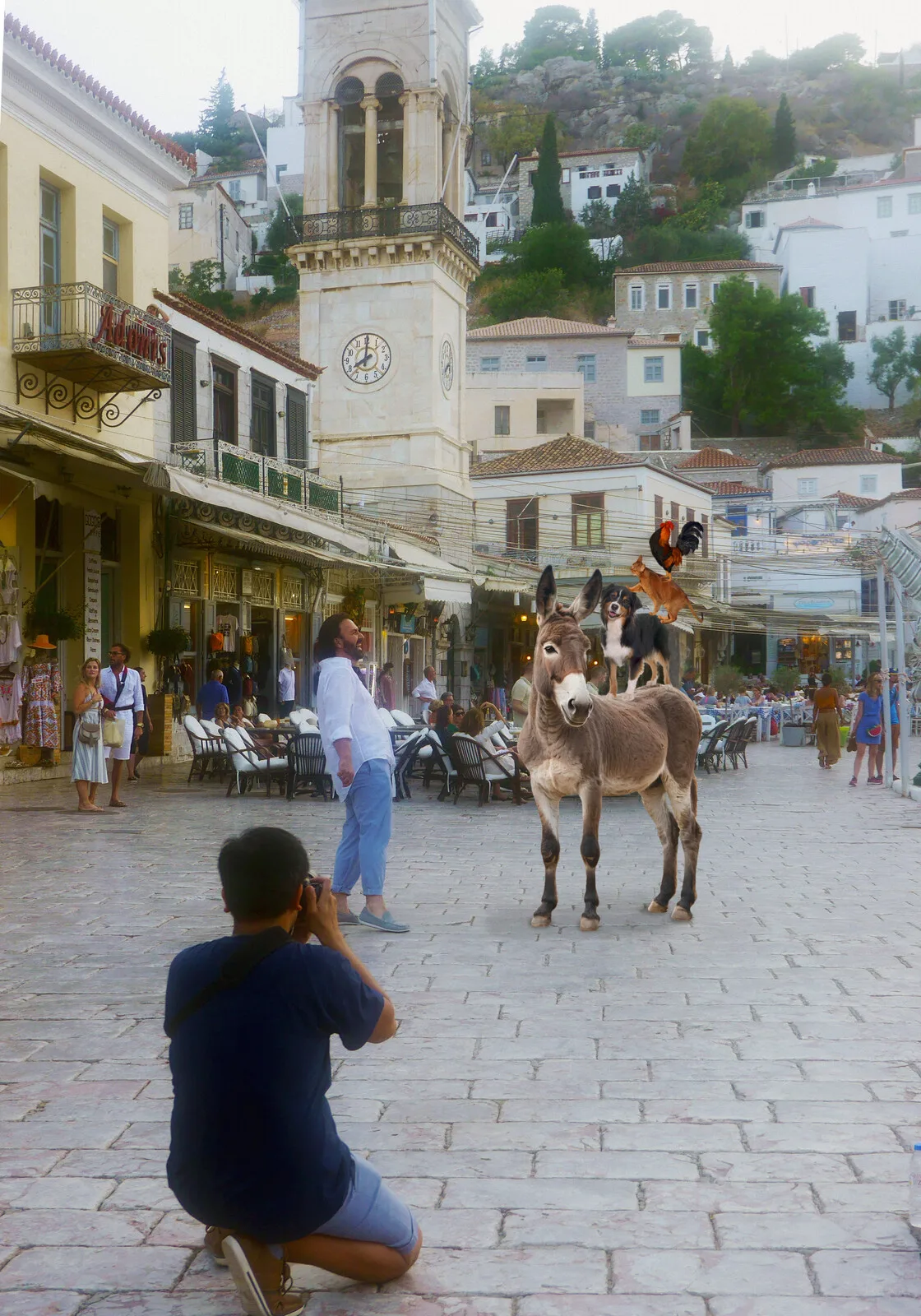
Jörgen Thornberg
The Bremen Musicians on Hydra: A Tale of Time-Traveling Tricksters, 2020
Digital
50 x 70 cm
The Bremen Musicians’ Song
Through forests deep and cities old,
Four creatures brave, with spirits bold,
A donkey, a dog, a cat, and a relentless cock,
They walked the roads around the clock.
From Oldenburg’s gates to lands afar,
They chased the wealth beneath the star,
Outwitting those with hearts of greed,
By cunning plan and daring deed.
In castles grand and manors vast,
They turned the tables, held the last,
Of riches gained by guile and theft,
And lived only where thieves had left.
They took from those who took from all,
And watched as mighty empires fall,
A symphony of justice played,
In every trick, a price was paid.
Yet in their eyes, no malice lay,
Just survival in a world of grey,
For the quartet, the players of this tune,
Knew darkness would meet its end soon.
So on they march, through night and day,
With laughter bright to light their way,
The Bremen Musicians, forever free,
In song and tale, they’ll always be.
Hydra, August 2024
The Bremen Musicians on Hydra: A Tale of Time-Traveling Tricksters
It was a scene of pure astonishment in the harbour of Hydra. Not every day does one witness a dog balancing on a donkey’s back, with a cat perched on the dog and a crowing rooster atop the cat. The donkeys, mules, and horses patiently stood on the quay, waiting for tourists eager for a ride, looking on with envy. None of them had ever experienced such fun. Even more surprisingly, the quartet seemed to be managing themselves, with no owner nearby to command them. Cameras flashed, and people stared until their eyes hurt.
I realised they were Time-travellers when I overheard the animals telepathically conversing with each other. They were well-versed and hadn’t come to Hydra by chance; they were here to scout the area. After a while, it all made sense to me—they were none other than the famous Bremen Musicians who had come to the island. Their entire history unravelled as they talked, reminding each other how they had been travelling the world since the 1100s.
The Bremen Musicians is a tale of four ageing domestic animals who, after a lifetime of hard work, often neglected and mistreated by their former masters, decided to run away and become town musicians in the city of Bremen. Their unwavering determination to change their fate and pursue their dreams despite the odds is truly inspiring.
Bruno, the donkey, was the first to speak up, his deep, resonant voice carrying across the quay. "Ah, Bremen. I’ve told you before that it wasn’t my idea to leave, but what choice did I have? The farmer was ready to send me to the butcher because I couldn’t haul the heavy loads anymore."
Max, the dog, nodded, his tail thumping against Bruno’s flank. "And I wasn’t much use as a hunter anymore. My joints ached too much to chase rabbits. When you suggested going to Bremen, it sounded like a way to escape the bullet."
Felix, the cat perched delicately on Max’s back, flicked his tail and purred. "Better than being drowned in a sack, which is what they had planned for me. Imagine that—a lifetime of catching mice, and that’s the thanks I get!"
Rusty, the rooster, flapped his wings and released a proud crow. "And me—turned into coq au vin? Not a chance! When I heard about Bremen, I knew I had to join you. Every good band needs a trumpet, and I’m the best!"
The four of them had banded together, each with a tale of near escape, and set off for Bremen, where they believed they could start anew as musicians. Bruno, ever the leader, had envisioned himself as the cello, his braying voice mimicking the rich, resonant tones of the instrument. With his rhythmic barking and tail-wagging, Max was the percussion section, providing both the beat and the energy. With his melodic purring and quick reflexes, Felix played the violin, adding elegance and charm. And Rusty, with his mighty crow, was the trumpet, leading the charge with flair.
But Bremen was not to be their final destination. As Felix explained, "We never actually made it to Bremen. On the way, we ran into a band of robbers and took over their hideout instead. We scared them off with our music—though I’m not sure they’d call it that—and lived in their house until we’d eaten everything in sight."
Bruno laughed, a deep, hearty sound. "That’s right. We’ve been travelling ever since, from one place to another, always finding new rogues to outwit and new places to call home, at least for a while."
Their adventures had taken them far and wide. They had spent time in Oldenburg, where they ousted a gang of thieves and enjoyed the spoils of their victory. They moved west to the wealthy Hanseatic city of Groningen, where they found yet another group of scoundrels to displace. Each new town brought new challenges and opportunities for the clever quartet.
As Rusty put it, "We’ve been everywhere—Paris, Venice, Florence, Constantinople, Amsterdam, Hong Kong and Tokyo ... We’ve seen it all. And we’ve lived off the riches of the rogues we’ve bested. Why settle down in Bremen when the world is full of places to explore and thieves to outsmart?"
Max added, "We even spent a good long while in London. The City of London was full of opportunity in the 1700s. And when we tired of it, we headed to New York. Wall Street, now there’s a place full of rogues!"
Their time in New York was particularly eventful. "We lived in style," Felix purred. "Bernard Madoff had this penthouse, and when his empire collapsed, we moved right in. Lived like kings, we did, until it was time to move on."
Bruno nodded sagely. "The world keeps changing, but one thing stays the same—where there are fortunes to be made, there are scoundrels to be found. And that’s where we come in."
As they recounted their adventures, I couldn’t help but marvel at their adaptability. For centuries, these animals had outsmarted the cleverest of men, surviving by their wits and music. Their ability to adapt to every new age and situation, thriving in adversity, is awe-inspiring.
"And now," Rusty crowed, "we’re here on Hydra. Not as many rogues as we’re used to, but who knows? We might find a few before we move on."
Bruno brayed in agreement. "And if not, there’s always a meal and a song to be sung."
Their story was a testament to their indomitable spirit. The Bremen Musicians had never had a steady income, but they had always found a way to survive, from the start, trading their talents for food and shelter to outsmarting those who tried to take advantage of them. They had seen the world, crossed borders, and navigated the seas, always staying one step ahead of those who would do them harm.
And now, they were on Hydra, ready for whatever new adventure awaited them. Whether they would find rogues to outwit or simply enjoy the island’s hospitality, one thing was sure—they would do it together, as they always had.
As they strolled off toward the town, I couldn’t help but wonder where their travels would take them next. But one thing was clear: wherever they went, they would bring their unique brand of music, mischief, and camaraderie, leaving behind a trail of outwitted rogues and stories that would be told for generations to come.
And so, the Bremen Musicians—Bruno the donkey, Max the dog, Felix the cat, and Rusty the rooster—continued their journey, timeless and ageless, ever on the lookout for the next adventure, the next rogue to outsmart, and the next place to call home, even if only for a little while.
As the Bremen Musicians in the 12th century made their way through the dense forests of northern Germany, they eventually arrived in the ancient city of Oldenburg, then known as Aldenburg. The town, though prosperous, had become a haven for robbers and scoundrels who preyed upon the riches of passing merchants. Here, the quartet encountered their first real challenge—a band of notorious thieves who had taken up residence in a grand, fortified manor on the outskirts of the town.
The robbers, confident in their power and untouchable within their stronghold, had no idea that four ageing animals would soon turn their world upside down. As night fell, the Musicians devised a clever plan. Bruno, the donkey, suggested they use their combined talents to frighten the thieves out of their lair. Together, they positioned themselves in front of the manor. Bruno began to bray deeply, like a booming cello, while Max barked rhythmically like a drum. Felix added his high-pitched, eerie meowing, and Rusty, the rooster, topped it off with a piercing crow that echoed through the night like a trumpet blast.
The cacophony was terrifying. Hearing what they thought was a monstrous, supernatural force outside, the robbers panicked. Believing they were under attack by some unholy creatures, they fled the manor in terror, abandoning their loot and the comforts of their home.
Now, with the manor to themselves, the Bremen Musicians moved in and made it their own. They lived there comfortably, feasting on the supplies the robbers had left behind until the house was completely emptied. When the time came to move on, they left Oldenburg as quietly as they had arrived, continuing their journey and leaving behind only the legend of how four unlikely heroes had driven out the region's most feared band of robbers.
The Bremen Musicians had a knack for finding themselves in the company of the most notorious scoundrels throughout history. Their adventures took them across Europe and beyond, where they encountered and outwitted some of the most cunning minds of their time, constantly emerging victorious.
Their journey continued in the 12th century with Henryk Prawdzic in Krakow, a Polish nobleman who had amassed wealth through high-interest loans and debt traps targeting various royal houses. The quartet, posing as foreign diplomats offering exclusive trade routes, tricked Prawdzic into investing heavily in a non-existent venture. When the scheme unravelled, Prawdzic became bankrupt, and the Musicians took over his lavish estate.
In the 13th century, they crossed paths with Richard of Cornwall, the younger brother of England’s King Henry III and Holy Roman Emperor. Richard’s greed and corrupt dealings made him a prime target for the Musicians, who duped him into believing they possessed a mystical artefact that would grant him dominion over all of Europe. The artefact was a mere trinket, but Richard’s obsession led him to sign over vast tracts of land and wealth to the animals, leaving him disgraced and destitute.
As the Renaissance dawned, the Musicians found themselves in Florence, where they encountered Cosimo de' Medici, the powerful founder of the Medici dynasty. Disguised as scholars and alchemists, they convinced Cosimo that they had unlocked the secret to eternal youth—a concoction requiring vast amounts of gold. Eager for the elixir, Cosimo parted with a significant portion of his fortune, only to realise too late that a donkey, a dog, a cat, and a rooster had fooled him. The Musicians lived in his villa for nearly a century, sustained by the wealth of the Medici family.
Their travels next took them to Germany in the 15th century, where they encountered Jakob Fugger, one of the wealthiest men in Europe, who controlled the continent’s copper and silver markets. The Musicians, ever the opportunists, posed as miners with knowledge of a hidden, untapped vein of precious metals. Fugger, blinded by greed, invested heavily in their fictitious mine, only to find himself outmanoeuvred and swindled. The quartet stayed in Fugger's grand estate for nearly two hundred years, enjoying the riches they had deceitfully acquired.
In the 18th century, the Musicians found themselves in London, where they orchestrated a financial disaster for John Law, the Scottish economist responsible for the infamous "Mississippi Bubble." They presented Law with seemingly infallible investment opportunities, quickly becoming catastrophic failures. Desperate to recover his losses, Law was forced to relinquish his grand mansion to the quartet, who lived there comfortably until the market collapsed and it was time to move on.
Not long after, in the era of colonial expansion, the Musicians encountered Robert Clive, also known as "Clive of India," in the heart of the British Empire. Exploiting Clive's ambition and greed, they lured him into a fabricated scheme to monopolise the trade of exotic spices. Clive, convinced of the scheme’s potential, handed over his vast wealth, only to be left with empty promises and looted bank accounts. The Musicians took over his estate, living off his ill-gotten gains for years.
As the 19th century rolled in, the quartet’s adventures took them across the Atlantic to the United States. There, they deftly outplayed the infamous Jay Gould and Daniel Drew, notorious for their financial schemes in the railway industry. Posing as government insiders with privileged information, the Musicians convinced Gould and Drew to invest heavily in a bogus railway project. When the stocks plummeted, the animals walked away with their sprawling estates, leaving the magnates with nothing but worthless paper.
In the early 20th century, the Musicians crossed paths with Charles Ponzi, the mastermind behind the infamous Ponzi scheme. Sensing an opportunity, the quartet convinced Ponzi they had access to a rare and valuable commodity. Ponzi eagerly invested, only to find himself penniless and without his luxurious home. The Musicians moved into his opulent palace, enjoying the high life until it was time to seek their next mark.
Their final notable encounters occurred in New York City in the late 20th century. First, they encountered Ivan Boesky, the infamous American stock trader known for his role in the insider trading scandal of the 1980s, which inspired the character Gordon Gekko in the film ‘Wall Street’. Ever confident in his financial acumen, Boesky was easily duped by the quartet into investing in a phantom hedge fund that promised astronomical returns. By the time Boesky realised he had been tricked, the Musicians had taken up residence in his luxurious penthouse overlooking Central Park. They lived there in style until the pantry was empty, and there were no more antiques to sell off.
Conveniently, they came across Bernard Madoff, the architect of one of the largest Ponzi schemes in history. Madoff, who had defrauded investors of billions, was no match for the cunning quartet. They moved into one of his lavish penthouses, a property never listed among the assets seized by the authorities. The penthouse was filled with priceless antiques and hidden vaults brimming with cash, ensuring the quartet wouldn’t need to worry about resources for decades. They even had the luxury of alternating between this home and a more "modest" fifteen-room apartment by the Hudson River, once owned by the notorious media mogul Robert Maxwell. Maxwell, who had embezzled hundreds of millions from his companies' pension funds, had never anticipated being outwitted by four ageing animals.
The musicians stayed in these lavish abodes until the stores began to run low, and at this point, they decided it was time to change scenery. Their wanderlust led them to Hydra, where they hoped to enjoy a bit of a vacation. Although Hydra was known for its share of scoundrels and pirates in the late 1700s, by the time the Musicians arrived, they found few worthy targets with properties that matched the grandeur they had grown accustomed to. It was, however, an ideal spot for rest and relaxation.
The Bremen Musicians had even crossed paths with Aristotle Onassis in the 1960s when they drove him off one of his private islands near Hydra. Onassis, the Greek shipping magnate, was known for his aggressive and shrewd business practices. While his methods were undoubtedly unscrupulous, they never quite crossed the line into outright criminality. He capitalised on opportunities, often at the expense of others, such as buying ships at rock-bottom prices during the Great Depression and profiting immensely from wartime shipping demands. Controversial dealings, like his oil contracts with Saudi Arabia that sparked conflicts with American companies, marked his career.
Though Onassis was a formidable and sometimes ruthless businessman, labelling him as a ‘villain’ like Bernard Madoff or Charles Ponzi might be an overstatement. He wasn’t involved in outright fraud but was certainly not bound for sainthood. So wealthy that he could be seen as a god in his own right, Onassis embodied a level of power and influence that made him a significant, if morally ambiguous, figure in the Musicians' long history of outwitting the rich and powerful.
Some detractors might call the quartet parasites, but the Bremen Musicians see themselves as a sort of sanitation crew for the financial world, cleaning up by redistributing the wealth of the world's greediest individuals.
In the context of their timeless story, the Musicians’ ages could be seen as a source of tragedy, inviting readers to reconsider their views on ageing. In modern Western society, old age is often perceived as bleak and burdensome. Yet the quartet defies this notion, displaying a joyous vitality that belies their years. The animals are so heavily abstracted that it’s nearly impossible to identify them as elderly. Their instruments don’t weigh them down; they float effortlessly, their vibrant life illustrating their playful and lively spirit. This choice becomes all the more moving when set against the backdrop of the global financial world—a gathering of ruffians. Despite living in a tumultuous and unforgiving world, they refuse to surrender to it, instead choosing to paint their world with a childlike sense of joy, wonder, and endless possibility. Their defiance of societal norms is a powerful reminder of the freedom to live on one's own terms.
In the world of fairy tales, children push witches into ovens, trick giants into overeating until they burst, and Little Red Riding Hood ensures the wolf meets his end. This dark justice echoes through modern cinema, where the 'good guys' often vanquish evil in brutal, sometimes grisly ways—through high-octane shootouts, elaborate traps, or cold-blooded retribution. Yesterday's tales were just as violent as today’s most graphic action films, with blood splattering on and between the lines. The world of fairy tales is far from where the righteous turn the other cheek, as Jesus once taught. Instead, it’s a realm where justice is often served with a sharp edge, reminding us that mercy is rarely the victor in the battle between good and evil.
The tale of the Bremen Musicians leaves us pondering a curious moral question: is it justifiable to steal from thieves, outwit the swindlers and live off the spoils of their deceit? With their cunning and playful spirit, the quartet might suggest that in a world filled with greed and corruption, turning the tables on those who exploit others is not only a survival tactic but perhaps a form of justice. Their actions, while unconventional, seem to be driven by a deep sense of justice. Yet, it also blurs the line between right and wrong, challenging us to consider whether fighting fire with fire cleanses the world of wrongdoing or perpetuates a cycle of moral ambiguity. Ultimately, the Bremen Musicians’ story reminds us that in a world full of shades of grey, the true measure of justice may lie in our intentions and the balance we strike between survival and integrity.
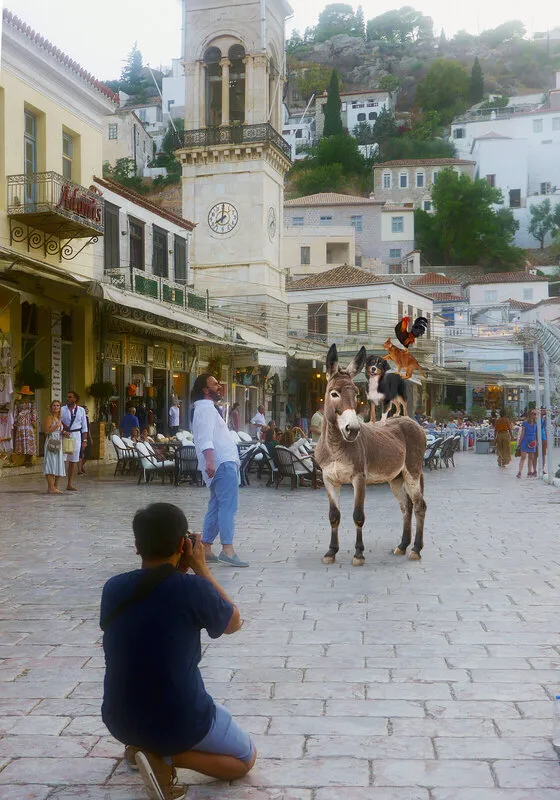
Jörgen Thornberg
The Bremen Musicians on Hydra: A Tale of Time-Traveling Tricksters, 2020
Digital
50 x 70 cm
The Bremen Musicians’ Song
Through forests deep and cities old,
Four creatures brave, with spirits bold,
A donkey, a dog, a cat, and a relentless cock,
They walked the roads around the clock.
From Oldenburg’s gates to lands afar,
They chased the wealth beneath the star,
Outwitting those with hearts of greed,
By cunning plan and daring deed.
In castles grand and manors vast,
They turned the tables, held the last,
Of riches gained by guile and theft,
And lived only where thieves had left.
They took from those who took from all,
And watched as mighty empires fall,
A symphony of justice played,
In every trick, a price was paid.
Yet in their eyes, no malice lay,
Just survival in a world of grey,
For the quartet, the players of this tune,
Knew darkness would meet its end soon.
So on they march, through night and day,
With laughter bright to light their way,
The Bremen Musicians, forever free,
In song and tale, they’ll always be.
Hydra, August 2024
The Bremen Musicians on Hydra: A Tale of Time-Traveling Tricksters
It was a scene of pure astonishment in the harbour of Hydra. Not every day does one witness a dog balancing on a donkey’s back, with a cat perched on the dog and a crowing rooster atop the cat. The donkeys, mules, and horses patiently stood on the quay, waiting for tourists eager for a ride, looking on with envy. None of them had ever experienced such fun. Even more surprisingly, the quartet seemed to be managing themselves, with no owner nearby to command them. Cameras flashed, and people stared until their eyes hurt.
I realised they were Time-travellers when I overheard the animals telepathically conversing with each other. They were well-versed and hadn’t come to Hydra by chance; they were here to scout the area. After a while, it all made sense to me—they were none other than the famous Bremen Musicians who had come to the island. Their entire history unravelled as they talked, reminding each other how they had been travelling the world since the 1100s.
The Bremen Musicians is a tale of four ageing domestic animals who, after a lifetime of hard work, often neglected and mistreated by their former masters, decided to run away and become town musicians in the city of Bremen. Their unwavering determination to change their fate and pursue their dreams despite the odds is truly inspiring.
Bruno, the donkey, was the first to speak up, his deep, resonant voice carrying across the quay. "Ah, Bremen. I’ve told you before that it wasn’t my idea to leave, but what choice did I have? The farmer was ready to send me to the butcher because I couldn’t haul the heavy loads anymore."
Max, the dog, nodded, his tail thumping against Bruno’s flank. "And I wasn’t much use as a hunter anymore. My joints ached too much to chase rabbits. When you suggested going to Bremen, it sounded like a way to escape the bullet."
Felix, the cat perched delicately on Max’s back, flicked his tail and purred. "Better than being drowned in a sack, which is what they had planned for me. Imagine that—a lifetime of catching mice, and that’s the thanks I get!"
Rusty, the rooster, flapped his wings and released a proud crow. "And me—turned into coq au vin? Not a chance! When I heard about Bremen, I knew I had to join you. Every good band needs a trumpet, and I’m the best!"
The four of them had banded together, each with a tale of near escape, and set off for Bremen, where they believed they could start anew as musicians. Bruno, ever the leader, had envisioned himself as the cello, his braying voice mimicking the rich, resonant tones of the instrument. With his rhythmic barking and tail-wagging, Max was the percussion section, providing both the beat and the energy. With his melodic purring and quick reflexes, Felix played the violin, adding elegance and charm. And Rusty, with his mighty crow, was the trumpet, leading the charge with flair.
But Bremen was not to be their final destination. As Felix explained, "We never actually made it to Bremen. On the way, we ran into a band of robbers and took over their hideout instead. We scared them off with our music—though I’m not sure they’d call it that—and lived in their house until we’d eaten everything in sight."
Bruno laughed, a deep, hearty sound. "That’s right. We’ve been travelling ever since, from one place to another, always finding new rogues to outwit and new places to call home, at least for a while."
Their adventures had taken them far and wide. They had spent time in Oldenburg, where they ousted a gang of thieves and enjoyed the spoils of their victory. They moved west to the wealthy Hanseatic city of Groningen, where they found yet another group of scoundrels to displace. Each new town brought new challenges and opportunities for the clever quartet.
As Rusty put it, "We’ve been everywhere—Paris, Venice, Florence, Constantinople, Amsterdam, Hong Kong and Tokyo ... We’ve seen it all. And we’ve lived off the riches of the rogues we’ve bested. Why settle down in Bremen when the world is full of places to explore and thieves to outsmart?"
Max added, "We even spent a good long while in London. The City of London was full of opportunity in the 1700s. And when we tired of it, we headed to New York. Wall Street, now there’s a place full of rogues!"
Their time in New York was particularly eventful. "We lived in style," Felix purred. "Bernard Madoff had this penthouse, and when his empire collapsed, we moved right in. Lived like kings, we did, until it was time to move on."
Bruno nodded sagely. "The world keeps changing, but one thing stays the same—where there are fortunes to be made, there are scoundrels to be found. And that’s where we come in."
As they recounted their adventures, I couldn’t help but marvel at their adaptability. For centuries, these animals had outsmarted the cleverest of men, surviving by their wits and music. Their ability to adapt to every new age and situation, thriving in adversity, is awe-inspiring.
"And now," Rusty crowed, "we’re here on Hydra. Not as many rogues as we’re used to, but who knows? We might find a few before we move on."
Bruno brayed in agreement. "And if not, there’s always a meal and a song to be sung."
Their story was a testament to their indomitable spirit. The Bremen Musicians had never had a steady income, but they had always found a way to survive, from the start, trading their talents for food and shelter to outsmarting those who tried to take advantage of them. They had seen the world, crossed borders, and navigated the seas, always staying one step ahead of those who would do them harm.
And now, they were on Hydra, ready for whatever new adventure awaited them. Whether they would find rogues to outwit or simply enjoy the island’s hospitality, one thing was sure—they would do it together, as they always had.
As they strolled off toward the town, I couldn’t help but wonder where their travels would take them next. But one thing was clear: wherever they went, they would bring their unique brand of music, mischief, and camaraderie, leaving behind a trail of outwitted rogues and stories that would be told for generations to come.
And so, the Bremen Musicians—Bruno the donkey, Max the dog, Felix the cat, and Rusty the rooster—continued their journey, timeless and ageless, ever on the lookout for the next adventure, the next rogue to outsmart, and the next place to call home, even if only for a little while.
As the Bremen Musicians in the 12th century made their way through the dense forests of northern Germany, they eventually arrived in the ancient city of Oldenburg, then known as Aldenburg. The town, though prosperous, had become a haven for robbers and scoundrels who preyed upon the riches of passing merchants. Here, the quartet encountered their first real challenge—a band of notorious thieves who had taken up residence in a grand, fortified manor on the outskirts of the town.
The robbers, confident in their power and untouchable within their stronghold, had no idea that four ageing animals would soon turn their world upside down. As night fell, the Musicians devised a clever plan. Bruno, the donkey, suggested they use their combined talents to frighten the thieves out of their lair. Together, they positioned themselves in front of the manor. Bruno began to bray deeply, like a booming cello, while Max barked rhythmically like a drum. Felix added his high-pitched, eerie meowing, and Rusty, the rooster, topped it off with a piercing crow that echoed through the night like a trumpet blast.
The cacophony was terrifying. Hearing what they thought was a monstrous, supernatural force outside, the robbers panicked. Believing they were under attack by some unholy creatures, they fled the manor in terror, abandoning their loot and the comforts of their home.
Now, with the manor to themselves, the Bremen Musicians moved in and made it their own. They lived there comfortably, feasting on the supplies the robbers had left behind until the house was completely emptied. When the time came to move on, they left Oldenburg as quietly as they had arrived, continuing their journey and leaving behind only the legend of how four unlikely heroes had driven out the region's most feared band of robbers.
The Bremen Musicians had a knack for finding themselves in the company of the most notorious scoundrels throughout history. Their adventures took them across Europe and beyond, where they encountered and outwitted some of the most cunning minds of their time, constantly emerging victorious.
Their journey continued in the 12th century with Henryk Prawdzic in Krakow, a Polish nobleman who had amassed wealth through high-interest loans and debt traps targeting various royal houses. The quartet, posing as foreign diplomats offering exclusive trade routes, tricked Prawdzic into investing heavily in a non-existent venture. When the scheme unravelled, Prawdzic became bankrupt, and the Musicians took over his lavish estate.
In the 13th century, they crossed paths with Richard of Cornwall, the younger brother of England’s King Henry III and Holy Roman Emperor. Richard’s greed and corrupt dealings made him a prime target for the Musicians, who duped him into believing they possessed a mystical artefact that would grant him dominion over all of Europe. The artefact was a mere trinket, but Richard’s obsession led him to sign over vast tracts of land and wealth to the animals, leaving him disgraced and destitute.
As the Renaissance dawned, the Musicians found themselves in Florence, where they encountered Cosimo de' Medici, the powerful founder of the Medici dynasty. Disguised as scholars and alchemists, they convinced Cosimo that they had unlocked the secret to eternal youth—a concoction requiring vast amounts of gold. Eager for the elixir, Cosimo parted with a significant portion of his fortune, only to realise too late that a donkey, a dog, a cat, and a rooster had fooled him. The Musicians lived in his villa for nearly a century, sustained by the wealth of the Medici family.
Their travels next took them to Germany in the 15th century, where they encountered Jakob Fugger, one of the wealthiest men in Europe, who controlled the continent’s copper and silver markets. The Musicians, ever the opportunists, posed as miners with knowledge of a hidden, untapped vein of precious metals. Fugger, blinded by greed, invested heavily in their fictitious mine, only to find himself outmanoeuvred and swindled. The quartet stayed in Fugger's grand estate for nearly two hundred years, enjoying the riches they had deceitfully acquired.
In the 18th century, the Musicians found themselves in London, where they orchestrated a financial disaster for John Law, the Scottish economist responsible for the infamous "Mississippi Bubble." They presented Law with seemingly infallible investment opportunities, quickly becoming catastrophic failures. Desperate to recover his losses, Law was forced to relinquish his grand mansion to the quartet, who lived there comfortably until the market collapsed and it was time to move on.
Not long after, in the era of colonial expansion, the Musicians encountered Robert Clive, also known as "Clive of India," in the heart of the British Empire. Exploiting Clive's ambition and greed, they lured him into a fabricated scheme to monopolise the trade of exotic spices. Clive, convinced of the scheme’s potential, handed over his vast wealth, only to be left with empty promises and looted bank accounts. The Musicians took over his estate, living off his ill-gotten gains for years.
As the 19th century rolled in, the quartet’s adventures took them across the Atlantic to the United States. There, they deftly outplayed the infamous Jay Gould and Daniel Drew, notorious for their financial schemes in the railway industry. Posing as government insiders with privileged information, the Musicians convinced Gould and Drew to invest heavily in a bogus railway project. When the stocks plummeted, the animals walked away with their sprawling estates, leaving the magnates with nothing but worthless paper.
In the early 20th century, the Musicians crossed paths with Charles Ponzi, the mastermind behind the infamous Ponzi scheme. Sensing an opportunity, the quartet convinced Ponzi they had access to a rare and valuable commodity. Ponzi eagerly invested, only to find himself penniless and without his luxurious home. The Musicians moved into his opulent palace, enjoying the high life until it was time to seek their next mark.
Their final notable encounters occurred in New York City in the late 20th century. First, they encountered Ivan Boesky, the infamous American stock trader known for his role in the insider trading scandal of the 1980s, which inspired the character Gordon Gekko in the film ‘Wall Street’. Ever confident in his financial acumen, Boesky was easily duped by the quartet into investing in a phantom hedge fund that promised astronomical returns. By the time Boesky realised he had been tricked, the Musicians had taken up residence in his luxurious penthouse overlooking Central Park. They lived there in style until the pantry was empty, and there were no more antiques to sell off.
Conveniently, they came across Bernard Madoff, the architect of one of the largest Ponzi schemes in history. Madoff, who had defrauded investors of billions, was no match for the cunning quartet. They moved into one of his lavish penthouses, a property never listed among the assets seized by the authorities. The penthouse was filled with priceless antiques and hidden vaults brimming with cash, ensuring the quartet wouldn’t need to worry about resources for decades. They even had the luxury of alternating between this home and a more "modest" fifteen-room apartment by the Hudson River, once owned by the notorious media mogul Robert Maxwell. Maxwell, who had embezzled hundreds of millions from his companies' pension funds, had never anticipated being outwitted by four ageing animals.
The musicians stayed in these lavish abodes until the stores began to run low, and at this point, they decided it was time to change scenery. Their wanderlust led them to Hydra, where they hoped to enjoy a bit of a vacation. Although Hydra was known for its share of scoundrels and pirates in the late 1700s, by the time the Musicians arrived, they found few worthy targets with properties that matched the grandeur they had grown accustomed to. It was, however, an ideal spot for rest and relaxation.
The Bremen Musicians had even crossed paths with Aristotle Onassis in the 1960s when they drove him off one of his private islands near Hydra. Onassis, the Greek shipping magnate, was known for his aggressive and shrewd business practices. While his methods were undoubtedly unscrupulous, they never quite crossed the line into outright criminality. He capitalised on opportunities, often at the expense of others, such as buying ships at rock-bottom prices during the Great Depression and profiting immensely from wartime shipping demands. Controversial dealings, like his oil contracts with Saudi Arabia that sparked conflicts with American companies, marked his career.
Though Onassis was a formidable and sometimes ruthless businessman, labelling him as a ‘villain’ like Bernard Madoff or Charles Ponzi might be an overstatement. He wasn’t involved in outright fraud but was certainly not bound for sainthood. So wealthy that he could be seen as a god in his own right, Onassis embodied a level of power and influence that made him a significant, if morally ambiguous, figure in the Musicians' long history of outwitting the rich and powerful.
Some detractors might call the quartet parasites, but the Bremen Musicians see themselves as a sort of sanitation crew for the financial world, cleaning up by redistributing the wealth of the world's greediest individuals.
In the context of their timeless story, the Musicians’ ages could be seen as a source of tragedy, inviting readers to reconsider their views on ageing. In modern Western society, old age is often perceived as bleak and burdensome. Yet the quartet defies this notion, displaying a joyous vitality that belies their years. The animals are so heavily abstracted that it’s nearly impossible to identify them as elderly. Their instruments don’t weigh them down; they float effortlessly, their vibrant life illustrating their playful and lively spirit. This choice becomes all the more moving when set against the backdrop of the global financial world—a gathering of ruffians. Despite living in a tumultuous and unforgiving world, they refuse to surrender to it, instead choosing to paint their world with a childlike sense of joy, wonder, and endless possibility. Their defiance of societal norms is a powerful reminder of the freedom to live on one's own terms.
In the world of fairy tales, children push witches into ovens, trick giants into overeating until they burst, and Little Red Riding Hood ensures the wolf meets his end. This dark justice echoes through modern cinema, where the 'good guys' often vanquish evil in brutal, sometimes grisly ways—through high-octane shootouts, elaborate traps, or cold-blooded retribution. Yesterday's tales were just as violent as today’s most graphic action films, with blood splattering on and between the lines. The world of fairy tales is far from where the righteous turn the other cheek, as Jesus once taught. Instead, it’s a realm where justice is often served with a sharp edge, reminding us that mercy is rarely the victor in the battle between good and evil.
The tale of the Bremen Musicians leaves us pondering a curious moral question: is it justifiable to steal from thieves, outwit the swindlers and live off the spoils of their deceit? With their cunning and playful spirit, the quartet might suggest that in a world filled with greed and corruption, turning the tables on those who exploit others is not only a survival tactic but perhaps a form of justice. Their actions, while unconventional, seem to be driven by a deep sense of justice. Yet, it also blurs the line between right and wrong, challenging us to consider whether fighting fire with fire cleanses the world of wrongdoing or perpetuates a cycle of moral ambiguity. Ultimately, the Bremen Musicians’ story reminds us that in a world full of shades of grey, the true measure of justice may lie in our intentions and the balance we strike between survival and integrity.

Jörgen Thornberg
Malmö
Lite om bilder och mig. Translation in English at the end.
Jag är en nyfiken person som ser allt i bilder, även det jag fäster i ord, gärna tillsammans för bakom alla mina bilder finns en berättelse. Till vissa bilder hör en kortare eller längre novell som följer med bilden.
Bilder berättar historier. Jag omges av naturlig skönhet, intressanta människor och historia var jag än går. Jag använder min kamera för att dokumentera världen och blanda det jag ser med vad jag känner för att fånga den dolda magin.
Mina bilder berättar mina historier. Genom mina bilder, tryck och berättelser. Jag bjuder in dig att ta del av dessa berättelser, in i ditt liv och hem och dela min mycket personliga syn på vår värld. Mer än vad ögat ser. Jag tänker i bilder, drömmer och skriver och pratar om dem; följaktligen måste jag också skapa bilder. De blir vad jag ser, inte nödvändigtvis begränsade till verkligheten. Det finns en bild runt varje hörn. Jag hoppas att du kommer att se vad jag såg och gilla det.
Jag är också en skrivande person och till många bilder hör en kortare eller längre essay. Den följer med tavlan, tryckt på fint papper och med en personlig hälsning från mig.
Flertalet bilder startar sin resa i min kamera. Enkelt förklarat beskriver jag bilden jag ser i mitt inre, upplevd eller fantiserad. Bilden uppstår inom mig redan innan jag fått okularet till ögat. På bråkdelen av ett ögonblick ser jag vad jag vill ha och vad som kan göras med bilden. Här skall jag stoppa in en giraff, stålmannen, Titanic eller vad det är min fantasi finner ut. Ännu märkligare är att jag kommer ihåg minnesbilden långt efteråt när det blir tid att skapa verket. Om jag lyckas eller inte, är upp till betraktaren, oftast präglat av en stråk av svart humor – meningen är att man skall bli underhållen. Mina bilder blir ofta en snackis där de hänger.
Jag föredrar bilder som förmedlar ett budskap i flera lager. Vid första anblicken fylld av feel-good, en vacker utsikt, fint väder, solen skiner, blommor på ängen eller vattnet som ligger förrädiskt spegelblankt. I en sådan bild kan jag gömma min egentliga berättelse, mitt förakt för förtryckare och våldsverkare, rasister och fördomsfulla människor - ett gärna återkommande motiv mer eller mindre dolt i det vackra motivet. Jag försöker förena dem i ett gemensamt narrativ.
Bild och formgivning har löpt som en röd tråd genom livet. Fotokonst känns som en värdig final som jag gärna delar med mig.
Min genre är vid som framgår av mina bilder, temat en blandning av pop- och gatukonst i kollage som kan bestå av hundratals lager. Vissa bilder kan ta veckor, andra någon dag innan det är dags att överlämna resultatet till printverkstaden. Fine Art Prints är digitala fotocollage. I dessa kollage sker rivandet, klippandet, pusslandet, målandet, ritandet och sprayningen digitalt. Det jag monterar in kan vara hundratals år gamla bilder som jag omsorgsfullt frilägger så att de ser ut att vara en del av tavlan men också bilder skapade av mig själv efter min egen fantasi. Därefter besöks printstudion och för vissa bilder numrera en limiterad upplaga (oftast 7 exemplar) och signera för hand. Vissa bilder kan köpas i olika format. Det är bara att fråga efter vilka. Gillar man en bild som är 70x100 men inte har plats på väggen, går den kanske att få i 50x70 cm istället. Frågan är fri.
Metoden Giclée eller Fine Art Print som det också kallas är det moderna sättet för framställning av grafisk konst. Villkoret för denna typ av utskrifter är att en högkvalitativ storformatskrivare används med åldersbeständigt färgpigment och konstnärspapper eller i förekommande fall på duk. Pappret som används möter de krav på livslängd som ställs av museer och gallerier. Normalt säljer jag mina bilder oinramade så att den nya ägaren själv kan bestämma hur de skall se ut, med eller utan passepartout färg på ram, med eller utan glas etc..
Under många år ställde jag bara ut på nätet, i valda grupper och på min egen Facebooksida - https://www.facebook.com/jorgen.thornberg.9
Jag finns också på en egen hemsida som tyvärr inte alltid är uppdaterad – https://www.jth.life/ Där kan du också läsa en del av de berättelser som följer med bilden.
UTSTÄLLNINGAR
Luftkastellet, oktober 2022
Konst i Lund, november 2022
Luftkastellet, mars 2023
Engleson Galleri Caroli, april 2023
Hydra, Greece June 2023
Engleson Galleri Caroli, oktober 2023
Toppen, Höllviken december 2023
Luftkastellet, mars 2024
Torups Galleri, mars 2024
Venice, May 2024
Luftkastellet, oktober 2024
Konst i Advent, December 2024
Galleri Engleson, Caroli December 2024
Jäger & Jansson Galleri, april 2025
A bit about pictures and me.
I'm a curious person who sees everything in pictures, even what I express in words, often combining them, for behind all my pictures lies a story. These narratives, some as short as a single image and others as long as a novel, are the heart and soul of my work.
Pictures tell stories. Wherever I go, I'm surrounded by natural beauty, exciting people, and history. I use my camera to document the world and blend what I see with what I feel to capture the hidden magic.
My images tell my stories. Through my pictures, prints, and narratives, I invite you to partake in these stories in your life and home and share my deeply personal perspective of our world. More than meets the eye. I think in pictures, dream, write, and talk about them; consequently, I must create images too. They become what I see, not necessarily confined to reality. There's a picture around every corner. I hope you'll see what I saw and enjoy it.
I'm also a writer, and many images come with a shorter or longer essay. It accompanies the painting, printed on fine paper with my personal greeting.
Many pictures start their journey on my camera. Simply put, I describe the image I see in my mind, experienced or imagined. The image arises within me even before I bring the eyepiece to my eye. In a fraction of a moment, I see what I want and what can be done with the picture. Here, I'll insert a giraffe, Superman, the Titanic, or whatever my imagination conjures up. Even stranger is that I remember the mental image long after it's time to create the work. Whether I succeed is up to the observer, often imbued with a streak of black humour – the aim is to entertain. My pictures usually become a talking point wherever they hang.
I prefer pictures that convey a message in multiple layers. At first glance, they're filled with feel-good vibes, a beautiful view, lovely weather, the sun shining, flowers in the meadow, or the water lying deceptively calm. But beneath this surface beauty, I often conceal a deeper story, a narrative that challenges societal norms or explores the human condition. I invite you to delve into these hidden narratives and discover the layers of meaning within my work.
Picture and design have been a thread running through my life. Photographic art feels like a fitting finale, and I'm happy to share it.
My genre is varied, as seen in my pictures; the theme is a blend of pop and street art in collages that can consist of hundreds of layers. Some images can take weeks, others just a day before it's time to hand over the result to the print workshop. Fine Art Prints are digital photo collages. In these collages, tearing, cutting, puzzling, painting, drawing, and spraying happen digitally. What I insert can be images hundreds of years old that I carefully extract so they appear to be part of the painting, but also images created by myself, now also generated from my imagination. Next, visit the print studio and, for certain images, number a limited edition (usually 7 copies) and sign them by hand. Some images may be available in other formats. Just ask which ones. If you like an image that's 70x100 but doesn't have space on the wall, you might be able to get it in 50x70 cm instead. The question is open.
The Giclée method, or Fine Art Print as it's also called, is the modern way of producing graphic art. This method ensures the highest quality and longevity of the artwork, using a high-quality large-format printer with archival pigment inks and artist paper or, in some cases, canvas. The paper used meets the longevity requirements set by museums and galleries. I sell my pictures unframed, allowing the new owner to personalise their artwork, confident in the lasting value and quality of the piece.
For many years, I only exhibited online, in selected groups, and on my Facebook page - https://www.facebook.com/jorgen.thornberg.9. I also have my website, which unfortunately is not constantly updated - https://www.jth.life/. You can also read some of the stories accompanying the pictures there.
EXHIBITIONS
Luftkastellet, October 2022
Art in Lund, November 2022
Luftkastellet, March 2023
Engleson Gallery Caroli, April 2023
Hydra, Greece June 2023
Engleson Gallery Caroli, October 2023
Toppen, Höllviken December 2023
Luftkastellet, March 2024
Torup Gallery, March 2024
Venice, May 2024
UTSTÄLLNINGAR
Luftkastellet, oktober 2022
Konst i Lund, november 2022
Luftkastellet, mars 2023
Engleson Galleri Caroli, april 2023
Hydra, Greece June 2023
Engleson Galleri Caroli, oktober 2023
Toppen, Höllviken december 2023
Luftkastellet, mars 2024
Torups Galleri, mars 2024
Venice, May 2024
Luftkastellet, October 2024
Konst i Advent, December 2024
Galleri Engleson, Caroli December 2024
Jäger & Jansson Galleri, April 2025
Utbildning
Autodidakt
Medlem i konstnärsförening
Öppna Sinnen
Med i konstrunda
Konstrundan i Skåne
Utställningar
Luftkastellet, October 2022
Art in Lund, November 2022
Luftkastellet, March 2023
Engleson Gallery Caroli, April 2023
Hydra, Greece June 2023
Engleson Gallery Caroli, October 2023
Toppen, Höllviken December 2023
Luftkastellet, March 2024
Torup Gallery, March 2024
Venice, May 2024