Vi använder cookies för att ge dig bästa möjliga upplevelse. Välj vilka cookies du tillåter.
Läs mer i vår integritetspolicy
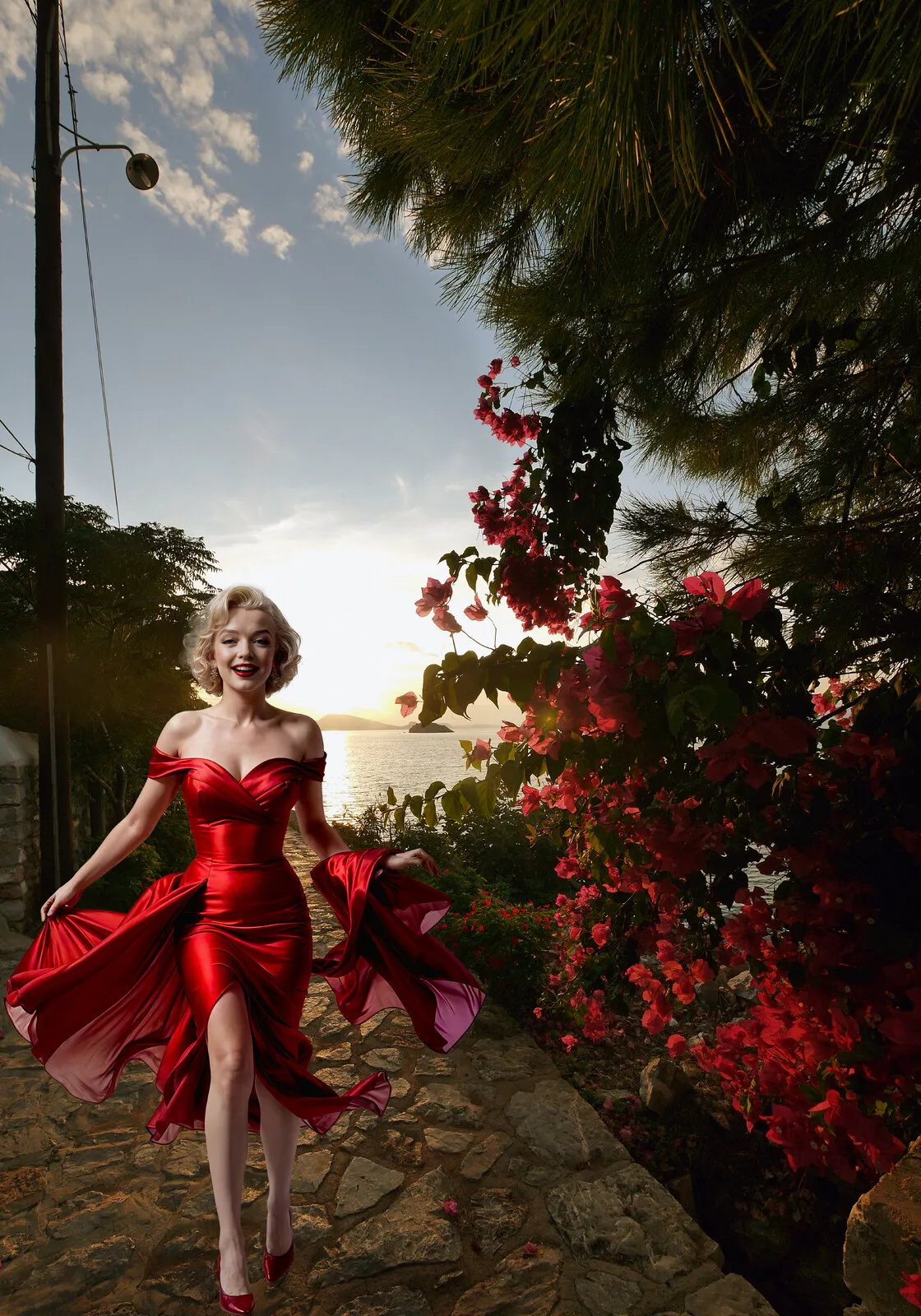
Jörgen Thornberg
The Smart Blonde, 2024
Digital
50 x 70 cm
Ode to the timeless allure of golden-haired Goddesses
In ancient tales of yore and lore,
Where myths and legends freely soar,
There shone a golden-haired divine,
The first of blondes, with light to shine.
Nanaya, the Sumer goddess bright,
With hair of gold, a wondrous sight.
From love and war, she did descend,
Inanna's daughter, wisdom’s blend.
From her lineage sprang the fair,
Aphrodite, with golden hair.
Born from seafoam, pure and bright,
The goddess of love, a radiant light.
By Kamini on Hydra’s shore,
In a small cove, her birth once more.
From the ocean's depths, she rose anew,
With beauty, love, and wisdom, too.
Aphrodite, with beauty unmatched,
In hearts of men, her name attached.
Not just a face but wisdom deep,
Her secrets in the stars we keep.
She walked the shores of ancient Greece,
Her golden hair is a symbol of peace.
A mind as sharp as any blade,
In her, the world's great beauty stayed.
From mountaintops to ocean wave,
Her influence, the hearts did crave.
Not just a Muse but a guiding star,
In love and wisdom, she set the bar.
Through ages past and those to come,
Her legacy is a beating drum.
In every heart that dares to dream,
Aphrodite's light does gleam.
So here's to blondes of ancient time,
Whose beauty and minds forever chime.
Aphrodite, goddess of lore,
With golden hair, forever more.
And now, in modern times, we see,
The truth revealed, the proof set free.
Blondes with wisdom, sharp and bright,
Their intellect is a shining light.
Aphrodite smiles, her legacy secure,
Science now makes clear and sure,
That blondes are the smartest of all,
In wisdom and beauty, they stand tall.
So let the world take note and see,
The golden-haired, their minds set free.
Aphrodite, the goddess, leads the way,
Proving blondes shine bright as day.
Hydra, July 2024
Aphrodite walked along the coastal road between Vlychos and Hydra, passing the small bay where she was born nearly three thousand years ago. Under the setting sun behind her back lay the reclining Goddess of Dokos. Aphrodite's red dress swirled as the evening breeze blew. Her pumps matched the dress, nails, and lipstick. She swayed a little sensually, even though only the cicadas, male cicadas at that, were watching her. They were so absorbed in their song that they likely didn’t notice a blonde beauty: song and song. How any poet could have thought to call this infernal buzzing noise music suggests that the person must have been entirely tone-deaf, musically inept, or mad.
Aphrodite enjoyed dressing up as someone else, and this evening, she was on her way to a gallery opening at the museum as Marilyn Monroe. She had met the actress many times among the stars at ‘The Blonde Art Society,’ an organisation a thousand years older than Aphrodite, founded by Nanaya, the primordial mother of all blonde people, daughter of the Sumerian goddess Inanna – The Queen of Heaven and Goddess of love, war, and fertility – and her husband Dumuzid the Shepherd, God of shepherds and fertility. Aphrodite's impersonation of Marilyn Monroe was not just a playful act but a tribute to the actress and her influence on the perception of beauty and femininity. This connection between Aphrodite and Marilyn Monroe is a testament to the enduring influence of blonde figures in shaping societal perceptions of beauty and femininity.
Like her mother, Nanaya was a goddess associated with love, sensuality, and fertility. She was primarily worshipped in Uruk and had her cult there. Nanaya had golden hair, and everyone was amazed by her beauty.
There is much to ponder while walking alone, and Aphrodite was thoughtful. She knew that goddesses must appear superior to the humans who worship them, a fact she carried with grace and dignity.
She laughed to herself with a hint of schadenfreude as she thought about recent scientific findings showing that blondes are the most intelligent beings on Earth. Aphrodite had known this for three thousand years, but it was now finally scientifically proven. Based on extensive research and cognitive studies, these findings have debunked the long-standing stereotype about blondes and their intelligence, providing a fresh perspective on the societal perceptions of blondes.
Aphrodite thought about her birth. Few are privileged to know it, but it worked out perfectly since she was born as a full-grown beauty. This unique birth has always been a source of both pride and discomfort for her. Like an internal film, all images of her from different cultures and artists over three millennia rolled through her mind. One stood out because it caused so much commotion during its time and was very close to Aphrodite’s memories of the birth moment. Sandro Botticelli's "The Birth of Venus" was inspired by Greek and Roman mythology, but some divine presence must have penetrated the artist’s dreams and planted the image there.
Botticelli intended to demonstrate how physical beauty could lead to divine contemplation. At that time, nudity in art was reserved for Paradise, and when Venus emerged from the sea, it caused a grand scandal. It was the first secular painting to incorporate nudity. Before Botticelli's painting, nudity was only used in religious art to depict the sin of Eve.
The central figure in the painting is Venus, the goddess of beauty and love. Zephyr, the March Wind, and his counterpart, Chloris or Aura, are on the left. On the right is Flora, the goddess of Spring. Aphrodite suspected it could be one of these two who had gossiped.
Botticelli's painting of Aphrodite’s birth features four characters: Venus, whom she has problems with because it is not her real name but a Roman alias. Besides herself as a newborn, there was Flora, Zephyr, and Zephyr's counterpart.
Aphrodite in Greek circles, Venus in Rome, was also the goddess of beauty, love, and fertility. Born out of a mix of seafoam and Uranus's severed genitals, which were cast into the sea by Uranus' son Cronus, Venus is greeted by one member of the Horae—the four goddesses of the seasons—who is ready to serve as Venus' handmaid. The Horae played a crucial role in her birth, each contributing uniquely to her character. The handmaid's flower-patterned apparel indicates she may be Flora, the goddess of Spring. This explanation of Horae's role in Aphrodite's birth provides historical context and enriches the reader's understanding of her mythological origins.
Venus sails to shore on the breath of the winged Zephyr. Known also as the March Wind, Zephyr is the gentlest of the four wind gods and summons the season of Spring. There are different thoughts on the identity of Zephyr's counterpart in "The Birth of Venus." Some speculate it is Zephyr's lover, Chloris, who is assisting him in blowing Venus to land. However, this seems contrary to the rest of the painting since, according to mythology, Chloris eventually transforms into Flora. Others posit that she is Aura, a deity of lesser power than Zephyr but known for providing a breeze and fresh morning air.
As Aphrodite passed Kamini and the bay of her birth, she thought about her hair colour. In modern Greece, there was almost a craze for blondes, most of them fake. It was nothing Aphrodite found particularly pleasant. All those women with blonde hair that darkened to black the closer to the roots one got.
Most people in ancient Greece had dark hair, so the Greeks found blond hair immensely fascinating. In the Homeric epics, Menelaus, the Spartan king, is portrayed as blond, along with other Achaean leaders. Other blond characters in the Homeric poems include Peleus, Achilles, Meleager, Agamede, and Rhadamanthys. Aphrodite, the Greek goddess of love and beauty, was often described as golden-haired and portrayed with this colour hair in art. Aphrodite's master epithet in the Homeric epics is khruséē, which means "golden". The traces of hair colour on Greek korai probably reflect the colours the artists saw in natural hair, including a broad diversity of shades of blond, red, and brown. The minority of statues with blond hair ranges from strawberry to platinum.
The poet Sappho of Lesbos (c. 630–570 BC) wrote that purple-coloured wraps as a headdress were good enough, except if the hair was blond: "...for the girl who has hair that is yellower than a torch [it is better to decorate it] with wreaths of flowers in bloom." Sappho also praises Aphrodite for her golden hair, stating that since gold metal is rust-free, the goddess' golden hair represents her freedom from ritual pollution. Sappho's contemporary, the Spartan Alcman, praised golden hair as one of the most desirable qualities of a beautiful woman, describing in various poems ‘The girl with the yellow hair’ or writing about girls with the hair purest gold.
In the fifth century BC, the sculptor Pheidias may have depicted the Greek goddess of wisdom Athena's hair using gold in his famous statue of Athena Parthenos, which was displayed inside the Parthenon. The Greeks thought of the Thracians who lived to the north as having reddish-blond hair. Because many Greek slaves were captured from Thrace, slaves were stereotyped as blond or red-headed. ‘Xanthias’, meaning ‘reddish blond,’ was a common name for slaves in ancient Greece, and a slave by this name appears in many of Aristophanes' comedies. Historian and Egyptologist Joann Fletcher asserts that the Macedonian ruler Alexander the Great and members of the Macedonian Greek Ptolemaic dynasty of Hellenistic Egypt had blond hair, such as Arsinoe II and Berenice II. Additionally, the ancient Greek lyric poet Bacchylides wrote of ‘The blonde daughters of the Lacedaemonians’, Spartans, while noting the golden hair of athletes at the Nemean Games.
The most famous statue of Aphrodite, the Aphrodite of Knidos, sculpted in the fourth century BC by Praxiteles, represented the goddess' hair using gold leaf and contributed to the popularity of the image of Aphrodite as a blonde goddess. Greek prostitutes frequently dyed their hair blond using saffron dyes or coloured powders. Blond dye was costly, took great effort to apply, and smelled repugnant, but none of these factors inhibited Greek prostitutes from dyeing their hair. As a result of this and the natural rarity of blond hair in the Mediterranean region, by the fourth century BC, blond hair was inextricably associated with prostitutes.
The comic playwright ‘Menander’ from around 300 BC, protests that ‘no chaste woman ought to make her hair yellow.’ At another point, he deplores blond hair dye as dangerous: "What can we women do wise or brilliant, who sit with hair dyed yellow, outraging the character of gentlewomen, causing the overthrow of houses, the ruin of nuptials, and accusations on the part of children?"
During the early years of the Roman Empire, blond hair was associated with prostitutes. The preference changed to bleaching the hair blond when Greek culture, which practised bleaching, reached Rome and was reinforced when the legions that conquered Gaul returned with blond slaves. Sherrow also states that Roman women tried to lighten their hair, but the substances often caused hair loss, so they resorted to wigs made from the captives' hair. According to Francis Owen, Roman literary records describe many well-known Roman historical personalities as blond.
Medieval Scandinavian art and literature often emphasised the length and colour of a woman's hair, considering long, blond hair ideal, as it was associated with gold. In Norse mythology, the goddess Sif has famously blond hair. In the Old Norse Gunnlaug Saga, Helga the Beautiful, described as "the most beautiful woman in the world," is said to have had blond hair so long that it can "envelop her entirely." In the Poetic Edda poem Rígsþula, the blond man Jarl is considered the ancestor of the dominant warrior class.
The Scandinavians were not the only ones to place a strong emphasis on the beauty of blond hair; the French writer Christine de Pisan writes in her book ‘The Treasure of the City of Ladies’ (1404) that "there is nothing in the world lovelier on a woman's head than beautiful blond hair". In medieval artwork, female saints are often shown with long, shimmering blond hair, emphasising their holiness and virginity. At the same time, however, Eve in Paradise Garden is sometimes shown with long, blond hair, which frames her nude body and draws attention to her sexual attractiveness. Iseult was so closely associated with blondness that, in the poems of Chrétien de Troyes, she is called "Iseult le Blonde". In Geoffrey Chaucer's Canterbury Tales, the knight describes Princess Emily as blond in his tale. What else?
In Mark Twain and the American West, American novelist Willa Cather describes Alexander the Great in Alexander's Bridge as embodying the ideal: a "large, muscular man with broad shoulders and rugged, blond good looks.
As she walked toward the sunset at Spilia, Aphrodite suddenly burst into laughter. It was the thought of all the silly blonde jokes she had heard over the years—Countless, each worse than the last. That’s when I saw her. We had met some years ago when Babis Mores occupied the ochre villa above my house. I asked her what was so funny. It could have been me looking ridiculous in my oversized yellow shorts.
“Not at all, Jorgos,” she said, reading my thoughts. “I was thinking about blonde stereotypes, and they can be pretty funny if you ignore their stupidity.
“Originating in Europe, the 'blonde stereotype' is also associated with being less severe or less intelligent. Blonde jokes are a class of jokes based on the stereotype of blonde women as unintelligent. In Brazil, this extends to blonde women being looked down upon, as reflected in sexist jokes, as well as sexually licentious. It is believed the originator of the dumb blonde was an eighteenth-century blonde French prostitute named Rosalie Duthé, whose reputation for being beautiful but dumb inspired a play about her called *Les Curiosités de la Foire* (Paris 1775).
“Blonde actresses have contributed to this perception; some include Jean Harlow, Marilyn Monroe, Judy Holliday, Jayne Mansfield, and Goldie Hawn during her time on the program *Laugh-In*,” I said.
“Absolutely right. The British filmmaker Alfred Hitchcock preferred to cast blonde women for major roles in his films as he believed the audience would suspect them the least, comparing them to 'virgin snow that shows up the bloody footprints,' hence the term ‘Hitchcock blonde’. He’s told me that himself,” said Aphrodite, shaking her blonde hair.
“This stereotype has become so ingrained it has spawned counter-narratives, such as in the 2001 film *Legally Blonde* in which Elle Woods, played by Reese Witherspoon, succeeds at Harvard despite biases against her beauty and blond hair. The film was, however, funny,” I said.
“In a way, yes. In the 1950s, my fellow Time-traveller Marilyn Monroe’s screen persona centred on her blonde hair and the stereotypes associated with it, especially dumbness, naïveté, sexual availability, and artificiality. She often used a breathy, childish voice in her films and, in interviews, gave the impression that everything she said was 'utterly innocent and uncalculated,' parodying herself with double entendres that came to be known as 'Monroeisms.' For example, when she was asked what she had on in a 1949 nude photo shoot, she replied, 'I had the radio on.'
“Yeah, I’ve heard that, but she didn’t mean it seriously, did she?”
“Of course not. 'What wouldn’t one do for a bit of publicity,' Marilyn laughed when I reminded her of the incident. 'The dumbest are those who think I was serious. They are almost always men, foolish ones. A blonde’s hunger for publicity outsmarts men’s understanding.'”
“That’s the least one can say.”
“Marilyn often used simple tricks to twist men’s heads, wore white to emphasise her blondeness, and drew attention by wearing revealing outfits that showed off her figure. Although Monroe’s typecast screen persona as a dim-witted but sexually attractive blonde was carefully crafted, audiences and film critics believed it to be her real personality. They did not realise that she only acted and often mocked the men.”
"I have read that the notion that blondes are less intelligent is not grounded in fact,” I said ingratiatingly.
“Which hair colour is linked to a higher intelligence?” Aphrodite asked slyly, making me realise she had read the same study.
“The stereotype is that blondes, while having more fun, are not as smart. However, contrary to this typecast, a study finds that blonde women have slightly higher IQs than brunettes. The difference is so small as to be statistically insignificant.”
“Sure, but a fact is that blonde women are the smartest of all creatures on Earth.” Aphrodite made a little leap, which is easy for someone hovering a few millimetres above the ground.
"That’s certainly true," I said diplomatically. I couldn't help but chuckle at her confidence. "Blonde men, meanwhile, have similar IQs to men with other hair colours. I was blonde until my hair darkened at three years old if that matters. In any case, blondes are not dumb—male or female. The point might seem trivial, but the study’s author, Dr. Zagorsky, argues that stereotypes can have real-world implications, such as impacting hiring, promotions, and other social experiences and contributing to the prevalence of dumb blonde jokes."
“I thought there might be a bit of blonde behind your light brown curls,” said Aphrodite with a smile.
“Maybe so.” I nodded thoughtfully. "It's amazing how such stereotypes can have such deep roots and broad impacts."
Aphrodite smiled. “According to me, dumb blonde jokes are one of the last 'acceptable' forms of prejudice, only surpassed by racist jokes and jokes about rape and other abuses against women.”
Some
I thought momentarily and said, "It's interesting how certain prejudices persist while others are challenged more readily. It's about time we question and dismantle these harmful stereotypes."
She agreed, “Absolutely. It’s crucial to recognise the intelligence and capabilities of individuals, regardless of their appearance. Stereotypes are just lazy thinking.”
As we continued our walk, I sincerely appreciated the complexities behind seemingly simple jokes and the importance of challenging societal norms.
“Du skall få ett alternativt blondinskämt”, sa Aphrodite.
”Shoot!” sa jag.
“A blonde, a brunette, and a redhead university student got lost in the desert. They found an antique lamp in the sand, and the brunette rubbed it. Nothing happened. The brunette said, “Isn’t a genie supposed to pop out?”
The redhead replied, “Look, a creature that grants wishes sounds great on paper. But magically changing reality on a whim would subvert our ability to take responsibility for our actions and would be antithetical to human existence. Today, we brought insufficient water and no map, and it’s forty degrees out here. The dizziness, headaches, and confusion will begin in about thirty minutes. A few hours later, seizures, rhabdomyolysis, and kidney failure. We thought this would be a Sunday Funday, but our ill-preparedness has turned this into quite the opposite,” she said gloomily.
The Blonde sighed and said, “Yeah, but isn’t it funnier if a genie pours out? Because then there can be, like, high jinks.” She shook the bottle, which gurgled and unscrewed the cap on the spout, pouring half a mug of water each, only half, to make sure the water lasted until they were rescued. That happened for two reasons: the blonde didn’t believe in old nonsense and ensured the water lasted two days until they were found.
The story's moral is that practical intelligence and resourcefulness can be far more valuable than fantastical thinking or stereotypes. Despite the stereotype that blondes are less intelligent, in this scenario, the blonde uses common sense and practical actions to ensure their survival, ultimately leading to their rescue. This highlights the importance of not underestimating someone based on superficial attributes and reinforces that true wisdom often lies in pragmatic and level-headed thinking.
Jörgen Thornberg
The Smart Blonde, 2024
Digital
50 x 70 cm
Ode to the timeless allure of golden-haired Goddesses
In ancient tales of yore and lore,
Where myths and legends freely soar,
There shone a golden-haired divine,
The first of blondes, with light to shine.
Nanaya, the Sumer goddess bright,
With hair of gold, a wondrous sight.
From love and war, she did descend,
Inanna's daughter, wisdom’s blend.
From her lineage sprang the fair,
Aphrodite, with golden hair.
Born from seafoam, pure and bright,
The goddess of love, a radiant light.
By Kamini on Hydra’s shore,
In a small cove, her birth once more.
From the ocean's depths, she rose anew,
With beauty, love, and wisdom, too.
Aphrodite, with beauty unmatched,
In hearts of men, her name attached.
Not just a face but wisdom deep,
Her secrets in the stars we keep.
She walked the shores of ancient Greece,
Her golden hair is a symbol of peace.
A mind as sharp as any blade,
In her, the world's great beauty stayed.
From mountaintops to ocean wave,
Her influence, the hearts did crave.
Not just a Muse but a guiding star,
In love and wisdom, she set the bar.
Through ages past and those to come,
Her legacy is a beating drum.
In every heart that dares to dream,
Aphrodite's light does gleam.
So here's to blondes of ancient time,
Whose beauty and minds forever chime.
Aphrodite, goddess of lore,
With golden hair, forever more.
And now, in modern times, we see,
The truth revealed, the proof set free.
Blondes with wisdom, sharp and bright,
Their intellect is a shining light.
Aphrodite smiles, her legacy secure,
Science now makes clear and sure,
That blondes are the smartest of all,
In wisdom and beauty, they stand tall.
So let the world take note and see,
The golden-haired, their minds set free.
Aphrodite, the goddess, leads the way,
Proving blondes shine bright as day.
Hydra, July 2024
Aphrodite walked along the coastal road between Vlychos and Hydra, passing the small bay where she was born nearly three thousand years ago. Under the setting sun behind her back lay the reclining Goddess of Dokos. Aphrodite's red dress swirled as the evening breeze blew. Her pumps matched the dress, nails, and lipstick. She swayed a little sensually, even though only the cicadas, male cicadas at that, were watching her. They were so absorbed in their song that they likely didn’t notice a blonde beauty: song and song. How any poet could have thought to call this infernal buzzing noise music suggests that the person must have been entirely tone-deaf, musically inept, or mad.
Aphrodite enjoyed dressing up as someone else, and this evening, she was on her way to a gallery opening at the museum as Marilyn Monroe. She had met the actress many times among the stars at ‘The Blonde Art Society,’ an organisation a thousand years older than Aphrodite, founded by Nanaya, the primordial mother of all blonde people, daughter of the Sumerian goddess Inanna – The Queen of Heaven and Goddess of love, war, and fertility – and her husband Dumuzid the Shepherd, God of shepherds and fertility. Aphrodite's impersonation of Marilyn Monroe was not just a playful act but a tribute to the actress and her influence on the perception of beauty and femininity. This connection between Aphrodite and Marilyn Monroe is a testament to the enduring influence of blonde figures in shaping societal perceptions of beauty and femininity.
Like her mother, Nanaya was a goddess associated with love, sensuality, and fertility. She was primarily worshipped in Uruk and had her cult there. Nanaya had golden hair, and everyone was amazed by her beauty.
There is much to ponder while walking alone, and Aphrodite was thoughtful. She knew that goddesses must appear superior to the humans who worship them, a fact she carried with grace and dignity.
She laughed to herself with a hint of schadenfreude as she thought about recent scientific findings showing that blondes are the most intelligent beings on Earth. Aphrodite had known this for three thousand years, but it was now finally scientifically proven. Based on extensive research and cognitive studies, these findings have debunked the long-standing stereotype about blondes and their intelligence, providing a fresh perspective on the societal perceptions of blondes.
Aphrodite thought about her birth. Few are privileged to know it, but it worked out perfectly since she was born as a full-grown beauty. This unique birth has always been a source of both pride and discomfort for her. Like an internal film, all images of her from different cultures and artists over three millennia rolled through her mind. One stood out because it caused so much commotion during its time and was very close to Aphrodite’s memories of the birth moment. Sandro Botticelli's "The Birth of Venus" was inspired by Greek and Roman mythology, but some divine presence must have penetrated the artist’s dreams and planted the image there.
Botticelli intended to demonstrate how physical beauty could lead to divine contemplation. At that time, nudity in art was reserved for Paradise, and when Venus emerged from the sea, it caused a grand scandal. It was the first secular painting to incorporate nudity. Before Botticelli's painting, nudity was only used in religious art to depict the sin of Eve.
The central figure in the painting is Venus, the goddess of beauty and love. Zephyr, the March Wind, and his counterpart, Chloris or Aura, are on the left. On the right is Flora, the goddess of Spring. Aphrodite suspected it could be one of these two who had gossiped.
Botticelli's painting of Aphrodite’s birth features four characters: Venus, whom she has problems with because it is not her real name but a Roman alias. Besides herself as a newborn, there was Flora, Zephyr, and Zephyr's counterpart.
Aphrodite in Greek circles, Venus in Rome, was also the goddess of beauty, love, and fertility. Born out of a mix of seafoam and Uranus's severed genitals, which were cast into the sea by Uranus' son Cronus, Venus is greeted by one member of the Horae—the four goddesses of the seasons—who is ready to serve as Venus' handmaid. The Horae played a crucial role in her birth, each contributing uniquely to her character. The handmaid's flower-patterned apparel indicates she may be Flora, the goddess of Spring. This explanation of Horae's role in Aphrodite's birth provides historical context and enriches the reader's understanding of her mythological origins.
Venus sails to shore on the breath of the winged Zephyr. Known also as the March Wind, Zephyr is the gentlest of the four wind gods and summons the season of Spring. There are different thoughts on the identity of Zephyr's counterpart in "The Birth of Venus." Some speculate it is Zephyr's lover, Chloris, who is assisting him in blowing Venus to land. However, this seems contrary to the rest of the painting since, according to mythology, Chloris eventually transforms into Flora. Others posit that she is Aura, a deity of lesser power than Zephyr but known for providing a breeze and fresh morning air.
As Aphrodite passed Kamini and the bay of her birth, she thought about her hair colour. In modern Greece, there was almost a craze for blondes, most of them fake. It was nothing Aphrodite found particularly pleasant. All those women with blonde hair that darkened to black the closer to the roots one got.
Most people in ancient Greece had dark hair, so the Greeks found blond hair immensely fascinating. In the Homeric epics, Menelaus, the Spartan king, is portrayed as blond, along with other Achaean leaders. Other blond characters in the Homeric poems include Peleus, Achilles, Meleager, Agamede, and Rhadamanthys. Aphrodite, the Greek goddess of love and beauty, was often described as golden-haired and portrayed with this colour hair in art. Aphrodite's master epithet in the Homeric epics is khruséē, which means "golden". The traces of hair colour on Greek korai probably reflect the colours the artists saw in natural hair, including a broad diversity of shades of blond, red, and brown. The minority of statues with blond hair ranges from strawberry to platinum.
The poet Sappho of Lesbos (c. 630–570 BC) wrote that purple-coloured wraps as a headdress were good enough, except if the hair was blond: "...for the girl who has hair that is yellower than a torch [it is better to decorate it] with wreaths of flowers in bloom." Sappho also praises Aphrodite for her golden hair, stating that since gold metal is rust-free, the goddess' golden hair represents her freedom from ritual pollution. Sappho's contemporary, the Spartan Alcman, praised golden hair as one of the most desirable qualities of a beautiful woman, describing in various poems ‘The girl with the yellow hair’ or writing about girls with the hair purest gold.
In the fifth century BC, the sculptor Pheidias may have depicted the Greek goddess of wisdom Athena's hair using gold in his famous statue of Athena Parthenos, which was displayed inside the Parthenon. The Greeks thought of the Thracians who lived to the north as having reddish-blond hair. Because many Greek slaves were captured from Thrace, slaves were stereotyped as blond or red-headed. ‘Xanthias’, meaning ‘reddish blond,’ was a common name for slaves in ancient Greece, and a slave by this name appears in many of Aristophanes' comedies. Historian and Egyptologist Joann Fletcher asserts that the Macedonian ruler Alexander the Great and members of the Macedonian Greek Ptolemaic dynasty of Hellenistic Egypt had blond hair, such as Arsinoe II and Berenice II. Additionally, the ancient Greek lyric poet Bacchylides wrote of ‘The blonde daughters of the Lacedaemonians’, Spartans, while noting the golden hair of athletes at the Nemean Games.
The most famous statue of Aphrodite, the Aphrodite of Knidos, sculpted in the fourth century BC by Praxiteles, represented the goddess' hair using gold leaf and contributed to the popularity of the image of Aphrodite as a blonde goddess. Greek prostitutes frequently dyed their hair blond using saffron dyes or coloured powders. Blond dye was costly, took great effort to apply, and smelled repugnant, but none of these factors inhibited Greek prostitutes from dyeing their hair. As a result of this and the natural rarity of blond hair in the Mediterranean region, by the fourth century BC, blond hair was inextricably associated with prostitutes.
The comic playwright ‘Menander’ from around 300 BC, protests that ‘no chaste woman ought to make her hair yellow.’ At another point, he deplores blond hair dye as dangerous: "What can we women do wise or brilliant, who sit with hair dyed yellow, outraging the character of gentlewomen, causing the overthrow of houses, the ruin of nuptials, and accusations on the part of children?"
During the early years of the Roman Empire, blond hair was associated with prostitutes. The preference changed to bleaching the hair blond when Greek culture, which practised bleaching, reached Rome and was reinforced when the legions that conquered Gaul returned with blond slaves. Sherrow also states that Roman women tried to lighten their hair, but the substances often caused hair loss, so they resorted to wigs made from the captives' hair. According to Francis Owen, Roman literary records describe many well-known Roman historical personalities as blond.
Medieval Scandinavian art and literature often emphasised the length and colour of a woman's hair, considering long, blond hair ideal, as it was associated with gold. In Norse mythology, the goddess Sif has famously blond hair. In the Old Norse Gunnlaug Saga, Helga the Beautiful, described as "the most beautiful woman in the world," is said to have had blond hair so long that it can "envelop her entirely." In the Poetic Edda poem Rígsþula, the blond man Jarl is considered the ancestor of the dominant warrior class.
The Scandinavians were not the only ones to place a strong emphasis on the beauty of blond hair; the French writer Christine de Pisan writes in her book ‘The Treasure of the City of Ladies’ (1404) that "there is nothing in the world lovelier on a woman's head than beautiful blond hair". In medieval artwork, female saints are often shown with long, shimmering blond hair, emphasising their holiness and virginity. At the same time, however, Eve in Paradise Garden is sometimes shown with long, blond hair, which frames her nude body and draws attention to her sexual attractiveness. Iseult was so closely associated with blondness that, in the poems of Chrétien de Troyes, she is called "Iseult le Blonde". In Geoffrey Chaucer's Canterbury Tales, the knight describes Princess Emily as blond in his tale. What else?
In Mark Twain and the American West, American novelist Willa Cather describes Alexander the Great in Alexander's Bridge as embodying the ideal: a "large, muscular man with broad shoulders and rugged, blond good looks.
As she walked toward the sunset at Spilia, Aphrodite suddenly burst into laughter. It was the thought of all the silly blonde jokes she had heard over the years—Countless, each worse than the last. That’s when I saw her. We had met some years ago when Babis Mores occupied the ochre villa above my house. I asked her what was so funny. It could have been me looking ridiculous in my oversized yellow shorts.
“Not at all, Jorgos,” she said, reading my thoughts. “I was thinking about blonde stereotypes, and they can be pretty funny if you ignore their stupidity.
“Originating in Europe, the 'blonde stereotype' is also associated with being less severe or less intelligent. Blonde jokes are a class of jokes based on the stereotype of blonde women as unintelligent. In Brazil, this extends to blonde women being looked down upon, as reflected in sexist jokes, as well as sexually licentious. It is believed the originator of the dumb blonde was an eighteenth-century blonde French prostitute named Rosalie Duthé, whose reputation for being beautiful but dumb inspired a play about her called *Les Curiosités de la Foire* (Paris 1775).
“Blonde actresses have contributed to this perception; some include Jean Harlow, Marilyn Monroe, Judy Holliday, Jayne Mansfield, and Goldie Hawn during her time on the program *Laugh-In*,” I said.
“Absolutely right. The British filmmaker Alfred Hitchcock preferred to cast blonde women for major roles in his films as he believed the audience would suspect them the least, comparing them to 'virgin snow that shows up the bloody footprints,' hence the term ‘Hitchcock blonde’. He’s told me that himself,” said Aphrodite, shaking her blonde hair.
“This stereotype has become so ingrained it has spawned counter-narratives, such as in the 2001 film *Legally Blonde* in which Elle Woods, played by Reese Witherspoon, succeeds at Harvard despite biases against her beauty and blond hair. The film was, however, funny,” I said.
“In a way, yes. In the 1950s, my fellow Time-traveller Marilyn Monroe’s screen persona centred on her blonde hair and the stereotypes associated with it, especially dumbness, naïveté, sexual availability, and artificiality. She often used a breathy, childish voice in her films and, in interviews, gave the impression that everything she said was 'utterly innocent and uncalculated,' parodying herself with double entendres that came to be known as 'Monroeisms.' For example, when she was asked what she had on in a 1949 nude photo shoot, she replied, 'I had the radio on.'
“Yeah, I’ve heard that, but she didn’t mean it seriously, did she?”
“Of course not. 'What wouldn’t one do for a bit of publicity,' Marilyn laughed when I reminded her of the incident. 'The dumbest are those who think I was serious. They are almost always men, foolish ones. A blonde’s hunger for publicity outsmarts men’s understanding.'”
“That’s the least one can say.”
“Marilyn often used simple tricks to twist men’s heads, wore white to emphasise her blondeness, and drew attention by wearing revealing outfits that showed off her figure. Although Monroe’s typecast screen persona as a dim-witted but sexually attractive blonde was carefully crafted, audiences and film critics believed it to be her real personality. They did not realise that she only acted and often mocked the men.”
"I have read that the notion that blondes are less intelligent is not grounded in fact,” I said ingratiatingly.
“Which hair colour is linked to a higher intelligence?” Aphrodite asked slyly, making me realise she had read the same study.
“The stereotype is that blondes, while having more fun, are not as smart. However, contrary to this typecast, a study finds that blonde women have slightly higher IQs than brunettes. The difference is so small as to be statistically insignificant.”
“Sure, but a fact is that blonde women are the smartest of all creatures on Earth.” Aphrodite made a little leap, which is easy for someone hovering a few millimetres above the ground.
"That’s certainly true," I said diplomatically. I couldn't help but chuckle at her confidence. "Blonde men, meanwhile, have similar IQs to men with other hair colours. I was blonde until my hair darkened at three years old if that matters. In any case, blondes are not dumb—male or female. The point might seem trivial, but the study’s author, Dr. Zagorsky, argues that stereotypes can have real-world implications, such as impacting hiring, promotions, and other social experiences and contributing to the prevalence of dumb blonde jokes."
“I thought there might be a bit of blonde behind your light brown curls,” said Aphrodite with a smile.
“Maybe so.” I nodded thoughtfully. "It's amazing how such stereotypes can have such deep roots and broad impacts."
Aphrodite smiled. “According to me, dumb blonde jokes are one of the last 'acceptable' forms of prejudice, only surpassed by racist jokes and jokes about rape and other abuses against women.”
Some
I thought momentarily and said, "It's interesting how certain prejudices persist while others are challenged more readily. It's about time we question and dismantle these harmful stereotypes."
She agreed, “Absolutely. It’s crucial to recognise the intelligence and capabilities of individuals, regardless of their appearance. Stereotypes are just lazy thinking.”
As we continued our walk, I sincerely appreciated the complexities behind seemingly simple jokes and the importance of challenging societal norms.
“Du skall få ett alternativt blondinskämt”, sa Aphrodite.
”Shoot!” sa jag.
“A blonde, a brunette, and a redhead university student got lost in the desert. They found an antique lamp in the sand, and the brunette rubbed it. Nothing happened. The brunette said, “Isn’t a genie supposed to pop out?”
The redhead replied, “Look, a creature that grants wishes sounds great on paper. But magically changing reality on a whim would subvert our ability to take responsibility for our actions and would be antithetical to human existence. Today, we brought insufficient water and no map, and it’s forty degrees out here. The dizziness, headaches, and confusion will begin in about thirty minutes. A few hours later, seizures, rhabdomyolysis, and kidney failure. We thought this would be a Sunday Funday, but our ill-preparedness has turned this into quite the opposite,” she said gloomily.
The Blonde sighed and said, “Yeah, but isn’t it funnier if a genie pours out? Because then there can be, like, high jinks.” She shook the bottle, which gurgled and unscrewed the cap on the spout, pouring half a mug of water each, only half, to make sure the water lasted until they were rescued. That happened for two reasons: the blonde didn’t believe in old nonsense and ensured the water lasted two days until they were found.
The story's moral is that practical intelligence and resourcefulness can be far more valuable than fantastical thinking or stereotypes. Despite the stereotype that blondes are less intelligent, in this scenario, the blonde uses common sense and practical actions to ensure their survival, ultimately leading to their rescue. This highlights the importance of not underestimating someone based on superficial attributes and reinforces that true wisdom often lies in pragmatic and level-headed thinking.

Jörgen Thornberg
Malmö
Lite om bilder och mig. Translation in English at the end.
Jag är en nyfiken person som ser allt i bilder, även det jag fäster i ord, gärna tillsammans för bakom alla mina bilder finns en berättelse. Till vissa bilder hör en kortare eller längre novell som följer med bilden.
Bilder berättar historier. Jag omges av naturlig skönhet, intressanta människor och historia var jag än går. Jag använder min kamera för att dokumentera världen och blanda det jag ser med vad jag känner för att fånga den dolda magin.
Mina bilder berättar mina historier. Genom mina bilder, tryck och berättelser. Jag bjuder in dig att ta del av dessa berättelser, in i ditt liv och hem och dela min mycket personliga syn på vår värld. Mer än vad ögat ser. Jag tänker i bilder, drömmer och skriver och pratar om dem; följaktligen måste jag också skapa bilder. De blir vad jag ser, inte nödvändigtvis begränsade till verkligheten. Det finns en bild runt varje hörn. Jag hoppas att du kommer att se vad jag såg och gilla det.
Jag är också en skrivande person och till många bilder hör en kortare eller längre essay. Den följer med tavlan, tryckt på fint papper och med en personlig hälsning från mig.
Flertalet bilder startar sin resa i min kamera. Enkelt förklarat beskriver jag bilden jag ser i mitt inre, upplevd eller fantiserad. Bilden uppstår inom mig redan innan jag fått okularet till ögat. På bråkdelen av ett ögonblick ser jag vad jag vill ha och vad som kan göras med bilden. Här skall jag stoppa in en giraff, stålmannen, Titanic eller vad det är min fantasi finner ut. Ännu märkligare är att jag kommer ihåg minnesbilden långt efteråt när det blir tid att skapa verket. Om jag lyckas eller inte, är upp till betraktaren, oftast präglat av en stråk av svart humor – meningen är att man skall bli underhållen. Mina bilder blir ofta en snackis där de hänger.
Jag föredrar bilder som förmedlar ett budskap i flera lager. Vid första anblicken fylld av feel-good, en vacker utsikt, fint väder, solen skiner, blommor på ängen eller vattnet som ligger förrädiskt spegelblankt. I en sådan bild kan jag gömma min egentliga berättelse, mitt förakt för förtryckare och våldsverkare, rasister och fördomsfulla människor - ett gärna återkommande motiv mer eller mindre dolt i det vackra motivet. Jag försöker förena dem i ett gemensamt narrativ.
Bild och formgivning har löpt som en röd tråd genom livet. Fotokonst känns som en värdig final som jag gärna delar med mig.
Min genre är vid som framgår av mina bilder, temat en blandning av pop- och gatukonst i kollage som kan bestå av hundratals lager. Vissa bilder kan ta veckor, andra någon dag innan det är dags att överlämna resultatet till printverkstaden. Fine Art Prints är digitala fotocollage. I dessa kollage sker rivandet, klippandet, pusslandet, målandet, ritandet och sprayningen digitalt. Det jag monterar in kan vara hundratals år gamla bilder som jag omsorgsfullt frilägger så att de ser ut att vara en del av tavlan men också bilder skapade av mig själv efter min egen fantasi. Därefter besöks printstudion och för vissa bilder numrera en limiterad upplaga (oftast 7 exemplar) och signera för hand. Vissa bilder kan köpas i olika format. Det är bara att fråga efter vilka. Gillar man en bild som är 70x100 men inte har plats på väggen, går den kanske att få i 50x70 cm istället. Frågan är fri.
Metoden Giclée eller Fine Art Print som det också kallas är det moderna sättet för framställning av grafisk konst. Villkoret för denna typ av utskrifter är att en högkvalitativ storformatskrivare används med åldersbeständigt färgpigment och konstnärspapper eller i förekommande fall på duk. Pappret som används möter de krav på livslängd som ställs av museer och gallerier. Normalt säljer jag mina bilder oinramade så att den nya ägaren själv kan bestämma hur de skall se ut, med eller utan passepartout färg på ram, med eller utan glas etc..
Under många år ställde jag bara ut på nätet, i valda grupper och på min egen Facebooksida - https://www.facebook.com/jorgen.thornberg.9
Jag finns också på en egen hemsida som tyvärr inte alltid är uppdaterad – https://www.jth.life/ Där kan du också läsa en del av de berättelser som följer med bilden.
UTSTÄLLNINGAR
Luftkastellet, oktober 2022
Konst i Lund, november 2022
Luftkastellet, mars 2023
Engleson Galleri Caroli, april 2023
Hydra, Greece June 2023
Engleson Galleri Caroli, oktober 2023
Toppen, Höllviken december 2023
Luftkastellet, mars 2024
Torups Galleri, mars 2024
Venice, May 2024
Luftkastellet, oktober 2024
Konst i Advent, December 2024
Galleri Engleson, Caroli December 2024
Jäger & Jansson Galleri, april 2025
A bit about pictures and me.
I'm a curious person who sees everything in pictures, even what I express in words, often combining them, for behind all my pictures lies a story. These narratives, some as short as a single image and others as long as a novel, are the heart and soul of my work.
Pictures tell stories. Wherever I go, I'm surrounded by natural beauty, exciting people, and history. I use my camera to document the world and blend what I see with what I feel to capture the hidden magic.
My images tell my stories. Through my pictures, prints, and narratives, I invite you to partake in these stories in your life and home and share my deeply personal perspective of our world. More than meets the eye. I think in pictures, dream, write, and talk about them; consequently, I must create images too. They become what I see, not necessarily confined to reality. There's a picture around every corner. I hope you'll see what I saw and enjoy it.
I'm also a writer, and many images come with a shorter or longer essay. It accompanies the painting, printed on fine paper with my personal greeting.
Many pictures start their journey on my camera. Simply put, I describe the image I see in my mind, experienced or imagined. The image arises within me even before I bring the eyepiece to my eye. In a fraction of a moment, I see what I want and what can be done with the picture. Here, I'll insert a giraffe, Superman, the Titanic, or whatever my imagination conjures up. Even stranger is that I remember the mental image long after it's time to create the work. Whether I succeed is up to the observer, often imbued with a streak of black humour – the aim is to entertain. My pictures usually become a talking point wherever they hang.
I prefer pictures that convey a message in multiple layers. At first glance, they're filled with feel-good vibes, a beautiful view, lovely weather, the sun shining, flowers in the meadow, or the water lying deceptively calm. But beneath this surface beauty, I often conceal a deeper story, a narrative that challenges societal norms or explores the human condition. I invite you to delve into these hidden narratives and discover the layers of meaning within my work.
Picture and design have been a thread running through my life. Photographic art feels like a fitting finale, and I'm happy to share it.
My genre is varied, as seen in my pictures; the theme is a blend of pop and street art in collages that can consist of hundreds of layers. Some images can take weeks, others just a day before it's time to hand over the result to the print workshop. Fine Art Prints are digital photo collages. In these collages, tearing, cutting, puzzling, painting, drawing, and spraying happen digitally. What I insert can be images hundreds of years old that I carefully extract so they appear to be part of the painting, but also images created by myself, now also generated from my imagination. Next, visit the print studio and, for certain images, number a limited edition (usually 7 copies) and sign them by hand. Some images may be available in other formats. Just ask which ones. If you like an image that's 70x100 but doesn't have space on the wall, you might be able to get it in 50x70 cm instead. The question is open.
The Giclée method, or Fine Art Print as it's also called, is the modern way of producing graphic art. This method ensures the highest quality and longevity of the artwork, using a high-quality large-format printer with archival pigment inks and artist paper or, in some cases, canvas. The paper used meets the longevity requirements set by museums and galleries. I sell my pictures unframed, allowing the new owner to personalise their artwork, confident in the lasting value and quality of the piece.
For many years, I only exhibited online, in selected groups, and on my Facebook page - https://www.facebook.com/jorgen.thornberg.9. I also have my website, which unfortunately is not constantly updated - https://www.jth.life/. You can also read some of the stories accompanying the pictures there.
EXHIBITIONS
Luftkastellet, October 2022
Art in Lund, November 2022
Luftkastellet, March 2023
Engleson Gallery Caroli, April 2023
Hydra, Greece June 2023
Engleson Gallery Caroli, October 2023
Toppen, Höllviken December 2023
Luftkastellet, March 2024
Torup Gallery, March 2024
Venice, May 2024
UTSTÄLLNINGAR
Luftkastellet, oktober 2022
Konst i Lund, november 2022
Luftkastellet, mars 2023
Engleson Galleri Caroli, april 2023
Hydra, Greece June 2023
Engleson Galleri Caroli, oktober 2023
Toppen, Höllviken december 2023
Luftkastellet, mars 2024
Torups Galleri, mars 2024
Venice, May 2024
Luftkastellet, October 2024
Konst i Advent, December 2024
Galleri Engleson, Caroli December 2024
Jäger & Jansson Galleri, April 2025
Utbildning
Autodidakt
Medlem i konstnärsförening
Öppna Sinnen
Med i konstrunda
Konstrundan i Skåne
Utställningar
Luftkastellet, October 2022
Art in Lund, November 2022
Luftkastellet, March 2023
Engleson Gallery Caroli, April 2023
Hydra, Greece June 2023
Engleson Gallery Caroli, October 2023
Toppen, Höllviken December 2023
Luftkastellet, March 2024
Torup Gallery, March 2024
Venice, May 2024