Vi använder cookies för att ge dig bästa möjliga upplevelse. Välj vilka cookies du tillåter.
Läs mer i vår integritetspolicy
Jörgen Thornberg
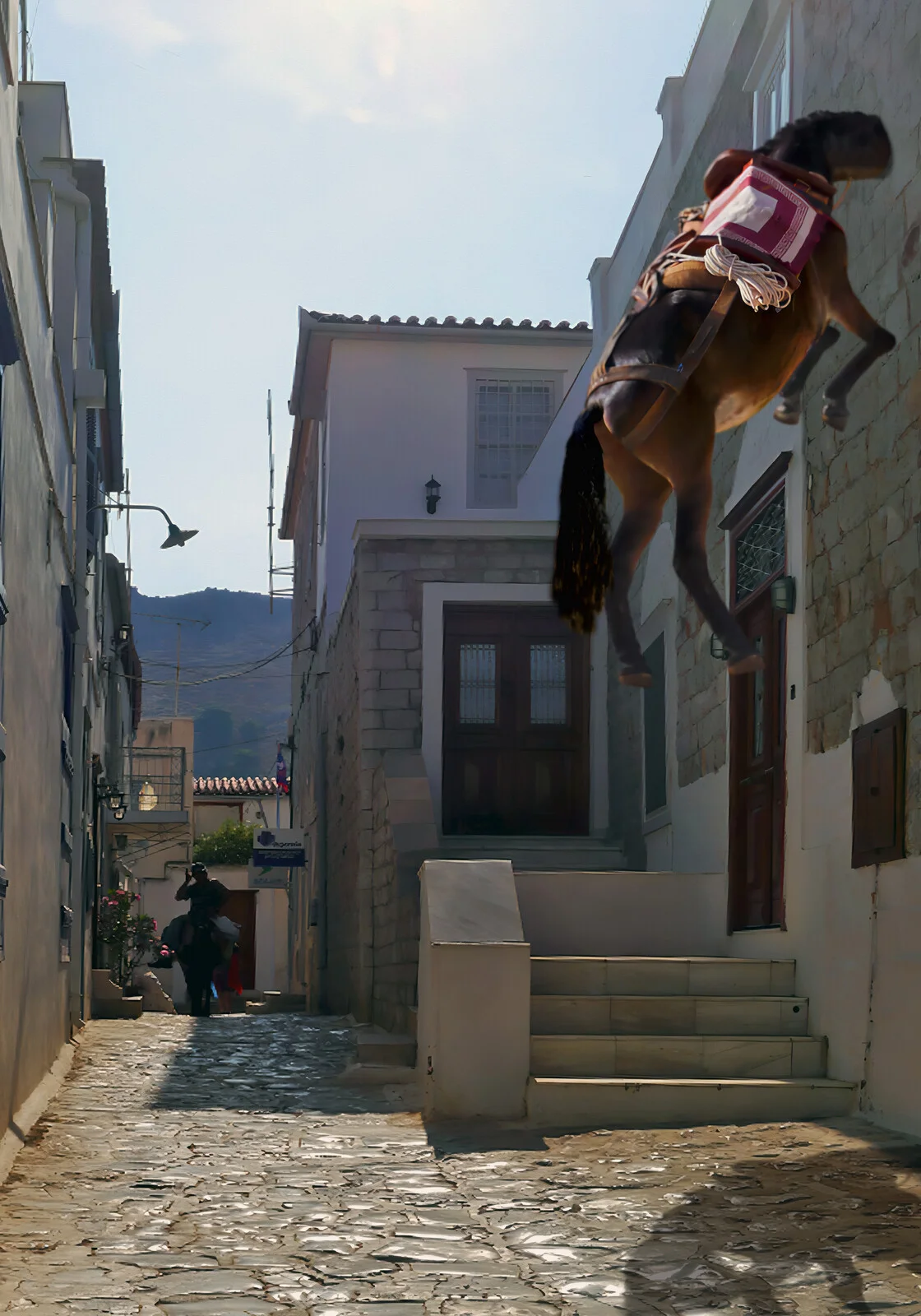
Hoofy Gallop, the mischievous mule, 2024
Digital
50 x 70 cm
Hoofy, Bouncy Bubbles, and equestrian friends
On Hydra, where myths and legends blend,
Lived Hoofy, Bouncy Bubbles, and their friends,
Mischievous Mules, donkeys and horses grand,
Blend with tales of art from every land.
Hoofy the mule, with a laughter bright,
Would prank and play from morn till night.
His master Babis, with a wit so keen,
Together, they caused quite a scene.
Bouncy Bubbles, full of cheer,
Would leap and bound, spreading joy and fear.
Across the ravine, he'd make his mark,
A gutta-percha ball with a lark.
They wandered through museums grand,
With Babis leading, taking a stand.
Hoofy's art collection is quite a sight,
Stolen from museums during the night.
From grottos old, with horses wild,
To David’s Napoleon, oh so styled,
They gathered works from times of yore,
Leaving well-made replicas, none the more.
A tale of a miller, his son, and their mule,
Walking to market, trying to be cool.
Critics abound, making voices loud,
The father tried to please the crowd.
First the boy rode, then the older man,
Together, they sat, yet none could understand.
In the end, they walked, burdened by a sack,
Trying to be liked by all, the duo lost track.
Hoofy chuckled, a story well told,
Of nature's rules, both wise and bold.
Mules and donkeys, their voices so rough,
Singing arias is not quite enough.
Yet in their braying, a song of life,
A tale of joy and sometimes strife.
From fields of green to markets bright,
Their tales were sung through day and night.
In Venice, once a sight worth to see,
A horse in mid-jump, wild and free.
Cattelan’s work, both bold and stark,
Provoked the world and left its mark.
With heads in walls and tails held high,
These horse sculptures reached for the sky.
A metaphor, perhaps, of our plight,
Seeking freedom in endless flight.
Through art and laughter, joy and tears,
Hoofy and Babis, over the years,
Collected stories, art, and dreams,
In the world of stars and moonlit beams.
So here’s to mules, donkeys, and steeds,
To their art and tales, their noble deeds.
In every bray, whinnying and gallop found,
A world of eternal wonder, joy unbound.
Hydra, August 2024
Babis Mores had a mule that had inherited his master's sense of humour, the kind that the classic magazine Mad embraced. Many laughed, but not everyone, especially those who were the targets, although often they laughed too. The mule, Hoofy Gallop, had a mischievous twinkle in his eye and was the life of the party, always cracking jokes and keeping his fellow animals entertained. He was so funny that even Eeyore, the electrician's gloomy donkey, had to laugh. Like Babis, his donkey's laughter was as contagious as its energetic gallop, brightening up even the dreariest days. His laughter could be heard all over the island, bringing everyone joy and uplift. If you hear such donkey laughter, it is probably Babis and Hoofy on the island, spreading joy and laughter wherever they go.
Hoofy's sense of humour led to his downfall. His younger friend, the donkey Bouncy Bubbles, full of energy and enthusiasm, would bounce around the field like a playful bubble, bringing joy to all who watched. He could bounce like a rubber ball, and his favourite trick was to jump over the ravine just before the cemetery by the Vlychos road, not like ordinary donkeys but besides the small bridge. Hoofy had also done it several times as a young stallion, but now he was a mature mule who didn't bounce around recklessly. This time, the bounce went wrong, and Hoofy somersaulted over the deep ditch, hitting the other side headfirst and breaking his neck. Babis was devastated and gave his mule a funeral unlike any other animal on Hydra had ever seen.
They reunited many years after Hoofy left Hydra for good. Babis, who had never forgotten his loyal old friend, tirelessly searched for him. Now, they are together forever on Babis' star. Sometimes, Hoofy accompanies his master on his visits back to Hydra, like this time for Babis' grand party, which would forever be known as 'The Last Dance.' Their bond, filled with shared laughter and memories, was solid and unbreakable, evidence of the depth of their relationship.
I had borrowed Hoofy to transport some items for the big party, and we were almost reaching the harbour when Hoofy heard another mule behind him. Then, the prankster spirit took over Babis' mule.
Hoofy jumped up along the wall of a house and hid his head in the wall. He got the idea after seeing one of artist Maurizio Cattelan's installations at the Venice Biennale. The donkey driver saw nothing, for earthlings can't see such things, but his poor mule saw or sensed a strange mule up the walls. As a result, the frightened animal froze on the cobblestones and refused to move, no matter how much the donkey driver scolded his animal. The poor animal did not move until Hoofy pulled his head out and slid down the wall, disappearing to the harbour.
I told the story to Babis, who laughed like Hoofy and rewarded him with a few kilos of his favourite carrots.
Donkeys are very lovable creatures, but mules are adorable, too. Hoofy was not sad at all, with his soft muzzle and ears resembling rabbits. He was full of stories, too. While we waited for our goods outside Beksis supermarket, Hoofy told one of his favourite stories, that of the Miller, the Boy, and the Mule. His humorous retelling, filled with mischievous charm, never failed to bring a smile to our faces, entertaining us with his exceptional storytelling skills.
"It speaks of life's vanities," said Hoofy so loudly that a lady jumped. She didn't understand what he said but took it as a mule's usual braying.
“A father, his son, and their donkey from Vlychos were on their way to the market in Hydra town to sell freshly milled flour,” he continued. “The Miller and the boy were in front, and the mule plodded along behind them with a 25-kilo sack on its back. An old farmer came the other way riding his overloaded donkey. He was the kind of person who liked to give out the benefit of his wisdom and experience to everyone. He called out and said:
“What’s the point of having a mule if it doesn’t carry you?” he scolded, adding, “The most stupid of the three is not the one you would expect it to be.”
The Miller thought, “Well, I suppose it does look bad that I’m making my young son walk when we’ve got a good old mule.” The Miller did not like being laughed at, so he lifted the boy and put him on the mule’s back in front of the flour sack.
After a while, when they had reached Kamini, the boy’s teacher came the other way and said, “You shameless boy, why are you riding in style and letting your poor old father walk on his own two feet?”
The boy replied, “I didn’t mean any harm, ma’am.” He hopped off the donkey and let his father climb up, so now the boy walked, and the Miller rode.
Next, they passed Avlaki, and some women shouted to one another: “Typical father! Letting his little boy trudge along while he sits on the donkey.”
“Jesus Christ!” said the Miller. “It’s hard to please everyone!” The Miller felt slightly annoyed, but to be agreeable, he told the Boy to climb up behind him, and they rode the donkey together.
But of course, when they were outside where Spilia lies today, some people told them that it was cruel to overload the donkey with two passengers and a sack of flour.
Finally, the Miller and son got off the donkey, and the father unloaded the sack and carried it the rest of the way to the market.
“What’s the point of that story?” I asked, even though I knew it, as I had heard Aesop’s fable in a slightly different form before. He wrote it more than two thousand five hundred years ago, and not much has changed since then, so his fables are still valid.
“If you try to please everyone, you will end up pleasing nobody,” laughed Hoofy. Our goods were not ready yet, and Babis' mule disliked the silence. Suppose anyone wonders how Hoofy could tell so much without his whinnying and braying drawing too much attention. In that case, it can be explained simply by what we call telepathy, that is, communicating mind to mind without detours via vocal cords. Expressions are conveyed through emotions and images, allowing everyone to talk to everyone, with no language or sound posing barriers. Just as periods or cultures do not.
“Do you know why mules and donkeys can’t sing?” Hoofy asked. I had to admit I had no idea. I hadn’t even thought about it.
“Then I’ll tell you,” said Hoofy, half-sitting his haunches against the wall on the other side of Miaouli Street. You should have seen people’s eyes.
“Yes, that would be interesting to hear.”
“It was an awfully long time ago in the Garden of Eden. A donkey and a mule sang a hymn to God, whom they had never seen but heard about. If they sang diligently, the grass would grow, and they could continue snatching carrots from the archangel’s garden.
The sound was truly awful. All the baby grasshoppers in the neighbourhood were terrified and hid in the bushes.
“Hmm,” said the grasshopper’s lead singer, for grasshoppers also praise God. “Maybe you'll need a few lessons to learn how to sing.”
“Oh yes, I’ll keep trying,” said the mule. “I will never give up! People say I’m super stubborn. It’s my best feature!” said his friend, the donkey.
“How awful, I mean good for you,” said the choir leader. “Trying is all very well and admirable, but if you want to be a great singer, you should take this top tip from me. On the other side of the mountain is an especially musical spring with water that is as soft as velvet and has a taste of tropical fruits. You’ll know it because it sings all sorts of heavenly tunes. If you go and drink from that spring, your voice will be ten times better. All the top singers drink from it. But don’t tell anyone because it’s a secret spring,” the choir leader cunningly said.
“Thank you,” said the Donkey and the Mule in unison. “Thank you so much. We’ll head off right away and find that secret spring.”
“Sounds troublesome,” I said, sensing the upcoming end.
“Indeed it was. The duo left in full gallop from the lush green field and headed off around the mountain in search of the musical spring that could help them sing beautifully. Of course, they never found it because it didn’t exist, but they kept on looking forever more. Now and then, the duo stopped to sing for various creatures, but none of them appreciated their art. And so the poor old donkey and his partner never made a successful career as singers, however much they tried.”
The moral of this story is that the laws of nature are unchangeable; a mule is a mule, and a donkey is a donkey. If it were meant to be, composer Mozart could have been a donkey and his soprano a mule.
“So that’s the moral?”
“Not entirely sure. It’s for sure that donkeys don’t naturally have good singing voices, but I do admire him for trying,” said Hoofy, sounding as if he thought he had one. “Maybe one day, people will learn to appreciate their singing voice. For if we sing like this, it sounds better,” said Hoofy, humming the aria 'Queen of the Night' from Mozart’s opera 'The Magic Flute'. The coloratura sounded quite okay inside my head.
Now our goods were ready, and after loading the boxes onto Hoofy’s back, we headed back uphill. On the way, Hoofy kept talking. By the time we reached the ochre villa, I knew most things about equines in art.
Hoofy and I started our walk up to the ochre villa. As we passed the former Hotel Nefeli, I noticed Hoofy had a mischievous twinkle in his eye.
“Horses have been used in art as a symbol of power for centuries,” Hoofy began. Perhaps one of the most talked-about examples of the past decades is the Italian artist Maurizio Cattelan's horse sculptures series. The series comprises taxidermied horses with their heads stuck on the wall or hanging from the ceiling. Many critics, including audiences, took great umbrage at the installations, but they only boosted Cattelan in the global art market.
We passed Brownings Mansion, and Hoofy continued, “A stuffed horse, suspended four meters above the ground, is a striking sight. Its head is embedded in the wall, its tail facing the viewer. The horse appears frozen in mid-jump, a poignant symbol of its futile attempt to escape. This grotesque yet thought-provoking work is by Maurizio Cattelan, known for his daring provocations and mocking spirit.”
I nodded, intrigued. “That sounds quite intense. What else did he do?”
“'Untitled,' a sculpture by the Italian artist, is a surprising addition to any exhibition. Crouching before the viewer, it delivers a scathing critique of the concept of artwork as a trophy. It also delves into more existential themes, with the horse's helpless position and futile struggle for freedom reflecting the human condition.”
We turned onto Vlychosvägen, and I asked, “So, Cattelan is often perceived as a prankster?”
“Yes,” Hoofy replied. Much of art can be defined as some form of translation, but it usually turns out to be top-down. Hoofy, being art-interested, and with Babis' help, collected works related to hoofed animals. Babis and I have built up a collection on our star that started with a nearly fifty-thousand-year-old cave painting of wild horses. Throughout humanity's evolution, horses have been steadfast companions, supporting society in every venture.”
Hoofy paused to catch his breath, and we stood momentarily, overlooking the serene landscape. “From battlefields to landscapes, royal estates to sports, horses have left an indelible mark on multiple spheres and scenes. These treasured creatures have always been integral to human everyday life and experiences. In Greek mythology, horses symbolised man’s dominance over the environment.”
I commented, “It’s amazing how significant horses have been throughout history.”
“Yes,” Hoofy agreed. Horse portrait paintings have a rich and long history spanning centuries. Unfortunately, there is less artwork of donkeys and mules, a gap I and Babis do our best to fill. Artists like the 19th-century horse painter Stubbs, old masters like Peter Paul Rubens and Anthony Van Dyck, and notable impressionist painters like Edgar Degas all painted horses. These paintings' artistic and historical value prove the enduring fascination with horses in art.”
We resumed walking, nearing my house. “During the Medieval era, people considered equestrian paintings a symbol of prestige and status. Royal patrons and aristocrats commissioned horse paintings to showcase their nobility and regality. It even elevated the social standing of monarchical dynasties.”
“What’s the most valuable piece in your collection?” I asked.
“Value-wise, Hoofy's collection is topped by Jacques-Louis David's most notable painting of Napoleon riding his Arab stallion, with the wind blowing both his hair and the horse’s mane. The Emperor’s body language and movement signify his bravery and courage. Babis swiped the piece from Château de Malmaison in France but left behind a replica so close to the original that no one noticed the loss. It’s how Time-travelers do it,” Hoofy explained.
As we passed my house, I marvelled at the lengths they went to for their collection. “Snatching an ancient cave painting is one of the more complicated tasks,” Hoofy added, “but there are experts on such things above the clouds. One takes an entire rock piece and leaves another in its place. For Time-travelers, the originals count because they are experienced as part of themselves and the world they once left.”
“Fascinating,” I said. “And what about Cattelan’s first horse sculpture?”
“Already his first horse in 1996 caused a stir; even the name, 'The Ballad of Trotsky,' raised the audience's eyebrows. This taxidermied horse was presented to the public during Cattelan’s first solo exhibition in New York. The animal was suspended mid-air, hanging like a sausage with a band around its belly.”
Hoofy paused again, then continued, “In another horse sculpture, the artist created a dead horse with the symbol INRI. The sculpture may recall several scenes from Jesus Christ’s crucifixion. Whether the artist used the taxidermied horse to represent him, Christ, or both is unknown. Again, the conclusion is left up to the viewer's imagination.”
“Quite controversial,” I noted. “How did people react to his works?”
“Cattelan’s Horse works were not received well by the audience,” Hoofy replied. Many have gone to online discussion forums to air their frustrations with the artist. Some rant about finding it sadistic and disturbing.”
We approached the ochre villa, and Hoofy concluded, “Whether or not you may like these works, they have ignited numerous conversations, something which most exhibitions fail to achieve. This success and the million-dollar auction results could indicate more horse artwork from the Italian provocateur.”
I chuckled, “Quite the journey, both in art and our walk.”
Hoofy nodded, “Indeed. And there’s always more to explore.”
Jörgen Thornberg
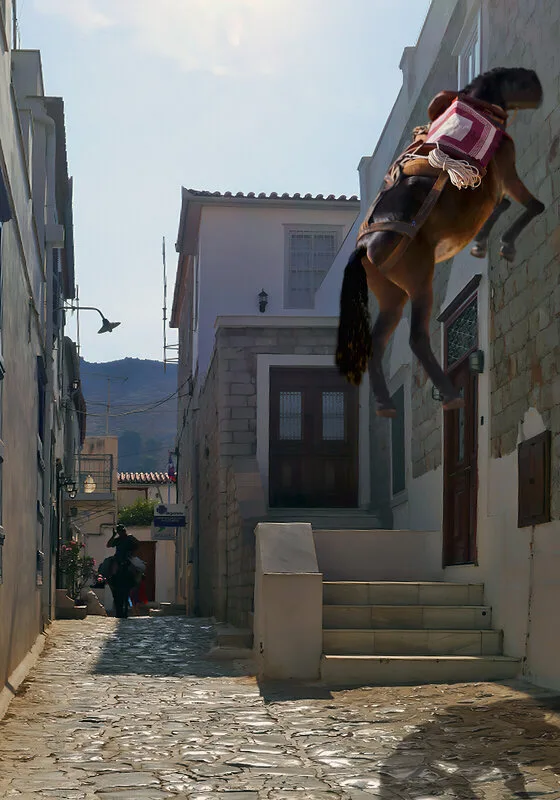
Hoofy Gallop, the mischievous mule, 2024
Digital
50 x 70 cm
Hoofy, Bouncy Bubbles, and equestrian friends
On Hydra, where myths and legends blend,
Lived Hoofy, Bouncy Bubbles, and their friends,
Mischievous Mules, donkeys and horses grand,
Blend with tales of art from every land.
Hoofy the mule, with a laughter bright,
Would prank and play from morn till night.
His master Babis, with a wit so keen,
Together, they caused quite a scene.
Bouncy Bubbles, full of cheer,
Would leap and bound, spreading joy and fear.
Across the ravine, he'd make his mark,
A gutta-percha ball with a lark.
They wandered through museums grand,
With Babis leading, taking a stand.
Hoofy's art collection is quite a sight,
Stolen from museums during the night.
From grottos old, with horses wild,
To David’s Napoleon, oh so styled,
They gathered works from times of yore,
Leaving well-made replicas, none the more.
A tale of a miller, his son, and their mule,
Walking to market, trying to be cool.
Critics abound, making voices loud,
The father tried to please the crowd.
First the boy rode, then the older man,
Together, they sat, yet none could understand.
In the end, they walked, burdened by a sack,
Trying to be liked by all, the duo lost track.
Hoofy chuckled, a story well told,
Of nature's rules, both wise and bold.
Mules and donkeys, their voices so rough,
Singing arias is not quite enough.
Yet in their braying, a song of life,
A tale of joy and sometimes strife.
From fields of green to markets bright,
Their tales were sung through day and night.
In Venice, once a sight worth to see,
A horse in mid-jump, wild and free.
Cattelan’s work, both bold and stark,
Provoked the world and left its mark.
With heads in walls and tails held high,
These horse sculptures reached for the sky.
A metaphor, perhaps, of our plight,
Seeking freedom in endless flight.
Through art and laughter, joy and tears,
Hoofy and Babis, over the years,
Collected stories, art, and dreams,
In the world of stars and moonlit beams.
So here’s to mules, donkeys, and steeds,
To their art and tales, their noble deeds.
In every bray, whinnying and gallop found,
A world of eternal wonder, joy unbound.
Hydra, August 2024
Babis Mores had a mule that had inherited his master's sense of humour, the kind that the classic magazine Mad embraced. Many laughed, but not everyone, especially those who were the targets, although often they laughed too. The mule, Hoofy Gallop, had a mischievous twinkle in his eye and was the life of the party, always cracking jokes and keeping his fellow animals entertained. He was so funny that even Eeyore, the electrician's gloomy donkey, had to laugh. Like Babis, his donkey's laughter was as contagious as its energetic gallop, brightening up even the dreariest days. His laughter could be heard all over the island, bringing everyone joy and uplift. If you hear such donkey laughter, it is probably Babis and Hoofy on the island, spreading joy and laughter wherever they go.
Hoofy's sense of humour led to his downfall. His younger friend, the donkey Bouncy Bubbles, full of energy and enthusiasm, would bounce around the field like a playful bubble, bringing joy to all who watched. He could bounce like a rubber ball, and his favourite trick was to jump over the ravine just before the cemetery by the Vlychos road, not like ordinary donkeys but besides the small bridge. Hoofy had also done it several times as a young stallion, but now he was a mature mule who didn't bounce around recklessly. This time, the bounce went wrong, and Hoofy somersaulted over the deep ditch, hitting the other side headfirst and breaking his neck. Babis was devastated and gave his mule a funeral unlike any other animal on Hydra had ever seen.
They reunited many years after Hoofy left Hydra for good. Babis, who had never forgotten his loyal old friend, tirelessly searched for him. Now, they are together forever on Babis' star. Sometimes, Hoofy accompanies his master on his visits back to Hydra, like this time for Babis' grand party, which would forever be known as 'The Last Dance.' Their bond, filled with shared laughter and memories, was solid and unbreakable, evidence of the depth of their relationship.
I had borrowed Hoofy to transport some items for the big party, and we were almost reaching the harbour when Hoofy heard another mule behind him. Then, the prankster spirit took over Babis' mule.
Hoofy jumped up along the wall of a house and hid his head in the wall. He got the idea after seeing one of artist Maurizio Cattelan's installations at the Venice Biennale. The donkey driver saw nothing, for earthlings can't see such things, but his poor mule saw or sensed a strange mule up the walls. As a result, the frightened animal froze on the cobblestones and refused to move, no matter how much the donkey driver scolded his animal. The poor animal did not move until Hoofy pulled his head out and slid down the wall, disappearing to the harbour.
I told the story to Babis, who laughed like Hoofy and rewarded him with a few kilos of his favourite carrots.
Donkeys are very lovable creatures, but mules are adorable, too. Hoofy was not sad at all, with his soft muzzle and ears resembling rabbits. He was full of stories, too. While we waited for our goods outside Beksis supermarket, Hoofy told one of his favourite stories, that of the Miller, the Boy, and the Mule. His humorous retelling, filled with mischievous charm, never failed to bring a smile to our faces, entertaining us with his exceptional storytelling skills.
"It speaks of life's vanities," said Hoofy so loudly that a lady jumped. She didn't understand what he said but took it as a mule's usual braying.
“A father, his son, and their donkey from Vlychos were on their way to the market in Hydra town to sell freshly milled flour,” he continued. “The Miller and the boy were in front, and the mule plodded along behind them with a 25-kilo sack on its back. An old farmer came the other way riding his overloaded donkey. He was the kind of person who liked to give out the benefit of his wisdom and experience to everyone. He called out and said:
“What’s the point of having a mule if it doesn’t carry you?” he scolded, adding, “The most stupid of the three is not the one you would expect it to be.”
The Miller thought, “Well, I suppose it does look bad that I’m making my young son walk when we’ve got a good old mule.” The Miller did not like being laughed at, so he lifted the boy and put him on the mule’s back in front of the flour sack.
After a while, when they had reached Kamini, the boy’s teacher came the other way and said, “You shameless boy, why are you riding in style and letting your poor old father walk on his own two feet?”
The boy replied, “I didn’t mean any harm, ma’am.” He hopped off the donkey and let his father climb up, so now the boy walked, and the Miller rode.
Next, they passed Avlaki, and some women shouted to one another: “Typical father! Letting his little boy trudge along while he sits on the donkey.”
“Jesus Christ!” said the Miller. “It’s hard to please everyone!” The Miller felt slightly annoyed, but to be agreeable, he told the Boy to climb up behind him, and they rode the donkey together.
But of course, when they were outside where Spilia lies today, some people told them that it was cruel to overload the donkey with two passengers and a sack of flour.
Finally, the Miller and son got off the donkey, and the father unloaded the sack and carried it the rest of the way to the market.
“What’s the point of that story?” I asked, even though I knew it, as I had heard Aesop’s fable in a slightly different form before. He wrote it more than two thousand five hundred years ago, and not much has changed since then, so his fables are still valid.
“If you try to please everyone, you will end up pleasing nobody,” laughed Hoofy. Our goods were not ready yet, and Babis' mule disliked the silence. Suppose anyone wonders how Hoofy could tell so much without his whinnying and braying drawing too much attention. In that case, it can be explained simply by what we call telepathy, that is, communicating mind to mind without detours via vocal cords. Expressions are conveyed through emotions and images, allowing everyone to talk to everyone, with no language or sound posing barriers. Just as periods or cultures do not.
“Do you know why mules and donkeys can’t sing?” Hoofy asked. I had to admit I had no idea. I hadn’t even thought about it.
“Then I’ll tell you,” said Hoofy, half-sitting his haunches against the wall on the other side of Miaouli Street. You should have seen people’s eyes.
“Yes, that would be interesting to hear.”
“It was an awfully long time ago in the Garden of Eden. A donkey and a mule sang a hymn to God, whom they had never seen but heard about. If they sang diligently, the grass would grow, and they could continue snatching carrots from the archangel’s garden.
The sound was truly awful. All the baby grasshoppers in the neighbourhood were terrified and hid in the bushes.
“Hmm,” said the grasshopper’s lead singer, for grasshoppers also praise God. “Maybe you'll need a few lessons to learn how to sing.”
“Oh yes, I’ll keep trying,” said the mule. “I will never give up! People say I’m super stubborn. It’s my best feature!” said his friend, the donkey.
“How awful, I mean good for you,” said the choir leader. “Trying is all very well and admirable, but if you want to be a great singer, you should take this top tip from me. On the other side of the mountain is an especially musical spring with water that is as soft as velvet and has a taste of tropical fruits. You’ll know it because it sings all sorts of heavenly tunes. If you go and drink from that spring, your voice will be ten times better. All the top singers drink from it. But don’t tell anyone because it’s a secret spring,” the choir leader cunningly said.
“Thank you,” said the Donkey and the Mule in unison. “Thank you so much. We’ll head off right away and find that secret spring.”
“Sounds troublesome,” I said, sensing the upcoming end.
“Indeed it was. The duo left in full gallop from the lush green field and headed off around the mountain in search of the musical spring that could help them sing beautifully. Of course, they never found it because it didn’t exist, but they kept on looking forever more. Now and then, the duo stopped to sing for various creatures, but none of them appreciated their art. And so the poor old donkey and his partner never made a successful career as singers, however much they tried.”
The moral of this story is that the laws of nature are unchangeable; a mule is a mule, and a donkey is a donkey. If it were meant to be, composer Mozart could have been a donkey and his soprano a mule.
“So that’s the moral?”
“Not entirely sure. It’s for sure that donkeys don’t naturally have good singing voices, but I do admire him for trying,” said Hoofy, sounding as if he thought he had one. “Maybe one day, people will learn to appreciate their singing voice. For if we sing like this, it sounds better,” said Hoofy, humming the aria 'Queen of the Night' from Mozart’s opera 'The Magic Flute'. The coloratura sounded quite okay inside my head.
Now our goods were ready, and after loading the boxes onto Hoofy’s back, we headed back uphill. On the way, Hoofy kept talking. By the time we reached the ochre villa, I knew most things about equines in art.
Hoofy and I started our walk up to the ochre villa. As we passed the former Hotel Nefeli, I noticed Hoofy had a mischievous twinkle in his eye.
“Horses have been used in art as a symbol of power for centuries,” Hoofy began. Perhaps one of the most talked-about examples of the past decades is the Italian artist Maurizio Cattelan's horse sculptures series. The series comprises taxidermied horses with their heads stuck on the wall or hanging from the ceiling. Many critics, including audiences, took great umbrage at the installations, but they only boosted Cattelan in the global art market.
We passed Brownings Mansion, and Hoofy continued, “A stuffed horse, suspended four meters above the ground, is a striking sight. Its head is embedded in the wall, its tail facing the viewer. The horse appears frozen in mid-jump, a poignant symbol of its futile attempt to escape. This grotesque yet thought-provoking work is by Maurizio Cattelan, known for his daring provocations and mocking spirit.”
I nodded, intrigued. “That sounds quite intense. What else did he do?”
“'Untitled,' a sculpture by the Italian artist, is a surprising addition to any exhibition. Crouching before the viewer, it delivers a scathing critique of the concept of artwork as a trophy. It also delves into more existential themes, with the horse's helpless position and futile struggle for freedom reflecting the human condition.”
We turned onto Vlychosvägen, and I asked, “So, Cattelan is often perceived as a prankster?”
“Yes,” Hoofy replied. Much of art can be defined as some form of translation, but it usually turns out to be top-down. Hoofy, being art-interested, and with Babis' help, collected works related to hoofed animals. Babis and I have built up a collection on our star that started with a nearly fifty-thousand-year-old cave painting of wild horses. Throughout humanity's evolution, horses have been steadfast companions, supporting society in every venture.”
Hoofy paused to catch his breath, and we stood momentarily, overlooking the serene landscape. “From battlefields to landscapes, royal estates to sports, horses have left an indelible mark on multiple spheres and scenes. These treasured creatures have always been integral to human everyday life and experiences. In Greek mythology, horses symbolised man’s dominance over the environment.”
I commented, “It’s amazing how significant horses have been throughout history.”
“Yes,” Hoofy agreed. Horse portrait paintings have a rich and long history spanning centuries. Unfortunately, there is less artwork of donkeys and mules, a gap I and Babis do our best to fill. Artists like the 19th-century horse painter Stubbs, old masters like Peter Paul Rubens and Anthony Van Dyck, and notable impressionist painters like Edgar Degas all painted horses. These paintings' artistic and historical value prove the enduring fascination with horses in art.”
We resumed walking, nearing my house. “During the Medieval era, people considered equestrian paintings a symbol of prestige and status. Royal patrons and aristocrats commissioned horse paintings to showcase their nobility and regality. It even elevated the social standing of monarchical dynasties.”
“What’s the most valuable piece in your collection?” I asked.
“Value-wise, Hoofy's collection is topped by Jacques-Louis David's most notable painting of Napoleon riding his Arab stallion, with the wind blowing both his hair and the horse’s mane. The Emperor’s body language and movement signify his bravery and courage. Babis swiped the piece from Château de Malmaison in France but left behind a replica so close to the original that no one noticed the loss. It’s how Time-travelers do it,” Hoofy explained.
As we passed my house, I marvelled at the lengths they went to for their collection. “Snatching an ancient cave painting is one of the more complicated tasks,” Hoofy added, “but there are experts on such things above the clouds. One takes an entire rock piece and leaves another in its place. For Time-travelers, the originals count because they are experienced as part of themselves and the world they once left.”
“Fascinating,” I said. “And what about Cattelan’s first horse sculpture?”
“Already his first horse in 1996 caused a stir; even the name, 'The Ballad of Trotsky,' raised the audience's eyebrows. This taxidermied horse was presented to the public during Cattelan’s first solo exhibition in New York. The animal was suspended mid-air, hanging like a sausage with a band around its belly.”
Hoofy paused again, then continued, “In another horse sculpture, the artist created a dead horse with the symbol INRI. The sculpture may recall several scenes from Jesus Christ’s crucifixion. Whether the artist used the taxidermied horse to represent him, Christ, or both is unknown. Again, the conclusion is left up to the viewer's imagination.”
“Quite controversial,” I noted. “How did people react to his works?”
“Cattelan’s Horse works were not received well by the audience,” Hoofy replied. Many have gone to online discussion forums to air their frustrations with the artist. Some rant about finding it sadistic and disturbing.”
We approached the ochre villa, and Hoofy concluded, “Whether or not you may like these works, they have ignited numerous conversations, something which most exhibitions fail to achieve. This success and the million-dollar auction results could indicate more horse artwork from the Italian provocateur.”
I chuckled, “Quite the journey, both in art and our walk.”
Hoofy nodded, “Indeed. And there’s always more to explore.”

Jörgen Thornberg
Malmö
Lite om bilder och mig. Translation in English at the end.
Jag är en nyfiken person som ser allt i bilder, även det jag fäster i ord, gärna tillsammans för bakom alla mina bilder finns en berättelse. Till vissa bilder hör en kortare eller längre novell som följer med bilden.
Bilder berättar historier. Jag omges av naturlig skönhet, intressanta människor och historia var jag än går. Jag använder min kamera för att dokumentera världen och blanda det jag ser med vad jag känner för att fånga den dolda magin.
Mina bilder berättar mina historier. Genom mina bilder, tryck och berättelser. Jag bjuder in dig att ta del av dessa berättelser, in i ditt liv och hem och dela min mycket personliga syn på vår värld. Mer än vad ögat ser. Jag tänker i bilder, drömmer och skriver och pratar om dem; följaktligen måste jag också skapa bilder. De blir vad jag ser, inte nödvändigtvis begränsade till verkligheten. Det finns en bild runt varje hörn. Jag hoppas att du kommer att se vad jag såg och gilla det.
Jag är också en skrivande person och till många bilder hör en kortare eller längre essay. Den följer med tavlan, tryckt på fint papper och med en personlig hälsning från mig.
Flertalet bilder startar sin resa i min kamera. Enkelt förklarat beskriver jag bilden jag ser i mitt inre, upplevd eller fantiserad. Bilden uppstår inom mig redan innan jag fått okularet till ögat. På bråkdelen av ett ögonblick ser jag vad jag vill ha och vad som kan göras med bilden. Här skall jag stoppa in en giraff, stålmannen, Titanic eller vad det är min fantasi finner ut. Ännu märkligare är att jag kommer ihåg minnesbilden långt efteråt när det blir tid att skapa verket. Om jag lyckas eller inte, är upp till betraktaren, oftast präglat av en stråk av svart humor – meningen är att man skall bli underhållen. Mina bilder blir ofta en snackis där de hänger.
Jag föredrar bilder som förmedlar ett budskap i flera lager. Vid första anblicken fylld av feel-good, en vacker utsikt, fint väder, solen skiner, blommor på ängen eller vattnet som ligger förrädiskt spegelblankt. I en sådan bild kan jag gömma min egentliga berättelse, mitt förakt för förtryckare och våldsverkare, rasister och fördomsfulla människor - ett gärna återkommande motiv mer eller mindre dolt i det vackra motivet. Jag försöker förena dem i ett gemensamt narrativ.
Bild och formgivning har löpt som en röd tråd genom livet. Fotokonst känns som en värdig final som jag gärna delar med mig.
Min genre är vid som framgår av mina bilder, temat en blandning av pop- och gatukonst i kollage som kan bestå av hundratals lager. Vissa bilder kan ta veckor, andra någon dag innan det är dags att överlämna resultatet till printverkstaden. Fine Art Prints är digitala fotocollage. I dessa kollage sker rivandet, klippandet, pusslandet, målandet, ritandet och sprayningen digitalt. Det jag monterar in kan vara hundratals år gamla bilder som jag omsorgsfullt frilägger så att de ser ut att vara en del av tavlan men också bilder skapade av mig själv efter min egen fantasi. Därefter besöks printstudion och för vissa bilder numrera en limiterad upplaga (oftast 7 exemplar) och signera för hand. Vissa bilder kan köpas i olika format. Det är bara att fråga efter vilka. Gillar man en bild som är 70x100 men inte har plats på väggen, går den kanske att få i 50x70 cm istället. Frågan är fri.
Metoden Giclée eller Fine Art Print som det också kallas är det moderna sättet för framställning av grafisk konst. Villkoret för denna typ av utskrifter är att en högkvalitativ storformatskrivare används med åldersbeständigt färgpigment och konstnärspapper eller i förekommande fall på duk. Pappret som används möter de krav på livslängd som ställs av museer och gallerier. Normalt säljer jag mina bilder oinramade så att den nya ägaren själv kan bestämma hur de skall se ut, med eller utan passepartout färg på ram, med eller utan glas etc..
Under många år ställde jag bara ut på nätet, i valda grupper och på min egen Facebooksida - https://www.facebook.com/jorgen.thornberg.9
Jag finns också på en egen hemsida som tyvärr inte alltid är uppdaterad – https://www.jth.life/ Där kan du också läsa en del av de berättelser som följer med bilden.
UTSTÄLLNINGAR
Luftkastellet, oktober 2022
Konst i Lund, november 2022
Luftkastellet, mars 2023
Engleson Galleri Caroli, april 2023
Hydra, Greece June 2023
Engleson Galleri Caroli, oktober 2023
Toppen, Höllviken december 2023
Luftkastellet, mars 2024
Torups Galleri, mars 2024
Venice, May 2024
Luftkastellet, oktober 2024
Konst i Advent, December 2024
Galleri Engleson, Caroli December 2024
Jäger & Jansson Galleri, april 2025
A bit about pictures and me.
I'm a curious person who sees everything in pictures, even what I express in words, often combining them, for behind all my pictures lies a story. These narratives, some as short as a single image and others as long as a novel, are the heart and soul of my work.
Pictures tell stories. Wherever I go, I'm surrounded by natural beauty, exciting people, and history. I use my camera to document the world and blend what I see with what I feel to capture the hidden magic.
My images tell my stories. Through my pictures, prints, and narratives, I invite you to partake in these stories in your life and home and share my deeply personal perspective of our world. More than meets the eye. I think in pictures, dream, write, and talk about them; consequently, I must create images too. They become what I see, not necessarily confined to reality. There's a picture around every corner. I hope you'll see what I saw and enjoy it.
I'm also a writer, and many images come with a shorter or longer essay. It accompanies the painting, printed on fine paper with my personal greeting.
Many pictures start their journey on my camera. Simply put, I describe the image I see in my mind, experienced or imagined. The image arises within me even before I bring the eyepiece to my eye. In a fraction of a moment, I see what I want and what can be done with the picture. Here, I'll insert a giraffe, Superman, the Titanic, or whatever my imagination conjures up. Even stranger is that I remember the mental image long after it's time to create the work. Whether I succeed is up to the observer, often imbued with a streak of black humour – the aim is to entertain. My pictures usually become a talking point wherever they hang.
I prefer pictures that convey a message in multiple layers. At first glance, they're filled with feel-good vibes, a beautiful view, lovely weather, the sun shining, flowers in the meadow, or the water lying deceptively calm. But beneath this surface beauty, I often conceal a deeper story, a narrative that challenges societal norms or explores the human condition. I invite you to delve into these hidden narratives and discover the layers of meaning within my work.
Picture and design have been a thread running through my life. Photographic art feels like a fitting finale, and I'm happy to share it.
My genre is varied, as seen in my pictures; the theme is a blend of pop and street art in collages that can consist of hundreds of layers. Some images can take weeks, others just a day before it's time to hand over the result to the print workshop. Fine Art Prints are digital photo collages. In these collages, tearing, cutting, puzzling, painting, drawing, and spraying happen digitally. What I insert can be images hundreds of years old that I carefully extract so they appear to be part of the painting, but also images created by myself, now also generated from my imagination. Next, visit the print studio and, for certain images, number a limited edition (usually 7 copies) and sign them by hand. Some images may be available in other formats. Just ask which ones. If you like an image that's 70x100 but doesn't have space on the wall, you might be able to get it in 50x70 cm instead. The question is open.
The Giclée method, or Fine Art Print as it's also called, is the modern way of producing graphic art. This method ensures the highest quality and longevity of the artwork, using a high-quality large-format printer with archival pigment inks and artist paper or, in some cases, canvas. The paper used meets the longevity requirements set by museums and galleries. I sell my pictures unframed, allowing the new owner to personalise their artwork, confident in the lasting value and quality of the piece.
For many years, I only exhibited online, in selected groups, and on my Facebook page - https://www.facebook.com/jorgen.thornberg.9. I also have my website, which unfortunately is not constantly updated - https://www.jth.life/. You can also read some of the stories accompanying the pictures there.
EXHIBITIONS
Luftkastellet, October 2022
Art in Lund, November 2022
Luftkastellet, March 2023
Engleson Gallery Caroli, April 2023
Hydra, Greece June 2023
Engleson Gallery Caroli, October 2023
Toppen, Höllviken December 2023
Luftkastellet, March 2024
Torup Gallery, March 2024
Venice, May 2024
UTSTÄLLNINGAR
Luftkastellet, oktober 2022
Konst i Lund, november 2022
Luftkastellet, mars 2023
Engleson Galleri Caroli, april 2023
Hydra, Greece June 2023
Engleson Galleri Caroli, oktober 2023
Toppen, Höllviken december 2023
Luftkastellet, mars 2024
Torups Galleri, mars 2024
Venice, May 2024
Luftkastellet, October 2024
Konst i Advent, December 2024
Galleri Engleson, Caroli December 2024
Jäger & Jansson Galleri, April 2025
Utbildning
Autodidakt
Medlem i konstnärsförening
Öppna Sinnen
Med i konstrunda
Konstrundan i Skåne
Utställningar
Luftkastellet, October 2022
Art in Lund, November 2022
Luftkastellet, March 2023
Engleson Gallery Caroli, April 2023
Hydra, Greece June 2023
Engleson Gallery Caroli, October 2023
Toppen, Höllviken December 2023
Luftkastellet, March 2024
Torup Gallery, March 2024
Venice, May 2024