Vi använder cookies för att ge dig bästa möjliga upplevelse. Välj vilka cookies du tillåter.
Läs mer i vår integritetspolicy
Jörgen Thornberg
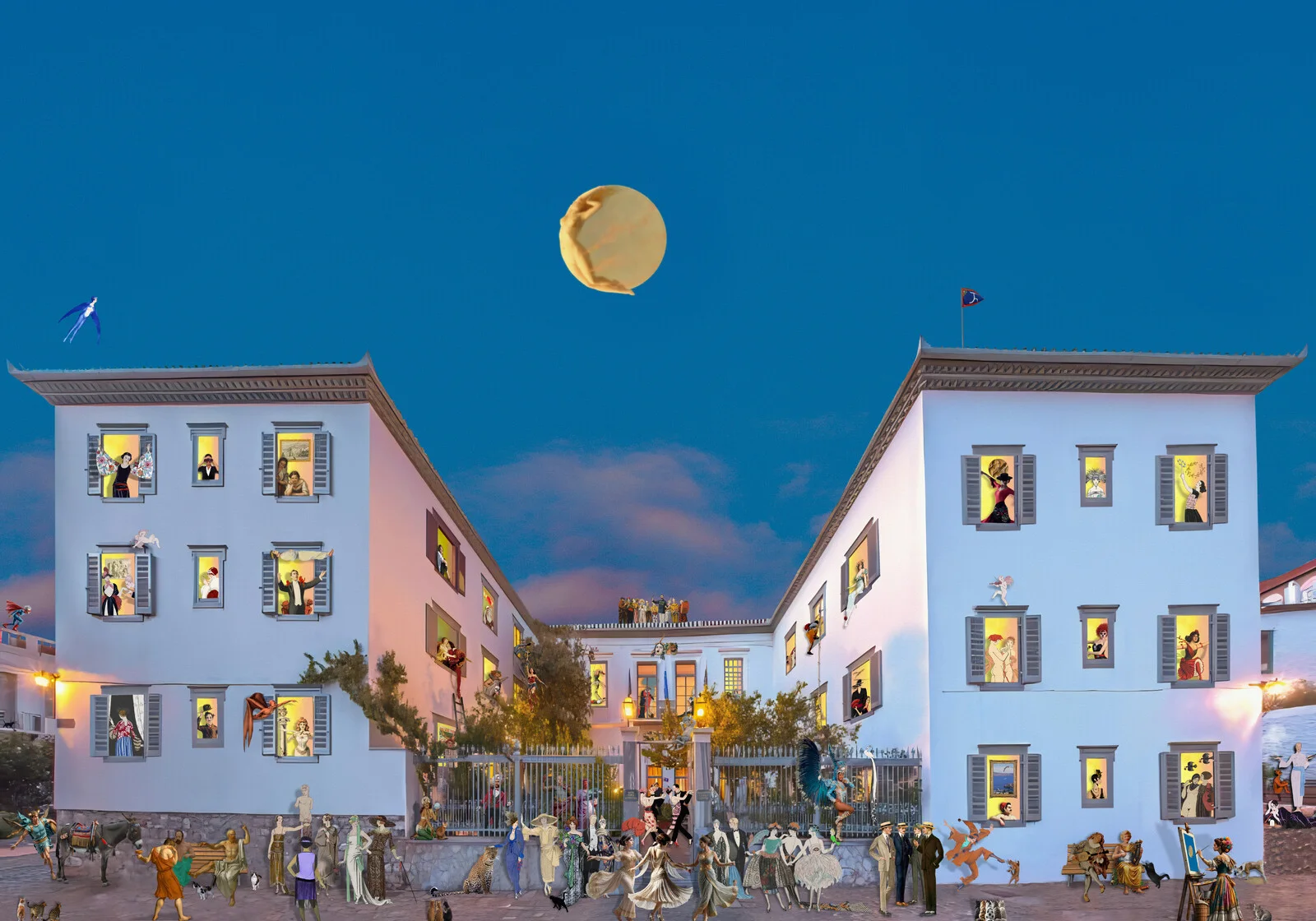
Much Ado About Nothing – The Hydroussa Experience: A Night of Roaring Twenties Glamour on Hydra, 2024
Digital
100 x 70 cm
A Roaring Night at Hydroussa
In the heart of Hydra, under Selene's glow,
Hydroussa Hotel, where legends flow.
A gathering of gods and men, both old and new,
A party so grand, it outshone the view.
Leonard Cohen, with hat in hand,
Waved the Hydra flag across the land.
Marianne beside him, love so true,
Eternal in starlight, their bond anew.
Ghikas, the artist, as Socrates came,
With wisdom and wit, never quite tame.
Beside him sat Nicodemus, the wise old steed,
A donkey of legend, known for his deed.
Through intricate doors and marble grand,
Time-travelers mingled, hand in hand.
Under the moon, in the courtyard fair,
Danced gods and mortals without a care.
Charleston and Foxtrot, the dance of the night,
Lindy Hop, Jitterbug, a glorious sight.
With each step and twirl, the past came alive,
Echoes of jazz in the air did thrive.
Paul Whiteman’s orchestra set the tone,
As Chaplin’s hat, with charm, was shown.
From rooftop circus to swirling courtyard grace,
Each corner of Hydroussa became a dance space.
The true hero of freedom's fight, ahead of his time,
Antonis Oikonomou, with visions so sublime.
By his own kin, in shadows slain, for dreams of liberty,
In heaven's light, his spirit shines, a beacon for the free.
In eternity, Antonis finds his due, a hero's lauded name,
From battles past to festive dance, he garners just acclaim.
To Charleston’s beat, he moves with grace from a different time,
In the spirit of his nation's pride, his steps align in rhyme.
Romeo to Juliet scaled the white wall,
Marilyn’s harp echoed through the ball.
Pan’s donkey, on the second floor,
A magical sight no one could ignore.
Thurston’s devils, in fiery delight,
Thrilled the guests with mystical might.
In windows and nooks, mischief was found,
With laughter and joy, the night did resound.
Magicians and clowns, with tricks up their sleeve,
Kept guests in wonder; no one thought of leave.
Time-travellers, in dimensions they roam,
Created a night that felt like home.
Through dimensions six, their laughter soared,
While Earthlings slept, completely ignored.
With music and magic, under starry skies,
Hydroussa's ball reached heavenly highs.
So, raise a glass to the gods and men,
To Hydroussa’s night, beyond our ken.
A fest for the ages, under moon’s soft gleam,
Where dreams and reality merge in a seam.
Cat pals Hecate, Felix, and Galinthias were in sight,
Alcyoneus, Cybele, and others joined the night's delight.
All mingled with the guests in the moon's gentle ray,
For they wouldn't sleep through a chance to join the fray.
Hydra, July 2024
The Hydroussa Experience: A Night of Roaring Twenties Glamour on Hydra
The full moon above the Hydroussa Hotel revealed its most feminine side, embodying the moon goddess Selene in full bloom. She personified the moon and travelled across the night sky in a chariot drawn by two horses, which she had respectfully parked on the moon's far side in deference to Hydra's ban on wheeled vehicles. Selene was an exceptionally beautiful woman associated with various myths and legends, including that of Endymion, a handsome young man she fell in love with. He was a shepherd living in prehistoric times at the foot of Mount Eros on Hydra, called Latmos in ancient times. As he was mortal and thus would age, wither, and fade away, Selene asked Zeus to grant Endymion eternal sleep to preserve his beauty and youth. Zeus granted her wish, and Endymion fell into a deep, eternal sleep where he never ages. Selene visits him in his cave on Mount Eros every full moon, where she gazes at and cares for him as he sleeps. The myth symbolises eternal and unchanging love, the kind only Time-travelers can have. Many guests on this particular evening enjoyed this everlasting love, such as Leonard Cohen, who was set to sing later that night. In the picture, he lifts his hat to his beloved island and waves its flag. Marianne, his eternally inseparable love, was, of course, also present.
Hydra's great artist Ghikas, a rare guest on the island since his house burned down and turned into a ruin, was dressed as Socrates, whose way of leaving Earth the artist found cubist, as he put it. His choice of costume was a nod to the philosophical and intellectual atmosphere of the Roaring Twenties. He sat with the original on a bench under a small window where Charles Chaplin tipped his hat to this magnificent party. The donkey next to Socrates was not as earthly as it seemed, but it was a famous donkey, Nicodemus, a Greek name that means 'victory of the people.' Nicodemus the Donkey was a loyal companion to a poor farmer in ancient Greece. Despite his humble background, Nicodemus became known for his wisdom and loyalty. He helped his master through difficult times, carrying heavy loads without complaint, and always found the way home, even in the dark, just like his descendants on today's Hydra.
One day, while travelling to a distant village to sell crops at the market, Nicodemus saved his master from a group of thieves by quickly navigating through dangerous terrain that only he knew. His courage and intelligence soon became legendary.
The tale of Nicodemus reached even the royal palace. The king, impressed by the stories of the wise donkey, invited Nicodemus and his master to the palace to honour them. Nicodemus became a symbol of endurance and loyalty, and his story spread across the land, inspiring people never to give up, no matter how tough the times. Among the stars, Time-travelers competed to borrow the farmer's animal when travelling to Earth. Socrates' chance to have Nicodemus was naturally due to their shared intelligence.
If other Earthlings could see the image my camera and I saw, a grand party would come to life before their eyes. As usual on Hydra, Babis Mores, the legendary owner of the nightclub Lagoudera, was the party planner. The scene was electrifying and enchanting, with a palpable sense of magic and wonder that captivated all present.
The enigmatic evening and night attracted several magicians and illusionists. Their performances were fascinating and awe-inspiring. With his fiery little devils, Thurston fascinated an audience in the 1920s and has done so again, leaving everyone in awe of his skill and showmanship. With their fiery red costumes and acrobatic skills, the devils performed a mesmerising dance that defied the laws of physics, leaving the audience spellbound.
Mischief occurred in every window, and one might wonder how the regular guests could sleep with all the noise. But that's how it is when living in different dimensions: we Earthlings in the first, second, and third, Time-travelers in the fourth, fifth, and the incomprehensible sixth, which defies all physical laws. The orchestra's trumpeter could press the instrument's bell right into the ear of the lightest sleeper without them hearing a thing. That way, they missed Marilyn Monroe playing the harp with a jester from the sixteenth century. Not to mention Romeo climbing up to his beloved Juliet on the second floor. That they live together for eternity on their star doesn’t matter; they want to relive the magical moment Shakespeare and others have depicted in words and poetry. How Pan got his donkey to the second floor is not a concern; they teleport while Pan prefers to take the stairs. Three orchestras were playing, so the sound should have reached the next solar system. The circus orchestra on the roof was only for all the clowns and acrobats and stricter than the two jazz orchestras in full swing. Outside on the street, groups of guests warmed up. Despite being in the middle of the night, the temperature was still thirty degrees, but indoors, the air conditioning kept it at twenty-four, which might feel cool for those living on a star. The scene was filled with mystery and intrigue, leaving me, the audience, guessing what would happen next.
Babis and Max hoped that tonight's spectacular party would dethrone the legendary Biltmore bash and consign it to second place. They had already christened the event "The Hydroussa Experience."
The Hydroussa Hotel on Votsi Square, with its nearest neighbour, the small church of St. Yiorgos, was bubbling with a celebration in the spirit of the Roaring 1920s, a hedonistic fest linked to the gods of Olympus. Many of them were here because Hydra's reputation as a party spot had spread even to the Olympus constellation, a group of stars in the night sky that was believed to be the home of the ancient Greek gods. This connection to the gods of Olympus added a mystical and historical dimension to the party.
One person Babis didn't forget to invite was the true hero of the War of Independence, a man ahead of his time, Antonis Oikonomou, who was murdered by his own people when he tried to implement democracy on Hydra. He has, so to speak, received his reward in heaven, that is, in eternity, where he is celebrated as the hero he truly is. Antonis enjoys coming to parties, even though the 1920s might be a bit foreign to someone born in the 18th century. The 1920s, known for its cultural and social revolution, was a time of great change and innovation, and the party celebrated this era. But dancing the Charleston is just a matter of speeding up a Greek folk dance, and Antonis was an expert at that.
To the gods, what humans on Earth called the constellation mattered little. For them, ‘Orion’ was an earthly name among astronomers, but 'Olympus,' the ancient god’s eternal gathering place. Olympos’s significance lies in its prominence and recognizability in the night sky. As a prominent figure in Greek mythology and the heavens, it represents an essential and central location, much like the mountain Olympus. Orion, known for being a great hunter in mythology and involving many gods like Artemis and Zeus in his tales, serves as a fitting symbol for a place where gods convene, but with another name. Its visual dominance, with bright stars and vast expanse across the sky, captures the grandeur and dominance that Olympus was thought to embody.
The night's festivities at the Hydroussa Experience were a stunning reimagining of the legendary Biltmore Hotel party, with glittering costumes, extravagant decorations, and an atmosphere buzzing with the energy of the Charleston, Lindy Hop, and other popular dances of the 1920s. Notable figures from the 1920s, such as Zelda Fitzgerald and Ernest Hemingway, mingled with historic revolutionaries from the Greek War of Independence and local bakers, carpenters, and their lively partners. The grand courtyard and elegant drawing rooms were filled with laughter and music as guests from different eras and backgrounds celebrated together.
Unfazed by earthly conventions, the gods steadfastly adhered to their eternal designations, with Olympen reigning supreme in the starlit sky.
It was a true rager, "The Bees Knees," as they said back then, that would make Jay Gatsby jealous of his star. He wasn’t invited, but the author who created him, Scott Fitzgerald, was. We have the fictional character to thank for the everlasting pop culture trend of 1920s parties. Still, Babis Mores wanted his 1920s-themed party to be a bacchanal worthy of a gossip magazine with glitz, glamour, and extravagance that'll be remembered for years. It was time to take a deep dive into what the 20s were like and bring it to life in a party Gatsby would be jealous he didn't throw. Not that Hydra had made it onto the entertainment map in the 20s, but to relive one of many special party nights at Lagoudera in the 60s and 70s. Babis had, however, invited the inspiration for Gatsby, bootlegger and businessman Max Gerlach. Max was a self-made millionaire with a mysterious background and a penchant for throwing extravagant parties, just like Gatsby. He had helped Babis set the period-appropriate mood.
No matter what the theme is, locations are imperative for every party. A backdrop will either set the stage or ruin the show when you're choosing a historical theme that people have expectations about. Parties in the 1920s were quite lavish, and Babis's parties did not fall short. Lagoudera's first location, where Papagalos now stands, was too cramped, and Omilos, where the club later moved, was far too small to host a party like this. Instead, Babis chose to occupy Hydroussa for a few hours, which was much more extensive and had a history of grand celebrations.
The Hotel Hydroussa, a historic building dating back to the early 19th century, was initially the residence of the prominent Tsamadou family. The family played a significant role in the Greek War of Independence and threw legendary parties here, contributing to the hotel's reputation as a cultural and historical significance hub.
The building itself is a fine example of the island's traditional architecture. It was constructed in the popular neoclassical style, featuring grand spaces, high ceilings, and elegant decor. The lobby's grandeur, intricately carved wooden doors, and cool, inviting spaces all added to the hotel's charm and made it the perfect setting for a party like no other.
Over the years, the hotel has become a cultural landmark on Hydra, hosting numerous artists, writers, and intellectuals. Its contribution to the island's reputation as a haven for creative minds was unparalleled. Now, it was the perfect setting for a party like no other, carrying the weight of its cultural significance.
The festivities unfold in a furious tempo. In the generous marble lobby, intricately carved wooden doors and cool, inviting spaces, a group of acrobats entertained guests amazed by their daring moves. It’s important to note that the guests at the party included 'Time-travelers ', a group of individuals who had left the earthly realm and were now enjoying the festivities. While they could twist an ankle, they didn’t face the same mortal risks as earthly beings. Besides, Time-travelers dislike the word 'die' and its synonyms and prefer to refer to the experience as 'moving on,' which they had already done when they left Earth.
The property's allure is a leafy courtyard sanctuary with shade trees, flowers, potted plants, and vines climbing whitewashed walls. This is most likely where guests begin their day with an al fresco breakfast at one of the wrought-iron tables with striped cushioned chairs. It was also here that many guests from eternity took a moonlit drink, and between the tables, people danced wildly to fashionable dances from yesteryear.
During the magic party, from a distance, I enjoyed the music and dances of the Roaring Twenties. Throughout the night, the orchestra, led by the famous Paul Whiteman, known as the King of Jazz, played a medley of music that got everyone dancing. In one corner, Zelda Fitzgerald and F. Scott Fitzgerald swirled around the courtyard, Zelda’s laughter echoing as they did the Charleston. This iconic dance from the 20s was performed to fast jazz music with quick leg movements and kicks. The upbeat 4/4 time signature enabled a strong beat, and their feet moved with the rhythm, drawing cheers from the crowd.
Ernest Hemingway and his literary friends near the bar showed off their skills in the Lindy Hop, an early form of swing dance developed in Harlem, New York. It combined jazz, tap, breakaway, and Charleston movements. Hemingway's bold steps and strong lead paired perfectly with the energetic music, allowing others to join in the fun.
By the grand staircase, Coco Chanel and her entourage opted for the sophisticated Foxtrot. This smoother and slower dance, compared to the Charleston, was still prevalent in the 1920s. They glided gracefully across the floor, often to the sounds of a big band, their movements elegant and measured.
In another part of the courtyard, Josephine Baker mesmerised onlookers with the Black Bottom, a dance from New Orleans featuring hip and leg movements. Her performance was electric, her famous banana skirt swinging in time with lively beats, captivating everyone around her.
Amidst the crowd of dancers, revolutionaries from the Greek War of Independence, dressed in traditional garb, attempted the Shimmy. This dance style, in which dancers shook their shoulders and upper bodies, was a hit in the 1920s and provided a playful contrast to the more restrained movements of earlier dances.
In a quieter corner, a group of admirals and generals watched as young couples danced the Tango. Originating from Argentina, the tango had become very popular in Europe and North America during the 1920s. Its dramatic and intimate movements made it a favourite among those looking for more body contact.
As the night wore on, the dance floor saw a single Waltz. This classical dance, often performed to slower, more formal music, continued to be popular during the 1920s. An old freedom fighter took his wife by the hand, and they waltzed gracefully, their movements a testament to their lifelong partnership.
The Breakaway, a variant of Lindy Hop in which dancers break away from each other to perform individual improvisations, attracted the more adventurous souls, including young artists and writers. The open space around them allowed for spontaneous creativity, drawing applause from the crowd.
Finally, as the energy peaked, the Jitterbug took over. This early form of swing dance, known for its energetic and acrobatic movements, had everyone on their feet. The wild jumps and spins showcased the dancers' physical prowess, with Time-travellers and locals alike joining in the fun.
The moon was full above the Hydroussa Hotel, showing its most feminine side, the moon goddess Selene in full bloom. She personified the moon and travelled across the night sky in a chariot pulled by two horses, which, in respect of Hydra’s ban on wheeled vehicles, she had parked on the dark side of the moon. Selene was a rarely beautiful woman associated with various myths and legends, including Endymion, a handsome young man she loved. He was a shepherd living in prehistoric times at the foot of Mount Eros on Hydra, though the mountain was called Latmos back then. Since he was mortal and thus would age, wither away, and disappear, Selene asked Zeus to grant Endymion eternal sleep to preserve his beauty and youth. Zeus granted her wish, and Endymion fell into a deep, eternal sleep where he never aged. Selene visits him in his cave on Mount Eros every full moon, where she gazes at and tends to him while he sleeps. The myth symbolises eternal and unchanging love, the kind only Time-travelers can have. Many of the guests this special evening had the privilege of loving in eternity, like Leonard Cohen, who would sing later that night. In the picture, he tips his hat to his beloved island and waves its flag. Marianne was, of course, also present, his eternally inseparable love.
The party could have lasted forever, for time is relative among the stars. A second for us on Earth can be experienced as a thousand years, while a few hours can seem like a fleeting moment. When the first light began to appear in the east, hidden behind the mountains, the party was in full swing. One moment, the orchestra was playing "Yes Sir, That's My Baby," a cheerful and uplifting song that made the distant guests dance like crazy, and in the next moment, they were all gone, and silence descended over Hydroussa. Only the cats and I remained. They, like me, trudged home full of impressions.
Jörgen Thornberg
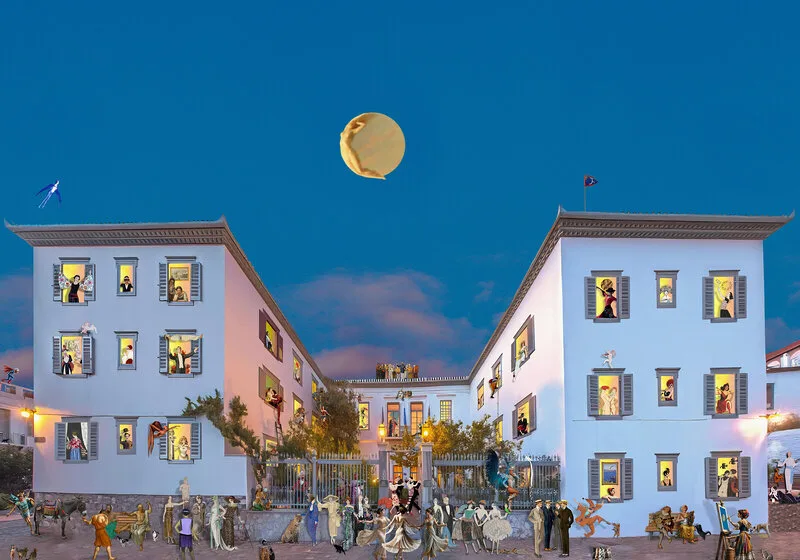
Much Ado About Nothing – The Hydroussa Experience: A Night of Roaring Twenties Glamour on Hydra, 2024
Digital
100 x 70 cm
A Roaring Night at Hydroussa
In the heart of Hydra, under Selene's glow,
Hydroussa Hotel, where legends flow.
A gathering of gods and men, both old and new,
A party so grand, it outshone the view.
Leonard Cohen, with hat in hand,
Waved the Hydra flag across the land.
Marianne beside him, love so true,
Eternal in starlight, their bond anew.
Ghikas, the artist, as Socrates came,
With wisdom and wit, never quite tame.
Beside him sat Nicodemus, the wise old steed,
A donkey of legend, known for his deed.
Through intricate doors and marble grand,
Time-travelers mingled, hand in hand.
Under the moon, in the courtyard fair,
Danced gods and mortals without a care.
Charleston and Foxtrot, the dance of the night,
Lindy Hop, Jitterbug, a glorious sight.
With each step and twirl, the past came alive,
Echoes of jazz in the air did thrive.
Paul Whiteman’s orchestra set the tone,
As Chaplin’s hat, with charm, was shown.
From rooftop circus to swirling courtyard grace,
Each corner of Hydroussa became a dance space.
The true hero of freedom's fight, ahead of his time,
Antonis Oikonomou, with visions so sublime.
By his own kin, in shadows slain, for dreams of liberty,
In heaven's light, his spirit shines, a beacon for the free.
In eternity, Antonis finds his due, a hero's lauded name,
From battles past to festive dance, he garners just acclaim.
To Charleston’s beat, he moves with grace from a different time,
In the spirit of his nation's pride, his steps align in rhyme.
Romeo to Juliet scaled the white wall,
Marilyn’s harp echoed through the ball.
Pan’s donkey, on the second floor,
A magical sight no one could ignore.
Thurston’s devils, in fiery delight,
Thrilled the guests with mystical might.
In windows and nooks, mischief was found,
With laughter and joy, the night did resound.
Magicians and clowns, with tricks up their sleeve,
Kept guests in wonder; no one thought of leave.
Time-travellers, in dimensions they roam,
Created a night that felt like home.
Through dimensions six, their laughter soared,
While Earthlings slept, completely ignored.
With music and magic, under starry skies,
Hydroussa's ball reached heavenly highs.
So, raise a glass to the gods and men,
To Hydroussa’s night, beyond our ken.
A fest for the ages, under moon’s soft gleam,
Where dreams and reality merge in a seam.
Cat pals Hecate, Felix, and Galinthias were in sight,
Alcyoneus, Cybele, and others joined the night's delight.
All mingled with the guests in the moon's gentle ray,
For they wouldn't sleep through a chance to join the fray.
Hydra, July 2024
The Hydroussa Experience: A Night of Roaring Twenties Glamour on Hydra
The full moon above the Hydroussa Hotel revealed its most feminine side, embodying the moon goddess Selene in full bloom. She personified the moon and travelled across the night sky in a chariot drawn by two horses, which she had respectfully parked on the moon's far side in deference to Hydra's ban on wheeled vehicles. Selene was an exceptionally beautiful woman associated with various myths and legends, including that of Endymion, a handsome young man she fell in love with. He was a shepherd living in prehistoric times at the foot of Mount Eros on Hydra, called Latmos in ancient times. As he was mortal and thus would age, wither, and fade away, Selene asked Zeus to grant Endymion eternal sleep to preserve his beauty and youth. Zeus granted her wish, and Endymion fell into a deep, eternal sleep where he never ages. Selene visits him in his cave on Mount Eros every full moon, where she gazes at and cares for him as he sleeps. The myth symbolises eternal and unchanging love, the kind only Time-travelers can have. Many guests on this particular evening enjoyed this everlasting love, such as Leonard Cohen, who was set to sing later that night. In the picture, he lifts his hat to his beloved island and waves its flag. Marianne, his eternally inseparable love, was, of course, also present.
Hydra's great artist Ghikas, a rare guest on the island since his house burned down and turned into a ruin, was dressed as Socrates, whose way of leaving Earth the artist found cubist, as he put it. His choice of costume was a nod to the philosophical and intellectual atmosphere of the Roaring Twenties. He sat with the original on a bench under a small window where Charles Chaplin tipped his hat to this magnificent party. The donkey next to Socrates was not as earthly as it seemed, but it was a famous donkey, Nicodemus, a Greek name that means 'victory of the people.' Nicodemus the Donkey was a loyal companion to a poor farmer in ancient Greece. Despite his humble background, Nicodemus became known for his wisdom and loyalty. He helped his master through difficult times, carrying heavy loads without complaint, and always found the way home, even in the dark, just like his descendants on today's Hydra.
One day, while travelling to a distant village to sell crops at the market, Nicodemus saved his master from a group of thieves by quickly navigating through dangerous terrain that only he knew. His courage and intelligence soon became legendary.
The tale of Nicodemus reached even the royal palace. The king, impressed by the stories of the wise donkey, invited Nicodemus and his master to the palace to honour them. Nicodemus became a symbol of endurance and loyalty, and his story spread across the land, inspiring people never to give up, no matter how tough the times. Among the stars, Time-travelers competed to borrow the farmer's animal when travelling to Earth. Socrates' chance to have Nicodemus was naturally due to their shared intelligence.
If other Earthlings could see the image my camera and I saw, a grand party would come to life before their eyes. As usual on Hydra, Babis Mores, the legendary owner of the nightclub Lagoudera, was the party planner. The scene was electrifying and enchanting, with a palpable sense of magic and wonder that captivated all present.
The enigmatic evening and night attracted several magicians and illusionists. Their performances were fascinating and awe-inspiring. With his fiery little devils, Thurston fascinated an audience in the 1920s and has done so again, leaving everyone in awe of his skill and showmanship. With their fiery red costumes and acrobatic skills, the devils performed a mesmerising dance that defied the laws of physics, leaving the audience spellbound.
Mischief occurred in every window, and one might wonder how the regular guests could sleep with all the noise. But that's how it is when living in different dimensions: we Earthlings in the first, second, and third, Time-travelers in the fourth, fifth, and the incomprehensible sixth, which defies all physical laws. The orchestra's trumpeter could press the instrument's bell right into the ear of the lightest sleeper without them hearing a thing. That way, they missed Marilyn Monroe playing the harp with a jester from the sixteenth century. Not to mention Romeo climbing up to his beloved Juliet on the second floor. That they live together for eternity on their star doesn’t matter; they want to relive the magical moment Shakespeare and others have depicted in words and poetry. How Pan got his donkey to the second floor is not a concern; they teleport while Pan prefers to take the stairs. Three orchestras were playing, so the sound should have reached the next solar system. The circus orchestra on the roof was only for all the clowns and acrobats and stricter than the two jazz orchestras in full swing. Outside on the street, groups of guests warmed up. Despite being in the middle of the night, the temperature was still thirty degrees, but indoors, the air conditioning kept it at twenty-four, which might feel cool for those living on a star. The scene was filled with mystery and intrigue, leaving me, the audience, guessing what would happen next.
Babis and Max hoped that tonight's spectacular party would dethrone the legendary Biltmore bash and consign it to second place. They had already christened the event "The Hydroussa Experience."
The Hydroussa Hotel on Votsi Square, with its nearest neighbour, the small church of St. Yiorgos, was bubbling with a celebration in the spirit of the Roaring 1920s, a hedonistic fest linked to the gods of Olympus. Many of them were here because Hydra's reputation as a party spot had spread even to the Olympus constellation, a group of stars in the night sky that was believed to be the home of the ancient Greek gods. This connection to the gods of Olympus added a mystical and historical dimension to the party.
One person Babis didn't forget to invite was the true hero of the War of Independence, a man ahead of his time, Antonis Oikonomou, who was murdered by his own people when he tried to implement democracy on Hydra. He has, so to speak, received his reward in heaven, that is, in eternity, where he is celebrated as the hero he truly is. Antonis enjoys coming to parties, even though the 1920s might be a bit foreign to someone born in the 18th century. The 1920s, known for its cultural and social revolution, was a time of great change and innovation, and the party celebrated this era. But dancing the Charleston is just a matter of speeding up a Greek folk dance, and Antonis was an expert at that.
To the gods, what humans on Earth called the constellation mattered little. For them, ‘Orion’ was an earthly name among astronomers, but 'Olympus,' the ancient god’s eternal gathering place. Olympos’s significance lies in its prominence and recognizability in the night sky. As a prominent figure in Greek mythology and the heavens, it represents an essential and central location, much like the mountain Olympus. Orion, known for being a great hunter in mythology and involving many gods like Artemis and Zeus in his tales, serves as a fitting symbol for a place where gods convene, but with another name. Its visual dominance, with bright stars and vast expanse across the sky, captures the grandeur and dominance that Olympus was thought to embody.
The night's festivities at the Hydroussa Experience were a stunning reimagining of the legendary Biltmore Hotel party, with glittering costumes, extravagant decorations, and an atmosphere buzzing with the energy of the Charleston, Lindy Hop, and other popular dances of the 1920s. Notable figures from the 1920s, such as Zelda Fitzgerald and Ernest Hemingway, mingled with historic revolutionaries from the Greek War of Independence and local bakers, carpenters, and their lively partners. The grand courtyard and elegant drawing rooms were filled with laughter and music as guests from different eras and backgrounds celebrated together.
Unfazed by earthly conventions, the gods steadfastly adhered to their eternal designations, with Olympen reigning supreme in the starlit sky.
It was a true rager, "The Bees Knees," as they said back then, that would make Jay Gatsby jealous of his star. He wasn’t invited, but the author who created him, Scott Fitzgerald, was. We have the fictional character to thank for the everlasting pop culture trend of 1920s parties. Still, Babis Mores wanted his 1920s-themed party to be a bacchanal worthy of a gossip magazine with glitz, glamour, and extravagance that'll be remembered for years. It was time to take a deep dive into what the 20s were like and bring it to life in a party Gatsby would be jealous he didn't throw. Not that Hydra had made it onto the entertainment map in the 20s, but to relive one of many special party nights at Lagoudera in the 60s and 70s. Babis had, however, invited the inspiration for Gatsby, bootlegger and businessman Max Gerlach. Max was a self-made millionaire with a mysterious background and a penchant for throwing extravagant parties, just like Gatsby. He had helped Babis set the period-appropriate mood.
No matter what the theme is, locations are imperative for every party. A backdrop will either set the stage or ruin the show when you're choosing a historical theme that people have expectations about. Parties in the 1920s were quite lavish, and Babis's parties did not fall short. Lagoudera's first location, where Papagalos now stands, was too cramped, and Omilos, where the club later moved, was far too small to host a party like this. Instead, Babis chose to occupy Hydroussa for a few hours, which was much more extensive and had a history of grand celebrations.
The Hotel Hydroussa, a historic building dating back to the early 19th century, was initially the residence of the prominent Tsamadou family. The family played a significant role in the Greek War of Independence and threw legendary parties here, contributing to the hotel's reputation as a cultural and historical significance hub.
The building itself is a fine example of the island's traditional architecture. It was constructed in the popular neoclassical style, featuring grand spaces, high ceilings, and elegant decor. The lobby's grandeur, intricately carved wooden doors, and cool, inviting spaces all added to the hotel's charm and made it the perfect setting for a party like no other.
Over the years, the hotel has become a cultural landmark on Hydra, hosting numerous artists, writers, and intellectuals. Its contribution to the island's reputation as a haven for creative minds was unparalleled. Now, it was the perfect setting for a party like no other, carrying the weight of its cultural significance.
The festivities unfold in a furious tempo. In the generous marble lobby, intricately carved wooden doors and cool, inviting spaces, a group of acrobats entertained guests amazed by their daring moves. It’s important to note that the guests at the party included 'Time-travelers ', a group of individuals who had left the earthly realm and were now enjoying the festivities. While they could twist an ankle, they didn’t face the same mortal risks as earthly beings. Besides, Time-travelers dislike the word 'die' and its synonyms and prefer to refer to the experience as 'moving on,' which they had already done when they left Earth.
The property's allure is a leafy courtyard sanctuary with shade trees, flowers, potted plants, and vines climbing whitewashed walls. This is most likely where guests begin their day with an al fresco breakfast at one of the wrought-iron tables with striped cushioned chairs. It was also here that many guests from eternity took a moonlit drink, and between the tables, people danced wildly to fashionable dances from yesteryear.
During the magic party, from a distance, I enjoyed the music and dances of the Roaring Twenties. Throughout the night, the orchestra, led by the famous Paul Whiteman, known as the King of Jazz, played a medley of music that got everyone dancing. In one corner, Zelda Fitzgerald and F. Scott Fitzgerald swirled around the courtyard, Zelda’s laughter echoing as they did the Charleston. This iconic dance from the 20s was performed to fast jazz music with quick leg movements and kicks. The upbeat 4/4 time signature enabled a strong beat, and their feet moved with the rhythm, drawing cheers from the crowd.
Ernest Hemingway and his literary friends near the bar showed off their skills in the Lindy Hop, an early form of swing dance developed in Harlem, New York. It combined jazz, tap, breakaway, and Charleston movements. Hemingway's bold steps and strong lead paired perfectly with the energetic music, allowing others to join in the fun.
By the grand staircase, Coco Chanel and her entourage opted for the sophisticated Foxtrot. This smoother and slower dance, compared to the Charleston, was still prevalent in the 1920s. They glided gracefully across the floor, often to the sounds of a big band, their movements elegant and measured.
In another part of the courtyard, Josephine Baker mesmerised onlookers with the Black Bottom, a dance from New Orleans featuring hip and leg movements. Her performance was electric, her famous banana skirt swinging in time with lively beats, captivating everyone around her.
Amidst the crowd of dancers, revolutionaries from the Greek War of Independence, dressed in traditional garb, attempted the Shimmy. This dance style, in which dancers shook their shoulders and upper bodies, was a hit in the 1920s and provided a playful contrast to the more restrained movements of earlier dances.
In a quieter corner, a group of admirals and generals watched as young couples danced the Tango. Originating from Argentina, the tango had become very popular in Europe and North America during the 1920s. Its dramatic and intimate movements made it a favourite among those looking for more body contact.
As the night wore on, the dance floor saw a single Waltz. This classical dance, often performed to slower, more formal music, continued to be popular during the 1920s. An old freedom fighter took his wife by the hand, and they waltzed gracefully, their movements a testament to their lifelong partnership.
The Breakaway, a variant of Lindy Hop in which dancers break away from each other to perform individual improvisations, attracted the more adventurous souls, including young artists and writers. The open space around them allowed for spontaneous creativity, drawing applause from the crowd.
Finally, as the energy peaked, the Jitterbug took over. This early form of swing dance, known for its energetic and acrobatic movements, had everyone on their feet. The wild jumps and spins showcased the dancers' physical prowess, with Time-travellers and locals alike joining in the fun.
The moon was full above the Hydroussa Hotel, showing its most feminine side, the moon goddess Selene in full bloom. She personified the moon and travelled across the night sky in a chariot pulled by two horses, which, in respect of Hydra’s ban on wheeled vehicles, she had parked on the dark side of the moon. Selene was a rarely beautiful woman associated with various myths and legends, including Endymion, a handsome young man she loved. He was a shepherd living in prehistoric times at the foot of Mount Eros on Hydra, though the mountain was called Latmos back then. Since he was mortal and thus would age, wither away, and disappear, Selene asked Zeus to grant Endymion eternal sleep to preserve his beauty and youth. Zeus granted her wish, and Endymion fell into a deep, eternal sleep where he never aged. Selene visits him in his cave on Mount Eros every full moon, where she gazes at and tends to him while he sleeps. The myth symbolises eternal and unchanging love, the kind only Time-travelers can have. Many of the guests this special evening had the privilege of loving in eternity, like Leonard Cohen, who would sing later that night. In the picture, he tips his hat to his beloved island and waves its flag. Marianne was, of course, also present, his eternally inseparable love.
The party could have lasted forever, for time is relative among the stars. A second for us on Earth can be experienced as a thousand years, while a few hours can seem like a fleeting moment. When the first light began to appear in the east, hidden behind the mountains, the party was in full swing. One moment, the orchestra was playing "Yes Sir, That's My Baby," a cheerful and uplifting song that made the distant guests dance like crazy, and in the next moment, they were all gone, and silence descended over Hydroussa. Only the cats and I remained. They, like me, trudged home full of impressions.

Jörgen Thornberg
Malmö
Lite om bilder och mig. Translation in English at the end.
Jag är en nyfiken person som ser allt i bilder, även det jag fäster i ord, gärna tillsammans för bakom alla mina bilder finns en berättelse. Till vissa bilder hör en kortare eller längre novell som följer med bilden.
Bilder berättar historier. Jag omges av naturlig skönhet, intressanta människor och historia var jag än går. Jag använder min kamera för att dokumentera världen och blanda det jag ser med vad jag känner för att fånga den dolda magin.
Mina bilder berättar mina historier. Genom mina bilder, tryck och berättelser. Jag bjuder in dig att ta del av dessa berättelser, in i ditt liv och hem och dela min mycket personliga syn på vår värld. Mer än vad ögat ser. Jag tänker i bilder, drömmer och skriver och pratar om dem; följaktligen måste jag också skapa bilder. De blir vad jag ser, inte nödvändigtvis begränsade till verkligheten. Det finns en bild runt varje hörn. Jag hoppas att du kommer att se vad jag såg och gilla det.
Jag är också en skrivande person och till många bilder hör en kortare eller längre essay. Den följer med tavlan, tryckt på fint papper och med en personlig hälsning från mig.
Flertalet bilder startar sin resa i min kamera. Enkelt förklarat beskriver jag bilden jag ser i mitt inre, upplevd eller fantiserad. Bilden uppstår inom mig redan innan jag fått okularet till ögat. På bråkdelen av ett ögonblick ser jag vad jag vill ha och vad som kan göras med bilden. Här skall jag stoppa in en giraff, stålmannen, Titanic eller vad det är min fantasi finner ut. Ännu märkligare är att jag kommer ihåg minnesbilden långt efteråt när det blir tid att skapa verket. Om jag lyckas eller inte, är upp till betraktaren, oftast präglat av en stråk av svart humor – meningen är att man skall bli underhållen. Mina bilder blir ofta en snackis där de hänger.
Jag föredrar bilder som förmedlar ett budskap i flera lager. Vid första anblicken fylld av feel-good, en vacker utsikt, fint väder, solen skiner, blommor på ängen eller vattnet som ligger förrädiskt spegelblankt. I en sådan bild kan jag gömma min egentliga berättelse, mitt förakt för förtryckare och våldsverkare, rasister och fördomsfulla människor - ett gärna återkommande motiv mer eller mindre dolt i det vackra motivet. Jag försöker förena dem i ett gemensamt narrativ.
Bild och formgivning har löpt som en röd tråd genom livet. Fotokonst känns som en värdig final som jag gärna delar med mig.
Min genre är vid som framgår av mina bilder, temat en blandning av pop- och gatukonst i kollage som kan bestå av hundratals lager. Vissa bilder kan ta veckor, andra någon dag innan det är dags att överlämna resultatet till printverkstaden. Fine Art Prints är digitala fotocollage. I dessa kollage sker rivandet, klippandet, pusslandet, målandet, ritandet och sprayningen digitalt. Det jag monterar in kan vara hundratals år gamla bilder som jag omsorgsfullt frilägger så att de ser ut att vara en del av tavlan men också bilder skapade av mig själv efter min egen fantasi. Därefter besöks printstudion och för vissa bilder numrera en limiterad upplaga (oftast 7 exemplar) och signera för hand. Vissa bilder kan köpas i olika format. Det är bara att fråga efter vilka. Gillar man en bild som är 70x100 men inte har plats på väggen, går den kanske att få i 50x70 cm istället. Frågan är fri.
Metoden Giclée eller Fine Art Print som det också kallas är det moderna sättet för framställning av grafisk konst. Villkoret för denna typ av utskrifter är att en högkvalitativ storformatskrivare används med åldersbeständigt färgpigment och konstnärspapper eller i förekommande fall på duk. Pappret som används möter de krav på livslängd som ställs av museer och gallerier. Normalt säljer jag mina bilder oinramade så att den nya ägaren själv kan bestämma hur de skall se ut, med eller utan passepartout färg på ram, med eller utan glas etc..
Under många år ställde jag bara ut på nätet, i valda grupper och på min egen Facebooksida - https://www.facebook.com/jorgen.thornberg.9
Jag finns också på en egen hemsida som tyvärr inte alltid är uppdaterad – https://www.jth.life/ Där kan du också läsa en del av de berättelser som följer med bilden.
UTSTÄLLNINGAR
Luftkastellet, oktober 2022
Konst i Lund, november 2022
Luftkastellet, mars 2023
Engleson Galleri Caroli, april 2023
Hydra, Greece June 2023
Engleson Galleri Caroli, oktober 2023
Toppen, Höllviken december 2023
Luftkastellet, mars 2024
Torups Galleri, mars 2024
Venice, May 2024
Luftkastellet, oktober 2024
Konst i Advent, December 2024
Galleri Engleson, Caroli December 2024
Jäger & Jansson Galleri, april 2025
A bit about pictures and me.
I'm a curious person who sees everything in pictures, even what I express in words, often combining them, for behind all my pictures lies a story. These narratives, some as short as a single image and others as long as a novel, are the heart and soul of my work.
Pictures tell stories. Wherever I go, I'm surrounded by natural beauty, exciting people, and history. I use my camera to document the world and blend what I see with what I feel to capture the hidden magic.
My images tell my stories. Through my pictures, prints, and narratives, I invite you to partake in these stories in your life and home and share my deeply personal perspective of our world. More than meets the eye. I think in pictures, dream, write, and talk about them; consequently, I must create images too. They become what I see, not necessarily confined to reality. There's a picture around every corner. I hope you'll see what I saw and enjoy it.
I'm also a writer, and many images come with a shorter or longer essay. It accompanies the painting, printed on fine paper with my personal greeting.
Many pictures start their journey on my camera. Simply put, I describe the image I see in my mind, experienced or imagined. The image arises within me even before I bring the eyepiece to my eye. In a fraction of a moment, I see what I want and what can be done with the picture. Here, I'll insert a giraffe, Superman, the Titanic, or whatever my imagination conjures up. Even stranger is that I remember the mental image long after it's time to create the work. Whether I succeed is up to the observer, often imbued with a streak of black humour – the aim is to entertain. My pictures usually become a talking point wherever they hang.
I prefer pictures that convey a message in multiple layers. At first glance, they're filled with feel-good vibes, a beautiful view, lovely weather, the sun shining, flowers in the meadow, or the water lying deceptively calm. But beneath this surface beauty, I often conceal a deeper story, a narrative that challenges societal norms or explores the human condition. I invite you to delve into these hidden narratives and discover the layers of meaning within my work.
Picture and design have been a thread running through my life. Photographic art feels like a fitting finale, and I'm happy to share it.
My genre is varied, as seen in my pictures; the theme is a blend of pop and street art in collages that can consist of hundreds of layers. Some images can take weeks, others just a day before it's time to hand over the result to the print workshop. Fine Art Prints are digital photo collages. In these collages, tearing, cutting, puzzling, painting, drawing, and spraying happen digitally. What I insert can be images hundreds of years old that I carefully extract so they appear to be part of the painting, but also images created by myself, now also generated from my imagination. Next, visit the print studio and, for certain images, number a limited edition (usually 7 copies) and sign them by hand. Some images may be available in other formats. Just ask which ones. If you like an image that's 70x100 but doesn't have space on the wall, you might be able to get it in 50x70 cm instead. The question is open.
The Giclée method, or Fine Art Print as it's also called, is the modern way of producing graphic art. This method ensures the highest quality and longevity of the artwork, using a high-quality large-format printer with archival pigment inks and artist paper or, in some cases, canvas. The paper used meets the longevity requirements set by museums and galleries. I sell my pictures unframed, allowing the new owner to personalise their artwork, confident in the lasting value and quality of the piece.
For many years, I only exhibited online, in selected groups, and on my Facebook page - https://www.facebook.com/jorgen.thornberg.9. I also have my website, which unfortunately is not constantly updated - https://www.jth.life/. You can also read some of the stories accompanying the pictures there.
EXHIBITIONS
Luftkastellet, October 2022
Art in Lund, November 2022
Luftkastellet, March 2023
Engleson Gallery Caroli, April 2023
Hydra, Greece June 2023
Engleson Gallery Caroli, October 2023
Toppen, Höllviken December 2023
Luftkastellet, March 2024
Torup Gallery, March 2024
Venice, May 2024
UTSTÄLLNINGAR
Luftkastellet, oktober 2022
Konst i Lund, november 2022
Luftkastellet, mars 2023
Engleson Galleri Caroli, april 2023
Hydra, Greece June 2023
Engleson Galleri Caroli, oktober 2023
Toppen, Höllviken december 2023
Luftkastellet, mars 2024
Torups Galleri, mars 2024
Venice, May 2024
Luftkastellet, October 2024
Konst i Advent, December 2024
Galleri Engleson, Caroli December 2024
Jäger & Jansson Galleri, April 2025
Utbildning
Autodidakt
Medlem i konstnärsförening
Öppna Sinnen
Med i konstrunda
Konstrundan i Skåne
Utställningar
Luftkastellet, October 2022
Art in Lund, November 2022
Luftkastellet, March 2023
Engleson Gallery Caroli, April 2023
Hydra, Greece June 2023
Engleson Gallery Caroli, October 2023
Toppen, Höllviken December 2023
Luftkastellet, March 2024
Torup Gallery, March 2024
Venice, May 2024