Vi använder cookies för att ge dig bästa möjliga upplevelse. Välj vilka cookies du tillåter.
Läs mer i vår integritetspolicy
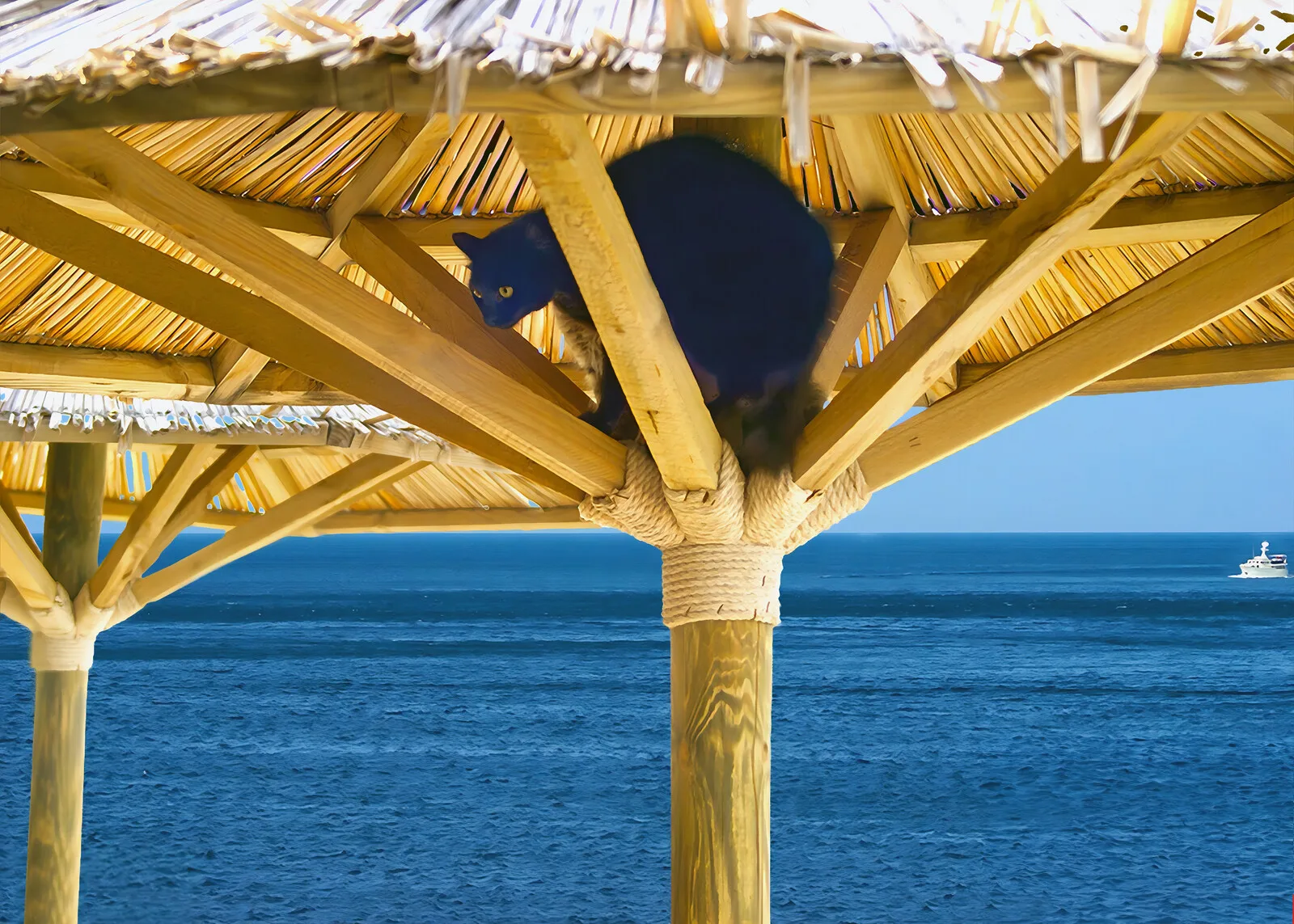
Jörgen Thornberg
Cat under a Hot Straw Roof, 2019
Digital
70 x 50 cm
Cat under a Hot Straw Roof
Please have a look at more of my work. You will be surprised. Follow the link below.
https://www.konst.se/jorgen-thornberg
Cat Under a Hot Straw Roof
Scene 1 - The Morning
Ophelia met Cassandra where the fishing boats lay,
All the hopeful cats gathered, hoping for the day.
The fisherman loved cats, gave scraps once he was through,
Ophelia didn't wait; she had news she claimed was true.
Ophelia: "Old Fart is fine! Do you know where Adonis might be?"
Cassandra: "Not seen him today, he should be cleaning Donkey Shit, you see."
Ophelia: "You never liked children, Cassandra; please don't lie."
Cassandra: "Well-behaved ones I like; too much joy makes me sigh."
Ophelia: "Then have some of your own; bring them up, right."
Cassandra wanted kittens, but only with Adonis in sight.
Adonis decided to hide; not even his mother he'd greet,
Ophelia yelled for him, her voice filling the street.
Ophelia: "Ol’ Fart’s healthy, except for a few things," she lied,
Disappointed by Adonis's silence, she fell to her knees and cried.
Ophelia assumed much, made it hard for Cassandra to say,
That Adonis didn't want her, it was he who turned away.
Adonis's sexual orientation lay like rocks in their path,
Cassandra's reflection made her feel old, losing her wrath.
By chance, they met outside the supermarket’s door,
Adonis sneaks in for the cold Coke he adores.
Cassandra: "Adonis, Old Fart is dying, the lie’s taken you in,"
Adonis was silent; his hatred for lies kept deep within.
Cassandra: "I stick with you for Old Fart’s pearl, though poor I’d stay,
I love you regardless, come what may."
Adonis: "I wish things were simple, like when Growler and I
As youngsters hunted mice, things were clear, no lie."
Cassandra: "But we can't go back, we face what's in front,
Together, we'll stand strong, and there is no need to confront."
Adonis looked the other away, lost in the past’s glow,
While Cassandra watched, her heart aching, beating slow.
Scene 2 – Four Seasons
Cassandra took an outing to Plakes, where the beach lay,
She sought solace alone to while away the day.
Strolling along the cliff path, gorgeous and steep,
Or hitching with a donkey, their scent made her leap.
She stowed on the shuttle, to the hotel she went,
Exploring sunbeds, where the wealthy time spent.
Finding one in the shade, she settled to stay,
With Proust in her bag, she’d keep others away.
Though the book was unread, its purpose was clear,
To ward off the social, to keep solitude near.
The sunbeds around her, for planning and chat,
Cassandra just wanted her peace, and that was that.
Alcyone appeared the last cat she wanted to see,
So Cassandra hid quickly under the parasol's canopy.
Alcyone didn’t stay long; her walk back was tough,
Despised by the donkeys, her hissing too much.
Cassandra enjoyed another hour in the sun,
Before heading back, her grooming began.
She readied herself for Old Fart's birthday affair,
Hoping to be close to Adonis and pretending they cared.
Scene 3 - The Restaurant
In a small square near the port at Ostria, they meet,
Cassandra and Adonis, sharing leftovers discreet.
The setting is idyllic, amidst alleys so tight,
Their meal was in secret, hidden from sight.
Cassandra, the black sleek, panther-like cat,
Envied by others, where she elegantly sat.
Adonis, a tabby with fur banded fine,
Spoiled from birth, a favourite feline.
Adonis’s brokenness, a stark contrast within,
Repressed feelings for Growler, a fight he can't win.
His mother, Ophelia, is crude and sincere,
His father, Old Fart, with stories to hear.
Over the meal, Cassandra’s heart lay bare,
Adonis is indifferent, showing little care.
Cassandra’s frustration, her longing displayed,
Adonis’s silence, her hopes are delayed.
She spoke of Xan and Alcyone's greedy plan,
To cut Adonis out of his legacy, poor man.
Old Fart’s illness, a secret Ophelia held tight,
Adonis's behaviour is a weapon for the fight.
Cassandra: "Did you hear about Xan and wife?
They plan to cut you out; their greed is rife."
Adonis: "Hmm," his response so bare,
Cassandra fought to make him aware.
Cassandra: "You have a lead, Old Fart’s love for you,
Show you're better; you must prove what’s true."
Adonis: "Why should I? It’s all meaningless,"
Cassandra felt the weight of his emptiness.
Cassandra: "You weren’t always like this, you were wonderful once,
I haven’t given up hope, though you see me as a dunce."
Adonis’s silence made Cassandra push more,
But his indifference was a heavy locked door.
Scene 4 - The Evening Unfolds
The evening brought tension, a storm in the air,
At Old Fart and Ophelia's, the guests were aware.
There was no formal invite, but rumours spread fast,
About Old Fart's illness, his time almost passed.
Ophelia played hostess, gracious and kind,
Guests brought their offerings with plans in mind.
Milk was for toasting, no wine to share,
The garden, their living room, with a sea breeze fair.
Old Fart led the group, the hypocrite Tuck by his side,
Xan discusses memorials flirting with Old Fart’s pride.
Cassandra began chanting, her voice soft and clear,
Old Fart interrupted, his command severe.
Ophelia fussed over Adonis, Old Fart's orders loud,
The atmosphere is heavy, tension in the crowd.
Alcyone’s children sang songs of love,
Contrived affection, hoping for wealth from above.
Ophelia's sudden speech made everyone uneasy,
They learned the truth, making the scene quite queasy.
Cassandra, Alcyone, and Xan vied for Old Fart's grace,
Their desperation is evident in the inheritance race.
Old Fart questioned Adonis about last night,
Adonis’s answers tried to avoid the light.
Old Fart’s crude notions, Ophelia’s quiet plea,
Their relationship was strained for all to see.
Ophelia’s declaration of love met with disdain,
Old Fart's cruel response brought her pain.
Old Fart to Adonis, about Cassandra and Alcyone’s plot,
Adonis revealed their aim, the inheritance they sought.
Old Fart heard a noise, Alcyone at the gate,
Her spying words met with Old Fart's hate.
Adonis's drinking, his problem laid bare,
Old Fart's harsh truth is hard to bear.
Scene 5 - The Winemaker’s Bar
The family gathered tension lays heavy in the air,
Ophelia is uneasy if Old Fart was no longer there.
Cassandra fetched Adonis, his presence tense,
Xan and Alcyone's news, Ophelia’s suspense.
Old Fart's cancer revealed, Ophelia’s hysteria shown,
Adonis's drinking problem and Ophelia's disowned.
The truth shook the family; their bonds laid bare,
Ophelia’s denial but for Old Fart her genuine care.
Cassandra defended Adonis, Xan’s fury displayed,
Among them, hostility grew as insults were made.
Adonis’s indifference and his drinking to cope,
Ophelia’s wish for a grandson is her desperate hope.
Cassandra's announcement, her lie to maintain,
Ophelia's happiness, Xan and Alcyone's disdain.
Ophelia rushed to tell Old Fart the news,
Alcyone's accusation, Cassandra’s ruse.
Cassandra claims a baby on the way,
Old Fart’s grandchild, the talk of the day.
Ophelia’s joy, while Xan and Alcyone sneer,
A lie so bold that Cassandra's scam is unclear.
Adonis's “click,” his drink in hand,
Cassandra's plan, her lie to withstand.
She hid the liquor, demanding love,
Adonis’s dependence, her power above.
Ophelia’s interruption, seeking morphine's aid,
Cassandra’s control, her love displayed.
As the curtain fell, Cassandra declared,
Her love for Adonis, his response ensnared.
Scene 6 - Reflections
“Wouldn’t it be funny if that was true?”
Adonis’s remark, a summary view.
Reflecting on Hydra’s cats and their play,
It is a tale of love, lies, and life’s fray.
Katty listened, her questions wise,
A dramedy, a catedy, through feline eyes.
Balancing drama and comedy's thread,
A story of cats and their lives widespread.
Deception, ageing, themes so deep,
Adonis’s drinking, secrets to keep.
Homosexuality, death, truths concealed,
Relationships strained, hearts unhealed.
Katty: "Nostalgia and wealth, themes in the play,
The past was fun, but today’s hardly okay."
The play’s happiest moments were memories, dear.
Adonis’s past, Ophelia’s and Cassandra’s fear.
Old Fart’s legacy, the pearl’s hidden worth,
Cassandra’s final lie is a desperate birth.
Katty: "Tragicomedy, life’s highs and lows,
The truths and lies, the story flows."
Reflecting on events and life’s vibrant hue,
The title is fitting for cats and humans, too.
Cassandra’s resilience, her struggle and fight,
Her victory was clear on the final night.
Katty’s wisdom, her feline view,
The play’s essence, through and through.
"Cat under a Hot Straw Roof," a tale so bright,
Of love, lies, intrigues and life’s twilight.
Hydra, July 2024
Cat under a Hot Straw Roof
A Play in six acts
Scene 1 - The Morning
Ophelia meets Cassandra, where the fishing boat docked, and all the hopeful cats gather. The fisherman liked cats, and after the customers got their share, the cats could count on the fish scraps and maybe even a small whole fish or two. Ophelia didn’t plan to wait that long but said she had wonderful news about Old Fart. She asked if Cassandra knew where Adonis was.
Ophelia: "I have wonderful news about Old Fart. Do you know where Adonis is?"
Cassandra: "I haven't seen him since last night, but he should be helping clean Donkey Shit Lane by now," she said, knowing full well that Adonis had quit that job.
Without any reason, Ophelia accuses Cassandra of disliking children.
Ophelia: "You never liked children, did you, Cassandra?"
Cassandra: "That's not true. I just like well-behaved children."
Ophelia: "Then you should have some of your own and bring them up properly."
Cassandra wanted kittens, but only with Adonis.
Adonis had decided to hide from the world, refusing to speak even with his mother.
Ophelia yells for Adonis and then discloses that the results of Old Fart’s health report were all negative—he’s in satisfactory condition, save for some issues.
Ophelia: "He's perfectly healthy, except for a few issues," she lied. Ophelia is disappointed with Adonis’s lack of response, saying she fell to her knees when she heard the news.
Ophelia makes assumptions about Cassandra and Adonis’s relationship that make it difficult for Cassandra to communicate the truth—that it’s Adonis who does not want her, not the other way around. And, as will be revealed, the rocks in their relationship lie in Adonis's bisexual orientation. Cassandra’s unhappiness stems from her having to deal with Adonis’s lack of affection for her and his family. As she gazes into a 21st-century shop window, she seems to be losing hold of herself. She sees herself becoming an ageing, unattractive cat.
By chance, she and Adonis run into each other outside Bexis supermarket, where he had sneaked in to see if he could snatch a small bottle of Coca-Cola, his favourite drink, which cats shouldn't drink for fear of losing their teeth.
Cassandra: "Adonis, I have something to tell you."
Adonis: "What is it, Cassandra?"
Cassandra: "Old Fart doesn’t have cancer. He does! His coming death has been hidden—been repressed. Old Fart is dying, and Xan, Alcyone, and I are all vying for a piece of his wealth. The lie has completely taken you in."
Adonis, meanwhile, had been completely taken in by the lie. This will become more important in hindsight, as Adonis's hatred of lying will be revealed in due time. Cassandra tells Adonis that she is sticking with him because she wants him to get Old Fart's pearl, as she hates to be a poor cat. She lies; she loves him regardless of whether he is rich.
Cassandra brings up the past when she had an affair with Growler, and Adonis does everything he can to try and stop her, in vain.
Cassandra: "There was a time with Growler, Adonis. Before you."
Adonis: "Stop it, Cassandra. I don't want to hear about it."
Cassandra: "Both Growler and I loved you, Adonis."
At first, it seems that Adonis can't face that there was a time before him, but as she explains that both she and Growler loved him, it becomes clear that he can't deal with the possible homosexual aspect of his friendship with Growler. Cassandra refuses to give in to Adonis's attempt to repress the past.
Now, the tension starts to come out. Cassandra's story makes Growler’s love for Adonis clear. While Adonis uses his crutch—his only support in his physical brokenness—to try to shut Cassandra up and, in so doing, preserve his only support in his spiritual brokenness—the idea that his friendship with Growler was pure and true and had no homosexual overtones. Cassandra seems to think that Growler is the only one who harbours such feelings. But Adonis's desperation to shut her up suggests that perhaps that isn't true.
Adonis’s surprisingly honest response reveals how much he still lives in the past. He wants to go back to his days as a teenager, hunting mice with Growler, when their friendship in Adonis's mind was pure, sound, and uncomplicated. The other day, his jumping donkeys were a drunken attempt to return to those times. But you can't go back, and he broke his ankle trying.
Adonis: "I wish things could be simple again. Like when Growler and I hunted mice. Everything was clear then."
Cassandra: "But we can't go back, Adonis. We have to face what's in front of us."
The scene ends with Adonis looking away, lost in thought, while Cassandra watches him, her heart aching with unspoken words.
Scene 2 – Four Seasons
Cassandra had taken some time for an outing to Plakes and the Four Seasons hotel with its fantastic beach and numerous soft beach beds perfect for a cat to lie in. If Adonis could disappear, so could she. Getting to Plakes was no problem; the path along the cliff edge towards the sea was breathtakingly beautiful, something even a cat girl appreciates. It was better to hitch a ride with a donkey friend, and Cassandra had many of those. But today, she preferred to be a stowaway on the shuttle boat between the hotel and Hydra port.
Walking just over three kilometres at a leisurely pace, for a cat girl doesn't hurry, stopping now and then to sniff around would take Cassandra an hour and a quarter. Hitching a ride with a donkey was a bumpy trip of three-quarters of an hour, but Cassandra liked their scent.
Since she had slept late that morning and was to visit her prospective father-in-law in the evening, she didn't want to push her schedule and instead sneaked onto the boat. It took five minutes, and some sea air cleared her nostrils. No one questions a cat; everyone thinks it belongs to someone else. Cassandra quickly explored among the hundreds of sunbeds. The section closest to Hydra is often less crowded and considered less prestigious by the regulars, many of whom booked a sunbed for an extended period, some for the whole summer. When she arrived at lunchtime, many guests had gone to the restaurant for a long lunch with a view. Cassandra quickly found an empty bed in the back row. She wouldn't be swimming anyway. Preparing the bed didn't take long, crumpling the towel that had been neatly folded in anticipation of a guest and taking out the book she had carried in a bag hanging from her mouth.
In the shade of a large wooden parasol covered with a straw roof, a cat can lie for a long time and ponder, at least until chased away. In the late afternoon, the risk is lower when most people have gone home to shower and change for the evening dinner. Cassandra brought a paperback book she had picked up outside another of Hydra's more luxurious hotels in Mandraki. There, people pay so much for a room per night that it could feed all of Hydra's cats for two days—a thousand portions! Their guests like to keep up their appearance and seem cultured, even though some must have stolen their money. The book was unread but dog-eared, so Cassandra concluded that it had only been carried back and forth between the sun lounger and the room. It was her way of ensuring she had the sunbed to herself.
The book was volume three of Marcel Proust's monumental work, 'In Search of Lost Time.' Not that Cassandra could read, but she had noticed that people avoided that sunbed if that book lay beside her on the cushion. She had understood that it had to do with the work's over four thousand pages. If someone had only reached volume three of seven, more than half remained. Such readers were rarely social; others found it pointless to lie next to them if hoping for social interaction. Most who sought out Plakes did so. It was here that excursions and dinners were planned, and new contacts were made. Cassandra just wanted to be left alone and had her reasons.
As usual, she was alone; she only wanted to share her solitude with her great love, Adonis, and no one else would do. Cassandra had been left in peace and dozed all afternoon when suddenly her so-called sister-in-law Alcyone appeared, the last cat on earth she wanted to meet just then. It's hard to hide on a beach, but Cassandra made a giant leap up and hid just under the roof of the straw parasol. The shrew Alcyone lay down on one of the nearby sunbeds, so Cassandra had to stay where she was. They were to meet in the evening, so that would suffice. Her prospective father-in-law, Old Fart, had invited family and close friends to his birthday party. It was not an evening Cassandra was looking forward to, except for the opportunity to be close to Adonis and pretend for a while that everything was normal.
Alcyone didn't stay long, as she had to walk all the way back. The so-called sister-in-law was not a well-liked cat and was despised by the donkeys for her hissing. The boat was also not an option, as she looked so angry that no one would want to acknowledge that cat. So she had to exercise. She came to the Four Seasons only to brag to her friends; status was important for her kind.
Cassandra could climb down and enjoy another hour of dozing before putting Proust back in the bag and walking a hundred meters to the boat, which was ready. The trip back was as uneventful as the previous one, and Cassandra had plenty of time to get home for a bit of grooming, filing her claws, and polishing her fur before heading to the birthday party. But first meeting with the great love of her life.
Scene 3
We meet our main characters in a small square near the port, at the restaurant Ostria. Cassandra and Adonis had decided to meet there before the party to get something to eat. The party only served cake, which was not a good way to satisfy their hunger. They are sharing a meal from the leftovers of a recently enamoured couple. The surroundings couldn't be more idyllic. The outdoor dining space is spectacular amidst the island and neo-classical architecture, next to the labyrinth of narrow alleyways and at the base of the staircases of Donkey Shit Lane. The ambience there is warm and friendly, and co-owner Tassoula knows both cats well and knows just how long to turn her back for them to snatch a bite of what Stathis, her husband, has prepared in the small kitchen.
Cassandra, her name meaning ’Man's Defender’, is a sleek, panther-like Bombay cat and is a sight to behold. Her beauty is such that all the tomcats whistle at her. She is the ‘Cat’ with a capital ‘C’ in the story I’m about to tell. She should cherish every day as the best, but that wasn't the case. Cassandra is lonely and miserable by her own choice due to Adonis's refusal to make her his desire. This made her hard, nervous, and irritable. Cassandra constantly poses in mirrors, shop windows, and occasionally in the nearest puddle when it rains on Hydra, holding the audience transfixed. The excitement of the play lies in the force of the audience's identification with its gorgeous heroine, a woman anxious about growing old, desperate in her sense of loneliness, which is made all the more beautiful by her envy, longing, and dispossession. Every day, she desperately scanned for grey hairs in her fur, which she meticulously licked away.
Adonis, a Ticked Tabby with a subtle tabby pattern where each hair is banded with different colours, was spoiled from birth. His mother was a house cat for the wealthy wine producer Boutaris, who owned a large villa on the island. Adonis was her favourite son, and she was used to girls fawning over him wherever he went. Adonis embodies an almost archetypal masculinity, but appearances can be deceiving. At the same time, the Adonis before us is also a broken cat because of his repressed homosexual desire for Growly, the pirate prankster with a voice like Leonard Cohen—a lovely cat in everyone’s eyes, especially Cassandra’s. Growly was not interested in Adonis more than as a drinking companion. Adonis didn't need to work to be well-fed. Still, sometimes, he helped Dimitri, one of the municipal sanitation workers, gather trash and donkey droppings, which Dimitri could easily scoop up and cart away. As a thank you, he treated Adonis to his favourite snack, honey-roasted calamari, which he kept in a bag in his pocket. Adonis called it his job, though it wasn’t much to brag about. His brokenness, however, is a stark contrast to his outward appearance.
Adonis's father, the birthday boy—if you can call an old cat something so disrespectful, whom Cassandra dubbed Old Fart, was a ship’s cat, an authentic polydactyl cat with an extra toe on each foot, which was an advantage on slippery decks. They called them ‘Boxing Cats’ on the island because they often won fights due to having more claws. Affectionately dubbed by Cassandra as an old-fashioned Kamini Troller, he was done with life as a ship’s cat. This didn’t bother Old Fart, who boasted widely about his voyages around the world, how he once climbed the mainmast of a schooner in a storm south of Cape Horn and bit through a stuck rope, thus saving the ship from doom. Another story was about how wealthy he was, though he didn’t need to be on an island where nothing was lacking. His fortune was a rare black pearl, perfectly round and larger than a cat’s eye, with an immaculate surface and a brilliant shine. In the human market, it would be worth a fortune.
Old Fart is a large, brash, and vulgar old codger who believes he has returned from the grave. Though his imminent death has been quickly suppressed, in some sense, Old Fart has confronted its possibility. In returning from the other side of the River Styx, where he had been Hades’s house cat in Death’s Country, Old Fart would force Adonis to face his desire.
Adonis’s mother, Ophelia, has lost the lustre in her fur over the years. She is overweight, breathless, sincere, earnest, and crude, with a necklace richly decorated with flashy gems. Ophelia is a woman embarrassingly dedicated to a man who despises her and is in feeble denial of her husband’s disgust. She considers Adonis her ‘only son’ despite having dozens more with different fathers. But a mother is always a mother to her son.
Despite a lit candle on the table, Stathis’s exquisite calamari as an appetiser, and a tasty plate of freshly caught red mullet and sea bass as the main course, the spark Cassandra had hoped for didn’t appear. Adonis barely responds or listens as she purrs tenderly, showing how complex communicating will be. Cassandra, in her most well-groomed fur that accentuates her form—and yet ignored by Adonis—suggests her frustrated sexuality. Adonis's ankle, the way he can't stand upright, displays his brokenness.
Instead, Cassandra slipped into discussing how Adonis’s half-brother, Xan, and his partner, Alcyone, aim to cut Adonis out of Big Daddy’s estate now that they have a report confirming that Old Fart is dying of cancer. She continues to complain about Adonis’s behaviour, which makes it easier for Xan and Alcyone to make a case against giving him part of the inheritance. Adonis had quit working cleaning the alleys, started drinking, and just last night injured his ankle while attempting to jump donkeys in a silly game, one that only boys play, which is all about impressing and outdoing each other.
Xan had done well in life but still wasn’t satisfied; much wanted more. Xan was a favourite cat of the owner of the restaurant Kodylenia in Kamini. Famous for its delicious fish dishes, it was heaven on earth for a cat. Xan is Old Fart’s elder and less-favoured son, likely due to his mother coming from a simple fishing family. He deeply resents his father’s love for Adonis, viciously relishes Old Fart’s illness, and rather ruthlessly plots to secure control of Old Fart’s hidden treasure, a genuine black pearl the old man had stolen during a trip to Polynesia when he was younger. According to Old Fart, you could buy a dozen fishing boats with it, nets and all. Where it was hidden, Old Fart hadn’t revealed, but Xan was sure the old man had hidden the pearl in the ship’s chest he never left unlocked.
Xan’s partner, Alcyone, is a mean, agitated ‘monster of fertility’ who schemes with her husband Xan to secure Old Fart’s treasure. She practically spews out kittens and, according to jealous neighbour cats, is on the verge of filling Kamini with her offspring. Alcyone appears primarily responsible for the burlesques of familial love and devotion she and the children stage before the grandparents. Her strategy with all the children could be a way to create sympathy with the stern Ophelia, but like all grandmothers, she loved her grandchildren, each new one boosting her self-esteem.
“Despite all that, Adonis still has one big advantage—Old Fart dotes on him and dislikes Xan and Alcyone. Cassandra also suspects that Old Fart has a ‘lech’ for her from the way he stares at her body when she’s talking to him. She continues to tell Adonis about the details of last night’s supper, how odious Alcyone and Xan were, talking about the grandchildren, and how little Old Fart seemed to care. However, Adonis doesn’t seem to pay much attention to her arguments. Cassandra continues and stresses how Xan believes he took a step up the social ladder by taking Alcyone as his partner when her family was only wealthy once. Then they lost that, too, when their butcher shop went bankrupt.
As Cassandra continues to make fun of Alcyone’s bragging about being a former carnival queen, she notices the way that Adonis is staring at her—not in the way a woman wants a man to look at her. Frightened, she asks Adonis why he’s looking at her like that. Adonis claims he wasn’t conscious of looking at her, but Cassandra continues speaking. She says she’s aware she’s transformed and become thick-skinned and mean.
Cassandra alludes to the fact that she used to act differently—nicely—but circumstances have forced her to change. Her reaction to Adonis’s stare also emphasises their distance and how little they understand each other.
Adonis rejects Cassandra’s advances, returning none of the affection Cassandra shows him. When Cassandra mentions that she’s lonely, rather than offering comfort, Adonis asks her whether she’d like to live alone, forcing Cassandra to change the topic and reel in her feelings. All conversation between the two is very strained, mainly as Adonis makes no effort to engage or be pleasant.
Cassandra says Adonis may think he looks better since he started drinking, which is false. On the contrary, drinking makes him appear pathetic. Cassandra begins to mention Adonis’s friend Growly before abruptly interrupting herself and apologising. Instead, she reminisces about how fantastic Adonis once was and says that if she thought he would never love her again, she would find a knife and stab herself in the heart. However, she hasn’t given up hope and compares herself metaphorically to a cat on a hot roof in the noonday sun—trying to stay on the hot surface as long as possible.
At this moment, as often in life when it’s difficult, the past seems like a much better place than the present. It sounds like Cassandra was once happy when Adonis flirted with her, but circumstances changed, and he no longer returned her love. The topic of Growly is yet another subject Cassandra knows she should not talk about, yet another obstacle in conversation, yet another secret or repressed issue.
They rose from the table and walked around the corner, as Cassandra didn’t want their discord to be visible to others. Cassandra again asks what Adonis was thinking of when looking at her. She asks whether he is thinking of Growly, and Adonis ignores her as Cassandra informs him that the ‘laws of silence don’t work.’ Adonis drops his crutch, and when Cassandra tells him to lean on her instead, he loses his temper, yelling that he doesn’t want to lean on her shoulder. Cassandra hurriedly hands him his crutch. Adonis is alternately silent and violent, making conversation difficult. He loses his composure, mainly when Growly is brought into the conversation.
Cassandra tells Adonis that they mustn’t shout because the walls have ears—but she believes that a crack in his composure is a good sign. Adonis tells Cassandra that being catty doesn’t help matters, and Cassandra says she knows that—but she’s eaten up with longing and envy. Adonis tells her she’s spoiling his peace with her voice, and Cassandra says she always feels like a cat on a hot roof with no chance of finding shade. Adonis responds that cats can jump off roofs and land on their feet—he advises her to jump and choose someone other than him. She says that she can’t see other men and wishes Adonis would get fat or ugly so that she could bear his indifference.
Cassandra: "Did you hear about Xan and Alcyone? They plan to cut you out of the estate. Old Fart's dying, and they have a report confirming it. They're using your behaviour against you. Drinking, quitting work, and last night’s donkey-jumping injury—it's all ammunition for them."
Adonis: (barely listening) "Hmm."
Cassandra feels the sting of his indifference. She knows she must fight to keep his attention, to make him see the danger.
Cassandra: "Xan is ruthless. He resents you, and Alcyone is a monster of fertility, flooding Kamini with their offspring. They want everything, including the black pearl Old Fart hid."
Adonis: "Where do you think it is?"
Cassandra: "In the ship’s chest. It’s the only thing he never leaves unlocked. You have one advantage, though—Old Fart dotes on you and dislikes Xan and Alcyone."
Adonis: "He has a lech for you too."
Cassandra shivers at the thought but knows it might be their only leverage.
Cassandra: "He stares at me, yes. But that doesn't change our situation. You need to show you're better than Xan. Prove it to Old Fart."
Adonis: "Why should I?"
Cassandra: "Because it’s our future. Don’t you care about us?"
Adonis looks at her, his gaze empty. Cassandra's heart sinks.
Adonis: "What’s the point? It’s all meaningless."
Cassandra feels the weight of his despair. She tries to rally, to find a spark of hope.
Cassandra: "You weren’t always like this. You were wonderful once. If I thought you'd never love me again, I’d find a knife and stab myself. But I haven’t given up hope. I'm like a cat on a hot roof, trying to stay on as long as possible before frying my paws."
Adonis: "Jump off then. Cats land on their feet."
Cassandra: "I can’t. I can’t see other men. I wish you'd get fat or ugly so I could stand your indifference."
Adonis’s silence is crushing. Cassandra knows she must keep talking and keep pushing.
Cassandra: "Remember how Xan believes he climbed the social ladder with Alcyone? Her family was only wealthy once, and they lost it all when their butcher shop went bankrupt."
Adonis shrugs, unmoved. Cassandra fights the urge to scream.
Cassandra: "Being catty doesn’t help, I know. But I'm eaten up with longing and envy. You're spoiling my peace."
Adonis: "And you're spoiling mine with your voice."
Cassandra’s frustration boils over. She feels like a cat on a hot roof, desperate for relief.
Cassandra: "I always feel like a cat on a hot roof with no shade."
Adonis: "Cats can jump off roofs and land on their feet. Jump and choose someone else."
Cassandra: "I can't. I can’t see other men."
Their conversation circles back to the same unresolved issues. Cassandra’s desperation grows, but Adonis remains distant, broken, and unreachable.
Scene 4 - The Evening Unfolds
The evening brought a certain tension, with a thunderstorm brewing over Peloponnese. Whether it would cross the strait was unclear, as the weather gods and meteorologists seemed equally divided. Despite this uncertainty, a different kind of storm was brewing at Old Fart and Ophelia's home. No one had invited anyone for a meeting, but the rumour of Old Fart's illness spread, drawing in people with various interests in whether he lived or not. Bit by bit, they arrived, and Ophelia, as always, played the gracious hostess.
In a Greek cat household, no guest goes unwelcomed without some offering. Cats have no refrigerators, so it had to be highly improvised. A tetra pack of milk could be pinched from their human hosts, Boutaris, for cats preferred to toast with milk rather than wine when welcoming guests. Their living room was outside in a corner of the large garden that stretched down the hillside in several terraces. At the bottom, near the port, stood a statue of Artemis, the huntress goddess and Apollo's twin sister.
Old Fart leads the group, followed by the priest’s cat Tuck and Xan, discussing memorials.
Old Fart: "Why all this talk about memorials? Someone planning to die?"
Tuck laughs awkwardly as Alcyone and Asclepius appear, talking about the children's vaccination.
Cassandra: "Adonis, please sing a chant."
When he ignores her, she starts chanting herself.
Old Fart: "Shut that off!"
She fell silent immediately as Ophelia entered the terrace and called for Adonis.
Old Fart: "Start singing again!"
Everyone laughs at Ophelia’s expense. She laughs it off and approaches Adonis.
Old Fart is the centre of everything, issuing orders and having everyone do his bidding. Tuck knows Old Fart is dying of cancer, and he keeps hinting at memorials, hoping to secure money for the church after Old Fart’s death. Old Fart's response shows he believes the health report—he thinks he's going to live. The people around him take on a different tone: he sees them as small fish following big fish, but they are sharks drawn by Old Fart’s wealth. Notice Old Fart's cruelty toward Ophelia—his effort to drown out her ability to communicate by turning on the radio—and her sad response. Their relationship is revealed: he despises her, and she is desperate to please him. This tension in their relationships is palpable, making the audience feel uncomfortable.
Ophelia fusses over Adonis and flops down on a marble bench, pulling the priest’s cat onto her as a joke.
Old Fart: "Stop that foolishness!"
Ophelia signals the cue for the kitchen cats to bring in Old Fart’s birthday cake and champagne. Everyone except Adonis meow "Happy Birthday to You," and when that’s finished, Alcyone signals her children to sing another song about how much they love Old Fart and Ophelia.
Old Fart has little patience or affection for Ophelia, though she seems sincere in her affection for him. The choir of Alcyone’s children is a contrived, naked ploy to get Old Fart's affection and, therefore, his money. It raises the issue that the birthday song is also contrived, an example of the kind of lie people create to depict social harmony and project a non-existent love. Only Adonis refuses to participate.
Ophelia: "And the health report was wonderful news!"
Cassandra interjects, asking Adonis whether he’s given Old Fart his birthday present yet.
Xan bets Adonis doesn’t know about the present, while Cassandra opens the package. She sounds surprised as she pulls out a cashmere robe, but Alcyone accuses her of faking the surprise, knowing Cassandra purchased it last Saturday. As the conversation gets cattier, Old Fart bellows for quiet. The priest’s cat, unfortunately, finishes a sentence in the silence after everyone stops speaking, and Old Fart turns on him, accusing him of talking about memorials again.
Ophelia’s speech makes everyone uncomfortable because they know she’s unknowingly lying about Old Fart’s health report, so Cassandra interrupts her. Cassandra, Alcyone, and Xan then manoeuvre to try to win Old Fart's love and money. Their desperation is evident, making the audience feel the characters' eagerness and anxiety. Old Fart has no patience for it or the sanctimonious Tuck. He fulfils his traditional role: getting whatever he wants while telling everyone else what to do. Old Fart's anger at Tuck for talking about memorials indicates his intense fear of death.
As the atmosphere grows uncomfortable, Old Fart turns to Adonis.
Old Fart: "What were you doing in the port the other night when hurting yourself? Laying a woman?"
Alcyone quickly ushers the priest's cat out onto the arcade.
Adonis: "No, I wasn’t."
Old Fart continues to interrogate him, asking whether he was drunk. Ophelia and Cassandra try to change the subject, drawing attention back to the cake.
Old Fart: "Stop it, both of you!"
Meanwhile, Xan has retreated to the gallery as well. Old Fart wants to know what happened to Adonis last night and doesn’t mind destroying the conversation on the terrace to find out. His notion of sexuality is crude and masculine. He thinks nothing of asking Adonis if he was "laying a woman" in front of his wife. Perhaps he is being so crude to shock the conversation into truth because he suspects the truth about Adonis and Growler. The characters' fear of Old Fart is palpable, making the audience feel the characters' apprehension and dread.
Old Fart: "I’m tired of you trying to take over because you thought I was dying of cancer."
Ophelia: "Hush, please!"
Old Fart: "I built the plantation by myself. I refuse to let you take it over now. My colon's spastic from disgust for hypocrisy and liars."
Ophelia, upset, exclaims that she has loved him all these years, but he doesn’t believe her. She rushes out onto the gallery, her heart heavy with the weight of his disbelief and her unrequited love.
Old Fart: "Wouldn’t it be funny if that was true…" He says this with a sly smile, his eyes fixed on Adonis, his true intentions veiled behind a facade of nonchalance.
Old Fart rejects Ophelia’s affection, believing she has ulterior motives. He considers her affection a lie, an effort to take what he built. The play explores similar ideas with Cassandra and Adonis, as Cassandra seems to love Adonis, be impossibly physically attracted to him, and want the money he may inherit. Old Fart sees love as a lie, a way for women to take what belongs to men. Incidentally, his comment that "liars" gave him a spastic colon is more accurate than he knows: the "spastic colon" is itself a lie, given to him by liars.
Old Fart: "I need to speak with Adonis."
Cassandra delivers him, exiting onto the gallery with a kiss, which Adonis wipes off. Now Old Fart and Adonis are alone.
Old Fart: "Look at Cassandra and Alcyone. They’re like cats on a hot tin roof."
Adonis: "They’re trying to get a piece of your land."
Old Fart: "They have a surprise coming—they think I'm planning to die soon."
Even Adonis’s small actions—like wiping a kiss—reject Cassandra and Old Fart notices this. Adonis and Old Fart, when alone, communicate more directly and bluntly than with others. Adonis quickly reveals what everyone else is trying to do: that Alcyone and Cassandra both want a piece of Old Fart’s inheritance. Yet Adonis doesn't reveal the real secret that Old Fart's belief that he's going to live on for some time is wrong. Their communication is incomplete.
Old Fart hears a sound from the next terrace and asks who’s there. Alcyone appears by the gallery entrance.
Old Fart: "Stop spying."
Alcyone: "Why are you so unkind to those who love you?"
Old Fart: "Shut up. I'm moving you and Xan away from the terrace. All you do is spy and report to Ophelia."
Alcyone leaves dramatically, pressing a handkerchief to her nose. Another example of a private conversation interrupted. Even if the topics weren’t so sensitive, conversation would be difficult in this household. Alcyone accuses Old Fart of not returning the love around him—accurate for Ophelia, though Alcyone’s motives are suspect. Yet Old Fart thinks Ophelia has the same motives. For the characters, love and selfishness have become tangled.
Old Fart: "Alcyone and Xan say you won’t sleep with Cassandra. Is that true? If you don’t like her, get rid of her."
Adonis has gone to Boutaris's liquor cabinet to steal something more potent than milk to drink.
Old Fart: "You have a real liquor problem. Quit drinking and stop throwing your life away."
Adonis agrees without really listening. Old Fart comments that it’s hard to communicate genuinely.
As Old Fart turns the conversation back to Adonis and Cassandra—to their sexuality or lack thereof—Adonis retreats into alcohol. Conversations in the play are often paused as he refreshes his drinks or waits for his “click.” Old Fart notices how Adonis uses alcohol to block communication, but also how communication is just difficult in general.
The Cathedral clock bells.
Adonis: "Pleasant sound."
Old Fart: "Guess how much I’m worth," he said, completely unprovoked.
When Adonis doesn’t respond, Old Fart informs him that he’s worth millions of in humankind's wealth. He concludes somberly that a man can’t buy his life. He reminisces about Europe, saying he has enough wealth to feed Hydra’s cats for a long time. Old Fart claims rich humans like Boutaris hoard their money, hoping one purchase will turn out to be life everlasting.
Old Fart: "You can't buy immortality."
Adonis pours himself another drink from Boutaris outdoor bar and tells Old Fart that he’s talking a lot tonight.
Adonis: "I prefer solid quiet. Are you done talking?"
Old Fart: "We never truly talk—you try to look like you listen, but you never actually do."
Old Fart closes the gallery gate so that he and Adonis are alone.
Old Fart: "Ever been downright terrified in your life? I thought I had cancer."
With the new health report, he feels much better.
Old Fart: "I'm contemplating pleasure with women. Slept with Ophelia until five years ago, never even liked her."
Ophelia bustles through the gate to join them.
Old Fart: "Use a different place, whatever you want."
She makes a playful face at him and hurries through. Adonis hobbles towards the gallery gate.
Old Fart: "This talk’s not finished."
Ophelia tries to walk back through. Old Fart closes the gate, not letting her in.
Ophelia: "Take back your words about me trying to take over my life."
She retreats down the gallery, sobbing.
Old Fart's cruel treatment of Ophelia, even as he tells Adonis about his desire for "pleasure with women," shows how little he cares for love, either hers or in general. Old Fart sees women as a means to pleasure, not love. Ophelia tries to bear up under his mistreatment, thinking endurance will win his love but ultimately breaks down. Adonis’s discomfort with any topic touching on sexuality makes him try to escape, but Old Fart is dead set on a conversation on communication.
As Old Fart contemplates pleasure with women, talking about using his wealth to secure a young woman, Adonis rises with effort.
Old Fart: "What makes you so restless?"
Adonis: "The click hasn’t happened yet."
He explains the click he gets when he drinks alcohol. Old Fart, astonished, calls him an alcoholic, which Adonis calmly accepts. Adonis attempts to leave again, saying this talk is going nowhere. Old Fart seizes Adonis’s crutch and tosses it across the terrace.
Old Fart: "Stay."
Old Fart continues about his test results and how he believed he had cancer. Adonis makes a wild dash for his crutch.
Old Fart: "Why do you drink?"
Ophelia rushes in.
Old Fart: "Get out!"
She runs out, sobbing. Adonis hobbles towards the gallery again, but Old Fart retakes his crutch.
Old Fart: "Why do you drink? I'll pour you a drink if you tell me."
Adonis: "Out of disgust."
Old Fart: "Disgust with what?"
Adonis refuses to say until Old Fart pours him a drink.
Adonis: "Disgust with mendacity—lying and liars."
On the terrace next door, the children start chanting for Old Fart. Xan appears in the gallery gate.
Xan: "Come see the rest of the family."
Old Fart shuts him out.
Old Fart: "Who’s been lying to you? I know all about deception. I had to lie about caring for Ophelia, Xan, and Alcyone. The only one I’ve ever had any devotion to is you. There’s nothing to live with other than dishonesty."
Adonis: "Liquor is something else to live with."
Old Fart: "That’s not living."
Adonis: "Milk, I've avoided it since I grew tired of mother's milk, but never the packaging," said Adonis, laughing at his joke.
Old Fart says he couldn’t decide who to make his will out to—to give it to Xan and Alcyone or to support Adonis as he rotted away. Adonis responds with indifference and heads to the gallery gate to watch Old Fart’s birthday fireworks. Xan had hidden a box he found last Easter, and any cat can light a Swan Vestas match, the kind you can strike on any hard surface. Hold the match between your teeth and scrape the head against the terrace's stone tiles.
Old Fart: "We shouldn’t leave the conversation here without being fully honest with each other."
Adonis: "I’ve never lied to you, but we’ve never truly talked."
Old Fart wants to continue about Adonis’s drinking.
Old Fart: "Go back to physical training."
Adonis: "I hate running without a goal.”
Old Fart: "You started drinking when Growler died."
Silence.
Adonis: "What are you suggesting?"
Old Fart: "Nothing. Xan and Alcyone say there was something off about your friendship with Growler."
Adonis loses his composure.
Adonis: "Who else said that?"
Adonis: "Are you accusing me of being queer?"
Old Fart denies it as Tuck enters, looking for somewhere to pee. In a wealthy person's house, you don't do such things just anywhere. Old Fart continues talking.
Old Fart: "I've seen a lot. Aristotele Petrarchos and Petros Elion had a special relationship. When Petros died, Petrarchos stopped eating and died too."
Adonis throws his glass across the terrace, shouting.
Adonis: "You think Growler and I performed sodomy together? Comparing us to dirty old men like Petrarchos and Elion?"
Adonis drops his crutch and falls. Old Fart helps him up, trying to calm him down.
Adonis: "A guy from Mandraki was found attempting an ‘unnatural thing’ and was chased off the island. I've heard he fled to Albania. Why can’t true friendship between two men be respected as pure and decent?"
Old Fart says it’s hard to talk, but instead of letting it go, he asks why Growler started drinking. Adonis decides to tell Old Fart the truth about the health report. First, he grabs another drink from the host’s bar and starts telling Old Fart his version of what happened with Growler.
“Cassandra was jealous of our friendship and planted in Growler the idea that he was in love with me, so Growler had sex with Cassandra to prove it wasn’t true. However, he believed it was true when that didn't work out. It was that simple and a long time ago. We were young cats and didn’t understand.”
Old Fart pressures Adonis, believing he left something out.
Adonis: "Much later, some months ago, in a state of drunken stupor, Growler was overcome with guilt and called across the harbour basin to give a drunken confession of love. I shut my ears. That was the last I heard from him."
Old Fart: "You’re disgusted with yourself for digging your friend’s grave before facing the truth with him."
Adonis: "No one—including you—can face the truth."
Adonis blurts out that everyone but Old Fart knows the truth of the health report.
Old Fart: "Adonis!"
Adonis returns to apologise.
Adonis: "It’s hard for me to understand that anyone cares whether they live or die anymore."
Old Fart passionately condemns all liars before leaving the terrace and retreating down the gallery. A child is heard being slapped, running through the terrace, crying, and out of the gallery gate.
Old Fart imagines himself as the bringer of truth. Now, he must face it himself. While the truth drives Adonis to alcoholism, it drives Old Fart to grief and rage. Adonis is beyond caring about living or dying; Old Fart only cares about living. Old Fart faces his imminent death, the understanding that those around him knew, and whether out of love or selfishness, made him into a dying man who did not know it. The slap of the child is ambiguous, demonstrating how rage and violence are passed down or that Old Fart can't stand the idea of a child living on while he dies.
Scene 5 - The winemaker’s bar
Everyone but Adonis trickles back onto the terrace, calling for Old Fart. Ophelia, with a hint of unease, suggests that Old Fart might have left because he was just worn out but was very happy to see family. Sensing the tension, Cassandra goes to the gallery to fetch Adonis while Ophelia becomes increasingly nervous about the family gathering around her. Alcyone's suggestion that Adonis said something he shouldn’t have said to Old Fart adds to the mounting tension, and Ophelia's eagerness to know what that might be is palpable. Before Xan can say anything, Alcyone rushes over to Ophelia and hugs her, which Ophelia impatiently pushes off. Ophelia starts talking about Adonis’s drinking as Adonis appears behind her, his presence adding to the already tense atmosphere. Adonis immediately heads for the winemaker’s bar, his actions further fueling the tension in the scene.
Ophelia’s little lie about Old Fart being very happy to see the family is a perfect example of the type of dishonesty that Adonis rejects—the kind of lie that society teaches us to spread to maintain social harmony. It's unclear if Alcyone is expressing genuine emotion for Ophelia here or is just continuing to try to ingratiate herself with her mother-in-law while driving a wedge between Ophelia and Adonis. Adonis, for his part, after being forced to reveal himself, once again rushes to the bar to protect himself from feeling anything.
Cassandra instructs Adonis to sit with Ophelia as they deliver the news, but he insists Cassandra sit with her instead. Xan and Alcyone reveal the shocking news of Old Fart's cancer. In a fit of hysteria, Ophelia calls for Adonis, her “only son,” A statement that offends Alcyone and Xan. Ophelia, in a moment of hypocrisy, denies Xan as her son based on his dislike of Old Fart. It becomes clear that Ophelia has completely sublimated herself to Old Fart. The priest’s cat, Tuck, leaves a package of morphine he stole from his master on the table in case Old Fart has pain, and then he leaves as well.
The truth finally comes out to Ophelia, who is visibly shaken and doesn’t handle it well. Her hysterics, however, are further evidence that her affection for Old Fart is genuine. She even denies Xan as her son based on Xan's dislike of Old Fart. She has, it seems, completely sublimated herself to Old Fart. The priest’s hypocritical cat, Tuck, has managed to secure funds for the church, but now he leaves when things get rough, adding to the emotional turmoil of the scene.
Ophelia tells Cassandra that she’s got to help get Adonis sober again so that he can take hold of Old Fart's estate, which sends Xan and Alcyone into a panic. They say that Adonis is much too irresponsible to take hold of things, and Cassandra comes to his defence, saying that Xan and Alcyone’s campaign against Adonis is founded entirely on avarice and greed.
Xan, in a fit of fury, admits his resentment towards Adonis and Old Fart’s favouritism, but he is savvy enough to protect his own interests. Alcyone and Xan's hostility towards Cassandra and Adonis escalates as Adonis reenters the terrace. Ophelia intervenes, telling them to hush, but the tension is palpable.
Xan and Alcyone reveal how much of this meeting revolves around Old Fart’s inheritance, as Cassandra accuses them of greed. Xan also references his past—his unrequited affection for Old Fart—and reveals his resentment towards his parents for their favouritism. As the situation becomes tense, communication also breaks down further, with insults coming out into the open. The conflicting emotions of greed, resentment, and unrequited affection add a layer of complexity to the relationships, making the audience feel the intricacies of the characters' feelings.
Meanwhile, Adonis is drinking and meowing to the moon. Ophelia says he looks just like he did as a little boy. Ophelia tells Adonis that Old Fart’s fondest dream would be to have a grandson from Adonis. Alcyone responds that it’s too bad Cassandra and Adonis can’t oblige.
In response, Cassandra grows determined and says she has an announcement to make. Cassandra announces that she and Adonis will have kittens, and Ophelia gasps in happiness while Xan and Alcyone dismiss the news as false.
Adonis’s alcoholism again acts as a barrier between him and the others, removing him from the conversation. Ophelia still dotes on him, however, even though he’s unreachable—she reaches into her memory of Adonis in order to love him. Ophelia's comment that Old Fart would like Adonis to have a son indicates another way that Old Fart might achieve immortality—through the line of his one son whom he loves and in whom he sees himself. Seeing an opportunity, Cassandra tells the play’s final lie. And just as Ophelia has clung to every other lie, she clings to this one, likely settling the question of inheritance in Adonis’s favour—though this isn’t said explicitly.
Ophelia rushes out to tell Old Fart the news while Alcyone screams that Cassandra is lying about her pregnancy. Alcyone says that she and Xan can hear Cassandra and Adonis in the hut next door and know that Adonis won’t sleep with her. Suddenly, a cry of pain and rage fills the house, and Alcyone and Xan run to see what it is, leaving Adonis and Cassandra alone.
Alcyone tries to reveal Cassandra’s lie, even though she hasn’t been entirely truthful throughout the play either, spying and withholding information about Old Fart’s health report. The cries of rage are implied to be in response to Ophelia's news about Cassandra's kittens and further suggest that Old Fart doesn't give a crap about "immortality" gained through Adonis's unborn. Old Fart wants to live for himself!
Cassandra thanks Adonis for not exposing her. Meanwhile, Adonis continues to drink and finally obtains his “click.” As he stands in the gallery with ancient columns, Cassandra grabs all the bottles in Boutaris bar and runs out of the terrace with them. When she returns, she faces off with Adonis. She tells him she’s now stronger than him and can truly love him more. Cassandra says that she’s hidden Boutaris' liquor, and they will make her lie true before she reveals the hiding place. As Adonis reaches for his crutch, Cassandra grabs it and runs out to hurl it over the gallery before returning, panting. Suddenly, Ophelia runs into the terrace, looking for the Morphin package. She runs out again after kissing Adonis and calling him “Little Father.” As the curtain falls, Cassandra announces to Adonis that she does love him, and he responds sadly, “Wouldn’t it be funny if that was true?”
Cassandra finally takes charge at the end of the play. She couldn't penetrate Adonis's alcohol-based distance. Still, now she - like Old Fart earlier - realises that Adonis's dependence on alcohol makes him weak, symbolised by Cassandra throwing away his crutch and defence. She can extort his love for her, at least physically. Love continues to be a function of power—suggesting that the women's love for their men is almost entirely a function of their dependence on them. But now Adonis is dependent on her. Further, Cassandra realises she can be the first character in this play to turn her lie into truth with this power.
Even Ophelia’s interruption doesn’t upset Cassandra, who calmly hands Ophelia the medicine before returning her attention to Adonis. Ophelia, meanwhile, goes to "ease" Old Fart's pain—but his pain is emotional and existential. In essence, she is putting Old Fart on a drug much more potent than alcohol, and all because of her sincere love for him. Old Fart wants to live, but Ophelia, now that she has control over him, is going to ensure merely that he survives, all motivated by love.
Cassandra, in her power, similarly tells Adonis her truth—that she loves him—and he, echoing Old Fart earlier in the play, doesn’t believe her. He sees it as just one more lie people tell each other. However, unlike Old Fart in his earlier scene with Ophelia, Adonis is weaker than Cassandra at this point. His rejection doesn't matter because she doesn't accept it.
Scene 6 – Reflections
“Wouldn’t it be funny if that was true?” Adonis's remark to Cassandra when she assures him of her love can be said to summarise the entire play,” I said to our house cat in Sweden, Katty, as I recounted my experience on Hydra. The jet-black feline listened intently and asked intelligent questions that made me think hard to answer. It would be funny if all this were true, but if it’s not the whole truth. The naked truth is rarely just amusing; it’s filled with drama and tragedy—tragicomedy or comedy-drama.
“That’s interesting!” Katty said, tilting her head. “Can what happened be called Dramedy? Or Catedy, since it perfectly captures the everyday life of cats.”
“Absolutely! The portmanteau expression ‘Dramedy’ came about in the 1980s. A dramedy is a play or movie that balances elements of both drama and comedy. This hybrid genre often involves real-life situations, grounded characters, and believable scenarios. Like ‘Cat Under a Hot Straw Roof,’ dramedies often tackle severe and relatable topics such as heartbreak, divorce, illness, or other hardships.
“So if you mix a missed mouse hunt where the mouse escapes with mom dropping a bag of cat treats on the floor and then stumbling over one of the treats, that’s Dramedy?”
“Exactly. The ratio between drama and comedy can vary, but usually, there’s an equal measure of both, with neither side dominating. Just like our lives, if that weren’t the case, it would be a solemn play about something serious, a drama, or something you laugh at all the time, a comedy. When I stumbled over your treat, my knee hurt for days and still aches occasionally.”
Dualities and Inadmissible Truths
“After experiencing these two days up close and writing everything down as if in a diary, I’ve come to a few conclusions. First and foremost, how similar cats and humans are when you strip away fur and skin and come closer to the soul. Like all living beings, cats have a soul, no matter what the church says.”
“If you say so, it must be true. I’ve lived with humans all my life, but I still find it hard to understand their thoughts. When I chase and play with a mouse, it’s just a game, but it's serious when humans do the same. They set a trap, kill the mouse, and then throw it in the trash. How fun is that?” Katty looked concerned.
“The most significant themes of ‘Cat Under a Hot Straw Roof’ are deception and the fear of ageing. Many of the characters in the play lie to each other, and themselves, and Old Fart is terrified of death. Other themes include masculinity and relationships.”
“I am feminine, and the boys can speak for themselves, and I can’t count, so I don’t know how old I am, so the years don’t matter,” Katty said wisely. “But why did Adonis drink? Cats don’t like alcohol. At least, I don’t. I lapped up some spilt beer once and got completely dizzy. I won’t do that again. Besides, it didn’t taste good.”
“Adonis and Old Fart’s major confrontation reveals Adonis’s confession that he drinks out of disgust with society’s pervasive mendacity. This ‘system of lies’ pertains to how society represses and conceals what Adonis calls ‘inadmissible things.’ Within the play, these two inadmissible things are homosexuality and death. The story revolves around Adonis’s terror about and repression of his possible homosexual feelings for Growler and Old Fart’s desire to escape death, intertwined with the family’s lie about his health report.
“Death is nothing to talk about; it just exists like life. I live one day at a time and never worry about the next. Food is served in my golden bowl. I don’t need to lie about that. If it were empty, I would tell you, meow loudly until it was filled, so why lie?”
“True, lying works as a cry for help. These are not the only lies in the play. Alcyone and Xan’s behaviour during negotiations reveals holes in their relationship despite their desperate façade of being a loving, functional unit. Ophelia lies to herself about Adonis becoming a stable family man once he has a child. The play concludes with Cassandra’s final lie, claiming she is pregnant with Adonis’s child. Even after telling this lie, however, Cassandra remains, in one sense, the most honest character in the play, as she is determined to make this lie true.”
“Unrequited Love? That sounds awful,” said Katty, who has been privileged since she came to earth.
“The theme of unrequited love in ‘Cat Under a Hot Straw Roof’ is much more than hiding from the sun or a sister-in-law; it centres on the male characters, especially Adonis and Old Fart. Adonis is the object of unrequited love for Cassandra, his friend Growler, and his parents, Old Fart and Ophelia. Their energies—sometimes sexual, sometimes protective—propel most of the confrontations in the play as they bounce off Adonis's cold, distant character. Other instances of unrequited love include Ophelia’s love for Old Fart and the tension between Alcyone and Xan, hinting at possible marital strife beneath their façade. This is summed up in the repeated line at the end of the play, where Old Fart and Adonis, untouchable men, respond under their breath to themselves, ‘Wouldn’t it be funny if that were true?’ Neither can conceive of their women truly loving them.”
“Sex and sexuality play significant roles,” Katty asked curiously, “how does that come into play?”
“Adonis struggles with his possible homosexuality and homophobia, believing that accusations of homosexuality tainted his friendship with Growler. Adonis’s alcoholism arises from an inner struggle with his sexual feelings for Growler, guilt over his role in Growler’s death by ignoring his feelings, or both. Williams leaves this ambiguous. Old Fart also discusses sex, saying he wants to experience ‘pleasure with women,’ not love. Meanwhile, Cassandra’s desperation for Adonis’s attention turns her catty and aggressive, yet she remains an alluring yet heartbreaking protagonist, resorting to bartering alcohol for sex.”
“I don’t quite understand this homophobia thing. I like boys but keep to myself, and when I meet a female friend, there are so many other things to talk about than boys and sex. I understand it seems important to others, but not that it should be a problem. Look at the mice; they seem to do nothing but have sex. That’s why there are so many of them, which benefits us cats.”
“Yes, that’s one way to look at it if it weren’t for the fact that they eat our food and make a mess. But back to Hydra. Ophelia believes Old Fart will find solace in the news that Cassandra is pregnant, seeing it as a way for Old Fart to discover a sense of immortality through his favoured son. However, it’s implied that Old Fart’s howls of rage and sorrow in response to Ophelia’s ‘happy’ news show he desires only one kind of immortality: his own.”
“What about fear? Where does that fit in?” Katty asked.
“Fear is central to the play. Adonis fears his possible homosexual feelings and the societal backlash they would bring, driving his alcoholism and self-destructive behaviour. He’s terrified of the truth about himself and Growler, which he represses. Old Fart’s fear is death. He believes that men, especially wealthy men, have
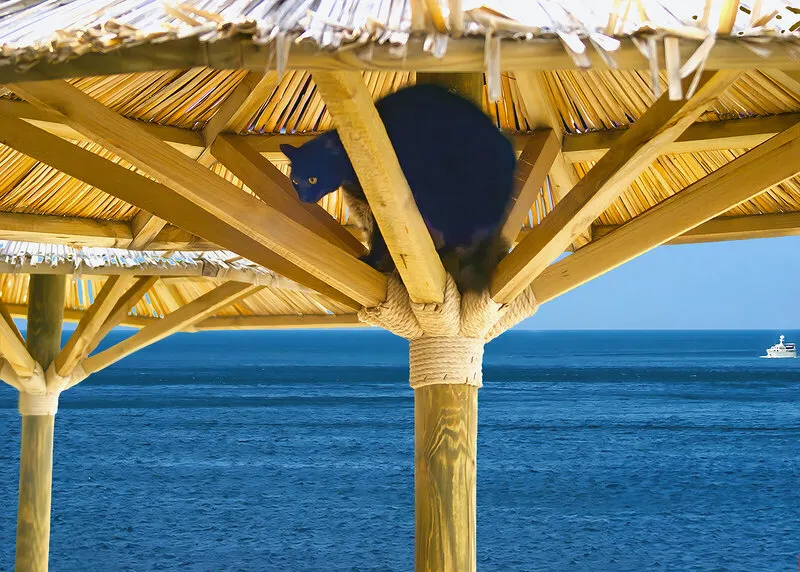
Jörgen Thornberg
Cat under a Hot Straw Roof, 2019
Digital
70 x 50 cm
Cat under a Hot Straw Roof
Please have a look at more of my work. You will be surprised. Follow the link below.
https://www.konst.se/jorgen-thornberg
Cat Under a Hot Straw Roof
Scene 1 - The Morning
Ophelia met Cassandra where the fishing boats lay,
All the hopeful cats gathered, hoping for the day.
The fisherman loved cats, gave scraps once he was through,
Ophelia didn't wait; she had news she claimed was true.
Ophelia: "Old Fart is fine! Do you know where Adonis might be?"
Cassandra: "Not seen him today, he should be cleaning Donkey Shit, you see."
Ophelia: "You never liked children, Cassandra; please don't lie."
Cassandra: "Well-behaved ones I like; too much joy makes me sigh."
Ophelia: "Then have some of your own; bring them up, right."
Cassandra wanted kittens, but only with Adonis in sight.
Adonis decided to hide; not even his mother he'd greet,
Ophelia yelled for him, her voice filling the street.
Ophelia: "Ol’ Fart’s healthy, except for a few things," she lied,
Disappointed by Adonis's silence, she fell to her knees and cried.
Ophelia assumed much, made it hard for Cassandra to say,
That Adonis didn't want her, it was he who turned away.
Adonis's sexual orientation lay like rocks in their path,
Cassandra's reflection made her feel old, losing her wrath.
By chance, they met outside the supermarket’s door,
Adonis sneaks in for the cold Coke he adores.
Cassandra: "Adonis, Old Fart is dying, the lie’s taken you in,"
Adonis was silent; his hatred for lies kept deep within.
Cassandra: "I stick with you for Old Fart’s pearl, though poor I’d stay,
I love you regardless, come what may."
Adonis: "I wish things were simple, like when Growler and I
As youngsters hunted mice, things were clear, no lie."
Cassandra: "But we can't go back, we face what's in front,
Together, we'll stand strong, and there is no need to confront."
Adonis looked the other away, lost in the past’s glow,
While Cassandra watched, her heart aching, beating slow.
Scene 2 – Four Seasons
Cassandra took an outing to Plakes, where the beach lay,
She sought solace alone to while away the day.
Strolling along the cliff path, gorgeous and steep,
Or hitching with a donkey, their scent made her leap.
She stowed on the shuttle, to the hotel she went,
Exploring sunbeds, where the wealthy time spent.
Finding one in the shade, she settled to stay,
With Proust in her bag, she’d keep others away.
Though the book was unread, its purpose was clear,
To ward off the social, to keep solitude near.
The sunbeds around her, for planning and chat,
Cassandra just wanted her peace, and that was that.
Alcyone appeared the last cat she wanted to see,
So Cassandra hid quickly under the parasol's canopy.
Alcyone didn’t stay long; her walk back was tough,
Despised by the donkeys, her hissing too much.
Cassandra enjoyed another hour in the sun,
Before heading back, her grooming began.
She readied herself for Old Fart's birthday affair,
Hoping to be close to Adonis and pretending they cared.
Scene 3 - The Restaurant
In a small square near the port at Ostria, they meet,
Cassandra and Adonis, sharing leftovers discreet.
The setting is idyllic, amidst alleys so tight,
Their meal was in secret, hidden from sight.
Cassandra, the black sleek, panther-like cat,
Envied by others, where she elegantly sat.
Adonis, a tabby with fur banded fine,
Spoiled from birth, a favourite feline.
Adonis’s brokenness, a stark contrast within,
Repressed feelings for Growler, a fight he can't win.
His mother, Ophelia, is crude and sincere,
His father, Old Fart, with stories to hear.
Over the meal, Cassandra’s heart lay bare,
Adonis is indifferent, showing little care.
Cassandra’s frustration, her longing displayed,
Adonis’s silence, her hopes are delayed.
She spoke of Xan and Alcyone's greedy plan,
To cut Adonis out of his legacy, poor man.
Old Fart’s illness, a secret Ophelia held tight,
Adonis's behaviour is a weapon for the fight.
Cassandra: "Did you hear about Xan and wife?
They plan to cut you out; their greed is rife."
Adonis: "Hmm," his response so bare,
Cassandra fought to make him aware.
Cassandra: "You have a lead, Old Fart’s love for you,
Show you're better; you must prove what’s true."
Adonis: "Why should I? It’s all meaningless,"
Cassandra felt the weight of his emptiness.
Cassandra: "You weren’t always like this, you were wonderful once,
I haven’t given up hope, though you see me as a dunce."
Adonis’s silence made Cassandra push more,
But his indifference was a heavy locked door.
Scene 4 - The Evening Unfolds
The evening brought tension, a storm in the air,
At Old Fart and Ophelia's, the guests were aware.
There was no formal invite, but rumours spread fast,
About Old Fart's illness, his time almost passed.
Ophelia played hostess, gracious and kind,
Guests brought their offerings with plans in mind.
Milk was for toasting, no wine to share,
The garden, their living room, with a sea breeze fair.
Old Fart led the group, the hypocrite Tuck by his side,
Xan discusses memorials flirting with Old Fart’s pride.
Cassandra began chanting, her voice soft and clear,
Old Fart interrupted, his command severe.
Ophelia fussed over Adonis, Old Fart's orders loud,
The atmosphere is heavy, tension in the crowd.
Alcyone’s children sang songs of love,
Contrived affection, hoping for wealth from above.
Ophelia's sudden speech made everyone uneasy,
They learned the truth, making the scene quite queasy.
Cassandra, Alcyone, and Xan vied for Old Fart's grace,
Their desperation is evident in the inheritance race.
Old Fart questioned Adonis about last night,
Adonis’s answers tried to avoid the light.
Old Fart’s crude notions, Ophelia’s quiet plea,
Their relationship was strained for all to see.
Ophelia’s declaration of love met with disdain,
Old Fart's cruel response brought her pain.
Old Fart to Adonis, about Cassandra and Alcyone’s plot,
Adonis revealed their aim, the inheritance they sought.
Old Fart heard a noise, Alcyone at the gate,
Her spying words met with Old Fart's hate.
Adonis's drinking, his problem laid bare,
Old Fart's harsh truth is hard to bear.
Scene 5 - The Winemaker’s Bar
The family gathered tension lays heavy in the air,
Ophelia is uneasy if Old Fart was no longer there.
Cassandra fetched Adonis, his presence tense,
Xan and Alcyone's news, Ophelia’s suspense.
Old Fart's cancer revealed, Ophelia’s hysteria shown,
Adonis's drinking problem and Ophelia's disowned.
The truth shook the family; their bonds laid bare,
Ophelia’s denial but for Old Fart her genuine care.
Cassandra defended Adonis, Xan’s fury displayed,
Among them, hostility grew as insults were made.
Adonis’s indifference and his drinking to cope,
Ophelia’s wish for a grandson is her desperate hope.
Cassandra's announcement, her lie to maintain,
Ophelia's happiness, Xan and Alcyone's disdain.
Ophelia rushed to tell Old Fart the news,
Alcyone's accusation, Cassandra’s ruse.
Cassandra claims a baby on the way,
Old Fart’s grandchild, the talk of the day.
Ophelia’s joy, while Xan and Alcyone sneer,
A lie so bold that Cassandra's scam is unclear.
Adonis's “click,” his drink in hand,
Cassandra's plan, her lie to withstand.
She hid the liquor, demanding love,
Adonis’s dependence, her power above.
Ophelia’s interruption, seeking morphine's aid,
Cassandra’s control, her love displayed.
As the curtain fell, Cassandra declared,
Her love for Adonis, his response ensnared.
Scene 6 - Reflections
“Wouldn’t it be funny if that was true?”
Adonis’s remark, a summary view.
Reflecting on Hydra’s cats and their play,
It is a tale of love, lies, and life’s fray.
Katty listened, her questions wise,
A dramedy, a catedy, through feline eyes.
Balancing drama and comedy's thread,
A story of cats and their lives widespread.
Deception, ageing, themes so deep,
Adonis’s drinking, secrets to keep.
Homosexuality, death, truths concealed,
Relationships strained, hearts unhealed.
Katty: "Nostalgia and wealth, themes in the play,
The past was fun, but today’s hardly okay."
The play’s happiest moments were memories, dear.
Adonis’s past, Ophelia’s and Cassandra’s fear.
Old Fart’s legacy, the pearl’s hidden worth,
Cassandra’s final lie is a desperate birth.
Katty: "Tragicomedy, life’s highs and lows,
The truths and lies, the story flows."
Reflecting on events and life’s vibrant hue,
The title is fitting for cats and humans, too.
Cassandra’s resilience, her struggle and fight,
Her victory was clear on the final night.
Katty’s wisdom, her feline view,
The play’s essence, through and through.
"Cat under a Hot Straw Roof," a tale so bright,
Of love, lies, intrigues and life’s twilight.
Hydra, July 2024
Cat under a Hot Straw Roof
A Play in six acts
Scene 1 - The Morning
Ophelia meets Cassandra, where the fishing boat docked, and all the hopeful cats gather. The fisherman liked cats, and after the customers got their share, the cats could count on the fish scraps and maybe even a small whole fish or two. Ophelia didn’t plan to wait that long but said she had wonderful news about Old Fart. She asked if Cassandra knew where Adonis was.
Ophelia: "I have wonderful news about Old Fart. Do you know where Adonis is?"
Cassandra: "I haven't seen him since last night, but he should be helping clean Donkey Shit Lane by now," she said, knowing full well that Adonis had quit that job.
Without any reason, Ophelia accuses Cassandra of disliking children.
Ophelia: "You never liked children, did you, Cassandra?"
Cassandra: "That's not true. I just like well-behaved children."
Ophelia: "Then you should have some of your own and bring them up properly."
Cassandra wanted kittens, but only with Adonis.
Adonis had decided to hide from the world, refusing to speak even with his mother.
Ophelia yells for Adonis and then discloses that the results of Old Fart’s health report were all negative—he’s in satisfactory condition, save for some issues.
Ophelia: "He's perfectly healthy, except for a few issues," she lied. Ophelia is disappointed with Adonis’s lack of response, saying she fell to her knees when she heard the news.
Ophelia makes assumptions about Cassandra and Adonis’s relationship that make it difficult for Cassandra to communicate the truth—that it’s Adonis who does not want her, not the other way around. And, as will be revealed, the rocks in their relationship lie in Adonis's bisexual orientation. Cassandra’s unhappiness stems from her having to deal with Adonis’s lack of affection for her and his family. As she gazes into a 21st-century shop window, she seems to be losing hold of herself. She sees herself becoming an ageing, unattractive cat.
By chance, she and Adonis run into each other outside Bexis supermarket, where he had sneaked in to see if he could snatch a small bottle of Coca-Cola, his favourite drink, which cats shouldn't drink for fear of losing their teeth.
Cassandra: "Adonis, I have something to tell you."
Adonis: "What is it, Cassandra?"
Cassandra: "Old Fart doesn’t have cancer. He does! His coming death has been hidden—been repressed. Old Fart is dying, and Xan, Alcyone, and I are all vying for a piece of his wealth. The lie has completely taken you in."
Adonis, meanwhile, had been completely taken in by the lie. This will become more important in hindsight, as Adonis's hatred of lying will be revealed in due time. Cassandra tells Adonis that she is sticking with him because she wants him to get Old Fart's pearl, as she hates to be a poor cat. She lies; she loves him regardless of whether he is rich.
Cassandra brings up the past when she had an affair with Growler, and Adonis does everything he can to try and stop her, in vain.
Cassandra: "There was a time with Growler, Adonis. Before you."
Adonis: "Stop it, Cassandra. I don't want to hear about it."
Cassandra: "Both Growler and I loved you, Adonis."
At first, it seems that Adonis can't face that there was a time before him, but as she explains that both she and Growler loved him, it becomes clear that he can't deal with the possible homosexual aspect of his friendship with Growler. Cassandra refuses to give in to Adonis's attempt to repress the past.
Now, the tension starts to come out. Cassandra's story makes Growler’s love for Adonis clear. While Adonis uses his crutch—his only support in his physical brokenness—to try to shut Cassandra up and, in so doing, preserve his only support in his spiritual brokenness—the idea that his friendship with Growler was pure and true and had no homosexual overtones. Cassandra seems to think that Growler is the only one who harbours such feelings. But Adonis's desperation to shut her up suggests that perhaps that isn't true.
Adonis’s surprisingly honest response reveals how much he still lives in the past. He wants to go back to his days as a teenager, hunting mice with Growler, when their friendship in Adonis's mind was pure, sound, and uncomplicated. The other day, his jumping donkeys were a drunken attempt to return to those times. But you can't go back, and he broke his ankle trying.
Adonis: "I wish things could be simple again. Like when Growler and I hunted mice. Everything was clear then."
Cassandra: "But we can't go back, Adonis. We have to face what's in front of us."
The scene ends with Adonis looking away, lost in thought, while Cassandra watches him, her heart aching with unspoken words.
Scene 2 – Four Seasons
Cassandra had taken some time for an outing to Plakes and the Four Seasons hotel with its fantastic beach and numerous soft beach beds perfect for a cat to lie in. If Adonis could disappear, so could she. Getting to Plakes was no problem; the path along the cliff edge towards the sea was breathtakingly beautiful, something even a cat girl appreciates. It was better to hitch a ride with a donkey friend, and Cassandra had many of those. But today, she preferred to be a stowaway on the shuttle boat between the hotel and Hydra port.
Walking just over three kilometres at a leisurely pace, for a cat girl doesn't hurry, stopping now and then to sniff around would take Cassandra an hour and a quarter. Hitching a ride with a donkey was a bumpy trip of three-quarters of an hour, but Cassandra liked their scent.
Since she had slept late that morning and was to visit her prospective father-in-law in the evening, she didn't want to push her schedule and instead sneaked onto the boat. It took five minutes, and some sea air cleared her nostrils. No one questions a cat; everyone thinks it belongs to someone else. Cassandra quickly explored among the hundreds of sunbeds. The section closest to Hydra is often less crowded and considered less prestigious by the regulars, many of whom booked a sunbed for an extended period, some for the whole summer. When she arrived at lunchtime, many guests had gone to the restaurant for a long lunch with a view. Cassandra quickly found an empty bed in the back row. She wouldn't be swimming anyway. Preparing the bed didn't take long, crumpling the towel that had been neatly folded in anticipation of a guest and taking out the book she had carried in a bag hanging from her mouth.
In the shade of a large wooden parasol covered with a straw roof, a cat can lie for a long time and ponder, at least until chased away. In the late afternoon, the risk is lower when most people have gone home to shower and change for the evening dinner. Cassandra brought a paperback book she had picked up outside another of Hydra's more luxurious hotels in Mandraki. There, people pay so much for a room per night that it could feed all of Hydra's cats for two days—a thousand portions! Their guests like to keep up their appearance and seem cultured, even though some must have stolen their money. The book was unread but dog-eared, so Cassandra concluded that it had only been carried back and forth between the sun lounger and the room. It was her way of ensuring she had the sunbed to herself.
The book was volume three of Marcel Proust's monumental work, 'In Search of Lost Time.' Not that Cassandra could read, but she had noticed that people avoided that sunbed if that book lay beside her on the cushion. She had understood that it had to do with the work's over four thousand pages. If someone had only reached volume three of seven, more than half remained. Such readers were rarely social; others found it pointless to lie next to them if hoping for social interaction. Most who sought out Plakes did so. It was here that excursions and dinners were planned, and new contacts were made. Cassandra just wanted to be left alone and had her reasons.
As usual, she was alone; she only wanted to share her solitude with her great love, Adonis, and no one else would do. Cassandra had been left in peace and dozed all afternoon when suddenly her so-called sister-in-law Alcyone appeared, the last cat on earth she wanted to meet just then. It's hard to hide on a beach, but Cassandra made a giant leap up and hid just under the roof of the straw parasol. The shrew Alcyone lay down on one of the nearby sunbeds, so Cassandra had to stay where she was. They were to meet in the evening, so that would suffice. Her prospective father-in-law, Old Fart, had invited family and close friends to his birthday party. It was not an evening Cassandra was looking forward to, except for the opportunity to be close to Adonis and pretend for a while that everything was normal.
Alcyone didn't stay long, as she had to walk all the way back. The so-called sister-in-law was not a well-liked cat and was despised by the donkeys for her hissing. The boat was also not an option, as she looked so angry that no one would want to acknowledge that cat. So she had to exercise. She came to the Four Seasons only to brag to her friends; status was important for her kind.
Cassandra could climb down and enjoy another hour of dozing before putting Proust back in the bag and walking a hundred meters to the boat, which was ready. The trip back was as uneventful as the previous one, and Cassandra had plenty of time to get home for a bit of grooming, filing her claws, and polishing her fur before heading to the birthday party. But first meeting with the great love of her life.
Scene 3
We meet our main characters in a small square near the port, at the restaurant Ostria. Cassandra and Adonis had decided to meet there before the party to get something to eat. The party only served cake, which was not a good way to satisfy their hunger. They are sharing a meal from the leftovers of a recently enamoured couple. The surroundings couldn't be more idyllic. The outdoor dining space is spectacular amidst the island and neo-classical architecture, next to the labyrinth of narrow alleyways and at the base of the staircases of Donkey Shit Lane. The ambience there is warm and friendly, and co-owner Tassoula knows both cats well and knows just how long to turn her back for them to snatch a bite of what Stathis, her husband, has prepared in the small kitchen.
Cassandra, her name meaning ’Man's Defender’, is a sleek, panther-like Bombay cat and is a sight to behold. Her beauty is such that all the tomcats whistle at her. She is the ‘Cat’ with a capital ‘C’ in the story I’m about to tell. She should cherish every day as the best, but that wasn't the case. Cassandra is lonely and miserable by her own choice due to Adonis's refusal to make her his desire. This made her hard, nervous, and irritable. Cassandra constantly poses in mirrors, shop windows, and occasionally in the nearest puddle when it rains on Hydra, holding the audience transfixed. The excitement of the play lies in the force of the audience's identification with its gorgeous heroine, a woman anxious about growing old, desperate in her sense of loneliness, which is made all the more beautiful by her envy, longing, and dispossession. Every day, she desperately scanned for grey hairs in her fur, which she meticulously licked away.
Adonis, a Ticked Tabby with a subtle tabby pattern where each hair is banded with different colours, was spoiled from birth. His mother was a house cat for the wealthy wine producer Boutaris, who owned a large villa on the island. Adonis was her favourite son, and she was used to girls fawning over him wherever he went. Adonis embodies an almost archetypal masculinity, but appearances can be deceiving. At the same time, the Adonis before us is also a broken cat because of his repressed homosexual desire for Growly, the pirate prankster with a voice like Leonard Cohen—a lovely cat in everyone’s eyes, especially Cassandra’s. Growly was not interested in Adonis more than as a drinking companion. Adonis didn't need to work to be well-fed. Still, sometimes, he helped Dimitri, one of the municipal sanitation workers, gather trash and donkey droppings, which Dimitri could easily scoop up and cart away. As a thank you, he treated Adonis to his favourite snack, honey-roasted calamari, which he kept in a bag in his pocket. Adonis called it his job, though it wasn’t much to brag about. His brokenness, however, is a stark contrast to his outward appearance.
Adonis's father, the birthday boy—if you can call an old cat something so disrespectful, whom Cassandra dubbed Old Fart, was a ship’s cat, an authentic polydactyl cat with an extra toe on each foot, which was an advantage on slippery decks. They called them ‘Boxing Cats’ on the island because they often won fights due to having more claws. Affectionately dubbed by Cassandra as an old-fashioned Kamini Troller, he was done with life as a ship’s cat. This didn’t bother Old Fart, who boasted widely about his voyages around the world, how he once climbed the mainmast of a schooner in a storm south of Cape Horn and bit through a stuck rope, thus saving the ship from doom. Another story was about how wealthy he was, though he didn’t need to be on an island where nothing was lacking. His fortune was a rare black pearl, perfectly round and larger than a cat’s eye, with an immaculate surface and a brilliant shine. In the human market, it would be worth a fortune.
Old Fart is a large, brash, and vulgar old codger who believes he has returned from the grave. Though his imminent death has been quickly suppressed, in some sense, Old Fart has confronted its possibility. In returning from the other side of the River Styx, where he had been Hades’s house cat in Death’s Country, Old Fart would force Adonis to face his desire.
Adonis’s mother, Ophelia, has lost the lustre in her fur over the years. She is overweight, breathless, sincere, earnest, and crude, with a necklace richly decorated with flashy gems. Ophelia is a woman embarrassingly dedicated to a man who despises her and is in feeble denial of her husband’s disgust. She considers Adonis her ‘only son’ despite having dozens more with different fathers. But a mother is always a mother to her son.
Despite a lit candle on the table, Stathis’s exquisite calamari as an appetiser, and a tasty plate of freshly caught red mullet and sea bass as the main course, the spark Cassandra had hoped for didn’t appear. Adonis barely responds or listens as she purrs tenderly, showing how complex communicating will be. Cassandra, in her most well-groomed fur that accentuates her form—and yet ignored by Adonis—suggests her frustrated sexuality. Adonis's ankle, the way he can't stand upright, displays his brokenness.
Instead, Cassandra slipped into discussing how Adonis’s half-brother, Xan, and his partner, Alcyone, aim to cut Adonis out of Big Daddy’s estate now that they have a report confirming that Old Fart is dying of cancer. She continues to complain about Adonis’s behaviour, which makes it easier for Xan and Alcyone to make a case against giving him part of the inheritance. Adonis had quit working cleaning the alleys, started drinking, and just last night injured his ankle while attempting to jump donkeys in a silly game, one that only boys play, which is all about impressing and outdoing each other.
Xan had done well in life but still wasn’t satisfied; much wanted more. Xan was a favourite cat of the owner of the restaurant Kodylenia in Kamini. Famous for its delicious fish dishes, it was heaven on earth for a cat. Xan is Old Fart’s elder and less-favoured son, likely due to his mother coming from a simple fishing family. He deeply resents his father’s love for Adonis, viciously relishes Old Fart’s illness, and rather ruthlessly plots to secure control of Old Fart’s hidden treasure, a genuine black pearl the old man had stolen during a trip to Polynesia when he was younger. According to Old Fart, you could buy a dozen fishing boats with it, nets and all. Where it was hidden, Old Fart hadn’t revealed, but Xan was sure the old man had hidden the pearl in the ship’s chest he never left unlocked.
Xan’s partner, Alcyone, is a mean, agitated ‘monster of fertility’ who schemes with her husband Xan to secure Old Fart’s treasure. She practically spews out kittens and, according to jealous neighbour cats, is on the verge of filling Kamini with her offspring. Alcyone appears primarily responsible for the burlesques of familial love and devotion she and the children stage before the grandparents. Her strategy with all the children could be a way to create sympathy with the stern Ophelia, but like all grandmothers, she loved her grandchildren, each new one boosting her self-esteem.
“Despite all that, Adonis still has one big advantage—Old Fart dotes on him and dislikes Xan and Alcyone. Cassandra also suspects that Old Fart has a ‘lech’ for her from the way he stares at her body when she’s talking to him. She continues to tell Adonis about the details of last night’s supper, how odious Alcyone and Xan were, talking about the grandchildren, and how little Old Fart seemed to care. However, Adonis doesn’t seem to pay much attention to her arguments. Cassandra continues and stresses how Xan believes he took a step up the social ladder by taking Alcyone as his partner when her family was only wealthy once. Then they lost that, too, when their butcher shop went bankrupt.
As Cassandra continues to make fun of Alcyone’s bragging about being a former carnival queen, she notices the way that Adonis is staring at her—not in the way a woman wants a man to look at her. Frightened, she asks Adonis why he’s looking at her like that. Adonis claims he wasn’t conscious of looking at her, but Cassandra continues speaking. She says she’s aware she’s transformed and become thick-skinned and mean.
Cassandra alludes to the fact that she used to act differently—nicely—but circumstances have forced her to change. Her reaction to Adonis’s stare also emphasises their distance and how little they understand each other.
Adonis rejects Cassandra’s advances, returning none of the affection Cassandra shows him. When Cassandra mentions that she’s lonely, rather than offering comfort, Adonis asks her whether she’d like to live alone, forcing Cassandra to change the topic and reel in her feelings. All conversation between the two is very strained, mainly as Adonis makes no effort to engage or be pleasant.
Cassandra says Adonis may think he looks better since he started drinking, which is false. On the contrary, drinking makes him appear pathetic. Cassandra begins to mention Adonis’s friend Growly before abruptly interrupting herself and apologising. Instead, she reminisces about how fantastic Adonis once was and says that if she thought he would never love her again, she would find a knife and stab herself in the heart. However, she hasn’t given up hope and compares herself metaphorically to a cat on a hot roof in the noonday sun—trying to stay on the hot surface as long as possible.
At this moment, as often in life when it’s difficult, the past seems like a much better place than the present. It sounds like Cassandra was once happy when Adonis flirted with her, but circumstances changed, and he no longer returned her love. The topic of Growly is yet another subject Cassandra knows she should not talk about, yet another obstacle in conversation, yet another secret or repressed issue.
They rose from the table and walked around the corner, as Cassandra didn’t want their discord to be visible to others. Cassandra again asks what Adonis was thinking of when looking at her. She asks whether he is thinking of Growly, and Adonis ignores her as Cassandra informs him that the ‘laws of silence don’t work.’ Adonis drops his crutch, and when Cassandra tells him to lean on her instead, he loses his temper, yelling that he doesn’t want to lean on her shoulder. Cassandra hurriedly hands him his crutch. Adonis is alternately silent and violent, making conversation difficult. He loses his composure, mainly when Growly is brought into the conversation.
Cassandra tells Adonis that they mustn’t shout because the walls have ears—but she believes that a crack in his composure is a good sign. Adonis tells Cassandra that being catty doesn’t help matters, and Cassandra says she knows that—but she’s eaten up with longing and envy. Adonis tells her she’s spoiling his peace with her voice, and Cassandra says she always feels like a cat on a hot roof with no chance of finding shade. Adonis responds that cats can jump off roofs and land on their feet—he advises her to jump and choose someone other than him. She says that she can’t see other men and wishes Adonis would get fat or ugly so that she could bear his indifference.
Cassandra: "Did you hear about Xan and Alcyone? They plan to cut you out of the estate. Old Fart's dying, and they have a report confirming it. They're using your behaviour against you. Drinking, quitting work, and last night’s donkey-jumping injury—it's all ammunition for them."
Adonis: (barely listening) "Hmm."
Cassandra feels the sting of his indifference. She knows she must fight to keep his attention, to make him see the danger.
Cassandra: "Xan is ruthless. He resents you, and Alcyone is a monster of fertility, flooding Kamini with their offspring. They want everything, including the black pearl Old Fart hid."
Adonis: "Where do you think it is?"
Cassandra: "In the ship’s chest. It’s the only thing he never leaves unlocked. You have one advantage, though—Old Fart dotes on you and dislikes Xan and Alcyone."
Adonis: "He has a lech for you too."
Cassandra shivers at the thought but knows it might be their only leverage.
Cassandra: "He stares at me, yes. But that doesn't change our situation. You need to show you're better than Xan. Prove it to Old Fart."
Adonis: "Why should I?"
Cassandra: "Because it’s our future. Don’t you care about us?"
Adonis looks at her, his gaze empty. Cassandra's heart sinks.
Adonis: "What’s the point? It’s all meaningless."
Cassandra feels the weight of his despair. She tries to rally, to find a spark of hope.
Cassandra: "You weren’t always like this. You were wonderful once. If I thought you'd never love me again, I’d find a knife and stab myself. But I haven’t given up hope. I'm like a cat on a hot roof, trying to stay on as long as possible before frying my paws."
Adonis: "Jump off then. Cats land on their feet."
Cassandra: "I can’t. I can’t see other men. I wish you'd get fat or ugly so I could stand your indifference."
Adonis’s silence is crushing. Cassandra knows she must keep talking and keep pushing.
Cassandra: "Remember how Xan believes he climbed the social ladder with Alcyone? Her family was only wealthy once, and they lost it all when their butcher shop went bankrupt."
Adonis shrugs, unmoved. Cassandra fights the urge to scream.
Cassandra: "Being catty doesn’t help, I know. But I'm eaten up with longing and envy. You're spoiling my peace."
Adonis: "And you're spoiling mine with your voice."
Cassandra’s frustration boils over. She feels like a cat on a hot roof, desperate for relief.
Cassandra: "I always feel like a cat on a hot roof with no shade."
Adonis: "Cats can jump off roofs and land on their feet. Jump and choose someone else."
Cassandra: "I can't. I can’t see other men."
Their conversation circles back to the same unresolved issues. Cassandra’s desperation grows, but Adonis remains distant, broken, and unreachable.
Scene 4 - The Evening Unfolds
The evening brought a certain tension, with a thunderstorm brewing over Peloponnese. Whether it would cross the strait was unclear, as the weather gods and meteorologists seemed equally divided. Despite this uncertainty, a different kind of storm was brewing at Old Fart and Ophelia's home. No one had invited anyone for a meeting, but the rumour of Old Fart's illness spread, drawing in people with various interests in whether he lived or not. Bit by bit, they arrived, and Ophelia, as always, played the gracious hostess.
In a Greek cat household, no guest goes unwelcomed without some offering. Cats have no refrigerators, so it had to be highly improvised. A tetra pack of milk could be pinched from their human hosts, Boutaris, for cats preferred to toast with milk rather than wine when welcoming guests. Their living room was outside in a corner of the large garden that stretched down the hillside in several terraces. At the bottom, near the port, stood a statue of Artemis, the huntress goddess and Apollo's twin sister.
Old Fart leads the group, followed by the priest’s cat Tuck and Xan, discussing memorials.
Old Fart: "Why all this talk about memorials? Someone planning to die?"
Tuck laughs awkwardly as Alcyone and Asclepius appear, talking about the children's vaccination.
Cassandra: "Adonis, please sing a chant."
When he ignores her, she starts chanting herself.
Old Fart: "Shut that off!"
She fell silent immediately as Ophelia entered the terrace and called for Adonis.
Old Fart: "Start singing again!"
Everyone laughs at Ophelia’s expense. She laughs it off and approaches Adonis.
Old Fart is the centre of everything, issuing orders and having everyone do his bidding. Tuck knows Old Fart is dying of cancer, and he keeps hinting at memorials, hoping to secure money for the church after Old Fart’s death. Old Fart's response shows he believes the health report—he thinks he's going to live. The people around him take on a different tone: he sees them as small fish following big fish, but they are sharks drawn by Old Fart’s wealth. Notice Old Fart's cruelty toward Ophelia—his effort to drown out her ability to communicate by turning on the radio—and her sad response. Their relationship is revealed: he despises her, and she is desperate to please him. This tension in their relationships is palpable, making the audience feel uncomfortable.
Ophelia fusses over Adonis and flops down on a marble bench, pulling the priest’s cat onto her as a joke.
Old Fart: "Stop that foolishness!"
Ophelia signals the cue for the kitchen cats to bring in Old Fart’s birthday cake and champagne. Everyone except Adonis meow "Happy Birthday to You," and when that’s finished, Alcyone signals her children to sing another song about how much they love Old Fart and Ophelia.
Old Fart has little patience or affection for Ophelia, though she seems sincere in her affection for him. The choir of Alcyone’s children is a contrived, naked ploy to get Old Fart's affection and, therefore, his money. It raises the issue that the birthday song is also contrived, an example of the kind of lie people create to depict social harmony and project a non-existent love. Only Adonis refuses to participate.
Ophelia: "And the health report was wonderful news!"
Cassandra interjects, asking Adonis whether he’s given Old Fart his birthday present yet.
Xan bets Adonis doesn’t know about the present, while Cassandra opens the package. She sounds surprised as she pulls out a cashmere robe, but Alcyone accuses her of faking the surprise, knowing Cassandra purchased it last Saturday. As the conversation gets cattier, Old Fart bellows for quiet. The priest’s cat, unfortunately, finishes a sentence in the silence after everyone stops speaking, and Old Fart turns on him, accusing him of talking about memorials again.
Ophelia’s speech makes everyone uncomfortable because they know she’s unknowingly lying about Old Fart’s health report, so Cassandra interrupts her. Cassandra, Alcyone, and Xan then manoeuvre to try to win Old Fart's love and money. Their desperation is evident, making the audience feel the characters' eagerness and anxiety. Old Fart has no patience for it or the sanctimonious Tuck. He fulfils his traditional role: getting whatever he wants while telling everyone else what to do. Old Fart's anger at Tuck for talking about memorials indicates his intense fear of death.
As the atmosphere grows uncomfortable, Old Fart turns to Adonis.
Old Fart: "What were you doing in the port the other night when hurting yourself? Laying a woman?"
Alcyone quickly ushers the priest's cat out onto the arcade.
Adonis: "No, I wasn’t."
Old Fart continues to interrogate him, asking whether he was drunk. Ophelia and Cassandra try to change the subject, drawing attention back to the cake.
Old Fart: "Stop it, both of you!"
Meanwhile, Xan has retreated to the gallery as well. Old Fart wants to know what happened to Adonis last night and doesn’t mind destroying the conversation on the terrace to find out. His notion of sexuality is crude and masculine. He thinks nothing of asking Adonis if he was "laying a woman" in front of his wife. Perhaps he is being so crude to shock the conversation into truth because he suspects the truth about Adonis and Growler. The characters' fear of Old Fart is palpable, making the audience feel the characters' apprehension and dread.
Old Fart: "I’m tired of you trying to take over because you thought I was dying of cancer."
Ophelia: "Hush, please!"
Old Fart: "I built the plantation by myself. I refuse to let you take it over now. My colon's spastic from disgust for hypocrisy and liars."
Ophelia, upset, exclaims that she has loved him all these years, but he doesn’t believe her. She rushes out onto the gallery, her heart heavy with the weight of his disbelief and her unrequited love.
Old Fart: "Wouldn’t it be funny if that was true…" He says this with a sly smile, his eyes fixed on Adonis, his true intentions veiled behind a facade of nonchalance.
Old Fart rejects Ophelia’s affection, believing she has ulterior motives. He considers her affection a lie, an effort to take what he built. The play explores similar ideas with Cassandra and Adonis, as Cassandra seems to love Adonis, be impossibly physically attracted to him, and want the money he may inherit. Old Fart sees love as a lie, a way for women to take what belongs to men. Incidentally, his comment that "liars" gave him a spastic colon is more accurate than he knows: the "spastic colon" is itself a lie, given to him by liars.
Old Fart: "I need to speak with Adonis."
Cassandra delivers him, exiting onto the gallery with a kiss, which Adonis wipes off. Now Old Fart and Adonis are alone.
Old Fart: "Look at Cassandra and Alcyone. They’re like cats on a hot tin roof."
Adonis: "They’re trying to get a piece of your land."
Old Fart: "They have a surprise coming—they think I'm planning to die soon."
Even Adonis’s small actions—like wiping a kiss—reject Cassandra and Old Fart notices this. Adonis and Old Fart, when alone, communicate more directly and bluntly than with others. Adonis quickly reveals what everyone else is trying to do: that Alcyone and Cassandra both want a piece of Old Fart’s inheritance. Yet Adonis doesn't reveal the real secret that Old Fart's belief that he's going to live on for some time is wrong. Their communication is incomplete.
Old Fart hears a sound from the next terrace and asks who’s there. Alcyone appears by the gallery entrance.
Old Fart: "Stop spying."
Alcyone: "Why are you so unkind to those who love you?"
Old Fart: "Shut up. I'm moving you and Xan away from the terrace. All you do is spy and report to Ophelia."
Alcyone leaves dramatically, pressing a handkerchief to her nose. Another example of a private conversation interrupted. Even if the topics weren’t so sensitive, conversation would be difficult in this household. Alcyone accuses Old Fart of not returning the love around him—accurate for Ophelia, though Alcyone’s motives are suspect. Yet Old Fart thinks Ophelia has the same motives. For the characters, love and selfishness have become tangled.
Old Fart: "Alcyone and Xan say you won’t sleep with Cassandra. Is that true? If you don’t like her, get rid of her."
Adonis has gone to Boutaris's liquor cabinet to steal something more potent than milk to drink.
Old Fart: "You have a real liquor problem. Quit drinking and stop throwing your life away."
Adonis agrees without really listening. Old Fart comments that it’s hard to communicate genuinely.
As Old Fart turns the conversation back to Adonis and Cassandra—to their sexuality or lack thereof—Adonis retreats into alcohol. Conversations in the play are often paused as he refreshes his drinks or waits for his “click.” Old Fart notices how Adonis uses alcohol to block communication, but also how communication is just difficult in general.
The Cathedral clock bells.
Adonis: "Pleasant sound."
Old Fart: "Guess how much I’m worth," he said, completely unprovoked.
When Adonis doesn’t respond, Old Fart informs him that he’s worth millions of in humankind's wealth. He concludes somberly that a man can’t buy his life. He reminisces about Europe, saying he has enough wealth to feed Hydra’s cats for a long time. Old Fart claims rich humans like Boutaris hoard their money, hoping one purchase will turn out to be life everlasting.
Old Fart: "You can't buy immortality."
Adonis pours himself another drink from Boutaris outdoor bar and tells Old Fart that he’s talking a lot tonight.
Adonis: "I prefer solid quiet. Are you done talking?"
Old Fart: "We never truly talk—you try to look like you listen, but you never actually do."
Old Fart closes the gallery gate so that he and Adonis are alone.
Old Fart: "Ever been downright terrified in your life? I thought I had cancer."
With the new health report, he feels much better.
Old Fart: "I'm contemplating pleasure with women. Slept with Ophelia until five years ago, never even liked her."
Ophelia bustles through the gate to join them.
Old Fart: "Use a different place, whatever you want."
She makes a playful face at him and hurries through. Adonis hobbles towards the gallery gate.
Old Fart: "This talk’s not finished."
Ophelia tries to walk back through. Old Fart closes the gate, not letting her in.
Ophelia: "Take back your words about me trying to take over my life."
She retreats down the gallery, sobbing.
Old Fart's cruel treatment of Ophelia, even as he tells Adonis about his desire for "pleasure with women," shows how little he cares for love, either hers or in general. Old Fart sees women as a means to pleasure, not love. Ophelia tries to bear up under his mistreatment, thinking endurance will win his love but ultimately breaks down. Adonis’s discomfort with any topic touching on sexuality makes him try to escape, but Old Fart is dead set on a conversation on communication.
As Old Fart contemplates pleasure with women, talking about using his wealth to secure a young woman, Adonis rises with effort.
Old Fart: "What makes you so restless?"
Adonis: "The click hasn’t happened yet."
He explains the click he gets when he drinks alcohol. Old Fart, astonished, calls him an alcoholic, which Adonis calmly accepts. Adonis attempts to leave again, saying this talk is going nowhere. Old Fart seizes Adonis’s crutch and tosses it across the terrace.
Old Fart: "Stay."
Old Fart continues about his test results and how he believed he had cancer. Adonis makes a wild dash for his crutch.
Old Fart: "Why do you drink?"
Ophelia rushes in.
Old Fart: "Get out!"
She runs out, sobbing. Adonis hobbles towards the gallery again, but Old Fart retakes his crutch.
Old Fart: "Why do you drink? I'll pour you a drink if you tell me."
Adonis: "Out of disgust."
Old Fart: "Disgust with what?"
Adonis refuses to say until Old Fart pours him a drink.
Adonis: "Disgust with mendacity—lying and liars."
On the terrace next door, the children start chanting for Old Fart. Xan appears in the gallery gate.
Xan: "Come see the rest of the family."
Old Fart shuts him out.
Old Fart: "Who’s been lying to you? I know all about deception. I had to lie about caring for Ophelia, Xan, and Alcyone. The only one I’ve ever had any devotion to is you. There’s nothing to live with other than dishonesty."
Adonis: "Liquor is something else to live with."
Old Fart: "That’s not living."
Adonis: "Milk, I've avoided it since I grew tired of mother's milk, but never the packaging," said Adonis, laughing at his joke.
Old Fart says he couldn’t decide who to make his will out to—to give it to Xan and Alcyone or to support Adonis as he rotted away. Adonis responds with indifference and heads to the gallery gate to watch Old Fart’s birthday fireworks. Xan had hidden a box he found last Easter, and any cat can light a Swan Vestas match, the kind you can strike on any hard surface. Hold the match between your teeth and scrape the head against the terrace's stone tiles.
Old Fart: "We shouldn’t leave the conversation here without being fully honest with each other."
Adonis: "I’ve never lied to you, but we’ve never truly talked."
Old Fart wants to continue about Adonis’s drinking.
Old Fart: "Go back to physical training."
Adonis: "I hate running without a goal.”
Old Fart: "You started drinking when Growler died."
Silence.
Adonis: "What are you suggesting?"
Old Fart: "Nothing. Xan and Alcyone say there was something off about your friendship with Growler."
Adonis loses his composure.
Adonis: "Who else said that?"
Adonis: "Are you accusing me of being queer?"
Old Fart denies it as Tuck enters, looking for somewhere to pee. In a wealthy person's house, you don't do such things just anywhere. Old Fart continues talking.
Old Fart: "I've seen a lot. Aristotele Petrarchos and Petros Elion had a special relationship. When Petros died, Petrarchos stopped eating and died too."
Adonis throws his glass across the terrace, shouting.
Adonis: "You think Growler and I performed sodomy together? Comparing us to dirty old men like Petrarchos and Elion?"
Adonis drops his crutch and falls. Old Fart helps him up, trying to calm him down.
Adonis: "A guy from Mandraki was found attempting an ‘unnatural thing’ and was chased off the island. I've heard he fled to Albania. Why can’t true friendship between two men be respected as pure and decent?"
Old Fart says it’s hard to talk, but instead of letting it go, he asks why Growler started drinking. Adonis decides to tell Old Fart the truth about the health report. First, he grabs another drink from the host’s bar and starts telling Old Fart his version of what happened with Growler.
“Cassandra was jealous of our friendship and planted in Growler the idea that he was in love with me, so Growler had sex with Cassandra to prove it wasn’t true. However, he believed it was true when that didn't work out. It was that simple and a long time ago. We were young cats and didn’t understand.”
Old Fart pressures Adonis, believing he left something out.
Adonis: "Much later, some months ago, in a state of drunken stupor, Growler was overcome with guilt and called across the harbour basin to give a drunken confession of love. I shut my ears. That was the last I heard from him."
Old Fart: "You’re disgusted with yourself for digging your friend’s grave before facing the truth with him."
Adonis: "No one—including you—can face the truth."
Adonis blurts out that everyone but Old Fart knows the truth of the health report.
Old Fart: "Adonis!"
Adonis returns to apologise.
Adonis: "It’s hard for me to understand that anyone cares whether they live or die anymore."
Old Fart passionately condemns all liars before leaving the terrace and retreating down the gallery. A child is heard being slapped, running through the terrace, crying, and out of the gallery gate.
Old Fart imagines himself as the bringer of truth. Now, he must face it himself. While the truth drives Adonis to alcoholism, it drives Old Fart to grief and rage. Adonis is beyond caring about living or dying; Old Fart only cares about living. Old Fart faces his imminent death, the understanding that those around him knew, and whether out of love or selfishness, made him into a dying man who did not know it. The slap of the child is ambiguous, demonstrating how rage and violence are passed down or that Old Fart can't stand the idea of a child living on while he dies.
Scene 5 - The winemaker’s bar
Everyone but Adonis trickles back onto the terrace, calling for Old Fart. Ophelia, with a hint of unease, suggests that Old Fart might have left because he was just worn out but was very happy to see family. Sensing the tension, Cassandra goes to the gallery to fetch Adonis while Ophelia becomes increasingly nervous about the family gathering around her. Alcyone's suggestion that Adonis said something he shouldn’t have said to Old Fart adds to the mounting tension, and Ophelia's eagerness to know what that might be is palpable. Before Xan can say anything, Alcyone rushes over to Ophelia and hugs her, which Ophelia impatiently pushes off. Ophelia starts talking about Adonis’s drinking as Adonis appears behind her, his presence adding to the already tense atmosphere. Adonis immediately heads for the winemaker’s bar, his actions further fueling the tension in the scene.
Ophelia’s little lie about Old Fart being very happy to see the family is a perfect example of the type of dishonesty that Adonis rejects—the kind of lie that society teaches us to spread to maintain social harmony. It's unclear if Alcyone is expressing genuine emotion for Ophelia here or is just continuing to try to ingratiate herself with her mother-in-law while driving a wedge between Ophelia and Adonis. Adonis, for his part, after being forced to reveal himself, once again rushes to the bar to protect himself from feeling anything.
Cassandra instructs Adonis to sit with Ophelia as they deliver the news, but he insists Cassandra sit with her instead. Xan and Alcyone reveal the shocking news of Old Fart's cancer. In a fit of hysteria, Ophelia calls for Adonis, her “only son,” A statement that offends Alcyone and Xan. Ophelia, in a moment of hypocrisy, denies Xan as her son based on his dislike of Old Fart. It becomes clear that Ophelia has completely sublimated herself to Old Fart. The priest’s cat, Tuck, leaves a package of morphine he stole from his master on the table in case Old Fart has pain, and then he leaves as well.
The truth finally comes out to Ophelia, who is visibly shaken and doesn’t handle it well. Her hysterics, however, are further evidence that her affection for Old Fart is genuine. She even denies Xan as her son based on Xan's dislike of Old Fart. She has, it seems, completely sublimated herself to Old Fart. The priest’s hypocritical cat, Tuck, has managed to secure funds for the church, but now he leaves when things get rough, adding to the emotional turmoil of the scene.
Ophelia tells Cassandra that she’s got to help get Adonis sober again so that he can take hold of Old Fart's estate, which sends Xan and Alcyone into a panic. They say that Adonis is much too irresponsible to take hold of things, and Cassandra comes to his defence, saying that Xan and Alcyone’s campaign against Adonis is founded entirely on avarice and greed.
Xan, in a fit of fury, admits his resentment towards Adonis and Old Fart’s favouritism, but he is savvy enough to protect his own interests. Alcyone and Xan's hostility towards Cassandra and Adonis escalates as Adonis reenters the terrace. Ophelia intervenes, telling them to hush, but the tension is palpable.
Xan and Alcyone reveal how much of this meeting revolves around Old Fart’s inheritance, as Cassandra accuses them of greed. Xan also references his past—his unrequited affection for Old Fart—and reveals his resentment towards his parents for their favouritism. As the situation becomes tense, communication also breaks down further, with insults coming out into the open. The conflicting emotions of greed, resentment, and unrequited affection add a layer of complexity to the relationships, making the audience feel the intricacies of the characters' feelings.
Meanwhile, Adonis is drinking and meowing to the moon. Ophelia says he looks just like he did as a little boy. Ophelia tells Adonis that Old Fart’s fondest dream would be to have a grandson from Adonis. Alcyone responds that it’s too bad Cassandra and Adonis can’t oblige.
In response, Cassandra grows determined and says she has an announcement to make. Cassandra announces that she and Adonis will have kittens, and Ophelia gasps in happiness while Xan and Alcyone dismiss the news as false.
Adonis’s alcoholism again acts as a barrier between him and the others, removing him from the conversation. Ophelia still dotes on him, however, even though he’s unreachable—she reaches into her memory of Adonis in order to love him. Ophelia's comment that Old Fart would like Adonis to have a son indicates another way that Old Fart might achieve immortality—through the line of his one son whom he loves and in whom he sees himself. Seeing an opportunity, Cassandra tells the play’s final lie. And just as Ophelia has clung to every other lie, she clings to this one, likely settling the question of inheritance in Adonis’s favour—though this isn’t said explicitly.
Ophelia rushes out to tell Old Fart the news while Alcyone screams that Cassandra is lying about her pregnancy. Alcyone says that she and Xan can hear Cassandra and Adonis in the hut next door and know that Adonis won’t sleep with her. Suddenly, a cry of pain and rage fills the house, and Alcyone and Xan run to see what it is, leaving Adonis and Cassandra alone.
Alcyone tries to reveal Cassandra’s lie, even though she hasn’t been entirely truthful throughout the play either, spying and withholding information about Old Fart’s health report. The cries of rage are implied to be in response to Ophelia's news about Cassandra's kittens and further suggest that Old Fart doesn't give a crap about "immortality" gained through Adonis's unborn. Old Fart wants to live for himself!
Cassandra thanks Adonis for not exposing her. Meanwhile, Adonis continues to drink and finally obtains his “click.” As he stands in the gallery with ancient columns, Cassandra grabs all the bottles in Boutaris bar and runs out of the terrace with them. When she returns, she faces off with Adonis. She tells him she’s now stronger than him and can truly love him more. Cassandra says that she’s hidden Boutaris' liquor, and they will make her lie true before she reveals the hiding place. As Adonis reaches for his crutch, Cassandra grabs it and runs out to hurl it over the gallery before returning, panting. Suddenly, Ophelia runs into the terrace, looking for the Morphin package. She runs out again after kissing Adonis and calling him “Little Father.” As the curtain falls, Cassandra announces to Adonis that she does love him, and he responds sadly, “Wouldn’t it be funny if that was true?”
Cassandra finally takes charge at the end of the play. She couldn't penetrate Adonis's alcohol-based distance. Still, now she - like Old Fart earlier - realises that Adonis's dependence on alcohol makes him weak, symbolised by Cassandra throwing away his crutch and defence. She can extort his love for her, at least physically. Love continues to be a function of power—suggesting that the women's love for their men is almost entirely a function of their dependence on them. But now Adonis is dependent on her. Further, Cassandra realises she can be the first character in this play to turn her lie into truth with this power.
Even Ophelia’s interruption doesn’t upset Cassandra, who calmly hands Ophelia the medicine before returning her attention to Adonis. Ophelia, meanwhile, goes to "ease" Old Fart's pain—but his pain is emotional and existential. In essence, she is putting Old Fart on a drug much more potent than alcohol, and all because of her sincere love for him. Old Fart wants to live, but Ophelia, now that she has control over him, is going to ensure merely that he survives, all motivated by love.
Cassandra, in her power, similarly tells Adonis her truth—that she loves him—and he, echoing Old Fart earlier in the play, doesn’t believe her. He sees it as just one more lie people tell each other. However, unlike Old Fart in his earlier scene with Ophelia, Adonis is weaker than Cassandra at this point. His rejection doesn't matter because she doesn't accept it.
Scene 6 – Reflections
“Wouldn’t it be funny if that was true?” Adonis's remark to Cassandra when she assures him of her love can be said to summarise the entire play,” I said to our house cat in Sweden, Katty, as I recounted my experience on Hydra. The jet-black feline listened intently and asked intelligent questions that made me think hard to answer. It would be funny if all this were true, but if it’s not the whole truth. The naked truth is rarely just amusing; it’s filled with drama and tragedy—tragicomedy or comedy-drama.
“That’s interesting!” Katty said, tilting her head. “Can what happened be called Dramedy? Or Catedy, since it perfectly captures the everyday life of cats.”
“Absolutely! The portmanteau expression ‘Dramedy’ came about in the 1980s. A dramedy is a play or movie that balances elements of both drama and comedy. This hybrid genre often involves real-life situations, grounded characters, and believable scenarios. Like ‘Cat Under a Hot Straw Roof,’ dramedies often tackle severe and relatable topics such as heartbreak, divorce, illness, or other hardships.
“So if you mix a missed mouse hunt where the mouse escapes with mom dropping a bag of cat treats on the floor and then stumbling over one of the treats, that’s Dramedy?”
“Exactly. The ratio between drama and comedy can vary, but usually, there’s an equal measure of both, with neither side dominating. Just like our lives, if that weren’t the case, it would be a solemn play about something serious, a drama, or something you laugh at all the time, a comedy. When I stumbled over your treat, my knee hurt for days and still aches occasionally.”
Dualities and Inadmissible Truths
“After experiencing these two days up close and writing everything down as if in a diary, I’ve come to a few conclusions. First and foremost, how similar cats and humans are when you strip away fur and skin and come closer to the soul. Like all living beings, cats have a soul, no matter what the church says.”
“If you say so, it must be true. I’ve lived with humans all my life, but I still find it hard to understand their thoughts. When I chase and play with a mouse, it’s just a game, but it's serious when humans do the same. They set a trap, kill the mouse, and then throw it in the trash. How fun is that?” Katty looked concerned.
“The most significant themes of ‘Cat Under a Hot Straw Roof’ are deception and the fear of ageing. Many of the characters in the play lie to each other, and themselves, and Old Fart is terrified of death. Other themes include masculinity and relationships.”
“I am feminine, and the boys can speak for themselves, and I can’t count, so I don’t know how old I am, so the years don’t matter,” Katty said wisely. “But why did Adonis drink? Cats don’t like alcohol. At least, I don’t. I lapped up some spilt beer once and got completely dizzy. I won’t do that again. Besides, it didn’t taste good.”
“Adonis and Old Fart’s major confrontation reveals Adonis’s confession that he drinks out of disgust with society’s pervasive mendacity. This ‘system of lies’ pertains to how society represses and conceals what Adonis calls ‘inadmissible things.’ Within the play, these two inadmissible things are homosexuality and death. The story revolves around Adonis’s terror about and repression of his possible homosexual feelings for Growler and Old Fart’s desire to escape death, intertwined with the family’s lie about his health report.
“Death is nothing to talk about; it just exists like life. I live one day at a time and never worry about the next. Food is served in my golden bowl. I don’t need to lie about that. If it were empty, I would tell you, meow loudly until it was filled, so why lie?”
“True, lying works as a cry for help. These are not the only lies in the play. Alcyone and Xan’s behaviour during negotiations reveals holes in their relationship despite their desperate façade of being a loving, functional unit. Ophelia lies to herself about Adonis becoming a stable family man once he has a child. The play concludes with Cassandra’s final lie, claiming she is pregnant with Adonis’s child. Even after telling this lie, however, Cassandra remains, in one sense, the most honest character in the play, as she is determined to make this lie true.”
“Unrequited Love? That sounds awful,” said Katty, who has been privileged since she came to earth.
“The theme of unrequited love in ‘Cat Under a Hot Straw Roof’ is much more than hiding from the sun or a sister-in-law; it centres on the male characters, especially Adonis and Old Fart. Adonis is the object of unrequited love for Cassandra, his friend Growler, and his parents, Old Fart and Ophelia. Their energies—sometimes sexual, sometimes protective—propel most of the confrontations in the play as they bounce off Adonis's cold, distant character. Other instances of unrequited love include Ophelia’s love for Old Fart and the tension between Alcyone and Xan, hinting at possible marital strife beneath their façade. This is summed up in the repeated line at the end of the play, where Old Fart and Adonis, untouchable men, respond under their breath to themselves, ‘Wouldn’t it be funny if that were true?’ Neither can conceive of their women truly loving them.”
“Sex and sexuality play significant roles,” Katty asked curiously, “how does that come into play?”
“Adonis struggles with his possible homosexuality and homophobia, believing that accusations of homosexuality tainted his friendship with Growler. Adonis’s alcoholism arises from an inner struggle with his sexual feelings for Growler, guilt over his role in Growler’s death by ignoring his feelings, or both. Williams leaves this ambiguous. Old Fart also discusses sex, saying he wants to experience ‘pleasure with women,’ not love. Meanwhile, Cassandra’s desperation for Adonis’s attention turns her catty and aggressive, yet she remains an alluring yet heartbreaking protagonist, resorting to bartering alcohol for sex.”
“I don’t quite understand this homophobia thing. I like boys but keep to myself, and when I meet a female friend, there are so many other things to talk about than boys and sex. I understand it seems important to others, but not that it should be a problem. Look at the mice; they seem to do nothing but have sex. That’s why there are so many of them, which benefits us cats.”
“Yes, that’s one way to look at it if it weren’t for the fact that they eat our food and make a mess. But back to Hydra. Ophelia believes Old Fart will find solace in the news that Cassandra is pregnant, seeing it as a way for Old Fart to discover a sense of immortality through his favoured son. However, it’s implied that Old Fart’s howls of rage and sorrow in response to Ophelia’s ‘happy’ news show he desires only one kind of immortality: his own.”
“What about fear? Where does that fit in?” Katty asked.
“Fear is central to the play. Adonis fears his possible homosexual feelings and the societal backlash they would bring, driving his alcoholism and self-destructive behaviour. He’s terrified of the truth about himself and Growler, which he represses. Old Fart’s fear is death. He believes that men, especially wealthy men, have

Jörgen Thornberg
Malmö
Lite om bilder och mig. Translation in English at the end.
Jag är en nyfiken person som ser allt i bilder, även det jag fäster i ord, gärna tillsammans för bakom alla mina bilder finns en berättelse. Till vissa bilder hör en kortare eller längre novell som följer med bilden.
Bilder berättar historier. Jag omges av naturlig skönhet, intressanta människor och historia var jag än går. Jag använder min kamera för att dokumentera världen och blanda det jag ser med vad jag känner för att fånga den dolda magin.
Mina bilder berättar mina historier. Genom mina bilder, tryck och berättelser. Jag bjuder in dig att ta del av dessa berättelser, in i ditt liv och hem och dela min mycket personliga syn på vår värld. Mer än vad ögat ser. Jag tänker i bilder, drömmer och skriver och pratar om dem; följaktligen måste jag också skapa bilder. De blir vad jag ser, inte nödvändigtvis begränsade till verkligheten. Det finns en bild runt varje hörn. Jag hoppas att du kommer att se vad jag såg och gilla det.
Jag är också en skrivande person och till många bilder hör en kortare eller längre essay. Den följer med tavlan, tryckt på fint papper och med en personlig hälsning från mig.
Flertalet bilder startar sin resa i min kamera. Enkelt förklarat beskriver jag bilden jag ser i mitt inre, upplevd eller fantiserad. Bilden uppstår inom mig redan innan jag fått okularet till ögat. På bråkdelen av ett ögonblick ser jag vad jag vill ha och vad som kan göras med bilden. Här skall jag stoppa in en giraff, stålmannen, Titanic eller vad det är min fantasi finner ut. Ännu märkligare är att jag kommer ihåg minnesbilden långt efteråt när det blir tid att skapa verket. Om jag lyckas eller inte, är upp till betraktaren, oftast präglat av en stråk av svart humor – meningen är att man skall bli underhållen. Mina bilder blir ofta en snackis där de hänger.
Jag föredrar bilder som förmedlar ett budskap i flera lager. Vid första anblicken fylld av feel-good, en vacker utsikt, fint väder, solen skiner, blommor på ängen eller vattnet som ligger förrädiskt spegelblankt. I en sådan bild kan jag gömma min egentliga berättelse, mitt förakt för förtryckare och våldsverkare, rasister och fördomsfulla människor - ett gärna återkommande motiv mer eller mindre dolt i det vackra motivet. Jag försöker förena dem i ett gemensamt narrativ.
Bild och formgivning har löpt som en röd tråd genom livet. Fotokonst känns som en värdig final som jag gärna delar med mig.
Min genre är vid som framgår av mina bilder, temat en blandning av pop- och gatukonst i kollage som kan bestå av hundratals lager. Vissa bilder kan ta veckor, andra någon dag innan det är dags att överlämna resultatet till printverkstaden. Fine Art Prints är digitala fotocollage. I dessa kollage sker rivandet, klippandet, pusslandet, målandet, ritandet och sprayningen digitalt. Det jag monterar in kan vara hundratals år gamla bilder som jag omsorgsfullt frilägger så att de ser ut att vara en del av tavlan men också bilder skapade av mig själv efter min egen fantasi. Därefter besöks printstudion och för vissa bilder numrera en limiterad upplaga (oftast 7 exemplar) och signera för hand. Vissa bilder kan köpas i olika format. Det är bara att fråga efter vilka. Gillar man en bild som är 70x100 men inte har plats på väggen, går den kanske att få i 50x70 cm istället. Frågan är fri.
Metoden Giclée eller Fine Art Print som det också kallas är det moderna sättet för framställning av grafisk konst. Villkoret för denna typ av utskrifter är att en högkvalitativ storformatskrivare används med åldersbeständigt färgpigment och konstnärspapper eller i förekommande fall på duk. Pappret som används möter de krav på livslängd som ställs av museer och gallerier. Normalt säljer jag mina bilder oinramade så att den nya ägaren själv kan bestämma hur de skall se ut, med eller utan passepartout färg på ram, med eller utan glas etc..
Under många år ställde jag bara ut på nätet, i valda grupper och på min egen Facebooksida - https://www.facebook.com/jorgen.thornberg.9
Jag finns också på en egen hemsida som tyvärr inte alltid är uppdaterad – https://www.jth.life/ Där kan du också läsa en del av de berättelser som följer med bilden.
UTSTÄLLNINGAR
Luftkastellet, oktober 2022
Konst i Lund, november 2022
Luftkastellet, mars 2023
Engleson Galleri Caroli, april 2023
Hydra, Greece June 2023
Engleson Galleri Caroli, oktober 2023
Toppen, Höllviken december 2023
Luftkastellet, mars 2024
Torups Galleri, mars 2024
Venice, May 2024
Luftkastellet, oktober 2024
Konst i Advent, December 2024
Galleri Engleson, Caroli December 2024
Jäger & Jansson Galleri, april 2025
A bit about pictures and me.
I'm a curious person who sees everything in pictures, even what I express in words, often combining them, for behind all my pictures lies a story. These narratives, some as short as a single image and others as long as a novel, are the heart and soul of my work.
Pictures tell stories. Wherever I go, I'm surrounded by natural beauty, exciting people, and history. I use my camera to document the world and blend what I see with what I feel to capture the hidden magic.
My images tell my stories. Through my pictures, prints, and narratives, I invite you to partake in these stories in your life and home and share my deeply personal perspective of our world. More than meets the eye. I think in pictures, dream, write, and talk about them; consequently, I must create images too. They become what I see, not necessarily confined to reality. There's a picture around every corner. I hope you'll see what I saw and enjoy it.
I'm also a writer, and many images come with a shorter or longer essay. It accompanies the painting, printed on fine paper with my personal greeting.
Many pictures start their journey on my camera. Simply put, I describe the image I see in my mind, experienced or imagined. The image arises within me even before I bring the eyepiece to my eye. In a fraction of a moment, I see what I want and what can be done with the picture. Here, I'll insert a giraffe, Superman, the Titanic, or whatever my imagination conjures up. Even stranger is that I remember the mental image long after it's time to create the work. Whether I succeed is up to the observer, often imbued with a streak of black humour – the aim is to entertain. My pictures usually become a talking point wherever they hang.
I prefer pictures that convey a message in multiple layers. At first glance, they're filled with feel-good vibes, a beautiful view, lovely weather, the sun shining, flowers in the meadow, or the water lying deceptively calm. But beneath this surface beauty, I often conceal a deeper story, a narrative that challenges societal norms or explores the human condition. I invite you to delve into these hidden narratives and discover the layers of meaning within my work.
Picture and design have been a thread running through my life. Photographic art feels like a fitting finale, and I'm happy to share it.
My genre is varied, as seen in my pictures; the theme is a blend of pop and street art in collages that can consist of hundreds of layers. Some images can take weeks, others just a day before it's time to hand over the result to the print workshop. Fine Art Prints are digital photo collages. In these collages, tearing, cutting, puzzling, painting, drawing, and spraying happen digitally. What I insert can be images hundreds of years old that I carefully extract so they appear to be part of the painting, but also images created by myself, now also generated from my imagination. Next, visit the print studio and, for certain images, number a limited edition (usually 7 copies) and sign them by hand. Some images may be available in other formats. Just ask which ones. If you like an image that's 70x100 but doesn't have space on the wall, you might be able to get it in 50x70 cm instead. The question is open.
The Giclée method, or Fine Art Print as it's also called, is the modern way of producing graphic art. This method ensures the highest quality and longevity of the artwork, using a high-quality large-format printer with archival pigment inks and artist paper or, in some cases, canvas. The paper used meets the longevity requirements set by museums and galleries. I sell my pictures unframed, allowing the new owner to personalise their artwork, confident in the lasting value and quality of the piece.
For many years, I only exhibited online, in selected groups, and on my Facebook page - https://www.facebook.com/jorgen.thornberg.9. I also have my website, which unfortunately is not constantly updated - https://www.jth.life/. You can also read some of the stories accompanying the pictures there.
EXHIBITIONS
Luftkastellet, October 2022
Art in Lund, November 2022
Luftkastellet, March 2023
Engleson Gallery Caroli, April 2023
Hydra, Greece June 2023
Engleson Gallery Caroli, October 2023
Toppen, Höllviken December 2023
Luftkastellet, March 2024
Torup Gallery, March 2024
Venice, May 2024
UTSTÄLLNINGAR
Luftkastellet, oktober 2022
Konst i Lund, november 2022
Luftkastellet, mars 2023
Engleson Galleri Caroli, april 2023
Hydra, Greece June 2023
Engleson Galleri Caroli, oktober 2023
Toppen, Höllviken december 2023
Luftkastellet, mars 2024
Torups Galleri, mars 2024
Venice, May 2024
Luftkastellet, October 2024
Konst i Advent, December 2024
Galleri Engleson, Caroli December 2024
Jäger & Jansson Galleri, April 2025
Utbildning
Autodidakt
Medlem i konstnärsförening
Öppna Sinnen
Med i konstrunda
Konstrundan i Skåne
Utställningar
Luftkastellet, October 2022
Art in Lund, November 2022
Luftkastellet, March 2023
Engleson Gallery Caroli, April 2023
Hydra, Greece June 2023
Engleson Gallery Caroli, October 2023
Toppen, Höllviken December 2023
Luftkastellet, March 2024
Torup Gallery, March 2024
Venice, May 2024