Vi använder cookies för att ge dig bästa möjliga upplevelse. Välj vilka cookies du tillåter.
Läs mer i vår integritetspolicy
Jörgen Thornberg
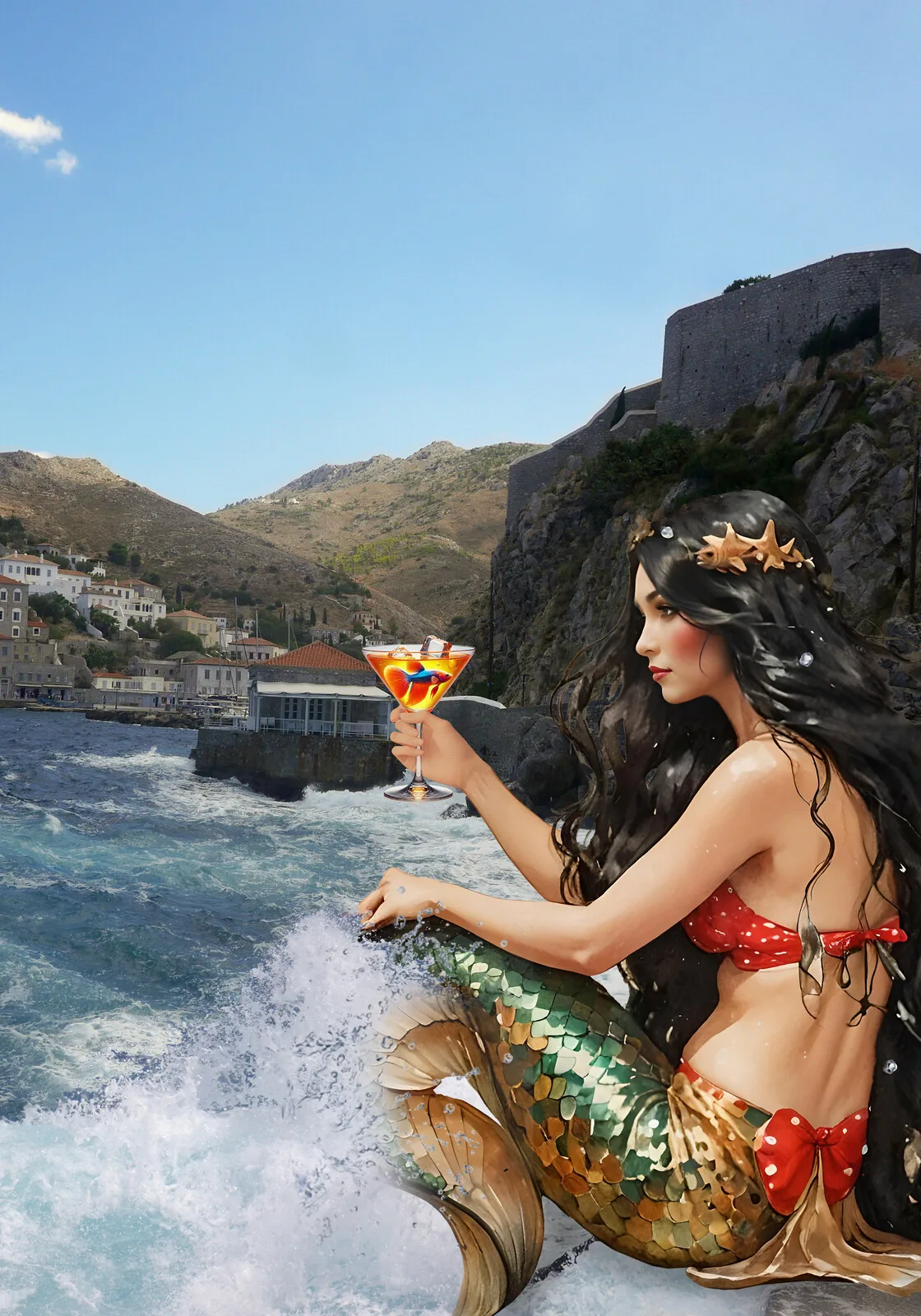
A Mermaid's tribute to Hydra, 2024
Digital
50 x 70 cm
Mariel’s Lament
Upon the stormy shores of Hydra, where
the northerly winds and waves collide,
Came the goddess Mariel, a mermaid fair,
With millennium’s secrets deep inside.
Her song was soft, an alto's lure,
With a timbre rich and warm,
In Greek, she sang a tale so pure,
Of life far beyond the norm.
Her raven hair flowed long and free,
Her scales, like peacock's gleam,
Half a fish and half a lady was she,
From a three-millennia dream.
Born of old, a goddess bright,
Atargatis was her maiden name,
From Assyria's ancient light,
To Greece, where Mariel came.
With a martini glass in hand,
She toasted to the night,
"Eviva Hydra! Yiamas!"
Her voice a fleeting light.
Her story spoke of lust and woe,
Of loves that could not stay,
A mortal’s touch, a lover’s glow,
All washed in ocean spray.
She saved a prince, but mute remained,
Her voice, the price she paid,
And though her heart with love was chained,
In silence, for long, she stayed.
The waves pulled Mariel back to sea,
As quickly as she came,
Her song had a mournful melody,
Of loss and endless shame.
For centuries, she’d stirred the hearts,
Of sailors lost to tides,
Her beauty and her fishy parts,
A tale where sorrow hides.
She sang of lust, of hope misplaced,
Of dreams that couldn’t be,
A life of longing, love embraced,
Then, swept back into the sea.
Her legend lingered on the waves,
A myth, a sad refrain,
Mariel, who couldn’t save,
Her heart from endless pain.
Hydra July 2024
It’s neither unusual nor surprising for mermaids to appear on Hydra, a place steeped in maritime history and mythology. After all, we live on an island surrounded by water, a perfect setting for such legends. It seemed perfectly natural for one to show up on this stormy June day. The wind was so strong that the harbour was deserted, and no large boats were moored on the outer pier. In other words, she had the place to herself. The girl’s name is Mariel, and she lives on Dokos, the neighbouring island whose silhouette from Hydra looks like Mariel lying on her side, resting.
Her name, which sounds almost like 'Ariel,' remains one of the top-earning Disney princesses, born in 1989. However, it was not Mariel who was inspired by the name of Disney's much later creation, but rather the opposite. In fact, she was the three-thousand-year-old mermaid goddess Atargatis, often called Derketo by the Greeks of that time, a goddess of fertility and lust. Atargatis was a complex figure, revered for her powers of fertility and feared for her unpredictable nature. The latter is significant considering how many sexual fantasies she has sparked over three millennia. Mariel was a gorgeous woman. It struck me that she also kept up with fashion; her bikini top was a polka-dot type often seen on Hydra's beaches. Her raven-black, flowing hair reached far below her waist. Around her waist, she wore a band with a bow matching the top. She wore nothing to cover her lower part unless you count something resembling a dolphin in shape, though the scales covering her lower half most closely looked like the Mediterranean's most beautiful fish, the colourful East Atlantic Peacock Wrasse, a fish that, as the name suggests, competes with a peacock in splendour. Her song was alluring, her voice a soft alto with a rich timbre. The song was in Greek, and I could only catch fragments, but gradually, I realised she was singing about herself, her life, and all she had been through.
In her hand, Mariel held an oversized martini glass with an orange drink and a small parrotfish stirring the drink with its fins. I heard Mariel singing, "Eviva Hydra! Yiamas." This would mean "Long live Hydra!" or "Cheers to Hydra!" followed by "To our health!" I would have gladly joined in that toast, but the next moment, Mariel let herself be pulled back into the sea by a wave captured in my picture. It felt a bit disappointing that my first meeting would be so brief. Back up in Kiafa, Hydra’s ‘Grande Corniche,’ known for dramatic scenery and spectacular views, I quickly wrote down everything I could recall about mermaids and other marine beings. Perhaps some would like to refresh their memories.
The Origins and Legends of Mermaids
The first known stories featuring this lustful creature come from Assyria and date back to 1000 BC. They tell the tale of the goddess Atargatis, who loved a mortal man. Tragically, during the act of love, she accidentally killed her lover. As punishment, she jumped into a lake, taking the form of a fish out of shame for her actions. Despite her efforts, the waters could not hide her divine beauty, and she retained her human form from the waist up while keeping her fishtail. This tale led to a stigma attached to eating fish in the region, as many believed the goddess could take on the form of a fish. Her transformation and story may have influenced later Greek depictions of the Sirens as fish-tailed.
A mermaid or sea woman is a female aquatic supernatural being characterised by a human upper body and a fishtail as the lower body. Mermaids are found in folklore and mythology in various parts of the world. Often, she was imagined as a beautiful and erotically appealing woman who lured sailors to their doom with her beautiful song. Historically, she can be traced back to ancient Southwest Asia. In Mesopotamian mythology, for instance, there are similar divine or semi-divine beings like the Chaldean sea god Ea. A parallel in Greek mythology is the Sirens, who lured sailors to them with their songs and then killed them. These usually had a woman's head and chest and a bird's body. One of the people who was subjected to their songs was Odysseus.
The most famous mention of a Siren in ancient Greek literature is the scene from Homer’s epic poem The Odyssey, in which the sorceress Circe warns Odysseus of the irresistible song of the Sirens. Curious about what he would hear, Odysseus ordered his crew to tie him to the mast of the ship, not to untie him until they passed the creatures, and to plug their ears with beeswax. Upon hearing their beautiful song, Odysseus begged his crew to release him, but they obediently sailed onward. According to some ancient authors, the Sirens were fated to die if anyone heard their song and resisted; therefore, Odysseus was the first to kill the Sirens, who jumped to their deaths into the sea after he successfully fled. While the ancient Greek Sirens do not precisely resemble mermaids, as they are half-bird, not half-fish, they began to shift forms in antiquity.
The mermaid is a bad omen in British folklore, signalling an approaching storm. In Nordic countries, she has been a part of sailor folklore since the Middle Ages and is called the sea spirit. Mermaids are sometimes associated with perilous events such as floods, storms, shipwrecks, and drownings. In other folk traditions, or sometimes within the same traditions, they can be benevolent, bestowing boons or falling in love with humans.
The male equivalent of the mermaid is the merman, also a familiar figure in folklore and heraldry. Although traditions about and reported sightings of mermen are less common than those of mermaids, they are generally assumed to coexist with their female counterparts in folklore. The male and female collectively are sometimes referred to as merfolk or merpeople. The sighting alone portends an impending storm. Norwegians do not wish to see the Havfrue, the mermaid, as she heralds a storm or bad weather.
The conception of the siren as both a mermaid-like creature and part bird-like persisted in Byzantine Greece for some time. The Physiologus began switching the illustration of the siren to that of a mermaid, as in a version dated to the ninth century. The tenth-century Byzantine Greek dictionary Suda still favored the avian description. A modern Greek legend is that Alexander the Great's sister, Thessaloniki, living in the Aegean, turned into a mermaid after her death. She would ask the sailors on any ship she encountered only one question: "Is King Alexander alive?" to which the correct answer was: "He lives and reigns and conquers the world." This answer would please her, and she would calm the waters and bid the ship farewell. Any other answer would enrage her, and she would stir up a terrible storm, dooming the ship and every sailor on board. This legend derives from an Alexander romance entitled ‘the Phylláda tou Megaléxandrou’.
Mermaids are often figureheads on ships. How do mermaids sleep? Mermaids sleep like mere mortals—in beds. Sirens reproduce sexually and are viviparous. They typically have a gestation period of nine months. Sailors, in their lonely imaginations, fantasised about having sex with them as they would with women from behind. They can be benevolent, bestowing boons or falling in love with humans.
According to the book "Natural History of the Indies" from 1717, it even happened that a mermaid was captured. Under a drawing, it reads: “She was one and a half meters long and shaped like an eel, lived on land for four days and seven hours in a tub of water, made small cries, ate nothing, then died.”
Though not always reliable, newspaper articles from the late 1800s reported occasional captures of mermaids by surprised fishermen. In November 1896, the New York Herald shared how the crew of the steamer Anedamoff, on a fishing expedition from Japan via the Aleutians, Bering Sea, and the Pacific Ocean, arrived at Watmoff Island on July 26, where they spotted a group of porpoises, including several unusual white specimens. Since the expedition consisted of "English noblemen, French politicians, and a Russian prince," ordinary sea creatures did not suffice as catches, but here was a chance to catch something as rare as white porpoises. A boat was launched, and a group of men set out in pursuit. After shooting one of the white porpoises, one of the lords suddenly saw an even stranger creature among the waves and managed to shoot it between the eyes.
When the group reached the beast, they found it had not been harmed by the shot but had only lost consciousness. What they saw before them was "the most terrible and incredible monster a human has ever seen"—a "seaman." In an attempt to get the several-meter-long creature into the boat, they grabbed hold of it. They were surprised when it regained consciousness and suddenly grabbed the ship's side with its hands. When the boat was about to capsize, a crew member managed to bring out an axe and delivered a well-aimed blow to kill the "seaman."
In the summer of 1962, several villages by the Irish Sea experienced mermaid fever after a beautiful red-haired mermaid was reportedly seen several times. A hunt was launched but without result.
The 1800s were perhaps the best time for mermaids. On July 7, 1871, one was even reported from a river in Texas. The creature had a white, human-like face with large black eyes and was observed from three meters away for ten minutes. Nothing else was reported about the body except that it was covered in black and white spots.
One of my favourite stories is "The Little Mermaid," written in 1837 by the Danish storyteller H.C. Andersen. The tale is not a classic folktale but rather a novella.
Far beneath the ocean's surface lived the sea king with his six daughters, all mermaids. Each time one of the daughters turned fifteen, she was allowed to visit the world above the surface. When it was the youngest mermaid's turn, she was the most curious about the world above the water. On the surface, she saw a beautiful ship where a party took place. Curiously, she swam closer and saw a handsome man in a window. He was a prince, and the party was held in his honour. When the ship was wrecked in a storm, she saved the prince and brought him to shore on an island where a temple stood. After that, the little mermaid could not forget the prince; she was in love.
The girl sought out a sea witch who gave her a potion that painfully transformed her fish tail into human legs. But for this, the mermaid had to pay with her voice, and the witch cut out her tongue. She, who once sang the most beautifully of all, became mute. There were conditions to the enchantment: if she managed to win the prince's heart before anyone else did, she would gain an immortal soul just like humans. But if she failed, her heart would break, and she would turn into sea foam.
After drinking the potion, she gained legs and was found by the prince. But the prince never fell in love with her; he saw her only as a little sister. Eventually, the prince was to marry a princess from a neighbouring kingdom. When he saw her, he fell in love immediately. The princess was on the island where the mermaid had left him, and the prince believed she had saved him.
The mute mermaid could not tell him she had saved him from drowning. The mermaid carried the bride's train at the prince's wedding to the princess. The wedding occurred on a ship, and the mermaid went out to cool off during the festivities. Her sisters came up from the sea, gave her a knife they had exchanged for their hair with the sea witch, and told her that if she killed the prince before the sun rose, she would turn back into a mermaid. When she went to the prince and saw him lying with the princess in his arms, she could not bring herself to kill him. So she went out, threw herself into the sea, and became foam.
Or not quite. Just when the mermaid thought she would fade away, air spirits appeared. They told her they did not have souls but could gain one through good deeds. They allowed the little mermaid to become an air spirit for her love and selflessness, and together, they set out to encourage goodness and happiness in the world.
Interpretations of "The Little Mermaid"
How should this be interpreted? One theory is that H.C. Andersen was bisexual and in love with a male friend. When the friend got married, Andersen wrote the story. He channelled his feelings into this tale since his passion was as impossible as the little mermaid's.
A significant theme is unrequited love. The girl meets the prince, a common motif in folktales, but this story ends tragically. The mermaid sacrifices everything for her prince, but he never reciprocates her feelings, and she nearly dies. The moral here might be not to sacrifice too much for love.
Another interpretation is that the story is about not trying to be someone other than who you are. The mermaid desperately wants to be human to win her beloved, but he doesn't love her even in that form. Some interpret this to mean that she becomes less of herself as a human. She cannot communicate with the prince or express her feelings by giving up her voice to the sea witch. She loses much of herself when she tries to be someone else. No matter how you interpret it, "The Little Mermaid" is a sad tale.
Mermaids and Water Spirits in Folklore
Mermaids live in the sea, but on the mainland, in lakes and streams, particularly in waterfalls, live the Näcken and other water sprites. Under various names, they are expected to be the stories of all Germanic peoples, although they are perhaps best known in Scandinavian folklore. The related English knucker was generally depicted as a worm or dragon, although more recent versions depict the spirits in other forms. Their sex, bynames, and various transformations vary geographically. The German 'Nix' and his Scandinavian counterparts were male. The German 'Nixe' was a female river mermaid. English folklore contains many creatures similar to the Nix or Näck, including Jenny Greenteeth, the Shellycoat, the river-hag Peg Powler, the Bäckahäst-like Brag, and the Grindylow.
The Nordic ‘Näcken’ were male water spirits who played enchanted songs on the violin, luring women and children to drown in lakes or streams. However, not all of these spirits were necessarily malevolent; many stories indicate that they were entirely harmless to their audience and attracted not only women and children but also men with their sweet songs. The myth arose from the babbling brooks and waterfalls' deceptive beauty and mystical surroundings.
Stories also exist in which the spirit agrees to live with a girl who has fallen in love with him. Still, many of these stories end with the Näcken returning to his home, usually a nearby waterfall or brook. The temptation was naturally great, almost pornographic. The Näcken is often imagined as fair and naked when playing his violin.
If a person offered the Näcken a treat of three drops of blood, a black animal, mostly a cat, some Scandinavian vodka, or wet snuff dropped into the water, the Näcken would teach his enchanting form of music.
"Where by the marishes boometh the bittern,
Neckar, the soulless one, sits with his ghittern.
Sits inconsolable, friendless and foeless.
Waiting his destiny, – Neckar the soulless."
Sebastian Evans, 19th century
A tragic story must be conveyed to explain people's distance from these enigmatic water beings. At a Swedish lake, a poor fisherman once had a beautiful daughter. The small lake yielded little fish, and the fisherman had difficulties providing for his little family. One day, as the fisherman was fishing in his little oak dugout, he met the Näcken, who offered him great fish catches on the condition that the fisherman gave him his beautiful daughter the day she turned eighteen. The desperate fisherman agreed and promised the Näcken, his daughter. On the day the girl turned eighteen, she went to the shore to meet the Näcken. The Näcken gladly asked her to walk down to his watery abode, but the girl took forth a knife and said that he would never have her alive, then stuck the knife into her heart and fell into the lake, dead. Her blood tinted the water lilies red, and from that day, the water lilies of some forestlakes have been red.
The Mermaid in Art and Literature
The mermaid with a fishtail is a common motif in art and literature. Besides H.C. Andersen's tragic character, there are countless romanticised depictions. Famous examples include Elisabeth Baumann's mermaid paintings, Edvard Eriksen's sculpture 'The Little Mermaid' in Copenhagen, and John William Waterhouse's 'A Mermaid' (1900).
The French pop singer Nolwenn Leroy appeared as a mermaid on the cover of her album ‘Ô Filles de l'eau’ from 2012 and in the music video for her single 'Sixième Continent.'
Interest in mermaid costuming has grown with the popularity of fantasy cosplay and the availability of inexpensive monofins used in creating these costumes, often with a touch of sex appeal. These costumes are typically designed to be worn while swimming, an activity known as ‘Mermaiding’. Mermaid fandom conventions have also been held. People are not as dumb as you think; they are dumber.
Mermaid Shows
Scantily clad women placed in water tanks and impersonating mermaids performed at the 1939 New York World's Fair. It was part of the "Dream of Venus" installation by Surrealist artist Salvador Dalí. The mermaid interacted with Oscar the Obscene Octopus, and the events were portrayed in E. L. Doctorow's novel *World's Fair*.
Professional female divers have performed as mermaids at Florida's Weeki Wachee Springs since 1947. The state park calls itself "The Only City of Live Mermaids" and was extremely popular in the 1960s, drawing almost one million tourists annually. Most current performers work part-time while attending college and are certified scuba divers. They wear fabric tails and perform aquatic ballet (while holding their breath) for an audience on an underwater stage with glass walls. Children often ask if the "mermaids" are real. The park's PR director says, "Just like with Santa Claus or any other mythical character, we always say yes. We're not going to tell them they're not real."
The Ama Divers
The Ama are Japanese skin divers, predominantly women, who traditionally dive for shellfish and seaweed wearing only a loincloth and have been in action for at least 2,000 years. Starting in the twentieth century, they have increasingly been regarded as a tourist attraction. They operate off reefs near the shore; some perform for sightseers instead of diving to collect a harvest. They have been romanticised as mermaids.
Barnum's Mermaid Hoax
In December 1841, circus legend P.T. Barnum opened a curious museum in New York. The main attraction among all the oddities was a natural but dead mermaid, supposedly captured off the coast of Fiji, according to Barnum. The creature visitors saw was far from beautiful; it was more frightening than the fair beings of legend. It was, of course, a grotesque forgery. The upper body of a shaved and dried monkey had been attached to the tail of a large fish, creating a monstrous appearance.
Jörgen Thornberg
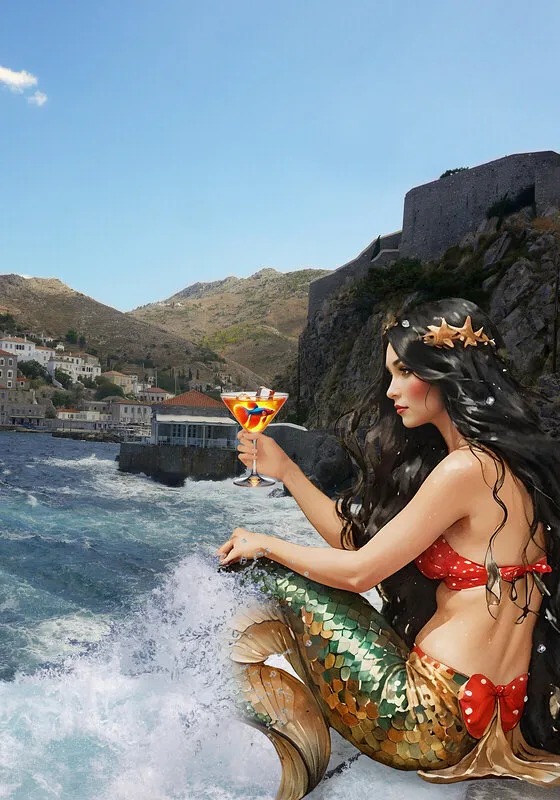
A Mermaid's tribute to Hydra, 2024
Digital
50 x 70 cm
Mariel’s Lament
Upon the stormy shores of Hydra, where
the northerly winds and waves collide,
Came the goddess Mariel, a mermaid fair,
With millennium’s secrets deep inside.
Her song was soft, an alto's lure,
With a timbre rich and warm,
In Greek, she sang a tale so pure,
Of life far beyond the norm.
Her raven hair flowed long and free,
Her scales, like peacock's gleam,
Half a fish and half a lady was she,
From a three-millennia dream.
Born of old, a goddess bright,
Atargatis was her maiden name,
From Assyria's ancient light,
To Greece, where Mariel came.
With a martini glass in hand,
She toasted to the night,
"Eviva Hydra! Yiamas!"
Her voice a fleeting light.
Her story spoke of lust and woe,
Of loves that could not stay,
A mortal’s touch, a lover’s glow,
All washed in ocean spray.
She saved a prince, but mute remained,
Her voice, the price she paid,
And though her heart with love was chained,
In silence, for long, she stayed.
The waves pulled Mariel back to sea,
As quickly as she came,
Her song had a mournful melody,
Of loss and endless shame.
For centuries, she’d stirred the hearts,
Of sailors lost to tides,
Her beauty and her fishy parts,
A tale where sorrow hides.
She sang of lust, of hope misplaced,
Of dreams that couldn’t be,
A life of longing, love embraced,
Then, swept back into the sea.
Her legend lingered on the waves,
A myth, a sad refrain,
Mariel, who couldn’t save,
Her heart from endless pain.
Hydra July 2024
It’s neither unusual nor surprising for mermaids to appear on Hydra, a place steeped in maritime history and mythology. After all, we live on an island surrounded by water, a perfect setting for such legends. It seemed perfectly natural for one to show up on this stormy June day. The wind was so strong that the harbour was deserted, and no large boats were moored on the outer pier. In other words, she had the place to herself. The girl’s name is Mariel, and she lives on Dokos, the neighbouring island whose silhouette from Hydra looks like Mariel lying on her side, resting.
Her name, which sounds almost like 'Ariel,' remains one of the top-earning Disney princesses, born in 1989. However, it was not Mariel who was inspired by the name of Disney's much later creation, but rather the opposite. In fact, she was the three-thousand-year-old mermaid goddess Atargatis, often called Derketo by the Greeks of that time, a goddess of fertility and lust. Atargatis was a complex figure, revered for her powers of fertility and feared for her unpredictable nature. The latter is significant considering how many sexual fantasies she has sparked over three millennia. Mariel was a gorgeous woman. It struck me that she also kept up with fashion; her bikini top was a polka-dot type often seen on Hydra's beaches. Her raven-black, flowing hair reached far below her waist. Around her waist, she wore a band with a bow matching the top. She wore nothing to cover her lower part unless you count something resembling a dolphin in shape, though the scales covering her lower half most closely looked like the Mediterranean's most beautiful fish, the colourful East Atlantic Peacock Wrasse, a fish that, as the name suggests, competes with a peacock in splendour. Her song was alluring, her voice a soft alto with a rich timbre. The song was in Greek, and I could only catch fragments, but gradually, I realised she was singing about herself, her life, and all she had been through.
In her hand, Mariel held an oversized martini glass with an orange drink and a small parrotfish stirring the drink with its fins. I heard Mariel singing, "Eviva Hydra! Yiamas." This would mean "Long live Hydra!" or "Cheers to Hydra!" followed by "To our health!" I would have gladly joined in that toast, but the next moment, Mariel let herself be pulled back into the sea by a wave captured in my picture. It felt a bit disappointing that my first meeting would be so brief. Back up in Kiafa, Hydra’s ‘Grande Corniche,’ known for dramatic scenery and spectacular views, I quickly wrote down everything I could recall about mermaids and other marine beings. Perhaps some would like to refresh their memories.
The Origins and Legends of Mermaids
The first known stories featuring this lustful creature come from Assyria and date back to 1000 BC. They tell the tale of the goddess Atargatis, who loved a mortal man. Tragically, during the act of love, she accidentally killed her lover. As punishment, she jumped into a lake, taking the form of a fish out of shame for her actions. Despite her efforts, the waters could not hide her divine beauty, and she retained her human form from the waist up while keeping her fishtail. This tale led to a stigma attached to eating fish in the region, as many believed the goddess could take on the form of a fish. Her transformation and story may have influenced later Greek depictions of the Sirens as fish-tailed.
A mermaid or sea woman is a female aquatic supernatural being characterised by a human upper body and a fishtail as the lower body. Mermaids are found in folklore and mythology in various parts of the world. Often, she was imagined as a beautiful and erotically appealing woman who lured sailors to their doom with her beautiful song. Historically, she can be traced back to ancient Southwest Asia. In Mesopotamian mythology, for instance, there are similar divine or semi-divine beings like the Chaldean sea god Ea. A parallel in Greek mythology is the Sirens, who lured sailors to them with their songs and then killed them. These usually had a woman's head and chest and a bird's body. One of the people who was subjected to their songs was Odysseus.
The most famous mention of a Siren in ancient Greek literature is the scene from Homer’s epic poem The Odyssey, in which the sorceress Circe warns Odysseus of the irresistible song of the Sirens. Curious about what he would hear, Odysseus ordered his crew to tie him to the mast of the ship, not to untie him until they passed the creatures, and to plug their ears with beeswax. Upon hearing their beautiful song, Odysseus begged his crew to release him, but they obediently sailed onward. According to some ancient authors, the Sirens were fated to die if anyone heard their song and resisted; therefore, Odysseus was the first to kill the Sirens, who jumped to their deaths into the sea after he successfully fled. While the ancient Greek Sirens do not precisely resemble mermaids, as they are half-bird, not half-fish, they began to shift forms in antiquity.
The mermaid is a bad omen in British folklore, signalling an approaching storm. In Nordic countries, she has been a part of sailor folklore since the Middle Ages and is called the sea spirit. Mermaids are sometimes associated with perilous events such as floods, storms, shipwrecks, and drownings. In other folk traditions, or sometimes within the same traditions, they can be benevolent, bestowing boons or falling in love with humans.
The male equivalent of the mermaid is the merman, also a familiar figure in folklore and heraldry. Although traditions about and reported sightings of mermen are less common than those of mermaids, they are generally assumed to coexist with their female counterparts in folklore. The male and female collectively are sometimes referred to as merfolk or merpeople. The sighting alone portends an impending storm. Norwegians do not wish to see the Havfrue, the mermaid, as she heralds a storm or bad weather.
The conception of the siren as both a mermaid-like creature and part bird-like persisted in Byzantine Greece for some time. The Physiologus began switching the illustration of the siren to that of a mermaid, as in a version dated to the ninth century. The tenth-century Byzantine Greek dictionary Suda still favored the avian description. A modern Greek legend is that Alexander the Great's sister, Thessaloniki, living in the Aegean, turned into a mermaid after her death. She would ask the sailors on any ship she encountered only one question: "Is King Alexander alive?" to which the correct answer was: "He lives and reigns and conquers the world." This answer would please her, and she would calm the waters and bid the ship farewell. Any other answer would enrage her, and she would stir up a terrible storm, dooming the ship and every sailor on board. This legend derives from an Alexander romance entitled ‘the Phylláda tou Megaléxandrou’.
Mermaids are often figureheads on ships. How do mermaids sleep? Mermaids sleep like mere mortals—in beds. Sirens reproduce sexually and are viviparous. They typically have a gestation period of nine months. Sailors, in their lonely imaginations, fantasised about having sex with them as they would with women from behind. They can be benevolent, bestowing boons or falling in love with humans.
According to the book "Natural History of the Indies" from 1717, it even happened that a mermaid was captured. Under a drawing, it reads: “She was one and a half meters long and shaped like an eel, lived on land for four days and seven hours in a tub of water, made small cries, ate nothing, then died.”
Though not always reliable, newspaper articles from the late 1800s reported occasional captures of mermaids by surprised fishermen. In November 1896, the New York Herald shared how the crew of the steamer Anedamoff, on a fishing expedition from Japan via the Aleutians, Bering Sea, and the Pacific Ocean, arrived at Watmoff Island on July 26, where they spotted a group of porpoises, including several unusual white specimens. Since the expedition consisted of "English noblemen, French politicians, and a Russian prince," ordinary sea creatures did not suffice as catches, but here was a chance to catch something as rare as white porpoises. A boat was launched, and a group of men set out in pursuit. After shooting one of the white porpoises, one of the lords suddenly saw an even stranger creature among the waves and managed to shoot it between the eyes.
When the group reached the beast, they found it had not been harmed by the shot but had only lost consciousness. What they saw before them was "the most terrible and incredible monster a human has ever seen"—a "seaman." In an attempt to get the several-meter-long creature into the boat, they grabbed hold of it. They were surprised when it regained consciousness and suddenly grabbed the ship's side with its hands. When the boat was about to capsize, a crew member managed to bring out an axe and delivered a well-aimed blow to kill the "seaman."
In the summer of 1962, several villages by the Irish Sea experienced mermaid fever after a beautiful red-haired mermaid was reportedly seen several times. A hunt was launched but without result.
The 1800s were perhaps the best time for mermaids. On July 7, 1871, one was even reported from a river in Texas. The creature had a white, human-like face with large black eyes and was observed from three meters away for ten minutes. Nothing else was reported about the body except that it was covered in black and white spots.
One of my favourite stories is "The Little Mermaid," written in 1837 by the Danish storyteller H.C. Andersen. The tale is not a classic folktale but rather a novella.
Far beneath the ocean's surface lived the sea king with his six daughters, all mermaids. Each time one of the daughters turned fifteen, she was allowed to visit the world above the surface. When it was the youngest mermaid's turn, she was the most curious about the world above the water. On the surface, she saw a beautiful ship where a party took place. Curiously, she swam closer and saw a handsome man in a window. He was a prince, and the party was held in his honour. When the ship was wrecked in a storm, she saved the prince and brought him to shore on an island where a temple stood. After that, the little mermaid could not forget the prince; she was in love.
The girl sought out a sea witch who gave her a potion that painfully transformed her fish tail into human legs. But for this, the mermaid had to pay with her voice, and the witch cut out her tongue. She, who once sang the most beautifully of all, became mute. There were conditions to the enchantment: if she managed to win the prince's heart before anyone else did, she would gain an immortal soul just like humans. But if she failed, her heart would break, and she would turn into sea foam.
After drinking the potion, she gained legs and was found by the prince. But the prince never fell in love with her; he saw her only as a little sister. Eventually, the prince was to marry a princess from a neighbouring kingdom. When he saw her, he fell in love immediately. The princess was on the island where the mermaid had left him, and the prince believed she had saved him.
The mute mermaid could not tell him she had saved him from drowning. The mermaid carried the bride's train at the prince's wedding to the princess. The wedding occurred on a ship, and the mermaid went out to cool off during the festivities. Her sisters came up from the sea, gave her a knife they had exchanged for their hair with the sea witch, and told her that if she killed the prince before the sun rose, she would turn back into a mermaid. When she went to the prince and saw him lying with the princess in his arms, she could not bring herself to kill him. So she went out, threw herself into the sea, and became foam.
Or not quite. Just when the mermaid thought she would fade away, air spirits appeared. They told her they did not have souls but could gain one through good deeds. They allowed the little mermaid to become an air spirit for her love and selflessness, and together, they set out to encourage goodness and happiness in the world.
Interpretations of "The Little Mermaid"
How should this be interpreted? One theory is that H.C. Andersen was bisexual and in love with a male friend. When the friend got married, Andersen wrote the story. He channelled his feelings into this tale since his passion was as impossible as the little mermaid's.
A significant theme is unrequited love. The girl meets the prince, a common motif in folktales, but this story ends tragically. The mermaid sacrifices everything for her prince, but he never reciprocates her feelings, and she nearly dies. The moral here might be not to sacrifice too much for love.
Another interpretation is that the story is about not trying to be someone other than who you are. The mermaid desperately wants to be human to win her beloved, but he doesn't love her even in that form. Some interpret this to mean that she becomes less of herself as a human. She cannot communicate with the prince or express her feelings by giving up her voice to the sea witch. She loses much of herself when she tries to be someone else. No matter how you interpret it, "The Little Mermaid" is a sad tale.
Mermaids and Water Spirits in Folklore
Mermaids live in the sea, but on the mainland, in lakes and streams, particularly in waterfalls, live the Näcken and other water sprites. Under various names, they are expected to be the stories of all Germanic peoples, although they are perhaps best known in Scandinavian folklore. The related English knucker was generally depicted as a worm or dragon, although more recent versions depict the spirits in other forms. Their sex, bynames, and various transformations vary geographically. The German 'Nix' and his Scandinavian counterparts were male. The German 'Nixe' was a female river mermaid. English folklore contains many creatures similar to the Nix or Näck, including Jenny Greenteeth, the Shellycoat, the river-hag Peg Powler, the Bäckahäst-like Brag, and the Grindylow.
The Nordic ‘Näcken’ were male water spirits who played enchanted songs on the violin, luring women and children to drown in lakes or streams. However, not all of these spirits were necessarily malevolent; many stories indicate that they were entirely harmless to their audience and attracted not only women and children but also men with their sweet songs. The myth arose from the babbling brooks and waterfalls' deceptive beauty and mystical surroundings.
Stories also exist in which the spirit agrees to live with a girl who has fallen in love with him. Still, many of these stories end with the Näcken returning to his home, usually a nearby waterfall or brook. The temptation was naturally great, almost pornographic. The Näcken is often imagined as fair and naked when playing his violin.
If a person offered the Näcken a treat of three drops of blood, a black animal, mostly a cat, some Scandinavian vodka, or wet snuff dropped into the water, the Näcken would teach his enchanting form of music.
"Where by the marishes boometh the bittern,
Neckar, the soulless one, sits with his ghittern.
Sits inconsolable, friendless and foeless.
Waiting his destiny, – Neckar the soulless."
Sebastian Evans, 19th century
A tragic story must be conveyed to explain people's distance from these enigmatic water beings. At a Swedish lake, a poor fisherman once had a beautiful daughter. The small lake yielded little fish, and the fisherman had difficulties providing for his little family. One day, as the fisherman was fishing in his little oak dugout, he met the Näcken, who offered him great fish catches on the condition that the fisherman gave him his beautiful daughter the day she turned eighteen. The desperate fisherman agreed and promised the Näcken, his daughter. On the day the girl turned eighteen, she went to the shore to meet the Näcken. The Näcken gladly asked her to walk down to his watery abode, but the girl took forth a knife and said that he would never have her alive, then stuck the knife into her heart and fell into the lake, dead. Her blood tinted the water lilies red, and from that day, the water lilies of some forestlakes have been red.
The Mermaid in Art and Literature
The mermaid with a fishtail is a common motif in art and literature. Besides H.C. Andersen's tragic character, there are countless romanticised depictions. Famous examples include Elisabeth Baumann's mermaid paintings, Edvard Eriksen's sculpture 'The Little Mermaid' in Copenhagen, and John William Waterhouse's 'A Mermaid' (1900).
The French pop singer Nolwenn Leroy appeared as a mermaid on the cover of her album ‘Ô Filles de l'eau’ from 2012 and in the music video for her single 'Sixième Continent.'
Interest in mermaid costuming has grown with the popularity of fantasy cosplay and the availability of inexpensive monofins used in creating these costumes, often with a touch of sex appeal. These costumes are typically designed to be worn while swimming, an activity known as ‘Mermaiding’. Mermaid fandom conventions have also been held. People are not as dumb as you think; they are dumber.
Mermaid Shows
Scantily clad women placed in water tanks and impersonating mermaids performed at the 1939 New York World's Fair. It was part of the "Dream of Venus" installation by Surrealist artist Salvador Dalí. The mermaid interacted with Oscar the Obscene Octopus, and the events were portrayed in E. L. Doctorow's novel *World's Fair*.
Professional female divers have performed as mermaids at Florida's Weeki Wachee Springs since 1947. The state park calls itself "The Only City of Live Mermaids" and was extremely popular in the 1960s, drawing almost one million tourists annually. Most current performers work part-time while attending college and are certified scuba divers. They wear fabric tails and perform aquatic ballet (while holding their breath) for an audience on an underwater stage with glass walls. Children often ask if the "mermaids" are real. The park's PR director says, "Just like with Santa Claus or any other mythical character, we always say yes. We're not going to tell them they're not real."
The Ama Divers
The Ama are Japanese skin divers, predominantly women, who traditionally dive for shellfish and seaweed wearing only a loincloth and have been in action for at least 2,000 years. Starting in the twentieth century, they have increasingly been regarded as a tourist attraction. They operate off reefs near the shore; some perform for sightseers instead of diving to collect a harvest. They have been romanticised as mermaids.
Barnum's Mermaid Hoax
In December 1841, circus legend P.T. Barnum opened a curious museum in New York. The main attraction among all the oddities was a natural but dead mermaid, supposedly captured off the coast of Fiji, according to Barnum. The creature visitors saw was far from beautiful; it was more frightening than the fair beings of legend. It was, of course, a grotesque forgery. The upper body of a shaved and dried monkey had been attached to the tail of a large fish, creating a monstrous appearance.

Jörgen Thornberg
Malmö
Lite om bilder och mig. Translation in English at the end.
Jag är en nyfiken person som ser allt i bilder, även det jag fäster i ord, gärna tillsammans för bakom alla mina bilder finns en berättelse. Till vissa bilder hör en kortare eller längre novell som följer med bilden.
Bilder berättar historier. Jag omges av naturlig skönhet, intressanta människor och historia var jag än går. Jag använder min kamera för att dokumentera världen och blanda det jag ser med vad jag känner för att fånga den dolda magin.
Mina bilder berättar mina historier. Genom mina bilder, tryck och berättelser. Jag bjuder in dig att ta del av dessa berättelser, in i ditt liv och hem och dela min mycket personliga syn på vår värld. Mer än vad ögat ser. Jag tänker i bilder, drömmer och skriver och pratar om dem; följaktligen måste jag också skapa bilder. De blir vad jag ser, inte nödvändigtvis begränsade till verkligheten. Det finns en bild runt varje hörn. Jag hoppas att du kommer att se vad jag såg och gilla det.
Jag är också en skrivande person och till många bilder hör en kortare eller längre essay. Den följer med tavlan, tryckt på fint papper och med en personlig hälsning från mig.
Flertalet bilder startar sin resa i min kamera. Enkelt förklarat beskriver jag bilden jag ser i mitt inre, upplevd eller fantiserad. Bilden uppstår inom mig redan innan jag fått okularet till ögat. På bråkdelen av ett ögonblick ser jag vad jag vill ha och vad som kan göras med bilden. Här skall jag stoppa in en giraff, stålmannen, Titanic eller vad det är min fantasi finner ut. Ännu märkligare är att jag kommer ihåg minnesbilden långt efteråt när det blir tid att skapa verket. Om jag lyckas eller inte, är upp till betraktaren, oftast präglat av en stråk av svart humor – meningen är att man skall bli underhållen. Mina bilder blir ofta en snackis där de hänger.
Jag föredrar bilder som förmedlar ett budskap i flera lager. Vid första anblicken fylld av feel-good, en vacker utsikt, fint väder, solen skiner, blommor på ängen eller vattnet som ligger förrädiskt spegelblankt. I en sådan bild kan jag gömma min egentliga berättelse, mitt förakt för förtryckare och våldsverkare, rasister och fördomsfulla människor - ett gärna återkommande motiv mer eller mindre dolt i det vackra motivet. Jag försöker förena dem i ett gemensamt narrativ.
Bild och formgivning har löpt som en röd tråd genom livet. Fotokonst känns som en värdig final som jag gärna delar med mig.
Min genre är vid som framgår av mina bilder, temat en blandning av pop- och gatukonst i kollage som kan bestå av hundratals lager. Vissa bilder kan ta veckor, andra någon dag innan det är dags att överlämna resultatet till printverkstaden. Fine Art Prints är digitala fotocollage. I dessa kollage sker rivandet, klippandet, pusslandet, målandet, ritandet och sprayningen digitalt. Det jag monterar in kan vara hundratals år gamla bilder som jag omsorgsfullt frilägger så att de ser ut att vara en del av tavlan men också bilder skapade av mig själv efter min egen fantasi. Därefter besöks printstudion och för vissa bilder numrera en limiterad upplaga (oftast 7 exemplar) och signera för hand. Vissa bilder kan köpas i olika format. Det är bara att fråga efter vilka. Gillar man en bild som är 70x100 men inte har plats på väggen, går den kanske att få i 50x70 cm istället. Frågan är fri.
Metoden Giclée eller Fine Art Print som det också kallas är det moderna sättet för framställning av grafisk konst. Villkoret för denna typ av utskrifter är att en högkvalitativ storformatskrivare används med åldersbeständigt färgpigment och konstnärspapper eller i förekommande fall på duk. Pappret som används möter de krav på livslängd som ställs av museer och gallerier. Normalt säljer jag mina bilder oinramade så att den nya ägaren själv kan bestämma hur de skall se ut, med eller utan passepartout färg på ram, med eller utan glas etc..
Under många år ställde jag bara ut på nätet, i valda grupper och på min egen Facebooksida - https://www.facebook.com/jorgen.thornberg.9
Jag finns också på en egen hemsida som tyvärr inte alltid är uppdaterad – https://www.jth.life/ Där kan du också läsa en del av de berättelser som följer med bilden.
UTSTÄLLNINGAR
Luftkastellet, oktober 2022
Konst i Lund, november 2022
Luftkastellet, mars 2023
Engleson Galleri Caroli, april 2023
Hydra, Greece June 2023
Engleson Galleri Caroli, oktober 2023
Toppen, Höllviken december 2023
Luftkastellet, mars 2024
Torups Galleri, mars 2024
Venice, May 2024
Luftkastellet, oktober 2024
Konst i Advent, December 2024
Galleri Engleson, Caroli December 2024
Jäger & Jansson Galleri, april 2025
A bit about pictures and me.
I'm a curious person who sees everything in pictures, even what I express in words, often combining them, for behind all my pictures lies a story. These narratives, some as short as a single image and others as long as a novel, are the heart and soul of my work.
Pictures tell stories. Wherever I go, I'm surrounded by natural beauty, exciting people, and history. I use my camera to document the world and blend what I see with what I feel to capture the hidden magic.
My images tell my stories. Through my pictures, prints, and narratives, I invite you to partake in these stories in your life and home and share my deeply personal perspective of our world. More than meets the eye. I think in pictures, dream, write, and talk about them; consequently, I must create images too. They become what I see, not necessarily confined to reality. There's a picture around every corner. I hope you'll see what I saw and enjoy it.
I'm also a writer, and many images come with a shorter or longer essay. It accompanies the painting, printed on fine paper with my personal greeting.
Many pictures start their journey on my camera. Simply put, I describe the image I see in my mind, experienced or imagined. The image arises within me even before I bring the eyepiece to my eye. In a fraction of a moment, I see what I want and what can be done with the picture. Here, I'll insert a giraffe, Superman, the Titanic, or whatever my imagination conjures up. Even stranger is that I remember the mental image long after it's time to create the work. Whether I succeed is up to the observer, often imbued with a streak of black humour – the aim is to entertain. My pictures usually become a talking point wherever they hang.
I prefer pictures that convey a message in multiple layers. At first glance, they're filled with feel-good vibes, a beautiful view, lovely weather, the sun shining, flowers in the meadow, or the water lying deceptively calm. But beneath this surface beauty, I often conceal a deeper story, a narrative that challenges societal norms or explores the human condition. I invite you to delve into these hidden narratives and discover the layers of meaning within my work.
Picture and design have been a thread running through my life. Photographic art feels like a fitting finale, and I'm happy to share it.
My genre is varied, as seen in my pictures; the theme is a blend of pop and street art in collages that can consist of hundreds of layers. Some images can take weeks, others just a day before it's time to hand over the result to the print workshop. Fine Art Prints are digital photo collages. In these collages, tearing, cutting, puzzling, painting, drawing, and spraying happen digitally. What I insert can be images hundreds of years old that I carefully extract so they appear to be part of the painting, but also images created by myself, now also generated from my imagination. Next, visit the print studio and, for certain images, number a limited edition (usually 7 copies) and sign them by hand. Some images may be available in other formats. Just ask which ones. If you like an image that's 70x100 but doesn't have space on the wall, you might be able to get it in 50x70 cm instead. The question is open.
The Giclée method, or Fine Art Print as it's also called, is the modern way of producing graphic art. This method ensures the highest quality and longevity of the artwork, using a high-quality large-format printer with archival pigment inks and artist paper or, in some cases, canvas. The paper used meets the longevity requirements set by museums and galleries. I sell my pictures unframed, allowing the new owner to personalise their artwork, confident in the lasting value and quality of the piece.
For many years, I only exhibited online, in selected groups, and on my Facebook page - https://www.facebook.com/jorgen.thornberg.9. I also have my website, which unfortunately is not constantly updated - https://www.jth.life/. You can also read some of the stories accompanying the pictures there.
EXHIBITIONS
Luftkastellet, October 2022
Art in Lund, November 2022
Luftkastellet, March 2023
Engleson Gallery Caroli, April 2023
Hydra, Greece June 2023
Engleson Gallery Caroli, October 2023
Toppen, Höllviken December 2023
Luftkastellet, March 2024
Torup Gallery, March 2024
Venice, May 2024
UTSTÄLLNINGAR
Luftkastellet, oktober 2022
Konst i Lund, november 2022
Luftkastellet, mars 2023
Engleson Galleri Caroli, april 2023
Hydra, Greece June 2023
Engleson Galleri Caroli, oktober 2023
Toppen, Höllviken december 2023
Luftkastellet, mars 2024
Torups Galleri, mars 2024
Venice, May 2024
Luftkastellet, October 2024
Konst i Advent, December 2024
Galleri Engleson, Caroli December 2024
Jäger & Jansson Galleri, April 2025
Utbildning
Autodidakt
Medlem i konstnärsförening
Öppna Sinnen
Med i konstrunda
Konstrundan i Skåne
Utställningar
Luftkastellet, October 2022
Art in Lund, November 2022
Luftkastellet, March 2023
Engleson Gallery Caroli, April 2023
Hydra, Greece June 2023
Engleson Gallery Caroli, October 2023
Toppen, Höllviken December 2023
Luftkastellet, March 2024
Torup Gallery, March 2024
Venice, May 2024