Vi använder cookies för att ge dig bästa möjliga upplevelse. Välj vilka cookies du tillåter.
Läs mer i vår integritetspolicy
Jörgen Thornberg
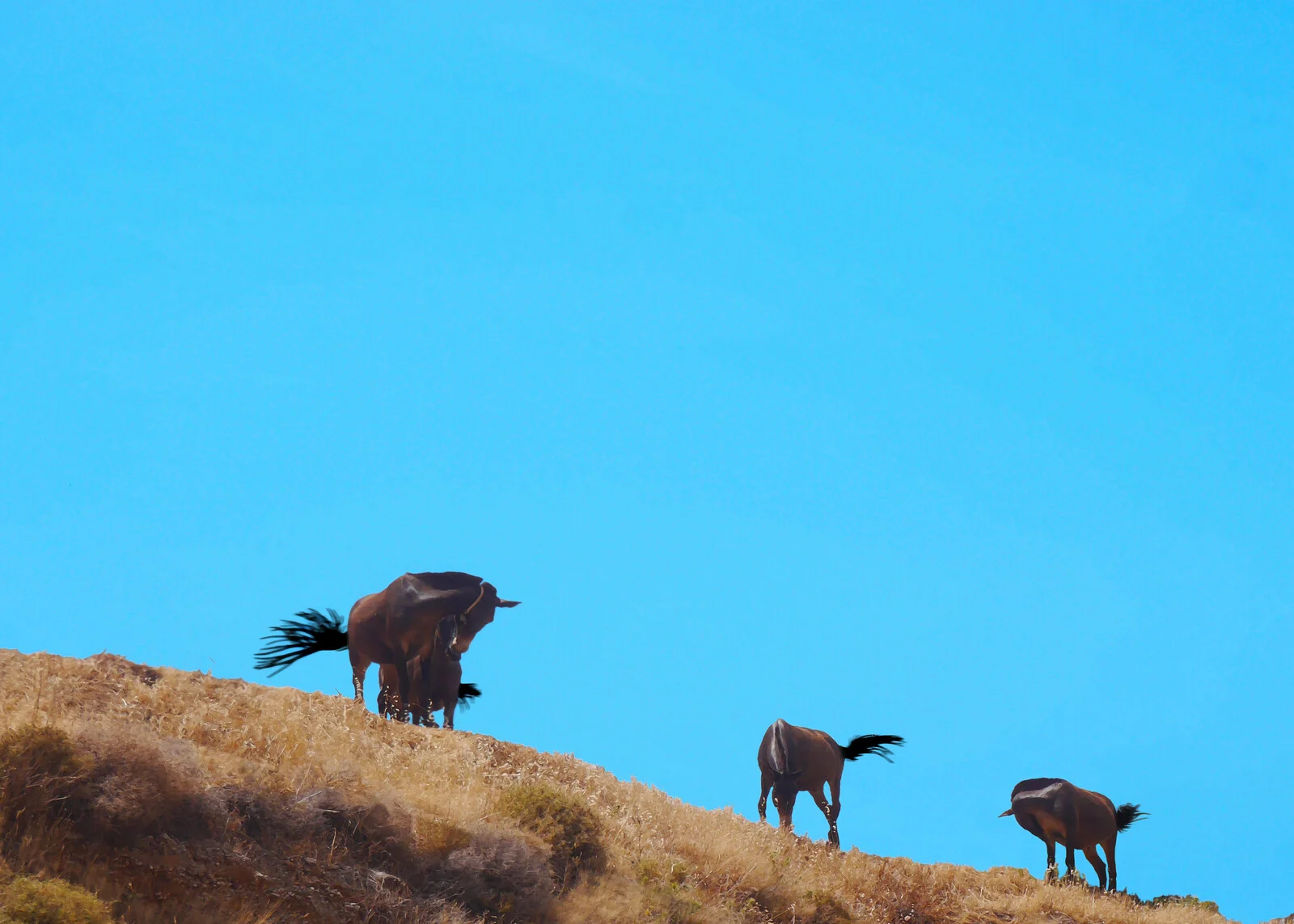
Wagging Tails - Horse Talk under Blue Sky, 2019
Digital
70 x 50 cm
Wagging Tails - Horse talk under Blue Sky
In a meadow high above Vlychos' road,
Dokos’ grand silhouette makes a timeless ode,
Grazed horses, tails swishing in the gentle breeze,
Amidst the wildflowers beneath the ancient trees.
Bella and Maximos, in coats of chestnut and grey,
Basked in the sunshine of this tranquil day.
Their eyes are on the horizon, where sea meets sky,
Their hearts are full of wonder as the clouds drift by.
They spoke of tails, a simple, joyful grace,
Of humans long lost, who once shared our case.
"Imagine," said Bella, "a time so long past,
When humans, like us, had tails to cast."
Maximos nodded, pondering this curious thought,
Of balance and wagging, what evolution brought.
“We’ve kept our tails for swatting flies away,
For communicating joy in our equine way.”
The sun climbed higher, painting shadows long,
As birds sang softly, a gentle noontime song.
The grass was sweet, the clover blooms bright,
A perfect harmony of Hydra nature's delight.
They spoke of ancient ties to creatures old and new,
Of human dreams and equine species views.
"Imagine a human wagging a tail," Maximos grinned,
"A sight so funny, where would they begin?"
Bella laughed, her eyes a sparkling light,
"Each creature has its own special right.
We swish and sway; they smile and embrace,
Each finds beauty in this shared space."
As the day moved on, their friendship grew,
In silent understanding, under skies so blue.
Two horses, pondering the world's grand tale,
Their hearts were as vast as the open trail.
In the divine stillness, they found their lustrous way,
Through meadows of green, in the warmth of the day.
And as evening fell, with stars shining bright,
Bella and Maximos whispered, “Goodnight.”
In dreams, they wandered through ancient lands,
Tails and tales entwined like shifting sands.
For in the Vlychos meadow high above the sea,
They found the magic of what life could be.
From ancient shadows, where the earth was young and in constant change,
A creature emerged, both elegant and robust, through ages refined.
A horse slowly shaped, through aeons of life's relentless march,
With ancestors scaled, small as dogs, they braved the endless plains.
Teeth and hooves transformed, step by step, through time's grand stage,
From forest shelter to the open light to fields vast and wide.
Hyracotherium, the first among horses, nimble and small,
Made way for new species, adapted to nature's harsh decree.
Where Eohippus trod, with four toes, dainty and neat,
An evolutionary leap to Protohippus, a precursor of today's horse.
Millennia passed, hooves grew strong, teeth suited for grass,
From forest refuge to plains of green, they evolved with grace.
Miohippus and Merychippus they battled through the ages,
Adaptation's struggle, survival's trials, arduous and tough.
Pliohippus, a step on the path near the horse we now see,
Proud and powerful, with a single toe, galloping through history’s land.
Then came Equus, our species today, the crown of evolution’s path,
Adapted for speed, for flight’s swift escape, over fields so free.
Thousands upon thousands of years in service to man, in partnership,
From battlefields to the farmer’s plough, a loyal companion are we.
In hexameter’s rhythm, a tribute to the noble horse's form,
A saga of survival, of nature’s power, and of time’s passage.
From ancient shadows to today’s light, the horse's grand journey,
An eternal symbol of strength and freedom, forever our friend and our faith.
Hydra, July 2024
Wagging Tails – Horse talk under Blue sky
High above Vlychos Road, the sun is shining, the sky is sparkling blue, and a group of horses graze peacefully on a lush meadow, with the silhouette of Dokos Island in the background. These happy horses have an unbeatable view, and as they munch on the fresh grass, they chat about their surroundings.
A horse named Bella lifts her head and gazes at the horizon. "Look at that view," she says. "It's simply breathtaking. I could stand here all day and take it all in."
Her friend, Maximos, swishes his tail to keep the flies away and nods in agreement. "Absolutely, Bella. The grass here is also top-notch. It's so fresh and tender, just how we like it."
Their conversation, as surreal as it may seem, mirrors the communication methods of other animals, particularly dogs, whose tail-wagging has intrigued scientists for years. Much like horses appreciate the quality of their environment, dogs use their tails to express their emotions and communicate with humans and other dogs.
Bella: (chewing on grass she found on an extra green patch) "We've got an unbeatable view up here. Dokos looks stunning today."
Maximos: (nodding) "Absolutely. And this grass is top quality. Ever wonder if dogs appreciate their surroundings like we do?" He swatted a few flies with his tail, sending them tumbling down the slope. “Why do dogs wag their tails if not to get rid of flies?” Maximos asked.
Alekos: (curious) "Speaking of dogs, I heard humans get excited when their dogs wag their tails. Ever wonder why they do that?"
Bella: "I read somewhere that dogs are among the few animals primarily using their tails for communication. For humans, there’s nothing more heartwarming than coming home to a dog excitedly wagging its tail."
Maximos: (interested) "Really? So, why do dogs wag their tails, exactly?"
Bella: "Well, I understand that scientists have a few theories. One is called the 'domestication syndrome' hypothesis. It suggests that humans might have unintentionally selected for tail-wagging because it was linked with other favourable traits like tameness and friendliness."
Alekos: "That makes sense. We horses aren’t so tame that we sleep in people’s beds and wag our tails as soon as our owners approach. But what about consciously selecting for it?"
Bella: "That’s another theory—the 'domesticated rhythmic wagging' hypothesis. It posits that humans might have consciously or unconsciously preferred tail-wagging during domestication due to an innate attraction to rhythmic stimuli."
Maximos: "Interesting. So, dogs wag their tails differently to convey different messages?"
Bella: "Yes, exactly. A dog wagging more to the right might be curious and friendly while wagging to the left could indicate uncertainty. A low tail wag, where the tail is pinned down, is often a sign of insecurity or submission."
Alekos: (surprised) "I didn’t know that! Can dogs understand these signals in each other?"
Bella: "Yes, they can. In a study, dogs were shown videos of silhouettes of other dogs wagging to the left, and they responded with more anxiety than those wagging to the right."
Maximos: "Fascinating. But are there still gaps in this understanding?"
Bella: "Definitely. Scientists are particularly interested in how much tail-wagging is conscious versus unconscious. They suggest more systematic studies, like analysing videos and measuring physiological responses such as heart rates and hormone levels during tail-wagging. Neuroimaging techniques could also provide deeper insights into what’s happening in dogs’ brains during this behaviour."
Alekos: "Understanding why dogs wag their tails could teach us a lot about our own history, too. Don’t you think?"
Bella: "Exactly. Since humans domesticated dogs, understanding this behaviour could shed light on the evolution of our species. As one researcher put it, studying modern dogs can give us a glimpse into the past and the impact of early humans on their canine companions."
Maximos: "Who knew a wagging tail could tell such a story?"
Alekos: "Indeed. And speaking of stories, this grass here tells me it's time for lunch."
Bella: (laughing) "Enjoy, everyone. Here's to more tales and tails!"
The horses continue grazing, their conversation blending into the peaceful sounds of the meadow, a soothing backdrop to their thoughts.
Bella: "You know, humans used to have tails too. They lost them over time, but they still have a little tailbone that shows they once had one."
Maximos: (ears perked up) "Really? That's interesting. I can't imagine humans with tails. What do you think they used them for?"
Bella: (swishing her tail thoughtfully) "Well, probably not for swatting flies like we do. Maybe for balance or communication, like dogs and us. It's funny to think about how different they are now."
Maximos: (nodding) "It does make you wonder. I heard that tailbones are called the coccyx. It's a small reminder of what once was. Just like our tails help us communicate, maybe theirs did too, a long time ago."
Bella: "Humans have evolved so much, haven't they? They walk upright, build cities, and communicate in such complex ways. Losing their tails must have been part of their journey to becoming who they are today."
Maximos: "Yeah, it's all part of evolution. Just like how we’ve adapted to our surroundings. We've got these beautiful tails that help us communicate and keep those pesky flies at bay."
Bella: (chuckling) "And let's not forget the wagging. Sometimes, I think humans wish they still had tails to wag when they're happy. It’s such a clear way to show how we feel."
Maximos: (swishing his tail more vigorously, making a playful motion) "I bet they do! Can you imagine a human wagging their tail when they see someone they love? It would be quite the sight."
Bella: (laughing) "It would indeed. But I suppose they have their ways of showing affection and joy. Smiles, hugs, even just how they look at each other."
Maximos: (sighing contentedly) "Yes, every species has its unique way of expressing itself. Our tails, their smiles... it's all part of the beautiful diversity of life."
Bella: "You’ve noticed that when humans ride you bareback, without a saddle, you can feel that tailbone when their rump lands too hard on your back. It hurts."
They both stand in silence for a moment, appreciating the serene landscape and their unique place in the world. The conversation about tails had given them a new perspective on evolution and the subtle connections between all living beings.
Bella: "Well, we should get back to grazing. This grass isn't going to eat itself."
Maximos: "True. And who knows, maybe one day humans will come up here and marvel at our tails, just as we marvel at their world."
With that, the two horses return to their grazing, their tails gently swishing in the breeze, a reminder of their place in the ongoing story of evolution. Maximos wonders if the flies they swatted landed down below on Vlychos Road. If so, there must be piles of dead flies there. Every horse knew that if you stumbled down the slope, there would be no more grass-eating forever.
Jörgen Thornberg
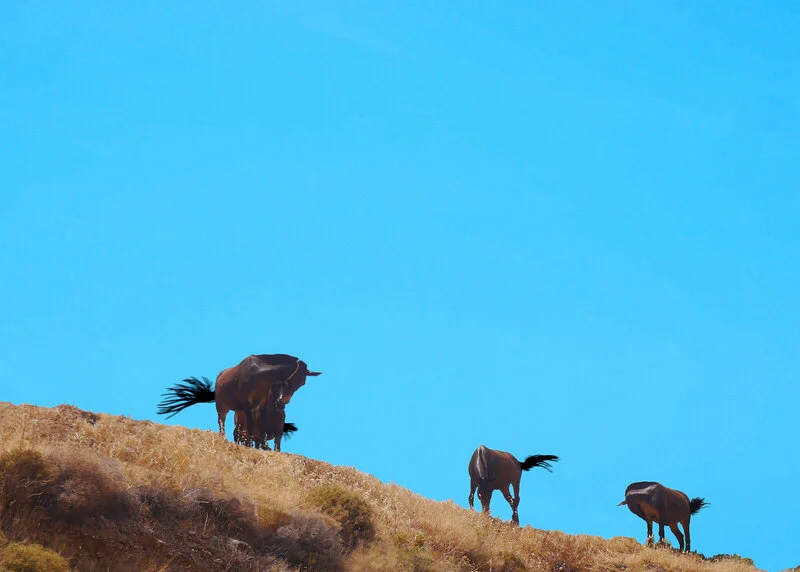
Wagging Tails - Horse Talk under Blue Sky, 2019
Digital
70 x 50 cm
Wagging Tails - Horse talk under Blue Sky
In a meadow high above Vlychos' road,
Dokos’ grand silhouette makes a timeless ode,
Grazed horses, tails swishing in the gentle breeze,
Amidst the wildflowers beneath the ancient trees.
Bella and Maximos, in coats of chestnut and grey,
Basked in the sunshine of this tranquil day.
Their eyes are on the horizon, where sea meets sky,
Their hearts are full of wonder as the clouds drift by.
They spoke of tails, a simple, joyful grace,
Of humans long lost, who once shared our case.
"Imagine," said Bella, "a time so long past,
When humans, like us, had tails to cast."
Maximos nodded, pondering this curious thought,
Of balance and wagging, what evolution brought.
“We’ve kept our tails for swatting flies away,
For communicating joy in our equine way.”
The sun climbed higher, painting shadows long,
As birds sang softly, a gentle noontime song.
The grass was sweet, the clover blooms bright,
A perfect harmony of Hydra nature's delight.
They spoke of ancient ties to creatures old and new,
Of human dreams and equine species views.
"Imagine a human wagging a tail," Maximos grinned,
"A sight so funny, where would they begin?"
Bella laughed, her eyes a sparkling light,
"Each creature has its own special right.
We swish and sway; they smile and embrace,
Each finds beauty in this shared space."
As the day moved on, their friendship grew,
In silent understanding, under skies so blue.
Two horses, pondering the world's grand tale,
Their hearts were as vast as the open trail.
In the divine stillness, they found their lustrous way,
Through meadows of green, in the warmth of the day.
And as evening fell, with stars shining bright,
Bella and Maximos whispered, “Goodnight.”
In dreams, they wandered through ancient lands,
Tails and tales entwined like shifting sands.
For in the Vlychos meadow high above the sea,
They found the magic of what life could be.
From ancient shadows, where the earth was young and in constant change,
A creature emerged, both elegant and robust, through ages refined.
A horse slowly shaped, through aeons of life's relentless march,
With ancestors scaled, small as dogs, they braved the endless plains.
Teeth and hooves transformed, step by step, through time's grand stage,
From forest shelter to the open light to fields vast and wide.
Hyracotherium, the first among horses, nimble and small,
Made way for new species, adapted to nature's harsh decree.
Where Eohippus trod, with four toes, dainty and neat,
An evolutionary leap to Protohippus, a precursor of today's horse.
Millennia passed, hooves grew strong, teeth suited for grass,
From forest refuge to plains of green, they evolved with grace.
Miohippus and Merychippus they battled through the ages,
Adaptation's struggle, survival's trials, arduous and tough.
Pliohippus, a step on the path near the horse we now see,
Proud and powerful, with a single toe, galloping through history’s land.
Then came Equus, our species today, the crown of evolution’s path,
Adapted for speed, for flight’s swift escape, over fields so free.
Thousands upon thousands of years in service to man, in partnership,
From battlefields to the farmer’s plough, a loyal companion are we.
In hexameter’s rhythm, a tribute to the noble horse's form,
A saga of survival, of nature’s power, and of time’s passage.
From ancient shadows to today’s light, the horse's grand journey,
An eternal symbol of strength and freedom, forever our friend and our faith.
Hydra, July 2024
Wagging Tails – Horse talk under Blue sky
High above Vlychos Road, the sun is shining, the sky is sparkling blue, and a group of horses graze peacefully on a lush meadow, with the silhouette of Dokos Island in the background. These happy horses have an unbeatable view, and as they munch on the fresh grass, they chat about their surroundings.
A horse named Bella lifts her head and gazes at the horizon. "Look at that view," she says. "It's simply breathtaking. I could stand here all day and take it all in."
Her friend, Maximos, swishes his tail to keep the flies away and nods in agreement. "Absolutely, Bella. The grass here is also top-notch. It's so fresh and tender, just how we like it."
Their conversation, as surreal as it may seem, mirrors the communication methods of other animals, particularly dogs, whose tail-wagging has intrigued scientists for years. Much like horses appreciate the quality of their environment, dogs use their tails to express their emotions and communicate with humans and other dogs.
Bella: (chewing on grass she found on an extra green patch) "We've got an unbeatable view up here. Dokos looks stunning today."
Maximos: (nodding) "Absolutely. And this grass is top quality. Ever wonder if dogs appreciate their surroundings like we do?" He swatted a few flies with his tail, sending them tumbling down the slope. “Why do dogs wag their tails if not to get rid of flies?” Maximos asked.
Alekos: (curious) "Speaking of dogs, I heard humans get excited when their dogs wag their tails. Ever wonder why they do that?"
Bella: "I read somewhere that dogs are among the few animals primarily using their tails for communication. For humans, there’s nothing more heartwarming than coming home to a dog excitedly wagging its tail."
Maximos: (interested) "Really? So, why do dogs wag their tails, exactly?"
Bella: "Well, I understand that scientists have a few theories. One is called the 'domestication syndrome' hypothesis. It suggests that humans might have unintentionally selected for tail-wagging because it was linked with other favourable traits like tameness and friendliness."
Alekos: "That makes sense. We horses aren’t so tame that we sleep in people’s beds and wag our tails as soon as our owners approach. But what about consciously selecting for it?"
Bella: "That’s another theory—the 'domesticated rhythmic wagging' hypothesis. It posits that humans might have consciously or unconsciously preferred tail-wagging during domestication due to an innate attraction to rhythmic stimuli."
Maximos: "Interesting. So, dogs wag their tails differently to convey different messages?"
Bella: "Yes, exactly. A dog wagging more to the right might be curious and friendly while wagging to the left could indicate uncertainty. A low tail wag, where the tail is pinned down, is often a sign of insecurity or submission."
Alekos: (surprised) "I didn’t know that! Can dogs understand these signals in each other?"
Bella: "Yes, they can. In a study, dogs were shown videos of silhouettes of other dogs wagging to the left, and they responded with more anxiety than those wagging to the right."
Maximos: "Fascinating. But are there still gaps in this understanding?"
Bella: "Definitely. Scientists are particularly interested in how much tail-wagging is conscious versus unconscious. They suggest more systematic studies, like analysing videos and measuring physiological responses such as heart rates and hormone levels during tail-wagging. Neuroimaging techniques could also provide deeper insights into what’s happening in dogs’ brains during this behaviour."
Alekos: "Understanding why dogs wag their tails could teach us a lot about our own history, too. Don’t you think?"
Bella: "Exactly. Since humans domesticated dogs, understanding this behaviour could shed light on the evolution of our species. As one researcher put it, studying modern dogs can give us a glimpse into the past and the impact of early humans on their canine companions."
Maximos: "Who knew a wagging tail could tell such a story?"
Alekos: "Indeed. And speaking of stories, this grass here tells me it's time for lunch."
Bella: (laughing) "Enjoy, everyone. Here's to more tales and tails!"
The horses continue grazing, their conversation blending into the peaceful sounds of the meadow, a soothing backdrop to their thoughts.
Bella: "You know, humans used to have tails too. They lost them over time, but they still have a little tailbone that shows they once had one."
Maximos: (ears perked up) "Really? That's interesting. I can't imagine humans with tails. What do you think they used them for?"
Bella: (swishing her tail thoughtfully) "Well, probably not for swatting flies like we do. Maybe for balance or communication, like dogs and us. It's funny to think about how different they are now."
Maximos: (nodding) "It does make you wonder. I heard that tailbones are called the coccyx. It's a small reminder of what once was. Just like our tails help us communicate, maybe theirs did too, a long time ago."
Bella: "Humans have evolved so much, haven't they? They walk upright, build cities, and communicate in such complex ways. Losing their tails must have been part of their journey to becoming who they are today."
Maximos: "Yeah, it's all part of evolution. Just like how we’ve adapted to our surroundings. We've got these beautiful tails that help us communicate and keep those pesky flies at bay."
Bella: (chuckling) "And let's not forget the wagging. Sometimes, I think humans wish they still had tails to wag when they're happy. It’s such a clear way to show how we feel."
Maximos: (swishing his tail more vigorously, making a playful motion) "I bet they do! Can you imagine a human wagging their tail when they see someone they love? It would be quite the sight."
Bella: (laughing) "It would indeed. But I suppose they have their ways of showing affection and joy. Smiles, hugs, even just how they look at each other."
Maximos: (sighing contentedly) "Yes, every species has its unique way of expressing itself. Our tails, their smiles... it's all part of the beautiful diversity of life."
Bella: "You’ve noticed that when humans ride you bareback, without a saddle, you can feel that tailbone when their rump lands too hard on your back. It hurts."
They both stand in silence for a moment, appreciating the serene landscape and their unique place in the world. The conversation about tails had given them a new perspective on evolution and the subtle connections between all living beings.
Bella: "Well, we should get back to grazing. This grass isn't going to eat itself."
Maximos: "True. And who knows, maybe one day humans will come up here and marvel at our tails, just as we marvel at their world."
With that, the two horses return to their grazing, their tails gently swishing in the breeze, a reminder of their place in the ongoing story of evolution. Maximos wonders if the flies they swatted landed down below on Vlychos Road. If so, there must be piles of dead flies there. Every horse knew that if you stumbled down the slope, there would be no more grass-eating forever.

Jörgen Thornberg
Malmö
Lite om bilder och mig. Translation in English at the end.
Jag är en nyfiken person som ser allt i bilder, även det jag fäster i ord, gärna tillsammans för bakom alla mina bilder finns en berättelse. Till vissa bilder hör en kortare eller längre novell som följer med bilden.
Bilder berättar historier. Jag omges av naturlig skönhet, intressanta människor och historia var jag än går. Jag använder min kamera för att dokumentera världen och blanda det jag ser med vad jag känner för att fånga den dolda magin.
Mina bilder berättar mina historier. Genom mina bilder, tryck och berättelser. Jag bjuder in dig att ta del av dessa berättelser, in i ditt liv och hem och dela min mycket personliga syn på vår värld. Mer än vad ögat ser. Jag tänker i bilder, drömmer och skriver och pratar om dem; följaktligen måste jag också skapa bilder. De blir vad jag ser, inte nödvändigtvis begränsade till verkligheten. Det finns en bild runt varje hörn. Jag hoppas att du kommer att se vad jag såg och gilla det.
Jag är också en skrivande person och till många bilder hör en kortare eller längre essay. Den följer med tavlan, tryckt på fint papper och med en personlig hälsning från mig.
Flertalet bilder startar sin resa i min kamera. Enkelt förklarat beskriver jag bilden jag ser i mitt inre, upplevd eller fantiserad. Bilden uppstår inom mig redan innan jag fått okularet till ögat. På bråkdelen av ett ögonblick ser jag vad jag vill ha och vad som kan göras med bilden. Här skall jag stoppa in en giraff, stålmannen, Titanic eller vad det är min fantasi finner ut. Ännu märkligare är att jag kommer ihåg minnesbilden långt efteråt när det blir tid att skapa verket. Om jag lyckas eller inte, är upp till betraktaren, oftast präglat av en stråk av svart humor – meningen är att man skall bli underhållen. Mina bilder blir ofta en snackis där de hänger.
Jag föredrar bilder som förmedlar ett budskap i flera lager. Vid första anblicken fylld av feel-good, en vacker utsikt, fint väder, solen skiner, blommor på ängen eller vattnet som ligger förrädiskt spegelblankt. I en sådan bild kan jag gömma min egentliga berättelse, mitt förakt för förtryckare och våldsverkare, rasister och fördomsfulla människor - ett gärna återkommande motiv mer eller mindre dolt i det vackra motivet. Jag försöker förena dem i ett gemensamt narrativ.
Bild och formgivning har löpt som en röd tråd genom livet. Fotokonst känns som en värdig final som jag gärna delar med mig.
Min genre är vid som framgår av mina bilder, temat en blandning av pop- och gatukonst i kollage som kan bestå av hundratals lager. Vissa bilder kan ta veckor, andra någon dag innan det är dags att överlämna resultatet till printverkstaden. Fine Art Prints är digitala fotocollage. I dessa kollage sker rivandet, klippandet, pusslandet, målandet, ritandet och sprayningen digitalt. Det jag monterar in kan vara hundratals år gamla bilder som jag omsorgsfullt frilägger så att de ser ut att vara en del av tavlan men också bilder skapade av mig själv efter min egen fantasi. Därefter besöks printstudion och för vissa bilder numrera en limiterad upplaga (oftast 7 exemplar) och signera för hand. Vissa bilder kan köpas i olika format. Det är bara att fråga efter vilka. Gillar man en bild som är 70x100 men inte har plats på väggen, går den kanske att få i 50x70 cm istället. Frågan är fri.
Metoden Giclée eller Fine Art Print som det också kallas är det moderna sättet för framställning av grafisk konst. Villkoret för denna typ av utskrifter är att en högkvalitativ storformatskrivare används med åldersbeständigt färgpigment och konstnärspapper eller i förekommande fall på duk. Pappret som används möter de krav på livslängd som ställs av museer och gallerier. Normalt säljer jag mina bilder oinramade så att den nya ägaren själv kan bestämma hur de skall se ut, med eller utan passepartout färg på ram, med eller utan glas etc..
Under många år ställde jag bara ut på nätet, i valda grupper och på min egen Facebooksida - https://www.facebook.com/jorgen.thornberg.9
Jag finns också på en egen hemsida som tyvärr inte alltid är uppdaterad – https://www.jth.life/ Där kan du också läsa en del av de berättelser som följer med bilden.
UTSTÄLLNINGAR
Luftkastellet, oktober 2022
Konst i Lund, november 2022
Luftkastellet, mars 2023
Engleson Galleri Caroli, april 2023
Hydra, Greece June 2023
Engleson Galleri Caroli, oktober 2023
Toppen, Höllviken december 2023
Luftkastellet, mars 2024
Torups Galleri, mars 2024
Venice, May 2024
Luftkastellet, oktober 2024
Konst i Advent, December 2024
Galleri Engleson, Caroli December 2024
Jäger & Jansson Galleri, april 2025
A bit about pictures and me.
I'm a curious person who sees everything in pictures, even what I express in words, often combining them, for behind all my pictures lies a story. These narratives, some as short as a single image and others as long as a novel, are the heart and soul of my work.
Pictures tell stories. Wherever I go, I'm surrounded by natural beauty, exciting people, and history. I use my camera to document the world and blend what I see with what I feel to capture the hidden magic.
My images tell my stories. Through my pictures, prints, and narratives, I invite you to partake in these stories in your life and home and share my deeply personal perspective of our world. More than meets the eye. I think in pictures, dream, write, and talk about them; consequently, I must create images too. They become what I see, not necessarily confined to reality. There's a picture around every corner. I hope you'll see what I saw and enjoy it.
I'm also a writer, and many images come with a shorter or longer essay. It accompanies the painting, printed on fine paper with my personal greeting.
Many pictures start their journey on my camera. Simply put, I describe the image I see in my mind, experienced or imagined. The image arises within me even before I bring the eyepiece to my eye. In a fraction of a moment, I see what I want and what can be done with the picture. Here, I'll insert a giraffe, Superman, the Titanic, or whatever my imagination conjures up. Even stranger is that I remember the mental image long after it's time to create the work. Whether I succeed is up to the observer, often imbued with a streak of black humour – the aim is to entertain. My pictures usually become a talking point wherever they hang.
I prefer pictures that convey a message in multiple layers. At first glance, they're filled with feel-good vibes, a beautiful view, lovely weather, the sun shining, flowers in the meadow, or the water lying deceptively calm. But beneath this surface beauty, I often conceal a deeper story, a narrative that challenges societal norms or explores the human condition. I invite you to delve into these hidden narratives and discover the layers of meaning within my work.
Picture and design have been a thread running through my life. Photographic art feels like a fitting finale, and I'm happy to share it.
My genre is varied, as seen in my pictures; the theme is a blend of pop and street art in collages that can consist of hundreds of layers. Some images can take weeks, others just a day before it's time to hand over the result to the print workshop. Fine Art Prints are digital photo collages. In these collages, tearing, cutting, puzzling, painting, drawing, and spraying happen digitally. What I insert can be images hundreds of years old that I carefully extract so they appear to be part of the painting, but also images created by myself, now also generated from my imagination. Next, visit the print studio and, for certain images, number a limited edition (usually 7 copies) and sign them by hand. Some images may be available in other formats. Just ask which ones. If you like an image that's 70x100 but doesn't have space on the wall, you might be able to get it in 50x70 cm instead. The question is open.
The Giclée method, or Fine Art Print as it's also called, is the modern way of producing graphic art. This method ensures the highest quality and longevity of the artwork, using a high-quality large-format printer with archival pigment inks and artist paper or, in some cases, canvas. The paper used meets the longevity requirements set by museums and galleries. I sell my pictures unframed, allowing the new owner to personalise their artwork, confident in the lasting value and quality of the piece.
For many years, I only exhibited online, in selected groups, and on my Facebook page - https://www.facebook.com/jorgen.thornberg.9. I also have my website, which unfortunately is not constantly updated - https://www.jth.life/. You can also read some of the stories accompanying the pictures there.
EXHIBITIONS
Luftkastellet, October 2022
Art in Lund, November 2022
Luftkastellet, March 2023
Engleson Gallery Caroli, April 2023
Hydra, Greece June 2023
Engleson Gallery Caroli, October 2023
Toppen, Höllviken December 2023
Luftkastellet, March 2024
Torup Gallery, March 2024
Venice, May 2024
UTSTÄLLNINGAR
Luftkastellet, oktober 2022
Konst i Lund, november 2022
Luftkastellet, mars 2023
Engleson Galleri Caroli, april 2023
Hydra, Greece June 2023
Engleson Galleri Caroli, oktober 2023
Toppen, Höllviken december 2023
Luftkastellet, mars 2024
Torups Galleri, mars 2024
Venice, May 2024
Luftkastellet, October 2024
Konst i Advent, December 2024
Galleri Engleson, Caroli December 2024
Jäger & Jansson Galleri, April 2025
Utbildning
Autodidakt
Medlem i konstnärsförening
Öppna Sinnen
Med i konstrunda
Konstrundan i Skåne
Utställningar
Luftkastellet, October 2022
Art in Lund, November 2022
Luftkastellet, March 2023
Engleson Gallery Caroli, April 2023
Hydra, Greece June 2023
Engleson Gallery Caroli, October 2023
Toppen, Höllviken December 2023
Luftkastellet, March 2024
Torup Gallery, March 2024
Venice, May 2024