Vi använder cookies för att ge dig bästa möjliga upplevelse. Välj vilka cookies du tillåter.
Läs mer i vår integritetspolicy
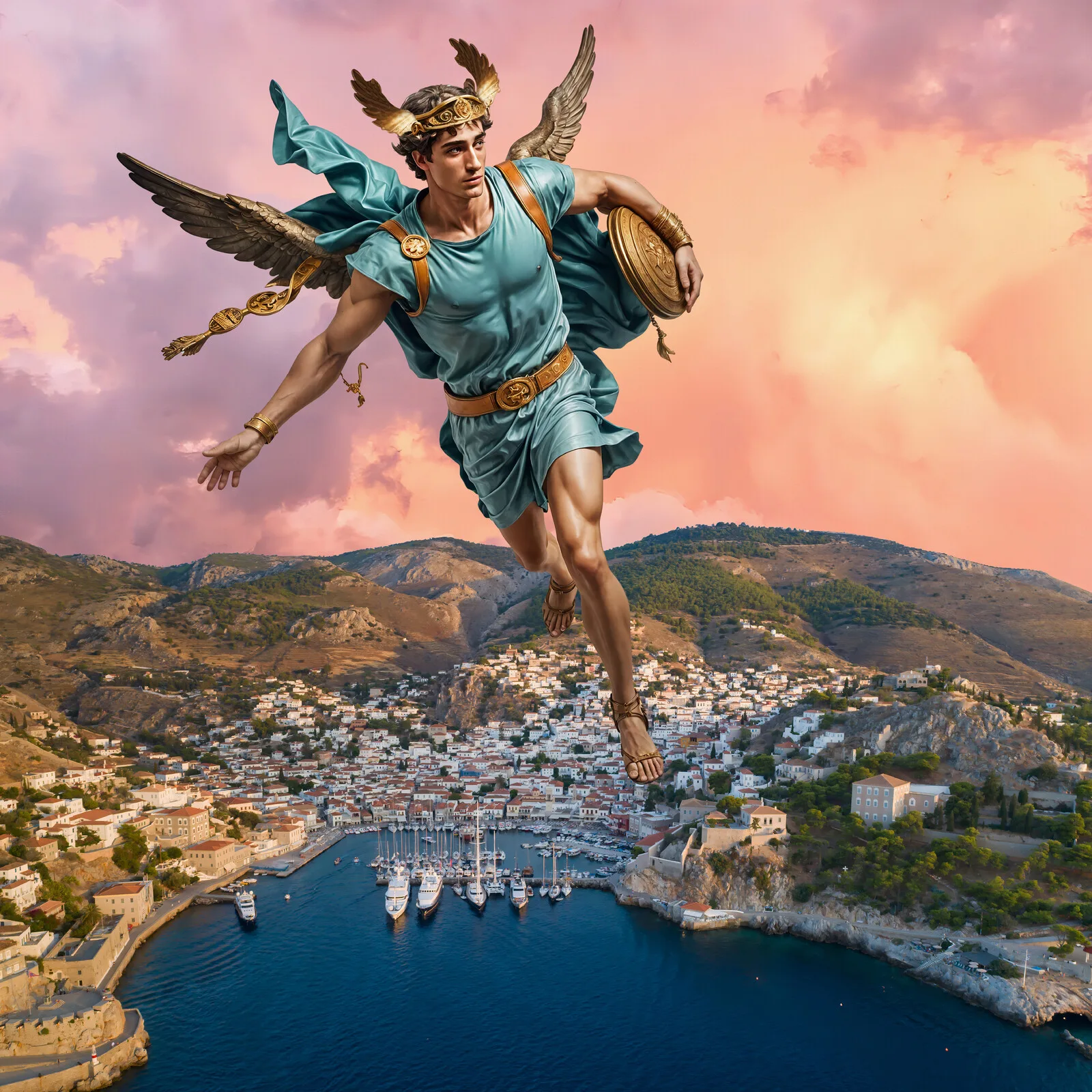
Jörgen Thornberg
Late afternoon mail arrival, 2024
Digital
70 x 70 cm
Hermes' Heavenly Hijinks - A Hydra Tale
The other day, with my drone in the air,
seeking Hydra secrets in a sky so fair.
A divine filter on the lens, just in case,
For gods often visit this mystical place.
Leonard Cohen once gifted me this tool,
To spot the divine is pretty cool.
The drone buzzed above, not long in flight,
When Hermes appeared, a surprising sight.
Scaring gulls away with a swift glide,
Hermes, for a bird, could never hide.
Crystal clear, my snapshot did catch,
Hermes on a mission, a divine dispatch.
Red-nosed and weary from a night of cheer,
He joined me at Pirate Bar, his purpose clear.
Over strong coffee, he shared his tale,
Of pranks and missions, without fail.
Hermes, the herald, mail carrier supreme,
Protector of travellers, or so it would seem.
He guards merchants, thieves, and orators too,
A trickster with winged sandals, swift as dew.
Cunning and sly, a good friend yet a foe,
A baby’s innocence, though a shadow below.
Church disapproves, yet messages come,
From Hermes, the divine, they cannot shun.
His talents attract the notorious few,
Orators like Hitler, Trump, and Putin too.
Lying fast as racehorses, swift and untrue,
Their deceptions, a stable of dung to view.
Youngest Olympian, his worship began,
On Mount Cyllene, in Arcadian land.
But overcrowded Arcadia made him roam,
To uninhabited Hydra and found a home.
Annual feasts, topped by Hermaea’s grand,
Athletics and sacrifices throughout the land.
Dionysos directs with gods seated in delight,
Amphitheatre now a harbour, day into night.
Infant trickster, Apollo’s cattle he stole,
Erasing hoofprints was a devious goal.
A lyre made from a tortoise shell, his gift,
For Apollo, prophecy in return was swift.
Hermes arrived from the sky as Internet fell,
Pan’s prank with the black sheep causes hell.
A urination fix and connection restored,
Hermes’ scolding, Pan couldn’t ignore.
The black sheep grilled, the party began,
Hydra’s outages are a typical plan.
Hermes, protector of flocks and herds,
Saved Hydra from plague with hymns and words.
‘Hurrian Hymn’ from ancient Ugarit,
Hermes chanted as the winds did permit.
Offering to Selene the moon’s bright light,
Echoes of the past, on a full moon night.
Pan, with his pipes, chased nymphs around,
Pitys and Syrinx, their stories profound.
Echo’s voice, in island valleys she stays,
Call her name, and she replies in waves.
Pan, with Dionysos, revelled in mirth,
Thieves and pranksters, rulers of Earth.
Cicadas sing, a loud, constant drone,
A reminder of Pan, never alone.
Hermes in battles, aiding the strong,
Invisibility helmet, making right from wrong.
Hercules and Perseus, his guidance clear,
He took Medusa’s head, a prize to revere.
Hermaphroditus, his son of love and trick,
Fused with Salmacis, a transformation quick.
A tale of dual gender, old as time,
Respecting all is the LGBTQ climb.
Hermes’ many roles, protector and guide,
From youth to scholars, his influence is wide.
He’s a busy god, yet partying still,
With Pan and Dionysos, he has his fill.
Wine enough to fill Gennesaret sea,
Inspired Jesus’ miracle, divinity.
Silly grins on the gods’ face, forever in play,
Hydra’s mythical charm is alive every day.
The other day, I let my drone spin over Hydra to see if I could find any new and exciting perspectives. Just in case, I put my divine filter on the lens. You never know what might be flying over Hydra, one of the gods' favourite spots. The largely uninhabited island and its rugged interior have made it a playground for Greek gods and Time-travellers. I got the filter a few years ago from Leonard Cohen during one of his visits to Hydra, a story I’ve shared before.
The drone hadn't been flying long when a familiar figure suddenly appeared, scaring away a few lazily gliding seagulls. Animals, as you know, can see what humans cannot. The snapshot of Hermes leaving Hydra is one of my best—crystal clear proof that he’s still active. It wasn’t until yesterday that I learned what he was up to. He was back on the island and, to be honest, didn’t look great. His nose was red, and his eyes were bloodshot—he looked like he had partied all night. Ever social, he joined me for a strong coffee at Pirate Bar and recounted the night’s festivities and his recent mission.
Hermes is considered the herald of the gods. He brings mail and is nowadays responsible for the Internet. He is also the protector of human heralds, travellers, thieves, and merchants, which, according to many, is the same. Hermes also protects orators and modern bloggers. He can move quickly and freely between the worlds of the mortal and the divine, aided by his winged sandals.
Hermes, with his ambiguous personality, is a deified trickster and a master of thieves. He's a plunderer, cattle-raider, night-watcher, and cheater. Despite his cunning nature, he's known as the friendliest to man, though treacherous and a true schemer. Hermes is amoral, like a baby, unaware that many consider him a bad influence. Ask a priest, and they will tell you the church disapproves of messages delivered by Hermes, yet they receive them anyway. It's believed that Hermes played a role in transmitting some biblical messages. His talents have attracted notorious orators like Hitler, Joseph Goebbels, and today's Mr Trump and Putin. They all metaphorically lie like racehorses run because they lie like rugs. Hermes had a stable full of such horses, capable of filling the stable with dung in no time. The story of Hercules' incredible feat of cleaning the Augean stables in a single day is inspired by the daily cleaning of Hermes' gigantic horse stable on Hydra near Episkopi—the fertile soil results from all the manure cleared from the lying stallions over the ages. Just Mr Trump alone can fill a field in no time, with his 30,573 false or misleading claims over four years, averaging twenty-one daily.
Hermes is the youngest Olympian, and his initial coming is probably due to contacts with celestial deities. One of Hermes's oldest places of worship was Mount Cyllene in Arcadia, where he was born. But he soon moved to the uninhabited island of Hydra when Arcadia became too crowded. Annually, Hermes' feast, the Hermaea, was celebrated with sacrifices to the god and athletic and gymnastic competitions. This festival was established on Hydra in the 6th century BC and held in the island's natural amphitheatre, now Hydra Town. Gods, demigods, titans, nymphs, and all kinds of mythical creatures sat on ledges and rocky outcrops, with the stage where the harbour square is today. Dionysos was, of course, the director.
He was renowned for mischievous acts, such as the infamous theft of Apollo's cows. Even as an infant, he travelled from Cyllene, his birthplace, to Pieria, where Apollo's cattle were kept. After successfully stealing them, he led the animals to Pylos, where he concealed them before returning to Cyllene.
His cunning was evident even in infancy, as he meticulously erased all traces of the animals' hooves to make them difficult to track. Upon his return to Cyllene, he crafted a lyre from a tortoise shell and the intestines of some of the cattle he had killed.
However, the crafty god overlooked one crucial detail in his malicious plan. With his gift of prophecy, Apollo quickly identified the thief who had stolen his property.
So, rushing to Cyllene, the god of light snatched little Hermes and took him to Olympus to be judged by the mighty ruler of the heavens, Zeus. At first, little Hermes denied the theft charges, but later on, he had to admit he was indeed the culprit. To appease his godbrother, Apollo, the little prankster, gave him the lyre he had invented as a gift. In return, Apollo gave him a long, strong stick to help him control his cattle while grazing and the gift of prophecy.
Hermes was a busy man, and, remarkably, he managed to attend all the parties with Dionysos and his son Pan. They must have been perpetually intoxicated. It has been calculated that the amount of wine consumed over three thousand years is enough to fill the Sea of Galilee. This analogy once inspired Jesus to turn water into wine—no wonder these three gentlemen are always depicted with silly grins.
Hermes arrived on Hydra late that afternoon because the Internet was down, and no one knew why. The telephone companies blamed each other, but only Hermes knew the truth. It was, as usual, his son Pan who had played a prank on Hermes’ old island. Pan had deliberately let his blackest sheep graze on the invisible cable that constitutes ‘Cyberspace. ' Without it, the Internet doesn’t work.
After a scolding from his father, Hermes, Pan had to restore the connection, which he did most easily by urinating on the severed cable. The black sheep received its punishment and was grilled on a spit during the evening’s boisterous reconnection party. The island's residents can confirm that these outages happen from time to time, and sometimes, it takes hours before Hermes gets there, the party can begin, and Cyberspace is restored.
Hermes was known as the patron god of flocks, herds, and shepherds. He once saved prehistoric Hydra from a plague by flying around the island with a ram in his arms, singing a hymn in all directions. The 'Hurrian Hymn,' a fertility song from ancient Ugarit, where Hermes once operated, is deeply intertwined with the mythological narrative. When the wind is just right, you can imagine Hermes singing the hymn and making offerings to the moon goddess Selene. The sound, reminiscent of the chanting of the prelates in Hydra’s cathedral but quieter, carries the echoes of a distant past. If you focus your gaze when the moon is full simultaneously, you might glimpse Selene driving her chariot across the night sky, a sight that has fascinated generations of Hydriots. She, a Titaness and the daughter of the Titans Hyperion and Theia, is forever associated with the full moon, her image often adorned with a crescent moon.
Numerous depictions of Hermes as a shepherd god carrying a lamb on his shoulders have been found throughout the Mediterranean world, and it is possible that the iconography of Hermes as "The Good Shepherd" influenced early Christianity, specifically in the description of Christ as "the Good Shepherd" in the Gospel of John.
Hermes is called "the bringer of good luck," "guide and guardian," and is excellent in various tricks. Hermes was the one who gave Pandora the gifts of lies, seductive words, and a dubious character.
Once, nearly three thousand five hundred years ago, an entire flock of gods led by the god Pan lived on Hydra. Many associated his name with the word ‘pan,’ meaning ‘all.’ However, its true origin lay in an old Arcadian word for ‘rustic,’ but the fact is that one does not exclude the other since Pan has a bit of everything in his personality. It is easy to recognise humanity’s worst but most amusing traits. If not a twin, he could have been my half-brother.
As it is today, Hydra was then an island of festivities where Pan held the baton. Hermes’ son was the minor god of shepherds and was responsible for hunters and the meadows and forests of the mountain wilds. His unseen presence aroused panic in those who traversed his realm, which made people avoid Hydra for a long time. This explains why no significant traces exist from human presence before the 1400s. Only a few dared to venture here, but they usually did not stay long enough to leave visible traces behind.
Pan idled in the rugged countryside of Hydra, playing his panpipes and chasing nymphs. One of these, Pitys, fled his advances and was transformed into a mountain pine, the god's sacred tree, on the side facing the Myrtoan Sea near Agias Mamas. The tragic fate of Pitys, who was once a nymph full of life and now a silent tree, is a poignant reminder of the power and caprice of the gods. Unfortunately, this holy tree burned down ten years ago due to a wildfire caused by negligence at Hydra’s city dump. The perpetrator will face a grim fate when joining the stars one day. Greek gods are known for their vengefulness. The charred trunk remains as a testament to the ancient tree.
Another young nymph, Syrinx, escaped but was turned into a clump of reeds from which Pan crafted his pipes. A third girl, the beautiful Echo, was cursed to fade away for spurning the god, leaving behind just a voice to repeat his mountain cries. Though a mere echo, her voice retains the beauty and allure of her former self. You can still hear her in Hydra’s valleys; call her name, and she will answer, sometimes several times, to ensure you heard.
Pan was depicted as a man with the horns, legs, and tail of a goat, a thick beard, a snub nose, and pointed ears. His unique appearance, a blend of human and animal features, sets him apart from other gods. He often appears in scenes with his best friend Dionysus, the favourite god of all revellers. Pan’s drunken revelries with Dionysus are legendary and richly described in literature.
As the god of thieves and pranksters, Pan enjoys playing tricks on people. When chickens disappear on Hydra, cats are unfairly blamed. Often, it is Hermes who steals the cockerels to raise into roosters that peck on the slopes towards the sea. They crow at all imaginable times, prompting others to join in. Pan also commands all the world’s cicadas, filling the air with their racket.
The song of the cicadas is among the loudest sounds produced by insects and has been depicted in poetry since ancient times. The males produce the sound to attract nymphs to Pan and occasionally a female to themselves. Pan is not far away because the cicadas are making a racket in my trees today.
Hermes took part in the battle of the Giants and killed Hippolytus thanks to a magic helmet that the god received from Hades, making whoever wore it invisible. Perhaps this is why you never see him directly but only indirectly through all the mischief he causes, like the crowing of roosters and the so-called song of the cicadas.
Hermes was deemed responsible for selling the mighty hero Hercules as a slave, but he also stood by the hero in dire straits. When Hercules descended to the Underworld to steal Cerberus to fulfil the last of his labours dictated to him by King Eurystheus, he could thank Hermes for a successful outcome.
Hermes also encouraged Perseus to kill the horrible Medusa. As a token of gratitude, Perseus gave Hermes Hades a magic helmet. In return, Hermes gave the hero an adamantine sword, which Perseus used to take Medusa’s head. The petrified head went astray and disappeared from Greece. The terrible head was recently found in Turkish Antalya, formerly the ancient city of Antiocheia Ad Cragum. Hermes has sworn to steal it when he sees a break between his party-filled engagements with Dionysus.
Lastly, let’s mention one of Hermes' many children. Hermaphroditus was the gorgeous son of Hermes and Aphrodite, who, as I’ve mentioned before, still has her summer residence in one of the caves near Limnioniza.
As the story goes, once, as the shy young man wandered through a forest of Halicarnassus, he stopped by a lake to see his reflection in the water. The lake's nymph, Salmacis, saw him and immediately fell madly in love with the handsome youth. This story of Hermaphroditus, a figure from Greek mythology who embodies both male and female characteristics, is often cited in discussions about gender identity and fluidity.
To avoid her, the boy jumped into the lake. The nymph followed him until she embraced him passionately, praying to the gods to unite them forever. The gods heard her prayers and fused their bodies so that no one could tell whether the body belonged to a man or a woman. This story dates back to ancient Greece and reflects the historical persecution of individuals who did not conform to traditional gender roles. The ancient Greeks persecuted hermaphrodites and threw them into the sea. It was not until the late seventeenth century that their rights were respected by law.
Hermaphrodites among humans don't exist. That outdated term implies a person is entirely male and female, which isn't biologically possible. Many people who are intersex consider that term derogatory and stigmatising. Intersex and being intersex are the correct terms, and they belong to the LGBT community.
Hermes' Diverse Powers and Roles:
1. Herald and Messenger:
- Brave and wing-footed, Hermes served as the gods' messenger and herald.
- Symbols: Kerykeion (gold wand with two snakes or feathers) and winged sandals.
2. Patron of Youth:
- Represented ideal ancient Greek youthfulness.
- Patron of Gymnasium and Palaistra (athletic and educational buildings).
- Honored through athletic contests called Hermaia.
3. Patron of Herds:
- Protector of herds and agriculture.
- Epithets: Milosoos, Nomios, and Epimilios.
- Worshiped in grazing lands of Arcadia, notably near his birthplace, Mount Cyllene.
4. Patron of Roads:
- Patron and saviour of Travellers.
- Epithets: Odeios, Enodeios, Hegemoneios, and Agetor.
- Travelers erected stone heaps (Hermaia) as path markers in his honour.
5. Patron of Trades and Theft:
- Patron of merchants, known as Kerdoos (profit).
- Credited with inventing weights and measures, depicted holding a coin pouch in the agora.
- Patron of thieves associated with fraud and theft.
6. Patron of Scholars:
- Noted for intelligence and persuasion, known as Logios (scholar).
- Patron of Orators and Philosophers, credited with inventing writing.
- Patron of Astronomy and father of mathematics.
7. Patron of Health, Sleep, and Dreams:
- Helped the ill and saved Tanagra from a plague by carrying a ram around the city.
- Knowledgeable about medicinal herbs, protected Odysseus with a moly plant from Circe's sorcery.
- Known as Hypnodotis (sleep giver), he brought sleep, wakefulness, and sent dreams.
8. Companion of the Dead:
- Bearer of souls to the Underworld.
- Known as Psychopompos, Psychagogos, or Tamias ton Nekron (treasurer of the dead).
Hermes was a busy man, and remarkably, he managed to attend all the parties with his sons Pan and Dionysos. They must have been perpetually intoxicated. It has been calculated that the amount of wine consumed over more than three thousand years of partying is enough to fill the Sea of Galilee, an analogy that once inspired Jesus to turn water into wine—no wonder these three gentlemen are always depicted with silly grins.
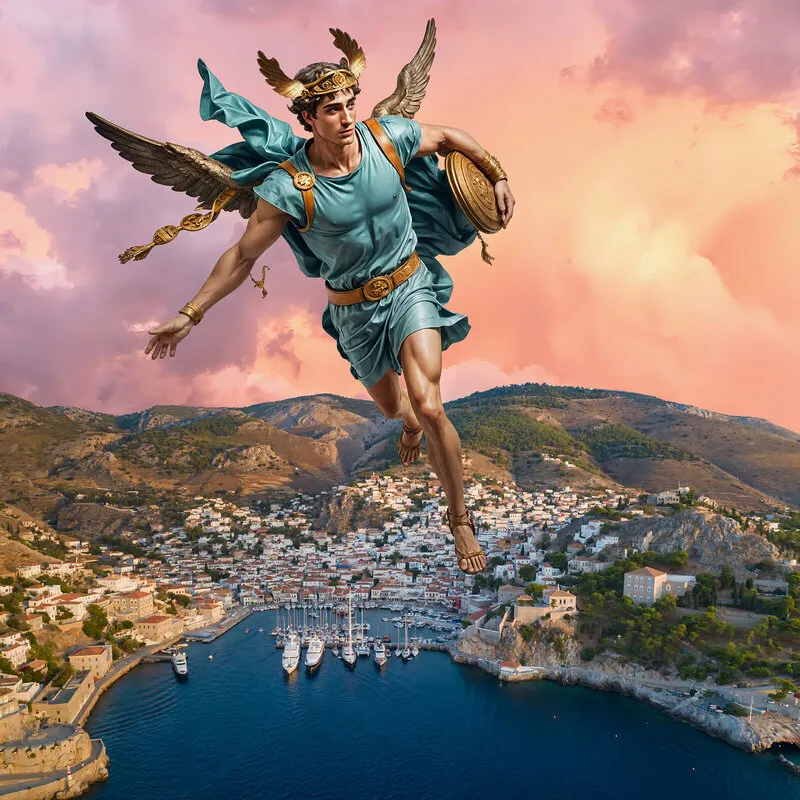
Jörgen Thornberg
Late afternoon mail arrival, 2024
Digital
70 x 70 cm
Hermes' Heavenly Hijinks - A Hydra Tale
The other day, with my drone in the air,
seeking Hydra secrets in a sky so fair.
A divine filter on the lens, just in case,
For gods often visit this mystical place.
Leonard Cohen once gifted me this tool,
To spot the divine is pretty cool.
The drone buzzed above, not long in flight,
When Hermes appeared, a surprising sight.
Scaring gulls away with a swift glide,
Hermes, for a bird, could never hide.
Crystal clear, my snapshot did catch,
Hermes on a mission, a divine dispatch.
Red-nosed and weary from a night of cheer,
He joined me at Pirate Bar, his purpose clear.
Over strong coffee, he shared his tale,
Of pranks and missions, without fail.
Hermes, the herald, mail carrier supreme,
Protector of travellers, or so it would seem.
He guards merchants, thieves, and orators too,
A trickster with winged sandals, swift as dew.
Cunning and sly, a good friend yet a foe,
A baby’s innocence, though a shadow below.
Church disapproves, yet messages come,
From Hermes, the divine, they cannot shun.
His talents attract the notorious few,
Orators like Hitler, Trump, and Putin too.
Lying fast as racehorses, swift and untrue,
Their deceptions, a stable of dung to view.
Youngest Olympian, his worship began,
On Mount Cyllene, in Arcadian land.
But overcrowded Arcadia made him roam,
To uninhabited Hydra and found a home.
Annual feasts, topped by Hermaea’s grand,
Athletics and sacrifices throughout the land.
Dionysos directs with gods seated in delight,
Amphitheatre now a harbour, day into night.
Infant trickster, Apollo’s cattle he stole,
Erasing hoofprints was a devious goal.
A lyre made from a tortoise shell, his gift,
For Apollo, prophecy in return was swift.
Hermes arrived from the sky as Internet fell,
Pan’s prank with the black sheep causes hell.
A urination fix and connection restored,
Hermes’ scolding, Pan couldn’t ignore.
The black sheep grilled, the party began,
Hydra’s outages are a typical plan.
Hermes, protector of flocks and herds,
Saved Hydra from plague with hymns and words.
‘Hurrian Hymn’ from ancient Ugarit,
Hermes chanted as the winds did permit.
Offering to Selene the moon’s bright light,
Echoes of the past, on a full moon night.
Pan, with his pipes, chased nymphs around,
Pitys and Syrinx, their stories profound.
Echo’s voice, in island valleys she stays,
Call her name, and she replies in waves.
Pan, with Dionysos, revelled in mirth,
Thieves and pranksters, rulers of Earth.
Cicadas sing, a loud, constant drone,
A reminder of Pan, never alone.
Hermes in battles, aiding the strong,
Invisibility helmet, making right from wrong.
Hercules and Perseus, his guidance clear,
He took Medusa’s head, a prize to revere.
Hermaphroditus, his son of love and trick,
Fused with Salmacis, a transformation quick.
A tale of dual gender, old as time,
Respecting all is the LGBTQ climb.
Hermes’ many roles, protector and guide,
From youth to scholars, his influence is wide.
He’s a busy god, yet partying still,
With Pan and Dionysos, he has his fill.
Wine enough to fill Gennesaret sea,
Inspired Jesus’ miracle, divinity.
Silly grins on the gods’ face, forever in play,
Hydra’s mythical charm is alive every day.
The other day, I let my drone spin over Hydra to see if I could find any new and exciting perspectives. Just in case, I put my divine filter on the lens. You never know what might be flying over Hydra, one of the gods' favourite spots. The largely uninhabited island and its rugged interior have made it a playground for Greek gods and Time-travellers. I got the filter a few years ago from Leonard Cohen during one of his visits to Hydra, a story I’ve shared before.
The drone hadn't been flying long when a familiar figure suddenly appeared, scaring away a few lazily gliding seagulls. Animals, as you know, can see what humans cannot. The snapshot of Hermes leaving Hydra is one of my best—crystal clear proof that he’s still active. It wasn’t until yesterday that I learned what he was up to. He was back on the island and, to be honest, didn’t look great. His nose was red, and his eyes were bloodshot—he looked like he had partied all night. Ever social, he joined me for a strong coffee at Pirate Bar and recounted the night’s festivities and his recent mission.
Hermes is considered the herald of the gods. He brings mail and is nowadays responsible for the Internet. He is also the protector of human heralds, travellers, thieves, and merchants, which, according to many, is the same. Hermes also protects orators and modern bloggers. He can move quickly and freely between the worlds of the mortal and the divine, aided by his winged sandals.
Hermes, with his ambiguous personality, is a deified trickster and a master of thieves. He's a plunderer, cattle-raider, night-watcher, and cheater. Despite his cunning nature, he's known as the friendliest to man, though treacherous and a true schemer. Hermes is amoral, like a baby, unaware that many consider him a bad influence. Ask a priest, and they will tell you the church disapproves of messages delivered by Hermes, yet they receive them anyway. It's believed that Hermes played a role in transmitting some biblical messages. His talents have attracted notorious orators like Hitler, Joseph Goebbels, and today's Mr Trump and Putin. They all metaphorically lie like racehorses run because they lie like rugs. Hermes had a stable full of such horses, capable of filling the stable with dung in no time. The story of Hercules' incredible feat of cleaning the Augean stables in a single day is inspired by the daily cleaning of Hermes' gigantic horse stable on Hydra near Episkopi—the fertile soil results from all the manure cleared from the lying stallions over the ages. Just Mr Trump alone can fill a field in no time, with his 30,573 false or misleading claims over four years, averaging twenty-one daily.
Hermes is the youngest Olympian, and his initial coming is probably due to contacts with celestial deities. One of Hermes's oldest places of worship was Mount Cyllene in Arcadia, where he was born. But he soon moved to the uninhabited island of Hydra when Arcadia became too crowded. Annually, Hermes' feast, the Hermaea, was celebrated with sacrifices to the god and athletic and gymnastic competitions. This festival was established on Hydra in the 6th century BC and held in the island's natural amphitheatre, now Hydra Town. Gods, demigods, titans, nymphs, and all kinds of mythical creatures sat on ledges and rocky outcrops, with the stage where the harbour square is today. Dionysos was, of course, the director.
He was renowned for mischievous acts, such as the infamous theft of Apollo's cows. Even as an infant, he travelled from Cyllene, his birthplace, to Pieria, where Apollo's cattle were kept. After successfully stealing them, he led the animals to Pylos, where he concealed them before returning to Cyllene.
His cunning was evident even in infancy, as he meticulously erased all traces of the animals' hooves to make them difficult to track. Upon his return to Cyllene, he crafted a lyre from a tortoise shell and the intestines of some of the cattle he had killed.
However, the crafty god overlooked one crucial detail in his malicious plan. With his gift of prophecy, Apollo quickly identified the thief who had stolen his property.
So, rushing to Cyllene, the god of light snatched little Hermes and took him to Olympus to be judged by the mighty ruler of the heavens, Zeus. At first, little Hermes denied the theft charges, but later on, he had to admit he was indeed the culprit. To appease his godbrother, Apollo, the little prankster, gave him the lyre he had invented as a gift. In return, Apollo gave him a long, strong stick to help him control his cattle while grazing and the gift of prophecy.
Hermes was a busy man, and, remarkably, he managed to attend all the parties with Dionysos and his son Pan. They must have been perpetually intoxicated. It has been calculated that the amount of wine consumed over three thousand years is enough to fill the Sea of Galilee. This analogy once inspired Jesus to turn water into wine—no wonder these three gentlemen are always depicted with silly grins.
Hermes arrived on Hydra late that afternoon because the Internet was down, and no one knew why. The telephone companies blamed each other, but only Hermes knew the truth. It was, as usual, his son Pan who had played a prank on Hermes’ old island. Pan had deliberately let his blackest sheep graze on the invisible cable that constitutes ‘Cyberspace. ' Without it, the Internet doesn’t work.
After a scolding from his father, Hermes, Pan had to restore the connection, which he did most easily by urinating on the severed cable. The black sheep received its punishment and was grilled on a spit during the evening’s boisterous reconnection party. The island's residents can confirm that these outages happen from time to time, and sometimes, it takes hours before Hermes gets there, the party can begin, and Cyberspace is restored.
Hermes was known as the patron god of flocks, herds, and shepherds. He once saved prehistoric Hydra from a plague by flying around the island with a ram in his arms, singing a hymn in all directions. The 'Hurrian Hymn,' a fertility song from ancient Ugarit, where Hermes once operated, is deeply intertwined with the mythological narrative. When the wind is just right, you can imagine Hermes singing the hymn and making offerings to the moon goddess Selene. The sound, reminiscent of the chanting of the prelates in Hydra’s cathedral but quieter, carries the echoes of a distant past. If you focus your gaze when the moon is full simultaneously, you might glimpse Selene driving her chariot across the night sky, a sight that has fascinated generations of Hydriots. She, a Titaness and the daughter of the Titans Hyperion and Theia, is forever associated with the full moon, her image often adorned with a crescent moon.
Numerous depictions of Hermes as a shepherd god carrying a lamb on his shoulders have been found throughout the Mediterranean world, and it is possible that the iconography of Hermes as "The Good Shepherd" influenced early Christianity, specifically in the description of Christ as "the Good Shepherd" in the Gospel of John.
Hermes is called "the bringer of good luck," "guide and guardian," and is excellent in various tricks. Hermes was the one who gave Pandora the gifts of lies, seductive words, and a dubious character.
Once, nearly three thousand five hundred years ago, an entire flock of gods led by the god Pan lived on Hydra. Many associated his name with the word ‘pan,’ meaning ‘all.’ However, its true origin lay in an old Arcadian word for ‘rustic,’ but the fact is that one does not exclude the other since Pan has a bit of everything in his personality. It is easy to recognise humanity’s worst but most amusing traits. If not a twin, he could have been my half-brother.
As it is today, Hydra was then an island of festivities where Pan held the baton. Hermes’ son was the minor god of shepherds and was responsible for hunters and the meadows and forests of the mountain wilds. His unseen presence aroused panic in those who traversed his realm, which made people avoid Hydra for a long time. This explains why no significant traces exist from human presence before the 1400s. Only a few dared to venture here, but they usually did not stay long enough to leave visible traces behind.
Pan idled in the rugged countryside of Hydra, playing his panpipes and chasing nymphs. One of these, Pitys, fled his advances and was transformed into a mountain pine, the god's sacred tree, on the side facing the Myrtoan Sea near Agias Mamas. The tragic fate of Pitys, who was once a nymph full of life and now a silent tree, is a poignant reminder of the power and caprice of the gods. Unfortunately, this holy tree burned down ten years ago due to a wildfire caused by negligence at Hydra’s city dump. The perpetrator will face a grim fate when joining the stars one day. Greek gods are known for their vengefulness. The charred trunk remains as a testament to the ancient tree.
Another young nymph, Syrinx, escaped but was turned into a clump of reeds from which Pan crafted his pipes. A third girl, the beautiful Echo, was cursed to fade away for spurning the god, leaving behind just a voice to repeat his mountain cries. Though a mere echo, her voice retains the beauty and allure of her former self. You can still hear her in Hydra’s valleys; call her name, and she will answer, sometimes several times, to ensure you heard.
Pan was depicted as a man with the horns, legs, and tail of a goat, a thick beard, a snub nose, and pointed ears. His unique appearance, a blend of human and animal features, sets him apart from other gods. He often appears in scenes with his best friend Dionysus, the favourite god of all revellers. Pan’s drunken revelries with Dionysus are legendary and richly described in literature.
As the god of thieves and pranksters, Pan enjoys playing tricks on people. When chickens disappear on Hydra, cats are unfairly blamed. Often, it is Hermes who steals the cockerels to raise into roosters that peck on the slopes towards the sea. They crow at all imaginable times, prompting others to join in. Pan also commands all the world’s cicadas, filling the air with their racket.
The song of the cicadas is among the loudest sounds produced by insects and has been depicted in poetry since ancient times. The males produce the sound to attract nymphs to Pan and occasionally a female to themselves. Pan is not far away because the cicadas are making a racket in my trees today.
Hermes took part in the battle of the Giants and killed Hippolytus thanks to a magic helmet that the god received from Hades, making whoever wore it invisible. Perhaps this is why you never see him directly but only indirectly through all the mischief he causes, like the crowing of roosters and the so-called song of the cicadas.
Hermes was deemed responsible for selling the mighty hero Hercules as a slave, but he also stood by the hero in dire straits. When Hercules descended to the Underworld to steal Cerberus to fulfil the last of his labours dictated to him by King Eurystheus, he could thank Hermes for a successful outcome.
Hermes also encouraged Perseus to kill the horrible Medusa. As a token of gratitude, Perseus gave Hermes Hades a magic helmet. In return, Hermes gave the hero an adamantine sword, which Perseus used to take Medusa’s head. The petrified head went astray and disappeared from Greece. The terrible head was recently found in Turkish Antalya, formerly the ancient city of Antiocheia Ad Cragum. Hermes has sworn to steal it when he sees a break between his party-filled engagements with Dionysus.
Lastly, let’s mention one of Hermes' many children. Hermaphroditus was the gorgeous son of Hermes and Aphrodite, who, as I’ve mentioned before, still has her summer residence in one of the caves near Limnioniza.
As the story goes, once, as the shy young man wandered through a forest of Halicarnassus, he stopped by a lake to see his reflection in the water. The lake's nymph, Salmacis, saw him and immediately fell madly in love with the handsome youth. This story of Hermaphroditus, a figure from Greek mythology who embodies both male and female characteristics, is often cited in discussions about gender identity and fluidity.
To avoid her, the boy jumped into the lake. The nymph followed him until she embraced him passionately, praying to the gods to unite them forever. The gods heard her prayers and fused their bodies so that no one could tell whether the body belonged to a man or a woman. This story dates back to ancient Greece and reflects the historical persecution of individuals who did not conform to traditional gender roles. The ancient Greeks persecuted hermaphrodites and threw them into the sea. It was not until the late seventeenth century that their rights were respected by law.
Hermaphrodites among humans don't exist. That outdated term implies a person is entirely male and female, which isn't biologically possible. Many people who are intersex consider that term derogatory and stigmatising. Intersex and being intersex are the correct terms, and they belong to the LGBT community.
Hermes' Diverse Powers and Roles:
1. Herald and Messenger:
- Brave and wing-footed, Hermes served as the gods' messenger and herald.
- Symbols: Kerykeion (gold wand with two snakes or feathers) and winged sandals.
2. Patron of Youth:
- Represented ideal ancient Greek youthfulness.
- Patron of Gymnasium and Palaistra (athletic and educational buildings).
- Honored through athletic contests called Hermaia.
3. Patron of Herds:
- Protector of herds and agriculture.
- Epithets: Milosoos, Nomios, and Epimilios.
- Worshiped in grazing lands of Arcadia, notably near his birthplace, Mount Cyllene.
4. Patron of Roads:
- Patron and saviour of Travellers.
- Epithets: Odeios, Enodeios, Hegemoneios, and Agetor.
- Travelers erected stone heaps (Hermaia) as path markers in his honour.
5. Patron of Trades and Theft:
- Patron of merchants, known as Kerdoos (profit).
- Credited with inventing weights and measures, depicted holding a coin pouch in the agora.
- Patron of thieves associated with fraud and theft.
6. Patron of Scholars:
- Noted for intelligence and persuasion, known as Logios (scholar).
- Patron of Orators and Philosophers, credited with inventing writing.
- Patron of Astronomy and father of mathematics.
7. Patron of Health, Sleep, and Dreams:
- Helped the ill and saved Tanagra from a plague by carrying a ram around the city.
- Knowledgeable about medicinal herbs, protected Odysseus with a moly plant from Circe's sorcery.
- Known as Hypnodotis (sleep giver), he brought sleep, wakefulness, and sent dreams.
8. Companion of the Dead:
- Bearer of souls to the Underworld.
- Known as Psychopompos, Psychagogos, or Tamias ton Nekron (treasurer of the dead).
Hermes was a busy man, and remarkably, he managed to attend all the parties with his sons Pan and Dionysos. They must have been perpetually intoxicated. It has been calculated that the amount of wine consumed over more than three thousand years of partying is enough to fill the Sea of Galilee, an analogy that once inspired Jesus to turn water into wine—no wonder these three gentlemen are always depicted with silly grins.

Jörgen Thornberg
Malmö
Lite om bilder och mig. Translation in English at the end.
Jag är en nyfiken person som ser allt i bilder, även det jag fäster i ord, gärna tillsammans för bakom alla mina bilder finns en berättelse. Till vissa bilder hör en kortare eller längre novell som följer med bilden.
Bilder berättar historier. Jag omges av naturlig skönhet, intressanta människor och historia var jag än går. Jag använder min kamera för att dokumentera världen och blanda det jag ser med vad jag känner för att fånga den dolda magin.
Mina bilder berättar mina historier. Genom mina bilder, tryck och berättelser. Jag bjuder in dig att ta del av dessa berättelser, in i ditt liv och hem och dela min mycket personliga syn på vår värld. Mer än vad ögat ser. Jag tänker i bilder, drömmer och skriver och pratar om dem; följaktligen måste jag också skapa bilder. De blir vad jag ser, inte nödvändigtvis begränsade till verkligheten. Det finns en bild runt varje hörn. Jag hoppas att du kommer att se vad jag såg och gilla det.
Jag är också en skrivande person och till många bilder hör en kortare eller längre essay. Den följer med tavlan, tryckt på fint papper och med en personlig hälsning från mig.
Flertalet bilder startar sin resa i min kamera. Enkelt förklarat beskriver jag bilden jag ser i mitt inre, upplevd eller fantiserad. Bilden uppstår inom mig redan innan jag fått okularet till ögat. På bråkdelen av ett ögonblick ser jag vad jag vill ha och vad som kan göras med bilden. Här skall jag stoppa in en giraff, stålmannen, Titanic eller vad det är min fantasi finner ut. Ännu märkligare är att jag kommer ihåg minnesbilden långt efteråt när det blir tid att skapa verket. Om jag lyckas eller inte, är upp till betraktaren, oftast präglat av en stråk av svart humor – meningen är att man skall bli underhållen. Mina bilder blir ofta en snackis där de hänger.
Jag föredrar bilder som förmedlar ett budskap i flera lager. Vid första anblicken fylld av feel-good, en vacker utsikt, fint väder, solen skiner, blommor på ängen eller vattnet som ligger förrädiskt spegelblankt. I en sådan bild kan jag gömma min egentliga berättelse, mitt förakt för förtryckare och våldsverkare, rasister och fördomsfulla människor - ett gärna återkommande motiv mer eller mindre dolt i det vackra motivet. Jag försöker förena dem i ett gemensamt narrativ.
Bild och formgivning har löpt som en röd tråd genom livet. Fotokonst känns som en värdig final som jag gärna delar med mig.
Min genre är vid som framgår av mina bilder, temat en blandning av pop- och gatukonst i kollage som kan bestå av hundratals lager. Vissa bilder kan ta veckor, andra någon dag innan det är dags att överlämna resultatet till printverkstaden. Fine Art Prints är digitala fotocollage. I dessa kollage sker rivandet, klippandet, pusslandet, målandet, ritandet och sprayningen digitalt. Det jag monterar in kan vara hundratals år gamla bilder som jag omsorgsfullt frilägger så att de ser ut att vara en del av tavlan men också bilder skapade av mig själv efter min egen fantasi. Därefter besöks printstudion och för vissa bilder numrera en limiterad upplaga (oftast 7 exemplar) och signera för hand. Vissa bilder kan köpas i olika format. Det är bara att fråga efter vilka. Gillar man en bild som är 70x100 men inte har plats på väggen, går den kanske att få i 50x70 cm istället. Frågan är fri.
Metoden Giclée eller Fine Art Print som det också kallas är det moderna sättet för framställning av grafisk konst. Villkoret för denna typ av utskrifter är att en högkvalitativ storformatskrivare används med åldersbeständigt färgpigment och konstnärspapper eller i förekommande fall på duk. Pappret som används möter de krav på livslängd som ställs av museer och gallerier. Normalt säljer jag mina bilder oinramade så att den nya ägaren själv kan bestämma hur de skall se ut, med eller utan passepartout färg på ram, med eller utan glas etc..
Under många år ställde jag bara ut på nätet, i valda grupper och på min egen Facebooksida - https://www.facebook.com/jorgen.thornberg.9
Jag finns också på en egen hemsida som tyvärr inte alltid är uppdaterad – https://www.jth.life/ Där kan du också läsa en del av de berättelser som följer med bilden.
UTSTÄLLNINGAR
Luftkastellet, oktober 2022
Konst i Lund, november 2022
Luftkastellet, mars 2023
Engleson Galleri Caroli, april 2023
Hydra, Greece June 2023
Engleson Galleri Caroli, oktober 2023
Toppen, Höllviken december 2023
Luftkastellet, mars 2024
Torups Galleri, mars 2024
Venice, May 2024
Luftkastellet, oktober 2024
Konst i Advent, December 2024
Galleri Engleson, Caroli December 2024
Jäger & Jansson Galleri, april 2025
A bit about pictures and me.
I'm a curious person who sees everything in pictures, even what I express in words, often combining them, for behind all my pictures lies a story. These narratives, some as short as a single image and others as long as a novel, are the heart and soul of my work.
Pictures tell stories. Wherever I go, I'm surrounded by natural beauty, exciting people, and history. I use my camera to document the world and blend what I see with what I feel to capture the hidden magic.
My images tell my stories. Through my pictures, prints, and narratives, I invite you to partake in these stories in your life and home and share my deeply personal perspective of our world. More than meets the eye. I think in pictures, dream, write, and talk about them; consequently, I must create images too. They become what I see, not necessarily confined to reality. There's a picture around every corner. I hope you'll see what I saw and enjoy it.
I'm also a writer, and many images come with a shorter or longer essay. It accompanies the painting, printed on fine paper with my personal greeting.
Many pictures start their journey on my camera. Simply put, I describe the image I see in my mind, experienced or imagined. The image arises within me even before I bring the eyepiece to my eye. In a fraction of a moment, I see what I want and what can be done with the picture. Here, I'll insert a giraffe, Superman, the Titanic, or whatever my imagination conjures up. Even stranger is that I remember the mental image long after it's time to create the work. Whether I succeed is up to the observer, often imbued with a streak of black humour – the aim is to entertain. My pictures usually become a talking point wherever they hang.
I prefer pictures that convey a message in multiple layers. At first glance, they're filled with feel-good vibes, a beautiful view, lovely weather, the sun shining, flowers in the meadow, or the water lying deceptively calm. But beneath this surface beauty, I often conceal a deeper story, a narrative that challenges societal norms or explores the human condition. I invite you to delve into these hidden narratives and discover the layers of meaning within my work.
Picture and design have been a thread running through my life. Photographic art feels like a fitting finale, and I'm happy to share it.
My genre is varied, as seen in my pictures; the theme is a blend of pop and street art in collages that can consist of hundreds of layers. Some images can take weeks, others just a day before it's time to hand over the result to the print workshop. Fine Art Prints are digital photo collages. In these collages, tearing, cutting, puzzling, painting, drawing, and spraying happen digitally. What I insert can be images hundreds of years old that I carefully extract so they appear to be part of the painting, but also images created by myself, now also generated from my imagination. Next, visit the print studio and, for certain images, number a limited edition (usually 7 copies) and sign them by hand. Some images may be available in other formats. Just ask which ones. If you like an image that's 70x100 but doesn't have space on the wall, you might be able to get it in 50x70 cm instead. The question is open.
The Giclée method, or Fine Art Print as it's also called, is the modern way of producing graphic art. This method ensures the highest quality and longevity of the artwork, using a high-quality large-format printer with archival pigment inks and artist paper or, in some cases, canvas. The paper used meets the longevity requirements set by museums and galleries. I sell my pictures unframed, allowing the new owner to personalise their artwork, confident in the lasting value and quality of the piece.
For many years, I only exhibited online, in selected groups, and on my Facebook page - https://www.facebook.com/jorgen.thornberg.9. I also have my website, which unfortunately is not constantly updated - https://www.jth.life/. You can also read some of the stories accompanying the pictures there.
EXHIBITIONS
Luftkastellet, October 2022
Art in Lund, November 2022
Luftkastellet, March 2023
Engleson Gallery Caroli, April 2023
Hydra, Greece June 2023
Engleson Gallery Caroli, October 2023
Toppen, Höllviken December 2023
Luftkastellet, March 2024
Torup Gallery, March 2024
Venice, May 2024
UTSTÄLLNINGAR
Luftkastellet, oktober 2022
Konst i Lund, november 2022
Luftkastellet, mars 2023
Engleson Galleri Caroli, april 2023
Hydra, Greece June 2023
Engleson Galleri Caroli, oktober 2023
Toppen, Höllviken december 2023
Luftkastellet, mars 2024
Torups Galleri, mars 2024
Venice, May 2024
Luftkastellet, October 2024
Konst i Advent, December 2024
Galleri Engleson, Caroli December 2024
Jäger & Jansson Galleri, April 2025
Utbildning
Autodidakt
Medlem i konstnärsförening
Öppna Sinnen
Med i konstrunda
Konstrundan i Skåne
Utställningar
Luftkastellet, October 2022
Art in Lund, November 2022
Luftkastellet, March 2023
Engleson Gallery Caroli, April 2023
Hydra, Greece June 2023
Engleson Gallery Caroli, October 2023
Toppen, Höllviken December 2023
Luftkastellet, March 2024
Torup Gallery, March 2024
Venice, May 2024