Vi använder cookies för att ge dig bästa möjliga upplevelse. Välj vilka cookies du tillåter.
Läs mer i vår integritetspolicy
Jörgen Thornberg
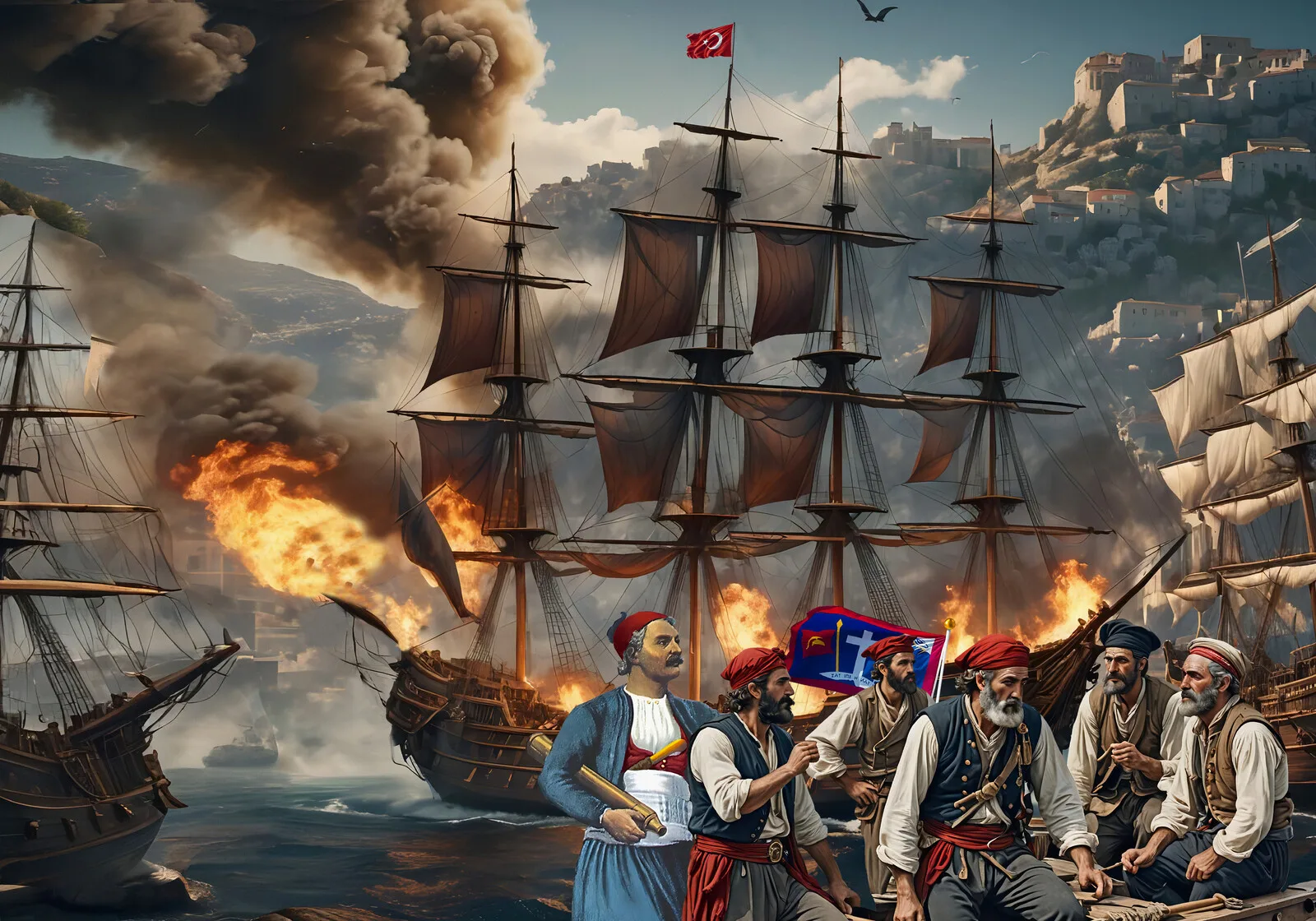
Returning home after setting Greek fire on the Osmans, 2024
Digital
70 x 50 cm
The Battle of Spetses
In 1822, not far from Hydra upon the Azure Sea,
Miaoulis led the Greeks in their quest for liberty.
The Battle of Spetses, brave hearts and spirits free,
A tale I'll share with wit in rhyming harmony.
The Ottoman fleet set sail to Nafplio they aimed,
Kolokotronis might have left their pride inflamed.
Nafplio's walls held firm; by Greeks, they were acclaimed,
But hunger gnawed the Turks, who soon would be ashamed.
Eighty-seven ships, from Lesvos they did come,
Turks, Egyptians, Algerians, to battle’s steady drum.
Spetses lay in wait, its fate a beating drum,
Yet Greek resolve would see the foe succumb.
Miaoulis led the charge, his fleet in a perfect line,
Fire ships and warships, with courage so divine.
Kriezis broke the ranks, and his cannons did align,
The battle raged with fury through the strait's confine.
Pipinos, bold and fierce, with Greek fire in his eyes,
Took his blazing ship to where an Algerian ship lies.
Flames rose high and wild beneath the summer skies,
As Ottoman ships scattered, consumed by their cries.
Barbatsis, on his quest, with fireship aglow,
Charged the Ottoman flagship and dealt a mighty blow.
Panic seized the foe, as fear began to grow,
Spetses’ shores were safe, thanks to Barbatsis' show.
Smoke clouded the day as ships and cannons clashed,
Hydra thought Spetses burned, their hopes nearly dashed.
Yet Greek unity held firm as Ottoman dreams were thrashed,
Each captain fought with courage in the sea's wild splash.
The Kapudan Pasha's fleet, by Frenchmen, kept at bay,
Warned of lurking fireships, thus stayed far away.
Miaoulis seized the chance; no Turks would win the day,
The Peloponnese were free, their foes held at bay.
The Battle of Spetses, a saga brave and true,
Of Miaoulis and his fleet, with hearts of iron hue.
Their legacy of bravery, ever fresh and new,
For Greece, their land beloved, forever they pursue.
Raise a glass in cheer to those who faced that night,
Miaoulis and his crew fought with all their might.
In history's pages, their deeds forever bright,
Heroes of Spetses, shining in the light.
The Miaoulia and Miaoulis
With the culmination of the Miaoulia festival behind us and its drawn-out dramatisation of events from two hundred years ago, capped by a grand fireworks display, some might wonder what lies behind it all. My picture above does not claim to be historically accurate but is more intended to create a visual introduction, an accent.
What started as a simple day of remembrance has blossomed into the spectacular Miaoulia Festival. This two-week extravaganza, a unique testament to the event's historical importance, reaches its climax on the final Saturday with a reenactment of the Ottoman Empire's flagship sinking in the Gulf just outside Hydra Harbour. This reenactment serves as a vivid reminder of the island's struggle for independence. The festival then transitions to a more solemn tone with a wreath-laying church service on Sunday, a moment of reflection and gratitude for the sacrifices made during the war.
Admiral Miaoulis, a key figure in the Greek War of Independence, passed away on June 24, 1835. His legacy and other heroes are celebrated annually on Hydra for his pivotal role during the war. Andreas Vokos, known as Miaoulis, was not just a Greek revolutionary, admiral, and politician. He was the commanding force behind the Greek naval forces during the Greek War of Independence, a leader whose actions shaped history.
The date of the Miaoulia Festival is calculated as the weekend following the 24th of June and then worked backwards to get the start date, which depends on how many days will be needed for the number of activities the Festivals Committee of the Municipality can book.
Today, the Miaoulia Festival is a vibrant celebration of all that is good about this small, tight-knit community. It showcases everything from traditional dance to ballet performances, circus acts and choral works, parades, art shows and tributes to some of our citizens and people associated with Hydra who have had a significantly positive impact on the island. In recent years, the festival has incorporated modern elements to attract a broader audience. In 2015, Leonard Cohen was honoured, as was Melina Mercouri. After Leonard’s death, the 2017 festival was also dedicated to him, adding a modern twist to this historical celebration and making it more appealing to the younger generation.
The Miaoulia Festival is a celebration and a vital educational platform. It provides a unique opportunity for the schools and clubs of Hydra to showcase their year-long work, contributing to the preservation and dissemination of the island's rich history and culture. It's a celebration of the local community and the island's proud history, making it a must-visit for history enthusiasts who will leave feeling enlightened and informed.
Over the two weeks, residents and visitors are treated to professional performances, celebrity stage shows, and events, including Hydra's music, dance, and karate clubs. Numerous art exhibitions are also taking place. The Miaoulia Festival can be said to mark the start of the summer high season. But why Miauoulia at all? We have to go back two hundred years to understand that.
In 1822, Admiral Miaoulis led the Crucial Battle of Spetses for the Struggle in the Peloponnese, one of the most significant naval battles of the 1821 Revolution. Although it may not be particularly well-known to the general public, many are familiar with the reenactment of the battle ("Armata"), which occurs annually in Spetses in early September and as the Miaoulia in Hydra every June.
The Ottoman fleet sails towards Nafplio – The Greek response.
After Theodoros Kolokotronis destroyed Dramali at Dervenakia, the situation in the Peloponnese was dire for the Turks. Only a few forts resisted. The most significant of these was the fortress of Nafplio, which was besieged by Demetrios Ypsilantis from the land and Bouboulina with the Spetsiots from the sea. However, the besieged Turks faced a severe problem. Their food supplies were running out, and they would soon be in a dire situation.
Since July, the Psarians had informed that 87 Ottoman ships were near Lesvos. After some unsuccessful actions in Missolonghi and the Peloponnese, at the end of August, the Ottoman fleet, a testament to strategic planning and coordination, consisting of Turkish, Egyptian, Algerian, Tunisian, and other ships from Barbary, appeared at Cape Tainaron. Their primary goal was to resupply the besieged in Nafplio.
On September 8, they arrived east of Spetses. The Greek fleet, a symbol of courage and determination, consisting of 56 warships and 16 fire ships, unaware of the enemy's movements until then, was positioned between the islands of Spetsopoula, Parapola (Velopoula), and Trikeri. The Hydra ships were between Trikeri and the island of Dokos, the Spetsiot ships south of Spetsopoula, and the Psarian ships further east. Having a favourable wind, the Ottoman fleet had their ships' bows pointed towards the strait between Spetses and Ermionida. Leading the Greek fleet was the fearless Andreas Miaoulis, a figure that continues to inspire and make us proud.
The Battle of Spetses
The great admiral ordered the ships to follow him into the strait, where it would be easier to confront the enemy. Anastasios Orlandos described his plan as "disastrous." However, some ships, commanded by Antonis Kriezis, Anargyros Lebesis, Leonardos Theodori, Yiannis Tsoupas, Dimitris Lambrou, Lazaros Panagiota, and others, either due to miscommunication or believing that Miaoulis wanted to avoid the confrontation, did not obey and sailed further east than the other Greek ships, ending up among the Ottoman ships. Kriezis immediately began bombarding the enemy ships, which continued their course. Miaoulis saw that his plans had been overturned. Within a short period, the battle that had started on the eastern side of the strait spread to the western side as well. A few Greek ships facing immediate danger sailed towards the islet of Dokos, where the enemy ships could barely reach. However, some small Ottoman ships managed to approach the Greek ships. At that moment, Pipinos, in a daring move, tried to attach his fireship to an Algerian ship.
Antonios, the son of Andreas Miaoulis, describes in detail the attempt of the brave fireship captain:
"One of the fireships, directed by Pipinos, attached to the stern of an enemy brig, and about fifty of its men jumped onto the fireship and managed to detach it from the brig. But as the fire increased, all of them burned and drowned. Out of the crew of this fireship, two sailors were wounded, and two more from the ship of Captain Antonis Kriezis."
The daring action of the Pipinos forced the Turkish ships to withdraw from the western side of the strait where they had been drawn, but the battle continued for many hours on the opposite side. To assist the ships of Kriezis, Lebesis, and others, Sachtouris, Hadzi-Anargyros, Dimitrios Miaoulis, Raftis, and others rushed in. They prevented the Turkish ships, which were also receiving fire from the coastal batteries of Spetses led by Hatzigiannis Mexis, from entering the Argolic Gulf.
As nightfall approached, 140 ships were involved in the battle. The area between Hydra and Spetses was covered with so much smoke that the Hydriots thought Spetses was burning. The moments were very critical. Then, the Spetsiot Kosmas Barbatsis, starting from the shores of his island, charged with his fireship against the Ottoman flagship.
Anastasios Orlandos writes characteristically: "He became superior to himself at that moment" and continues: "The Ottomans in that moving mountain, surprised by this most daring and unexpected decision of the fireship captain, were immediately seized by panic and fled, cannonading the fireship only from the stern of the flagship."
The flagship was followed in its disorderly retreat by the other ships. None of our sources (see at the end of the article) mention that the Ottoman flagship caught fire and sank in front of the port of Spetses, as the island's tradition has been preserved. Everyone agrees that with the brave action of Barbatsis, the Turks panicked and fled in disarray, all this in a battle where Miaoulis's plans were not implemented. Anastasios Orlandos writes: "Each of the captains acted independently in whatever seemed most saving for the homeland, and only bravery and patriotism, a common thread among all, guided each in their movements." This unity and patriotism are a source of national pride for the Greeks.
Due to the prevailing calm, the two fleets did not clash in the following days. On September 11, the Ottoman fleet, which was near Hydra, headed towards Spetsopoula. Again, the calm prevented the Greek ships from approaching them. The next day, a new naval battle lasted three hours. However, as Miaoulis writes in a letter on September 13: "Bad luck, it was calm all night, and we couldn't go with our fireships..."
The Attempt to Supply Nafplio
On September 12, the Turkish Kapudan Pasha (Admiral) attempted to head towards Nafplio to deliver food to the besieged. However, ten miles from the city's port, he encountered the French fleet, whose commander, Viel, informed him that he should not risk it because Greek fireships were lurking in the Argolic Gulf. Consequently, after sending an Austrian ship to Nafplio, the Turkish admiral abandoned the waters of the Peloponnese on September 15 without achieving his goal.
Even the Austrian ship that was sent to Nafplio with supplies was detected by Miaoulis, who sent two fireships to capture it and transport it to Hydra along with its crew. The ship's captain was Joseph Vernik from Fiume (present-day Rijeka, Croatia). From the crew, the Greeks learned that "the Turks are very frightened by our fireships, without water, without provisions, in great disorder. All the captains caused an uproar and did not want to enter Nafplio, but the Kapudan Pasha threatened to kill them and insisted they enter. Thus, they decided to send the ship." After seizing the ship's cargo, the Greeks allowed Vernik to leave with the boat and crew.
The Consequences of the Battle of Spetses
The Battle of Spetses was vital for the Revolution. Spetses, which the Ottomans had targeted, remained unscathed. The resupply of Nafplio never took place, and the besieged surrendered two months later. Moreover, the Ottoman fleet did not assist with other parts of the Peloponnese. Much of it moved towards Crete, where it arrived on September 30.
"Armata"
In Spetses, the Greek success is celebrated with grandeur in early September. The festivities last for a week. The island's residents attributed their victory to the help of the Virgin Mary (September 8 is the feast day of the Nativity of the Theotokos). Thus, they named the small church in the old harbour "Panagia Armata." The highlight of the celebratory events, which, as mentioned, attract thousands of visitors, is the reenactment of the burning of a replica of the Turkish flagship, with the launching of fireworks and flares.
About some of the heroes’ names. Lebesis: Albanian for "the one who keeps faith." Kriezis: Albanian for "the Black-Headed." Mexis, Koutsis, etc. It is well known that Miaoulis not only gave orders to his sailors exclusively in Arvanitika (an Albanian dialect), but also, when he attended national assemblies, he brought an interpreter to communicate in Greek. Why were we never taught this in school, even as academic knowledge?
Miaoulis was not only a good sailor, merchant, and revolutionary, but he also participated three times in committees abroad to conclude national loans, which required delicate handling and diplomatic flexibility.
Jörgen Thornberg
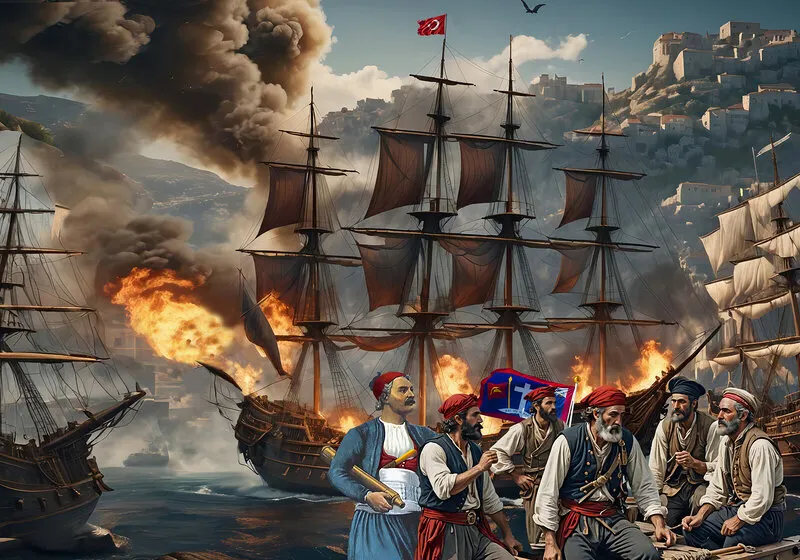
Returning home after setting Greek fire on the Osmans, 2024
Digital
70 x 50 cm
The Battle of Spetses
In 1822, not far from Hydra upon the Azure Sea,
Miaoulis led the Greeks in their quest for liberty.
The Battle of Spetses, brave hearts and spirits free,
A tale I'll share with wit in rhyming harmony.
The Ottoman fleet set sail to Nafplio they aimed,
Kolokotronis might have left their pride inflamed.
Nafplio's walls held firm; by Greeks, they were acclaimed,
But hunger gnawed the Turks, who soon would be ashamed.
Eighty-seven ships, from Lesvos they did come,
Turks, Egyptians, Algerians, to battle’s steady drum.
Spetses lay in wait, its fate a beating drum,
Yet Greek resolve would see the foe succumb.
Miaoulis led the charge, his fleet in a perfect line,
Fire ships and warships, with courage so divine.
Kriezis broke the ranks, and his cannons did align,
The battle raged with fury through the strait's confine.
Pipinos, bold and fierce, with Greek fire in his eyes,
Took his blazing ship to where an Algerian ship lies.
Flames rose high and wild beneath the summer skies,
As Ottoman ships scattered, consumed by their cries.
Barbatsis, on his quest, with fireship aglow,
Charged the Ottoman flagship and dealt a mighty blow.
Panic seized the foe, as fear began to grow,
Spetses’ shores were safe, thanks to Barbatsis' show.
Smoke clouded the day as ships and cannons clashed,
Hydra thought Spetses burned, their hopes nearly dashed.
Yet Greek unity held firm as Ottoman dreams were thrashed,
Each captain fought with courage in the sea's wild splash.
The Kapudan Pasha's fleet, by Frenchmen, kept at bay,
Warned of lurking fireships, thus stayed far away.
Miaoulis seized the chance; no Turks would win the day,
The Peloponnese were free, their foes held at bay.
The Battle of Spetses, a saga brave and true,
Of Miaoulis and his fleet, with hearts of iron hue.
Their legacy of bravery, ever fresh and new,
For Greece, their land beloved, forever they pursue.
Raise a glass in cheer to those who faced that night,
Miaoulis and his crew fought with all their might.
In history's pages, their deeds forever bright,
Heroes of Spetses, shining in the light.
The Miaoulia and Miaoulis
With the culmination of the Miaoulia festival behind us and its drawn-out dramatisation of events from two hundred years ago, capped by a grand fireworks display, some might wonder what lies behind it all. My picture above does not claim to be historically accurate but is more intended to create a visual introduction, an accent.
What started as a simple day of remembrance has blossomed into the spectacular Miaoulia Festival. This two-week extravaganza, a unique testament to the event's historical importance, reaches its climax on the final Saturday with a reenactment of the Ottoman Empire's flagship sinking in the Gulf just outside Hydra Harbour. This reenactment serves as a vivid reminder of the island's struggle for independence. The festival then transitions to a more solemn tone with a wreath-laying church service on Sunday, a moment of reflection and gratitude for the sacrifices made during the war.
Admiral Miaoulis, a key figure in the Greek War of Independence, passed away on June 24, 1835. His legacy and other heroes are celebrated annually on Hydra for his pivotal role during the war. Andreas Vokos, known as Miaoulis, was not just a Greek revolutionary, admiral, and politician. He was the commanding force behind the Greek naval forces during the Greek War of Independence, a leader whose actions shaped history.
The date of the Miaoulia Festival is calculated as the weekend following the 24th of June and then worked backwards to get the start date, which depends on how many days will be needed for the number of activities the Festivals Committee of the Municipality can book.
Today, the Miaoulia Festival is a vibrant celebration of all that is good about this small, tight-knit community. It showcases everything from traditional dance to ballet performances, circus acts and choral works, parades, art shows and tributes to some of our citizens and people associated with Hydra who have had a significantly positive impact on the island. In recent years, the festival has incorporated modern elements to attract a broader audience. In 2015, Leonard Cohen was honoured, as was Melina Mercouri. After Leonard’s death, the 2017 festival was also dedicated to him, adding a modern twist to this historical celebration and making it more appealing to the younger generation.
The Miaoulia Festival is a celebration and a vital educational platform. It provides a unique opportunity for the schools and clubs of Hydra to showcase their year-long work, contributing to the preservation and dissemination of the island's rich history and culture. It's a celebration of the local community and the island's proud history, making it a must-visit for history enthusiasts who will leave feeling enlightened and informed.
Over the two weeks, residents and visitors are treated to professional performances, celebrity stage shows, and events, including Hydra's music, dance, and karate clubs. Numerous art exhibitions are also taking place. The Miaoulia Festival can be said to mark the start of the summer high season. But why Miauoulia at all? We have to go back two hundred years to understand that.
In 1822, Admiral Miaoulis led the Crucial Battle of Spetses for the Struggle in the Peloponnese, one of the most significant naval battles of the 1821 Revolution. Although it may not be particularly well-known to the general public, many are familiar with the reenactment of the battle ("Armata"), which occurs annually in Spetses in early September and as the Miaoulia in Hydra every June.
The Ottoman fleet sails towards Nafplio – The Greek response.
After Theodoros Kolokotronis destroyed Dramali at Dervenakia, the situation in the Peloponnese was dire for the Turks. Only a few forts resisted. The most significant of these was the fortress of Nafplio, which was besieged by Demetrios Ypsilantis from the land and Bouboulina with the Spetsiots from the sea. However, the besieged Turks faced a severe problem. Their food supplies were running out, and they would soon be in a dire situation.
Since July, the Psarians had informed that 87 Ottoman ships were near Lesvos. After some unsuccessful actions in Missolonghi and the Peloponnese, at the end of August, the Ottoman fleet, a testament to strategic planning and coordination, consisting of Turkish, Egyptian, Algerian, Tunisian, and other ships from Barbary, appeared at Cape Tainaron. Their primary goal was to resupply the besieged in Nafplio.
On September 8, they arrived east of Spetses. The Greek fleet, a symbol of courage and determination, consisting of 56 warships and 16 fire ships, unaware of the enemy's movements until then, was positioned between the islands of Spetsopoula, Parapola (Velopoula), and Trikeri. The Hydra ships were between Trikeri and the island of Dokos, the Spetsiot ships south of Spetsopoula, and the Psarian ships further east. Having a favourable wind, the Ottoman fleet had their ships' bows pointed towards the strait between Spetses and Ermionida. Leading the Greek fleet was the fearless Andreas Miaoulis, a figure that continues to inspire and make us proud.
The Battle of Spetses
The great admiral ordered the ships to follow him into the strait, where it would be easier to confront the enemy. Anastasios Orlandos described his plan as "disastrous." However, some ships, commanded by Antonis Kriezis, Anargyros Lebesis, Leonardos Theodori, Yiannis Tsoupas, Dimitris Lambrou, Lazaros Panagiota, and others, either due to miscommunication or believing that Miaoulis wanted to avoid the confrontation, did not obey and sailed further east than the other Greek ships, ending up among the Ottoman ships. Kriezis immediately began bombarding the enemy ships, which continued their course. Miaoulis saw that his plans had been overturned. Within a short period, the battle that had started on the eastern side of the strait spread to the western side as well. A few Greek ships facing immediate danger sailed towards the islet of Dokos, where the enemy ships could barely reach. However, some small Ottoman ships managed to approach the Greek ships. At that moment, Pipinos, in a daring move, tried to attach his fireship to an Algerian ship.
Antonios, the son of Andreas Miaoulis, describes in detail the attempt of the brave fireship captain:
"One of the fireships, directed by Pipinos, attached to the stern of an enemy brig, and about fifty of its men jumped onto the fireship and managed to detach it from the brig. But as the fire increased, all of them burned and drowned. Out of the crew of this fireship, two sailors were wounded, and two more from the ship of Captain Antonis Kriezis."
The daring action of the Pipinos forced the Turkish ships to withdraw from the western side of the strait where they had been drawn, but the battle continued for many hours on the opposite side. To assist the ships of Kriezis, Lebesis, and others, Sachtouris, Hadzi-Anargyros, Dimitrios Miaoulis, Raftis, and others rushed in. They prevented the Turkish ships, which were also receiving fire from the coastal batteries of Spetses led by Hatzigiannis Mexis, from entering the Argolic Gulf.
As nightfall approached, 140 ships were involved in the battle. The area between Hydra and Spetses was covered with so much smoke that the Hydriots thought Spetses was burning. The moments were very critical. Then, the Spetsiot Kosmas Barbatsis, starting from the shores of his island, charged with his fireship against the Ottoman flagship.
Anastasios Orlandos writes characteristically: "He became superior to himself at that moment" and continues: "The Ottomans in that moving mountain, surprised by this most daring and unexpected decision of the fireship captain, were immediately seized by panic and fled, cannonading the fireship only from the stern of the flagship."
The flagship was followed in its disorderly retreat by the other ships. None of our sources (see at the end of the article) mention that the Ottoman flagship caught fire and sank in front of the port of Spetses, as the island's tradition has been preserved. Everyone agrees that with the brave action of Barbatsis, the Turks panicked and fled in disarray, all this in a battle where Miaoulis's plans were not implemented. Anastasios Orlandos writes: "Each of the captains acted independently in whatever seemed most saving for the homeland, and only bravery and patriotism, a common thread among all, guided each in their movements." This unity and patriotism are a source of national pride for the Greeks.
Due to the prevailing calm, the two fleets did not clash in the following days. On September 11, the Ottoman fleet, which was near Hydra, headed towards Spetsopoula. Again, the calm prevented the Greek ships from approaching them. The next day, a new naval battle lasted three hours. However, as Miaoulis writes in a letter on September 13: "Bad luck, it was calm all night, and we couldn't go with our fireships..."
The Attempt to Supply Nafplio
On September 12, the Turkish Kapudan Pasha (Admiral) attempted to head towards Nafplio to deliver food to the besieged. However, ten miles from the city's port, he encountered the French fleet, whose commander, Viel, informed him that he should not risk it because Greek fireships were lurking in the Argolic Gulf. Consequently, after sending an Austrian ship to Nafplio, the Turkish admiral abandoned the waters of the Peloponnese on September 15 without achieving his goal.
Even the Austrian ship that was sent to Nafplio with supplies was detected by Miaoulis, who sent two fireships to capture it and transport it to Hydra along with its crew. The ship's captain was Joseph Vernik from Fiume (present-day Rijeka, Croatia). From the crew, the Greeks learned that "the Turks are very frightened by our fireships, without water, without provisions, in great disorder. All the captains caused an uproar and did not want to enter Nafplio, but the Kapudan Pasha threatened to kill them and insisted they enter. Thus, they decided to send the ship." After seizing the ship's cargo, the Greeks allowed Vernik to leave with the boat and crew.
The Consequences of the Battle of Spetses
The Battle of Spetses was vital for the Revolution. Spetses, which the Ottomans had targeted, remained unscathed. The resupply of Nafplio never took place, and the besieged surrendered two months later. Moreover, the Ottoman fleet did not assist with other parts of the Peloponnese. Much of it moved towards Crete, where it arrived on September 30.
"Armata"
In Spetses, the Greek success is celebrated with grandeur in early September. The festivities last for a week. The island's residents attributed their victory to the help of the Virgin Mary (September 8 is the feast day of the Nativity of the Theotokos). Thus, they named the small church in the old harbour "Panagia Armata." The highlight of the celebratory events, which, as mentioned, attract thousands of visitors, is the reenactment of the burning of a replica of the Turkish flagship, with the launching of fireworks and flares.
About some of the heroes’ names. Lebesis: Albanian for "the one who keeps faith." Kriezis: Albanian for "the Black-Headed." Mexis, Koutsis, etc. It is well known that Miaoulis not only gave orders to his sailors exclusively in Arvanitika (an Albanian dialect), but also, when he attended national assemblies, he brought an interpreter to communicate in Greek. Why were we never taught this in school, even as academic knowledge?
Miaoulis was not only a good sailor, merchant, and revolutionary, but he also participated three times in committees abroad to conclude national loans, which required delicate handling and diplomatic flexibility.

Jörgen Thornberg
Malmö
Lite om bilder och mig. Translation in English at the end.
Jag är en nyfiken person som ser allt i bilder, även det jag fäster i ord, gärna tillsammans för bakom alla mina bilder finns en berättelse. Till vissa bilder hör en kortare eller längre novell som följer med bilden.
Bilder berättar historier. Jag omges av naturlig skönhet, intressanta människor och historia var jag än går. Jag använder min kamera för att dokumentera världen och blanda det jag ser med vad jag känner för att fånga den dolda magin.
Mina bilder berättar mina historier. Genom mina bilder, tryck och berättelser. Jag bjuder in dig att ta del av dessa berättelser, in i ditt liv och hem och dela min mycket personliga syn på vår värld. Mer än vad ögat ser. Jag tänker i bilder, drömmer och skriver och pratar om dem; följaktligen måste jag också skapa bilder. De blir vad jag ser, inte nödvändigtvis begränsade till verkligheten. Det finns en bild runt varje hörn. Jag hoppas att du kommer att se vad jag såg och gilla det.
Jag är också en skrivande person och till många bilder hör en kortare eller längre essay. Den följer med tavlan, tryckt på fint papper och med en personlig hälsning från mig.
Flertalet bilder startar sin resa i min kamera. Enkelt förklarat beskriver jag bilden jag ser i mitt inre, upplevd eller fantiserad. Bilden uppstår inom mig redan innan jag fått okularet till ögat. På bråkdelen av ett ögonblick ser jag vad jag vill ha och vad som kan göras med bilden. Här skall jag stoppa in en giraff, stålmannen, Titanic eller vad det är min fantasi finner ut. Ännu märkligare är att jag kommer ihåg minnesbilden långt efteråt när det blir tid att skapa verket. Om jag lyckas eller inte, är upp till betraktaren, oftast präglat av en stråk av svart humor – meningen är att man skall bli underhållen. Mina bilder blir ofta en snackis där de hänger.
Jag föredrar bilder som förmedlar ett budskap i flera lager. Vid första anblicken fylld av feel-good, en vacker utsikt, fint väder, solen skiner, blommor på ängen eller vattnet som ligger förrädiskt spegelblankt. I en sådan bild kan jag gömma min egentliga berättelse, mitt förakt för förtryckare och våldsverkare, rasister och fördomsfulla människor - ett gärna återkommande motiv mer eller mindre dolt i det vackra motivet. Jag försöker förena dem i ett gemensamt narrativ.
Bild och formgivning har löpt som en röd tråd genom livet. Fotokonst känns som en värdig final som jag gärna delar med mig.
Min genre är vid som framgår av mina bilder, temat en blandning av pop- och gatukonst i kollage som kan bestå av hundratals lager. Vissa bilder kan ta veckor, andra någon dag innan det är dags att överlämna resultatet till printverkstaden. Fine Art Prints är digitala fotocollage. I dessa kollage sker rivandet, klippandet, pusslandet, målandet, ritandet och sprayningen digitalt. Det jag monterar in kan vara hundratals år gamla bilder som jag omsorgsfullt frilägger så att de ser ut att vara en del av tavlan men också bilder skapade av mig själv efter min egen fantasi. Därefter besöks printstudion och för vissa bilder numrera en limiterad upplaga (oftast 7 exemplar) och signera för hand. Vissa bilder kan köpas i olika format. Det är bara att fråga efter vilka. Gillar man en bild som är 70x100 men inte har plats på väggen, går den kanske att få i 50x70 cm istället. Frågan är fri.
Metoden Giclée eller Fine Art Print som det också kallas är det moderna sättet för framställning av grafisk konst. Villkoret för denna typ av utskrifter är att en högkvalitativ storformatskrivare används med åldersbeständigt färgpigment och konstnärspapper eller i förekommande fall på duk. Pappret som används möter de krav på livslängd som ställs av museer och gallerier. Normalt säljer jag mina bilder oinramade så att den nya ägaren själv kan bestämma hur de skall se ut, med eller utan passepartout färg på ram, med eller utan glas etc..
Under många år ställde jag bara ut på nätet, i valda grupper och på min egen Facebooksida - https://www.facebook.com/jorgen.thornberg.9
Jag finns också på en egen hemsida som tyvärr inte alltid är uppdaterad – https://www.jth.life/ Där kan du också läsa en del av de berättelser som följer med bilden.
UTSTÄLLNINGAR
Luftkastellet, oktober 2022
Konst i Lund, november 2022
Luftkastellet, mars 2023
Engleson Galleri Caroli, april 2023
Hydra, Greece June 2023
Engleson Galleri Caroli, oktober 2023
Toppen, Höllviken december 2023
Luftkastellet, mars 2024
Torups Galleri, mars 2024
Venice, May 2024
Luftkastellet, oktober 2024
Konst i Advent, December 2024
Galleri Engleson, Caroli December 2024
Jäger & Jansson Galleri, april 2025
A bit about pictures and me.
I'm a curious person who sees everything in pictures, even what I express in words, often combining them, for behind all my pictures lies a story. These narratives, some as short as a single image and others as long as a novel, are the heart and soul of my work.
Pictures tell stories. Wherever I go, I'm surrounded by natural beauty, exciting people, and history. I use my camera to document the world and blend what I see with what I feel to capture the hidden magic.
My images tell my stories. Through my pictures, prints, and narratives, I invite you to partake in these stories in your life and home and share my deeply personal perspective of our world. More than meets the eye. I think in pictures, dream, write, and talk about them; consequently, I must create images too. They become what I see, not necessarily confined to reality. There's a picture around every corner. I hope you'll see what I saw and enjoy it.
I'm also a writer, and many images come with a shorter or longer essay. It accompanies the painting, printed on fine paper with my personal greeting.
Many pictures start their journey on my camera. Simply put, I describe the image I see in my mind, experienced or imagined. The image arises within me even before I bring the eyepiece to my eye. In a fraction of a moment, I see what I want and what can be done with the picture. Here, I'll insert a giraffe, Superman, the Titanic, or whatever my imagination conjures up. Even stranger is that I remember the mental image long after it's time to create the work. Whether I succeed is up to the observer, often imbued with a streak of black humour – the aim is to entertain. My pictures usually become a talking point wherever they hang.
I prefer pictures that convey a message in multiple layers. At first glance, they're filled with feel-good vibes, a beautiful view, lovely weather, the sun shining, flowers in the meadow, or the water lying deceptively calm. But beneath this surface beauty, I often conceal a deeper story, a narrative that challenges societal norms or explores the human condition. I invite you to delve into these hidden narratives and discover the layers of meaning within my work.
Picture and design have been a thread running through my life. Photographic art feels like a fitting finale, and I'm happy to share it.
My genre is varied, as seen in my pictures; the theme is a blend of pop and street art in collages that can consist of hundreds of layers. Some images can take weeks, others just a day before it's time to hand over the result to the print workshop. Fine Art Prints are digital photo collages. In these collages, tearing, cutting, puzzling, painting, drawing, and spraying happen digitally. What I insert can be images hundreds of years old that I carefully extract so they appear to be part of the painting, but also images created by myself, now also generated from my imagination. Next, visit the print studio and, for certain images, number a limited edition (usually 7 copies) and sign them by hand. Some images may be available in other formats. Just ask which ones. If you like an image that's 70x100 but doesn't have space on the wall, you might be able to get it in 50x70 cm instead. The question is open.
The Giclée method, or Fine Art Print as it's also called, is the modern way of producing graphic art. This method ensures the highest quality and longevity of the artwork, using a high-quality large-format printer with archival pigment inks and artist paper or, in some cases, canvas. The paper used meets the longevity requirements set by museums and galleries. I sell my pictures unframed, allowing the new owner to personalise their artwork, confident in the lasting value and quality of the piece.
For many years, I only exhibited online, in selected groups, and on my Facebook page - https://www.facebook.com/jorgen.thornberg.9. I also have my website, which unfortunately is not constantly updated - https://www.jth.life/. You can also read some of the stories accompanying the pictures there.
EXHIBITIONS
Luftkastellet, October 2022
Art in Lund, November 2022
Luftkastellet, March 2023
Engleson Gallery Caroli, April 2023
Hydra, Greece June 2023
Engleson Gallery Caroli, October 2023
Toppen, Höllviken December 2023
Luftkastellet, March 2024
Torup Gallery, March 2024
Venice, May 2024
UTSTÄLLNINGAR
Luftkastellet, oktober 2022
Konst i Lund, november 2022
Luftkastellet, mars 2023
Engleson Galleri Caroli, april 2023
Hydra, Greece June 2023
Engleson Galleri Caroli, oktober 2023
Toppen, Höllviken december 2023
Luftkastellet, mars 2024
Torups Galleri, mars 2024
Venice, May 2024
Luftkastellet, October 2024
Konst i Advent, December 2024
Galleri Engleson, Caroli December 2024
Jäger & Jansson Galleri, April 2025
Utbildning
Autodidakt
Medlem i konstnärsförening
Öppna Sinnen
Med i konstrunda
Konstrundan i Skåne
Utställningar
Luftkastellet, October 2022
Art in Lund, November 2022
Luftkastellet, March 2023
Engleson Gallery Caroli, April 2023
Hydra, Greece June 2023
Engleson Gallery Caroli, October 2023
Toppen, Höllviken December 2023
Luftkastellet, March 2024
Torup Gallery, March 2024
Venice, May 2024