Vi använder cookies för att ge dig bästa möjliga upplevelse. Välj vilka cookies du tillåter.
Läs mer i vår integritetspolicy
Jörgen Thornberg
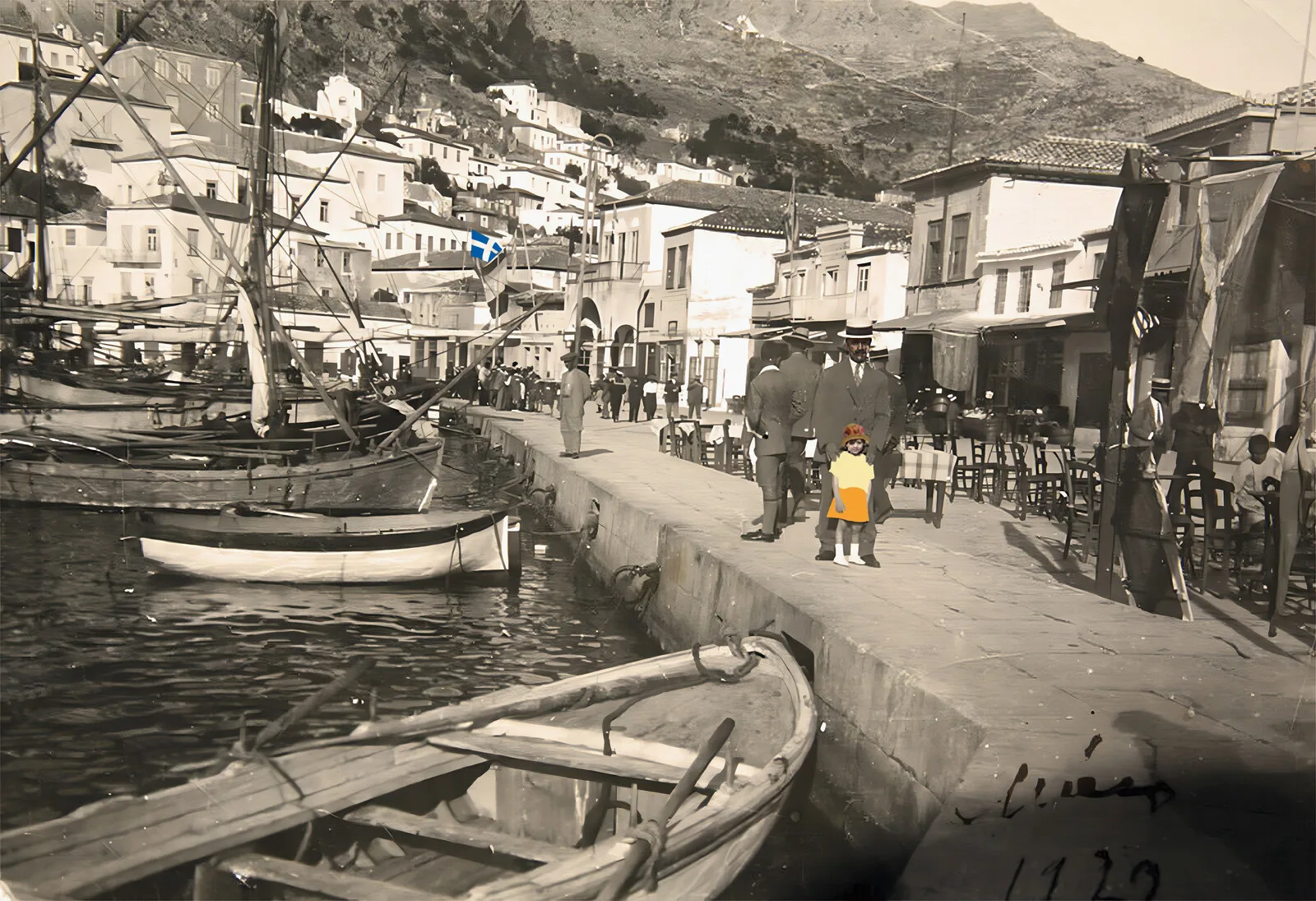
The Girl in the Floral Hat, 2024
Digital
70 x 50 cm
A six-year-old girl in a floral hat with her proud father in the harbour of Hydra. We can call her Olga. It is a timeless photo, for fathers are always proud of their daughters, copies of their mother, the woman they love. Not much has changed in the harbour; the houses are the same, the sky and the mountain behind, but flashy jewellers, fashion shops with imported clothes, and chic cafes and bars have replaced yesterday's shops and workshops. Katsikas is still where it was, though it is now called Roloi, under the same clock tower. The boats at the quay have all been broken up, and most of today's boats are more extensive and made of plastic. Additionally, luxurious yachts are now noticeable, along with catamarans that take up too much space in the port. Olga’s father wears a double-breasted suit, a white shirt with a tie, and a well-groomed short beard. He proudly wears an imported straw hat. They probably belong to middle-class Hydra and are doing well.
Olga was born in 1914, the same year World War 1 started, and the Greek genocide, the Genoktonía ton Ellínon, which included the Pontic genocide, was the systematic killing of the Christian Ottoman Greek population of Anatolia carried out by the Turks. The genocide included massacres, forced deportations involving death marches through the Syrian Desert, expulsions, summary executions, the destruction of Eastern Orthodox cultural, historical, and religious monuments and finally, the burning of the cosmopolitan city of Smyrna. Several hundred thousand Ottoman Greeks died during this period. Some estimations say a million. Most of the refugees and survivors fled to Greece, adding over a quarter to the prior population of Greece.
Olga was lucky to be born on Hydra into a family that was either poor or rich, but she was brought up by parents who could afford to buy her a fancy flowery hat. What life could she expect?
The photo was taken in 1920, the start of a decade when Greece experienced an extraordinary series of kaleidoscopic changes, including political upheavals, economic reforms, and social transformations. Given its size and significance, few countries benefited more from the war than Greece. The Greeks should have considered themselves exceptionally fortunate, as their role in the war had been somewhat questionable, with their commitment to the Allied cause coming late and seemingly uncertain. The highly favourable agreements Greece managed to secure with the Great Powers were essentially thanks to the statesmanship and extraordinary tact of Prime Minister Eleftherios Venizelos. His leadership and influence, particularly in securing these agreements, were pivotal in every significant political change of the 1920s. In the fall, Olga will start school in the first grade. She feels almost grown up.
In the East, the Greek genocide continued, which included the Pontic genocide, which was the Turks' systematic killing of the Christian Ottoman Greek population of Anatolia, which was carried out mainly during World War I and its aftermath but continued into the 1920s. Her parents always lowered their voices when discussing the topic to avoid worrying the children. But there were relatives on her father's side who were at risk.
Olga had just begun her second grade in school, and the end of 1921 marked a significant turning point in Greek history. This period saw Eleftherios Venizelos fall and King Constantine I's return to the throne. Despite being 'unrecognised' by the Allied Powers, the King was reinstated with enthusiastic support from the population, which triggered a wave of anti-Venizelist reprisals, including political purges and social unrest. It was a time of great uncertainty, with the looming threat of war in Anatolia, where the Turkish Nationalist leader, Mustafa Kemal Pasha, was rapidly gaining support. The tension and anxiety of the period were palpable.
For a little girl like Olga, the distant war in the ancient eastern Greek lands felt very far away. The Greek campaign was launched primarily because the Western Allies, particularly British Prime Minister David Lloyd George, had promised Greece territorial gains at the expense of the Ottoman Empire, which had been recently defeated in World War I. Greek claims were based on Anatolia being part of Ancient Greece and the Byzantine Empire before the Turks conquered the area in the 12th–15th centuries.
As Olga, a young girl of innocence, went about her daily life, these grand historical events unfolded around her, shaping the future of her homeland. While the complexities of politics and war were far beyond her understanding, they created an atmosphere of change and uncertainty that even a young girl, innocent and unaware, could sense.
As the nation braced itself for the unfolding drama, Olga continued with her school days, her small world of learning and play seemingly untouched by the more extraordinary tumult yet subtly influenced by the undercurrents of a country in transition. The stark contrast between her innocent world and the more significant historical events underscores the war's profound impact on her childhood. The distant war in the ancient eastern Greek lands felt very far away to a little girl like Olga, yet the tension and anxiety of the period were palpable, shaping her perception of the world around her.
Olga’s third year in school had been underway for a few months when the war against the Turks was lost. 1922 was a watershed moment in the history of modern Greece. It marked the fall of ideas central to Hellenism since its early days of struggle for independence. The centenary of this struggle had just been celebrated, particularly the idea of a greater Greece, which had been closely associated with Eleftherios Venizelos since his rise to power in 1910. Once a dominant Balkan power, Greece was now thrust back into the unenviable position it held after the Greco-Turkish War of 1897.
The catastrophic outcome of the Asia Minor Campaign, a significant event that led to the abdication of King Constantine I on 27 September 1922 in favour of his son, King George II, marked a substantial shift in the country's leadership. Her father was distraught; a distant part of the family had been severely affected when they were forced to flee Smyrna with only the clothes on their backs. At least they had managed to survive. By chance, they ended up on the same boat as the young Onassis and his grandmother. Like her father's cousin, the coming shipping magnate was born in Smyrna in the Ottoman Empire and fled the city to Greece in 1922 in the wake of the burning of Smyrna.
In 1922, Greece encountered a significant financial crisis, marked by the dichotomisation of the drachma. This crucial event, triggered by the country's inability to secure more loans abroad for the war with Turkey, was announced by Finance Minister Petros Protopapadakis. The decision was to halve the value of each drachma, with the owner retaining half and the other half being surrendered to the government in exchange for a 20-year, 6.5% loan.
As an adult, Olga would see how World War II prevented the repayment of the loans, but even without the war, it was doubtful the Greek government could have managed to repay such enormous debts. The strategy of dichotomising the drachma had initially provided significant revenues for the state, with minimal inflation effects. However, the government's inability to repay loans from a decade of war and refugee resettlement led to deflation and interest rates. These policies caused many people to lose faith in their government, which led to decreased investment as they stopped holding assets in cash and began holding tangible goods.
With her passion for learning, Olga excelled in school and was already reading books like The Odyssey, which she loved.
Olga's fourth year in school, 1923, had started on a Monday according to the Gregorian calendar, marking a significant shift in Greek history. This year represented the 1923rd year of the Common Era (CE) and Anno Domini (AD) designations, the 923rd year of the 2nd millennium, the 23rd year of the 20th century, and the 4th year of the 1920s decade. The impact of this shift was such that at the start of 1923, the Gregorian calendar was 13 days ahead of the Julian calendar, which was then relegated to use only by churches after Greece adopted the Gregorian calendar.
In Greece, 1923 contained only 352 days, as 13 days were skipped to achieve the calendrical alignment with the Gregorian calendar. The change from the Julian to the Gregorian Calendar had practical implications for the daily lives of Greeks, affecting everything from work schedules to religious observances. This switch aligned Greece's calendar with the rest of Europe. In consequence, Wednesday, 15 February, according to the old Julian Calendar, was followed by Thursday, 1 March, in the new Gregorian Calendar. What a leap. Olga was thrilled because the school term became shorter. There was so much else a nine-year-old could do, like accompanying her father on a business trip to Athens, a bustling metropolis, another planet. Everything was so big. For the first time, Olga visited the Parthenon, which is considered a key landmark of early Western culture with a breathtaking view over Athens. Then they had ice cream before visiting The National Archaeological Museum with its rich collection of Greek Antiquity. Everything was so vast, the statues so tall, and the Greek history so overwhelming that it made Olga's head spin.
Back home, she spent the extra days playing hopscotch with her friends. The rules were simple. You needed a moderately sized stone and a series of squares. They drew eight squares or more on the harbour stones with chalk. The squares had to alternate between left and right and form a rectangle. They placed the stone in front of the first square. Then, the girl or boy had to move towards the first square, hop on one leg, and try to push the stone with one foot into the first square without falling over. Then, if they started from the left square, they pushed the stone to the right and vice versa. They had to push the stone into all the squares without moving it outside the square or touching the line. If someone pushed the stone out of the intended square, they lost and had to sit on the admiral's monument and watch.
In the spring of 1924, before ten-year-old Olga started her fifth year of school, a referendum was held on Greece becoming a republic. This followed the disaster of the Asia Minor Campaign, a significant event with great impact on the political situation in Greece. King George had to go into exile in the Kingdom of Romania, the home of his wife, Elisabeth, while the government debated the fate of the monarchy. Ultimately, a referendum was called. The referendum reflected the see-saw nature of the Greek electorate and the then-present dominance of the Liberal and Republican Venizelists in Greek politics, resulting in the abolition of the Crown. In the lead-up to the referendum, Prime Minister Alexandros Papanastasiou favoured the vote for the Republic, while the cunning Venizelos kept a neutral stance. Nonetheless, on 25 March 1924, the Second Hellenic Republic was proclaimed by parliament.
On Hydra, where royalism had never been particularly strong, life went on as usual. The island had a history of toppling kings who didn't align with the wishes of its influential residents. Olga, deeply passionate about history, knew her island's past well. She had already begun to think about what she would become when she grew up, leaning towards a career in something related to history, perhaps archaeology, a field that fascinated her and felt like a part of her since her visit to The National Archaeological Museum.
Olga was mature for her age and listened carefully to her wise mother, who encouraged her curiosity. The prospects for a girl on an island like Hydra were otherwise limited. Traditionally, a girl could only expect to be married off and bear children, one after the other, as discussions about birth control were rare and opposed by the church. Her father, who had the privilege of furthering his education after the obligatory six years of primary school, had studied economics at the University of Athens and was one of the most educated people on the island. This did not make him a millionaire, but his job at the municipality provided a steady and secure income.
If Olga were to follow in his footsteps, it would be highly unusual for a girl, and on Hydra, it would be unique. The prevailing hypothesis was that women should act without being heard and preferably not be seen too much either. Olga, however, had different aspirations. She had read that the Greek politician Solon aptly summarised the Greek philosophy on women: “The best Greek women are the ones you hear the least about either way.” In ancient Greece, women were literally kept out of sight most of the time. But Olga was determined to be more than just a whisper in history.
Ancient writers said that Spartan women were the most beautiful and indeed independent. They were educated and given physical training. They were free-range, so they had tanned skin. Ancient Athenian girls were married off at the age of 13 to 30-year-old men or older. Yikes! Then, they were secluded in harems, so they had pale skin.
Olga had decided she wanted to be a Spartan woman. She eagerly participated in the boys' play with wooden swords and had become quite skilled, too skilled, since the boys hated being defeated by a girl.
It was summer again, and Olga had turned eleven. Tensions were bubbling and brewing in Greece, and as usual, there were as many opinions as there were inhabitants. Something had to give. During Olga's summer vacation, just two days before Hydra's big celebration, Miaoulia, everything erupted. This day, commemorating Admiral Miaoulis, who died on June 24, 1835, had been celebrated long before Olga was born as an annual event to honour his significant role during the Greek War of Independence. The significance of this event was not lost on anyone. Nothing could wait until Saturday, so rest in peace, Miaoulis.
The 1925 Greek coup d’état took place on Thursday, June 25. General Theodore Pangalos led it, quickly rising to power and becoming the dictator of Greece the next day. Despite this, Hydra, a symbol of resilience, did not cancel Miaoulia. On the contrary, they doubled the fireworks, a testament to their determination. Hydra had always been rebellious and forged its path. They harboured no love for the Turks and symbolically burned one of their ships every year.
The Greco-Turkish War had left deep scars, and the Burning of Smyrna caused much political unrest in Greece. Many people were furious about losing the war, leading to a revolution in Athens under the leadership of Nikolaos Plastiras.
On the evening of June 24, Pangalos was informed that his arrest was imminent. He immediately ordered his officers to occupy strategic positions. The movement initially took place in the military hospital where Colonel Dertilis was detained. The fleet joined the movement in Thessaloniki while initiated naval officers captured the battleship Averof. Afterwards, Kavala followed, and soon, the coup controlled Thrace and Macedonia.
An eleven-year-old doesn’t reflect much on such events, and Hydra’s mayoral election went calmly and orderly, even though opinions on the candidates varied. After all, everyone had to live on the same island after the election, and people were used to doing as they pleased anyway. If that wasn’t enough, one could always bribe their way through. Olga’s father used to bribe her with candy, so the system worked even in small ways.
But Olga's story was far from ordinary. She now had to attend school on another island because she had moved up to a Gymnasium, Lower Secondary School, and there was no such school on Hydra. During the week, she stayed with relatives on Spetses but came home for the weekends. She was the first girl in the family to get this opportunity and one of the first on the island overall. It wasn’t just Olga who had ideas about her future but also her forward-thinking parents. Her father leaned towards something prestigious, like becoming a doctor, making her the first female doctor from the island. Olga and her mother, however, were inclined towards archaeology but wisely kept this to themselves. Despite the challenges, the family's unwavering support for Olga's education was truly inspiring.
The year 1926 would prove to be eventful, marked by yet another referendum and a prank that momentarily shook the foundations of medical research. January began with Epiphany, when the island celebrated Jesus' baptism in the Jordan River. Olga's second term at the Gymnasium had not yet started, so she was still at home. The Greek Orthodox Religion dominates Hydra's calendar. By the 25th of March, there was another significant event, and Olga stayed home for a few days as the island and all of Greece celebrated Greek Independence Day. This day was particularly important for the family since her father's and mother's families had been active during the revolution in 1821. After the obligatory church services, Olga and the other children, dressed to the nines, paraded along the harbour front to the enthusiastic applause of families and friends.
As the time for Apokries, the Carnival, approached, preparations were in full swing. Like many others on the island, Olga and her family were preparing for the festive season. 'Apokries' means 'Carnival' and 'Apoxh apo kreas' means 'Goodbye to meat,' which is what it's all about—the fast, where the devout abstain from many goodies until Easter seven weeks later. Initially, it was a pagan festival welcoming spring, but the church hijacked it. Olga's family didn't fast but kept a low profile for the neighbours' sake. It's best in a small town. And the town's priest was not to be trifled with, an unpleasant man Olga had decided to torment.
Tsiknopempti is the last Thursday before Pascha Lent, when meat can be eaten. It is a day of impromptu street BBQs, and families are doing the same at home! It is followed by Clean Monday, the first day of Lent. Olga's mother served traditional Lenten food, prepared and eaten even by those, like her family, who didn't observe the rest of Lent. It was also the day when Olga and her friends flew homemade kites. Olga had painted the priest's slightly distorted face on her kite and let it perform dizzying loops above Hydra's cathedral. All who knew about the prank laughed as the priest-kite attacked the bell tower.
On April 19th, according to the new Gregorian calendar, it was time for a week's school holiday in connection with Easter. Easter is a massive celebration of Jesus, with mournful observance of the Crucifixion of Christ on Good Friday. For Olga's family, it represented tradition no more, but they loyally followed the crowd, and after all the masses came the reward after the prolonged Saturday night mass. After a soup Olga didn't like, everything exploded with fireworks and cheers. A lamb was grilled the next day, so the smoke hung heavily over the island. Easter Sunday is a day of feasting with family and friends when the entire community comes together to celebrate.
Then, just before sunset, everyone gathered to witness the almost pagan re-enactment of the death of Judas Iscariot, who betrayed Jesus. In the harbour below the Merchant Academy, a straw effigy of Judas was hung, made to suffer all the torments of hell and die over and over again. First, he was strangled by the noose of the gallows, then shot with the island's oldest weapon, and finally, the villain was consumed in flames. Then there were fireworks again.
It wasn't long before it was time for the next holiday, and May Day interrupted the daily grind. This was one of Olga's favourites when she and all the girls decorated their homes with flower wreaths. The entire island bloomed, with enough flowers for thousands of wreaths. The anticipation of the upcoming celebrations filled the air with excitement, making every moment leading up to the eventful day thrilling.
Miaoulia occurred that year without a coup in Athens and was reminiscent of previous years. The speeches varied, but the content was the same: to glorify Hydra's and Miaoulis' efforts a hundred years earlier. It was the mayor's big day, basking in the glory of the past. His voice was ecstatic. A newly purchased Marconi public address loudspeaker with a simple amplifier made the situation unbearable for those standing closest with its shrill sound.
Everything around made the day exciting, including all those who returned to the family and the island to celebrate. At that time, tourism was barely invented, but once a Swedish artist showed up, the pale-faced Northerner became the event's sensation. For many years, 1926 was called the year the Swede came.
On Sunday, August 15th, Olga was free for Assumption Day. This joyful celebration commemorates Mary's reunion with Jesus in heaven. On Hydra, it is also the 'name day' of the cathedral church 'The Assumption of the Virgin Mary'. Part of the evening services was an extended procession with the Icon of the Virgin Mary at the forefront, filling the streets as the procession passed. Everyone who wanted to be seen joined the procession.
Monday, the 23rd of August, was a full moon, coinciding with a harvest holiday. Olga was on Hydra and was about to carry out a long-planned prank against the hated priest. It is still a well-kept secret who was behind it, but it might be time to lift the veil. Credit where credit is due, for the priest was indeed deserving of the prank. Olga had a naughty side and liked to play pranks when the mood struck. This time, it did and involved bitter fruits for the priest. The mystery surrounding the prank and its perpetrator adds an element of intrigue to the narrative, leaving the readers curious and engaged.
Lemons are always available since lemon trees bloom all year and can have flowers and ripe and unripe fruit all at once. They were a suitable colour for Olga's prank; both fully ripe yellow and green unripe ones worked.
Measles is a severe disease, highly contagious and sometimes fatal, so it is not something to joke about. Olga had to compromise because the ailment was essential to her prank. Olga had a few confidants, a couple of friends, and Lucas, a boy who, like her, attended the Gymnasium, two grades higher—the only two from Hydra. Lucas's father was the liner's captain who ran between Piraeus and Hydra several times weekly. That way, Lucas could occasionally travel to Athens and buy the coveted cigarettes that minors couldn't purchase on the island. Athens also had shops selling makeup, and Lucas bought five bottles of cheap but intensely red nail polish in one. They had pooled their money to collect the sum.
On the night of the full moon, the accomplices climbed, with the help of a ladder, up a large lemon tree in the priest's garden. First, the fruit was quickly wiped with pure gasoline to remove the thin film on the peel, then the fruit was dotted with the nail polish brush, with small but many red spots on each fruit. The risk of being caught on a Sunday night was small. If one was up for a party, the weekend had taken its toll, and rest was needed before a new workweek. Tourists were non-existent, and no night work took place on Hydra. The earliest risers were some bakers who might be up and about by four. The children went there to buy freshly baked bread and spread the rumour about the lemons getting measles because of the full moon. This is a sensitive matter for a priest since the full moon is associated with dark forces, not those he represents.
One of the priest's admirers, a simple-minded man always seen in the priest's entourage, was central to the plan. He not only looked foolish but was also so. Olga approached him and told him about the rumour that the priest's lemons had contracted measles and that she had heard someone had cast a curse and invoked the moon's help, a serious threat to the island's health. And to the priest's credibility. Olga said it with so much feigned sensation that it penetrated the simpleton's skull. He ran straight to the priest, who received his informed version just as more and more parishioners contacted him. Rumours spread on Hydra faster than light, and already before lunch, there weren't many who didn't know about the calamity.
It looked like a medical sensation, the first time measles appeared in the plant kingdom. After a superficial inspection, the pharmacist and the town doctor could confirm that it seemed the disease had spread from humans to a lemon tree. A boy was currently isolated at the small hospital with confirmed measles, so the infection probably came from him. The doctor saw his chance for a medical breakthrough. A Nobel Prize loomed and a prominent position at the university in Athens. To escape old ladies and coughing men would be a relief.
Since measles spread through the air, the priest's house and the garden in front were cordoned off by the police chief following a decree issued by the mayor. Hydra was, if not in a panic, then in an uproar. If nothing else, then after the priest's doomsday sermon at mass the next day. The priest had taken the simpleton's information about the moon's influence and the dark forces behind it to heart. According to the priest, Hydra was under a general attack by the evil one. Everything had to be due to the congregation's ungodly living and the attack aimed at God's representative on the island, that is himself. If the island was spared an epidemic, it was only due to his prayers. The packed cathedral cowered before the priest's harsh words.
There were no phones on the island, so it took a few days before an epidemic expert from Athens showed up. He was as baffled as his medical colleague and returned to the capital with a fruit picked under extraordinary security measures. Time passed, and while waiting for the expert's report, the priest's lemon tree was felled with the help of soldiers equipped with gas masks and full-body rubber suits and burned. The doctor instructed a young lieutenant to collect five infected fruits in a hermetically sealed container. For my research, said the doctor, who hadn't given up on the Nobel Prize.
The person who solved the mystery was neither the pharmacist nor the doctor but the town's suspicious hairdresser. She convinced her fiancé, the young lieutenant, to look at a fruit. Of course, she had to wear a rubber suit and gas mask. The hairdresser immediately recognised the colour as a cheap nail polish that no respectable woman on the island would use. She had a hidden bottle, a sample left by a salesman, which she fetched, and on the way, she picked up a ripe lemon from the merchant Katsikas. Then she put red dots on the lemon, which immediately got measles. Then she took a bottle of acetone and a cotton ball and dabbed the fruit, which turned reddish but gradually recovered and became yellow and OK again. After much resistance from her fiancé, she treated one of the priest's measles lemons in the same way, with a gas mask on and the brush fastened to a long stick. The fruit's recovery was just as quick, and then they contacted the mayor, who was a clever man.
He immediately realised that the controversial priest had been subjected to a practical joke. As quickly as the rumour of the plague had spread, the counter-information travelled, and already that evening, the entire island laughed both relieved and gleefully. Olga and the other children managed to keep their secret, and the priest went to a monastery far away. The doctor threw twenty pages of learned analysis into the trash and continued on Hydra until retirement freed him.
While waiting for Hydra's Patron, St. Day, Ag. Konstandinos, on November 13th-15th and the year's highlight, Christmas, Olga managed to complete another term at the Gymnasium, the third and now in grade two.
Two important things happened in 1927: Olga became a teenager, which marked a significant mental shift from feeling like a child to growing up almost overnight. At thirteen, Olga's world changed as she started to think more about what women usually do, such as what to wear, hairstyles, and other fashionable concerns. She also began to have more advanced thoughts on various matters, a sudden and profound transition.
Her playful nature hadn't disappeared, which the baker who had delivered mouldy bread to her mother soon found out. Olga stuffed a half-rotten fish into the bakery's fan, causing the shop to stink. It was just as gross as her first menstrual period. Although her mother had prepared her, the new experience of dealing with messy cloth pads was unpleasant. This contrast between her playful antics and the growing responsibilities of womanhood was a tension she had to navigate.
When Olga had a break from school, her gatherings with friends were always lively and energetic. Upon arriving at the harbour square, they often formed a circle, enjoyed baked pie, sipped homemade lemonade, and danced. They performed short satirical sketches, poking fun at familiar situations and easily recognisable village characters. After the priest left, they had to find new targets for their jokes. Their dances varied from the usual ones with absurd and exaggerated movements to special dances featuring ribald songs and rather lewd gestures, such as "How They Grind the Pepper," where they rubbed against the ground with different parts of their bodies, or "Saint Savior," in which hands were linked between the legs. It was always noisy and fun.
Olga's thoughts on the Spartan ideal of womanhood were reinforced as women's liberation during the 1920s was not just an American phenomenon. Progress in Greece was slow, and it seemed almost stagnant in Hydra. On Spetses, however, several wealthy individuals from Athens had bought houses. Their women often left behind flashy fashion magazines and women's journals, which were highly coveted and forbidden.
The girls traded these magazines according to an intricate price list. For example, it took twelve issues of the dreary Greek Woman, the monthly Magazine of the National Council of Greek Women, to obtain a single coveted copy of Harper's Bazaar, the American women's fashion magazine—the newer, the pricier. Greek Woman offered no guidance for an emerging young woman unless she wanted to become like everyone else, which Olga did not.
The Designer – the Woman’s Magazine was a tidy American publication seemingly meant for well-off housewives. Olga was not very impressed, but it was still something to browse through without alternatives. She had traded it for a well-thumbed copy of Vogue from 1924. Olga soon found that The Designer was a magazine her mother could appreciate, which she did. For Olga, it wasn’t exciting enough. Headlines such as ‘It's All Jackie's Fault’, ‘There Goes a Lady!’, ‘Help Your Child Form Good Habits’ by Dr George K. Pratt and ‘Putting Your Garden to Sleep’ was mind-numbingly dull.
Her worldview shifted, and the Spartan women took on new life when Olga traded for a well-preserved copy of La Parisienne from the previous May. The cover alone set the tone. La Vie Parisienne, an advanced French magazine for women but also for men who enjoyed seeing scantily clad women in provocative poses, featured a tennis-playing woman caught draped over the net. Judging by her double partner’s wide-eyed stare from behind, he clearly saw what she wore underneath.
Founded in 1863, La Vie Parisienne initially targeted the upper classes with its literary pieces, society gossip, and articles about the arts. Olga's new favourite artist, Georges Barbier, contributed to this weekly periodical covering contemporary literature, music, arts, and theatre. The magazine offered an attractive mix of subjects and witty commentary on current events. Lavishly illustrated, it employed many of the era's most renowned artists and became an integral part of Parisian life. This deluxe large-format volume presented numerous sumptuous colour illustrations, primarily consisting of cover designs and editorial cartoons. These images often depicted chic young beauties in fanciful and occasionally mildly risqué tableaux, such as a whimsical wind lifting a skirt to reveal a thigh and expose a red garter. This recurring theme could be varied endlessly, considering the season, weather, and the woman's attire as long as it could swirl upwards. Even the occasional partial nudity was tastefully and softly presented, though humorously flirtatious. The cover of Olga's copy was a prime example. The colour of the girl's undergarments was left to the reader's imagination, or perhaps she wore none at all. The artwork of La Vie Parisienne reflected the stylisation of Art Nouveau and Art Deco illustration, mirroring the aesthetic of the age as well as the values. This, combined with the intellectualism, wit, and satire of its written contributions, proved irresistible to the French public and Olga, significantly shaping her choices and preferences.
This modern magazine showcased attire and behaviour that few respectable Greek women would consider. The contrast between modern and ancient Greek attire was stark, yet Olga found a way to bridge the gap. Dressing like the women of Sparta from over two thousand years ago was an acceptable compromise for her, as she could always refer to classical Greek traditions.
In ancient Greece, concepts of beauty varied depending on the city, class, and period. In classical Greece, beauty was more focused on the male form, and boyish-looking women with small breasts and hips attracted attention, which suited Olga perfectly, as that was her appearance. Spartan girls wore short dresses similar to modern cocktail dresses, with a split up the side, and they exercised a lot. Olga began training and applied makeup, curled her hair, and used oil-based unguents. Her clothing could vary between quite demure or very revealing, depending on the fineness of her clothes. Her mother was not entirely happy with that.
Olga's mother preferred the Krobylos hairstyle, a topknot or bun worn high on the back of the head, popular among Athenian women and associated with the goddess Athena. She thought this could also suit Olga, who had been growing her hair for several years. Spartan women had curled and woven hair. They used curling irons or waving techniques to create curled or wavy hairstyles considered fashionable. When they wanted to dress up, they typically wore long and braided hair, often adorning it with ribbons, beads, or other decorations. “That’s my girl,” Olga exclaimed to herself when she found an example of this in her new magazine.
As she was almost an adult, Olga had to start understanding Greek politics. In Greece, it is essential to have an opinion, and everyone does, even those barely adults.
The new constitution, a pivotal subject in Olga's civics lessons, held sway throughout the 1920s and the Second Hellenic Republic. This era drew to a close in 1935 when a military coup orchestrated by Georgios Kondylis suspended the constitution, reinstated the monarchy, and brought back the 1911 constitution. Despite this tumultuous turn, the 1927 constitution's elements left an indelible mark, shaping the Greek Constitution of 1952 and, thereby, the nation's governance, a testament to the enduring impact of historical events.
As a native of Hydra, Olga was heartened by the new constitution's removal of any references to the Greek monarchy; kings were never popular on the island. It established a parliamentary republic with a bicameral legislature and an elected president as a ceremonial head of state. What particularly struck her was the formalisation of the previously unwritten principle of parliamentary majority, called ‘Dedilomeni’, a significant stride towards a more structured and democratic governance system, marking the evolution of governance. During the late summer, a biphasic dengue epidemic affected the Athens metropolitan area. More than ninety per cent of the population became sick, and one thousand five hundred in the entire country died, but the disease never reached Hydra. This was the most recent and most serious dengue fever epidemic in Europe.
Another important thing happened this year. Olga had shown such promise that she had the opportunity to continue her studies at the Lyceum, Upper Secondary School, also on Spetses, in the autumn. This was not a given in the 1920s; it was primarily a matter of financial resources and parental choice—specifically, her father's choice. Many considered it a waste of money since women were expected to stay at home, keep quiet, and have children, preferably staying no more than three meters from the kitchen stove to avoid being considered wayward, as her father jokingly put it. He still dreamed of Olga becoming Hydra's first female doctor, so it is evident that she should continue her education. Her mother, however, was a silent but strong supporter of Olga's education, with archaeology being her priority in a secret pact with Olga. This subject didn't need to be addressed for a few more years, so she let Olga's father have his dreams for now.
There were also new developments. A foreign language was introduced, and at that time, it was French, in addition to the mandatory ancient languages Classical Greek and Latin, both required for studies in Medicine and Archaeology. The former also meant that English was added in the second year since it was always beneficial for doctors to communicate with patients from visiting Americans, who had begun appearing more frequently in Europe after World War I. The Americans were well-liked in Greece after saving many refugees from the burning of Smyrna.
A flotilla, organised and commanded by the American humanitarian Asa Jennings, entered the port. It saved many lives, following the initiative of Captain Arthur Hepburn, chief of Staff of the American naval squadron. American officials from the YMCA and YWCA were also involved, risking their lives while being shot at by the Turks. Their actions profoundly impacted Greek society, as they were well-liked in Greece after saving many refugees from the burning of Smyrna. Winston Churchill called it an 'infernal orgy' and stated that: 'For a deliberately planned and methodically executed atrocity, Smyrna must...find few parallels in the history of human crime.'
During her first school vacation from Lyceum, dengue fever popped up again in the summer of 1928, but it was milder this time, and Hydra was again spared.
Olga’s body was changing, becoming rounder, with the muscles she had trained no longer as pronounced. As a fourteen-year-old woman, other changes were also evident, particularly in how men treated her, including her old boyfriends. Their glances! Eyes that once sparkled with mischief now had a different, more lustful gleam, while some boys had become shy. Sure, it was nice to be appreciated, but not like that. Olga felt objectified. Her mother had trained her on how to sit and move, especially not to sit, to avoid attracting undue attention from men.
She was the only girl in her class among boys aiming to become doctors or engineers. Olga didn't bother sharing her innermost plans and pretended both paths were possible. She was the best in her class, excelling in sciences, languages, and history. This way, she kept her father calm. She kept her Spartan ideals in check and avoided dressing provocatively. What had been acceptable while playing on Hydra was no longer appropriate here. Even the priest from Spetses, who frequently visited the school and often led the morning prayers, she had managed to charm. Just because she knew her Bible and attended the obligatory masses, the priest had assumed she was religious. Since women were not welcome in the pastoral community other than to make coffee and prepare meals, she posed no threat to the priest’s worldview.
As Olga's second school year began, Greece witnessed a significant political event- the Liberal Party's triumph in the parliamentary elections, securing 178 of the 250 seats. This victory paved the way for a coalition of five parties of the liberals under the leadership of Eleftherios Venizelos. These parties, including the Democratic Union (later the Agricultural and Labour Party), the National Democratic Party, the Conservative Democratic Party, and the Progressive Union, formed a formidable alliance. However, not everyone agreed with Venizelos' leadership. Georgios Kafantaris, along with some personal friends and dissatisfied liberals, chose to chart an independent course by founding the Progressive Party.
The elections also showcased the diversity of the political landscape. The anti-Venizelist movement, for instance, was not a unified front. It was represented by the People's Party, the Freethinkers' Party, and a few independent royalists who contested the elections. The former dictator, Theodoros Pangalos, added another dimension to the elections by standing as the head of the National Union in Athens. Furthermore, the presence of many unaligned and independent candidates, along with the entry of the Communist Party of Greece as the United Front, added further complexity to the electoral scenario.
It was, in other words, a game of musical chairs with unexpected winners and losers. And not precisely Olga's idea of liberalism. Not a woman in sight. The communists were brazen as lice, first-class opportunists, determined to seize power in Greece at any cost, even if violence was necessary. Two had managed to infiltrate the Lyceum, one in her class. Olga, a liberal at heart, saw no other option for a young woman who understood that being a feminist essentially meant standing up for the equal value of all people.
What mattered was the behaviour of the person before you, not whether they were black or white, man or woman, from one village or another. That’s why Olga was a liberal, even though she couldn’t vote until 1952 when Greek women finally gained suffrage, one of the last in Europe. By then, Olga was a professor of archaeology and an international authority, yet not trusted to influence her country’s future, Greece, where democracy was born more than two thousand years ago. Female suffrage had faced an uphill battle, and the church had offered no support. Olga's fight against this male bastion and subculture was deeply ingrained, a testament to the injustice she faced.
No one should imagine that her career progressed smoothly, a chapter that Olga, now fourteen, had yet to ponder. In school, it was straightforward: what you achieved orally and on tests determined your grades. The future would reveal that as a woman, merely being competent and outperforming her male colleagues was not enough. Objectivity and equal rights did not prevail in the male-dominated world she worked tirelessly to penetrate daily.
In 1929, Olga, fueled by determination, turned fifteen and could get a driving license.
“What do you need a license for on an island without cars? You don’t need a license to ride a donkey,” her father laughed when she asked.
“There are cars on Spetses and in Athens if you want me to continue at the university. A woman should have a license and choose her passengers. Plus, I’ll be the first on Hydra,” she said, giving her father one of those irresistible hugs that made him give in immediately.
1929 marked a significant political shift in Greece. On April 21, the nation held its first Senate elections, a pivotal moment in the country's history. The Liberal Party emerged victorious, securing 64 of the 92 directly elected seats, a clear endorsement of Prime Minister Eleftherios Venizelos's policies.
During the summer, Olga secretly interned at a minor excavation around the Acropolis with the later legendary Greek archaeologist Spyridon Marinatos, a man she would have much to do with later. He was thirteen years older and already fully trained. He would become a significant obstacle in her career. In the late 1930s, he was close to the quasi-fascist dictatorship of Ioannis Metaxas, under whom he initiated legislation to restrict women's roles in Greek archaeology, and he was later an enthusiastic supporter of the junta. “The Mummy,” Olga called him when she succeeded him at the University of Athens much later.
Indirect presidential elections were held in Greece on December 14, 1929, following the resignation of President Pavlos Kountouriotis. Former six-time prime minister and incumbent acting President since December 10, 1929, Alexandros Zaimis, defeated former short-term prime minister Georgios Kafantaris in a vote conducted by the Greek Parliament and Senate. Zaimis was sworn in for his first full term as the third President of the Second Hellenic Republic that same day.
Astero was a Greek silent film directed by Dimitris Gaziadis in 1929. The film is considered a romantic fustanella film and was filmed in a rural Greek setting. The fustanella was traditional Greek attire. It is a pleated skirt-like garment that is also referred to as a kilt. Even though it was considered somewhat of a melodramatic parody, Olga loved the film.
The most important political event in 1929 was the “Idionymon.” In ordinary and historical discourse, the term 'Idionymon' refers mainly to the crime established by the new Law - 'concerning safety measures for the social establishment and protection of freedom.' It was introduced by the liberal government of Eleftherios Venizelos, which established a penalty of six months imprisonment for anyone 'who attempts to apply ideas that have as an obvious target the violent overthrow of the current social system, or who acts in propagandising their application.' The law was directed against communists and anarchists and was used to enforce repression against the trade union movement. By the end of 1930, the law had been used to ban and dissolve most worker's organisations affiliated with the far left. The Idionymon was the first of a series of legal measures directed against the Communist Party of Greece. The calls to violent revolution were considered a growing threat by the Greek establishment in the inter-war years, culminating in the brutal persecution of communists and socialists by the Metaxas regime.
The democratically elected post-war government re-introduced measures similar to the Idionymon through the Emergency Law of 1947 in the context of the Greek Civil War. This law remained in effect until its final repeal by Decree-Law of September 1974, introduced by the transitional government following the end of the Regime of the Colonels.
In 1930, Olga's final year at Lyceum was underway, and she was already set to begin university in the fall. Her internship at the Acropolis excavation was more due to Marinatos's interest in her body than her intellect or intention of becoming a colleague. At that time, women on excavations were still considered somewhat quaint and often seen as mere companions. However, Olga's determination and resilience shone through when another archaeologist, Antonios Keramopoulos, a well-established gentleman, appreciated her insights into the palace of Mycenae. Olga had been secretly studying this topic, and her knowledge impressed him enough to help her enter the faculty. Later, he ensured she got to work with him at Mycenae, conveniently within commuting distance from Hydra. After all, Olga had a driver's license.
Her pioneering role marked Olga's journey in archaeology. She became the first female student of the 'Practical School of Art History,' an archaeological training centre established by the Archaeological Society of Athens at the Greek government's request. The British archaeologist and female pioneer Winifred Lamb was crucial to Olga's success until she earned her doctorate in 1938.
The world financial crises of 1930 and 1931 initiated a period of political chaos in Greece. Based on the export of luxury agricultural goods such as tobacco, olive oil, and raisins, the national economy saw international demand plummet during the Great Depression. However, by then, Olga had already begun her university studies and remained largely unaffected by the economic downturn.
Olga's Journey from Innocence to Insight
A six-year-old girl in a floral hat,
With her proud father in the harbour sat.
Olga, her name, in a timeless frame,
Where fathers and daughters always remain the same.
Born in '14, a world was in turmoil,
On Hydra, she grew away from the soil.
Parents cherished, with dreams in their hearts,
Bought her a hat, a fancy work of art.
1920, a unsure decade unfurled,
Greece in upheaval, a changing world.
Olga starts school feeling quite grand,
Almost grown-up, with dreams in hand.
Genocide shadows in the east did loom,
Parents whispered to shield her from doom.
Distant relatives at risk, in her father's mind,
But in her small world, peace she did find.
Second grade brought changes anew,
Venizelos fell, and Constantine grew.
A time of tension, a War's threat near,
But to little Olga, it wasn't yet clear.
Her third year in school and war was lost,
1922, a year of genocide of high cost
Family fled Smyrna, clothes on their backs,
Olga learned of survival amidst attacks.
Drachma was split, and the economy tight,
Olga's love for "The Odyssey" took flight.
Learning and reading, her world expanded,
With each book, her young heart commanded.
1923, her school started anew,
Gregorian shift and 13 days flew.
A nine-year-Olga thrilled with a shorter term,
In Athens she saw Greek history so firm.
Hopscotch games and ancient tales,
Dreams of archaeology, as history prevails.
Listening to mother, wise and bright,
Olga saw beyond traditional sight.
1924, the republic was proclaimed,
Hydra stayed cool, its stance untamed.
History in mind, future plans in sight,
Archaeology lured, a secret delight.
Eleven years old, a summer of change,
Miaoulia festival made a putsch feel strange.
Hydra's resilience and fireworks bright,
In Olga's heart lit a spark of light.
School on Spetses, a new chapter turned,
The first girl from her family, dreams burned.
Father's doctor hopes, mother's quiet scheme,
But Olga's future was a shared dream.
1926 brought pranks and more,
Measles on lemons, an island uproar.
The Priest's garden a playful plot,
Olga's laughter, nobody forgot.
Thirteen years old, changes inside,
Thoughts on clothes and how to glide.
First menstruation, a new phase begun,
Navigating womanhood, battles won.
School friends gathered, lively and bright,
Dances and pranks, joy in sight.
Magazines traded, fashion explored,
Dreams of Sparta, her soul soared.
New constitution, lessons learned,
Political landscape, passions burned.
Liberal ideals, equality’s call,
Olga stood firm, justice for all.
Fifteen and driving, a license in hand,
Father's approval, plans so grand.
Summer internships, ancient sites,
Marinatos's gaze, Keramopoulos's insights.
1929, Olga enjoyed a silent film's charm,
In Athens, politics shifts and economic alarm.
Internships in Athens, knowledge deep,
University dreams, her future to keep.
1930, the years in Lyceum’s end,
University beckoned a new trend.
Excavations, a dirty old man and ancient lore,
But Antonius helped her dreams to explore.
Olga's journey from six to sixteen,
A path of growth, a scholar has seen.
Looking ahead, the future looks bright,
Being an archaeologist with all her might.
Into the future, her vision is clear,
A world of knowledge, no place for fear.
Equality and justice remain her guiding star,
From Hydra's shores, she will travel far.
Jörgen Thornberg
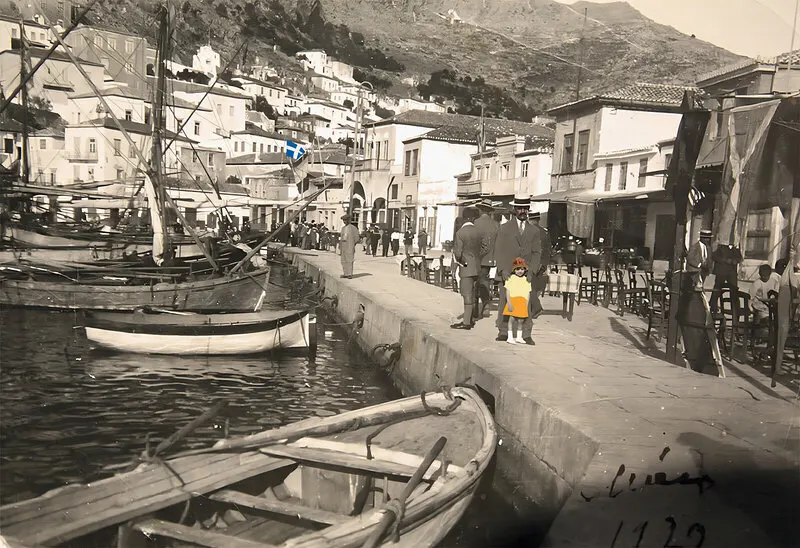
The Girl in the Floral Hat, 2024
Digital
70 x 50 cm
A six-year-old girl in a floral hat with her proud father in the harbour of Hydra. We can call her Olga. It is a timeless photo, for fathers are always proud of their daughters, copies of their mother, the woman they love. Not much has changed in the harbour; the houses are the same, the sky and the mountain behind, but flashy jewellers, fashion shops with imported clothes, and chic cafes and bars have replaced yesterday's shops and workshops. Katsikas is still where it was, though it is now called Roloi, under the same clock tower. The boats at the quay have all been broken up, and most of today's boats are more extensive and made of plastic. Additionally, luxurious yachts are now noticeable, along with catamarans that take up too much space in the port. Olga’s father wears a double-breasted suit, a white shirt with a tie, and a well-groomed short beard. He proudly wears an imported straw hat. They probably belong to middle-class Hydra and are doing well.
Olga was born in 1914, the same year World War 1 started, and the Greek genocide, the Genoktonía ton Ellínon, which included the Pontic genocide, was the systematic killing of the Christian Ottoman Greek population of Anatolia carried out by the Turks. The genocide included massacres, forced deportations involving death marches through the Syrian Desert, expulsions, summary executions, the destruction of Eastern Orthodox cultural, historical, and religious monuments and finally, the burning of the cosmopolitan city of Smyrna. Several hundred thousand Ottoman Greeks died during this period. Some estimations say a million. Most of the refugees and survivors fled to Greece, adding over a quarter to the prior population of Greece.
Olga was lucky to be born on Hydra into a family that was either poor or rich, but she was brought up by parents who could afford to buy her a fancy flowery hat. What life could she expect?
The photo was taken in 1920, the start of a decade when Greece experienced an extraordinary series of kaleidoscopic changes, including political upheavals, economic reforms, and social transformations. Given its size and significance, few countries benefited more from the war than Greece. The Greeks should have considered themselves exceptionally fortunate, as their role in the war had been somewhat questionable, with their commitment to the Allied cause coming late and seemingly uncertain. The highly favourable agreements Greece managed to secure with the Great Powers were essentially thanks to the statesmanship and extraordinary tact of Prime Minister Eleftherios Venizelos. His leadership and influence, particularly in securing these agreements, were pivotal in every significant political change of the 1920s. In the fall, Olga will start school in the first grade. She feels almost grown up.
In the East, the Greek genocide continued, which included the Pontic genocide, which was the Turks' systematic killing of the Christian Ottoman Greek population of Anatolia, which was carried out mainly during World War I and its aftermath but continued into the 1920s. Her parents always lowered their voices when discussing the topic to avoid worrying the children. But there were relatives on her father's side who were at risk.
Olga had just begun her second grade in school, and the end of 1921 marked a significant turning point in Greek history. This period saw Eleftherios Venizelos fall and King Constantine I's return to the throne. Despite being 'unrecognised' by the Allied Powers, the King was reinstated with enthusiastic support from the population, which triggered a wave of anti-Venizelist reprisals, including political purges and social unrest. It was a time of great uncertainty, with the looming threat of war in Anatolia, where the Turkish Nationalist leader, Mustafa Kemal Pasha, was rapidly gaining support. The tension and anxiety of the period were palpable.
For a little girl like Olga, the distant war in the ancient eastern Greek lands felt very far away. The Greek campaign was launched primarily because the Western Allies, particularly British Prime Minister David Lloyd George, had promised Greece territorial gains at the expense of the Ottoman Empire, which had been recently defeated in World War I. Greek claims were based on Anatolia being part of Ancient Greece and the Byzantine Empire before the Turks conquered the area in the 12th–15th centuries.
As Olga, a young girl of innocence, went about her daily life, these grand historical events unfolded around her, shaping the future of her homeland. While the complexities of politics and war were far beyond her understanding, they created an atmosphere of change and uncertainty that even a young girl, innocent and unaware, could sense.
As the nation braced itself for the unfolding drama, Olga continued with her school days, her small world of learning and play seemingly untouched by the more extraordinary tumult yet subtly influenced by the undercurrents of a country in transition. The stark contrast between her innocent world and the more significant historical events underscores the war's profound impact on her childhood. The distant war in the ancient eastern Greek lands felt very far away to a little girl like Olga, yet the tension and anxiety of the period were palpable, shaping her perception of the world around her.
Olga’s third year in school had been underway for a few months when the war against the Turks was lost. 1922 was a watershed moment in the history of modern Greece. It marked the fall of ideas central to Hellenism since its early days of struggle for independence. The centenary of this struggle had just been celebrated, particularly the idea of a greater Greece, which had been closely associated with Eleftherios Venizelos since his rise to power in 1910. Once a dominant Balkan power, Greece was now thrust back into the unenviable position it held after the Greco-Turkish War of 1897.
The catastrophic outcome of the Asia Minor Campaign, a significant event that led to the abdication of King Constantine I on 27 September 1922 in favour of his son, King George II, marked a substantial shift in the country's leadership. Her father was distraught; a distant part of the family had been severely affected when they were forced to flee Smyrna with only the clothes on their backs. At least they had managed to survive. By chance, they ended up on the same boat as the young Onassis and his grandmother. Like her father's cousin, the coming shipping magnate was born in Smyrna in the Ottoman Empire and fled the city to Greece in 1922 in the wake of the burning of Smyrna.
In 1922, Greece encountered a significant financial crisis, marked by the dichotomisation of the drachma. This crucial event, triggered by the country's inability to secure more loans abroad for the war with Turkey, was announced by Finance Minister Petros Protopapadakis. The decision was to halve the value of each drachma, with the owner retaining half and the other half being surrendered to the government in exchange for a 20-year, 6.5% loan.
As an adult, Olga would see how World War II prevented the repayment of the loans, but even without the war, it was doubtful the Greek government could have managed to repay such enormous debts. The strategy of dichotomising the drachma had initially provided significant revenues for the state, with minimal inflation effects. However, the government's inability to repay loans from a decade of war and refugee resettlement led to deflation and interest rates. These policies caused many people to lose faith in their government, which led to decreased investment as they stopped holding assets in cash and began holding tangible goods.
With her passion for learning, Olga excelled in school and was already reading books like The Odyssey, which she loved.
Olga's fourth year in school, 1923, had started on a Monday according to the Gregorian calendar, marking a significant shift in Greek history. This year represented the 1923rd year of the Common Era (CE) and Anno Domini (AD) designations, the 923rd year of the 2nd millennium, the 23rd year of the 20th century, and the 4th year of the 1920s decade. The impact of this shift was such that at the start of 1923, the Gregorian calendar was 13 days ahead of the Julian calendar, which was then relegated to use only by churches after Greece adopted the Gregorian calendar.
In Greece, 1923 contained only 352 days, as 13 days were skipped to achieve the calendrical alignment with the Gregorian calendar. The change from the Julian to the Gregorian Calendar had practical implications for the daily lives of Greeks, affecting everything from work schedules to religious observances. This switch aligned Greece's calendar with the rest of Europe. In consequence, Wednesday, 15 February, according to the old Julian Calendar, was followed by Thursday, 1 March, in the new Gregorian Calendar. What a leap. Olga was thrilled because the school term became shorter. There was so much else a nine-year-old could do, like accompanying her father on a business trip to Athens, a bustling metropolis, another planet. Everything was so big. For the first time, Olga visited the Parthenon, which is considered a key landmark of early Western culture with a breathtaking view over Athens. Then they had ice cream before visiting The National Archaeological Museum with its rich collection of Greek Antiquity. Everything was so vast, the statues so tall, and the Greek history so overwhelming that it made Olga's head spin.
Back home, she spent the extra days playing hopscotch with her friends. The rules were simple. You needed a moderately sized stone and a series of squares. They drew eight squares or more on the harbour stones with chalk. The squares had to alternate between left and right and form a rectangle. They placed the stone in front of the first square. Then, the girl or boy had to move towards the first square, hop on one leg, and try to push the stone with one foot into the first square without falling over. Then, if they started from the left square, they pushed the stone to the right and vice versa. They had to push the stone into all the squares without moving it outside the square or touching the line. If someone pushed the stone out of the intended square, they lost and had to sit on the admiral's monument and watch.
In the spring of 1924, before ten-year-old Olga started her fifth year of school, a referendum was held on Greece becoming a republic. This followed the disaster of the Asia Minor Campaign, a significant event with great impact on the political situation in Greece. King George had to go into exile in the Kingdom of Romania, the home of his wife, Elisabeth, while the government debated the fate of the monarchy. Ultimately, a referendum was called. The referendum reflected the see-saw nature of the Greek electorate and the then-present dominance of the Liberal and Republican Venizelists in Greek politics, resulting in the abolition of the Crown. In the lead-up to the referendum, Prime Minister Alexandros Papanastasiou favoured the vote for the Republic, while the cunning Venizelos kept a neutral stance. Nonetheless, on 25 March 1924, the Second Hellenic Republic was proclaimed by parliament.
On Hydra, where royalism had never been particularly strong, life went on as usual. The island had a history of toppling kings who didn't align with the wishes of its influential residents. Olga, deeply passionate about history, knew her island's past well. She had already begun to think about what she would become when she grew up, leaning towards a career in something related to history, perhaps archaeology, a field that fascinated her and felt like a part of her since her visit to The National Archaeological Museum.
Olga was mature for her age and listened carefully to her wise mother, who encouraged her curiosity. The prospects for a girl on an island like Hydra were otherwise limited. Traditionally, a girl could only expect to be married off and bear children, one after the other, as discussions about birth control were rare and opposed by the church. Her father, who had the privilege of furthering his education after the obligatory six years of primary school, had studied economics at the University of Athens and was one of the most educated people on the island. This did not make him a millionaire, but his job at the municipality provided a steady and secure income.
If Olga were to follow in his footsteps, it would be highly unusual for a girl, and on Hydra, it would be unique. The prevailing hypothesis was that women should act without being heard and preferably not be seen too much either. Olga, however, had different aspirations. She had read that the Greek politician Solon aptly summarised the Greek philosophy on women: “The best Greek women are the ones you hear the least about either way.” In ancient Greece, women were literally kept out of sight most of the time. But Olga was determined to be more than just a whisper in history.
Ancient writers said that Spartan women were the most beautiful and indeed independent. They were educated and given physical training. They were free-range, so they had tanned skin. Ancient Athenian girls were married off at the age of 13 to 30-year-old men or older. Yikes! Then, they were secluded in harems, so they had pale skin.
Olga had decided she wanted to be a Spartan woman. She eagerly participated in the boys' play with wooden swords and had become quite skilled, too skilled, since the boys hated being defeated by a girl.
It was summer again, and Olga had turned eleven. Tensions were bubbling and brewing in Greece, and as usual, there were as many opinions as there were inhabitants. Something had to give. During Olga's summer vacation, just two days before Hydra's big celebration, Miaoulia, everything erupted. This day, commemorating Admiral Miaoulis, who died on June 24, 1835, had been celebrated long before Olga was born as an annual event to honour his significant role during the Greek War of Independence. The significance of this event was not lost on anyone. Nothing could wait until Saturday, so rest in peace, Miaoulis.
The 1925 Greek coup d’état took place on Thursday, June 25. General Theodore Pangalos led it, quickly rising to power and becoming the dictator of Greece the next day. Despite this, Hydra, a symbol of resilience, did not cancel Miaoulia. On the contrary, they doubled the fireworks, a testament to their determination. Hydra had always been rebellious and forged its path. They harboured no love for the Turks and symbolically burned one of their ships every year.
The Greco-Turkish War had left deep scars, and the Burning of Smyrna caused much political unrest in Greece. Many people were furious about losing the war, leading to a revolution in Athens under the leadership of Nikolaos Plastiras.
On the evening of June 24, Pangalos was informed that his arrest was imminent. He immediately ordered his officers to occupy strategic positions. The movement initially took place in the military hospital where Colonel Dertilis was detained. The fleet joined the movement in Thessaloniki while initiated naval officers captured the battleship Averof. Afterwards, Kavala followed, and soon, the coup controlled Thrace and Macedonia.
An eleven-year-old doesn’t reflect much on such events, and Hydra’s mayoral election went calmly and orderly, even though opinions on the candidates varied. After all, everyone had to live on the same island after the election, and people were used to doing as they pleased anyway. If that wasn’t enough, one could always bribe their way through. Olga’s father used to bribe her with candy, so the system worked even in small ways.
But Olga's story was far from ordinary. She now had to attend school on another island because she had moved up to a Gymnasium, Lower Secondary School, and there was no such school on Hydra. During the week, she stayed with relatives on Spetses but came home for the weekends. She was the first girl in the family to get this opportunity and one of the first on the island overall. It wasn’t just Olga who had ideas about her future but also her forward-thinking parents. Her father leaned towards something prestigious, like becoming a doctor, making her the first female doctor from the island. Olga and her mother, however, were inclined towards archaeology but wisely kept this to themselves. Despite the challenges, the family's unwavering support for Olga's education was truly inspiring.
The year 1926 would prove to be eventful, marked by yet another referendum and a prank that momentarily shook the foundations of medical research. January began with Epiphany, when the island celebrated Jesus' baptism in the Jordan River. Olga's second term at the Gymnasium had not yet started, so she was still at home. The Greek Orthodox Religion dominates Hydra's calendar. By the 25th of March, there was another significant event, and Olga stayed home for a few days as the island and all of Greece celebrated Greek Independence Day. This day was particularly important for the family since her father's and mother's families had been active during the revolution in 1821. After the obligatory church services, Olga and the other children, dressed to the nines, paraded along the harbour front to the enthusiastic applause of families and friends.
As the time for Apokries, the Carnival, approached, preparations were in full swing. Like many others on the island, Olga and her family were preparing for the festive season. 'Apokries' means 'Carnival' and 'Apoxh apo kreas' means 'Goodbye to meat,' which is what it's all about—the fast, where the devout abstain from many goodies until Easter seven weeks later. Initially, it was a pagan festival welcoming spring, but the church hijacked it. Olga's family didn't fast but kept a low profile for the neighbours' sake. It's best in a small town. And the town's priest was not to be trifled with, an unpleasant man Olga had decided to torment.
Tsiknopempti is the last Thursday before Pascha Lent, when meat can be eaten. It is a day of impromptu street BBQs, and families are doing the same at home! It is followed by Clean Monday, the first day of Lent. Olga's mother served traditional Lenten food, prepared and eaten even by those, like her family, who didn't observe the rest of Lent. It was also the day when Olga and her friends flew homemade kites. Olga had painted the priest's slightly distorted face on her kite and let it perform dizzying loops above Hydra's cathedral. All who knew about the prank laughed as the priest-kite attacked the bell tower.
On April 19th, according to the new Gregorian calendar, it was time for a week's school holiday in connection with Easter. Easter is a massive celebration of Jesus, with mournful observance of the Crucifixion of Christ on Good Friday. For Olga's family, it represented tradition no more, but they loyally followed the crowd, and after all the masses came the reward after the prolonged Saturday night mass. After a soup Olga didn't like, everything exploded with fireworks and cheers. A lamb was grilled the next day, so the smoke hung heavily over the island. Easter Sunday is a day of feasting with family and friends when the entire community comes together to celebrate.
Then, just before sunset, everyone gathered to witness the almost pagan re-enactment of the death of Judas Iscariot, who betrayed Jesus. In the harbour below the Merchant Academy, a straw effigy of Judas was hung, made to suffer all the torments of hell and die over and over again. First, he was strangled by the noose of the gallows, then shot with the island's oldest weapon, and finally, the villain was consumed in flames. Then there were fireworks again.
It wasn't long before it was time for the next holiday, and May Day interrupted the daily grind. This was one of Olga's favourites when she and all the girls decorated their homes with flower wreaths. The entire island bloomed, with enough flowers for thousands of wreaths. The anticipation of the upcoming celebrations filled the air with excitement, making every moment leading up to the eventful day thrilling.
Miaoulia occurred that year without a coup in Athens and was reminiscent of previous years. The speeches varied, but the content was the same: to glorify Hydra's and Miaoulis' efforts a hundred years earlier. It was the mayor's big day, basking in the glory of the past. His voice was ecstatic. A newly purchased Marconi public address loudspeaker with a simple amplifier made the situation unbearable for those standing closest with its shrill sound.
Everything around made the day exciting, including all those who returned to the family and the island to celebrate. At that time, tourism was barely invented, but once a Swedish artist showed up, the pale-faced Northerner became the event's sensation. For many years, 1926 was called the year the Swede came.
On Sunday, August 15th, Olga was free for Assumption Day. This joyful celebration commemorates Mary's reunion with Jesus in heaven. On Hydra, it is also the 'name day' of the cathedral church 'The Assumption of the Virgin Mary'. Part of the evening services was an extended procession with the Icon of the Virgin Mary at the forefront, filling the streets as the procession passed. Everyone who wanted to be seen joined the procession.
Monday, the 23rd of August, was a full moon, coinciding with a harvest holiday. Olga was on Hydra and was about to carry out a long-planned prank against the hated priest. It is still a well-kept secret who was behind it, but it might be time to lift the veil. Credit where credit is due, for the priest was indeed deserving of the prank. Olga had a naughty side and liked to play pranks when the mood struck. This time, it did and involved bitter fruits for the priest. The mystery surrounding the prank and its perpetrator adds an element of intrigue to the narrative, leaving the readers curious and engaged.
Lemons are always available since lemon trees bloom all year and can have flowers and ripe and unripe fruit all at once. They were a suitable colour for Olga's prank; both fully ripe yellow and green unripe ones worked.
Measles is a severe disease, highly contagious and sometimes fatal, so it is not something to joke about. Olga had to compromise because the ailment was essential to her prank. Olga had a few confidants, a couple of friends, and Lucas, a boy who, like her, attended the Gymnasium, two grades higher—the only two from Hydra. Lucas's father was the liner's captain who ran between Piraeus and Hydra several times weekly. That way, Lucas could occasionally travel to Athens and buy the coveted cigarettes that minors couldn't purchase on the island. Athens also had shops selling makeup, and Lucas bought five bottles of cheap but intensely red nail polish in one. They had pooled their money to collect the sum.
On the night of the full moon, the accomplices climbed, with the help of a ladder, up a large lemon tree in the priest's garden. First, the fruit was quickly wiped with pure gasoline to remove the thin film on the peel, then the fruit was dotted with the nail polish brush, with small but many red spots on each fruit. The risk of being caught on a Sunday night was small. If one was up for a party, the weekend had taken its toll, and rest was needed before a new workweek. Tourists were non-existent, and no night work took place on Hydra. The earliest risers were some bakers who might be up and about by four. The children went there to buy freshly baked bread and spread the rumour about the lemons getting measles because of the full moon. This is a sensitive matter for a priest since the full moon is associated with dark forces, not those he represents.
One of the priest's admirers, a simple-minded man always seen in the priest's entourage, was central to the plan. He not only looked foolish but was also so. Olga approached him and told him about the rumour that the priest's lemons had contracted measles and that she had heard someone had cast a curse and invoked the moon's help, a serious threat to the island's health. And to the priest's credibility. Olga said it with so much feigned sensation that it penetrated the simpleton's skull. He ran straight to the priest, who received his informed version just as more and more parishioners contacted him. Rumours spread on Hydra faster than light, and already before lunch, there weren't many who didn't know about the calamity.
It looked like a medical sensation, the first time measles appeared in the plant kingdom. After a superficial inspection, the pharmacist and the town doctor could confirm that it seemed the disease had spread from humans to a lemon tree. A boy was currently isolated at the small hospital with confirmed measles, so the infection probably came from him. The doctor saw his chance for a medical breakthrough. A Nobel Prize loomed and a prominent position at the university in Athens. To escape old ladies and coughing men would be a relief.
Since measles spread through the air, the priest's house and the garden in front were cordoned off by the police chief following a decree issued by the mayor. Hydra was, if not in a panic, then in an uproar. If nothing else, then after the priest's doomsday sermon at mass the next day. The priest had taken the simpleton's information about the moon's influence and the dark forces behind it to heart. According to the priest, Hydra was under a general attack by the evil one. Everything had to be due to the congregation's ungodly living and the attack aimed at God's representative on the island, that is himself. If the island was spared an epidemic, it was only due to his prayers. The packed cathedral cowered before the priest's harsh words.
There were no phones on the island, so it took a few days before an epidemic expert from Athens showed up. He was as baffled as his medical colleague and returned to the capital with a fruit picked under extraordinary security measures. Time passed, and while waiting for the expert's report, the priest's lemon tree was felled with the help of soldiers equipped with gas masks and full-body rubber suits and burned. The doctor instructed a young lieutenant to collect five infected fruits in a hermetically sealed container. For my research, said the doctor, who hadn't given up on the Nobel Prize.
The person who solved the mystery was neither the pharmacist nor the doctor but the town's suspicious hairdresser. She convinced her fiancé, the young lieutenant, to look at a fruit. Of course, she had to wear a rubber suit and gas mask. The hairdresser immediately recognised the colour as a cheap nail polish that no respectable woman on the island would use. She had a hidden bottle, a sample left by a salesman, which she fetched, and on the way, she picked up a ripe lemon from the merchant Katsikas. Then she put red dots on the lemon, which immediately got measles. Then she took a bottle of acetone and a cotton ball and dabbed the fruit, which turned reddish but gradually recovered and became yellow and OK again. After much resistance from her fiancé, she treated one of the priest's measles lemons in the same way, with a gas mask on and the brush fastened to a long stick. The fruit's recovery was just as quick, and then they contacted the mayor, who was a clever man.
He immediately realised that the controversial priest had been subjected to a practical joke. As quickly as the rumour of the plague had spread, the counter-information travelled, and already that evening, the entire island laughed both relieved and gleefully. Olga and the other children managed to keep their secret, and the priest went to a monastery far away. The doctor threw twenty pages of learned analysis into the trash and continued on Hydra until retirement freed him.
While waiting for Hydra's Patron, St. Day, Ag. Konstandinos, on November 13th-15th and the year's highlight, Christmas, Olga managed to complete another term at the Gymnasium, the third and now in grade two.
Two important things happened in 1927: Olga became a teenager, which marked a significant mental shift from feeling like a child to growing up almost overnight. At thirteen, Olga's world changed as she started to think more about what women usually do, such as what to wear, hairstyles, and other fashionable concerns. She also began to have more advanced thoughts on various matters, a sudden and profound transition.
Her playful nature hadn't disappeared, which the baker who had delivered mouldy bread to her mother soon found out. Olga stuffed a half-rotten fish into the bakery's fan, causing the shop to stink. It was just as gross as her first menstrual period. Although her mother had prepared her, the new experience of dealing with messy cloth pads was unpleasant. This contrast between her playful antics and the growing responsibilities of womanhood was a tension she had to navigate.
When Olga had a break from school, her gatherings with friends were always lively and energetic. Upon arriving at the harbour square, they often formed a circle, enjoyed baked pie, sipped homemade lemonade, and danced. They performed short satirical sketches, poking fun at familiar situations and easily recognisable village characters. After the priest left, they had to find new targets for their jokes. Their dances varied from the usual ones with absurd and exaggerated movements to special dances featuring ribald songs and rather lewd gestures, such as "How They Grind the Pepper," where they rubbed against the ground with different parts of their bodies, or "Saint Savior," in which hands were linked between the legs. It was always noisy and fun.
Olga's thoughts on the Spartan ideal of womanhood were reinforced as women's liberation during the 1920s was not just an American phenomenon. Progress in Greece was slow, and it seemed almost stagnant in Hydra. On Spetses, however, several wealthy individuals from Athens had bought houses. Their women often left behind flashy fashion magazines and women's journals, which were highly coveted and forbidden.
The girls traded these magazines according to an intricate price list. For example, it took twelve issues of the dreary Greek Woman, the monthly Magazine of the National Council of Greek Women, to obtain a single coveted copy of Harper's Bazaar, the American women's fashion magazine—the newer, the pricier. Greek Woman offered no guidance for an emerging young woman unless she wanted to become like everyone else, which Olga did not.
The Designer – the Woman’s Magazine was a tidy American publication seemingly meant for well-off housewives. Olga was not very impressed, but it was still something to browse through without alternatives. She had traded it for a well-thumbed copy of Vogue from 1924. Olga soon found that The Designer was a magazine her mother could appreciate, which she did. For Olga, it wasn’t exciting enough. Headlines such as ‘It's All Jackie's Fault’, ‘There Goes a Lady!’, ‘Help Your Child Form Good Habits’ by Dr George K. Pratt and ‘Putting Your Garden to Sleep’ was mind-numbingly dull.
Her worldview shifted, and the Spartan women took on new life when Olga traded for a well-preserved copy of La Parisienne from the previous May. The cover alone set the tone. La Vie Parisienne, an advanced French magazine for women but also for men who enjoyed seeing scantily clad women in provocative poses, featured a tennis-playing woman caught draped over the net. Judging by her double partner’s wide-eyed stare from behind, he clearly saw what she wore underneath.
Founded in 1863, La Vie Parisienne initially targeted the upper classes with its literary pieces, society gossip, and articles about the arts. Olga's new favourite artist, Georges Barbier, contributed to this weekly periodical covering contemporary literature, music, arts, and theatre. The magazine offered an attractive mix of subjects and witty commentary on current events. Lavishly illustrated, it employed many of the era's most renowned artists and became an integral part of Parisian life. This deluxe large-format volume presented numerous sumptuous colour illustrations, primarily consisting of cover designs and editorial cartoons. These images often depicted chic young beauties in fanciful and occasionally mildly risqué tableaux, such as a whimsical wind lifting a skirt to reveal a thigh and expose a red garter. This recurring theme could be varied endlessly, considering the season, weather, and the woman's attire as long as it could swirl upwards. Even the occasional partial nudity was tastefully and softly presented, though humorously flirtatious. The cover of Olga's copy was a prime example. The colour of the girl's undergarments was left to the reader's imagination, or perhaps she wore none at all. The artwork of La Vie Parisienne reflected the stylisation of Art Nouveau and Art Deco illustration, mirroring the aesthetic of the age as well as the values. This, combined with the intellectualism, wit, and satire of its written contributions, proved irresistible to the French public and Olga, significantly shaping her choices and preferences.
This modern magazine showcased attire and behaviour that few respectable Greek women would consider. The contrast between modern and ancient Greek attire was stark, yet Olga found a way to bridge the gap. Dressing like the women of Sparta from over two thousand years ago was an acceptable compromise for her, as she could always refer to classical Greek traditions.
In ancient Greece, concepts of beauty varied depending on the city, class, and period. In classical Greece, beauty was more focused on the male form, and boyish-looking women with small breasts and hips attracted attention, which suited Olga perfectly, as that was her appearance. Spartan girls wore short dresses similar to modern cocktail dresses, with a split up the side, and they exercised a lot. Olga began training and applied makeup, curled her hair, and used oil-based unguents. Her clothing could vary between quite demure or very revealing, depending on the fineness of her clothes. Her mother was not entirely happy with that.
Olga's mother preferred the Krobylos hairstyle, a topknot or bun worn high on the back of the head, popular among Athenian women and associated with the goddess Athena. She thought this could also suit Olga, who had been growing her hair for several years. Spartan women had curled and woven hair. They used curling irons or waving techniques to create curled or wavy hairstyles considered fashionable. When they wanted to dress up, they typically wore long and braided hair, often adorning it with ribbons, beads, or other decorations. “That’s my girl,” Olga exclaimed to herself when she found an example of this in her new magazine.
As she was almost an adult, Olga had to start understanding Greek politics. In Greece, it is essential to have an opinion, and everyone does, even those barely adults.
The new constitution, a pivotal subject in Olga's civics lessons, held sway throughout the 1920s and the Second Hellenic Republic. This era drew to a close in 1935 when a military coup orchestrated by Georgios Kondylis suspended the constitution, reinstated the monarchy, and brought back the 1911 constitution. Despite this tumultuous turn, the 1927 constitution's elements left an indelible mark, shaping the Greek Constitution of 1952 and, thereby, the nation's governance, a testament to the enduring impact of historical events.
As a native of Hydra, Olga was heartened by the new constitution's removal of any references to the Greek monarchy; kings were never popular on the island. It established a parliamentary republic with a bicameral legislature and an elected president as a ceremonial head of state. What particularly struck her was the formalisation of the previously unwritten principle of parliamentary majority, called ‘Dedilomeni’, a significant stride towards a more structured and democratic governance system, marking the evolution of governance. During the late summer, a biphasic dengue epidemic affected the Athens metropolitan area. More than ninety per cent of the population became sick, and one thousand five hundred in the entire country died, but the disease never reached Hydra. This was the most recent and most serious dengue fever epidemic in Europe.
Another important thing happened this year. Olga had shown such promise that she had the opportunity to continue her studies at the Lyceum, Upper Secondary School, also on Spetses, in the autumn. This was not a given in the 1920s; it was primarily a matter of financial resources and parental choice—specifically, her father's choice. Many considered it a waste of money since women were expected to stay at home, keep quiet, and have children, preferably staying no more than three meters from the kitchen stove to avoid being considered wayward, as her father jokingly put it. He still dreamed of Olga becoming Hydra's first female doctor, so it is evident that she should continue her education. Her mother, however, was a silent but strong supporter of Olga's education, with archaeology being her priority in a secret pact with Olga. This subject didn't need to be addressed for a few more years, so she let Olga's father have his dreams for now.
There were also new developments. A foreign language was introduced, and at that time, it was French, in addition to the mandatory ancient languages Classical Greek and Latin, both required for studies in Medicine and Archaeology. The former also meant that English was added in the second year since it was always beneficial for doctors to communicate with patients from visiting Americans, who had begun appearing more frequently in Europe after World War I. The Americans were well-liked in Greece after saving many refugees from the burning of Smyrna.
A flotilla, organised and commanded by the American humanitarian Asa Jennings, entered the port. It saved many lives, following the initiative of Captain Arthur Hepburn, chief of Staff of the American naval squadron. American officials from the YMCA and YWCA were also involved, risking their lives while being shot at by the Turks. Their actions profoundly impacted Greek society, as they were well-liked in Greece after saving many refugees from the burning of Smyrna. Winston Churchill called it an 'infernal orgy' and stated that: 'For a deliberately planned and methodically executed atrocity, Smyrna must...find few parallels in the history of human crime.'
During her first school vacation from Lyceum, dengue fever popped up again in the summer of 1928, but it was milder this time, and Hydra was again spared.
Olga’s body was changing, becoming rounder, with the muscles she had trained no longer as pronounced. As a fourteen-year-old woman, other changes were also evident, particularly in how men treated her, including her old boyfriends. Their glances! Eyes that once sparkled with mischief now had a different, more lustful gleam, while some boys had become shy. Sure, it was nice to be appreciated, but not like that. Olga felt objectified. Her mother had trained her on how to sit and move, especially not to sit, to avoid attracting undue attention from men.
She was the only girl in her class among boys aiming to become doctors or engineers. Olga didn't bother sharing her innermost plans and pretended both paths were possible. She was the best in her class, excelling in sciences, languages, and history. This way, she kept her father calm. She kept her Spartan ideals in check and avoided dressing provocatively. What had been acceptable while playing on Hydra was no longer appropriate here. Even the priest from Spetses, who frequently visited the school and often led the morning prayers, she had managed to charm. Just because she knew her Bible and attended the obligatory masses, the priest had assumed she was religious. Since women were not welcome in the pastoral community other than to make coffee and prepare meals, she posed no threat to the priest’s worldview.
As Olga's second school year began, Greece witnessed a significant political event- the Liberal Party's triumph in the parliamentary elections, securing 178 of the 250 seats. This victory paved the way for a coalition of five parties of the liberals under the leadership of Eleftherios Venizelos. These parties, including the Democratic Union (later the Agricultural and Labour Party), the National Democratic Party, the Conservative Democratic Party, and the Progressive Union, formed a formidable alliance. However, not everyone agreed with Venizelos' leadership. Georgios Kafantaris, along with some personal friends and dissatisfied liberals, chose to chart an independent course by founding the Progressive Party.
The elections also showcased the diversity of the political landscape. The anti-Venizelist movement, for instance, was not a unified front. It was represented by the People's Party, the Freethinkers' Party, and a few independent royalists who contested the elections. The former dictator, Theodoros Pangalos, added another dimension to the elections by standing as the head of the National Union in Athens. Furthermore, the presence of many unaligned and independent candidates, along with the entry of the Communist Party of Greece as the United Front, added further complexity to the electoral scenario.
It was, in other words, a game of musical chairs with unexpected winners and losers. And not precisely Olga's idea of liberalism. Not a woman in sight. The communists were brazen as lice, first-class opportunists, determined to seize power in Greece at any cost, even if violence was necessary. Two had managed to infiltrate the Lyceum, one in her class. Olga, a liberal at heart, saw no other option for a young woman who understood that being a feminist essentially meant standing up for the equal value of all people.
What mattered was the behaviour of the person before you, not whether they were black or white, man or woman, from one village or another. That’s why Olga was a liberal, even though she couldn’t vote until 1952 when Greek women finally gained suffrage, one of the last in Europe. By then, Olga was a professor of archaeology and an international authority, yet not trusted to influence her country’s future, Greece, where democracy was born more than two thousand years ago. Female suffrage had faced an uphill battle, and the church had offered no support. Olga's fight against this male bastion and subculture was deeply ingrained, a testament to the injustice she faced.
No one should imagine that her career progressed smoothly, a chapter that Olga, now fourteen, had yet to ponder. In school, it was straightforward: what you achieved orally and on tests determined your grades. The future would reveal that as a woman, merely being competent and outperforming her male colleagues was not enough. Objectivity and equal rights did not prevail in the male-dominated world she worked tirelessly to penetrate daily.
In 1929, Olga, fueled by determination, turned fifteen and could get a driving license.
“What do you need a license for on an island without cars? You don’t need a license to ride a donkey,” her father laughed when she asked.
“There are cars on Spetses and in Athens if you want me to continue at the university. A woman should have a license and choose her passengers. Plus, I’ll be the first on Hydra,” she said, giving her father one of those irresistible hugs that made him give in immediately.
1929 marked a significant political shift in Greece. On April 21, the nation held its first Senate elections, a pivotal moment in the country's history. The Liberal Party emerged victorious, securing 64 of the 92 directly elected seats, a clear endorsement of Prime Minister Eleftherios Venizelos's policies.
During the summer, Olga secretly interned at a minor excavation around the Acropolis with the later legendary Greek archaeologist Spyridon Marinatos, a man she would have much to do with later. He was thirteen years older and already fully trained. He would become a significant obstacle in her career. In the late 1930s, he was close to the quasi-fascist dictatorship of Ioannis Metaxas, under whom he initiated legislation to restrict women's roles in Greek archaeology, and he was later an enthusiastic supporter of the junta. “The Mummy,” Olga called him when she succeeded him at the University of Athens much later.
Indirect presidential elections were held in Greece on December 14, 1929, following the resignation of President Pavlos Kountouriotis. Former six-time prime minister and incumbent acting President since December 10, 1929, Alexandros Zaimis, defeated former short-term prime minister Georgios Kafantaris in a vote conducted by the Greek Parliament and Senate. Zaimis was sworn in for his first full term as the third President of the Second Hellenic Republic that same day.
Astero was a Greek silent film directed by Dimitris Gaziadis in 1929. The film is considered a romantic fustanella film and was filmed in a rural Greek setting. The fustanella was traditional Greek attire. It is a pleated skirt-like garment that is also referred to as a kilt. Even though it was considered somewhat of a melodramatic parody, Olga loved the film.
The most important political event in 1929 was the “Idionymon.” In ordinary and historical discourse, the term 'Idionymon' refers mainly to the crime established by the new Law - 'concerning safety measures for the social establishment and protection of freedom.' It was introduced by the liberal government of Eleftherios Venizelos, which established a penalty of six months imprisonment for anyone 'who attempts to apply ideas that have as an obvious target the violent overthrow of the current social system, or who acts in propagandising their application.' The law was directed against communists and anarchists and was used to enforce repression against the trade union movement. By the end of 1930, the law had been used to ban and dissolve most worker's organisations affiliated with the far left. The Idionymon was the first of a series of legal measures directed against the Communist Party of Greece. The calls to violent revolution were considered a growing threat by the Greek establishment in the inter-war years, culminating in the brutal persecution of communists and socialists by the Metaxas regime.
The democratically elected post-war government re-introduced measures similar to the Idionymon through the Emergency Law of 1947 in the context of the Greek Civil War. This law remained in effect until its final repeal by Decree-Law of September 1974, introduced by the transitional government following the end of the Regime of the Colonels.
In 1930, Olga's final year at Lyceum was underway, and she was already set to begin university in the fall. Her internship at the Acropolis excavation was more due to Marinatos's interest in her body than her intellect or intention of becoming a colleague. At that time, women on excavations were still considered somewhat quaint and often seen as mere companions. However, Olga's determination and resilience shone through when another archaeologist, Antonios Keramopoulos, a well-established gentleman, appreciated her insights into the palace of Mycenae. Olga had been secretly studying this topic, and her knowledge impressed him enough to help her enter the faculty. Later, he ensured she got to work with him at Mycenae, conveniently within commuting distance from Hydra. After all, Olga had a driver's license.
Her pioneering role marked Olga's journey in archaeology. She became the first female student of the 'Practical School of Art History,' an archaeological training centre established by the Archaeological Society of Athens at the Greek government's request. The British archaeologist and female pioneer Winifred Lamb was crucial to Olga's success until she earned her doctorate in 1938.
The world financial crises of 1930 and 1931 initiated a period of political chaos in Greece. Based on the export of luxury agricultural goods such as tobacco, olive oil, and raisins, the national economy saw international demand plummet during the Great Depression. However, by then, Olga had already begun her university studies and remained largely unaffected by the economic downturn.
Olga's Journey from Innocence to Insight
A six-year-old girl in a floral hat,
With her proud father in the harbour sat.
Olga, her name, in a timeless frame,
Where fathers and daughters always remain the same.
Born in '14, a world was in turmoil,
On Hydra, she grew away from the soil.
Parents cherished, with dreams in their hearts,
Bought her a hat, a fancy work of art.
1920, a unsure decade unfurled,
Greece in upheaval, a changing world.
Olga starts school feeling quite grand,
Almost grown-up, with dreams in hand.
Genocide shadows in the east did loom,
Parents whispered to shield her from doom.
Distant relatives at risk, in her father's mind,
But in her small world, peace she did find.
Second grade brought changes anew,
Venizelos fell, and Constantine grew.
A time of tension, a War's threat near,
But to little Olga, it wasn't yet clear.
Her third year in school and war was lost,
1922, a year of genocide of high cost
Family fled Smyrna, clothes on their backs,
Olga learned of survival amidst attacks.
Drachma was split, and the economy tight,
Olga's love for "The Odyssey" took flight.
Learning and reading, her world expanded,
With each book, her young heart commanded.
1923, her school started anew,
Gregorian shift and 13 days flew.
A nine-year-Olga thrilled with a shorter term,
In Athens she saw Greek history so firm.
Hopscotch games and ancient tales,
Dreams of archaeology, as history prevails.
Listening to mother, wise and bright,
Olga saw beyond traditional sight.
1924, the republic was proclaimed,
Hydra stayed cool, its stance untamed.
History in mind, future plans in sight,
Archaeology lured, a secret delight.
Eleven years old, a summer of change,
Miaoulia festival made a putsch feel strange.
Hydra's resilience and fireworks bright,
In Olga's heart lit a spark of light.
School on Spetses, a new chapter turned,
The first girl from her family, dreams burned.
Father's doctor hopes, mother's quiet scheme,
But Olga's future was a shared dream.
1926 brought pranks and more,
Measles on lemons, an island uproar.
The Priest's garden a playful plot,
Olga's laughter, nobody forgot.
Thirteen years old, changes inside,
Thoughts on clothes and how to glide.
First menstruation, a new phase begun,
Navigating womanhood, battles won.
School friends gathered, lively and bright,
Dances and pranks, joy in sight.
Magazines traded, fashion explored,
Dreams of Sparta, her soul soared.
New constitution, lessons learned,
Political landscape, passions burned.
Liberal ideals, equality’s call,
Olga stood firm, justice for all.
Fifteen and driving, a license in hand,
Father's approval, plans so grand.
Summer internships, ancient sites,
Marinatos's gaze, Keramopoulos's insights.
1929, Olga enjoyed a silent film's charm,
In Athens, politics shifts and economic alarm.
Internships in Athens, knowledge deep,
University dreams, her future to keep.
1930, the years in Lyceum’s end,
University beckoned a new trend.
Excavations, a dirty old man and ancient lore,
But Antonius helped her dreams to explore.
Olga's journey from six to sixteen,
A path of growth, a scholar has seen.
Looking ahead, the future looks bright,
Being an archaeologist with all her might.
Into the future, her vision is clear,
A world of knowledge, no place for fear.
Equality and justice remain her guiding star,
From Hydra's shores, she will travel far.

Jörgen Thornberg
Malmö
Lite om bilder och mig. Translation in English at the end.
Jag är en nyfiken person som ser allt i bilder, även det jag fäster i ord, gärna tillsammans för bakom alla mina bilder finns en berättelse. Till vissa bilder hör en kortare eller längre novell som följer med bilden.
Bilder berättar historier. Jag omges av naturlig skönhet, intressanta människor och historia var jag än går. Jag använder min kamera för att dokumentera världen och blanda det jag ser med vad jag känner för att fånga den dolda magin.
Mina bilder berättar mina historier. Genom mina bilder, tryck och berättelser. Jag bjuder in dig att ta del av dessa berättelser, in i ditt liv och hem och dela min mycket personliga syn på vår värld. Mer än vad ögat ser. Jag tänker i bilder, drömmer och skriver och pratar om dem; följaktligen måste jag också skapa bilder. De blir vad jag ser, inte nödvändigtvis begränsade till verkligheten. Det finns en bild runt varje hörn. Jag hoppas att du kommer att se vad jag såg och gilla det.
Jag är också en skrivande person och till många bilder hör en kortare eller längre essay. Den följer med tavlan, tryckt på fint papper och med en personlig hälsning från mig.
Flertalet bilder startar sin resa i min kamera. Enkelt förklarat beskriver jag bilden jag ser i mitt inre, upplevd eller fantiserad. Bilden uppstår inom mig redan innan jag fått okularet till ögat. På bråkdelen av ett ögonblick ser jag vad jag vill ha och vad som kan göras med bilden. Här skall jag stoppa in en giraff, stålmannen, Titanic eller vad det är min fantasi finner ut. Ännu märkligare är att jag kommer ihåg minnesbilden långt efteråt när det blir tid att skapa verket. Om jag lyckas eller inte, är upp till betraktaren, oftast präglat av en stråk av svart humor – meningen är att man skall bli underhållen. Mina bilder blir ofta en snackis där de hänger.
Jag föredrar bilder som förmedlar ett budskap i flera lager. Vid första anblicken fylld av feel-good, en vacker utsikt, fint väder, solen skiner, blommor på ängen eller vattnet som ligger förrädiskt spegelblankt. I en sådan bild kan jag gömma min egentliga berättelse, mitt förakt för förtryckare och våldsverkare, rasister och fördomsfulla människor - ett gärna återkommande motiv mer eller mindre dolt i det vackra motivet. Jag försöker förena dem i ett gemensamt narrativ.
Bild och formgivning har löpt som en röd tråd genom livet. Fotokonst känns som en värdig final som jag gärna delar med mig.
Min genre är vid som framgår av mina bilder, temat en blandning av pop- och gatukonst i kollage som kan bestå av hundratals lager. Vissa bilder kan ta veckor, andra någon dag innan det är dags att överlämna resultatet till printverkstaden. Fine Art Prints är digitala fotocollage. I dessa kollage sker rivandet, klippandet, pusslandet, målandet, ritandet och sprayningen digitalt. Det jag monterar in kan vara hundratals år gamla bilder som jag omsorgsfullt frilägger så att de ser ut att vara en del av tavlan men också bilder skapade av mig själv efter min egen fantasi. Därefter besöks printstudion och för vissa bilder numrera en limiterad upplaga (oftast 7 exemplar) och signera för hand. Vissa bilder kan köpas i olika format. Det är bara att fråga efter vilka. Gillar man en bild som är 70x100 men inte har plats på väggen, går den kanske att få i 50x70 cm istället. Frågan är fri.
Metoden Giclée eller Fine Art Print som det också kallas är det moderna sättet för framställning av grafisk konst. Villkoret för denna typ av utskrifter är att en högkvalitativ storformatskrivare används med åldersbeständigt färgpigment och konstnärspapper eller i förekommande fall på duk. Pappret som används möter de krav på livslängd som ställs av museer och gallerier. Normalt säljer jag mina bilder oinramade så att den nya ägaren själv kan bestämma hur de skall se ut, med eller utan passepartout färg på ram, med eller utan glas etc..
Under många år ställde jag bara ut på nätet, i valda grupper och på min egen Facebooksida - https://www.facebook.com/jorgen.thornberg.9
Jag finns också på en egen hemsida som tyvärr inte alltid är uppdaterad – https://www.jth.life/ Där kan du också läsa en del av de berättelser som följer med bilden.
UTSTÄLLNINGAR
Luftkastellet, oktober 2022
Konst i Lund, november 2022
Luftkastellet, mars 2023
Engleson Galleri Caroli, april 2023
Hydra, Greece June 2023
Engleson Galleri Caroli, oktober 2023
Toppen, Höllviken december 2023
Luftkastellet, mars 2024
Torups Galleri, mars 2024
Venice, May 2024
Luftkastellet, oktober 2024
Konst i Advent, December 2024
Galleri Engleson, Caroli December 2024
Jäger & Jansson Galleri, april 2025
A bit about pictures and me.
I'm a curious person who sees everything in pictures, even what I express in words, often combining them, for behind all my pictures lies a story. These narratives, some as short as a single image and others as long as a novel, are the heart and soul of my work.
Pictures tell stories. Wherever I go, I'm surrounded by natural beauty, exciting people, and history. I use my camera to document the world and blend what I see with what I feel to capture the hidden magic.
My images tell my stories. Through my pictures, prints, and narratives, I invite you to partake in these stories in your life and home and share my deeply personal perspective of our world. More than meets the eye. I think in pictures, dream, write, and talk about them; consequently, I must create images too. They become what I see, not necessarily confined to reality. There's a picture around every corner. I hope you'll see what I saw and enjoy it.
I'm also a writer, and many images come with a shorter or longer essay. It accompanies the painting, printed on fine paper with my personal greeting.
Many pictures start their journey on my camera. Simply put, I describe the image I see in my mind, experienced or imagined. The image arises within me even before I bring the eyepiece to my eye. In a fraction of a moment, I see what I want and what can be done with the picture. Here, I'll insert a giraffe, Superman, the Titanic, or whatever my imagination conjures up. Even stranger is that I remember the mental image long after it's time to create the work. Whether I succeed is up to the observer, often imbued with a streak of black humour – the aim is to entertain. My pictures usually become a talking point wherever they hang.
I prefer pictures that convey a message in multiple layers. At first glance, they're filled with feel-good vibes, a beautiful view, lovely weather, the sun shining, flowers in the meadow, or the water lying deceptively calm. But beneath this surface beauty, I often conceal a deeper story, a narrative that challenges societal norms or explores the human condition. I invite you to delve into these hidden narratives and discover the layers of meaning within my work.
Picture and design have been a thread running through my life. Photographic art feels like a fitting finale, and I'm happy to share it.
My genre is varied, as seen in my pictures; the theme is a blend of pop and street art in collages that can consist of hundreds of layers. Some images can take weeks, others just a day before it's time to hand over the result to the print workshop. Fine Art Prints are digital photo collages. In these collages, tearing, cutting, puzzling, painting, drawing, and spraying happen digitally. What I insert can be images hundreds of years old that I carefully extract so they appear to be part of the painting, but also images created by myself, now also generated from my imagination. Next, visit the print studio and, for certain images, number a limited edition (usually 7 copies) and sign them by hand. Some images may be available in other formats. Just ask which ones. If you like an image that's 70x100 but doesn't have space on the wall, you might be able to get it in 50x70 cm instead. The question is open.
The Giclée method, or Fine Art Print as it's also called, is the modern way of producing graphic art. This method ensures the highest quality and longevity of the artwork, using a high-quality large-format printer with archival pigment inks and artist paper or, in some cases, canvas. The paper used meets the longevity requirements set by museums and galleries. I sell my pictures unframed, allowing the new owner to personalise their artwork, confident in the lasting value and quality of the piece.
For many years, I only exhibited online, in selected groups, and on my Facebook page - https://www.facebook.com/jorgen.thornberg.9. I also have my website, which unfortunately is not constantly updated - https://www.jth.life/. You can also read some of the stories accompanying the pictures there.
EXHIBITIONS
Luftkastellet, October 2022
Art in Lund, November 2022
Luftkastellet, March 2023
Engleson Gallery Caroli, April 2023
Hydra, Greece June 2023
Engleson Gallery Caroli, October 2023
Toppen, Höllviken December 2023
Luftkastellet, March 2024
Torup Gallery, March 2024
Venice, May 2024
UTSTÄLLNINGAR
Luftkastellet, oktober 2022
Konst i Lund, november 2022
Luftkastellet, mars 2023
Engleson Galleri Caroli, april 2023
Hydra, Greece June 2023
Engleson Galleri Caroli, oktober 2023
Toppen, Höllviken december 2023
Luftkastellet, mars 2024
Torups Galleri, mars 2024
Venice, May 2024
Luftkastellet, October 2024
Konst i Advent, December 2024
Galleri Engleson, Caroli December 2024
Jäger & Jansson Galleri, April 2025
Utbildning
Autodidakt
Medlem i konstnärsförening
Öppna Sinnen
Med i konstrunda
Konstrundan i Skåne
Utställningar
Luftkastellet, October 2022
Art in Lund, November 2022
Luftkastellet, March 2023
Engleson Gallery Caroli, April 2023
Hydra, Greece June 2023
Engleson Gallery Caroli, October 2023
Toppen, Höllviken December 2023
Luftkastellet, March 2024
Torup Gallery, March 2024
Venice, May 2024