Vi använder cookies för att ge dig bästa möjliga upplevelse. Välj vilka cookies du tillåter.
Läs mer i vår integritetspolicy
Jörgen Thornberg
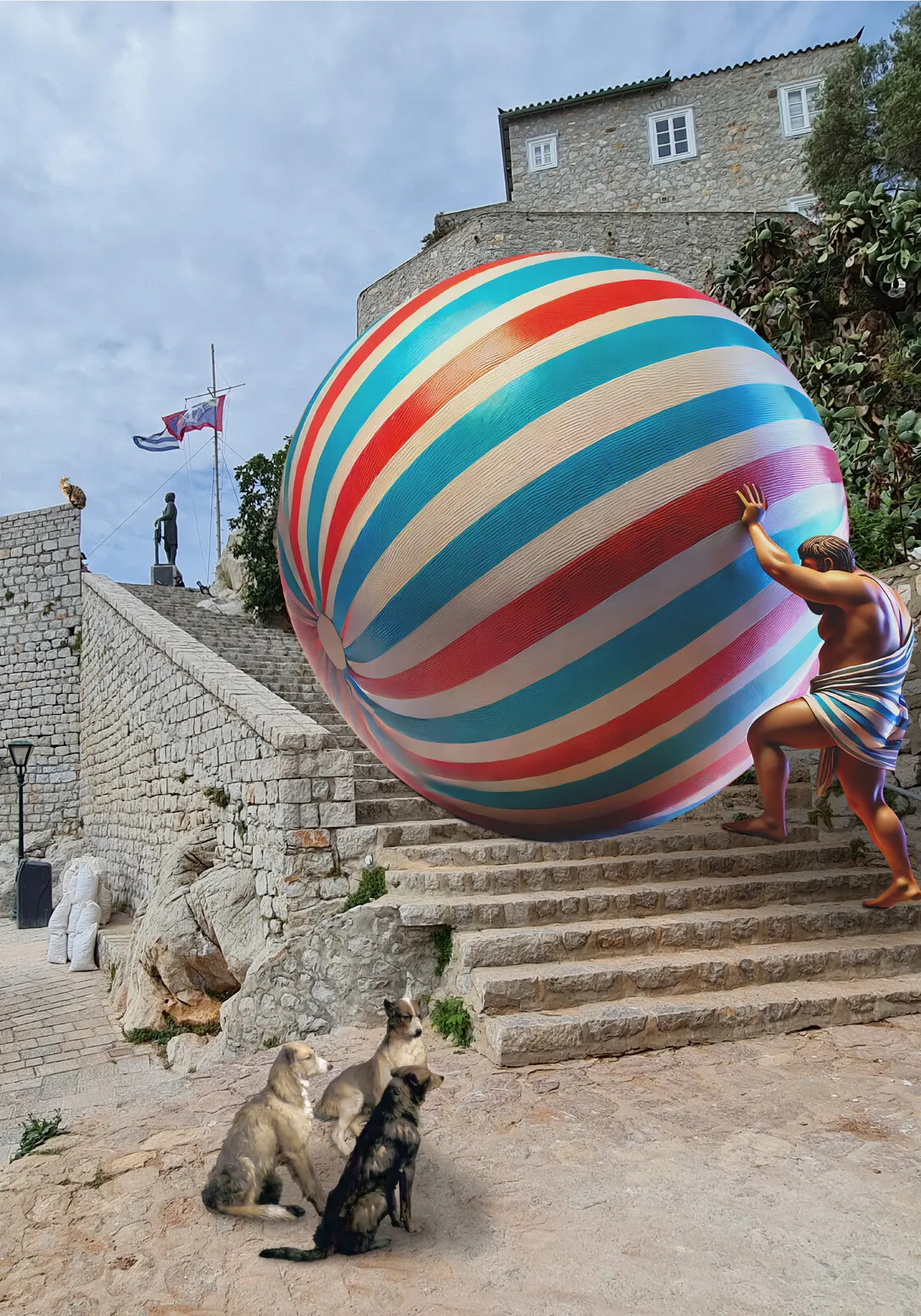
Sisyphus up and down Hydra, The Rock, 2024
Digital
50 x 70 cm
The Tale of Sisyphus and His Colorful Stone
In ancient Greece, where myths unfold,
Lived Sisyphus, both bold and cold.
A king with cunning, a heart of stone,
His fate is a tale of sins atone.
Deceitful acts and trickery,
His days were marked by misery.
He cheated death, defied the gods,
And faced their wrath with knowing nods.
Bound by chains of his own making,
Endless toil, his spirit breaking.
Up a hill, he pushed his plight,
A granite stone, both heavy and bright.
The boulder, round and smooth and fair,
Rolled down the slope, his heart's despair.
Yet still he strove with endless might,
To climb again in a ceaseless fight.
Then fate took hold and changed its tune,
He found himself on Hydra late in June.
His granite burden, now transformed,
A joyful sphere with colours warm.
A ball of stripes, like in children's play,
A whimsical twist to his dismay.
Sisyphus laughed, for irony's sake,
His punishment now seemed less at stake.
Though still, he laboured day and night,
The ball of joy gave strange delight.
A jest from gods to lighten the load,
A playful end to his grim, steep road.
Yet, in his heart, he knew the game,
A trick of fate, but still much the same.
For up and down, his life would wend,
Till the stars saw his toil come to an end.
Old Sisyphus' tale must be retold,
Of endless struggle, tuff and bowled.
On Hydra's shore, with boulder bright,
A grim symbol of his endless fight.
Hydra July 2024
The infamous Sisyphus has a laughably cursed legacy. He was not a pleasant person. To describe him, one must resort to strong invectives. Honestly, he was a scoundrel, an arch-bastard; some would even say Sisyphus was a prime asshole who well deserved his punishment. He was the type of guy who, if you found him at a party, you'd quickly realise he was the one who spiked the punch to watch the chaos unfold.
"In warning to others," it was said in olden times, a punishment intended to deter. And his punishment was truly infernally devised. Sisyphus was a perpetrator, a thrill killer, and an all-around societal menace. Imagine having someone like that in your neighbourhood. He'd probably be the guy who lets his dog poop on your lawn and laughs about it. But his punishment, to endlessly roll a boulder up a hill, only to watch it roll back down, is a punishment that even the most hardened of us can't help but feel a sense of absurdity and futility about. It's a punishment that makes us question the fairness of the universe and perhaps even feel a twinge of sympathy for the condemned. The sheer absurdity of his eternal task is enough to make us shake our heads in disbelief.
He was also Odysseus' father, which must have been a heavy burden for the son, who restlessly wandered the Mediterranean after the end of the Trojan War. Talk about daddy issues! Can you picture Odysseus at a therapy session, lying on a couch, recounting tales of how his dad was condemned to push a boulder up a hill for eternity? "And how does that make you feel, Odysseus?" the therapist would ask. "It explains my deep-seated mistrust of large rocks and inclines."
Sisyphus' punishment, now known as a Sisyphean task, is the ultimate metaphor for futile labour. Imagine waking up every day only to roll a boulder up a hill, knowing it will roll back down. No weekends, no holidays, just an eternal workout with no gains. No wonder the gym is sometimes referred to as a modern-day Sisyphean experience.
The criminal mastermind Sisyphus was the king of Ephyra (later known as Corinth), and he earned his dreadful fate by being a deceitful and crafty ruler. He was known for trickery and cunning, often outwitting gods and mortals. He once cheated death not once, but twice, which sounds impressive until you realise the gods don't take kindly to being mocked. His cunning ways were so legendary that he managed to chain Thanatos, the god of death, in his shackles. This bold move led to a temporary halt in human mortality, which sounds great but must have caused quite a backlog in the underworld. The gods, however, were not to be outwitted for long, and they devised a punishment that would truly fit the crime.
Being Odysseus' father is perhaps the least infamous aspect of his life, but it didn't win him any father-of-the-year awards. One can only imagine family dinners in the Sisyphus household. "Dad, could you pass the ambrosia?" "Sure, but first, let me tell you about the time I cheated death." Not precisely the heartwarming tales a young Odysseus might have hoped for.
The essence of Sisyphus's story is that he was condemned to an eternity of frustration. Picture this: Sisyphus starts with hope every day, thinking that the boulder may stay at the top today. Every evening, he watches it roll back down, probably muttering curses under his breath. It's a cosmic joke with no punchline, a never-ending cycle of toil and disappointment.
It's called a Sisyphean task for a reason. We all have those moments when we feel like Sisyphus, endlessly working on something that never seems to get done. Maybe it's a never-ending pile of laundry, an inbox that keeps filling up or assembling furniture from Ikea. Sisyphus's plight reminds us that sometimes, the struggle is the point, and maybe, just maybe, there's a lesson in persistence, even if the task seems hopeless. By stressing these parallels, we can all feel a sense of connection and relatability to Sisyphus's story. We've all been there, pushing our metaphorical boulders up our hills. Sisyphus's story is not just a tale of punishment but a mirror reflecting our struggles and lessons from which we can learn.
In the end, what can we learn from Sisyphus? Perhaps it's that no matter how smart or cunning you think you are, karma, fate, or the universe will find a way to balance the scales. Or maybe some tasks, no matter how futile, are worth undertaking because they build character, resilience, and a healthy sense of humour about the absurdity of life. Sisyphus's story is a reminder that the struggle itself can be the point and that there's a lesson in persistence, even if the task seems hopeless. It's a lesson that can leave us enlightened and reflective about our struggles. It's a lesson that can inspire us to keep pushing that boulder, even when it seems like it's all for nought. Sisyphus's story is not just a cautionary tale. Still, it is a beacon of inspiration, reminding us that persistence can lead to enlightenment and growth despite seemingly impossible tasks.
So next time you find yourself pushing a metaphorical boulder up a hill, think of Sisyphus and remember: at least you're not doing it for eternity. And who knows, maybe you'll even find a way to laugh about it.
What was Sisyphus, who belonged to the underworld Hades, the ancient hell, doing on the paradise island of Hydra? Well, even among the gods, there was a certain logic and reason. To share the historical burdens and misery, even fortunate places like Hydra had to help. In this way, Sisyphus, like other eternally damned souls, moved between different locations on Earth, in his case with the common feature of steep mountains, ravines, or steep stairs that ensured the former king had to exert himself greatly.
Sisyphus pushed a gigantic stone beach ball. After being forced to haul a piece of grey-speckled bedrock for thousands of years, the gods finally took pity on the old tyrant and replaced the dull boulder with a much happier beach ball of granite. The weight was the same, but Sisyphus was cheered by the colourful striped company. He was so accustomed to his rolling that he found it more enjoyable than meaningless discussions with other old-timers from the past. For a while, he left the party of the damned for a trip up the stairs of Bastion leading to the statue of Andreas Miaoulis. It should, with history in mind, not be misunderstood. He would soon return to roll it up again in his eternal cycle. Others played Sudoku; Sisyphus rolled stone. The moral is that he did not escape his fate by moving to eternity, but he had a magnificent view of the brutal rocky landscape and the azure sea.
These eternal prisoners travelled in groups for practical reasons, so Sisyphus was not alone on Hydra at this particular time. Another unfortunate companion was Tantalus, the former king of ancient Phrygia. For trying to trick the gods into eating his son, Tantalus was condemned to stand in a pool of water beneath a fruit tree with low branches, with the fruit always eluding his grasp and the water perpetually receding before he could take a drink. It was our pomegranate tree, filled with ripe, red-glowing, juicy fruits. It's a favourite for many, rich in flavour and packed with beneficial vitamins and antioxidants. Tantalus, who hadn't tasted fruit in three thousand years, suffered all the torments of hell, and the small pool with spring water from Mount Olympus was unreachable. Our swimming pool had nice cold water on this hot day, and it was a few meters away. Not for him! Our paradise was his hell.
The Greeks used the proverb "Tantalean punishment" to refer to those who possess good things but are not allowed to enjoy them. His name and punishment are also the origin of the English word "tantalise," which means to torment with the sight of something desired but out of reach and to tease by arousing repeatedly disappointed expectations. Seductive girls often exploit this weapon. It's not kind at all.
Another lost soul found on Hydra was Niobe, Tantalus's daughter. She remained there forever because moving her was not an easy task. Zeus had tried once. He had grown tired of Niobe's constant lamentations that pierced through marrow, bone, and mountain. At that time, Hydra was closer to Mount Olympus, and Zeus wanted to throw the island to the ends of the Earth. He exerted so much force that the whole world creaked, and Hydra, like a discus, was flung but landed where it still lies today.
Niobe's fate, a story of profound significance in Greek mythology, is one of the most memorable Greek punishments. It is a striking example of the consequences of hubris, a Greek term defined as arrogance or excessive pride. This myth, widespread in ancient literature, poetry, and art, is a testament to the tragic consequences of Niobe's actions, evoking a deep sense of empathy. It's not surprising that the legend of Niobe appears in one of our oldest and best sources for Greek myths, Homer's Iliad.
The tragic tale of Niobe is one of the most poignant in Greek mythology. Her father was Tantalus, king of a town above Mount Sipylus in Anatolia, but we do not know exactly who her mother was. Niobe had two brothers, Broteas and Pelops, who would later be legendary heroes and give their name to the Peloponnese.
When Niobe grew up, she married Amphion, king of Thebes. This was a turning point in her life, and a series of tragic events followed, giving her a distinct place in one of the most tragic dramas in Greek mythology. Niobe and Amphion had fourteen children: seven sons and seven daughters.
At a ceremony held in honour of Leto, the mother of the divine twins Apollo and Artemis, who was also living in Thebes, Niobe, in a fit of arrogance, she bragged about her fourteen children. Niobe said that she was superior to Leto, as she had fourteen children and not only two. This was a fatal mistake and led to a horrible crime. Leto, a goddess often overshadowed by her more famous children, was deeply hurt by Niobe's words, and her children's reaction was swift and merciless.
When the twins knew this insult, they got enraged and, at once, came down to Earth to kill the children of Niobe. Apollo, the god of light and music, killed all seven of Niobe's sons with his mighty arrows before their mother's eyes.
Although Niobe was pleading with Apollo to feel mercy for her last surviving son, Apollo's lethal arrow had already left his bow to find its mark with deadly accuracy, thus wiping out all the male descendants of Niobe. Artemis, the virgin goddess of nature and hunting, killed Niobe's seven daughters with her lethal arrows, and their dead bodies lay unburied for nine days.
Devastated by the slaughter of his children, Amphion committed suicide. Some versions say that he, too, was killed by Apollo when he tried to avenge his children's deaths. And so it was that the gods had wiped out Niobe's entire family in a matter of moments, a sudden and abrupt tragedy. In deep anguish, she ran to Mount Sipylus. There, she pleaded with the Gods to give an end to her pain. Zeus felt sorry for her and transformed her into a rock to make her feel like a stone. That rock is Hydra; since then, it has always been called 'The Rock.'
However, even as a rock, Niobe continued to cry. You can hear it if you place your ear to the ground anywhere on Hydra. Her endless tears poured forth as a stream from the rock, ending up in the wells of Kala Pigadia on top of Miaouli Street. This stands as a moving reminder of a mother's eternal mourning. To this day, Niobe mourns for her children, and people believe that her faint image can still be carved in Mount Eros and the ceaseless tears Hydriots have been drinking for centuries. Have you tasted the water, then you know its flavour is divined?
The tragic tale of Niobe centres on the consequences of hubris, a strange concept in Greek antiquity that said that if you act with arrogance towards the Gods, you will be punished. Niobe's story is a classic example of the wrath of gods against human weaknesses. It is a powerful reminder of the dangers of excessive pride and the importance of humility, a moral lesson beautifully narrated in Homer's Iliad.
Prometheus, a Titan and lord of fire, was on Hydra, tirelessly striving to rectify the consequences of his fire. A reckless celebration on a visiting yacht had carelessly organised a fireworks display at Bisti Beach, on the southwestern part of Hydra, where they had anchored for the night. This led to a devastating fire in a beautiful pine forest. He often convinced the weather gods to intervene with only his persuasive abilities. The fact that the Earth hasn't succumbed to flames is a testament to his perseverance. While his successes outnumber his failures, the struggle is eternal, and the world is vast. This time, with the aid of the elements, he contained the fire, allowing Hydra's firefighters to extinguish it before it could spread.
Prometheus once stole fire from Zeus and restored it to humanity. As punishment, Zeus chained Prometheus to a rock, where an eagle would come daily to eat his liver, which would regenerate each night. Years later, the Greek hero Heracles, with Zeus' permission, killed the eagle and freed Prometheus from this torment. In gratitude, Prometheus has forever taken on the task of overseeing, as far as possible, that humans do not misuse fire. Sometimes, things go terribly wrong, such as when Nero burned down Rome in 64 AD to make room for his new palace. The burning of the Great Library of Alexandria was a significant blow to humanity, destroying hundreds of thousands of scrolls, the books of the time, and delaying human progress by hundreds of years.
Some other eternal travellers who sometimes happened to show up simultaneously could be seen on Hydra that day. Birds of a feather flock together, one might say, for there was a given reason for their presence. It was not Hydra's beauty that attracted them; it was other interests. Love lives on in eternity, even hopeless love.
Ahasuerus, The Wandering Jew or the Eternal Jew, was condemned to wander forever after he denied Jesus rest on the way to Golgotha. From place to place, the homeless Jew wanders in ever-shifting exile since he hurried Jesus along - "Go on quicker, Jesus! Go on quicker! Why dost Thou loiter?" Jesus replied with a curse: "I shall stand and rest, but thou shalt go on till the last day." Since then, the Eternal Jew has been on a perpetual journey, rarely staying more than a day in one place. He has visited over seven hundred thousand places. If the world and the towns still exist, it will take him another twelve thousand years to visit every city on Earth. Much longer, as he sometimes returns to the same place. He had been to Hydra once before. He appeared that day because Ahasuerus had fallen in love with Cassandra, the woman who foresees the future but is never believed. The love is unrequited because she knows that there is no salvation for Ahasuerus until the Last Day. Since she also knows that such a day does not exist in eternity, a relationship with the otherwise attractive man is hopeless.
Cassandra was the daughter of Priam, king of Troy. She had a fling with Apollo, and he allowed her to see the future. She broke it off, and Apollo couldn't rescind the gift, but he could add to it, ensuring no one would ever believe her predictions. She tried to warn the Trojans about the horse, but no one trusted her. Then, Ajax took her and brought her to Agamemnon as his concubine. Cassandra was murdered by Agamemnon's original wife, along with Agamemnon himself. Since then, she has travelled through time and whispered in people's ears about what would happen if nothing was done. For a long time, she has warned about climate change and its devastating impact on the Earth and all its inhabitants. She often appears at night and whispers her message in dreams. Ask Al Gore, Bill Clinton's vice president and the god of all environmentalists.
Cassandra had her reason for being on Hydra that day. She was secretly in love with Helen of Troy, a woman eternally doomed to move from embrace to embrace, abducted, exploited, but often not without her fault.
Helen's beauty makes her forever a vain, promiscuous, and dangerous woman who thoughtlessly often initiates new relationships. For two thousand years, she has cast longing eyes on Atlas, the Titan condemned to hold up the heavens for eternity. For a while, a few hundred years, he stood on Mount Eros, Hydra's highest point, holding up the sky above, night and day, in all weather, preventing everything above from falling and crushing all living things. Cassandra had tried countless times to tell Helen that Atlas was doomed to stand there with his heavy burden forever since eternity had no end. Cassandra spoke the truth but was not believed because she spoke in her own interest. Still, Cassandra did not give up and was on Hydra to make yet another attempt.
Jörgen Thornberg
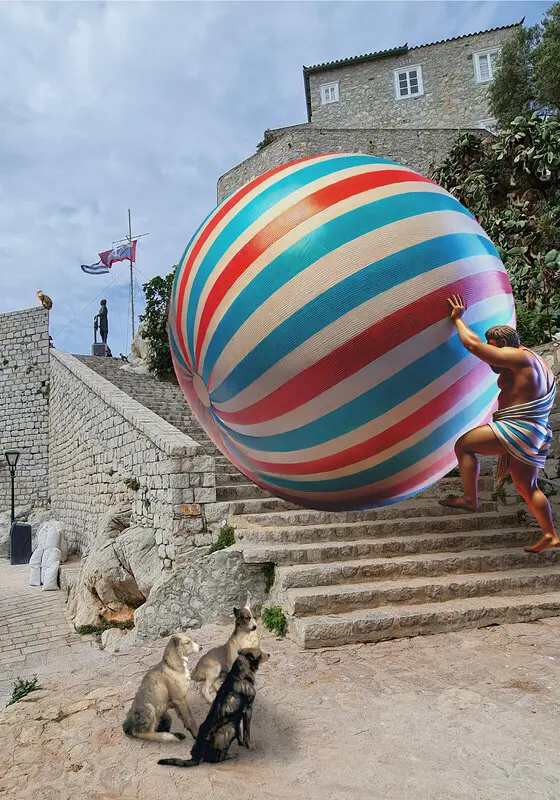
Sisyphus up and down Hydra, The Rock, 2024
Digital
50 x 70 cm
The Tale of Sisyphus and His Colorful Stone
In ancient Greece, where myths unfold,
Lived Sisyphus, both bold and cold.
A king with cunning, a heart of stone,
His fate is a tale of sins atone.
Deceitful acts and trickery,
His days were marked by misery.
He cheated death, defied the gods,
And faced their wrath with knowing nods.
Bound by chains of his own making,
Endless toil, his spirit breaking.
Up a hill, he pushed his plight,
A granite stone, both heavy and bright.
The boulder, round and smooth and fair,
Rolled down the slope, his heart's despair.
Yet still he strove with endless might,
To climb again in a ceaseless fight.
Then fate took hold and changed its tune,
He found himself on Hydra late in June.
His granite burden, now transformed,
A joyful sphere with colours warm.
A ball of stripes, like in children's play,
A whimsical twist to his dismay.
Sisyphus laughed, for irony's sake,
His punishment now seemed less at stake.
Though still, he laboured day and night,
The ball of joy gave strange delight.
A jest from gods to lighten the load,
A playful end to his grim, steep road.
Yet, in his heart, he knew the game,
A trick of fate, but still much the same.
For up and down, his life would wend,
Till the stars saw his toil come to an end.
Old Sisyphus' tale must be retold,
Of endless struggle, tuff and bowled.
On Hydra's shore, with boulder bright,
A grim symbol of his endless fight.
Hydra July 2024
The infamous Sisyphus has a laughably cursed legacy. He was not a pleasant person. To describe him, one must resort to strong invectives. Honestly, he was a scoundrel, an arch-bastard; some would even say Sisyphus was a prime asshole who well deserved his punishment. He was the type of guy who, if you found him at a party, you'd quickly realise he was the one who spiked the punch to watch the chaos unfold.
"In warning to others," it was said in olden times, a punishment intended to deter. And his punishment was truly infernally devised. Sisyphus was a perpetrator, a thrill killer, and an all-around societal menace. Imagine having someone like that in your neighbourhood. He'd probably be the guy who lets his dog poop on your lawn and laughs about it. But his punishment, to endlessly roll a boulder up a hill, only to watch it roll back down, is a punishment that even the most hardened of us can't help but feel a sense of absurdity and futility about. It's a punishment that makes us question the fairness of the universe and perhaps even feel a twinge of sympathy for the condemned. The sheer absurdity of his eternal task is enough to make us shake our heads in disbelief.
He was also Odysseus' father, which must have been a heavy burden for the son, who restlessly wandered the Mediterranean after the end of the Trojan War. Talk about daddy issues! Can you picture Odysseus at a therapy session, lying on a couch, recounting tales of how his dad was condemned to push a boulder up a hill for eternity? "And how does that make you feel, Odysseus?" the therapist would ask. "It explains my deep-seated mistrust of large rocks and inclines."
Sisyphus' punishment, now known as a Sisyphean task, is the ultimate metaphor for futile labour. Imagine waking up every day only to roll a boulder up a hill, knowing it will roll back down. No weekends, no holidays, just an eternal workout with no gains. No wonder the gym is sometimes referred to as a modern-day Sisyphean experience.
The criminal mastermind Sisyphus was the king of Ephyra (later known as Corinth), and he earned his dreadful fate by being a deceitful and crafty ruler. He was known for trickery and cunning, often outwitting gods and mortals. He once cheated death not once, but twice, which sounds impressive until you realise the gods don't take kindly to being mocked. His cunning ways were so legendary that he managed to chain Thanatos, the god of death, in his shackles. This bold move led to a temporary halt in human mortality, which sounds great but must have caused quite a backlog in the underworld. The gods, however, were not to be outwitted for long, and they devised a punishment that would truly fit the crime.
Being Odysseus' father is perhaps the least infamous aspect of his life, but it didn't win him any father-of-the-year awards. One can only imagine family dinners in the Sisyphus household. "Dad, could you pass the ambrosia?" "Sure, but first, let me tell you about the time I cheated death." Not precisely the heartwarming tales a young Odysseus might have hoped for.
The essence of Sisyphus's story is that he was condemned to an eternity of frustration. Picture this: Sisyphus starts with hope every day, thinking that the boulder may stay at the top today. Every evening, he watches it roll back down, probably muttering curses under his breath. It's a cosmic joke with no punchline, a never-ending cycle of toil and disappointment.
It's called a Sisyphean task for a reason. We all have those moments when we feel like Sisyphus, endlessly working on something that never seems to get done. Maybe it's a never-ending pile of laundry, an inbox that keeps filling up or assembling furniture from Ikea. Sisyphus's plight reminds us that sometimes, the struggle is the point, and maybe, just maybe, there's a lesson in persistence, even if the task seems hopeless. By stressing these parallels, we can all feel a sense of connection and relatability to Sisyphus's story. We've all been there, pushing our metaphorical boulders up our hills. Sisyphus's story is not just a tale of punishment but a mirror reflecting our struggles and lessons from which we can learn.
In the end, what can we learn from Sisyphus? Perhaps it's that no matter how smart or cunning you think you are, karma, fate, or the universe will find a way to balance the scales. Or maybe some tasks, no matter how futile, are worth undertaking because they build character, resilience, and a healthy sense of humour about the absurdity of life. Sisyphus's story is a reminder that the struggle itself can be the point and that there's a lesson in persistence, even if the task seems hopeless. It's a lesson that can leave us enlightened and reflective about our struggles. It's a lesson that can inspire us to keep pushing that boulder, even when it seems like it's all for nought. Sisyphus's story is not just a cautionary tale. Still, it is a beacon of inspiration, reminding us that persistence can lead to enlightenment and growth despite seemingly impossible tasks.
So next time you find yourself pushing a metaphorical boulder up a hill, think of Sisyphus and remember: at least you're not doing it for eternity. And who knows, maybe you'll even find a way to laugh about it.
What was Sisyphus, who belonged to the underworld Hades, the ancient hell, doing on the paradise island of Hydra? Well, even among the gods, there was a certain logic and reason. To share the historical burdens and misery, even fortunate places like Hydra had to help. In this way, Sisyphus, like other eternally damned souls, moved between different locations on Earth, in his case with the common feature of steep mountains, ravines, or steep stairs that ensured the former king had to exert himself greatly.
Sisyphus pushed a gigantic stone beach ball. After being forced to haul a piece of grey-speckled bedrock for thousands of years, the gods finally took pity on the old tyrant and replaced the dull boulder with a much happier beach ball of granite. The weight was the same, but Sisyphus was cheered by the colourful striped company. He was so accustomed to his rolling that he found it more enjoyable than meaningless discussions with other old-timers from the past. For a while, he left the party of the damned for a trip up the stairs of Bastion leading to the statue of Andreas Miaoulis. It should, with history in mind, not be misunderstood. He would soon return to roll it up again in his eternal cycle. Others played Sudoku; Sisyphus rolled stone. The moral is that he did not escape his fate by moving to eternity, but he had a magnificent view of the brutal rocky landscape and the azure sea.
These eternal prisoners travelled in groups for practical reasons, so Sisyphus was not alone on Hydra at this particular time. Another unfortunate companion was Tantalus, the former king of ancient Phrygia. For trying to trick the gods into eating his son, Tantalus was condemned to stand in a pool of water beneath a fruit tree with low branches, with the fruit always eluding his grasp and the water perpetually receding before he could take a drink. It was our pomegranate tree, filled with ripe, red-glowing, juicy fruits. It's a favourite for many, rich in flavour and packed with beneficial vitamins and antioxidants. Tantalus, who hadn't tasted fruit in three thousand years, suffered all the torments of hell, and the small pool with spring water from Mount Olympus was unreachable. Our swimming pool had nice cold water on this hot day, and it was a few meters away. Not for him! Our paradise was his hell.
The Greeks used the proverb "Tantalean punishment" to refer to those who possess good things but are not allowed to enjoy them. His name and punishment are also the origin of the English word "tantalise," which means to torment with the sight of something desired but out of reach and to tease by arousing repeatedly disappointed expectations. Seductive girls often exploit this weapon. It's not kind at all.
Another lost soul found on Hydra was Niobe, Tantalus's daughter. She remained there forever because moving her was not an easy task. Zeus had tried once. He had grown tired of Niobe's constant lamentations that pierced through marrow, bone, and mountain. At that time, Hydra was closer to Mount Olympus, and Zeus wanted to throw the island to the ends of the Earth. He exerted so much force that the whole world creaked, and Hydra, like a discus, was flung but landed where it still lies today.
Niobe's fate, a story of profound significance in Greek mythology, is one of the most memorable Greek punishments. It is a striking example of the consequences of hubris, a Greek term defined as arrogance or excessive pride. This myth, widespread in ancient literature, poetry, and art, is a testament to the tragic consequences of Niobe's actions, evoking a deep sense of empathy. It's not surprising that the legend of Niobe appears in one of our oldest and best sources for Greek myths, Homer's Iliad.
The tragic tale of Niobe is one of the most poignant in Greek mythology. Her father was Tantalus, king of a town above Mount Sipylus in Anatolia, but we do not know exactly who her mother was. Niobe had two brothers, Broteas and Pelops, who would later be legendary heroes and give their name to the Peloponnese.
When Niobe grew up, she married Amphion, king of Thebes. This was a turning point in her life, and a series of tragic events followed, giving her a distinct place in one of the most tragic dramas in Greek mythology. Niobe and Amphion had fourteen children: seven sons and seven daughters.
At a ceremony held in honour of Leto, the mother of the divine twins Apollo and Artemis, who was also living in Thebes, Niobe, in a fit of arrogance, she bragged about her fourteen children. Niobe said that she was superior to Leto, as she had fourteen children and not only two. This was a fatal mistake and led to a horrible crime. Leto, a goddess often overshadowed by her more famous children, was deeply hurt by Niobe's words, and her children's reaction was swift and merciless.
When the twins knew this insult, they got enraged and, at once, came down to Earth to kill the children of Niobe. Apollo, the god of light and music, killed all seven of Niobe's sons with his mighty arrows before their mother's eyes.
Although Niobe was pleading with Apollo to feel mercy for her last surviving son, Apollo's lethal arrow had already left his bow to find its mark with deadly accuracy, thus wiping out all the male descendants of Niobe. Artemis, the virgin goddess of nature and hunting, killed Niobe's seven daughters with her lethal arrows, and their dead bodies lay unburied for nine days.
Devastated by the slaughter of his children, Amphion committed suicide. Some versions say that he, too, was killed by Apollo when he tried to avenge his children's deaths. And so it was that the gods had wiped out Niobe's entire family in a matter of moments, a sudden and abrupt tragedy. In deep anguish, she ran to Mount Sipylus. There, she pleaded with the Gods to give an end to her pain. Zeus felt sorry for her and transformed her into a rock to make her feel like a stone. That rock is Hydra; since then, it has always been called 'The Rock.'
However, even as a rock, Niobe continued to cry. You can hear it if you place your ear to the ground anywhere on Hydra. Her endless tears poured forth as a stream from the rock, ending up in the wells of Kala Pigadia on top of Miaouli Street. This stands as a moving reminder of a mother's eternal mourning. To this day, Niobe mourns for her children, and people believe that her faint image can still be carved in Mount Eros and the ceaseless tears Hydriots have been drinking for centuries. Have you tasted the water, then you know its flavour is divined?
The tragic tale of Niobe centres on the consequences of hubris, a strange concept in Greek antiquity that said that if you act with arrogance towards the Gods, you will be punished. Niobe's story is a classic example of the wrath of gods against human weaknesses. It is a powerful reminder of the dangers of excessive pride and the importance of humility, a moral lesson beautifully narrated in Homer's Iliad.
Prometheus, a Titan and lord of fire, was on Hydra, tirelessly striving to rectify the consequences of his fire. A reckless celebration on a visiting yacht had carelessly organised a fireworks display at Bisti Beach, on the southwestern part of Hydra, where they had anchored for the night. This led to a devastating fire in a beautiful pine forest. He often convinced the weather gods to intervene with only his persuasive abilities. The fact that the Earth hasn't succumbed to flames is a testament to his perseverance. While his successes outnumber his failures, the struggle is eternal, and the world is vast. This time, with the aid of the elements, he contained the fire, allowing Hydra's firefighters to extinguish it before it could spread.
Prometheus once stole fire from Zeus and restored it to humanity. As punishment, Zeus chained Prometheus to a rock, where an eagle would come daily to eat his liver, which would regenerate each night. Years later, the Greek hero Heracles, with Zeus' permission, killed the eagle and freed Prometheus from this torment. In gratitude, Prometheus has forever taken on the task of overseeing, as far as possible, that humans do not misuse fire. Sometimes, things go terribly wrong, such as when Nero burned down Rome in 64 AD to make room for his new palace. The burning of the Great Library of Alexandria was a significant blow to humanity, destroying hundreds of thousands of scrolls, the books of the time, and delaying human progress by hundreds of years.
Some other eternal travellers who sometimes happened to show up simultaneously could be seen on Hydra that day. Birds of a feather flock together, one might say, for there was a given reason for their presence. It was not Hydra's beauty that attracted them; it was other interests. Love lives on in eternity, even hopeless love.
Ahasuerus, The Wandering Jew or the Eternal Jew, was condemned to wander forever after he denied Jesus rest on the way to Golgotha. From place to place, the homeless Jew wanders in ever-shifting exile since he hurried Jesus along - "Go on quicker, Jesus! Go on quicker! Why dost Thou loiter?" Jesus replied with a curse: "I shall stand and rest, but thou shalt go on till the last day." Since then, the Eternal Jew has been on a perpetual journey, rarely staying more than a day in one place. He has visited over seven hundred thousand places. If the world and the towns still exist, it will take him another twelve thousand years to visit every city on Earth. Much longer, as he sometimes returns to the same place. He had been to Hydra once before. He appeared that day because Ahasuerus had fallen in love with Cassandra, the woman who foresees the future but is never believed. The love is unrequited because she knows that there is no salvation for Ahasuerus until the Last Day. Since she also knows that such a day does not exist in eternity, a relationship with the otherwise attractive man is hopeless.
Cassandra was the daughter of Priam, king of Troy. She had a fling with Apollo, and he allowed her to see the future. She broke it off, and Apollo couldn't rescind the gift, but he could add to it, ensuring no one would ever believe her predictions. She tried to warn the Trojans about the horse, but no one trusted her. Then, Ajax took her and brought her to Agamemnon as his concubine. Cassandra was murdered by Agamemnon's original wife, along with Agamemnon himself. Since then, she has travelled through time and whispered in people's ears about what would happen if nothing was done. For a long time, she has warned about climate change and its devastating impact on the Earth and all its inhabitants. She often appears at night and whispers her message in dreams. Ask Al Gore, Bill Clinton's vice president and the god of all environmentalists.
Cassandra had her reason for being on Hydra that day. She was secretly in love with Helen of Troy, a woman eternally doomed to move from embrace to embrace, abducted, exploited, but often not without her fault.
Helen's beauty makes her forever a vain, promiscuous, and dangerous woman who thoughtlessly often initiates new relationships. For two thousand years, she has cast longing eyes on Atlas, the Titan condemned to hold up the heavens for eternity. For a while, a few hundred years, he stood on Mount Eros, Hydra's highest point, holding up the sky above, night and day, in all weather, preventing everything above from falling and crushing all living things. Cassandra had tried countless times to tell Helen that Atlas was doomed to stand there with his heavy burden forever since eternity had no end. Cassandra spoke the truth but was not believed because she spoke in her own interest. Still, Cassandra did not give up and was on Hydra to make yet another attempt.

Jörgen Thornberg
Malmö
Lite om bilder och mig. Translation in English at the end.
Jag är en nyfiken person som ser allt i bilder, även det jag fäster i ord, gärna tillsammans för bakom alla mina bilder finns en berättelse. Till vissa bilder hör en kortare eller längre novell som följer med bilden.
Bilder berättar historier. Jag omges av naturlig skönhet, intressanta människor och historia var jag än går. Jag använder min kamera för att dokumentera världen och blanda det jag ser med vad jag känner för att fånga den dolda magin.
Mina bilder berättar mina historier. Genom mina bilder, tryck och berättelser. Jag bjuder in dig att ta del av dessa berättelser, in i ditt liv och hem och dela min mycket personliga syn på vår värld. Mer än vad ögat ser. Jag tänker i bilder, drömmer och skriver och pratar om dem; följaktligen måste jag också skapa bilder. De blir vad jag ser, inte nödvändigtvis begränsade till verkligheten. Det finns en bild runt varje hörn. Jag hoppas att du kommer att se vad jag såg och gilla det.
Jag är också en skrivande person och till många bilder hör en kortare eller längre essay. Den följer med tavlan, tryckt på fint papper och med en personlig hälsning från mig.
Flertalet bilder startar sin resa i min kamera. Enkelt förklarat beskriver jag bilden jag ser i mitt inre, upplevd eller fantiserad. Bilden uppstår inom mig redan innan jag fått okularet till ögat. På bråkdelen av ett ögonblick ser jag vad jag vill ha och vad som kan göras med bilden. Här skall jag stoppa in en giraff, stålmannen, Titanic eller vad det är min fantasi finner ut. Ännu märkligare är att jag kommer ihåg minnesbilden långt efteråt när det blir tid att skapa verket. Om jag lyckas eller inte, är upp till betraktaren, oftast präglat av en stråk av svart humor – meningen är att man skall bli underhållen. Mina bilder blir ofta en snackis där de hänger.
Jag föredrar bilder som förmedlar ett budskap i flera lager. Vid första anblicken fylld av feel-good, en vacker utsikt, fint väder, solen skiner, blommor på ängen eller vattnet som ligger förrädiskt spegelblankt. I en sådan bild kan jag gömma min egentliga berättelse, mitt förakt för förtryckare och våldsverkare, rasister och fördomsfulla människor - ett gärna återkommande motiv mer eller mindre dolt i det vackra motivet. Jag försöker förena dem i ett gemensamt narrativ.
Bild och formgivning har löpt som en röd tråd genom livet. Fotokonst känns som en värdig final som jag gärna delar med mig.
Min genre är vid som framgår av mina bilder, temat en blandning av pop- och gatukonst i kollage som kan bestå av hundratals lager. Vissa bilder kan ta veckor, andra någon dag innan det är dags att överlämna resultatet till printverkstaden. Fine Art Prints är digitala fotocollage. I dessa kollage sker rivandet, klippandet, pusslandet, målandet, ritandet och sprayningen digitalt. Det jag monterar in kan vara hundratals år gamla bilder som jag omsorgsfullt frilägger så att de ser ut att vara en del av tavlan men också bilder skapade av mig själv efter min egen fantasi. Därefter besöks printstudion och för vissa bilder numrera en limiterad upplaga (oftast 7 exemplar) och signera för hand. Vissa bilder kan köpas i olika format. Det är bara att fråga efter vilka. Gillar man en bild som är 70x100 men inte har plats på väggen, går den kanske att få i 50x70 cm istället. Frågan är fri.
Metoden Giclée eller Fine Art Print som det också kallas är det moderna sättet för framställning av grafisk konst. Villkoret för denna typ av utskrifter är att en högkvalitativ storformatskrivare används med åldersbeständigt färgpigment och konstnärspapper eller i förekommande fall på duk. Pappret som används möter de krav på livslängd som ställs av museer och gallerier. Normalt säljer jag mina bilder oinramade så att den nya ägaren själv kan bestämma hur de skall se ut, med eller utan passepartout färg på ram, med eller utan glas etc..
Under många år ställde jag bara ut på nätet, i valda grupper och på min egen Facebooksida - https://www.facebook.com/jorgen.thornberg.9
Jag finns också på en egen hemsida som tyvärr inte alltid är uppdaterad – https://www.jth.life/ Där kan du också läsa en del av de berättelser som följer med bilden.
UTSTÄLLNINGAR
Luftkastellet, oktober 2022
Konst i Lund, november 2022
Luftkastellet, mars 2023
Engleson Galleri Caroli, april 2023
Hydra, Greece June 2023
Engleson Galleri Caroli, oktober 2023
Toppen, Höllviken december 2023
Luftkastellet, mars 2024
Torups Galleri, mars 2024
Venice, May 2024
Luftkastellet, oktober 2024
Konst i Advent, December 2024
Galleri Engleson, Caroli December 2024
Jäger & Jansson Galleri, april 2025
A bit about pictures and me.
I'm a curious person who sees everything in pictures, even what I express in words, often combining them, for behind all my pictures lies a story. These narratives, some as short as a single image and others as long as a novel, are the heart and soul of my work.
Pictures tell stories. Wherever I go, I'm surrounded by natural beauty, exciting people, and history. I use my camera to document the world and blend what I see with what I feel to capture the hidden magic.
My images tell my stories. Through my pictures, prints, and narratives, I invite you to partake in these stories in your life and home and share my deeply personal perspective of our world. More than meets the eye. I think in pictures, dream, write, and talk about them; consequently, I must create images too. They become what I see, not necessarily confined to reality. There's a picture around every corner. I hope you'll see what I saw and enjoy it.
I'm also a writer, and many images come with a shorter or longer essay. It accompanies the painting, printed on fine paper with my personal greeting.
Many pictures start their journey on my camera. Simply put, I describe the image I see in my mind, experienced or imagined. The image arises within me even before I bring the eyepiece to my eye. In a fraction of a moment, I see what I want and what can be done with the picture. Here, I'll insert a giraffe, Superman, the Titanic, or whatever my imagination conjures up. Even stranger is that I remember the mental image long after it's time to create the work. Whether I succeed is up to the observer, often imbued with a streak of black humour – the aim is to entertain. My pictures usually become a talking point wherever they hang.
I prefer pictures that convey a message in multiple layers. At first glance, they're filled with feel-good vibes, a beautiful view, lovely weather, the sun shining, flowers in the meadow, or the water lying deceptively calm. But beneath this surface beauty, I often conceal a deeper story, a narrative that challenges societal norms or explores the human condition. I invite you to delve into these hidden narratives and discover the layers of meaning within my work.
Picture and design have been a thread running through my life. Photographic art feels like a fitting finale, and I'm happy to share it.
My genre is varied, as seen in my pictures; the theme is a blend of pop and street art in collages that can consist of hundreds of layers. Some images can take weeks, others just a day before it's time to hand over the result to the print workshop. Fine Art Prints are digital photo collages. In these collages, tearing, cutting, puzzling, painting, drawing, and spraying happen digitally. What I insert can be images hundreds of years old that I carefully extract so they appear to be part of the painting, but also images created by myself, now also generated from my imagination. Next, visit the print studio and, for certain images, number a limited edition (usually 7 copies) and sign them by hand. Some images may be available in other formats. Just ask which ones. If you like an image that's 70x100 but doesn't have space on the wall, you might be able to get it in 50x70 cm instead. The question is open.
The Giclée method, or Fine Art Print as it's also called, is the modern way of producing graphic art. This method ensures the highest quality and longevity of the artwork, using a high-quality large-format printer with archival pigment inks and artist paper or, in some cases, canvas. The paper used meets the longevity requirements set by museums and galleries. I sell my pictures unframed, allowing the new owner to personalise their artwork, confident in the lasting value and quality of the piece.
For many years, I only exhibited online, in selected groups, and on my Facebook page - https://www.facebook.com/jorgen.thornberg.9. I also have my website, which unfortunately is not constantly updated - https://www.jth.life/. You can also read some of the stories accompanying the pictures there.
EXHIBITIONS
Luftkastellet, October 2022
Art in Lund, November 2022
Luftkastellet, March 2023
Engleson Gallery Caroli, April 2023
Hydra, Greece June 2023
Engleson Gallery Caroli, October 2023
Toppen, Höllviken December 2023
Luftkastellet, March 2024
Torup Gallery, March 2024
Venice, May 2024
UTSTÄLLNINGAR
Luftkastellet, oktober 2022
Konst i Lund, november 2022
Luftkastellet, mars 2023
Engleson Galleri Caroli, april 2023
Hydra, Greece June 2023
Engleson Galleri Caroli, oktober 2023
Toppen, Höllviken december 2023
Luftkastellet, mars 2024
Torups Galleri, mars 2024
Venice, May 2024
Luftkastellet, October 2024
Konst i Advent, December 2024
Galleri Engleson, Caroli December 2024
Jäger & Jansson Galleri, April 2025
Utbildning
Autodidakt
Medlem i konstnärsförening
Öppna Sinnen
Med i konstrunda
Konstrundan i Skåne
Utställningar
Luftkastellet, October 2022
Art in Lund, November 2022
Luftkastellet, March 2023
Engleson Gallery Caroli, April 2023
Hydra, Greece June 2023
Engleson Gallery Caroli, October 2023
Toppen, Höllviken December 2023
Luftkastellet, March 2024
Torup Gallery, March 2024
Venice, May 2024