Vi använder cookies för att ge dig bästa möjliga upplevelse. Välj vilka cookies du tillåter.
Läs mer i vår integritetspolicy
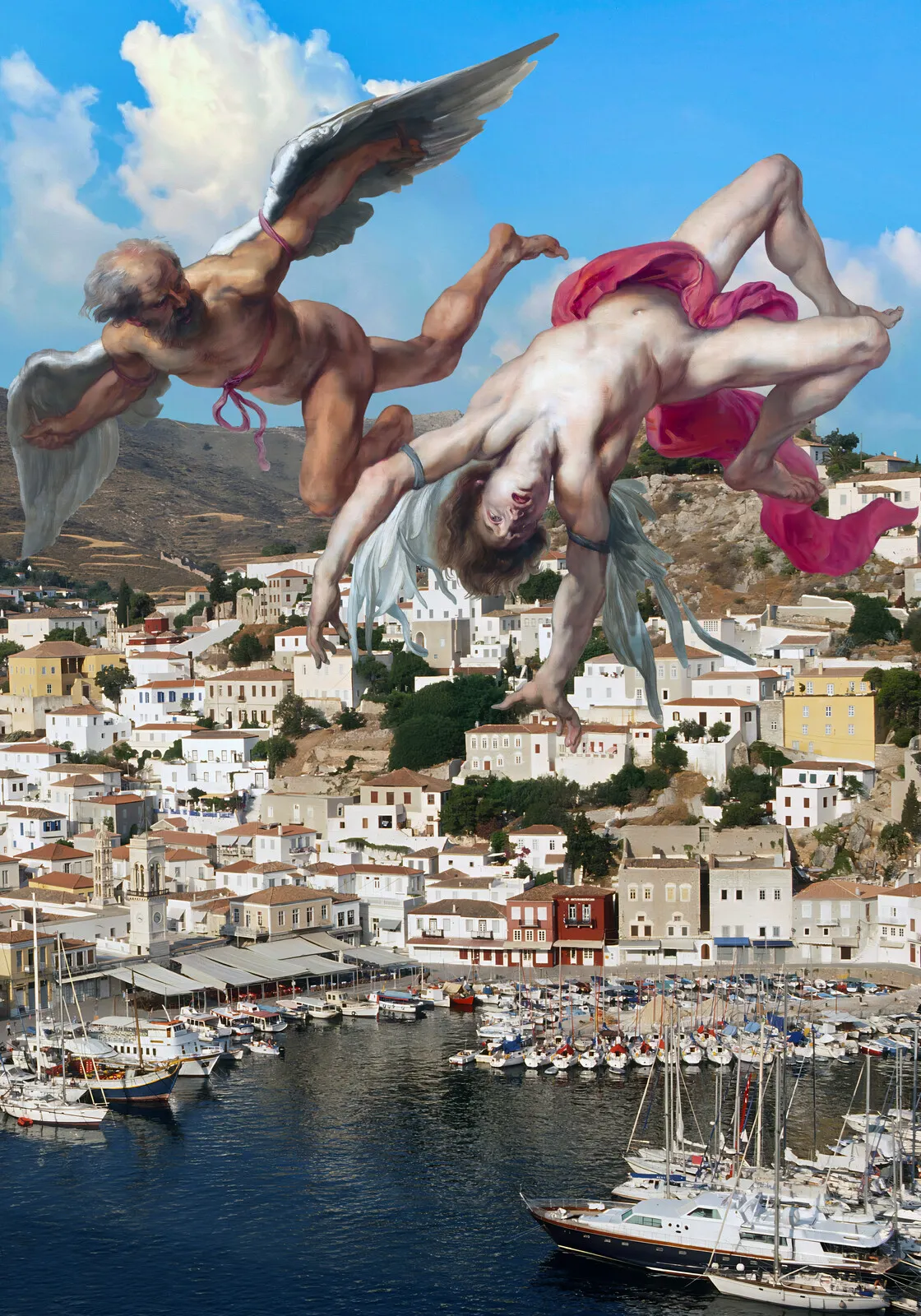
Jörgen Thornberg
Icarus Fall Over Hydra, 2024
Digital
50 x 70 cm
Icarus Fall Over Hydra - A Tale of Dreams and Caution. A timeless narrative transcending generations, the story of Icarus and Daedalus continues to resonate in our modern world, offering profound insights into the human condition and the enduring struggle for freedom and self-discovery.
In ancient Greece, where legends bloom,
A tale of flight, ambition's plume,
Of Daedalus, the craftsman's art,
And Icarus, with an eager heart.
Within the labyrinth's twisted maze,
Minotaur's roar in darkness stays,
A father and his son are confined,
With wings of wax and feathered bind.
"Fly not too high," Daedalus said,
"The sun's bright flames your wings will shed,
Nor too low where the sea mist clings,
But find the path where freedom sings."
Up they soared on feathered wings of flight,
From the labyrinth's dark into the light,
Icarus felt the rush of air,
A thrill of freedom without a care.
Higher still, he chased the sun,
In youthful glee, his caution shunned,
But wax did melt, and feathers fell,
A tragic end, no tale could quell.
The sea embraced him, cold and deep,
A lesson in his final leap,
Of hubris, dreams, and warnings spurned,
A timeless tale where wisdom is earned.
From Crete to modern skies, we turn,
To Leonardo's dreams that brightly burn,
His sketches spoke of flight's allure,
Yet grounded stayed to learn much more.
Hot air balloons in skies so blue,
In the 1700s, dreams anew,
Then Lilienthal, with wings so wide,
Defied the earth and dared to glide.
Yet gravity, that silent force,
Pulled many dreamers from their course,
Like Icarus, they reached too high,
And fell beneath the boundless sky.
Teenage hearts, like Icarus bold,
With dreams unmeasured, futures told,
They chase the sun with reckless glee,
Blind to the dangers they can't see.
Parents, like Daedalus, stand near,
With wisdom born of love and fear,
To guide, to warn, yet let them soar,
To find their path, their own encore.
So let us dream, but dream with care,
With eyes wide open, hearts aware,
For in the flight, both high and wise,
True freedom's found beyond the skies.
In every fall, a lesson learned,
In every rise, ambition burned,
So temper dreams with wisdom's light,
And soar the skies with measured flight.
Through wormholes, they'd soar and swoop,
From Hydra's port, Icarus' daring loop,
A splash that echoed loud and clear,
Yet none could see the cause so near.
Hydra's charm had caught his heart,
Inspired by Leonard Cohen's art,
In concert 'neath the starlit dome,
"Bird on a Wire" is his flight's new home.
With wings anew and wax refined,
By Daedalus' hand, the best design,
Icarus soared once more, defying fate,
Sun’s fierce heat he’d underestimate.
From ancient Rome to modern day,
Their starting points are a grand array,
Souvenirs from every single time,
A president's pen, a seal's lost shine.
Cape Canaveral's fiery blast,
In '86, their hopes did cast,
A tragic fall, like Challenger's fate,
Yet Icarus and his father would not abate.
Through Hydra's skies and wormholes vast,
They ventured forth yet failed at last,
But with eternity in hand,
Their quest would never, ever stand.
Back to Hydra, splash so bright,
Plunged in waters, out of sight,
Fifty million kilometres more,
To touch the sun, their endless chore.
Each flight a step, each fall a chance,
In endless time, their hopeful dance,
For Icarus and Daedalus strive,
To conquer heights, to feel alive.
So learn from Icarus, heed this call,
Dream high, but fear the fall,
For in each flight and each return,
Lies the lesson we must learn.
With wings of hope and hearts so bold,
Embrace your dreams, but wisely hold,
The balance between sky and sea,
To soar with grace and humility.
The Splash in the Harbor
The splash in the harbour basin outside the museum was eye-catching and echoed between the sides of the harbour. Naturally, people looked in that direction, but when the splash settled and nothing was visible, they quickly lost interest. Perhaps an overweight seagull had died of a heart attack; there was no other explanation. I was one of the few who noticed the cause: the overly bold, forever teenage Icarus.
Icarus, a young and adventurous Time-traveller, had fallen in love with a celestial body named Hydra after listening to Leonard Cohen at a concert among the stars. His song "Bird on a Wire" inspired him. Icarus decided to test his wings again, just as he had done for the first time in 545 BC. His father, Daedalus, was a brilliant inventor who had created the wings that allowed Icarus to fly. Time and again, Icarus attempted to reach the sun. Higher and higher he flew, with the same result. Despite his father's increasingly sophisticated constructions and new beeswax mixtures, the wax eventually melted. Feather by feather, the wings lost lift, and Icarus fell freely towards the sea or the ground. Since Time-travelers can only die once, he risked nothing but disgrace and his prestige. Icarus was a stubborn boy who remained at his age when he fell to his doom at 16. As stubborn as sin, he took eternity to help him and was convinced he would reach his goal sooner or later. He had reached high beyond today's satellites and our moon. He automatically returned to where he started since he had long used one of the many wormholes that connected all celestial bodies.
The pair had tested many starting points, such as the Roman Forum and the Colosseum, during Nero's bloody games. Much later, they arrived at Cape Canaveral Space Force Station in Florida in 1986, but it didn't go any better for them than for the space shuttle Challenger a few months later. Their starting points had become something of a souvenir collection over the millennia. From each place, they took something, such as one of President Obama's favourite pens, from the desk in the White House. They had done the same on Hydra, and the mayor was probably wondering where his seal with the boy on the dolphin had gone. A gift from the director after filming was completed.
One of these wormholes, a celestial passage that allowed for instantaneous travel between distant points in the universe, began and ended just outside the Hydra Museum, and it was from there that he started this July day. The temperature was already thirty-five degrees in the shade, but according to his father's calculations, the new wax mixture should withstand several thousand degrees Celsius. The margins were significant, even though the few who witnessed the adventure were already gasping from the heat. Icarus and his father flapped away and quickly disappeared among the clouds. Travelling through a wormhole is so fast that the sun's rays seem like bound snails in comparison. Icarus was back in no time, and after just a few minutes, the young man came flying in free fall and splashed into the harbour basin approximately where the short pier was located. Ordinary earthlings could not see Icarus, but no one could have missed the splash. It was just for father and son to return to their star and start over from the beginning. According to his father's calculations, there were only forty-nine million kilometres left to the sun's surface, so it should be achievable. They had eternity on their side.
Icarus' Fall Over Hydra: A Tale of Hubris and Teenage Overconfidence
The tale of Icarus is one of ancient Greece's most captivating and enduring myths. Its powerful themes of ambition, hubris, and the consequences of overreaching echo through the ages. The story begins at a time when Greece was a cradle of myths and legends, where gods and mortals often intersected in dramatic narratives that shaped the cultural and spiritual landscape of the ancient world.
The Labyrinth and the Minotaur
Our story unfolds on the island of Crete, ruled by King Minos. He commanded the master craftsman Daedalus to construct an intricate labyrinth to imprison the monstrous Minotaur, a creature half-man, half-bull. The maze was a marvel of ancient engineering, designed to be so complex and confounding that none could escape it once inside. It symbolised the physical entrapment and the entangling nature of human pride and folly.
Daedalus, however, found himself and his son, Icarus, imprisoned in the very labyrinth he had created, victims of the king's wrath. Determined to escape, Daedalus used his ingenuity to fashion two pairs of wings from feathers and wax, one for himself and one for his son. Before they took to the skies, Daedalus gave Icarus a stern warning: fly too high, and the sun's heat would melt the wax; fly too low, and the sea's dampness would weigh down the feathers.
The Flight and Fall of Icarus
The thrill of flight soon overcame Icarus' sense of caution. The moment of freedom, the wind rushing through his hair, the vast open sky—all these exhilarations led Icarus to ascend higher and higher, heedless of his father's warnings. In his youthful exuberance, he believed himself invincible, mightier even than the sun.
The sun, however, a great celestial body that had long watched over the earth, challenged Icarus' hubris. The heat began to soften the wax that held the feathers together. As Icarus soared too close, the wax melted, his wings disintegrated, and he plummeted into the sea below, meeting a tragic end. This dramatic fall, a result of overconfidence and disobedience, left an indelible mark on the psyche of the ancient Greeks.
Ancient Greece: A Land of Myths and Legends
In ancient Greece, stories like that of Icarus were more than just tales; they were integral to understanding human nature and the world around them. Greece was a mosaic of city-states with unique traditions, deities, and legends. The Greeks were master storytellers, weaving complex narratives that explored themes of heroism, divine intervention, and the human condition.
The Long Shadow of Icarus
For centuries, the story of Icarus served as a cautionary tale. It wasn't until the Renaissance that Leonardo da Vinci, a man of boundless curiosity and intellect, dared dream of human flight again. Aware of Icarus' folly, Da Vinci designed flying machines that echoed the mythical wings but grounded his ambition in scientific observation and understanding. Though he never built these machines, his drawings suggested that human flight was within the realm of possibility.
The dream of flight lay dormant until the 18th century when the first hot air balloons took to the skies, lifting humans aloft in a new era of aeronautical adventure. It wasn't until 1893 that Otto Lilienthal made the first controlled flights, gliding through the air on wings he crafted himself. Yet, like Icarus, many pioneers of flight encountered the perils of gravity, a force as unforgiving as the sun's heat. Lilienthal perished in a crash, underscoring the dangers inherent in humanity's quest to conquer the skies.
The Teenage Icarus
The tale of Icarus resonates deeply with the experiences of many modern parents and their teenage children. Adolescence is a time of burgeoning independence when young individuals often feel invincible and eager to push boundaries. Like Icarus, teenagers frequently overestimate their capabilities and underestimate the potential consequences of their actions.
Much like Daedalus, parents provide guidance and set boundaries, hoping to protect their children from the harsh realities of life. Yet, despite their best efforts, teenagers often stray, driven by a potent mix of curiosity, confidence, and a desire for autonomy. This natural rebellion is both a rite of passage and a source of anxiety for parents who watch their children navigate the treacherous path to adulthood.
Modern Parallels and the Lessons of Icarus
Consider the modern teenager: brimming with energy, eager to explore the world, and confident in their burgeoning capabilities. They are the Icaruses of today, convinced that they can fly higher and achieve more than the generations before them. Much like Daedalus, The challenge for parents is to guide these youthful ambitions without stifling their spirit while instilling a sense of awareness about the potential dangers.
For many parents, this overconfidence manifests in a variety of ways. It could be the teenager who insists on driving too fast, believing themselves to be the best driver on the road, or the one who neglects their studies because they think they can always catch up later. Like Icarus, they feel invincible, immune to the consequences of their actions. And, just like Icarus, they often learn the hard way that reality can be unforgiving.
The Tale Endures
The story of Icarus serves as a potent allegory for the perils of unchecked ambition and the importance of humility. It reminds us that while it is natural to dream and strive for greatness, it is equally important to recognise and respect the boundaries that life imposes.
In the end, the story of Icarus is not just about the fall but also about the flight. It is about the courage to dream and the wisdom to heed the lessons of those who came before. It is a story that continues to inspire and caution, a timeless narrative that speaks to the heart of human ambition and the eternal quest for the skies.
The Musty Moral
And so, as we reflect on Icarus and his tragic fall, let us remember the lessons he imparted. Ambition should be tempered with caution, dreams with wisdom, and flight with understanding one's limits. In doing so, we honour the spirit of Icarus not just by soaring but by soaring wisely. For every teenager who dreams of flying high, there lies the potential for greatness if only they remember the wax and feathers that bind their wings.
Jörgen Thornberg
Icarus Fall Over Hydra, 2024
Digital
50 x 70 cm
Icarus Fall Over Hydra - A Tale of Dreams and Caution. A timeless narrative transcending generations, the story of Icarus and Daedalus continues to resonate in our modern world, offering profound insights into the human condition and the enduring struggle for freedom and self-discovery.
In ancient Greece, where legends bloom,
A tale of flight, ambition's plume,
Of Daedalus, the craftsman's art,
And Icarus, with an eager heart.
Within the labyrinth's twisted maze,
Minotaur's roar in darkness stays,
A father and his son are confined,
With wings of wax and feathered bind.
"Fly not too high," Daedalus said,
"The sun's bright flames your wings will shed,
Nor too low where the sea mist clings,
But find the path where freedom sings."
Up they soared on feathered wings of flight,
From the labyrinth's dark into the light,
Icarus felt the rush of air,
A thrill of freedom without a care.
Higher still, he chased the sun,
In youthful glee, his caution shunned,
But wax did melt, and feathers fell,
A tragic end, no tale could quell.
The sea embraced him, cold and deep,
A lesson in his final leap,
Of hubris, dreams, and warnings spurned,
A timeless tale where wisdom is earned.
From Crete to modern skies, we turn,
To Leonardo's dreams that brightly burn,
His sketches spoke of flight's allure,
Yet grounded stayed to learn much more.
Hot air balloons in skies so blue,
In the 1700s, dreams anew,
Then Lilienthal, with wings so wide,
Defied the earth and dared to glide.
Yet gravity, that silent force,
Pulled many dreamers from their course,
Like Icarus, they reached too high,
And fell beneath the boundless sky.
Teenage hearts, like Icarus bold,
With dreams unmeasured, futures told,
They chase the sun with reckless glee,
Blind to the dangers they can't see.
Parents, like Daedalus, stand near,
With wisdom born of love and fear,
To guide, to warn, yet let them soar,
To find their path, their own encore.
So let us dream, but dream with care,
With eyes wide open, hearts aware,
For in the flight, both high and wise,
True freedom's found beyond the skies.
In every fall, a lesson learned,
In every rise, ambition burned,
So temper dreams with wisdom's light,
And soar the skies with measured flight.
Through wormholes, they'd soar and swoop,
From Hydra's port, Icarus' daring loop,
A splash that echoed loud and clear,
Yet none could see the cause so near.
Hydra's charm had caught his heart,
Inspired by Leonard Cohen's art,
In concert 'neath the starlit dome,
"Bird on a Wire" is his flight's new home.
With wings anew and wax refined,
By Daedalus' hand, the best design,
Icarus soared once more, defying fate,
Sun’s fierce heat he’d underestimate.
From ancient Rome to modern day,
Their starting points are a grand array,
Souvenirs from every single time,
A president's pen, a seal's lost shine.
Cape Canaveral's fiery blast,
In '86, their hopes did cast,
A tragic fall, like Challenger's fate,
Yet Icarus and his father would not abate.
Through Hydra's skies and wormholes vast,
They ventured forth yet failed at last,
But with eternity in hand,
Their quest would never, ever stand.
Back to Hydra, splash so bright,
Plunged in waters, out of sight,
Fifty million kilometres more,
To touch the sun, their endless chore.
Each flight a step, each fall a chance,
In endless time, their hopeful dance,
For Icarus and Daedalus strive,
To conquer heights, to feel alive.
So learn from Icarus, heed this call,
Dream high, but fear the fall,
For in each flight and each return,
Lies the lesson we must learn.
With wings of hope and hearts so bold,
Embrace your dreams, but wisely hold,
The balance between sky and sea,
To soar with grace and humility.
The Splash in the Harbor
The splash in the harbour basin outside the museum was eye-catching and echoed between the sides of the harbour. Naturally, people looked in that direction, but when the splash settled and nothing was visible, they quickly lost interest. Perhaps an overweight seagull had died of a heart attack; there was no other explanation. I was one of the few who noticed the cause: the overly bold, forever teenage Icarus.
Icarus, a young and adventurous Time-traveller, had fallen in love with a celestial body named Hydra after listening to Leonard Cohen at a concert among the stars. His song "Bird on a Wire" inspired him. Icarus decided to test his wings again, just as he had done for the first time in 545 BC. His father, Daedalus, was a brilliant inventor who had created the wings that allowed Icarus to fly. Time and again, Icarus attempted to reach the sun. Higher and higher he flew, with the same result. Despite his father's increasingly sophisticated constructions and new beeswax mixtures, the wax eventually melted. Feather by feather, the wings lost lift, and Icarus fell freely towards the sea or the ground. Since Time-travelers can only die once, he risked nothing but disgrace and his prestige. Icarus was a stubborn boy who remained at his age when he fell to his doom at 16. As stubborn as sin, he took eternity to help him and was convinced he would reach his goal sooner or later. He had reached high beyond today's satellites and our moon. He automatically returned to where he started since he had long used one of the many wormholes that connected all celestial bodies.
The pair had tested many starting points, such as the Roman Forum and the Colosseum, during Nero's bloody games. Much later, they arrived at Cape Canaveral Space Force Station in Florida in 1986, but it didn't go any better for them than for the space shuttle Challenger a few months later. Their starting points had become something of a souvenir collection over the millennia. From each place, they took something, such as one of President Obama's favourite pens, from the desk in the White House. They had done the same on Hydra, and the mayor was probably wondering where his seal with the boy on the dolphin had gone. A gift from the director after filming was completed.
One of these wormholes, a celestial passage that allowed for instantaneous travel between distant points in the universe, began and ended just outside the Hydra Museum, and it was from there that he started this July day. The temperature was already thirty-five degrees in the shade, but according to his father's calculations, the new wax mixture should withstand several thousand degrees Celsius. The margins were significant, even though the few who witnessed the adventure were already gasping from the heat. Icarus and his father flapped away and quickly disappeared among the clouds. Travelling through a wormhole is so fast that the sun's rays seem like bound snails in comparison. Icarus was back in no time, and after just a few minutes, the young man came flying in free fall and splashed into the harbour basin approximately where the short pier was located. Ordinary earthlings could not see Icarus, but no one could have missed the splash. It was just for father and son to return to their star and start over from the beginning. According to his father's calculations, there were only forty-nine million kilometres left to the sun's surface, so it should be achievable. They had eternity on their side.
Icarus' Fall Over Hydra: A Tale of Hubris and Teenage Overconfidence
The tale of Icarus is one of ancient Greece's most captivating and enduring myths. Its powerful themes of ambition, hubris, and the consequences of overreaching echo through the ages. The story begins at a time when Greece was a cradle of myths and legends, where gods and mortals often intersected in dramatic narratives that shaped the cultural and spiritual landscape of the ancient world.
The Labyrinth and the Minotaur
Our story unfolds on the island of Crete, ruled by King Minos. He commanded the master craftsman Daedalus to construct an intricate labyrinth to imprison the monstrous Minotaur, a creature half-man, half-bull. The maze was a marvel of ancient engineering, designed to be so complex and confounding that none could escape it once inside. It symbolised the physical entrapment and the entangling nature of human pride and folly.
Daedalus, however, found himself and his son, Icarus, imprisoned in the very labyrinth he had created, victims of the king's wrath. Determined to escape, Daedalus used his ingenuity to fashion two pairs of wings from feathers and wax, one for himself and one for his son. Before they took to the skies, Daedalus gave Icarus a stern warning: fly too high, and the sun's heat would melt the wax; fly too low, and the sea's dampness would weigh down the feathers.
The Flight and Fall of Icarus
The thrill of flight soon overcame Icarus' sense of caution. The moment of freedom, the wind rushing through his hair, the vast open sky—all these exhilarations led Icarus to ascend higher and higher, heedless of his father's warnings. In his youthful exuberance, he believed himself invincible, mightier even than the sun.
The sun, however, a great celestial body that had long watched over the earth, challenged Icarus' hubris. The heat began to soften the wax that held the feathers together. As Icarus soared too close, the wax melted, his wings disintegrated, and he plummeted into the sea below, meeting a tragic end. This dramatic fall, a result of overconfidence and disobedience, left an indelible mark on the psyche of the ancient Greeks.
Ancient Greece: A Land of Myths and Legends
In ancient Greece, stories like that of Icarus were more than just tales; they were integral to understanding human nature and the world around them. Greece was a mosaic of city-states with unique traditions, deities, and legends. The Greeks were master storytellers, weaving complex narratives that explored themes of heroism, divine intervention, and the human condition.
The Long Shadow of Icarus
For centuries, the story of Icarus served as a cautionary tale. It wasn't until the Renaissance that Leonardo da Vinci, a man of boundless curiosity and intellect, dared dream of human flight again. Aware of Icarus' folly, Da Vinci designed flying machines that echoed the mythical wings but grounded his ambition in scientific observation and understanding. Though he never built these machines, his drawings suggested that human flight was within the realm of possibility.
The dream of flight lay dormant until the 18th century when the first hot air balloons took to the skies, lifting humans aloft in a new era of aeronautical adventure. It wasn't until 1893 that Otto Lilienthal made the first controlled flights, gliding through the air on wings he crafted himself. Yet, like Icarus, many pioneers of flight encountered the perils of gravity, a force as unforgiving as the sun's heat. Lilienthal perished in a crash, underscoring the dangers inherent in humanity's quest to conquer the skies.
The Teenage Icarus
The tale of Icarus resonates deeply with the experiences of many modern parents and their teenage children. Adolescence is a time of burgeoning independence when young individuals often feel invincible and eager to push boundaries. Like Icarus, teenagers frequently overestimate their capabilities and underestimate the potential consequences of their actions.
Much like Daedalus, parents provide guidance and set boundaries, hoping to protect their children from the harsh realities of life. Yet, despite their best efforts, teenagers often stray, driven by a potent mix of curiosity, confidence, and a desire for autonomy. This natural rebellion is both a rite of passage and a source of anxiety for parents who watch their children navigate the treacherous path to adulthood.
Modern Parallels and the Lessons of Icarus
Consider the modern teenager: brimming with energy, eager to explore the world, and confident in their burgeoning capabilities. They are the Icaruses of today, convinced that they can fly higher and achieve more than the generations before them. Much like Daedalus, The challenge for parents is to guide these youthful ambitions without stifling their spirit while instilling a sense of awareness about the potential dangers.
For many parents, this overconfidence manifests in a variety of ways. It could be the teenager who insists on driving too fast, believing themselves to be the best driver on the road, or the one who neglects their studies because they think they can always catch up later. Like Icarus, they feel invincible, immune to the consequences of their actions. And, just like Icarus, they often learn the hard way that reality can be unforgiving.
The Tale Endures
The story of Icarus serves as a potent allegory for the perils of unchecked ambition and the importance of humility. It reminds us that while it is natural to dream and strive for greatness, it is equally important to recognise and respect the boundaries that life imposes.
In the end, the story of Icarus is not just about the fall but also about the flight. It is about the courage to dream and the wisdom to heed the lessons of those who came before. It is a story that continues to inspire and caution, a timeless narrative that speaks to the heart of human ambition and the eternal quest for the skies.
The Musty Moral
And so, as we reflect on Icarus and his tragic fall, let us remember the lessons he imparted. Ambition should be tempered with caution, dreams with wisdom, and flight with understanding one's limits. In doing so, we honour the spirit of Icarus not just by soaring but by soaring wisely. For every teenager who dreams of flying high, there lies the potential for greatness if only they remember the wax and feathers that bind their wings.

Jörgen Thornberg
Malmö
Lite om bilder och mig. Translation in English at the end.
Jag är en nyfiken person som ser allt i bilder, även det jag fäster i ord, gärna tillsammans för bakom alla mina bilder finns en berättelse. Till vissa bilder hör en kortare eller längre novell som följer med bilden.
Bilder berättar historier. Jag omges av naturlig skönhet, intressanta människor och historia var jag än går. Jag använder min kamera för att dokumentera världen och blanda det jag ser med vad jag känner för att fånga den dolda magin.
Mina bilder berättar mina historier. Genom mina bilder, tryck och berättelser. Jag bjuder in dig att ta del av dessa berättelser, in i ditt liv och hem och dela min mycket personliga syn på vår värld. Mer än vad ögat ser. Jag tänker i bilder, drömmer och skriver och pratar om dem; följaktligen måste jag också skapa bilder. De blir vad jag ser, inte nödvändigtvis begränsade till verkligheten. Det finns en bild runt varje hörn. Jag hoppas att du kommer att se vad jag såg och gilla det.
Jag är också en skrivande person och till många bilder hör en kortare eller längre essay. Den följer med tavlan, tryckt på fint papper och med en personlig hälsning från mig.
Flertalet bilder startar sin resa i min kamera. Enkelt förklarat beskriver jag bilden jag ser i mitt inre, upplevd eller fantiserad. Bilden uppstår inom mig redan innan jag fått okularet till ögat. På bråkdelen av ett ögonblick ser jag vad jag vill ha och vad som kan göras med bilden. Här skall jag stoppa in en giraff, stålmannen, Titanic eller vad det är min fantasi finner ut. Ännu märkligare är att jag kommer ihåg minnesbilden långt efteråt när det blir tid att skapa verket. Om jag lyckas eller inte, är upp till betraktaren, oftast präglat av en stråk av svart humor – meningen är att man skall bli underhållen. Mina bilder blir ofta en snackis där de hänger.
Jag föredrar bilder som förmedlar ett budskap i flera lager. Vid första anblicken fylld av feel-good, en vacker utsikt, fint väder, solen skiner, blommor på ängen eller vattnet som ligger förrädiskt spegelblankt. I en sådan bild kan jag gömma min egentliga berättelse, mitt förakt för förtryckare och våldsverkare, rasister och fördomsfulla människor - ett gärna återkommande motiv mer eller mindre dolt i det vackra motivet. Jag försöker förena dem i ett gemensamt narrativ.
Bild och formgivning har löpt som en röd tråd genom livet. Fotokonst känns som en värdig final som jag gärna delar med mig.
Min genre är vid som framgår av mina bilder, temat en blandning av pop- och gatukonst i kollage som kan bestå av hundratals lager. Vissa bilder kan ta veckor, andra någon dag innan det är dags att överlämna resultatet till printverkstaden. Fine Art Prints är digitala fotocollage. I dessa kollage sker rivandet, klippandet, pusslandet, målandet, ritandet och sprayningen digitalt. Det jag monterar in kan vara hundratals år gamla bilder som jag omsorgsfullt frilägger så att de ser ut att vara en del av tavlan men också bilder skapade av mig själv efter min egen fantasi. Därefter besöks printstudion och för vissa bilder numrera en limiterad upplaga (oftast 7 exemplar) och signera för hand. Vissa bilder kan köpas i olika format. Det är bara att fråga efter vilka. Gillar man en bild som är 70x100 men inte har plats på väggen, går den kanske att få i 50x70 cm istället. Frågan är fri.
Metoden Giclée eller Fine Art Print som det också kallas är det moderna sättet för framställning av grafisk konst. Villkoret för denna typ av utskrifter är att en högkvalitativ storformatskrivare används med åldersbeständigt färgpigment och konstnärspapper eller i förekommande fall på duk. Pappret som används möter de krav på livslängd som ställs av museer och gallerier. Normalt säljer jag mina bilder oinramade så att den nya ägaren själv kan bestämma hur de skall se ut, med eller utan passepartout färg på ram, med eller utan glas etc..
Under många år ställde jag bara ut på nätet, i valda grupper och på min egen Facebooksida - https://www.facebook.com/jorgen.thornberg.9
Jag finns också på en egen hemsida som tyvärr inte alltid är uppdaterad – https://www.jth.life/ Där kan du också läsa en del av de berättelser som följer med bilden.
UTSTÄLLNINGAR
Luftkastellet, oktober 2022
Konst i Lund, november 2022
Luftkastellet, mars 2023
Engleson Galleri Caroli, april 2023
Hydra, Greece June 2023
Engleson Galleri Caroli, oktober 2023
Toppen, Höllviken december 2023
Luftkastellet, mars 2024
Torups Galleri, mars 2024
Venice, May 2024
Luftkastellet, oktober 2024
Konst i Advent, December 2024
Galleri Engleson, Caroli December 2024
Jäger & Jansson Galleri, april 2025
A bit about pictures and me.
I'm a curious person who sees everything in pictures, even what I express in words, often combining them, for behind all my pictures lies a story. These narratives, some as short as a single image and others as long as a novel, are the heart and soul of my work.
Pictures tell stories. Wherever I go, I'm surrounded by natural beauty, exciting people, and history. I use my camera to document the world and blend what I see with what I feel to capture the hidden magic.
My images tell my stories. Through my pictures, prints, and narratives, I invite you to partake in these stories in your life and home and share my deeply personal perspective of our world. More than meets the eye. I think in pictures, dream, write, and talk about them; consequently, I must create images too. They become what I see, not necessarily confined to reality. There's a picture around every corner. I hope you'll see what I saw and enjoy it.
I'm also a writer, and many images come with a shorter or longer essay. It accompanies the painting, printed on fine paper with my personal greeting.
Many pictures start their journey on my camera. Simply put, I describe the image I see in my mind, experienced or imagined. The image arises within me even before I bring the eyepiece to my eye. In a fraction of a moment, I see what I want and what can be done with the picture. Here, I'll insert a giraffe, Superman, the Titanic, or whatever my imagination conjures up. Even stranger is that I remember the mental image long after it's time to create the work. Whether I succeed is up to the observer, often imbued with a streak of black humour – the aim is to entertain. My pictures usually become a talking point wherever they hang.
I prefer pictures that convey a message in multiple layers. At first glance, they're filled with feel-good vibes, a beautiful view, lovely weather, the sun shining, flowers in the meadow, or the water lying deceptively calm. But beneath this surface beauty, I often conceal a deeper story, a narrative that challenges societal norms or explores the human condition. I invite you to delve into these hidden narratives and discover the layers of meaning within my work.
Picture and design have been a thread running through my life. Photographic art feels like a fitting finale, and I'm happy to share it.
My genre is varied, as seen in my pictures; the theme is a blend of pop and street art in collages that can consist of hundreds of layers. Some images can take weeks, others just a day before it's time to hand over the result to the print workshop. Fine Art Prints are digital photo collages. In these collages, tearing, cutting, puzzling, painting, drawing, and spraying happen digitally. What I insert can be images hundreds of years old that I carefully extract so they appear to be part of the painting, but also images created by myself, now also generated from my imagination. Next, visit the print studio and, for certain images, number a limited edition (usually 7 copies) and sign them by hand. Some images may be available in other formats. Just ask which ones. If you like an image that's 70x100 but doesn't have space on the wall, you might be able to get it in 50x70 cm instead. The question is open.
The Giclée method, or Fine Art Print as it's also called, is the modern way of producing graphic art. This method ensures the highest quality and longevity of the artwork, using a high-quality large-format printer with archival pigment inks and artist paper or, in some cases, canvas. The paper used meets the longevity requirements set by museums and galleries. I sell my pictures unframed, allowing the new owner to personalise their artwork, confident in the lasting value and quality of the piece.
For many years, I only exhibited online, in selected groups, and on my Facebook page - https://www.facebook.com/jorgen.thornberg.9. I also have my website, which unfortunately is not constantly updated - https://www.jth.life/. You can also read some of the stories accompanying the pictures there.
EXHIBITIONS
Luftkastellet, October 2022
Art in Lund, November 2022
Luftkastellet, March 2023
Engleson Gallery Caroli, April 2023
Hydra, Greece June 2023
Engleson Gallery Caroli, October 2023
Toppen, Höllviken December 2023
Luftkastellet, March 2024
Torup Gallery, March 2024
Venice, May 2024
UTSTÄLLNINGAR
Luftkastellet, oktober 2022
Konst i Lund, november 2022
Luftkastellet, mars 2023
Engleson Galleri Caroli, april 2023
Hydra, Greece June 2023
Engleson Galleri Caroli, oktober 2023
Toppen, Höllviken december 2023
Luftkastellet, mars 2024
Torups Galleri, mars 2024
Venice, May 2024
Luftkastellet, October 2024
Konst i Advent, December 2024
Galleri Engleson, Caroli December 2024
Jäger & Jansson Galleri, April 2025
Utbildning
Autodidakt
Medlem i konstnärsförening
Öppna Sinnen
Med i konstrunda
Konstrundan i Skåne
Utställningar
Luftkastellet, October 2022
Art in Lund, November 2022
Luftkastellet, March 2023
Engleson Gallery Caroli, April 2023
Hydra, Greece June 2023
Engleson Gallery Caroli, October 2023
Toppen, Höllviken December 2023
Luftkastellet, March 2024
Torup Gallery, March 2024
Venice, May 2024