Vi använder cookies för att ge dig bästa möjliga upplevelse. Välj vilka cookies du tillåter.
Läs mer i vår integritetspolicy
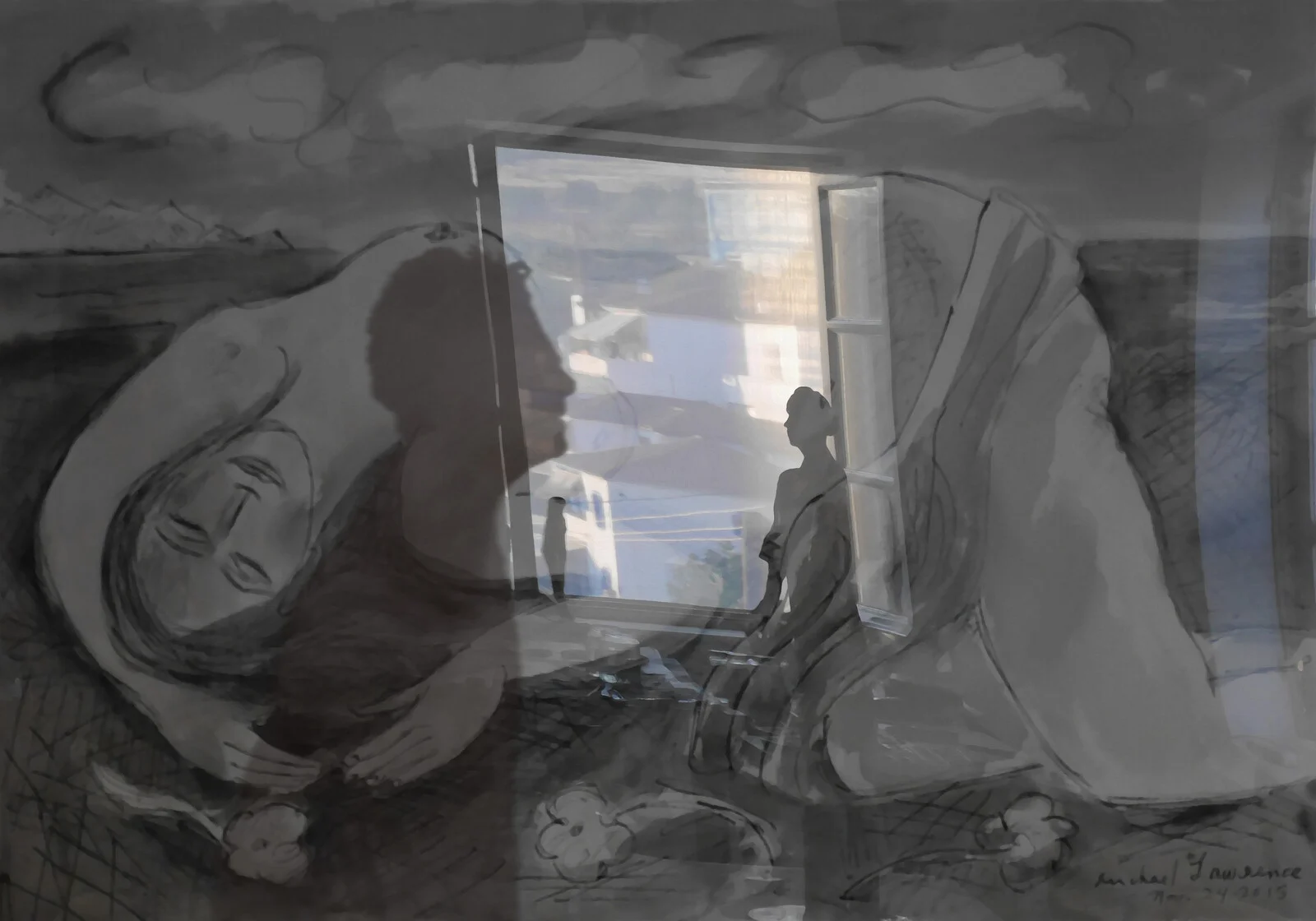
Jörgen Thornberg
Four Deities, 2023
Digital
70 x 50 cm
In the picture 'Four deities,' one had to travel to his star, but three remained on Hydra for a while since both the painting and the divine statue are gone, probably sold and now living elsewhere. If I could write an email to Michael today, it would go something like this.
Ciao Michael,
Michael, your sudden departure has left a void that cannot be filled. I regret not being able to share one more coffee in your studio, to hear about your past winter's endeavour, and to read your next book about fascinating encounters. Your absence is deeply felt.
It is too easy to wish you rest in peace. I don't think that is what you intend to do on your bright star. I'll bet you have chosen Pollux because of its orange hue. Good choice! It goes well with many of your watercolours. You will, of course, continue your vital work and experiment with new styles and complexions. In your interpretation, you will make more statues like the ones we documented the other year, as the classic Greek goddess.
In eternity, you will have all the time not given on earth, filling paper and canvasses. The good thing is that you left a frail body on earth and let your strong spirit carry on unhindered.
Your art is not just well-represented all over Hydra; it is celebrated. Your life-affirming watercolours hang here and everywhere, bringing sunshine to even the greyest, wintry days. You would have been delighted by the retrospective exhibition that Dina and the Museum opened the other day. The large room breathes precisely the light and colours that were so typical of you. It is impossible not to be uplifted when you step into the room, even in your absence. You could not even dream of the catalogue they made. One hundred fifteen pages with a fantastic selection of your works, including watercolours, paintings, and statues. You can be proud on your star.
If anyone counts your brushes in the studio you left, they will probably notice that some of your favourite ones are missing. You brought them with you, which is wise and typical of you.
That said, Michael, please don't rest in peace, but go on and let people from other cultures and periods enjoy your work in eternity. We, your friends and admirers, should not be heartbroken but excited over the challenge waiting for you among the stars. Just imagine. People with empty walls populate billions of stars. I am sure you will be fully busy fulfilling their demand. Your work will continue to inspire and captivate, transcending time and culture.
See you down the road,
Jorgen
Some years ago, I was with Michael to help him photograph some of his latest sculptures that he wanted to market internationally. He felt like a prisoner on Hydra, unable to meet the right audience, those who visited the significant galleries on the grand streets of New York, London, and Paris, those with big money. Visitors to his studio on Hydra were many, but most bought nothing; they were visiting the island, and their holiday budget was limited. Additionally, luggage restrictions limited spontaneous purchases. A small watercolour in a roll was fine, but none of his larger paintings. Admiring his paintings and having exciting discussions doesn't feed the cat, which could occasionally irritate him. He wanted to be seen as an artist, not a tourist attraction. Rightfully so. We always had these kinds of discussions, but today, we slipped into talking about goddesses. The reason was one of the sculptures, a beautiful woman with a loincloth as her only garment and her arms raised to the sky, one holding a sun disk in her hand.
Michael was unsure who she was; he had various inspirations in mind when he created her during the winter. Grace Kelly or Ariadne. He leaned more towards the latter. Michael gave a brief lecture about Ariadne. She was the daughter of King Minos and Queen Pasiphaë, making her a princess of Crete. Minos's palace in Knossos is sometimes called the "dancing ground of Ariadne." When Theseus came to Crete to kill the Minotaur, Ariadne fell in love with him and gave him a ball of twine to help him navigate the Labyrinth. Ariadne and Theseus left Crete together, but he later abandoned her on the island of Naxos, where she was saved by Dionysus, whom she married. Her wedding wreath was placed in the heavens as the constellation Corona Borealis. Diadem or sun disk, a star is a sun, so it became a disk.
We worked for a few hours; I photographed, and Michael moved and turned the sculpture so that the girl, whatever her name, would be shown to her best advantage. During a break with a cup of tea, the discussions came up again. Who was the woman? I thought she resembled a goddess, an idea that intrigued Michael a bit.
The revealing factor appeared a little later when we had started working again, and it was a painting on the wall of a gracefully resting monochrome woman, covered only by a towel over her hips. The girl posed in a way that reminded me of the shape of the island Dokos, which in turn looked like a reclining woman lazily lying on her side between the Peloponnese and Hydra's southwestern tip. Queen, I used to call her, the reclining Queen of Dokos. Or maybe she was a goddess.
"Definitely a goddess," Michael said firmly.
"So, who could she be?" I prodded, sparking a lively debate about the goddess's identity.
"Hestia," Michael suggested.
"Hestia, beautiful but unsexy," I objected. "I can't imagine her lying like that."
"Why not?" Michael had inexplicably latched onto her.
"Hestia was the kindest and most nurturing among the goddesses. A mother with a capital 'M'. She was the Greek goddess of the hearth and home, a gentle Hestia epitomised the warmth and comfort of domestic life."
"I don't want to scandalise an honourable woman in one of my watercolours. Do you have a better suggestion?"
"Demeter, maybe. Wasn't she a lush woman?" I liked the word "lush," I thought the swelling hills on Dokos facing Hydra looked a bit like that.
"That's probably the kindest thing you can say about Demeter," Michael said, laughing. "A real farmwife, I would say. She was often depicted as a nurturing and motherly figure with a serene and gentle beauty. Being the goddess of harvest and grain, she was highly regarded in ancient Greece. I believe she was the daughter of Kronos, a prominent Titan. No, I don't want to offend the goddess of agriculture," Michael laughed.
"Aphrodite, or Venus as the Romans call her, is overused, right?"
"Definitely. Besides, she should be standing on a seashell with her chest exposed, surrounded by wind and spring."
"Athena was said to be a stately woman."
"Certainly stately, but I have a hard time imagining her lounging like that. She always had a helmet on her head and was ready to go to battle. My painting doesn't depict a warrior."
"What about her mother, Hera, the Queen of Gods? According to legends, she was a gorgeous woman."
"Not my type either, George. In ancient Greek religion, Hera, Zeus's wife, was the goddess of marriage, women, and family and the protector of women during childbirth. Also, she is not the type to stretch out on a divan with all her children, grandchildren, and great-grandchildren to take care of. I need a real beauty," Michael chuckled.
"Nemesis," I said, though I realised she was wrong, exciting and dangerous, no 'donna' if you see what I mean.
"A dangerous woman to make an enemy of," Michael said grimly. "Nemesis personifies divine retribution against those who commit Hubris, arrogance before the Gods. She represents righteous anger due to enactment or divine vengeance. Let's skip her."
"What about Hebe, the youngest daughter of Zeus and Hera? She was considered a real beauty."
"In ancient Greece, she was often given the epithet Ganymeda, the goddess of youth or the prime of life. She functioned as the cupbearer for the gods and goddesses of Mount Olympus, serving their nectar and ambrosia, the gods' intoxicants, their drugs. She could fit. The woman in my painting looks a bit tipsy." Michael laughed at his joke.
"Wasn't she often disguised as an eagle?"
"Yes, and often depicted in art both in ancient times and later. Right?"
"Unfortunately, I'm not looking for someone common in my painting. So, Hebe also ends up on the scrap heap of art history," Michael sighed, rejecting another common choice.
"The beauty cupboard is starting to run dry," I said, shaking my head.
"Helen!" Michael said thoughtfully. "Helen of Troy, a woman who stirred many desires. Helen was considered the most beautiful mortal woman during the Age of Heroes. She was the daughter of Zeus and Leda."
"Leda, the one with the swan?"
"Exactly."
"She really caused trouble. When she eloped with Paris, a prince of Troy, the whole Greek world plunged into the Trojan War. And she indirectly sent Odysseus on his wanderings. She was the Cleopatra of her time, using the bed as a weapon. But Helen wasn't a goddess."
"She is now," Michael said firmly. And so his reclining woman personified the island of Dokos and the reclining divinity in Michael's painting—Helen of Troy, a goddess in her own right, a figure of divine beauty and power.
At that moment, the four deities coalesced into a flash, growing into a picture. The picture was already in front of me—four deities in the same image, a moment of inspiration.
The newly appointed goddess in Michael's painting, the statue of Ariadne, also elevated to a goddess in Michael's world, and then the artist himself, a true divinity, and outside the open window Hydra with the sunlit Kamini, a divine view in the background. Three deities are reflected in the glass of the painting, protecting the fourth. I raised my camera and took the picture you see above. The moment captured lasted maybe two seconds because, in the next moment, Michael straightened his back and removed his hands from the statue he had adjusted.
"Ariadne is definitely a goddess. Just look at her posture. Only a goddess can carry herself like that," Michael said, signalling that I could take some pictures from the new angle.
"I'll do it 'Meraki'," I said. "Just like you with your art."
"Sorry? Meraki?"
"Meraki means to do something with passion, absolute devotion, and undivided attention. As I understand it, it's a verb or adverb, a Modern Greek word derived from the Turkish 'Merak,' meaning 'Labor of love,' to do something with pleasure and is applied to tasks, usually creative or artistic tasks, but can be applied to any task at all."
"Then I do everything, Meraki," Michael said, his passion for his art evident in his every word and action, leaving no doubt about his commitment and dedication to his craft.
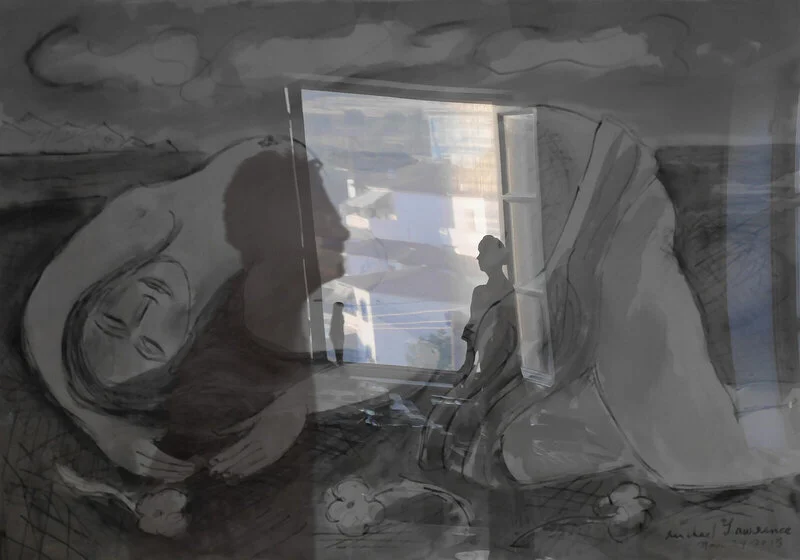
Jörgen Thornberg
Four Deities, 2023
Digital
70 x 50 cm
In the picture 'Four deities,' one had to travel to his star, but three remained on Hydra for a while since both the painting and the divine statue are gone, probably sold and now living elsewhere. If I could write an email to Michael today, it would go something like this.
Ciao Michael,
Michael, your sudden departure has left a void that cannot be filled. I regret not being able to share one more coffee in your studio, to hear about your past winter's endeavour, and to read your next book about fascinating encounters. Your absence is deeply felt.
It is too easy to wish you rest in peace. I don't think that is what you intend to do on your bright star. I'll bet you have chosen Pollux because of its orange hue. Good choice! It goes well with many of your watercolours. You will, of course, continue your vital work and experiment with new styles and complexions. In your interpretation, you will make more statues like the ones we documented the other year, as the classic Greek goddess.
In eternity, you will have all the time not given on earth, filling paper and canvasses. The good thing is that you left a frail body on earth and let your strong spirit carry on unhindered.
Your art is not just well-represented all over Hydra; it is celebrated. Your life-affirming watercolours hang here and everywhere, bringing sunshine to even the greyest, wintry days. You would have been delighted by the retrospective exhibition that Dina and the Museum opened the other day. The large room breathes precisely the light and colours that were so typical of you. It is impossible not to be uplifted when you step into the room, even in your absence. You could not even dream of the catalogue they made. One hundred fifteen pages with a fantastic selection of your works, including watercolours, paintings, and statues. You can be proud on your star.
If anyone counts your brushes in the studio you left, they will probably notice that some of your favourite ones are missing. You brought them with you, which is wise and typical of you.
That said, Michael, please don't rest in peace, but go on and let people from other cultures and periods enjoy your work in eternity. We, your friends and admirers, should not be heartbroken but excited over the challenge waiting for you among the stars. Just imagine. People with empty walls populate billions of stars. I am sure you will be fully busy fulfilling their demand. Your work will continue to inspire and captivate, transcending time and culture.
See you down the road,
Jorgen
Some years ago, I was with Michael to help him photograph some of his latest sculptures that he wanted to market internationally. He felt like a prisoner on Hydra, unable to meet the right audience, those who visited the significant galleries on the grand streets of New York, London, and Paris, those with big money. Visitors to his studio on Hydra were many, but most bought nothing; they were visiting the island, and their holiday budget was limited. Additionally, luggage restrictions limited spontaneous purchases. A small watercolour in a roll was fine, but none of his larger paintings. Admiring his paintings and having exciting discussions doesn't feed the cat, which could occasionally irritate him. He wanted to be seen as an artist, not a tourist attraction. Rightfully so. We always had these kinds of discussions, but today, we slipped into talking about goddesses. The reason was one of the sculptures, a beautiful woman with a loincloth as her only garment and her arms raised to the sky, one holding a sun disk in her hand.
Michael was unsure who she was; he had various inspirations in mind when he created her during the winter. Grace Kelly or Ariadne. He leaned more towards the latter. Michael gave a brief lecture about Ariadne. She was the daughter of King Minos and Queen Pasiphaë, making her a princess of Crete. Minos's palace in Knossos is sometimes called the "dancing ground of Ariadne." When Theseus came to Crete to kill the Minotaur, Ariadne fell in love with him and gave him a ball of twine to help him navigate the Labyrinth. Ariadne and Theseus left Crete together, but he later abandoned her on the island of Naxos, where she was saved by Dionysus, whom she married. Her wedding wreath was placed in the heavens as the constellation Corona Borealis. Diadem or sun disk, a star is a sun, so it became a disk.
We worked for a few hours; I photographed, and Michael moved and turned the sculpture so that the girl, whatever her name, would be shown to her best advantage. During a break with a cup of tea, the discussions came up again. Who was the woman? I thought she resembled a goddess, an idea that intrigued Michael a bit.
The revealing factor appeared a little later when we had started working again, and it was a painting on the wall of a gracefully resting monochrome woman, covered only by a towel over her hips. The girl posed in a way that reminded me of the shape of the island Dokos, which in turn looked like a reclining woman lazily lying on her side between the Peloponnese and Hydra's southwestern tip. Queen, I used to call her, the reclining Queen of Dokos. Or maybe she was a goddess.
"Definitely a goddess," Michael said firmly.
"So, who could she be?" I prodded, sparking a lively debate about the goddess's identity.
"Hestia," Michael suggested.
"Hestia, beautiful but unsexy," I objected. "I can't imagine her lying like that."
"Why not?" Michael had inexplicably latched onto her.
"Hestia was the kindest and most nurturing among the goddesses. A mother with a capital 'M'. She was the Greek goddess of the hearth and home, a gentle Hestia epitomised the warmth and comfort of domestic life."
"I don't want to scandalise an honourable woman in one of my watercolours. Do you have a better suggestion?"
"Demeter, maybe. Wasn't she a lush woman?" I liked the word "lush," I thought the swelling hills on Dokos facing Hydra looked a bit like that.
"That's probably the kindest thing you can say about Demeter," Michael said, laughing. "A real farmwife, I would say. She was often depicted as a nurturing and motherly figure with a serene and gentle beauty. Being the goddess of harvest and grain, she was highly regarded in ancient Greece. I believe she was the daughter of Kronos, a prominent Titan. No, I don't want to offend the goddess of agriculture," Michael laughed.
"Aphrodite, or Venus as the Romans call her, is overused, right?"
"Definitely. Besides, she should be standing on a seashell with her chest exposed, surrounded by wind and spring."
"Athena was said to be a stately woman."
"Certainly stately, but I have a hard time imagining her lounging like that. She always had a helmet on her head and was ready to go to battle. My painting doesn't depict a warrior."
"What about her mother, Hera, the Queen of Gods? According to legends, she was a gorgeous woman."
"Not my type either, George. In ancient Greek religion, Hera, Zeus's wife, was the goddess of marriage, women, and family and the protector of women during childbirth. Also, she is not the type to stretch out on a divan with all her children, grandchildren, and great-grandchildren to take care of. I need a real beauty," Michael chuckled.
"Nemesis," I said, though I realised she was wrong, exciting and dangerous, no 'donna' if you see what I mean.
"A dangerous woman to make an enemy of," Michael said grimly. "Nemesis personifies divine retribution against those who commit Hubris, arrogance before the Gods. She represents righteous anger due to enactment or divine vengeance. Let's skip her."
"What about Hebe, the youngest daughter of Zeus and Hera? She was considered a real beauty."
"In ancient Greece, she was often given the epithet Ganymeda, the goddess of youth or the prime of life. She functioned as the cupbearer for the gods and goddesses of Mount Olympus, serving their nectar and ambrosia, the gods' intoxicants, their drugs. She could fit. The woman in my painting looks a bit tipsy." Michael laughed at his joke.
"Wasn't she often disguised as an eagle?"
"Yes, and often depicted in art both in ancient times and later. Right?"
"Unfortunately, I'm not looking for someone common in my painting. So, Hebe also ends up on the scrap heap of art history," Michael sighed, rejecting another common choice.
"The beauty cupboard is starting to run dry," I said, shaking my head.
"Helen!" Michael said thoughtfully. "Helen of Troy, a woman who stirred many desires. Helen was considered the most beautiful mortal woman during the Age of Heroes. She was the daughter of Zeus and Leda."
"Leda, the one with the swan?"
"Exactly."
"She really caused trouble. When she eloped with Paris, a prince of Troy, the whole Greek world plunged into the Trojan War. And she indirectly sent Odysseus on his wanderings. She was the Cleopatra of her time, using the bed as a weapon. But Helen wasn't a goddess."
"She is now," Michael said firmly. And so his reclining woman personified the island of Dokos and the reclining divinity in Michael's painting—Helen of Troy, a goddess in her own right, a figure of divine beauty and power.
At that moment, the four deities coalesced into a flash, growing into a picture. The picture was already in front of me—four deities in the same image, a moment of inspiration.
The newly appointed goddess in Michael's painting, the statue of Ariadne, also elevated to a goddess in Michael's world, and then the artist himself, a true divinity, and outside the open window Hydra with the sunlit Kamini, a divine view in the background. Three deities are reflected in the glass of the painting, protecting the fourth. I raised my camera and took the picture you see above. The moment captured lasted maybe two seconds because, in the next moment, Michael straightened his back and removed his hands from the statue he had adjusted.
"Ariadne is definitely a goddess. Just look at her posture. Only a goddess can carry herself like that," Michael said, signalling that I could take some pictures from the new angle.
"I'll do it 'Meraki'," I said. "Just like you with your art."
"Sorry? Meraki?"
"Meraki means to do something with passion, absolute devotion, and undivided attention. As I understand it, it's a verb or adverb, a Modern Greek word derived from the Turkish 'Merak,' meaning 'Labor of love,' to do something with pleasure and is applied to tasks, usually creative or artistic tasks, but can be applied to any task at all."
"Then I do everything, Meraki," Michael said, his passion for his art evident in his every word and action, leaving no doubt about his commitment and dedication to his craft.

Jörgen Thornberg
Malmö
Lite om bilder och mig. Translation in English at the end.
Jag är en nyfiken person som ser allt i bilder, även det jag fäster i ord, gärna tillsammans för bakom alla mina bilder finns en berättelse. Till vissa bilder hör en kortare eller längre novell som följer med bilden.
Bilder berättar historier. Jag omges av naturlig skönhet, intressanta människor och historia var jag än går. Jag använder min kamera för att dokumentera världen och blanda det jag ser med vad jag känner för att fånga den dolda magin.
Mina bilder berättar mina historier. Genom mina bilder, tryck och berättelser. Jag bjuder in dig att ta del av dessa berättelser, in i ditt liv och hem och dela min mycket personliga syn på vår värld. Mer än vad ögat ser. Jag tänker i bilder, drömmer och skriver och pratar om dem; följaktligen måste jag också skapa bilder. De blir vad jag ser, inte nödvändigtvis begränsade till verkligheten. Det finns en bild runt varje hörn. Jag hoppas att du kommer att se vad jag såg och gilla det.
Jag är också en skrivande person och till många bilder hör en kortare eller längre essay. Den följer med tavlan, tryckt på fint papper och med en personlig hälsning från mig.
Flertalet bilder startar sin resa i min kamera. Enkelt förklarat beskriver jag bilden jag ser i mitt inre, upplevd eller fantiserad. Bilden uppstår inom mig redan innan jag fått okularet till ögat. På bråkdelen av ett ögonblick ser jag vad jag vill ha och vad som kan göras med bilden. Här skall jag stoppa in en giraff, stålmannen, Titanic eller vad det är min fantasi finner ut. Ännu märkligare är att jag kommer ihåg minnesbilden långt efteråt när det blir tid att skapa verket. Om jag lyckas eller inte, är upp till betraktaren, oftast präglat av en stråk av svart humor – meningen är att man skall bli underhållen. Mina bilder blir ofta en snackis där de hänger.
Jag föredrar bilder som förmedlar ett budskap i flera lager. Vid första anblicken fylld av feel-good, en vacker utsikt, fint väder, solen skiner, blommor på ängen eller vattnet som ligger förrädiskt spegelblankt. I en sådan bild kan jag gömma min egentliga berättelse, mitt förakt för förtryckare och våldsverkare, rasister och fördomsfulla människor - ett gärna återkommande motiv mer eller mindre dolt i det vackra motivet. Jag försöker förena dem i ett gemensamt narrativ.
Bild och formgivning har löpt som en röd tråd genom livet. Fotokonst känns som en värdig final som jag gärna delar med mig.
Min genre är vid som framgår av mina bilder, temat en blandning av pop- och gatukonst i kollage som kan bestå av hundratals lager. Vissa bilder kan ta veckor, andra någon dag innan det är dags att överlämna resultatet till printverkstaden. Fine Art Prints är digitala fotocollage. I dessa kollage sker rivandet, klippandet, pusslandet, målandet, ritandet och sprayningen digitalt. Det jag monterar in kan vara hundratals år gamla bilder som jag omsorgsfullt frilägger så att de ser ut att vara en del av tavlan men också bilder skapade av mig själv efter min egen fantasi. Därefter besöks printstudion och för vissa bilder numrera en limiterad upplaga (oftast 7 exemplar) och signera för hand. Vissa bilder kan köpas i olika format. Det är bara att fråga efter vilka. Gillar man en bild som är 70x100 men inte har plats på väggen, går den kanske att få i 50x70 cm istället. Frågan är fri.
Metoden Giclée eller Fine Art Print som det också kallas är det moderna sättet för framställning av grafisk konst. Villkoret för denna typ av utskrifter är att en högkvalitativ storformatskrivare används med åldersbeständigt färgpigment och konstnärspapper eller i förekommande fall på duk. Pappret som används möter de krav på livslängd som ställs av museer och gallerier. Normalt säljer jag mina bilder oinramade så att den nya ägaren själv kan bestämma hur de skall se ut, med eller utan passepartout färg på ram, med eller utan glas etc..
Under många år ställde jag bara ut på nätet, i valda grupper och på min egen Facebooksida - https://www.facebook.com/jorgen.thornberg.9
Jag finns också på en egen hemsida som tyvärr inte alltid är uppdaterad – https://www.jth.life/ Där kan du också läsa en del av de berättelser som följer med bilden.
UTSTÄLLNINGAR
Luftkastellet, oktober 2022
Konst i Lund, november 2022
Luftkastellet, mars 2023
Engleson Galleri Caroli, april 2023
Hydra, Greece June 2023
Engleson Galleri Caroli, oktober 2023
Toppen, Höllviken december 2023
Luftkastellet, mars 2024
Torups Galleri, mars 2024
Venice, May 2024
Luftkastellet, oktober 2024
Konst i Advent, December 2024
Galleri Engleson, Caroli December 2024
Jäger & Jansson Galleri, april 2025
A bit about pictures and me.
I'm a curious person who sees everything in pictures, even what I express in words, often combining them, for behind all my pictures lies a story. These narratives, some as short as a single image and others as long as a novel, are the heart and soul of my work.
Pictures tell stories. Wherever I go, I'm surrounded by natural beauty, exciting people, and history. I use my camera to document the world and blend what I see with what I feel to capture the hidden magic.
My images tell my stories. Through my pictures, prints, and narratives, I invite you to partake in these stories in your life and home and share my deeply personal perspective of our world. More than meets the eye. I think in pictures, dream, write, and talk about them; consequently, I must create images too. They become what I see, not necessarily confined to reality. There's a picture around every corner. I hope you'll see what I saw and enjoy it.
I'm also a writer, and many images come with a shorter or longer essay. It accompanies the painting, printed on fine paper with my personal greeting.
Many pictures start their journey on my camera. Simply put, I describe the image I see in my mind, experienced or imagined. The image arises within me even before I bring the eyepiece to my eye. In a fraction of a moment, I see what I want and what can be done with the picture. Here, I'll insert a giraffe, Superman, the Titanic, or whatever my imagination conjures up. Even stranger is that I remember the mental image long after it's time to create the work. Whether I succeed is up to the observer, often imbued with a streak of black humour – the aim is to entertain. My pictures usually become a talking point wherever they hang.
I prefer pictures that convey a message in multiple layers. At first glance, they're filled with feel-good vibes, a beautiful view, lovely weather, the sun shining, flowers in the meadow, or the water lying deceptively calm. But beneath this surface beauty, I often conceal a deeper story, a narrative that challenges societal norms or explores the human condition. I invite you to delve into these hidden narratives and discover the layers of meaning within my work.
Picture and design have been a thread running through my life. Photographic art feels like a fitting finale, and I'm happy to share it.
My genre is varied, as seen in my pictures; the theme is a blend of pop and street art in collages that can consist of hundreds of layers. Some images can take weeks, others just a day before it's time to hand over the result to the print workshop. Fine Art Prints are digital photo collages. In these collages, tearing, cutting, puzzling, painting, drawing, and spraying happen digitally. What I insert can be images hundreds of years old that I carefully extract so they appear to be part of the painting, but also images created by myself, now also generated from my imagination. Next, visit the print studio and, for certain images, number a limited edition (usually 7 copies) and sign them by hand. Some images may be available in other formats. Just ask which ones. If you like an image that's 70x100 but doesn't have space on the wall, you might be able to get it in 50x70 cm instead. The question is open.
The Giclée method, or Fine Art Print as it's also called, is the modern way of producing graphic art. This method ensures the highest quality and longevity of the artwork, using a high-quality large-format printer with archival pigment inks and artist paper or, in some cases, canvas. The paper used meets the longevity requirements set by museums and galleries. I sell my pictures unframed, allowing the new owner to personalise their artwork, confident in the lasting value and quality of the piece.
For many years, I only exhibited online, in selected groups, and on my Facebook page - https://www.facebook.com/jorgen.thornberg.9. I also have my website, which unfortunately is not constantly updated - https://www.jth.life/. You can also read some of the stories accompanying the pictures there.
EXHIBITIONS
Luftkastellet, October 2022
Art in Lund, November 2022
Luftkastellet, March 2023
Engleson Gallery Caroli, April 2023
Hydra, Greece June 2023
Engleson Gallery Caroli, October 2023
Toppen, Höllviken December 2023
Luftkastellet, March 2024
Torup Gallery, March 2024
Venice, May 2024
UTSTÄLLNINGAR
Luftkastellet, oktober 2022
Konst i Lund, november 2022
Luftkastellet, mars 2023
Engleson Galleri Caroli, april 2023
Hydra, Greece June 2023
Engleson Galleri Caroli, oktober 2023
Toppen, Höllviken december 2023
Luftkastellet, mars 2024
Torups Galleri, mars 2024
Venice, May 2024
Luftkastellet, October 2024
Konst i Advent, December 2024
Galleri Engleson, Caroli December 2024
Jäger & Jansson Galleri, April 2025
Utbildning
Autodidakt
Medlem i konstnärsförening
Öppna Sinnen
Med i konstrunda
Konstrundan i Skåne
Utställningar
Luftkastellet, October 2022
Art in Lund, November 2022
Luftkastellet, March 2023
Engleson Gallery Caroli, April 2023
Hydra, Greece June 2023
Engleson Gallery Caroli, October 2023
Toppen, Höllviken December 2023
Luftkastellet, March 2024
Torup Gallery, March 2024
Venice, May 2024