Vi använder cookies för att ge dig bästa möjliga upplevelse. Välj vilka cookies du tillåter.
Läs mer i vår integritetspolicy
Jörgen Thornberg
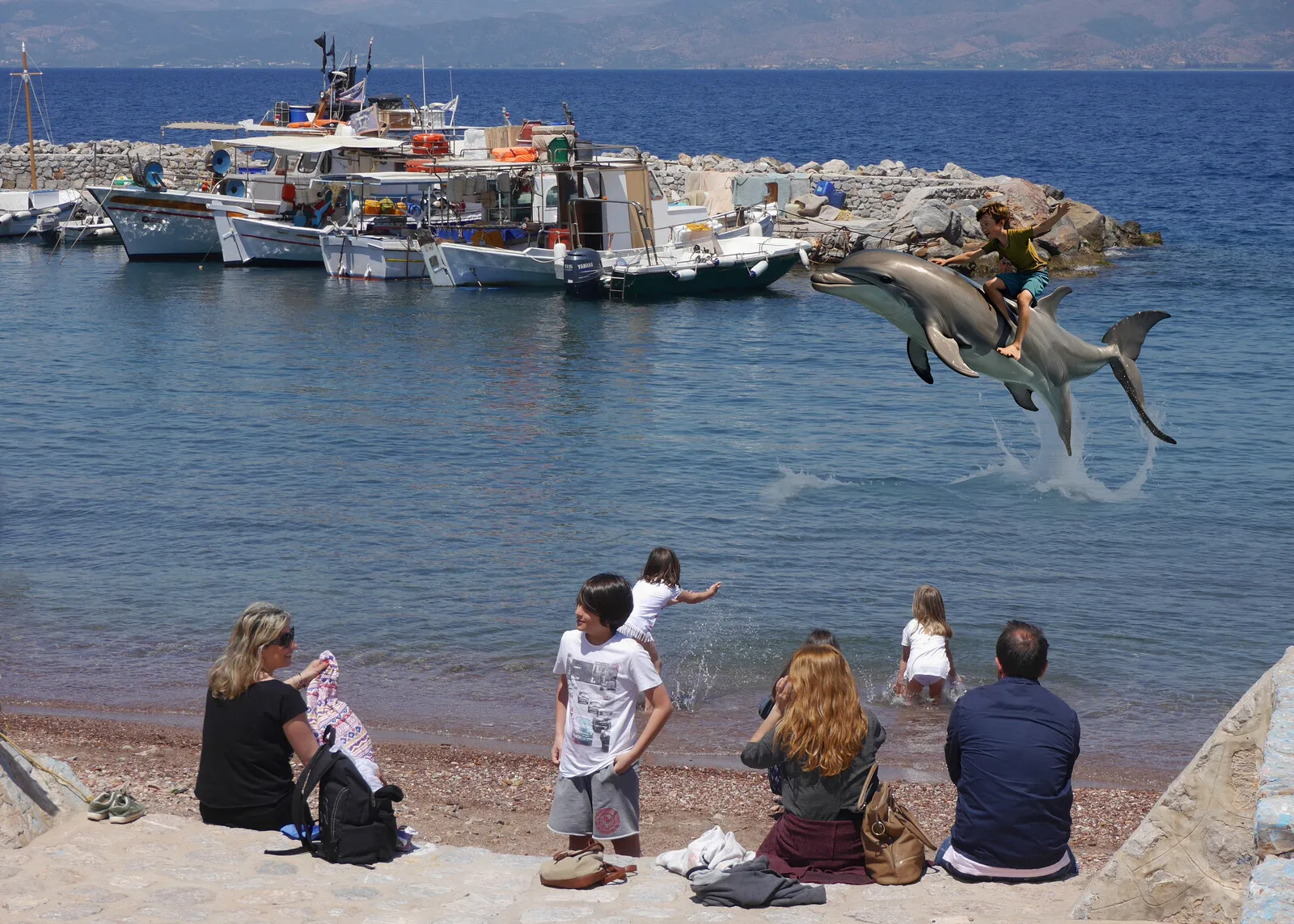
Home Sweet Kamini - The Boy on the Dolphin's Home Port, 2024
Digital
70 x 50 cm
The Boy on the Dolphin: A Timeless Tale
In Kamini's tranquil bay, where dolphins play,
A boy named Taras, bright as the day,
Poseidon's son, in myth and lore,
Rides on waves forevermore.
Born in waters clear and deep,
Where ancient secrets dolphins keep,
A timeless bond, so strong and true,
Between a boy and a dolphin grew.
Once saved from a shipwreck's cruel embrace,
By a kindhearted dolphin's speed and grace.
Together, the two would roam the seas,
In joy and laughter, and gentle breeze.
On ancient coins, their story told,
In silver didrachms, legends old,
Taras on his friend the Dolphin rides,
Became a symbol of the ocean's tides.
In Taras distant Calabria, a long time ago,
Greeks once lived, and legends still grow,
The Boy and Dolphin's tale was spun,
Underneath the Grecian sun.
Arion, too, with a song so sweet,
A singer none could ever beat,
By the Dolphin saved from waters dark,
Brought safely home, a living spark.
In myths of old, their lives entwined,
In stories rich, their fates aligned,
Through time and history, they swam,
Across the seas, a timeless span.
Poseidon's son, sometimes Arion called,
In Delphi's temple, hearts enthralled,
Their images in art and rhyme,
A legacy that spans through time.
The Boy and his Dolphin, side by side,
In every wave, in every tide,
On ancient coins, on film so grand,
Their story was known in every land.
In Greece, the Dolphin held so dear,
A creature brave, with a heart sincere,
In pottery and art, they were seen,
In ancient frescoes, bright and keen.
Their story is etched in every stone,
In every tale, the ancients known,
A bond of hope, of love, of grace,
A friendship time cannot erase.
From Delphi's heights to Hades' deep,
The Boy and Dolphin, their secrets keep.
In Greece, their tale is forever told,
Of friendship, bravery, and hearts of gold.
Dionysus, too, with Dolphins fair,
A story rich beyond compare,
In deep blue seas, they come to aid,
In every storm, in every shade.
The gods above, the sea below,
Their kindness to the dolphins show,
A myth of love, of rescue bold,
A story in the hearts of old.
On Hydra's shores, at sunset's glow,
Where calm and peace in waters flow,
The Boy on the Dolphin, a silhouette bright,
Display a scene of beauty, pure delight.
Their legend lives in hearts and stays,
Through ancient times and modern days,
A symbol of the ocean's might,
Of friendship's bond and purest light.
In every wave, in every star,
Their story echoes near and far,
The Boy on his Dolphin, myth divine,
Forever in the hearts enshrined.
Their journey is told in narratives so old,
Of a friendship brave and hearts of gold,
From myths and coins, their tale was cast,
About their timeless bond, forever vast.
Eventually, their lives became a book and a film,
Why on Hydra might seem a whimsical whim,
But fate governs such things in ways quite profound,
Was it the Dolphin's tail or Sophia's bust that spread around?
In any case, a statue in bronze on Hydra stands tall,
Honouring the pair who brought wealth and fame to all.
Even today, pilgrims come from far and wide,
To glimpse the Boy and his Dolphin, forever tied.
The family in Kamini's harbour had the rare delight,
To see the duo must been a magical sight.
Their meeting is depicted in the image above,
A testament to the timeless bond and love
Hydra 2024
It was not a day like any other, though few noticed it. I was on my way to Vlychos and, for once, had decided to take the scenic route along the sea. Coming down from Hydra's roof, Kiafa, I passed Kamini and its small harbour. Peace reigned; it was siesta time, and the port was almost empty except for three little girls playing at the water's edge in the inner part of the harbour while the adults were having coffee and their older brother, who was facing my direction, missed the whole scene. Amidst the girls' giggles, the serene silence was suddenly broken by a splash. It was this that made me jump and grab my camera. Sudden sounds often mean unexpected, exciting events. This time was no exception.
Into the port came the timeless boy, a figure so crucial to Hydra and Kamini, riding his Dolphin. I had understood that long before people came to the island and much later built the harbour, the little bay was the Dolphin's home port. Now, the agile creature came flying in at great speed, quickly turned, and headed back toward the strait when the Dolphin noticed people in the harbour. Naturally, there was a splash when the Dolphin jumped out of the water. The girls splashed back, and the boy on the Dolphin's back waved happily before the duo disappeared between the piers seconds later. The little girls giggled, and the adults, who had been engaged in some discussion, had managed to turn their heads and saw a tail fin disappear. But I got the picture. Just one, because the moment was over so quickly. As the poem above describes, the boy and the Dolphin had lived a rich life into their third millennium, a life that was as fleeting as the moment I had captured.
Below is a further deep dive into their history
Arion gripped the Lyre and paid his fare
In the song, soothing the ocean waves with his singing
The gods see good deeds: Jupiter took the Dolphin
And ordered its constellation to contain nine stars
Extract from the Fasti by Publius Ovidius Naso (43 BCE-17/18 CE)
During the sunset, the statue of the Boy and the Dolphin, a physical representation of the poem, escaped Hydra for a swim in the lovely sea. Go and check tomorrow if they have come back.
The Boy on the Dolphin, named Taras, appears on ancient Greek coins minted in Taras Calabria, a Greek-occupied region in southern Italy, from 334 to 231 BC. These coins, specifically the Silver didrachm (Nomos), depict a boy riding a dolphin on one side and a horseman on the other, reflecting a rich mythological narrative popular during this period. According to Greek mythology, Taras, the son of Poseidon, was rescued from a shipwreck by a heroic dolphin, a creature of immense courage and compassion, sent by his father. The city that arose where he was brought ashore was named in his honour. The equestrians depicted on the coins, ranging from boys to youths and from nude to armed, are engaged in various activities, possibly representing the equestrian athletic events held at Taras, further enriching the mythological allure of the coin. This narrative not only offers a glimpse into the values and beliefs of ancient societies but also underscores the enduring cultural importance of the Boy and Dolphin narrative.
Another depiction of a boy on a dolphin involves Arion, a character from Ovid's 'The Fasti,' a poem detailing the Roman calendar's customs, festivals, and myths. Ovid narrates that on February 3rd, when the Dolphin (Delphinus) constellation disappears, Arion, a celebrated singer, wins silver in a music competition in Sicily. However, Corinthian sailors, coveting his winnings, attack him. To avoid being killed, Arion throws himself into the sea. A dolphin, charmed by his music and sent by Jupiter, saves and returns Arion safely to Corinth. This story, inherited from the Greeks and adapted by the Romans, not only enriches the mythological context but also highlights the profound cultural significance of the Boy and the Dolphin narrative, offering a glimpse into the values and beliefs of ancient societies, a treasure trove of intrigue and engagement.
In this tale, the Dolphin carries Arion to safety at the sanctuary of Poseidon at Cape Tainaron. However, upon reaching land, Arion neglects to return the Dolphin to the sea, and the poor animal dies.
The Dolphin, a totem animal associated with Apollo and Orpheus, holds profound meaning in Greek culture. The Greek word for Dolphin, 'Delphis,' is pronounced similarly to "uterus" and echoes Delphes, the temple of Apollo's oracle. Symbolically, the Dolphin represents the profound connection between the heights of Olympus and the depths of Hades. This concept resonated deeply with the ancient Greeks and continues to captivate our imagination today, a testament to its enduring cultural importance.
In ancient Greece, killing a dolphin was considered blasphemy against the gods, punishable by death. The Dolphin, linked to the god Delphinus, is Greece's official national animal. For Greeks, it embodies hope, compassion, and providing help when needed. Dolphins have been depicted in pottery, art, literature, jewellery, coins, frescoes, and architecture, symbolising the Greeks' deep connection to the sea. One such example is the depiction of a boy riding a dolphin on ancient Greek coins, as mentioned earlier. Another example is the portrayal of Arion's rescue by a dolphin in Ovid's 'The Fasti,' a famous Roman poem. These diverse representations of the Boy and Dolphin narrative in various forms of ancient art and literature attest to its widespread popularity and enduring influence.
One Greek myth recounts the tale of Dionysus, the god of wine and revelry, being abducted by pirates. In this story, the sea transforms into wine and dolphins, creatures associated with Dionysus, come to his rescue. In gratitude, Dionysus transforms the pirates into dolphins and assigns them the duty of safeguarding people at sea. This narrative, which shares the theme of a dolphin rescuing a human, underscores the ideal of solid social bonds fundamental to Greek city-states, with dolphins symbolising this communal value for ancient Greeks. This myth and the Boy and Dolphin narrative underscore the importance of compassion, help, and protection in ancient Greek society.
The film Boy on a Dolphin, based on David Divine's 1955 novel, takes us on a thrilling adventure. The plot centres around British professor Alan Calder's quest on the idyllic Greek island of Mykonos. His mission? To uncover a statue of a boy on a dolphin, hidden beneath the azure waters with a classical vessel. Along the way, he encounters Pero, a woman still pining for her unfaithful Italian lover, Guido, who has promised the statue to someone else. Guido, driven by greed, arranges to sell the statue to a scrupulous Swedish millionaire. Pero, however, has other plans. Realising the potential of the statue to attract tourists and boost the island's economy, she uses her mischievous charm and resourcefulness to outwit Guido. Calder's magic brings Pero and the statue to life as the story unfolds, leading to a few pastoral hours of easy reading. The author did not win the Nobel Prize; need I say more?
Subsequently, the location shooting for Boy on a Dolphin was initially planned to take place on the Greek islands of Mykonos, Rhodes, Delos, and Santorini. Other locations included the Parthenon and the Amphitheatre in Athens, Delphi, Corinth, and the Meteora Monastery. But these Greek islands proved windy and far away; distance and weather conditions mean money. Solution Hydra, next door to Athens and its airport, told some Greek advisor with links to Hydra—money talks.
Hollywood met Hydra, and nothing was as it was before. 1950s Hollywood, glittering with stars, sets sail to the serene and rugged island of Hydra to film the Boy and his Dolphin. It sounds like a movie plot in itself, but the reality of this cinematic adventure is even more entertaining than the film. The production of 'Boy on a Dolphin' brought Hollywood glamour to Hydra and left a lasting impact on the island's economy and cultural landscape, a testament to the power of film production.
The filming of Boy on a Dolphin was not without its challenges. The production began with high hopes and heavy equipment, with two Greek landing barges roped in to transport the cumbersome 55mm cameras and generators. However, the dream of shooting in high-definition quickly became a logistical nightmare. Hydra's beautiful yet unforgiving terrain wasn't exactly designed for Hollywood's bulky gadgets. Thus, the ambitious 55mm plan was shelved, much to the relief of the production crew, who were undoubtedly tired of lugging around the heavy gear. This behind-the-scenes struggle adds a layer of appreciation for the final product, showcasing the dedication and adaptability of the production crew.
Hydra, a picturesque island, wasn't equipped to host Hollywood royalty in the style they were accustomed to. So, the studio had to improvise. Luxury cabin cruisers were hired to serve as floating five-star hotels. Alan Ladd and his wife, Sue Carol, Clifton Webb and his mother, Maybelle, got the largest boats. Meanwhile, the glamorous Sophia Loren and the meticulous director Jean Negulesco made do with the two available rental houses on land. This setup, while quaint, was far from the lavish lifestyle they were used to, adding a humorous touch to their daily routines.
Sophia Loren, in particular, had to navigate the rugged terrain and some rather tricky film techniques. Loren was required to walk in a trench to make the diminutive Alan Ladd appear taller. It's not every day you see a Hollywood star wading through ditches for the sake of cinema magic! The scene in the museum, where Ladd is visibly standing on a box and then steps down, became a classic moment of movie-making ingenuity. At one point, Alan Ladd's character Calder says, "...the smaller the man, the bigger the knife." He said it!
Then, there was Loren's iconic sponge-diving outfit, a creation Negulesco found inspiration from a Japanese pearl diver. The dress, first tested in Loren's warm bathtub and double-lined to get past censors, made a splash – quite literally – when it was time to film in the cold Aegean Sea. When Sophia emerged from the water, her "lovelies" pointing with daring accuracy, it caused quite a stir. The photographer dropped his camera, the soundman raised his boom, and the Greek assistants were left thunderstruck. This wasn't just a scene but a moment of cinematic history that solidified Loren's reputation as one of the era's sexiest actresses. The resulting image became a best-selling and infamous poster worldwide.
Critics had mixed feelings about the film. Some praised the stunning visuals and Loren's magnetic screen presence, while others found the plot as rugged as Hydra's terrain. However, the audience's reception was far more enthusiastic. Moviegoers were captivated by the exotic locations, the underwater scenes, and, of course, Sophia Loren. The film's romantic adventure and the behind-the-scenes stories became part of its enduring charm.
Despite the challenges, 'Boy on a Dolphin' remains a beloved classic, not just for its cinematic appeal but for the stories of Hollywood's escapade in Greece. From luxury yachts serving as temporary homes to the unforgettable moment Loren surfaced in her daring outfit, the film is a testament to the magic that happens when Hollywood meets Hydra. So, next time you watch this classic, remember: the drama behind the camera was just as entertaining as the drama on screen.
The film's production was a turning point for Hydra, putting the island on the map and launching its golden era. Celebrities from film, literature, art, and culture flocked to Hydra, and for a decade, it was the most sought-after destination in the Mediterranean, hotter than the French Riviera.
What do Leonard Cohen, Marianne Ihlen, Onassis, Jackie O, Maria Callas, Ernest Hemingway, Allan Ladd, Empress Soraya, Audrey Hepburn, Princess Grace Kelly, Greta Garbo, Princess Margret, and a few hundred other celebrities have in common? The most obvious is that they no longer live on earth. What may be new for some is that they now live on their stars in space. All have also been to the Greek island Hydra and the nightclub Lagoudera, which, during its golden age, was one of Europe's foremost water holes among jetsetters.
Boy with a dolphin, two species at play!
Submerged for a moment, then up to the spray!
Two mammals at leisure, no danger in sight
Just swimming together neath golden sunlight!
The lines come from a poem, 'Boy with a Dolphin', by the contemporary British poet Denis Martindale. This poem, a beautiful ode to the harmony between humans and wildlife, encourages people to reflect on the beauty of wildlife and the joy it brings to our lives.
National Superhero Day was founded to celebrate everyone's favourite superhero. It is a noble concept, as our world is filled with these unsung heroes, often living next door, quietly carrying out their missions. They may not wear capes, but their bravery and selflessness are unparalleled. Let's not wait for an afterlife to reward them, but show our support and respect now. Forget about fictional characters like Superman and Wonder Woman. Instead, let's focus on these anonymous everyday heroes and an exceptional boy riding a dolphin for thousands of years. When at the statue, show your respect, hat off, a bow or a curtsy. You are standing next to so much more than a pretentious film and a half-decent book. This is thousands of years of Hydra history, including Hercules, Apollon, an intelligent boy and an even smarter Dolphin. April is 'Child Abuse Awareness Month', and Alexander, the Boy from Hydra, becomes a patron and John, his partner the Dolphin, a guardian.
We delve into the island's intriguing history, rich with real drama. Stay with us to uncover the events that unfolded long before your arrival.
Jörgen Thornberg
Home Sweet Kamini - The Boy on the Dolphin's Home Port, 2024
Digital
70 x 50 cm
The Boy on the Dolphin: A Timeless Tale
In Kamini's tranquil bay, where dolphins play,
A boy named Taras, bright as the day,
Poseidon's son, in myth and lore,
Rides on waves forevermore.
Born in waters clear and deep,
Where ancient secrets dolphins keep,
A timeless bond, so strong and true,
Between a boy and a dolphin grew.
Once saved from a shipwreck's cruel embrace,
By a kindhearted dolphin's speed and grace.
Together, the two would roam the seas,
In joy and laughter, and gentle breeze.
On ancient coins, their story told,
In silver didrachms, legends old,
Taras on his friend the Dolphin rides,
Became a symbol of the ocean's tides.
In Taras distant Calabria, a long time ago,
Greeks once lived, and legends still grow,
The Boy and Dolphin's tale was spun,
Underneath the Grecian sun.
Arion, too, with a song so sweet,
A singer none could ever beat,
By the Dolphin saved from waters dark,
Brought safely home, a living spark.
In myths of old, their lives entwined,
In stories rich, their fates aligned,
Through time and history, they swam,
Across the seas, a timeless span.
Poseidon's son, sometimes Arion called,
In Delphi's temple, hearts enthralled,
Their images in art and rhyme,
A legacy that spans through time.
The Boy and his Dolphin, side by side,
In every wave, in every tide,
On ancient coins, on film so grand,
Their story was known in every land.
In Greece, the Dolphin held so dear,
A creature brave, with a heart sincere,
In pottery and art, they were seen,
In ancient frescoes, bright and keen.
Their story is etched in every stone,
In every tale, the ancients known,
A bond of hope, of love, of grace,
A friendship time cannot erase.
From Delphi's heights to Hades' deep,
The Boy and Dolphin, their secrets keep.
In Greece, their tale is forever told,
Of friendship, bravery, and hearts of gold.
Dionysus, too, with Dolphins fair,
A story rich beyond compare,
In deep blue seas, they come to aid,
In every storm, in every shade.
The gods above, the sea below,
Their kindness to the dolphins show,
A myth of love, of rescue bold,
A story in the hearts of old.
On Hydra's shores, at sunset's glow,
Where calm and peace in waters flow,
The Boy on the Dolphin, a silhouette bright,
Display a scene of beauty, pure delight.
Their legend lives in hearts and stays,
Through ancient times and modern days,
A symbol of the ocean's might,
Of friendship's bond and purest light.
In every wave, in every star,
Their story echoes near and far,
The Boy on his Dolphin, myth divine,
Forever in the hearts enshrined.
Their journey is told in narratives so old,
Of a friendship brave and hearts of gold,
From myths and coins, their tale was cast,
About their timeless bond, forever vast.
Eventually, their lives became a book and a film,
Why on Hydra might seem a whimsical whim,
But fate governs such things in ways quite profound,
Was it the Dolphin's tail or Sophia's bust that spread around?
In any case, a statue in bronze on Hydra stands tall,
Honouring the pair who brought wealth and fame to all.
Even today, pilgrims come from far and wide,
To glimpse the Boy and his Dolphin, forever tied.
The family in Kamini's harbour had the rare delight,
To see the duo must been a magical sight.
Their meeting is depicted in the image above,
A testament to the timeless bond and love
Hydra 2024
It was not a day like any other, though few noticed it. I was on my way to Vlychos and, for once, had decided to take the scenic route along the sea. Coming down from Hydra's roof, Kiafa, I passed Kamini and its small harbour. Peace reigned; it was siesta time, and the port was almost empty except for three little girls playing at the water's edge in the inner part of the harbour while the adults were having coffee and their older brother, who was facing my direction, missed the whole scene. Amidst the girls' giggles, the serene silence was suddenly broken by a splash. It was this that made me jump and grab my camera. Sudden sounds often mean unexpected, exciting events. This time was no exception.
Into the port came the timeless boy, a figure so crucial to Hydra and Kamini, riding his Dolphin. I had understood that long before people came to the island and much later built the harbour, the little bay was the Dolphin's home port. Now, the agile creature came flying in at great speed, quickly turned, and headed back toward the strait when the Dolphin noticed people in the harbour. Naturally, there was a splash when the Dolphin jumped out of the water. The girls splashed back, and the boy on the Dolphin's back waved happily before the duo disappeared between the piers seconds later. The little girls giggled, and the adults, who had been engaged in some discussion, had managed to turn their heads and saw a tail fin disappear. But I got the picture. Just one, because the moment was over so quickly. As the poem above describes, the boy and the Dolphin had lived a rich life into their third millennium, a life that was as fleeting as the moment I had captured.
Below is a further deep dive into their history
Arion gripped the Lyre and paid his fare
In the song, soothing the ocean waves with his singing
The gods see good deeds: Jupiter took the Dolphin
And ordered its constellation to contain nine stars
Extract from the Fasti by Publius Ovidius Naso (43 BCE-17/18 CE)
During the sunset, the statue of the Boy and the Dolphin, a physical representation of the poem, escaped Hydra for a swim in the lovely sea. Go and check tomorrow if they have come back.
The Boy on the Dolphin, named Taras, appears on ancient Greek coins minted in Taras Calabria, a Greek-occupied region in southern Italy, from 334 to 231 BC. These coins, specifically the Silver didrachm (Nomos), depict a boy riding a dolphin on one side and a horseman on the other, reflecting a rich mythological narrative popular during this period. According to Greek mythology, Taras, the son of Poseidon, was rescued from a shipwreck by a heroic dolphin, a creature of immense courage and compassion, sent by his father. The city that arose where he was brought ashore was named in his honour. The equestrians depicted on the coins, ranging from boys to youths and from nude to armed, are engaged in various activities, possibly representing the equestrian athletic events held at Taras, further enriching the mythological allure of the coin. This narrative not only offers a glimpse into the values and beliefs of ancient societies but also underscores the enduring cultural importance of the Boy and Dolphin narrative.
Another depiction of a boy on a dolphin involves Arion, a character from Ovid's 'The Fasti,' a poem detailing the Roman calendar's customs, festivals, and myths. Ovid narrates that on February 3rd, when the Dolphin (Delphinus) constellation disappears, Arion, a celebrated singer, wins silver in a music competition in Sicily. However, Corinthian sailors, coveting his winnings, attack him. To avoid being killed, Arion throws himself into the sea. A dolphin, charmed by his music and sent by Jupiter, saves and returns Arion safely to Corinth. This story, inherited from the Greeks and adapted by the Romans, not only enriches the mythological context but also highlights the profound cultural significance of the Boy and the Dolphin narrative, offering a glimpse into the values and beliefs of ancient societies, a treasure trove of intrigue and engagement.
In this tale, the Dolphin carries Arion to safety at the sanctuary of Poseidon at Cape Tainaron. However, upon reaching land, Arion neglects to return the Dolphin to the sea, and the poor animal dies.
The Dolphin, a totem animal associated with Apollo and Orpheus, holds profound meaning in Greek culture. The Greek word for Dolphin, 'Delphis,' is pronounced similarly to "uterus" and echoes Delphes, the temple of Apollo's oracle. Symbolically, the Dolphin represents the profound connection between the heights of Olympus and the depths of Hades. This concept resonated deeply with the ancient Greeks and continues to captivate our imagination today, a testament to its enduring cultural importance.
In ancient Greece, killing a dolphin was considered blasphemy against the gods, punishable by death. The Dolphin, linked to the god Delphinus, is Greece's official national animal. For Greeks, it embodies hope, compassion, and providing help when needed. Dolphins have been depicted in pottery, art, literature, jewellery, coins, frescoes, and architecture, symbolising the Greeks' deep connection to the sea. One such example is the depiction of a boy riding a dolphin on ancient Greek coins, as mentioned earlier. Another example is the portrayal of Arion's rescue by a dolphin in Ovid's 'The Fasti,' a famous Roman poem. These diverse representations of the Boy and Dolphin narrative in various forms of ancient art and literature attest to its widespread popularity and enduring influence.
One Greek myth recounts the tale of Dionysus, the god of wine and revelry, being abducted by pirates. In this story, the sea transforms into wine and dolphins, creatures associated with Dionysus, come to his rescue. In gratitude, Dionysus transforms the pirates into dolphins and assigns them the duty of safeguarding people at sea. This narrative, which shares the theme of a dolphin rescuing a human, underscores the ideal of solid social bonds fundamental to Greek city-states, with dolphins symbolising this communal value for ancient Greeks. This myth and the Boy and Dolphin narrative underscore the importance of compassion, help, and protection in ancient Greek society.
The film Boy on a Dolphin, based on David Divine's 1955 novel, takes us on a thrilling adventure. The plot centres around British professor Alan Calder's quest on the idyllic Greek island of Mykonos. His mission? To uncover a statue of a boy on a dolphin, hidden beneath the azure waters with a classical vessel. Along the way, he encounters Pero, a woman still pining for her unfaithful Italian lover, Guido, who has promised the statue to someone else. Guido, driven by greed, arranges to sell the statue to a scrupulous Swedish millionaire. Pero, however, has other plans. Realising the potential of the statue to attract tourists and boost the island's economy, she uses her mischievous charm and resourcefulness to outwit Guido. Calder's magic brings Pero and the statue to life as the story unfolds, leading to a few pastoral hours of easy reading. The author did not win the Nobel Prize; need I say more?
Subsequently, the location shooting for Boy on a Dolphin was initially planned to take place on the Greek islands of Mykonos, Rhodes, Delos, and Santorini. Other locations included the Parthenon and the Amphitheatre in Athens, Delphi, Corinth, and the Meteora Monastery. But these Greek islands proved windy and far away; distance and weather conditions mean money. Solution Hydra, next door to Athens and its airport, told some Greek advisor with links to Hydra—money talks.
Hollywood met Hydra, and nothing was as it was before. 1950s Hollywood, glittering with stars, sets sail to the serene and rugged island of Hydra to film the Boy and his Dolphin. It sounds like a movie plot in itself, but the reality of this cinematic adventure is even more entertaining than the film. The production of 'Boy on a Dolphin' brought Hollywood glamour to Hydra and left a lasting impact on the island's economy and cultural landscape, a testament to the power of film production.
The filming of Boy on a Dolphin was not without its challenges. The production began with high hopes and heavy equipment, with two Greek landing barges roped in to transport the cumbersome 55mm cameras and generators. However, the dream of shooting in high-definition quickly became a logistical nightmare. Hydra's beautiful yet unforgiving terrain wasn't exactly designed for Hollywood's bulky gadgets. Thus, the ambitious 55mm plan was shelved, much to the relief of the production crew, who were undoubtedly tired of lugging around the heavy gear. This behind-the-scenes struggle adds a layer of appreciation for the final product, showcasing the dedication and adaptability of the production crew.
Hydra, a picturesque island, wasn't equipped to host Hollywood royalty in the style they were accustomed to. So, the studio had to improvise. Luxury cabin cruisers were hired to serve as floating five-star hotels. Alan Ladd and his wife, Sue Carol, Clifton Webb and his mother, Maybelle, got the largest boats. Meanwhile, the glamorous Sophia Loren and the meticulous director Jean Negulesco made do with the two available rental houses on land. This setup, while quaint, was far from the lavish lifestyle they were used to, adding a humorous touch to their daily routines.
Sophia Loren, in particular, had to navigate the rugged terrain and some rather tricky film techniques. Loren was required to walk in a trench to make the diminutive Alan Ladd appear taller. It's not every day you see a Hollywood star wading through ditches for the sake of cinema magic! The scene in the museum, where Ladd is visibly standing on a box and then steps down, became a classic moment of movie-making ingenuity. At one point, Alan Ladd's character Calder says, "...the smaller the man, the bigger the knife." He said it!
Then, there was Loren's iconic sponge-diving outfit, a creation Negulesco found inspiration from a Japanese pearl diver. The dress, first tested in Loren's warm bathtub and double-lined to get past censors, made a splash – quite literally – when it was time to film in the cold Aegean Sea. When Sophia emerged from the water, her "lovelies" pointing with daring accuracy, it caused quite a stir. The photographer dropped his camera, the soundman raised his boom, and the Greek assistants were left thunderstruck. This wasn't just a scene but a moment of cinematic history that solidified Loren's reputation as one of the era's sexiest actresses. The resulting image became a best-selling and infamous poster worldwide.
Critics had mixed feelings about the film. Some praised the stunning visuals and Loren's magnetic screen presence, while others found the plot as rugged as Hydra's terrain. However, the audience's reception was far more enthusiastic. Moviegoers were captivated by the exotic locations, the underwater scenes, and, of course, Sophia Loren. The film's romantic adventure and the behind-the-scenes stories became part of its enduring charm.
Despite the challenges, 'Boy on a Dolphin' remains a beloved classic, not just for its cinematic appeal but for the stories of Hollywood's escapade in Greece. From luxury yachts serving as temporary homes to the unforgettable moment Loren surfaced in her daring outfit, the film is a testament to the magic that happens when Hollywood meets Hydra. So, next time you watch this classic, remember: the drama behind the camera was just as entertaining as the drama on screen.
The film's production was a turning point for Hydra, putting the island on the map and launching its golden era. Celebrities from film, literature, art, and culture flocked to Hydra, and for a decade, it was the most sought-after destination in the Mediterranean, hotter than the French Riviera.
What do Leonard Cohen, Marianne Ihlen, Onassis, Jackie O, Maria Callas, Ernest Hemingway, Allan Ladd, Empress Soraya, Audrey Hepburn, Princess Grace Kelly, Greta Garbo, Princess Margret, and a few hundred other celebrities have in common? The most obvious is that they no longer live on earth. What may be new for some is that they now live on their stars in space. All have also been to the Greek island Hydra and the nightclub Lagoudera, which, during its golden age, was one of Europe's foremost water holes among jetsetters.
Boy with a dolphin, two species at play!
Submerged for a moment, then up to the spray!
Two mammals at leisure, no danger in sight
Just swimming together neath golden sunlight!
The lines come from a poem, 'Boy with a Dolphin', by the contemporary British poet Denis Martindale. This poem, a beautiful ode to the harmony between humans and wildlife, encourages people to reflect on the beauty of wildlife and the joy it brings to our lives.
National Superhero Day was founded to celebrate everyone's favourite superhero. It is a noble concept, as our world is filled with these unsung heroes, often living next door, quietly carrying out their missions. They may not wear capes, but their bravery and selflessness are unparalleled. Let's not wait for an afterlife to reward them, but show our support and respect now. Forget about fictional characters like Superman and Wonder Woman. Instead, let's focus on these anonymous everyday heroes and an exceptional boy riding a dolphin for thousands of years. When at the statue, show your respect, hat off, a bow or a curtsy. You are standing next to so much more than a pretentious film and a half-decent book. This is thousands of years of Hydra history, including Hercules, Apollon, an intelligent boy and an even smarter Dolphin. April is 'Child Abuse Awareness Month', and Alexander, the Boy from Hydra, becomes a patron and John, his partner the Dolphin, a guardian.
We delve into the island's intriguing history, rich with real drama. Stay with us to uncover the events that unfolded long before your arrival.

Jörgen Thornberg
Malmö
Lite om bilder och mig. Translation in English at the end.
Jag är en nyfiken person som ser allt i bilder, även det jag fäster i ord, gärna tillsammans för bakom alla mina bilder finns en berättelse. Till vissa bilder hör en kortare eller längre novell som följer med bilden.
Bilder berättar historier. Jag omges av naturlig skönhet, intressanta människor och historia var jag än går. Jag använder min kamera för att dokumentera världen och blanda det jag ser med vad jag känner för att fånga den dolda magin.
Mina bilder berättar mina historier. Genom mina bilder, tryck och berättelser. Jag bjuder in dig att ta del av dessa berättelser, in i ditt liv och hem och dela min mycket personliga syn på vår värld. Mer än vad ögat ser. Jag tänker i bilder, drömmer och skriver och pratar om dem; följaktligen måste jag också skapa bilder. De blir vad jag ser, inte nödvändigtvis begränsade till verkligheten. Det finns en bild runt varje hörn. Jag hoppas att du kommer att se vad jag såg och gilla det.
Jag är också en skrivande person och till många bilder hör en kortare eller längre essay. Den följer med tavlan, tryckt på fint papper och med en personlig hälsning från mig.
Flertalet bilder startar sin resa i min kamera. Enkelt förklarat beskriver jag bilden jag ser i mitt inre, upplevd eller fantiserad. Bilden uppstår inom mig redan innan jag fått okularet till ögat. På bråkdelen av ett ögonblick ser jag vad jag vill ha och vad som kan göras med bilden. Här skall jag stoppa in en giraff, stålmannen, Titanic eller vad det är min fantasi finner ut. Ännu märkligare är att jag kommer ihåg minnesbilden långt efteråt när det blir tid att skapa verket. Om jag lyckas eller inte, är upp till betraktaren, oftast präglat av en stråk av svart humor – meningen är att man skall bli underhållen. Mina bilder blir ofta en snackis där de hänger.
Jag föredrar bilder som förmedlar ett budskap i flera lager. Vid första anblicken fylld av feel-good, en vacker utsikt, fint väder, solen skiner, blommor på ängen eller vattnet som ligger förrädiskt spegelblankt. I en sådan bild kan jag gömma min egentliga berättelse, mitt förakt för förtryckare och våldsverkare, rasister och fördomsfulla människor - ett gärna återkommande motiv mer eller mindre dolt i det vackra motivet. Jag försöker förena dem i ett gemensamt narrativ.
Bild och formgivning har löpt som en röd tråd genom livet. Fotokonst känns som en värdig final som jag gärna delar med mig.
Min genre är vid som framgår av mina bilder, temat en blandning av pop- och gatukonst i kollage som kan bestå av hundratals lager. Vissa bilder kan ta veckor, andra någon dag innan det är dags att överlämna resultatet till printverkstaden. Fine Art Prints är digitala fotocollage. I dessa kollage sker rivandet, klippandet, pusslandet, målandet, ritandet och sprayningen digitalt. Det jag monterar in kan vara hundratals år gamla bilder som jag omsorgsfullt frilägger så att de ser ut att vara en del av tavlan men också bilder skapade av mig själv efter min egen fantasi. Därefter besöks printstudion och för vissa bilder numrera en limiterad upplaga (oftast 7 exemplar) och signera för hand. Vissa bilder kan köpas i olika format. Det är bara att fråga efter vilka. Gillar man en bild som är 70x100 men inte har plats på väggen, går den kanske att få i 50x70 cm istället. Frågan är fri.
Metoden Giclée eller Fine Art Print som det också kallas är det moderna sättet för framställning av grafisk konst. Villkoret för denna typ av utskrifter är att en högkvalitativ storformatskrivare används med åldersbeständigt färgpigment och konstnärspapper eller i förekommande fall på duk. Pappret som används möter de krav på livslängd som ställs av museer och gallerier. Normalt säljer jag mina bilder oinramade så att den nya ägaren själv kan bestämma hur de skall se ut, med eller utan passepartout färg på ram, med eller utan glas etc..
Under många år ställde jag bara ut på nätet, i valda grupper och på min egen Facebooksida - https://www.facebook.com/jorgen.thornberg.9
Jag finns också på en egen hemsida som tyvärr inte alltid är uppdaterad – https://www.jth.life/ Där kan du också läsa en del av de berättelser som följer med bilden.
UTSTÄLLNINGAR
Luftkastellet, oktober 2022
Konst i Lund, november 2022
Luftkastellet, mars 2023
Engleson Galleri Caroli, april 2023
Hydra, Greece June 2023
Engleson Galleri Caroli, oktober 2023
Toppen, Höllviken december 2023
Luftkastellet, mars 2024
Torups Galleri, mars 2024
Venice, May 2024
Luftkastellet, oktober 2024
Konst i Advent, December 2024
Galleri Engleson, Caroli December 2024
Jäger & Jansson Galleri, april 2025
A bit about pictures and me.
I'm a curious person who sees everything in pictures, even what I express in words, often combining them, for behind all my pictures lies a story. These narratives, some as short as a single image and others as long as a novel, are the heart and soul of my work.
Pictures tell stories. Wherever I go, I'm surrounded by natural beauty, exciting people, and history. I use my camera to document the world and blend what I see with what I feel to capture the hidden magic.
My images tell my stories. Through my pictures, prints, and narratives, I invite you to partake in these stories in your life and home and share my deeply personal perspective of our world. More than meets the eye. I think in pictures, dream, write, and talk about them; consequently, I must create images too. They become what I see, not necessarily confined to reality. There's a picture around every corner. I hope you'll see what I saw and enjoy it.
I'm also a writer, and many images come with a shorter or longer essay. It accompanies the painting, printed on fine paper with my personal greeting.
Many pictures start their journey on my camera. Simply put, I describe the image I see in my mind, experienced or imagined. The image arises within me even before I bring the eyepiece to my eye. In a fraction of a moment, I see what I want and what can be done with the picture. Here, I'll insert a giraffe, Superman, the Titanic, or whatever my imagination conjures up. Even stranger is that I remember the mental image long after it's time to create the work. Whether I succeed is up to the observer, often imbued with a streak of black humour – the aim is to entertain. My pictures usually become a talking point wherever they hang.
I prefer pictures that convey a message in multiple layers. At first glance, they're filled with feel-good vibes, a beautiful view, lovely weather, the sun shining, flowers in the meadow, or the water lying deceptively calm. But beneath this surface beauty, I often conceal a deeper story, a narrative that challenges societal norms or explores the human condition. I invite you to delve into these hidden narratives and discover the layers of meaning within my work.
Picture and design have been a thread running through my life. Photographic art feels like a fitting finale, and I'm happy to share it.
My genre is varied, as seen in my pictures; the theme is a blend of pop and street art in collages that can consist of hundreds of layers. Some images can take weeks, others just a day before it's time to hand over the result to the print workshop. Fine Art Prints are digital photo collages. In these collages, tearing, cutting, puzzling, painting, drawing, and spraying happen digitally. What I insert can be images hundreds of years old that I carefully extract so they appear to be part of the painting, but also images created by myself, now also generated from my imagination. Next, visit the print studio and, for certain images, number a limited edition (usually 7 copies) and sign them by hand. Some images may be available in other formats. Just ask which ones. If you like an image that's 70x100 but doesn't have space on the wall, you might be able to get it in 50x70 cm instead. The question is open.
The Giclée method, or Fine Art Print as it's also called, is the modern way of producing graphic art. This method ensures the highest quality and longevity of the artwork, using a high-quality large-format printer with archival pigment inks and artist paper or, in some cases, canvas. The paper used meets the longevity requirements set by museums and galleries. I sell my pictures unframed, allowing the new owner to personalise their artwork, confident in the lasting value and quality of the piece.
For many years, I only exhibited online, in selected groups, and on my Facebook page - https://www.facebook.com/jorgen.thornberg.9. I also have my website, which unfortunately is not constantly updated - https://www.jth.life/. You can also read some of the stories accompanying the pictures there.
EXHIBITIONS
Luftkastellet, October 2022
Art in Lund, November 2022
Luftkastellet, March 2023
Engleson Gallery Caroli, April 2023
Hydra, Greece June 2023
Engleson Gallery Caroli, October 2023
Toppen, Höllviken December 2023
Luftkastellet, March 2024
Torup Gallery, March 2024
Venice, May 2024
UTSTÄLLNINGAR
Luftkastellet, oktober 2022
Konst i Lund, november 2022
Luftkastellet, mars 2023
Engleson Galleri Caroli, april 2023
Hydra, Greece June 2023
Engleson Galleri Caroli, oktober 2023
Toppen, Höllviken december 2023
Luftkastellet, mars 2024
Torups Galleri, mars 2024
Venice, May 2024
Luftkastellet, October 2024
Konst i Advent, December 2024
Galleri Engleson, Caroli December 2024
Jäger & Jansson Galleri, April 2025
Utbildning
Autodidakt
Medlem i konstnärsförening
Öppna Sinnen
Med i konstrunda
Konstrundan i Skåne
Utställningar
Luftkastellet, October 2022
Art in Lund, November 2022
Luftkastellet, March 2023
Engleson Gallery Caroli, April 2023
Hydra, Greece June 2023
Engleson Gallery Caroli, October 2023
Toppen, Höllviken December 2023
Luftkastellet, March 2024
Torup Gallery, March 2024
Venice, May 2024