Vi använder cookies för att ge dig bästa möjliga upplevelse. Välj vilka cookies du tillåter.
Läs mer i vår integritetspolicy
Jörgen Thornberg
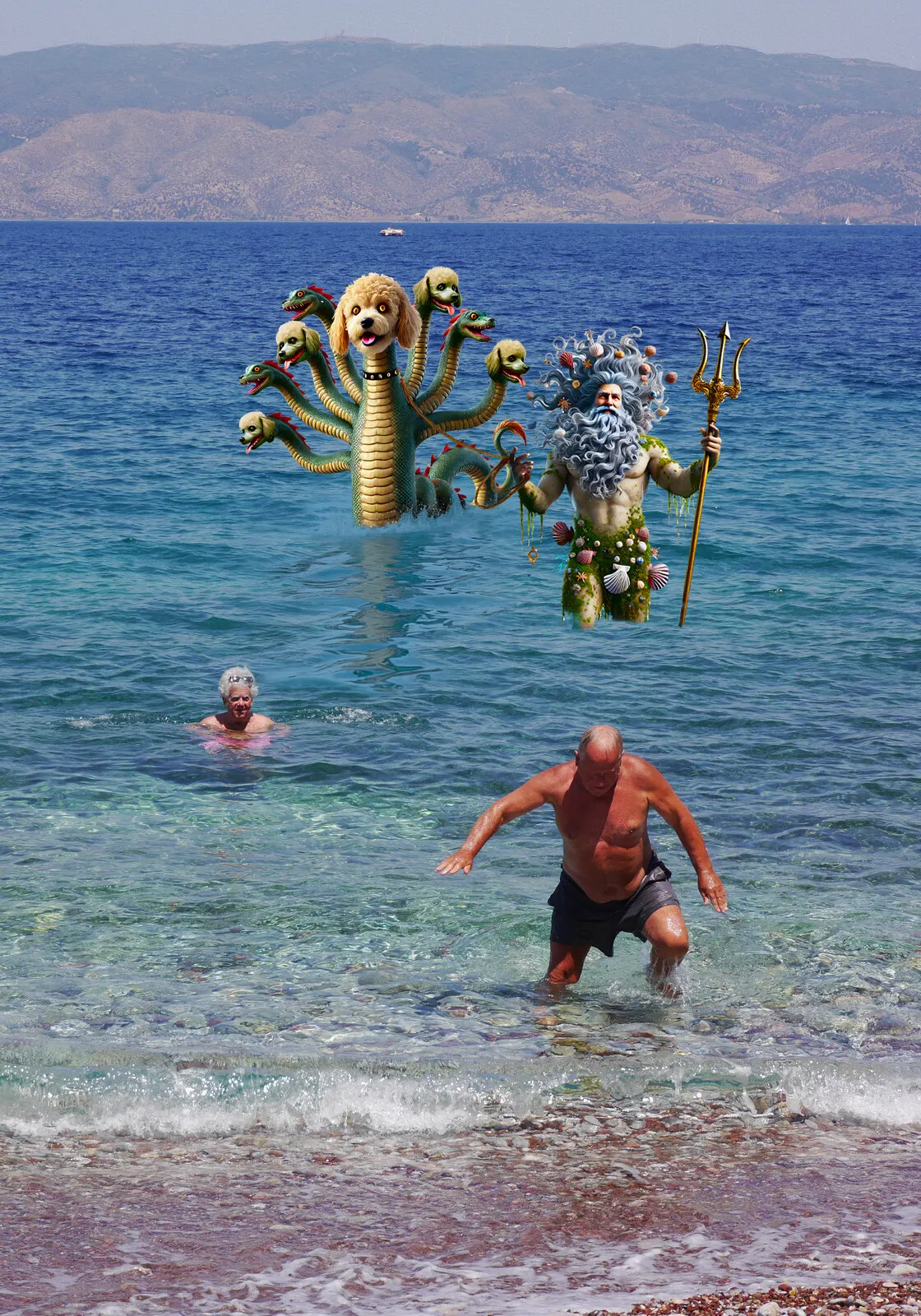
Hydra Surprises - Poseidon with his Hydra pet visiting Vlychos, 2024
Digital
50 x 70 cm
In the ancient myths, the Lernaean Hydra, as told by Palaephatus, Ovid, Diodorus Siculus, Euripides, and later Servius, is a creature of intrigue and terror. The name "Hydra" derives from the Greek word 'Hydros', which means 'What lives in water'. The root word probably goes back to Proto-Indo-European because the Sanskrit word for an aquatic animal is "Udrah", similar to Hydra, considering the languages are several thousand years apart.
This fearsome beast, famously slain by Hercules as one of his twelve labours, is often portrayed as a monstrous serpent with multiple heads, each capable of regenerating two new heads when one was severed. The myth describes how Hercules, with the assistance of his nephew Lolaus, cauterised each neck stump after decapitating a head, preventing them from regrowing. Like many of Hercules' exploits, this tale is filled with exaggerations and pure fantasies. The best evidence is that the poodle-headed Hydra was recently spotted on one of Vlychos' beaches. This sight challenges our preconceived notions of these mythical beings and leaves us with a sense of wonder, opening up new possibilities in the audience's mind.
Contrary to the belief that the Hydra hailed from the swampy lake of Lerna, her actual home waters were indeed the bay of Vlychos on the island of Hydra – an island that got its name from the very beast that lived along its coast. With her many poodle-like heads, the Hydra was not just a dangerous creature but could also be an adorable pet who loved to play and cuddle with her master, Poseidon. The sea would lie calm on such days, indicating that the Hydra was with her master. Her playful nature, often seen in her interactions with Poseidon, brought joy and entertainment to those who witnessed it, adding a delightful twist to the myth.
Poseidon, the mighty God of the sea, earthquakes, and horses, is often depicted as a mature, bearded man wielding a trident. He is a powerful and temperamental deity, capable of stirring the oceans into violent storms or soothing them into gentle waves. Poseidon's influence over the sea is absolute, and his moods can dictate the fate of sailors and seafarers. However, his bond with the Hydra is a testament to his softer side. The Hydra was not just a pet but a loyal companion to Poseidon. Known for his fierce demeanour, Poseidon's interactions with the Hydra reveal a nurturing and affectionate relationship. This mythical pet, with her playful antics and loyal nature, provides a rare glimpse into the gentler aspect of Poseidon's character.
In ancient times, tales of the Hydra's ferocity spread fear and fascination. Writers like Euripides dramatised her in their plays, portraying her as a symbol of chaos and danger. Ovid's poetic verses immortalised her in Roman literature, while Diodorus Siculus provided historical narratives that intertwined myth with reality. In his commentaries, Servius further cemented the Hydra's place in the pantheon of legendary creatures.
However, the recent sightings of the Hydra on Vlychos' shores present a new narrative. The locals, once wary of the creature, have come to appreciate her as a harbinger of tranquillity. The waters remain calm whenever the Hydra is spotted frolicking with Poseidon, and the fishermen and sailors rejoice. This serene presence, coupled with her playful nature, has led many to believe that the Hydra's antics have a calming effect on Poseidon, keeping his notorious temper in check and providing a source of amusement for the onlookers - like all poodles. This reassurance of a calm sea in the presence of the Hydra is a comforting thought for all who venture into the waters.
With its rich history and mythological significance, the island of Hydra owes much to its namesake. Far from being a mere legend, the poodle-headed Hydra symbolises the island's unique heritage. Her presence is seen as a blessing, ensuring safe passage and smooth seas and fostering a deep sense of cultural connection among the island's inhabitants and visitors. The Hydra's role as a symbol of the island's unique heritage is not just a matter of belief but a part of the island's cultural identity, celebrated by locals and visitors, strengthening the bond between the audience and the myth.
In essence, the story of the Hydra is not just one of a fearsome monster defeated by Hercules. It is also a tale of companionship and the unlikely bond between a sea god and his many-headed pet. As the myths evolve and new stories emerge, the Hydra continues to captivate the imagination, reminding us of the timeless connection between myth and reality.
Those who doubt this story should note that the artist Michael Lawrence is bobbing in the water nearest the approaching Hydra. Not only did he survive, but the animal-loving Michael also got to scratch all the poodle heads on their necks. He carefully ensured that each head received an equal number of scratches. Otherwise, they might fall off, and three more would grow in their place. In this way, he could have spent the rest of his life scratching them, poor Michael. Note our mutual faint-hearted friend fleeing up the shore. For so it is. Some believe what they see, while Michael and I, as artists, know that what is captured on canvas is just a variant of reality, an alternative truth, and a piece of canvas, harmless yet decorative, thought-provoking, and amusing. Michael, who saw circus performers and ballerinas everywhere, had no trouble with monsters from antiquity. Now that he has left this Earth, Michael meets Poseidon and his furry friend more often, as they live on a star not far from Michael's brightly shining one.
"In fact, he occasionally accompanies them to one of his favourite beaches on Hydra, Hydra's official birthplace outside Vlychos, or the smaller beach at Castello, also designated as the Hydra's womb, hence the name 'Baby-beach.' Michael loved to cool off in the strait's waves on days when Hydra was nearby, and the sea was calm. Spotting a Time-traveller is difficult, but you can sense their presence. Keep an eye out for Michael's hat; he took it with him to his star. If you see a lone straw hat on one of the beach benches, well-worn with damage on the crown, know that Michael is not far away.
If not, look up to the starry sky and locate Michael's brightly shining star, Antares, which, like its owner, varies in brightness over days, months, or years but is always equally fascinating.
A Portrait of Michael Lawrence
Born in the land of the free,
A wonder child in Italy.
Destined for the artist's throne,
But Hydra called, made him its own.
Michael Lawrence, a man of tales,
With stories vast, like wind-filled sails.
He spoke often, shared with glee,
Of people he met and places he'd see.
A self-portrait he never drew,
So I did what he couldn't do.
'Michael Times Four' I named the piece,
A brush, his baton, strokes never ceased.
In his worn-out hat, full of grace,
Under Hydra's sun, he found his place.
No fashionista, yet elegance he had,
In his painter's shirt, well-worn, a tad.
His brush flew fast. Thoughts raced ahead,
A single painting, but ten in his head.
He saw circuses in every move,
A woman's grace, a cat on the groove.
His watercolours spoke his mind,
No layers, just truth, purely defined.
He saw life in his unique way,
A circus of joy, colours in play.
A naked woman on a rocky seat,
The cat below, a scene complete.
In Michael's eyes, a circus grew,
A horse, a rider, a view anew.
In early summer's heat, terrain turned dry,
Yet, in Michael's mind, colours would fly.
Acrobats and jugglers make a vibrant scene,
In his inner world, he had a creative dream.
A drink in hand, dark days gone by,
On Hydra's shore, beneath the sky.
He conquered demons, held water instead,
Colourful drinks became art instead.
'Four deities in an image,' the final show,
Goddesses in reflection, a divine glow.
Michael stepped into the frame,
Overgod himself, without shame.
On his star, he paints still,
In eternity, with time to fill.
While we wait to join above,
Reconnecting with Michael's art, we love.
Michael Lawrence was a man of many stories. He spoke often and willingly, always having something to share about people he met or situations that touched him. If you asked, he would give a glimpse into his own life. His company was never dull, and his art reflects the richness of his experiences.
As far as I know, he never did a self-portrait, so I took care of that for him. 'Michael Times Four—Lawrence's Self-Portrait.' There are no grand attributes; the attribute was himself. In the picture, he has the brush that flew over the paper as if it were the conductor's baton.
And then there's the hat that had been around for a while and had its wear and tear—his beloved straw hat, which provided shade under the Hydra sun and gave him a discreet elegance. Michael was no fashionista; it wasn't suitable on Hydra. The well-used, thin painter's shirt was worn out, too, and the number of washes had bleached away the original pattern, replacing it with some paint splatters that resisted the most potent detergents. He waved the brush around like his gestures when he talked.
Michael painted quickly, trying to capture his tumbling thoughts on paper at the same pace as the painting behind the shaggy grey hair. A mission impossible because while Michael painted one picture, ten more grew in his imagination.
Michael's unique perspective was evident in his art. He didn't fuss; strokes and colours were there immediately. Watercolour suited him perfectly; there were no layers upon layers and no erasing; everything was there from the start. Michael saw what he saw and saw it in his way. He saw circuses everywhere—a woman's movements, a child's somersault, a cat on the move could set him off, and soon, an acrobat would be dancing a pirouette on the paper.
Michael's paintings are a celebration of joy and imagination. The colours, the movements, and the imagination that galloped freely to keep up with Michael's world of thoughts all come together to inspire and uplift the viewer.
That's what my imagination did when I placed a naked woman on a rock above Hydra and the sea, the harbour, and the enchanting nature. The blanket she sat on and the cat below would have tempted ordinary artists to transform the cat below the rock into a tiger skin under her bare bottom. But Michael was no ordinary artist. Sure, he could appreciate a beautiful woman; Michael had a reputation for being a ladies' man. But not on that day or any other. So what did it become?
Of course, a circus motif. 'What a view! A woman in the right place.' The cat became a horse, and the girl dressed and rode around on the horse's back in Michael's inner arena. Even though the early summer heat had turned the terrain into a sun-scorched remnant of spring's flower carpet, it still thrived in Michael's mind and became a colourful circus with acrobats, jugglers, and God knows what. Because that's how he wanted it; what he saw inside him was what came to life on the paper. It sparkled and invited the viewer into the picture, where the circus sounds made themselves known if you open the door to your world of imagination. Most people probably carry memories of childhood circus visits. Michael helped bring those memories to life.
The drink in hand reminds me of the darkness that plagued Michael when I got to know him. He had a bad temper when it came to alcohol, as they say. The occasions were many, and the temptations on Hydra were hard to resist. The island has been a party island since the fifties. After a few years, he learned to control the alcohol, and in the last ten years, I never saw Michael with anything other than water in his hand. The colourful drinks became smudges on the paper, which seemed to have a good effect.
The last painting we show here is the most important. 'Four deities in an image' is precisely what the title describes. The picture was there when I helped Michael portray some statues of goddesses he had made during the winter, which were now cast and ready to be marketed. Although Hydra is the centre of the world for many, reaching the international art market from an island in Greece isn't easy. When I photographed one of the goddesses, the statue was reflected in the glass covering one of Michael's goddesses who voluptuously revelled among spring flowers, with the Hydra strait and Peloponnese as a backdrop. 'Step into the picture and look your statue in the eye,' I commanded. Obediently, Michael stepped into what became one of my dearest pictures. Four divine beings were captured momentarily: the goddess as a statue, the other goddess among the flowers, the divine Hydra outside the window, and the Overgod himself, Michael, whose silhouette punctuated the divine quartet.
Don't think that Michael is resting. On his star, he lives on in eternity like all other Time-travellers. While others take it easy or do things they didn't have time for on Earth, I'm sure Michael continued where he laid down his brushes for the last time on Hydra. We'll have to wait until we join above to reconnect with Michael Lawrence's art.
Jörgen Thornberg
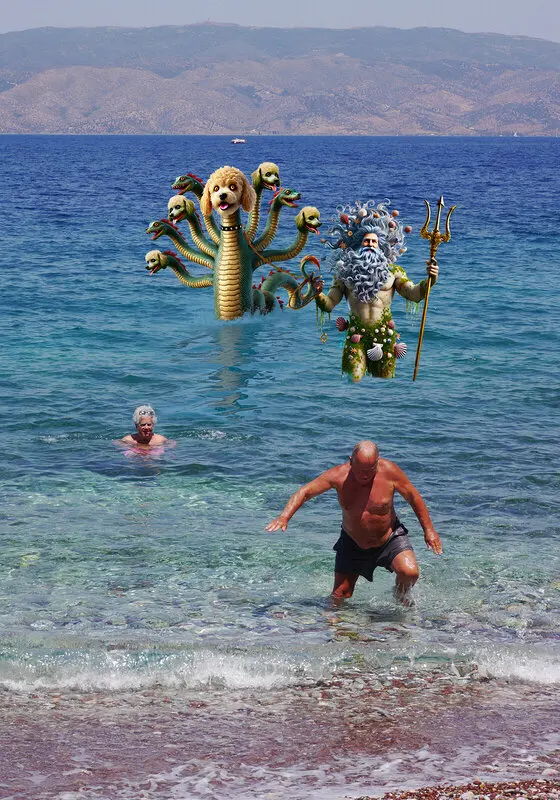
Hydra Surprises - Poseidon with his Hydra pet visiting Vlychos, 2024
Digital
50 x 70 cm
In the ancient myths, the Lernaean Hydra, as told by Palaephatus, Ovid, Diodorus Siculus, Euripides, and later Servius, is a creature of intrigue and terror. The name "Hydra" derives from the Greek word 'Hydros', which means 'What lives in water'. The root word probably goes back to Proto-Indo-European because the Sanskrit word for an aquatic animal is "Udrah", similar to Hydra, considering the languages are several thousand years apart.
This fearsome beast, famously slain by Hercules as one of his twelve labours, is often portrayed as a monstrous serpent with multiple heads, each capable of regenerating two new heads when one was severed. The myth describes how Hercules, with the assistance of his nephew Lolaus, cauterised each neck stump after decapitating a head, preventing them from regrowing. Like many of Hercules' exploits, this tale is filled with exaggerations and pure fantasies. The best evidence is that the poodle-headed Hydra was recently spotted on one of Vlychos' beaches. This sight challenges our preconceived notions of these mythical beings and leaves us with a sense of wonder, opening up new possibilities in the audience's mind.
Contrary to the belief that the Hydra hailed from the swampy lake of Lerna, her actual home waters were indeed the bay of Vlychos on the island of Hydra – an island that got its name from the very beast that lived along its coast. With her many poodle-like heads, the Hydra was not just a dangerous creature but could also be an adorable pet who loved to play and cuddle with her master, Poseidon. The sea would lie calm on such days, indicating that the Hydra was with her master. Her playful nature, often seen in her interactions with Poseidon, brought joy and entertainment to those who witnessed it, adding a delightful twist to the myth.
Poseidon, the mighty God of the sea, earthquakes, and horses, is often depicted as a mature, bearded man wielding a trident. He is a powerful and temperamental deity, capable of stirring the oceans into violent storms or soothing them into gentle waves. Poseidon's influence over the sea is absolute, and his moods can dictate the fate of sailors and seafarers. However, his bond with the Hydra is a testament to his softer side. The Hydra was not just a pet but a loyal companion to Poseidon. Known for his fierce demeanour, Poseidon's interactions with the Hydra reveal a nurturing and affectionate relationship. This mythical pet, with her playful antics and loyal nature, provides a rare glimpse into the gentler aspect of Poseidon's character.
In ancient times, tales of the Hydra's ferocity spread fear and fascination. Writers like Euripides dramatised her in their plays, portraying her as a symbol of chaos and danger. Ovid's poetic verses immortalised her in Roman literature, while Diodorus Siculus provided historical narratives that intertwined myth with reality. In his commentaries, Servius further cemented the Hydra's place in the pantheon of legendary creatures.
However, the recent sightings of the Hydra on Vlychos' shores present a new narrative. The locals, once wary of the creature, have come to appreciate her as a harbinger of tranquillity. The waters remain calm whenever the Hydra is spotted frolicking with Poseidon, and the fishermen and sailors rejoice. This serene presence, coupled with her playful nature, has led many to believe that the Hydra's antics have a calming effect on Poseidon, keeping his notorious temper in check and providing a source of amusement for the onlookers - like all poodles. This reassurance of a calm sea in the presence of the Hydra is a comforting thought for all who venture into the waters.
With its rich history and mythological significance, the island of Hydra owes much to its namesake. Far from being a mere legend, the poodle-headed Hydra symbolises the island's unique heritage. Her presence is seen as a blessing, ensuring safe passage and smooth seas and fostering a deep sense of cultural connection among the island's inhabitants and visitors. The Hydra's role as a symbol of the island's unique heritage is not just a matter of belief but a part of the island's cultural identity, celebrated by locals and visitors, strengthening the bond between the audience and the myth.
In essence, the story of the Hydra is not just one of a fearsome monster defeated by Hercules. It is also a tale of companionship and the unlikely bond between a sea god and his many-headed pet. As the myths evolve and new stories emerge, the Hydra continues to captivate the imagination, reminding us of the timeless connection between myth and reality.
Those who doubt this story should note that the artist Michael Lawrence is bobbing in the water nearest the approaching Hydra. Not only did he survive, but the animal-loving Michael also got to scratch all the poodle heads on their necks. He carefully ensured that each head received an equal number of scratches. Otherwise, they might fall off, and three more would grow in their place. In this way, he could have spent the rest of his life scratching them, poor Michael. Note our mutual faint-hearted friend fleeing up the shore. For so it is. Some believe what they see, while Michael and I, as artists, know that what is captured on canvas is just a variant of reality, an alternative truth, and a piece of canvas, harmless yet decorative, thought-provoking, and amusing. Michael, who saw circus performers and ballerinas everywhere, had no trouble with monsters from antiquity. Now that he has left this Earth, Michael meets Poseidon and his furry friend more often, as they live on a star not far from Michael's brightly shining one.
"In fact, he occasionally accompanies them to one of his favourite beaches on Hydra, Hydra's official birthplace outside Vlychos, or the smaller beach at Castello, also designated as the Hydra's womb, hence the name 'Baby-beach.' Michael loved to cool off in the strait's waves on days when Hydra was nearby, and the sea was calm. Spotting a Time-traveller is difficult, but you can sense their presence. Keep an eye out for Michael's hat; he took it with him to his star. If you see a lone straw hat on one of the beach benches, well-worn with damage on the crown, know that Michael is not far away.
If not, look up to the starry sky and locate Michael's brightly shining star, Antares, which, like its owner, varies in brightness over days, months, or years but is always equally fascinating.
A Portrait of Michael Lawrence
Born in the land of the free,
A wonder child in Italy.
Destined for the artist's throne,
But Hydra called, made him its own.
Michael Lawrence, a man of tales,
With stories vast, like wind-filled sails.
He spoke often, shared with glee,
Of people he met and places he'd see.
A self-portrait he never drew,
So I did what he couldn't do.
'Michael Times Four' I named the piece,
A brush, his baton, strokes never ceased.
In his worn-out hat, full of grace,
Under Hydra's sun, he found his place.
No fashionista, yet elegance he had,
In his painter's shirt, well-worn, a tad.
His brush flew fast. Thoughts raced ahead,
A single painting, but ten in his head.
He saw circuses in every move,
A woman's grace, a cat on the groove.
His watercolours spoke his mind,
No layers, just truth, purely defined.
He saw life in his unique way,
A circus of joy, colours in play.
A naked woman on a rocky seat,
The cat below, a scene complete.
In Michael's eyes, a circus grew,
A horse, a rider, a view anew.
In early summer's heat, terrain turned dry,
Yet, in Michael's mind, colours would fly.
Acrobats and jugglers make a vibrant scene,
In his inner world, he had a creative dream.
A drink in hand, dark days gone by,
On Hydra's shore, beneath the sky.
He conquered demons, held water instead,
Colourful drinks became art instead.
'Four deities in an image,' the final show,
Goddesses in reflection, a divine glow.
Michael stepped into the frame,
Overgod himself, without shame.
On his star, he paints still,
In eternity, with time to fill.
While we wait to join above,
Reconnecting with Michael's art, we love.
Michael Lawrence was a man of many stories. He spoke often and willingly, always having something to share about people he met or situations that touched him. If you asked, he would give a glimpse into his own life. His company was never dull, and his art reflects the richness of his experiences.
As far as I know, he never did a self-portrait, so I took care of that for him. 'Michael Times Four—Lawrence's Self-Portrait.' There are no grand attributes; the attribute was himself. In the picture, he has the brush that flew over the paper as if it were the conductor's baton.
And then there's the hat that had been around for a while and had its wear and tear—his beloved straw hat, which provided shade under the Hydra sun and gave him a discreet elegance. Michael was no fashionista; it wasn't suitable on Hydra. The well-used, thin painter's shirt was worn out, too, and the number of washes had bleached away the original pattern, replacing it with some paint splatters that resisted the most potent detergents. He waved the brush around like his gestures when he talked.
Michael painted quickly, trying to capture his tumbling thoughts on paper at the same pace as the painting behind the shaggy grey hair. A mission impossible because while Michael painted one picture, ten more grew in his imagination.
Michael's unique perspective was evident in his art. He didn't fuss; strokes and colours were there immediately. Watercolour suited him perfectly; there were no layers upon layers and no erasing; everything was there from the start. Michael saw what he saw and saw it in his way. He saw circuses everywhere—a woman's movements, a child's somersault, a cat on the move could set him off, and soon, an acrobat would be dancing a pirouette on the paper.
Michael's paintings are a celebration of joy and imagination. The colours, the movements, and the imagination that galloped freely to keep up with Michael's world of thoughts all come together to inspire and uplift the viewer.
That's what my imagination did when I placed a naked woman on a rock above Hydra and the sea, the harbour, and the enchanting nature. The blanket she sat on and the cat below would have tempted ordinary artists to transform the cat below the rock into a tiger skin under her bare bottom. But Michael was no ordinary artist. Sure, he could appreciate a beautiful woman; Michael had a reputation for being a ladies' man. But not on that day or any other. So what did it become?
Of course, a circus motif. 'What a view! A woman in the right place.' The cat became a horse, and the girl dressed and rode around on the horse's back in Michael's inner arena. Even though the early summer heat had turned the terrain into a sun-scorched remnant of spring's flower carpet, it still thrived in Michael's mind and became a colourful circus with acrobats, jugglers, and God knows what. Because that's how he wanted it; what he saw inside him was what came to life on the paper. It sparkled and invited the viewer into the picture, where the circus sounds made themselves known if you open the door to your world of imagination. Most people probably carry memories of childhood circus visits. Michael helped bring those memories to life.
The drink in hand reminds me of the darkness that plagued Michael when I got to know him. He had a bad temper when it came to alcohol, as they say. The occasions were many, and the temptations on Hydra were hard to resist. The island has been a party island since the fifties. After a few years, he learned to control the alcohol, and in the last ten years, I never saw Michael with anything other than water in his hand. The colourful drinks became smudges on the paper, which seemed to have a good effect.
The last painting we show here is the most important. 'Four deities in an image' is precisely what the title describes. The picture was there when I helped Michael portray some statues of goddesses he had made during the winter, which were now cast and ready to be marketed. Although Hydra is the centre of the world for many, reaching the international art market from an island in Greece isn't easy. When I photographed one of the goddesses, the statue was reflected in the glass covering one of Michael's goddesses who voluptuously revelled among spring flowers, with the Hydra strait and Peloponnese as a backdrop. 'Step into the picture and look your statue in the eye,' I commanded. Obediently, Michael stepped into what became one of my dearest pictures. Four divine beings were captured momentarily: the goddess as a statue, the other goddess among the flowers, the divine Hydra outside the window, and the Overgod himself, Michael, whose silhouette punctuated the divine quartet.
Don't think that Michael is resting. On his star, he lives on in eternity like all other Time-travellers. While others take it easy or do things they didn't have time for on Earth, I'm sure Michael continued where he laid down his brushes for the last time on Hydra. We'll have to wait until we join above to reconnect with Michael Lawrence's art.

Jörgen Thornberg
Malmö
Lite om bilder och mig. Translation in English at the end.
Jag är en nyfiken person som ser allt i bilder, även det jag fäster i ord, gärna tillsammans för bakom alla mina bilder finns en berättelse. Till vissa bilder hör en kortare eller längre novell som följer med bilden.
Bilder berättar historier. Jag omges av naturlig skönhet, intressanta människor och historia var jag än går. Jag använder min kamera för att dokumentera världen och blanda det jag ser med vad jag känner för att fånga den dolda magin.
Mina bilder berättar mina historier. Genom mina bilder, tryck och berättelser. Jag bjuder in dig att ta del av dessa berättelser, in i ditt liv och hem och dela min mycket personliga syn på vår värld. Mer än vad ögat ser. Jag tänker i bilder, drömmer och skriver och pratar om dem; följaktligen måste jag också skapa bilder. De blir vad jag ser, inte nödvändigtvis begränsade till verkligheten. Det finns en bild runt varje hörn. Jag hoppas att du kommer att se vad jag såg och gilla det.
Jag är också en skrivande person och till många bilder hör en kortare eller längre essay. Den följer med tavlan, tryckt på fint papper och med en personlig hälsning från mig.
Flertalet bilder startar sin resa i min kamera. Enkelt förklarat beskriver jag bilden jag ser i mitt inre, upplevd eller fantiserad. Bilden uppstår inom mig redan innan jag fått okularet till ögat. På bråkdelen av ett ögonblick ser jag vad jag vill ha och vad som kan göras med bilden. Här skall jag stoppa in en giraff, stålmannen, Titanic eller vad det är min fantasi finner ut. Ännu märkligare är att jag kommer ihåg minnesbilden långt efteråt när det blir tid att skapa verket. Om jag lyckas eller inte, är upp till betraktaren, oftast präglat av en stråk av svart humor – meningen är att man skall bli underhållen. Mina bilder blir ofta en snackis där de hänger.
Jag föredrar bilder som förmedlar ett budskap i flera lager. Vid första anblicken fylld av feel-good, en vacker utsikt, fint väder, solen skiner, blommor på ängen eller vattnet som ligger förrädiskt spegelblankt. I en sådan bild kan jag gömma min egentliga berättelse, mitt förakt för förtryckare och våldsverkare, rasister och fördomsfulla människor - ett gärna återkommande motiv mer eller mindre dolt i det vackra motivet. Jag försöker förena dem i ett gemensamt narrativ.
Bild och formgivning har löpt som en röd tråd genom livet. Fotokonst känns som en värdig final som jag gärna delar med mig.
Min genre är vid som framgår av mina bilder, temat en blandning av pop- och gatukonst i kollage som kan bestå av hundratals lager. Vissa bilder kan ta veckor, andra någon dag innan det är dags att överlämna resultatet till printverkstaden. Fine Art Prints är digitala fotocollage. I dessa kollage sker rivandet, klippandet, pusslandet, målandet, ritandet och sprayningen digitalt. Det jag monterar in kan vara hundratals år gamla bilder som jag omsorgsfullt frilägger så att de ser ut att vara en del av tavlan men också bilder skapade av mig själv efter min egen fantasi. Därefter besöks printstudion och för vissa bilder numrera en limiterad upplaga (oftast 7 exemplar) och signera för hand. Vissa bilder kan köpas i olika format. Det är bara att fråga efter vilka. Gillar man en bild som är 70x100 men inte har plats på väggen, går den kanske att få i 50x70 cm istället. Frågan är fri.
Metoden Giclée eller Fine Art Print som det också kallas är det moderna sättet för framställning av grafisk konst. Villkoret för denna typ av utskrifter är att en högkvalitativ storformatskrivare används med åldersbeständigt färgpigment och konstnärspapper eller i förekommande fall på duk. Pappret som används möter de krav på livslängd som ställs av museer och gallerier. Normalt säljer jag mina bilder oinramade så att den nya ägaren själv kan bestämma hur de skall se ut, med eller utan passepartout färg på ram, med eller utan glas etc..
Under många år ställde jag bara ut på nätet, i valda grupper och på min egen Facebooksida - https://www.facebook.com/jorgen.thornberg.9
Jag finns också på en egen hemsida som tyvärr inte alltid är uppdaterad – https://www.jth.life/ Där kan du också läsa en del av de berättelser som följer med bilden.
UTSTÄLLNINGAR
Luftkastellet, oktober 2022
Konst i Lund, november 2022
Luftkastellet, mars 2023
Engleson Galleri Caroli, april 2023
Hydra, Greece June 2023
Engleson Galleri Caroli, oktober 2023
Toppen, Höllviken december 2023
Luftkastellet, mars 2024
Torups Galleri, mars 2024
Venice, May 2024
Luftkastellet, oktober 2024
Konst i Advent, December 2024
Galleri Engleson, Caroli December 2024
Jäger & Jansson Galleri, april 2025
A bit about pictures and me.
I'm a curious person who sees everything in pictures, even what I express in words, often combining them, for behind all my pictures lies a story. These narratives, some as short as a single image and others as long as a novel, are the heart and soul of my work.
Pictures tell stories. Wherever I go, I'm surrounded by natural beauty, exciting people, and history. I use my camera to document the world and blend what I see with what I feel to capture the hidden magic.
My images tell my stories. Through my pictures, prints, and narratives, I invite you to partake in these stories in your life and home and share my deeply personal perspective of our world. More than meets the eye. I think in pictures, dream, write, and talk about them; consequently, I must create images too. They become what I see, not necessarily confined to reality. There's a picture around every corner. I hope you'll see what I saw and enjoy it.
I'm also a writer, and many images come with a shorter or longer essay. It accompanies the painting, printed on fine paper with my personal greeting.
Many pictures start their journey on my camera. Simply put, I describe the image I see in my mind, experienced or imagined. The image arises within me even before I bring the eyepiece to my eye. In a fraction of a moment, I see what I want and what can be done with the picture. Here, I'll insert a giraffe, Superman, the Titanic, or whatever my imagination conjures up. Even stranger is that I remember the mental image long after it's time to create the work. Whether I succeed is up to the observer, often imbued with a streak of black humour – the aim is to entertain. My pictures usually become a talking point wherever they hang.
I prefer pictures that convey a message in multiple layers. At first glance, they're filled with feel-good vibes, a beautiful view, lovely weather, the sun shining, flowers in the meadow, or the water lying deceptively calm. But beneath this surface beauty, I often conceal a deeper story, a narrative that challenges societal norms or explores the human condition. I invite you to delve into these hidden narratives and discover the layers of meaning within my work.
Picture and design have been a thread running through my life. Photographic art feels like a fitting finale, and I'm happy to share it.
My genre is varied, as seen in my pictures; the theme is a blend of pop and street art in collages that can consist of hundreds of layers. Some images can take weeks, others just a day before it's time to hand over the result to the print workshop. Fine Art Prints are digital photo collages. In these collages, tearing, cutting, puzzling, painting, drawing, and spraying happen digitally. What I insert can be images hundreds of years old that I carefully extract so they appear to be part of the painting, but also images created by myself, now also generated from my imagination. Next, visit the print studio and, for certain images, number a limited edition (usually 7 copies) and sign them by hand. Some images may be available in other formats. Just ask which ones. If you like an image that's 70x100 but doesn't have space on the wall, you might be able to get it in 50x70 cm instead. The question is open.
The Giclée method, or Fine Art Print as it's also called, is the modern way of producing graphic art. This method ensures the highest quality and longevity of the artwork, using a high-quality large-format printer with archival pigment inks and artist paper or, in some cases, canvas. The paper used meets the longevity requirements set by museums and galleries. I sell my pictures unframed, allowing the new owner to personalise their artwork, confident in the lasting value and quality of the piece.
For many years, I only exhibited online, in selected groups, and on my Facebook page - https://www.facebook.com/jorgen.thornberg.9. I also have my website, which unfortunately is not constantly updated - https://www.jth.life/. You can also read some of the stories accompanying the pictures there.
EXHIBITIONS
Luftkastellet, October 2022
Art in Lund, November 2022
Luftkastellet, March 2023
Engleson Gallery Caroli, April 2023
Hydra, Greece June 2023
Engleson Gallery Caroli, October 2023
Toppen, Höllviken December 2023
Luftkastellet, March 2024
Torup Gallery, March 2024
Venice, May 2024
UTSTÄLLNINGAR
Luftkastellet, oktober 2022
Konst i Lund, november 2022
Luftkastellet, mars 2023
Engleson Galleri Caroli, april 2023
Hydra, Greece June 2023
Engleson Galleri Caroli, oktober 2023
Toppen, Höllviken december 2023
Luftkastellet, mars 2024
Torups Galleri, mars 2024
Venice, May 2024
Luftkastellet, October 2024
Konst i Advent, December 2024
Galleri Engleson, Caroli December 2024
Jäger & Jansson Galleri, April 2025
Utbildning
Autodidakt
Medlem i konstnärsförening
Öppna Sinnen
Med i konstrunda
Konstrundan i Skåne
Utställningar
Luftkastellet, October 2022
Art in Lund, November 2022
Luftkastellet, March 2023
Engleson Gallery Caroli, April 2023
Hydra, Greece June 2023
Engleson Gallery Caroli, October 2023
Toppen, Höllviken December 2023
Luftkastellet, March 2024
Torup Gallery, March 2024
Venice, May 2024