Vi använder cookies för att ge dig bästa möjliga upplevelse. Välj vilka cookies du tillåter.
Läs mer i vår integritetspolicy
Jörgen Thornberg
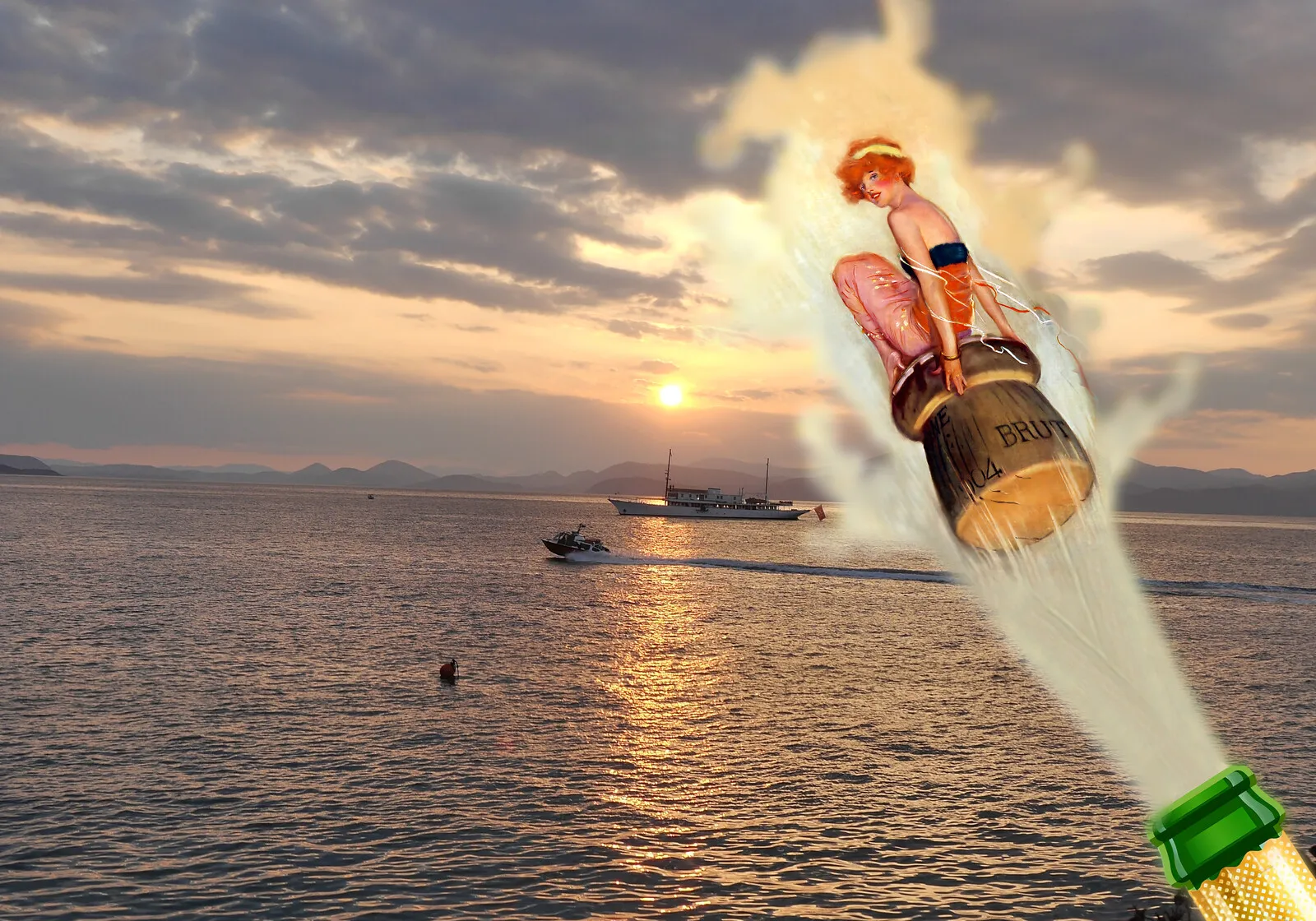
A Tender for Lucy, 2021
Digital
70 x 50 cm
Did she make it? Riding the cork to the yacht in the middle of Hydra Strait. I don’t know, but it must have been a spectacular ride.
The Failed Wine of Champagne
Sip, sip, hooray! Cheers! Yamas! Skål! All over the world, not the least on Hydra, one fills glasses with Champagne when victories are to be celebrated, brides and grooms marry, and, of course, when the new year is greeted with fireworks. The Golden Drops are now considered by many to be the best wine of all. This is the short version of my story for those thinking that less is beautiful. If you want to dig deeper into the secrets behind Champagne, please feel free to continue. For my less-loving friend, it’s time to leave for another FB acquaintance, so be free to jump off. Before you do, I‘ll give you one for the road. A riddle. “Why is an empty champagne bottle like an orphan? Because it has lost its pops.” Now you may leave. Or? Remember, Champagne is not just a drink; it's a journey filled with sparkling stories and intoxicating bubbles.
There is indeed an even shorter way of talking about sparkling goodies. With emoji. It tells a lot but nothing. For my other friends, I will continue to tell facts and secrets about the famous, multifaceted, mythical, and celebrated wine. However, this has not always been the case. Generations of Champagne district wine farmers lived in shame for being unable to produce as good a wine as their counterparts in Burgundy. Bubbles in the wine were seen as an impurity. Only at the end of the 17th century did noble families on the other side of the English Channel begin to appreciate the fizzing bubbles of Champagne. Then, the shame turned to pride, and the money started pouring in. That current hasn't ebbed since, marking a remarkable journey of Champagne from a flawed wine to a celebrated one.
But before we go any further, there is another issue that Mrs Less is Beautiful would like to discuss - the one about the woman and the cork. The picture is sexist, but in my defence, it should be said that it is based on a 1915 English magazine illustration of a lady propelled by a champagne cork. A time-typical view of women, odd but still a bit funny in today's eyes. Not only male chauvinist pigs’.
Why on earth should a woman want to ride a cork? First and foremost, the champagne cork needs to be more significant. Second, it seems to be uncomfortable. Women are known to be practical and comfy and would instead choose an aeroplane seat on the way to Greece. And most certainly, never leave a party when Champagne is still left. But what if there's more to this story? What if there's a hidden meaning behind this quirky image? Let's delve deeper into the world of Champagne and find out.
"The question, where are we going, me and the cork," she might ask herself.
If she started her journey sitting on a bottle at Hydra, the destination could be given to Metoxi on the other side of the strait. She needed to sit on an oversized bottle called the Melchisedech from the Champagne house, Drappier – 120 centimetres high and weighing 45 kilos – grabbing a 31-millimetre cork. Even if the colossal bottle contains 400 glasses of Champagne, climbing would not be easy.
Another conclusion is that she should realise that it was the final trip of her life. The landing against the cliffs of Peloponnesus would be brutal. The verdict must be that the image is false, not to say ridiculous. No woman would travel this way even after a bottle of Champagne alone. Only the bigoted Baron von Münchausen did such a thing, but he chose a cannonball. But fantasy is a beautiful gift, so feel free to join her ride.
Okay, Mrs Less is Beautiful. You can finally leave, and others continue to the Champagne district. I hope you will not regret joining me in my champagne journey over the centuries. It is hilarious with all its sparkling stories and intoxicating bubbles.
The vines, which the Romans were the first to plant in Champagne’s chalky soil in 57 BC, had a hard time. Both during the Roman rule and the following thousand years or so, the area's wine aroused great interest. For a long time, the wine from Champagne was reddish, made from blue grapes, and lacked bubbles—at least deliberately induced ones. The farmers tried desperately to produce a tasty, classic, full-flavoured wine, but the region’s climate was against them.
The cold winters this far north caused fermentation to stop soon after harvest. Nevertheless, the wine was bottled. Not much happened during winter, but as soon as Champagne was reached by the warm rays of the spring sun, fermentation began again. But not with the desired result.
Carbon dioxide bubbles were created in the wine, which was considered a mistake that ruined the already lousy wine. The Champagne farmers called the sparkling product "the evil wine".
"Drink it before Easter, before spring comes, and it gets warm because then the wine starts to fizz again," the wine merchants warned when selling the sour wine from Champagne.
At first, customers loathed the bubbling sensation on the tongue. As early as 1663, the poet Samuel Butler referred to something he called 'brisk champagne'. Even Champagne's falsely claimed creator, Dom Pérignon, disliked it. But when the British tasted the undrinkable carbonated wine, the corks started flying! And how they have flown ever since.
The stinging bubbles, the drink of silliness and the party’s highlight. Humorist and writer Mark Twain couldn't get enough, and womaniser Casanova considered the drink an "indispensable aid to seduction" His peer, the blighter Don Giovanni – a compound of Cruelty and Lust – missed it because he was a fictional character; otherwise, he would most certainly have been one of Champagne’s most significant users. Tsar Peter, the Great of Russia, always brought four bottles to bed with a bunch of girls to warm him up after the chilled Champagne.
History is full of great personalities with a passionate relationship with the sparkling drops from the north of France. Churchill is said to have drunk two bottles of Champagne a day, and by the time he took his last sip in 1965, he had consumed 42,000 bottles of his favourite Pol Roger champagne. He believed Champagne must fulfil three things: dry, cold, and free. He should also have said: “I could not live without Champagne. In victory, I deserve it. In defeat, I need it.” The problem is that the quote is also attributed to Napoleon Bonaparte, maybe after Waterloo one hundred years earlier.
The movie star Marilyn Monroe was a great bubble drinker; Dom Perignon was her favourite brand. She was indeed bright like glitter and bubbly like Champagne. Can you hear the sparkles inside you when Marilyn sang these lines in the unforgettable film ‘Some Like It Hot’ from 1959? Poo-poo-pee-doo, the bubbles sound.
Poo-poo-pee-doo
I wanna be loved by you, just you
And nobody else but you
I wanna be loved by you alone
Boop-boop-de-boop!
Poo-poo-pee-doo
The legendary fashion designer Coco Chanel said she drank bubbles when she was in love—and when she wasn't. Lily Bollinger, once boss at the champagne house with the same name, claimed: “I drink Champagne when I’m happy and when I’m sad. Sometimes I drink it when I’m alone. When I have company, I consider it obligatory. I trifle with it if I’m not hungry and drink it when I am. Otherwise, I never touch it―unless I’m thirsty.”
The name 'Champagne' was already protected in 1891, meaning only sparkling wine from the Champagne district may use the exclusive designation. And the title 'Grand Cru' is even narrower. Grand Cru is the highest classification for a vineyard in Champagne. There are currently 17 villages with Grand-Cru classification out of 319 champagne villages.
If you have 250 euros to spare, try a bottle of Dom Pérignon 2008. It got 97p out of 100. A cherished (unopened) Dom Perignon can last 5 to 10 years or more - if stored properly! Once uncorked, it has a shelf life of around 3-5 days. It’s worth every single Euro.
French wineries outside the narrow Champagne region must use the designation ‘Crémant’ for their sparkling wines. The production is done similarly, but the price is often only one-third. The quality varies, but some are top-class bubbles.
However, the world is nowadays full of buzzing and heady competitors. Some of them are really good.
The German equivalent of Champagne is Sekt. The German bubbles can be dated to the early 19th century when a German wine producer with a background in a French champagne house started producing German sparkling wine. Try Brundlmayer Sekt Brut it’s worth a try. A man in Lederhosen celebrated with a bottle of Sekt. It marked his one-day anniversary of being sober.
Winegrower Carlo Gancia spent several years in Reims in Champagne before developing his so-called Moscato Champagne in 1859. In 1908, the sparkling wine was named Spumante. Italians prefer to toast in Spumante or prosecco, which is mostly an unpretentious wine, a volume product with high yields and a quick production process with a second fermentation in a pressure tank. But there is also the real stuff. I recommend Ca' del Bosco Franciacorta Cuvee Prestige Rosé made using the same method, champenoise, with a similar flavour palate of punchy acidity and toasty yeast. This is sure to impress sparkling connoisseurs. It’s costly but magnificent.
A classic anecdote from Italy is about a man at a wedding who was urged to tell everyone what he had for breakfast. Everybody assumed he had had the standard double espresso on his way to the office. He stepped up on a table and ringed his champagne glass a few times until all eyes stared at him, and then he said in the bride’s direction: "A toast!"
There is no evil without good. In 1872, Spanish winegrower Josep Raventó's red wine vines were attacked by vine lice. Therefore, he started growing green grapes instead - which led to the great success of Cava. Cava is among the most underrated sparkling wines, with the best brands rivalling Champagne and other top fizzes. Cava is made the same way as Champagne and throughout Spain, with no geographical restrictions – unlike in Champagne. I once picked up this story in Madrid. Time was around eleven on New Year’s Eve, and I should soon be off for a party. I was in the hotel lobby bar, and a guy ordered a glass of Champagne. "It's finally happened!" he saluted me and raised his glass. "I've made enough money that I don't have to work for the rest of the year!"
The production of 'Sovetskoje Shampanskoje', Soviet Champagne, began in the 1920s when the state wanted to develop a cheap 'champagne for the people' that was often sweeter than the conservative champagne lover preferred. However, the top drink in Russia is Vodka, which gets you drunk faster. It's tasteless but cost-effective.
A priest, a nun, a giraffe, a telepathic unicorn, twenty-one Crimean Tatars, the evil clown Pantalone, a ninja, and Vladimir Putin walked into a bar in Moscow. The bartender, struggling to open the pink Sjampanskoje, said: “...yeah, I don't know how I'm going to pull this one off”.
South Africa produces a lot of bubbles. The Boschendal is one of my personal favourites. It is very pricey. I cannot guarantee that this story is true, but why not? A drunkard was brought to court in Johannesburg for drunken behaviour. The Judge addressed the drunkard.
"You have been brought here for drinking."
"Thank you very much, your honour. That's very sweet of you. Let's start," said the Drunkard. All present in the court burst out laughing.
"Order," the Judge said, banging the gavel.
"For me, a glass of champagne, please," said the Drunkard.
I was in California after Mr Trump had lost the election and reluctantly left his presidency. The western USA was not his favourite state; he had lost to Biden with 30 per cent. I shared a bottle of Schramsberg Blanc de Blancs, a splendid alternative to Champagne. My friend told me what had happened to Donald Trump and his chauffeur driving on a country road during his campaign.
Suddenly, a sow ran in front of the car. The chauffeur had no time to react, so he ran over the animal, killing it instantly. They got out of the vehicle, looked around and spotted a small farm in the distance. Trump told the driver:
“The Sow probably came from there. You should at least tell them that you killed the pig. Don’t offer any money because the blame is on the Sow. It is always the bitch”. Trump told him what to say, returned to the car, and soon fell asleep.
The chauffeur did as he was told. A few hours later, he came out of the farmhouse, covered in lipstick kiss marks, his clothes in disarray and with a glass of Champagne in each hand. Trump woke up and asked:
“Holy shit! What did you tell those assholes?”
“What you told me to. Hi, I'm Donald Trump's chauffeur, and I've just killed the pig!"
Australia has become a great wine producer and offers a variety of sparkling wines today.
One of the better ones is Castagna Sparkling Genesis Syrah. It shows a deep garnet in colour with a charming bouquet that engulfs your palate with flavours like sandalwood, pepper, a touch of apricot, sexy blackberries and dark cherries mixed with graphite. As it opens up, you taste briary notes and black fruit. It is complex and expensive at 84 $. I was in Sydney in 1992 and oversaw a ferry launch at Cockatoo Island Dockyard. After the shipowner’s wife had baptised the ship, I socialised with the technical director of the shipyard. “How do you launch a champagne factory in Europe,” he asked with a serious face. “They throw a boat at it”, I answered and looked him in the eyes. The company shut down the same year, and I have heard it had something to do with Champagne.
New Zealand produces a lot of excellent wines and sparkling ones, too. Cloudy Bay Pelorus Brut, a Chardonnay Pinot Noir, is part of the luxury goods company LVMH (Louis Vuitton Moët Hennessy). Moët & Chandon, Krug and Veuve Clicquot are other stable mates. It is a safe bet to assume that Marlborough-based Cloudy Bay will get some technical help from the group of Champagne producers. The sophistication suggests so. In a bar in Auckland, I overheard a funny conversation between a married couple.
“Look at that dipso”, she said, nodding in the direction of a visibly drunken fellow with a champagne glass in front of him.
“Who is he?” he answered, giving the boozer a shallow glance.
She said mockingly, “Ten years back, he proposed to me, but I turned him down. See what happens.”
“Oh, my God! He is still celebrating,” he commented and got the last word.
How about Hydra? Some local hardly drinkable wine is produced among the rocks. I am still waiting to discover anything sparkling. But one doesn't have to cross the strait to get water. You can buy good Greek wine on the island. Greece is one of the oldest wine-producing countries in the world. It has millennia of experience and expertise in viticulture and has developed a set of flavours and characteristics found nowhere else on earth. There are less expensive ones, but try Vassaltis Pet Nat, an excellent Greek sparkling wine. Once a week, I go to Isalos during their happy hour. You get every second glass for free. I enjoy a glass of sparkling for its health benefits. The other glasses are for my witty comebacks and flawless dance moves. It was in Isalos that I overheard this conversation some years ago.
An overserved fellow came from the catamaran from Piraeus. His walk was wobbly, and he flopped down at the table next to the town priest and his friend. The man's tie was stained, his hair tousled, his face was plastered with red lipstick, and a half-empty mini bottle of sparkling wine stuck out of his torn coat pocket.
He gave no notice to the priest and his company but opened a crumpled newspaper and began reading. After a few minutes, the dishevelled guy turned to the priest and asked:
"Say, Father, what causes arthritis?"
"It's caused by loose living, cheap women and too much alcohol!" answered the priest in a severe tone.
"Well, I'll be damned!" the wino muttered, returning to his paper.
The town priest thought about what he had said, nudged the man and apologised.
"I'm very sorry. I shouldn't have been so unpleasant about it. Tell me, how long have you had arthritis?"
"I don't have it, Father. I was reading here that the Patriarch does!"
Richard Juhlin is the world's number one champagne expert and has held the world record for the number of champagnes tasted since 1998. He has so far tasted 13,500 different champagnes and 150,000 bottles, including a couple from the early 19th century. That tasting was sensational. After nearly two centuries under the Baltic Sea, the world's oldest Champagne had kept its sparkle and tasted superb. The still-thriving Veuve Clicquot house once produced it. The ship, discovered in 2007 under 150 feet of water, is believed to have sunk between 1825 and 1830. In all, a total of 168 intact Champagne bottles were discovered. The cold temperatures and immense pressure on the corks have offered the wines perfect cellaring conditions. The bottles could fetch as much as $70,000 each at auction! Juhlin once started his career with Spanish Cava because, as a young, he could not afford the real stuff. Officially, he does not comment on sparkling wines other than Champagne. Unofficially, he has said that there are alternatives at the highest level.
The monk Dom Pérignon has wrongly been called the "father of champagne". He did not create the sparkling wine at all. On the contrary, he spent his entire life trying to eliminate the bubbles. However, he revolutionised the wine world with his innovative thinking. Dom Pérignon introduced the morning routine of picking the grapes, as the low temperature helped keep them intact. Pérignon also sorted out damaged grapes, which was unique when quantity was paramount. "Less makes the wine beautiful and brings glory and profit," said the monk. So right, he was. I know that Mrs Less is beautiful, but I would not agree in this case. But that is another story.
Another innovation was Dom Pérignon's experiment with blending wine from different plantations and different grape varieties. The monk also insisted that the pressing be done carefully so that not too much peel would be squeezed into the juice. This way, he got a fine white wine, even though the region's blue grapes were included.
In the 1700s, champagne parties with oysters became popular among European nobility. The English had already discovered the tickling sensation on the tongue, and soon, the fashion spread to noble houses and courts around Europe. At the beginning of the 18th century, the trend had also reached the grapes’ home country and the French court.
"People who like champagne want bubbles in it", proclaimed King Louis XV in 1728. The French Revolution and the subsequent Napoleonic wars temporarily derailed the popularity surge of Champagne. To save some of their noble clients from the guillotine, Champagne merchants altered business records by replacing the titles of their clients with 'Citizen'. During his imprisonment, Citizen Louis Capet got his Champagne this way. However, the merchants lost a vital customer when Louis XVI in 1793 finally lost his mouth and head. "Less is beautiful", said the incorruptible Maximilien Robespierre. "Cheers!" exclaimed his fellow revolutionary, the exuberant Georges Danton, who loved Champagne, soon to follow his king, losing head and mouth.
They might not have lost their head, but the champagne makers had other problems. The bottles exploded. Due to the sales success, the winegrowers of Champagne no longer had to tame the bubbles. Instead, they got a security issue. The slightest shaking or increased temperature and subsequent overpressure caused the bottles to explode. When the so-called devil's wine exploded, the wine farmers were forced to wear specially-made iron masks to protect themselves from flying glass.
If a chain reaction of exploding bottles started, the wine cellar could turn into a war zone in seconds. Improved bottles, precise methods and recipes, and controlled storage have reduced the problem. However, the human element remains. It is no good idea to accidentally add sugar twice, a common mistake in the past. And then it slammed, for example, during The Champagne Riots of 1910 and 1911.
The protests resulted from a series of problems faced by grape growers in the Champagne area. The precipitating event may have been the announcement in 1908 by the French government that it would delimit by decree the exact geographic area that would be granted economic advantage and protection by being awarded the Champagne appellation. Those ending outside feared slowing business and bankruptcy. These borders have been changed back and forth over the years. Less is profitable, at least for those within. As late as 2008, France redrew the boundaries of the fragmented area designated as champagne land in the industry’s biggest shake-up for 80 years. Authorities wanted to cope with surging world demand, particularly from China and Russia, and old markets such as Britain and the US. The changes gave booming business for the areas around 40 villages - not to mention soaring property prices, the value of land could suddenly be 200 times what it was. The lucky chosen villages could overnight change the name of their product from Crémant to Champagne: same product but triple the price.
The explosions could be devastating. At the beginning of the 18th century, wineries lost 20–90 per cent of their production annually. The English came to the rescue. According to historians, they developed thick-bellied and more durable bottles and probably also discovered that you could use bottle stoppers made of cork. Cork was perhaps first used to seal wine in the sixth century BC (BCE) in Toscana (Tuscany). The method was much better at resisting the pressure in the bottle than the oil-soaked hemp with which the French had previously closed the bottleneck. Now, the golden age of Champagne could emerge. There were no more exploding bottles with hemp projectiles flying in the wine cellars. But they should also fly in the future, mainly in a controlled fashion.
In large parts of the world, it is now tradition to let the Champagne corks fly on New Year's Eve. No New Year's party without bubbles in the glass! The practice of drinking Champagne on the last day of the year and toasting the new year with sparkling wine can be traced back to Marie-Antoinette's parties before she followed her husband and lost her head. The queen loved to gamble, dress in expensive dresses and party all night. And drink Champagne. A lot of. She is told to have invented the champagne stirrer so she could drink more but not get too drunk. Its use is heavily frowned upon as it destroys Champagne's most valued and distinctive aspect. And the effect is null; you get as drunk as before. Nowadays, it is a rare device.
Naturally, the bourgeoisie wanted to do the same. In the 19th century, serving bubbles at New Year's parties became increasingly common. Only then did the New Year become a holiday during which large parts of the population stayed until midnight. In the 20th century, the popularity of Champagne also reached a broader population, and they could treat themselves to good food at least once a year and toast the new year with bubbles in the glass.
Eventually, someone got around to throwing a bottle of Champagne at a ship being launched. As soon as the boat bobbed in its proper element, it was toasted in the same Champagne that had been smashed against the ship's hull. Bubbles were needed everywhere. One can honestly speak of an exuberant success, not least because of intelligent marketing.
About two and a half billion bottles of sparkling wine are sold annually worldwide. Of this, 320 million are Champagne – after the French, no one in the world drinks more bubbles than the English, but in terms of value, the USA beats all. The largest producer is Italy, making up 27% of all the sparkling wines in the world. Champagne is no longer the world’s most important sparkling wine when measuring volume, but they are, by far, if we look at value. Champagne accounts for 12% of the world’s sparkling wine but 33% of its value.
You can make the cork fly in different ways. The most advanced is Sabrage, a technique for opening a champagne bottle with a sabre. As you can guess, it was not invented by a woman. It originated from the Napoleonic wars and was a way for young officers to impress aristocratic girls. Also, it speeds up the opening of many bottles. The soldiers also like when the cork and top, like artillery, fly some 10 meters. It is not advisable to be in its way. The world record for sabered bottles in a row is 623. It is, however, more sophisticated – and challenging – to open a bottle with just a discreet hissing noise and keep the cork in your opening hand. It is also appreciated that the host is not having their ceiling destroyed.
How is sabring done? Well, in theory, it's easy, but a lot can go wrong in practice. You can fill the room with shattered glass and flood the floor with expensive Champagne. The wielder must slide the sabre along the body seam of the bottle to the lip to break the top of the neck away, leaving the neck of the bottle open and pouring out the Champagne. Someone must be there prepared with a glass; otherwise, the house lady will hate you. The force of the blunt side of the blade hitting the lip breaks the glass to separate the collar from the neck of the bottle. One does not use the sharp side of the blade. The cork and collar remain together after separating from the neck and fly far away.
During the Napoleonic Wars in the early 1800s, champagne salespeople were hot on the heels of the French army. They were ready with bottles for the celebration after a battle was won. Champagne sales were also well helped by the fact that Napoleon himself loved the sparkling drops. And as I previously wrote, had he lost, he drowned his sorrow in the noble drink. Champagne producer Jean-Rémy Moët presented the Emperor with a guest palace at the Moët family headquarters in Épernay. Champagne was marketed as the drink of the wealthy and upper class, which worked great. Everyone wanted to drink what the emperor drank. When he had lost his empire and been deported to St. Helena, they saluted that in Champagne.
While the carbonated wine was on its way to victory in the world, it was time again. The vines of Champagne were bathed in blood during the First World War. For 1,051 days, shells rained over Reims, leaving four-fifths of the champagne capital in ruins, while the region's precious vineyards were dug up during the fierce trench warfare. Not even Churchill's motivational words could prevent the disaster.
“Remember, gentlemen, it is not just France we are fighting for – it is Champagne!” said the then minister of armaments to his colleagues in 1918. Production resumed after the war, but the vines had barely been tied up before the Second World War cast new shadows over Champagne. The German Wehrmacht occupied the region and confiscated the sparkling wine. In several places, however, the locals managed to wall up and hide cellar vaults with ancient and delicate champagne varieties so the Germans could not find them.
Peace on the Western Front was concluded in Reims in May 1945. It was almost better than the champagne houses' marketers could have planned.
"I think this calls for champagne," Allied Supreme Commander Dwight D. Eisenhower said after signing the document. It’s time to conclude a matter so great that it quickly could fill one of the more extensive wine vaults in Champagne. I will finally share a story from one of my preferred cellars in Epernay. The owner insists it’s true, but it did not happen in his house. It hit a neighbour. Anyhow!
The neighbour had lost his regular taster drowning in a tank with 5000-litre first fermentation blanc de blanc. Rumour tells that this vintage became extraordinary. While the fermentation continued, the neighbour started looking for a new one to hire. This is a rare selection, so the row of applicants was far from endless.
After a week or so, a drunkard with a ragged, dirty look came in to apply for the position. He was from the village, but no person anyone took him seriously.
The neighbour wondered how to send him away without being rude. He gave him a glass to drink and filled it to the rim.
The boozer tried it and said:
“It's a Muscat, three years old, grown on a north slope, matured in steel containers. Low grade, but acceptable.” Then he ostentatiously put down the half-full glass.
"That's correct", said the neighbour and picked forward another bottle without a label. He generously filled another glass with a deep ruby red wine.
The dipso raised the glass, twisted it, and sniffed before taking a big sip, letting the wine roll in his mouth before swallowing it. He took another sip and swallowed again—no waste!
“This is a Cabernet, eight years old, a southwestern slope, oak barrels, blackcurrant, dark cherry and plum, high tannins, matured at 8 degrees. Requires three more years for the finest results.”
"Correct." The neighbour said, a little bit impressed. Cabernet Sauvignon is one of the world's most widely recognised red wine grape varieties because it is resistant to diseases and easily adapts to different climates and soils, including the lime slopes surrounding Epernay.
He went into the wine cellar and was away for almost ten minutes. He brought a dusty bottle, opened it, and filled two glasses, one for himself and one for the carouser.
“What do you think of this one,” he asked with a genuine smile.
"It's a single-vineyard Pinot Noir Champagne Grand Cru, high grade and exclusive,'' the drunkard said calmly, spinning the glass so the bubbles got speed. It is a blend of 65% Pinot Noir and 5% Chardonnay grown south slope on pure Belemnite chalk soil that accumulates heat, further promoting optimum ripeness levels. No need for much extra sugar. It’s vintage from what is called ‘frost years’, 1970, 1971, 1972, and 1973, and they are considered the best years for champagne because they had such a great harvest. The frost was great for growing vines but had no negative effect on the taste of the grapes. As a result, the Champagne was even more flavourful and delicious than before. This one is extra crispy, refreshing, and very tasty. I would say late bottled 1971. A 94/100. If you had added a little more Chardonnay, it would have been one of the all-time highs, a 99.” He stretched forward his glass, asking for a refill.
The neighbour was stunned. He had heard his father saying the same thing, accusing himself of losing a unique opportunity. How on earth could this dipsomaniac know all this? He winked at his secretary, secretly suggesting something. The good-looking girl left the room overly swinging her ass, and came back in with a glass of urine. It was lukewarm.
The alcoholic tried it, smacked his lips, and looked the neighbour into his eyes.
"It's a blond, 26-year-old, three months pregnant, and if I don't get the job, I'll name the father."
He got the job and still drinks but is admittedly one of the best in Epernay.
Dry or sweet?
Many people have bought an extra dry sparkling wine and thought they were purchasing a dry one. But they did not. The particular language for sparkling wines that Champagne has made known worldwide applies to all sparkling wines, at least those produced within the EU. However, a similar terminology has been adopted in many other places. Thus, the following applies to the sugar content or sweetness:
Brut Nature: no dosage (no added sugar) and less than 3 grams of residual sugar (RS, non-fermented sugar) per litre
Extra Brut: between 0 and 6 grams of RS per litre
Brut: less than 12 grams RS (so 0-12)
Extra dry/extra sec: between 12 and 17 grams RS
Dry/sec/trocken: between 17 and 32 grams RS
Demi-sec/halbtrocken: between 32 and 50 grams RS
Doux/mild: more than 50 grams RS
If you think less is not enough, you can read:
Don & Petie Kladstrup, How the world’s most glamorous wine triumphed over war and hard times, Harper Perennial, 2006
Becky Sue Epstein, Champagne: A global history, Reaktion Books, 2011
Jörgen Thornberg
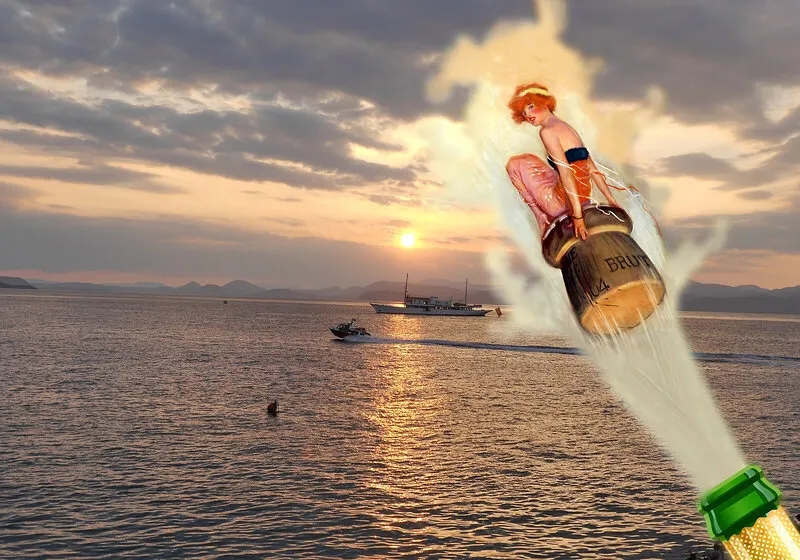
A Tender for Lucy, 2021
Digital
70 x 50 cm
Did she make it? Riding the cork to the yacht in the middle of Hydra Strait. I don’t know, but it must have been a spectacular ride.
The Failed Wine of Champagne
Sip, sip, hooray! Cheers! Yamas! Skål! All over the world, not the least on Hydra, one fills glasses with Champagne when victories are to be celebrated, brides and grooms marry, and, of course, when the new year is greeted with fireworks. The Golden Drops are now considered by many to be the best wine of all. This is the short version of my story for those thinking that less is beautiful. If you want to dig deeper into the secrets behind Champagne, please feel free to continue. For my less-loving friend, it’s time to leave for another FB acquaintance, so be free to jump off. Before you do, I‘ll give you one for the road. A riddle. “Why is an empty champagne bottle like an orphan? Because it has lost its pops.” Now you may leave. Or? Remember, Champagne is not just a drink; it's a journey filled with sparkling stories and intoxicating bubbles.
There is indeed an even shorter way of talking about sparkling goodies. With emoji. It tells a lot but nothing. For my other friends, I will continue to tell facts and secrets about the famous, multifaceted, mythical, and celebrated wine. However, this has not always been the case. Generations of Champagne district wine farmers lived in shame for being unable to produce as good a wine as their counterparts in Burgundy. Bubbles in the wine were seen as an impurity. Only at the end of the 17th century did noble families on the other side of the English Channel begin to appreciate the fizzing bubbles of Champagne. Then, the shame turned to pride, and the money started pouring in. That current hasn't ebbed since, marking a remarkable journey of Champagne from a flawed wine to a celebrated one.
But before we go any further, there is another issue that Mrs Less is Beautiful would like to discuss - the one about the woman and the cork. The picture is sexist, but in my defence, it should be said that it is based on a 1915 English magazine illustration of a lady propelled by a champagne cork. A time-typical view of women, odd but still a bit funny in today's eyes. Not only male chauvinist pigs’.
Why on earth should a woman want to ride a cork? First and foremost, the champagne cork needs to be more significant. Second, it seems to be uncomfortable. Women are known to be practical and comfy and would instead choose an aeroplane seat on the way to Greece. And most certainly, never leave a party when Champagne is still left. But what if there's more to this story? What if there's a hidden meaning behind this quirky image? Let's delve deeper into the world of Champagne and find out.
"The question, where are we going, me and the cork," she might ask herself.
If she started her journey sitting on a bottle at Hydra, the destination could be given to Metoxi on the other side of the strait. She needed to sit on an oversized bottle called the Melchisedech from the Champagne house, Drappier – 120 centimetres high and weighing 45 kilos – grabbing a 31-millimetre cork. Even if the colossal bottle contains 400 glasses of Champagne, climbing would not be easy.
Another conclusion is that she should realise that it was the final trip of her life. The landing against the cliffs of Peloponnesus would be brutal. The verdict must be that the image is false, not to say ridiculous. No woman would travel this way even after a bottle of Champagne alone. Only the bigoted Baron von Münchausen did such a thing, but he chose a cannonball. But fantasy is a beautiful gift, so feel free to join her ride.
Okay, Mrs Less is Beautiful. You can finally leave, and others continue to the Champagne district. I hope you will not regret joining me in my champagne journey over the centuries. It is hilarious with all its sparkling stories and intoxicating bubbles.
The vines, which the Romans were the first to plant in Champagne’s chalky soil in 57 BC, had a hard time. Both during the Roman rule and the following thousand years or so, the area's wine aroused great interest. For a long time, the wine from Champagne was reddish, made from blue grapes, and lacked bubbles—at least deliberately induced ones. The farmers tried desperately to produce a tasty, classic, full-flavoured wine, but the region’s climate was against them.
The cold winters this far north caused fermentation to stop soon after harvest. Nevertheless, the wine was bottled. Not much happened during winter, but as soon as Champagne was reached by the warm rays of the spring sun, fermentation began again. But not with the desired result.
Carbon dioxide bubbles were created in the wine, which was considered a mistake that ruined the already lousy wine. The Champagne farmers called the sparkling product "the evil wine".
"Drink it before Easter, before spring comes, and it gets warm because then the wine starts to fizz again," the wine merchants warned when selling the sour wine from Champagne.
At first, customers loathed the bubbling sensation on the tongue. As early as 1663, the poet Samuel Butler referred to something he called 'brisk champagne'. Even Champagne's falsely claimed creator, Dom Pérignon, disliked it. But when the British tasted the undrinkable carbonated wine, the corks started flying! And how they have flown ever since.
The stinging bubbles, the drink of silliness and the party’s highlight. Humorist and writer Mark Twain couldn't get enough, and womaniser Casanova considered the drink an "indispensable aid to seduction" His peer, the blighter Don Giovanni – a compound of Cruelty and Lust – missed it because he was a fictional character; otherwise, he would most certainly have been one of Champagne’s most significant users. Tsar Peter, the Great of Russia, always brought four bottles to bed with a bunch of girls to warm him up after the chilled Champagne.
History is full of great personalities with a passionate relationship with the sparkling drops from the north of France. Churchill is said to have drunk two bottles of Champagne a day, and by the time he took his last sip in 1965, he had consumed 42,000 bottles of his favourite Pol Roger champagne. He believed Champagne must fulfil three things: dry, cold, and free. He should also have said: “I could not live without Champagne. In victory, I deserve it. In defeat, I need it.” The problem is that the quote is also attributed to Napoleon Bonaparte, maybe after Waterloo one hundred years earlier.
The movie star Marilyn Monroe was a great bubble drinker; Dom Perignon was her favourite brand. She was indeed bright like glitter and bubbly like Champagne. Can you hear the sparkles inside you when Marilyn sang these lines in the unforgettable film ‘Some Like It Hot’ from 1959? Poo-poo-pee-doo, the bubbles sound.
Poo-poo-pee-doo
I wanna be loved by you, just you
And nobody else but you
I wanna be loved by you alone
Boop-boop-de-boop!
Poo-poo-pee-doo
The legendary fashion designer Coco Chanel said she drank bubbles when she was in love—and when she wasn't. Lily Bollinger, once boss at the champagne house with the same name, claimed: “I drink Champagne when I’m happy and when I’m sad. Sometimes I drink it when I’m alone. When I have company, I consider it obligatory. I trifle with it if I’m not hungry and drink it when I am. Otherwise, I never touch it―unless I’m thirsty.”
The name 'Champagne' was already protected in 1891, meaning only sparkling wine from the Champagne district may use the exclusive designation. And the title 'Grand Cru' is even narrower. Grand Cru is the highest classification for a vineyard in Champagne. There are currently 17 villages with Grand-Cru classification out of 319 champagne villages.
If you have 250 euros to spare, try a bottle of Dom Pérignon 2008. It got 97p out of 100. A cherished (unopened) Dom Perignon can last 5 to 10 years or more - if stored properly! Once uncorked, it has a shelf life of around 3-5 days. It’s worth every single Euro.
French wineries outside the narrow Champagne region must use the designation ‘Crémant’ for their sparkling wines. The production is done similarly, but the price is often only one-third. The quality varies, but some are top-class bubbles.
However, the world is nowadays full of buzzing and heady competitors. Some of them are really good.
The German equivalent of Champagne is Sekt. The German bubbles can be dated to the early 19th century when a German wine producer with a background in a French champagne house started producing German sparkling wine. Try Brundlmayer Sekt Brut it’s worth a try. A man in Lederhosen celebrated with a bottle of Sekt. It marked his one-day anniversary of being sober.
Winegrower Carlo Gancia spent several years in Reims in Champagne before developing his so-called Moscato Champagne in 1859. In 1908, the sparkling wine was named Spumante. Italians prefer to toast in Spumante or prosecco, which is mostly an unpretentious wine, a volume product with high yields and a quick production process with a second fermentation in a pressure tank. But there is also the real stuff. I recommend Ca' del Bosco Franciacorta Cuvee Prestige Rosé made using the same method, champenoise, with a similar flavour palate of punchy acidity and toasty yeast. This is sure to impress sparkling connoisseurs. It’s costly but magnificent.
A classic anecdote from Italy is about a man at a wedding who was urged to tell everyone what he had for breakfast. Everybody assumed he had had the standard double espresso on his way to the office. He stepped up on a table and ringed his champagne glass a few times until all eyes stared at him, and then he said in the bride’s direction: "A toast!"
There is no evil without good. In 1872, Spanish winegrower Josep Raventó's red wine vines were attacked by vine lice. Therefore, he started growing green grapes instead - which led to the great success of Cava. Cava is among the most underrated sparkling wines, with the best brands rivalling Champagne and other top fizzes. Cava is made the same way as Champagne and throughout Spain, with no geographical restrictions – unlike in Champagne. I once picked up this story in Madrid. Time was around eleven on New Year’s Eve, and I should soon be off for a party. I was in the hotel lobby bar, and a guy ordered a glass of Champagne. "It's finally happened!" he saluted me and raised his glass. "I've made enough money that I don't have to work for the rest of the year!"
The production of 'Sovetskoje Shampanskoje', Soviet Champagne, began in the 1920s when the state wanted to develop a cheap 'champagne for the people' that was often sweeter than the conservative champagne lover preferred. However, the top drink in Russia is Vodka, which gets you drunk faster. It's tasteless but cost-effective.
A priest, a nun, a giraffe, a telepathic unicorn, twenty-one Crimean Tatars, the evil clown Pantalone, a ninja, and Vladimir Putin walked into a bar in Moscow. The bartender, struggling to open the pink Sjampanskoje, said: “...yeah, I don't know how I'm going to pull this one off”.
South Africa produces a lot of bubbles. The Boschendal is one of my personal favourites. It is very pricey. I cannot guarantee that this story is true, but why not? A drunkard was brought to court in Johannesburg for drunken behaviour. The Judge addressed the drunkard.
"You have been brought here for drinking."
"Thank you very much, your honour. That's very sweet of you. Let's start," said the Drunkard. All present in the court burst out laughing.
"Order," the Judge said, banging the gavel.
"For me, a glass of champagne, please," said the Drunkard.
I was in California after Mr Trump had lost the election and reluctantly left his presidency. The western USA was not his favourite state; he had lost to Biden with 30 per cent. I shared a bottle of Schramsberg Blanc de Blancs, a splendid alternative to Champagne. My friend told me what had happened to Donald Trump and his chauffeur driving on a country road during his campaign.
Suddenly, a sow ran in front of the car. The chauffeur had no time to react, so he ran over the animal, killing it instantly. They got out of the vehicle, looked around and spotted a small farm in the distance. Trump told the driver:
“The Sow probably came from there. You should at least tell them that you killed the pig. Don’t offer any money because the blame is on the Sow. It is always the bitch”. Trump told him what to say, returned to the car, and soon fell asleep.
The chauffeur did as he was told. A few hours later, he came out of the farmhouse, covered in lipstick kiss marks, his clothes in disarray and with a glass of Champagne in each hand. Trump woke up and asked:
“Holy shit! What did you tell those assholes?”
“What you told me to. Hi, I'm Donald Trump's chauffeur, and I've just killed the pig!"
Australia has become a great wine producer and offers a variety of sparkling wines today.
One of the better ones is Castagna Sparkling Genesis Syrah. It shows a deep garnet in colour with a charming bouquet that engulfs your palate with flavours like sandalwood, pepper, a touch of apricot, sexy blackberries and dark cherries mixed with graphite. As it opens up, you taste briary notes and black fruit. It is complex and expensive at 84 $. I was in Sydney in 1992 and oversaw a ferry launch at Cockatoo Island Dockyard. After the shipowner’s wife had baptised the ship, I socialised with the technical director of the shipyard. “How do you launch a champagne factory in Europe,” he asked with a serious face. “They throw a boat at it”, I answered and looked him in the eyes. The company shut down the same year, and I have heard it had something to do with Champagne.
New Zealand produces a lot of excellent wines and sparkling ones, too. Cloudy Bay Pelorus Brut, a Chardonnay Pinot Noir, is part of the luxury goods company LVMH (Louis Vuitton Moët Hennessy). Moët & Chandon, Krug and Veuve Clicquot are other stable mates. It is a safe bet to assume that Marlborough-based Cloudy Bay will get some technical help from the group of Champagne producers. The sophistication suggests so. In a bar in Auckland, I overheard a funny conversation between a married couple.
“Look at that dipso”, she said, nodding in the direction of a visibly drunken fellow with a champagne glass in front of him.
“Who is he?” he answered, giving the boozer a shallow glance.
She said mockingly, “Ten years back, he proposed to me, but I turned him down. See what happens.”
“Oh, my God! He is still celebrating,” he commented and got the last word.
How about Hydra? Some local hardly drinkable wine is produced among the rocks. I am still waiting to discover anything sparkling. But one doesn't have to cross the strait to get water. You can buy good Greek wine on the island. Greece is one of the oldest wine-producing countries in the world. It has millennia of experience and expertise in viticulture and has developed a set of flavours and characteristics found nowhere else on earth. There are less expensive ones, but try Vassaltis Pet Nat, an excellent Greek sparkling wine. Once a week, I go to Isalos during their happy hour. You get every second glass for free. I enjoy a glass of sparkling for its health benefits. The other glasses are for my witty comebacks and flawless dance moves. It was in Isalos that I overheard this conversation some years ago.
An overserved fellow came from the catamaran from Piraeus. His walk was wobbly, and he flopped down at the table next to the town priest and his friend. The man's tie was stained, his hair tousled, his face was plastered with red lipstick, and a half-empty mini bottle of sparkling wine stuck out of his torn coat pocket.
He gave no notice to the priest and his company but opened a crumpled newspaper and began reading. After a few minutes, the dishevelled guy turned to the priest and asked:
"Say, Father, what causes arthritis?"
"It's caused by loose living, cheap women and too much alcohol!" answered the priest in a severe tone.
"Well, I'll be damned!" the wino muttered, returning to his paper.
The town priest thought about what he had said, nudged the man and apologised.
"I'm very sorry. I shouldn't have been so unpleasant about it. Tell me, how long have you had arthritis?"
"I don't have it, Father. I was reading here that the Patriarch does!"
Richard Juhlin is the world's number one champagne expert and has held the world record for the number of champagnes tasted since 1998. He has so far tasted 13,500 different champagnes and 150,000 bottles, including a couple from the early 19th century. That tasting was sensational. After nearly two centuries under the Baltic Sea, the world's oldest Champagne had kept its sparkle and tasted superb. The still-thriving Veuve Clicquot house once produced it. The ship, discovered in 2007 under 150 feet of water, is believed to have sunk between 1825 and 1830. In all, a total of 168 intact Champagne bottles were discovered. The cold temperatures and immense pressure on the corks have offered the wines perfect cellaring conditions. The bottles could fetch as much as $70,000 each at auction! Juhlin once started his career with Spanish Cava because, as a young, he could not afford the real stuff. Officially, he does not comment on sparkling wines other than Champagne. Unofficially, he has said that there are alternatives at the highest level.
The monk Dom Pérignon has wrongly been called the "father of champagne". He did not create the sparkling wine at all. On the contrary, he spent his entire life trying to eliminate the bubbles. However, he revolutionised the wine world with his innovative thinking. Dom Pérignon introduced the morning routine of picking the grapes, as the low temperature helped keep them intact. Pérignon also sorted out damaged grapes, which was unique when quantity was paramount. "Less makes the wine beautiful and brings glory and profit," said the monk. So right, he was. I know that Mrs Less is beautiful, but I would not agree in this case. But that is another story.
Another innovation was Dom Pérignon's experiment with blending wine from different plantations and different grape varieties. The monk also insisted that the pressing be done carefully so that not too much peel would be squeezed into the juice. This way, he got a fine white wine, even though the region's blue grapes were included.
In the 1700s, champagne parties with oysters became popular among European nobility. The English had already discovered the tickling sensation on the tongue, and soon, the fashion spread to noble houses and courts around Europe. At the beginning of the 18th century, the trend had also reached the grapes’ home country and the French court.
"People who like champagne want bubbles in it", proclaimed King Louis XV in 1728. The French Revolution and the subsequent Napoleonic wars temporarily derailed the popularity surge of Champagne. To save some of their noble clients from the guillotine, Champagne merchants altered business records by replacing the titles of their clients with 'Citizen'. During his imprisonment, Citizen Louis Capet got his Champagne this way. However, the merchants lost a vital customer when Louis XVI in 1793 finally lost his mouth and head. "Less is beautiful", said the incorruptible Maximilien Robespierre. "Cheers!" exclaimed his fellow revolutionary, the exuberant Georges Danton, who loved Champagne, soon to follow his king, losing head and mouth.
They might not have lost their head, but the champagne makers had other problems. The bottles exploded. Due to the sales success, the winegrowers of Champagne no longer had to tame the bubbles. Instead, they got a security issue. The slightest shaking or increased temperature and subsequent overpressure caused the bottles to explode. When the so-called devil's wine exploded, the wine farmers were forced to wear specially-made iron masks to protect themselves from flying glass.
If a chain reaction of exploding bottles started, the wine cellar could turn into a war zone in seconds. Improved bottles, precise methods and recipes, and controlled storage have reduced the problem. However, the human element remains. It is no good idea to accidentally add sugar twice, a common mistake in the past. And then it slammed, for example, during The Champagne Riots of 1910 and 1911.
The protests resulted from a series of problems faced by grape growers in the Champagne area. The precipitating event may have been the announcement in 1908 by the French government that it would delimit by decree the exact geographic area that would be granted economic advantage and protection by being awarded the Champagne appellation. Those ending outside feared slowing business and bankruptcy. These borders have been changed back and forth over the years. Less is profitable, at least for those within. As late as 2008, France redrew the boundaries of the fragmented area designated as champagne land in the industry’s biggest shake-up for 80 years. Authorities wanted to cope with surging world demand, particularly from China and Russia, and old markets such as Britain and the US. The changes gave booming business for the areas around 40 villages - not to mention soaring property prices, the value of land could suddenly be 200 times what it was. The lucky chosen villages could overnight change the name of their product from Crémant to Champagne: same product but triple the price.
The explosions could be devastating. At the beginning of the 18th century, wineries lost 20–90 per cent of their production annually. The English came to the rescue. According to historians, they developed thick-bellied and more durable bottles and probably also discovered that you could use bottle stoppers made of cork. Cork was perhaps first used to seal wine in the sixth century BC (BCE) in Toscana (Tuscany). The method was much better at resisting the pressure in the bottle than the oil-soaked hemp with which the French had previously closed the bottleneck. Now, the golden age of Champagne could emerge. There were no more exploding bottles with hemp projectiles flying in the wine cellars. But they should also fly in the future, mainly in a controlled fashion.
In large parts of the world, it is now tradition to let the Champagne corks fly on New Year's Eve. No New Year's party without bubbles in the glass! The practice of drinking Champagne on the last day of the year and toasting the new year with sparkling wine can be traced back to Marie-Antoinette's parties before she followed her husband and lost her head. The queen loved to gamble, dress in expensive dresses and party all night. And drink Champagne. A lot of. She is told to have invented the champagne stirrer so she could drink more but not get too drunk. Its use is heavily frowned upon as it destroys Champagne's most valued and distinctive aspect. And the effect is null; you get as drunk as before. Nowadays, it is a rare device.
Naturally, the bourgeoisie wanted to do the same. In the 19th century, serving bubbles at New Year's parties became increasingly common. Only then did the New Year become a holiday during which large parts of the population stayed until midnight. In the 20th century, the popularity of Champagne also reached a broader population, and they could treat themselves to good food at least once a year and toast the new year with bubbles in the glass.
Eventually, someone got around to throwing a bottle of Champagne at a ship being launched. As soon as the boat bobbed in its proper element, it was toasted in the same Champagne that had been smashed against the ship's hull. Bubbles were needed everywhere. One can honestly speak of an exuberant success, not least because of intelligent marketing.
About two and a half billion bottles of sparkling wine are sold annually worldwide. Of this, 320 million are Champagne – after the French, no one in the world drinks more bubbles than the English, but in terms of value, the USA beats all. The largest producer is Italy, making up 27% of all the sparkling wines in the world. Champagne is no longer the world’s most important sparkling wine when measuring volume, but they are, by far, if we look at value. Champagne accounts for 12% of the world’s sparkling wine but 33% of its value.
You can make the cork fly in different ways. The most advanced is Sabrage, a technique for opening a champagne bottle with a sabre. As you can guess, it was not invented by a woman. It originated from the Napoleonic wars and was a way for young officers to impress aristocratic girls. Also, it speeds up the opening of many bottles. The soldiers also like when the cork and top, like artillery, fly some 10 meters. It is not advisable to be in its way. The world record for sabered bottles in a row is 623. It is, however, more sophisticated – and challenging – to open a bottle with just a discreet hissing noise and keep the cork in your opening hand. It is also appreciated that the host is not having their ceiling destroyed.
How is sabring done? Well, in theory, it's easy, but a lot can go wrong in practice. You can fill the room with shattered glass and flood the floor with expensive Champagne. The wielder must slide the sabre along the body seam of the bottle to the lip to break the top of the neck away, leaving the neck of the bottle open and pouring out the Champagne. Someone must be there prepared with a glass; otherwise, the house lady will hate you. The force of the blunt side of the blade hitting the lip breaks the glass to separate the collar from the neck of the bottle. One does not use the sharp side of the blade. The cork and collar remain together after separating from the neck and fly far away.
During the Napoleonic Wars in the early 1800s, champagne salespeople were hot on the heels of the French army. They were ready with bottles for the celebration after a battle was won. Champagne sales were also well helped by the fact that Napoleon himself loved the sparkling drops. And as I previously wrote, had he lost, he drowned his sorrow in the noble drink. Champagne producer Jean-Rémy Moët presented the Emperor with a guest palace at the Moët family headquarters in Épernay. Champagne was marketed as the drink of the wealthy and upper class, which worked great. Everyone wanted to drink what the emperor drank. When he had lost his empire and been deported to St. Helena, they saluted that in Champagne.
While the carbonated wine was on its way to victory in the world, it was time again. The vines of Champagne were bathed in blood during the First World War. For 1,051 days, shells rained over Reims, leaving four-fifths of the champagne capital in ruins, while the region's precious vineyards were dug up during the fierce trench warfare. Not even Churchill's motivational words could prevent the disaster.
“Remember, gentlemen, it is not just France we are fighting for – it is Champagne!” said the then minister of armaments to his colleagues in 1918. Production resumed after the war, but the vines had barely been tied up before the Second World War cast new shadows over Champagne. The German Wehrmacht occupied the region and confiscated the sparkling wine. In several places, however, the locals managed to wall up and hide cellar vaults with ancient and delicate champagne varieties so the Germans could not find them.
Peace on the Western Front was concluded in Reims in May 1945. It was almost better than the champagne houses' marketers could have planned.
"I think this calls for champagne," Allied Supreme Commander Dwight D. Eisenhower said after signing the document. It’s time to conclude a matter so great that it quickly could fill one of the more extensive wine vaults in Champagne. I will finally share a story from one of my preferred cellars in Epernay. The owner insists it’s true, but it did not happen in his house. It hit a neighbour. Anyhow!
The neighbour had lost his regular taster drowning in a tank with 5000-litre first fermentation blanc de blanc. Rumour tells that this vintage became extraordinary. While the fermentation continued, the neighbour started looking for a new one to hire. This is a rare selection, so the row of applicants was far from endless.
After a week or so, a drunkard with a ragged, dirty look came in to apply for the position. He was from the village, but no person anyone took him seriously.
The neighbour wondered how to send him away without being rude. He gave him a glass to drink and filled it to the rim.
The boozer tried it and said:
“It's a Muscat, three years old, grown on a north slope, matured in steel containers. Low grade, but acceptable.” Then he ostentatiously put down the half-full glass.
"That's correct", said the neighbour and picked forward another bottle without a label. He generously filled another glass with a deep ruby red wine.
The dipso raised the glass, twisted it, and sniffed before taking a big sip, letting the wine roll in his mouth before swallowing it. He took another sip and swallowed again—no waste!
“This is a Cabernet, eight years old, a southwestern slope, oak barrels, blackcurrant, dark cherry and plum, high tannins, matured at 8 degrees. Requires three more years for the finest results.”
"Correct." The neighbour said, a little bit impressed. Cabernet Sauvignon is one of the world's most widely recognised red wine grape varieties because it is resistant to diseases and easily adapts to different climates and soils, including the lime slopes surrounding Epernay.
He went into the wine cellar and was away for almost ten minutes. He brought a dusty bottle, opened it, and filled two glasses, one for himself and one for the carouser.
“What do you think of this one,” he asked with a genuine smile.
"It's a single-vineyard Pinot Noir Champagne Grand Cru, high grade and exclusive,'' the drunkard said calmly, spinning the glass so the bubbles got speed. It is a blend of 65% Pinot Noir and 5% Chardonnay grown south slope on pure Belemnite chalk soil that accumulates heat, further promoting optimum ripeness levels. No need for much extra sugar. It’s vintage from what is called ‘frost years’, 1970, 1971, 1972, and 1973, and they are considered the best years for champagne because they had such a great harvest. The frost was great for growing vines but had no negative effect on the taste of the grapes. As a result, the Champagne was even more flavourful and delicious than before. This one is extra crispy, refreshing, and very tasty. I would say late bottled 1971. A 94/100. If you had added a little more Chardonnay, it would have been one of the all-time highs, a 99.” He stretched forward his glass, asking for a refill.
The neighbour was stunned. He had heard his father saying the same thing, accusing himself of losing a unique opportunity. How on earth could this dipsomaniac know all this? He winked at his secretary, secretly suggesting something. The good-looking girl left the room overly swinging her ass, and came back in with a glass of urine. It was lukewarm.
The alcoholic tried it, smacked his lips, and looked the neighbour into his eyes.
"It's a blond, 26-year-old, three months pregnant, and if I don't get the job, I'll name the father."
He got the job and still drinks but is admittedly one of the best in Epernay.
Dry or sweet?
Many people have bought an extra dry sparkling wine and thought they were purchasing a dry one. But they did not. The particular language for sparkling wines that Champagne has made known worldwide applies to all sparkling wines, at least those produced within the EU. However, a similar terminology has been adopted in many other places. Thus, the following applies to the sugar content or sweetness:
Brut Nature: no dosage (no added sugar) and less than 3 grams of residual sugar (RS, non-fermented sugar) per litre
Extra Brut: between 0 and 6 grams of RS per litre
Brut: less than 12 grams RS (so 0-12)
Extra dry/extra sec: between 12 and 17 grams RS
Dry/sec/trocken: between 17 and 32 grams RS
Demi-sec/halbtrocken: between 32 and 50 grams RS
Doux/mild: more than 50 grams RS
If you think less is not enough, you can read:
Don & Petie Kladstrup, How the world’s most glamorous wine triumphed over war and hard times, Harper Perennial, 2006
Becky Sue Epstein, Champagne: A global history, Reaktion Books, 2011

Jörgen Thornberg
Malmö
Lite om bilder och mig. Translation in English at the end.
Jag är en nyfiken person som ser allt i bilder, även det jag fäster i ord, gärna tillsammans för bakom alla mina bilder finns en berättelse. Till vissa bilder hör en kortare eller längre novell som följer med bilden.
Bilder berättar historier. Jag omges av naturlig skönhet, intressanta människor och historia var jag än går. Jag använder min kamera för att dokumentera världen och blanda det jag ser med vad jag känner för att fånga den dolda magin.
Mina bilder berättar mina historier. Genom mina bilder, tryck och berättelser. Jag bjuder in dig att ta del av dessa berättelser, in i ditt liv och hem och dela min mycket personliga syn på vår värld. Mer än vad ögat ser. Jag tänker i bilder, drömmer och skriver och pratar om dem; följaktligen måste jag också skapa bilder. De blir vad jag ser, inte nödvändigtvis begränsade till verkligheten. Det finns en bild runt varje hörn. Jag hoppas att du kommer att se vad jag såg och gilla det.
Jag är också en skrivande person och till många bilder hör en kortare eller längre essay. Den följer med tavlan, tryckt på fint papper och med en personlig hälsning från mig.
Flertalet bilder startar sin resa i min kamera. Enkelt förklarat beskriver jag bilden jag ser i mitt inre, upplevd eller fantiserad. Bilden uppstår inom mig redan innan jag fått okularet till ögat. På bråkdelen av ett ögonblick ser jag vad jag vill ha och vad som kan göras med bilden. Här skall jag stoppa in en giraff, stålmannen, Titanic eller vad det är min fantasi finner ut. Ännu märkligare är att jag kommer ihåg minnesbilden långt efteråt när det blir tid att skapa verket. Om jag lyckas eller inte, är upp till betraktaren, oftast präglat av en stråk av svart humor – meningen är att man skall bli underhållen. Mina bilder blir ofta en snackis där de hänger.
Jag föredrar bilder som förmedlar ett budskap i flera lager. Vid första anblicken fylld av feel-good, en vacker utsikt, fint väder, solen skiner, blommor på ängen eller vattnet som ligger förrädiskt spegelblankt. I en sådan bild kan jag gömma min egentliga berättelse, mitt förakt för förtryckare och våldsverkare, rasister och fördomsfulla människor - ett gärna återkommande motiv mer eller mindre dolt i det vackra motivet. Jag försöker förena dem i ett gemensamt narrativ.
Bild och formgivning har löpt som en röd tråd genom livet. Fotokonst känns som en värdig final som jag gärna delar med mig.
Min genre är vid som framgår av mina bilder, temat en blandning av pop- och gatukonst i kollage som kan bestå av hundratals lager. Vissa bilder kan ta veckor, andra någon dag innan det är dags att överlämna resultatet till printverkstaden. Fine Art Prints är digitala fotocollage. I dessa kollage sker rivandet, klippandet, pusslandet, målandet, ritandet och sprayningen digitalt. Det jag monterar in kan vara hundratals år gamla bilder som jag omsorgsfullt frilägger så att de ser ut att vara en del av tavlan men också bilder skapade av mig själv efter min egen fantasi. Därefter besöks printstudion och för vissa bilder numrera en limiterad upplaga (oftast 7 exemplar) och signera för hand. Vissa bilder kan köpas i olika format. Det är bara att fråga efter vilka. Gillar man en bild som är 70x100 men inte har plats på väggen, går den kanske att få i 50x70 cm istället. Frågan är fri.
Metoden Giclée eller Fine Art Print som det också kallas är det moderna sättet för framställning av grafisk konst. Villkoret för denna typ av utskrifter är att en högkvalitativ storformatskrivare används med åldersbeständigt färgpigment och konstnärspapper eller i förekommande fall på duk. Pappret som används möter de krav på livslängd som ställs av museer och gallerier. Normalt säljer jag mina bilder oinramade så att den nya ägaren själv kan bestämma hur de skall se ut, med eller utan passepartout färg på ram, med eller utan glas etc..
Under många år ställde jag bara ut på nätet, i valda grupper och på min egen Facebooksida - https://www.facebook.com/jorgen.thornberg.9
Jag finns också på en egen hemsida som tyvärr inte alltid är uppdaterad – https://www.jth.life/ Där kan du också läsa en del av de berättelser som följer med bilden.
UTSTÄLLNINGAR
Luftkastellet, oktober 2022
Konst i Lund, november 2022
Luftkastellet, mars 2023
Engleson Galleri Caroli, april 2023
Hydra, Greece June 2023
Engleson Galleri Caroli, oktober 2023
Toppen, Höllviken december 2023
Luftkastellet, mars 2024
Torups Galleri, mars 2024
Venice, May 2024
Luftkastellet, oktober 2024
Konst i Advent, December 2024
Galleri Engleson, Caroli December 2024
Jäger & Jansson Galleri, april 2025
A bit about pictures and me.
I'm a curious person who sees everything in pictures, even what I express in words, often combining them, for behind all my pictures lies a story. These narratives, some as short as a single image and others as long as a novel, are the heart and soul of my work.
Pictures tell stories. Wherever I go, I'm surrounded by natural beauty, exciting people, and history. I use my camera to document the world and blend what I see with what I feel to capture the hidden magic.
My images tell my stories. Through my pictures, prints, and narratives, I invite you to partake in these stories in your life and home and share my deeply personal perspective of our world. More than meets the eye. I think in pictures, dream, write, and talk about them; consequently, I must create images too. They become what I see, not necessarily confined to reality. There's a picture around every corner. I hope you'll see what I saw and enjoy it.
I'm also a writer, and many images come with a shorter or longer essay. It accompanies the painting, printed on fine paper with my personal greeting.
Many pictures start their journey on my camera. Simply put, I describe the image I see in my mind, experienced or imagined. The image arises within me even before I bring the eyepiece to my eye. In a fraction of a moment, I see what I want and what can be done with the picture. Here, I'll insert a giraffe, Superman, the Titanic, or whatever my imagination conjures up. Even stranger is that I remember the mental image long after it's time to create the work. Whether I succeed is up to the observer, often imbued with a streak of black humour – the aim is to entertain. My pictures usually become a talking point wherever they hang.
I prefer pictures that convey a message in multiple layers. At first glance, they're filled with feel-good vibes, a beautiful view, lovely weather, the sun shining, flowers in the meadow, or the water lying deceptively calm. But beneath this surface beauty, I often conceal a deeper story, a narrative that challenges societal norms or explores the human condition. I invite you to delve into these hidden narratives and discover the layers of meaning within my work.
Picture and design have been a thread running through my life. Photographic art feels like a fitting finale, and I'm happy to share it.
My genre is varied, as seen in my pictures; the theme is a blend of pop and street art in collages that can consist of hundreds of layers. Some images can take weeks, others just a day before it's time to hand over the result to the print workshop. Fine Art Prints are digital photo collages. In these collages, tearing, cutting, puzzling, painting, drawing, and spraying happen digitally. What I insert can be images hundreds of years old that I carefully extract so they appear to be part of the painting, but also images created by myself, now also generated from my imagination. Next, visit the print studio and, for certain images, number a limited edition (usually 7 copies) and sign them by hand. Some images may be available in other formats. Just ask which ones. If you like an image that's 70x100 but doesn't have space on the wall, you might be able to get it in 50x70 cm instead. The question is open.
The Giclée method, or Fine Art Print as it's also called, is the modern way of producing graphic art. This method ensures the highest quality and longevity of the artwork, using a high-quality large-format printer with archival pigment inks and artist paper or, in some cases, canvas. The paper used meets the longevity requirements set by museums and galleries. I sell my pictures unframed, allowing the new owner to personalise their artwork, confident in the lasting value and quality of the piece.
For many years, I only exhibited online, in selected groups, and on my Facebook page - https://www.facebook.com/jorgen.thornberg.9. I also have my website, which unfortunately is not constantly updated - https://www.jth.life/. You can also read some of the stories accompanying the pictures there.
EXHIBITIONS
Luftkastellet, October 2022
Art in Lund, November 2022
Luftkastellet, March 2023
Engleson Gallery Caroli, April 2023
Hydra, Greece June 2023
Engleson Gallery Caroli, October 2023
Toppen, Höllviken December 2023
Luftkastellet, March 2024
Torup Gallery, March 2024
Venice, May 2024
UTSTÄLLNINGAR
Luftkastellet, oktober 2022
Konst i Lund, november 2022
Luftkastellet, mars 2023
Engleson Galleri Caroli, april 2023
Hydra, Greece June 2023
Engleson Galleri Caroli, oktober 2023
Toppen, Höllviken december 2023
Luftkastellet, mars 2024
Torups Galleri, mars 2024
Venice, May 2024
Luftkastellet, October 2024
Konst i Advent, December 2024
Galleri Engleson, Caroli December 2024
Jäger & Jansson Galleri, April 2025
Utbildning
Autodidakt
Medlem i konstnärsförening
Öppna Sinnen
Med i konstrunda
Konstrundan i Skåne
Utställningar
Luftkastellet, October 2022
Art in Lund, November 2022
Luftkastellet, March 2023
Engleson Gallery Caroli, April 2023
Hydra, Greece June 2023
Engleson Gallery Caroli, October 2023
Toppen, Höllviken December 2023
Luftkastellet, March 2024
Torup Gallery, March 2024
Venice, May 2024