Vi använder cookies för att ge dig bästa möjliga upplevelse. Välj vilka cookies du tillåter.
Läs mer i vår integritetspolicy
Jörgen Thornberg
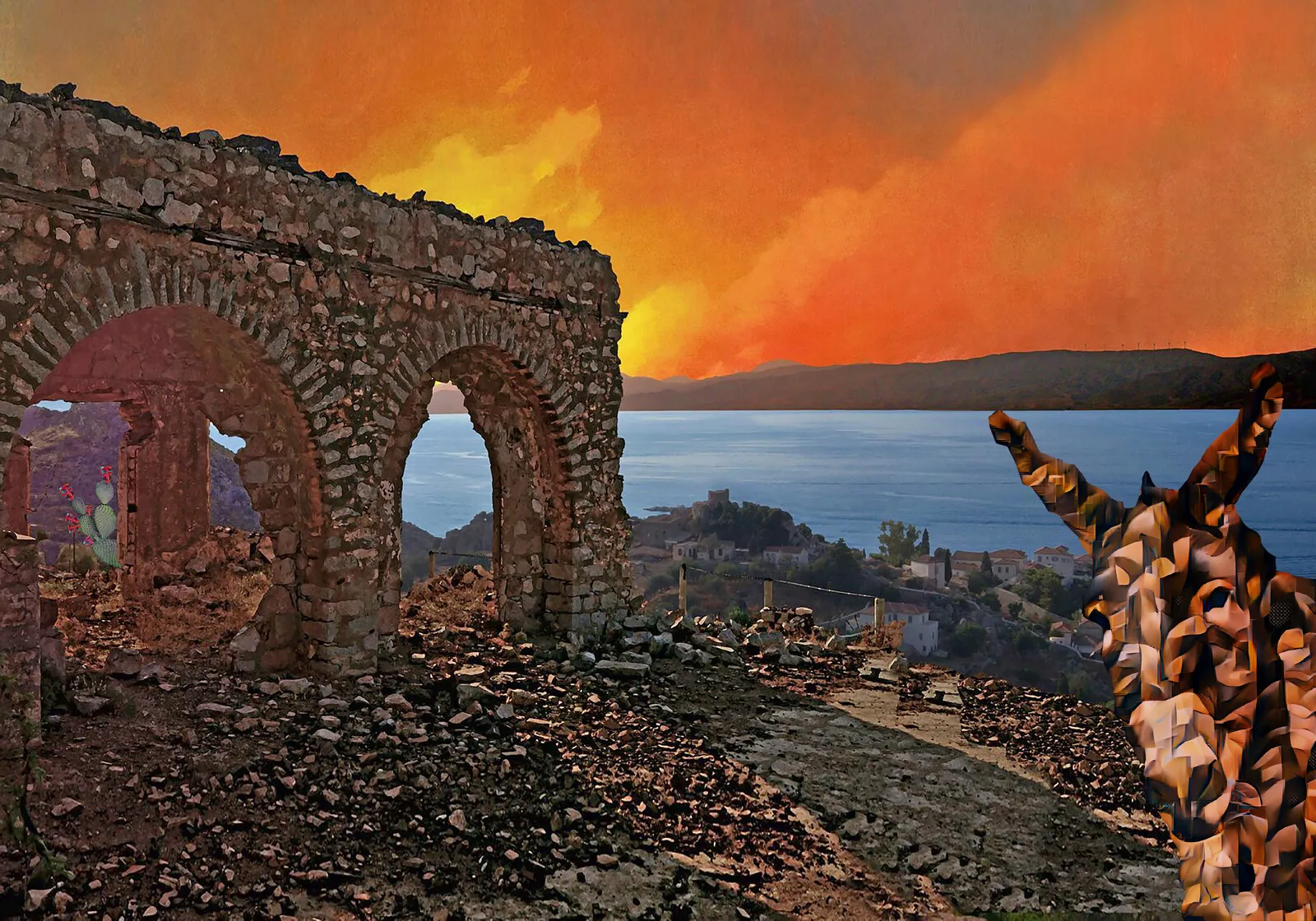
Ghikaboo! A Cubistic Donkey’s Tribute, 2021
Digital
70 x 50 cm
Your ruined villa still
guards the broken hill
observing avarice and fire.
The three stanzas from "For Ghika" in The Poetry of Bettina Helen Massie summarise the drama surrounding Niko Ghika and his mansion above Kamini on Hydra. The poet's husband admits they used to steal figs and almonds from the ruined garden. So have I, and unlike most people, I have sneaked in there, felt the weight of the past and taken lots of pictures from angles that must once have satisfied Ghikas and his guests. One I show here. How I felt at the moment and the presence of Niko Ghika.
The painter Nikos Hadjikyriakos-Ghikas, a unique figure in the art world, is long gone, but the cubic ruins of his dream castle remain, a testament to his unconventional vision. They inspire passersby and are objects of wonder, speculation, and gossip. Like his distinct cubistic art, Ghikas and his mansion have become a part of the island's mythology.
The burnt-out shell of the once majestic mansion still sparks flights of fancy. It reminds us of the good old days and Ghika's highly personal version of Cubism. It also makes us ponder the dark allure of ruins in general and Ghikas in particular.
Observing the mansion without considering Ghikas, his art, and the drama around the fire is to overlook a significant piece of history. Once in the house, the artist created important paintings and filled his mansion with beautiful furniture, oriental carpets, and a well-assorted library. The place was among the particularities around which Hydra's reputation grew as a haven for artists and cultural people, followed by all sorts of notabilities. It became the jewel in the Hydra crown, a symbol of the island's cultural richness that had existed since before the war and exploded in the 1950s and 60s.
Behind the walls, nearly sixty years after its destruction, the Ghikas mansion gradually becomes an old ruin, a poignant reminder of the fleeting nature of human achievements. Weathered and overrun with wildflowers, home to cats and stray dogs, donkeys and goats, it is a testament to life's impermanence. As a piece of cubistic art, his mansion prevails, and each year, it reminds us more and more about one of his paintings.
Please read on to learn more about Ghikas and his Cubism.
The sky is burning, and a donkey peeks into the picture. Living and dead take new shapes in the twilight and remind of a great painter's work. You see what you want to see under the intoxicating influence of nature and the everchanging painting signed by the setting sun. Something or somebody triggers my shutter, filling the camera lens with a sparkling miracle. The contrasts are striking. In one of Pablo Picasso's most famous cubistic paintings, The Ladies of Avignon, from 1907, two women look like donkeys. It could be that a couple of them had sneaked into my picture, mixing into the haze around the island of Dokos seen through the ruined arches.
His dark ruin, Niko Ghika's burned-down 40-room mansion on Hydra, stands there as a grim reminder of a ruined life's work - the colours not at all reminiscent of the artist's cubist work depicting his beloved Hydra and the abandoned nine terraces dug into the steep ridge still overlooking Kamini and the setting sun. It lays like a wound on the hillside. During its heydays, the mansion was Niko Ghika's family ziggurat in Hydra, a holy place running along a fateful road from an Artists' Haven to Enchanted Ruins.
Today, you must imagine what once happened on the other side of the high walls, maybe having seen photographs, reading a book, or using your fantasy to figure out the former leisure inside the houses. They had great fun, I can tell. The phenomenon of 'cultural tourism' and a touristic leveraging of Hydra is a cultural capital accrued by tangible locations associated with writers, artists, and singers – and myths. While the Beatles were finding each other in Liverpool, the expatriate artist community had already formed on Hydra. Before 1960, the hub was Ghika and his castle, which had been so since before the war. Wine flew in streams, and the cuisine led by Madame Ghikas was excellent. From today's decayed terrace, once distinctly Oriental in flavour, guests could look out on the sea in drunken stupefaction. In 1821, the view was described as 'the white arms of the little town clasping the rugged bosom of the wild rock.'
Nikos Hadjikyriakos-Ghikas - also known as Niko Ghika - was, in the late 1920s, drawn to the simplest form of art, Cubism, or more precisely, its second period, Synthetic Cubism and once introduced by artists Pablo Picasso and Georges Braque, seeking the reduction of the visible to abstract shapes. Synthetic Cubism let Ghika return to his objects' sources, to their senses, to a new acquaintance with the things themselves, which finally led to a collage. Ghika was initiated to Cubism through Hydra's nature and its light and colour. When Cubism in its first stage occurred during 1907-14, the movement opposed the Impressionists' light depictions and the Expressionists' subjective expression and tried to achieve a more objective picture of reality.
I prefer Ghika's interpretation of Cubism, his version under the influence of his loved island, Hydra.
Ghika's rejuvenated philosophy of Cubism, deeply rooted in medieval Greek painting, is a testament to his artistic brilliance. His dismissal of the horizon line, economical use of colours, and emotional rather than descriptive approach mirrored the aesthetics of Byzantine art. What was once dismissed as primitive was now seen as an escape from the tyranny of too accurate photographic representation. Ghika's freedom to find joy in transformation instead of being restricted by imitation was a gift he reintroduced to his native country, leaving an indelible mark on the art world.
The artist focused on harmony and purity and wanted to deconstruct the Hydriatic landscape and the intense natural light into simple geometric shapes and interlocking planes. Cubist ideas and techniques continue to be used today, particularly collages invented during the synthetic period. I love to weave together different eras, artists, things, and events in photo collages that blur time and space. The style was four-dimensional, combining length, area, volume, and passage of time. Cubism was heavily influenced by the theories of French artist Henri Bergson, who believed that time and space were fluid concepts.
Early 20th-century art critics found the idea of painters not objectively replicating the world anxiety-inducing. Abstraction was heretical. The French art critic Louis Vauxcelles insultingly referred to paintings by Picasso and Georges Braque as composed of "little cubes." Thereof, Cubism.
Like my pictures, Synthetic Cubism is all about construction or synthesis, bridging the gap between reality and art by literally interpolating real-world pieces into the picture.
Ghika's interest in 'austere structures' was deeply influenced by the higgledy-piggledy flow of white Greek houses down the hillside at Hydra or the stone walls zigzagging across the dry landscape. His abstract landscapes and the way he blurred the line between painting and sculpture in his version of Synthetic Cubism reflected his personal experiences and observations.
He wove together planes and lines, fracturing the subjects, leaving an illusion of a third dimension with every subject portrayed from multiple perspectives. While other cubists used a limited range of dark colours with slight tonal variation tending to be muted with a similar dark tone, Ghikas' oeuvre only partially followed cubist standards, combining constructivism with the rich colours and traditional particularities of the Hydriatic landscape.
Instead of looking closely at an object, such as a hammock, to interpret its shape and structure, Ghika created a hammock-like body from his imagination in one of his paintings. Could it be a small boat he had seen in the Kamini harbour below his house? Contrary to reassembling facets of the original image, he synthesized entirely new structures.
Hydra often appeared directly or indirectly in Ghikas' compositions after leaving the island and was usually in his imaginative mind. Ghika lived in a grand 18th-century mansion built by his great-great-great-grandfather overlooking Kamini and the island, which provided the subjects for hundreds of paintings and sketches. He was a figurative painter in that his pictures always have a real-world object, but Ghika gives everything a strongly geometric stylization.
To this grand setting, Ghikas invited numerous friends, including, among others, the American writer Henry Miller, who was working on his book 'The Colossus of Marousi' in his house, considered by many to be Miller's most excellent book; Ghikas' dear friend Patrick Leigh Fermor (Paddy) during an extended stay finishing his successful travel book, Mani and fellow artist John Craxton, not to forget two Greek writers, George Seferis, a diplomat and poet who would be awarded the Nobel Prize for Literature in 1963, and George Katsimbalis, an editor and publisher who was enormously influential on Greek literature of the period.
For fifteen years after WWII, his Hydra mansion was Ghika's base and a popular venue for artists, writers, and artists in the arts to meet and mingle.
Ghikas' departure from Hydra was a tragic and involuntary event; his life's work, his sanctuary, was reduced to ashes for unclear reasons. Some attribute it to a housekeeper's anger at her employer for leaving his wife for another woman. Regardless, Ghikas never returned to his house, but instead, a trusted friend was sent to salvage what remained of his masterpieces.
Only structures, walls, empty, overgrown terraces, and former gardens remain today. What once was a dream on earth looks more like a dark, gloomy version of synthetic Cubism than Ghika's whimsical and colourful images. The complete tragedy is compounded by the fact that Hydra has not given the island's great man, perhaps Greece's most significant artist of all time, his museum, only a street stump bearing his name. Better it is in Athens, where a whole house cherishes Ghikas' memory—shame on Hydra.
The viewer of ruins is not merely confronted with the past but is compelled to contemplate our shared destiny. To politicians, ruins symbolize the fall of Empires, and to philosophers, they represent the futility of mortal man's aspirations. As a writer, I see the decay of a monument like Ghikas' house as the dissolution of the individual ego in the flow of time. To painters or architects, the fragments of stupendous antiquity call into question the purpose of their art. To me, it is a timeless reminder of the impermanence of everything, a profound reflection on the transience of human achievements.
Sic transit gloria mundi. Thus passes the glory of the world.
Jörgen Thornberg
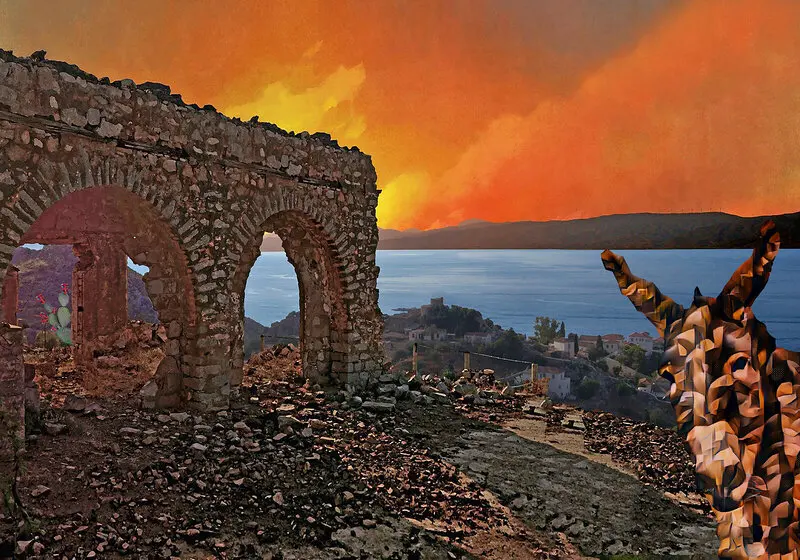
Ghikaboo! A Cubistic Donkey’s Tribute, 2021
Digital
70 x 50 cm
Your ruined villa still
guards the broken hill
observing avarice and fire.
The three stanzas from "For Ghika" in The Poetry of Bettina Helen Massie summarise the drama surrounding Niko Ghika and his mansion above Kamini on Hydra. The poet's husband admits they used to steal figs and almonds from the ruined garden. So have I, and unlike most people, I have sneaked in there, felt the weight of the past and taken lots of pictures from angles that must once have satisfied Ghikas and his guests. One I show here. How I felt at the moment and the presence of Niko Ghika.
The painter Nikos Hadjikyriakos-Ghikas, a unique figure in the art world, is long gone, but the cubic ruins of his dream castle remain, a testament to his unconventional vision. They inspire passersby and are objects of wonder, speculation, and gossip. Like his distinct cubistic art, Ghikas and his mansion have become a part of the island's mythology.
The burnt-out shell of the once majestic mansion still sparks flights of fancy. It reminds us of the good old days and Ghika's highly personal version of Cubism. It also makes us ponder the dark allure of ruins in general and Ghikas in particular.
Observing the mansion without considering Ghikas, his art, and the drama around the fire is to overlook a significant piece of history. Once in the house, the artist created important paintings and filled his mansion with beautiful furniture, oriental carpets, and a well-assorted library. The place was among the particularities around which Hydra's reputation grew as a haven for artists and cultural people, followed by all sorts of notabilities. It became the jewel in the Hydra crown, a symbol of the island's cultural richness that had existed since before the war and exploded in the 1950s and 60s.
Behind the walls, nearly sixty years after its destruction, the Ghikas mansion gradually becomes an old ruin, a poignant reminder of the fleeting nature of human achievements. Weathered and overrun with wildflowers, home to cats and stray dogs, donkeys and goats, it is a testament to life's impermanence. As a piece of cubistic art, his mansion prevails, and each year, it reminds us more and more about one of his paintings.
Please read on to learn more about Ghikas and his Cubism.
The sky is burning, and a donkey peeks into the picture. Living and dead take new shapes in the twilight and remind of a great painter's work. You see what you want to see under the intoxicating influence of nature and the everchanging painting signed by the setting sun. Something or somebody triggers my shutter, filling the camera lens with a sparkling miracle. The contrasts are striking. In one of Pablo Picasso's most famous cubistic paintings, The Ladies of Avignon, from 1907, two women look like donkeys. It could be that a couple of them had sneaked into my picture, mixing into the haze around the island of Dokos seen through the ruined arches.
His dark ruin, Niko Ghika's burned-down 40-room mansion on Hydra, stands there as a grim reminder of a ruined life's work - the colours not at all reminiscent of the artist's cubist work depicting his beloved Hydra and the abandoned nine terraces dug into the steep ridge still overlooking Kamini and the setting sun. It lays like a wound on the hillside. During its heydays, the mansion was Niko Ghika's family ziggurat in Hydra, a holy place running along a fateful road from an Artists' Haven to Enchanted Ruins.
Today, you must imagine what once happened on the other side of the high walls, maybe having seen photographs, reading a book, or using your fantasy to figure out the former leisure inside the houses. They had great fun, I can tell. The phenomenon of 'cultural tourism' and a touristic leveraging of Hydra is a cultural capital accrued by tangible locations associated with writers, artists, and singers – and myths. While the Beatles were finding each other in Liverpool, the expatriate artist community had already formed on Hydra. Before 1960, the hub was Ghika and his castle, which had been so since before the war. Wine flew in streams, and the cuisine led by Madame Ghikas was excellent. From today's decayed terrace, once distinctly Oriental in flavour, guests could look out on the sea in drunken stupefaction. In 1821, the view was described as 'the white arms of the little town clasping the rugged bosom of the wild rock.'
Nikos Hadjikyriakos-Ghikas - also known as Niko Ghika - was, in the late 1920s, drawn to the simplest form of art, Cubism, or more precisely, its second period, Synthetic Cubism and once introduced by artists Pablo Picasso and Georges Braque, seeking the reduction of the visible to abstract shapes. Synthetic Cubism let Ghika return to his objects' sources, to their senses, to a new acquaintance with the things themselves, which finally led to a collage. Ghika was initiated to Cubism through Hydra's nature and its light and colour. When Cubism in its first stage occurred during 1907-14, the movement opposed the Impressionists' light depictions and the Expressionists' subjective expression and tried to achieve a more objective picture of reality.
I prefer Ghika's interpretation of Cubism, his version under the influence of his loved island, Hydra.
Ghika's rejuvenated philosophy of Cubism, deeply rooted in medieval Greek painting, is a testament to his artistic brilliance. His dismissal of the horizon line, economical use of colours, and emotional rather than descriptive approach mirrored the aesthetics of Byzantine art. What was once dismissed as primitive was now seen as an escape from the tyranny of too accurate photographic representation. Ghika's freedom to find joy in transformation instead of being restricted by imitation was a gift he reintroduced to his native country, leaving an indelible mark on the art world.
The artist focused on harmony and purity and wanted to deconstruct the Hydriatic landscape and the intense natural light into simple geometric shapes and interlocking planes. Cubist ideas and techniques continue to be used today, particularly collages invented during the synthetic period. I love to weave together different eras, artists, things, and events in photo collages that blur time and space. The style was four-dimensional, combining length, area, volume, and passage of time. Cubism was heavily influenced by the theories of French artist Henri Bergson, who believed that time and space were fluid concepts.
Early 20th-century art critics found the idea of painters not objectively replicating the world anxiety-inducing. Abstraction was heretical. The French art critic Louis Vauxcelles insultingly referred to paintings by Picasso and Georges Braque as composed of "little cubes." Thereof, Cubism.
Like my pictures, Synthetic Cubism is all about construction or synthesis, bridging the gap between reality and art by literally interpolating real-world pieces into the picture.
Ghika's interest in 'austere structures' was deeply influenced by the higgledy-piggledy flow of white Greek houses down the hillside at Hydra or the stone walls zigzagging across the dry landscape. His abstract landscapes and the way he blurred the line between painting and sculpture in his version of Synthetic Cubism reflected his personal experiences and observations.
He wove together planes and lines, fracturing the subjects, leaving an illusion of a third dimension with every subject portrayed from multiple perspectives. While other cubists used a limited range of dark colours with slight tonal variation tending to be muted with a similar dark tone, Ghikas' oeuvre only partially followed cubist standards, combining constructivism with the rich colours and traditional particularities of the Hydriatic landscape.
Instead of looking closely at an object, such as a hammock, to interpret its shape and structure, Ghika created a hammock-like body from his imagination in one of his paintings. Could it be a small boat he had seen in the Kamini harbour below his house? Contrary to reassembling facets of the original image, he synthesized entirely new structures.
Hydra often appeared directly or indirectly in Ghikas' compositions after leaving the island and was usually in his imaginative mind. Ghika lived in a grand 18th-century mansion built by his great-great-great-grandfather overlooking Kamini and the island, which provided the subjects for hundreds of paintings and sketches. He was a figurative painter in that his pictures always have a real-world object, but Ghika gives everything a strongly geometric stylization.
To this grand setting, Ghikas invited numerous friends, including, among others, the American writer Henry Miller, who was working on his book 'The Colossus of Marousi' in his house, considered by many to be Miller's most excellent book; Ghikas' dear friend Patrick Leigh Fermor (Paddy) during an extended stay finishing his successful travel book, Mani and fellow artist John Craxton, not to forget two Greek writers, George Seferis, a diplomat and poet who would be awarded the Nobel Prize for Literature in 1963, and George Katsimbalis, an editor and publisher who was enormously influential on Greek literature of the period.
For fifteen years after WWII, his Hydra mansion was Ghika's base and a popular venue for artists, writers, and artists in the arts to meet and mingle.
Ghikas' departure from Hydra was a tragic and involuntary event; his life's work, his sanctuary, was reduced to ashes for unclear reasons. Some attribute it to a housekeeper's anger at her employer for leaving his wife for another woman. Regardless, Ghikas never returned to his house, but instead, a trusted friend was sent to salvage what remained of his masterpieces.
Only structures, walls, empty, overgrown terraces, and former gardens remain today. What once was a dream on earth looks more like a dark, gloomy version of synthetic Cubism than Ghika's whimsical and colourful images. The complete tragedy is compounded by the fact that Hydra has not given the island's great man, perhaps Greece's most significant artist of all time, his museum, only a street stump bearing his name. Better it is in Athens, where a whole house cherishes Ghikas' memory—shame on Hydra.
The viewer of ruins is not merely confronted with the past but is compelled to contemplate our shared destiny. To politicians, ruins symbolize the fall of Empires, and to philosophers, they represent the futility of mortal man's aspirations. As a writer, I see the decay of a monument like Ghikas' house as the dissolution of the individual ego in the flow of time. To painters or architects, the fragments of stupendous antiquity call into question the purpose of their art. To me, it is a timeless reminder of the impermanence of everything, a profound reflection on the transience of human achievements.
Sic transit gloria mundi. Thus passes the glory of the world.

Jörgen Thornberg
Malmö
Lite om bilder och mig. Translation in English at the end.
Jag är en nyfiken person som ser allt i bilder, även det jag fäster i ord, gärna tillsammans för bakom alla mina bilder finns en berättelse. Till vissa bilder hör en kortare eller längre novell som följer med bilden.
Bilder berättar historier. Jag omges av naturlig skönhet, intressanta människor och historia var jag än går. Jag använder min kamera för att dokumentera världen och blanda det jag ser med vad jag känner för att fånga den dolda magin.
Mina bilder berättar mina historier. Genom mina bilder, tryck och berättelser. Jag bjuder in dig att ta del av dessa berättelser, in i ditt liv och hem och dela min mycket personliga syn på vår värld. Mer än vad ögat ser. Jag tänker i bilder, drömmer och skriver och pratar om dem; följaktligen måste jag också skapa bilder. De blir vad jag ser, inte nödvändigtvis begränsade till verkligheten. Det finns en bild runt varje hörn. Jag hoppas att du kommer att se vad jag såg och gilla det.
Jag är också en skrivande person och till många bilder hör en kortare eller längre essay. Den följer med tavlan, tryckt på fint papper och med en personlig hälsning från mig.
Flertalet bilder startar sin resa i min kamera. Enkelt förklarat beskriver jag bilden jag ser i mitt inre, upplevd eller fantiserad. Bilden uppstår inom mig redan innan jag fått okularet till ögat. På bråkdelen av ett ögonblick ser jag vad jag vill ha och vad som kan göras med bilden. Här skall jag stoppa in en giraff, stålmannen, Titanic eller vad det är min fantasi finner ut. Ännu märkligare är att jag kommer ihåg minnesbilden långt efteråt när det blir tid att skapa verket. Om jag lyckas eller inte, är upp till betraktaren, oftast präglat av en stråk av svart humor – meningen är att man skall bli underhållen. Mina bilder blir ofta en snackis där de hänger.
Jag föredrar bilder som förmedlar ett budskap i flera lager. Vid första anblicken fylld av feel-good, en vacker utsikt, fint väder, solen skiner, blommor på ängen eller vattnet som ligger förrädiskt spegelblankt. I en sådan bild kan jag gömma min egentliga berättelse, mitt förakt för förtryckare och våldsverkare, rasister och fördomsfulla människor - ett gärna återkommande motiv mer eller mindre dolt i det vackra motivet. Jag försöker förena dem i ett gemensamt narrativ.
Bild och formgivning har löpt som en röd tråd genom livet. Fotokonst känns som en värdig final som jag gärna delar med mig.
Min genre är vid som framgår av mina bilder, temat en blandning av pop- och gatukonst i kollage som kan bestå av hundratals lager. Vissa bilder kan ta veckor, andra någon dag innan det är dags att överlämna resultatet till printverkstaden. Fine Art Prints är digitala fotocollage. I dessa kollage sker rivandet, klippandet, pusslandet, målandet, ritandet och sprayningen digitalt. Det jag monterar in kan vara hundratals år gamla bilder som jag omsorgsfullt frilägger så att de ser ut att vara en del av tavlan men också bilder skapade av mig själv efter min egen fantasi. Därefter besöks printstudion och för vissa bilder numrera en limiterad upplaga (oftast 7 exemplar) och signera för hand. Vissa bilder kan köpas i olika format. Det är bara att fråga efter vilka. Gillar man en bild som är 70x100 men inte har plats på väggen, går den kanske att få i 50x70 cm istället. Frågan är fri.
Metoden Giclée eller Fine Art Print som det också kallas är det moderna sättet för framställning av grafisk konst. Villkoret för denna typ av utskrifter är att en högkvalitativ storformatskrivare används med åldersbeständigt färgpigment och konstnärspapper eller i förekommande fall på duk. Pappret som används möter de krav på livslängd som ställs av museer och gallerier. Normalt säljer jag mina bilder oinramade så att den nya ägaren själv kan bestämma hur de skall se ut, med eller utan passepartout färg på ram, med eller utan glas etc..
Under många år ställde jag bara ut på nätet, i valda grupper och på min egen Facebooksida - https://www.facebook.com/jorgen.thornberg.9
Jag finns också på en egen hemsida som tyvärr inte alltid är uppdaterad – https://www.jth.life/ Där kan du också läsa en del av de berättelser som följer med bilden.
UTSTÄLLNINGAR
Luftkastellet, oktober 2022
Konst i Lund, november 2022
Luftkastellet, mars 2023
Engleson Galleri Caroli, april 2023
Hydra, Greece June 2023
Engleson Galleri Caroli, oktober 2023
Toppen, Höllviken december 2023
Luftkastellet, mars 2024
Torups Galleri, mars 2024
Venice, May 2024
Luftkastellet, oktober 2024
Konst i Advent, December 2024
Galleri Engleson, Caroli December 2024
Jäger & Jansson Galleri, april 2025
A bit about pictures and me.
I'm a curious person who sees everything in pictures, even what I express in words, often combining them, for behind all my pictures lies a story. These narratives, some as short as a single image and others as long as a novel, are the heart and soul of my work.
Pictures tell stories. Wherever I go, I'm surrounded by natural beauty, exciting people, and history. I use my camera to document the world and blend what I see with what I feel to capture the hidden magic.
My images tell my stories. Through my pictures, prints, and narratives, I invite you to partake in these stories in your life and home and share my deeply personal perspective of our world. More than meets the eye. I think in pictures, dream, write, and talk about them; consequently, I must create images too. They become what I see, not necessarily confined to reality. There's a picture around every corner. I hope you'll see what I saw and enjoy it.
I'm also a writer, and many images come with a shorter or longer essay. It accompanies the painting, printed on fine paper with my personal greeting.
Many pictures start their journey on my camera. Simply put, I describe the image I see in my mind, experienced or imagined. The image arises within me even before I bring the eyepiece to my eye. In a fraction of a moment, I see what I want and what can be done with the picture. Here, I'll insert a giraffe, Superman, the Titanic, or whatever my imagination conjures up. Even stranger is that I remember the mental image long after it's time to create the work. Whether I succeed is up to the observer, often imbued with a streak of black humour – the aim is to entertain. My pictures usually become a talking point wherever they hang.
I prefer pictures that convey a message in multiple layers. At first glance, they're filled with feel-good vibes, a beautiful view, lovely weather, the sun shining, flowers in the meadow, or the water lying deceptively calm. But beneath this surface beauty, I often conceal a deeper story, a narrative that challenges societal norms or explores the human condition. I invite you to delve into these hidden narratives and discover the layers of meaning within my work.
Picture and design have been a thread running through my life. Photographic art feels like a fitting finale, and I'm happy to share it.
My genre is varied, as seen in my pictures; the theme is a blend of pop and street art in collages that can consist of hundreds of layers. Some images can take weeks, others just a day before it's time to hand over the result to the print workshop. Fine Art Prints are digital photo collages. In these collages, tearing, cutting, puzzling, painting, drawing, and spraying happen digitally. What I insert can be images hundreds of years old that I carefully extract so they appear to be part of the painting, but also images created by myself, now also generated from my imagination. Next, visit the print studio and, for certain images, number a limited edition (usually 7 copies) and sign them by hand. Some images may be available in other formats. Just ask which ones. If you like an image that's 70x100 but doesn't have space on the wall, you might be able to get it in 50x70 cm instead. The question is open.
The Giclée method, or Fine Art Print as it's also called, is the modern way of producing graphic art. This method ensures the highest quality and longevity of the artwork, using a high-quality large-format printer with archival pigment inks and artist paper or, in some cases, canvas. The paper used meets the longevity requirements set by museums and galleries. I sell my pictures unframed, allowing the new owner to personalise their artwork, confident in the lasting value and quality of the piece.
For many years, I only exhibited online, in selected groups, and on my Facebook page - https://www.facebook.com/jorgen.thornberg.9. I also have my website, which unfortunately is not constantly updated - https://www.jth.life/. You can also read some of the stories accompanying the pictures there.
EXHIBITIONS
Luftkastellet, October 2022
Art in Lund, November 2022
Luftkastellet, March 2023
Engleson Gallery Caroli, April 2023
Hydra, Greece June 2023
Engleson Gallery Caroli, October 2023
Toppen, Höllviken December 2023
Luftkastellet, March 2024
Torup Gallery, March 2024
Venice, May 2024
UTSTÄLLNINGAR
Luftkastellet, oktober 2022
Konst i Lund, november 2022
Luftkastellet, mars 2023
Engleson Galleri Caroli, april 2023
Hydra, Greece June 2023
Engleson Galleri Caroli, oktober 2023
Toppen, Höllviken december 2023
Luftkastellet, mars 2024
Torups Galleri, mars 2024
Venice, May 2024
Luftkastellet, October 2024
Konst i Advent, December 2024
Galleri Engleson, Caroli December 2024
Jäger & Jansson Galleri, April 2025
Utbildning
Autodidakt
Medlem i konstnärsförening
Öppna Sinnen
Med i konstrunda
Konstrundan i Skåne
Utställningar
Luftkastellet, October 2022
Art in Lund, November 2022
Luftkastellet, March 2023
Engleson Gallery Caroli, April 2023
Hydra, Greece June 2023
Engleson Gallery Caroli, October 2023
Toppen, Höllviken December 2023
Luftkastellet, March 2024
Torup Gallery, March 2024
Venice, May 2024