Vi använder cookies för att ge dig bästa möjliga upplevelse. Välj vilka cookies du tillåter.
Läs mer i vår integritetspolicy
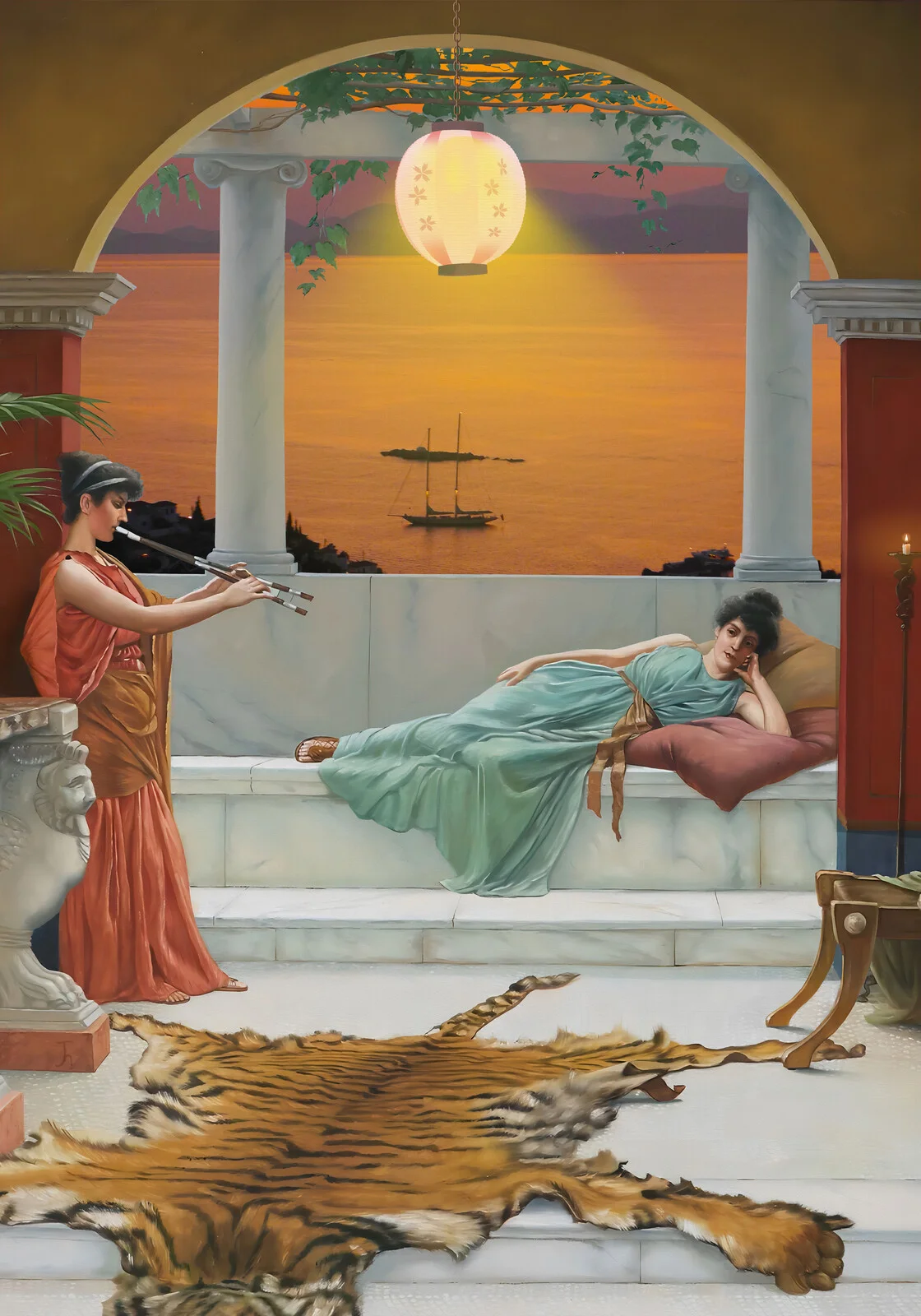
Jörgen Thornberg
Serenade on Flute, 2022
Digital
50 x 70 cm
Sleep, love sleep,
The night winds sigh,
In soft lullaby.
The Lark is at rest
With the dew on her breast.
So close those dear eyes,
That borrowed their hue
From the heavens so blue,
Sleep, love sleep.
The stanzas from the poem "Serenade" by 19th-century American poet Mary Weston Fordham are timeless and could have been written two millennia earlier during antiquity. Or today. The woman in the picture plays an aulos, the ancient Greek double-piped wind instrument with a dramatic birth in connection with a musical challenge between a satyr and Apollo. A serenade is often played in honour of something or somebody. From the picture, we must conclude that she is paying tribute to Hydra and one of the island's glowing sunsets. In ancient Greece, Aulos was often depicted as a hetaera, a controversial kind of woman, a sort of prostitute, courtesan, or mistress. Or could the picture hide anything else, something related to the island of Lesbos? The picture's opaque message conceals secrets from the past worth knowing.
Read the full story on old-time flutes, courtesans, and serenades!
Indeed, the start was dramatic for the ancient double flute or pipe. Apollo challenged a Satyr to play the Aulos. Apollo did not win as planned because King Midas, as judge, chose the Satyr and made the god the lesser player. Apollo became angry and turned Midas's ears into those of a donkey as a sign of the king's foolishness. The two contenders may have played the Delphic Hymns, two musical compositions from Ancient Greece, which have survived in substantial fragments. These Hymns were aptly enough addressed to Apollo, which did not help the god in this case. The pipe has been reconstructed and played after archaeologists found fragments of Aulos. Before that, we only knew about them through numerous pictures on urns and vases.
In myth, Marsyas the Satyr is told to have invented the aulos or picked it up after Athena had thrown it away because it caused her cheeks to puff out and ruined her beauty. Whatever, the Satyr challenged Apollo to a musical contest. The winner would then "do whatever he wanted" to the loser. Marsyas's dirty thinking, typical of a satyr, was that this would be sexual. But Apollo and his lyre beat Marsyas and his aulos. And since the pure lord of Delphi's mind worked differently from Marsyas's, he celebrated his victory by stringing his opponent up from a tree and flaying him alive. No sex that was, and Marsyas's blood mixed with the tears of the Muses formed the river Marsyas in Asia Minor.
The old saga warns against hubris or overweening pride, such as when Marsyas thought he could win against a god. The brutal myth reflects how the ancient Greeks expressed opposition between the lyre and aulos - Freedom vs servility and tyranny, leisured amateurs fighting professionals and moderation against excess, etc. During the 19th century AD, modern painters discovered antiquity. They presented the past more romantically, i.e. Apollo challenging Dionysus with the help of the string instrument kithara, representing 'Reason' instead of 'Madness' in the shape of an aulos. Two thousand years ago, the temple to Apollo at Delphi also displayed a shrine to Dionysus – the "god of many forms" and inexpressible depths. The lusty god and his Maenads were shown drinking cups of wine and playing the aulos. However, Dionysus is sometimes depicted holding a kithara or lyre. Modern painters' interpretations, like my picture, can be a little more complicated than simple duality. Read more about that later.
A serenade, also called 'serenata', is often delivered in honour of someone or something - for a lover, friend, person of rank or another person worthy of honouring. They are typically calm, delicate pieces of music played or sung softly. The name derives from the Italian word serenata, which comes from the Latin serenus and sera, "evening," from the Latin serus "late". Tradition often lets a lover sing to his lady on a balcony or open window above. Usually, a nocturnal piece is performed on a quiet and pleasant evening, as opposed to an aubade, which would be performed in the morning.
Thebes was once the centre of aulos-playing. At Sparta, with no Bacchic or Korybantic cults to serve, the aulos were associated with Apollo, who accompanied the hoplites into battle.
Though aulos is often translated as "flute" or "double flute", it was a double-reeded instrument with a penetrating, insisting and exciting sound reminding of later times bagpipes. There may be better instruments for a serene and caressing serenata. That brings us to the sensitive part with the aulete, the musician performing on an aulo. In this case, a seductively beautiful woman in red is playing for a lustfully resting partner in pastel green. The tunes flowing over the reddish Hydra strait tinted by the setting sun over the Peloponnese could arouse anybody.
Traditionally, a special kind of woman treated the instrument. The connection between a Satyr and Hetaira could be a coincidence, but it is probably not.
Hetaira, in ancient Greek, meaning companion, was a type of prostitute serving as an artist, entertainer and educated conversationalist – plus, of course, providing sexual service. Unlike most ancient Greek women, hetairai were highly educated and allowed to participate in the symposium, a social gathering in antiquity. At Symposia, male citizens would gather for dining, drinking, conversation, music, and entertainment – the latter generally female companions in the shape of a Hetaira.
Historians have long distinguished between Hetairai and Pornai, another class of prostitute in ancient Greece. A Pornai provided sex for numerous clients in brothels or on the street. At the same time, hetairai had sex with a few men as clients at any one time, often in long-term relationships providing companionship, intellectual stimulation, and sex. Indeed, hetaeras belonged to a very different and privileged class, usually highly educated women.
Other historians have questioned the distinction between the two, meaning that Hetaira was a euphemism for any prostitute. Both kinds could be enslaved people or free and might or might not work for a pimp. Hetairai veiled that they were selling sex through the language of gift exchange. What joyless academic rascals.
Rebecca Futo Kennedy, an American Professor of Classics, Women's, and Gender Studies, advances a third position. She suggests that hetairai "were not prostitutes or even courtesans" but "elite women ... who participated in a luxury culture" like their colleagues Hetairoi. The masculine form of the word refers to groups of elite men at symposia.
Hetairism was a product of the symposium. Hetairai were permitted as sexually available companions of the male partygoers, providing flattering and skilful conversation. They were supposed to be witty and refined and musically educated and more seen as attributes than a simple whore.
Free and prosperous hetairai often became wealthy and could control their finances. However, their careers could be short, with age, new faces, and their lover's fall. If Hetaira could no longer support herself, she might have been forced to work in a brothel or as a pimp to ensure a steady income as they aged. Compare Hetairism with the Japanese system of Geisha.
I am considering the lark in the poem above. Indeed, there are larks in Greece, and occasionally, their enchanting chirp is heard on Hydra. It must be emphasised that the light song of a lark could not be compared with the buzzy sound of an Aulos.
The picture behind my story, though altered from daytime to evening tete-a-tete in the light of the setting sun and a lamp and candlelight, is fascinating. It was painted in 1891 by John William Godward (1861–1922) and called 'The Sweet Siesta of a Summer Day'. The bigot and sexually hampered Victorian society locked women in covered by heavy dresses, showing little or nothing of their bodies. Instead, their walls let light-dressed women from antiquity show everything, leaving little to one's imagination. To men, such pictures must have caused sexual lust and pleasant dreams.
Godward and his colleagues, Sir Lawrence Alma-Tadema and Sir Edward Poynter, became famous for their romanticised images. People adored the depictions of the luxury and decadence of the Roman Empire. Languorous figures were set in fabulous, marbled interiors or against a dazzling blue Mediterranean Sea and sky backdrop. Hydra fits well in this purpose, and life on the island during the 1960s and 1970s may fit into these artists' expectations.
However, another aspect of the picture showing two young women in a seemingly peaceful scene is an underlying sense of courtship or romance. Godward and his colleagues were all educated academics and knew their history. Having one of the girls playing an aulos could not have been a coincidence, although it's unclear if Godward told his customer so. The absence of a man listening and her friend's relaxed, inviting position opens up your fantasy, dirty or not.
In classical antiquity, philosophers like Plato, Herodotus, Xenophon, Athenaeus and many others explored aspects of homosexuality in Greek society. People then did not conceive of sexual orientation as a social identifier as modern Western societies have done. The first recorded appearance of a deep emotional bond between adult men in ancient Greek culture was in Homer's Iliad, eight centuries before our time. In general, the historical record of love and sexual relations between women is sparse. However, Plato's work 'Symposium' mentions women who "do not care for men but have female attachments".
The most famous lesbian character Sappho was an Archaic poet from the island of Lesbos in eastern Greece (630 – c. 570 BC). She wrote many love poems addressed to women and girls. The love in these poems is sometimes mutual and sometimes not. Sappho is thought to have written over 10,000 lines of poetry about her passion and desire for other women. Of these, only 600 lines have survived. Her fame has made her island emblematic of love between women - a vocabulary that not even legal action by outraged island inhabitants can stop. Numerous lesbians travel to Lesbos as an act of pilgrimage arising from a desire to visit the home of the archaic poet whose passionate, lyrical evocations of female same-sex desire still inspire.
Renée Vivien, an Anglo-French poet, and her lover, the American heiress Natalie Barney tried to set up an artist's colony on Lesbos in 1904. It was ultimately unsuccessful. Vivien retreated to Paris, where she held wild salons instead, complete with replica Greek temples and recitations of Sappho's poetry.
The Greek attitude to same-sex attraction was not nearly as permissive or free as one assumes. Any idealised view of the Greeks falls apart the moment one remembers that ancient Greece was a society where slave ownership was prevalent and that enslaved people were regularly sexually exploited by their masters. Indeed, the ancient Greeks tolerated same-sex attraction but endured the violent sexual abuse of men and women in a manner nobody could countenance today.
Godward's fantasy tricked him; his dirty mind triggered a wish to share a woman with another woman, a threesome that would turn on no lesbian—the end of a pictorial misunderstanding.
One tradition claims that Sappho committed suicide by jumping off the Leucadian cliff, a fitting end for modern days' unwritten law and order. Anyhow. Today, same-sex love is again more and more accepted, at least in civilised countries. They are slandered and persecuted elsewhere, but no doubt time will change that. So, play your flute in peace, dear Sophia, whatever the reasons. Preferably with Hydra as a scenery.
Amor vincit omnia. Love conquers all.
Jörgen Thornberg
Serenade on Flute, 2022
Digital
50 x 70 cm
Sleep, love sleep,
The night winds sigh,
In soft lullaby.
The Lark is at rest
With the dew on her breast.
So close those dear eyes,
That borrowed their hue
From the heavens so blue,
Sleep, love sleep.
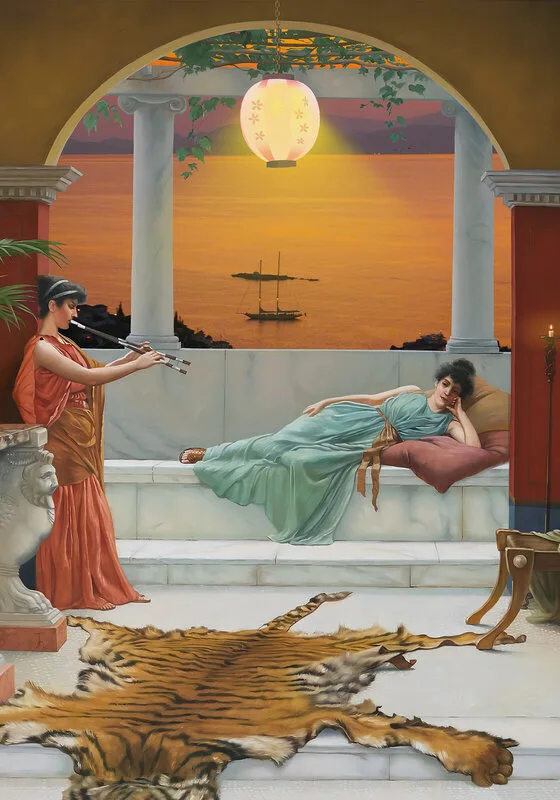
The stanzas from the poem "Serenade" by 19th-century American poet Mary Weston Fordham are timeless and could have been written two millennia earlier during antiquity. Or today. The woman in the picture plays an aulos, the ancient Greek double-piped wind instrument with a dramatic birth in connection with a musical challenge between a satyr and Apollo. A serenade is often played in honour of something or somebody. From the picture, we must conclude that she is paying tribute to Hydra and one of the island's glowing sunsets. In ancient Greece, Aulos was often depicted as a hetaera, a controversial kind of woman, a sort of prostitute, courtesan, or mistress. Or could the picture hide anything else, something related to the island of Lesbos? The picture's opaque message conceals secrets from the past worth knowing.
Read the full story on old-time flutes, courtesans, and serenades!
Indeed, the start was dramatic for the ancient double flute or pipe. Apollo challenged a Satyr to play the Aulos. Apollo did not win as planned because King Midas, as judge, chose the Satyr and made the god the lesser player. Apollo became angry and turned Midas's ears into those of a donkey as a sign of the king's foolishness. The two contenders may have played the Delphic Hymns, two musical compositions from Ancient Greece, which have survived in substantial fragments. These Hymns were aptly enough addressed to Apollo, which did not help the god in this case. The pipe has been reconstructed and played after archaeologists found fragments of Aulos. Before that, we only knew about them through numerous pictures on urns and vases.
In myth, Marsyas the Satyr is told to have invented the aulos or picked it up after Athena had thrown it away because it caused her cheeks to puff out and ruined her beauty. Whatever, the Satyr challenged Apollo to a musical contest. The winner would then "do whatever he wanted" to the loser. Marsyas's dirty thinking, typical of a satyr, was that this would be sexual. But Apollo and his lyre beat Marsyas and his aulos. And since the pure lord of Delphi's mind worked differently from Marsyas's, he celebrated his victory by stringing his opponent up from a tree and flaying him alive. No sex that was, and Marsyas's blood mixed with the tears of the Muses formed the river Marsyas in Asia Minor.
The old saga warns against hubris or overweening pride, such as when Marsyas thought he could win against a god. The brutal myth reflects how the ancient Greeks expressed opposition between the lyre and aulos - Freedom vs servility and tyranny, leisured amateurs fighting professionals and moderation against excess, etc. During the 19th century AD, modern painters discovered antiquity. They presented the past more romantically, i.e. Apollo challenging Dionysus with the help of the string instrument kithara, representing 'Reason' instead of 'Madness' in the shape of an aulos. Two thousand years ago, the temple to Apollo at Delphi also displayed a shrine to Dionysus – the "god of many forms" and inexpressible depths. The lusty god and his Maenads were shown drinking cups of wine and playing the aulos. However, Dionysus is sometimes depicted holding a kithara or lyre. Modern painters' interpretations, like my picture, can be a little more complicated than simple duality. Read more about that later.
A serenade, also called 'serenata', is often delivered in honour of someone or something - for a lover, friend, person of rank or another person worthy of honouring. They are typically calm, delicate pieces of music played or sung softly. The name derives from the Italian word serenata, which comes from the Latin serenus and sera, "evening," from the Latin serus "late". Tradition often lets a lover sing to his lady on a balcony or open window above. Usually, a nocturnal piece is performed on a quiet and pleasant evening, as opposed to an aubade, which would be performed in the morning.
Thebes was once the centre of aulos-playing. At Sparta, with no Bacchic or Korybantic cults to serve, the aulos were associated with Apollo, who accompanied the hoplites into battle.
Though aulos is often translated as "flute" or "double flute", it was a double-reeded instrument with a penetrating, insisting and exciting sound reminding of later times bagpipes. There may be better instruments for a serene and caressing serenata. That brings us to the sensitive part with the aulete, the musician performing on an aulo. In this case, a seductively beautiful woman in red is playing for a lustfully resting partner in pastel green. The tunes flowing over the reddish Hydra strait tinted by the setting sun over the Peloponnese could arouse anybody.
Traditionally, a special kind of woman treated the instrument. The connection between a Satyr and Hetaira could be a coincidence, but it is probably not.
Hetaira, in ancient Greek, meaning companion, was a type of prostitute serving as an artist, entertainer and educated conversationalist – plus, of course, providing sexual service. Unlike most ancient Greek women, hetairai were highly educated and allowed to participate in the symposium, a social gathering in antiquity. At Symposia, male citizens would gather for dining, drinking, conversation, music, and entertainment – the latter generally female companions in the shape of a Hetaira.
Historians have long distinguished between Hetairai and Pornai, another class of prostitute in ancient Greece. A Pornai provided sex for numerous clients in brothels or on the street. At the same time, hetairai had sex with a few men as clients at any one time, often in long-term relationships providing companionship, intellectual stimulation, and sex. Indeed, hetaeras belonged to a very different and privileged class, usually highly educated women.
Other historians have questioned the distinction between the two, meaning that Hetaira was a euphemism for any prostitute. Both kinds could be enslaved people or free and might or might not work for a pimp. Hetairai veiled that they were selling sex through the language of gift exchange. What joyless academic rascals.
Rebecca Futo Kennedy, an American Professor of Classics, Women's, and Gender Studies, advances a third position. She suggests that hetairai "were not prostitutes or even courtesans" but "elite women ... who participated in a luxury culture" like their colleagues Hetairoi. The masculine form of the word refers to groups of elite men at symposia.
Hetairism was a product of the symposium. Hetairai were permitted as sexually available companions of the male partygoers, providing flattering and skilful conversation. They were supposed to be witty and refined and musically educated and more seen as attributes than a simple whore.
Free and prosperous hetairai often became wealthy and could control their finances. However, their careers could be short, with age, new faces, and their lover's fall. If Hetaira could no longer support herself, she might have been forced to work in a brothel or as a pimp to ensure a steady income as they aged. Compare Hetairism with the Japanese system of Geisha.
I am considering the lark in the poem above. Indeed, there are larks in Greece, and occasionally, their enchanting chirp is heard on Hydra. It must be emphasised that the light song of a lark could not be compared with the buzzy sound of an Aulos.
The picture behind my story, though altered from daytime to evening tete-a-tete in the light of the setting sun and a lamp and candlelight, is fascinating. It was painted in 1891 by John William Godward (1861–1922) and called 'The Sweet Siesta of a Summer Day'. The bigot and sexually hampered Victorian society locked women in covered by heavy dresses, showing little or nothing of their bodies. Instead, their walls let light-dressed women from antiquity show everything, leaving little to one's imagination. To men, such pictures must have caused sexual lust and pleasant dreams.
Godward and his colleagues, Sir Lawrence Alma-Tadema and Sir Edward Poynter, became famous for their romanticised images. People adored the depictions of the luxury and decadence of the Roman Empire. Languorous figures were set in fabulous, marbled interiors or against a dazzling blue Mediterranean Sea and sky backdrop. Hydra fits well in this purpose, and life on the island during the 1960s and 1970s may fit into these artists' expectations.
However, another aspect of the picture showing two young women in a seemingly peaceful scene is an underlying sense of courtship or romance. Godward and his colleagues were all educated academics and knew their history. Having one of the girls playing an aulos could not have been a coincidence, although it's unclear if Godward told his customer so. The absence of a man listening and her friend's relaxed, inviting position opens up your fantasy, dirty or not.
In classical antiquity, philosophers like Plato, Herodotus, Xenophon, Athenaeus and many others explored aspects of homosexuality in Greek society. People then did not conceive of sexual orientation as a social identifier as modern Western societies have done. The first recorded appearance of a deep emotional bond between adult men in ancient Greek culture was in Homer's Iliad, eight centuries before our time. In general, the historical record of love and sexual relations between women is sparse. However, Plato's work 'Symposium' mentions women who "do not care for men but have female attachments".
The most famous lesbian character Sappho was an Archaic poet from the island of Lesbos in eastern Greece (630 – c. 570 BC). She wrote many love poems addressed to women and girls. The love in these poems is sometimes mutual and sometimes not. Sappho is thought to have written over 10,000 lines of poetry about her passion and desire for other women. Of these, only 600 lines have survived. Her fame has made her island emblematic of love between women - a vocabulary that not even legal action by outraged island inhabitants can stop. Numerous lesbians travel to Lesbos as an act of pilgrimage arising from a desire to visit the home of the archaic poet whose passionate, lyrical evocations of female same-sex desire still inspire.
Renée Vivien, an Anglo-French poet, and her lover, the American heiress Natalie Barney tried to set up an artist's colony on Lesbos in 1904. It was ultimately unsuccessful. Vivien retreated to Paris, where she held wild salons instead, complete with replica Greek temples and recitations of Sappho's poetry.
The Greek attitude to same-sex attraction was not nearly as permissive or free as one assumes. Any idealised view of the Greeks falls apart the moment one remembers that ancient Greece was a society where slave ownership was prevalent and that enslaved people were regularly sexually exploited by their masters. Indeed, the ancient Greeks tolerated same-sex attraction but endured the violent sexual abuse of men and women in a manner nobody could countenance today.
Godward's fantasy tricked him; his dirty mind triggered a wish to share a woman with another woman, a threesome that would turn on no lesbian—the end of a pictorial misunderstanding.
One tradition claims that Sappho committed suicide by jumping off the Leucadian cliff, a fitting end for modern days' unwritten law and order. Anyhow. Today, same-sex love is again more and more accepted, at least in civilised countries. They are slandered and persecuted elsewhere, but no doubt time will change that. So, play your flute in peace, dear Sophia, whatever the reasons. Preferably with Hydra as a scenery.
Amor vincit omnia. Love conquers all.

Jörgen Thornberg
Malmö
Lite om bilder och mig. Translation in English at the end.
Jag är en nyfiken person som ser allt i bilder, även det jag fäster i ord, gärna tillsammans för bakom alla mina bilder finns en berättelse. Till vissa bilder hör en kortare eller längre novell som följer med bilden.
Bilder berättar historier. Jag omges av naturlig skönhet, intressanta människor och historia var jag än går. Jag använder min kamera för att dokumentera världen och blanda det jag ser med vad jag känner för att fånga den dolda magin.
Mina bilder berättar mina historier. Genom mina bilder, tryck och berättelser. Jag bjuder in dig att ta del av dessa berättelser, in i ditt liv och hem och dela min mycket personliga syn på vår värld. Mer än vad ögat ser. Jag tänker i bilder, drömmer och skriver och pratar om dem; följaktligen måste jag också skapa bilder. De blir vad jag ser, inte nödvändigtvis begränsade till verkligheten. Det finns en bild runt varje hörn. Jag hoppas att du kommer att se vad jag såg och gilla det.
Jag är också en skrivande person och till många bilder hör en kortare eller längre essay. Den följer med tavlan, tryckt på fint papper och med en personlig hälsning från mig.
Flertalet bilder startar sin resa i min kamera. Enkelt förklarat beskriver jag bilden jag ser i mitt inre, upplevd eller fantiserad. Bilden uppstår inom mig redan innan jag fått okularet till ögat. På bråkdelen av ett ögonblick ser jag vad jag vill ha och vad som kan göras med bilden. Här skall jag stoppa in en giraff, stålmannen, Titanic eller vad det är min fantasi finner ut. Ännu märkligare är att jag kommer ihåg minnesbilden långt efteråt när det blir tid att skapa verket. Om jag lyckas eller inte, är upp till betraktaren, oftast präglat av en stråk av svart humor – meningen är att man skall bli underhållen. Mina bilder blir ofta en snackis där de hänger.
Jag föredrar bilder som förmedlar ett budskap i flera lager. Vid första anblicken fylld av feel-good, en vacker utsikt, fint väder, solen skiner, blommor på ängen eller vattnet som ligger förrädiskt spegelblankt. I en sådan bild kan jag gömma min egentliga berättelse, mitt förakt för förtryckare och våldsverkare, rasister och fördomsfulla människor - ett gärna återkommande motiv mer eller mindre dolt i det vackra motivet. Jag försöker förena dem i ett gemensamt narrativ.
Bild och formgivning har löpt som en röd tråd genom livet. Fotokonst känns som en värdig final som jag gärna delar med mig.
Min genre är vid som framgår av mina bilder, temat en blandning av pop- och gatukonst i kollage som kan bestå av hundratals lager. Vissa bilder kan ta veckor, andra någon dag innan det är dags att överlämna resultatet till printverkstaden. Fine Art Prints är digitala fotocollage. I dessa kollage sker rivandet, klippandet, pusslandet, målandet, ritandet och sprayningen digitalt. Det jag monterar in kan vara hundratals år gamla bilder som jag omsorgsfullt frilägger så att de ser ut att vara en del av tavlan men också bilder skapade av mig själv efter min egen fantasi. Därefter besöks printstudion och för vissa bilder numrera en limiterad upplaga (oftast 7 exemplar) och signera för hand. Vissa bilder kan köpas i olika format. Det är bara att fråga efter vilka. Gillar man en bild som är 70x100 men inte har plats på väggen, går den kanske att få i 50x70 cm istället. Frågan är fri.
Metoden Giclée eller Fine Art Print som det också kallas är det moderna sättet för framställning av grafisk konst. Villkoret för denna typ av utskrifter är att en högkvalitativ storformatskrivare används med åldersbeständigt färgpigment och konstnärspapper eller i förekommande fall på duk. Pappret som används möter de krav på livslängd som ställs av museer och gallerier. Normalt säljer jag mina bilder oinramade så att den nya ägaren själv kan bestämma hur de skall se ut, med eller utan passepartout färg på ram, med eller utan glas etc..
Under många år ställde jag bara ut på nätet, i valda grupper och på min egen Facebooksida - https://www.facebook.com/jorgen.thornberg.9
Jag finns också på en egen hemsida som tyvärr inte alltid är uppdaterad – https://www.jth.life/ Där kan du också läsa en del av de berättelser som följer med bilden.
UTSTÄLLNINGAR
Luftkastellet, oktober 2022
Konst i Lund, november 2022
Luftkastellet, mars 2023
Engleson Galleri Caroli, april 2023
Hydra, Greece June 2023
Engleson Galleri Caroli, oktober 2023
Toppen, Höllviken december 2023
Luftkastellet, mars 2024
Torups Galleri, mars 2024
Venice, May 2024
Luftkastellet, oktober 2024
Konst i Advent, December 2024
Galleri Engleson, Caroli December 2024
Jäger & Jansson Galleri, april 2025
A bit about pictures and me.
I'm a curious person who sees everything in pictures, even what I express in words, often combining them, for behind all my pictures lies a story. These narratives, some as short as a single image and others as long as a novel, are the heart and soul of my work.
Pictures tell stories. Wherever I go, I'm surrounded by natural beauty, exciting people, and history. I use my camera to document the world and blend what I see with what I feel to capture the hidden magic.
My images tell my stories. Through my pictures, prints, and narratives, I invite you to partake in these stories in your life and home and share my deeply personal perspective of our world. More than meets the eye. I think in pictures, dream, write, and talk about them; consequently, I must create images too. They become what I see, not necessarily confined to reality. There's a picture around every corner. I hope you'll see what I saw and enjoy it.
I'm also a writer, and many images come with a shorter or longer essay. It accompanies the painting, printed on fine paper with my personal greeting.
Many pictures start their journey on my camera. Simply put, I describe the image I see in my mind, experienced or imagined. The image arises within me even before I bring the eyepiece to my eye. In a fraction of a moment, I see what I want and what can be done with the picture. Here, I'll insert a giraffe, Superman, the Titanic, or whatever my imagination conjures up. Even stranger is that I remember the mental image long after it's time to create the work. Whether I succeed is up to the observer, often imbued with a streak of black humour – the aim is to entertain. My pictures usually become a talking point wherever they hang.
I prefer pictures that convey a message in multiple layers. At first glance, they're filled with feel-good vibes, a beautiful view, lovely weather, the sun shining, flowers in the meadow, or the water lying deceptively calm. But beneath this surface beauty, I often conceal a deeper story, a narrative that challenges societal norms or explores the human condition. I invite you to delve into these hidden narratives and discover the layers of meaning within my work.
Picture and design have been a thread running through my life. Photographic art feels like a fitting finale, and I'm happy to share it.
My genre is varied, as seen in my pictures; the theme is a blend of pop and street art in collages that can consist of hundreds of layers. Some images can take weeks, others just a day before it's time to hand over the result to the print workshop. Fine Art Prints are digital photo collages. In these collages, tearing, cutting, puzzling, painting, drawing, and spraying happen digitally. What I insert can be images hundreds of years old that I carefully extract so they appear to be part of the painting, but also images created by myself, now also generated from my imagination. Next, visit the print studio and, for certain images, number a limited edition (usually 7 copies) and sign them by hand. Some images may be available in other formats. Just ask which ones. If you like an image that's 70x100 but doesn't have space on the wall, you might be able to get it in 50x70 cm instead. The question is open.
The Giclée method, or Fine Art Print as it's also called, is the modern way of producing graphic art. This method ensures the highest quality and longevity of the artwork, using a high-quality large-format printer with archival pigment inks and artist paper or, in some cases, canvas. The paper used meets the longevity requirements set by museums and galleries. I sell my pictures unframed, allowing the new owner to personalise their artwork, confident in the lasting value and quality of the piece.
For many years, I only exhibited online, in selected groups, and on my Facebook page - https://www.facebook.com/jorgen.thornberg.9. I also have my website, which unfortunately is not constantly updated - https://www.jth.life/. You can also read some of the stories accompanying the pictures there.
EXHIBITIONS
Luftkastellet, October 2022
Art in Lund, November 2022
Luftkastellet, March 2023
Engleson Gallery Caroli, April 2023
Hydra, Greece June 2023
Engleson Gallery Caroli, October 2023
Toppen, Höllviken December 2023
Luftkastellet, March 2024
Torup Gallery, March 2024
Venice, May 2024
UTSTÄLLNINGAR
Luftkastellet, oktober 2022
Konst i Lund, november 2022
Luftkastellet, mars 2023
Engleson Galleri Caroli, april 2023
Hydra, Greece June 2023
Engleson Galleri Caroli, oktober 2023
Toppen, Höllviken december 2023
Luftkastellet, mars 2024
Torups Galleri, mars 2024
Venice, May 2024
Luftkastellet, October 2024
Konst i Advent, December 2024
Galleri Engleson, Caroli December 2024
Jäger & Jansson Galleri, April 2025
Utbildning
Autodidakt
Medlem i konstnärsförening
Öppna Sinnen
Med i konstrunda
Konstrundan i Skåne
Utställningar
Luftkastellet, October 2022
Art in Lund, November 2022
Luftkastellet, March 2023
Engleson Gallery Caroli, April 2023
Hydra, Greece June 2023
Engleson Gallery Caroli, October 2023
Toppen, Höllviken December 2023
Luftkastellet, March 2024
Torup Gallery, March 2024
Venice, May 2024