Vi använder cookies för att ge dig bästa möjliga upplevelse. Välj vilka cookies du tillåter.
Läs mer i vår integritetspolicy
Jörgen Thornberg
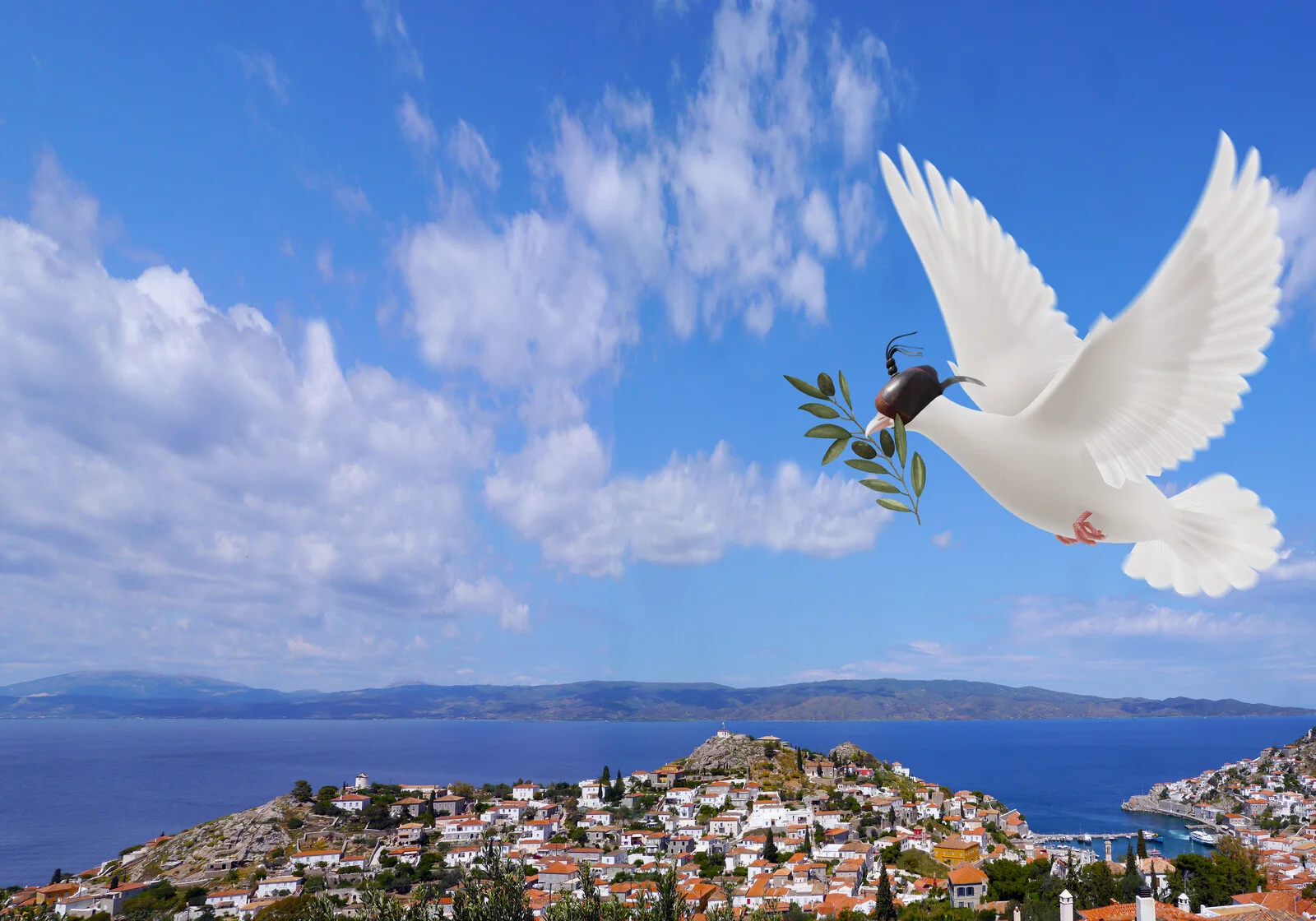
Dangerous attraction. A blindfolded peace dove passing Hydra island, 2024
Digital
70 x 50 cm
Ah, the wars they will be fought again
The holy dove, she will be caught again
Bought and sold, and bought again
The dove is never free
The lines come from Leonard Cohen's 'Anthem', a song about a dismal world. The tunes echo inside the white bird flying high above Hydra.
Passing Hydra's beauty and serenity, a peace-dove must pass the island blindfolded. Otherwise, the risk is apparent that the bird will join all others looking for a break with Peace and tranquillity, apart from the rest of the world. It is an illusion because the island is just a couple of hours away from Athen's airport and thus connected to all global crises.
In many ways, Hydra is an Arcadia for tired souls seeking refuge from troubled reality. If you close your eyes with a cooling drink and sip in the salty breeze from the sea surrounding the island, listening to the lazy waves caressing the rocky shores, you are safe for a moment or two. Don't touch your mobile opening for global news. Avoid the international media offered at the bookstore, and whatever you do, don't listen to a serious conversation among neighbouring tables. Lock reality out and enjoy life. You're probably worth it; taking a break won't stop the war in Ukraine. Or?
Please learn more about Leonard and his crack for everything: climate change, environmentally friendly donkeys, and why the dove is blindfolded.
Out of the frying pan into the fire. The dove of Peace, wanting to avoid the temptation of being seduced by Hydra, instead risked being devoured by the monstrous beast looming among the clouds. The gigantic Ouroboros had momentarily released its grip on its tail, usually locked in its jaws. Ouroboros seemed destined to swallow the dove and Peace itself forever. When the beast bites its tail, it represents the beginning and the end of time, and now it seems that Peace is forever lost. But fear not! The dove of Peace had survived since the dawn of time, though often in great peril. She did so now as well; she gathered her strength, flapped her wings with a few extra powerful strokes, and flew straight through the monster's jaws before they could snap shut.
Is it okay to treat yourself like this when the walls all over threaten to fall in everywhere else? Well. Yes and no. No, if you consider your carbon footprint, which measures the total greenhouse gas (GHG) emissions you cause in the harborside café. For your information, it's typically measured as tons of CO2 equivalent per defined function or unit. 594 kg for you alone just for the air travel, another 25 kilos for taxis at home and to Piraeus, and then you must add 15 kilos for the catamaran and the pleasant voyage through the archipelago. You can start breathing when setting your feet on the cobblestones in the harbour.
Lifting the glass and cheering your friends does not affect global warming, so relax. How did you get there, what was your impact from travelling, and how much greenhouse gas emissions you caused the long way from home to Hydra—taxi, plane, taxi, boat, and so forth? There are no trains to Hydra. Only when you arrive on the island can your conscience be at ease. Donkeys set a good example, so the way up to your room or house doesn't cause much damage. A donkey's waste, manure, is reused and becomes a new crop after it has been picked up from Donkey Shit Lane.
The biomass of a donkey or mule is a carbon' sink' in the same way as the biomass of the pine trees surrounding Hydra is a carbon 'sink'. How come? Elementary. The digestive process of horses, donkeys and mules produces far less methane than the digestive system of cattle and sheep. Cattle, sheep, and certain other grazing animals are known as ruminants because their gut contains rumen. The rumen is a part of their digestive system that breaks down tough grasses found in natural pastures. In breaking down the tough grasses, the bacteria in the rumen release large amounts of methane gas. These ruminant animals then spew out the methane gas. Farting monsters, they are, letting out some burps too.
Hydra's Equine animals are not ruminants. Their digestive system cannot break down tough grass like cows or sheep. Like humans, they have a single stomach that only deals with easily digestible carbohydrates in grasses and straw. Donkeys, for instance, are selective grazers and will not eat the tougher grasses because they cannot digest them. So, like horses and mules, they produce less methane in their digestive system. The animals carrying your luggage on Hydra have a considerably smaller carbon footprint than an automobile. Climate change and global warming are not why the white dove bypasses Hydra. She observes neither pollution nor microplastics every day from her high position.
The decline and pause in globalisation in the global economy, which has positively affected women's liberation and poverty reduction in developing nations, may not directly affect the peaceful dove. However, the erosion of democracy and human rights worldwide is a cause for concern for this symbol of Peace. This is not because doves and other creatures share equal rights but because they exist within a delicate, balanced system that has evolved over millions of years.
The deteriorating conditions in the free world have led to global instability and conflicts. The dove is deeply troubled by Russia's aggression towards its neighbour. A single olive branch is insufficient; the dove needs a whole stack. The escalating tensions with a more assertive China might require an entire forest of olives. Can you picture it? The dove continues to fly, blindfolded and refusing to land, even for a brief respite.
While Hydra may not be a sanctuary for all Earth predators, it temporarily escapes reality for a week or two. However, a dove entrusted with the responsibility of Peace cannot afford such luxuries. Its commitment to its mission is unwavering.
Leonard said the world was dismal when he wrote his graphic song Anthem. Cohen should not have changed his mind today. But he left an open crack to a better future. The aperture is still there, so we should not give up. We might have lost the battle but not the war, so let us go out there and fight.
In an interview in 1992, Leonard elaborated on what he meant with his song: "This is not the place where you make things perfect, neither in your marriage, nor in your work, nor anything, nor your love of God, nor your love of family or country. The thing is imperfect. And worse, there is a crack in everything you can put together: physical objects, mental objects, and constructions of any kind. But that's where the light gets in, and that's where the resurrection is, and that's where the return, that's where the repentance is. It is with the confrontation, with the brokenness of things." So, in the end, the crack will fix it all. The peace dove can land on Hydra and enjoy life as the rest of us, without any bad conscience of not being elsewhere.
The use of a dove as a symbol of Peace originated with early Christians, who portrayed baptism accompanied by a dove. The Spirit of God descended as a dove on Jesus when he was baptised by John the Baptist.
The olive branch has symbolised Peace in Western civilisation since the 5th century BC. The old Greeks believed it represented plenty and drove away evil spirits. The branch was one of the attributes of Eirene, the Greek goddess of Peace, whom the Romans called Pax. The fruits also make fantastic oil and help keep evil spirits away from our plates.
Ring the bells that still can ring
Forget your perfect offering
There is a crack in everything
That's how the light gets in.
Semper Invicta. Always undefeated.
This is true because history shows that good wins in the end. It can take time to defeat evil, sometimes generations, but Peace is always the victor. Leonard knew that. He knew humankind and was not as pessimistic as people think. He was not Mr. Doom and Gloom but a realist who left a crack for everything.
Jörgen Thornberg
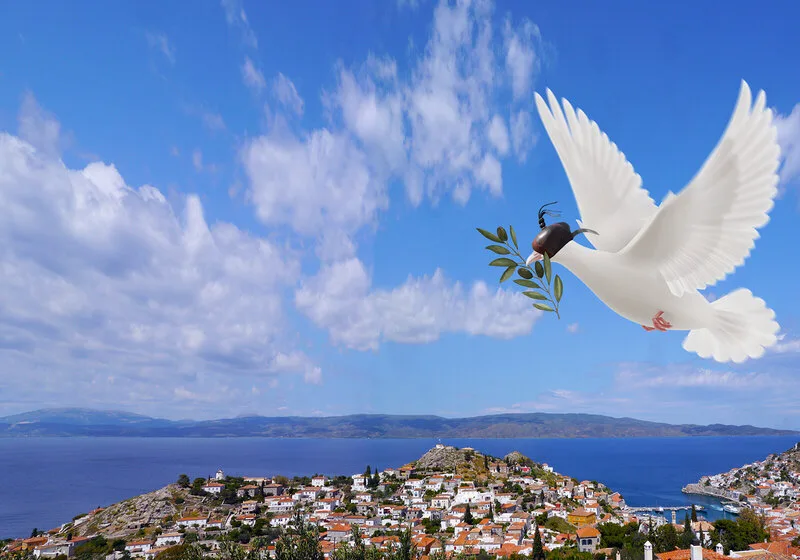
Dangerous attraction. A blindfolded peace dove passing Hydra island, 2024
Digital
70 x 50 cm
Ah, the wars they will be fought again
The holy dove, she will be caught again
Bought and sold, and bought again
The dove is never free
The lines come from Leonard Cohen's 'Anthem', a song about a dismal world. The tunes echo inside the white bird flying high above Hydra.
Passing Hydra's beauty and serenity, a peace-dove must pass the island blindfolded. Otherwise, the risk is apparent that the bird will join all others looking for a break with Peace and tranquillity, apart from the rest of the world. It is an illusion because the island is just a couple of hours away from Athen's airport and thus connected to all global crises.
In many ways, Hydra is an Arcadia for tired souls seeking refuge from troubled reality. If you close your eyes with a cooling drink and sip in the salty breeze from the sea surrounding the island, listening to the lazy waves caressing the rocky shores, you are safe for a moment or two. Don't touch your mobile opening for global news. Avoid the international media offered at the bookstore, and whatever you do, don't listen to a serious conversation among neighbouring tables. Lock reality out and enjoy life. You're probably worth it; taking a break won't stop the war in Ukraine. Or?
Please learn more about Leonard and his crack for everything: climate change, environmentally friendly donkeys, and why the dove is blindfolded.
Out of the frying pan into the fire. The dove of Peace, wanting to avoid the temptation of being seduced by Hydra, instead risked being devoured by the monstrous beast looming among the clouds. The gigantic Ouroboros had momentarily released its grip on its tail, usually locked in its jaws. Ouroboros seemed destined to swallow the dove and Peace itself forever. When the beast bites its tail, it represents the beginning and the end of time, and now it seems that Peace is forever lost. But fear not! The dove of Peace had survived since the dawn of time, though often in great peril. She did so now as well; she gathered her strength, flapped her wings with a few extra powerful strokes, and flew straight through the monster's jaws before they could snap shut.
Is it okay to treat yourself like this when the walls all over threaten to fall in everywhere else? Well. Yes and no. No, if you consider your carbon footprint, which measures the total greenhouse gas (GHG) emissions you cause in the harborside café. For your information, it's typically measured as tons of CO2 equivalent per defined function or unit. 594 kg for you alone just for the air travel, another 25 kilos for taxis at home and to Piraeus, and then you must add 15 kilos for the catamaran and the pleasant voyage through the archipelago. You can start breathing when setting your feet on the cobblestones in the harbour.
Lifting the glass and cheering your friends does not affect global warming, so relax. How did you get there, what was your impact from travelling, and how much greenhouse gas emissions you caused the long way from home to Hydra—taxi, plane, taxi, boat, and so forth? There are no trains to Hydra. Only when you arrive on the island can your conscience be at ease. Donkeys set a good example, so the way up to your room or house doesn't cause much damage. A donkey's waste, manure, is reused and becomes a new crop after it has been picked up from Donkey Shit Lane.
The biomass of a donkey or mule is a carbon' sink' in the same way as the biomass of the pine trees surrounding Hydra is a carbon 'sink'. How come? Elementary. The digestive process of horses, donkeys and mules produces far less methane than the digestive system of cattle and sheep. Cattle, sheep, and certain other grazing animals are known as ruminants because their gut contains rumen. The rumen is a part of their digestive system that breaks down tough grasses found in natural pastures. In breaking down the tough grasses, the bacteria in the rumen release large amounts of methane gas. These ruminant animals then spew out the methane gas. Farting monsters, they are, letting out some burps too.
Hydra's Equine animals are not ruminants. Their digestive system cannot break down tough grass like cows or sheep. Like humans, they have a single stomach that only deals with easily digestible carbohydrates in grasses and straw. Donkeys, for instance, are selective grazers and will not eat the tougher grasses because they cannot digest them. So, like horses and mules, they produce less methane in their digestive system. The animals carrying your luggage on Hydra have a considerably smaller carbon footprint than an automobile. Climate change and global warming are not why the white dove bypasses Hydra. She observes neither pollution nor microplastics every day from her high position.
The decline and pause in globalisation in the global economy, which has positively affected women's liberation and poverty reduction in developing nations, may not directly affect the peaceful dove. However, the erosion of democracy and human rights worldwide is a cause for concern for this symbol of Peace. This is not because doves and other creatures share equal rights but because they exist within a delicate, balanced system that has evolved over millions of years.
The deteriorating conditions in the free world have led to global instability and conflicts. The dove is deeply troubled by Russia's aggression towards its neighbour. A single olive branch is insufficient; the dove needs a whole stack. The escalating tensions with a more assertive China might require an entire forest of olives. Can you picture it? The dove continues to fly, blindfolded and refusing to land, even for a brief respite.
While Hydra may not be a sanctuary for all Earth predators, it temporarily escapes reality for a week or two. However, a dove entrusted with the responsibility of Peace cannot afford such luxuries. Its commitment to its mission is unwavering.
Leonard said the world was dismal when he wrote his graphic song Anthem. Cohen should not have changed his mind today. But he left an open crack to a better future. The aperture is still there, so we should not give up. We might have lost the battle but not the war, so let us go out there and fight.
In an interview in 1992, Leonard elaborated on what he meant with his song: "This is not the place where you make things perfect, neither in your marriage, nor in your work, nor anything, nor your love of God, nor your love of family or country. The thing is imperfect. And worse, there is a crack in everything you can put together: physical objects, mental objects, and constructions of any kind. But that's where the light gets in, and that's where the resurrection is, and that's where the return, that's where the repentance is. It is with the confrontation, with the brokenness of things." So, in the end, the crack will fix it all. The peace dove can land on Hydra and enjoy life as the rest of us, without any bad conscience of not being elsewhere.
The use of a dove as a symbol of Peace originated with early Christians, who portrayed baptism accompanied by a dove. The Spirit of God descended as a dove on Jesus when he was baptised by John the Baptist.
The olive branch has symbolised Peace in Western civilisation since the 5th century BC. The old Greeks believed it represented plenty and drove away evil spirits. The branch was one of the attributes of Eirene, the Greek goddess of Peace, whom the Romans called Pax. The fruits also make fantastic oil and help keep evil spirits away from our plates.
Ring the bells that still can ring
Forget your perfect offering
There is a crack in everything
That's how the light gets in.
Semper Invicta. Always undefeated.
This is true because history shows that good wins in the end. It can take time to defeat evil, sometimes generations, but Peace is always the victor. Leonard knew that. He knew humankind and was not as pessimistic as people think. He was not Mr. Doom and Gloom but a realist who left a crack for everything.

Jörgen Thornberg
Malmö
Lite om bilder och mig. Translation in English at the end.
Jag är en nyfiken person som ser allt i bilder, även det jag fäster i ord, gärna tillsammans för bakom alla mina bilder finns en berättelse. Till vissa bilder hör en kortare eller längre novell som följer med bilden.
Bilder berättar historier. Jag omges av naturlig skönhet, intressanta människor och historia var jag än går. Jag använder min kamera för att dokumentera världen och blanda det jag ser med vad jag känner för att fånga den dolda magin.
Mina bilder berättar mina historier. Genom mina bilder, tryck och berättelser. Jag bjuder in dig att ta del av dessa berättelser, in i ditt liv och hem och dela min mycket personliga syn på vår värld. Mer än vad ögat ser. Jag tänker i bilder, drömmer och skriver och pratar om dem; följaktligen måste jag också skapa bilder. De blir vad jag ser, inte nödvändigtvis begränsade till verkligheten. Det finns en bild runt varje hörn. Jag hoppas att du kommer att se vad jag såg och gilla det.
Jag är också en skrivande person och till många bilder hör en kortare eller längre essay. Den följer med tavlan, tryckt på fint papper och med en personlig hälsning från mig.
Flertalet bilder startar sin resa i min kamera. Enkelt förklarat beskriver jag bilden jag ser i mitt inre, upplevd eller fantiserad. Bilden uppstår inom mig redan innan jag fått okularet till ögat. På bråkdelen av ett ögonblick ser jag vad jag vill ha och vad som kan göras med bilden. Här skall jag stoppa in en giraff, stålmannen, Titanic eller vad det är min fantasi finner ut. Ännu märkligare är att jag kommer ihåg minnesbilden långt efteråt när det blir tid att skapa verket. Om jag lyckas eller inte, är upp till betraktaren, oftast präglat av en stråk av svart humor – meningen är att man skall bli underhållen. Mina bilder blir ofta en snackis där de hänger.
Jag föredrar bilder som förmedlar ett budskap i flera lager. Vid första anblicken fylld av feel-good, en vacker utsikt, fint väder, solen skiner, blommor på ängen eller vattnet som ligger förrädiskt spegelblankt. I en sådan bild kan jag gömma min egentliga berättelse, mitt förakt för förtryckare och våldsverkare, rasister och fördomsfulla människor - ett gärna återkommande motiv mer eller mindre dolt i det vackra motivet. Jag försöker förena dem i ett gemensamt narrativ.
Bild och formgivning har löpt som en röd tråd genom livet. Fotokonst känns som en värdig final som jag gärna delar med mig.
Min genre är vid som framgår av mina bilder, temat en blandning av pop- och gatukonst i kollage som kan bestå av hundratals lager. Vissa bilder kan ta veckor, andra någon dag innan det är dags att överlämna resultatet till printverkstaden. Fine Art Prints är digitala fotocollage. I dessa kollage sker rivandet, klippandet, pusslandet, målandet, ritandet och sprayningen digitalt. Det jag monterar in kan vara hundratals år gamla bilder som jag omsorgsfullt frilägger så att de ser ut att vara en del av tavlan men också bilder skapade av mig själv efter min egen fantasi. Därefter besöks printstudion och för vissa bilder numrera en limiterad upplaga (oftast 7 exemplar) och signera för hand. Vissa bilder kan köpas i olika format. Det är bara att fråga efter vilka. Gillar man en bild som är 70x100 men inte har plats på väggen, går den kanske att få i 50x70 cm istället. Frågan är fri.
Metoden Giclée eller Fine Art Print som det också kallas är det moderna sättet för framställning av grafisk konst. Villkoret för denna typ av utskrifter är att en högkvalitativ storformatskrivare används med åldersbeständigt färgpigment och konstnärspapper eller i förekommande fall på duk. Pappret som används möter de krav på livslängd som ställs av museer och gallerier. Normalt säljer jag mina bilder oinramade så att den nya ägaren själv kan bestämma hur de skall se ut, med eller utan passepartout färg på ram, med eller utan glas etc..
Under många år ställde jag bara ut på nätet, i valda grupper och på min egen Facebooksida - https://www.facebook.com/jorgen.thornberg.9
Jag finns också på en egen hemsida som tyvärr inte alltid är uppdaterad – https://www.jth.life/ Där kan du också läsa en del av de berättelser som följer med bilden.
UTSTÄLLNINGAR
Luftkastellet, oktober 2022
Konst i Lund, november 2022
Luftkastellet, mars 2023
Engleson Galleri Caroli, april 2023
Hydra, Greece June 2023
Engleson Galleri Caroli, oktober 2023
Toppen, Höllviken december 2023
Luftkastellet, mars 2024
Torups Galleri, mars 2024
Venice, May 2024
Luftkastellet, oktober 2024
Konst i Advent, December 2024
Galleri Engleson, Caroli December 2024
Jäger & Jansson Galleri, april 2025
A bit about pictures and me.
I'm a curious person who sees everything in pictures, even what I express in words, often combining them, for behind all my pictures lies a story. These narratives, some as short as a single image and others as long as a novel, are the heart and soul of my work.
Pictures tell stories. Wherever I go, I'm surrounded by natural beauty, exciting people, and history. I use my camera to document the world and blend what I see with what I feel to capture the hidden magic.
My images tell my stories. Through my pictures, prints, and narratives, I invite you to partake in these stories in your life and home and share my deeply personal perspective of our world. More than meets the eye. I think in pictures, dream, write, and talk about them; consequently, I must create images too. They become what I see, not necessarily confined to reality. There's a picture around every corner. I hope you'll see what I saw and enjoy it.
I'm also a writer, and many images come with a shorter or longer essay. It accompanies the painting, printed on fine paper with my personal greeting.
Many pictures start their journey on my camera. Simply put, I describe the image I see in my mind, experienced or imagined. The image arises within me even before I bring the eyepiece to my eye. In a fraction of a moment, I see what I want and what can be done with the picture. Here, I'll insert a giraffe, Superman, the Titanic, or whatever my imagination conjures up. Even stranger is that I remember the mental image long after it's time to create the work. Whether I succeed is up to the observer, often imbued with a streak of black humour – the aim is to entertain. My pictures usually become a talking point wherever they hang.
I prefer pictures that convey a message in multiple layers. At first glance, they're filled with feel-good vibes, a beautiful view, lovely weather, the sun shining, flowers in the meadow, or the water lying deceptively calm. But beneath this surface beauty, I often conceal a deeper story, a narrative that challenges societal norms or explores the human condition. I invite you to delve into these hidden narratives and discover the layers of meaning within my work.
Picture and design have been a thread running through my life. Photographic art feels like a fitting finale, and I'm happy to share it.
My genre is varied, as seen in my pictures; the theme is a blend of pop and street art in collages that can consist of hundreds of layers. Some images can take weeks, others just a day before it's time to hand over the result to the print workshop. Fine Art Prints are digital photo collages. In these collages, tearing, cutting, puzzling, painting, drawing, and spraying happen digitally. What I insert can be images hundreds of years old that I carefully extract so they appear to be part of the painting, but also images created by myself, now also generated from my imagination. Next, visit the print studio and, for certain images, number a limited edition (usually 7 copies) and sign them by hand. Some images may be available in other formats. Just ask which ones. If you like an image that's 70x100 but doesn't have space on the wall, you might be able to get it in 50x70 cm instead. The question is open.
The Giclée method, or Fine Art Print as it's also called, is the modern way of producing graphic art. This method ensures the highest quality and longevity of the artwork, using a high-quality large-format printer with archival pigment inks and artist paper or, in some cases, canvas. The paper used meets the longevity requirements set by museums and galleries. I sell my pictures unframed, allowing the new owner to personalise their artwork, confident in the lasting value and quality of the piece.
For many years, I only exhibited online, in selected groups, and on my Facebook page - https://www.facebook.com/jorgen.thornberg.9. I also have my website, which unfortunately is not constantly updated - https://www.jth.life/. You can also read some of the stories accompanying the pictures there.
EXHIBITIONS
Luftkastellet, October 2022
Art in Lund, November 2022
Luftkastellet, March 2023
Engleson Gallery Caroli, April 2023
Hydra, Greece June 2023
Engleson Gallery Caroli, October 2023
Toppen, Höllviken December 2023
Luftkastellet, March 2024
Torup Gallery, March 2024
Venice, May 2024
UTSTÄLLNINGAR
Luftkastellet, oktober 2022
Konst i Lund, november 2022
Luftkastellet, mars 2023
Engleson Galleri Caroli, april 2023
Hydra, Greece June 2023
Engleson Galleri Caroli, oktober 2023
Toppen, Höllviken december 2023
Luftkastellet, mars 2024
Torups Galleri, mars 2024
Venice, May 2024
Luftkastellet, October 2024
Konst i Advent, December 2024
Galleri Engleson, Caroli December 2024
Jäger & Jansson Galleri, April 2025
Utbildning
Autodidakt
Medlem i konstnärsförening
Öppna Sinnen
Med i konstrunda
Konstrundan i Skåne
Utställningar
Luftkastellet, October 2022
Art in Lund, November 2022
Luftkastellet, March 2023
Engleson Gallery Caroli, April 2023
Hydra, Greece June 2023
Engleson Gallery Caroli, October 2023
Toppen, Höllviken December 2023
Luftkastellet, March 2024
Torup Gallery, March 2024
Venice, May 2024