Vi använder cookies för att ge dig bästa möjliga upplevelse. Välj vilka cookies du tillåter.
Läs mer i vår integritetspolicy
Jörgen Thornberg
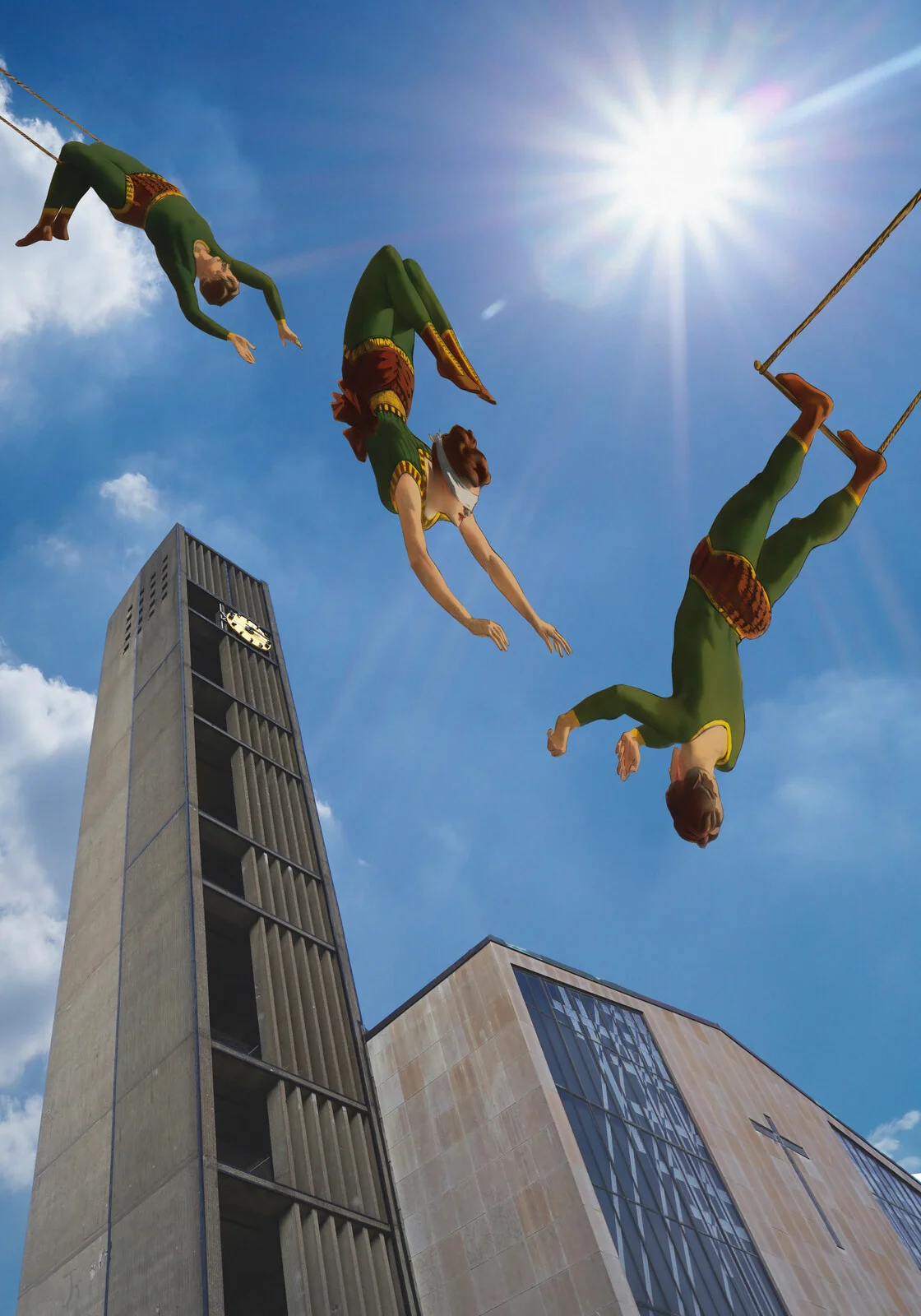
One who swings highest, swings best - Svingar högst som svingar bäst, 2022
Digital
50 x 70 cm
3 200 kr
I'm sure the St. Andrew's Church in Malmö can be used for more purposes than just looking magnificent. One can swing to heights other than the 41-meter-high bell tower. The modern church, inaugurated in 1959, was named after Jesus' disciple Andrew, Peter's brother. Both he and his brother Peter were fishermen by trade. Being a fisherman could be pretty acrobatic, climbing masts and diving into the sea to untangle nets. It was a dangerous profession.
Acrobatics, the art of tumbling, jumping, balancing, and using equipment like trapezes and trampolines, has a history that stretches back further than expected. The word 'Acrobatics' originates from the ancient Greek meaning 'to walk on tiptoe or strut,' a testament to the physical prowess and skill required. Indeed, acrobatics has been a part of most ancient cultures, with early evidence appearing in Minoan art from ancient Greece, dating back to 2000 B.C. The Minoans practised acrobatic feats on the backs of bulls, a dangerous and thrilling display of agility and strength.
In ancient China, acrobatics dates back to the Tang Dynasty in 203 BC. It was an integral part of celebrations, festivals, and dances, showcasing the agility and skill of the performers.
During the Middle Ages, acrobats travelled alongside troubadours and storytellers, performing at the castles of nobles. Their acts included juggling and simple gymnastics on the floor. As tastes evolved, more sophisticated stunts and apparatuses were incorporated, showcasing the adaptability and creativity of acrobatics. Today, acrobatics has become highly specialised, with performers often focusing on a particular skill, demonstrating the continued evolution of this dynamic art form.
Acrobatics is a discipline that demands not just physical strength and agility but also quick reflexes, precise timing, and fearlessness. Learning acrobatics starts with mastering the fundamentals, with safety being the top priority. Each move requires careful planning, and spotters are always present to ensure safety. From learning to fall safely to coordinating with others, acrobatics is a discipline that takes years to perfect physically and mentally.
A Journey Through Time and Culture
Acrobatics, the art of performing extraordinary feats of balance, agility, and coordination, has a long and captivating history. This dynamic discipline has transcended time and culture, evolving from ancient rituals to modern performances. The story of acrobatics is not just about daring exploits but also about its deep cultural significance and the inspiring inclusion of women in a field that once seemed exclusively masculine. Join me on a journey through the fascinating history of acrobatics, filled with exciting anecdotes and insights into how this art form has captivated audiences for millennia.
Bull-Leaping in Knossos
One of the earliest recorded forms of acrobatics comes from the Minoan civilisation on the island of Crete, around 2000 BCE. The Minoans practised a thrilling and dangerous sport known as bull-leaping, which was depicted in vivid frescoes at the palace of Knossos. In this ritual, athletes would grab the horns of a charging bull, vault over its back, and land gracefully on the other side. This practice displayed physical prowess and a religious ceremony, symbolising human mastery over nature. Bull-leaping required immense strength, agility, and bravery, becoming a central theme in Minoan culture.
Maya Acrobatics and Other Ancient Civilisations
Across the Atlantic, the ancient Maya civilisation in Mesoamerica also had its acrobatic traditions. The Maya were known for their ceremonial ball games, which included elements of acrobatics. Players would use their bodies to keep a heavy rubber ball in play, often performing flips and somersaults to strike the ball with their hips or forearms. These games were not just sports; they held deep religious significance and were sometimes played as part of ceremonial events.
In ancient China, acrobatics evolved into a sophisticated art form known as "zaji" or "variety arts." These performances included juggling, contortion, balancing acts, and aerial stunts. The Chinese acrobats were renowned for their incredible precision and flexibility, and their skills were often showcased in royal courts and public festivals.
Women in acrobatics breaking boundaries.
For much of history, men dominated acrobatics, but women have gradually carved out their place in this exhilarating field. In ancient Egypt, women performed acrobatics at banquets and religious ceremonies, showcasing their flexibility and grace. However, in the 19th and 20th centuries, women began gaining widespread recognition as acrobats.
One of the most famous female acrobats of the early 20th century was Lillian Leitzel, a German-born performer who dazzled audiences with her aerial stunts and broke barriers in a male-dominated field. Leitzel's signature act involved performing one-arm plunges and flips while suspended high above the ground. Her incredible strength and elegance made her a star in the Ringling Brothers and Barnum & Bailey Circus, and she became an inspiration for future generations of female acrobats, showing that women can excel in acrobatics.
Cirque du Soleil and Beyond
In the modern era, acrobatics has reached new heights of popularity and sophistication. Cirque du Soleil, founded in 1984 by Guy Laliberté and Gilles Ste-Croix, revolutionised the world of acrobatics with its blend of circus arts, street performance, and theatrical storytelling. Cirque du Soleil's productions, such as "Alegría," "O," and "KÀ," feature jaw-dropping acrobatic acts that push the boundaries of human potential.
One memorable anecdote from Cirque du Soleil involves the development of the "Wheel of Death," a large rotating apparatus on which performers execute gravity-defying stunts. During creating the show "KÀ," one acrobat suggested incorporating the wheel into the performance. Initially met with scepticism, the idea was eventually embraced, and the Wheel of Death became one of the most thrilling acts in Cirque du Soleil's repertoire.
Cultural Significance and Anecdotes
Acrobatics has always been significant in various cultures, serving as a symbol of human resilience and creativity. In the Soviet Union, acrobatics was a testament to physical strength and discipline. Soviet acrobats, such as the famous Flying Cranes, became national heroes and were celebrated for their daring aerial manoeuvres.
In Japan, acrobatics has a unique cultural expression in the form of "taiko" drumming combined with acrobatic dance. Groups like Kodo have popularised this art form, blending powerful drumming with synchronised acrobatic movements that captivate audiences worldwide.
One delightful anecdote comes from the world of French circus performer Jules Léotard, who invented the flying trapeze act in the mid-19th century. Léotard's daring performances, which included mid-air somersaults and leaps from one trapeze to another, inspired the popular song "The Daring Young Man on the Flying Trapeze." His innovation transformed circus performances and left a lasting legacy in popular culture.
The Ever-Evolving Art of Acrobatics
Acrobatics continues to evolve, captivating audiences with its blend of athleticism, artistry, and daring. From the bull-leapers of ancient Crete to the high-flying performers of Cirque du Soleil, acrobats have always pushed the limits of what is possible. Women have played an increasingly prominent role in this field, breaking barriers and inspiring future generations. As acrobatics develops, it is a testament to human creativity, resilience, and the desire to reach for the stars.
In every corner of the world, acrobatics brings joy, wonder, and a sense of awe, reminding us of the extraordinary capabilities of the human body and spirit.
Andreas, a name of Greek origin, holds a significant place in history. Primarily given to males, it symbolises 'man,' but interestingly, it can also be used as a feminine form. Andreus, the son of the river god Peneus, founded Orchomenos in Boeotia, adding a mythological touch to the name's lineage.
The Apostle Andrew was a verbal acrobat who converted thousands of Jews to Christianity without any personal gain, only spiritual satisfaction. But he had other skills in his repertoire. Though primarily associated with Jesus, the miracle of the loaves and fishes is closely linked to Saint Andrew. He was the one who brought the boy with five barley loaves and two fish to Jesus, which led to the miraculous feeding of the hungry five thousand. Talk about acrobatics, feeding so many with just a few loaves and two fish. The logistics alone are impressive.
An acrobatic masterpiece was when he raised the dead; the very thought is staggering. Saint Andrew raised a young man named Philopater from the dead. This miracle convinced many people of Andrew's divine mission and led to numerous conversions to Christianity.
Another type of acrobatics is financial acrobatics, which involves people who understand how to use others' money without increasing their risk through high-risk financial tricks that provide great rewards.
Financial acrobats leverage other people's money to amass substantial fortunes through bold and often risky manoeuvres. These financial daredevils dance on the tightrope of high stakes and complex strategies, frequently blurring the line between genius and recklessness. Their stories are as fascinating as they are cautionary, revealing both the potential for immense wealth and the perils that come with such daring exploits. The thrill and risk involved in financial acrobatics are genuinely captivating.
One of the most renowned financial acrobats is George Soros. Born in Hungary, Soros became famous as a hedge fund manager and philanthropist. Established in 1973, his Quantum Fund gained legendary status when Soros shorted $10 billion of British pounds in 1992. This bold move, known as the Black Wednesday trade, earned him a staggering $1 billion profit and cemented his reputation as 'the man who broke the Bank of England.' Soros's success story is truly inspiring.
Warren Buffett, often called the "Oracle of Omaha," presents a more conservative form of financial acrobatics. As the chairman and CEO of Berkshire Hathaway, Buffett's strategy revolves around value investing—identifying undervalued companies and holding them for long-term growth. In comparison, he is not a high-risk taker in the traditional sense; his immense investments and the trust placed in his judgment make him a financial acrobat in his own right.
Michael Milken, the "Junk Bond King," revolutionised corporate finance in the 1980s through his work at Drexel Burnham Lambert. Milken's innovation was in high-yield bonds, which he used to finance corporate takeovers and leveraged buyouts. Despite his success, his aggressive tactics led to legal troubles, and he served time in prison for securities fraud, underscoring the thin line between innovation and illegality.
Carl Icahn is another titan of financial acrobatics, known for his activism and corporate raiding. Icahn's method involves using significant leverage and investor capital to acquire large company stakes, pushing for changes to unlock shareholder value. His high-stakes manoeuvres have yielded substantial profits, though not without controversy.
Bernard Madoff's story is a dark chapter in the annals of financial acrobatics. Running one of the largest Ponzi schemes in history, Madoff promised high, steady returns to investors, using new investors' money to pay returns to earlier ones. The scheme unravelled in 2008, resulting in $65 billion in losses and Madoff's imprisonment, highlighting the catastrophic potential of fraudulent financial practices.
John Paulson made his mark by betting against the U.S. housing market in 2007. His hedge fund, Paulson & Co., capitalised on the impending subprime mortgage crisis, netting him approximately $4 billion. Paulson's success showcased the power of foresight and the ability to profit from market downturns.
Jim Simons, a mathematician turned hedge fund manager, founded Renaissance Technologies and its Medallion Fund. Known for high-frequency trading and complex algorithms, the fund has achieved extraordinary returns, demonstrating the intersection of technology and finance in modern-day acrobatics.
Nick Leeson offers a cautionary tale. As a derivatives trader, his unauthorised speculative trading led to the collapse of Barings Bank in 1995. Leeson's high-risk bets on the Japanese stock market resulted in losses of £827 million, a stark reminder of the potential dangers inherent in financial acrobatics.
Jesse Livermore, an early 20th-century stock trader, epitomised the highs and lows of speculative trading. He made and lost several fortunes, most famously profiting $100 million by shorting the market during the 1929 stock market crash.
These financial acrobats have left indelible marks on the world of finance. Their stories, filled with bold moves, immense risks, and sometimes devastating consequences, inspire and warn. They illustrate the extraordinary potential for wealth that comes with financial daring and the profound impact such individuals can have on the markets and society.
Throughout history, financial acrobats have dazzled the world with their daring exploits, savvy manoeuvring, and larger-than-life personalities. These individuals leveraged their wit, audacity, and sometimes sheer luck to amass fortunes and alter the course of financial history. Let's embark on a whimsical journey through time to meet some of these fascinating characters.
Our journey begins with Croesus, the legendary king of Lydia. Known for his immense wealth and being a big spender, Croesus didn't just sit on his riches; he epitomised "spend big to win big." His fortune was so vast that "as rich as Croesus" became synonymous with unimaginable wealth. He famously founded the Temple of Artemis at Ephesus, one of the Seven Wonders of the Ancient World. Although Croesus met a tragic end, his legacy as a financial acrobat who dazzled the ancient world with wealth endures.
Fast forward to ancient Rome, where Marcus Licinius Crassus profited by exploiting opportunities others missed. Crassus was the ultimate real estate mogul, known as one of the wealthiest men in Roman history. He had a knack for buying properties on the cheap, especially those that were burning down. His private fire brigade would rush to the scene, and Crassus would offer to buy the building at a fraction of its value before putting out the fire. If the owner refused, he let it burn. Crassus's shrewd, albeit ruthless, strategies made him a key power player in Rome.
In the 16th century, Jacob Fugger, the Renaissance Tycoon, also known as "Fugger the Rich," dominated the European financial scene. He amassed his wealth through banking, mining, and trade, establishing an economic empire that spanned the continent. Fugger financed emperors and kings, earning himself political influence and the ability to shape European politics. His financial acrobatics included innovative practices like double-entry bookkeeping, laying the foundation for modern accounting.
John Law, a Scottish economist and gambler, is famous for his bold financial experiments in early 18th-century France when he invented paper money (and a Bubble). He convinced the French government to let him establish the Banque Générale, which issued bank notes backed by land. Law's Mississippi Company scheme, which promised immense wealth from the Louisiana territory, created one of history's first financial bubbles. When the bubble burst, many were ruined, but Law's innovative ideas about paper money and central banking were ahead of their time.
In the late 19th and early 20th centuries, Hetty Green, known as the "Witch of Wall Street," became one of America's wealthiest women. Despite her miserly reputation and frugal lifestyle, Green was a wise investor. She capitalised on market downturns, buying undervalued assets and holding them until they appreciated. Her ability to amass and grow her fortune in a male-dominated financial world was nothing short of acrobatic.
Jay Gould, the robber baron, was a notorious figure of the Gilded Age who was a master of financial manipulation and speculation. Known as a "robber baron," Gould used ruthless tactics to gain control of railroad companies and other enterprises. His involvement in the infamous Black Friday gold panic of 1869, where he and his partners attempted to corner the gold market, showcased his audacious risk-taking. Gould's legacy is a mix of financial genius and unscrupulous behaviour.
In recent history, Bernie Madoff's name became synonymous with financial fraud. His Ponzi scheme, one of the largest in history, promised consistently high returns to investors. Madoff used new investors' funds to pay returns to earlier investors, creating an illusion of a profitable enterprise. The scheme eventually collapsed, leading to significant financial losses and Madoff's imprisonment. His story is a stark reminder of the perils of unchecked financial acrobatics.
These historical figures, from ancient kings to modern swindlers, demonstrate how financial acrobatics have shaped economies and lives. Their stories testify to human ingenuity, ambition, and the sometimes fine line between brilliance and folly.
Jörgen Thornberg
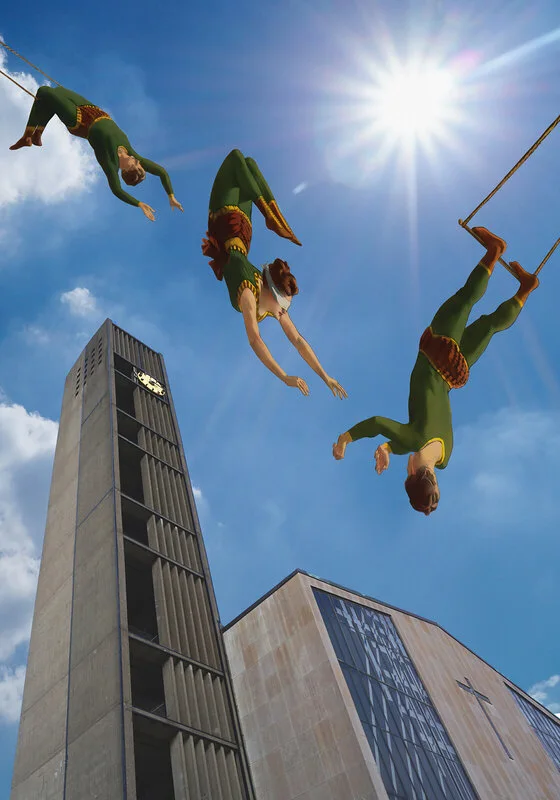
One who swings highest, swings best - Svingar högst som svingar bäst, 2022
Digital
50 x 70 cm
3 200 kr
I'm sure the St. Andrew's Church in Malmö can be used for more purposes than just looking magnificent. One can swing to heights other than the 41-meter-high bell tower. The modern church, inaugurated in 1959, was named after Jesus' disciple Andrew, Peter's brother. Both he and his brother Peter were fishermen by trade. Being a fisherman could be pretty acrobatic, climbing masts and diving into the sea to untangle nets. It was a dangerous profession.
Acrobatics, the art of tumbling, jumping, balancing, and using equipment like trapezes and trampolines, has a history that stretches back further than expected. The word 'Acrobatics' originates from the ancient Greek meaning 'to walk on tiptoe or strut,' a testament to the physical prowess and skill required. Indeed, acrobatics has been a part of most ancient cultures, with early evidence appearing in Minoan art from ancient Greece, dating back to 2000 B.C. The Minoans practised acrobatic feats on the backs of bulls, a dangerous and thrilling display of agility and strength.
In ancient China, acrobatics dates back to the Tang Dynasty in 203 BC. It was an integral part of celebrations, festivals, and dances, showcasing the agility and skill of the performers.
During the Middle Ages, acrobats travelled alongside troubadours and storytellers, performing at the castles of nobles. Their acts included juggling and simple gymnastics on the floor. As tastes evolved, more sophisticated stunts and apparatuses were incorporated, showcasing the adaptability and creativity of acrobatics. Today, acrobatics has become highly specialised, with performers often focusing on a particular skill, demonstrating the continued evolution of this dynamic art form.
Acrobatics is a discipline that demands not just physical strength and agility but also quick reflexes, precise timing, and fearlessness. Learning acrobatics starts with mastering the fundamentals, with safety being the top priority. Each move requires careful planning, and spotters are always present to ensure safety. From learning to fall safely to coordinating with others, acrobatics is a discipline that takes years to perfect physically and mentally.
A Journey Through Time and Culture
Acrobatics, the art of performing extraordinary feats of balance, agility, and coordination, has a long and captivating history. This dynamic discipline has transcended time and culture, evolving from ancient rituals to modern performances. The story of acrobatics is not just about daring exploits but also about its deep cultural significance and the inspiring inclusion of women in a field that once seemed exclusively masculine. Join me on a journey through the fascinating history of acrobatics, filled with exciting anecdotes and insights into how this art form has captivated audiences for millennia.
Bull-Leaping in Knossos
One of the earliest recorded forms of acrobatics comes from the Minoan civilisation on the island of Crete, around 2000 BCE. The Minoans practised a thrilling and dangerous sport known as bull-leaping, which was depicted in vivid frescoes at the palace of Knossos. In this ritual, athletes would grab the horns of a charging bull, vault over its back, and land gracefully on the other side. This practice displayed physical prowess and a religious ceremony, symbolising human mastery over nature. Bull-leaping required immense strength, agility, and bravery, becoming a central theme in Minoan culture.
Maya Acrobatics and Other Ancient Civilisations
Across the Atlantic, the ancient Maya civilisation in Mesoamerica also had its acrobatic traditions. The Maya were known for their ceremonial ball games, which included elements of acrobatics. Players would use their bodies to keep a heavy rubber ball in play, often performing flips and somersaults to strike the ball with their hips or forearms. These games were not just sports; they held deep religious significance and were sometimes played as part of ceremonial events.
In ancient China, acrobatics evolved into a sophisticated art form known as "zaji" or "variety arts." These performances included juggling, contortion, balancing acts, and aerial stunts. The Chinese acrobats were renowned for their incredible precision and flexibility, and their skills were often showcased in royal courts and public festivals.
Women in acrobatics breaking boundaries.
For much of history, men dominated acrobatics, but women have gradually carved out their place in this exhilarating field. In ancient Egypt, women performed acrobatics at banquets and religious ceremonies, showcasing their flexibility and grace. However, in the 19th and 20th centuries, women began gaining widespread recognition as acrobats.
One of the most famous female acrobats of the early 20th century was Lillian Leitzel, a German-born performer who dazzled audiences with her aerial stunts and broke barriers in a male-dominated field. Leitzel's signature act involved performing one-arm plunges and flips while suspended high above the ground. Her incredible strength and elegance made her a star in the Ringling Brothers and Barnum & Bailey Circus, and she became an inspiration for future generations of female acrobats, showing that women can excel in acrobatics.
Cirque du Soleil and Beyond
In the modern era, acrobatics has reached new heights of popularity and sophistication. Cirque du Soleil, founded in 1984 by Guy Laliberté and Gilles Ste-Croix, revolutionised the world of acrobatics with its blend of circus arts, street performance, and theatrical storytelling. Cirque du Soleil's productions, such as "Alegría," "O," and "KÀ," feature jaw-dropping acrobatic acts that push the boundaries of human potential.
One memorable anecdote from Cirque du Soleil involves the development of the "Wheel of Death," a large rotating apparatus on which performers execute gravity-defying stunts. During creating the show "KÀ," one acrobat suggested incorporating the wheel into the performance. Initially met with scepticism, the idea was eventually embraced, and the Wheel of Death became one of the most thrilling acts in Cirque du Soleil's repertoire.
Cultural Significance and Anecdotes
Acrobatics has always been significant in various cultures, serving as a symbol of human resilience and creativity. In the Soviet Union, acrobatics was a testament to physical strength and discipline. Soviet acrobats, such as the famous Flying Cranes, became national heroes and were celebrated for their daring aerial manoeuvres.
In Japan, acrobatics has a unique cultural expression in the form of "taiko" drumming combined with acrobatic dance. Groups like Kodo have popularised this art form, blending powerful drumming with synchronised acrobatic movements that captivate audiences worldwide.
One delightful anecdote comes from the world of French circus performer Jules Léotard, who invented the flying trapeze act in the mid-19th century. Léotard's daring performances, which included mid-air somersaults and leaps from one trapeze to another, inspired the popular song "The Daring Young Man on the Flying Trapeze." His innovation transformed circus performances and left a lasting legacy in popular culture.
The Ever-Evolving Art of Acrobatics
Acrobatics continues to evolve, captivating audiences with its blend of athleticism, artistry, and daring. From the bull-leapers of ancient Crete to the high-flying performers of Cirque du Soleil, acrobats have always pushed the limits of what is possible. Women have played an increasingly prominent role in this field, breaking barriers and inspiring future generations. As acrobatics develops, it is a testament to human creativity, resilience, and the desire to reach for the stars.
In every corner of the world, acrobatics brings joy, wonder, and a sense of awe, reminding us of the extraordinary capabilities of the human body and spirit.
Andreas, a name of Greek origin, holds a significant place in history. Primarily given to males, it symbolises 'man,' but interestingly, it can also be used as a feminine form. Andreus, the son of the river god Peneus, founded Orchomenos in Boeotia, adding a mythological touch to the name's lineage.
The Apostle Andrew was a verbal acrobat who converted thousands of Jews to Christianity without any personal gain, only spiritual satisfaction. But he had other skills in his repertoire. Though primarily associated with Jesus, the miracle of the loaves and fishes is closely linked to Saint Andrew. He was the one who brought the boy with five barley loaves and two fish to Jesus, which led to the miraculous feeding of the hungry five thousand. Talk about acrobatics, feeding so many with just a few loaves and two fish. The logistics alone are impressive.
An acrobatic masterpiece was when he raised the dead; the very thought is staggering. Saint Andrew raised a young man named Philopater from the dead. This miracle convinced many people of Andrew's divine mission and led to numerous conversions to Christianity.
Another type of acrobatics is financial acrobatics, which involves people who understand how to use others' money without increasing their risk through high-risk financial tricks that provide great rewards.
Financial acrobats leverage other people's money to amass substantial fortunes through bold and often risky manoeuvres. These financial daredevils dance on the tightrope of high stakes and complex strategies, frequently blurring the line between genius and recklessness. Their stories are as fascinating as they are cautionary, revealing both the potential for immense wealth and the perils that come with such daring exploits. The thrill and risk involved in financial acrobatics are genuinely captivating.
One of the most renowned financial acrobats is George Soros. Born in Hungary, Soros became famous as a hedge fund manager and philanthropist. Established in 1973, his Quantum Fund gained legendary status when Soros shorted $10 billion of British pounds in 1992. This bold move, known as the Black Wednesday trade, earned him a staggering $1 billion profit and cemented his reputation as 'the man who broke the Bank of England.' Soros's success story is truly inspiring.
Warren Buffett, often called the "Oracle of Omaha," presents a more conservative form of financial acrobatics. As the chairman and CEO of Berkshire Hathaway, Buffett's strategy revolves around value investing—identifying undervalued companies and holding them for long-term growth. In comparison, he is not a high-risk taker in the traditional sense; his immense investments and the trust placed in his judgment make him a financial acrobat in his own right.
Michael Milken, the "Junk Bond King," revolutionised corporate finance in the 1980s through his work at Drexel Burnham Lambert. Milken's innovation was in high-yield bonds, which he used to finance corporate takeovers and leveraged buyouts. Despite his success, his aggressive tactics led to legal troubles, and he served time in prison for securities fraud, underscoring the thin line between innovation and illegality.
Carl Icahn is another titan of financial acrobatics, known for his activism and corporate raiding. Icahn's method involves using significant leverage and investor capital to acquire large company stakes, pushing for changes to unlock shareholder value. His high-stakes manoeuvres have yielded substantial profits, though not without controversy.
Bernard Madoff's story is a dark chapter in the annals of financial acrobatics. Running one of the largest Ponzi schemes in history, Madoff promised high, steady returns to investors, using new investors' money to pay returns to earlier ones. The scheme unravelled in 2008, resulting in $65 billion in losses and Madoff's imprisonment, highlighting the catastrophic potential of fraudulent financial practices.
John Paulson made his mark by betting against the U.S. housing market in 2007. His hedge fund, Paulson & Co., capitalised on the impending subprime mortgage crisis, netting him approximately $4 billion. Paulson's success showcased the power of foresight and the ability to profit from market downturns.
Jim Simons, a mathematician turned hedge fund manager, founded Renaissance Technologies and its Medallion Fund. Known for high-frequency trading and complex algorithms, the fund has achieved extraordinary returns, demonstrating the intersection of technology and finance in modern-day acrobatics.
Nick Leeson offers a cautionary tale. As a derivatives trader, his unauthorised speculative trading led to the collapse of Barings Bank in 1995. Leeson's high-risk bets on the Japanese stock market resulted in losses of £827 million, a stark reminder of the potential dangers inherent in financial acrobatics.
Jesse Livermore, an early 20th-century stock trader, epitomised the highs and lows of speculative trading. He made and lost several fortunes, most famously profiting $100 million by shorting the market during the 1929 stock market crash.
These financial acrobats have left indelible marks on the world of finance. Their stories, filled with bold moves, immense risks, and sometimes devastating consequences, inspire and warn. They illustrate the extraordinary potential for wealth that comes with financial daring and the profound impact such individuals can have on the markets and society.
Throughout history, financial acrobats have dazzled the world with their daring exploits, savvy manoeuvring, and larger-than-life personalities. These individuals leveraged their wit, audacity, and sometimes sheer luck to amass fortunes and alter the course of financial history. Let's embark on a whimsical journey through time to meet some of these fascinating characters.
Our journey begins with Croesus, the legendary king of Lydia. Known for his immense wealth and being a big spender, Croesus didn't just sit on his riches; he epitomised "spend big to win big." His fortune was so vast that "as rich as Croesus" became synonymous with unimaginable wealth. He famously founded the Temple of Artemis at Ephesus, one of the Seven Wonders of the Ancient World. Although Croesus met a tragic end, his legacy as a financial acrobat who dazzled the ancient world with wealth endures.
Fast forward to ancient Rome, where Marcus Licinius Crassus profited by exploiting opportunities others missed. Crassus was the ultimate real estate mogul, known as one of the wealthiest men in Roman history. He had a knack for buying properties on the cheap, especially those that were burning down. His private fire brigade would rush to the scene, and Crassus would offer to buy the building at a fraction of its value before putting out the fire. If the owner refused, he let it burn. Crassus's shrewd, albeit ruthless, strategies made him a key power player in Rome.
In the 16th century, Jacob Fugger, the Renaissance Tycoon, also known as "Fugger the Rich," dominated the European financial scene. He amassed his wealth through banking, mining, and trade, establishing an economic empire that spanned the continent. Fugger financed emperors and kings, earning himself political influence and the ability to shape European politics. His financial acrobatics included innovative practices like double-entry bookkeeping, laying the foundation for modern accounting.
John Law, a Scottish economist and gambler, is famous for his bold financial experiments in early 18th-century France when he invented paper money (and a Bubble). He convinced the French government to let him establish the Banque Générale, which issued bank notes backed by land. Law's Mississippi Company scheme, which promised immense wealth from the Louisiana territory, created one of history's first financial bubbles. When the bubble burst, many were ruined, but Law's innovative ideas about paper money and central banking were ahead of their time.
In the late 19th and early 20th centuries, Hetty Green, known as the "Witch of Wall Street," became one of America's wealthiest women. Despite her miserly reputation and frugal lifestyle, Green was a wise investor. She capitalised on market downturns, buying undervalued assets and holding them until they appreciated. Her ability to amass and grow her fortune in a male-dominated financial world was nothing short of acrobatic.
Jay Gould, the robber baron, was a notorious figure of the Gilded Age who was a master of financial manipulation and speculation. Known as a "robber baron," Gould used ruthless tactics to gain control of railroad companies and other enterprises. His involvement in the infamous Black Friday gold panic of 1869, where he and his partners attempted to corner the gold market, showcased his audacious risk-taking. Gould's legacy is a mix of financial genius and unscrupulous behaviour.
In recent history, Bernie Madoff's name became synonymous with financial fraud. His Ponzi scheme, one of the largest in history, promised consistently high returns to investors. Madoff used new investors' funds to pay returns to earlier investors, creating an illusion of a profitable enterprise. The scheme eventually collapsed, leading to significant financial losses and Madoff's imprisonment. His story is a stark reminder of the perils of unchecked financial acrobatics.
These historical figures, from ancient kings to modern swindlers, demonstrate how financial acrobatics have shaped economies and lives. Their stories testify to human ingenuity, ambition, and the sometimes fine line between brilliance and folly.
3 200 kr

Jörgen Thornberg
Malmö
Lite om bilder och mig. Translation in English at the end.
Jag är en nyfiken person som ser allt i bilder, även det jag fäster i ord, gärna tillsammans för bakom alla mina bilder finns en berättelse. Till vissa bilder hör en kortare eller längre novell som följer med bilden.
Bilder berättar historier. Jag omges av naturlig skönhet, intressanta människor och historia var jag än går. Jag använder min kamera för att dokumentera världen och blanda det jag ser med vad jag känner för att fånga den dolda magin.
Mina bilder berättar mina historier. Genom mina bilder, tryck och berättelser. Jag bjuder in dig att ta del av dessa berättelser, in i ditt liv och hem och dela min mycket personliga syn på vår värld. Mer än vad ögat ser. Jag tänker i bilder, drömmer och skriver och pratar om dem; följaktligen måste jag också skapa bilder. De blir vad jag ser, inte nödvändigtvis begränsade till verkligheten. Det finns en bild runt varje hörn. Jag hoppas att du kommer att se vad jag såg och gilla det.
Jag är också en skrivande person och till många bilder hör en kortare eller längre essay. Den följer med tavlan, tryckt på fint papper och med en personlig hälsning från mig.
Flertalet bilder startar sin resa i min kamera. Enkelt förklarat beskriver jag bilden jag ser i mitt inre, upplevd eller fantiserad. Bilden uppstår inom mig redan innan jag fått okularet till ögat. På bråkdelen av ett ögonblick ser jag vad jag vill ha och vad som kan göras med bilden. Här skall jag stoppa in en giraff, stålmannen, Titanic eller vad det är min fantasi finner ut. Ännu märkligare är att jag kommer ihåg minnesbilden långt efteråt när det blir tid att skapa verket. Om jag lyckas eller inte, är upp till betraktaren, oftast präglat av en stråk av svart humor – meningen är att man skall bli underhållen. Mina bilder blir ofta en snackis där de hänger.
Jag föredrar bilder som förmedlar ett budskap i flera lager. Vid första anblicken fylld av feel-good, en vacker utsikt, fint väder, solen skiner, blommor på ängen eller vattnet som ligger förrädiskt spegelblankt. I en sådan bild kan jag gömma min egentliga berättelse, mitt förakt för förtryckare och våldsverkare, rasister och fördomsfulla människor - ett gärna återkommande motiv mer eller mindre dolt i det vackra motivet. Jag försöker förena dem i ett gemensamt narrativ.
Bild och formgivning har löpt som en röd tråd genom livet. Fotokonst känns som en värdig final som jag gärna delar med mig.
Min genre är vid som framgår av mina bilder, temat en blandning av pop- och gatukonst i kollage som kan bestå av hundratals lager. Vissa bilder kan ta veckor, andra någon dag innan det är dags att överlämna resultatet till printverkstaden. Fine Art Prints är digitala fotocollage. I dessa kollage sker rivandet, klippandet, pusslandet, målandet, ritandet och sprayningen digitalt. Det jag monterar in kan vara hundratals år gamla bilder som jag omsorgsfullt frilägger så att de ser ut att vara en del av tavlan men också bilder skapade av mig själv efter min egen fantasi. Därefter besöks printstudion och för vissa bilder numrera en limiterad upplaga (oftast 7 exemplar) och signera för hand. Vissa bilder kan köpas i olika format. Det är bara att fråga efter vilka. Gillar man en bild som är 70x100 men inte har plats på väggen, går den kanske att få i 50x70 cm istället. Frågan är fri.
Metoden Giclée eller Fine Art Print som det också kallas är det moderna sättet för framställning av grafisk konst. Villkoret för denna typ av utskrifter är att en högkvalitativ storformatskrivare används med åldersbeständigt färgpigment och konstnärspapper eller i förekommande fall på duk. Pappret som används möter de krav på livslängd som ställs av museer och gallerier. Normalt säljer jag mina bilder oinramade så att den nya ägaren själv kan bestämma hur de skall se ut, med eller utan passepartout färg på ram, med eller utan glas etc..
Under många år ställde jag bara ut på nätet, i valda grupper och på min egen Facebooksida - https://www.facebook.com/jorgen.thornberg.9
Jag finns också på en egen hemsida som tyvärr inte alltid är uppdaterad – https://www.jth.life/ Där kan du också läsa en del av de berättelser som följer med bilden.
UTSTÄLLNINGAR
Luftkastellet, oktober 2022
Konst i Lund, november 2022
Luftkastellet, mars 2023
Engleson Galleri Caroli, april 2023
Hydra, Greece June 2023
Engleson Galleri Caroli, oktober 2023
Toppen, Höllviken december 2023
Luftkastellet, mars 2024
Torups Galleri, mars 2024
Venice, May 2024
Luftkastellet, oktober 2024
Konst i Advent, December 2024
Galleri Engleson, Caroli December 2024
Jäger & Jansson Galleri, april 2025
A bit about pictures and me.
I'm a curious person who sees everything in pictures, even what I express in words, often combining them, for behind all my pictures lies a story. These narratives, some as short as a single image and others as long as a novel, are the heart and soul of my work.
Pictures tell stories. Wherever I go, I'm surrounded by natural beauty, exciting people, and history. I use my camera to document the world and blend what I see with what I feel to capture the hidden magic.
My images tell my stories. Through my pictures, prints, and narratives, I invite you to partake in these stories in your life and home and share my deeply personal perspective of our world. More than meets the eye. I think in pictures, dream, write, and talk about them; consequently, I must create images too. They become what I see, not necessarily confined to reality. There's a picture around every corner. I hope you'll see what I saw and enjoy it.
I'm also a writer, and many images come with a shorter or longer essay. It accompanies the painting, printed on fine paper with my personal greeting.
Many pictures start their journey on my camera. Simply put, I describe the image I see in my mind, experienced or imagined. The image arises within me even before I bring the eyepiece to my eye. In a fraction of a moment, I see what I want and what can be done with the picture. Here, I'll insert a giraffe, Superman, the Titanic, or whatever my imagination conjures up. Even stranger is that I remember the mental image long after it's time to create the work. Whether I succeed is up to the observer, often imbued with a streak of black humour – the aim is to entertain. My pictures usually become a talking point wherever they hang.
I prefer pictures that convey a message in multiple layers. At first glance, they're filled with feel-good vibes, a beautiful view, lovely weather, the sun shining, flowers in the meadow, or the water lying deceptively calm. But beneath this surface beauty, I often conceal a deeper story, a narrative that challenges societal norms or explores the human condition. I invite you to delve into these hidden narratives and discover the layers of meaning within my work.
Picture and design have been a thread running through my life. Photographic art feels like a fitting finale, and I'm happy to share it.
My genre is varied, as seen in my pictures; the theme is a blend of pop and street art in collages that can consist of hundreds of layers. Some images can take weeks, others just a day before it's time to hand over the result to the print workshop. Fine Art Prints are digital photo collages. In these collages, tearing, cutting, puzzling, painting, drawing, and spraying happen digitally. What I insert can be images hundreds of years old that I carefully extract so they appear to be part of the painting, but also images created by myself, now also generated from my imagination. Next, visit the print studio and, for certain images, number a limited edition (usually 7 copies) and sign them by hand. Some images may be available in other formats. Just ask which ones. If you like an image that's 70x100 but doesn't have space on the wall, you might be able to get it in 50x70 cm instead. The question is open.
The Giclée method, or Fine Art Print as it's also called, is the modern way of producing graphic art. This method ensures the highest quality and longevity of the artwork, using a high-quality large-format printer with archival pigment inks and artist paper or, in some cases, canvas. The paper used meets the longevity requirements set by museums and galleries. I sell my pictures unframed, allowing the new owner to personalise their artwork, confident in the lasting value and quality of the piece.
For many years, I only exhibited online, in selected groups, and on my Facebook page - https://www.facebook.com/jorgen.thornberg.9. I also have my website, which unfortunately is not constantly updated - https://www.jth.life/. You can also read some of the stories accompanying the pictures there.
EXHIBITIONS
Luftkastellet, October 2022
Art in Lund, November 2022
Luftkastellet, March 2023
Engleson Gallery Caroli, April 2023
Hydra, Greece June 2023
Engleson Gallery Caroli, October 2023
Toppen, Höllviken December 2023
Luftkastellet, March 2024
Torup Gallery, March 2024
Venice, May 2024
UTSTÄLLNINGAR
Luftkastellet, oktober 2022
Konst i Lund, november 2022
Luftkastellet, mars 2023
Engleson Galleri Caroli, april 2023
Hydra, Greece June 2023
Engleson Galleri Caroli, oktober 2023
Toppen, Höllviken december 2023
Luftkastellet, mars 2024
Torups Galleri, mars 2024
Venice, May 2024
Luftkastellet, October 2024
Konst i Advent, December 2024
Galleri Engleson, Caroli December 2024
Jäger & Jansson Galleri, April 2025
Utbildning
Autodidakt
Medlem i konstnärsförening
Öppna Sinnen
Med i konstrunda
Konstrundan i Skåne
Utställningar
Luftkastellet, October 2022
Art in Lund, November 2022
Luftkastellet, March 2023
Engleson Gallery Caroli, April 2023
Hydra, Greece June 2023
Engleson Gallery Caroli, October 2023
Toppen, Höllviken December 2023
Luftkastellet, March 2024
Torup Gallery, March 2024
Venice, May 2024