Vi använder cookies för att ge dig bästa möjliga upplevelse. Välj vilka cookies du tillåter.
Läs mer i vår integritetspolicy
Jörgen Thornberg
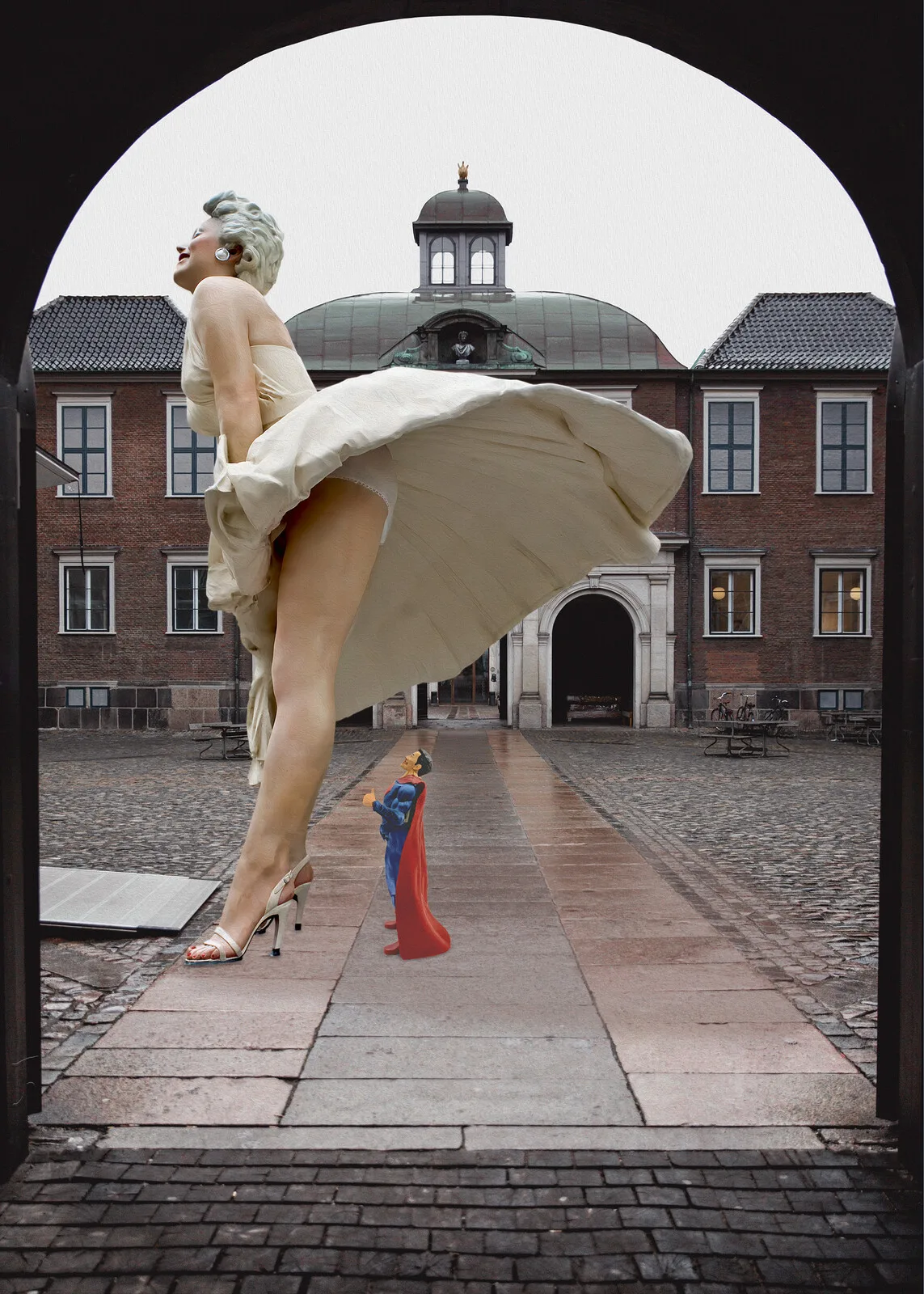
When It Rains in Copenhagen, Superman Doesn’t Rust, 2023
Digital
50 x 70 cm
3 200 kr
The image's title is "When It Rains in Copenhagen, Superman Doesn't Rust." This is highly symbolic since Superman is not made of steel, not even stainless steel. The image has an amusing and intricate background, making it worth sharing.
The moniker 'The Man of Steel' was not just a random name but a symbolic representation of Superman's strength and invincibility. Given his near-indestructibility, it was a fitting comparison to the robust metal steel. Interestingly, this nickname also connects to a superhero who predated Superman: Doc Savage. The 'Man of Steel' nickname has become a part of Superman's identity and influenced his relationships with other characters, such as his love interest Lois Lane and arch-nemesis Lex Luthor, adding depth and complexity to his narrative. Good question.
Why is Superman called "The Man of Steel" if he's not made of steel? This intriguing question opens the door to the rich lore surrounding one of the most iconic superheroes. Since his debut in 1938 in Action Comics #1, created by Jerry Siegel and Joe Shuster, Superman has been a pivotal figure in the comic book world. The title "Man of Steel" reflects his near-indestructibility and extraordinary strength, likening him to the rigid metal despite his alien origins.
Superman's story started with his arrival on Earth from a doomed planet, showcasing his superhuman abilities from a young age. Introduced as a newspaper reporter by day and a caped hero by night, he quickly became a household name. The nickname "Man of Steel" first appeared in Action Comics #6, symbolising his robust physicality and marking a critical development in his character portrayal.
Interestingly, the "Man of Steel" nickname also nods to an earlier superhero, Doc Savage, known as "The Man of Bronze", who debuted in 1933. Savage significantly influenced Superman's creation, equipped with his Arctic hideaway and remarkable capabilities. This parallel between the two heroes underlines the evolution of superhero narratives and the intertextual connections within the genre.
The adoption of "Man of Steel" by Siegel and Shuster was likely an intentional effort to position Superman as even mightier than Doc Savage, acknowledging the legacy while setting their hero apart. This moniker has endured through the ages, evidenced by its use in modern films and comics, encapsulating the timeless appeal and enduring legacy of Superman as a cultural icon.
Despite his near-invulnerability to physical harm, Superman's ability to experience sensations like touch is a fascinating aspect of his character. Superman's invulnerability comes from his Kryptonian physiology, which gives him a bio-electric "aura" that protects him from most physical damages and extreme environmental effects under Earth's yellow sun. However, this aura is primarily a defensive mechanism against harmful impacts and doesn't numb his sensory nerves.
Thus, while Superman can withstand bullets, explosions, and extreme forces without injury, his sensory perception—designed to function on a planet like Earth—is intact. This means he can feel gentler, non-damaging stimuli such as touch, temperature, and texture, allowing him to experience human sensations like a caress or a warm embrace. When Lois Lane touches his cheek, Superman feels it much like any human, thanks to this selective sensitivity that allows him to interact meaningfully with the world and people around him.
This selective perception is crucial for Superman's interaction with his environment, people, and humanity. It allows him to connect emotionally and physically with others, maintaining his human side despite his alien origins and superhuman abilities.
'Stålmannen', 'Super-Homem', 'Sūpāman', and 'Chāorén', depending on language or the most common 'Superman', are not made of steel. His name, "Man of Steel", refers to his almost invincible strength and ability to resist physical damage rather than his actual physical composition. Superman comes from the planet Krypton, and it is his Kryptonian biology that, when exposed to Earth's yellow sun, gives him his superhuman powers. These powers include superhuman strength, speed, vision, invulnerability, and the ability to fly.
The term "Man of Steel" is a metaphor to describe his invulnerability and strength, making him resemble a figure sculpted in steel—something robust and almost indestructible. It also highlights the dramatic difference between his fragile existence on Krypton and his nearly godlike existence on Earth.
Superman's body comprises Kryptonian biology, genetically similar to humans but with specific crucial differences activated by Earth's yellow sun. Superman does not have these powers on Krypton, where the sun is red and weaker. Particular wavelengths of light from Earth's sun give Superman powers by interacting with his Kryptonian cell structure.
Superman's cells are super-efficient solar collectors that absorb and convert solar radiation into energy. This process gives him superhuman powers: Thanks to the energy his cells generate, his muscles and skeleton are incredibly durable and robust, giving him superhuman strength and speed. By manipulating the gravitational field around him, Superman can lift and fly, which also involves his ability to handle and direct the power he generates.
His skin and cells are highly resistant to damage. This is due to a combination of his cellular density, which is enhanced by solar energy, and a force field that his body generates, making him almost invulnerable. Superman's superhuman sensory perceptions, such as his vision and hearing, are greatly enhanced, allowing him to see through solid objects (except lead) and hear sounds at extremely long distances.
Even Superman, his Achilles heel and his weaknesses. Kryptonite: A radioactive mineral from his home planet, Krypton that can block or interfere with the absorption of solar energy in his cells, thus making him weak and vulnerable.
Superman's biological powers also offer no resistance to magical attacks, making magic a practical weakness. This fantasy-based "science" gives Superman his iconic powers and defines the limitations that exist for his character within various stories and media. It has been filling the publishers' coffers since 1938, making film companies even richer and keeping Superman himself stainless.
But why did he seek shelter under Marilyn Monroe's statue's skirt? This question may seem trivial, but it speaks to the human side of Superman. Silly question. Because Superman is a man and wants to look up at her panties, like any man, he has his curiosities and interests, even with his superhuman abilities. This aspect of his character adds a touch of relatability and humour to his otherwise serious and powerful persona.
Marilyn Monroe, a name that twinkles with Hollywood glamour much like the stars on a clear movie premiere night, continues to captivate hearts and imaginations worldwide. Known for her platinum blonde hair and signature breathy voice, Marilyn became much more than an actress; she was an enduring icon of charm, wit, and a dash of mystery.
Born as Norma Jeane Mortenson in 1926, Marilyn's story is a classic tale of transformation. From a factory worker in Los Angeles to a global superstar, she seemed to live the American dream in Technicolor. Yet, like the best of tales, it came with its twists. Her life off-screen, often marked by personal struggles and public fascination, added layers to her on-screen persona that were both endearing and heartbreaking.
Marilyn's film career featured performances that often poked fun at her bombshell image. Who could forget the iconic scene in "The Seven Year Itch" where she stood over a subway grate, her white dress billowing up, while she naively exclaimed, "Isn't it delicious?" This scene alone cements her status as a cultural and comedic force; she was in on the joke, controlling her image with a knowing wink.
Her roles often showcased her comedic talents, which were as natural and effervescent as the bubbly she preferred at soirees. In films like "Gentlemen Prefer Blondes" and "How to Marry a Millionaire," Marilyn delivered lines with comedic timing that rivalled the seasoned pros. She played up the blonde stereotype to her advantage, subverting expectations with her sharp delivery, proving that she understood how to manipulate her screen persona for laughs and effect.
Despite her glamorous facade, Marilyn was voraciously intellectual. She was a voracious reader, known to tote a hefty bag filled with books ranging from James Joyce to Walt Whitman. Her love for literature wasn't just for show; it was a sincere part of her quest for self-education. She often joked about her image versus intellect, once quipping, "I'm not interested in money; I just want to be wonderful."
Marilyn's relationships with figures like Joe DiMaggio and Arthur Miller were as high-profile as her films. With DiMaggio, she shared a tender vulnerability, while with Miller, she explored intellectual passions. Each relationship seemed to bring out a different facet of her character, from starry-eyed lover to serious actress, reflecting her multifaceted personality.
Despite her global fame, Marilyn maintained a playful and sometimes cheeky sense of humour. She famously sang "Happy Birthday" to President John F. Kennedy in a way that could make even the national anthem blush. The performance was sultry, yes, but also brimming with a cheeky audacity that only Marilyn could pull off without a hitch.
Tragically, Marilyn's candle flickered out far too soon at 36, leaving behind a legacy wrapped in a blend of joy, sadness, and unfulfilled potential. Her life and career were a series of beautiful snapshots marred by the occasional streak, but through it all, her spirit never faded from the public consciousness.
Marilyn Monroe remains a study in contrasts: a sex symbol who wanted respect, a merry prankster who craved seriousness, and a public figure who desired a private life. Today, she is remembered not just for her breathy voice or glamorous looks but for her enduring impact on film, culture, and the very notion of celebrity. In all her complexity, Marilyn Monroe continues to be a beacon of the timeless allure of Hollywood's golden era, reminding us all that while stars may fade, icons blaze forever.
Marilyn Monroe's life, while full of glamour and stardom, also had its darker moments, marked by exploitation and mistreatment by powerful men who saw her as little more than an object for their desires. Two significant instances in her career and personal life involved Louis B. Mayer, the head of MGM, and the politically prominent Kennedy brothers.
Marilyn encountered Louis B. Mayer during her time in Hollywood; he was known for his controlling nature and was a pivotal figure in the studio system that often exploited actresses. The "casting couch" practices were an open secret in the industry; many young actresses, including Marilyn, were expected to endure sexual advances from executives and influential figures as a means to secure roles or favourable contracts. Although specific details of Mayer's interactions with Marilyn are not as documented as in other cases, it's widely acknowledged that Marilyn was subjected to the general atmosphere of sexual predation that Mayer and others perpetuated in Hollywood.
Marilyn's involvement with John F. Kennedy and, to a lesser extent, Robert Kennedy has been widely speculated upon and remains a topic of intrigue and sorrow. Her relationships with them were complicated and, by many accounts, exploitative. It is rumoured that Marilyn has had affairs with both brothers at different times. These relationships brought her a mix of public attention and private pain. The Kennedy brothers were significant political figures, and their interactions with Monroe were seen by many as taking advantage of her vulnerability and fame for their gratification. After her relationship with them ended, Marilyn reportedly felt abandoned and used, which contributed to her emotional and psychological struggles.
These experiences with Mayer and the Kennedys exemplify the darker side of Marilyn Monroe's life, overshadowing her professional achievements and personal aspirations with tales of exploitation and abuse. Marilyn's story reflects the broader issues of power dynamics and the mistreatment of women in the entertainment industry, which are still relevant today. Her enduring legacy as a cultural icon also reminds her of the personal costs she bore as one of Hollywood's most luminous stars, navigating a world that often valued her glamour over her well-being.
Marilyn Monroe's experiences with exploitation occurred long before movements like #MeToo brought widespread attention to the systematic abuse of power by men in positions of authority to coerce or pressure women into unwanted sexual encounters. The stories of her encounters with Louis B. Mayer and the Kennedy brothers highlight the harsh reality of her era, where such behaviour was often ignored or tacitly accepted within the industry and beyond.
Louis B. Mayer, in particular, exemplified this type of predatory behaviour in Hollywood, where his influence as a studio mogul allowed him to exploit numerous young actresses with impunity. The culture of the time permitted and even encouraged such actions, leaving the victims with little recourse or support.
In stark contrast, the #MeToo movement has shone a spotlight on similar abuses in the entertainment industry and beyond, empowering survivors to come forward and hold perpetrators accountable. Harvey Weinstein, once a powerful film producer, became a central figure in the #MeToo movement, his actions leading to public outcry and legal consequences. However, when comparing the likes of Weinstein to figures like Mayer, it's clear that Weinstein, despite his significant abuses, might seem like a choir boy next to the unchecked and widespread exploitation perpetrated by earlier Hollywood moguls like Mayer.
This historical context underscores the significant changes in societal attitudes towards sexual harassment and abuse, highlighting the importance of continuing to fight for a world where such abuses are no longer tolerated and where the victims are heard and believed.
Back to my picture, when Marilyn is sheltering Superman because a whirlwind on Lexington Avenue raised Marilyn's skirt.
It was a warm summer evening in 1954, and the streets of Manhattan were bustling with the usual crowd. But a palpable buzz wasn't just from the New York heat that day. The setting was Lexington Avenue, where a large crowd had gathered, not for a parade but to witness a cinematic moment that would flutter through the annals of film history like a playful breeze—Marilyn Monroe's iconic skirt scene.
The film in question was The Seven Year Itch. The scene involved Marilyn standing over a subway grate, her white dress billowing up as a train passed underneath, her laughter mingling with the sound of a subway that was unwittingly playing co-star. It was a scene that would define allure and cinematic charm for decades. But what was happening on Lexington Avenue?
Imagine the scenario: the director, Billy Wilder, a perfectionist by trade and a provocateur by nature, had decided that this moment had to be captured in the raw vibrancy of the New York streets. Wilder was relentless, the subway trains were punctual, and Marilyn was, well, Marilyn—effervescent and enchanting. Take after take, the dress danced in the gusts of the passing trains, and each flutter was met with cheers and gasps from the ever-growing audience, captivated by Monroe's undeniable charm.
The onlookers, a mix of flustered men with tipped hats and women who admired Monroe's unwavering composure, were getting more than they bargained for with their casual evening stroll. The scene turned Lexington into a makeshift theatre, the streets becoming the stage and the buildings the grandstands. Popcorn was replaced by the rustling sounds of newspaper pages being turned to see if this spectacle made the evening news, adding to the theatrical atmosphere.
With each take, Monroe perfected her playful act of surprise, her smile beaming under the New York City lights. Wilder, ever the stickler, insisted on capturing the perfect combination of shock and charm. He was crafting a moment of accidental allure, a choreographed candidness that would encapsulate Monroe's irresistible charm.
And what about the dress? Ah, the dress! It deserved its billing as a co-star. Designed by William Travilla, it was both the provocateur and the protector of Monroe's modesty. It ballooned gracefully, creating a powerful image that transcended the film to become a symbol of playful sexuality forever imprinted in popular culture.
But let's not overlook the unsung hero of this escapade—the New York City subway. Yes, the very vehicle of urban monotony turned maestro, dictating the tempo of Monroe's ballet above ground with each passing train. It was as if the subway knew it was part of cinema history, puffing itself up to contribute its gusty cameo.
As the night wore on and the takes accumulated, so did the tales. Later retellings of the event would say you could feel the collective heartbeat of the crowd syncing up with the rising of Monroe's dress. Satisfied with his orchestration of this perfectly imperfect moment, Wilder finally called it a wrap. Monroe walked away, her laughter still mingling with the crowd's chatter, leaving behind a scene that would be replayed in millions of minds and on countless screens.
Thus concluded the night when Marilyn Monroe, a simple subway grate, and a white dress came together to create a whirlwind on Lexington Avenue. This whirlwind would continue to spin through the reels of film history long after the subway's last train home.
The colossal statue of Marilyn Monroe, with her skirt elegantly captured in an uplift reminiscent of the famous scene from 'The Seven Year Itch', is an iconic representation of the beloved movie star. This statue, which stands at an impressive size, is located in Los Angeles and Florida, attesting to its popularity and cultural significance.
Created by artist Seward Johnson, known for his lifelike and often humorous sculptures of famous figures, Marilyn's statue has not escaped controversy. Johnson's ability to capture the moment when Marilyn's skirt flutters in the wind is technically impressive but has also led to moral debates. Critics and moral guardians have expressed at various times that the statue is inappropriate, causing it to be relocated several times.
Reactions to the statute have varied widely. Some view it as a celebration of film history and Monroe's enduring legacy of glamour and charm, while others believe it unacceptably objectifies her. This opinion discrepancy reflects broader societal debates about art, celebrity culture, and female representation.
Despite the controversies, Seward Johnson's work attracts admirers and critics and remains a curious and discussed addition to public art. Johnson's death has not diminished interest in his artwork; instead, it has cemented his status as an artist who could captivate audiences with his provocative and thought-provoking creations. The statue of Marilyn Monroe, with its dynamic portrayal and historical allusion, continues to be a powerful and debated symbol in America's cultural landscape.
American sculptor Seward Johnson, who passed away in March 2020, is known for his hyper-realistic sculptures, often depicting ordinary people and pop culture icons in everyday situations. His ability to capture ordinary and iconic moments, like Marilyn Monroe's skirt moment, has made him a prominent figure in public art. His beloved and controversial works continue to encourage dialogue about the role of art in society and its impact on the public sphere.
What does all this have to do with it raining in Copenhagen? Absolutely nothing. Copenhagen typically experiences around 170 days of precipitation per year. This includes not just days of rain but also other forms of precipitation, like snow. So, it was easy to let my imagination wander one day as I passed this beautiful courtyard when it was raining cats and dogs. I didn't even need to move the statue. It was already in my camera from a visit to America. It's pretty impressive to stand underneath it; a fully grown man barely reaches the middle of her calves. I can assure you her underwear was clean.
Jörgen Thornberg
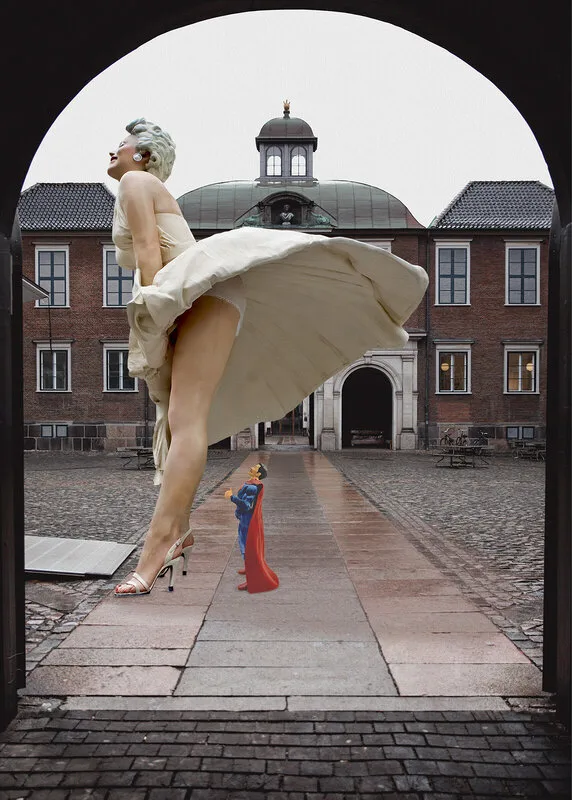
When It Rains in Copenhagen, Superman Doesn’t Rust, 2023
Digital
50 x 70 cm
3 200 kr
The image's title is "When It Rains in Copenhagen, Superman Doesn't Rust." This is highly symbolic since Superman is not made of steel, not even stainless steel. The image has an amusing and intricate background, making it worth sharing.
The moniker 'The Man of Steel' was not just a random name but a symbolic representation of Superman's strength and invincibility. Given his near-indestructibility, it was a fitting comparison to the robust metal steel. Interestingly, this nickname also connects to a superhero who predated Superman: Doc Savage. The 'Man of Steel' nickname has become a part of Superman's identity and influenced his relationships with other characters, such as his love interest Lois Lane and arch-nemesis Lex Luthor, adding depth and complexity to his narrative. Good question.
Why is Superman called "The Man of Steel" if he's not made of steel? This intriguing question opens the door to the rich lore surrounding one of the most iconic superheroes. Since his debut in 1938 in Action Comics #1, created by Jerry Siegel and Joe Shuster, Superman has been a pivotal figure in the comic book world. The title "Man of Steel" reflects his near-indestructibility and extraordinary strength, likening him to the rigid metal despite his alien origins.
Superman's story started with his arrival on Earth from a doomed planet, showcasing his superhuman abilities from a young age. Introduced as a newspaper reporter by day and a caped hero by night, he quickly became a household name. The nickname "Man of Steel" first appeared in Action Comics #6, symbolising his robust physicality and marking a critical development in his character portrayal.
Interestingly, the "Man of Steel" nickname also nods to an earlier superhero, Doc Savage, known as "The Man of Bronze", who debuted in 1933. Savage significantly influenced Superman's creation, equipped with his Arctic hideaway and remarkable capabilities. This parallel between the two heroes underlines the evolution of superhero narratives and the intertextual connections within the genre.
The adoption of "Man of Steel" by Siegel and Shuster was likely an intentional effort to position Superman as even mightier than Doc Savage, acknowledging the legacy while setting their hero apart. This moniker has endured through the ages, evidenced by its use in modern films and comics, encapsulating the timeless appeal and enduring legacy of Superman as a cultural icon.
Despite his near-invulnerability to physical harm, Superman's ability to experience sensations like touch is a fascinating aspect of his character. Superman's invulnerability comes from his Kryptonian physiology, which gives him a bio-electric "aura" that protects him from most physical damages and extreme environmental effects under Earth's yellow sun. However, this aura is primarily a defensive mechanism against harmful impacts and doesn't numb his sensory nerves.
Thus, while Superman can withstand bullets, explosions, and extreme forces without injury, his sensory perception—designed to function on a planet like Earth—is intact. This means he can feel gentler, non-damaging stimuli such as touch, temperature, and texture, allowing him to experience human sensations like a caress or a warm embrace. When Lois Lane touches his cheek, Superman feels it much like any human, thanks to this selective sensitivity that allows him to interact meaningfully with the world and people around him.
This selective perception is crucial for Superman's interaction with his environment, people, and humanity. It allows him to connect emotionally and physically with others, maintaining his human side despite his alien origins and superhuman abilities.
'Stålmannen', 'Super-Homem', 'Sūpāman', and 'Chāorén', depending on language or the most common 'Superman', are not made of steel. His name, "Man of Steel", refers to his almost invincible strength and ability to resist physical damage rather than his actual physical composition. Superman comes from the planet Krypton, and it is his Kryptonian biology that, when exposed to Earth's yellow sun, gives him his superhuman powers. These powers include superhuman strength, speed, vision, invulnerability, and the ability to fly.
The term "Man of Steel" is a metaphor to describe his invulnerability and strength, making him resemble a figure sculpted in steel—something robust and almost indestructible. It also highlights the dramatic difference between his fragile existence on Krypton and his nearly godlike existence on Earth.
Superman's body comprises Kryptonian biology, genetically similar to humans but with specific crucial differences activated by Earth's yellow sun. Superman does not have these powers on Krypton, where the sun is red and weaker. Particular wavelengths of light from Earth's sun give Superman powers by interacting with his Kryptonian cell structure.
Superman's cells are super-efficient solar collectors that absorb and convert solar radiation into energy. This process gives him superhuman powers: Thanks to the energy his cells generate, his muscles and skeleton are incredibly durable and robust, giving him superhuman strength and speed. By manipulating the gravitational field around him, Superman can lift and fly, which also involves his ability to handle and direct the power he generates.
His skin and cells are highly resistant to damage. This is due to a combination of his cellular density, which is enhanced by solar energy, and a force field that his body generates, making him almost invulnerable. Superman's superhuman sensory perceptions, such as his vision and hearing, are greatly enhanced, allowing him to see through solid objects (except lead) and hear sounds at extremely long distances.
Even Superman, his Achilles heel and his weaknesses. Kryptonite: A radioactive mineral from his home planet, Krypton that can block or interfere with the absorption of solar energy in his cells, thus making him weak and vulnerable.
Superman's biological powers also offer no resistance to magical attacks, making magic a practical weakness. This fantasy-based "science" gives Superman his iconic powers and defines the limitations that exist for his character within various stories and media. It has been filling the publishers' coffers since 1938, making film companies even richer and keeping Superman himself stainless.
But why did he seek shelter under Marilyn Monroe's statue's skirt? This question may seem trivial, but it speaks to the human side of Superman. Silly question. Because Superman is a man and wants to look up at her panties, like any man, he has his curiosities and interests, even with his superhuman abilities. This aspect of his character adds a touch of relatability and humour to his otherwise serious and powerful persona.
Marilyn Monroe, a name that twinkles with Hollywood glamour much like the stars on a clear movie premiere night, continues to captivate hearts and imaginations worldwide. Known for her platinum blonde hair and signature breathy voice, Marilyn became much more than an actress; she was an enduring icon of charm, wit, and a dash of mystery.
Born as Norma Jeane Mortenson in 1926, Marilyn's story is a classic tale of transformation. From a factory worker in Los Angeles to a global superstar, she seemed to live the American dream in Technicolor. Yet, like the best of tales, it came with its twists. Her life off-screen, often marked by personal struggles and public fascination, added layers to her on-screen persona that were both endearing and heartbreaking.
Marilyn's film career featured performances that often poked fun at her bombshell image. Who could forget the iconic scene in "The Seven Year Itch" where she stood over a subway grate, her white dress billowing up, while she naively exclaimed, "Isn't it delicious?" This scene alone cements her status as a cultural and comedic force; she was in on the joke, controlling her image with a knowing wink.
Her roles often showcased her comedic talents, which were as natural and effervescent as the bubbly she preferred at soirees. In films like "Gentlemen Prefer Blondes" and "How to Marry a Millionaire," Marilyn delivered lines with comedic timing that rivalled the seasoned pros. She played up the blonde stereotype to her advantage, subverting expectations with her sharp delivery, proving that she understood how to manipulate her screen persona for laughs and effect.
Despite her glamorous facade, Marilyn was voraciously intellectual. She was a voracious reader, known to tote a hefty bag filled with books ranging from James Joyce to Walt Whitman. Her love for literature wasn't just for show; it was a sincere part of her quest for self-education. She often joked about her image versus intellect, once quipping, "I'm not interested in money; I just want to be wonderful."
Marilyn's relationships with figures like Joe DiMaggio and Arthur Miller were as high-profile as her films. With DiMaggio, she shared a tender vulnerability, while with Miller, she explored intellectual passions. Each relationship seemed to bring out a different facet of her character, from starry-eyed lover to serious actress, reflecting her multifaceted personality.
Despite her global fame, Marilyn maintained a playful and sometimes cheeky sense of humour. She famously sang "Happy Birthday" to President John F. Kennedy in a way that could make even the national anthem blush. The performance was sultry, yes, but also brimming with a cheeky audacity that only Marilyn could pull off without a hitch.
Tragically, Marilyn's candle flickered out far too soon at 36, leaving behind a legacy wrapped in a blend of joy, sadness, and unfulfilled potential. Her life and career were a series of beautiful snapshots marred by the occasional streak, but through it all, her spirit never faded from the public consciousness.
Marilyn Monroe remains a study in contrasts: a sex symbol who wanted respect, a merry prankster who craved seriousness, and a public figure who desired a private life. Today, she is remembered not just for her breathy voice or glamorous looks but for her enduring impact on film, culture, and the very notion of celebrity. In all her complexity, Marilyn Monroe continues to be a beacon of the timeless allure of Hollywood's golden era, reminding us all that while stars may fade, icons blaze forever.
Marilyn Monroe's life, while full of glamour and stardom, also had its darker moments, marked by exploitation and mistreatment by powerful men who saw her as little more than an object for their desires. Two significant instances in her career and personal life involved Louis B. Mayer, the head of MGM, and the politically prominent Kennedy brothers.
Marilyn encountered Louis B. Mayer during her time in Hollywood; he was known for his controlling nature and was a pivotal figure in the studio system that often exploited actresses. The "casting couch" practices were an open secret in the industry; many young actresses, including Marilyn, were expected to endure sexual advances from executives and influential figures as a means to secure roles or favourable contracts. Although specific details of Mayer's interactions with Marilyn are not as documented as in other cases, it's widely acknowledged that Marilyn was subjected to the general atmosphere of sexual predation that Mayer and others perpetuated in Hollywood.
Marilyn's involvement with John F. Kennedy and, to a lesser extent, Robert Kennedy has been widely speculated upon and remains a topic of intrigue and sorrow. Her relationships with them were complicated and, by many accounts, exploitative. It is rumoured that Marilyn has had affairs with both brothers at different times. These relationships brought her a mix of public attention and private pain. The Kennedy brothers were significant political figures, and their interactions with Monroe were seen by many as taking advantage of her vulnerability and fame for their gratification. After her relationship with them ended, Marilyn reportedly felt abandoned and used, which contributed to her emotional and psychological struggles.
These experiences with Mayer and the Kennedys exemplify the darker side of Marilyn Monroe's life, overshadowing her professional achievements and personal aspirations with tales of exploitation and abuse. Marilyn's story reflects the broader issues of power dynamics and the mistreatment of women in the entertainment industry, which are still relevant today. Her enduring legacy as a cultural icon also reminds her of the personal costs she bore as one of Hollywood's most luminous stars, navigating a world that often valued her glamour over her well-being.
Marilyn Monroe's experiences with exploitation occurred long before movements like #MeToo brought widespread attention to the systematic abuse of power by men in positions of authority to coerce or pressure women into unwanted sexual encounters. The stories of her encounters with Louis B. Mayer and the Kennedy brothers highlight the harsh reality of her era, where such behaviour was often ignored or tacitly accepted within the industry and beyond.
Louis B. Mayer, in particular, exemplified this type of predatory behaviour in Hollywood, where his influence as a studio mogul allowed him to exploit numerous young actresses with impunity. The culture of the time permitted and even encouraged such actions, leaving the victims with little recourse or support.
In stark contrast, the #MeToo movement has shone a spotlight on similar abuses in the entertainment industry and beyond, empowering survivors to come forward and hold perpetrators accountable. Harvey Weinstein, once a powerful film producer, became a central figure in the #MeToo movement, his actions leading to public outcry and legal consequences. However, when comparing the likes of Weinstein to figures like Mayer, it's clear that Weinstein, despite his significant abuses, might seem like a choir boy next to the unchecked and widespread exploitation perpetrated by earlier Hollywood moguls like Mayer.
This historical context underscores the significant changes in societal attitudes towards sexual harassment and abuse, highlighting the importance of continuing to fight for a world where such abuses are no longer tolerated and where the victims are heard and believed.
Back to my picture, when Marilyn is sheltering Superman because a whirlwind on Lexington Avenue raised Marilyn's skirt.
It was a warm summer evening in 1954, and the streets of Manhattan were bustling with the usual crowd. But a palpable buzz wasn't just from the New York heat that day. The setting was Lexington Avenue, where a large crowd had gathered, not for a parade but to witness a cinematic moment that would flutter through the annals of film history like a playful breeze—Marilyn Monroe's iconic skirt scene.
The film in question was The Seven Year Itch. The scene involved Marilyn standing over a subway grate, her white dress billowing up as a train passed underneath, her laughter mingling with the sound of a subway that was unwittingly playing co-star. It was a scene that would define allure and cinematic charm for decades. But what was happening on Lexington Avenue?
Imagine the scenario: the director, Billy Wilder, a perfectionist by trade and a provocateur by nature, had decided that this moment had to be captured in the raw vibrancy of the New York streets. Wilder was relentless, the subway trains were punctual, and Marilyn was, well, Marilyn—effervescent and enchanting. Take after take, the dress danced in the gusts of the passing trains, and each flutter was met with cheers and gasps from the ever-growing audience, captivated by Monroe's undeniable charm.
The onlookers, a mix of flustered men with tipped hats and women who admired Monroe's unwavering composure, were getting more than they bargained for with their casual evening stroll. The scene turned Lexington into a makeshift theatre, the streets becoming the stage and the buildings the grandstands. Popcorn was replaced by the rustling sounds of newspaper pages being turned to see if this spectacle made the evening news, adding to the theatrical atmosphere.
With each take, Monroe perfected her playful act of surprise, her smile beaming under the New York City lights. Wilder, ever the stickler, insisted on capturing the perfect combination of shock and charm. He was crafting a moment of accidental allure, a choreographed candidness that would encapsulate Monroe's irresistible charm.
And what about the dress? Ah, the dress! It deserved its billing as a co-star. Designed by William Travilla, it was both the provocateur and the protector of Monroe's modesty. It ballooned gracefully, creating a powerful image that transcended the film to become a symbol of playful sexuality forever imprinted in popular culture.
But let's not overlook the unsung hero of this escapade—the New York City subway. Yes, the very vehicle of urban monotony turned maestro, dictating the tempo of Monroe's ballet above ground with each passing train. It was as if the subway knew it was part of cinema history, puffing itself up to contribute its gusty cameo.
As the night wore on and the takes accumulated, so did the tales. Later retellings of the event would say you could feel the collective heartbeat of the crowd syncing up with the rising of Monroe's dress. Satisfied with his orchestration of this perfectly imperfect moment, Wilder finally called it a wrap. Monroe walked away, her laughter still mingling with the crowd's chatter, leaving behind a scene that would be replayed in millions of minds and on countless screens.
Thus concluded the night when Marilyn Monroe, a simple subway grate, and a white dress came together to create a whirlwind on Lexington Avenue. This whirlwind would continue to spin through the reels of film history long after the subway's last train home.
The colossal statue of Marilyn Monroe, with her skirt elegantly captured in an uplift reminiscent of the famous scene from 'The Seven Year Itch', is an iconic representation of the beloved movie star. This statue, which stands at an impressive size, is located in Los Angeles and Florida, attesting to its popularity and cultural significance.
Created by artist Seward Johnson, known for his lifelike and often humorous sculptures of famous figures, Marilyn's statue has not escaped controversy. Johnson's ability to capture the moment when Marilyn's skirt flutters in the wind is technically impressive but has also led to moral debates. Critics and moral guardians have expressed at various times that the statue is inappropriate, causing it to be relocated several times.
Reactions to the statute have varied widely. Some view it as a celebration of film history and Monroe's enduring legacy of glamour and charm, while others believe it unacceptably objectifies her. This opinion discrepancy reflects broader societal debates about art, celebrity culture, and female representation.
Despite the controversies, Seward Johnson's work attracts admirers and critics and remains a curious and discussed addition to public art. Johnson's death has not diminished interest in his artwork; instead, it has cemented his status as an artist who could captivate audiences with his provocative and thought-provoking creations. The statue of Marilyn Monroe, with its dynamic portrayal and historical allusion, continues to be a powerful and debated symbol in America's cultural landscape.
American sculptor Seward Johnson, who passed away in March 2020, is known for his hyper-realistic sculptures, often depicting ordinary people and pop culture icons in everyday situations. His ability to capture ordinary and iconic moments, like Marilyn Monroe's skirt moment, has made him a prominent figure in public art. His beloved and controversial works continue to encourage dialogue about the role of art in society and its impact on the public sphere.
What does all this have to do with it raining in Copenhagen? Absolutely nothing. Copenhagen typically experiences around 170 days of precipitation per year. This includes not just days of rain but also other forms of precipitation, like snow. So, it was easy to let my imagination wander one day as I passed this beautiful courtyard when it was raining cats and dogs. I didn't even need to move the statue. It was already in my camera from a visit to America. It's pretty impressive to stand underneath it; a fully grown man barely reaches the middle of her calves. I can assure you her underwear was clean.
3 200 kr

Jörgen Thornberg
Malmö
Lite om bilder och mig. Translation in English at the end.
Jag är en nyfiken person som ser allt i bilder, även det jag fäster i ord, gärna tillsammans för bakom alla mina bilder finns en berättelse. Till vissa bilder hör en kortare eller längre novell som följer med bilden.
Bilder berättar historier. Jag omges av naturlig skönhet, intressanta människor och historia var jag än går. Jag använder min kamera för att dokumentera världen och blanda det jag ser med vad jag känner för att fånga den dolda magin.
Mina bilder berättar mina historier. Genom mina bilder, tryck och berättelser. Jag bjuder in dig att ta del av dessa berättelser, in i ditt liv och hem och dela min mycket personliga syn på vår värld. Mer än vad ögat ser. Jag tänker i bilder, drömmer och skriver och pratar om dem; följaktligen måste jag också skapa bilder. De blir vad jag ser, inte nödvändigtvis begränsade till verkligheten. Det finns en bild runt varje hörn. Jag hoppas att du kommer att se vad jag såg och gilla det.
Jag är också en skrivande person och till många bilder hör en kortare eller längre essay. Den följer med tavlan, tryckt på fint papper och med en personlig hälsning från mig.
Flertalet bilder startar sin resa i min kamera. Enkelt förklarat beskriver jag bilden jag ser i mitt inre, upplevd eller fantiserad. Bilden uppstår inom mig redan innan jag fått okularet till ögat. På bråkdelen av ett ögonblick ser jag vad jag vill ha och vad som kan göras med bilden. Här skall jag stoppa in en giraff, stålmannen, Titanic eller vad det är min fantasi finner ut. Ännu märkligare är att jag kommer ihåg minnesbilden långt efteråt när det blir tid att skapa verket. Om jag lyckas eller inte, är upp till betraktaren, oftast präglat av en stråk av svart humor – meningen är att man skall bli underhållen. Mina bilder blir ofta en snackis där de hänger.
Jag föredrar bilder som förmedlar ett budskap i flera lager. Vid första anblicken fylld av feel-good, en vacker utsikt, fint väder, solen skiner, blommor på ängen eller vattnet som ligger förrädiskt spegelblankt. I en sådan bild kan jag gömma min egentliga berättelse, mitt förakt för förtryckare och våldsverkare, rasister och fördomsfulla människor - ett gärna återkommande motiv mer eller mindre dolt i det vackra motivet. Jag försöker förena dem i ett gemensamt narrativ.
Bild och formgivning har löpt som en röd tråd genom livet. Fotokonst känns som en värdig final som jag gärna delar med mig.
Min genre är vid som framgår av mina bilder, temat en blandning av pop- och gatukonst i kollage som kan bestå av hundratals lager. Vissa bilder kan ta veckor, andra någon dag innan det är dags att överlämna resultatet till printverkstaden. Fine Art Prints är digitala fotocollage. I dessa kollage sker rivandet, klippandet, pusslandet, målandet, ritandet och sprayningen digitalt. Det jag monterar in kan vara hundratals år gamla bilder som jag omsorgsfullt frilägger så att de ser ut att vara en del av tavlan men också bilder skapade av mig själv efter min egen fantasi. Därefter besöks printstudion och för vissa bilder numrera en limiterad upplaga (oftast 7 exemplar) och signera för hand. Vissa bilder kan köpas i olika format. Det är bara att fråga efter vilka. Gillar man en bild som är 70x100 men inte har plats på väggen, går den kanske att få i 50x70 cm istället. Frågan är fri.
Metoden Giclée eller Fine Art Print som det också kallas är det moderna sättet för framställning av grafisk konst. Villkoret för denna typ av utskrifter är att en högkvalitativ storformatskrivare används med åldersbeständigt färgpigment och konstnärspapper eller i förekommande fall på duk. Pappret som används möter de krav på livslängd som ställs av museer och gallerier. Normalt säljer jag mina bilder oinramade så att den nya ägaren själv kan bestämma hur de skall se ut, med eller utan passepartout färg på ram, med eller utan glas etc..
Under många år ställde jag bara ut på nätet, i valda grupper och på min egen Facebooksida - https://www.facebook.com/jorgen.thornberg.9
Jag finns också på en egen hemsida som tyvärr inte alltid är uppdaterad – https://www.jth.life/ Där kan du också läsa en del av de berättelser som följer med bilden.
UTSTÄLLNINGAR
Luftkastellet, oktober 2022
Konst i Lund, november 2022
Luftkastellet, mars 2023
Engleson Galleri Caroli, april 2023
Hydra, Greece June 2023
Engleson Galleri Caroli, oktober 2023
Toppen, Höllviken december 2023
Luftkastellet, mars 2024
Torups Galleri, mars 2024
Venice, May 2024
Luftkastellet, oktober 2024
Konst i Advent, December 2024
Galleri Engleson, Caroli December 2024
Jäger & Jansson Galleri, april 2025
A bit about pictures and me.
I'm a curious person who sees everything in pictures, even what I express in words, often combining them, for behind all my pictures lies a story. These narratives, some as short as a single image and others as long as a novel, are the heart and soul of my work.
Pictures tell stories. Wherever I go, I'm surrounded by natural beauty, exciting people, and history. I use my camera to document the world and blend what I see with what I feel to capture the hidden magic.
My images tell my stories. Through my pictures, prints, and narratives, I invite you to partake in these stories in your life and home and share my deeply personal perspective of our world. More than meets the eye. I think in pictures, dream, write, and talk about them; consequently, I must create images too. They become what I see, not necessarily confined to reality. There's a picture around every corner. I hope you'll see what I saw and enjoy it.
I'm also a writer, and many images come with a shorter or longer essay. It accompanies the painting, printed on fine paper with my personal greeting.
Many pictures start their journey on my camera. Simply put, I describe the image I see in my mind, experienced or imagined. The image arises within me even before I bring the eyepiece to my eye. In a fraction of a moment, I see what I want and what can be done with the picture. Here, I'll insert a giraffe, Superman, the Titanic, or whatever my imagination conjures up. Even stranger is that I remember the mental image long after it's time to create the work. Whether I succeed is up to the observer, often imbued with a streak of black humour – the aim is to entertain. My pictures usually become a talking point wherever they hang.
I prefer pictures that convey a message in multiple layers. At first glance, they're filled with feel-good vibes, a beautiful view, lovely weather, the sun shining, flowers in the meadow, or the water lying deceptively calm. But beneath this surface beauty, I often conceal a deeper story, a narrative that challenges societal norms or explores the human condition. I invite you to delve into these hidden narratives and discover the layers of meaning within my work.
Picture and design have been a thread running through my life. Photographic art feels like a fitting finale, and I'm happy to share it.
My genre is varied, as seen in my pictures; the theme is a blend of pop and street art in collages that can consist of hundreds of layers. Some images can take weeks, others just a day before it's time to hand over the result to the print workshop. Fine Art Prints are digital photo collages. In these collages, tearing, cutting, puzzling, painting, drawing, and spraying happen digitally. What I insert can be images hundreds of years old that I carefully extract so they appear to be part of the painting, but also images created by myself, now also generated from my imagination. Next, visit the print studio and, for certain images, number a limited edition (usually 7 copies) and sign them by hand. Some images may be available in other formats. Just ask which ones. If you like an image that's 70x100 but doesn't have space on the wall, you might be able to get it in 50x70 cm instead. The question is open.
The Giclée method, or Fine Art Print as it's also called, is the modern way of producing graphic art. This method ensures the highest quality and longevity of the artwork, using a high-quality large-format printer with archival pigment inks and artist paper or, in some cases, canvas. The paper used meets the longevity requirements set by museums and galleries. I sell my pictures unframed, allowing the new owner to personalise their artwork, confident in the lasting value and quality of the piece.
For many years, I only exhibited online, in selected groups, and on my Facebook page - https://www.facebook.com/jorgen.thornberg.9. I also have my website, which unfortunately is not constantly updated - https://www.jth.life/. You can also read some of the stories accompanying the pictures there.
EXHIBITIONS
Luftkastellet, October 2022
Art in Lund, November 2022
Luftkastellet, March 2023
Engleson Gallery Caroli, April 2023
Hydra, Greece June 2023
Engleson Gallery Caroli, October 2023
Toppen, Höllviken December 2023
Luftkastellet, March 2024
Torup Gallery, March 2024
Venice, May 2024
UTSTÄLLNINGAR
Luftkastellet, oktober 2022
Konst i Lund, november 2022
Luftkastellet, mars 2023
Engleson Galleri Caroli, april 2023
Hydra, Greece June 2023
Engleson Galleri Caroli, oktober 2023
Toppen, Höllviken december 2023
Luftkastellet, mars 2024
Torups Galleri, mars 2024
Venice, May 2024
Luftkastellet, October 2024
Konst i Advent, December 2024
Galleri Engleson, Caroli December 2024
Jäger & Jansson Galleri, April 2025
Utbildning
Autodidakt
Medlem i konstnärsförening
Öppna Sinnen
Med i konstrunda
Konstrundan i Skåne
Utställningar
Luftkastellet, October 2022
Art in Lund, November 2022
Luftkastellet, March 2023
Engleson Gallery Caroli, April 2023
Hydra, Greece June 2023
Engleson Gallery Caroli, October 2023
Toppen, Höllviken December 2023
Luftkastellet, March 2024
Torup Gallery, March 2024
Venice, May 2024