Vi använder cookies för att ge dig bästa möjliga upplevelse. Välj vilka cookies du tillåter.
Läs mer i vår integritetspolicy
Jörgen Thornberg
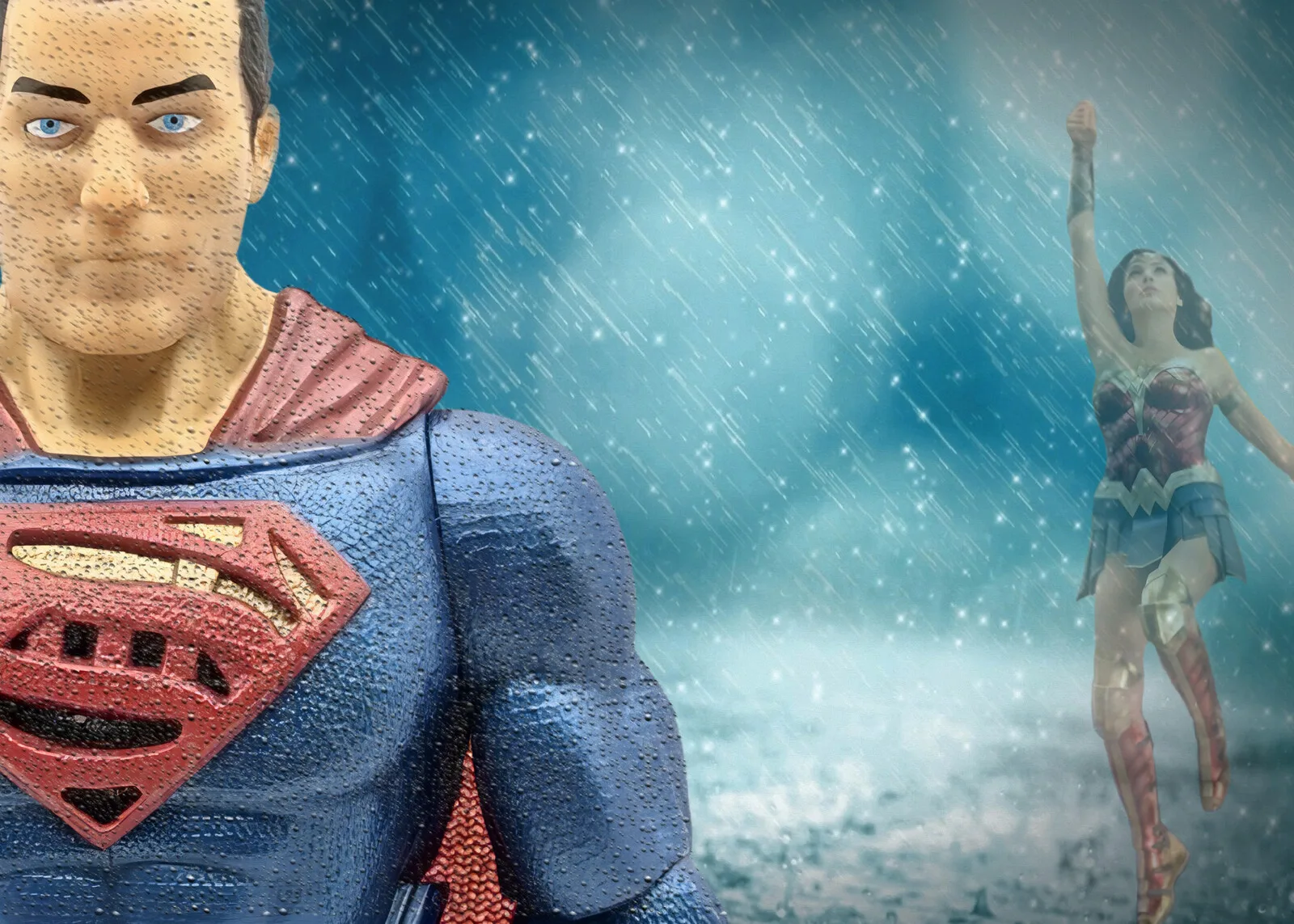
Superman never rusts, 2023
Digital
70 x 50 cm
3 200 kr
"When It Rains, Superman Doesn't Rust" is the symbolic title of the image. Nothing affects him more than kryptonite, remnants from his destroyed home planet, which renders him as powerless as an ordinary man. However, rainy weather always makes him reminisce about the rainy summer days of his childhood when he was off school. The all-day rains made Clark Kent, as he was known then, stay indoors, lie on his bed, and read one of the Famous Five books, his favourite literature - The novels feature the adventures of a group of young children – Julian, Dick, Anne, George and their dog Timmy. Clark loved to listen to the drumming of raindrops on the windowsill, which let drowsiness slide into a half-slumber and give way to daydreams about girls, as such thoughts are always present in young boys. The girl of his dreams was one of British author Enid Blyton's characters, the androgynous Georgina from the Famous Five books, the tomboy who did everything not to be perceived as a girl but as a boy. Clark didn't know it then, but she was as accurate as he was—Diana Prince, still known as a teenage girl.
Diana, who later grew up to be Wonder Woman. Like Georgina, Diana was adventurous, lively, fearless, independent, influential, strategic, and stubborn. Clark had many sexual fantasies about this dream girl that remained deep inside him among his most secret dreams. As often with such fantasies, they seldom become reality, especially in Clark's case since comic writer Jerome Siegel and illustrator Joseph Shuster created his life. Clark had no control over his love life and was quickly made aware that the duo wanted to pair him with a girl different from the one in his dreams. Wonder Woman will follow Clark and Superman in life. Every time it rains, she appears in his mind, the same sexual fantasies.
If there's a boy, there must also be a girl; otherwise, the thought that maybe he was gay, with tights and all, soon arises. The solution was to introduce Lois Lane almost from the beginning of the plot, which happened in 1938, the same year Superman debuted as a comic character. Lois, a celebrated journalist for the Metropolis newspaper, the Daily Planet, is not just the love interest of Superman and Clark Kent but a woman of remarkable intelligence and independence. Her character traits have evolved, reflecting American society's changing attitudes towards women. However, her independence, intelligence, determination, and strong will have remained constant in most incarnations. Starting early in the 1940s, Lois began to suspect that Clark Kent was Superman and started to attempt to uncover his secret identity, all of which backfired because of Superman's efforts.
Lois Lane is also a fictional character in the television series "Smallville", where she eventually marries her Superman, and they have children together, presumably living happily ever after. The question is whether Superman ages or not. Will she age by his side while Superman in the future will have to attend both her and their son's funerals after they've lived a long life while time stands still for Superman? This perspective was used for a previous superhero, the boastful 18th-century Baron Münchhausen, who, in a film adaptation, finally decides to end his immortality and age together with his wife.
It is interesting to compare Superman with Baron von Münchhausen, the literary character from the 18th century known for his fantastic and exaggerated adventures. Both characters possess extraordinary abilities, albeit in very different ways. Münchhausen is famous for his improbable and humorous travels, often involving incredible feats such as riding on cannonballs or lifting himself by his hair. On the other hand, Superman is a superhero with physical powers that far exceed anything human, used to fight evil and save the world. While Münchhausen uses his "powers" to entertain and amaze, Superman's purpose is to protect and serve, reflecting their different roles in literature and popular culture.
It's a fascinating twist in the story of Baron Münchhausen! When he ends his immortality to age with his wife, a deeper and more human dimension is added to his otherwise fantastic and exaggerated adventures. This decision highlights a sentimental side of Münchhausen that is rarely explored in the more humorous and improbable parts of his legends. It also gives the story a poignant reflection on the power of love and the desire to share all stages of life with another person, even if it means giving up something as extraordinary as immortality.
Superman is not immortal in the strict sense. Still, he has an extremely long lifespan and is almost impossible to kill with conventional methods, thanks to his Kryptonian physiology under Earth's yellow sun. His body is much more resilient than an average human's, making him resistant to most forms of physical damage, diseases, and ageing. However, he can be injured or even killed by particular substances like kryptonite or through magic, both of which are his well-known weaknesses. In other words, he will have issues with Lois in the future. She will continue to age while he ages so slowly that time seems to stand still.
Superman, also known as Superman, is one of the most iconic superheroes ever to sweep through the comic world and in front of the white screen. His creation by Jerry Siegel and Joe Shuster during the Great Depression, a time of economic hardship and social upheaval, is a testament to his enduring cultural significance. The Great Depression, a severe economic downturn and social unrest, was marked by widespread poverty, unemployment, and political instability. In this context, Superman emerged as a symbol of hope and resilience, a beacon of light in a world grappling with despair. He first appeared in "Action Comics #1" in 1938, when the world desperately needed a hero. Born on the dying planet Krypton and sent to Earth by his parents, he was raised by Martha and Jonathan Kent in the small town of Smallville. Under Earth's yellow sun, he developed superpowers, and today, we know him as Clark Kent, a modest reporter at the "Daily Planet" in Metropolis. But when he rips off his suit, he becomes the symbol of justice, hope, and tight blue tights.
Superman's relationship with other superheroes, especially Wonder Woman, is filled with mutual respect and professional admiration. Despite their diametrically different backgrounds, both carry a deep sense of responsibility for humanity. Where Wonder Woman fights for truth and justice, Superman is the incarnation of hope and the triumph of good over evil. Their collaborations in the Justice League often illustrate a dynamic where strength meets diplomacy, a combination that usually ends with them saving the world – again.
But how do men and women perceive Superman? Many see him as the ultimate hero, a symbol of all that is good and right. He can be the handsome knight in shining armour (or spandex) for women, while men may see him as the highest standard of heroic virtue and masculinity. However, feminists have a more nuanced view. Some criticise Superman for representing an outdated and idealised masculinity, arguing that his physical strength and invulnerability perpetuate harmful stereotypes about men. The discussion of his white ethnicity has also sparked debate. Critics question why the universe's perhaps strongest hero must be a white man, suggesting that this choice reinforces the dominance of white culture in popular media. This question reflects a broader debate about representation in popular culture, highlighting the need for more diverse and inclusive portrayals of heroism.
A recurring question is why Superman, with his godlike powers, does not intervene in the world's major political crises. Fans have wondered why he did not stop Hitler or Stalin, and today, where is Superman when Putin is rampaging in Ukraine? Critics argue that if Superman truly exists to "save us all", his efforts should include global and historical evils. The answer is often that Superman, as a fictional character, is bound by the stories the creators choose to explore. He fights supervillains like Lex Luthor, not necessarily because they are the most evil opponents he could face, but because they offer an exciting and entertaining conflict within a comic book or film framework.
Superman's role is to be more than just a superhero; he is a cultural icon that reflects and challenges our ideals, morals, and values. His stories provide us with a mirror to examine ourselves and our world. He is the hero who never gives up and stands by hope even when the situation seems hopeless. So, perhaps Superman's real power is not his superhuman strength or ability to fly but his eternal ability to inspire us to strive to be our best selves. And maybe, just maybe, that's the greatest superpower of all.
In light of our modern world's diversity and the steps forward that society has taken, including Barack Obama as America's first black president, the question arises as to why Superman cannot reflect this diversity. With the global fascination with superheroes, it may be time to reshape this iconic figure to include more ethnicities. For instance, we have seen successful, diverse superheroes like Black Panther and Ms. Marvel. Why not a black Superman or an Asian or Native American version? This could lead to a new form of "Superleague", where heroes from various cultural and ethnic backgrounds stand side by side to fight evil and highlight and embrace global diversity.
Such a change would be a victory for representation and a powerful message that heroism and virtues are not bound to any specific ethnicity. However, it's essential to consider the potential challenges. How would the existing fanbase receive these new versions of Superman? Would they be seen as authentic representations or mere tokenism? Despite these challenges, the benefits are significant. It would challenge existing norms and expand perspectives on what a superhero can be and symbolise. By exploring these alternatives, Superman and other superheroes can continue to be relevant and inspiring for new generations worldwide while supporting a more inclusive view of heroism. This shift could also have a transformative effect on the superhero genre and popular culture, opening up new narrative possibilities and broadening the audience's understanding of heroism and diversity.
With that said, Superman's ethnicity and the cultural context in which he is portrayed raise further questions about representation and identity. As a white male hero, he has long been considered 'normative' in the superhero genre, reflecting broader societal structures and power balances. 'Normative' in this context refers to the dominant or expected representation, which often aligns with the cultural and social norms of the majority. In an increasingly globalised and multicultural world, questions arise about why heroes do not more often reflect a broader ethnic and cultural diversity. The relevance and resonance of the narrative must reflect on how and why specific stories are given more space and how they affect our view of justice, morality, and heroism. By exploring and possibly reshaping these cultural icons, we might create a more inclusive and multifaceted image of what it means to be a hero. This discussion is not just about Superman but the broader issue of representation in popular culture and how it can shape our understanding of diversity and identity. It could also lead to a more nuanced understanding of heroism, where heroism is not just about physical strength or superpowers but also about the ability to empathise, understand, and respect different cultures and perspectives.
Wonder Woman, the iconic superhero from DC Comics, is not just a superhero but a complex character with a rich history and a unique role in popular culture. She is a unique blend of diplomat, warrior, and feminist symbol. Created in 1941 as a deliberate response to the violent male superheroes of the time, she emphasises the 'power of love'. Her character is intriguing and significant as she challenges traditional gender roles, showing that strength and compassion are not mutually exclusive.
Themyscira, an island populated only by women, is where women survive and thrive beyond the reach of patriarchy. Here, in this matriarchal utopia, Diana becomes the princess of the Amazons. She is trained to be the greatest warrior ever but also profoundly believes in peace and justice. Her weapons, such as the magical lasso that compels people to tell the truth, reflect her ideology of openness and fairness.
When she arrives in "man's world," Wonder Woman brings her ideals and becomes part of the Justice League, where she works alongside superheroes like Batman and Superman. The relationship between Wonder Woman and Superman has always been exciting, as both share a divine background and a desire to use their powers for the good of humanity. While Superman represents hope, Wonder Woman stands for truth—two principles often necessary to achieve justice. Her feelings for Superman are not entirely spiritual, but just like him, she is guided by the strategies and fantasies of her creators.
For both men and women, Wonder Woman is a complex symbol. Men often admire her strength and warrior skills, while women view her as a role model for empowerment. She challenges traditional gender roles, showing that strength and compassion are not mutually exclusive. For feminists, Wonder Woman is a key figure; she exemplifies that women can wear both a tiara and a sword, being both nurturing and decisive. Her character is about physical strength, emotional intelligence, compassion, and a strong sense of justice. These qualities make her a feminist symbol, as they challenge the traditional notion of femininity and show that women can be powerful and assertive without sacrificing their femininity.
Despite her popularity and influence, Wonder Woman has not been immune to criticism. Some feminist interpretations have raised questions about her portrayal, particularly the emphasis on her beauty and sexual allure. This debate, which echoes broader discussions within feminist circles, raises important questions about the representation of female superheroes and the potential perpetuation of stereotypical images of female power and sexuality in popular culture. It's important to note that these criticisms are not a dismissal of Wonder Woman's character or her impact but rather a call for a more nuanced and diverse representation of female superheroes that goes beyond traditional beauty standards and sexual appeal.
Wonder Woman, a character who carries a message of power, compassion, and justice, continues to be a stalwart figure in both comics and films. Her rich history and continued relevance inspire generations of men and women to reconsider what it means to be strong and how to fight for what we believe in. Wonder Woman is not just a superhero—she is a time icon, uniting culture, gender, and the fight for equality in a complex and ever-expanding narrative. Her story is a source of inspiration and hope for a better, more just world.
Wonder Woman, or Diana Prince as she is known outside her heroic identity, is a complex figure with a rich inner life. Her love life has often been explored in various stories where she is depicted as strong and independent, capable of forming deep emotional bonds.
Historically, Diana has been associated with Steve Trevor, a pilot from the US military who became her first love when he accidentally crash-landed on Themyscira, her home island. This relationship often highlights her humanity and desire to bridge her world and "man's world." Steve usually represents a selfless and courageous masculinity that she values.
But Wonder Woman is not just defined by her relationships with men. She is also a symbol of feminist strength and independence. Her attraction extends beyond the romantic and into the ideological. She is drawn to those who share her justice, honesty, and compassion values. These ideals are central to her life, not just in her fight for justice but also in her relationships.
There has been speculation and discussion about the possibility that Diana might be bisexual, a potential aspect of her identity that could align with her origin from an island populated only by women—Themyscira. This speculation, if true, could add another layer of complexity to her character and expand her role as an icon within the LGBTQ+ community. It's a potential representation that could make community members feel seen and validated in popular culture.
Regarding what she "turns on," it could be said that Wonder Woman is drawn to people as passionate as she is about fighting for and defending those in need, whether men or women. Her dreams are probably not limited to romantic longings; they extend to visions of a world where peace and justice prevail, and everyone can live free from oppression and pain. Wonder Woman is not just a warrior but also a peacemaker, making her love life as rich and complex as her fight for justice.
At least we can conclude that Wonder Woman is not a promiscuous character, not someone who sleeps around in the comic panels, even though many men might wish for that. She will probably never sleep with Superman. Poor Clark.
Jörgen Thornberg
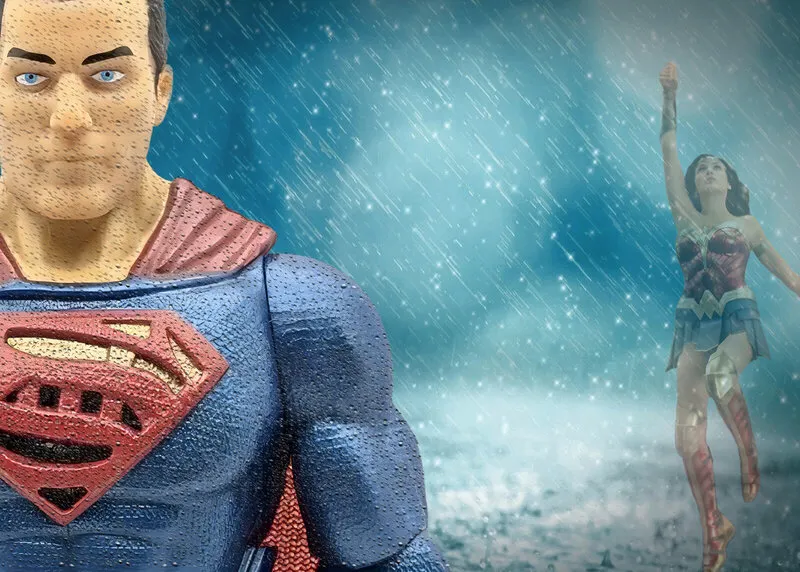
Superman never rusts, 2023
Digital
70 x 50 cm
3 200 kr
"When It Rains, Superman Doesn't Rust" is the symbolic title of the image. Nothing affects him more than kryptonite, remnants from his destroyed home planet, which renders him as powerless as an ordinary man. However, rainy weather always makes him reminisce about the rainy summer days of his childhood when he was off school. The all-day rains made Clark Kent, as he was known then, stay indoors, lie on his bed, and read one of the Famous Five books, his favourite literature - The novels feature the adventures of a group of young children – Julian, Dick, Anne, George and their dog Timmy. Clark loved to listen to the drumming of raindrops on the windowsill, which let drowsiness slide into a half-slumber and give way to daydreams about girls, as such thoughts are always present in young boys. The girl of his dreams was one of British author Enid Blyton's characters, the androgynous Georgina from the Famous Five books, the tomboy who did everything not to be perceived as a girl but as a boy. Clark didn't know it then, but she was as accurate as he was—Diana Prince, still known as a teenage girl.
Diana, who later grew up to be Wonder Woman. Like Georgina, Diana was adventurous, lively, fearless, independent, influential, strategic, and stubborn. Clark had many sexual fantasies about this dream girl that remained deep inside him among his most secret dreams. As often with such fantasies, they seldom become reality, especially in Clark's case since comic writer Jerome Siegel and illustrator Joseph Shuster created his life. Clark had no control over his love life and was quickly made aware that the duo wanted to pair him with a girl different from the one in his dreams. Wonder Woman will follow Clark and Superman in life. Every time it rains, she appears in his mind, the same sexual fantasies.
If there's a boy, there must also be a girl; otherwise, the thought that maybe he was gay, with tights and all, soon arises. The solution was to introduce Lois Lane almost from the beginning of the plot, which happened in 1938, the same year Superman debuted as a comic character. Lois, a celebrated journalist for the Metropolis newspaper, the Daily Planet, is not just the love interest of Superman and Clark Kent but a woman of remarkable intelligence and independence. Her character traits have evolved, reflecting American society's changing attitudes towards women. However, her independence, intelligence, determination, and strong will have remained constant in most incarnations. Starting early in the 1940s, Lois began to suspect that Clark Kent was Superman and started to attempt to uncover his secret identity, all of which backfired because of Superman's efforts.
Lois Lane is also a fictional character in the television series "Smallville", where she eventually marries her Superman, and they have children together, presumably living happily ever after. The question is whether Superman ages or not. Will she age by his side while Superman in the future will have to attend both her and their son's funerals after they've lived a long life while time stands still for Superman? This perspective was used for a previous superhero, the boastful 18th-century Baron Münchhausen, who, in a film adaptation, finally decides to end his immortality and age together with his wife.
It is interesting to compare Superman with Baron von Münchhausen, the literary character from the 18th century known for his fantastic and exaggerated adventures. Both characters possess extraordinary abilities, albeit in very different ways. Münchhausen is famous for his improbable and humorous travels, often involving incredible feats such as riding on cannonballs or lifting himself by his hair. On the other hand, Superman is a superhero with physical powers that far exceed anything human, used to fight evil and save the world. While Münchhausen uses his "powers" to entertain and amaze, Superman's purpose is to protect and serve, reflecting their different roles in literature and popular culture.
It's a fascinating twist in the story of Baron Münchhausen! When he ends his immortality to age with his wife, a deeper and more human dimension is added to his otherwise fantastic and exaggerated adventures. This decision highlights a sentimental side of Münchhausen that is rarely explored in the more humorous and improbable parts of his legends. It also gives the story a poignant reflection on the power of love and the desire to share all stages of life with another person, even if it means giving up something as extraordinary as immortality.
Superman is not immortal in the strict sense. Still, he has an extremely long lifespan and is almost impossible to kill with conventional methods, thanks to his Kryptonian physiology under Earth's yellow sun. His body is much more resilient than an average human's, making him resistant to most forms of physical damage, diseases, and ageing. However, he can be injured or even killed by particular substances like kryptonite or through magic, both of which are his well-known weaknesses. In other words, he will have issues with Lois in the future. She will continue to age while he ages so slowly that time seems to stand still.
Superman, also known as Superman, is one of the most iconic superheroes ever to sweep through the comic world and in front of the white screen. His creation by Jerry Siegel and Joe Shuster during the Great Depression, a time of economic hardship and social upheaval, is a testament to his enduring cultural significance. The Great Depression, a severe economic downturn and social unrest, was marked by widespread poverty, unemployment, and political instability. In this context, Superman emerged as a symbol of hope and resilience, a beacon of light in a world grappling with despair. He first appeared in "Action Comics #1" in 1938, when the world desperately needed a hero. Born on the dying planet Krypton and sent to Earth by his parents, he was raised by Martha and Jonathan Kent in the small town of Smallville. Under Earth's yellow sun, he developed superpowers, and today, we know him as Clark Kent, a modest reporter at the "Daily Planet" in Metropolis. But when he rips off his suit, he becomes the symbol of justice, hope, and tight blue tights.
Superman's relationship with other superheroes, especially Wonder Woman, is filled with mutual respect and professional admiration. Despite their diametrically different backgrounds, both carry a deep sense of responsibility for humanity. Where Wonder Woman fights for truth and justice, Superman is the incarnation of hope and the triumph of good over evil. Their collaborations in the Justice League often illustrate a dynamic where strength meets diplomacy, a combination that usually ends with them saving the world – again.
But how do men and women perceive Superman? Many see him as the ultimate hero, a symbol of all that is good and right. He can be the handsome knight in shining armour (or spandex) for women, while men may see him as the highest standard of heroic virtue and masculinity. However, feminists have a more nuanced view. Some criticise Superman for representing an outdated and idealised masculinity, arguing that his physical strength and invulnerability perpetuate harmful stereotypes about men. The discussion of his white ethnicity has also sparked debate. Critics question why the universe's perhaps strongest hero must be a white man, suggesting that this choice reinforces the dominance of white culture in popular media. This question reflects a broader debate about representation in popular culture, highlighting the need for more diverse and inclusive portrayals of heroism.
A recurring question is why Superman, with his godlike powers, does not intervene in the world's major political crises. Fans have wondered why he did not stop Hitler or Stalin, and today, where is Superman when Putin is rampaging in Ukraine? Critics argue that if Superman truly exists to "save us all", his efforts should include global and historical evils. The answer is often that Superman, as a fictional character, is bound by the stories the creators choose to explore. He fights supervillains like Lex Luthor, not necessarily because they are the most evil opponents he could face, but because they offer an exciting and entertaining conflict within a comic book or film framework.
Superman's role is to be more than just a superhero; he is a cultural icon that reflects and challenges our ideals, morals, and values. His stories provide us with a mirror to examine ourselves and our world. He is the hero who never gives up and stands by hope even when the situation seems hopeless. So, perhaps Superman's real power is not his superhuman strength or ability to fly but his eternal ability to inspire us to strive to be our best selves. And maybe, just maybe, that's the greatest superpower of all.
In light of our modern world's diversity and the steps forward that society has taken, including Barack Obama as America's first black president, the question arises as to why Superman cannot reflect this diversity. With the global fascination with superheroes, it may be time to reshape this iconic figure to include more ethnicities. For instance, we have seen successful, diverse superheroes like Black Panther and Ms. Marvel. Why not a black Superman or an Asian or Native American version? This could lead to a new form of "Superleague", where heroes from various cultural and ethnic backgrounds stand side by side to fight evil and highlight and embrace global diversity.
Such a change would be a victory for representation and a powerful message that heroism and virtues are not bound to any specific ethnicity. However, it's essential to consider the potential challenges. How would the existing fanbase receive these new versions of Superman? Would they be seen as authentic representations or mere tokenism? Despite these challenges, the benefits are significant. It would challenge existing norms and expand perspectives on what a superhero can be and symbolise. By exploring these alternatives, Superman and other superheroes can continue to be relevant and inspiring for new generations worldwide while supporting a more inclusive view of heroism. This shift could also have a transformative effect on the superhero genre and popular culture, opening up new narrative possibilities and broadening the audience's understanding of heroism and diversity.
With that said, Superman's ethnicity and the cultural context in which he is portrayed raise further questions about representation and identity. As a white male hero, he has long been considered 'normative' in the superhero genre, reflecting broader societal structures and power balances. 'Normative' in this context refers to the dominant or expected representation, which often aligns with the cultural and social norms of the majority. In an increasingly globalised and multicultural world, questions arise about why heroes do not more often reflect a broader ethnic and cultural diversity. The relevance and resonance of the narrative must reflect on how and why specific stories are given more space and how they affect our view of justice, morality, and heroism. By exploring and possibly reshaping these cultural icons, we might create a more inclusive and multifaceted image of what it means to be a hero. This discussion is not just about Superman but the broader issue of representation in popular culture and how it can shape our understanding of diversity and identity. It could also lead to a more nuanced understanding of heroism, where heroism is not just about physical strength or superpowers but also about the ability to empathise, understand, and respect different cultures and perspectives.
Wonder Woman, the iconic superhero from DC Comics, is not just a superhero but a complex character with a rich history and a unique role in popular culture. She is a unique blend of diplomat, warrior, and feminist symbol. Created in 1941 as a deliberate response to the violent male superheroes of the time, she emphasises the 'power of love'. Her character is intriguing and significant as she challenges traditional gender roles, showing that strength and compassion are not mutually exclusive.
Themyscira, an island populated only by women, is where women survive and thrive beyond the reach of patriarchy. Here, in this matriarchal utopia, Diana becomes the princess of the Amazons. She is trained to be the greatest warrior ever but also profoundly believes in peace and justice. Her weapons, such as the magical lasso that compels people to tell the truth, reflect her ideology of openness and fairness.
When she arrives in "man's world," Wonder Woman brings her ideals and becomes part of the Justice League, where she works alongside superheroes like Batman and Superman. The relationship between Wonder Woman and Superman has always been exciting, as both share a divine background and a desire to use their powers for the good of humanity. While Superman represents hope, Wonder Woman stands for truth—two principles often necessary to achieve justice. Her feelings for Superman are not entirely spiritual, but just like him, she is guided by the strategies and fantasies of her creators.
For both men and women, Wonder Woman is a complex symbol. Men often admire her strength and warrior skills, while women view her as a role model for empowerment. She challenges traditional gender roles, showing that strength and compassion are not mutually exclusive. For feminists, Wonder Woman is a key figure; she exemplifies that women can wear both a tiara and a sword, being both nurturing and decisive. Her character is about physical strength, emotional intelligence, compassion, and a strong sense of justice. These qualities make her a feminist symbol, as they challenge the traditional notion of femininity and show that women can be powerful and assertive without sacrificing their femininity.
Despite her popularity and influence, Wonder Woman has not been immune to criticism. Some feminist interpretations have raised questions about her portrayal, particularly the emphasis on her beauty and sexual allure. This debate, which echoes broader discussions within feminist circles, raises important questions about the representation of female superheroes and the potential perpetuation of stereotypical images of female power and sexuality in popular culture. It's important to note that these criticisms are not a dismissal of Wonder Woman's character or her impact but rather a call for a more nuanced and diverse representation of female superheroes that goes beyond traditional beauty standards and sexual appeal.
Wonder Woman, a character who carries a message of power, compassion, and justice, continues to be a stalwart figure in both comics and films. Her rich history and continued relevance inspire generations of men and women to reconsider what it means to be strong and how to fight for what we believe in. Wonder Woman is not just a superhero—she is a time icon, uniting culture, gender, and the fight for equality in a complex and ever-expanding narrative. Her story is a source of inspiration and hope for a better, more just world.
Wonder Woman, or Diana Prince as she is known outside her heroic identity, is a complex figure with a rich inner life. Her love life has often been explored in various stories where she is depicted as strong and independent, capable of forming deep emotional bonds.
Historically, Diana has been associated with Steve Trevor, a pilot from the US military who became her first love when he accidentally crash-landed on Themyscira, her home island. This relationship often highlights her humanity and desire to bridge her world and "man's world." Steve usually represents a selfless and courageous masculinity that she values.
But Wonder Woman is not just defined by her relationships with men. She is also a symbol of feminist strength and independence. Her attraction extends beyond the romantic and into the ideological. She is drawn to those who share her justice, honesty, and compassion values. These ideals are central to her life, not just in her fight for justice but also in her relationships.
There has been speculation and discussion about the possibility that Diana might be bisexual, a potential aspect of her identity that could align with her origin from an island populated only by women—Themyscira. This speculation, if true, could add another layer of complexity to her character and expand her role as an icon within the LGBTQ+ community. It's a potential representation that could make community members feel seen and validated in popular culture.
Regarding what she "turns on," it could be said that Wonder Woman is drawn to people as passionate as she is about fighting for and defending those in need, whether men or women. Her dreams are probably not limited to romantic longings; they extend to visions of a world where peace and justice prevail, and everyone can live free from oppression and pain. Wonder Woman is not just a warrior but also a peacemaker, making her love life as rich and complex as her fight for justice.
At least we can conclude that Wonder Woman is not a promiscuous character, not someone who sleeps around in the comic panels, even though many men might wish for that. She will probably never sleep with Superman. Poor Clark.
3 200 kr

Jörgen Thornberg
Malmö
Lite om bilder och mig. Translation in English at the end.
Jag är en nyfiken person som ser allt i bilder, även det jag fäster i ord, gärna tillsammans för bakom alla mina bilder finns en berättelse. Till vissa bilder hör en kortare eller längre novell som följer med bilden.
Bilder berättar historier. Jag omges av naturlig skönhet, intressanta människor och historia var jag än går. Jag använder min kamera för att dokumentera världen och blanda det jag ser med vad jag känner för att fånga den dolda magin.
Mina bilder berättar mina historier. Genom mina bilder, tryck och berättelser. Jag bjuder in dig att ta del av dessa berättelser, in i ditt liv och hem och dela min mycket personliga syn på vår värld. Mer än vad ögat ser. Jag tänker i bilder, drömmer och skriver och pratar om dem; följaktligen måste jag också skapa bilder. De blir vad jag ser, inte nödvändigtvis begränsade till verkligheten. Det finns en bild runt varje hörn. Jag hoppas att du kommer att se vad jag såg och gilla det.
Jag är också en skrivande person och till många bilder hör en kortare eller längre essay. Den följer med tavlan, tryckt på fint papper och med en personlig hälsning från mig.
Flertalet bilder startar sin resa i min kamera. Enkelt förklarat beskriver jag bilden jag ser i mitt inre, upplevd eller fantiserad. Bilden uppstår inom mig redan innan jag fått okularet till ögat. På bråkdelen av ett ögonblick ser jag vad jag vill ha och vad som kan göras med bilden. Här skall jag stoppa in en giraff, stålmannen, Titanic eller vad det är min fantasi finner ut. Ännu märkligare är att jag kommer ihåg minnesbilden långt efteråt när det blir tid att skapa verket. Om jag lyckas eller inte, är upp till betraktaren, oftast präglat av en stråk av svart humor – meningen är att man skall bli underhållen. Mina bilder blir ofta en snackis där de hänger.
Jag föredrar bilder som förmedlar ett budskap i flera lager. Vid första anblicken fylld av feel-good, en vacker utsikt, fint väder, solen skiner, blommor på ängen eller vattnet som ligger förrädiskt spegelblankt. I en sådan bild kan jag gömma min egentliga berättelse, mitt förakt för förtryckare och våldsverkare, rasister och fördomsfulla människor - ett gärna återkommande motiv mer eller mindre dolt i det vackra motivet. Jag försöker förena dem i ett gemensamt narrativ.
Bild och formgivning har löpt som en röd tråd genom livet. Fotokonst känns som en värdig final som jag gärna delar med mig.
Min genre är vid som framgår av mina bilder, temat en blandning av pop- och gatukonst i kollage som kan bestå av hundratals lager. Vissa bilder kan ta veckor, andra någon dag innan det är dags att överlämna resultatet till printverkstaden. Fine Art Prints är digitala fotocollage. I dessa kollage sker rivandet, klippandet, pusslandet, målandet, ritandet och sprayningen digitalt. Det jag monterar in kan vara hundratals år gamla bilder som jag omsorgsfullt frilägger så att de ser ut att vara en del av tavlan men också bilder skapade av mig själv efter min egen fantasi. Därefter besöks printstudion och för vissa bilder numrera en limiterad upplaga (oftast 7 exemplar) och signera för hand. Vissa bilder kan köpas i olika format. Det är bara att fråga efter vilka. Gillar man en bild som är 70x100 men inte har plats på väggen, går den kanske att få i 50x70 cm istället. Frågan är fri.
Metoden Giclée eller Fine Art Print som det också kallas är det moderna sättet för framställning av grafisk konst. Villkoret för denna typ av utskrifter är att en högkvalitativ storformatskrivare används med åldersbeständigt färgpigment och konstnärspapper eller i förekommande fall på duk. Pappret som används möter de krav på livslängd som ställs av museer och gallerier. Normalt säljer jag mina bilder oinramade så att den nya ägaren själv kan bestämma hur de skall se ut, med eller utan passepartout färg på ram, med eller utan glas etc..
Under många år ställde jag bara ut på nätet, i valda grupper och på min egen Facebooksida - https://www.facebook.com/jorgen.thornberg.9
Jag finns också på en egen hemsida som tyvärr inte alltid är uppdaterad – https://www.jth.life/ Där kan du också läsa en del av de berättelser som följer med bilden.
UTSTÄLLNINGAR
Luftkastellet, oktober 2022
Konst i Lund, november 2022
Luftkastellet, mars 2023
Engleson Galleri Caroli, april 2023
Hydra, Greece June 2023
Engleson Galleri Caroli, oktober 2023
Toppen, Höllviken december 2023
Luftkastellet, mars 2024
Torups Galleri, mars 2024
Venice, May 2024
Luftkastellet, oktober 2024
Konst i Advent, December 2024
Galleri Engleson, Caroli December 2024
Jäger & Jansson Galleri, april 2025
A bit about pictures and me.
I'm a curious person who sees everything in pictures, even what I express in words, often combining them, for behind all my pictures lies a story. These narratives, some as short as a single image and others as long as a novel, are the heart and soul of my work.
Pictures tell stories. Wherever I go, I'm surrounded by natural beauty, exciting people, and history. I use my camera to document the world and blend what I see with what I feel to capture the hidden magic.
My images tell my stories. Through my pictures, prints, and narratives, I invite you to partake in these stories in your life and home and share my deeply personal perspective of our world. More than meets the eye. I think in pictures, dream, write, and talk about them; consequently, I must create images too. They become what I see, not necessarily confined to reality. There's a picture around every corner. I hope you'll see what I saw and enjoy it.
I'm also a writer, and many images come with a shorter or longer essay. It accompanies the painting, printed on fine paper with my personal greeting.
Many pictures start their journey on my camera. Simply put, I describe the image I see in my mind, experienced or imagined. The image arises within me even before I bring the eyepiece to my eye. In a fraction of a moment, I see what I want and what can be done with the picture. Here, I'll insert a giraffe, Superman, the Titanic, or whatever my imagination conjures up. Even stranger is that I remember the mental image long after it's time to create the work. Whether I succeed is up to the observer, often imbued with a streak of black humour – the aim is to entertain. My pictures usually become a talking point wherever they hang.
I prefer pictures that convey a message in multiple layers. At first glance, they're filled with feel-good vibes, a beautiful view, lovely weather, the sun shining, flowers in the meadow, or the water lying deceptively calm. But beneath this surface beauty, I often conceal a deeper story, a narrative that challenges societal norms or explores the human condition. I invite you to delve into these hidden narratives and discover the layers of meaning within my work.
Picture and design have been a thread running through my life. Photographic art feels like a fitting finale, and I'm happy to share it.
My genre is varied, as seen in my pictures; the theme is a blend of pop and street art in collages that can consist of hundreds of layers. Some images can take weeks, others just a day before it's time to hand over the result to the print workshop. Fine Art Prints are digital photo collages. In these collages, tearing, cutting, puzzling, painting, drawing, and spraying happen digitally. What I insert can be images hundreds of years old that I carefully extract so they appear to be part of the painting, but also images created by myself, now also generated from my imagination. Next, visit the print studio and, for certain images, number a limited edition (usually 7 copies) and sign them by hand. Some images may be available in other formats. Just ask which ones. If you like an image that's 70x100 but doesn't have space on the wall, you might be able to get it in 50x70 cm instead. The question is open.
The Giclée method, or Fine Art Print as it's also called, is the modern way of producing graphic art. This method ensures the highest quality and longevity of the artwork, using a high-quality large-format printer with archival pigment inks and artist paper or, in some cases, canvas. The paper used meets the longevity requirements set by museums and galleries. I sell my pictures unframed, allowing the new owner to personalise their artwork, confident in the lasting value and quality of the piece.
For many years, I only exhibited online, in selected groups, and on my Facebook page - https://www.facebook.com/jorgen.thornberg.9. I also have my website, which unfortunately is not constantly updated - https://www.jth.life/. You can also read some of the stories accompanying the pictures there.
EXHIBITIONS
Luftkastellet, October 2022
Art in Lund, November 2022
Luftkastellet, March 2023
Engleson Gallery Caroli, April 2023
Hydra, Greece June 2023
Engleson Gallery Caroli, October 2023
Toppen, Höllviken December 2023
Luftkastellet, March 2024
Torup Gallery, March 2024
Venice, May 2024
UTSTÄLLNINGAR
Luftkastellet, oktober 2022
Konst i Lund, november 2022
Luftkastellet, mars 2023
Engleson Galleri Caroli, april 2023
Hydra, Greece June 2023
Engleson Galleri Caroli, oktober 2023
Toppen, Höllviken december 2023
Luftkastellet, mars 2024
Torups Galleri, mars 2024
Venice, May 2024
Luftkastellet, October 2024
Konst i Advent, December 2024
Galleri Engleson, Caroli December 2024
Jäger & Jansson Galleri, April 2025
Utbildning
Autodidakt
Medlem i konstnärsförening
Öppna Sinnen
Med i konstrunda
Konstrundan i Skåne
Utställningar
Luftkastellet, October 2022
Art in Lund, November 2022
Luftkastellet, March 2023
Engleson Gallery Caroli, April 2023
Hydra, Greece June 2023
Engleson Gallery Caroli, October 2023
Toppen, Höllviken December 2023
Luftkastellet, March 2024
Torup Gallery, March 2024
Venice, May 2024