Vi använder cookies för att ge dig bästa möjliga upplevelse. Välj vilka cookies du tillåter.
Läs mer i vår integritetspolicy
Jörgen Thornberg
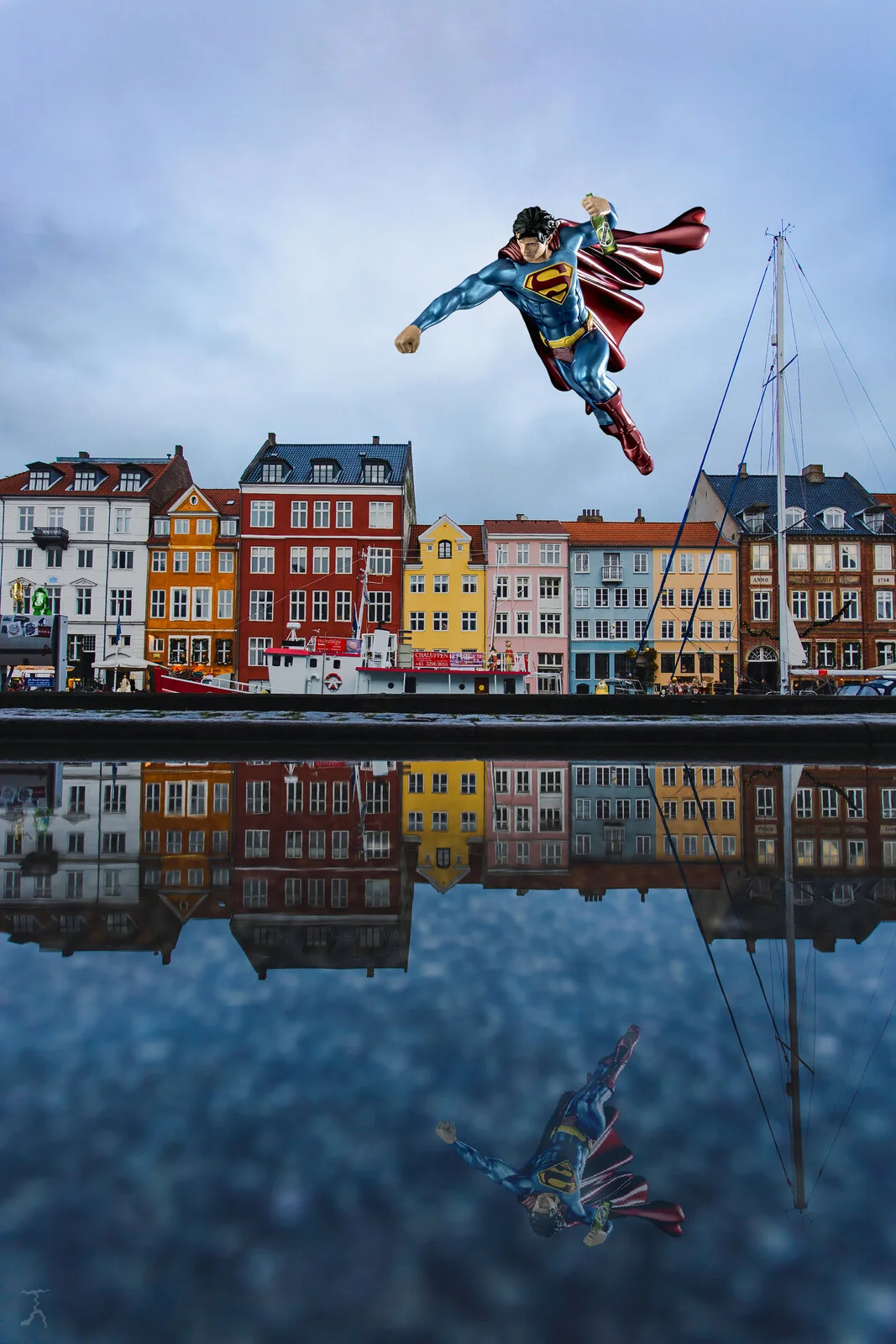
Hvornår smager en Tuborg bedst, 2023
Digital
50 x 70 cm
3 200 kr
”Du Perikles - ka' du sige mig hvornår smager en Tuborg bedst? Hver gang!” –“Hey Pericles, can you tell me when a Tuborg tastes best? Every time!”
This is a classic advertisement based on a classic Danish image. No wonder Superman flew to Copenhagen from the distant Metropolis. Although it's not his journey, my image is about more than just the surface. He plays an unexpected role behind the scenes, as a man's man, he-man, macho, and lady-charmer—the latter role less known since it's only hinted at between the comic strips. But he likes beer.
When asked when a specific beer tastes best, a true Tuborg fan would shout, "Always!" Someone who doesn't care for beer might say 'Never'. That's how it goes with taste. It's very individual. For my part, I haven't drunk a green Tuborg for a very long time. Most of the time, I've had the option to choose other beers, like the green Hof from Carlsberg. If I had to pick a beer from Tuborg, it would be a golden lady, Guld Tuborg.
The classic "Pericles" Tuborg poster! In 1943, Tuborg sought to depict the pinnacle of when a Tuborg tastes best. They turned to the artistic community. Robert Storm Peterson, better known as Storm P, a celebrated actor, cartoonist, and artist, brought this timeless poster to life - a testament to his creative prowess and enduring legacy.
I have travelled a lot, and Danish friends asked me why Tuborg and Carlsberg taste different in Asia than at home. Leading beers are brewed in many other places in the world. Since water significantly influences the outcome, even if everything else is equal, it's likely because local water is used in the brewing. That brings us to the dark continent, as it once was called. I cannot say how the beer once tasted in Africa, but there is a reason to speculate through the connection with the author and bon vivant Karen Blixen.
Although Superman is often associated with American ideals, he is depicted as a protector of Earth, advocating for global issues, including those that might affect Africa. His role as a worldwide hero means his influence and responsibilities extend to all parts of the world.
Superman's creators, Jerry Siegel and Joe Shuster, were influenced by the issues of their times, including those related to justice and human rights. Superman's mission often aligns with advocating for the disenfranchised and fighting against injustice, themes that resonate with many global narratives, including African nations.
Does Superman have any guilt about not doing enough for Africa? Considering he's been zipping around the globe since the 1930s and not just hanging out in Metropolis, you'd think he'd have stopped by. Maybe he was too busy with Lex Luthor to swing through the Sahara.
Some say the first African American character didn't appear in the Superman comics until the 1970s. Then there's the mention of a Black Kryptonian, something even the eagle-eyed Wikipedia editors missed. We're talking decades of storytelling without representing a whole demographic. Oops! Let's dive into the Superman archives:
In the first year, various dark-skinned tribes are portrayed with American native trappings. This is not exactly a home run for African representation.
A Black train porter appears in Superman #27. The portrayal isn't excellent, but it's 1944, and at least he's human.
By Superman #33, our hero is hanging out in "the exotic port of Massua on the Red Sea," meeting pirates and civilians of African descent. It's not the most flattering portrayal, but it's something.
- Fast forward a bit, and you've got silhouetted men (maybe from Africa?) carrying Lois Lane in a palanquin in Superman #49. Mysterious much?
- Superman #50 introduces some Africans working for a white hunter who's hogging all the credit.
- The storyline doesn't get much better by Superman #59, where more African natives serve another glory-hogging white hunter.
- There's a big gap until Superman #93, where a fictional African village appears in Metropolis for "educational" purposes. Is that man a statue or not?
- When we hit Superman #110, we're back to stereotypes with superstitious spear-wielding natives.
- It's not until Superman #149, at Superman's funeral, that we see more than one Black man who isn't a tribal stereotype.
- Superman #199 shows modern Africans using drums to communicate during a race event.
So, what have we learned? While Superman's world was packed with adventures, including Black characters, it wasn't stellar. None of these characters are what you'd call "well-developed." They rarely impact the story and are often just part of the backdrop. It took until the 1960s to see Black people in Metropolis regularly.
The journey of diversity in the Superman saga has been slower than a leisurely flight worldwide. While we've seen some progress, much more must be done. Let's keep pushing for better representation not just of Superman but also of all of the popular culture, not least among Superman's peers, like Batman, Wonder Woman, and others. Let's make it happen!
Now, we draw closer to Superman's visit to Copenhagen. Senior officials from Ukraine, G7 countries, the European Union, and nations like Brazil, India, Saudi Arabia, South Africa, and Turkey convened in Denmark on June 24th last year for discussions on the prospect of peace in Ukraine amidst an unfolding mutiny in Russia.
The Copenhagen meeting sought to advance Ukrainian President Volodymyr Zelenskyy's proposal for a "peace summit" to endorse principles foundational to any agreement to conclude the war that began with Russia's invasion 16 months prior. China, although invited, did not participate, underscoring the challenges Ukraine and its allies face in forging a comprehensive, influential global coalition. En route to this conference, he crossed the canal in Nyhavn.
Blix Beer, a South African brew, is more than a beverage. It's a celebration of Africa and a tribute to the iconic Karen Blixen. The label design, featuring elements from Africa and Stellenbosch, reflects Karen's rich cultural connections. The scenic Simonsberg Mountain, a biplane, and a girl are all motifs that draw inspiration from the 'Out of Africa' theme central to this brand. This design invites enthusiasts to explore a cultural odyssey, exploring beer's historical and cultural connections. The South African Breweries, a historic institution that originated in 1895 as Castle Brewery, was created to cater to the burgeoning community of European miners and prospectors around Johannesburg. This clientele might have included Karen and her spouses. And Superman, when in South Africa.
Karen Blixen, the inspiration behind Blix Beer, had a fascinating personal life. In 1914, she married Baron Bror von Blixen-Finecke, her cousin. This was after she had a failed romantic relationship with… his brother. She became Baroness Karen von Blixen-Finecke, a title reflecting her unique and unconventional life journey.
In 1915, the newly married Mrs. Blixen was diagnosed with syphilis, which caused her medical problems all through her life. As a result of the illness, she was separated from her husband in 1921; the couple divorced four years later.
Karen Blixen composed in English, a language she embraced during her years in Kenya. Her slightly unconventional English usage, as if she were savouring each word, is a hallmark of her writing style. This unique approach to language, which I first encountered at 16, has always captivated me and affirmed that contemporary writers could craft sentences from their own experiences that elevate the listener to a deep appreciation of reality.
Karen considered herself a raconteur. She spent evenings in solitude, writing stories to stave off loneliness and entertain her guests upon arrival. While I am less captivated by her many tales dominated by deception, some of which slipped into realms of romance and fantasy, in *Out of Africa*, Karen confined herself to the tangible – to her direct experiences and observations. This melding of her romantic disposition with a staunch realism is profoundly compelling and marks her literary significance.
Karen's era was one where imperialistic presence in Africa was palpable. I found it intriguing to come across a critique by Esther Poyer, a young British raw food advocate and life coach, who visited Karen's former home, now a museum in Nairobi. Esther questioned the relevance of Karen's legacy. While I understand this perspective, recognising the context of her time, I see Karen as a woman who loved profoundly and navigated her circumstances as best she could, leaving behind a legacy of luminous prose that endures well beyond her lifetime.
Karen Blixen, a woman of refined taste, cultivated coffee on her farm and maintained a distinct style. Her elegant dinner parties were a testament to her sophistication, with champagne being a staple, served under the velvety African sky upon guests' arrival. Karen Blixen's fondness for wine, particularly champagne, was not just a part of her sophisticated lifestyle in Denmark and during her years in Kenya but a passion that added depth to her persona and the refined social settings she frequented.
After her last drinking spree, Karen hid a half-empty liquor bottle. She couldn't remember where she hid it until she started drinking again. Karen's pattern of recall best illustrates:
It can be said that Karen's memories of her liquor bottle are a type of state-dependent memory. State-dependent memory is a situation where an individual can recall memories better if they are in their consciousness, such as when the memory is formed. State-dependent memory usually appears when the individual is highly influenced by psychoactive substances, in Karen's case, alcohol. This is why Karen can only remember where she puts her half-empty liquor bottle when she drinks.
As we know, 'In vino veritas' means 'In wine there is truth', and Karen loved to open a party
by saluting the guests with a glass of champagne.
" It is wonderful to have had so much to drink that you can speak as easily as you think", she said later. This sentiment reflects Karen's belief that fine wine is a metaphor for art and, ultimately, synonymous with truth (veritas), a theme that often permeates her writings.
But what beats a cold beer from the fridge when the heat is at its worst? Moreover, beer makes you less drunk and quenches your thirst better. Tuborg and Carlsberg were occasionally available in Johannesburg or Cape Town, but the beer from South African Castle Brewery wasn't too bad either. Why should Karen be any different if the Danish queen can publicly down a beer? Karen Blixen moved to Kenya and met Denys Finch Hatton, an English large-game hunter. The couple stayed together until 1931 when Hatton died tragically in a plane crash.
Upon her return to Denmark, Mrs. Blixen, a woman of many talents, unleashed Seven Gothic Tales in 1934. This English masterpiece, penned under her nom-de-plume Isak Dinesen, garnered critical acclaim, solidifying her status as a literary force to be reckoned with.
Out of Africa was published in 1937. The book tells of Karen's life in Kenya and was later made into a movie.
As Karen correctly observes, androgyny became a female ideal in the 1920s, and that is historically a new phenomenon, which she discusses primarily through the character' Rosendaal' in her book 'Carnival, written mainly during her time in Africa 1926-27.' The bodily female ideal was suddenly to have 'no dimples in the derrière' and breasts as flat as 'the Desert of Gobi'. Women started to wear 'step-in panties' too and practice a bohemian lifestyle: drinking, driving, smoking, going to nightclubs and having many lovers.
In 'Carnival' Rosendaal interprets the women of the 1920s – the flappers – as 'the only contemporaries of ours who make it their object to represent an idea'. Even though they might not be aware of it themselves, this means that the obliteration of traditional female shapes (breasts and bottom) and the promotion of the androgynous look, according to Rosendaal, represents the idea of female emancipation understood as the idea that we should first and foremost be recognised as human beings and only secondly as gender, which is a point of view Blixen also expressed repeatedly in her letters from Africa during the years she wrote 'Carnival' in Africa.
Carnival Entertainments and Posthumous Tales, published in 1978, is an animated collection of works from every stage of Karen's penname' Isak Dinesen's' career. Many were written during her most creative years but set aside; others she wrote 'just for entertainment.'
In 1939, Karen, a woman who had left an indelible mark on Danish literature, received Denmark's highest accolade for women in the arts or academics, the Tagea Brandt Rejselegat.
Karen wrote her books and stories in English and translated them back into Danish. When her health deteriorated, she had to stop writing but did several radio broadcasts.
At the age of 77, she died; the cause of death was either malnutrition, syphilis, anorexia, or a combination. A suburb of Nairobi where the author's home and coffee plantation was was renamed "Karen" in her honour.
In the spring of 1918, as a guest at a small dinner with other Europeans, Karen Blixen met the great love of her life, the English aristocrat Denys Finch Hatton. He is usually depicted from Karen Blixen's perspective, with her descriptions: handsome, physically strong and agile, possessing great intelligence, refined taste, and matching confidence. Based on Finch Hatton's later behaviour, other traits include a hefty dose of egoism, disregard, lack of empathy, and perpetual restlessness. He was always on the move, between people and continents. Superman in a nutshell.
Karen's life may have been like literature, but her literature was not like her life. One searches in vain on the pages of her books for the unhappy marriage and the lover's betrayal but finds strong men with a taste for adventure. Nor her secret love. She had a hidden fondness for Superman. When the superhero was born, he was already an adult, originally from the planet Krypton and endowed with superpowers on Earth. Karen liked fairy tales, so Superman was indeed a perfect fit. There was so much that needed to be set right in the world with Hitler, Nazism, and fascism, and a war that was looming in the air.
Karen Blixen's engagement with the social and political currents of her time was far from passive, as her essays and articles like "Breve fra et Land i Krig" (1940), "En Baaltale med 14 Aars Forsinkelse" (1952), and "Fra Lægmand til Lægmand" (1954) demonstrate. On the other hand, her fiction often veered away from contemporary political and social issues, reflecting her disapproval of literary realism, particularly the novel form. She positioned herself as a modern-day Scheherazade, weaving timeless tales that bypassed societal questions, yet her works remain a significant part of literary discussions. It's crucial to note that despite their apparent detachment, her fictional works are not devoid of political and social commentary.
Works such as "The Deluge at Norderney" and "Babette's Feast" resonate with echoes of the French Revolution and the Paris Commune, bringing with them profound political, social, and ideological shifts. "Sorrow Acre" juxtaposes two distinct historical and social epochs: the feudal and the liberal. "Out of Africa" contrasts African and European worlds regarding ethical values, mentality, and cultural practices, making it a focus of postcolonial analysis. While rooted in historical events, these themes remain relevant in our contemporary world. It's important to note that Blixen never overtly prioritises social or political issues. Instead, they are skillfully integrated into the narrative, enriching the atmosphere and providing a backdrop for exploring aesthetic concepts and ideas.
Even in her essays, which more directly address social issues, Blixen's approach is rooted in aesthetics rather than politics, underscoring her unique perspective and approach to literary analysis.
After her husband left her, Karen Blixen dove into the vibrant social scene that colonial Kenya offered to its European elite. When royalty, including the Duke and Prince of Wales, visited, she orchestrated traditional dances performed by the local Kikuyu as a spectacle of honour. Alongside her lover, British big-game hunter Denys Finch-Hatton, Karen drifted through the circles of the "Happy Valley set," infamously indulgent, chasing entertainment with a blend of alcohol, drugs, and promiscuity. A wry question circulated among British aristocrats at the time: "Are you married, or do you live in Kenya?"
Yet, none of these raucous escapades found their way into Blixen's memoirs. Instead, her writing skipped over the decadent parties, choosing to richly detail the landscapes and the lives of the "Natives."
Both Blixen's writings and the subsequent film Out of Africa have come to embody a bygone era of aristocratic colonial nostalgia.
Karen Blixen's relationship with Germany, Hitler, and the war offers a complex view of her as both a critical observer and a historical figure influenced by the tumultuous times she lived through. Known primarily for her literary escapades and profound narratives, Karen had a nuanced engagement with her era's political and philosophical undercurrents, especially concerning Germany's turbulent history during the early 20th century.
As discussed in Eric Voegelin's political philosophies, Karen's perspective on modernity and its crises reveals her deep contemplation on the spiritual and moral degradation characterising the secular and materialistic tendencies of the modern world. This philosophical viewpoint aligns with Voegelin's criticism of the Enlightenment and its aftermath, which Karen perceived as a catastrophic moral deviation that shaped the events leading to and surrounding World War II.
During a critical time in history, Karen visited Germany under a journalism fellowship, where she experienced firsthand the nationalistic fervour and the totalitarian control characteristic of Nazi Germany. Her writings from this period, mainly her reflections published post-war, articulate her observations on National Socialism as a dangerous embodiment of Enlightenment ideals gone awry. Karen criticised the Nazi regime for distorting reason and tradition, replacing a historically nuanced societal order with a brutal and reductionist ideological agenda.
Karen's literary and philosophical engagements reveal her confrontation with the era's political dogmas. She recognised the inherent dangers of ideological extremism and its capacity to manipulate and dominate the societal fabric, a theme prevalent in her discussions on the Nazi appropriation of art and culture as tools for political indoctrination.
Ultimately, Karen's interactions and intellectual confrontations during her visit to Germany deepened her disdain for the totalitarian impulses of the regime, reinforcing her commitment to a more spiritually and morally grounded worldview. Her reflections serve not only as a personal testament to her philosophical and political stance but also as a broader critique of the forces shaping Europe during one of its darkest periods. Through her experiences and writings, Karen Blixen emerges as a figure deeply embedded in her time's intellectual and historical dialogues, offering a poignant critique of the cultural and political degeneration she witnessed.
Superman fit that mould as well. Even though he was active during World War II, the Korean War, the Vietnam War, the Cold War, and all conflicts since then, Superman mainly operated in Metropolis. If he ventured out into the world, it was to combat criminals. He steered clear of political quagmires because that would affect sales figures in sensitive markets. This aspect never troubled Karen; she wasn't commercial in that sense. If she stood anywhere politically, it was to the left, but she was wise enough not to mix her tales with reality. She described the people she met and the life she experienced. Here and there, there is indirect criticism. It's clear that she disliked Hitler and totalitarianism, but she did not use her superpowers as an author to combat Hitler and his ilk. Neither did Superman.
Better to chug a beer together.
In the literary safari of Karen's life, her novelistic memoir 'Out of Africa' stands out like a grand African sunset, distinct and awe-inspiring. Published in 1937, this work is not just a story—it's a profound journey into the heart of Kenya through the eyes of a noble Danish baroness. Initially penning her tales under the name Isak Dinesen, Karen crafted a narrative less about her personal saga and more of an homage to the land and people she came to hold dear. Her experiences as a coffee plantation owner, her interactions with the native people, and her deep connection with the land all shape the narrative, providing a unique perspective on colonialism and African life.
Karen's aristocratic roots, reflected in her pen name and her ownership of a coffee plantation, cast a long shadow over her writings. She embraced her role not just as a landowner but as a steward of the land, believing firmly in the noblesse oblige—the noble's obligation. This perspective is vivid in her interactions with the native people and her efforts to uplift them, from treating illnesses to battling illiteracy by founding an evening school on her farm.
Yet, Karen's account of Africa is tinged with the hues of controversy. While her narrative does romanticise the continent, creating a "paradise lost," it also subtly critiques colonialism. However, some critics argue that her portrayal of the native people and her role as a 'protector' can be seen as paternalistic and perpetuating colonial stereotypes. Take, for instance, her inclusion of the harrowing tale of an African boy cruelly mistreated by an English settler. Karen doesn't shout her disapproval from the rooftops; instead, she lets the stories breathe and speak for themselves, weaving a subtle political statement into the fabric of her memoir.
'Out of Africa' is more a mosaic of African life than a linear story of Karen's adventures. Notably absent from the book are tales of her husband, her love affair with Denys Finch-Hatton, and her tribulations—from a heartbreaking miscarriage to battling syphilis. Instead, the book paints a vibrant picture of Kenya's people, their profound connection with nature, and the daily realities of farm life.
Karen's narrative style—fragmented and non-linear—mirrors the unpredictable rhythms of African life itself. This very irregularity and her candid portrayal of her experiences have made 'Out of Africa' a focal point in discussions of female autobiography. Yet, despite its biographical elements, the book remains enigmatic, focusing more on the land and the people than on Karen herself.
The 1985 cinematic adaptation by Sidney Pollack, starring Meryl Streep and Robert Redford, brought Karen's story to a global audience. While the film captures the romance of her African years, it glosses over the nuanced complexity of her original writings, choosing instead to craft a Hollywood love story that simplifies and sensationalises her life.
In essence, 'Out of Africa' is a testament to Karen's life's paradoxes: a baroness who felt more at home in the rugged landscapes of Africa than in the aristocratic salons of Europe. This coloniser saw herself as a protector of her adopted home's indigenous culture. Through her book, Karen invites us to view Africa through her eyes—not just as a land of exotic beauty but as a place of deep cultural richness and complex human relationships. It's a narrative that challenges, educates, and endears, remaining a significant literary work that speaks on multiple levels about the conflicts and harmonies between different worlds.
Karen's duality of voice, expressed in Danish and English, leaves an indelible mark on her literary footprint. The reception of 'Out of Africa' reveals a rich irony. The memoir was celebrated globally for its lyrical serenity and profound respect for Africa and its people. Critics were captivated by Karen's sensitive depiction of Kenyan landscapes and cultures, finding in her prose a timeless allure that transcends geographical boundaries.
However, back in her native Denmark, the reception was starkly different. Danish critics lobbed ad hominem attacks, painting Karen as a snob draped in noblesse oblige. They accused her of romanticising Africa and its people and of using her status as a plantation owner to justify her actions. But Karen embraced this critique, embodying the defiance of the very aristocracy she was born into. She saw her noble status as not a mere birthright but a mantle of responsibility. As Baroness Karen Blixen-Finecke, she believed her role as a plantation owner came with the duty to care for and uplift the native people on her land. Given the colonial backdrop of her story, this stance might have seemed paradoxical to some.
The dichotomy in reception only underscores the intricate nature of Karen's relationship with her home country and adopted homeland. Navigating the contradictions of her identity and privilege, her narrative offers a nuanced perspective on colonialism that challenges her readers at home and abroad to reconsider the narratives traditionally associated with Africa. Thus, Karen's memoir remains a narrative about Africa and a dialogue with the world about legacy, responsibility, and the transformative power of empathy.
Jörgen Thornberg
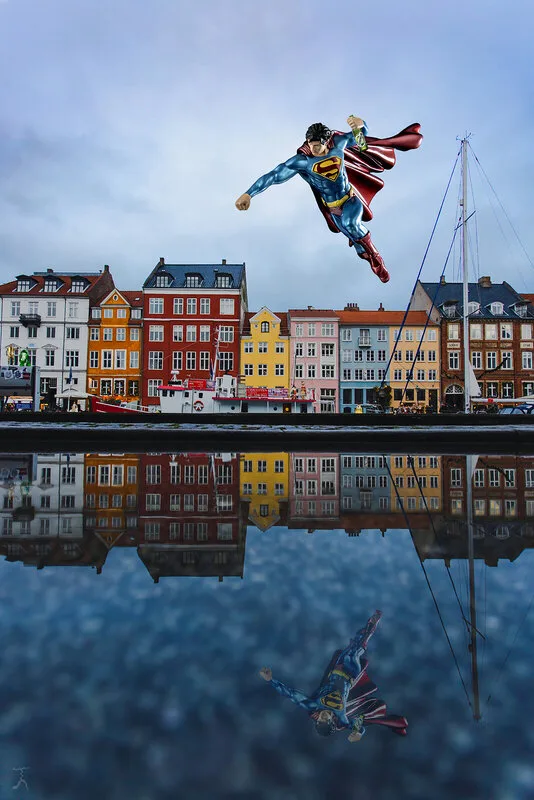
Hvornår smager en Tuborg bedst, 2023
Digital
50 x 70 cm
3 200 kr
”Du Perikles - ka' du sige mig hvornår smager en Tuborg bedst? Hver gang!” –“Hey Pericles, can you tell me when a Tuborg tastes best? Every time!”
This is a classic advertisement based on a classic Danish image. No wonder Superman flew to Copenhagen from the distant Metropolis. Although it's not his journey, my image is about more than just the surface. He plays an unexpected role behind the scenes, as a man's man, he-man, macho, and lady-charmer—the latter role less known since it's only hinted at between the comic strips. But he likes beer.
When asked when a specific beer tastes best, a true Tuborg fan would shout, "Always!" Someone who doesn't care for beer might say 'Never'. That's how it goes with taste. It's very individual. For my part, I haven't drunk a green Tuborg for a very long time. Most of the time, I've had the option to choose other beers, like the green Hof from Carlsberg. If I had to pick a beer from Tuborg, it would be a golden lady, Guld Tuborg.
The classic "Pericles" Tuborg poster! In 1943, Tuborg sought to depict the pinnacle of when a Tuborg tastes best. They turned to the artistic community. Robert Storm Peterson, better known as Storm P, a celebrated actor, cartoonist, and artist, brought this timeless poster to life - a testament to his creative prowess and enduring legacy.
I have travelled a lot, and Danish friends asked me why Tuborg and Carlsberg taste different in Asia than at home. Leading beers are brewed in many other places in the world. Since water significantly influences the outcome, even if everything else is equal, it's likely because local water is used in the brewing. That brings us to the dark continent, as it once was called. I cannot say how the beer once tasted in Africa, but there is a reason to speculate through the connection with the author and bon vivant Karen Blixen.
Although Superman is often associated with American ideals, he is depicted as a protector of Earth, advocating for global issues, including those that might affect Africa. His role as a worldwide hero means his influence and responsibilities extend to all parts of the world.
Superman's creators, Jerry Siegel and Joe Shuster, were influenced by the issues of their times, including those related to justice and human rights. Superman's mission often aligns with advocating for the disenfranchised and fighting against injustice, themes that resonate with many global narratives, including African nations.
Does Superman have any guilt about not doing enough for Africa? Considering he's been zipping around the globe since the 1930s and not just hanging out in Metropolis, you'd think he'd have stopped by. Maybe he was too busy with Lex Luthor to swing through the Sahara.
Some say the first African American character didn't appear in the Superman comics until the 1970s. Then there's the mention of a Black Kryptonian, something even the eagle-eyed Wikipedia editors missed. We're talking decades of storytelling without representing a whole demographic. Oops! Let's dive into the Superman archives:
In the first year, various dark-skinned tribes are portrayed with American native trappings. This is not exactly a home run for African representation.
A Black train porter appears in Superman #27. The portrayal isn't excellent, but it's 1944, and at least he's human.
By Superman #33, our hero is hanging out in "the exotic port of Massua on the Red Sea," meeting pirates and civilians of African descent. It's not the most flattering portrayal, but it's something.
- Fast forward a bit, and you've got silhouetted men (maybe from Africa?) carrying Lois Lane in a palanquin in Superman #49. Mysterious much?
- Superman #50 introduces some Africans working for a white hunter who's hogging all the credit.
- The storyline doesn't get much better by Superman #59, where more African natives serve another glory-hogging white hunter.
- There's a big gap until Superman #93, where a fictional African village appears in Metropolis for "educational" purposes. Is that man a statue or not?
- When we hit Superman #110, we're back to stereotypes with superstitious spear-wielding natives.
- It's not until Superman #149, at Superman's funeral, that we see more than one Black man who isn't a tribal stereotype.
- Superman #199 shows modern Africans using drums to communicate during a race event.
So, what have we learned? While Superman's world was packed with adventures, including Black characters, it wasn't stellar. None of these characters are what you'd call "well-developed." They rarely impact the story and are often just part of the backdrop. It took until the 1960s to see Black people in Metropolis regularly.
The journey of diversity in the Superman saga has been slower than a leisurely flight worldwide. While we've seen some progress, much more must be done. Let's keep pushing for better representation not just of Superman but also of all of the popular culture, not least among Superman's peers, like Batman, Wonder Woman, and others. Let's make it happen!
Now, we draw closer to Superman's visit to Copenhagen. Senior officials from Ukraine, G7 countries, the European Union, and nations like Brazil, India, Saudi Arabia, South Africa, and Turkey convened in Denmark on June 24th last year for discussions on the prospect of peace in Ukraine amidst an unfolding mutiny in Russia.
The Copenhagen meeting sought to advance Ukrainian President Volodymyr Zelenskyy's proposal for a "peace summit" to endorse principles foundational to any agreement to conclude the war that began with Russia's invasion 16 months prior. China, although invited, did not participate, underscoring the challenges Ukraine and its allies face in forging a comprehensive, influential global coalition. En route to this conference, he crossed the canal in Nyhavn.
Blix Beer, a South African brew, is more than a beverage. It's a celebration of Africa and a tribute to the iconic Karen Blixen. The label design, featuring elements from Africa and Stellenbosch, reflects Karen's rich cultural connections. The scenic Simonsberg Mountain, a biplane, and a girl are all motifs that draw inspiration from the 'Out of Africa' theme central to this brand. This design invites enthusiasts to explore a cultural odyssey, exploring beer's historical and cultural connections. The South African Breweries, a historic institution that originated in 1895 as Castle Brewery, was created to cater to the burgeoning community of European miners and prospectors around Johannesburg. This clientele might have included Karen and her spouses. And Superman, when in South Africa.
Karen Blixen, the inspiration behind Blix Beer, had a fascinating personal life. In 1914, she married Baron Bror von Blixen-Finecke, her cousin. This was after she had a failed romantic relationship with… his brother. She became Baroness Karen von Blixen-Finecke, a title reflecting her unique and unconventional life journey.
In 1915, the newly married Mrs. Blixen was diagnosed with syphilis, which caused her medical problems all through her life. As a result of the illness, she was separated from her husband in 1921; the couple divorced four years later.
Karen Blixen composed in English, a language she embraced during her years in Kenya. Her slightly unconventional English usage, as if she were savouring each word, is a hallmark of her writing style. This unique approach to language, which I first encountered at 16, has always captivated me and affirmed that contemporary writers could craft sentences from their own experiences that elevate the listener to a deep appreciation of reality.
Karen considered herself a raconteur. She spent evenings in solitude, writing stories to stave off loneliness and entertain her guests upon arrival. While I am less captivated by her many tales dominated by deception, some of which slipped into realms of romance and fantasy, in *Out of Africa*, Karen confined herself to the tangible – to her direct experiences and observations. This melding of her romantic disposition with a staunch realism is profoundly compelling and marks her literary significance.
Karen's era was one where imperialistic presence in Africa was palpable. I found it intriguing to come across a critique by Esther Poyer, a young British raw food advocate and life coach, who visited Karen's former home, now a museum in Nairobi. Esther questioned the relevance of Karen's legacy. While I understand this perspective, recognising the context of her time, I see Karen as a woman who loved profoundly and navigated her circumstances as best she could, leaving behind a legacy of luminous prose that endures well beyond her lifetime.
Karen Blixen, a woman of refined taste, cultivated coffee on her farm and maintained a distinct style. Her elegant dinner parties were a testament to her sophistication, with champagne being a staple, served under the velvety African sky upon guests' arrival. Karen Blixen's fondness for wine, particularly champagne, was not just a part of her sophisticated lifestyle in Denmark and during her years in Kenya but a passion that added depth to her persona and the refined social settings she frequented.
After her last drinking spree, Karen hid a half-empty liquor bottle. She couldn't remember where she hid it until she started drinking again. Karen's pattern of recall best illustrates:
It can be said that Karen's memories of her liquor bottle are a type of state-dependent memory. State-dependent memory is a situation where an individual can recall memories better if they are in their consciousness, such as when the memory is formed. State-dependent memory usually appears when the individual is highly influenced by psychoactive substances, in Karen's case, alcohol. This is why Karen can only remember where she puts her half-empty liquor bottle when she drinks.
As we know, 'In vino veritas' means 'In wine there is truth', and Karen loved to open a party
by saluting the guests with a glass of champagne.
" It is wonderful to have had so much to drink that you can speak as easily as you think", she said later. This sentiment reflects Karen's belief that fine wine is a metaphor for art and, ultimately, synonymous with truth (veritas), a theme that often permeates her writings.
But what beats a cold beer from the fridge when the heat is at its worst? Moreover, beer makes you less drunk and quenches your thirst better. Tuborg and Carlsberg were occasionally available in Johannesburg or Cape Town, but the beer from South African Castle Brewery wasn't too bad either. Why should Karen be any different if the Danish queen can publicly down a beer? Karen Blixen moved to Kenya and met Denys Finch Hatton, an English large-game hunter. The couple stayed together until 1931 when Hatton died tragically in a plane crash.
Upon her return to Denmark, Mrs. Blixen, a woman of many talents, unleashed Seven Gothic Tales in 1934. This English masterpiece, penned under her nom-de-plume Isak Dinesen, garnered critical acclaim, solidifying her status as a literary force to be reckoned with.
Out of Africa was published in 1937. The book tells of Karen's life in Kenya and was later made into a movie.
As Karen correctly observes, androgyny became a female ideal in the 1920s, and that is historically a new phenomenon, which she discusses primarily through the character' Rosendaal' in her book 'Carnival, written mainly during her time in Africa 1926-27.' The bodily female ideal was suddenly to have 'no dimples in the derrière' and breasts as flat as 'the Desert of Gobi'. Women started to wear 'step-in panties' too and practice a bohemian lifestyle: drinking, driving, smoking, going to nightclubs and having many lovers.
In 'Carnival' Rosendaal interprets the women of the 1920s – the flappers – as 'the only contemporaries of ours who make it their object to represent an idea'. Even though they might not be aware of it themselves, this means that the obliteration of traditional female shapes (breasts and bottom) and the promotion of the androgynous look, according to Rosendaal, represents the idea of female emancipation understood as the idea that we should first and foremost be recognised as human beings and only secondly as gender, which is a point of view Blixen also expressed repeatedly in her letters from Africa during the years she wrote 'Carnival' in Africa.
Carnival Entertainments and Posthumous Tales, published in 1978, is an animated collection of works from every stage of Karen's penname' Isak Dinesen's' career. Many were written during her most creative years but set aside; others she wrote 'just for entertainment.'
In 1939, Karen, a woman who had left an indelible mark on Danish literature, received Denmark's highest accolade for women in the arts or academics, the Tagea Brandt Rejselegat.
Karen wrote her books and stories in English and translated them back into Danish. When her health deteriorated, she had to stop writing but did several radio broadcasts.
At the age of 77, she died; the cause of death was either malnutrition, syphilis, anorexia, or a combination. A suburb of Nairobi where the author's home and coffee plantation was was renamed "Karen" in her honour.
In the spring of 1918, as a guest at a small dinner with other Europeans, Karen Blixen met the great love of her life, the English aristocrat Denys Finch Hatton. He is usually depicted from Karen Blixen's perspective, with her descriptions: handsome, physically strong and agile, possessing great intelligence, refined taste, and matching confidence. Based on Finch Hatton's later behaviour, other traits include a hefty dose of egoism, disregard, lack of empathy, and perpetual restlessness. He was always on the move, between people and continents. Superman in a nutshell.
Karen's life may have been like literature, but her literature was not like her life. One searches in vain on the pages of her books for the unhappy marriage and the lover's betrayal but finds strong men with a taste for adventure. Nor her secret love. She had a hidden fondness for Superman. When the superhero was born, he was already an adult, originally from the planet Krypton and endowed with superpowers on Earth. Karen liked fairy tales, so Superman was indeed a perfect fit. There was so much that needed to be set right in the world with Hitler, Nazism, and fascism, and a war that was looming in the air.
Karen Blixen's engagement with the social and political currents of her time was far from passive, as her essays and articles like "Breve fra et Land i Krig" (1940), "En Baaltale med 14 Aars Forsinkelse" (1952), and "Fra Lægmand til Lægmand" (1954) demonstrate. On the other hand, her fiction often veered away from contemporary political and social issues, reflecting her disapproval of literary realism, particularly the novel form. She positioned herself as a modern-day Scheherazade, weaving timeless tales that bypassed societal questions, yet her works remain a significant part of literary discussions. It's crucial to note that despite their apparent detachment, her fictional works are not devoid of political and social commentary.
Works such as "The Deluge at Norderney" and "Babette's Feast" resonate with echoes of the French Revolution and the Paris Commune, bringing with them profound political, social, and ideological shifts. "Sorrow Acre" juxtaposes two distinct historical and social epochs: the feudal and the liberal. "Out of Africa" contrasts African and European worlds regarding ethical values, mentality, and cultural practices, making it a focus of postcolonial analysis. While rooted in historical events, these themes remain relevant in our contemporary world. It's important to note that Blixen never overtly prioritises social or political issues. Instead, they are skillfully integrated into the narrative, enriching the atmosphere and providing a backdrop for exploring aesthetic concepts and ideas.
Even in her essays, which more directly address social issues, Blixen's approach is rooted in aesthetics rather than politics, underscoring her unique perspective and approach to literary analysis.
After her husband left her, Karen Blixen dove into the vibrant social scene that colonial Kenya offered to its European elite. When royalty, including the Duke and Prince of Wales, visited, she orchestrated traditional dances performed by the local Kikuyu as a spectacle of honour. Alongside her lover, British big-game hunter Denys Finch-Hatton, Karen drifted through the circles of the "Happy Valley set," infamously indulgent, chasing entertainment with a blend of alcohol, drugs, and promiscuity. A wry question circulated among British aristocrats at the time: "Are you married, or do you live in Kenya?"
Yet, none of these raucous escapades found their way into Blixen's memoirs. Instead, her writing skipped over the decadent parties, choosing to richly detail the landscapes and the lives of the "Natives."
Both Blixen's writings and the subsequent film Out of Africa have come to embody a bygone era of aristocratic colonial nostalgia.
Karen Blixen's relationship with Germany, Hitler, and the war offers a complex view of her as both a critical observer and a historical figure influenced by the tumultuous times she lived through. Known primarily for her literary escapades and profound narratives, Karen had a nuanced engagement with her era's political and philosophical undercurrents, especially concerning Germany's turbulent history during the early 20th century.
As discussed in Eric Voegelin's political philosophies, Karen's perspective on modernity and its crises reveals her deep contemplation on the spiritual and moral degradation characterising the secular and materialistic tendencies of the modern world. This philosophical viewpoint aligns with Voegelin's criticism of the Enlightenment and its aftermath, which Karen perceived as a catastrophic moral deviation that shaped the events leading to and surrounding World War II.
During a critical time in history, Karen visited Germany under a journalism fellowship, where she experienced firsthand the nationalistic fervour and the totalitarian control characteristic of Nazi Germany. Her writings from this period, mainly her reflections published post-war, articulate her observations on National Socialism as a dangerous embodiment of Enlightenment ideals gone awry. Karen criticised the Nazi regime for distorting reason and tradition, replacing a historically nuanced societal order with a brutal and reductionist ideological agenda.
Karen's literary and philosophical engagements reveal her confrontation with the era's political dogmas. She recognised the inherent dangers of ideological extremism and its capacity to manipulate and dominate the societal fabric, a theme prevalent in her discussions on the Nazi appropriation of art and culture as tools for political indoctrination.
Ultimately, Karen's interactions and intellectual confrontations during her visit to Germany deepened her disdain for the totalitarian impulses of the regime, reinforcing her commitment to a more spiritually and morally grounded worldview. Her reflections serve not only as a personal testament to her philosophical and political stance but also as a broader critique of the forces shaping Europe during one of its darkest periods. Through her experiences and writings, Karen Blixen emerges as a figure deeply embedded in her time's intellectual and historical dialogues, offering a poignant critique of the cultural and political degeneration she witnessed.
Superman fit that mould as well. Even though he was active during World War II, the Korean War, the Vietnam War, the Cold War, and all conflicts since then, Superman mainly operated in Metropolis. If he ventured out into the world, it was to combat criminals. He steered clear of political quagmires because that would affect sales figures in sensitive markets. This aspect never troubled Karen; she wasn't commercial in that sense. If she stood anywhere politically, it was to the left, but she was wise enough not to mix her tales with reality. She described the people she met and the life she experienced. Here and there, there is indirect criticism. It's clear that she disliked Hitler and totalitarianism, but she did not use her superpowers as an author to combat Hitler and his ilk. Neither did Superman.
Better to chug a beer together.
In the literary safari of Karen's life, her novelistic memoir 'Out of Africa' stands out like a grand African sunset, distinct and awe-inspiring. Published in 1937, this work is not just a story—it's a profound journey into the heart of Kenya through the eyes of a noble Danish baroness. Initially penning her tales under the name Isak Dinesen, Karen crafted a narrative less about her personal saga and more of an homage to the land and people she came to hold dear. Her experiences as a coffee plantation owner, her interactions with the native people, and her deep connection with the land all shape the narrative, providing a unique perspective on colonialism and African life.
Karen's aristocratic roots, reflected in her pen name and her ownership of a coffee plantation, cast a long shadow over her writings. She embraced her role not just as a landowner but as a steward of the land, believing firmly in the noblesse oblige—the noble's obligation. This perspective is vivid in her interactions with the native people and her efforts to uplift them, from treating illnesses to battling illiteracy by founding an evening school on her farm.
Yet, Karen's account of Africa is tinged with the hues of controversy. While her narrative does romanticise the continent, creating a "paradise lost," it also subtly critiques colonialism. However, some critics argue that her portrayal of the native people and her role as a 'protector' can be seen as paternalistic and perpetuating colonial stereotypes. Take, for instance, her inclusion of the harrowing tale of an African boy cruelly mistreated by an English settler. Karen doesn't shout her disapproval from the rooftops; instead, she lets the stories breathe and speak for themselves, weaving a subtle political statement into the fabric of her memoir.
'Out of Africa' is more a mosaic of African life than a linear story of Karen's adventures. Notably absent from the book are tales of her husband, her love affair with Denys Finch-Hatton, and her tribulations—from a heartbreaking miscarriage to battling syphilis. Instead, the book paints a vibrant picture of Kenya's people, their profound connection with nature, and the daily realities of farm life.
Karen's narrative style—fragmented and non-linear—mirrors the unpredictable rhythms of African life itself. This very irregularity and her candid portrayal of her experiences have made 'Out of Africa' a focal point in discussions of female autobiography. Yet, despite its biographical elements, the book remains enigmatic, focusing more on the land and the people than on Karen herself.
The 1985 cinematic adaptation by Sidney Pollack, starring Meryl Streep and Robert Redford, brought Karen's story to a global audience. While the film captures the romance of her African years, it glosses over the nuanced complexity of her original writings, choosing instead to craft a Hollywood love story that simplifies and sensationalises her life.
In essence, 'Out of Africa' is a testament to Karen's life's paradoxes: a baroness who felt more at home in the rugged landscapes of Africa than in the aristocratic salons of Europe. This coloniser saw herself as a protector of her adopted home's indigenous culture. Through her book, Karen invites us to view Africa through her eyes—not just as a land of exotic beauty but as a place of deep cultural richness and complex human relationships. It's a narrative that challenges, educates, and endears, remaining a significant literary work that speaks on multiple levels about the conflicts and harmonies between different worlds.
Karen's duality of voice, expressed in Danish and English, leaves an indelible mark on her literary footprint. The reception of 'Out of Africa' reveals a rich irony. The memoir was celebrated globally for its lyrical serenity and profound respect for Africa and its people. Critics were captivated by Karen's sensitive depiction of Kenyan landscapes and cultures, finding in her prose a timeless allure that transcends geographical boundaries.
However, back in her native Denmark, the reception was starkly different. Danish critics lobbed ad hominem attacks, painting Karen as a snob draped in noblesse oblige. They accused her of romanticising Africa and its people and of using her status as a plantation owner to justify her actions. But Karen embraced this critique, embodying the defiance of the very aristocracy she was born into. She saw her noble status as not a mere birthright but a mantle of responsibility. As Baroness Karen Blixen-Finecke, she believed her role as a plantation owner came with the duty to care for and uplift the native people on her land. Given the colonial backdrop of her story, this stance might have seemed paradoxical to some.
The dichotomy in reception only underscores the intricate nature of Karen's relationship with her home country and adopted homeland. Navigating the contradictions of her identity and privilege, her narrative offers a nuanced perspective on colonialism that challenges her readers at home and abroad to reconsider the narratives traditionally associated with Africa. Thus, Karen's memoir remains a narrative about Africa and a dialogue with the world about legacy, responsibility, and the transformative power of empathy.
3 200 kr

Jörgen Thornberg
Malmö
Lite om bilder och mig. Translation in English at the end.
Jag är en nyfiken person som ser allt i bilder, även det jag fäster i ord, gärna tillsammans för bakom alla mina bilder finns en berättelse. Till vissa bilder hör en kortare eller längre novell som följer med bilden.
Bilder berättar historier. Jag omges av naturlig skönhet, intressanta människor och historia var jag än går. Jag använder min kamera för att dokumentera världen och blanda det jag ser med vad jag känner för att fånga den dolda magin.
Mina bilder berättar mina historier. Genom mina bilder, tryck och berättelser. Jag bjuder in dig att ta del av dessa berättelser, in i ditt liv och hem och dela min mycket personliga syn på vår värld. Mer än vad ögat ser. Jag tänker i bilder, drömmer och skriver och pratar om dem; följaktligen måste jag också skapa bilder. De blir vad jag ser, inte nödvändigtvis begränsade till verkligheten. Det finns en bild runt varje hörn. Jag hoppas att du kommer att se vad jag såg och gilla det.
Jag är också en skrivande person och till många bilder hör en kortare eller längre essay. Den följer med tavlan, tryckt på fint papper och med en personlig hälsning från mig.
Flertalet bilder startar sin resa i min kamera. Enkelt förklarat beskriver jag bilden jag ser i mitt inre, upplevd eller fantiserad. Bilden uppstår inom mig redan innan jag fått okularet till ögat. På bråkdelen av ett ögonblick ser jag vad jag vill ha och vad som kan göras med bilden. Här skall jag stoppa in en giraff, stålmannen, Titanic eller vad det är min fantasi finner ut. Ännu märkligare är att jag kommer ihåg minnesbilden långt efteråt när det blir tid att skapa verket. Om jag lyckas eller inte, är upp till betraktaren, oftast präglat av en stråk av svart humor – meningen är att man skall bli underhållen. Mina bilder blir ofta en snackis där de hänger.
Jag föredrar bilder som förmedlar ett budskap i flera lager. Vid första anblicken fylld av feel-good, en vacker utsikt, fint väder, solen skiner, blommor på ängen eller vattnet som ligger förrädiskt spegelblankt. I en sådan bild kan jag gömma min egentliga berättelse, mitt förakt för förtryckare och våldsverkare, rasister och fördomsfulla människor - ett gärna återkommande motiv mer eller mindre dolt i det vackra motivet. Jag försöker förena dem i ett gemensamt narrativ.
Bild och formgivning har löpt som en röd tråd genom livet. Fotokonst känns som en värdig final som jag gärna delar med mig.
Min genre är vid som framgår av mina bilder, temat en blandning av pop- och gatukonst i kollage som kan bestå av hundratals lager. Vissa bilder kan ta veckor, andra någon dag innan det är dags att överlämna resultatet till printverkstaden. Fine Art Prints är digitala fotocollage. I dessa kollage sker rivandet, klippandet, pusslandet, målandet, ritandet och sprayningen digitalt. Det jag monterar in kan vara hundratals år gamla bilder som jag omsorgsfullt frilägger så att de ser ut att vara en del av tavlan men också bilder skapade av mig själv efter min egen fantasi. Därefter besöks printstudion och för vissa bilder numrera en limiterad upplaga (oftast 7 exemplar) och signera för hand. Vissa bilder kan köpas i olika format. Det är bara att fråga efter vilka. Gillar man en bild som är 70x100 men inte har plats på väggen, går den kanske att få i 50x70 cm istället. Frågan är fri.
Metoden Giclée eller Fine Art Print som det också kallas är det moderna sättet för framställning av grafisk konst. Villkoret för denna typ av utskrifter är att en högkvalitativ storformatskrivare används med åldersbeständigt färgpigment och konstnärspapper eller i förekommande fall på duk. Pappret som används möter de krav på livslängd som ställs av museer och gallerier. Normalt säljer jag mina bilder oinramade så att den nya ägaren själv kan bestämma hur de skall se ut, med eller utan passepartout färg på ram, med eller utan glas etc..
Under många år ställde jag bara ut på nätet, i valda grupper och på min egen Facebooksida - https://www.facebook.com/jorgen.thornberg.9
Jag finns också på en egen hemsida som tyvärr inte alltid är uppdaterad – https://www.jth.life/ Där kan du också läsa en del av de berättelser som följer med bilden.
UTSTÄLLNINGAR
Luftkastellet, oktober 2022
Konst i Lund, november 2022
Luftkastellet, mars 2023
Engleson Galleri Caroli, april 2023
Hydra, Greece June 2023
Engleson Galleri Caroli, oktober 2023
Toppen, Höllviken december 2023
Luftkastellet, mars 2024
Torups Galleri, mars 2024
Venice, May 2024
Luftkastellet, oktober 2024
Konst i Advent, December 2024
Galleri Engleson, Caroli December 2024
Jäger & Jansson Galleri, april 2025
A bit about pictures and me.
I'm a curious person who sees everything in pictures, even what I express in words, often combining them, for behind all my pictures lies a story. These narratives, some as short as a single image and others as long as a novel, are the heart and soul of my work.
Pictures tell stories. Wherever I go, I'm surrounded by natural beauty, exciting people, and history. I use my camera to document the world and blend what I see with what I feel to capture the hidden magic.
My images tell my stories. Through my pictures, prints, and narratives, I invite you to partake in these stories in your life and home and share my deeply personal perspective of our world. More than meets the eye. I think in pictures, dream, write, and talk about them; consequently, I must create images too. They become what I see, not necessarily confined to reality. There's a picture around every corner. I hope you'll see what I saw and enjoy it.
I'm also a writer, and many images come with a shorter or longer essay. It accompanies the painting, printed on fine paper with my personal greeting.
Many pictures start their journey on my camera. Simply put, I describe the image I see in my mind, experienced or imagined. The image arises within me even before I bring the eyepiece to my eye. In a fraction of a moment, I see what I want and what can be done with the picture. Here, I'll insert a giraffe, Superman, the Titanic, or whatever my imagination conjures up. Even stranger is that I remember the mental image long after it's time to create the work. Whether I succeed is up to the observer, often imbued with a streak of black humour – the aim is to entertain. My pictures usually become a talking point wherever they hang.
I prefer pictures that convey a message in multiple layers. At first glance, they're filled with feel-good vibes, a beautiful view, lovely weather, the sun shining, flowers in the meadow, or the water lying deceptively calm. But beneath this surface beauty, I often conceal a deeper story, a narrative that challenges societal norms or explores the human condition. I invite you to delve into these hidden narratives and discover the layers of meaning within my work.
Picture and design have been a thread running through my life. Photographic art feels like a fitting finale, and I'm happy to share it.
My genre is varied, as seen in my pictures; the theme is a blend of pop and street art in collages that can consist of hundreds of layers. Some images can take weeks, others just a day before it's time to hand over the result to the print workshop. Fine Art Prints are digital photo collages. In these collages, tearing, cutting, puzzling, painting, drawing, and spraying happen digitally. What I insert can be images hundreds of years old that I carefully extract so they appear to be part of the painting, but also images created by myself, now also generated from my imagination. Next, visit the print studio and, for certain images, number a limited edition (usually 7 copies) and sign them by hand. Some images may be available in other formats. Just ask which ones. If you like an image that's 70x100 but doesn't have space on the wall, you might be able to get it in 50x70 cm instead. The question is open.
The Giclée method, or Fine Art Print as it's also called, is the modern way of producing graphic art. This method ensures the highest quality and longevity of the artwork, using a high-quality large-format printer with archival pigment inks and artist paper or, in some cases, canvas. The paper used meets the longevity requirements set by museums and galleries. I sell my pictures unframed, allowing the new owner to personalise their artwork, confident in the lasting value and quality of the piece.
For many years, I only exhibited online, in selected groups, and on my Facebook page - https://www.facebook.com/jorgen.thornberg.9. I also have my website, which unfortunately is not constantly updated - https://www.jth.life/. You can also read some of the stories accompanying the pictures there.
EXHIBITIONS
Luftkastellet, October 2022
Art in Lund, November 2022
Luftkastellet, March 2023
Engleson Gallery Caroli, April 2023
Hydra, Greece June 2023
Engleson Gallery Caroli, October 2023
Toppen, Höllviken December 2023
Luftkastellet, March 2024
Torup Gallery, March 2024
Venice, May 2024
UTSTÄLLNINGAR
Luftkastellet, oktober 2022
Konst i Lund, november 2022
Luftkastellet, mars 2023
Engleson Galleri Caroli, april 2023
Hydra, Greece June 2023
Engleson Galleri Caroli, oktober 2023
Toppen, Höllviken december 2023
Luftkastellet, mars 2024
Torups Galleri, mars 2024
Venice, May 2024
Luftkastellet, October 2024
Konst i Advent, December 2024
Galleri Engleson, Caroli December 2024
Jäger & Jansson Galleri, April 2025
Utbildning
Autodidakt
Medlem i konstnärsförening
Öppna Sinnen
Med i konstrunda
Konstrundan i Skåne
Utställningar
Luftkastellet, October 2022
Art in Lund, November 2022
Luftkastellet, March 2023
Engleson Gallery Caroli, April 2023
Hydra, Greece June 2023
Engleson Gallery Caroli, October 2023
Toppen, Höllviken December 2023
Luftkastellet, March 2024
Torup Gallery, March 2024
Venice, May 2024