Vi använder cookies för att ge dig bästa möjliga upplevelse. Välj vilka cookies du tillåter.
Läs mer i vår integritetspolicy
Jörgen Thornberg
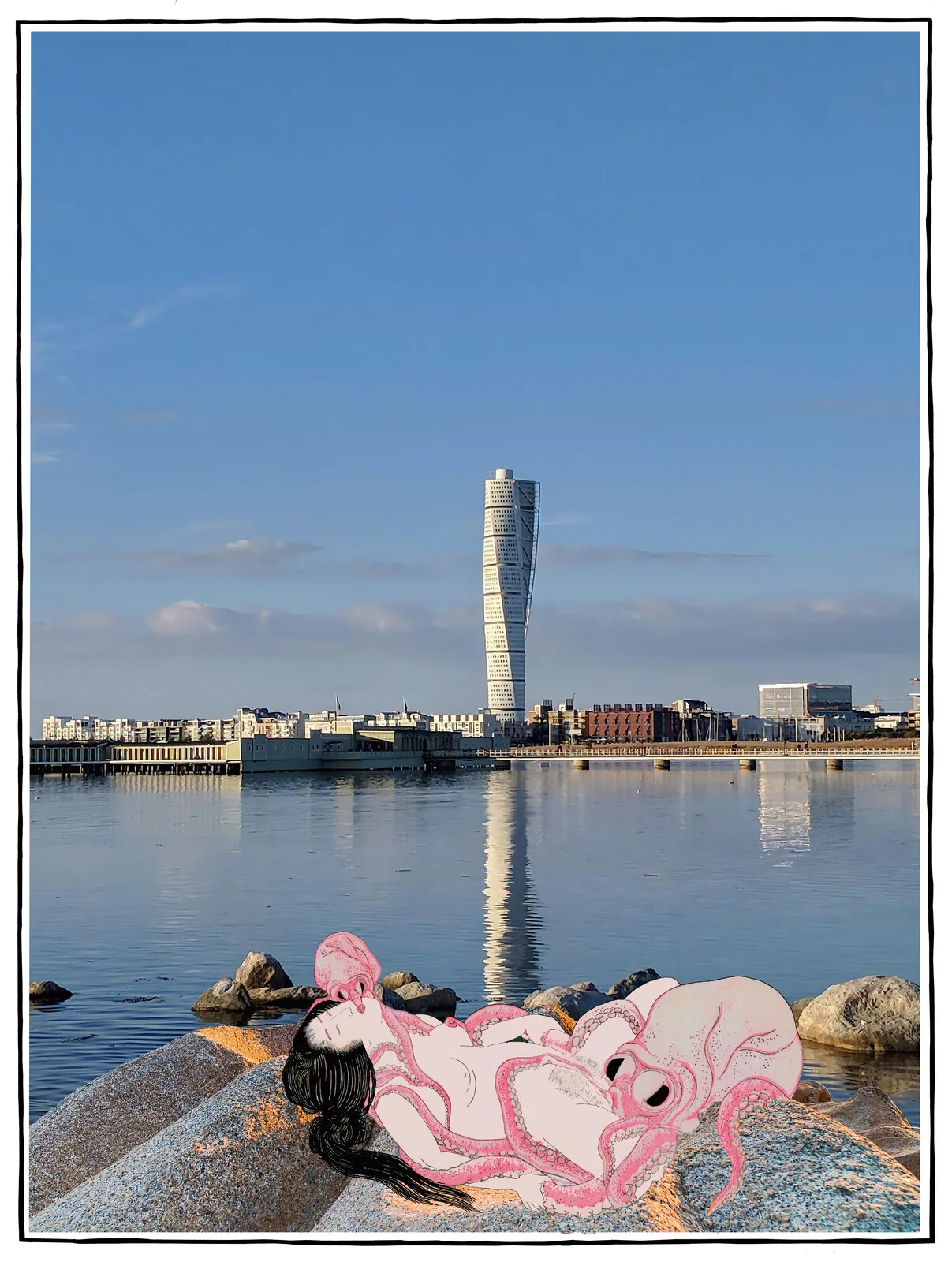
The Fisherman's Stale Dream Year 1814, 2021
Digital
50 x 70 cm
3 200 kr
The image of the copulating group with Malmö's phallic symbol Turning Torso in the background is, in some people's eyes, profoundly offensive pornography. However, before judging it too harshly, one should consider its context. This is a historic type of art, albeit controversial.
'The Dream of the Fisherman's Wife', also known as 'Girl Diver and Octopi', 'Diver and Two Octopi', etc., is a woodblock-printed design. It is included in Kinoe no Komatsu ('Young Pines'), a three-volume book of shunga erotica first published in 1814, and has become Katsushika Hokusai's (1760-1849) most famous shunga design. Playing with themes popular in Japanese art, it depicts a young ama diver entwined sexually with a pair of octopuses.
The book is a work of Shunga (erotic art) within the ukiyo-e genre. The image depicts a woman, evidently an ama (a shell diver), enveloped in the limbs of two octopuses. The larger of the two molluscs performs cunnilingus on her, while the smaller one, his offspring, assists by massaging the woman's mouth and left nipple. In the text above the image, the woman and the creatures express their mutual sexual pleasure from the encounter.
Shunga is a Japanese term for erotic art. "Shunga" means "literally picture of spring". Shunga was made through ink paintings or woodblock prints, which were applied to handscrolls and mass-produced illustrated texts. While it generally depicts male-female couples, particularly in the early Edo period, male-male couples could also be found. The images emphasise facial expressions of joy and satisfaction and feature exaggerated genitals on males and females.
The Delightful World of Shunga: A Humorous Journey Through Erotic Art
Shunga, often dubbed the Japanese equivalent of Playboy (minus the glossy pages and centrefolds), has been tickling the imaginations and senses of viewers for centuries. These erotic woodblock prints, whose name translates to "spring pictures," offer a playful peek into historical Japan's private lives and romantic escapades. But Shunga is far more than just ancient smut—it's a fascinating blend of art, culture, and comedy. Let's dive into the compelling history of Shunga with a touch of humour and a sprinkle of anecdotes.
The Birth of Shunga: Art Meets Eros
Shunga emerged during the Edo period (1603-1868) when Japan was a bustling hub of culture and commerce. Imagine a world where the samurai were not only wielding swords but also sneaking peeks at explicit prints in the back alleys of Edo (modern-day Tokyo). Artists like Hokusai, more famously known for "The Great Wave off Kanagawa," also dabbled in the risqué realm of Shunga. The creation of these prints wasn't just for titillation; they were considered good luck charms, believed to ward off evil spirits and even protect against fires. Talk about multi-purpose art!
An Anecdote of Laughs: The Monk and the Maiden
One of the more amusing anecdotes involves a hapless monk who, despite his vows of celibacy, finds himself in a compromising situation with a spirited maiden. In one famous Shunga print, the monk's exaggerated expressions of shock and delight as he gets entangled in amorous activities are priceless. The humorous twist? The monk's sandal is depicted flying off in the heat of passion, symbolising human desire's unexpected and uncontrollable nature.
Shunga in the Bedroom: Instruction Manuals for Lovers
Far from being mere pornography, Shunga served an educational purpose. They were essentially the Kama Sutra of Japan, providing visual aids for lovers looking to spice up their intimate lives. Newlyweds often received Shunga prints as part of their dowry, ensuring they were well-prepared for marital bliss. Imagine a blushing bride unwrapping a scroll to find a detailed illustration of creative bedroom gymnastics—talk about a wedding gift that keeps giving!
The Tale of the Tentacled Lover
Perhaps the most iconic Shunga piece is Hokusai's "The Dream of the Fisherman's Wife." This print features a woman entwined with a pair of amorous octopuses, and it's as bizarre as it is famous. Legend has it that the print was inspired by the story of Princess Tamatori, who bravely dove into the sea god's palace to retrieve a stolen pearl. The octopus became a symbol of forbidden love and the boundless nature of erotic imagination. Today, this image continues to fascinate and amuse, proving that our ancestors had quite a vivid imagination.
Shunga and the Law: Forbidden Yet Flourishing
Despite their popularity, Shunga prints often found themselves at odds with the law. During the Tokugawa shogunate, censorship laws were strict, and Shunga was technically illegal. However, this did little to deter artists and enthusiasts. Prints were often sold under the guise of "artistic studies" or "illustrated books." Police raids were frequent, but the demand for Shunga ensured its survival. In a particularly humorous turn of events, it's said that even the shogun had a secret collection of Shunga, proving that not even the highest authority could resist its allure.
Modern Day Shunga: From Taboo to Artistry
In contemporary times, Shunga has been re-evaluated as an important cultural artefact and celebrated for its artistic merit. Museums worldwide now showcase Shunga exhibitions, drawing crowds eager to glimpse the naughty yet beautifully crafted scenes. The shift from taboo to artistry highlights the timeless appeal of these prints.
The Last Laugh: Shunga's Enduring Legacy
Shunga's enduring legacy is its ability to blend humour, eroticism, and artistry seamlessly. These prints offer a candid, often comical, glimpse into the private lives of historical Japan, reminding us that human desires and fantasies are timeless. Whether it's the tale of a sandal-flinging monk, the educational prints for newlyweds, or the legendary tentacled lover, Shunga continues to entertain and enlighten.
So next time you stumble upon an ancient Shunga print, take a moment to appreciate its rich history and the laughs it has provided through the centuries. After all, who said history couldn't be a little bit cheeky?
A Cheeky Comparison: Shunga, Ancient Greek Art, and Pompeii's Erotic Imagery
When it comes to erotic art, the ancients knew how to have a good time. From the playful yet explicit Shunga prints of Japan to the sensual frescoes of Pompeii, erotic art has long been a means to explore and celebrate human sexuality. Let's take a cheeky dive into the similarities and differences between Shunga, ancient Greek art, and the erotic images preserved in Pompeii, all while acknowledging the influence of prudish censorship, particularly by the church.
Shunga: Japanese Erotica with a Twist
As we've seen, Shunga is a form of Japanese erotic art that flourished during the Edo period. These woodblock prints were a means of titillation and served educational and even superstitious purposes. Shunga was known for its playful and imaginative depictions of sexual encounters, often blending humour with explicit content. The artwork was detailed and vibrant, reflecting the rich cultural context of the time.
Ancient Greek Art: Gods, Myths, and Eroticism
Ancient Greek art, particularly in pottery, frequently depicted erotic scenes. These were often intertwined with mythological narratives, showcasing the exploits of gods and heroes. Erotic scenes could be found on kylixes (drinking cups) and amphorae, frequently used during symposia (drinking parties) where the boundaries between celebration, reverence, and eroticism blurred. Greek art emphasised the human form, celebrating its beauty and athleticism. Unlike Shunga, Greek erotic art was less about humour and more about the idealisation of the body and divine love.
Pompeii: The Roman Love for Erotica
Pompeii, the ancient Roman city frozen in time by the eruption of Mount Vesuvius in AD 79, offers a fascinating glimpse into Roman erotic art. The walls of Pompeii are adorned with explicit frescoes and mosaics depicting a wide range of sexual activities. These images were commonplace in bathhouses, brothels, and private homes. Unlike the somewhat discreet nature of Shunga, Pompeii's erotic art was displayed openly, reflecting a society more comfortable with public expressions of sexuality.
The Church's Censorship
The prudish nature of the Christian church, particularly during the medieval period, led to the destruction and censorship of much erotic art from antiquity. Greek and Roman artworks were often defaced or hidden away. The church viewed these images as immoral and contrary to Christian values. Many statues had their genitalia removed or covered, and erotic frescoes were plastered over or destroyed. This prudish attitude starkly contrasts with the more permissive approach of Japanese society towards Shunga, which, while technically illegal, was still widely circulated and enjoyed.
Common Themes and Divergences
Celebration of Sexuality: Both Shunga and the erotic art of Greece and Rome celebrate human sexuality openly. However, while Shunga often incorporates humour and fantastical elements (think octopuses), Greek and Roman art focuses more on the physical beauty and mythological significance of sex.
Medium and Style: Shunga primarily consists of woodblock prints rich in colour and detail. Greek erotic art is commonly found in pottery, and Roman art features frescoes and mosaics. The styles differ significantly, with Shunga's stylised and exaggerated forms contrasting with the more realistic depictions of the human body in Greek and Roman art.
Cultural Context: Shunga was often used as a private pleasure and educational tool, while Greek and Roman erotic art was more public. The Greeks subtly incorporated erotica into their myths and daily life, whereas the Romans were more overt, as seen in the brothels of Pompeii.
Impact of Censorship: The destruction and censorship of erotic art by the church in Europe starkly contrasts with Japan's approach, where Shunga was illicitly but widely accepted. This censorship resulted in the loss of countless artworks that might have provided further insights into ancient attitudes towards sex.
Anecdotes and Fun Facts
- Shunga and Superstition: Shunga prints were believed to protect against evil spirits and fire, adding a layer of practicality to their erotic allure.
- Erotic Pottery: In ancient Greece, the pottery used during symposia sometimes depicted sexual acts, turning an everyday item into an erotic conversation starter.
- Pompeii's Brothels: The brothels of Pompeii had explicit frescoes above the doorways, possibly serving as a "menu" of services offered, leaving little to the imagination.
While the erotic art of Shunga, ancient Greece, and Pompeii differs in style and cultural significance, they all share a common thread: the celebration of human sexuality. Each tradition offers a unique lens through which we can explore the erotic imaginations of our ancestors. Despite the attempts of prudish institutions to erase these expressions, the enduring appeal of erotic art reminds us of the timeless nature of human desire and creativity.
The text accompanying Hokusai's original surrounds the image and is worth reading.
LARGE OCTOPUS: My wish comes true at last, this day of days; finally, I have you in my grasp! Your "bobo" is ripe and full; how wonderful! Superior to all others! To suck and suck and suck some more. After we do it masterfully, I'll guide you to the Dragon Palace of the Sea God and envelop you. "Zuu sufu sufu chyu chyu chyu tsu zuu fufufuuu..."
The concluding sentence can best be described as an onomatopoetic foreplay. Slurp, whisper, whisper, swish, swish, squeak, squeak, squeak, smack, smack, smack, tsk, tap, sip, huff, huff, huff.
MAIDEN: You hateful octopus! Your sucking at the mouth of my womb makes me gasp for breath! Aah! Yes... it's... there!!! With the sucker, the sucker!! Inside, squiggle, squiggle, oooh! Oooh, good, oooh, good! There, there! Theeeeere! Goood! Whew! Aah! Good, good, aaaaaaaaaah! Not yet! Until now, it was I that men called an octopus! An octopus! Ooh! Whew! How are you able...!? Ooh! "Yoyoyooh, saa... hicha hicha gucha gucha, yuchyuu chyu guzu guzu suu suuu..."
The concluding sentence is a veritable onomatopoetic orgy. Woohoo, rustle, rustle, squish, squish, muddle, muddle, squeak, squeak, smack, smack, dawdle, dawdle, sigh, sigh
LARGE OCTOPUS: All eight limbs to intertwine with!! How do you like it this way? Ah, look! The inside has swollen, moistened by the warm waters of lust. "Nura nura doku doku doku..."
The orgie continues, and "Nura nura doku doku doku..." appears to be an example of onomatopoeia; in this case, it could describe a repetitive or continuous sound, such as dripping, flowing, or a rhythmic beat.
MAIDEN: Yes, it tingles now; soon, there will be no sensation at all left in my hips. Ooooooh! Boundaries and borders are gone! I've vanished...!!!!!!
SMALL OCTOPUS: After Daddy finishes, I, too, want to rub and rub my suckers at the ridge of your furry place until you disappear, and then I'll suck some more. "Chyu chyu..."
Chyu chyu is a Japanese onomatopoeia typically used to describe the sound of sucking or nibbling, such as sucking through a straw or a mouse gnawing. It can also be used cutely to describe someone giving small kisses or pecks. Context is vital to understanding the exact meaning of this sound word, especially in this pornographic context.
Hokusai's image would have reminded contemporary viewers of the story of Princess Tamatori, which gained widespread popularity during the Edo period. In this narrative, Tamatori is a humble shell diver who marries Fujiwara no Fuhito of the prestigious Fujiwara clan. Fujiwara is on a quest to retrieve a pearl stolen from his family by Ryūjin, the dragon god of the sea. Determined to assist her husband, Tamatori dives into the depths of the ocean to reach Ryūjin's undersea palace, Ryūgū-jō. She is pursued by the dragon god and his army of sea creatures, including octopuses. In a desperate bid to escape, Tamatori cuts open her breast, places the pearl inside, and swims to the surface. Although she manages to flee, she succumbs to her injury shortly after.
The Tamatori story was a favoured theme in ukiyo-e art, with the artist Utagawa Kuniyoshi producing several inspired works. These often feature octopuses among the sea creatures chasing the bare-breasted diver. In the text accompanying Hokusai's image, the giant octopus intends to take the girl to Ryūjin's palace, further reinforcing the connection to the Tamatori legend.
The Dream of the Fisherman's Wife is not the only piece of Edo-period art depicting erotic interactions between a woman and an octopus. Early netsuke carvings occasionally show cephalopods fondling nude women. Hokusai's contemporary, Yanagawa Shigenobu, created an image similar to Hokusai's, depicting a woman receiving cunnilingus from an octopus in his 1830 collection, Suetsumuhana.
Early 19th-century critics like Edmond de Goncourt and Jack Hillier interpreted Hokusai's work as a rape scene. These scholars viewed it outside a correct context without understanding the accompanying text and visual references, which stripped the image of its original context and meaning.
Jörgen Thornberg
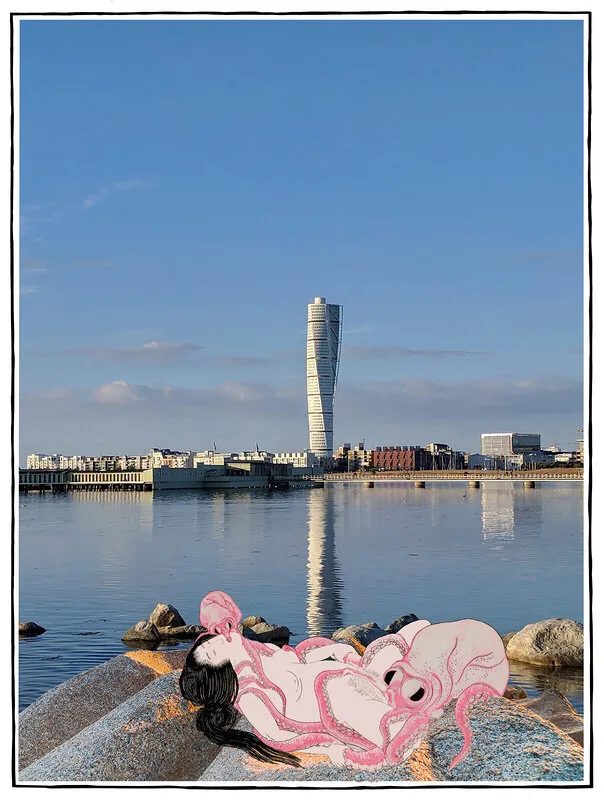
The Fisherman's Stale Dream Year 1814, 2021
Digital
50 x 70 cm
3 200 kr
The image of the copulating group with Malmö's phallic symbol Turning Torso in the background is, in some people's eyes, profoundly offensive pornography. However, before judging it too harshly, one should consider its context. This is a historic type of art, albeit controversial.
'The Dream of the Fisherman's Wife', also known as 'Girl Diver and Octopi', 'Diver and Two Octopi', etc., is a woodblock-printed design. It is included in Kinoe no Komatsu ('Young Pines'), a three-volume book of shunga erotica first published in 1814, and has become Katsushika Hokusai's (1760-1849) most famous shunga design. Playing with themes popular in Japanese art, it depicts a young ama diver entwined sexually with a pair of octopuses.
The book is a work of Shunga (erotic art) within the ukiyo-e genre. The image depicts a woman, evidently an ama (a shell diver), enveloped in the limbs of two octopuses. The larger of the two molluscs performs cunnilingus on her, while the smaller one, his offspring, assists by massaging the woman's mouth and left nipple. In the text above the image, the woman and the creatures express their mutual sexual pleasure from the encounter.
Shunga is a Japanese term for erotic art. "Shunga" means "literally picture of spring". Shunga was made through ink paintings or woodblock prints, which were applied to handscrolls and mass-produced illustrated texts. While it generally depicts male-female couples, particularly in the early Edo period, male-male couples could also be found. The images emphasise facial expressions of joy and satisfaction and feature exaggerated genitals on males and females.
The Delightful World of Shunga: A Humorous Journey Through Erotic Art
Shunga, often dubbed the Japanese equivalent of Playboy (minus the glossy pages and centrefolds), has been tickling the imaginations and senses of viewers for centuries. These erotic woodblock prints, whose name translates to "spring pictures," offer a playful peek into historical Japan's private lives and romantic escapades. But Shunga is far more than just ancient smut—it's a fascinating blend of art, culture, and comedy. Let's dive into the compelling history of Shunga with a touch of humour and a sprinkle of anecdotes.
The Birth of Shunga: Art Meets Eros
Shunga emerged during the Edo period (1603-1868) when Japan was a bustling hub of culture and commerce. Imagine a world where the samurai were not only wielding swords but also sneaking peeks at explicit prints in the back alleys of Edo (modern-day Tokyo). Artists like Hokusai, more famously known for "The Great Wave off Kanagawa," also dabbled in the risqué realm of Shunga. The creation of these prints wasn't just for titillation; they were considered good luck charms, believed to ward off evil spirits and even protect against fires. Talk about multi-purpose art!
An Anecdote of Laughs: The Monk and the Maiden
One of the more amusing anecdotes involves a hapless monk who, despite his vows of celibacy, finds himself in a compromising situation with a spirited maiden. In one famous Shunga print, the monk's exaggerated expressions of shock and delight as he gets entangled in amorous activities are priceless. The humorous twist? The monk's sandal is depicted flying off in the heat of passion, symbolising human desire's unexpected and uncontrollable nature.
Shunga in the Bedroom: Instruction Manuals for Lovers
Far from being mere pornography, Shunga served an educational purpose. They were essentially the Kama Sutra of Japan, providing visual aids for lovers looking to spice up their intimate lives. Newlyweds often received Shunga prints as part of their dowry, ensuring they were well-prepared for marital bliss. Imagine a blushing bride unwrapping a scroll to find a detailed illustration of creative bedroom gymnastics—talk about a wedding gift that keeps giving!
The Tale of the Tentacled Lover
Perhaps the most iconic Shunga piece is Hokusai's "The Dream of the Fisherman's Wife." This print features a woman entwined with a pair of amorous octopuses, and it's as bizarre as it is famous. Legend has it that the print was inspired by the story of Princess Tamatori, who bravely dove into the sea god's palace to retrieve a stolen pearl. The octopus became a symbol of forbidden love and the boundless nature of erotic imagination. Today, this image continues to fascinate and amuse, proving that our ancestors had quite a vivid imagination.
Shunga and the Law: Forbidden Yet Flourishing
Despite their popularity, Shunga prints often found themselves at odds with the law. During the Tokugawa shogunate, censorship laws were strict, and Shunga was technically illegal. However, this did little to deter artists and enthusiasts. Prints were often sold under the guise of "artistic studies" or "illustrated books." Police raids were frequent, but the demand for Shunga ensured its survival. In a particularly humorous turn of events, it's said that even the shogun had a secret collection of Shunga, proving that not even the highest authority could resist its allure.
Modern Day Shunga: From Taboo to Artistry
In contemporary times, Shunga has been re-evaluated as an important cultural artefact and celebrated for its artistic merit. Museums worldwide now showcase Shunga exhibitions, drawing crowds eager to glimpse the naughty yet beautifully crafted scenes. The shift from taboo to artistry highlights the timeless appeal of these prints.
The Last Laugh: Shunga's Enduring Legacy
Shunga's enduring legacy is its ability to blend humour, eroticism, and artistry seamlessly. These prints offer a candid, often comical, glimpse into the private lives of historical Japan, reminding us that human desires and fantasies are timeless. Whether it's the tale of a sandal-flinging monk, the educational prints for newlyweds, or the legendary tentacled lover, Shunga continues to entertain and enlighten.
So next time you stumble upon an ancient Shunga print, take a moment to appreciate its rich history and the laughs it has provided through the centuries. After all, who said history couldn't be a little bit cheeky?
A Cheeky Comparison: Shunga, Ancient Greek Art, and Pompeii's Erotic Imagery
When it comes to erotic art, the ancients knew how to have a good time. From the playful yet explicit Shunga prints of Japan to the sensual frescoes of Pompeii, erotic art has long been a means to explore and celebrate human sexuality. Let's take a cheeky dive into the similarities and differences between Shunga, ancient Greek art, and the erotic images preserved in Pompeii, all while acknowledging the influence of prudish censorship, particularly by the church.
Shunga: Japanese Erotica with a Twist
As we've seen, Shunga is a form of Japanese erotic art that flourished during the Edo period. These woodblock prints were a means of titillation and served educational and even superstitious purposes. Shunga was known for its playful and imaginative depictions of sexual encounters, often blending humour with explicit content. The artwork was detailed and vibrant, reflecting the rich cultural context of the time.
Ancient Greek Art: Gods, Myths, and Eroticism
Ancient Greek art, particularly in pottery, frequently depicted erotic scenes. These were often intertwined with mythological narratives, showcasing the exploits of gods and heroes. Erotic scenes could be found on kylixes (drinking cups) and amphorae, frequently used during symposia (drinking parties) where the boundaries between celebration, reverence, and eroticism blurred. Greek art emphasised the human form, celebrating its beauty and athleticism. Unlike Shunga, Greek erotic art was less about humour and more about the idealisation of the body and divine love.
Pompeii: The Roman Love for Erotica
Pompeii, the ancient Roman city frozen in time by the eruption of Mount Vesuvius in AD 79, offers a fascinating glimpse into Roman erotic art. The walls of Pompeii are adorned with explicit frescoes and mosaics depicting a wide range of sexual activities. These images were commonplace in bathhouses, brothels, and private homes. Unlike the somewhat discreet nature of Shunga, Pompeii's erotic art was displayed openly, reflecting a society more comfortable with public expressions of sexuality.
The Church's Censorship
The prudish nature of the Christian church, particularly during the medieval period, led to the destruction and censorship of much erotic art from antiquity. Greek and Roman artworks were often defaced or hidden away. The church viewed these images as immoral and contrary to Christian values. Many statues had their genitalia removed or covered, and erotic frescoes were plastered over or destroyed. This prudish attitude starkly contrasts with the more permissive approach of Japanese society towards Shunga, which, while technically illegal, was still widely circulated and enjoyed.
Common Themes and Divergences
Celebration of Sexuality: Both Shunga and the erotic art of Greece and Rome celebrate human sexuality openly. However, while Shunga often incorporates humour and fantastical elements (think octopuses), Greek and Roman art focuses more on the physical beauty and mythological significance of sex.
Medium and Style: Shunga primarily consists of woodblock prints rich in colour and detail. Greek erotic art is commonly found in pottery, and Roman art features frescoes and mosaics. The styles differ significantly, with Shunga's stylised and exaggerated forms contrasting with the more realistic depictions of the human body in Greek and Roman art.
Cultural Context: Shunga was often used as a private pleasure and educational tool, while Greek and Roman erotic art was more public. The Greeks subtly incorporated erotica into their myths and daily life, whereas the Romans were more overt, as seen in the brothels of Pompeii.
Impact of Censorship: The destruction and censorship of erotic art by the church in Europe starkly contrasts with Japan's approach, where Shunga was illicitly but widely accepted. This censorship resulted in the loss of countless artworks that might have provided further insights into ancient attitudes towards sex.
Anecdotes and Fun Facts
- Shunga and Superstition: Shunga prints were believed to protect against evil spirits and fire, adding a layer of practicality to their erotic allure.
- Erotic Pottery: In ancient Greece, the pottery used during symposia sometimes depicted sexual acts, turning an everyday item into an erotic conversation starter.
- Pompeii's Brothels: The brothels of Pompeii had explicit frescoes above the doorways, possibly serving as a "menu" of services offered, leaving little to the imagination.
While the erotic art of Shunga, ancient Greece, and Pompeii differs in style and cultural significance, they all share a common thread: the celebration of human sexuality. Each tradition offers a unique lens through which we can explore the erotic imaginations of our ancestors. Despite the attempts of prudish institutions to erase these expressions, the enduring appeal of erotic art reminds us of the timeless nature of human desire and creativity.
The text accompanying Hokusai's original surrounds the image and is worth reading.
LARGE OCTOPUS: My wish comes true at last, this day of days; finally, I have you in my grasp! Your "bobo" is ripe and full; how wonderful! Superior to all others! To suck and suck and suck some more. After we do it masterfully, I'll guide you to the Dragon Palace of the Sea God and envelop you. "Zuu sufu sufu chyu chyu chyu tsu zuu fufufuuu..."
The concluding sentence can best be described as an onomatopoetic foreplay. Slurp, whisper, whisper, swish, swish, squeak, squeak, squeak, smack, smack, smack, tsk, tap, sip, huff, huff, huff.
MAIDEN: You hateful octopus! Your sucking at the mouth of my womb makes me gasp for breath! Aah! Yes... it's... there!!! With the sucker, the sucker!! Inside, squiggle, squiggle, oooh! Oooh, good, oooh, good! There, there! Theeeeere! Goood! Whew! Aah! Good, good, aaaaaaaaaah! Not yet! Until now, it was I that men called an octopus! An octopus! Ooh! Whew! How are you able...!? Ooh! "Yoyoyooh, saa... hicha hicha gucha gucha, yuchyuu chyu guzu guzu suu suuu..."
The concluding sentence is a veritable onomatopoetic orgy. Woohoo, rustle, rustle, squish, squish, muddle, muddle, squeak, squeak, smack, smack, dawdle, dawdle, sigh, sigh
LARGE OCTOPUS: All eight limbs to intertwine with!! How do you like it this way? Ah, look! The inside has swollen, moistened by the warm waters of lust. "Nura nura doku doku doku..."
The orgie continues, and "Nura nura doku doku doku..." appears to be an example of onomatopoeia; in this case, it could describe a repetitive or continuous sound, such as dripping, flowing, or a rhythmic beat.
MAIDEN: Yes, it tingles now; soon, there will be no sensation at all left in my hips. Ooooooh! Boundaries and borders are gone! I've vanished...!!!!!!
SMALL OCTOPUS: After Daddy finishes, I, too, want to rub and rub my suckers at the ridge of your furry place until you disappear, and then I'll suck some more. "Chyu chyu..."
Chyu chyu is a Japanese onomatopoeia typically used to describe the sound of sucking or nibbling, such as sucking through a straw or a mouse gnawing. It can also be used cutely to describe someone giving small kisses or pecks. Context is vital to understanding the exact meaning of this sound word, especially in this pornographic context.
Hokusai's image would have reminded contemporary viewers of the story of Princess Tamatori, which gained widespread popularity during the Edo period. In this narrative, Tamatori is a humble shell diver who marries Fujiwara no Fuhito of the prestigious Fujiwara clan. Fujiwara is on a quest to retrieve a pearl stolen from his family by Ryūjin, the dragon god of the sea. Determined to assist her husband, Tamatori dives into the depths of the ocean to reach Ryūjin's undersea palace, Ryūgū-jō. She is pursued by the dragon god and his army of sea creatures, including octopuses. In a desperate bid to escape, Tamatori cuts open her breast, places the pearl inside, and swims to the surface. Although she manages to flee, she succumbs to her injury shortly after.
The Tamatori story was a favoured theme in ukiyo-e art, with the artist Utagawa Kuniyoshi producing several inspired works. These often feature octopuses among the sea creatures chasing the bare-breasted diver. In the text accompanying Hokusai's image, the giant octopus intends to take the girl to Ryūjin's palace, further reinforcing the connection to the Tamatori legend.
The Dream of the Fisherman's Wife is not the only piece of Edo-period art depicting erotic interactions between a woman and an octopus. Early netsuke carvings occasionally show cephalopods fondling nude women. Hokusai's contemporary, Yanagawa Shigenobu, created an image similar to Hokusai's, depicting a woman receiving cunnilingus from an octopus in his 1830 collection, Suetsumuhana.
Early 19th-century critics like Edmond de Goncourt and Jack Hillier interpreted Hokusai's work as a rape scene. These scholars viewed it outside a correct context without understanding the accompanying text and visual references, which stripped the image of its original context and meaning.
3 200 kr

Jörgen Thornberg
Malmö
Lite om bilder och mig. Translation in English at the end.
Jag är en nyfiken person som ser allt i bilder, även det jag fäster i ord, gärna tillsammans för bakom alla mina bilder finns en berättelse. Till vissa bilder hör en kortare eller längre novell som följer med bilden.
Bilder berättar historier. Jag omges av naturlig skönhet, intressanta människor och historia var jag än går. Jag använder min kamera för att dokumentera världen och blanda det jag ser med vad jag känner för att fånga den dolda magin.
Mina bilder berättar mina historier. Genom mina bilder, tryck och berättelser. Jag bjuder in dig att ta del av dessa berättelser, in i ditt liv och hem och dela min mycket personliga syn på vår värld. Mer än vad ögat ser. Jag tänker i bilder, drömmer och skriver och pratar om dem; följaktligen måste jag också skapa bilder. De blir vad jag ser, inte nödvändigtvis begränsade till verkligheten. Det finns en bild runt varje hörn. Jag hoppas att du kommer att se vad jag såg och gilla det.
Jag är också en skrivande person och till många bilder hör en kortare eller längre essay. Den följer med tavlan, tryckt på fint papper och med en personlig hälsning från mig.
Flertalet bilder startar sin resa i min kamera. Enkelt förklarat beskriver jag bilden jag ser i mitt inre, upplevd eller fantiserad. Bilden uppstår inom mig redan innan jag fått okularet till ögat. På bråkdelen av ett ögonblick ser jag vad jag vill ha och vad som kan göras med bilden. Här skall jag stoppa in en giraff, stålmannen, Titanic eller vad det är min fantasi finner ut. Ännu märkligare är att jag kommer ihåg minnesbilden långt efteråt när det blir tid att skapa verket. Om jag lyckas eller inte, är upp till betraktaren, oftast präglat av en stråk av svart humor – meningen är att man skall bli underhållen. Mina bilder blir ofta en snackis där de hänger.
Jag föredrar bilder som förmedlar ett budskap i flera lager. Vid första anblicken fylld av feel-good, en vacker utsikt, fint väder, solen skiner, blommor på ängen eller vattnet som ligger förrädiskt spegelblankt. I en sådan bild kan jag gömma min egentliga berättelse, mitt förakt för förtryckare och våldsverkare, rasister och fördomsfulla människor - ett gärna återkommande motiv mer eller mindre dolt i det vackra motivet. Jag försöker förena dem i ett gemensamt narrativ.
Bild och formgivning har löpt som en röd tråd genom livet. Fotokonst känns som en värdig final som jag gärna delar med mig.
Min genre är vid som framgår av mina bilder, temat en blandning av pop- och gatukonst i kollage som kan bestå av hundratals lager. Vissa bilder kan ta veckor, andra någon dag innan det är dags att överlämna resultatet till printverkstaden. Fine Art Prints är digitala fotocollage. I dessa kollage sker rivandet, klippandet, pusslandet, målandet, ritandet och sprayningen digitalt. Det jag monterar in kan vara hundratals år gamla bilder som jag omsorgsfullt frilägger så att de ser ut att vara en del av tavlan men också bilder skapade av mig själv efter min egen fantasi. Därefter besöks printstudion och för vissa bilder numrera en limiterad upplaga (oftast 7 exemplar) och signera för hand. Vissa bilder kan köpas i olika format. Det är bara att fråga efter vilka. Gillar man en bild som är 70x100 men inte har plats på väggen, går den kanske att få i 50x70 cm istället. Frågan är fri.
Metoden Giclée eller Fine Art Print som det också kallas är det moderna sättet för framställning av grafisk konst. Villkoret för denna typ av utskrifter är att en högkvalitativ storformatskrivare används med åldersbeständigt färgpigment och konstnärspapper eller i förekommande fall på duk. Pappret som används möter de krav på livslängd som ställs av museer och gallerier. Normalt säljer jag mina bilder oinramade så att den nya ägaren själv kan bestämma hur de skall se ut, med eller utan passepartout färg på ram, med eller utan glas etc..
Under många år ställde jag bara ut på nätet, i valda grupper och på min egen Facebooksida - https://www.facebook.com/jorgen.thornberg.9
Jag finns också på en egen hemsida som tyvärr inte alltid är uppdaterad – https://www.jth.life/ Där kan du också läsa en del av de berättelser som följer med bilden.
UTSTÄLLNINGAR
Luftkastellet, oktober 2022
Konst i Lund, november 2022
Luftkastellet, mars 2023
Engleson Galleri Caroli, april 2023
Hydra, Greece June 2023
Engleson Galleri Caroli, oktober 2023
Toppen, Höllviken december 2023
Luftkastellet, mars 2024
Torups Galleri, mars 2024
Venice, May 2024
Luftkastellet, oktober 2024
Konst i Advent, December 2024
Galleri Engleson, Caroli December 2024
Jäger & Jansson Galleri, april 2025
A bit about pictures and me.
I'm a curious person who sees everything in pictures, even what I express in words, often combining them, for behind all my pictures lies a story. These narratives, some as short as a single image and others as long as a novel, are the heart and soul of my work.
Pictures tell stories. Wherever I go, I'm surrounded by natural beauty, exciting people, and history. I use my camera to document the world and blend what I see with what I feel to capture the hidden magic.
My images tell my stories. Through my pictures, prints, and narratives, I invite you to partake in these stories in your life and home and share my deeply personal perspective of our world. More than meets the eye. I think in pictures, dream, write, and talk about them; consequently, I must create images too. They become what I see, not necessarily confined to reality. There's a picture around every corner. I hope you'll see what I saw and enjoy it.
I'm also a writer, and many images come with a shorter or longer essay. It accompanies the painting, printed on fine paper with my personal greeting.
Many pictures start their journey on my camera. Simply put, I describe the image I see in my mind, experienced or imagined. The image arises within me even before I bring the eyepiece to my eye. In a fraction of a moment, I see what I want and what can be done with the picture. Here, I'll insert a giraffe, Superman, the Titanic, or whatever my imagination conjures up. Even stranger is that I remember the mental image long after it's time to create the work. Whether I succeed is up to the observer, often imbued with a streak of black humour – the aim is to entertain. My pictures usually become a talking point wherever they hang.
I prefer pictures that convey a message in multiple layers. At first glance, they're filled with feel-good vibes, a beautiful view, lovely weather, the sun shining, flowers in the meadow, or the water lying deceptively calm. But beneath this surface beauty, I often conceal a deeper story, a narrative that challenges societal norms or explores the human condition. I invite you to delve into these hidden narratives and discover the layers of meaning within my work.
Picture and design have been a thread running through my life. Photographic art feels like a fitting finale, and I'm happy to share it.
My genre is varied, as seen in my pictures; the theme is a blend of pop and street art in collages that can consist of hundreds of layers. Some images can take weeks, others just a day before it's time to hand over the result to the print workshop. Fine Art Prints are digital photo collages. In these collages, tearing, cutting, puzzling, painting, drawing, and spraying happen digitally. What I insert can be images hundreds of years old that I carefully extract so they appear to be part of the painting, but also images created by myself, now also generated from my imagination. Next, visit the print studio and, for certain images, number a limited edition (usually 7 copies) and sign them by hand. Some images may be available in other formats. Just ask which ones. If you like an image that's 70x100 but doesn't have space on the wall, you might be able to get it in 50x70 cm instead. The question is open.
The Giclée method, or Fine Art Print as it's also called, is the modern way of producing graphic art. This method ensures the highest quality and longevity of the artwork, using a high-quality large-format printer with archival pigment inks and artist paper or, in some cases, canvas. The paper used meets the longevity requirements set by museums and galleries. I sell my pictures unframed, allowing the new owner to personalise their artwork, confident in the lasting value and quality of the piece.
For many years, I only exhibited online, in selected groups, and on my Facebook page - https://www.facebook.com/jorgen.thornberg.9. I also have my website, which unfortunately is not constantly updated - https://www.jth.life/. You can also read some of the stories accompanying the pictures there.
EXHIBITIONS
Luftkastellet, October 2022
Art in Lund, November 2022
Luftkastellet, March 2023
Engleson Gallery Caroli, April 2023
Hydra, Greece June 2023
Engleson Gallery Caroli, October 2023
Toppen, Höllviken December 2023
Luftkastellet, March 2024
Torup Gallery, March 2024
Venice, May 2024
UTSTÄLLNINGAR
Luftkastellet, oktober 2022
Konst i Lund, november 2022
Luftkastellet, mars 2023
Engleson Galleri Caroli, april 2023
Hydra, Greece June 2023
Engleson Galleri Caroli, oktober 2023
Toppen, Höllviken december 2023
Luftkastellet, mars 2024
Torups Galleri, mars 2024
Venice, May 2024
Luftkastellet, October 2024
Konst i Advent, December 2024
Galleri Engleson, Caroli December 2024
Jäger & Jansson Galleri, April 2025
Utbildning
Autodidakt
Medlem i konstnärsförening
Öppna Sinnen
Med i konstrunda
Konstrundan i Skåne
Utställningar
Luftkastellet, October 2022
Art in Lund, November 2022
Luftkastellet, March 2023
Engleson Gallery Caroli, April 2023
Hydra, Greece June 2023
Engleson Gallery Caroli, October 2023
Toppen, Höllviken December 2023
Luftkastellet, March 2024
Torup Gallery, March 2024
Venice, May 2024