Vi använder cookies för att ge dig bästa möjliga upplevelse. Välj vilka cookies du tillåter.
Läs mer i vår integritetspolicy
Jörgen Thornberg
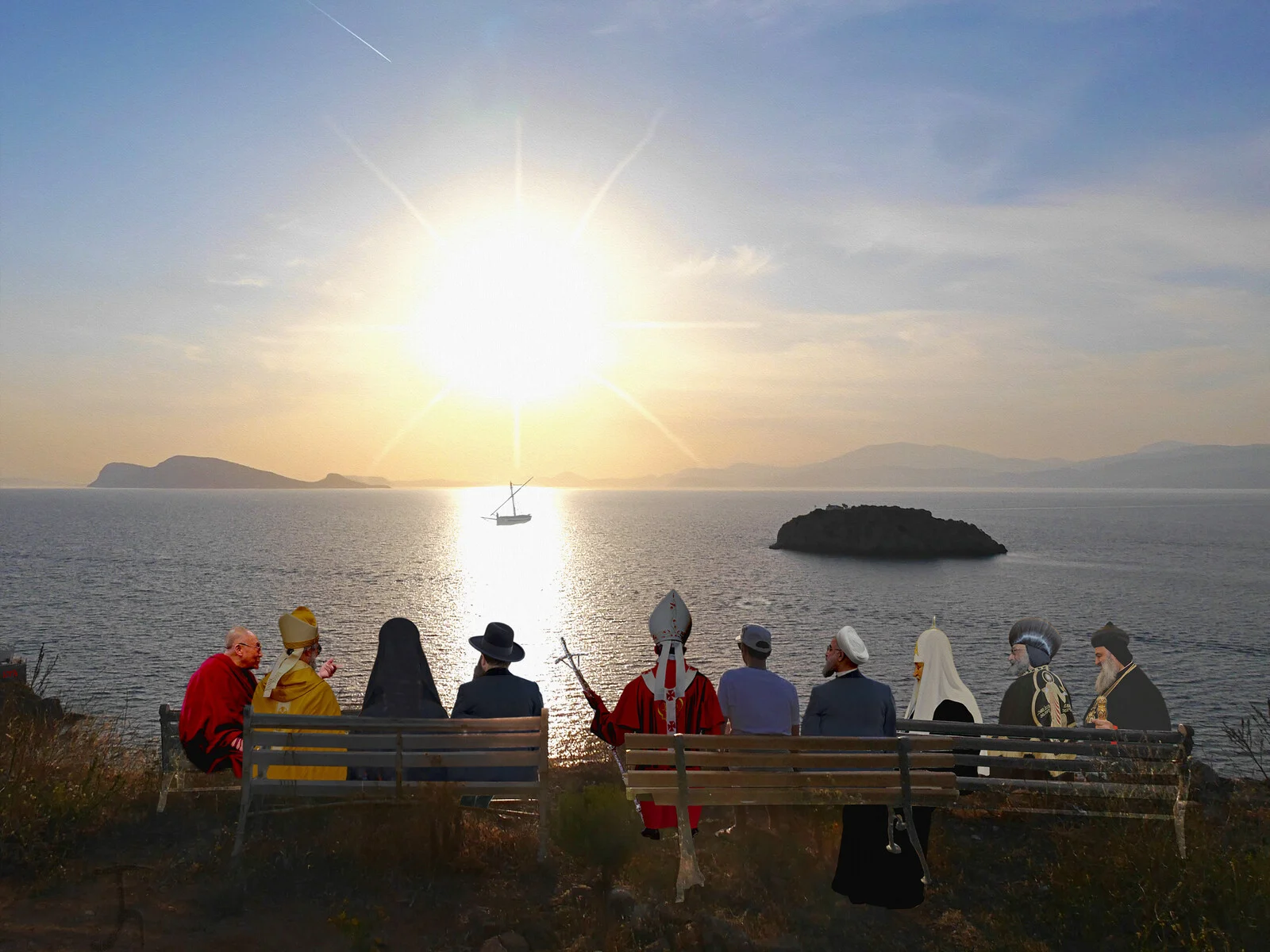
The Relation Theory of Hydra is all the love we need, 2021
Digital
100 x 70 cm
Well, maybe there's a God above
As for me, all I've ever learned from love
Is how to shoot somebody who outdrew you
But it's not a crime that you're here tonight
It's not some pilgrim who claims to have seen the Light
No, it's a cold and it's a very broken Hallelujah
A solitary man sat on one of the sofas above Vlychos, and a verse from "Hallelujah" floated in the haze of the setting sun. The song of Leonard Cohen was barely audible, blending with the cicada's evening concert, but the beat was easily recognisable. Cohen's text resonated through nature, but the scenery suddenly changed when a group of men ascended from the sea and joined the solitary man. I had already noticed that the solitary man had a halo hovering above his head. The accompanying men from the sea looked like priests in long robes and strange headgear, one more peculiar than the other. After squinting my eyes, I recognised them, wondering what reason had brought them to Hydra. It was all leaders of the Abrahamitic religions, Archbishop, Pope, Patriarch, Rabbi, Imam, Mufti, etc. They sat down facing the setting sun, and the solitary man soon had dignitaries on both sides. He seemed untouched and continued watching the sun. I noticed the men were affected and moved their heads in tune with Cohen's music. After a while of still contemplation at Leonard's song accompanied by all cicadas, they started arguing so loud it drowned the Hallelujah. I could hear the conversation as I sat among them. Centuries of injustices and wrongdoing were hailed. I felt the tension like sitting ringside before a boxing match. Then I saw him, at the short end, sitting alone on a sofa, turned at an angle to the other, a man dressed in a saffron-coloured Buddhist monk's robe. It was Dalai Lama. His face was friendly, and he slowly raised his right hand and reminded the other that they shared more than a god; their respective book all talked about love. "Where is the love tonight?" he kindly asked. "All you need is love, love is all you need", he softly sang, and I recognised the melody—Beatles tunes from the 60s. Eternally valid. "All you need is love; love is all you need". The high voices went silent, and the cicadas returned.
He had sat alone on one of the wooden benches above the tiny hamlet Vlychos, looking into the sun, preparing to seek rest beyond the Peloponnese mountains. The sun did so every single day; there was nothing strange about that. People always sit here. It gives you a good view of Hydra's coastline heading Southwest. It is also one of the enchanting points for catching sundown and the sun's last rays.
The man in the white T-shirt blended in with the surroundings. Quite an ordinary man, though his cap was unusual, it lacked advertising or silly text. Same thing with the T-shirt. I noted that he wore sunglasses and had a short haircut. It could be anyone, a Hydriot on his way home who took the opportunity to enjoy solitude and a moment of peace. Or maybe it was a lone tourist? Not everybody likes sitting at a café. This is far from the madding crowd in downtown Hydra. I could see he was wearing sandals. He sat still as a statue. Only then did I notice something unusual. The man had a halo hovering over his head. Maybe it was the sun playing tricks on me. At that exact moment, a shadow came forward in the streak of sunlight that ran from faint east of Ermioni and seemed to stop at the man and the bench. I squinted at the light line, and the sun's haze was contouring. Soon, the image cleared enough for me to see that it was an ancient Kaiki, a traditional fishing boat that had existed in these waters throughout our era. It steered at full speed towards the man on the bench even though no sails were set. Electric propulsion, perhaps, because not a sound was heard and strangely not making any movement on the water. It looked like it was floating on the Light.
After seconds that felt like an eternity, the Kaiki disappeared behind the rock wall that rose steeply from the sea below to flatten out right in front of the man's sandals. After a while, I saw the Kaiki turn back into the beam of sunlight when a group of strange headgear appeared in the sun haze. They came from the rocky shore below. I wouldn't dream of going either up or down that way. Not even a donkey, cat or dog, for that matter. It takes a mountain goat of the type that lives in North America. I've seen them on YouTube. Incredible animals. Such goats are powerful but agile and can jump nearly twelve feet in a single bound. That is what is needed here. And these guys came up from nowhere and walked like it was a paved road. Strange, utterly strange.
The men, for they were only men, sat down on the benches with the solitary man in the middle, still looking into the sun. Not a greeting, not a gesture, not a single sound. It was as still and quiet as before. The beach at Vlychos was empty of people; all that remained were the straw parasols and their shadows carving long dark lines in the soil toward the arch bridge to the southeast. I could hear the choir of cicadas sing Hallelujah; their cover was the best I've heard so far.
The Kaiki had made it roughly level with Agios Ioannis, the small chapel on the slightly larger islet that rises out of the strait just outside Hydra. There, it stopped. Without having cast anchor, the Kaiki somehow grafted itself to the picture as if it was painted. At the same time, I realised that the strange hats in front of me were the headgear worn by high church dignitaries to make them rise above the congregation.
My eyes adjusted to the Light as it stopped at the dignitaries' faces, which I could not see. The silhouettes gradually became more apparent. I saw the backs of church leaders from all the Abrahamic religions. What brought them to Hydra? The representatives from the various Orthodox churches, the Protestant, the Catholic, the Coptic, the Jewish faith and Islam? I recognised some of them, the Archbishop of Canterbury, the Pope from Rome and the one from Alexandria, a couple of Patriarchs whose names I cannot even pronounce, and what I suspect was the Chief Rabbi of Jerusalem and his colleague from Islam, the Grand Imam or maybe he is called Allamah. Not a single woman, despite over fifty per cent of humanity, is female. Strange!
Soon, the neighbourhood sounded like a Medina, with different salespeople shouting over each other, selling their religion as commodities, each better than the other. All cicadas were silenced, and so was Leonard. It felt like they were prepared to punch each other's faces for a while. Centuries of injustices and wrongdoing were hailed. I felt the tension like sitting ringside before a boxing match. Many catholic thinkers find the whole idea of Ecumenism, the traditional or, even worse, new ideas of widening the concept, ridiculous. They strictly interpret the teaching of 'Extra Ecclesiam Nulla Salus' - no salvation outside the Church - or that salvation can only be found in the Catholic Church. God selected the Jews as his people—nothing more to add. Muslims say that all others are blasphemers and pagans, not worth living. Their extremists practise the dogma with bombs—a tricky background for a reconciliation.
In an instant, they silenced, and all heads turned to the left. Apart from the man with the halo, still watching the Kaiki bobbing in the sun sea. Instead, they focused on the only one without a headdress, a man with a shaved head who sat alone on a bench on the short side facing the other. He wore a saffron-tinted robe from the shoulders down. The glasses and the clear profile made me recognise him. Dalai Lama!
If the Abrahamic counterparts' presence on Hydra was curious, the spiritual leader of Tibetan Buddhism was an enigma. The others at least shared the same apostles and origin even though their God differed in name and trinity. Hydra has 365 churches, cathedrals, abbeys and chapels, one for every day of the year, and all are Greek Orthodox. They contain God, Jesus, the Holy Spirit, the Virgin Maria, and all sorts of Saints. Islam does not allow picturing faces, but they still recognise all Christian saints plus their own Mohammed. Like all the others, Judaism, minus Jesus Christ, share the same God, though under a different name, God, Jahve and Allah.
Buddhism does not have any god, a sovereign creator, only incarnations of Avalokitesvara, a so-called bodhisattva who embodies the compassion of all Buddhas. Buddha is no god, just a good person who is a role model to humanity. The former prince Siddharta Gautama has survived 2500 years so far. He was soon given the title Buddha, which means the "Fully Awakened One" because he had woken up to the true nature of existence.
Perhaps it was as Buddha's representative, Dalai Lama, was called to our island. I interpreted the attention of the others as him acting as an interpreter, a mediator, and a reason. It was logical. Dalai Lama should be able to represent everyone more easily because he has no god competing with someone else's. There is no prestige to defend. That's what Leonard Cohen discovered during his lifelong search for a god worthy of its name. He wrote dozens of songs about it. Cohen spent five years in a Zen Buddhist monastery trying to find a spiritual home. He failed, but Buddhism remained with Leonard as a solid foundation to stand on while he sought the unreachable further. To him, love was the mutual component glueing together civilisation. Without love, there is no civilisation. Paragraph!
Buddhism deals with the soul, while other religions fight each other. First, the Romans oppressed Judaism, and then Christians were murdered on an assembly-line basis. Then, the Christians took over the empire and enmity with the Jews, albeit with new arguments that have been kept alive for almost two thousand years. In the seventh century CE, Islam appeared. So much blood has subsequently flowed in the name of God, Allah, and Muhammad that it probably filled the Sea of Galilee to the brim. Christianity and Islam have put killing and hatred into systems between factions and interpretations. Not to mention how many innocents have been killed during different religions' missionary activities. Converting people often required killing them or was done as a deterrent. Dead souls don't protest but still have a chance to go to heaven.
While violence has gradually subsided within Christendom, it has gained momentum between Sunnis and Shiites. You can argue about the Prophet's beard or who the father of the first caliph was. Blood is flowing, and the world is on fire. I suspected that this little ecumenical meeting might be about such matters. Then multicultural Hydra is a great place, and a sunset like this can make any soul realise what is essential. It is not to hate each other in the name of faith. Never!
I am curious to know how it happened. Probably twenty-five meters between the bench where I sat half hidden behind a pine tree and the prelates closer to the sea. But suddenly, I heard the Dalai Lama's voice. Perhaps the swift light breeze rising from the sea carried his speech. I could hear the words as if he had whispered them in my ear. Calm as the soft waves below. Peaceful and patient but as tireless as the sea. Dalai Lama gesticulated in a low-key way, and everyone focused on him.
"The world is facing a boundless challenge and requires the support of everyone regardless of what we call our God, what temples we build, the liturgy we use and the traditions that govern us. It should not be too complicated. We share most values," he said. Love is the word. "All you need is love; love is all you need", he sang softly with a tune I could not miss.
The boat offshore, the small Kaiki, now resembled the ecumenic symbol for the churches sharing God – a cross with two equally long intersecting bars. It did not look like a coincidence. The uniting symbol of Christianity could easily be transformed into something letting in other faiths. Ecumenism should not be a Christian matter but a universal one. Love is no intellectual monopoly.
"We have been called here in the name of Ecumenism, in a wider meaning than before. I propose calling it 'Cordialism' instead, expressing the will to build a world on friendship and social ability instead of selfishness." Dalai Lama had the same smile, which has fascinated people worldwide. A Buddha-like smile.
"All divine religions were founded to unify a group, tribe, community, or culture. It is time to expand that challenge to humanity and establish universal peace. Any movement that brings peace and agreement in human society is indeed religious. Whatever initiative makes people come together - Metaphorically speaking – under the same roof and tabernacle - must be animated by heavenly motives as this little group is getting together tonight. We had an inner call from someone connected with this island. Whoever it was sent a ship without sails, sailing through air and sea faster than we could think. It should not be possible; it passes all senses, but now we are here. And with a purpose." His hand wrote unreadable signs in the warm evening air, and from the movements of the heads, I could see that the prelates were following his hands.
"Ecumenism has been a privilege only for churches with Christianity. That is one good reason why we should choose another word. I suggest 'Cordialism'? It is hard to misunderstand and has yet to be misused.
I have learnt that the term 'ecumenism' was initially organised with the support of the Roman Emperor to keep peace within his empire. Christianity has not been a monolithic faith since the first century after Christ. Today, there are countless widely varied Christian groups. Several fractions within Buddhism. And also Islam. But fewer in the oldest surviving faith, Judaism. As long as humans are on the earth, individuals will think otherwise and find others sharing their views. The reasons are many. We must respect that. But we should never hate each other because of different opinions. And certainly not use violence.
Ecumenism came into modern languages via Latin from Greek' oikoumenikos' from 'oikoumenē' referring to the (inhabited) earth. During the 16th century, Christianity meant belonging to the universal Church.
Since the 1930s, the term has served as a concept and principle that Christians should work together to develop closer relationships among their churches and promote Christian unity. The time has come to expand this to all churches and movements—including those without faith, agnostics, and atheists. Here tonight, we represent about sixty per cent of humanity. That is a good beginning.
"Despite the division between different faiths, there is more in common than what differentiates us, including an understanding of theology, governing church systems, doctrine, and language. That is a stable foundation to build on." Dalai Lama continued.
"This world belongs to humanity, not its leaders or religious figureheads. Each country applies to its people, and they must be able to go on with their beliefs as long as they don't deny you yours. Our prime purpose in this life is to help others. And if you can't help them, don't hurt them. In principle, all such good advice is already within the different faiths, in their holy books, and told by priests. The problem is that many words are lost somewhere on the way. Often, it is deliberate misinterpretation or used as a tool for leaders' ambitions." He paused briefly, and I could hear the wind razzle through the grass.
"Dear colleagues, we share the most about faith; it is told in our books and is indisputable. The exact words are used though printed in different languages. Love is the most important word—the red thread. Love covers everything. Love is essential and the foundation of life. Love and compassion are necessities, not luxuries. Without them, humanity cannot survive. Without it, we cannot save the world.
Buddha once said: "Do not dwell in the past, do not dream of the future, concentrate the mind on the present." I am sure that Jesus said something similar. And Muhammed. They did not mean that we should be egoistic and concentrate on the present; they only meant that what must be done must be taken care of immediately. With wise decisions, creating a more just and advanced civilisation with global and sustainable prosperity is possible." Dalai Lama took a deep breath. "So, Dear Colleagues. We must develop a positive vision of these benches on this beautiful island to carry a positive action. Tomorrow starts today with the setting sun. Because the sun never sleeps, it moves to another place below the horizon. So, we must do."
Dalai Lama then spoke about issues that greatly affected all faiths regardless of where they had their proselytes. Climate-related disasters, pandemics, the war in Europe and the new economy with high inflation, low growth, and high unemployment. He elaborated on how multiple, increasingly severe, overlapping crises increase anxiety and uncertainty worldwide. Dalai Lama stated that although he was not an economist, he thought he understood that tried and tested solutions no longer work. No reputable politician can give a convincing answer. Only those who believe they have simple solutions to complicated problems dare to open their mouths. Unfortunately, they also do, and people listen. Globally, humanity is facing upheavals on a scale that may look impossible. "All you need is love; love is all you need; There's nothing you can do that can't be done", he sang suggestively.
The Dalai Lama pointed out that food, raw materials, energy, transport, and information are five areas that are usually considered the basis of our civilisation. All are, at the same time, exposed to disturbances. The situation signals that we are in an economic death spiral, leading to widespread unemployment, deepening inequality, and increased social unrest. With that often comes even more despots with simple solutions and, worst of all, war. He kept his calm voice, but his face was sincere and friendly when he continued.
"When we meet real threats to our world, such as the climate and destructive political leaders and wars like the one in Ukraine, we can react in two ways - either by losing hope and falling into self-destructive habits or using our inner strength. Where ignorance is the master, there is no possibility of real peace or solving nature's threats when it strikes back.
If many enough put their strength together, we can defeat even evil. This is where you and I come in and the churches we represent. The least we can do is to be exemplary and outspoken. We have many listeners, even more if we talk in one voice. The best way to resolve any problem is for all sides to sit down and talk, agree, and do something about it. Let this evening be the start of when we do as we preach and do it right. Love is all we need. Then I promise you that most will listen to us, even agnostics, atheists, politicians, business people, and even those who pretend not to care. Because we only have one world, something most must realise."
The last thing I heard before that nice wind stopped was Dalai Lama saying:
"The same global upheaval that lays ahead is also the basis for a new kind of civilisation. The hard part will be making the changes happen. That's where love comes in. Gods, prophets, saints, or liturgy will not do the job as little prayers or songs. Just content will function. Religion should be straightforward. Religion must be 'kindness' and 'respect'. Kindness to each other and respect for all living. Such force is invincible. No other weapons are needed."
Another half an hour passed, and I could hear scattered words and half sentences. But one thing I understood. There was reconciliation in the air, and the voices sounded almost boisterous. They sang about love together, and the air felt like a huge hug.
Suddenly, they broke up and left when they arrived at the precipice. I could follow the Kaiki disappearing into the beam of the almost full moon. It looked more like a ship of salvation, and the sight filled me with hope, an agnostic by choice.
The Dalai Lama is no salesman or politician but a chosen spiritual leader. He was picked as a child and has grown into his role. He is worth listening to because he is trustworthy and has no ambitions for himself or his faith. We have tried most without success. It can be time to let love and respect do the job.
The man with the halo had left with them, and I realised who he was. Jesus, whose salvation depended on love, said love is all we need. He said that two thousand years ago. His words were repeated by the Beatles two millennia later, in 1967. Regardless of faith, whether you are a believer, a denier, or an agnostic, the words of love are valid because love has nothing to do with religion. All species show it to each other; nothing is limited to humanity or a specific faith.
The last thing I heard as they disappeared behind the slope towards the sea was The Dalai Lama's voice.
" As I said earlier, do not dwell in the past, do not dream of the future, concentrate your mind on the present. Regardless of faith, whether you are a believer, a denier, or an agnostic, the words of love are valid because love has nothing to do with religion. All species show it to each other; nothing is limited to humanity or a specific faith. All we need is love; love is all we need," he hummed.
The Dalai Lama continued to summarise his message based on the inherent love in all religions, though often obscured by rituals and ceremonious tirades recited by priests, built upon over two millennia. "And seriously, gentlemen, who among us truly know if God, Yahweh, Allah, or whatever we call our deity, is male or female, black or white, yellow or red? If anyone here has seen their God with their own eyes, raise your hand." Not a hand moved.
The silence was profound, and the sea below could be heard clearly. Ultimately, I heard him say that maybe it was time to let women into the pulpit. Women have been excluded for two thousand years. The male church leaders had had a couple of thousand years to sort things out, and it hadn't gotten better, only more violence and hate. Then they went into thin air.
All we need is love; love is all we need.
Jörgen Thornberg
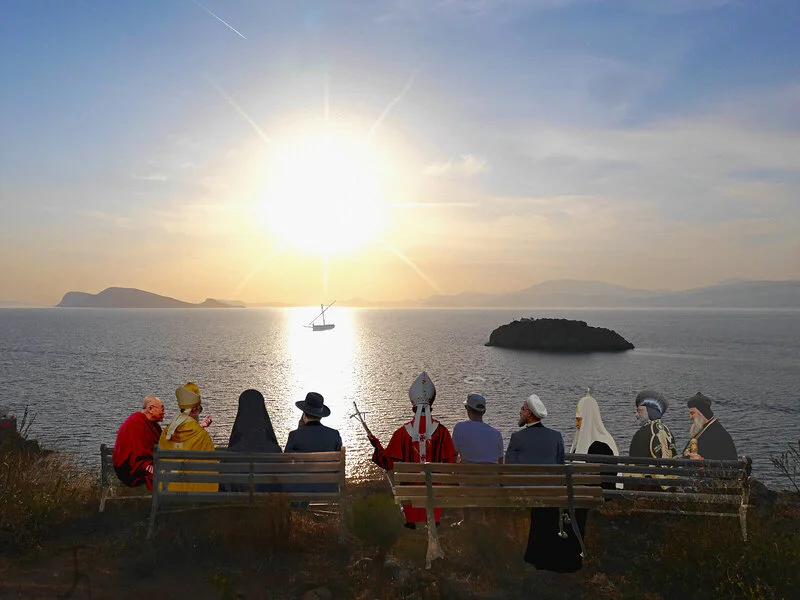
The Relation Theory of Hydra is all the love we need, 2021
Digital
100 x 70 cm
Well, maybe there's a God above
As for me, all I've ever learned from love
Is how to shoot somebody who outdrew you
But it's not a crime that you're here tonight
It's not some pilgrim who claims to have seen the Light
No, it's a cold and it's a very broken Hallelujah
A solitary man sat on one of the sofas above Vlychos, and a verse from "Hallelujah" floated in the haze of the setting sun. The song of Leonard Cohen was barely audible, blending with the cicada's evening concert, but the beat was easily recognisable. Cohen's text resonated through nature, but the scenery suddenly changed when a group of men ascended from the sea and joined the solitary man. I had already noticed that the solitary man had a halo hovering above his head. The accompanying men from the sea looked like priests in long robes and strange headgear, one more peculiar than the other. After squinting my eyes, I recognised them, wondering what reason had brought them to Hydra. It was all leaders of the Abrahamitic religions, Archbishop, Pope, Patriarch, Rabbi, Imam, Mufti, etc. They sat down facing the setting sun, and the solitary man soon had dignitaries on both sides. He seemed untouched and continued watching the sun. I noticed the men were affected and moved their heads in tune with Cohen's music. After a while of still contemplation at Leonard's song accompanied by all cicadas, they started arguing so loud it drowned the Hallelujah. I could hear the conversation as I sat among them. Centuries of injustices and wrongdoing were hailed. I felt the tension like sitting ringside before a boxing match. Then I saw him, at the short end, sitting alone on a sofa, turned at an angle to the other, a man dressed in a saffron-coloured Buddhist monk's robe. It was Dalai Lama. His face was friendly, and he slowly raised his right hand and reminded the other that they shared more than a god; their respective book all talked about love. "Where is the love tonight?" he kindly asked. "All you need is love, love is all you need", he softly sang, and I recognised the melody—Beatles tunes from the 60s. Eternally valid. "All you need is love; love is all you need". The high voices went silent, and the cicadas returned.
He had sat alone on one of the wooden benches above the tiny hamlet Vlychos, looking into the sun, preparing to seek rest beyond the Peloponnese mountains. The sun did so every single day; there was nothing strange about that. People always sit here. It gives you a good view of Hydra's coastline heading Southwest. It is also one of the enchanting points for catching sundown and the sun's last rays.
The man in the white T-shirt blended in with the surroundings. Quite an ordinary man, though his cap was unusual, it lacked advertising or silly text. Same thing with the T-shirt. I noted that he wore sunglasses and had a short haircut. It could be anyone, a Hydriot on his way home who took the opportunity to enjoy solitude and a moment of peace. Or maybe it was a lone tourist? Not everybody likes sitting at a café. This is far from the madding crowd in downtown Hydra. I could see he was wearing sandals. He sat still as a statue. Only then did I notice something unusual. The man had a halo hovering over his head. Maybe it was the sun playing tricks on me. At that exact moment, a shadow came forward in the streak of sunlight that ran from faint east of Ermioni and seemed to stop at the man and the bench. I squinted at the light line, and the sun's haze was contouring. Soon, the image cleared enough for me to see that it was an ancient Kaiki, a traditional fishing boat that had existed in these waters throughout our era. It steered at full speed towards the man on the bench even though no sails were set. Electric propulsion, perhaps, because not a sound was heard and strangely not making any movement on the water. It looked like it was floating on the Light.
After seconds that felt like an eternity, the Kaiki disappeared behind the rock wall that rose steeply from the sea below to flatten out right in front of the man's sandals. After a while, I saw the Kaiki turn back into the beam of sunlight when a group of strange headgear appeared in the sun haze. They came from the rocky shore below. I wouldn't dream of going either up or down that way. Not even a donkey, cat or dog, for that matter. It takes a mountain goat of the type that lives in North America. I've seen them on YouTube. Incredible animals. Such goats are powerful but agile and can jump nearly twelve feet in a single bound. That is what is needed here. And these guys came up from nowhere and walked like it was a paved road. Strange, utterly strange.
The men, for they were only men, sat down on the benches with the solitary man in the middle, still looking into the sun. Not a greeting, not a gesture, not a single sound. It was as still and quiet as before. The beach at Vlychos was empty of people; all that remained were the straw parasols and their shadows carving long dark lines in the soil toward the arch bridge to the southeast. I could hear the choir of cicadas sing Hallelujah; their cover was the best I've heard so far.
The Kaiki had made it roughly level with Agios Ioannis, the small chapel on the slightly larger islet that rises out of the strait just outside Hydra. There, it stopped. Without having cast anchor, the Kaiki somehow grafted itself to the picture as if it was painted. At the same time, I realised that the strange hats in front of me were the headgear worn by high church dignitaries to make them rise above the congregation.
My eyes adjusted to the Light as it stopped at the dignitaries' faces, which I could not see. The silhouettes gradually became more apparent. I saw the backs of church leaders from all the Abrahamic religions. What brought them to Hydra? The representatives from the various Orthodox churches, the Protestant, the Catholic, the Coptic, the Jewish faith and Islam? I recognised some of them, the Archbishop of Canterbury, the Pope from Rome and the one from Alexandria, a couple of Patriarchs whose names I cannot even pronounce, and what I suspect was the Chief Rabbi of Jerusalem and his colleague from Islam, the Grand Imam or maybe he is called Allamah. Not a single woman, despite over fifty per cent of humanity, is female. Strange!
Soon, the neighbourhood sounded like a Medina, with different salespeople shouting over each other, selling their religion as commodities, each better than the other. All cicadas were silenced, and so was Leonard. It felt like they were prepared to punch each other's faces for a while. Centuries of injustices and wrongdoing were hailed. I felt the tension like sitting ringside before a boxing match. Many catholic thinkers find the whole idea of Ecumenism, the traditional or, even worse, new ideas of widening the concept, ridiculous. They strictly interpret the teaching of 'Extra Ecclesiam Nulla Salus' - no salvation outside the Church - or that salvation can only be found in the Catholic Church. God selected the Jews as his people—nothing more to add. Muslims say that all others are blasphemers and pagans, not worth living. Their extremists practise the dogma with bombs—a tricky background for a reconciliation.
In an instant, they silenced, and all heads turned to the left. Apart from the man with the halo, still watching the Kaiki bobbing in the sun sea. Instead, they focused on the only one without a headdress, a man with a shaved head who sat alone on a bench on the short side facing the other. He wore a saffron-tinted robe from the shoulders down. The glasses and the clear profile made me recognise him. Dalai Lama!
If the Abrahamic counterparts' presence on Hydra was curious, the spiritual leader of Tibetan Buddhism was an enigma. The others at least shared the same apostles and origin even though their God differed in name and trinity. Hydra has 365 churches, cathedrals, abbeys and chapels, one for every day of the year, and all are Greek Orthodox. They contain God, Jesus, the Holy Spirit, the Virgin Maria, and all sorts of Saints. Islam does not allow picturing faces, but they still recognise all Christian saints plus their own Mohammed. Like all the others, Judaism, minus Jesus Christ, share the same God, though under a different name, God, Jahve and Allah.
Buddhism does not have any god, a sovereign creator, only incarnations of Avalokitesvara, a so-called bodhisattva who embodies the compassion of all Buddhas. Buddha is no god, just a good person who is a role model to humanity. The former prince Siddharta Gautama has survived 2500 years so far. He was soon given the title Buddha, which means the "Fully Awakened One" because he had woken up to the true nature of existence.
Perhaps it was as Buddha's representative, Dalai Lama, was called to our island. I interpreted the attention of the others as him acting as an interpreter, a mediator, and a reason. It was logical. Dalai Lama should be able to represent everyone more easily because he has no god competing with someone else's. There is no prestige to defend. That's what Leonard Cohen discovered during his lifelong search for a god worthy of its name. He wrote dozens of songs about it. Cohen spent five years in a Zen Buddhist monastery trying to find a spiritual home. He failed, but Buddhism remained with Leonard as a solid foundation to stand on while he sought the unreachable further. To him, love was the mutual component glueing together civilisation. Without love, there is no civilisation. Paragraph!
Buddhism deals with the soul, while other religions fight each other. First, the Romans oppressed Judaism, and then Christians were murdered on an assembly-line basis. Then, the Christians took over the empire and enmity with the Jews, albeit with new arguments that have been kept alive for almost two thousand years. In the seventh century CE, Islam appeared. So much blood has subsequently flowed in the name of God, Allah, and Muhammad that it probably filled the Sea of Galilee to the brim. Christianity and Islam have put killing and hatred into systems between factions and interpretations. Not to mention how many innocents have been killed during different religions' missionary activities. Converting people often required killing them or was done as a deterrent. Dead souls don't protest but still have a chance to go to heaven.
While violence has gradually subsided within Christendom, it has gained momentum between Sunnis and Shiites. You can argue about the Prophet's beard or who the father of the first caliph was. Blood is flowing, and the world is on fire. I suspected that this little ecumenical meeting might be about such matters. Then multicultural Hydra is a great place, and a sunset like this can make any soul realise what is essential. It is not to hate each other in the name of faith. Never!
I am curious to know how it happened. Probably twenty-five meters between the bench where I sat half hidden behind a pine tree and the prelates closer to the sea. But suddenly, I heard the Dalai Lama's voice. Perhaps the swift light breeze rising from the sea carried his speech. I could hear the words as if he had whispered them in my ear. Calm as the soft waves below. Peaceful and patient but as tireless as the sea. Dalai Lama gesticulated in a low-key way, and everyone focused on him.
"The world is facing a boundless challenge and requires the support of everyone regardless of what we call our God, what temples we build, the liturgy we use and the traditions that govern us. It should not be too complicated. We share most values," he said. Love is the word. "All you need is love; love is all you need", he sang softly with a tune I could not miss.
The boat offshore, the small Kaiki, now resembled the ecumenic symbol for the churches sharing God – a cross with two equally long intersecting bars. It did not look like a coincidence. The uniting symbol of Christianity could easily be transformed into something letting in other faiths. Ecumenism should not be a Christian matter but a universal one. Love is no intellectual monopoly.
"We have been called here in the name of Ecumenism, in a wider meaning than before. I propose calling it 'Cordialism' instead, expressing the will to build a world on friendship and social ability instead of selfishness." Dalai Lama had the same smile, which has fascinated people worldwide. A Buddha-like smile.
"All divine religions were founded to unify a group, tribe, community, or culture. It is time to expand that challenge to humanity and establish universal peace. Any movement that brings peace and agreement in human society is indeed religious. Whatever initiative makes people come together - Metaphorically speaking – under the same roof and tabernacle - must be animated by heavenly motives as this little group is getting together tonight. We had an inner call from someone connected with this island. Whoever it was sent a ship without sails, sailing through air and sea faster than we could think. It should not be possible; it passes all senses, but now we are here. And with a purpose." His hand wrote unreadable signs in the warm evening air, and from the movements of the heads, I could see that the prelates were following his hands.
"Ecumenism has been a privilege only for churches with Christianity. That is one good reason why we should choose another word. I suggest 'Cordialism'? It is hard to misunderstand and has yet to be misused.
I have learnt that the term 'ecumenism' was initially organised with the support of the Roman Emperor to keep peace within his empire. Christianity has not been a monolithic faith since the first century after Christ. Today, there are countless widely varied Christian groups. Several fractions within Buddhism. And also Islam. But fewer in the oldest surviving faith, Judaism. As long as humans are on the earth, individuals will think otherwise and find others sharing their views. The reasons are many. We must respect that. But we should never hate each other because of different opinions. And certainly not use violence.
Ecumenism came into modern languages via Latin from Greek' oikoumenikos' from 'oikoumenē' referring to the (inhabited) earth. During the 16th century, Christianity meant belonging to the universal Church.
Since the 1930s, the term has served as a concept and principle that Christians should work together to develop closer relationships among their churches and promote Christian unity. The time has come to expand this to all churches and movements—including those without faith, agnostics, and atheists. Here tonight, we represent about sixty per cent of humanity. That is a good beginning.
"Despite the division between different faiths, there is more in common than what differentiates us, including an understanding of theology, governing church systems, doctrine, and language. That is a stable foundation to build on." Dalai Lama continued.
"This world belongs to humanity, not its leaders or religious figureheads. Each country applies to its people, and they must be able to go on with their beliefs as long as they don't deny you yours. Our prime purpose in this life is to help others. And if you can't help them, don't hurt them. In principle, all such good advice is already within the different faiths, in their holy books, and told by priests. The problem is that many words are lost somewhere on the way. Often, it is deliberate misinterpretation or used as a tool for leaders' ambitions." He paused briefly, and I could hear the wind razzle through the grass.
"Dear colleagues, we share the most about faith; it is told in our books and is indisputable. The exact words are used though printed in different languages. Love is the most important word—the red thread. Love covers everything. Love is essential and the foundation of life. Love and compassion are necessities, not luxuries. Without them, humanity cannot survive. Without it, we cannot save the world.
Buddha once said: "Do not dwell in the past, do not dream of the future, concentrate the mind on the present." I am sure that Jesus said something similar. And Muhammed. They did not mean that we should be egoistic and concentrate on the present; they only meant that what must be done must be taken care of immediately. With wise decisions, creating a more just and advanced civilisation with global and sustainable prosperity is possible." Dalai Lama took a deep breath. "So, Dear Colleagues. We must develop a positive vision of these benches on this beautiful island to carry a positive action. Tomorrow starts today with the setting sun. Because the sun never sleeps, it moves to another place below the horizon. So, we must do."
Dalai Lama then spoke about issues that greatly affected all faiths regardless of where they had their proselytes. Climate-related disasters, pandemics, the war in Europe and the new economy with high inflation, low growth, and high unemployment. He elaborated on how multiple, increasingly severe, overlapping crises increase anxiety and uncertainty worldwide. Dalai Lama stated that although he was not an economist, he thought he understood that tried and tested solutions no longer work. No reputable politician can give a convincing answer. Only those who believe they have simple solutions to complicated problems dare to open their mouths. Unfortunately, they also do, and people listen. Globally, humanity is facing upheavals on a scale that may look impossible. "All you need is love; love is all you need; There's nothing you can do that can't be done", he sang suggestively.
The Dalai Lama pointed out that food, raw materials, energy, transport, and information are five areas that are usually considered the basis of our civilisation. All are, at the same time, exposed to disturbances. The situation signals that we are in an economic death spiral, leading to widespread unemployment, deepening inequality, and increased social unrest. With that often comes even more despots with simple solutions and, worst of all, war. He kept his calm voice, but his face was sincere and friendly when he continued.
"When we meet real threats to our world, such as the climate and destructive political leaders and wars like the one in Ukraine, we can react in two ways - either by losing hope and falling into self-destructive habits or using our inner strength. Where ignorance is the master, there is no possibility of real peace or solving nature's threats when it strikes back.
If many enough put their strength together, we can defeat even evil. This is where you and I come in and the churches we represent. The least we can do is to be exemplary and outspoken. We have many listeners, even more if we talk in one voice. The best way to resolve any problem is for all sides to sit down and talk, agree, and do something about it. Let this evening be the start of when we do as we preach and do it right. Love is all we need. Then I promise you that most will listen to us, even agnostics, atheists, politicians, business people, and even those who pretend not to care. Because we only have one world, something most must realise."
The last thing I heard before that nice wind stopped was Dalai Lama saying:
"The same global upheaval that lays ahead is also the basis for a new kind of civilisation. The hard part will be making the changes happen. That's where love comes in. Gods, prophets, saints, or liturgy will not do the job as little prayers or songs. Just content will function. Religion should be straightforward. Religion must be 'kindness' and 'respect'. Kindness to each other and respect for all living. Such force is invincible. No other weapons are needed."
Another half an hour passed, and I could hear scattered words and half sentences. But one thing I understood. There was reconciliation in the air, and the voices sounded almost boisterous. They sang about love together, and the air felt like a huge hug.
Suddenly, they broke up and left when they arrived at the precipice. I could follow the Kaiki disappearing into the beam of the almost full moon. It looked more like a ship of salvation, and the sight filled me with hope, an agnostic by choice.
The Dalai Lama is no salesman or politician but a chosen spiritual leader. He was picked as a child and has grown into his role. He is worth listening to because he is trustworthy and has no ambitions for himself or his faith. We have tried most without success. It can be time to let love and respect do the job.
The man with the halo had left with them, and I realised who he was. Jesus, whose salvation depended on love, said love is all we need. He said that two thousand years ago. His words were repeated by the Beatles two millennia later, in 1967. Regardless of faith, whether you are a believer, a denier, or an agnostic, the words of love are valid because love has nothing to do with religion. All species show it to each other; nothing is limited to humanity or a specific faith.
The last thing I heard as they disappeared behind the slope towards the sea was The Dalai Lama's voice.
" As I said earlier, do not dwell in the past, do not dream of the future, concentrate your mind on the present. Regardless of faith, whether you are a believer, a denier, or an agnostic, the words of love are valid because love has nothing to do with religion. All species show it to each other; nothing is limited to humanity or a specific faith. All we need is love; love is all we need," he hummed.
The Dalai Lama continued to summarise his message based on the inherent love in all religions, though often obscured by rituals and ceremonious tirades recited by priests, built upon over two millennia. "And seriously, gentlemen, who among us truly know if God, Yahweh, Allah, or whatever we call our deity, is male or female, black or white, yellow or red? If anyone here has seen their God with their own eyes, raise your hand." Not a hand moved.
The silence was profound, and the sea below could be heard clearly. Ultimately, I heard him say that maybe it was time to let women into the pulpit. Women have been excluded for two thousand years. The male church leaders had had a couple of thousand years to sort things out, and it hadn't gotten better, only more violence and hate. Then they went into thin air.
All we need is love; love is all we need.

Jörgen Thornberg
Malmö
Lite om bilder och mig. Translation in English at the end.
Jag är en nyfiken person som ser allt i bilder, även det jag fäster i ord, gärna tillsammans för bakom alla mina bilder finns en berättelse. Till vissa bilder hör en kortare eller längre novell som följer med bilden.
Bilder berättar historier. Jag omges av naturlig skönhet, intressanta människor och historia var jag än går. Jag använder min kamera för att dokumentera världen och blanda det jag ser med vad jag känner för att fånga den dolda magin.
Mina bilder berättar mina historier. Genom mina bilder, tryck och berättelser. Jag bjuder in dig att ta del av dessa berättelser, in i ditt liv och hem och dela min mycket personliga syn på vår värld. Mer än vad ögat ser. Jag tänker i bilder, drömmer och skriver och pratar om dem; följaktligen måste jag också skapa bilder. De blir vad jag ser, inte nödvändigtvis begränsade till verkligheten. Det finns en bild runt varje hörn. Jag hoppas att du kommer att se vad jag såg och gilla det.
Jag är också en skrivande person och till många bilder hör en kortare eller längre essay. Den följer med tavlan, tryckt på fint papper och med en personlig hälsning från mig.
Flertalet bilder startar sin resa i min kamera. Enkelt förklarat beskriver jag bilden jag ser i mitt inre, upplevd eller fantiserad. Bilden uppstår inom mig redan innan jag fått okularet till ögat. På bråkdelen av ett ögonblick ser jag vad jag vill ha och vad som kan göras med bilden. Här skall jag stoppa in en giraff, stålmannen, Titanic eller vad det är min fantasi finner ut. Ännu märkligare är att jag kommer ihåg minnesbilden långt efteråt när det blir tid att skapa verket. Om jag lyckas eller inte, är upp till betraktaren, oftast präglat av en stråk av svart humor – meningen är att man skall bli underhållen. Mina bilder blir ofta en snackis där de hänger.
Jag föredrar bilder som förmedlar ett budskap i flera lager. Vid första anblicken fylld av feel-good, en vacker utsikt, fint väder, solen skiner, blommor på ängen eller vattnet som ligger förrädiskt spegelblankt. I en sådan bild kan jag gömma min egentliga berättelse, mitt förakt för förtryckare och våldsverkare, rasister och fördomsfulla människor - ett gärna återkommande motiv mer eller mindre dolt i det vackra motivet. Jag försöker förena dem i ett gemensamt narrativ.
Bild och formgivning har löpt som en röd tråd genom livet. Fotokonst känns som en värdig final som jag gärna delar med mig.
Min genre är vid som framgår av mina bilder, temat en blandning av pop- och gatukonst i kollage som kan bestå av hundratals lager. Vissa bilder kan ta veckor, andra någon dag innan det är dags att överlämna resultatet till printverkstaden. Fine Art Prints är digitala fotocollage. I dessa kollage sker rivandet, klippandet, pusslandet, målandet, ritandet och sprayningen digitalt. Det jag monterar in kan vara hundratals år gamla bilder som jag omsorgsfullt frilägger så att de ser ut att vara en del av tavlan men också bilder skapade av mig själv efter min egen fantasi. Därefter besöks printstudion och för vissa bilder numrera en limiterad upplaga (oftast 7 exemplar) och signera för hand. Vissa bilder kan köpas i olika format. Det är bara att fråga efter vilka. Gillar man en bild som är 70x100 men inte har plats på väggen, går den kanske att få i 50x70 cm istället. Frågan är fri.
Metoden Giclée eller Fine Art Print som det också kallas är det moderna sättet för framställning av grafisk konst. Villkoret för denna typ av utskrifter är att en högkvalitativ storformatskrivare används med åldersbeständigt färgpigment och konstnärspapper eller i förekommande fall på duk. Pappret som används möter de krav på livslängd som ställs av museer och gallerier. Normalt säljer jag mina bilder oinramade så att den nya ägaren själv kan bestämma hur de skall se ut, med eller utan passepartout färg på ram, med eller utan glas etc..
Under många år ställde jag bara ut på nätet, i valda grupper och på min egen Facebooksida - https://www.facebook.com/jorgen.thornberg.9
Jag finns också på en egen hemsida som tyvärr inte alltid är uppdaterad – https://www.jth.life/ Där kan du också läsa en del av de berättelser som följer med bilden.
UTSTÄLLNINGAR
Luftkastellet, oktober 2022
Konst i Lund, november 2022
Luftkastellet, mars 2023
Engleson Galleri Caroli, april 2023
Hydra, Greece June 2023
Engleson Galleri Caroli, oktober 2023
Toppen, Höllviken december 2023
Luftkastellet, mars 2024
Torups Galleri, mars 2024
Venice, May 2024
Luftkastellet, oktober 2024
Konst i Advent, December 2024
Galleri Engleson, Caroli December 2024
Jäger & Jansson Galleri, april 2025
A bit about pictures and me.
I'm a curious person who sees everything in pictures, even what I express in words, often combining them, for behind all my pictures lies a story. These narratives, some as short as a single image and others as long as a novel, are the heart and soul of my work.
Pictures tell stories. Wherever I go, I'm surrounded by natural beauty, exciting people, and history. I use my camera to document the world and blend what I see with what I feel to capture the hidden magic.
My images tell my stories. Through my pictures, prints, and narratives, I invite you to partake in these stories in your life and home and share my deeply personal perspective of our world. More than meets the eye. I think in pictures, dream, write, and talk about them; consequently, I must create images too. They become what I see, not necessarily confined to reality. There's a picture around every corner. I hope you'll see what I saw and enjoy it.
I'm also a writer, and many images come with a shorter or longer essay. It accompanies the painting, printed on fine paper with my personal greeting.
Many pictures start their journey on my camera. Simply put, I describe the image I see in my mind, experienced or imagined. The image arises within me even before I bring the eyepiece to my eye. In a fraction of a moment, I see what I want and what can be done with the picture. Here, I'll insert a giraffe, Superman, the Titanic, or whatever my imagination conjures up. Even stranger is that I remember the mental image long after it's time to create the work. Whether I succeed is up to the observer, often imbued with a streak of black humour – the aim is to entertain. My pictures usually become a talking point wherever they hang.
I prefer pictures that convey a message in multiple layers. At first glance, they're filled with feel-good vibes, a beautiful view, lovely weather, the sun shining, flowers in the meadow, or the water lying deceptively calm. But beneath this surface beauty, I often conceal a deeper story, a narrative that challenges societal norms or explores the human condition. I invite you to delve into these hidden narratives and discover the layers of meaning within my work.
Picture and design have been a thread running through my life. Photographic art feels like a fitting finale, and I'm happy to share it.
My genre is varied, as seen in my pictures; the theme is a blend of pop and street art in collages that can consist of hundreds of layers. Some images can take weeks, others just a day before it's time to hand over the result to the print workshop. Fine Art Prints are digital photo collages. In these collages, tearing, cutting, puzzling, painting, drawing, and spraying happen digitally. What I insert can be images hundreds of years old that I carefully extract so they appear to be part of the painting, but also images created by myself, now also generated from my imagination. Next, visit the print studio and, for certain images, number a limited edition (usually 7 copies) and sign them by hand. Some images may be available in other formats. Just ask which ones. If you like an image that's 70x100 but doesn't have space on the wall, you might be able to get it in 50x70 cm instead. The question is open.
The Giclée method, or Fine Art Print as it's also called, is the modern way of producing graphic art. This method ensures the highest quality and longevity of the artwork, using a high-quality large-format printer with archival pigment inks and artist paper or, in some cases, canvas. The paper used meets the longevity requirements set by museums and galleries. I sell my pictures unframed, allowing the new owner to personalise their artwork, confident in the lasting value and quality of the piece.
For many years, I only exhibited online, in selected groups, and on my Facebook page - https://www.facebook.com/jorgen.thornberg.9. I also have my website, which unfortunately is not constantly updated - https://www.jth.life/. You can also read some of the stories accompanying the pictures there.
EXHIBITIONS
Luftkastellet, October 2022
Art in Lund, November 2022
Luftkastellet, March 2023
Engleson Gallery Caroli, April 2023
Hydra, Greece June 2023
Engleson Gallery Caroli, October 2023
Toppen, Höllviken December 2023
Luftkastellet, March 2024
Torup Gallery, March 2024
Venice, May 2024
UTSTÄLLNINGAR
Luftkastellet, oktober 2022
Konst i Lund, november 2022
Luftkastellet, mars 2023
Engleson Galleri Caroli, april 2023
Hydra, Greece June 2023
Engleson Galleri Caroli, oktober 2023
Toppen, Höllviken december 2023
Luftkastellet, mars 2024
Torups Galleri, mars 2024
Venice, May 2024
Luftkastellet, October 2024
Konst i Advent, December 2024
Galleri Engleson, Caroli December 2024
Jäger & Jansson Galleri, April 2025
Utbildning
Autodidakt
Medlem i konstnärsförening
Öppna Sinnen
Med i konstrunda
Konstrundan i Skåne
Utställningar
Luftkastellet, October 2022
Art in Lund, November 2022
Luftkastellet, March 2023
Engleson Gallery Caroli, April 2023
Hydra, Greece June 2023
Engleson Gallery Caroli, October 2023
Toppen, Höllviken December 2023
Luftkastellet, March 2024
Torup Gallery, March 2024
Venice, May 2024