Vi använder cookies för att ge dig bästa möjliga upplevelse. Välj vilka cookies du tillåter.
Läs mer i vår integritetspolicy
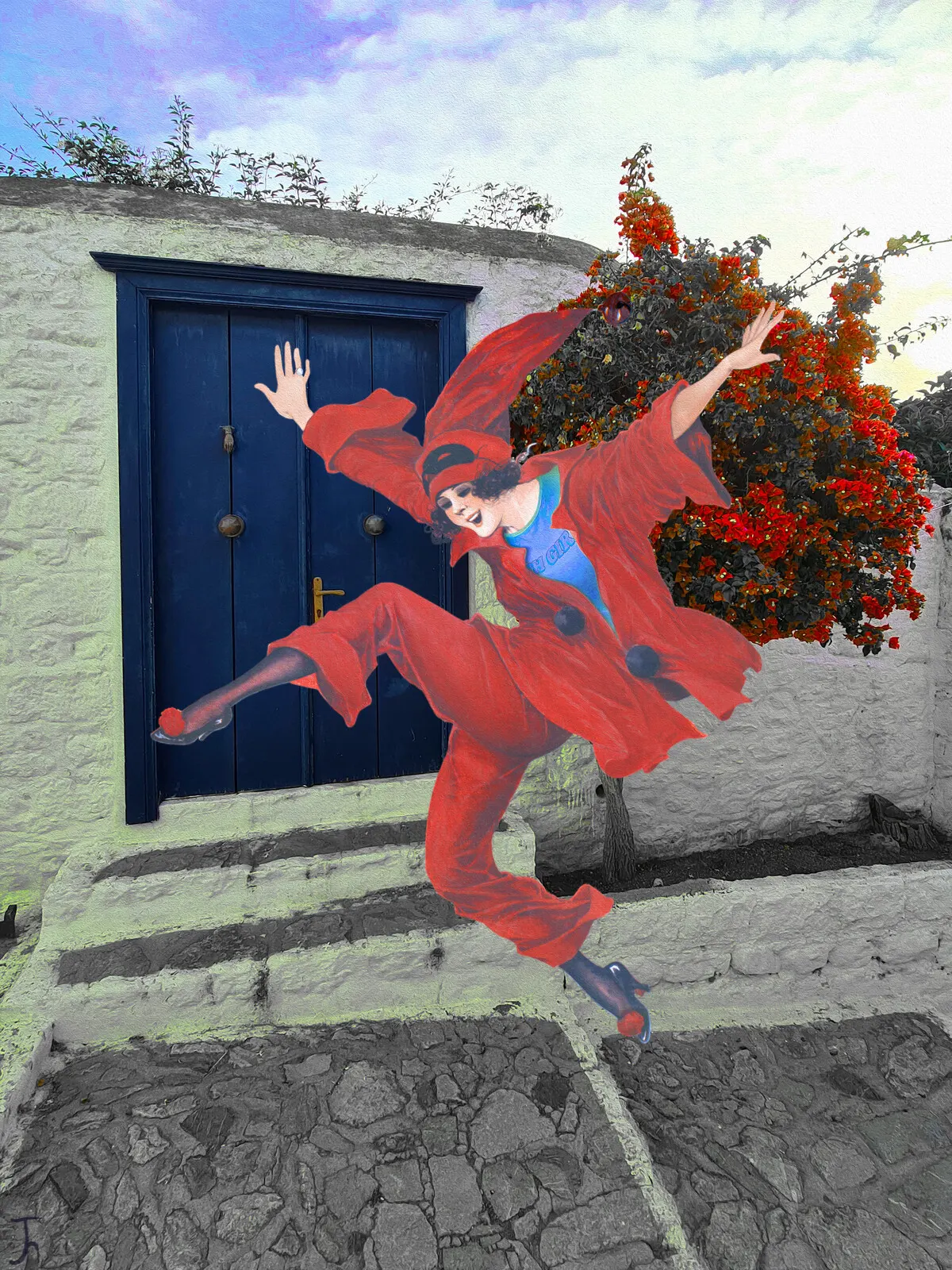
Jörgen Thornberg
Happy days are here again!, 2022
Digital
50 x 70 cm
Happy days are here again!
The skies above are clear again.
Let us sing a song of cheer again
Happy days are here again!
The wind has stopped – Yippee!! The beach is waiting for me.
In the picture, a girl jumps for joy outside the gate in Kamini. The house once belonged to a very close friend, who unfortunately died a few years ago. We once went to the recurring Easter lamb party in the garden behind. Many other times as well, because we were excellent friends. Many felt particularly honoured by the invitation to this extraordinary Greek. Time flies, and with it, many happy moments. Inspired by the French artist and illustrator Georges Léonnec, the girl looks like she will be granted many Easter lambs. Now, I was waiting to hear the story behind it.
The sun had not yet set on the other side, and Isalos was still in a pleasant shade. The harbour still was calm, and the sailboats' tackle and tow had fallen silent. Sitting in any of the harbour's taverns the night before had hardly been possible. Then, the north wind had blown straight into the port. But now the order was restored, the temperature was comfortable, and the previous day's high temperatures were ventilated. It would be thirty degrees this late June, utterly different from the heat that plagued Western Europe with temperatures above 40 degrees.
The biennale continued, and there was an unusual number of easels around. More and more artists from the stars joined. So many that the astute during the night could see the arrivals as a scattered star fall. I was not without curiosity about some of them, Hieronymus Bosch, for example. I have always wondered what the peddler in his 'The Haywain Triptych' has in his backpack. A spoon is hanging on its outside, but his anxiously looking back suggests that there are more valuable things than pewter spoons. Well, there is much more interesting about this strange artist who lived in the 15th and 16th centuries. If that triptych is weird, it is nothing against 'the Garden of Earthly Delights, which, in its ingenious absurdity, surpasses most in art history. Now Bosch was on Hydra, attracted by descriptions of the island's stripped-down and dramatic character. George said that all artists must repeat at least one of their previous works and, inspired by Hydra, make a new version. According to George, some ambitious colleagues have been on the island long enough to break the others. Millais, one of the pre-Raphaelites, had had his Ophelia swim twice in one of the small bays on the backside of Hydra, front if you like dramatic scenery and wilderness. Rossetti had made his' The Beloved' even more multicultural, putting in more nationalities and colours.
Over a coffee – a Latte, of course – George told his life's story before moving to his star.
"I began as a cartoonist selling drawings to newspapers already before 1900. My first real 'professional' drawings were published in Jean qui rit, a somewhat dubious magazine. I was under the great influence of Art Nouveau and dreamt about being the new Toulouse-Lautrec. Who did not? I lived a typical 'artist life' with Elisa, my first wife. 1907, I started working for La Vie Parisienne, the leading magazine for fashionable people, with a temperament that perfectly suited my ambitions. I love women. Maybe it has shown?
"It has not escaped me," I said, based on the countless illustrations he showed the night before at the biennial.
"That was when my lightly dressed and naughty girls were born," Georges said, chuckling with delight. I divorced Elisa in 1915 and met Hortense, who became my model in the coming years. She is the one who jumps on the picture that you fell in love with. Initially, it was the 1919 carnival she rejoiced over. I thought it fit the emotions this morning and the beautiful blue gate. The wind yesterday was depressing. I saw a girl dancing outside that door in Kamini. She may not have somersaulted, but she was indeed happy."
"Understandable," I said. "Who does not when the wind has been wining around the house for two days."
"I also worked for Le Sourire and made decorations for the Folies Bergère and the Casino de Paris. As long as it had to do with girls." Georges sipped his coffee and got a white moustache from the foam.
"Like many of my generation, I had to participate in World War I. I survived, but it was close enough a couple of times. After the peace, I moved to Montparnasse with great expectations. But any Lautrec I never became."
"You were pretty successful anyway," I said bluntly.
"The twenties were hectic. In 1923, Hortense and I married. We got two nice girls, Colette and Michèle. The 30s were calmer, and the family and I travelled extensively in Europe. Unfortunately, I missed Hydra then. Ghikas have scolded me many times for that." Georges did not comment on his career. And I have understood that Ghikas was angry with anyone who did not discover Hydra in his own time. That is until he left when his donkeyman torched his palace. But that is a story I will tell Georges. Ghikas himself still, after so many years, avoid the subject.
"You have to recoup," I said.
"I have already produced a dozen girls who will fit in La Vie Parisienne."
"Will fit?" I asked in surprise.
"Of course, a heavenly edition is published by the original editors united." Georges took another gentle sip, and the moustache came back.
I asked him to tell me about the magazine that appeared in every other sentence. He told us so much that we had time for another Latte and a Campari soda in between. Two boats from Piraeus came and left, and one on its way back. The number of taxi boats to and from the small villages along the coast was innumerable, and the traffic across the strait was heavy. It was a hectic day after the storm. The day before, the port police had stopped all small boats. Those going to the tavernas in Vlychos and Kamini had to walk along the coast.
La Vie Parisienne (the Parisian Life) was a weekly naughty French magazine founded in Paris in 1863. Initially, it covered novels, sports, theatre, music and the arts. The magazine was published without interruption until 1970 but gradually changed shape following the tides and changing values.
It evolved into a mildly risqué erotic publication to meet modern times. It was so dicey that—during World War I—the prude General Pershing personally warned American servicemen against purchasing the magazine. As a result, the magazine's popularity boosted in the United States. That's how it goes.
La Vie Parisienne came with full-page colour beautiful illustrations and aptly cartoons drawn by leading artists of the age, like Georges. The artwork reflected the stylisation of Art Nouveau and Art Deco and makes them attractive still today. Not the least, the magazine picked up and joked about the new woman, not seldom in a ridiculous way, with illustrations of scantily clad damsels abounded.
Some women today would object, and the type of cartoons would probably not be publishable in our time even if they were all done tastefully; the magazine had more than its fair share of detractors during its heydays. The magazine was even banned in certain countries, such as neighbouring Belgium. During the Great War, the magazine's contents reflected the spirit of the times—patriotism was indeed very 'chic.'
The magazine's success was guaranteed by its amalgam of short stories, veiled gossip, fashion banter, and comments about subjects from love and the arts to the stock exchange. Fashion and frivolity were the leading words. In those days, the content was coupled with intellectualism, wit, and satire in its written contributions—a combination that proved irresistible to the French public and overseas. The magazine was not much more than a high-class literary humour journal infamous for its advertisements. Small personal ads were seldom much more than classic lonely-hearts or marriage-seeking personals.
Georges ended his story by reading one of the ads from memory. It sounded so unlikely that the ad was probably wholly genuine.
"We are two 90-year-old men who want to meet ladies of the appropriate age. We drink, smoke and chew tobacco and have no money, summer cottages, cars or boats. We are not interested in theatre, travel, dancing, cosy dinners or romantic walks.
Reply to 'Preferably like-minded.' We both laughed, so a couple at our side looked
I was also well known for my advertising illustrations. You may have noticed Byrrh aperitif wine?" I had not, and Georges continued as he could read my mind. "The last poster I designed for "Naja" cigarettes, in 1939, a creation that has remained unpublished. Nowadays, people have quit smoking, and the company has gone bankrupt. The year after, I left Kersaint and went to my star. Cancer forced me. But I'm lucky I did not have to live in an occupied country. Terrible times. But that is another story, and now we must leave for the Slaughterhouse", he said and sighed. I had almost forgotten about the next event on the island—the Jeff Koons exhibition. Georges reminded me, and we decided to go there together.
"We have not been introduced. Koons and I. Not yet", George said with a curious smile. "But I know Botticelli is here and has a prank in mind. He always has. Or homage across the time barrier. An installation into the installation, one could say." I could see from Geroge's face that he was not to reveal what the prank was about. I had to wait.
Though time was already after seven, the temperature still hovered around thirty. Time-travelers living on a star are not bothered, but it was hot for a poor Earthling. We rounded the Castel and were granted a light wind that blew away most of the heat. We were not the only ones, but nobody was interested in a mature Swedish writer or an overmature Frog. George had a straw boater on his head. One of these is worn by gondoliers in Venice. I never wear hats myself. Even so, I have a decent collection on the island. They are very decorative in the hall. In my younger days, I found pleasure in wearing such because they made me look wiser and more cosmopolitan. I believe they add a decade or so to my visual age.
George shook his head. I always forget that these Time-travelers read your mind. Of his face, I could read his. 'Stupid Earthlings', he thought. Among the stars, the absence of oxygen makes it unnecessary to use the vocal cords. It's practical because they understand each other regardless of language, dialect or culture, like when Lucy, the Australopithecus afarensis girl who lived 3,2 million years ago, composes and plays the flute with Leonard Cohen. One must understand the other person's feelings and intentions to do that. They do. And thoughts never lie.
Happy days are here again!
The skies above are clear again,
Let us sing a song of cheer again,
Happy days are here again!
Altogether, shout it now,
There's no one who can doubt it now,
Let us tell the world about it now,
Happy days are here again!
Your cares and troubles are gone
There'll be no more from now on!
Happy days are here again!
The skies above are clear again
Let us sing a song of cheer again
Happy days are here again!
Happy days are here again!
The skies above are clear again
Let us sing a song of cheer again
Happy days are here again!
Happy Days Are Here Again, a joyous melody through time. The year was 1929. Wall Street had just taken a nosedive that would make even the bravest roller coaster enthusiasts feel queasy. Amidst the ensuing gloom of the Great Depression, a song emerged that, unlikely, got people tapping their feet and believing, if only for a moment, that things might turn out okay. That song is "Happy Days Are Here Again."
Written by Milton Ager (music) and Jack Yellen (lyrics), "Happy Days Are Here Again" first burst onto the scene in 1929 as part of a musical film called "Chasing Rainbows." The song's debut was perfectly timed—or perhaps wholly untimely, depending on your perspective—coinciding with the start of the Great Depression. But let's be honest, who needs perfect timing when you have a catchy tune that could make a cat tap dance?
The Birth of a Hit
"Happy Days Are Here Again" wasn't an instant sensation. It took some time before it started to resonate with the public. But once it did, there was no stopping its cheerful march through the airwaves and into the hearts of millions. The song's infectious optimism was what people needed during the darkest days of economic despair. It was like a musical pat on the back, reminding everyone to keep their chins up.
From Politics to Pop Culture
The song's big break came when it was adopted as the theme for Franklin D. Roosevelt's 1932 presidential campaign. Roosevelt, facing a nation desperate for hope and change, knew a good thing when he heard it. He embraced the song's upbeat message, and it became the Democratic Party's unofficial anthem. "Happy Days Are Here Again" played a pivotal role in creating a sense of unity and optimism that helped propel FDR to victory.
Campaign rallies filled with anxious Americans suddenly broke into smiles and even a few jiggy dance moves as the band struck those familiar notes. FDR's team knew they had a winner, and so did the crowds. It was almost like the song had a magical power to erase worries, at least for the duration of its jaunty melody.
A Tune for All Times
But "Happy Days Are Here Again" didn't stop at politics. It quickly seeped into the fabric of American culture. The song became a staple of celebratory moments, from the silver screen to TV variety shows. Judy Garland's rendition of the song, paired with "Get Happy," is a classic performance that still resonates with audiences today. It's hard to hear those first few notes and not feel a twinge of happiness creeping in.
Even the Muppets got in on the action. Who could forget Miss Piggy belting "Happy Days Are Here Again" with her signature dramatic flair? If a song can transcend genres and find a home with FDR and felt puppets, you know it has something special.
The Impact on People
So, what is it about "Happy Days Are Here Again" that has such a profound impact on people? For starters, it's incredibly catchy. Once you've heard it, you can't help but hum along. But more than that, it's the message. The lyrics promise better days, a reminder that there's always a reason to hope, no matter how tough things get.
During the Great Depression, the song provided a much-needed escape. It allowed people to dream of a brighter future, even when their present was anything but. And it wasn't just then. Through wars, recessions, and personal hardships, "Happy Days Are Here Again" has been a go-to anthem for lifting spirits.
A Timeless Classic
Today, "Happy Days Are Here Again" is more than just a song; it's a cultural icon. Its legacy is a testament to the power of music to bring joy and hope, even in the darkest times. Whether it's being sung at political rallies, performed on Broadway, or hummed absentmindedly by someone who needs a pick-me-up, its message remains clear: happier days are just around the corner.
So next time you feel down, remember that happy days will soon be here again, and the skies above clear again. If that doesn't make you smile, you might be a cat with enough tap dancing.
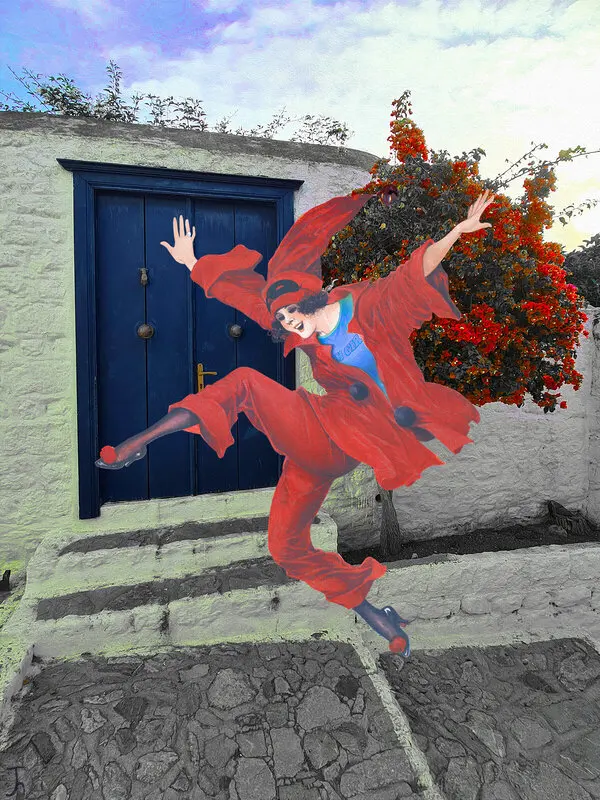
Jörgen Thornberg
Happy days are here again!, 2022
Digital
50 x 70 cm
Happy days are here again!
The skies above are clear again.
Let us sing a song of cheer again
Happy days are here again!
The wind has stopped – Yippee!! The beach is waiting for me.
In the picture, a girl jumps for joy outside the gate in Kamini. The house once belonged to a very close friend, who unfortunately died a few years ago. We once went to the recurring Easter lamb party in the garden behind. Many other times as well, because we were excellent friends. Many felt particularly honoured by the invitation to this extraordinary Greek. Time flies, and with it, many happy moments. Inspired by the French artist and illustrator Georges Léonnec, the girl looks like she will be granted many Easter lambs. Now, I was waiting to hear the story behind it.
The sun had not yet set on the other side, and Isalos was still in a pleasant shade. The harbour still was calm, and the sailboats' tackle and tow had fallen silent. Sitting in any of the harbour's taverns the night before had hardly been possible. Then, the north wind had blown straight into the port. But now the order was restored, the temperature was comfortable, and the previous day's high temperatures were ventilated. It would be thirty degrees this late June, utterly different from the heat that plagued Western Europe with temperatures above 40 degrees.
The biennale continued, and there was an unusual number of easels around. More and more artists from the stars joined. So many that the astute during the night could see the arrivals as a scattered star fall. I was not without curiosity about some of them, Hieronymus Bosch, for example. I have always wondered what the peddler in his 'The Haywain Triptych' has in his backpack. A spoon is hanging on its outside, but his anxiously looking back suggests that there are more valuable things than pewter spoons. Well, there is much more interesting about this strange artist who lived in the 15th and 16th centuries. If that triptych is weird, it is nothing against 'the Garden of Earthly Delights, which, in its ingenious absurdity, surpasses most in art history. Now Bosch was on Hydra, attracted by descriptions of the island's stripped-down and dramatic character. George said that all artists must repeat at least one of their previous works and, inspired by Hydra, make a new version. According to George, some ambitious colleagues have been on the island long enough to break the others. Millais, one of the pre-Raphaelites, had had his Ophelia swim twice in one of the small bays on the backside of Hydra, front if you like dramatic scenery and wilderness. Rossetti had made his' The Beloved' even more multicultural, putting in more nationalities and colours.
Over a coffee – a Latte, of course – George told his life's story before moving to his star.
"I began as a cartoonist selling drawings to newspapers already before 1900. My first real 'professional' drawings were published in Jean qui rit, a somewhat dubious magazine. I was under the great influence of Art Nouveau and dreamt about being the new Toulouse-Lautrec. Who did not? I lived a typical 'artist life' with Elisa, my first wife. 1907, I started working for La Vie Parisienne, the leading magazine for fashionable people, with a temperament that perfectly suited my ambitions. I love women. Maybe it has shown?
"It has not escaped me," I said, based on the countless illustrations he showed the night before at the biennial.
"That was when my lightly dressed and naughty girls were born," Georges said, chuckling with delight. I divorced Elisa in 1915 and met Hortense, who became my model in the coming years. She is the one who jumps on the picture that you fell in love with. Initially, it was the 1919 carnival she rejoiced over. I thought it fit the emotions this morning and the beautiful blue gate. The wind yesterday was depressing. I saw a girl dancing outside that door in Kamini. She may not have somersaulted, but she was indeed happy."
"Understandable," I said. "Who does not when the wind has been wining around the house for two days."
"I also worked for Le Sourire and made decorations for the Folies Bergère and the Casino de Paris. As long as it had to do with girls." Georges sipped his coffee and got a white moustache from the foam.
"Like many of my generation, I had to participate in World War I. I survived, but it was close enough a couple of times. After the peace, I moved to Montparnasse with great expectations. But any Lautrec I never became."
"You were pretty successful anyway," I said bluntly.
"The twenties were hectic. In 1923, Hortense and I married. We got two nice girls, Colette and Michèle. The 30s were calmer, and the family and I travelled extensively in Europe. Unfortunately, I missed Hydra then. Ghikas have scolded me many times for that." Georges did not comment on his career. And I have understood that Ghikas was angry with anyone who did not discover Hydra in his own time. That is until he left when his donkeyman torched his palace. But that is a story I will tell Georges. Ghikas himself still, after so many years, avoid the subject.
"You have to recoup," I said.
"I have already produced a dozen girls who will fit in La Vie Parisienne."
"Will fit?" I asked in surprise.
"Of course, a heavenly edition is published by the original editors united." Georges took another gentle sip, and the moustache came back.
I asked him to tell me about the magazine that appeared in every other sentence. He told us so much that we had time for another Latte and a Campari soda in between. Two boats from Piraeus came and left, and one on its way back. The number of taxi boats to and from the small villages along the coast was innumerable, and the traffic across the strait was heavy. It was a hectic day after the storm. The day before, the port police had stopped all small boats. Those going to the tavernas in Vlychos and Kamini had to walk along the coast.
La Vie Parisienne (the Parisian Life) was a weekly naughty French magazine founded in Paris in 1863. Initially, it covered novels, sports, theatre, music and the arts. The magazine was published without interruption until 1970 but gradually changed shape following the tides and changing values.
It evolved into a mildly risqué erotic publication to meet modern times. It was so dicey that—during World War I—the prude General Pershing personally warned American servicemen against purchasing the magazine. As a result, the magazine's popularity boosted in the United States. That's how it goes.
La Vie Parisienne came with full-page colour beautiful illustrations and aptly cartoons drawn by leading artists of the age, like Georges. The artwork reflected the stylisation of Art Nouveau and Art Deco and makes them attractive still today. Not the least, the magazine picked up and joked about the new woman, not seldom in a ridiculous way, with illustrations of scantily clad damsels abounded.
Some women today would object, and the type of cartoons would probably not be publishable in our time even if they were all done tastefully; the magazine had more than its fair share of detractors during its heydays. The magazine was even banned in certain countries, such as neighbouring Belgium. During the Great War, the magazine's contents reflected the spirit of the times—patriotism was indeed very 'chic.'
The magazine's success was guaranteed by its amalgam of short stories, veiled gossip, fashion banter, and comments about subjects from love and the arts to the stock exchange. Fashion and frivolity were the leading words. In those days, the content was coupled with intellectualism, wit, and satire in its written contributions—a combination that proved irresistible to the French public and overseas. The magazine was not much more than a high-class literary humour journal infamous for its advertisements. Small personal ads were seldom much more than classic lonely-hearts or marriage-seeking personals.
Georges ended his story by reading one of the ads from memory. It sounded so unlikely that the ad was probably wholly genuine.
"We are two 90-year-old men who want to meet ladies of the appropriate age. We drink, smoke and chew tobacco and have no money, summer cottages, cars or boats. We are not interested in theatre, travel, dancing, cosy dinners or romantic walks.
Reply to 'Preferably like-minded.' We both laughed, so a couple at our side looked
I was also well known for my advertising illustrations. You may have noticed Byrrh aperitif wine?" I had not, and Georges continued as he could read my mind. "The last poster I designed for "Naja" cigarettes, in 1939, a creation that has remained unpublished. Nowadays, people have quit smoking, and the company has gone bankrupt. The year after, I left Kersaint and went to my star. Cancer forced me. But I'm lucky I did not have to live in an occupied country. Terrible times. But that is another story, and now we must leave for the Slaughterhouse", he said and sighed. I had almost forgotten about the next event on the island—the Jeff Koons exhibition. Georges reminded me, and we decided to go there together.
"We have not been introduced. Koons and I. Not yet", George said with a curious smile. "But I know Botticelli is here and has a prank in mind. He always has. Or homage across the time barrier. An installation into the installation, one could say." I could see from Geroge's face that he was not to reveal what the prank was about. I had to wait.
Though time was already after seven, the temperature still hovered around thirty. Time-travelers living on a star are not bothered, but it was hot for a poor Earthling. We rounded the Castel and were granted a light wind that blew away most of the heat. We were not the only ones, but nobody was interested in a mature Swedish writer or an overmature Frog. George had a straw boater on his head. One of these is worn by gondoliers in Venice. I never wear hats myself. Even so, I have a decent collection on the island. They are very decorative in the hall. In my younger days, I found pleasure in wearing such because they made me look wiser and more cosmopolitan. I believe they add a decade or so to my visual age.
George shook his head. I always forget that these Time-travelers read your mind. Of his face, I could read his. 'Stupid Earthlings', he thought. Among the stars, the absence of oxygen makes it unnecessary to use the vocal cords. It's practical because they understand each other regardless of language, dialect or culture, like when Lucy, the Australopithecus afarensis girl who lived 3,2 million years ago, composes and plays the flute with Leonard Cohen. One must understand the other person's feelings and intentions to do that. They do. And thoughts never lie.
Happy days are here again!
The skies above are clear again,
Let us sing a song of cheer again,
Happy days are here again!
Altogether, shout it now,
There's no one who can doubt it now,
Let us tell the world about it now,
Happy days are here again!
Your cares and troubles are gone
There'll be no more from now on!
Happy days are here again!
The skies above are clear again
Let us sing a song of cheer again
Happy days are here again!
Happy days are here again!
The skies above are clear again
Let us sing a song of cheer again
Happy days are here again!
Happy Days Are Here Again, a joyous melody through time. The year was 1929. Wall Street had just taken a nosedive that would make even the bravest roller coaster enthusiasts feel queasy. Amidst the ensuing gloom of the Great Depression, a song emerged that, unlikely, got people tapping their feet and believing, if only for a moment, that things might turn out okay. That song is "Happy Days Are Here Again."
Written by Milton Ager (music) and Jack Yellen (lyrics), "Happy Days Are Here Again" first burst onto the scene in 1929 as part of a musical film called "Chasing Rainbows." The song's debut was perfectly timed—or perhaps wholly untimely, depending on your perspective—coinciding with the start of the Great Depression. But let's be honest, who needs perfect timing when you have a catchy tune that could make a cat tap dance?
The Birth of a Hit
"Happy Days Are Here Again" wasn't an instant sensation. It took some time before it started to resonate with the public. But once it did, there was no stopping its cheerful march through the airwaves and into the hearts of millions. The song's infectious optimism was what people needed during the darkest days of economic despair. It was like a musical pat on the back, reminding everyone to keep their chins up.
From Politics to Pop Culture
The song's big break came when it was adopted as the theme for Franklin D. Roosevelt's 1932 presidential campaign. Roosevelt, facing a nation desperate for hope and change, knew a good thing when he heard it. He embraced the song's upbeat message, and it became the Democratic Party's unofficial anthem. "Happy Days Are Here Again" played a pivotal role in creating a sense of unity and optimism that helped propel FDR to victory.
Campaign rallies filled with anxious Americans suddenly broke into smiles and even a few jiggy dance moves as the band struck those familiar notes. FDR's team knew they had a winner, and so did the crowds. It was almost like the song had a magical power to erase worries, at least for the duration of its jaunty melody.
A Tune for All Times
But "Happy Days Are Here Again" didn't stop at politics. It quickly seeped into the fabric of American culture. The song became a staple of celebratory moments, from the silver screen to TV variety shows. Judy Garland's rendition of the song, paired with "Get Happy," is a classic performance that still resonates with audiences today. It's hard to hear those first few notes and not feel a twinge of happiness creeping in.
Even the Muppets got in on the action. Who could forget Miss Piggy belting "Happy Days Are Here Again" with her signature dramatic flair? If a song can transcend genres and find a home with FDR and felt puppets, you know it has something special.
The Impact on People
So, what is it about "Happy Days Are Here Again" that has such a profound impact on people? For starters, it's incredibly catchy. Once you've heard it, you can't help but hum along. But more than that, it's the message. The lyrics promise better days, a reminder that there's always a reason to hope, no matter how tough things get.
During the Great Depression, the song provided a much-needed escape. It allowed people to dream of a brighter future, even when their present was anything but. And it wasn't just then. Through wars, recessions, and personal hardships, "Happy Days Are Here Again" has been a go-to anthem for lifting spirits.
A Timeless Classic
Today, "Happy Days Are Here Again" is more than just a song; it's a cultural icon. Its legacy is a testament to the power of music to bring joy and hope, even in the darkest times. Whether it's being sung at political rallies, performed on Broadway, or hummed absentmindedly by someone who needs a pick-me-up, its message remains clear: happier days are just around the corner.
So next time you feel down, remember that happy days will soon be here again, and the skies above clear again. If that doesn't make you smile, you might be a cat with enough tap dancing.

Jörgen Thornberg
Malmö
Lite om bilder och mig. Translation in English at the end.
Jag är en nyfiken person som ser allt i bilder, även det jag fäster i ord, gärna tillsammans för bakom alla mina bilder finns en berättelse. Till vissa bilder hör en kortare eller längre novell som följer med bilden.
Bilder berättar historier. Jag omges av naturlig skönhet, intressanta människor och historia var jag än går. Jag använder min kamera för att dokumentera världen och blanda det jag ser med vad jag känner för att fånga den dolda magin.
Mina bilder berättar mina historier. Genom mina bilder, tryck och berättelser. Jag bjuder in dig att ta del av dessa berättelser, in i ditt liv och hem och dela min mycket personliga syn på vår värld. Mer än vad ögat ser. Jag tänker i bilder, drömmer och skriver och pratar om dem; följaktligen måste jag också skapa bilder. De blir vad jag ser, inte nödvändigtvis begränsade till verkligheten. Det finns en bild runt varje hörn. Jag hoppas att du kommer att se vad jag såg och gilla det.
Jag är också en skrivande person och till många bilder hör en kortare eller längre essay. Den följer med tavlan, tryckt på fint papper och med en personlig hälsning från mig.
Flertalet bilder startar sin resa i min kamera. Enkelt förklarat beskriver jag bilden jag ser i mitt inre, upplevd eller fantiserad. Bilden uppstår inom mig redan innan jag fått okularet till ögat. På bråkdelen av ett ögonblick ser jag vad jag vill ha och vad som kan göras med bilden. Här skall jag stoppa in en giraff, stålmannen, Titanic eller vad det är min fantasi finner ut. Ännu märkligare är att jag kommer ihåg minnesbilden långt efteråt när det blir tid att skapa verket. Om jag lyckas eller inte, är upp till betraktaren, oftast präglat av en stråk av svart humor – meningen är att man skall bli underhållen. Mina bilder blir ofta en snackis där de hänger.
Jag föredrar bilder som förmedlar ett budskap i flera lager. Vid första anblicken fylld av feel-good, en vacker utsikt, fint väder, solen skiner, blommor på ängen eller vattnet som ligger förrädiskt spegelblankt. I en sådan bild kan jag gömma min egentliga berättelse, mitt förakt för förtryckare och våldsverkare, rasister och fördomsfulla människor - ett gärna återkommande motiv mer eller mindre dolt i det vackra motivet. Jag försöker förena dem i ett gemensamt narrativ.
Bild och formgivning har löpt som en röd tråd genom livet. Fotokonst känns som en värdig final som jag gärna delar med mig.
Min genre är vid som framgår av mina bilder, temat en blandning av pop- och gatukonst i kollage som kan bestå av hundratals lager. Vissa bilder kan ta veckor, andra någon dag innan det är dags att överlämna resultatet till printverkstaden. Fine Art Prints är digitala fotocollage. I dessa kollage sker rivandet, klippandet, pusslandet, målandet, ritandet och sprayningen digitalt. Det jag monterar in kan vara hundratals år gamla bilder som jag omsorgsfullt frilägger så att de ser ut att vara en del av tavlan men också bilder skapade av mig själv efter min egen fantasi. Därefter besöks printstudion och för vissa bilder numrera en limiterad upplaga (oftast 7 exemplar) och signera för hand. Vissa bilder kan köpas i olika format. Det är bara att fråga efter vilka. Gillar man en bild som är 70x100 men inte har plats på väggen, går den kanske att få i 50x70 cm istället. Frågan är fri.
Metoden Giclée eller Fine Art Print som det också kallas är det moderna sättet för framställning av grafisk konst. Villkoret för denna typ av utskrifter är att en högkvalitativ storformatskrivare används med åldersbeständigt färgpigment och konstnärspapper eller i förekommande fall på duk. Pappret som används möter de krav på livslängd som ställs av museer och gallerier. Normalt säljer jag mina bilder oinramade så att den nya ägaren själv kan bestämma hur de skall se ut, med eller utan passepartout färg på ram, med eller utan glas etc..
Under många år ställde jag bara ut på nätet, i valda grupper och på min egen Facebooksida - https://www.facebook.com/jorgen.thornberg.9
Jag finns också på en egen hemsida som tyvärr inte alltid är uppdaterad – https://www.jth.life/ Där kan du också läsa en del av de berättelser som följer med bilden.
UTSTÄLLNINGAR
Luftkastellet, oktober 2022
Konst i Lund, november 2022
Luftkastellet, mars 2023
Engleson Galleri Caroli, april 2023
Hydra, Greece June 2023
Engleson Galleri Caroli, oktober 2023
Toppen, Höllviken december 2023
Luftkastellet, mars 2024
Torups Galleri, mars 2024
Venice, May 2024
Luftkastellet, oktober 2024
Konst i Advent, December 2024
Galleri Engleson, Caroli December 2024
Jäger & Jansson Galleri, april 2025
A bit about pictures and me.
I'm a curious person who sees everything in pictures, even what I express in words, often combining them, for behind all my pictures lies a story. These narratives, some as short as a single image and others as long as a novel, are the heart and soul of my work.
Pictures tell stories. Wherever I go, I'm surrounded by natural beauty, exciting people, and history. I use my camera to document the world and blend what I see with what I feel to capture the hidden magic.
My images tell my stories. Through my pictures, prints, and narratives, I invite you to partake in these stories in your life and home and share my deeply personal perspective of our world. More than meets the eye. I think in pictures, dream, write, and talk about them; consequently, I must create images too. They become what I see, not necessarily confined to reality. There's a picture around every corner. I hope you'll see what I saw and enjoy it.
I'm also a writer, and many images come with a shorter or longer essay. It accompanies the painting, printed on fine paper with my personal greeting.
Many pictures start their journey on my camera. Simply put, I describe the image I see in my mind, experienced or imagined. The image arises within me even before I bring the eyepiece to my eye. In a fraction of a moment, I see what I want and what can be done with the picture. Here, I'll insert a giraffe, Superman, the Titanic, or whatever my imagination conjures up. Even stranger is that I remember the mental image long after it's time to create the work. Whether I succeed is up to the observer, often imbued with a streak of black humour – the aim is to entertain. My pictures usually become a talking point wherever they hang.
I prefer pictures that convey a message in multiple layers. At first glance, they're filled with feel-good vibes, a beautiful view, lovely weather, the sun shining, flowers in the meadow, or the water lying deceptively calm. But beneath this surface beauty, I often conceal a deeper story, a narrative that challenges societal norms or explores the human condition. I invite you to delve into these hidden narratives and discover the layers of meaning within my work.
Picture and design have been a thread running through my life. Photographic art feels like a fitting finale, and I'm happy to share it.
My genre is varied, as seen in my pictures; the theme is a blend of pop and street art in collages that can consist of hundreds of layers. Some images can take weeks, others just a day before it's time to hand over the result to the print workshop. Fine Art Prints are digital photo collages. In these collages, tearing, cutting, puzzling, painting, drawing, and spraying happen digitally. What I insert can be images hundreds of years old that I carefully extract so they appear to be part of the painting, but also images created by myself, now also generated from my imagination. Next, visit the print studio and, for certain images, number a limited edition (usually 7 copies) and sign them by hand. Some images may be available in other formats. Just ask which ones. If you like an image that's 70x100 but doesn't have space on the wall, you might be able to get it in 50x70 cm instead. The question is open.
The Giclée method, or Fine Art Print as it's also called, is the modern way of producing graphic art. This method ensures the highest quality and longevity of the artwork, using a high-quality large-format printer with archival pigment inks and artist paper or, in some cases, canvas. The paper used meets the longevity requirements set by museums and galleries. I sell my pictures unframed, allowing the new owner to personalise their artwork, confident in the lasting value and quality of the piece.
For many years, I only exhibited online, in selected groups, and on my Facebook page - https://www.facebook.com/jorgen.thornberg.9. I also have my website, which unfortunately is not constantly updated - https://www.jth.life/. You can also read some of the stories accompanying the pictures there.
EXHIBITIONS
Luftkastellet, October 2022
Art in Lund, November 2022
Luftkastellet, March 2023
Engleson Gallery Caroli, April 2023
Hydra, Greece June 2023
Engleson Gallery Caroli, October 2023
Toppen, Höllviken December 2023
Luftkastellet, March 2024
Torup Gallery, March 2024
Venice, May 2024
UTSTÄLLNINGAR
Luftkastellet, oktober 2022
Konst i Lund, november 2022
Luftkastellet, mars 2023
Engleson Galleri Caroli, april 2023
Hydra, Greece June 2023
Engleson Galleri Caroli, oktober 2023
Toppen, Höllviken december 2023
Luftkastellet, mars 2024
Torups Galleri, mars 2024
Venice, May 2024
Luftkastellet, October 2024
Konst i Advent, December 2024
Galleri Engleson, Caroli December 2024
Jäger & Jansson Galleri, April 2025
Utbildning
Autodidakt
Medlem i konstnärsförening
Öppna Sinnen
Med i konstrunda
Konstrundan i Skåne
Utställningar
Luftkastellet, October 2022
Art in Lund, November 2022
Luftkastellet, March 2023
Engleson Gallery Caroli, April 2023
Hydra, Greece June 2023
Engleson Gallery Caroli, October 2023
Toppen, Höllviken December 2023
Luftkastellet, March 2024
Torup Gallery, March 2024
Venice, May 2024