Vi använder cookies för att ge dig bästa möjliga upplevelse. Välj vilka cookies du tillåter.
Läs mer i vår integritetspolicy
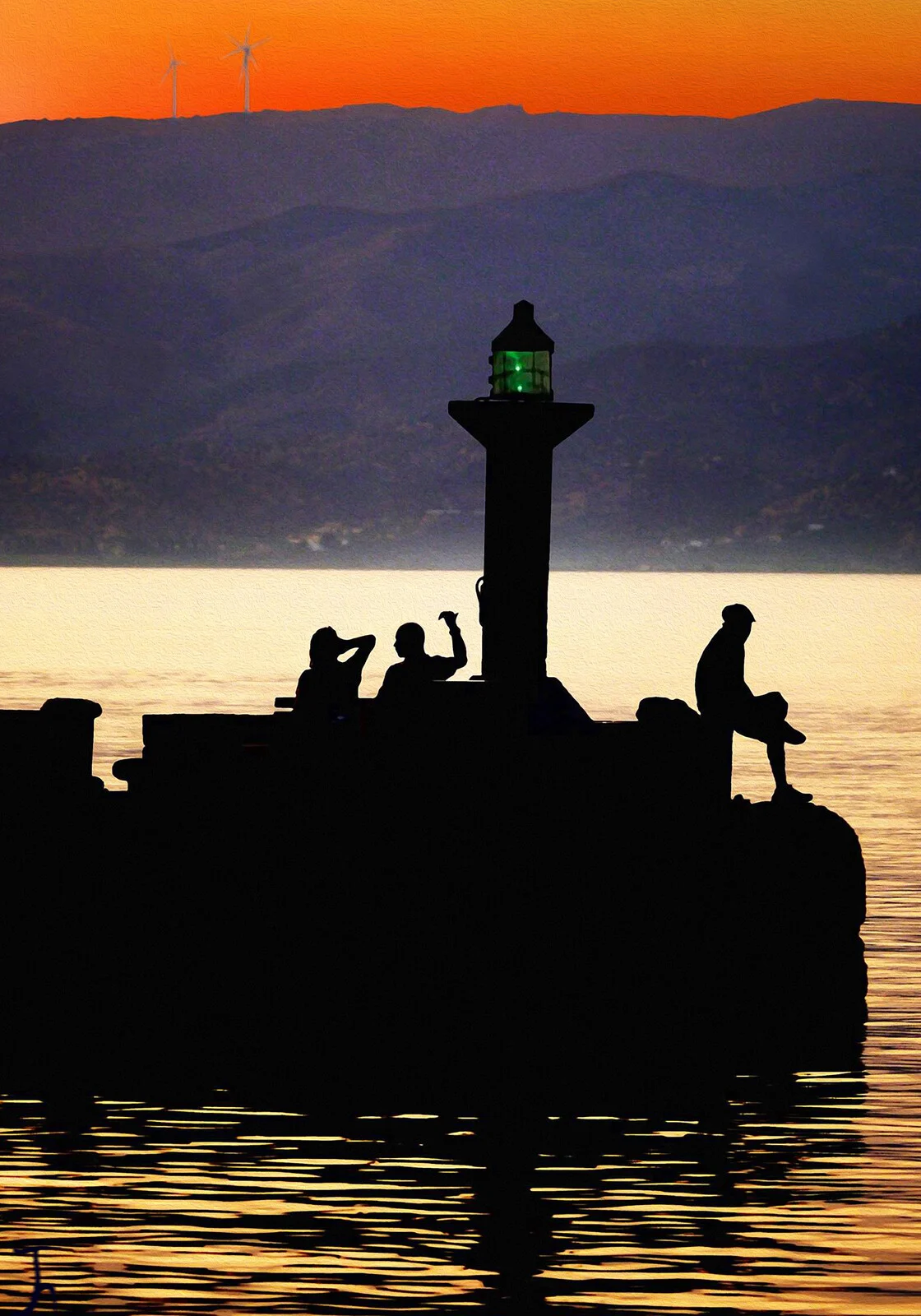
Jörgen Thornberg
A Light in the Dusk, 2018
Digital
50 x 70 cm
It was a balmy evening in June at the small entrance lighthouse on the outer pier of Hydra's harbour. Anna and Mark, a couple deeply in love, sat together, their hands intertwined, gazing at the deeply grey-pink sky over the Peloponnese. The air was filled with the scent of salt and sea and the sound of seagulls in the distance. On the inside of the pier, small boats swayed gently in the wake of a departing taxi boat. In the background, the murmurs from harbour restaurants and bars created a soft ambience. I sat on the other side of the lighthouse and overheard their conversation.
"You look like you're somewhere else," Anna said softly to her boyfriend, Mark, as they sat together at the inner side of the lighthouse.
"No, I'm here. I was thinking," Mark seemed caught off guard by something.
"What are you thinking about, darling?" Anna asked, nudging him.
"How beautiful it is here," Mark said dutifully, assuming that's what Anna wanted to hear.
"Isn't it?" said Anna, gazing dreamily at the Peloponnese silhouette. "The colours are so magical right now at dusk."
"Well, technically, dusk is right after sunset, leading into twilight. I'd say we're at the very end of astronomical twilight. The sun has set, but it's not completely dark yet," Mark said, squinting at the sky.
"I prefer to think of it as the perfect moment between day and night. It feels like time stands still, just for us." Anna smiled softly.
"That's one way to see it. Astronomical twilight is when the sun is between 12 and 18 degrees below the horizon. Beyond that, it's night. Right now, the stars are about to come out, but there's just enough light to see the outlines of everything. It's fascinating to see how light scatters and creates these colours. It's all about wavelengths and the atmosphere." Mark nodded, his eyes shining with the wonder of the science behind the scene.
"You and your technical explanations. Can't we just enjoy the magic of the moment?" Anna said, laughing lightly.
"Sure, but understanding its science makes it even more fascinating. Like how the light scatters and creates these colours. It's all about wavelengths and the atmosphere." Mark chuckled.
"And for me, it's about the feeling it gives. The way it makes my heart flutter, knowing that this moment is fleeting. It's like a secret shared just between us and the universe." Anna leaned closer, her voice barely a whisper, her eyes shining with the intensity of her emotions.
"I guess that's what makes it special. The mix of science and emotion." Mark smiled, wrapping an arm around her.
"And maybe... it's the perfect time for a kiss before it gets completely dark," whispered Anna.
"I think you're right." Mark leaned in.
They shared a tender kiss as the sky darkened further, and the romantic ambience, thick with the scent of the sea and the soft glow of the harbour lights, completed the moment. The lights from the harbour glimmered softly, reflecting off the water as night began to fall, adding to the enchantment of the scene.
Anna pulled back slightly, looking into his eyes. "See? Even the stars agree with me. It's the most romantic time of the day."
"You always get the last word, don't you?" Mark said, smiling.
"Only because you let me." Anna smiled back.
They both laughed softly, holding each other close as the night finally settled in around them.
For me, the murmur from the harbour took over, and I thought it might be nice to have a beer at Duskos. I stood up and rounded the couple, who exchanged yet another kiss. I felt a bit jealous and thought the beer might drown my sorrows.
While I have my beer, let me tell you the Illuminating History of Lighthouses to give the background to Hydra Harbour's small approach light on the outer pier and the Lighthouse of Zourva at the extreme east end of Hydra Island, a fantastic hiking destination for experienced walkers. Read more about Zourva at the end of the text.
Before the era of well-defined ports, mariners relied on fires built on hilltops to navigate their ships safely to shore. As the need for navigation grew more intricate, the concept of elevating these fires on platforms emerged, leading to the birth of lighthouses. These towering structures, both historic and modern, have been beacons of hope and safety, illuminating treacherous coastlines and guiding sailors through dangerous waters. They are a testament to human ingenuity and the enduring power of light, commanding respect and awe from all who encounter them.
The Lighthouses of Pharos, The Tower of Hercules, and the Bell Rock Lighthouse are just a few examples of the diverse and historically significant lighthouses that have guided sailors throughout the centuries.
The Lighthouse of Alexandria, also known as the Pharos of Alexandria, holds a significant place in maritime history. Erected in the 3rd century BCE on the small island of Pharos, this lighthouse was one of the Seven Wonders of the Ancient World. Its colossal structure, estimated to be over 100 meters tall, was a testament to its architectural prowess. The lighthouse employed a furnace at its peak to generate light, which was then reflected by a large mirror, making it visible to ships far out at sea. The Pharos served as a navigational aid and symbolised the opulence and might of Ptolemaic Egypt, marking a crucial milestone in the evolution of lighthouses.
The Tower of Hercules is the oldest extant Roman lighthouse. Built in the 1st century, the tower is on a peninsula close to A Coruña, Galicia, in northwestern Spain. Until the 20th century, it was known as the Farum Brigantium. The Latin word 'Farum' is derived from the Greek word Pharos, the Lighthouse of Alexandria. The structure stands 55 metres tall and overlooks the North Atlantic coast of Spain. The tower was renovated in 1791
Evolution of Lighthouse Technology
The basic design of lighthouses remained relatively straightforward until the 18th century when significant technological advancements began transforming efficiency and effectiveness. The introduction of the Fresnel lens in the early 19th century was a groundbreaking development. This lens, invented by French physicist Augustin-Jean Fresnel, allowed light to be concentrated into a powerful beam visible from much greater distances. The Fresnel lens revolutionised lighthouse illumination, making them more effective navigational aids.
The AGA Lighthouse
Swedish inventor Gustaf Dalén achieved a significant milestone in lighthouse technology. In the early 20th century, Dalén invented the AGA lighthouse, which used acetylene gas for illumination. His most notable contribution was the sun valve. This device automatically turns the light on at dusk and off at dawn, conserving gas and reducing the need for manual operation. Dalén's innovations significantly improved the efficiency and reliability of lighthouses worldwide. His work earned him the Nobel Prize in Physics in 1912, cementing his legacy in maritime history.
The Role of Lighthouses in Modern Times
In the contemporary era, lighthouses have adapted to the advancements in navigation technology. While electronic navigation systems like GPS have reduced the dependence on lighthouses, these structures still hold a crucial role in ensuring maritime safety. They act as vital backups in case of electronic failures and continue to guide smaller vessels and recreational boats, instilling a sense of security in the vastness of the sea. Moreover, lighthouses are cultural and historical landmarks, safeguarding the maritime heritage of coastal communities and reminding us of the significance of our maritime past, thereby maintaining their relevance in modern times.
The Cultural Significance of Lighthouses
Beyond their practical applications, lighthouses have ingrained themselves into the tapestry of human history, captivating the imagination and hearts of people for centuries. They transcend being mere structures; they embody safety, hope, and resilience, standing as beacons of light in the darkest nights. Many lighthouses have transformed into tourist attractions, attracting visitors with picturesque settings and rich histories. Stories of lighthouse keepers braving storms to keep the lights aglow have become part of the folklore in numerous coastal regions, profoundly connecting us to our maritime heritage.
Anecdotes from Lighthouse History
The history of lighthouses is replete with fascinating anecdotes. One such story is that of the Eddystone Lighthouse off the coast of England. The original structure, built by Henry Winstanley in the late 17th century, was destroyed in a storm. A second lighthouse, constructed by John Rudyerd, also met a tragic end when it caught fire. The third lighthouse, designed by John Smeaton in the mid-18th century, was revolutionary in its use of interlocking stone blocks and served as a model for future lighthouse construction.
Lighthouses in Popular Culture
Lighthouses have also found their way into popular culture, featuring prominently in literature, films, and art. They are often depicted as solitary sentinels standing against the relentless forces of nature, symbolising human endurance and perseverance. The lighthouses' romantic and sometimes eerie allure inspires writers and artists, keeping their legacy alive in the collective consciousness.
Modern Technological Advances: From Decca to GPS
The history of navigation took a significant turn during World War II with the introduction of the Decca Navigator System. Developed for military use, this hyperbolic radio navigation system provided accurate positioning information to Allied forces, revolutionising maritime navigation. After the war, Decca was adapted for civilian use, becoming one of the most widely used systems until the advent of satellite technology, marking a significant milestone in the evolution of navigation technology.
Today, Global Positioning System (GPS) technology has revolutionised navigation. Using satellites orbiting the Earth, GPS provides real-time location data with unprecedented accuracy. This technology guides maritime vessels and monitors the movement of all cargo globally. GPS and advanced satellite surveillance ensure that ships can navigate safely and efficiently, regardless of weather conditions or visibility. These advancements have made traditional lighthouses less critical for navigation but have not diminished their cultural and historical significance.
From ancient times, lighthouses have stood as unwavering sentinels, demonstrating their resilience and indispensability in maritime navigation and safety. The innovations in lighthouse technology, from the towering Pharos of Alexandria to the modern AGA lighthouses and beyond, reflect humanity's unending quest to conquer the seas and ensure safe passage for all who venture upon them. As functional structures and cultural icons, lighthouses are enduring symbols of guidance, protection, and hope, standing tall against the test of time and the relentless forces of nature.
Lighthouses may no longer be the primary navigational aids they once were, but their legacy continues to shine brightly. They remind us of a time when the flicker of a distant light could mean the difference between life and death, and they continue to evoke a sense of wonder and adventure for all who see their beams cutting through the night. The evolution from fires on hilltops to the sophisticated GPS systems of today underscores the incredible journey of maritime navigation, with lighthouses as a constant, guiding light through the ages. While their role may change, lighthouses will always be a beacon of our naval history and cultural heritage.
The Dark Art of Wrecking: Luring Ships to Their Doom
The history of maritime navigation is filled with stories of innovation and heroism and tales of treachery and deceit. Among the most nefarious practices that have plagued sailors since the advent of seafaring is wrecking—deliberately causing ships to run aground to plunder their valuable cargo. This dark art, which often used false lights or beacons to mislead mariners, has cast a long shadow over the history of lighthouses and coastal communities.
The Ancient Beginnings of Wrecking
Using false lights to misguide ships dates back to ancient times. The potential for their misuse became apparent as soon as the first lighthouses appeared along coastlines. Coastal communities often face economic hardship in incredibly remote and rugged areas. The lure of the treasures carried by passing ships proved too tempting for some. By manipulating the tools designed to ensure safe passage, these wreckers turned the maritime world on its head.
One of the earliest recorded instances of wrecking occurred in ancient Greece and Rome, where unscrupulous individuals would place lanterns on dangerous cliffs, mimicking the lights of a safe harbour. Guided by these false beacons, unsuspecting captains would steer their vessels toward the lights, only to meet their doom on the rocks below. The wreckers would then descend upon the stranded ships, looting them of their precious cargo.
The False Beacons of the Middle Ages
As maritime trade expanded during the Middle Ages, wrecking became more widespread. Coastal regions across Europe became notorious for their wreckers, with some areas even developing a grim reputation as graveyards of ships. In Cornwall, England, for instance, entire communities were rumoured to be complicit in the wrecking trade. The term "Cornish Wreckers" became synonymous with this deadly form of piracy.
These wreckers employed various methods to lure ships to their destruction. False beacons remained a favoured tactic, but they also used more elaborate schemes. For example, some would tie lanterns to the tails of livestock and drive them along the cliffs, creating the illusion of a moving ship's light. Others would signal with bonfires or reflective surfaces, confusing the already disoriented sailors.
Legends and Lore of Wrecking
The practice of wrecking is steeped in legends and folklore. One of the most famous tales is that of the "Lamp Lighters" of the Isles of Scilly, a group of islands off the southwestern coast of England. According to local lore, the Lamp Lighters would hang lanterns from their horses' necks and lead them along the shore on stormy nights. The bobbing lights, mistaken for a ship's lanterns, would draw vessels onto the rocks, where the wreckers awaited.
Another chilling legend is that of the "Wrecker's Daughter," a beautiful young woman who supposedly lured ships to their doom by standing on the cliffs with a lantern. The light of her lantern would entice sailors to steer towards what they believed to be a safe harbour, only to crash upon the rocks. While likely apocryphal, this story highlights the blend of fact and fiction surrounding the history of wrecking.
The Height of Wrecking and its Decline
The practice of wrecking reached its zenith during the 18th and 19th centuries, marked by intense maritime trade and frequent naval conflicts. The rugged coastlines of Britain, France, and Spain were particularly notorious for wrecking activities. The spoils of these wrecks were often substantial, including exotic goods from the East Indies, gold and silver from the Americas, and even valuable personal belongings of passengers.
Authorities attempted to crack down on wrecking by imposing harsh penalties and increasing the presence of coastal patrols. However, many coastal areas' remote and difficult-to-police nature allowed the practice to continue. It was not until the development of more reliable navigational aids, such as more accurate maps, better lighthouses, and eventually modern technology like GPS, that the prevalence of wrecking began to decline.
Even today, the remnants of this sinister practice can be found in the folklore and place names of many coastal regions. The "Wreckers' Coast" of Cornwall and the "Dead Men's Bay" in Newfoundland are just two examples of how the legacy of wrecking has left its mark on the cultural landscape.
Modern Wrecking and its Legacy
While the traditional practice of wrecking has largely disappeared, its legacy endures in modern maritime practices. The importance of accurate navigational aids and the need for robust coastal safety measures are lessons learned from centuries of maritime treachery. Today's technology, including satellite navigation and real-time tracking systems, ensures ships can navigate safely, reducing the risk of wrecking.
Moreover, the preservation of historic lighthouses and the stories of wrecking serve as reminders of a time when the sea was a far more dangerous place. These structures stand as monuments to the enduring human quest for safety and the relentless drive to overcome the perils of the natural world.
The history of wrecking is a testament to humanity's ingenuity and darker impulses. From the ancient Greeks to the notorious Cornish wreckers, luring ships to their doom has left an indelible mark on maritime history. While modern technology has made such practices largely obsolete, the stories and legends of wrecking continue to captivate us, reminding us of the fragile boundary between safety and peril on the high seas. As we look to the future, the legacy of wrecking serves as a powerful reminder of the need for vigilance, innovation, and respect for the unforgiving power of the ocean.
Wrecking in Literature and Popular Culture
The dark allure of wrecking has inspired countless works of literature and popular culture. From Daphne du Maurier's "Jamaica Inn," which depicts the grim reality of wreckers on the Cornish coast, to Robert Louis Stevenson's tales of pirates and shipwrecks, the theme of wrecking has captured the imaginations of readers and writers alike.
Plundering Whisky
The film "Whisky Galore!" is set during World War II and tells the story of the tiny Scottish island of Todday, which runs out of whisky. When the freighter S.S. Cabinet Minister runs aground nearby during a heavy fog, the islanders are delighted to discover that its cargo consists of 50,000 cases of whisky. When the officious English commanding officer Captain Waggett demands the return of the liquor, shopkeeper Joseph Macroon and his daughters Peggy and Catriona spearhead an island rebellion. It's a hilarious film about a sensitive subject. In this case, the ship was not deliberately run aground, but the following events are likely close to reality, though depicted here in an absurd drama.
The Zourva Lighthouse
The historic Lighthouse of Cape Zourva, first constructed in 1883, is a rectangular beacon standing proudly at the easternmost point of Hydra Island. With a height of approximately 10 meters, this beacon has witnessed significant historical events. Unfortunately, it was destroyed in 1944 during the German occupation of the Second World War. However, the resilient spirit of the people led to its reconstruction, and the lighthouse resumed its vital role in maritime safety.
Initially, the Zourva Lighthouse operated using oil until 1986, when it was modernised to use electricity. Since 1989, it has operated automatically, guiding sailors without manual intervention. This near-abandoned yet historically rich site is challenging to reach by land, making it a coveted destination for adventurers and trekking enthusiasts. For those less inclined to hike, a water taxi can be prearranged for a visit or pick-up from Cape Zourva.
Visiting this lighthouse is not just about reaching a destination; it's about experiencing a piece of history that has stood the test of time. It has adapted and evolved through the years while maintaining its steadfast role in ensuring the safety of mariners navigating the waters around Hydra Island.
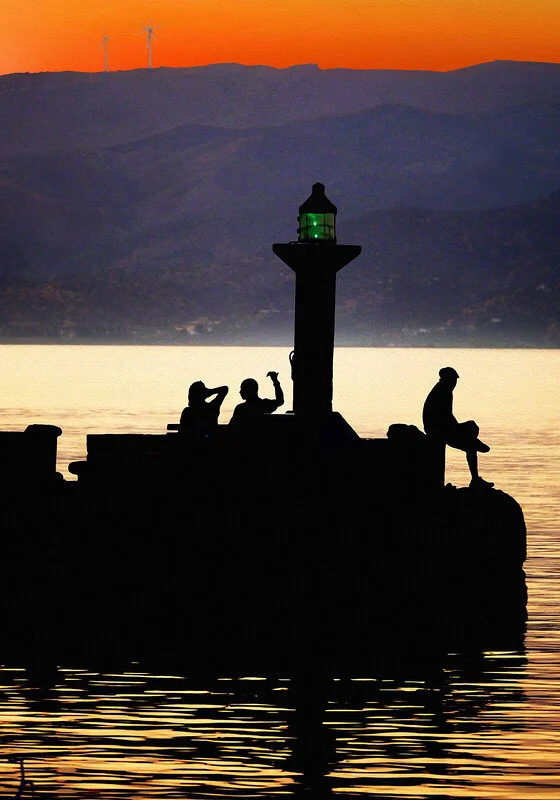
Jörgen Thornberg
A Light in the Dusk, 2018
Digital
50 x 70 cm
It was a balmy evening in June at the small entrance lighthouse on the outer pier of Hydra's harbour. Anna and Mark, a couple deeply in love, sat together, their hands intertwined, gazing at the deeply grey-pink sky over the Peloponnese. The air was filled with the scent of salt and sea and the sound of seagulls in the distance. On the inside of the pier, small boats swayed gently in the wake of a departing taxi boat. In the background, the murmurs from harbour restaurants and bars created a soft ambience. I sat on the other side of the lighthouse and overheard their conversation.
"You look like you're somewhere else," Anna said softly to her boyfriend, Mark, as they sat together at the inner side of the lighthouse.
"No, I'm here. I was thinking," Mark seemed caught off guard by something.
"What are you thinking about, darling?" Anna asked, nudging him.
"How beautiful it is here," Mark said dutifully, assuming that's what Anna wanted to hear.
"Isn't it?" said Anna, gazing dreamily at the Peloponnese silhouette. "The colours are so magical right now at dusk."
"Well, technically, dusk is right after sunset, leading into twilight. I'd say we're at the very end of astronomical twilight. The sun has set, but it's not completely dark yet," Mark said, squinting at the sky.
"I prefer to think of it as the perfect moment between day and night. It feels like time stands still, just for us." Anna smiled softly.
"That's one way to see it. Astronomical twilight is when the sun is between 12 and 18 degrees below the horizon. Beyond that, it's night. Right now, the stars are about to come out, but there's just enough light to see the outlines of everything. It's fascinating to see how light scatters and creates these colours. It's all about wavelengths and the atmosphere." Mark nodded, his eyes shining with the wonder of the science behind the scene.
"You and your technical explanations. Can't we just enjoy the magic of the moment?" Anna said, laughing lightly.
"Sure, but understanding its science makes it even more fascinating. Like how the light scatters and creates these colours. It's all about wavelengths and the atmosphere." Mark chuckled.
"And for me, it's about the feeling it gives. The way it makes my heart flutter, knowing that this moment is fleeting. It's like a secret shared just between us and the universe." Anna leaned closer, her voice barely a whisper, her eyes shining with the intensity of her emotions.
"I guess that's what makes it special. The mix of science and emotion." Mark smiled, wrapping an arm around her.
"And maybe... it's the perfect time for a kiss before it gets completely dark," whispered Anna.
"I think you're right." Mark leaned in.
They shared a tender kiss as the sky darkened further, and the romantic ambience, thick with the scent of the sea and the soft glow of the harbour lights, completed the moment. The lights from the harbour glimmered softly, reflecting off the water as night began to fall, adding to the enchantment of the scene.
Anna pulled back slightly, looking into his eyes. "See? Even the stars agree with me. It's the most romantic time of the day."
"You always get the last word, don't you?" Mark said, smiling.
"Only because you let me." Anna smiled back.
They both laughed softly, holding each other close as the night finally settled in around them.
For me, the murmur from the harbour took over, and I thought it might be nice to have a beer at Duskos. I stood up and rounded the couple, who exchanged yet another kiss. I felt a bit jealous and thought the beer might drown my sorrows.
While I have my beer, let me tell you the Illuminating History of Lighthouses to give the background to Hydra Harbour's small approach light on the outer pier and the Lighthouse of Zourva at the extreme east end of Hydra Island, a fantastic hiking destination for experienced walkers. Read more about Zourva at the end of the text.
Before the era of well-defined ports, mariners relied on fires built on hilltops to navigate their ships safely to shore. As the need for navigation grew more intricate, the concept of elevating these fires on platforms emerged, leading to the birth of lighthouses. These towering structures, both historic and modern, have been beacons of hope and safety, illuminating treacherous coastlines and guiding sailors through dangerous waters. They are a testament to human ingenuity and the enduring power of light, commanding respect and awe from all who encounter them.
The Lighthouses of Pharos, The Tower of Hercules, and the Bell Rock Lighthouse are just a few examples of the diverse and historically significant lighthouses that have guided sailors throughout the centuries.
The Lighthouse of Alexandria, also known as the Pharos of Alexandria, holds a significant place in maritime history. Erected in the 3rd century BCE on the small island of Pharos, this lighthouse was one of the Seven Wonders of the Ancient World. Its colossal structure, estimated to be over 100 meters tall, was a testament to its architectural prowess. The lighthouse employed a furnace at its peak to generate light, which was then reflected by a large mirror, making it visible to ships far out at sea. The Pharos served as a navigational aid and symbolised the opulence and might of Ptolemaic Egypt, marking a crucial milestone in the evolution of lighthouses.
The Tower of Hercules is the oldest extant Roman lighthouse. Built in the 1st century, the tower is on a peninsula close to A Coruña, Galicia, in northwestern Spain. Until the 20th century, it was known as the Farum Brigantium. The Latin word 'Farum' is derived from the Greek word Pharos, the Lighthouse of Alexandria. The structure stands 55 metres tall and overlooks the North Atlantic coast of Spain. The tower was renovated in 1791
Evolution of Lighthouse Technology
The basic design of lighthouses remained relatively straightforward until the 18th century when significant technological advancements began transforming efficiency and effectiveness. The introduction of the Fresnel lens in the early 19th century was a groundbreaking development. This lens, invented by French physicist Augustin-Jean Fresnel, allowed light to be concentrated into a powerful beam visible from much greater distances. The Fresnel lens revolutionised lighthouse illumination, making them more effective navigational aids.
The AGA Lighthouse
Swedish inventor Gustaf Dalén achieved a significant milestone in lighthouse technology. In the early 20th century, Dalén invented the AGA lighthouse, which used acetylene gas for illumination. His most notable contribution was the sun valve. This device automatically turns the light on at dusk and off at dawn, conserving gas and reducing the need for manual operation. Dalén's innovations significantly improved the efficiency and reliability of lighthouses worldwide. His work earned him the Nobel Prize in Physics in 1912, cementing his legacy in maritime history.
The Role of Lighthouses in Modern Times
In the contemporary era, lighthouses have adapted to the advancements in navigation technology. While electronic navigation systems like GPS have reduced the dependence on lighthouses, these structures still hold a crucial role in ensuring maritime safety. They act as vital backups in case of electronic failures and continue to guide smaller vessels and recreational boats, instilling a sense of security in the vastness of the sea. Moreover, lighthouses are cultural and historical landmarks, safeguarding the maritime heritage of coastal communities and reminding us of the significance of our maritime past, thereby maintaining their relevance in modern times.
The Cultural Significance of Lighthouses
Beyond their practical applications, lighthouses have ingrained themselves into the tapestry of human history, captivating the imagination and hearts of people for centuries. They transcend being mere structures; they embody safety, hope, and resilience, standing as beacons of light in the darkest nights. Many lighthouses have transformed into tourist attractions, attracting visitors with picturesque settings and rich histories. Stories of lighthouse keepers braving storms to keep the lights aglow have become part of the folklore in numerous coastal regions, profoundly connecting us to our maritime heritage.
Anecdotes from Lighthouse History
The history of lighthouses is replete with fascinating anecdotes. One such story is that of the Eddystone Lighthouse off the coast of England. The original structure, built by Henry Winstanley in the late 17th century, was destroyed in a storm. A second lighthouse, constructed by John Rudyerd, also met a tragic end when it caught fire. The third lighthouse, designed by John Smeaton in the mid-18th century, was revolutionary in its use of interlocking stone blocks and served as a model for future lighthouse construction.
Lighthouses in Popular Culture
Lighthouses have also found their way into popular culture, featuring prominently in literature, films, and art. They are often depicted as solitary sentinels standing against the relentless forces of nature, symbolising human endurance and perseverance. The lighthouses' romantic and sometimes eerie allure inspires writers and artists, keeping their legacy alive in the collective consciousness.
Modern Technological Advances: From Decca to GPS
The history of navigation took a significant turn during World War II with the introduction of the Decca Navigator System. Developed for military use, this hyperbolic radio navigation system provided accurate positioning information to Allied forces, revolutionising maritime navigation. After the war, Decca was adapted for civilian use, becoming one of the most widely used systems until the advent of satellite technology, marking a significant milestone in the evolution of navigation technology.
Today, Global Positioning System (GPS) technology has revolutionised navigation. Using satellites orbiting the Earth, GPS provides real-time location data with unprecedented accuracy. This technology guides maritime vessels and monitors the movement of all cargo globally. GPS and advanced satellite surveillance ensure that ships can navigate safely and efficiently, regardless of weather conditions or visibility. These advancements have made traditional lighthouses less critical for navigation but have not diminished their cultural and historical significance.
From ancient times, lighthouses have stood as unwavering sentinels, demonstrating their resilience and indispensability in maritime navigation and safety. The innovations in lighthouse technology, from the towering Pharos of Alexandria to the modern AGA lighthouses and beyond, reflect humanity's unending quest to conquer the seas and ensure safe passage for all who venture upon them. As functional structures and cultural icons, lighthouses are enduring symbols of guidance, protection, and hope, standing tall against the test of time and the relentless forces of nature.
Lighthouses may no longer be the primary navigational aids they once were, but their legacy continues to shine brightly. They remind us of a time when the flicker of a distant light could mean the difference between life and death, and they continue to evoke a sense of wonder and adventure for all who see their beams cutting through the night. The evolution from fires on hilltops to the sophisticated GPS systems of today underscores the incredible journey of maritime navigation, with lighthouses as a constant, guiding light through the ages. While their role may change, lighthouses will always be a beacon of our naval history and cultural heritage.
The Dark Art of Wrecking: Luring Ships to Their Doom
The history of maritime navigation is filled with stories of innovation and heroism and tales of treachery and deceit. Among the most nefarious practices that have plagued sailors since the advent of seafaring is wrecking—deliberately causing ships to run aground to plunder their valuable cargo. This dark art, which often used false lights or beacons to mislead mariners, has cast a long shadow over the history of lighthouses and coastal communities.
The Ancient Beginnings of Wrecking
Using false lights to misguide ships dates back to ancient times. The potential for their misuse became apparent as soon as the first lighthouses appeared along coastlines. Coastal communities often face economic hardship in incredibly remote and rugged areas. The lure of the treasures carried by passing ships proved too tempting for some. By manipulating the tools designed to ensure safe passage, these wreckers turned the maritime world on its head.
One of the earliest recorded instances of wrecking occurred in ancient Greece and Rome, where unscrupulous individuals would place lanterns on dangerous cliffs, mimicking the lights of a safe harbour. Guided by these false beacons, unsuspecting captains would steer their vessels toward the lights, only to meet their doom on the rocks below. The wreckers would then descend upon the stranded ships, looting them of their precious cargo.
The False Beacons of the Middle Ages
As maritime trade expanded during the Middle Ages, wrecking became more widespread. Coastal regions across Europe became notorious for their wreckers, with some areas even developing a grim reputation as graveyards of ships. In Cornwall, England, for instance, entire communities were rumoured to be complicit in the wrecking trade. The term "Cornish Wreckers" became synonymous with this deadly form of piracy.
These wreckers employed various methods to lure ships to their destruction. False beacons remained a favoured tactic, but they also used more elaborate schemes. For example, some would tie lanterns to the tails of livestock and drive them along the cliffs, creating the illusion of a moving ship's light. Others would signal with bonfires or reflective surfaces, confusing the already disoriented sailors.
Legends and Lore of Wrecking
The practice of wrecking is steeped in legends and folklore. One of the most famous tales is that of the "Lamp Lighters" of the Isles of Scilly, a group of islands off the southwestern coast of England. According to local lore, the Lamp Lighters would hang lanterns from their horses' necks and lead them along the shore on stormy nights. The bobbing lights, mistaken for a ship's lanterns, would draw vessels onto the rocks, where the wreckers awaited.
Another chilling legend is that of the "Wrecker's Daughter," a beautiful young woman who supposedly lured ships to their doom by standing on the cliffs with a lantern. The light of her lantern would entice sailors to steer towards what they believed to be a safe harbour, only to crash upon the rocks. While likely apocryphal, this story highlights the blend of fact and fiction surrounding the history of wrecking.
The Height of Wrecking and its Decline
The practice of wrecking reached its zenith during the 18th and 19th centuries, marked by intense maritime trade and frequent naval conflicts. The rugged coastlines of Britain, France, and Spain were particularly notorious for wrecking activities. The spoils of these wrecks were often substantial, including exotic goods from the East Indies, gold and silver from the Americas, and even valuable personal belongings of passengers.
Authorities attempted to crack down on wrecking by imposing harsh penalties and increasing the presence of coastal patrols. However, many coastal areas' remote and difficult-to-police nature allowed the practice to continue. It was not until the development of more reliable navigational aids, such as more accurate maps, better lighthouses, and eventually modern technology like GPS, that the prevalence of wrecking began to decline.
Even today, the remnants of this sinister practice can be found in the folklore and place names of many coastal regions. The "Wreckers' Coast" of Cornwall and the "Dead Men's Bay" in Newfoundland are just two examples of how the legacy of wrecking has left its mark on the cultural landscape.
Modern Wrecking and its Legacy
While the traditional practice of wrecking has largely disappeared, its legacy endures in modern maritime practices. The importance of accurate navigational aids and the need for robust coastal safety measures are lessons learned from centuries of maritime treachery. Today's technology, including satellite navigation and real-time tracking systems, ensures ships can navigate safely, reducing the risk of wrecking.
Moreover, the preservation of historic lighthouses and the stories of wrecking serve as reminders of a time when the sea was a far more dangerous place. These structures stand as monuments to the enduring human quest for safety and the relentless drive to overcome the perils of the natural world.
The history of wrecking is a testament to humanity's ingenuity and darker impulses. From the ancient Greeks to the notorious Cornish wreckers, luring ships to their doom has left an indelible mark on maritime history. While modern technology has made such practices largely obsolete, the stories and legends of wrecking continue to captivate us, reminding us of the fragile boundary between safety and peril on the high seas. As we look to the future, the legacy of wrecking serves as a powerful reminder of the need for vigilance, innovation, and respect for the unforgiving power of the ocean.
Wrecking in Literature and Popular Culture
The dark allure of wrecking has inspired countless works of literature and popular culture. From Daphne du Maurier's "Jamaica Inn," which depicts the grim reality of wreckers on the Cornish coast, to Robert Louis Stevenson's tales of pirates and shipwrecks, the theme of wrecking has captured the imaginations of readers and writers alike.
Plundering Whisky
The film "Whisky Galore!" is set during World War II and tells the story of the tiny Scottish island of Todday, which runs out of whisky. When the freighter S.S. Cabinet Minister runs aground nearby during a heavy fog, the islanders are delighted to discover that its cargo consists of 50,000 cases of whisky. When the officious English commanding officer Captain Waggett demands the return of the liquor, shopkeeper Joseph Macroon and his daughters Peggy and Catriona spearhead an island rebellion. It's a hilarious film about a sensitive subject. In this case, the ship was not deliberately run aground, but the following events are likely close to reality, though depicted here in an absurd drama.
The Zourva Lighthouse
The historic Lighthouse of Cape Zourva, first constructed in 1883, is a rectangular beacon standing proudly at the easternmost point of Hydra Island. With a height of approximately 10 meters, this beacon has witnessed significant historical events. Unfortunately, it was destroyed in 1944 during the German occupation of the Second World War. However, the resilient spirit of the people led to its reconstruction, and the lighthouse resumed its vital role in maritime safety.
Initially, the Zourva Lighthouse operated using oil until 1986, when it was modernised to use electricity. Since 1989, it has operated automatically, guiding sailors without manual intervention. This near-abandoned yet historically rich site is challenging to reach by land, making it a coveted destination for adventurers and trekking enthusiasts. For those less inclined to hike, a water taxi can be prearranged for a visit or pick-up from Cape Zourva.
Visiting this lighthouse is not just about reaching a destination; it's about experiencing a piece of history that has stood the test of time. It has adapted and evolved through the years while maintaining its steadfast role in ensuring the safety of mariners navigating the waters around Hydra Island.

Jörgen Thornberg
Malmö
Lite om bilder och mig. Translation in English at the end.
Jag är en nyfiken person som ser allt i bilder, även det jag fäster i ord, gärna tillsammans för bakom alla mina bilder finns en berättelse. Till vissa bilder hör en kortare eller längre novell som följer med bilden.
Bilder berättar historier. Jag omges av naturlig skönhet, intressanta människor och historia var jag än går. Jag använder min kamera för att dokumentera världen och blanda det jag ser med vad jag känner för att fånga den dolda magin.
Mina bilder berättar mina historier. Genom mina bilder, tryck och berättelser. Jag bjuder in dig att ta del av dessa berättelser, in i ditt liv och hem och dela min mycket personliga syn på vår värld. Mer än vad ögat ser. Jag tänker i bilder, drömmer och skriver och pratar om dem; följaktligen måste jag också skapa bilder. De blir vad jag ser, inte nödvändigtvis begränsade till verkligheten. Det finns en bild runt varje hörn. Jag hoppas att du kommer att se vad jag såg och gilla det.
Jag är också en skrivande person och till många bilder hör en kortare eller längre essay. Den följer med tavlan, tryckt på fint papper och med en personlig hälsning från mig.
Flertalet bilder startar sin resa i min kamera. Enkelt förklarat beskriver jag bilden jag ser i mitt inre, upplevd eller fantiserad. Bilden uppstår inom mig redan innan jag fått okularet till ögat. På bråkdelen av ett ögonblick ser jag vad jag vill ha och vad som kan göras med bilden. Här skall jag stoppa in en giraff, stålmannen, Titanic eller vad det är min fantasi finner ut. Ännu märkligare är att jag kommer ihåg minnesbilden långt efteråt när det blir tid att skapa verket. Om jag lyckas eller inte, är upp till betraktaren, oftast präglat av en stråk av svart humor – meningen är att man skall bli underhållen. Mina bilder blir ofta en snackis där de hänger.
Jag föredrar bilder som förmedlar ett budskap i flera lager. Vid första anblicken fylld av feel-good, en vacker utsikt, fint väder, solen skiner, blommor på ängen eller vattnet som ligger förrädiskt spegelblankt. I en sådan bild kan jag gömma min egentliga berättelse, mitt förakt för förtryckare och våldsverkare, rasister och fördomsfulla människor - ett gärna återkommande motiv mer eller mindre dolt i det vackra motivet. Jag försöker förena dem i ett gemensamt narrativ.
Bild och formgivning har löpt som en röd tråd genom livet. Fotokonst känns som en värdig final som jag gärna delar med mig.
Min genre är vid som framgår av mina bilder, temat en blandning av pop- och gatukonst i kollage som kan bestå av hundratals lager. Vissa bilder kan ta veckor, andra någon dag innan det är dags att överlämna resultatet till printverkstaden. Fine Art Prints är digitala fotocollage. I dessa kollage sker rivandet, klippandet, pusslandet, målandet, ritandet och sprayningen digitalt. Det jag monterar in kan vara hundratals år gamla bilder som jag omsorgsfullt frilägger så att de ser ut att vara en del av tavlan men också bilder skapade av mig själv efter min egen fantasi. Därefter besöks printstudion och för vissa bilder numrera en limiterad upplaga (oftast 7 exemplar) och signera för hand. Vissa bilder kan köpas i olika format. Det är bara att fråga efter vilka. Gillar man en bild som är 70x100 men inte har plats på väggen, går den kanske att få i 50x70 cm istället. Frågan är fri.
Metoden Giclée eller Fine Art Print som det också kallas är det moderna sättet för framställning av grafisk konst. Villkoret för denna typ av utskrifter är att en högkvalitativ storformatskrivare används med åldersbeständigt färgpigment och konstnärspapper eller i förekommande fall på duk. Pappret som används möter de krav på livslängd som ställs av museer och gallerier. Normalt säljer jag mina bilder oinramade så att den nya ägaren själv kan bestämma hur de skall se ut, med eller utan passepartout färg på ram, med eller utan glas etc..
Under många år ställde jag bara ut på nätet, i valda grupper och på min egen Facebooksida - https://www.facebook.com/jorgen.thornberg.9
Jag finns också på en egen hemsida som tyvärr inte alltid är uppdaterad – https://www.jth.life/ Där kan du också läsa en del av de berättelser som följer med bilden.
UTSTÄLLNINGAR
Luftkastellet, oktober 2022
Konst i Lund, november 2022
Luftkastellet, mars 2023
Engleson Galleri Caroli, april 2023
Hydra, Greece June 2023
Engleson Galleri Caroli, oktober 2023
Toppen, Höllviken december 2023
Luftkastellet, mars 2024
Torups Galleri, mars 2024
Venice, May 2024
Luftkastellet, oktober 2024
Konst i Advent, December 2024
Galleri Engleson, Caroli December 2024
Jäger & Jansson Galleri, april 2025
A bit about pictures and me.
I'm a curious person who sees everything in pictures, even what I express in words, often combining them, for behind all my pictures lies a story. These narratives, some as short as a single image and others as long as a novel, are the heart and soul of my work.
Pictures tell stories. Wherever I go, I'm surrounded by natural beauty, exciting people, and history. I use my camera to document the world and blend what I see with what I feel to capture the hidden magic.
My images tell my stories. Through my pictures, prints, and narratives, I invite you to partake in these stories in your life and home and share my deeply personal perspective of our world. More than meets the eye. I think in pictures, dream, write, and talk about them; consequently, I must create images too. They become what I see, not necessarily confined to reality. There's a picture around every corner. I hope you'll see what I saw and enjoy it.
I'm also a writer, and many images come with a shorter or longer essay. It accompanies the painting, printed on fine paper with my personal greeting.
Many pictures start their journey on my camera. Simply put, I describe the image I see in my mind, experienced or imagined. The image arises within me even before I bring the eyepiece to my eye. In a fraction of a moment, I see what I want and what can be done with the picture. Here, I'll insert a giraffe, Superman, the Titanic, or whatever my imagination conjures up. Even stranger is that I remember the mental image long after it's time to create the work. Whether I succeed is up to the observer, often imbued with a streak of black humour – the aim is to entertain. My pictures usually become a talking point wherever they hang.
I prefer pictures that convey a message in multiple layers. At first glance, they're filled with feel-good vibes, a beautiful view, lovely weather, the sun shining, flowers in the meadow, or the water lying deceptively calm. But beneath this surface beauty, I often conceal a deeper story, a narrative that challenges societal norms or explores the human condition. I invite you to delve into these hidden narratives and discover the layers of meaning within my work.
Picture and design have been a thread running through my life. Photographic art feels like a fitting finale, and I'm happy to share it.
My genre is varied, as seen in my pictures; the theme is a blend of pop and street art in collages that can consist of hundreds of layers. Some images can take weeks, others just a day before it's time to hand over the result to the print workshop. Fine Art Prints are digital photo collages. In these collages, tearing, cutting, puzzling, painting, drawing, and spraying happen digitally. What I insert can be images hundreds of years old that I carefully extract so they appear to be part of the painting, but also images created by myself, now also generated from my imagination. Next, visit the print studio and, for certain images, number a limited edition (usually 7 copies) and sign them by hand. Some images may be available in other formats. Just ask which ones. If you like an image that's 70x100 but doesn't have space on the wall, you might be able to get it in 50x70 cm instead. The question is open.
The Giclée method, or Fine Art Print as it's also called, is the modern way of producing graphic art. This method ensures the highest quality and longevity of the artwork, using a high-quality large-format printer with archival pigment inks and artist paper or, in some cases, canvas. The paper used meets the longevity requirements set by museums and galleries. I sell my pictures unframed, allowing the new owner to personalise their artwork, confident in the lasting value and quality of the piece.
For many years, I only exhibited online, in selected groups, and on my Facebook page - https://www.facebook.com/jorgen.thornberg.9. I also have my website, which unfortunately is not constantly updated - https://www.jth.life/. You can also read some of the stories accompanying the pictures there.
EXHIBITIONS
Luftkastellet, October 2022
Art in Lund, November 2022
Luftkastellet, March 2023
Engleson Gallery Caroli, April 2023
Hydra, Greece June 2023
Engleson Gallery Caroli, October 2023
Toppen, Höllviken December 2023
Luftkastellet, March 2024
Torup Gallery, March 2024
Venice, May 2024
UTSTÄLLNINGAR
Luftkastellet, oktober 2022
Konst i Lund, november 2022
Luftkastellet, mars 2023
Engleson Galleri Caroli, april 2023
Hydra, Greece June 2023
Engleson Galleri Caroli, oktober 2023
Toppen, Höllviken december 2023
Luftkastellet, mars 2024
Torups Galleri, mars 2024
Venice, May 2024
Luftkastellet, October 2024
Konst i Advent, December 2024
Galleri Engleson, Caroli December 2024
Jäger & Jansson Galleri, April 2025
Utbildning
Autodidakt
Medlem i konstnärsförening
Öppna Sinnen
Med i konstrunda
Konstrundan i Skåne
Utställningar
Luftkastellet, October 2022
Art in Lund, November 2022
Luftkastellet, March 2023
Engleson Gallery Caroli, April 2023
Hydra, Greece June 2023
Engleson Gallery Caroli, October 2023
Toppen, Höllviken December 2023
Luftkastellet, March 2024
Torup Gallery, March 2024
Venice, May 2024