Vi använder cookies för att ge dig bästa möjliga upplevelse. Välj vilka cookies du tillåter.
Läs mer i vår integritetspolicy
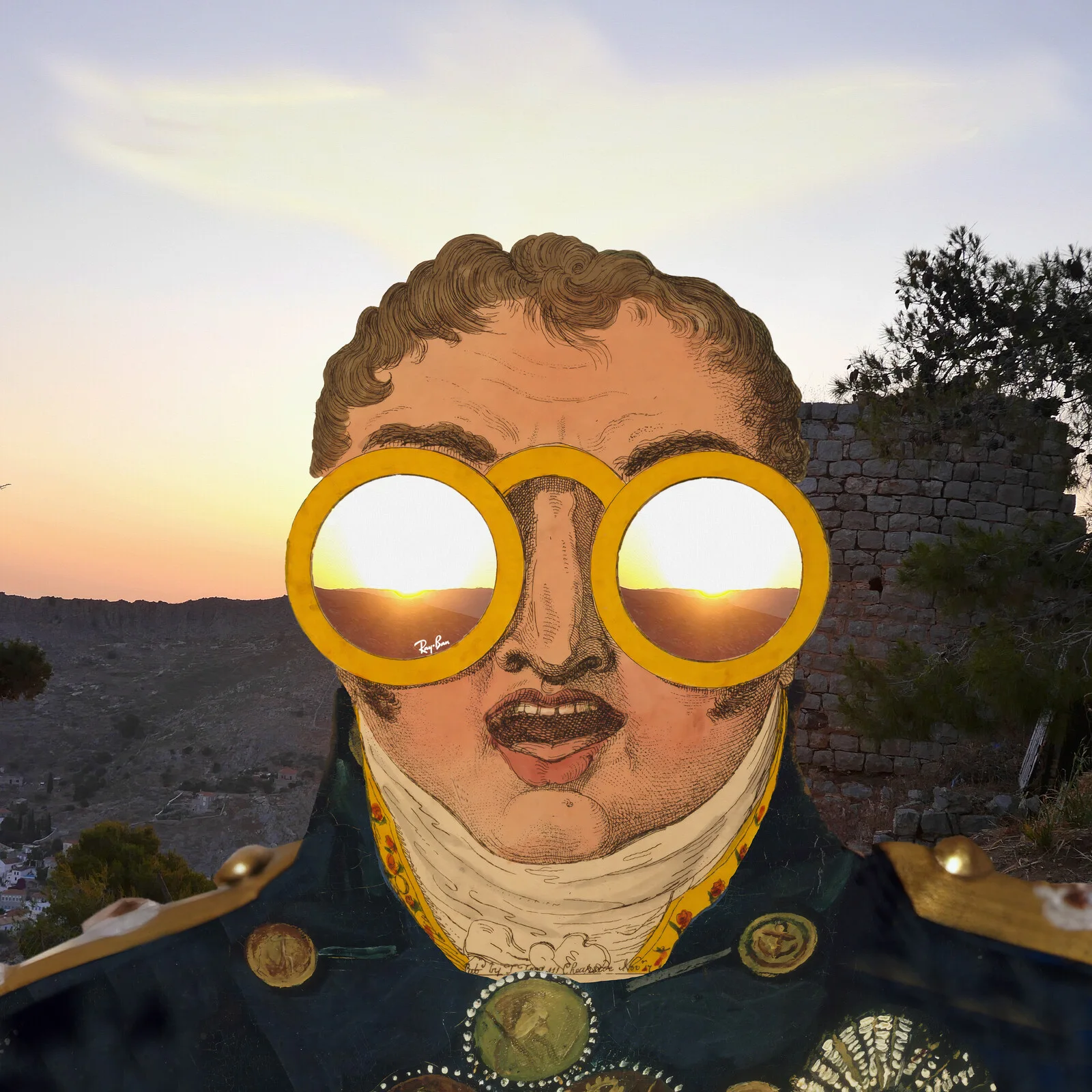
Jörgen Thornberg
Read my face, 2021
Digital
50 x 50 cm
Am I happy? Flabbergasted or just speechless with surprise? For on the man's face, one should be able to see mine. I am talking about states of mind and whether he likes me or not. This is the simplest form of physiognomy, also known as face reading. It interprets a person's character or personality traits from their facial features. It is hard to look grumpy if the person in front of you is happy and laughing. Those of you who see the picture see what I know while he still has his back turned. Guess what I am thinking and let my face reveal it.
Then, there is an equally complex and controversial science or pseudoscience about how a face reveals character. The man in the picture, is he a criminal or an incarnation of Buddha? Give it a try. Neither, actually, but a fictional man from the late 18th century who carried a message in his glasses. He still does, but the message has nothing to do with his character. The picture conveys a clear message. Beauty experiences, so profound and contagious, are hard to hide. One can see the beauty reflected in the man's astonished face. Looking into his eyes, where my thoughts are mirrored, is almost like watching the sunrise in the background. Imagine the anticipation as he turns around to see if he has read my experience correctly. He will not be disappointed. I borrowed his face from George Cruikshank, who died almost a hundred and 150 years ago. He would have loved how I made some changes here and there to his picture, which once protested against high prices. Does the theme sound familiar? After that, I integrated the result into a photo I took early Sunday morning in Hydra at precisely six o'clock.
My pictures, a blend of beauty and intrigue, often contain subtly hidden messages tinged with dark humour. These messages, usually satirical, reflect the societal issues and political climate of the time. This enigmatic quality probably explains my enduring interest in caricatures.
George Cruikshank (1792 – 1878) was a British caricaturist and book illustrator, praised as the "modern Hogarth" during his life. His book illustrations for his friend Charles Dickens and many other authors reached an international audience. He was a busy man in many ways, having fathered 11 illegitimate children with a mistress named Adelaide Attree, his former servant, who lived close to where George lived with his wife. The affair only came to light due to provisions in his will, which left part of his estate to his mistress and their children. Remarkably, he could not only keep his relationship a secret for all these years but also somehow ignore or at least fail to publicly acknowledge his enormous brood of illegitimate children living just down the street from him.
Cruikshank's early career was distinguished by his perceptive social caricatures of English life, which were widely published. His work and that of his contemporary James Gillray continue reverberating today, even after two centuries. When viewed in the context of the society they satirised, their intelligent and vivid strokes still stand firm, a testament to their art's enduring relevance and significance.
How was it now with that face-reading business? Let me introduce you to the topic using literary outliers you might have read.
The Ugliness of Facial Discrimination in Literature
Physiognomy, the supposed art of judging character from facial characteristics, has long fascinated and misled those eager to read moral character and personality from physical appearance. This pseudoscience was particularly influential in the 19th century, profoundly embedding itself into literature and cultural norms. The belief that one's external features could reveal inner virtues or vices became a convenient, albeit flawed, tool for authors to construct their characters, leading to widespread stereotypes and prejudices.
The Hero's Beauty and the Villain's Grotesque
In 19th-century literature, heroes were expected to be good-looking and physically robust, embodying widely accepted ideals of manliness and virtue. Conversely, villains were often depicted with grotesque features, unnatural postures, and physical weaknesses, embodying their moral inferiority. This stylistic cliché became a staple in British literature, helping to justify the hierarchical relationships that ensured the smooth functioning of Britain's extensive empire.
To modern readers, this stylistic trait can be grating. However, its pervasive influence was (and arguably still is) so great that it is impossible to dismiss it as merely an unfortunate legacy of a colonial past. Although views on race and character have evolved, the myth of the handsome hero persists, and there remains a cultural inclination to associate beauty with virtue and ugliness with vice.
Dickens' Gallery of Characters
Charles Dickens extensively used physiognomy to illustrate typical stereotypes in his novels. In "Oliver Twist," published in 1837, the characters' physical appearances provide immediate insights into their moral standings. The criminal Fagin is introduced as a "very old shrivelled Jew, whose villainous-looking and repulsive face was obscured by a quantity of matted red hair." In stark contrast, the hero Oliver is depicted as a "pale, thin child, somewhat diminutive in stature, and decidedly small in circumference." His face, described as a "living copy" of his beautiful mother's, elicits the reader's pity and sympathy. The real villain, Bill Sykes, has a "broad, heavy countenance with a beard of three days' growth, and two scowling eyes, one of which displayed various particoloured symptoms of having been recently damaged by a blow." Nancy, the prostitute with a heart of gold, and her friend Bet are described as "not exactly pretty but have a great deal of colour in their faces, and looked quite stout and hearty."
Dickens's repetitive use of physiognomy is a highly convenient device for a writer with many characters, making it easy for readers to grasp who is good and who is terrible immediately. However, despite its convenience, it reinforces superficial judgments and stereotypes, which can be problematic when uncritically accepted.
Dr Jekyll and Mr Hyde: A Study in Duality
Robert Louis Stevenson's "The Strange Case of Dr. Jekyll and Mr. Hyde," published in 1886, takes physiognomy to another level. In this short novel, Dr Jekyll recognises the "thorough and primitive duality of man" and dreams of finding a way to separate the two sides of his character. Following the logic of countenance, he develops a procedure to do just that and finds his two identities radically different in appearance. Edward Hyde, the evil side of his nature, is smaller, slighter, and younger than Henry Jekyll. While good shines upon the countenance of one, evil is written on the face of the other. This transformation is evident to all who encounter Hyde, with the lawyer Utterson remarking, "There was something abnormal and misbegotten in the very essence of the creature that now faced me - something seizing, surprising and revolting."
At first, Dr. Jekyll enjoys the separation of his two alter egos, following the idealism of his theory: "If each could but be housed in separate identities, life would be relieved of all that was unbearable: the unjust might go his way, delivered from the aspirations and remorse of his more upright twin; and the just could walk steadfastly and securely on the upward path, doing the good things in which he found his pleasure, and no longer exposed to disgrace and penitence by the hands of this extraneous evil."
Gradually, however, the evil side of his character takes over, and his appearance duly changes to embody his moral decay. The horror of this transformation is condensed in a scene in which Dr. Jekyll, waking from a nap, looks at his hand. His hand was "professional in shape and size; it was large, firm, white and comely." However, he sees something entirely different when he wakes up: a hand that is "lean, corded, knuckly, of a dusky pallor, and thickly shaded with a swart growth of hair." The story ends with Dr. Jekyll's suicide, providing an appropriate moral ending for Victorian readers. To surrender so entirely to the temptations of moral depravity can have but one outcome: it is a sin that leaves an indelible and immediately recognisable mark on its practitioner, leading inevitably to a horrifying death.
The Picture of Dorian Gray: Beauty and Depravity
Oscar Wilde's "The Picture of Dorian Gray," first published in 1891, explores the relationship between outward appearance and inner morality differently. Dorian Gray remains young and beautiful despite years of corruption and evil, while a portrait of him ages and decays. Wilde uses Dorian and his portrait to challenge the notion that physical beauty equates to moral goodness. Dorian's reputation suffers as his excesses become known, yet his appearance remains unchanged, belying the life he is leading.
When the artist Basil sees the hideous face on the canvas, he is horrified at what it reveals about his friend. Dorian ultimately murders Basil and, unable to stand the sight of his portrait, slashes it with a knife, killing himself in the process. His body is withered, wrinkled, and loathsome of visage, providing a dramatic moral ending. This dramatic ending was meant to be suitably moral but did not satisfy the prudish public as Stevenson's ending did. Condemned as an immoral work, it was used against Wilde when he brought a libel action against the Marquis of Queensberry, contributing to his conviction and two-year prison sentence for immoral acts (i.e., homosexuality). As Peter Ackroyd remarks in his introduction to the novel, the publication of "Dorian Gray" marked the first stage in Wilde's long descent into open scandal and eventual infamy, as he "did not realise that it was [so] self-revealing."
Sir Percival and the Lion: Knightly Judgments
The story of Sir Percival, one of King Arthur's knights, presents another example of physiognomy in literature. Riding through a forest, Sir Percival finds a lion fighting with a serpent. He draws his sword and helps the lion, believing it to be the more natural beast of the two. Based solely on appearance, this judgment reflects the ingrained belief that specific physical characteristics indicate moral qualities. In this case, the lion's noble appearance contrasts with the serpent's sinister, leading Sir Percival to decide which creature to aid.
Punch and King Theodore: Colonial Caricatures
In the Abyssinian crisis of 1868, the satirical magazine "Punch" depicted King Theodore in cartoons as a primitive savage, demanding that he be captured and exhibited in a cage like a gorilla. This portrayal reinforced colonial attitudes towards non-Western peoples, presenting them as grotesque and inferior. Such caricatures legitimised colonial conquests and the suppression of other cultures by portraying colonised peoples as less than human. This racist depiction of King Theodore exemplifies how physiognomy was used to justify imperial domination and the dehumanisation of other races.
Mr. Kelada: Challenging Racial Prejudices
Somerset Maugham's short story "Mr. Know-All," published in 1921, effectively undermines the prejudices embodied by physiognomy. Set on an ocean liner travelling from San Francisco to Yokohama, the narrator, prejudiced against Mr Kelada from the start, finds fault with everything about him. Mr. Kelada's swarthy complexion, hooked nose, and exuberant gestures mark him as an outsider. Despite being knowledgeable and friendly, he becomes the best-hated man on the ship.
The story's climax revolves around a bet over the authenticity of Mrs. Ramsay's pearl necklace. Mr Kelada, an expert on pearls, realises the necklace is genuine but, seeing Mrs Ramsay's distress, declares it an excellent imitation to save her from embarrassment. This act of kindness exposes the narrator's and the readers' prejudices, forcing them to reassess their assumptions about character and appearance. The story reveals how deeply ingrained prejudices can distort perceptions and judgments.
Crawfurd and Henriques: The Ugly Serpent
In John Buchan's adventure novel "Prester John" (1910), the hero David Crawford immediately dislikes Henriques, a fellow passenger, based solely on his appearance. Henriques is described as having a face the colour of mustard, bloodshot eyes, and a sneaky way of walking. Crawfurd's prejudice is evident in his descriptions, contrasting sharply with his admiration for the noble black Reverend Laputa, the leader of the native uprising. Despite recognising Laputa as an enemy, Crawfurd cannot hide his respect for his noble form and Roman emperor-like face.
Crawfurd's prejudice towards Henriques, whom he describes as a "yellow devil" and a "traitor to his race," highlights the deep-seated racial biases that informed British colonial attitudes. Laputa, in contrast, is seen as a noble enemy, reinforcing the idea that appearance dictates character and moral worth. This contrast between the descriptions of Henriques and Laputa underscores the hypocrisy and superficiality of physiognomy as a means of judgment.
The Hypocrisy of Physiognomy
The fallacy of physiognomy played a significant role in the narrative of the British Empire. It started as a stylistic device but developed into a tool that reinforced the myths of colonial hierarchies. Authors wanting to sell books could not afford to offend one of their public's most dearly held beliefs. However, Maugham's "Mr Know-All" successfully exposes the literary device of physiognomy as a perpetrator of unjust political and social hierarchies. The story reveals the narrator's prejudice and forces readers to confront their assumptions about character and appearance.
The Legacy of Physiognomy
The use of physiognomy in literature reflects a time when outward appearances were believed to reveal inner truths. We recognise this as a pseudoscience today, but its influence on past literature and society provides valuable insights into historical attitudes and prejudices. By studying its use in works by authors like Dickens, Stevenson, Wilde, and Maugham, we understand how perceptions of identity and morality have evolved. Despite its fallacies, physiognomy remains a fascinating aspect of literary history, revealing much about the cultural and social dynamics of the past.
My essay aims to comprehensively explore the use of physiognomy in literature, incorporating some rich examples and anecdotes from the original material. It highlights how authors used physical appearance to convey character and morality, reflecting and reinforcing societal prejudices. Examining specific works and characters underscores physiognomy's enduring influence and problematic nature in literary and cultural contexts.
Hitler practised every facial expression for days and weeks, and his mastery of mimicry is considered one of the reasons he could deceive his people. A modern master is Mr. Trump in the USA. Voters are indeed sensitive to how politicians look and their facial expressions. One who fared poorly was Nixon, who looked worn and glum, with a five o'clock shadow, when one isn't freshly shaven. He fell short in the debate against Kennedy regardless of what he said or stood for. It might be time to examine the scientific perspective on the issue.
The Evolution and Impact of Physiognomy: A Historical and Cultural Analysis
Face reading, or physiognomy, is a fascinating practice that spans cultures and epochs, merging the mystical with the empirical in ways that continue to captivate the human imagination. This ancient art asserts that one's character and fate can be discerned through the analysis of facial features. Here, we delve into a lively exploration of face reading across different cultures, particularly comparing Eastern practices with their Western counterparts and even taking a whimsical glance at how animals might perceive each other.
Eastern Traditions: Chinese and Japanese Physiognomy
In China, the art of face reading, known as 'Mian Xiang', has deep roots stretching back thousands of years. It's intertwined with Taoist philosophy and traditional Chinese medicine, emphasising the belief in Qi or life force. According to Chinese physiognomy, every facial feature has significance. For example, broad foreheads are associated with intelligence and ambition, while large ears suggest longevity. The Chinese might also interpret the balance of the yin and yang energies in one's face to predict their fortune and health.
Although Chinese practices influence Japanese face reading, the approach has nuances. It often focuses more on the person's "Honmei," a term that reflects one's true nature hidden behind the "Tatemae," the public face. This duality of expression is fundamental in Japanese social interactions and can be subtly read in the micro-expressions that betray one's true feelings.
Western Perspectives: From Lavater to Modern Psychology
Swiss pastor Johann Kaspar Lavater pioneered modern physiognomy in the West in the 18th century. He proposed that moral character was discernible through anatomy, particularly facial features. Although his theories don't hold much scientific credence today, they paved the way for later psychological studies into how we perceive faces. Today, rather than reading faces to tell the future or judge character, Western practices focus on understanding expressions and micro-expressions as gateways to deciphering emotions and intentions. This psychological approach is less about fate and more about immediate interpersonal communication.
Animals and Face Reading
While it's fun to imagine animals practising face reading, what exists in the animal kingdom is an automatic response to visual cues. Animals do not read faces to predict character or destiny, but they are adept at reading signals that indicate mood, aggression, or submission. For instance, a dog might show its teeth not only as a sign of aggression but also as a nervous smile, a signal understood by other dogs. Similarly, primates are known for their expressive faces and ability to communicate through facial expressions.
The Infectious Nature of Faces
Regardless of culture, faces have a universal language that can spread emotions contagiously. A smile or a frown can be infectious, transmitting feelings from one individual to another and transcending language and cultural barriers. This phenomenon is rooted in what psychologists call "emotional contagion," a form of mimicry where we unconsciously copy the facial expressions we see, which then influences our emotions.
Historical Context: Physiognomy from Antiquity to the Renaissance
Physiognomy has a long and varied history, beginning with the ancient Greeks. Pythagoras is said to have "physiognomised" his students, assessing their character based on their facial features. This practice was seen as a way to understand one's personality and potential. The theory served a dual purpose: diagnosing illness, delineating character, and establishing a method of divination based on physical appearance.
In the Renaissance, the Italian polymath Giambattista della Porta legitimised physiognomy as a product of natural science in his book "De Humana Physiognomonia." He presented illustrations of humans and the animals they resembled side-by-side, using exaggerated features to prove his point. These drawings are considered some of the earliest forms of caricature in human society.
Physiognomy and Scientific Racism
Physiognomy peaked in the 18th and 19th centuries, influencing various scientific fields. Johann Kaspar Lavater's massive four-volume work on physiognomy argued that physical beauty indicated moral beauty. He believed one could better love one's neighbour by classifying them according to facial features.
However, the application of physiognomy took a darker turn with the rise of scientific racism and eugenics. Physical anthropologists used measurements of the face, skull, and body to define race, correlating these characteristics with intelligence and moral character. Francis Galton, a cousin of Charles Darwin, introduced physiognomy into modern eugenics, using it to appraise character and assign intelligence and morality. An Italian physician, Cesare Lombroso, argued that criminals could be identified by their facial features, claiming they were evolutionary throwbacks closer to apes than humans.
Modern Rejection and Legacy of Physiognomy
By the latter half of the 20th century, physiognomy, scientific racism, and eugenics had been mainly debunked as harmful pseudoscience. Modern science has discarded the more problematic aspects of countenance, but efforts to gain information from human physical characteristics continue with contemporary technologies that gather and interpret bodily data.
Artificial intelligence and computer science technologies involving the human face can identify a person, infer one's emotions and biases, and uncover information about one's health. These approaches apply cutting-edge techniques to an age-old pursuit: to learn about a person's inner workings from their outward appearance. In the past, physiognomy sought to achieve a similar goal, though often misguided.
From Divination to Discipline: The Evolution of Physiognomy
Physiognomy developed in ancient Greece, transforming from a form of fortune-telling into a method for determining character. Classical Greek philosophers and physicians believed in symmetry between the soul and the body, aligning their views with humoral theory, which asserted that the balance of four bodily fluids dictated physical condition and temperament.
By the 16th century, physiognomy had been dismissed as occult. Scholars sought to re-establish it as a legitimate practice, referring to ancient Greek texts to inform their work. They demonstrated the merits of physiognomy in illustrated treatises, systematised its fundamental principles, and engaged in scholarly debates and academic lectures.
Physiognomy in Modern Times: A Persistent Fascination
Despite it causing disbelief, physiognomy continues to influence modern perceptions. Studies have found some correlation between facial features and personality traits such as extroversion and conscientiousness. For example, men with higher testosterone levels tend to have more masculine faces, which might be associated with aggression. These snap judgments can become self-fulfilling prophecies, where societal expectations shape behaviour and personality.
In conclusion, face reading traverses a rich landscape of cultural beliefs and scientific studies. Whether through the mystical interpretations of the East or the empirical analyses of the West, the face continues to be a profound canvas for human emotion and character. And while animals may not interpret faces with the same depth of symbolism as humans, their interactions remind us that the face is a powerful communicator across all species. Face reading, in all its forms, highlights a universal fascination with the human face as a mirror of the mind and soul.
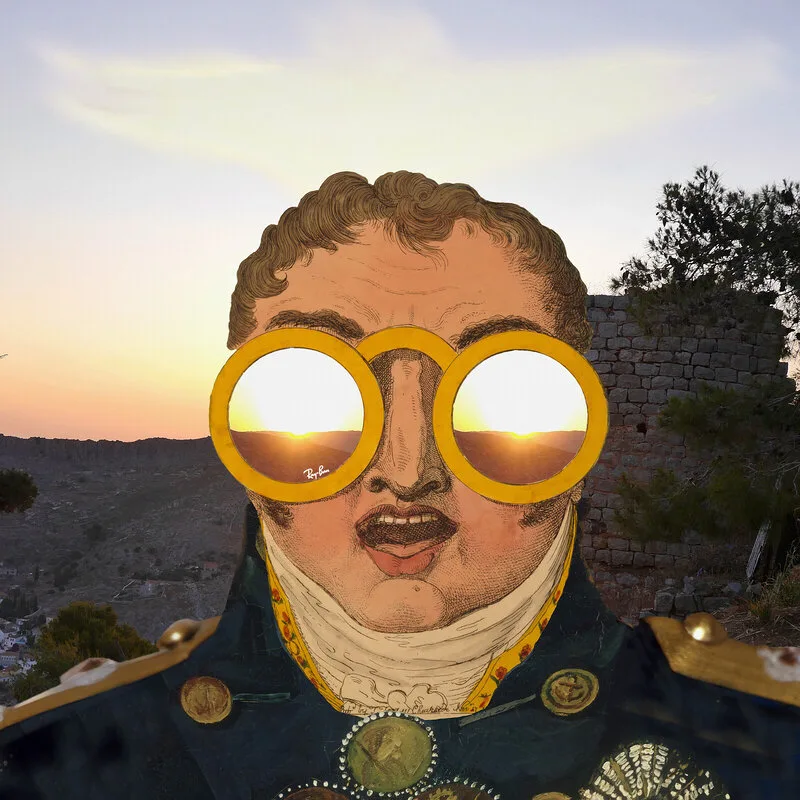
Jörgen Thornberg
Read my face, 2021
Digital
50 x 50 cm
Am I happy? Flabbergasted or just speechless with surprise? For on the man's face, one should be able to see mine. I am talking about states of mind and whether he likes me or not. This is the simplest form of physiognomy, also known as face reading. It interprets a person's character or personality traits from their facial features. It is hard to look grumpy if the person in front of you is happy and laughing. Those of you who see the picture see what I know while he still has his back turned. Guess what I am thinking and let my face reveal it.
Then, there is an equally complex and controversial science or pseudoscience about how a face reveals character. The man in the picture, is he a criminal or an incarnation of Buddha? Give it a try. Neither, actually, but a fictional man from the late 18th century who carried a message in his glasses. He still does, but the message has nothing to do with his character. The picture conveys a clear message. Beauty experiences, so profound and contagious, are hard to hide. One can see the beauty reflected in the man's astonished face. Looking into his eyes, where my thoughts are mirrored, is almost like watching the sunrise in the background. Imagine the anticipation as he turns around to see if he has read my experience correctly. He will not be disappointed. I borrowed his face from George Cruikshank, who died almost a hundred and 150 years ago. He would have loved how I made some changes here and there to his picture, which once protested against high prices. Does the theme sound familiar? After that, I integrated the result into a photo I took early Sunday morning in Hydra at precisely six o'clock.
My pictures, a blend of beauty and intrigue, often contain subtly hidden messages tinged with dark humour. These messages, usually satirical, reflect the societal issues and political climate of the time. This enigmatic quality probably explains my enduring interest in caricatures.
George Cruikshank (1792 – 1878) was a British caricaturist and book illustrator, praised as the "modern Hogarth" during his life. His book illustrations for his friend Charles Dickens and many other authors reached an international audience. He was a busy man in many ways, having fathered 11 illegitimate children with a mistress named Adelaide Attree, his former servant, who lived close to where George lived with his wife. The affair only came to light due to provisions in his will, which left part of his estate to his mistress and their children. Remarkably, he could not only keep his relationship a secret for all these years but also somehow ignore or at least fail to publicly acknowledge his enormous brood of illegitimate children living just down the street from him.
Cruikshank's early career was distinguished by his perceptive social caricatures of English life, which were widely published. His work and that of his contemporary James Gillray continue reverberating today, even after two centuries. When viewed in the context of the society they satirised, their intelligent and vivid strokes still stand firm, a testament to their art's enduring relevance and significance.
How was it now with that face-reading business? Let me introduce you to the topic using literary outliers you might have read.
The Ugliness of Facial Discrimination in Literature
Physiognomy, the supposed art of judging character from facial characteristics, has long fascinated and misled those eager to read moral character and personality from physical appearance. This pseudoscience was particularly influential in the 19th century, profoundly embedding itself into literature and cultural norms. The belief that one's external features could reveal inner virtues or vices became a convenient, albeit flawed, tool for authors to construct their characters, leading to widespread stereotypes and prejudices.
The Hero's Beauty and the Villain's Grotesque
In 19th-century literature, heroes were expected to be good-looking and physically robust, embodying widely accepted ideals of manliness and virtue. Conversely, villains were often depicted with grotesque features, unnatural postures, and physical weaknesses, embodying their moral inferiority. This stylistic cliché became a staple in British literature, helping to justify the hierarchical relationships that ensured the smooth functioning of Britain's extensive empire.
To modern readers, this stylistic trait can be grating. However, its pervasive influence was (and arguably still is) so great that it is impossible to dismiss it as merely an unfortunate legacy of a colonial past. Although views on race and character have evolved, the myth of the handsome hero persists, and there remains a cultural inclination to associate beauty with virtue and ugliness with vice.
Dickens' Gallery of Characters
Charles Dickens extensively used physiognomy to illustrate typical stereotypes in his novels. In "Oliver Twist," published in 1837, the characters' physical appearances provide immediate insights into their moral standings. The criminal Fagin is introduced as a "very old shrivelled Jew, whose villainous-looking and repulsive face was obscured by a quantity of matted red hair." In stark contrast, the hero Oliver is depicted as a "pale, thin child, somewhat diminutive in stature, and decidedly small in circumference." His face, described as a "living copy" of his beautiful mother's, elicits the reader's pity and sympathy. The real villain, Bill Sykes, has a "broad, heavy countenance with a beard of three days' growth, and two scowling eyes, one of which displayed various particoloured symptoms of having been recently damaged by a blow." Nancy, the prostitute with a heart of gold, and her friend Bet are described as "not exactly pretty but have a great deal of colour in their faces, and looked quite stout and hearty."
Dickens's repetitive use of physiognomy is a highly convenient device for a writer with many characters, making it easy for readers to grasp who is good and who is terrible immediately. However, despite its convenience, it reinforces superficial judgments and stereotypes, which can be problematic when uncritically accepted.
Dr Jekyll and Mr Hyde: A Study in Duality
Robert Louis Stevenson's "The Strange Case of Dr. Jekyll and Mr. Hyde," published in 1886, takes physiognomy to another level. In this short novel, Dr Jekyll recognises the "thorough and primitive duality of man" and dreams of finding a way to separate the two sides of his character. Following the logic of countenance, he develops a procedure to do just that and finds his two identities radically different in appearance. Edward Hyde, the evil side of his nature, is smaller, slighter, and younger than Henry Jekyll. While good shines upon the countenance of one, evil is written on the face of the other. This transformation is evident to all who encounter Hyde, with the lawyer Utterson remarking, "There was something abnormal and misbegotten in the very essence of the creature that now faced me - something seizing, surprising and revolting."
At first, Dr. Jekyll enjoys the separation of his two alter egos, following the idealism of his theory: "If each could but be housed in separate identities, life would be relieved of all that was unbearable: the unjust might go his way, delivered from the aspirations and remorse of his more upright twin; and the just could walk steadfastly and securely on the upward path, doing the good things in which he found his pleasure, and no longer exposed to disgrace and penitence by the hands of this extraneous evil."
Gradually, however, the evil side of his character takes over, and his appearance duly changes to embody his moral decay. The horror of this transformation is condensed in a scene in which Dr. Jekyll, waking from a nap, looks at his hand. His hand was "professional in shape and size; it was large, firm, white and comely." However, he sees something entirely different when he wakes up: a hand that is "lean, corded, knuckly, of a dusky pallor, and thickly shaded with a swart growth of hair." The story ends with Dr. Jekyll's suicide, providing an appropriate moral ending for Victorian readers. To surrender so entirely to the temptations of moral depravity can have but one outcome: it is a sin that leaves an indelible and immediately recognisable mark on its practitioner, leading inevitably to a horrifying death.
The Picture of Dorian Gray: Beauty and Depravity
Oscar Wilde's "The Picture of Dorian Gray," first published in 1891, explores the relationship between outward appearance and inner morality differently. Dorian Gray remains young and beautiful despite years of corruption and evil, while a portrait of him ages and decays. Wilde uses Dorian and his portrait to challenge the notion that physical beauty equates to moral goodness. Dorian's reputation suffers as his excesses become known, yet his appearance remains unchanged, belying the life he is leading.
When the artist Basil sees the hideous face on the canvas, he is horrified at what it reveals about his friend. Dorian ultimately murders Basil and, unable to stand the sight of his portrait, slashes it with a knife, killing himself in the process. His body is withered, wrinkled, and loathsome of visage, providing a dramatic moral ending. This dramatic ending was meant to be suitably moral but did not satisfy the prudish public as Stevenson's ending did. Condemned as an immoral work, it was used against Wilde when he brought a libel action against the Marquis of Queensberry, contributing to his conviction and two-year prison sentence for immoral acts (i.e., homosexuality). As Peter Ackroyd remarks in his introduction to the novel, the publication of "Dorian Gray" marked the first stage in Wilde's long descent into open scandal and eventual infamy, as he "did not realise that it was [so] self-revealing."
Sir Percival and the Lion: Knightly Judgments
The story of Sir Percival, one of King Arthur's knights, presents another example of physiognomy in literature. Riding through a forest, Sir Percival finds a lion fighting with a serpent. He draws his sword and helps the lion, believing it to be the more natural beast of the two. Based solely on appearance, this judgment reflects the ingrained belief that specific physical characteristics indicate moral qualities. In this case, the lion's noble appearance contrasts with the serpent's sinister, leading Sir Percival to decide which creature to aid.
Punch and King Theodore: Colonial Caricatures
In the Abyssinian crisis of 1868, the satirical magazine "Punch" depicted King Theodore in cartoons as a primitive savage, demanding that he be captured and exhibited in a cage like a gorilla. This portrayal reinforced colonial attitudes towards non-Western peoples, presenting them as grotesque and inferior. Such caricatures legitimised colonial conquests and the suppression of other cultures by portraying colonised peoples as less than human. This racist depiction of King Theodore exemplifies how physiognomy was used to justify imperial domination and the dehumanisation of other races.
Mr. Kelada: Challenging Racial Prejudices
Somerset Maugham's short story "Mr. Know-All," published in 1921, effectively undermines the prejudices embodied by physiognomy. Set on an ocean liner travelling from San Francisco to Yokohama, the narrator, prejudiced against Mr Kelada from the start, finds fault with everything about him. Mr. Kelada's swarthy complexion, hooked nose, and exuberant gestures mark him as an outsider. Despite being knowledgeable and friendly, he becomes the best-hated man on the ship.
The story's climax revolves around a bet over the authenticity of Mrs. Ramsay's pearl necklace. Mr Kelada, an expert on pearls, realises the necklace is genuine but, seeing Mrs Ramsay's distress, declares it an excellent imitation to save her from embarrassment. This act of kindness exposes the narrator's and the readers' prejudices, forcing them to reassess their assumptions about character and appearance. The story reveals how deeply ingrained prejudices can distort perceptions and judgments.
Crawfurd and Henriques: The Ugly Serpent
In John Buchan's adventure novel "Prester John" (1910), the hero David Crawford immediately dislikes Henriques, a fellow passenger, based solely on his appearance. Henriques is described as having a face the colour of mustard, bloodshot eyes, and a sneaky way of walking. Crawfurd's prejudice is evident in his descriptions, contrasting sharply with his admiration for the noble black Reverend Laputa, the leader of the native uprising. Despite recognising Laputa as an enemy, Crawfurd cannot hide his respect for his noble form and Roman emperor-like face.
Crawfurd's prejudice towards Henriques, whom he describes as a "yellow devil" and a "traitor to his race," highlights the deep-seated racial biases that informed British colonial attitudes. Laputa, in contrast, is seen as a noble enemy, reinforcing the idea that appearance dictates character and moral worth. This contrast between the descriptions of Henriques and Laputa underscores the hypocrisy and superficiality of physiognomy as a means of judgment.
The Hypocrisy of Physiognomy
The fallacy of physiognomy played a significant role in the narrative of the British Empire. It started as a stylistic device but developed into a tool that reinforced the myths of colonial hierarchies. Authors wanting to sell books could not afford to offend one of their public's most dearly held beliefs. However, Maugham's "Mr Know-All" successfully exposes the literary device of physiognomy as a perpetrator of unjust political and social hierarchies. The story reveals the narrator's prejudice and forces readers to confront their assumptions about character and appearance.
The Legacy of Physiognomy
The use of physiognomy in literature reflects a time when outward appearances were believed to reveal inner truths. We recognise this as a pseudoscience today, but its influence on past literature and society provides valuable insights into historical attitudes and prejudices. By studying its use in works by authors like Dickens, Stevenson, Wilde, and Maugham, we understand how perceptions of identity and morality have evolved. Despite its fallacies, physiognomy remains a fascinating aspect of literary history, revealing much about the cultural and social dynamics of the past.
My essay aims to comprehensively explore the use of physiognomy in literature, incorporating some rich examples and anecdotes from the original material. It highlights how authors used physical appearance to convey character and morality, reflecting and reinforcing societal prejudices. Examining specific works and characters underscores physiognomy's enduring influence and problematic nature in literary and cultural contexts.
Hitler practised every facial expression for days and weeks, and his mastery of mimicry is considered one of the reasons he could deceive his people. A modern master is Mr. Trump in the USA. Voters are indeed sensitive to how politicians look and their facial expressions. One who fared poorly was Nixon, who looked worn and glum, with a five o'clock shadow, when one isn't freshly shaven. He fell short in the debate against Kennedy regardless of what he said or stood for. It might be time to examine the scientific perspective on the issue.
The Evolution and Impact of Physiognomy: A Historical and Cultural Analysis
Face reading, or physiognomy, is a fascinating practice that spans cultures and epochs, merging the mystical with the empirical in ways that continue to captivate the human imagination. This ancient art asserts that one's character and fate can be discerned through the analysis of facial features. Here, we delve into a lively exploration of face reading across different cultures, particularly comparing Eastern practices with their Western counterparts and even taking a whimsical glance at how animals might perceive each other.
Eastern Traditions: Chinese and Japanese Physiognomy
In China, the art of face reading, known as 'Mian Xiang', has deep roots stretching back thousands of years. It's intertwined with Taoist philosophy and traditional Chinese medicine, emphasising the belief in Qi or life force. According to Chinese physiognomy, every facial feature has significance. For example, broad foreheads are associated with intelligence and ambition, while large ears suggest longevity. The Chinese might also interpret the balance of the yin and yang energies in one's face to predict their fortune and health.
Although Chinese practices influence Japanese face reading, the approach has nuances. It often focuses more on the person's "Honmei," a term that reflects one's true nature hidden behind the "Tatemae," the public face. This duality of expression is fundamental in Japanese social interactions and can be subtly read in the micro-expressions that betray one's true feelings.
Western Perspectives: From Lavater to Modern Psychology
Swiss pastor Johann Kaspar Lavater pioneered modern physiognomy in the West in the 18th century. He proposed that moral character was discernible through anatomy, particularly facial features. Although his theories don't hold much scientific credence today, they paved the way for later psychological studies into how we perceive faces. Today, rather than reading faces to tell the future or judge character, Western practices focus on understanding expressions and micro-expressions as gateways to deciphering emotions and intentions. This psychological approach is less about fate and more about immediate interpersonal communication.
Animals and Face Reading
While it's fun to imagine animals practising face reading, what exists in the animal kingdom is an automatic response to visual cues. Animals do not read faces to predict character or destiny, but they are adept at reading signals that indicate mood, aggression, or submission. For instance, a dog might show its teeth not only as a sign of aggression but also as a nervous smile, a signal understood by other dogs. Similarly, primates are known for their expressive faces and ability to communicate through facial expressions.
The Infectious Nature of Faces
Regardless of culture, faces have a universal language that can spread emotions contagiously. A smile or a frown can be infectious, transmitting feelings from one individual to another and transcending language and cultural barriers. This phenomenon is rooted in what psychologists call "emotional contagion," a form of mimicry where we unconsciously copy the facial expressions we see, which then influences our emotions.
Historical Context: Physiognomy from Antiquity to the Renaissance
Physiognomy has a long and varied history, beginning with the ancient Greeks. Pythagoras is said to have "physiognomised" his students, assessing their character based on their facial features. This practice was seen as a way to understand one's personality and potential. The theory served a dual purpose: diagnosing illness, delineating character, and establishing a method of divination based on physical appearance.
In the Renaissance, the Italian polymath Giambattista della Porta legitimised physiognomy as a product of natural science in his book "De Humana Physiognomonia." He presented illustrations of humans and the animals they resembled side-by-side, using exaggerated features to prove his point. These drawings are considered some of the earliest forms of caricature in human society.
Physiognomy and Scientific Racism
Physiognomy peaked in the 18th and 19th centuries, influencing various scientific fields. Johann Kaspar Lavater's massive four-volume work on physiognomy argued that physical beauty indicated moral beauty. He believed one could better love one's neighbour by classifying them according to facial features.
However, the application of physiognomy took a darker turn with the rise of scientific racism and eugenics. Physical anthropologists used measurements of the face, skull, and body to define race, correlating these characteristics with intelligence and moral character. Francis Galton, a cousin of Charles Darwin, introduced physiognomy into modern eugenics, using it to appraise character and assign intelligence and morality. An Italian physician, Cesare Lombroso, argued that criminals could be identified by their facial features, claiming they were evolutionary throwbacks closer to apes than humans.
Modern Rejection and Legacy of Physiognomy
By the latter half of the 20th century, physiognomy, scientific racism, and eugenics had been mainly debunked as harmful pseudoscience. Modern science has discarded the more problematic aspects of countenance, but efforts to gain information from human physical characteristics continue with contemporary technologies that gather and interpret bodily data.
Artificial intelligence and computer science technologies involving the human face can identify a person, infer one's emotions and biases, and uncover information about one's health. These approaches apply cutting-edge techniques to an age-old pursuit: to learn about a person's inner workings from their outward appearance. In the past, physiognomy sought to achieve a similar goal, though often misguided.
From Divination to Discipline: The Evolution of Physiognomy
Physiognomy developed in ancient Greece, transforming from a form of fortune-telling into a method for determining character. Classical Greek philosophers and physicians believed in symmetry between the soul and the body, aligning their views with humoral theory, which asserted that the balance of four bodily fluids dictated physical condition and temperament.
By the 16th century, physiognomy had been dismissed as occult. Scholars sought to re-establish it as a legitimate practice, referring to ancient Greek texts to inform their work. They demonstrated the merits of physiognomy in illustrated treatises, systematised its fundamental principles, and engaged in scholarly debates and academic lectures.
Physiognomy in Modern Times: A Persistent Fascination
Despite it causing disbelief, physiognomy continues to influence modern perceptions. Studies have found some correlation between facial features and personality traits such as extroversion and conscientiousness. For example, men with higher testosterone levels tend to have more masculine faces, which might be associated with aggression. These snap judgments can become self-fulfilling prophecies, where societal expectations shape behaviour and personality.
In conclusion, face reading traverses a rich landscape of cultural beliefs and scientific studies. Whether through the mystical interpretations of the East or the empirical analyses of the West, the face continues to be a profound canvas for human emotion and character. And while animals may not interpret faces with the same depth of symbolism as humans, their interactions remind us that the face is a powerful communicator across all species. Face reading, in all its forms, highlights a universal fascination with the human face as a mirror of the mind and soul.

Jörgen Thornberg
Malmö
Lite om bilder och mig. Translation in English at the end.
Jag är en nyfiken person som ser allt i bilder, även det jag fäster i ord, gärna tillsammans för bakom alla mina bilder finns en berättelse. Till vissa bilder hör en kortare eller längre novell som följer med bilden.
Bilder berättar historier. Jag omges av naturlig skönhet, intressanta människor och historia var jag än går. Jag använder min kamera för att dokumentera världen och blanda det jag ser med vad jag känner för att fånga den dolda magin.
Mina bilder berättar mina historier. Genom mina bilder, tryck och berättelser. Jag bjuder in dig att ta del av dessa berättelser, in i ditt liv och hem och dela min mycket personliga syn på vår värld. Mer än vad ögat ser. Jag tänker i bilder, drömmer och skriver och pratar om dem; följaktligen måste jag också skapa bilder. De blir vad jag ser, inte nödvändigtvis begränsade till verkligheten. Det finns en bild runt varje hörn. Jag hoppas att du kommer att se vad jag såg och gilla det.
Jag är också en skrivande person och till många bilder hör en kortare eller längre essay. Den följer med tavlan, tryckt på fint papper och med en personlig hälsning från mig.
Flertalet bilder startar sin resa i min kamera. Enkelt förklarat beskriver jag bilden jag ser i mitt inre, upplevd eller fantiserad. Bilden uppstår inom mig redan innan jag fått okularet till ögat. På bråkdelen av ett ögonblick ser jag vad jag vill ha och vad som kan göras med bilden. Här skall jag stoppa in en giraff, stålmannen, Titanic eller vad det är min fantasi finner ut. Ännu märkligare är att jag kommer ihåg minnesbilden långt efteråt när det blir tid att skapa verket. Om jag lyckas eller inte, är upp till betraktaren, oftast präglat av en stråk av svart humor – meningen är att man skall bli underhållen. Mina bilder blir ofta en snackis där de hänger.
Jag föredrar bilder som förmedlar ett budskap i flera lager. Vid första anblicken fylld av feel-good, en vacker utsikt, fint väder, solen skiner, blommor på ängen eller vattnet som ligger förrädiskt spegelblankt. I en sådan bild kan jag gömma min egentliga berättelse, mitt förakt för förtryckare och våldsverkare, rasister och fördomsfulla människor - ett gärna återkommande motiv mer eller mindre dolt i det vackra motivet. Jag försöker förena dem i ett gemensamt narrativ.
Bild och formgivning har löpt som en röd tråd genom livet. Fotokonst känns som en värdig final som jag gärna delar med mig.
Min genre är vid som framgår av mina bilder, temat en blandning av pop- och gatukonst i kollage som kan bestå av hundratals lager. Vissa bilder kan ta veckor, andra någon dag innan det är dags att överlämna resultatet till printverkstaden. Fine Art Prints är digitala fotocollage. I dessa kollage sker rivandet, klippandet, pusslandet, målandet, ritandet och sprayningen digitalt. Det jag monterar in kan vara hundratals år gamla bilder som jag omsorgsfullt frilägger så att de ser ut att vara en del av tavlan men också bilder skapade av mig själv efter min egen fantasi. Därefter besöks printstudion och för vissa bilder numrera en limiterad upplaga (oftast 7 exemplar) och signera för hand. Vissa bilder kan köpas i olika format. Det är bara att fråga efter vilka. Gillar man en bild som är 70x100 men inte har plats på väggen, går den kanske att få i 50x70 cm istället. Frågan är fri.
Metoden Giclée eller Fine Art Print som det också kallas är det moderna sättet för framställning av grafisk konst. Villkoret för denna typ av utskrifter är att en högkvalitativ storformatskrivare används med åldersbeständigt färgpigment och konstnärspapper eller i förekommande fall på duk. Pappret som används möter de krav på livslängd som ställs av museer och gallerier. Normalt säljer jag mina bilder oinramade så att den nya ägaren själv kan bestämma hur de skall se ut, med eller utan passepartout färg på ram, med eller utan glas etc..
Under många år ställde jag bara ut på nätet, i valda grupper och på min egen Facebooksida - https://www.facebook.com/jorgen.thornberg.9
Jag finns också på en egen hemsida som tyvärr inte alltid är uppdaterad – https://www.jth.life/ Där kan du också läsa en del av de berättelser som följer med bilden.
UTSTÄLLNINGAR
Luftkastellet, oktober 2022
Konst i Lund, november 2022
Luftkastellet, mars 2023
Engleson Galleri Caroli, april 2023
Hydra, Greece June 2023
Engleson Galleri Caroli, oktober 2023
Toppen, Höllviken december 2023
Luftkastellet, mars 2024
Torups Galleri, mars 2024
Venice, May 2024
Luftkastellet, oktober 2024
Konst i Advent, December 2024
Galleri Engleson, Caroli December 2024
Jäger & Jansson Galleri, april 2025
A bit about pictures and me.
I'm a curious person who sees everything in pictures, even what I express in words, often combining them, for behind all my pictures lies a story. These narratives, some as short as a single image and others as long as a novel, are the heart and soul of my work.
Pictures tell stories. Wherever I go, I'm surrounded by natural beauty, exciting people, and history. I use my camera to document the world and blend what I see with what I feel to capture the hidden magic.
My images tell my stories. Through my pictures, prints, and narratives, I invite you to partake in these stories in your life and home and share my deeply personal perspective of our world. More than meets the eye. I think in pictures, dream, write, and talk about them; consequently, I must create images too. They become what I see, not necessarily confined to reality. There's a picture around every corner. I hope you'll see what I saw and enjoy it.
I'm also a writer, and many images come with a shorter or longer essay. It accompanies the painting, printed on fine paper with my personal greeting.
Many pictures start their journey on my camera. Simply put, I describe the image I see in my mind, experienced or imagined. The image arises within me even before I bring the eyepiece to my eye. In a fraction of a moment, I see what I want and what can be done with the picture. Here, I'll insert a giraffe, Superman, the Titanic, or whatever my imagination conjures up. Even stranger is that I remember the mental image long after it's time to create the work. Whether I succeed is up to the observer, often imbued with a streak of black humour – the aim is to entertain. My pictures usually become a talking point wherever they hang.
I prefer pictures that convey a message in multiple layers. At first glance, they're filled with feel-good vibes, a beautiful view, lovely weather, the sun shining, flowers in the meadow, or the water lying deceptively calm. But beneath this surface beauty, I often conceal a deeper story, a narrative that challenges societal norms or explores the human condition. I invite you to delve into these hidden narratives and discover the layers of meaning within my work.
Picture and design have been a thread running through my life. Photographic art feels like a fitting finale, and I'm happy to share it.
My genre is varied, as seen in my pictures; the theme is a blend of pop and street art in collages that can consist of hundreds of layers. Some images can take weeks, others just a day before it's time to hand over the result to the print workshop. Fine Art Prints are digital photo collages. In these collages, tearing, cutting, puzzling, painting, drawing, and spraying happen digitally. What I insert can be images hundreds of years old that I carefully extract so they appear to be part of the painting, but also images created by myself, now also generated from my imagination. Next, visit the print studio and, for certain images, number a limited edition (usually 7 copies) and sign them by hand. Some images may be available in other formats. Just ask which ones. If you like an image that's 70x100 but doesn't have space on the wall, you might be able to get it in 50x70 cm instead. The question is open.
The Giclée method, or Fine Art Print as it's also called, is the modern way of producing graphic art. This method ensures the highest quality and longevity of the artwork, using a high-quality large-format printer with archival pigment inks and artist paper or, in some cases, canvas. The paper used meets the longevity requirements set by museums and galleries. I sell my pictures unframed, allowing the new owner to personalise their artwork, confident in the lasting value and quality of the piece.
For many years, I only exhibited online, in selected groups, and on my Facebook page - https://www.facebook.com/jorgen.thornberg.9. I also have my website, which unfortunately is not constantly updated - https://www.jth.life/. You can also read some of the stories accompanying the pictures there.
EXHIBITIONS
Luftkastellet, October 2022
Art in Lund, November 2022
Luftkastellet, March 2023
Engleson Gallery Caroli, April 2023
Hydra, Greece June 2023
Engleson Gallery Caroli, October 2023
Toppen, Höllviken December 2023
Luftkastellet, March 2024
Torup Gallery, March 2024
Venice, May 2024
UTSTÄLLNINGAR
Luftkastellet, oktober 2022
Konst i Lund, november 2022
Luftkastellet, mars 2023
Engleson Galleri Caroli, april 2023
Hydra, Greece June 2023
Engleson Galleri Caroli, oktober 2023
Toppen, Höllviken december 2023
Luftkastellet, mars 2024
Torups Galleri, mars 2024
Venice, May 2024
Luftkastellet, October 2024
Konst i Advent, December 2024
Galleri Engleson, Caroli December 2024
Jäger & Jansson Galleri, April 2025
Utbildning
Autodidakt
Medlem i konstnärsförening
Öppna Sinnen
Med i konstrunda
Konstrundan i Skåne
Utställningar
Luftkastellet, October 2022
Art in Lund, November 2022
Luftkastellet, March 2023
Engleson Gallery Caroli, April 2023
Hydra, Greece June 2023
Engleson Gallery Caroli, October 2023
Toppen, Höllviken December 2023
Luftkastellet, March 2024
Torup Gallery, March 2024
Venice, May 2024