Vi använder cookies för att ge dig bästa möjliga upplevelse. Välj vilka cookies du tillåter.
Läs mer i vår integritetspolicy
Jörgen Thornberg
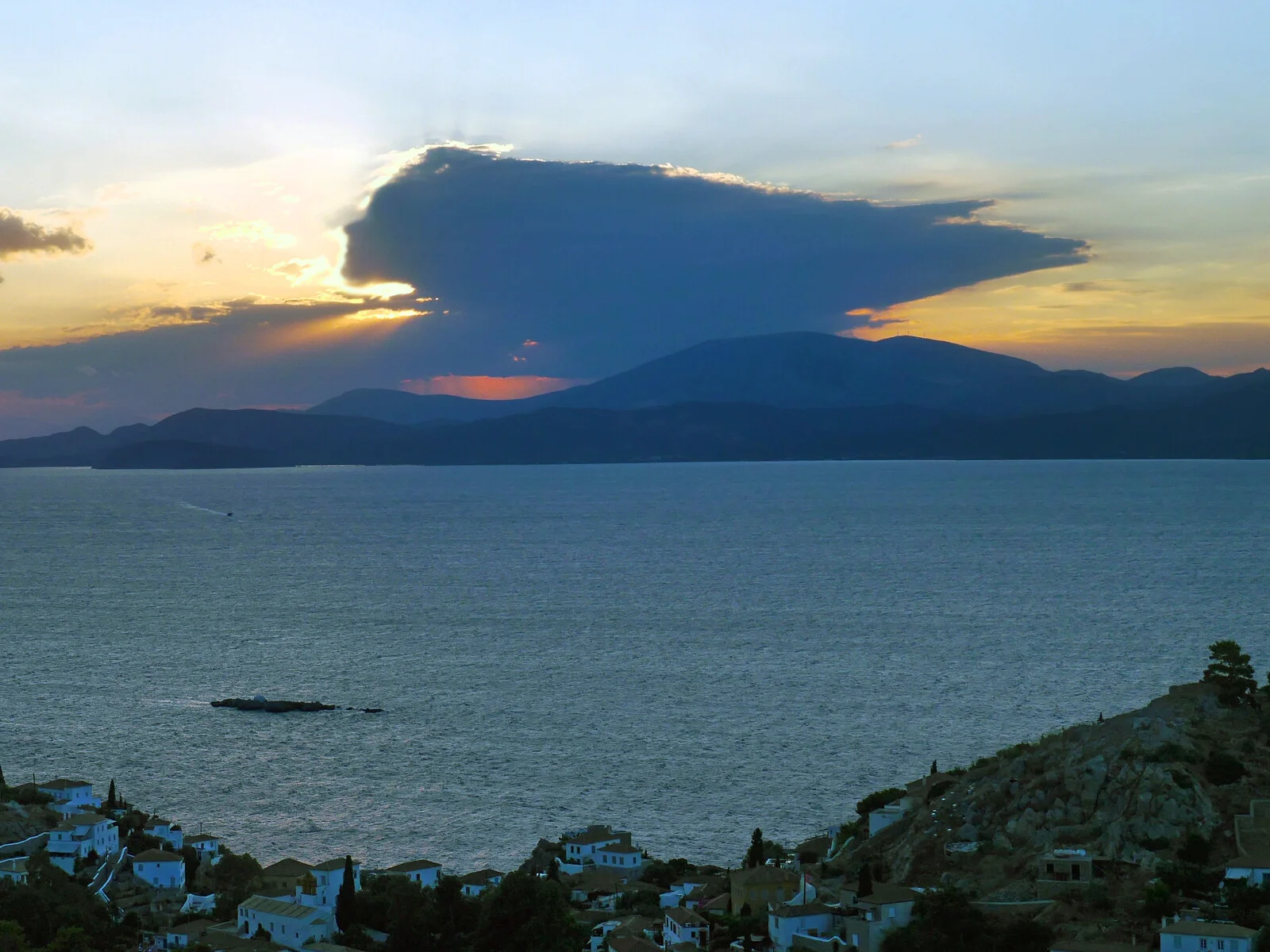
Greta Garbo Skyhigh, 2021
Digital
70 x 50 cm
Occasionally, exciting cumulus clouds formed and created the most fantastic shapes. The other day, Greta Garbo reappeared when the wind shaped a cloud in the Art Deco style over the Peloponnese. The setting sun cast a spotlight on the film star, and I managed to capture the image with my camera.
The profile is unmistakable. The Swedish artist Einar Nerman's iconic portrait of the star at the height of her fame immediately revealed the person, Greta Garbo. It was a massive cumulus cloud that suddenly took shape, driven by the strong winds above the Peloponnesus. First, it was kneaded on top, and a long hair tail extended toward Athens; cheeks, chin, and neck were all there. The rest of the face took longer, but tuft by tuft was added until her profile loomed above Ermioni on the other side of the strait. The grey cloud mass sculpted the pert nose and high forehead into one of the most significant figures in film history. I had my camera ready, and capturing the image took seconds – the time I had before the wind tore apart Greta's features in the sky. A line might be a bit fuzzy and need sharpening, but essentially, nature had done the job. Or perhaps it was a manifestation of Greta herself. I knew she occasionally returned.
I met Greta in the large kitchen of the Ochre Villa during Babis Mores' grand reunion a few years ago when he and other Time-Travellers occupied the grand Mansion high above Hydra's harbour. Over seven hundred came from their stars and all corners of the universe. She had to leave her beloved companion Mimi Pollak on their star because Mimi had never been to Babis' club Lagoudera. Those were the two key requirements: one must have left this Earth and been a club guest. In the kitchen, I listened to many amusing and truthful stories from her time on Earth. But before we met in the kitchen—by chance, as we were both after chilled spring water from one of the fridges—I had, along with Babis, observed a strange meeting between two film greats, Greta and Laurence Olivier. They had not seen each other since she had gotten him fired, so the tone was reserved. But I can recount the episode as I described it in my book 'The Last Dance'. Enjoy.
"Isn't that Garbo over there?" I pointed to a couple slowly and dignifiedly moving along the southern wall of the garden.
"That's right. Greta and Laurence, on their usual stroll, made the same gestures and the same lines. Every time!
"Olivier? Sir Laurence Olivier?"
"The very same. The scene is like a constant retake, a reprisal of the reprisal. It started when Greta got Laurence fired from the film about Queen Christina. He never forgives her for that. However, both of them can conduct themselves and play the theatre. That's what they're doing now, a performance for the gallery - for you and me and everyone else. Every time they meet. The same da capo," said Babis and laughed. He tapped his temple with his index finger.
"Just before the war, the couple met for the first time in six years. Laurence hadn't been in Hollywood since he got fired, and the atmosphere between them was somewhat strained. The walk they took in Director Cukor's garden could have been this one." Babis pointed to the backs that gracefully moved in sextuple time, like in a gentle polonaise. The couple disappeared along the paved path, took a few steps on the stairs, sprung forward on the gravel path, pirouetted past a sundial, paused occasionally, gestured, articulated, and checked each other, sometimes intensely but always expressively like a Shakespearean drama - Sir Laurence's speciality and the reason he was knighted. I didn't need to hear the words to imagine how the conversation progressed from moments of feigned surprise to moments of affected enthusiasm and feigned joy. This was the theatre of the highest class.
Babis concentrated on sensing the conversation from a distance and relaying it to me as a simultaneous interpretation.
"What a beautiful garden." "Indeed, it is beautiful. Very!" "We have gardens where I was born." "In Sweden?" "Yes, I was born there. In Stockholm." "It is a beautiful city. I haven't been there." "You should go there and meet the king." "Yes, I must. If His Majesty receives me." "He certainly will." "I can only hope." "Do you have beautiful gardens in England?" "Yes, we have gardens. Many are beautiful." "In my childhood garden, we grew apples." "We also have apples." "And figs?" "Only in orangeries." "And oranges?" "In the same places. But we grow peaches." "That would be delicious." "Yes, they are tasty." "We have peaches in Stockholm too." "How happy that makes me!" I tapped Babis on the shoulder as a sign that it was enough, but I couldn't stop giggling.
The comedic conversation continued fleetingly like water vapour among olive and fig trees, orange and lemon trees, past cacti and flowering bushes of Daphne odora, along stands of waxflower, a type of myrtle, stately Agapanthus and fragrant lavender. It was a beautiful walk, even though nothing sensible was said. Babis said that Greta and Laurence always returned, agreeing that the garden had been lovely. That was the only thing they agreed on since the incident in Hollywood. Babis concentrated on sensing the conversation from a distance and relayed it to me as a simultaneous interpretation.
I'll let you read a bit from my relaxed conversation in the kitchen with the now one-hundred-and-thirteen-year-old Greta.
"You have always been private, but it's hard to note you on Earth today. Is it the same up there?" I asked.
"Usually not. And just to be sure, I still prefer a stand-in instead of Greta Garbo. It has been over a hundred years since I was born, so 'my' generation has moved on. Unfortunately, curiosity follows people up there, so I do what I usually do - disguise myself, use funny names, and alter egos when booking hotels. My funniest one is 'Nomen Nescio' from Naples. No one realises it stands for N.N. - Latin for 'I don't know the name,' especially if I wear my dark wig. If someone thinks they know me and asks if I'm me, I reply, 'Do you think Greta Garbo would book such a lousy hotel?' It usually works. It's usually hotel staff trained to be discreet and want to keep their jobs. It's more challenging with all the band-aids and curious people in more public settings. They require a different tactic." Greta stepped away from the window as if someone had peered in from outside.
"You're mistaken; my name is Ingrid Bergman. Excuse me, but I'm waiting for 'my' toy boy. He's eighteen and a bit shy, so please excuse me," I used to say and put a finger to my lips, blinking with an artificially deep expression. It worked in America, and that's where I spent most of 'my' time. As you may know, Ingrid was unpopular after she left her husband and children for an Italian director. Few forgave her for that, but I had it coming. Women pursed their lips and said, 'Shame on you!' or 'Go to hell!' Greta laughed.
"Did men fall for that?"
"Men rarely dared to approach. If they did, I would change something. I still used the name Ingrid Bergman to confuse them, but I claimed to work at the IRS, the American federal tax agency. It is more unpopular than poor Ingrid, so the men vanish like a shot." We laughed, and the atmosphere felt relaxed.
"To tell the truth, the story of my life was about finding the right entrances, side doors, secret passageways, hidden elevators, and other ways to sneak in and out unnoticed. More than once, I hitched a ride crouched in a tiny elevator for dirty laundry. It bothered me less than cameras and flashes."
"Good thing she doesn't live today with all the mobile phones and people taking selfies every second," I thought, and Greta looked at me strangely.
"Have you ever been mischievous? You seem so cool and controlled. But what you just told me indicates a good dose of humour."
"Used to be! I can be mischievous, but only when it suits me and with people I trust."
"In what way?" I asked curiously. That was different from the impression I had gotten.
"Watch this!" Greta looked around the kitchen and soon found what she was looking for. An old-style fuse box with screw-in fuses. She walked up and quickly scanned through the fuses. "Three 16-ampere fuses must be for the stove and oven," she giggled. Greta loosened all three of them just a bit so it looked like the fuses were in place. He'll be surprised when the chef returns and tries to use the stove. I can picture it. First, he will turn and press all the buttons and knobs." She glanced at me sneakily. "Nothing happens. Then he kicks the stove because that's what 'men' do - they believe violence helps. Twiddles the knobs a bit more. Then, he goes to the fuse box and sees that the little red indicators are still intact, indicating that the fuses are fine. If he didn't swear earlier, he will now. He cries out in despair to an invisible force, begging it to throw the power company director behind bars, lock up, and throw away the key." Greta giggled at her mischief.
"Hmm." I recognised myself. "You're overlooking one thing."
"What? I'm sure he'll behave somewhat like that. I know 'men."
"Sure! But the chef will chase you with his knife. He's quite skilled at throwing both that and an axe."
"A chef who throws knives!" Greta looked at the painting on the wall with the chop marks. "What's his name?"
"Eddie."
"Ah! Eddie. Eddie Nagring 'from' Sweden. I know him. Eddie won't chase after me because I tickle him. Eddie is insanely ticklish. He was acting in Hollywood for a while as an extra. We Swedes stuck together. Eddie had worked as a circus artist but ended up in the wrong barrel. There were two, both filled with water. One was prepared for a jump from twelve meters and the other for eight. There was a misunderstanding about 'right' and 'left.' The right hand is the hand where the thumb points left. The assistant, a locally recruited farmhand, turned his palm up instead, and things went wrong. That's why he limps. Not like the malicious tongues claim that he put his foot in a bucket while drunk and foolish." I had heard both explanations, plus one involving the angry elephant Dumbo.
"There were few roles for someone with a limp, so Eddie learned to throw knives and axes," Greta continued. "He looked somewhat Southern, so Eddie could portray a dangerous Mexican when they stuck a moustache on him. Many cowboy movies were being made in Hollywood then, but the competition was tough. In most cases, the director wanted cheap, authentic Mexicans who would die on the spot, not someone who had to throw knives and demand extra payment. Eddie disappeared back to Sweden, and we lost touch. Later, I heard he became a skilled chef. And tonight, we're at the same party. Great! Now I understand why the buffet was so good."
"Our chef is quite a drinker. Babis told me another one of Eddie's quirks. 'Rosita,' a cheaper Finnish version of Campari. As a poor circus artist, he got used to it. Eddie would sweep it up and dab it behind his ears if it were spilt on the table, as it happens during boozy parties. 'Nothing should go to waste,' he usually says, and everyone laughs. He still gets red behind the ears all the time." Greta laughed loudly.
Greta hopped onto the kitchen counter and crossed her legs. I leaned against the refrigerator. The compressor's humming and the party's distant buzz could be heard in the following silence. Her face and silence conveyed more information than the words people speak daily. She was reflecting on her life. I observed her. Every nerve and muscle seemed relaxed. I found Greta pleasant and down-to-earth. She was also funny, which was a surprise. But then she got lost behind her closed eyes in another world full of memories. And so, a good while passed.
"Could you pass me a peach, please," she suddenly said. Greta had spotted the fruit bowl.
I picked up a ripe fruit and handed it to her. She greedily munched on the peach, causing the juice to dribble down her fingers. Greta reached for her handbag, which she had placed beside her. Greta had a crocodile-skin bag that women hardly dare to be seen with nowadays. She noticed my gaze. "I didn't kill the crocodile. It was already dead when I bought the bag." She chuckled to make sure I didn't take her seriously.
Greta opened the crocodile's jaws to retrieve a handkerchief. The handbag's inside looked as disorganised as one would expect—a "creative mess," as women put it. Greta rummaged for quite a while. I had ample insight into her private life. A toothbrush stuck in a side pocket; a small tube of toothpaste with an unreadable brand name and an old-fashioned perfume bottle; a deodorant she must have bought on Hydra because it had Greek text; headache pills; a mother-of-pearl cigarette case; what looked like a camisole and two pairs of rolled-up lace panties, as well as a silk scarf for when the night turns chilly. Finally, she found her handkerchief and wiped away some fruit residue. I also noticed a pocket edition of 'Greek Fire,' a stormy biography about Maria Callas and Onassis, both close friends of Greta.
"Hydra seems like such a charming place," Greta continued after she put the handkerchief back. "On Onassis' boat, they showed several films shot on the island, including one about a boy on a fish."
"A dolphin," I corrected.
"Yes, he rode a dolphin. I had hoped to meet Sophia Loren at the last party but heard she hasn't moved up yet. It's such a shame! Not that she's alive!" Greta hurriedly added. "But it would have been fun to meet. Sophia's mother, Romilda, was beautiful as can be. She won a contest as 'my' lookalike in Italy in 1932. She looked like me; we could be twins. I would have received Romilda in Hollywood, and everything was prepared for a career in the film industry. Unfortunately, it turned out that Romilda was only 17 and couldn't travel, so she got pregnant with Sophia. Lucky for Sophia."
"You can say that."
"There must be other stories like that 'from' an island with such a rich history. Nothing boring. Maybe the kind that is told about me nowadays. Anecdotes. How I stumbled or something." Greta had a certain self-awareness. I pondered and remembered the baker Dimitri and his miller father.
"There was a wealthy lady from Athens with a big house on Hydra who believed she could impress a simple mill owner by showing him her precious gemstones. The lady kept the jewels in a casket, which, in turn, was kept in a safe. The miller eventually asked if the showcased trinkets had cost a lot and what income they generated. Every expense had to be accounted for against an income for a businessman like him. Otherwise, you go bankrupt.
'Oh, they cost my late husband a fortune,' the lady replied indulgently. 'Precious stones don't yield any return, but they are highly valued. Not just by me, but unfortunately also by thieves and tricksters. Every year, the insurance that protects me from fire and theft costs nearly a thousand drachmas. But they are beautiful, aren't they?'"
'So be it,' replied the miller calmly, 'I like my millstones better - a runner and a recumbent, a thousand kilograms each, and the runner with spruce carved grooves. They do not sparkle like yours and have cost me ten thousand drachmas, but they give me six thousand a year. I don't have to worry about someone stealing them. If the mill burns down, the stones are still there."
"That's really good!" Garbo found it so funny that she laughed and laughed, just as she did in 'Ninotchka' when Melvyn Douglas fell off his chair.
"The story is said to be true. You can ask the son yourself. Dimitri is here. His father, the miller, eventually had to leave the house and the mill, but the son returned with a vengeance and left the Earth as a wealthy baker. Dimitri bought his aunt's house and all her jewels from the mortuary. He plays bouzouki and sings like a god. Tonight, too."
There was a moment of silence, and then Greta lifted her head from the half-eaten peach. She shifted her position and spoke slowly and with some difficulty in her accented voice:
"A woman was walking down a street in Philadelphia, and her blouse was open, exposing her left breast. An oncoming man - understanding that she was unaware of the situation, said kindly, 'Excuse me, ma'am, but do you realise you're exposing your left breast?' Surprised, the woman looked down, pulled up her blouse and exclaimed: 'Oh my God. I must have left the baby on the bus'" Greta sank her teeth into the peach and laughed until it splashed.
"Do you think 'my' feet are big?" she asked, waving her feet so that her sandals slipped.
"Why would I think that?" I found the question strange but realised that Greta had some complex.
"Because I think so."
"But that's not true. You have lovely feet. Normal size for a Nordic woman." Like my wife's, so I was on safe ground.
"Tell them about it, but do it in English because 'my' feet only speak the same language as the woman who does 'my' toenails." Greta lifted one foot at a time, and I repeated what I had said but in English. I felt ridiculous.
"There you go," Greta said to her feet in English. "Mae West had less!"
"Maybe so, but she looked like a ghost." Images of Mae's wavy hair still make me laugh. Calling her a sex symbol was, in my opinion, a joke.
"Is there a restroom?" Greta asked.
"There!" I pointed to a door in a hallway leading to a storage room.
"I used to go into the men's room to see what it felt like. Once, while we were shooting 'The Twins,' I went into the men's room, and a male colleague caught me. When he asked what I was doing there, I answered truthfully that I was checking out the view." Greta laughed happily and disappeared into the corridor.
She was funny.
In the late 60s, during a return visit to Lagoudera, she and the club owner Babis Mores were sitting in a dark corner inside Katsikas in the harbour one evening when a woman came over and asked:
"Aren't you Greta Garbo?" Greta looked at her and replied, "I'm sorry. What would Greta Garbo be doing in a place like this?" Babis laughed uproariously in his usual way, and the crestfallen woman walked away.
Jörgen Thornberg
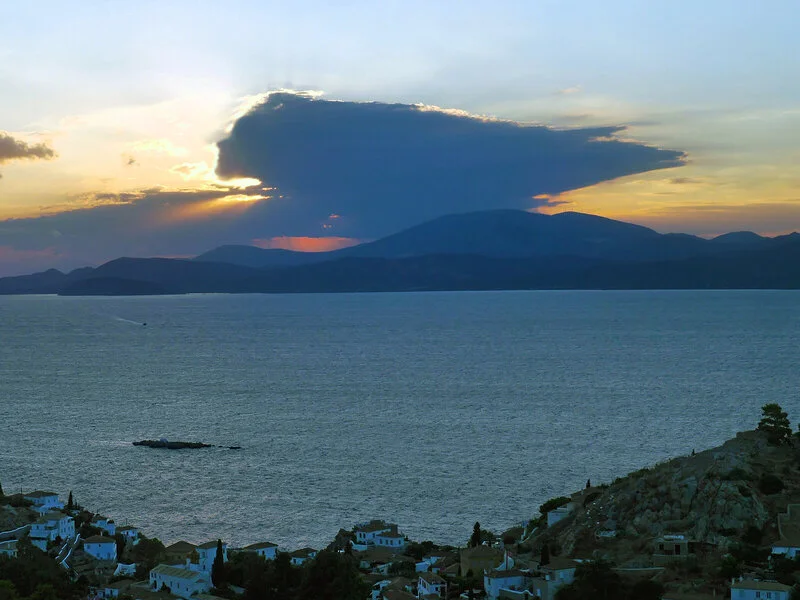
Greta Garbo Skyhigh, 2021
Digital
70 x 50 cm
Occasionally, exciting cumulus clouds formed and created the most fantastic shapes. The other day, Greta Garbo reappeared when the wind shaped a cloud in the Art Deco style over the Peloponnese. The setting sun cast a spotlight on the film star, and I managed to capture the image with my camera.
The profile is unmistakable. The Swedish artist Einar Nerman's iconic portrait of the star at the height of her fame immediately revealed the person, Greta Garbo. It was a massive cumulus cloud that suddenly took shape, driven by the strong winds above the Peloponnesus. First, it was kneaded on top, and a long hair tail extended toward Athens; cheeks, chin, and neck were all there. The rest of the face took longer, but tuft by tuft was added until her profile loomed above Ermioni on the other side of the strait. The grey cloud mass sculpted the pert nose and high forehead into one of the most significant figures in film history. I had my camera ready, and capturing the image took seconds – the time I had before the wind tore apart Greta's features in the sky. A line might be a bit fuzzy and need sharpening, but essentially, nature had done the job. Or perhaps it was a manifestation of Greta herself. I knew she occasionally returned.
I met Greta in the large kitchen of the Ochre Villa during Babis Mores' grand reunion a few years ago when he and other Time-Travellers occupied the grand Mansion high above Hydra's harbour. Over seven hundred came from their stars and all corners of the universe. She had to leave her beloved companion Mimi Pollak on their star because Mimi had never been to Babis' club Lagoudera. Those were the two key requirements: one must have left this Earth and been a club guest. In the kitchen, I listened to many amusing and truthful stories from her time on Earth. But before we met in the kitchen—by chance, as we were both after chilled spring water from one of the fridges—I had, along with Babis, observed a strange meeting between two film greats, Greta and Laurence Olivier. They had not seen each other since she had gotten him fired, so the tone was reserved. But I can recount the episode as I described it in my book 'The Last Dance'. Enjoy.
"Isn't that Garbo over there?" I pointed to a couple slowly and dignifiedly moving along the southern wall of the garden.
"That's right. Greta and Laurence, on their usual stroll, made the same gestures and the same lines. Every time!
"Olivier? Sir Laurence Olivier?"
"The very same. The scene is like a constant retake, a reprisal of the reprisal. It started when Greta got Laurence fired from the film about Queen Christina. He never forgives her for that. However, both of them can conduct themselves and play the theatre. That's what they're doing now, a performance for the gallery - for you and me and everyone else. Every time they meet. The same da capo," said Babis and laughed. He tapped his temple with his index finger.
"Just before the war, the couple met for the first time in six years. Laurence hadn't been in Hollywood since he got fired, and the atmosphere between them was somewhat strained. The walk they took in Director Cukor's garden could have been this one." Babis pointed to the backs that gracefully moved in sextuple time, like in a gentle polonaise. The couple disappeared along the paved path, took a few steps on the stairs, sprung forward on the gravel path, pirouetted past a sundial, paused occasionally, gestured, articulated, and checked each other, sometimes intensely but always expressively like a Shakespearean drama - Sir Laurence's speciality and the reason he was knighted. I didn't need to hear the words to imagine how the conversation progressed from moments of feigned surprise to moments of affected enthusiasm and feigned joy. This was the theatre of the highest class.
Babis concentrated on sensing the conversation from a distance and relaying it to me as a simultaneous interpretation.
"What a beautiful garden." "Indeed, it is beautiful. Very!" "We have gardens where I was born." "In Sweden?" "Yes, I was born there. In Stockholm." "It is a beautiful city. I haven't been there." "You should go there and meet the king." "Yes, I must. If His Majesty receives me." "He certainly will." "I can only hope." "Do you have beautiful gardens in England?" "Yes, we have gardens. Many are beautiful." "In my childhood garden, we grew apples." "We also have apples." "And figs?" "Only in orangeries." "And oranges?" "In the same places. But we grow peaches." "That would be delicious." "Yes, they are tasty." "We have peaches in Stockholm too." "How happy that makes me!" I tapped Babis on the shoulder as a sign that it was enough, but I couldn't stop giggling.
The comedic conversation continued fleetingly like water vapour among olive and fig trees, orange and lemon trees, past cacti and flowering bushes of Daphne odora, along stands of waxflower, a type of myrtle, stately Agapanthus and fragrant lavender. It was a beautiful walk, even though nothing sensible was said. Babis said that Greta and Laurence always returned, agreeing that the garden had been lovely. That was the only thing they agreed on since the incident in Hollywood. Babis concentrated on sensing the conversation from a distance and relayed it to me as a simultaneous interpretation.
I'll let you read a bit from my relaxed conversation in the kitchen with the now one-hundred-and-thirteen-year-old Greta.
"You have always been private, but it's hard to note you on Earth today. Is it the same up there?" I asked.
"Usually not. And just to be sure, I still prefer a stand-in instead of Greta Garbo. It has been over a hundred years since I was born, so 'my' generation has moved on. Unfortunately, curiosity follows people up there, so I do what I usually do - disguise myself, use funny names, and alter egos when booking hotels. My funniest one is 'Nomen Nescio' from Naples. No one realises it stands for N.N. - Latin for 'I don't know the name,' especially if I wear my dark wig. If someone thinks they know me and asks if I'm me, I reply, 'Do you think Greta Garbo would book such a lousy hotel?' It usually works. It's usually hotel staff trained to be discreet and want to keep their jobs. It's more challenging with all the band-aids and curious people in more public settings. They require a different tactic." Greta stepped away from the window as if someone had peered in from outside.
"You're mistaken; my name is Ingrid Bergman. Excuse me, but I'm waiting for 'my' toy boy. He's eighteen and a bit shy, so please excuse me," I used to say and put a finger to my lips, blinking with an artificially deep expression. It worked in America, and that's where I spent most of 'my' time. As you may know, Ingrid was unpopular after she left her husband and children for an Italian director. Few forgave her for that, but I had it coming. Women pursed their lips and said, 'Shame on you!' or 'Go to hell!' Greta laughed.
"Did men fall for that?"
"Men rarely dared to approach. If they did, I would change something. I still used the name Ingrid Bergman to confuse them, but I claimed to work at the IRS, the American federal tax agency. It is more unpopular than poor Ingrid, so the men vanish like a shot." We laughed, and the atmosphere felt relaxed.
"To tell the truth, the story of my life was about finding the right entrances, side doors, secret passageways, hidden elevators, and other ways to sneak in and out unnoticed. More than once, I hitched a ride crouched in a tiny elevator for dirty laundry. It bothered me less than cameras and flashes."
"Good thing she doesn't live today with all the mobile phones and people taking selfies every second," I thought, and Greta looked at me strangely.
"Have you ever been mischievous? You seem so cool and controlled. But what you just told me indicates a good dose of humour."
"Used to be! I can be mischievous, but only when it suits me and with people I trust."
"In what way?" I asked curiously. That was different from the impression I had gotten.
"Watch this!" Greta looked around the kitchen and soon found what she was looking for. An old-style fuse box with screw-in fuses. She walked up and quickly scanned through the fuses. "Three 16-ampere fuses must be for the stove and oven," she giggled. Greta loosened all three of them just a bit so it looked like the fuses were in place. He'll be surprised when the chef returns and tries to use the stove. I can picture it. First, he will turn and press all the buttons and knobs." She glanced at me sneakily. "Nothing happens. Then he kicks the stove because that's what 'men' do - they believe violence helps. Twiddles the knobs a bit more. Then, he goes to the fuse box and sees that the little red indicators are still intact, indicating that the fuses are fine. If he didn't swear earlier, he will now. He cries out in despair to an invisible force, begging it to throw the power company director behind bars, lock up, and throw away the key." Greta giggled at her mischief.
"Hmm." I recognised myself. "You're overlooking one thing."
"What? I'm sure he'll behave somewhat like that. I know 'men."
"Sure! But the chef will chase you with his knife. He's quite skilled at throwing both that and an axe."
"A chef who throws knives!" Greta looked at the painting on the wall with the chop marks. "What's his name?"
"Eddie."
"Ah! Eddie. Eddie Nagring 'from' Sweden. I know him. Eddie won't chase after me because I tickle him. Eddie is insanely ticklish. He was acting in Hollywood for a while as an extra. We Swedes stuck together. Eddie had worked as a circus artist but ended up in the wrong barrel. There were two, both filled with water. One was prepared for a jump from twelve meters and the other for eight. There was a misunderstanding about 'right' and 'left.' The right hand is the hand where the thumb points left. The assistant, a locally recruited farmhand, turned his palm up instead, and things went wrong. That's why he limps. Not like the malicious tongues claim that he put his foot in a bucket while drunk and foolish." I had heard both explanations, plus one involving the angry elephant Dumbo.
"There were few roles for someone with a limp, so Eddie learned to throw knives and axes," Greta continued. "He looked somewhat Southern, so Eddie could portray a dangerous Mexican when they stuck a moustache on him. Many cowboy movies were being made in Hollywood then, but the competition was tough. In most cases, the director wanted cheap, authentic Mexicans who would die on the spot, not someone who had to throw knives and demand extra payment. Eddie disappeared back to Sweden, and we lost touch. Later, I heard he became a skilled chef. And tonight, we're at the same party. Great! Now I understand why the buffet was so good."
"Our chef is quite a drinker. Babis told me another one of Eddie's quirks. 'Rosita,' a cheaper Finnish version of Campari. As a poor circus artist, he got used to it. Eddie would sweep it up and dab it behind his ears if it were spilt on the table, as it happens during boozy parties. 'Nothing should go to waste,' he usually says, and everyone laughs. He still gets red behind the ears all the time." Greta laughed loudly.
Greta hopped onto the kitchen counter and crossed her legs. I leaned against the refrigerator. The compressor's humming and the party's distant buzz could be heard in the following silence. Her face and silence conveyed more information than the words people speak daily. She was reflecting on her life. I observed her. Every nerve and muscle seemed relaxed. I found Greta pleasant and down-to-earth. She was also funny, which was a surprise. But then she got lost behind her closed eyes in another world full of memories. And so, a good while passed.
"Could you pass me a peach, please," she suddenly said. Greta had spotted the fruit bowl.
I picked up a ripe fruit and handed it to her. She greedily munched on the peach, causing the juice to dribble down her fingers. Greta reached for her handbag, which she had placed beside her. Greta had a crocodile-skin bag that women hardly dare to be seen with nowadays. She noticed my gaze. "I didn't kill the crocodile. It was already dead when I bought the bag." She chuckled to make sure I didn't take her seriously.
Greta opened the crocodile's jaws to retrieve a handkerchief. The handbag's inside looked as disorganised as one would expect—a "creative mess," as women put it. Greta rummaged for quite a while. I had ample insight into her private life. A toothbrush stuck in a side pocket; a small tube of toothpaste with an unreadable brand name and an old-fashioned perfume bottle; a deodorant she must have bought on Hydra because it had Greek text; headache pills; a mother-of-pearl cigarette case; what looked like a camisole and two pairs of rolled-up lace panties, as well as a silk scarf for when the night turns chilly. Finally, she found her handkerchief and wiped away some fruit residue. I also noticed a pocket edition of 'Greek Fire,' a stormy biography about Maria Callas and Onassis, both close friends of Greta.
"Hydra seems like such a charming place," Greta continued after she put the handkerchief back. "On Onassis' boat, they showed several films shot on the island, including one about a boy on a fish."
"A dolphin," I corrected.
"Yes, he rode a dolphin. I had hoped to meet Sophia Loren at the last party but heard she hasn't moved up yet. It's such a shame! Not that she's alive!" Greta hurriedly added. "But it would have been fun to meet. Sophia's mother, Romilda, was beautiful as can be. She won a contest as 'my' lookalike in Italy in 1932. She looked like me; we could be twins. I would have received Romilda in Hollywood, and everything was prepared for a career in the film industry. Unfortunately, it turned out that Romilda was only 17 and couldn't travel, so she got pregnant with Sophia. Lucky for Sophia."
"You can say that."
"There must be other stories like that 'from' an island with such a rich history. Nothing boring. Maybe the kind that is told about me nowadays. Anecdotes. How I stumbled or something." Greta had a certain self-awareness. I pondered and remembered the baker Dimitri and his miller father.
"There was a wealthy lady from Athens with a big house on Hydra who believed she could impress a simple mill owner by showing him her precious gemstones. The lady kept the jewels in a casket, which, in turn, was kept in a safe. The miller eventually asked if the showcased trinkets had cost a lot and what income they generated. Every expense had to be accounted for against an income for a businessman like him. Otherwise, you go bankrupt.
'Oh, they cost my late husband a fortune,' the lady replied indulgently. 'Precious stones don't yield any return, but they are highly valued. Not just by me, but unfortunately also by thieves and tricksters. Every year, the insurance that protects me from fire and theft costs nearly a thousand drachmas. But they are beautiful, aren't they?'"
'So be it,' replied the miller calmly, 'I like my millstones better - a runner and a recumbent, a thousand kilograms each, and the runner with spruce carved grooves. They do not sparkle like yours and have cost me ten thousand drachmas, but they give me six thousand a year. I don't have to worry about someone stealing them. If the mill burns down, the stones are still there."
"That's really good!" Garbo found it so funny that she laughed and laughed, just as she did in 'Ninotchka' when Melvyn Douglas fell off his chair.
"The story is said to be true. You can ask the son yourself. Dimitri is here. His father, the miller, eventually had to leave the house and the mill, but the son returned with a vengeance and left the Earth as a wealthy baker. Dimitri bought his aunt's house and all her jewels from the mortuary. He plays bouzouki and sings like a god. Tonight, too."
There was a moment of silence, and then Greta lifted her head from the half-eaten peach. She shifted her position and spoke slowly and with some difficulty in her accented voice:
"A woman was walking down a street in Philadelphia, and her blouse was open, exposing her left breast. An oncoming man - understanding that she was unaware of the situation, said kindly, 'Excuse me, ma'am, but do you realise you're exposing your left breast?' Surprised, the woman looked down, pulled up her blouse and exclaimed: 'Oh my God. I must have left the baby on the bus'" Greta sank her teeth into the peach and laughed until it splashed.
"Do you think 'my' feet are big?" she asked, waving her feet so that her sandals slipped.
"Why would I think that?" I found the question strange but realised that Greta had some complex.
"Because I think so."
"But that's not true. You have lovely feet. Normal size for a Nordic woman." Like my wife's, so I was on safe ground.
"Tell them about it, but do it in English because 'my' feet only speak the same language as the woman who does 'my' toenails." Greta lifted one foot at a time, and I repeated what I had said but in English. I felt ridiculous.
"There you go," Greta said to her feet in English. "Mae West had less!"
"Maybe so, but she looked like a ghost." Images of Mae's wavy hair still make me laugh. Calling her a sex symbol was, in my opinion, a joke.
"Is there a restroom?" Greta asked.
"There!" I pointed to a door in a hallway leading to a storage room.
"I used to go into the men's room to see what it felt like. Once, while we were shooting 'The Twins,' I went into the men's room, and a male colleague caught me. When he asked what I was doing there, I answered truthfully that I was checking out the view." Greta laughed happily and disappeared into the corridor.
She was funny.
In the late 60s, during a return visit to Lagoudera, she and the club owner Babis Mores were sitting in a dark corner inside Katsikas in the harbour one evening when a woman came over and asked:
"Aren't you Greta Garbo?" Greta looked at her and replied, "I'm sorry. What would Greta Garbo be doing in a place like this?" Babis laughed uproariously in his usual way, and the crestfallen woman walked away.

Jörgen Thornberg
Malmö
Lite om bilder och mig. Translation in English at the end.
Jag är en nyfiken person som ser allt i bilder, även det jag fäster i ord, gärna tillsammans för bakom alla mina bilder finns en berättelse. Till vissa bilder hör en kortare eller längre novell som följer med bilden.
Bilder berättar historier. Jag omges av naturlig skönhet, intressanta människor och historia var jag än går. Jag använder min kamera för att dokumentera världen och blanda det jag ser med vad jag känner för att fånga den dolda magin.
Mina bilder berättar mina historier. Genom mina bilder, tryck och berättelser. Jag bjuder in dig att ta del av dessa berättelser, in i ditt liv och hem och dela min mycket personliga syn på vår värld. Mer än vad ögat ser. Jag tänker i bilder, drömmer och skriver och pratar om dem; följaktligen måste jag också skapa bilder. De blir vad jag ser, inte nödvändigtvis begränsade till verkligheten. Det finns en bild runt varje hörn. Jag hoppas att du kommer att se vad jag såg och gilla det.
Jag är också en skrivande person och till många bilder hör en kortare eller längre essay. Den följer med tavlan, tryckt på fint papper och med en personlig hälsning från mig.
Flertalet bilder startar sin resa i min kamera. Enkelt förklarat beskriver jag bilden jag ser i mitt inre, upplevd eller fantiserad. Bilden uppstår inom mig redan innan jag fått okularet till ögat. På bråkdelen av ett ögonblick ser jag vad jag vill ha och vad som kan göras med bilden. Här skall jag stoppa in en giraff, stålmannen, Titanic eller vad det är min fantasi finner ut. Ännu märkligare är att jag kommer ihåg minnesbilden långt efteråt när det blir tid att skapa verket. Om jag lyckas eller inte, är upp till betraktaren, oftast präglat av en stråk av svart humor – meningen är att man skall bli underhållen. Mina bilder blir ofta en snackis där de hänger.
Jag föredrar bilder som förmedlar ett budskap i flera lager. Vid första anblicken fylld av feel-good, en vacker utsikt, fint väder, solen skiner, blommor på ängen eller vattnet som ligger förrädiskt spegelblankt. I en sådan bild kan jag gömma min egentliga berättelse, mitt förakt för förtryckare och våldsverkare, rasister och fördomsfulla människor - ett gärna återkommande motiv mer eller mindre dolt i det vackra motivet. Jag försöker förena dem i ett gemensamt narrativ.
Bild och formgivning har löpt som en röd tråd genom livet. Fotokonst känns som en värdig final som jag gärna delar med mig.
Min genre är vid som framgår av mina bilder, temat en blandning av pop- och gatukonst i kollage som kan bestå av hundratals lager. Vissa bilder kan ta veckor, andra någon dag innan det är dags att överlämna resultatet till printverkstaden. Fine Art Prints är digitala fotocollage. I dessa kollage sker rivandet, klippandet, pusslandet, målandet, ritandet och sprayningen digitalt. Det jag monterar in kan vara hundratals år gamla bilder som jag omsorgsfullt frilägger så att de ser ut att vara en del av tavlan men också bilder skapade av mig själv efter min egen fantasi. Därefter besöks printstudion och för vissa bilder numrera en limiterad upplaga (oftast 7 exemplar) och signera för hand. Vissa bilder kan köpas i olika format. Det är bara att fråga efter vilka. Gillar man en bild som är 70x100 men inte har plats på väggen, går den kanske att få i 50x70 cm istället. Frågan är fri.
Metoden Giclée eller Fine Art Print som det också kallas är det moderna sättet för framställning av grafisk konst. Villkoret för denna typ av utskrifter är att en högkvalitativ storformatskrivare används med åldersbeständigt färgpigment och konstnärspapper eller i förekommande fall på duk. Pappret som används möter de krav på livslängd som ställs av museer och gallerier. Normalt säljer jag mina bilder oinramade så att den nya ägaren själv kan bestämma hur de skall se ut, med eller utan passepartout färg på ram, med eller utan glas etc..
Under många år ställde jag bara ut på nätet, i valda grupper och på min egen Facebooksida - https://www.facebook.com/jorgen.thornberg.9
Jag finns också på en egen hemsida som tyvärr inte alltid är uppdaterad – https://www.jth.life/ Där kan du också läsa en del av de berättelser som följer med bilden.
UTSTÄLLNINGAR
Luftkastellet, oktober 2022
Konst i Lund, november 2022
Luftkastellet, mars 2023
Engleson Galleri Caroli, april 2023
Hydra, Greece June 2023
Engleson Galleri Caroli, oktober 2023
Toppen, Höllviken december 2023
Luftkastellet, mars 2024
Torups Galleri, mars 2024
Venice, May 2024
Luftkastellet, oktober 2024
Konst i Advent, December 2024
Galleri Engleson, Caroli December 2024
Jäger & Jansson Galleri, april 2025
A bit about pictures and me.
I'm a curious person who sees everything in pictures, even what I express in words, often combining them, for behind all my pictures lies a story. These narratives, some as short as a single image and others as long as a novel, are the heart and soul of my work.
Pictures tell stories. Wherever I go, I'm surrounded by natural beauty, exciting people, and history. I use my camera to document the world and blend what I see with what I feel to capture the hidden magic.
My images tell my stories. Through my pictures, prints, and narratives, I invite you to partake in these stories in your life and home and share my deeply personal perspective of our world. More than meets the eye. I think in pictures, dream, write, and talk about them; consequently, I must create images too. They become what I see, not necessarily confined to reality. There's a picture around every corner. I hope you'll see what I saw and enjoy it.
I'm also a writer, and many images come with a shorter or longer essay. It accompanies the painting, printed on fine paper with my personal greeting.
Many pictures start their journey on my camera. Simply put, I describe the image I see in my mind, experienced or imagined. The image arises within me even before I bring the eyepiece to my eye. In a fraction of a moment, I see what I want and what can be done with the picture. Here, I'll insert a giraffe, Superman, the Titanic, or whatever my imagination conjures up. Even stranger is that I remember the mental image long after it's time to create the work. Whether I succeed is up to the observer, often imbued with a streak of black humour – the aim is to entertain. My pictures usually become a talking point wherever they hang.
I prefer pictures that convey a message in multiple layers. At first glance, they're filled with feel-good vibes, a beautiful view, lovely weather, the sun shining, flowers in the meadow, or the water lying deceptively calm. But beneath this surface beauty, I often conceal a deeper story, a narrative that challenges societal norms or explores the human condition. I invite you to delve into these hidden narratives and discover the layers of meaning within my work.
Picture and design have been a thread running through my life. Photographic art feels like a fitting finale, and I'm happy to share it.
My genre is varied, as seen in my pictures; the theme is a blend of pop and street art in collages that can consist of hundreds of layers. Some images can take weeks, others just a day before it's time to hand over the result to the print workshop. Fine Art Prints are digital photo collages. In these collages, tearing, cutting, puzzling, painting, drawing, and spraying happen digitally. What I insert can be images hundreds of years old that I carefully extract so they appear to be part of the painting, but also images created by myself, now also generated from my imagination. Next, visit the print studio and, for certain images, number a limited edition (usually 7 copies) and sign them by hand. Some images may be available in other formats. Just ask which ones. If you like an image that's 70x100 but doesn't have space on the wall, you might be able to get it in 50x70 cm instead. The question is open.
The Giclée method, or Fine Art Print as it's also called, is the modern way of producing graphic art. This method ensures the highest quality and longevity of the artwork, using a high-quality large-format printer with archival pigment inks and artist paper or, in some cases, canvas. The paper used meets the longevity requirements set by museums and galleries. I sell my pictures unframed, allowing the new owner to personalise their artwork, confident in the lasting value and quality of the piece.
For many years, I only exhibited online, in selected groups, and on my Facebook page - https://www.facebook.com/jorgen.thornberg.9. I also have my website, which unfortunately is not constantly updated - https://www.jth.life/. You can also read some of the stories accompanying the pictures there.
EXHIBITIONS
Luftkastellet, October 2022
Art in Lund, November 2022
Luftkastellet, March 2023
Engleson Gallery Caroli, April 2023
Hydra, Greece June 2023
Engleson Gallery Caroli, October 2023
Toppen, Höllviken December 2023
Luftkastellet, March 2024
Torup Gallery, March 2024
Venice, May 2024
UTSTÄLLNINGAR
Luftkastellet, oktober 2022
Konst i Lund, november 2022
Luftkastellet, mars 2023
Engleson Galleri Caroli, april 2023
Hydra, Greece June 2023
Engleson Galleri Caroli, oktober 2023
Toppen, Höllviken december 2023
Luftkastellet, mars 2024
Torups Galleri, mars 2024
Venice, May 2024
Luftkastellet, October 2024
Konst i Advent, December 2024
Galleri Engleson, Caroli December 2024
Jäger & Jansson Galleri, April 2025
Utbildning
Autodidakt
Medlem i konstnärsförening
Öppna Sinnen
Med i konstrunda
Konstrundan i Skåne
Utställningar
Luftkastellet, October 2022
Art in Lund, November 2022
Luftkastellet, March 2023
Engleson Gallery Caroli, April 2023
Hydra, Greece June 2023
Engleson Gallery Caroli, October 2023
Toppen, Höllviken December 2023
Luftkastellet, March 2024
Torup Gallery, March 2024
Venice, May 2024