Vi använder cookies för att ge dig bästa möjliga upplevelse. Välj vilka cookies du tillåter.
Läs mer i vår integritetspolicy
Jörgen Thornberg
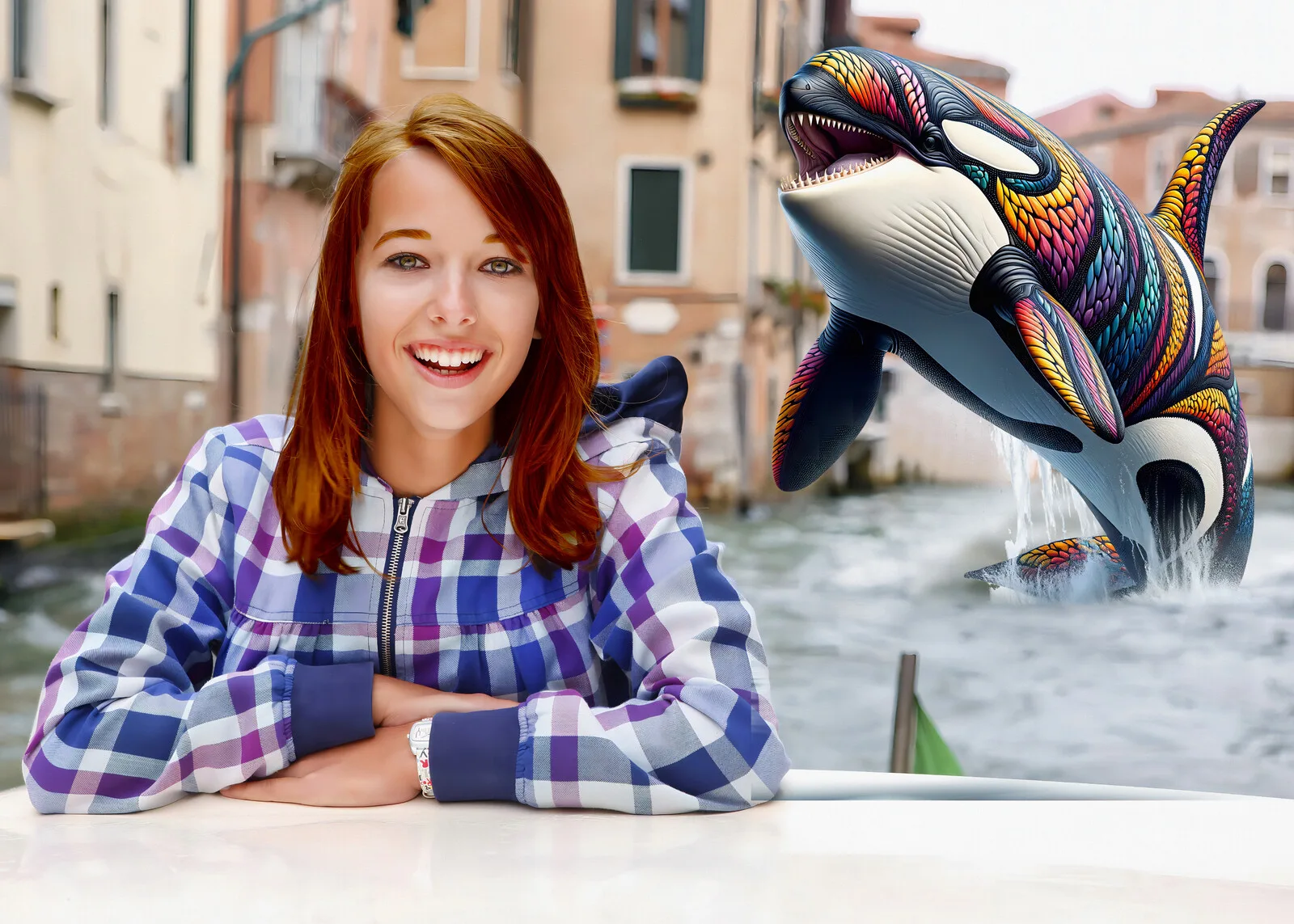
Still Waters Run Deep - I de tystaste vatten..., 2024
Digital
70 x 50 cm
3 200 kr
Orcas, the Killer whales, are making waves these days, not only in Venice. In recent years, orca whales have repeatedly made headlines after attacking—and, in several cases, capsizing—ships off the coast of Spain and Portugal. However, it's important to note that these incidents are unrelated to the orcas' behaviour in Venice. The redhead in Venice can rest easy. It's not her they're after. Possibly the boat she's sitting in.
These incidents, while belligerent, are a testament to the remarkable adaptability and intelligence of orcas (Orcinus orca), also known as killer whales. Sitting at the top of the aquatic food web, they are highly efficient apex predators and incredibly adaptable, capable of overcoming almost any prey. But does that mean humans are on the orca menu?
Fortunately, orcas aren't known for attacking (or eating) humans. Despite their reputation for devouring other marine mammals, they rarely, if ever, attack people in the wild. Much like how great white sharks favour seals' blubber-rich hides and generally don't target less-fatty hominids like us, experts believe that killer whales just aren't as drawn to human flesh compared to another fare like nutrient-rich salmon. This rarity of attacks should reassure you about their peaceful nature.
What Do Orcas Eat? The answer is far from simple. Orcas are dietarily diverse, with pods specialising in meal plans that best suit their environment throughout the world's oceans. They primarily feed on fish, such as salmon and squid. However, their diet can also include marine mammals, such as seals, sea lions, and other whales. Antarctic communities, for example, have a taste for penguins and seals, sometimes banding together to execute novel hunting strategies.
Some orcas even chase down larger marine mammals, including whales. While orcas usually go after calves rather than adults, there are exceptions. In a groundbreaking discovery, scientists recently observed orcas attacking, killing, and eating an adult blue whale for the first time. This was one of three predation events detailed in a 2022 paper in Marine Mammal Science, shedding new light on the hunting behaviours of these apex predators.
Sometimes, these attempts are simply bored individuals having fun, but other times, pods mean business. Human bystanders have observed multiple instances of dozens of orcas orchestrating successful attacks against their prey, in some cases even killing whales up to 70 feet long.
Still, these devastating assailants don't usually bite off more than they can chew. When pods engage with more giant whales, they most often steal vulnerable calves from their mothers.
Why don't Orcas attack humans? Good question. With all these options on the menu and the capability to take down the ocean's mightiest leviathans, humans seem to be easy, straightforward prey. Yet, besides simply not being very tasty or nutritious, we might also be a sort of taboo food for killer whales. Orcas have complex social networks, hosting ceremonial "greetings" between pods and funerals. They also exhibit unique vocalisations, and hunting strategies passed down through generations. Beyond biology, consuming hairless apes like us may not be a cultural custom.
Taken together, these factors help explain why there aren't any documented cases of orcas killing humans in the wild. By contrast, whales facing environmental stressors in captivity have sometimes tragically lashed out at their human trainers.
The Attack of Tilikum upset the animal world. Perhaps the most infamous orca attack involved Tilikum, a killer whale kept at SeaWorld between 1992 and 2017. Tilikum performed numerous acrobatic feats for a live audience, guided by steadfast trainers during his tenure. However, the cramped quarters and subpar living conditions of his enclosure led Tilikum to violent outbursts, resulting in the deaths of three people during his captivity.
Orcas like Tilikum may face profound mental stress in the confines of a tank, prompting violent episodes, according to a 2016 paper published in Animals. In the wild, they swim dozens of kilometres daily in pods of around a dozen members; as such, researchers suggest life in captivity can psychologically destabilise these social animals.
Orcas have a fling with boats. But even in the wild, orcas have been observed to be belligerent toward humans or human-made objects, like boats. Some scientists believe that it might simply be a form of juvenile delinquency, with young whales messing around with the local fishermen. Alternatively, the presence of an adult female during one of these incidents suggests that the animals may have learned to associate boats with danger. Fishing line entanglements occur every day in such waters. The isolated nature of the behaviours, occurring only off the Iberian Peninsula, suggests that they are more cultural than anything innate to orca biology.
While the history of humans and orcas is marred by pollution, capture, and the occasional interspecies scuffle, it's worth remembering that only an estimated 50,000 individuals are left in the world's oceans. Populations are scarce but crucial to proper ecosystem functioning. Perhaps we can learn to coexist with these (mostly) gentle giants more peacefully in due time. Finally, it must be said that very few orcas dress up like this one. Nor was it carnival season, which didn't occur until February this year. But he indeed had fun anyway, our colourful friend dressed as the Commedia dell'Arte character Harlequin. His costume can be described as a diamond pattern with elongated shapes arranged vertically. They are point-to-point, sometimes very close together, almost touching. There is sometimes space between the diamonds, and the negative space forms a lattice effect. And it was brilliantly colourful.
Finally, it must be said that very few orcas dress up like this one in Venice. Nor was it carnival season, which didn't occur until February this year. But he had fun anyway, our Orca friend dressed as the Commedia dell'Arte character Harlequin. Harlequin is the best-known comic servant character Zanni from the Italian Commedia dell'arte. Like the Orca, he is known for his physical agility and trickster qualities. But the redhead can rest easy. It's not her Orcas look for. Possibly the boat she's sitting in.
If our Orca had sunk its teeth into one of the gondolas, it would undoubtedly have spat out the gondolier immediately.
'Still Waters Run Deep' is a proverb that takes us on a fascinating journey through history. Originating from Latin, 'Still, waters run deep' suggests that a calm exterior often conceals a passionate or subtle nature. In the past, it warned that silent people can be dangerous. This intriguing evolution of the proverb is exemplified in William Shakespeare's play Henry VI Part 2, where Suffolk remarks on a fellow lord:
"Smooth runs the water where the brook is deep,
And in his simple show, he harbours treason...
No, no, my sovereign, Gloucester is a man
Unsounded yet and full of deep deceit."
The proverb first emerged in Classical times as "altissimo quaeque flumina minimo sono labi", which translates to 'the deepest rivers flow with the slightest sound'. It is prominently featured in 'The History of Alexander the Great' by Quintus Rufus Curtius, who claimed it was of Bactrian origin. The earliest use of English sources can be traced back to 1400, showcasing the depth of historical references and interpretations of this proverb.
Around 1490, Italian writer Laurentius Abstemius expanded the proverb into a brief fable in Latin titled 'De Rustico Eminem' in his Hecatomythium. This fable was subsequently included in European collections of Aesop's fables. In 1692, Roger L'Estrange featured a summary of the Abstemious version in his edition of the fables under the title 'A Country-man and a River,' interpreting that men of few words are dangerous:
A Country-man that was to pass a River sounded it up and down to try where it was most fordable, and upon Trial, he made this Observation don't: Where the Water ran Smooth, he found it Deepest; and on the contrary, Shallowest where it made most Noise. There's More Danger in a Reserv'd and Silent than in a Noisy, Babbling Enemy.
Just before L'Estrange's translation, there was an amplified version of the story in La Fontaine's Fables titled 'The Torrent and the River.' It narrates the tale of a man attempting to evade a robber who easily crosses a turbulent stream. Still, it perishes in a smooth-flowing river, concluding with the caution that 'Silent folk are dangerous.' The French equivalent to the English 'still waters run deep' underscores this danger: 'No water is worse than quiet water.' This literary richness of the proverb's usage adds to its cultural significance.
When caricaturist J. J. Grandville illustrated La Fontaine's fable, he further underlined this meaning by transforming it into a seduction scene. In the background, a capering donkey and a shrew advance along the road, watched by a woman whose hands are clasped by a sleek cat. Unnoticed at her feet, a snake slithers through the grass.
Thus, the evolution of "still waters run deep" is a fascinating journey through history, literature, and culture, highlighting the timeless wisdom that, sometimes, what appears calm on the surface may conceal the most profound depths.
The old Swedish saying "In the Calmest Waters, the Biggest Fish Swim" means the same thing, but the symbolic meaning is easier to understand.
The expression has an intriguing evolution. It's often rendered in everyday speech as "the ugliest fish." However, in the 16th century, the symbolic use of the snake was employed to express this phenomenon instead - "J this value æro orma værste" (In the quiet water, the worst snakes dwell). The transition from snake to fish is a mystery, but the snake's fundamentally lousy reputation since Adam and Eve adds a layer of intrigue to the saying's origins.
I don't understand that the biggest fish are in the calmest waters. There doesn't seem to be a moral in such an expression. It would be just pleasant for someone who wants to fish them up in that case. It's like saying that big pikes lurk in the reeds, which they do. Fish in our northern latitudes are not dangerous to humans; most are delicious and considered a staple food.
The expression has been distorted over the years, having existed in Swedish since the medieval period, probably much longer. If the point is something along the lines of "the enemy lurks where you least expect it," one might imagine the following scenarios:
"Big fish" is a euphemism for something worse, in the same way, that 'Gråben' (Gray-leg) is a euphemism for 'Wolf', which is a euphemism for 'Ulv' – in English' Old Grey' or 'Greyback'. Perhaps lurking behind the mythological 'Lindworm', an ancient Nordic sea serpent, which conceptually lies close to a snake.
The saying has undergone significant changes over time, reflecting shifts in language and culture. The earlier proverb, referring to the 'ugliest fish ', has been modernised. This shift in the saying's imagery is interesting, as it's rare to associate snakes with aquatic environments. 'Aquatic' is a term that describes plants and animals that primarily live in water.
Let me explain the concept of a 'Noa-name'. It's often described as a euphemism, but its meaning is more specific. A noa-name is a non-taboo synonym to avoid bad luck and replace a dangerous name. This replacement name can be innocuous or flattering, or it can be more accusatory.
The Lindworm, known as 'lindwyrm' or 'lindwurm', is a mythical creature in Northern, Western, and Central European folklore. It's traditionally depicted as a giant serpent monster living deep in the forest, resembling a dragon. According to legend, everything that lies under the Lindworm will increase as the Lindworm grows, giving rise to tales of dragons that brood over treasures to become more prosperous. The Lindworm is a complex creature with two distinct types: a good one, associated with luck, often a cursed prince who has been transformed into the beast, and a bad one, a dangerous man-eater who will attack humans on sight. A lindworm may even swallow its tail, turning itself into a rolling wheel, to pursue fleeing humans.
In Nordic folklore, specifically Swedish folklore, lindworms traditionally appear as giant forest serpents without limbs, living between the rocks deep in the forest. They are said to be dark in colour with a brighter underside. Along the spine, they are said to have fish-like dorsal fins or a horse-like mane, sometimes called a "mane snake" in Swedish' Manorm'. They can spit out a foul milk-like substance for defence and attack, which can blind enemies.
Lindworm eggs are said to be laid under the bark of linden trees. Once hatched, they slither away and make a home in a pile of rocks. When fully grown, they can become extremely long. That such a monster gains a bad reputation and is feared is understandable; hence, it is probably the old saying about them being found in the calmest waters.
"Still Waters (Run Deep)" is also a song by the Bee Gees. It is the third and final single from their 21st studio album, Still Waters (1997), written by Barry, Robin, and Maurice Gibb.
"Never you mind if I
Don't tell strangers passing by
If I don't brag
If I don't brag or boast
Click my glass and say a toast
About my love for you
How it runs so deep and true
And yet, it's so
'Cause don't you know, oh
Still waters run deep
Still waters run deep
Still waters run deep
Still waters run deep"
As the Bee Gees have done, this phenomenon can also be explained. It makes understanding why an orca has entered Venice's canal system easier. Not to devour a poor tourist but to feast on the fish hiding in the city's ordinarily murky waters.
The unexpected silver lining of the pandemic was crystal-clear canals in Venice. When the coronavirus brought Venice's bustling tourism to a standstill, a remarkable metamorphosis took place—the canals, once shrouded in obscurity, revealed their resilience by turning into a spectacle of crystal-clear water, unveiling the hidden world of fish beneath the surface. The stark contrast between the pre-pandemic and pandemic periods was a sight to behold, a testament to the canals' ability to bounce back.
Swans returned to the canals, and dolphins were spotted frolicking in the port. One might even imagine the killer whale sneaking in, hot on the trail of its prey.
The usually cloudy Venice canals turned crystal clear after the coronavirus lockdown. With the halt in tourism, the water was transparent enough to reveal the fish swimming below. Italy's tourism industry stopped once coronavirus cases began to spike. However, the Venice community, united in their love for their city, took to social media to share stunning images of the traffic-free canals, spreading the beauty of their home to the world.
While the sight of swans gliding and dolphins making rare appearances delighted the locals, the canals' newfound clarity did not directly result from improved water quality. It was, in fact, a consequence of significantly reduced boat traffic, a factor that typically stirs up sediment from the canal beds, thereby clouding the water.
The low turbidity of the water does not mean cleanliness. The transparency is due to the absence of sediment resuspension." Indeed, pictures from March 18, 2020, show clear waters filled with seaweed, starkly contrasting to the usual opacity.
The water's cold temperature, approximately 57 degrees Fahrenheit, also played a significant role. According to Campostrini, there is a minimal synthesis of organic compounds from carbon dioxide at this temperature, which doesn't initiate until the water reaches about 62 degrees Fahrenheit. This scientific phenomenon contributed to the unusual clarity of the canals during the pandemic.
As the spread of COVID-19 continued, Venice's canals remained clear due to the lack of tourists, motorboats, and pollution. This unexpected environmental benefit of the pandemic likely led to improved air quality, with pollutants significantly decreasing. It's a glimmer of hope in these challenging times, showing us the positive impact we can have on our environment when we come together.
Amid the crisis, this clarity offered a slight reprieve for Venice. In 2019, this city suffered devastating flooding from the highest tide in over 50 years, causing inestimable damage to its historic architecture.
So, while the pandemic brought much hardship, it also brought a rare and serene beauty to the storied canals of Venice, reminding us that even in difficult times, nature has a way of showing us its wonders.
Venice is indeed a Fishy Affair. A popular book on sale declares that "Venice is a Fish." This refers to the city's shape, as aerial photos will attest. However, if the saying "you are what you eat" holds any truth, Venice is a fish, for its traditional cuisine has a distinctly fishy flavour. This is hardly surprising given that Venice emerges from the centre of a lagoon on the edge of the Adriatic Sea, teeming with scaly and finned creatures.
What is surprising, however, is that one of the most popular fish in the city's cuisine comes not from the lagoon but from a remote Norwegian archipelago about 2,500 kilometres from St. Mark's Square. The reason why baccalà—air-dried stockfish, not salt cod—is so prevalent in Venice is, quite literally, based on an accident.
In 1432, a Venetian merchant named Pietro Querini found himself shipwrecked off the Lofoten islands in Norway. While waiting for a Venetian galley to rescue him, he gorged on the local dried fish and bought a large quantity as emergency rations for the return journey. Upon safely returning to Venice, Querini sold the baccalà at the Rialto market, and it became an overnight sensation. Since then, ships have been going back and forth to Norway, picking up supplies for hungry Venetians.
The Rialto fish market is world-famous for its incredible array of seafood. A paving slab on the wall near the entrance states the minimum size of fish that must be sold at the market.
However, a morning trip to the Rialto fish market will introduce you to the variety of fish found zero kilometres away instead of 2,500. Along with fish from the Atlantic and Mediterranean, you can find a full range of produce fished out of the Adriatic Sea and the Venetian lagoon itself.
On the side of the old fish market building is a stone inscription giving the minimum sizes for fish sold. It reads like a Wikipedia entry for local species, most of which have an established position in Venetian cuisine and can still be bought from adjacent stalls. The names are given in the Venetian dialect (as are the ones below, which differ slightly from standard Italian).
The most crucial local fish are sardele (pilchards) and sardon (anchovies) in the lagoon. Abundant and traditionally cheap, these form the basis of two Venetian classics: sardine in saor and bigoli in salsa. Sardele in saor, fish pickled in a sweet and sour sauce with onions, pine nuts, and sultanas, likely originates from Roman times to preserve fish. It's commonly served as cichéti (small plates) in Venetian bacari (wine bars), one of the best ways to eat in the city. Bigoli in salsa, one of the few actual Venetian pasta dishes, consists of spaghetti-like pasta served in a slow-cooked anchovy sauce.
Sardele is often filleted, opened flat, and fried in breadcrumbs. These complete di sardine are usually found as cichéti in bacari and are delicious with a glass of Friulano wine.
Other fish served as cichéti include folpetti (baby octopus) and peoci (mussels). Vongole (clams) are served with spaghetti in one of the most classic Italian primi (first courses). Capesante (scallops) and gamberi (prawns) are also famous, the latter being used as an alternative to sardele in saor.
Seppie (squid) are prized as much for their black ink as their flesh. Risotto al Nero di sepia is a stunning dish that looks like it's made with black rice and has a delicate, slightly sweet flavour.
You can find moeche (a soft-shell crab) in April and May, often cooked in dry white wine. Another highly seasonal find is schie (tiny shrimps), served on foggy winter days on a bed of steaming polenta, providing Venetians with much-needed comfort food. They are much sweeter than more giant shrimps, and it's impossible to have enough of them, however large the portion.
Bisati (eels) are a local delicacy often served grilled (sulla brace), cooked in a pan with tomatoes, garlic, and parsley (in tecia), or with bay leaves (sull'ara).
Larger fish include branzin (sea bass), orada (gilt-head bream), dental (common dentex), and rombo (sole). These are usually cooked whole in the oven or pan and served simply as a secondo or main course.
Sgombro (mackerel) is one of the most beautiful fish found in the lagoon. Its body is covered with black and steel-blue stripes that catch the light with iridescence. It is usually eaten filleted in a simple fish stock sauce.
Go (grass goby) is another archetypal fish of the lagoon and is served in a soup (in broeto) or as part of a risotto.
Other fish from further afield, such as pesce spada (swordfish), salmone (salmon), and tonno (tuna) are often found at the market to add variety, as if any were needed.
Even if you are not a fish aficionado, tracking down these local species and dishes for a real taste of the Serenissima is worth tracking next time you are in Venice. Eating local produce is good for the environment, and you can enjoy your authentic meal with a clear conscience.
Last time in Venice, on my trip back to Burano, my guide, the fisherman, cut the engine and paddled towards some bushy plants—samphire and santonico, a kind of lagoon absinthe—snipping off the tips for me to sniff. Some days, he harvests cuttings to sell to Venice restaurants along with his crabs.
Tourists, locals, and gondoliers certainly know it: Don't swim in the Venice canals. Venice's waterways may look picturesque but serve as the city's sewage system. However, an unexpected silver lining to the coronavirus pandemic has emerged—things are looking up for the fish and other marine animals that swim in the canals.
Furthermore, as a Venetian architect explained, most of the pollution in Venice's canals and lagoon is not due to human waste but chemicals that humans release into the waterways. These chemicals enter from various sources, from industrial chemicals to pesticides to essential household cleaners and detergents.
Jörgen Thornberg
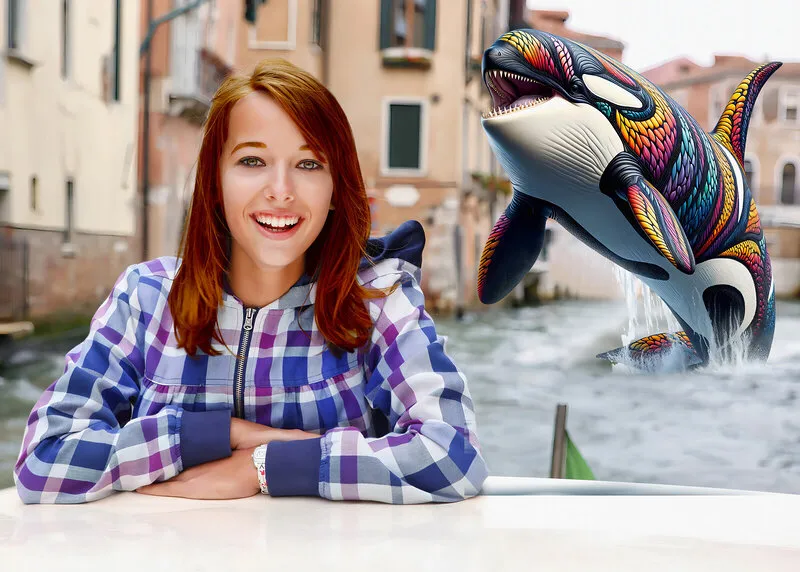
Still Waters Run Deep - I de tystaste vatten..., 2024
Digital
70 x 50 cm
3 200 kr
Orcas, the Killer whales, are making waves these days, not only in Venice. In recent years, orca whales have repeatedly made headlines after attacking—and, in several cases, capsizing—ships off the coast of Spain and Portugal. However, it's important to note that these incidents are unrelated to the orcas' behaviour in Venice. The redhead in Venice can rest easy. It's not her they're after. Possibly the boat she's sitting in.
These incidents, while belligerent, are a testament to the remarkable adaptability and intelligence of orcas (Orcinus orca), also known as killer whales. Sitting at the top of the aquatic food web, they are highly efficient apex predators and incredibly adaptable, capable of overcoming almost any prey. But does that mean humans are on the orca menu?
Fortunately, orcas aren't known for attacking (or eating) humans. Despite their reputation for devouring other marine mammals, they rarely, if ever, attack people in the wild. Much like how great white sharks favour seals' blubber-rich hides and generally don't target less-fatty hominids like us, experts believe that killer whales just aren't as drawn to human flesh compared to another fare like nutrient-rich salmon. This rarity of attacks should reassure you about their peaceful nature.
What Do Orcas Eat? The answer is far from simple. Orcas are dietarily diverse, with pods specialising in meal plans that best suit their environment throughout the world's oceans. They primarily feed on fish, such as salmon and squid. However, their diet can also include marine mammals, such as seals, sea lions, and other whales. Antarctic communities, for example, have a taste for penguins and seals, sometimes banding together to execute novel hunting strategies.
Some orcas even chase down larger marine mammals, including whales. While orcas usually go after calves rather than adults, there are exceptions. In a groundbreaking discovery, scientists recently observed orcas attacking, killing, and eating an adult blue whale for the first time. This was one of three predation events detailed in a 2022 paper in Marine Mammal Science, shedding new light on the hunting behaviours of these apex predators.
Sometimes, these attempts are simply bored individuals having fun, but other times, pods mean business. Human bystanders have observed multiple instances of dozens of orcas orchestrating successful attacks against their prey, in some cases even killing whales up to 70 feet long.
Still, these devastating assailants don't usually bite off more than they can chew. When pods engage with more giant whales, they most often steal vulnerable calves from their mothers.
Why don't Orcas attack humans? Good question. With all these options on the menu and the capability to take down the ocean's mightiest leviathans, humans seem to be easy, straightforward prey. Yet, besides simply not being very tasty or nutritious, we might also be a sort of taboo food for killer whales. Orcas have complex social networks, hosting ceremonial "greetings" between pods and funerals. They also exhibit unique vocalisations, and hunting strategies passed down through generations. Beyond biology, consuming hairless apes like us may not be a cultural custom.
Taken together, these factors help explain why there aren't any documented cases of orcas killing humans in the wild. By contrast, whales facing environmental stressors in captivity have sometimes tragically lashed out at their human trainers.
The Attack of Tilikum upset the animal world. Perhaps the most infamous orca attack involved Tilikum, a killer whale kept at SeaWorld between 1992 and 2017. Tilikum performed numerous acrobatic feats for a live audience, guided by steadfast trainers during his tenure. However, the cramped quarters and subpar living conditions of his enclosure led Tilikum to violent outbursts, resulting in the deaths of three people during his captivity.
Orcas like Tilikum may face profound mental stress in the confines of a tank, prompting violent episodes, according to a 2016 paper published in Animals. In the wild, they swim dozens of kilometres daily in pods of around a dozen members; as such, researchers suggest life in captivity can psychologically destabilise these social animals.
Orcas have a fling with boats. But even in the wild, orcas have been observed to be belligerent toward humans or human-made objects, like boats. Some scientists believe that it might simply be a form of juvenile delinquency, with young whales messing around with the local fishermen. Alternatively, the presence of an adult female during one of these incidents suggests that the animals may have learned to associate boats with danger. Fishing line entanglements occur every day in such waters. The isolated nature of the behaviours, occurring only off the Iberian Peninsula, suggests that they are more cultural than anything innate to orca biology.
While the history of humans and orcas is marred by pollution, capture, and the occasional interspecies scuffle, it's worth remembering that only an estimated 50,000 individuals are left in the world's oceans. Populations are scarce but crucial to proper ecosystem functioning. Perhaps we can learn to coexist with these (mostly) gentle giants more peacefully in due time. Finally, it must be said that very few orcas dress up like this one. Nor was it carnival season, which didn't occur until February this year. But he indeed had fun anyway, our colourful friend dressed as the Commedia dell'Arte character Harlequin. His costume can be described as a diamond pattern with elongated shapes arranged vertically. They are point-to-point, sometimes very close together, almost touching. There is sometimes space between the diamonds, and the negative space forms a lattice effect. And it was brilliantly colourful.
Finally, it must be said that very few orcas dress up like this one in Venice. Nor was it carnival season, which didn't occur until February this year. But he had fun anyway, our Orca friend dressed as the Commedia dell'Arte character Harlequin. Harlequin is the best-known comic servant character Zanni from the Italian Commedia dell'arte. Like the Orca, he is known for his physical agility and trickster qualities. But the redhead can rest easy. It's not her Orcas look for. Possibly the boat she's sitting in.
If our Orca had sunk its teeth into one of the gondolas, it would undoubtedly have spat out the gondolier immediately.
'Still Waters Run Deep' is a proverb that takes us on a fascinating journey through history. Originating from Latin, 'Still, waters run deep' suggests that a calm exterior often conceals a passionate or subtle nature. In the past, it warned that silent people can be dangerous. This intriguing evolution of the proverb is exemplified in William Shakespeare's play Henry VI Part 2, where Suffolk remarks on a fellow lord:
"Smooth runs the water where the brook is deep,
And in his simple show, he harbours treason...
No, no, my sovereign, Gloucester is a man
Unsounded yet and full of deep deceit."
The proverb first emerged in Classical times as "altissimo quaeque flumina minimo sono labi", which translates to 'the deepest rivers flow with the slightest sound'. It is prominently featured in 'The History of Alexander the Great' by Quintus Rufus Curtius, who claimed it was of Bactrian origin. The earliest use of English sources can be traced back to 1400, showcasing the depth of historical references and interpretations of this proverb.
Around 1490, Italian writer Laurentius Abstemius expanded the proverb into a brief fable in Latin titled 'De Rustico Eminem' in his Hecatomythium. This fable was subsequently included in European collections of Aesop's fables. In 1692, Roger L'Estrange featured a summary of the Abstemious version in his edition of the fables under the title 'A Country-man and a River,' interpreting that men of few words are dangerous:
A Country-man that was to pass a River sounded it up and down to try where it was most fordable, and upon Trial, he made this Observation don't: Where the Water ran Smooth, he found it Deepest; and on the contrary, Shallowest where it made most Noise. There's More Danger in a Reserv'd and Silent than in a Noisy, Babbling Enemy.
Just before L'Estrange's translation, there was an amplified version of the story in La Fontaine's Fables titled 'The Torrent and the River.' It narrates the tale of a man attempting to evade a robber who easily crosses a turbulent stream. Still, it perishes in a smooth-flowing river, concluding with the caution that 'Silent folk are dangerous.' The French equivalent to the English 'still waters run deep' underscores this danger: 'No water is worse than quiet water.' This literary richness of the proverb's usage adds to its cultural significance.
When caricaturist J. J. Grandville illustrated La Fontaine's fable, he further underlined this meaning by transforming it into a seduction scene. In the background, a capering donkey and a shrew advance along the road, watched by a woman whose hands are clasped by a sleek cat. Unnoticed at her feet, a snake slithers through the grass.
Thus, the evolution of "still waters run deep" is a fascinating journey through history, literature, and culture, highlighting the timeless wisdom that, sometimes, what appears calm on the surface may conceal the most profound depths.
The old Swedish saying "In the Calmest Waters, the Biggest Fish Swim" means the same thing, but the symbolic meaning is easier to understand.
The expression has an intriguing evolution. It's often rendered in everyday speech as "the ugliest fish." However, in the 16th century, the symbolic use of the snake was employed to express this phenomenon instead - "J this value æro orma værste" (In the quiet water, the worst snakes dwell). The transition from snake to fish is a mystery, but the snake's fundamentally lousy reputation since Adam and Eve adds a layer of intrigue to the saying's origins.
I don't understand that the biggest fish are in the calmest waters. There doesn't seem to be a moral in such an expression. It would be just pleasant for someone who wants to fish them up in that case. It's like saying that big pikes lurk in the reeds, which they do. Fish in our northern latitudes are not dangerous to humans; most are delicious and considered a staple food.
The expression has been distorted over the years, having existed in Swedish since the medieval period, probably much longer. If the point is something along the lines of "the enemy lurks where you least expect it," one might imagine the following scenarios:
"Big fish" is a euphemism for something worse, in the same way, that 'Gråben' (Gray-leg) is a euphemism for 'Wolf', which is a euphemism for 'Ulv' – in English' Old Grey' or 'Greyback'. Perhaps lurking behind the mythological 'Lindworm', an ancient Nordic sea serpent, which conceptually lies close to a snake.
The saying has undergone significant changes over time, reflecting shifts in language and culture. The earlier proverb, referring to the 'ugliest fish ', has been modernised. This shift in the saying's imagery is interesting, as it's rare to associate snakes with aquatic environments. 'Aquatic' is a term that describes plants and animals that primarily live in water.
Let me explain the concept of a 'Noa-name'. It's often described as a euphemism, but its meaning is more specific. A noa-name is a non-taboo synonym to avoid bad luck and replace a dangerous name. This replacement name can be innocuous or flattering, or it can be more accusatory.
The Lindworm, known as 'lindwyrm' or 'lindwurm', is a mythical creature in Northern, Western, and Central European folklore. It's traditionally depicted as a giant serpent monster living deep in the forest, resembling a dragon. According to legend, everything that lies under the Lindworm will increase as the Lindworm grows, giving rise to tales of dragons that brood over treasures to become more prosperous. The Lindworm is a complex creature with two distinct types: a good one, associated with luck, often a cursed prince who has been transformed into the beast, and a bad one, a dangerous man-eater who will attack humans on sight. A lindworm may even swallow its tail, turning itself into a rolling wheel, to pursue fleeing humans.
In Nordic folklore, specifically Swedish folklore, lindworms traditionally appear as giant forest serpents without limbs, living between the rocks deep in the forest. They are said to be dark in colour with a brighter underside. Along the spine, they are said to have fish-like dorsal fins or a horse-like mane, sometimes called a "mane snake" in Swedish' Manorm'. They can spit out a foul milk-like substance for defence and attack, which can blind enemies.
Lindworm eggs are said to be laid under the bark of linden trees. Once hatched, they slither away and make a home in a pile of rocks. When fully grown, they can become extremely long. That such a monster gains a bad reputation and is feared is understandable; hence, it is probably the old saying about them being found in the calmest waters.
"Still Waters (Run Deep)" is also a song by the Bee Gees. It is the third and final single from their 21st studio album, Still Waters (1997), written by Barry, Robin, and Maurice Gibb.
"Never you mind if I
Don't tell strangers passing by
If I don't brag
If I don't brag or boast
Click my glass and say a toast
About my love for you
How it runs so deep and true
And yet, it's so
'Cause don't you know, oh
Still waters run deep
Still waters run deep
Still waters run deep
Still waters run deep"
As the Bee Gees have done, this phenomenon can also be explained. It makes understanding why an orca has entered Venice's canal system easier. Not to devour a poor tourist but to feast on the fish hiding in the city's ordinarily murky waters.
The unexpected silver lining of the pandemic was crystal-clear canals in Venice. When the coronavirus brought Venice's bustling tourism to a standstill, a remarkable metamorphosis took place—the canals, once shrouded in obscurity, revealed their resilience by turning into a spectacle of crystal-clear water, unveiling the hidden world of fish beneath the surface. The stark contrast between the pre-pandemic and pandemic periods was a sight to behold, a testament to the canals' ability to bounce back.
Swans returned to the canals, and dolphins were spotted frolicking in the port. One might even imagine the killer whale sneaking in, hot on the trail of its prey.
The usually cloudy Venice canals turned crystal clear after the coronavirus lockdown. With the halt in tourism, the water was transparent enough to reveal the fish swimming below. Italy's tourism industry stopped once coronavirus cases began to spike. However, the Venice community, united in their love for their city, took to social media to share stunning images of the traffic-free canals, spreading the beauty of their home to the world.
While the sight of swans gliding and dolphins making rare appearances delighted the locals, the canals' newfound clarity did not directly result from improved water quality. It was, in fact, a consequence of significantly reduced boat traffic, a factor that typically stirs up sediment from the canal beds, thereby clouding the water.
The low turbidity of the water does not mean cleanliness. The transparency is due to the absence of sediment resuspension." Indeed, pictures from March 18, 2020, show clear waters filled with seaweed, starkly contrasting to the usual opacity.
The water's cold temperature, approximately 57 degrees Fahrenheit, also played a significant role. According to Campostrini, there is a minimal synthesis of organic compounds from carbon dioxide at this temperature, which doesn't initiate until the water reaches about 62 degrees Fahrenheit. This scientific phenomenon contributed to the unusual clarity of the canals during the pandemic.
As the spread of COVID-19 continued, Venice's canals remained clear due to the lack of tourists, motorboats, and pollution. This unexpected environmental benefit of the pandemic likely led to improved air quality, with pollutants significantly decreasing. It's a glimmer of hope in these challenging times, showing us the positive impact we can have on our environment when we come together.
Amid the crisis, this clarity offered a slight reprieve for Venice. In 2019, this city suffered devastating flooding from the highest tide in over 50 years, causing inestimable damage to its historic architecture.
So, while the pandemic brought much hardship, it also brought a rare and serene beauty to the storied canals of Venice, reminding us that even in difficult times, nature has a way of showing us its wonders.
Venice is indeed a Fishy Affair. A popular book on sale declares that "Venice is a Fish." This refers to the city's shape, as aerial photos will attest. However, if the saying "you are what you eat" holds any truth, Venice is a fish, for its traditional cuisine has a distinctly fishy flavour. This is hardly surprising given that Venice emerges from the centre of a lagoon on the edge of the Adriatic Sea, teeming with scaly and finned creatures.
What is surprising, however, is that one of the most popular fish in the city's cuisine comes not from the lagoon but from a remote Norwegian archipelago about 2,500 kilometres from St. Mark's Square. The reason why baccalà—air-dried stockfish, not salt cod—is so prevalent in Venice is, quite literally, based on an accident.
In 1432, a Venetian merchant named Pietro Querini found himself shipwrecked off the Lofoten islands in Norway. While waiting for a Venetian galley to rescue him, he gorged on the local dried fish and bought a large quantity as emergency rations for the return journey. Upon safely returning to Venice, Querini sold the baccalà at the Rialto market, and it became an overnight sensation. Since then, ships have been going back and forth to Norway, picking up supplies for hungry Venetians.
The Rialto fish market is world-famous for its incredible array of seafood. A paving slab on the wall near the entrance states the minimum size of fish that must be sold at the market.
However, a morning trip to the Rialto fish market will introduce you to the variety of fish found zero kilometres away instead of 2,500. Along with fish from the Atlantic and Mediterranean, you can find a full range of produce fished out of the Adriatic Sea and the Venetian lagoon itself.
On the side of the old fish market building is a stone inscription giving the minimum sizes for fish sold. It reads like a Wikipedia entry for local species, most of which have an established position in Venetian cuisine and can still be bought from adjacent stalls. The names are given in the Venetian dialect (as are the ones below, which differ slightly from standard Italian).
The most crucial local fish are sardele (pilchards) and sardon (anchovies) in the lagoon. Abundant and traditionally cheap, these form the basis of two Venetian classics: sardine in saor and bigoli in salsa. Sardele in saor, fish pickled in a sweet and sour sauce with onions, pine nuts, and sultanas, likely originates from Roman times to preserve fish. It's commonly served as cichéti (small plates) in Venetian bacari (wine bars), one of the best ways to eat in the city. Bigoli in salsa, one of the few actual Venetian pasta dishes, consists of spaghetti-like pasta served in a slow-cooked anchovy sauce.
Sardele is often filleted, opened flat, and fried in breadcrumbs. These complete di sardine are usually found as cichéti in bacari and are delicious with a glass of Friulano wine.
Other fish served as cichéti include folpetti (baby octopus) and peoci (mussels). Vongole (clams) are served with spaghetti in one of the most classic Italian primi (first courses). Capesante (scallops) and gamberi (prawns) are also famous, the latter being used as an alternative to sardele in saor.
Seppie (squid) are prized as much for their black ink as their flesh. Risotto al Nero di sepia is a stunning dish that looks like it's made with black rice and has a delicate, slightly sweet flavour.
You can find moeche (a soft-shell crab) in April and May, often cooked in dry white wine. Another highly seasonal find is schie (tiny shrimps), served on foggy winter days on a bed of steaming polenta, providing Venetians with much-needed comfort food. They are much sweeter than more giant shrimps, and it's impossible to have enough of them, however large the portion.
Bisati (eels) are a local delicacy often served grilled (sulla brace), cooked in a pan with tomatoes, garlic, and parsley (in tecia), or with bay leaves (sull'ara).
Larger fish include branzin (sea bass), orada (gilt-head bream), dental (common dentex), and rombo (sole). These are usually cooked whole in the oven or pan and served simply as a secondo or main course.
Sgombro (mackerel) is one of the most beautiful fish found in the lagoon. Its body is covered with black and steel-blue stripes that catch the light with iridescence. It is usually eaten filleted in a simple fish stock sauce.
Go (grass goby) is another archetypal fish of the lagoon and is served in a soup (in broeto) or as part of a risotto.
Other fish from further afield, such as pesce spada (swordfish), salmone (salmon), and tonno (tuna) are often found at the market to add variety, as if any were needed.
Even if you are not a fish aficionado, tracking down these local species and dishes for a real taste of the Serenissima is worth tracking next time you are in Venice. Eating local produce is good for the environment, and you can enjoy your authentic meal with a clear conscience.
Last time in Venice, on my trip back to Burano, my guide, the fisherman, cut the engine and paddled towards some bushy plants—samphire and santonico, a kind of lagoon absinthe—snipping off the tips for me to sniff. Some days, he harvests cuttings to sell to Venice restaurants along with his crabs.
Tourists, locals, and gondoliers certainly know it: Don't swim in the Venice canals. Venice's waterways may look picturesque but serve as the city's sewage system. However, an unexpected silver lining to the coronavirus pandemic has emerged—things are looking up for the fish and other marine animals that swim in the canals.
Furthermore, as a Venetian architect explained, most of the pollution in Venice's canals and lagoon is not due to human waste but chemicals that humans release into the waterways. These chemicals enter from various sources, from industrial chemicals to pesticides to essential household cleaners and detergents.
3 200 kr

Jörgen Thornberg
Malmö
Lite om bilder och mig. Translation in English at the end.
Jag är en nyfiken person som ser allt i bilder, även det jag fäster i ord, gärna tillsammans för bakom alla mina bilder finns en berättelse. Till vissa bilder hör en kortare eller längre novell som följer med bilden.
Bilder berättar historier. Jag omges av naturlig skönhet, intressanta människor och historia var jag än går. Jag använder min kamera för att dokumentera världen och blanda det jag ser med vad jag känner för att fånga den dolda magin.
Mina bilder berättar mina historier. Genom mina bilder, tryck och berättelser. Jag bjuder in dig att ta del av dessa berättelser, in i ditt liv och hem och dela min mycket personliga syn på vår värld. Mer än vad ögat ser. Jag tänker i bilder, drömmer och skriver och pratar om dem; följaktligen måste jag också skapa bilder. De blir vad jag ser, inte nödvändigtvis begränsade till verkligheten. Det finns en bild runt varje hörn. Jag hoppas att du kommer att se vad jag såg och gilla det.
Jag är också en skrivande person och till många bilder hör en kortare eller längre essay. Den följer med tavlan, tryckt på fint papper och med en personlig hälsning från mig.
Flertalet bilder startar sin resa i min kamera. Enkelt förklarat beskriver jag bilden jag ser i mitt inre, upplevd eller fantiserad. Bilden uppstår inom mig redan innan jag fått okularet till ögat. På bråkdelen av ett ögonblick ser jag vad jag vill ha och vad som kan göras med bilden. Här skall jag stoppa in en giraff, stålmannen, Titanic eller vad det är min fantasi finner ut. Ännu märkligare är att jag kommer ihåg minnesbilden långt efteråt när det blir tid att skapa verket. Om jag lyckas eller inte, är upp till betraktaren, oftast präglat av en stråk av svart humor – meningen är att man skall bli underhållen. Mina bilder blir ofta en snackis där de hänger.
Jag föredrar bilder som förmedlar ett budskap i flera lager. Vid första anblicken fylld av feel-good, en vacker utsikt, fint väder, solen skiner, blommor på ängen eller vattnet som ligger förrädiskt spegelblankt. I en sådan bild kan jag gömma min egentliga berättelse, mitt förakt för förtryckare och våldsverkare, rasister och fördomsfulla människor - ett gärna återkommande motiv mer eller mindre dolt i det vackra motivet. Jag försöker förena dem i ett gemensamt narrativ.
Bild och formgivning har löpt som en röd tråd genom livet. Fotokonst känns som en värdig final som jag gärna delar med mig.
Min genre är vid som framgår av mina bilder, temat en blandning av pop- och gatukonst i kollage som kan bestå av hundratals lager. Vissa bilder kan ta veckor, andra någon dag innan det är dags att överlämna resultatet till printverkstaden. Fine Art Prints är digitala fotocollage. I dessa kollage sker rivandet, klippandet, pusslandet, målandet, ritandet och sprayningen digitalt. Det jag monterar in kan vara hundratals år gamla bilder som jag omsorgsfullt frilägger så att de ser ut att vara en del av tavlan men också bilder skapade av mig själv efter min egen fantasi. Därefter besöks printstudion och för vissa bilder numrera en limiterad upplaga (oftast 7 exemplar) och signera för hand. Vissa bilder kan köpas i olika format. Det är bara att fråga efter vilka. Gillar man en bild som är 70x100 men inte har plats på väggen, går den kanske att få i 50x70 cm istället. Frågan är fri.
Metoden Giclée eller Fine Art Print som det också kallas är det moderna sättet för framställning av grafisk konst. Villkoret för denna typ av utskrifter är att en högkvalitativ storformatskrivare används med åldersbeständigt färgpigment och konstnärspapper eller i förekommande fall på duk. Pappret som används möter de krav på livslängd som ställs av museer och gallerier. Normalt säljer jag mina bilder oinramade så att den nya ägaren själv kan bestämma hur de skall se ut, med eller utan passepartout färg på ram, med eller utan glas etc..
Under många år ställde jag bara ut på nätet, i valda grupper och på min egen Facebooksida - https://www.facebook.com/jorgen.thornberg.9
Jag finns också på en egen hemsida som tyvärr inte alltid är uppdaterad – https://www.jth.life/ Där kan du också läsa en del av de berättelser som följer med bilden.
UTSTÄLLNINGAR
Luftkastellet, oktober 2022
Konst i Lund, november 2022
Luftkastellet, mars 2023
Engleson Galleri Caroli, april 2023
Hydra, Greece June 2023
Engleson Galleri Caroli, oktober 2023
Toppen, Höllviken december 2023
Luftkastellet, mars 2024
Torups Galleri, mars 2024
Venice, May 2024
Luftkastellet, oktober 2024
Konst i Advent, December 2024
Galleri Engleson, Caroli December 2024
Jäger & Jansson Galleri, april 2025
A bit about pictures and me.
I'm a curious person who sees everything in pictures, even what I express in words, often combining them, for behind all my pictures lies a story. These narratives, some as short as a single image and others as long as a novel, are the heart and soul of my work.
Pictures tell stories. Wherever I go, I'm surrounded by natural beauty, exciting people, and history. I use my camera to document the world and blend what I see with what I feel to capture the hidden magic.
My images tell my stories. Through my pictures, prints, and narratives, I invite you to partake in these stories in your life and home and share my deeply personal perspective of our world. More than meets the eye. I think in pictures, dream, write, and talk about them; consequently, I must create images too. They become what I see, not necessarily confined to reality. There's a picture around every corner. I hope you'll see what I saw and enjoy it.
I'm also a writer, and many images come with a shorter or longer essay. It accompanies the painting, printed on fine paper with my personal greeting.
Many pictures start their journey on my camera. Simply put, I describe the image I see in my mind, experienced or imagined. The image arises within me even before I bring the eyepiece to my eye. In a fraction of a moment, I see what I want and what can be done with the picture. Here, I'll insert a giraffe, Superman, the Titanic, or whatever my imagination conjures up. Even stranger is that I remember the mental image long after it's time to create the work. Whether I succeed is up to the observer, often imbued with a streak of black humour – the aim is to entertain. My pictures usually become a talking point wherever they hang.
I prefer pictures that convey a message in multiple layers. At first glance, they're filled with feel-good vibes, a beautiful view, lovely weather, the sun shining, flowers in the meadow, or the water lying deceptively calm. But beneath this surface beauty, I often conceal a deeper story, a narrative that challenges societal norms or explores the human condition. I invite you to delve into these hidden narratives and discover the layers of meaning within my work.
Picture and design have been a thread running through my life. Photographic art feels like a fitting finale, and I'm happy to share it.
My genre is varied, as seen in my pictures; the theme is a blend of pop and street art in collages that can consist of hundreds of layers. Some images can take weeks, others just a day before it's time to hand over the result to the print workshop. Fine Art Prints are digital photo collages. In these collages, tearing, cutting, puzzling, painting, drawing, and spraying happen digitally. What I insert can be images hundreds of years old that I carefully extract so they appear to be part of the painting, but also images created by myself, now also generated from my imagination. Next, visit the print studio and, for certain images, number a limited edition (usually 7 copies) and sign them by hand. Some images may be available in other formats. Just ask which ones. If you like an image that's 70x100 but doesn't have space on the wall, you might be able to get it in 50x70 cm instead. The question is open.
The Giclée method, or Fine Art Print as it's also called, is the modern way of producing graphic art. This method ensures the highest quality and longevity of the artwork, using a high-quality large-format printer with archival pigment inks and artist paper or, in some cases, canvas. The paper used meets the longevity requirements set by museums and galleries. I sell my pictures unframed, allowing the new owner to personalise their artwork, confident in the lasting value and quality of the piece.
For many years, I only exhibited online, in selected groups, and on my Facebook page - https://www.facebook.com/jorgen.thornberg.9. I also have my website, which unfortunately is not constantly updated - https://www.jth.life/. You can also read some of the stories accompanying the pictures there.
EXHIBITIONS
Luftkastellet, October 2022
Art in Lund, November 2022
Luftkastellet, March 2023
Engleson Gallery Caroli, April 2023
Hydra, Greece June 2023
Engleson Gallery Caroli, October 2023
Toppen, Höllviken December 2023
Luftkastellet, March 2024
Torup Gallery, March 2024
Venice, May 2024
UTSTÄLLNINGAR
Luftkastellet, oktober 2022
Konst i Lund, november 2022
Luftkastellet, mars 2023
Engleson Galleri Caroli, april 2023
Hydra, Greece June 2023
Engleson Galleri Caroli, oktober 2023
Toppen, Höllviken december 2023
Luftkastellet, mars 2024
Torups Galleri, mars 2024
Venice, May 2024
Luftkastellet, October 2024
Konst i Advent, December 2024
Galleri Engleson, Caroli December 2024
Jäger & Jansson Galleri, April 2025
Utbildning
Autodidakt
Medlem i konstnärsförening
Öppna Sinnen
Med i konstrunda
Konstrundan i Skåne
Utställningar
Luftkastellet, October 2022
Art in Lund, November 2022
Luftkastellet, March 2023
Engleson Gallery Caroli, April 2023
Hydra, Greece June 2023
Engleson Gallery Caroli, October 2023
Toppen, Höllviken December 2023
Luftkastellet, March 2024
Torup Gallery, March 2024
Venice, May 2024