Vi använder cookies för att ge dig bästa möjliga upplevelse. Välj vilka cookies du tillåter.
Läs mer i vår integritetspolicy
Jörgen Thornberg
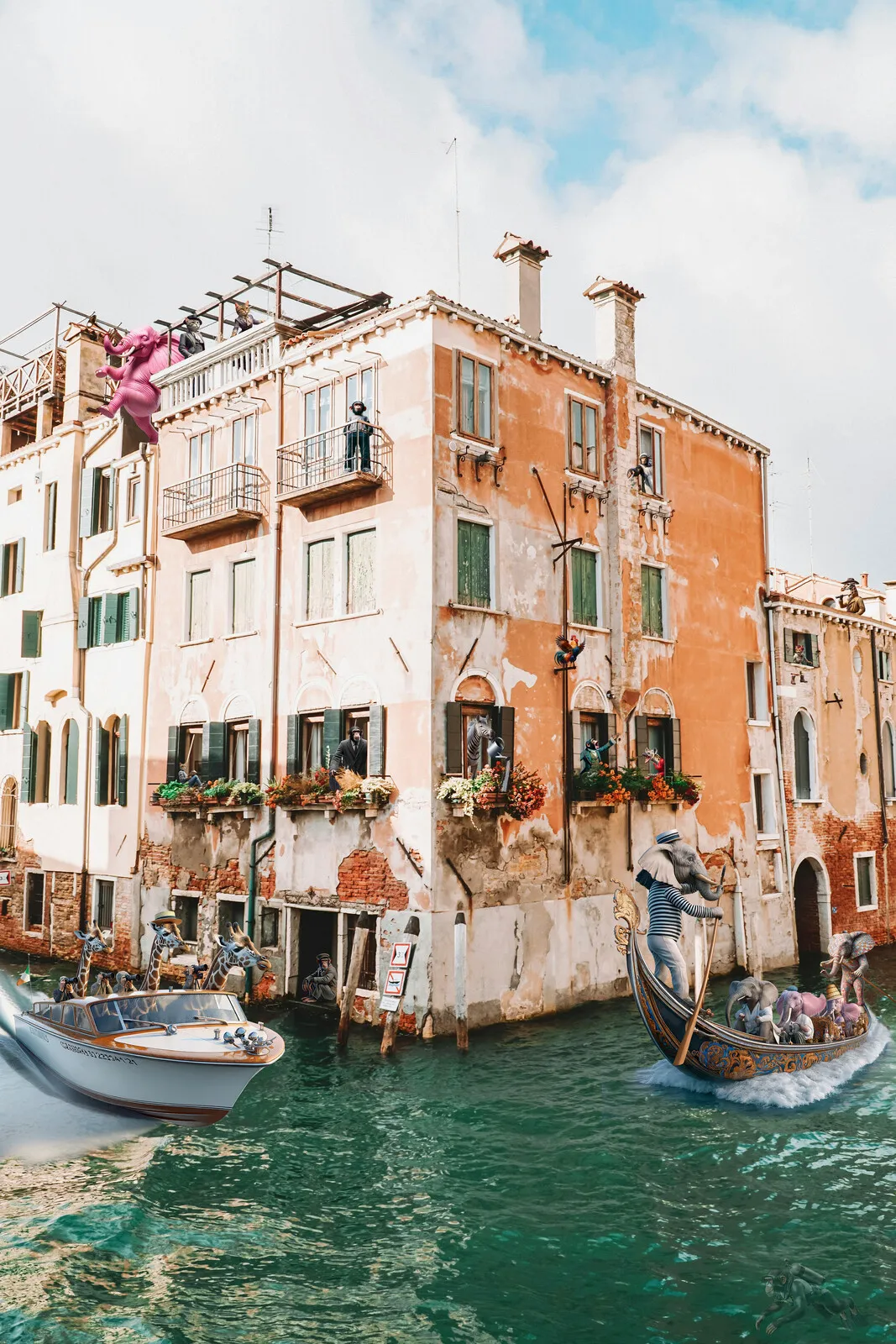
Navigare necesse est…., 2024
Digital
70 x 100 cm
5 200 kr
In Venice, it's usually more convenient to take a boat, though perhaps not in the way my picture depicts it. Fewer and fewer people can afford to live in the homes, which are instead rented out to tourists. When renting out their homes, some have to live on the damp ground floor unless there's a flood. In this case, they must swim between the bedroom and the bathroom.
Gnaeus Pompeius Magnus, a figure of immense historical significance, once uttered a saying that resonates with his bravery and determination: 'Navigare necesse est, vivere non est necesse' - sail is necessary; to live is unnecessary. This saying, attributed to him by Plutarch, stands as a testament to his strategic thinking and unwavering leadership. In the face of a severe storm, Pompeius fearlessly commanded his sailors to bring food from Africa to Rome, a feat that demonstrated his courage and determination.
Pompey...was ready to start his voyage home (when) a great storm arose upon the sea, and the ships' captains were reluctant to set sail. But he led the way himself and ordered them to weigh anchor, shouting to them: "We have to sail, we do not have to live ". This was in 56 B.C. Although Plutarch's text is in Greek, Pompey presumably spoke Latin. The Latin version, 'Navigare necesse est, vivere non est necesse, first appeared during the Middle Ages.
The ancient saying "Navigare necesse est, vivere non necesse" encapsulates, in my perspective, the very essence of water transportation. These words, spoken in 56 B.C. by the proconsul of ancient Rome, Gnaeus Pompeius, in a situation described by Plutarchus, have transcended time and continue to resonate. In the Middle Ages, they served as a motto of the Hanseatic League, and even today, they grace the pediment of the Seaman House in Bremen. In the twentieth century, Stefan Zweig (1881-1942) commenced the first chapter of his book on Magellan with these words, describing them as an ancient sailor's saying that continues to echo in human hearts. The act of travel, in its various forms and to increasingly remote and challenging destinations, is now a norm in contemporary society. However, it was an essential (sine qua non) aspect of life in the Middle Ages.
Medieval life was enriched by the diverse array of travellers who crisscrossed the world. While many people remained rooted in their birthplaces, some embarked on daring journeys, often spanning vast distances. Traders, warriors, adventurers, missionaries, diplomats, and even early tourists moved from one place to another, shaping the world through their trade, warfare, and missions. These diverse travellers, each with unique stories and perspectives, played a pivotal role in connecting distant parts of the world, disseminating news and narratives, and shaping the global narrative we know today.
Ah, My Venice! A city that draws in not just humans but even elephants, giraffes, and chimpanzees. And yes, even zebras. A city that defies the norm, floating on water, with canals for streets and boats for taxis. It's a place that has stirred the souls of poets, painters, and countless romantics. But beneath the glistening surface of the canals, there lies a history as enigmatic and alluring as the water itself. Let's plunge into some of the more spellbinding tales from this iconic city, brimming with famous visitors, eccentric citizens, and some juicy anecdotes.
The Birth of a Floating Marvel
Venice was not just born; it was crafted out of necessity. In the 5th century, the inhabitants of the Veneto region sought refuge from barbarian invasions on the lagoon's marshy islands. These early Venetians had a bold idea: 'Why not build a city here?' And so they did, using a foundation of wooden piles driven deep into the muddy lagoon. Over time, Venice became a significant maritime power, a bustling trade hub that bridged the gap between East and West. Its strategic location turned it into a melting pot of cultures, goods, and, of course, gossip.
Casanova, the Original Playboy
No discussion of Venice is complete without mentioning Giacomo Casanova, the city's most notorious lover. Born in 1725, Casanova was a man of many talents: writer, adventurer, and, most famously, seducer. His memoirs detail his numerous romantic exploits, which often read like a steamy soap opera. One of his more scandalous escapades involved seducing a nun – a feat that would make even the most brazen modern playboy blush.
Casanova's love life was so prolific that it landed him in prison more than once. His most famous imprisonment was in the Doge's Palace, where he dared escape by climbing the roof. He fled to Paris and continued his escapades, always leaving a trail of broken hearts and juicy stories in his wake.
The Doge's Daring Dodge
The Doges of Venice were the city's rulers for over a thousand years, but the role was not without its peculiarities. One of the most famous Doges, Enrico Dandolo, was blind and over 90 years old when he led the Fourth Crusade in 1202. Picture it: a nonagenarian blind man leading an army – if that's not a juicy anecdote, what is?
Dandolo's persuasion led the Crusaders to divert their attention from Jerusalem to sack Constantinople. This was not just a historical detour but a testament to Venetian diplomacy and cunning. The wealth plundered from Constantinople was a cornerstone for Venice's power and prosperity for centuries.
Byron, the Bad Boy Poet
Lord Byron, the quintessential Romantic poet, found Venice the perfect backdrop for his dramatic life. Arriving in 1816, Byron embraced the city's libertine atmosphere. He famously swam across the Grand Canal, shocking the Venetians, who were more accustomed to seeing gondolas than nearly naked Englishmen braving the murky waters.
Byron's love affairs were as fierce as his poetry. He rented the grand Palazzo Mocenigo and filled it with a menagerie of animals, including a monkey and several dogs. Byron's scandalous relationship with Marianna Segati, his landlord's wife, fueled the gossip fires. The poet's wild exploits and fiery temperament left an indelible mark on the city's history of juicy anecdotes.
The Artful Heiress Peggy Guggenheim
In the 20th century, Venice became a haven for artists and intellectuals, none more famous than Peggy Guggenheim. The American heiress turned her Venetian palazzo into a modern art museum, showcasing works by Jackson Pollock, Salvador Dalí, and other avant-garde artists. But Peggy's personal life was just as colourful as her art collection.
Known for her numerous affairs, Peggy once quipped that she'd had 400 lovers. Her romantic escapades were the talk of Venice, and her parties were legendary. Guests included Truman Capote and Tennessee Williams, and the gossip flowed as freely as the prosecco. Peggy's vibrant personality and contributions to the art world made her a beloved figure in Venice's history.
With its labyrinthine canals and storied history, Venice is a city where the past and present intertwine in fascinating ways. From Casanova's audacious escapes and Byron's scandalous swims to Peggy Guggenheim's bohemian soirées, the town has been a stage for some of history's most scandalous characters and juiciest anecdotes. So, next time you find yourself wandering through Venice, remember: every corner, every canal, and every palace has a story waiting to be told – some more scandalous than others.
Even though it might have been crowded in the past, it's nothing compared to today's Venice. The city that has etched its history on the water, sometimes under it, is also flooded by people and boats.
Venice flourished as a trading city, becoming one of Europe's most significant trading powers, and traffic grew. From the 9th century through its peak in the 14th century, Venice used its location and naval prowess to amass influence and wealth, filling its canals with boats. The city gained independence from the Byzantine Empire while maintaining a trading relationship. Venice's internal waterways have a rich history, with people and visitors relying on human-powered boats like rowboats and gondolas for centuries. This gondola-driven society lasted well into the 19th century until the steam-powered ship, the vaporetti, arrived in the 1880s, followed by gas-powered motorboats in the 1950s. Today, gondolas are almost exclusively used by tourists, serving as a visual reminder of Venice's past. There are too many of them, some say.
Once a hub of commerce, Venice was pivotal in connecting Europe with the East through the Silk Road. This strategic position allowed Venice to amass immense wealth and influence, with its fleet becoming one of the most powerful in the Mediterranean. The transition from rowboats to steam-powered boats in the 19th century marked a significant shift in Venetian transportation. The introduction of motorboats in the 1950s further transformed the city's waterways, leading to the near extinction of rowboats in the canals. The remaining gondolas, now mainly a tourist attraction, are a testament to the city's rich maritime history.
Unique Transportation
Venice faces unique transportation challenges. Traffic congestion is a significant issue, with nearly 150 canals crowded with various types and sizes of boats. Unlike other cities, Venice cannot expand its narrow streets and canals. The resident population is dropping below 55,000, while the average number of tourists in Venice in 2013 was 57,430 per day, with peaks of up to 90,000 in the summer. Tourists slow down Venetian's walking speed by approximately 16%. Cargo deliveries also contribute significantly to motorboat traffic, with 50% of goods estimated to be for tourists.
Venice's transportation system, while unique and picturesque, is not without its challenges. The city's layout, with its winding canals and narrow streets, poses unique logistical challenges. Traditional traffic control measures like traffic lights and stop signs are almost non-existent. Instead, the city relies on a combination of speed limits and regulations specific to boat types and locations. While a symbol of Venice's beauty, the canals are not designed to handle the modern influx of boats, leading to significant congestion, especially during peak tourist seasons. The high volume of tourists exacerbates these issues, as the city's infrastructure struggles to accommodate the sheer number of visitors.
Types of Boats
Venetian maritime traffic includes different types of boats for various purposes. The most prevalent form of public transport is the vaporetti—Venetian water buses. Other options include water taxis, Alilaguna (airport buses), and traghetti (for canal crossing). Private motorboats are less common due to the high price of mooring. Additionally, there are ambulance boats, police boats, small cargo boats, rowing boats and occasionally canoes or boards. Gondolas, now almost exclusively used by tourists, are the only primary type of boat on the canals that are not motorised.
The vaporetti system, operated by ACTV, is Venice's primary form of public transportation. It runs 160 water buses along the main canals, around Venice, and to nearby islands like Murano. Routes 1 and 2 snakes through the Grand Canal, while routes 4.1 and 4.2 circle the combined islands of Venice. Users must tap on the station before boarding the boat. Some routes may be restricted during Acqua Alta (high tides flood the city). The vaporetti system transports over 95 million passengers annually.
Water taxis provide a more private and direct transportation, albeit at a higher cost. These taxis can navigate the canals faster and offer point-to-point service, making them popular among tourists and locals. The traghetti are large, undecorated gondolas that ferry passengers across the Grand Canal, offering a quick and inexpensive crossing. These various modes of transport, each with its unique role, contribute to Venice's complex and dynamic traffic patterns.
Environmental and Safety Impacts
Venice's water transportation system poses significant environmental and safety challenges. The wave motion, moto ondoso, caused by boat traffic, inflicts substantial damage to buildings and canal walls. The pollution from motorboats further contaminates the canals and the delicate lagoon ecosystem. The narrow canals exacerbate these issues, as boats create wakes that damage canal walls and disrupt other boats, posing a safety risk.
The environmental impact of boat traffic in Venice is profound. The constant wake from motorboats contributes to canal wall erosion and undermines historic buildings' structural integrity. This wake-induced erosion, known as moto ondoso, is a significant factor in the ongoing degradation of Venice's infrastructure. Additionally, the pollution from boat engines contaminates the water, affecting the city's waterways and the broader lagoon ecosystem. Efforts to mitigate these effects include stricter speed regulations and promoting eco-friendly engines.
Public safety is another primary concern. The congested canals increase the risk of accidents, as evidenced by the fatal crash between a gondola and a vaporetto in 2013. This incident highlighted the need for better traffic regulation and enforcement. In response, the city introduced new safety measures, such as prohibiting mobile phones while steering any vessel and restricting commercial barges to early morning hours. These measures aim to reduce the risk of accidents and improve the overall safety of Venice's waterways.
Traffic Control
Effective traffic management is crucial to saving time and money in Venice. Speed limits are based on location and type of boat. The maximum speed limit in the lagoon is 20 km/hr; within the historic city centre, it is 11 km/hr; and within the Grand Canal and smaller canals, it is 5-7 km/hr. However, only 3% of boats abide by these limits.
The Venetian Municipal Authorities have implemented traffic monitoring systems since the 1990s. The public Vaporetto fleet has GPS satellite receivers, allowing for speed and trajectory monitoring. The SALOMON system uses onboard equipment to track boat positions and speed, issuing signals when speed limits are exceeded. The ARGOS project uses cameras and automated vision technology to monitor the Grand Canal.
In the 1990s, integrating GPS technology into the Vaporetto fleet marked a significant advancement in traffic management. This allowed the ACTV to monitor routes and enforce speed limits more effectively. The subsequent development of the SALOMON system provided even greater precision, with onboard GPS receivers tracking boat positions and speeds in real-time. The ARGOS project enhanced monitoring capabilities by using cameras and automated vision technology to cover the entire Grand Canal. These technological advancements have been instrumental in improving traffic control and reducing the environmental impact of boat traffic.
Significant progress has been made to monitor and improve Venice's water transportation. Recommendations include re-engineering taxi and cargo systems, reducing taxi travel time without passengers, and redesigning boat hulls and engines to reduce wake pollution. Increasing awareness of environmental impacts and stricter enforcement of regulations could also help.
One promising recommendation is to optimise the taxi dispatch system to reduce the time taxis travel without passengers. By allowing taxis to pick up passengers near their drop-off points rather than returning to their original stands, the overall travel time and environmental impact could be significantly reduced. Similarly, re-engineering the cargo delivery system to deliver goods by destination rather than item could streamline operations and reduce unnecessary travel.
Introducing low-wake hull designs, like the M-Hull, and hybrid or electric engines could also mitigate the environmental impact of boat traffic. These innovations can reduce wake pollution and emissions, helping to preserve Venice's historic canals and buildings. Public awareness campaigns about the environmental impact of boat traffic could encourage more responsible behaviour among boat operators and passengers.
If more people knew about the severe environmental impacts of waterborne traffic, they would be more inclined to follow rules and regulations like speed limits. Moto ondoso is a serious problem threatening the very foundation of Venice, and awareness might be able to increase conscientious commuters. Additionally, stricter enforcement of existing rules could help to discourage people from damaging and dangerous behaviours. The eco-friendly vaporetto will give off much lower levels of atmospheric emissions and save on fuel usage.
For a city known for its beautiful waters, Venice has a more complicated relationship with water than it appears to visitors. Water is transportation, economics, public safety, public works, infrastructure, and tourism all rolled into one. It must be managed comprehensively and understood at each of these levels. The canals are historical and famous but also crucial to a modern city. Venice's unique challenges require innovative solutions to preserve its heritage while meeting the demands of a bustling, modern urban environment.
Fortunately, not everyone zips around the canals like these clueless elephants who thought they could speed through Venice. Even more rushed were the giraffes making a quick tour on their way to the airport.
Jörgen Thornberg
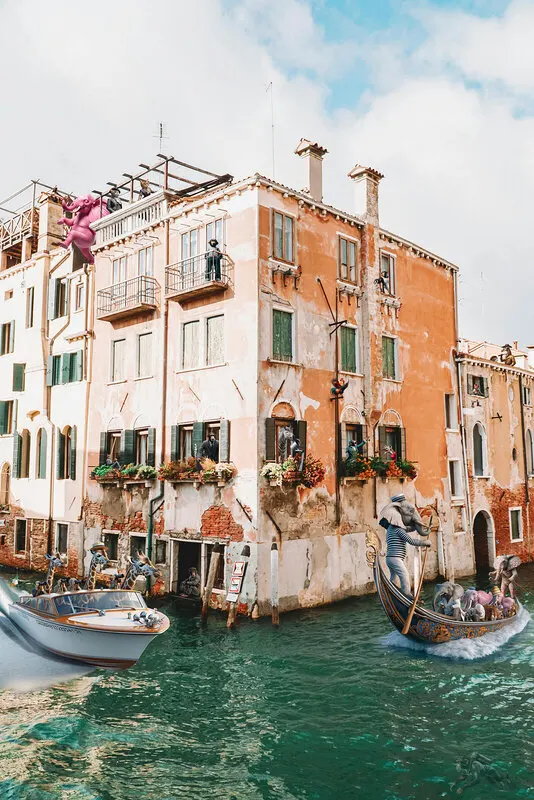
Navigare necesse est…., 2024
Digital
70 x 100 cm
5 200 kr
In Venice, it's usually more convenient to take a boat, though perhaps not in the way my picture depicts it. Fewer and fewer people can afford to live in the homes, which are instead rented out to tourists. When renting out their homes, some have to live on the damp ground floor unless there's a flood. In this case, they must swim between the bedroom and the bathroom.
Gnaeus Pompeius Magnus, a figure of immense historical significance, once uttered a saying that resonates with his bravery and determination: 'Navigare necesse est, vivere non est necesse' - sail is necessary; to live is unnecessary. This saying, attributed to him by Plutarch, stands as a testament to his strategic thinking and unwavering leadership. In the face of a severe storm, Pompeius fearlessly commanded his sailors to bring food from Africa to Rome, a feat that demonstrated his courage and determination.
Pompey...was ready to start his voyage home (when) a great storm arose upon the sea, and the ships' captains were reluctant to set sail. But he led the way himself and ordered them to weigh anchor, shouting to them: "We have to sail, we do not have to live ". This was in 56 B.C. Although Plutarch's text is in Greek, Pompey presumably spoke Latin. The Latin version, 'Navigare necesse est, vivere non est necesse, first appeared during the Middle Ages.
The ancient saying "Navigare necesse est, vivere non necesse" encapsulates, in my perspective, the very essence of water transportation. These words, spoken in 56 B.C. by the proconsul of ancient Rome, Gnaeus Pompeius, in a situation described by Plutarchus, have transcended time and continue to resonate. In the Middle Ages, they served as a motto of the Hanseatic League, and even today, they grace the pediment of the Seaman House in Bremen. In the twentieth century, Stefan Zweig (1881-1942) commenced the first chapter of his book on Magellan with these words, describing them as an ancient sailor's saying that continues to echo in human hearts. The act of travel, in its various forms and to increasingly remote and challenging destinations, is now a norm in contemporary society. However, it was an essential (sine qua non) aspect of life in the Middle Ages.
Medieval life was enriched by the diverse array of travellers who crisscrossed the world. While many people remained rooted in their birthplaces, some embarked on daring journeys, often spanning vast distances. Traders, warriors, adventurers, missionaries, diplomats, and even early tourists moved from one place to another, shaping the world through their trade, warfare, and missions. These diverse travellers, each with unique stories and perspectives, played a pivotal role in connecting distant parts of the world, disseminating news and narratives, and shaping the global narrative we know today.
Ah, My Venice! A city that draws in not just humans but even elephants, giraffes, and chimpanzees. And yes, even zebras. A city that defies the norm, floating on water, with canals for streets and boats for taxis. It's a place that has stirred the souls of poets, painters, and countless romantics. But beneath the glistening surface of the canals, there lies a history as enigmatic and alluring as the water itself. Let's plunge into some of the more spellbinding tales from this iconic city, brimming with famous visitors, eccentric citizens, and some juicy anecdotes.
The Birth of a Floating Marvel
Venice was not just born; it was crafted out of necessity. In the 5th century, the inhabitants of the Veneto region sought refuge from barbarian invasions on the lagoon's marshy islands. These early Venetians had a bold idea: 'Why not build a city here?' And so they did, using a foundation of wooden piles driven deep into the muddy lagoon. Over time, Venice became a significant maritime power, a bustling trade hub that bridged the gap between East and West. Its strategic location turned it into a melting pot of cultures, goods, and, of course, gossip.
Casanova, the Original Playboy
No discussion of Venice is complete without mentioning Giacomo Casanova, the city's most notorious lover. Born in 1725, Casanova was a man of many talents: writer, adventurer, and, most famously, seducer. His memoirs detail his numerous romantic exploits, which often read like a steamy soap opera. One of his more scandalous escapades involved seducing a nun – a feat that would make even the most brazen modern playboy blush.
Casanova's love life was so prolific that it landed him in prison more than once. His most famous imprisonment was in the Doge's Palace, where he dared escape by climbing the roof. He fled to Paris and continued his escapades, always leaving a trail of broken hearts and juicy stories in his wake.
The Doge's Daring Dodge
The Doges of Venice were the city's rulers for over a thousand years, but the role was not without its peculiarities. One of the most famous Doges, Enrico Dandolo, was blind and over 90 years old when he led the Fourth Crusade in 1202. Picture it: a nonagenarian blind man leading an army – if that's not a juicy anecdote, what is?
Dandolo's persuasion led the Crusaders to divert their attention from Jerusalem to sack Constantinople. This was not just a historical detour but a testament to Venetian diplomacy and cunning. The wealth plundered from Constantinople was a cornerstone for Venice's power and prosperity for centuries.
Byron, the Bad Boy Poet
Lord Byron, the quintessential Romantic poet, found Venice the perfect backdrop for his dramatic life. Arriving in 1816, Byron embraced the city's libertine atmosphere. He famously swam across the Grand Canal, shocking the Venetians, who were more accustomed to seeing gondolas than nearly naked Englishmen braving the murky waters.
Byron's love affairs were as fierce as his poetry. He rented the grand Palazzo Mocenigo and filled it with a menagerie of animals, including a monkey and several dogs. Byron's scandalous relationship with Marianna Segati, his landlord's wife, fueled the gossip fires. The poet's wild exploits and fiery temperament left an indelible mark on the city's history of juicy anecdotes.
The Artful Heiress Peggy Guggenheim
In the 20th century, Venice became a haven for artists and intellectuals, none more famous than Peggy Guggenheim. The American heiress turned her Venetian palazzo into a modern art museum, showcasing works by Jackson Pollock, Salvador Dalí, and other avant-garde artists. But Peggy's personal life was just as colourful as her art collection.
Known for her numerous affairs, Peggy once quipped that she'd had 400 lovers. Her romantic escapades were the talk of Venice, and her parties were legendary. Guests included Truman Capote and Tennessee Williams, and the gossip flowed as freely as the prosecco. Peggy's vibrant personality and contributions to the art world made her a beloved figure in Venice's history.
With its labyrinthine canals and storied history, Venice is a city where the past and present intertwine in fascinating ways. From Casanova's audacious escapes and Byron's scandalous swims to Peggy Guggenheim's bohemian soirées, the town has been a stage for some of history's most scandalous characters and juiciest anecdotes. So, next time you find yourself wandering through Venice, remember: every corner, every canal, and every palace has a story waiting to be told – some more scandalous than others.
Even though it might have been crowded in the past, it's nothing compared to today's Venice. The city that has etched its history on the water, sometimes under it, is also flooded by people and boats.
Venice flourished as a trading city, becoming one of Europe's most significant trading powers, and traffic grew. From the 9th century through its peak in the 14th century, Venice used its location and naval prowess to amass influence and wealth, filling its canals with boats. The city gained independence from the Byzantine Empire while maintaining a trading relationship. Venice's internal waterways have a rich history, with people and visitors relying on human-powered boats like rowboats and gondolas for centuries. This gondola-driven society lasted well into the 19th century until the steam-powered ship, the vaporetti, arrived in the 1880s, followed by gas-powered motorboats in the 1950s. Today, gondolas are almost exclusively used by tourists, serving as a visual reminder of Venice's past. There are too many of them, some say.
Once a hub of commerce, Venice was pivotal in connecting Europe with the East through the Silk Road. This strategic position allowed Venice to amass immense wealth and influence, with its fleet becoming one of the most powerful in the Mediterranean. The transition from rowboats to steam-powered boats in the 19th century marked a significant shift in Venetian transportation. The introduction of motorboats in the 1950s further transformed the city's waterways, leading to the near extinction of rowboats in the canals. The remaining gondolas, now mainly a tourist attraction, are a testament to the city's rich maritime history.
Unique Transportation
Venice faces unique transportation challenges. Traffic congestion is a significant issue, with nearly 150 canals crowded with various types and sizes of boats. Unlike other cities, Venice cannot expand its narrow streets and canals. The resident population is dropping below 55,000, while the average number of tourists in Venice in 2013 was 57,430 per day, with peaks of up to 90,000 in the summer. Tourists slow down Venetian's walking speed by approximately 16%. Cargo deliveries also contribute significantly to motorboat traffic, with 50% of goods estimated to be for tourists.
Venice's transportation system, while unique and picturesque, is not without its challenges. The city's layout, with its winding canals and narrow streets, poses unique logistical challenges. Traditional traffic control measures like traffic lights and stop signs are almost non-existent. Instead, the city relies on a combination of speed limits and regulations specific to boat types and locations. While a symbol of Venice's beauty, the canals are not designed to handle the modern influx of boats, leading to significant congestion, especially during peak tourist seasons. The high volume of tourists exacerbates these issues, as the city's infrastructure struggles to accommodate the sheer number of visitors.
Types of Boats
Venetian maritime traffic includes different types of boats for various purposes. The most prevalent form of public transport is the vaporetti—Venetian water buses. Other options include water taxis, Alilaguna (airport buses), and traghetti (for canal crossing). Private motorboats are less common due to the high price of mooring. Additionally, there are ambulance boats, police boats, small cargo boats, rowing boats and occasionally canoes or boards. Gondolas, now almost exclusively used by tourists, are the only primary type of boat on the canals that are not motorised.
The vaporetti system, operated by ACTV, is Venice's primary form of public transportation. It runs 160 water buses along the main canals, around Venice, and to nearby islands like Murano. Routes 1 and 2 snakes through the Grand Canal, while routes 4.1 and 4.2 circle the combined islands of Venice. Users must tap on the station before boarding the boat. Some routes may be restricted during Acqua Alta (high tides flood the city). The vaporetti system transports over 95 million passengers annually.
Water taxis provide a more private and direct transportation, albeit at a higher cost. These taxis can navigate the canals faster and offer point-to-point service, making them popular among tourists and locals. The traghetti are large, undecorated gondolas that ferry passengers across the Grand Canal, offering a quick and inexpensive crossing. These various modes of transport, each with its unique role, contribute to Venice's complex and dynamic traffic patterns.
Environmental and Safety Impacts
Venice's water transportation system poses significant environmental and safety challenges. The wave motion, moto ondoso, caused by boat traffic, inflicts substantial damage to buildings and canal walls. The pollution from motorboats further contaminates the canals and the delicate lagoon ecosystem. The narrow canals exacerbate these issues, as boats create wakes that damage canal walls and disrupt other boats, posing a safety risk.
The environmental impact of boat traffic in Venice is profound. The constant wake from motorboats contributes to canal wall erosion and undermines historic buildings' structural integrity. This wake-induced erosion, known as moto ondoso, is a significant factor in the ongoing degradation of Venice's infrastructure. Additionally, the pollution from boat engines contaminates the water, affecting the city's waterways and the broader lagoon ecosystem. Efforts to mitigate these effects include stricter speed regulations and promoting eco-friendly engines.
Public safety is another primary concern. The congested canals increase the risk of accidents, as evidenced by the fatal crash between a gondola and a vaporetto in 2013. This incident highlighted the need for better traffic regulation and enforcement. In response, the city introduced new safety measures, such as prohibiting mobile phones while steering any vessel and restricting commercial barges to early morning hours. These measures aim to reduce the risk of accidents and improve the overall safety of Venice's waterways.
Traffic Control
Effective traffic management is crucial to saving time and money in Venice. Speed limits are based on location and type of boat. The maximum speed limit in the lagoon is 20 km/hr; within the historic city centre, it is 11 km/hr; and within the Grand Canal and smaller canals, it is 5-7 km/hr. However, only 3% of boats abide by these limits.
The Venetian Municipal Authorities have implemented traffic monitoring systems since the 1990s. The public Vaporetto fleet has GPS satellite receivers, allowing for speed and trajectory monitoring. The SALOMON system uses onboard equipment to track boat positions and speed, issuing signals when speed limits are exceeded. The ARGOS project uses cameras and automated vision technology to monitor the Grand Canal.
In the 1990s, integrating GPS technology into the Vaporetto fleet marked a significant advancement in traffic management. This allowed the ACTV to monitor routes and enforce speed limits more effectively. The subsequent development of the SALOMON system provided even greater precision, with onboard GPS receivers tracking boat positions and speeds in real-time. The ARGOS project enhanced monitoring capabilities by using cameras and automated vision technology to cover the entire Grand Canal. These technological advancements have been instrumental in improving traffic control and reducing the environmental impact of boat traffic.
Significant progress has been made to monitor and improve Venice's water transportation. Recommendations include re-engineering taxi and cargo systems, reducing taxi travel time without passengers, and redesigning boat hulls and engines to reduce wake pollution. Increasing awareness of environmental impacts and stricter enforcement of regulations could also help.
One promising recommendation is to optimise the taxi dispatch system to reduce the time taxis travel without passengers. By allowing taxis to pick up passengers near their drop-off points rather than returning to their original stands, the overall travel time and environmental impact could be significantly reduced. Similarly, re-engineering the cargo delivery system to deliver goods by destination rather than item could streamline operations and reduce unnecessary travel.
Introducing low-wake hull designs, like the M-Hull, and hybrid or electric engines could also mitigate the environmental impact of boat traffic. These innovations can reduce wake pollution and emissions, helping to preserve Venice's historic canals and buildings. Public awareness campaigns about the environmental impact of boat traffic could encourage more responsible behaviour among boat operators and passengers.
If more people knew about the severe environmental impacts of waterborne traffic, they would be more inclined to follow rules and regulations like speed limits. Moto ondoso is a serious problem threatening the very foundation of Venice, and awareness might be able to increase conscientious commuters. Additionally, stricter enforcement of existing rules could help to discourage people from damaging and dangerous behaviours. The eco-friendly vaporetto will give off much lower levels of atmospheric emissions and save on fuel usage.
For a city known for its beautiful waters, Venice has a more complicated relationship with water than it appears to visitors. Water is transportation, economics, public safety, public works, infrastructure, and tourism all rolled into one. It must be managed comprehensively and understood at each of these levels. The canals are historical and famous but also crucial to a modern city. Venice's unique challenges require innovative solutions to preserve its heritage while meeting the demands of a bustling, modern urban environment.
Fortunately, not everyone zips around the canals like these clueless elephants who thought they could speed through Venice. Even more rushed were the giraffes making a quick tour on their way to the airport.
5 200 kr

Jörgen Thornberg
Malmö
Lite om bilder och mig. Translation in English at the end.
Jag är en nyfiken person som ser allt i bilder, även det jag fäster i ord, gärna tillsammans för bakom alla mina bilder finns en berättelse. Till vissa bilder hör en kortare eller längre novell som följer med bilden.
Bilder berättar historier. Jag omges av naturlig skönhet, intressanta människor och historia var jag än går. Jag använder min kamera för att dokumentera världen och blanda det jag ser med vad jag känner för att fånga den dolda magin.
Mina bilder berättar mina historier. Genom mina bilder, tryck och berättelser. Jag bjuder in dig att ta del av dessa berättelser, in i ditt liv och hem och dela min mycket personliga syn på vår värld. Mer än vad ögat ser. Jag tänker i bilder, drömmer och skriver och pratar om dem; följaktligen måste jag också skapa bilder. De blir vad jag ser, inte nödvändigtvis begränsade till verkligheten. Det finns en bild runt varje hörn. Jag hoppas att du kommer att se vad jag såg och gilla det.
Jag är också en skrivande person och till många bilder hör en kortare eller längre essay. Den följer med tavlan, tryckt på fint papper och med en personlig hälsning från mig.
Flertalet bilder startar sin resa i min kamera. Enkelt förklarat beskriver jag bilden jag ser i mitt inre, upplevd eller fantiserad. Bilden uppstår inom mig redan innan jag fått okularet till ögat. På bråkdelen av ett ögonblick ser jag vad jag vill ha och vad som kan göras med bilden. Här skall jag stoppa in en giraff, stålmannen, Titanic eller vad det är min fantasi finner ut. Ännu märkligare är att jag kommer ihåg minnesbilden långt efteråt när det blir tid att skapa verket. Om jag lyckas eller inte, är upp till betraktaren, oftast präglat av en stråk av svart humor – meningen är att man skall bli underhållen. Mina bilder blir ofta en snackis där de hänger.
Jag föredrar bilder som förmedlar ett budskap i flera lager. Vid första anblicken fylld av feel-good, en vacker utsikt, fint väder, solen skiner, blommor på ängen eller vattnet som ligger förrädiskt spegelblankt. I en sådan bild kan jag gömma min egentliga berättelse, mitt förakt för förtryckare och våldsverkare, rasister och fördomsfulla människor - ett gärna återkommande motiv mer eller mindre dolt i det vackra motivet. Jag försöker förena dem i ett gemensamt narrativ.
Bild och formgivning har löpt som en röd tråd genom livet. Fotokonst känns som en värdig final som jag gärna delar med mig.
Min genre är vid som framgår av mina bilder, temat en blandning av pop- och gatukonst i kollage som kan bestå av hundratals lager. Vissa bilder kan ta veckor, andra någon dag innan det är dags att överlämna resultatet till printverkstaden. Fine Art Prints är digitala fotocollage. I dessa kollage sker rivandet, klippandet, pusslandet, målandet, ritandet och sprayningen digitalt. Det jag monterar in kan vara hundratals år gamla bilder som jag omsorgsfullt frilägger så att de ser ut att vara en del av tavlan men också bilder skapade av mig själv efter min egen fantasi. Därefter besöks printstudion och för vissa bilder numrera en limiterad upplaga (oftast 7 exemplar) och signera för hand. Vissa bilder kan köpas i olika format. Det är bara att fråga efter vilka. Gillar man en bild som är 70x100 men inte har plats på väggen, går den kanske att få i 50x70 cm istället. Frågan är fri.
Metoden Giclée eller Fine Art Print som det också kallas är det moderna sättet för framställning av grafisk konst. Villkoret för denna typ av utskrifter är att en högkvalitativ storformatskrivare används med åldersbeständigt färgpigment och konstnärspapper eller i förekommande fall på duk. Pappret som används möter de krav på livslängd som ställs av museer och gallerier. Normalt säljer jag mina bilder oinramade så att den nya ägaren själv kan bestämma hur de skall se ut, med eller utan passepartout färg på ram, med eller utan glas etc..
Under många år ställde jag bara ut på nätet, i valda grupper och på min egen Facebooksida - https://www.facebook.com/jorgen.thornberg.9
Jag finns också på en egen hemsida som tyvärr inte alltid är uppdaterad – https://www.jth.life/ Där kan du också läsa en del av de berättelser som följer med bilden.
UTSTÄLLNINGAR
Luftkastellet, oktober 2022
Konst i Lund, november 2022
Luftkastellet, mars 2023
Engleson Galleri Caroli, april 2023
Hydra, Greece June 2023
Engleson Galleri Caroli, oktober 2023
Toppen, Höllviken december 2023
Luftkastellet, mars 2024
Torups Galleri, mars 2024
Venice, May 2024
Luftkastellet, oktober 2024
Konst i Advent, December 2024
Galleri Engleson, Caroli December 2024
Jäger & Jansson Galleri, april 2025
A bit about pictures and me.
I'm a curious person who sees everything in pictures, even what I express in words, often combining them, for behind all my pictures lies a story. These narratives, some as short as a single image and others as long as a novel, are the heart and soul of my work.
Pictures tell stories. Wherever I go, I'm surrounded by natural beauty, exciting people, and history. I use my camera to document the world and blend what I see with what I feel to capture the hidden magic.
My images tell my stories. Through my pictures, prints, and narratives, I invite you to partake in these stories in your life and home and share my deeply personal perspective of our world. More than meets the eye. I think in pictures, dream, write, and talk about them; consequently, I must create images too. They become what I see, not necessarily confined to reality. There's a picture around every corner. I hope you'll see what I saw and enjoy it.
I'm also a writer, and many images come with a shorter or longer essay. It accompanies the painting, printed on fine paper with my personal greeting.
Many pictures start their journey on my camera. Simply put, I describe the image I see in my mind, experienced or imagined. The image arises within me even before I bring the eyepiece to my eye. In a fraction of a moment, I see what I want and what can be done with the picture. Here, I'll insert a giraffe, Superman, the Titanic, or whatever my imagination conjures up. Even stranger is that I remember the mental image long after it's time to create the work. Whether I succeed is up to the observer, often imbued with a streak of black humour – the aim is to entertain. My pictures usually become a talking point wherever they hang.
I prefer pictures that convey a message in multiple layers. At first glance, they're filled with feel-good vibes, a beautiful view, lovely weather, the sun shining, flowers in the meadow, or the water lying deceptively calm. But beneath this surface beauty, I often conceal a deeper story, a narrative that challenges societal norms or explores the human condition. I invite you to delve into these hidden narratives and discover the layers of meaning within my work.
Picture and design have been a thread running through my life. Photographic art feels like a fitting finale, and I'm happy to share it.
My genre is varied, as seen in my pictures; the theme is a blend of pop and street art in collages that can consist of hundreds of layers. Some images can take weeks, others just a day before it's time to hand over the result to the print workshop. Fine Art Prints are digital photo collages. In these collages, tearing, cutting, puzzling, painting, drawing, and spraying happen digitally. What I insert can be images hundreds of years old that I carefully extract so they appear to be part of the painting, but also images created by myself, now also generated from my imagination. Next, visit the print studio and, for certain images, number a limited edition (usually 7 copies) and sign them by hand. Some images may be available in other formats. Just ask which ones. If you like an image that's 70x100 but doesn't have space on the wall, you might be able to get it in 50x70 cm instead. The question is open.
The Giclée method, or Fine Art Print as it's also called, is the modern way of producing graphic art. This method ensures the highest quality and longevity of the artwork, using a high-quality large-format printer with archival pigment inks and artist paper or, in some cases, canvas. The paper used meets the longevity requirements set by museums and galleries. I sell my pictures unframed, allowing the new owner to personalise their artwork, confident in the lasting value and quality of the piece.
For many years, I only exhibited online, in selected groups, and on my Facebook page - https://www.facebook.com/jorgen.thornberg.9. I also have my website, which unfortunately is not constantly updated - https://www.jth.life/. You can also read some of the stories accompanying the pictures there.
EXHIBITIONS
Luftkastellet, October 2022
Art in Lund, November 2022
Luftkastellet, March 2023
Engleson Gallery Caroli, April 2023
Hydra, Greece June 2023
Engleson Gallery Caroli, October 2023
Toppen, Höllviken December 2023
Luftkastellet, March 2024
Torup Gallery, March 2024
Venice, May 2024
UTSTÄLLNINGAR
Luftkastellet, oktober 2022
Konst i Lund, november 2022
Luftkastellet, mars 2023
Engleson Galleri Caroli, april 2023
Hydra, Greece June 2023
Engleson Galleri Caroli, oktober 2023
Toppen, Höllviken december 2023
Luftkastellet, mars 2024
Torups Galleri, mars 2024
Venice, May 2024
Luftkastellet, October 2024
Konst i Advent, December 2024
Galleri Engleson, Caroli December 2024
Jäger & Jansson Galleri, April 2025
Utbildning
Autodidakt
Medlem i konstnärsförening
Öppna Sinnen
Med i konstrunda
Konstrundan i Skåne
Utställningar
Luftkastellet, October 2022
Art in Lund, November 2022
Luftkastellet, March 2023
Engleson Gallery Caroli, April 2023
Hydra, Greece June 2023
Engleson Gallery Caroli, October 2023
Toppen, Höllviken December 2023
Luftkastellet, March 2024
Torup Gallery, March 2024
Venice, May 2024